***
FOUNDATIONS BE DESTROYED
***
“If the foundations be destroyed, what can the righteous do?” (Psalms 11:3 KJV)
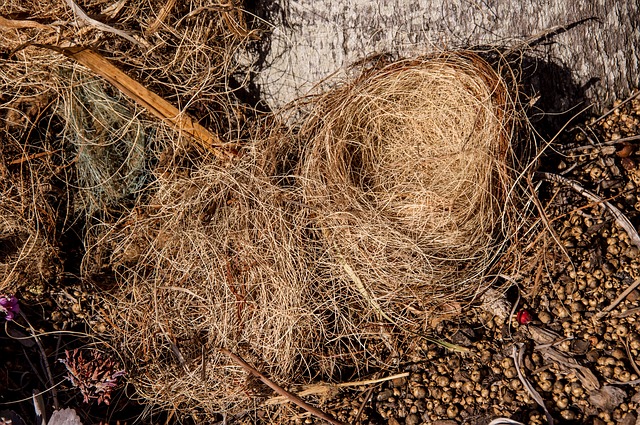
Fallen Nest ©Pixabay
*
*
“If the foundations be destroyed, what can the righteous do?” (Psalms 11:3 KJV)
Fallen Nest ©Pixabay
*
*

“As for these four children, God gave them knowledge and skill in all learning and wisdom: and Daniel had understanding in all visions and dreams.” (Daniel 1:17 KJV)
Four Children by wzbirdsjamj(JJSJ)
*
*
“Then a spirit passed before my face; the hair of my flesh stood up:” (Job 4:15 KJV)
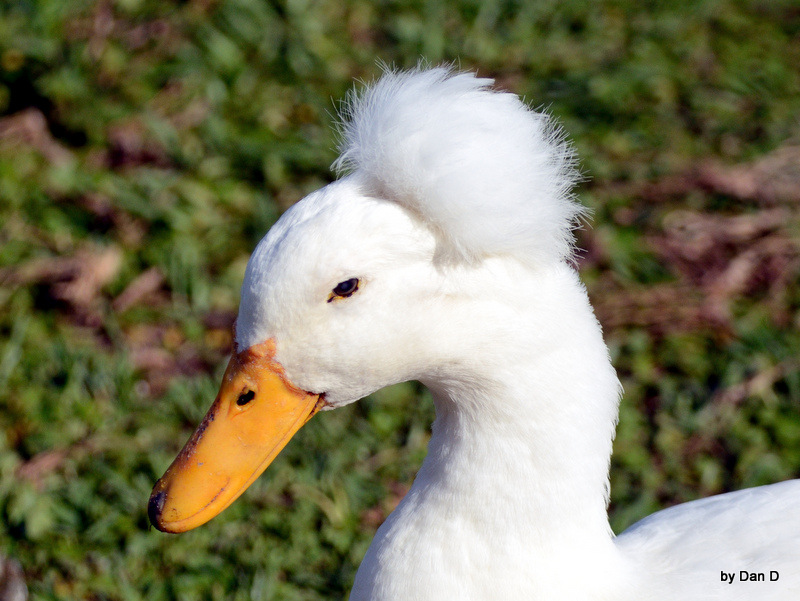
Aflac Duck Puffed Up – by Dan at Lake Morton
*
*
In this second article in this series, Avian Kinds on the Ark – What is a Kind?, I am introducing you to some of the studies by Dr. Jean Lightner. She and others are trying to figure out how many “kinds” of birds would have enter the ark. This study is worthwhile as a stand-alone research project — yet its importance is now accented by the “Ark Encounter”, a full-sized replica of the Noah’s Ark (produced and hosted by ANSWERS IN GENESIS ministry in Kentucky). The Ark Encounter team are trying to be as close to the Bible as possible in filling the ark with critters and especially avian kinds.
Since that article, I have found some more interesting data and quotes that I’d like to share. First, I made this quote in that article.
“In Birds of the Bible – Foundation #3 Updated, ” I made this remark “Noah did not have to round up the animals, they came to him. Because not every animal we see today came on board but the main kinds (for instance the “bird kinds” may have had a “warbler kind” but not have black and white warblers, yellow-rumped warblers, hooded warbler, etc.), which ever ones they were, there was plenty of room for them. I have an idea that because the LORD sent the animals, birds, and critters, that their DNAs [i.e., their specific genes — DNA-based genotypes) were of the highest quality. (That is my opinion)”
I want to expand on that this time. I have thinking about the birds that came to Noah. Did they come to Noah? — or did Noah have to go round them up? No, Noah did not have to go searching for the animals. After re-reading Genesis 7-9, it seems clear that they came to Noah. God sent them, by pairs of seven for each “kind” of birds. Dr. Lightner basically places the kinds equal with families in most cases.
Of every clean beast thou shalt take to thee by sevens, the male and his female: and of beasts that are not clean by two, the male and his female. Of fowls also of the air by sevens, the male and the female [notice! — of the bird kinds, the “sevens” exception was applied, regardless of whether the bird kinds were “clean” or “unclean”]; to keep seed alive upon the face of all the earth. (Genesis 7:2-3 KJV)

Great Frigatebird (Fregata minor) pair ©Flickr Len Blumin
And Noah went in, and his sons, and his wife, and his sons’ wives with him, into the Ark, because of the waters of the flood. Of clean beasts, and of beasts that are not clean, and of fowls, and of every thing that creepeth upon the earth, There went in two and two unto Noah into the ark, the male and the female, as God had commanded Noah. And it came to pass after seven days, that the waters of the flood were upon the earth. (Genesis 7:7-10 KJV)
In the selfsame day entered Noah, and Shem, and Ham, and Japheth, the sons of Noah, and Noah’s wife, and the three wives of his sons with them, into the ark; They, and every beast after his kind, and all the cattle after their kind, and every creeping thing that creepeth upon the earth after his kind, and every fowl after his kind, every bird of every sort. And they went in unto Noah into the ark, two and two of all flesh, wherein is the breath of life. (Genesis 7:13-15 KJV)
Bring forth with thee every living thing that is with thee, of all flesh, both of fowl, and of cattle, and of every creeping thing that creepeth upon the earth; that they may breed abundantly in the earth, and be fruitful, and multiply upon the earth. (Genesis 8:17 KJV)
Every beast, every creeping thing, and every fowl, and whatsoever creepeth upon the earth, after their kinds, went forth out of the ark. And Noah builded an altar unto the LORD; and took of every clean beast, and of every clean fowl, and offered burnt offerings on the altar. (Genesis 8:19-20 KJV)

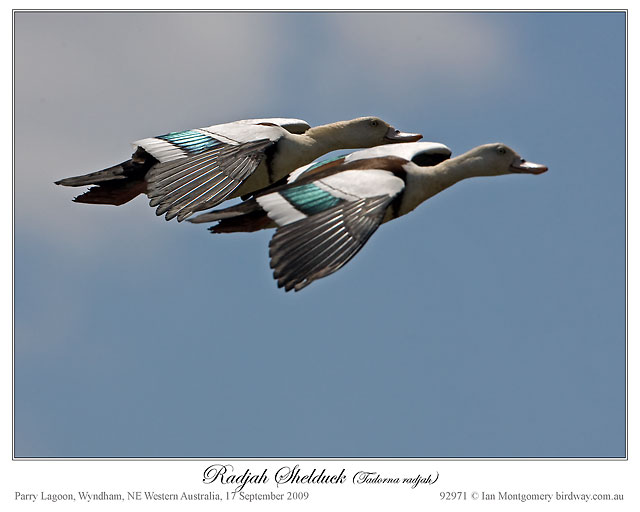
Green-winged Teal (Anas carolinensis) Pair ©WikiC
That is quite a bit of Scripture, and the bolding is to help with some points to I would like to make. First, notice that all the cattle or land animals are coming in pairs. The male and his female — that pair is deemed as “one” animal unit, because that is how God planned and made these animals in the first place. Critters that are not birds (i.e., land beasts like cattle, elephants, horses, etc.) are coming in by seven pairs if their kind is deemed “clean”, or by one pair if “unclean”. Yet the birds (fowls) are not coming in by clean or unclean. They are all coming in by seven pairs, according to their kind. [Notice how this shows a special favoritism that God has for birds! In a sense, therefore, it is a godly trait to regard birds as favorite animals! :) ]
Also notice that Noah and his family entered the Ark first, then the critters came in. “There went in two and two unto Noah into the ark” (7:9), and “in the selfsame day entered Noah” (7:13), then, “they went in unto Noah into the ark” (7:15). If I am reading the Word correctly, Noah was in the Ark when the land animals, birds and creeping things came in. Personally, I think that the Lord rounded up the critters that He wanted to be in the Ark to be preserved. If the Lord can make ravens to feed Elijah, ” I have commanded the ravens to feed thee there ” (1 Kings 17:4), can He not command the exact critters to come to Noah? Their DNA must have been the near perfect for their kinds, especially for conserving and transmitting the biodiversity that God Himself wanted to be provided to the post-Flood world. Just as all the diverse humans in the world (today) come from the eight humans on board the Ark, their DNA was and is diverse enough to produce all the different physical characteristics (skin colors, hair types, body sizes, etc.) that we see today. [In a sense, God preserved and transmitted all the molecular biology “hardware” and DNA/RNA “software” needed for all the phenotype “applications” we have today.]
Another point about the quoted verses. In Genesis 8 we see that it didn’t rain until seven days later. Could that be to give Noah and his family time to place all the animals in their stalls, pens, cages, or whatever containers were used for the long voyage ahead? What do you put “creeping things” in? :)
When they came off the Ark, after the Flood was over, not a single animal has perished because they came off in pairs,: one pair of unclean land animals (and “creeping things”), seven pairs of clean land animals, and seven pair of every “kind” of genetically defined bird category. Noah gives an offering to the Lord and uses one pair from the clean critters. Now we have six pairs of clean animals with which to breed abundantly in the earth, and be fruitful, and multiply upon the earth.

Northern Pintail (Anas acuta) pair by Ray
As was said before, the avian taxonomy of the birds (which is ultimately a mix of common sense, careful observations, plus some arbitrariness) is in flux. As Dr. Jean Lightner indicated there is much shuffling going on trying to figure out which bird belongs “where” [i.e., belongs to this group or that group, based ultimately on genetic compatibility — which is demonstrated by breedability). Here are a few quotes I thought interesting about this situation. Of course, these are from those who believe in evolution, but they are shaking their heads trying to figure which family and genus birds belong to.
Here is a quote from DNA Reveals New Bird Species by Current Results. “Examining the differences in the genetic bar code among birds leads scientists to suspect that 15 unidentified species of birds breed on the North American continent. At the same time, analysis of 643 bird species finds that 42 of these should actually be lumped as 17 species.” [Seems they keep narrowing down the species toward the kinds.] Here’s more interesting quotes from the same article.
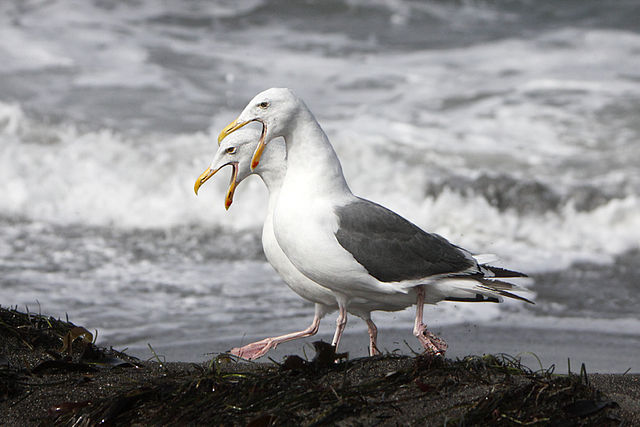
Western Gull (Larus occidentalis) Pair ©WikiC
“Can’t tell apart all those large, white-headed gulls lingering along the west coast seashore? Well apparently neither does the mitrochondiral DNA for eight species such as glaucous and herring gulls. Other birds that mitrochondrial DNA cannot distinguish are American from northwestern crows and red-naped from red-breasted sapsuckers. Most of these species with overlapping DNA are known to hybridize [i.e., they can successfully breed together].”
“Figuring out who is truly related to whom in modern bird families has been an ongoing problem, says Shannon Hackett. A biologist at the Field Museum in Chicago, she did not work on the new study. Part of the problem, she explains, is that at some point in the distant past, there was an explosion in the number of bird species. This rapid increase has made it difficult for scientists to decode the history of birds from fossils.” [Could that be when they were created?]
“In 2008, Hackett’s team studied 19 different segments of DNA from 169 bird species. Their tree of life suggested that falcons and hawks, and grebes and ducks, were only distantly related. Those surprises were confirmed by the new study.” [No surprise to Bible-believing creationists! Must be different kinds, maybe?]

African Hawk-Eagle (Aquila spilogaster) Pair ©WikiC
Answers In Genesis has many articles on this subject, but again, I want to share a few quotes. These are from Bird Speciation From the Flood to the Present by Dr. David W Boyd, Jr. In answer to how all those birds fit on the ark, he said, “Does that mean that Noah had two (or seven) of all 10,380 extant bird species (more if you count extinct species)? If a biblical kind and a species were equivalent, then yes. But they are not the same; many species are categorized under each biblical kind.”
“To help answer that question, we are aware that evolutionary scientists have recently compiled genetic and fossil evidence to suggest that flying birds originated from a group of dinosaurs in South America about 95 million years ago.6 Using their data, the scientists suggested that flying birds began radiating and diversifying over the world after a huge meteor struck near the Yucatan Peninsula 66 million years ago. The subsequent disaster of that meteor has been suggested as the main cause for the extinction of dinosaurs. Using this model, evolutionary scientists attempt to demonstrate that all birds in existence today descended from one common ancestor of the dinosaur lineage.”
“Scientists who accept the biblical account of creation and the worldwide Flood compile evidence from Scripture, genetics, the fossil record, hybridization data, and morphological characteristics to suggest that God created many kinds of birds that began radiating and diversifying over the world after the worldwide Flood destroyed the earth about 4,500 years ago. These birds included both flying and non-flying birds. The two answers given by evolutionary scientists and creation scientists are so far apart from one another that it seems almost impossible to think that they are looking at the same data.”
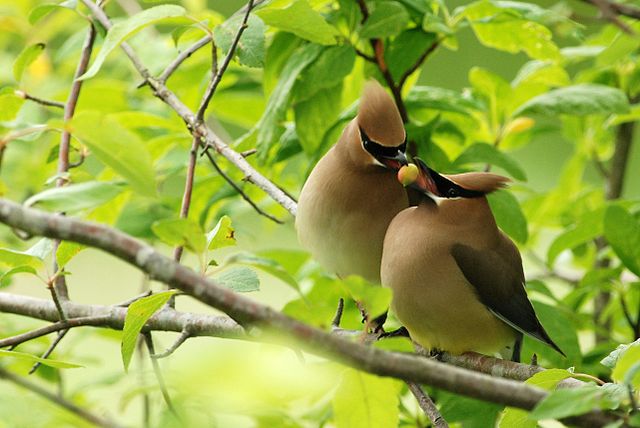
Cedar Waxwing (Bombycilla cedrorum) Passing Berries ©WikiC
“A scientist with a biblical worldview has to account for the different species of birds found today in each created bird kind from the Flood to the present. Models of speciation and radiation for those events would only need thousands of years.”
Here is my most favorite quote from his article: “Dr. Jean Lightner has conservatively estimated that birds are comprised of about 196 created kinds.7 If we round that up to 200 bird kinds, we could account for all 10,380 extant species by each species diverging into two species just once every 750 years—just six times (200 to 400 to 800 to 1,600 to 3,200 to 6,400 to 12,800). That would even give us 2,420 more bird species to account for some extinction events. That is a very simplistic view and does not account for many variables, but it does provide us with a quick way to estimate if simple speciation (doubling) could account for all the birds we have today.”
Here is a link to a very interesting chart I found on Pantasthumb. It shows the different birds grouped, by genera, within each family, in a tree format. Very interesting to look at. It might help make some of this article make a little more sense. Of course this is from an evolutionary perspective, but the evidence is shares by both sides. TO SEE CHART The article this chart came from is “Update on the Tree of Birds“.
That is enough to think about for now. More later in another Avian Kinds on the Ark. Actually, this series is a sub-series for Birds of the Bible.
*
Avian Kinds on the Ark – Introduction
Avian Kinds on the Ark – What is a Kind?
DNA Reveals New Bird Species by Current Results.
Bird Speciation From the Flood to the Present by Dr. David W Boyd, Jr
Birds of the Bible – Foundation – The Ark
Birds of the Bible – Foundation #3 Updated
An Initial Estimate of Avian Ark Kinds,
*

“Then the king, when he heard these words, was sore displeased with himself, and set his heart on Daniel to deliver him: and he laboured till the going down of the sun to deliver him. (Daniel 6:14 KJV)
“
Birds flying to their home during the sunset – Chitwan National Park ©WikiC
*
*
Continuing through the Tanagers of the Thraupidae, we have some more beautiful birds to let you enjoy. Our Lord must have loved creating this kind of bird. He sure created enough of them through their interbreeding. We are about half way through the Traupidae family. This is the fifth installment. Not sure how many more it will take to finish up this family. Trust you are enjoying them.
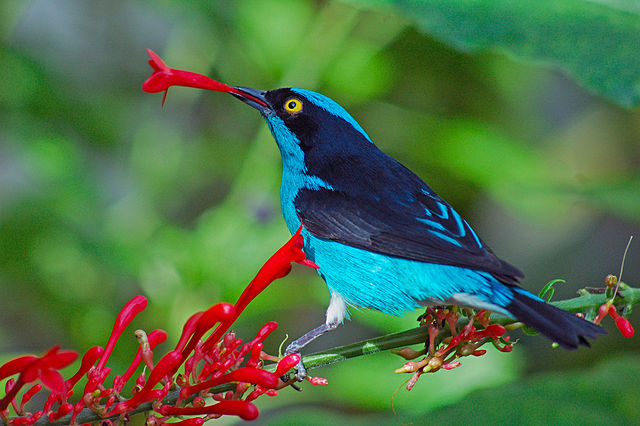
Black-faced Dacnis (Dacnis lineata) ©WikiC
The Dacnis genus are from the Columbia and other nearby countries in South America. Some I could not find photos of that gave permission to use, so enjoy the ones that could be shown. The most common Dacnis seems to be the Blue Dacnis. Typical of this genus, they “occur in forests and other woodlands, including gardens and parks. The bulky cup nest is built in a tree and the normal clutch is of two to three grey-blotched whitish eggs. The female incubates the eggs, but is fed by the male. These are social birds which eat mainly insects gleaned from foliage, flowers or bromeliads. Fruit is often taken and usually swallowed whole, but nectar is rarely consumed.” (Wikipedia) There is one more Dacnis that is in the Xenodacnis genus.
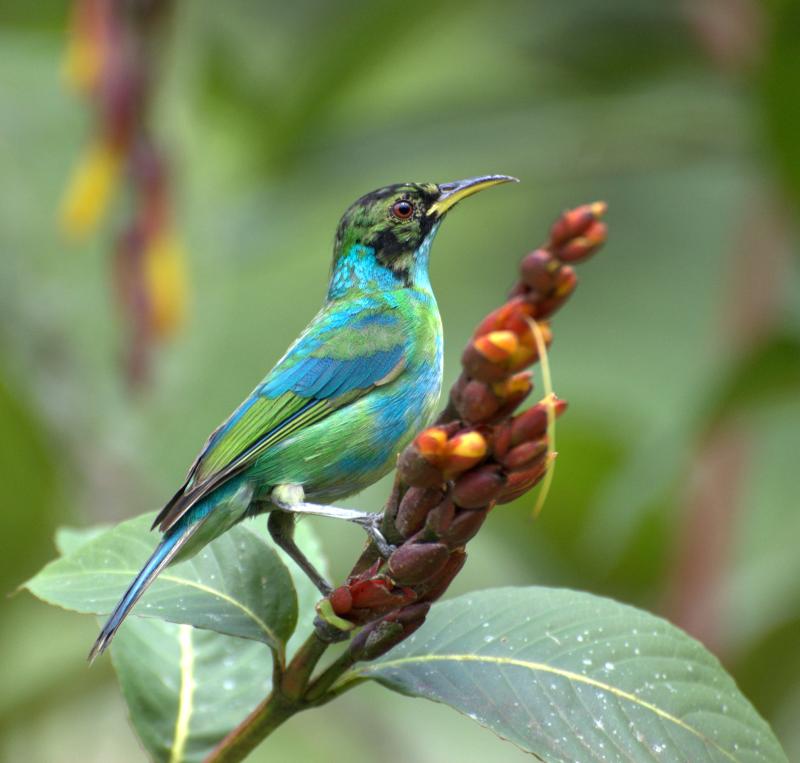
Green Honeycreeper (Chlorophanes spiza) Male Immature ©BirdPhotos.com
The next three genera, Cyanerpes, Chlorophanes, and Iridophanes are Honeycreepers. They have longer tails than the Dacnis and you will notice a little more down curve on their bills. The four Cyanerpes species have colourful legs, long wings and a short tail. The males are typically glossy purple-blue and the females greenish.
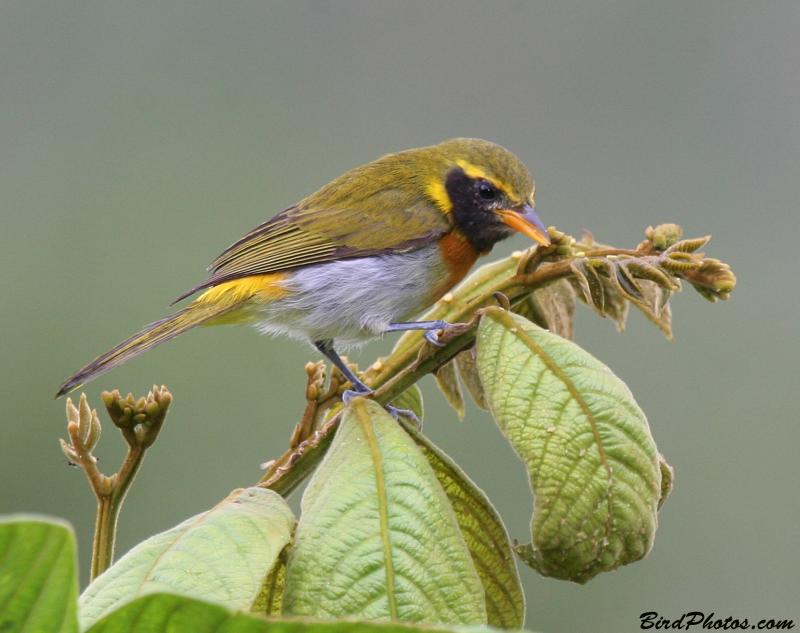
Guira Tanager (Hemithraupis guira) Male ©BirdPhotos.com
“Yellow-rumped” clade of Tanagers include the Heerospingus, Chrysothlpis, and Hemithraupis genera. These small to medium tanagers are found in the moist forests of Central and South America. The females are duller than the males.

White-browed Conebill (Conirostrum ferrugineiventre) ©WikiC
The Conebills from the Conirostrum genus, finish our group of beautiful birds from the Tanager Family for this week. “They are small tanagers (9–14 cm) found in the forests of South America. They feed in pairs or small flocks by gleaning insects from foliage.” Following these here is a Giant Conebill (Oreomanes fraseri) in its own genus.
“The genus consists of two rather distinct subgenera: The first, Ateleodacnis, possibly deserving full generic status, is confined to lowland areas. They are mostly grey in colour and inhabit deciduous woodlands, mangroves or riverbank habitats. The second group, the nominate Conirostrum subgenus, inhabits the forests of the Andes. They are somewhat more colourful combining grey or blue backs with rufous underparts. Their thin bills led to them being formerly classified as wood-warblers or honeycreepers but genetic data places them firmly in the tanager family and they are now generally considered to belong in the Thraupidae.” (Wikipedia)
Enjoy the Slideshow and the music below.
That in the ages to come he might shew the exceeding riches of his grace in his kindness toward us through Christ Jesus. For by grace are ye saved through faith; and that not of yourselves: it is the gift of God: Not of works, lest any man should boast. For we are his workmanship, created in Christ Jesus unto good works, which God hath before ordained that we should walk in them. (Ephesians 2:7-10 KJV)
“Amazing Grace & I Love You Written In Red” – Choir and Orchestra at Faith Baptist
*
Sunday Inspiration – Thraupidae – Tanagers and Allies I
Sunday Inspiration – Thraupidae – Tanagers and Allies II
Sunday Inspiration – Thraupidae – Tanagers and Allies III
Sunday Inspiration – Thraupidae – Tanagers and Allies IV
Traupidae Family – Tanagers and Allies
*
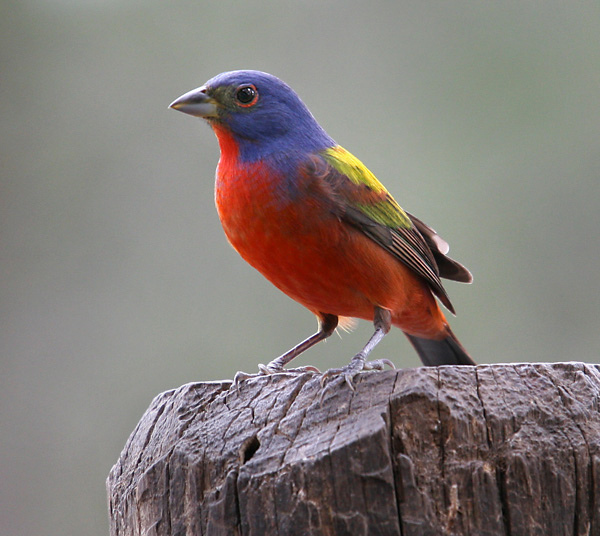
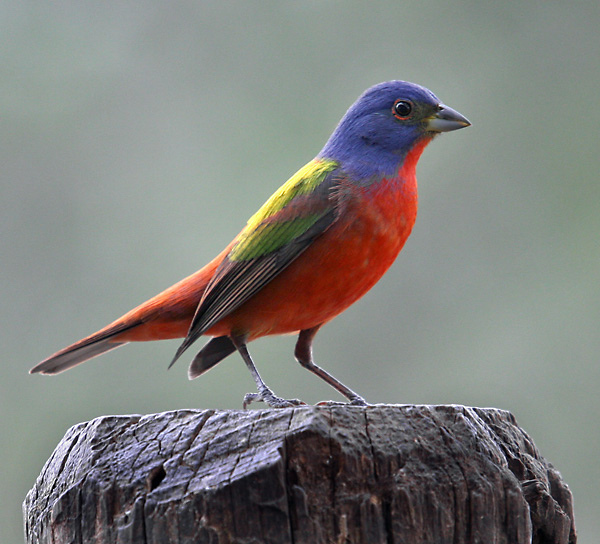
“Turn not to the right hand nor to the left: remove thy foot from evil.” (Proverbs 4:27 KJV)
Painted Bunting (Passerina ciris) Both Photos ©Flickr Ralph Arvesen
*
*

“And he that sat was to look upon like a jasper and a sardine stone: and there was a rainbow round about the throne, in sight like unto an emerald.” (Revelation 4:3 KJV)
Painted Bunting (Passerina ciris) ©©Flickr
*
*

“The light of the body is the eye: if therefore thine eye be single, thy whole body shall be full of light.” (Matthew 6:22 KJV)
Blue-necked Tanager (Tangara cyanicollis) ©Flickr Andres Cuervo
*
*

“And it came to pass in the six hundredth and first year, in the first month, the first day of the month, the waters were dried up from off the earth: and Noah removed the covering of the ark, and looked, and, behold, the face of the ground was dry.” (Genesis 8:13 KJV)
Philippine Hawk-Eagle (Nisaetus philippensis) ©Flickr Billy Lopue
*
*
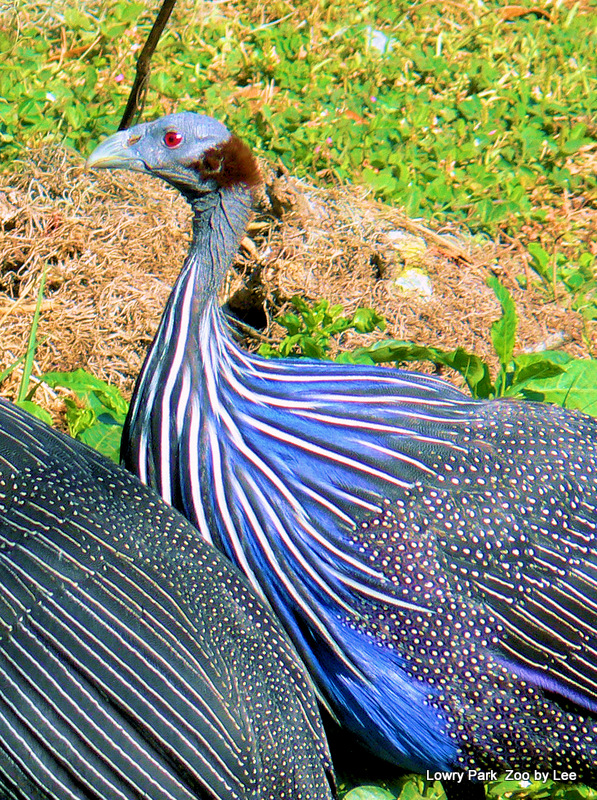
“And Cornelius said, Four days ago I was fasting until this hour; and at the ninth hour I prayed in my house, and, behold, a man stood before me in bright clothing,” (Acts 10:30 KJV)
Vulturine Guineafowl (Acryllium vulturinum) by Lee
*
*
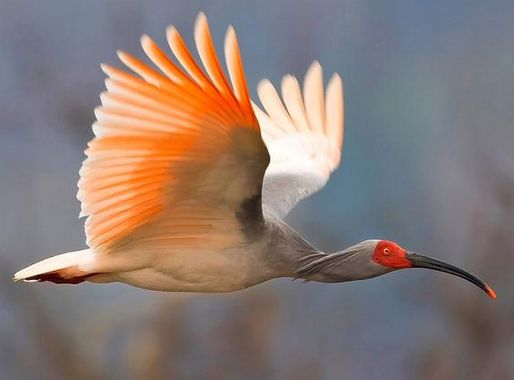
“And it is a rare thing that the king requireth, and there is none other that can shew it before the king, except the gods, whose dwelling is not with flesh.” (Daniel 2:11 KJV)
Crested Ibis (Asian) (Nipponia nippon) One of Rarest Birds ©©Pinterest
*
*
 Lee's Birdwatching Adventures Plus