
Ian’s Bird of the Week – Barn Swallow ~ by Ian Montgomery
Newsletter – 3/1/16
I’ve just been making galleries of the Australasian Swallow family ‘mobile-friendly’ and noticed that the Barn Swallow has never been Bird of the Week. Although not well known in Australia or New Zealand – where it is replaced by the closely related Welcome Swallow – it is an iconic migrant species in the Northern Hemisphere. It is a welcome harbinger of Spring and recognised not just by birders but by anyone with an interest in the weather. It has an almost global range south of the Arctic Circle breeding right across Eurasia and North America and spending the northern winter in almost all of Sub-Saharan Africa, South and Southeast Asia and most of Central and South America except southern Chile and Argentina.
Relatively small numbers reach northern Australia each year so sharp-eyed birders look out for it northern Western Australia, the Top End of the Northern Territory and Northern Queensland during the Southern Summer. Eight or more races are recognised and these vary in the length of the tail streamers, the width of the diagnostic dark blue breast band and the colour of the underparts, varying from white to rufous buff. Interestingly, in Eurasia the length of the tail streamers and the width of the breast band get shorter and narrower respectively as you travel from north-west to south-east – in other words the closer you get to Australia the more like the Welcome Swallow the races become.
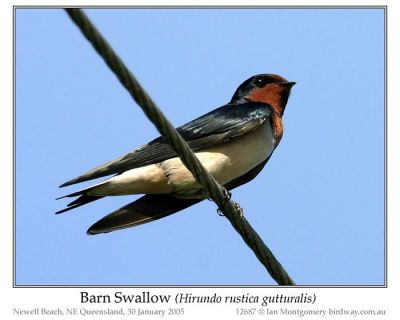
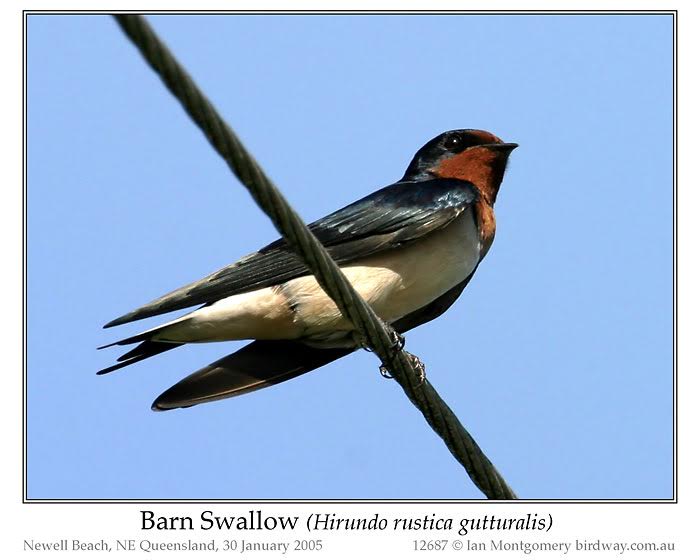
The Malaysian bird in the first photo is of the Asian race gutturalis – thought to be the one that turns up in Australia – while the one in the second photo was taken at Newell Beach near Mossman north of Cairns. After migrating in the northern Autumn, the birds moult and adults lose their long tail streamers, so this is why both these birds have short tails. Gutturalis, like ‘guttural’ refers to the throat i.e. ‘-throated’ without specifying what is distinctive about the throat. Maybe it refers to the dark spot in the centre of the breast band. Newell Beach is known as a bit of a Swallow hot-spot and on this occasion, the Barn Swallow was in the company of Welcome Swallows, Fairy and Tree Martins and Red-rumped Swallows (uncommon in Australia) all near the entrance to the golf course.

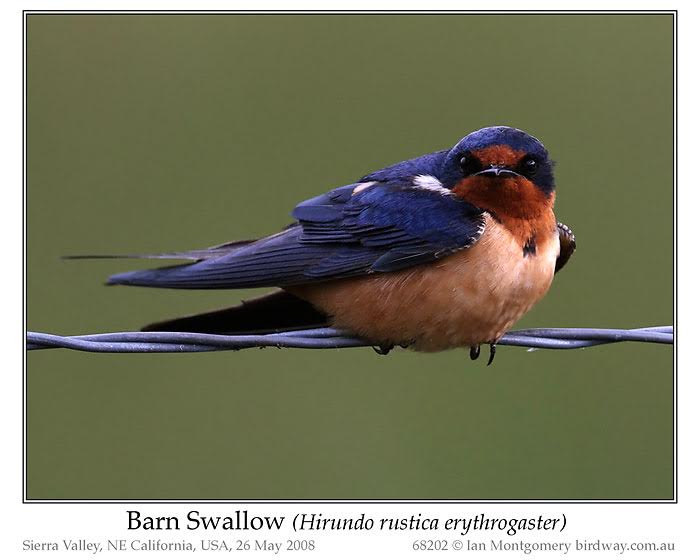
The North American race of the Barn Swallow is called erythrogaster, meaning red-bellied as in the fine specimen in the third photo. This has the dark spot in the middle of the throat too and an incomplete breast band, largely hidden in the third photo but more obvious in the two birds in the fourth photo taken about half an hour earlier in the same location. Females Barn Swallows are generally paler than males so I suppose the one on the left is a female though only one of several North American field guides that I consulted was prepared to commit itself on this gender-based distinction.

The one in the fifth photo of the nominate race rustica in Ireland in Spring shows the very white underparts and very long tail streamers of breeding adults. Because the adults moult in Autumn after migrating south, short adult tail streamers are not usually seen in the Northern Hemisphere and it is safe to assume there that birds with short streamers are juveniles.

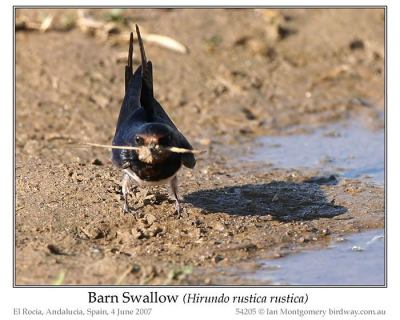
Swallows usually feed on the wing and perch above the ground. In adverse weather, they do sometimes feed on the ground and in the breeding season they land to collect mud and fibres such as grasses or horse hair to build their cup-shaped nests, sixth photo. This Spanish bird is also of the nominate race and you can see the broad breast band with no central spot. I keep mentioning this spot as, although all the field guides tell us that Welcome Swallows lack a breast band, all the birds I have photographed whether adults or juveniles have at least traces of this black spot, suggesting a close affinity with Asian Barn Swallows.
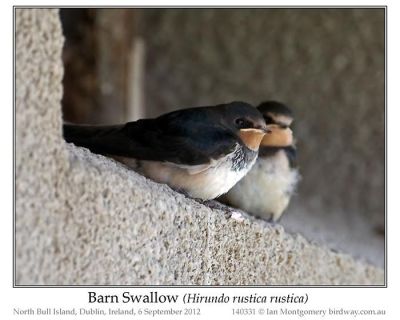
Barn Swallows are prolific breeders and will nest up to three times in a season. Studies have shown that breeding success averages 4-7 fledglings per pair. Adult survival on migration appears to be high – up to 65% return to the same breeding site – so juvenile mortality is presumably severe. The seventh photo shows two fledglings in a concrete shelter in a bird sanctuary in Dublin waiting for the parents to return with food.
The eight photo was taken 27 seconds later than the seventh and shows that one of the juveniles has flown out to meet an adult returning with food. Presumably such mid-air transfers help the fledglings develop their flying skills for the time when the parents abandon them to start a new brood and they have to fend for themselves.

We now take for granted the amazing migration of small birds but for a long time the complete disappearance of Swallows was assumed to be because they hibernated in winter. The ancient Greeks including Aristotle thought that they hibernated in the mud at the bottom of ponds. We now think that that’s a bit silly as they wouldn’t be able to breathe but the sensible rationale was presumably that the bottom of deep ponds do not freeze in winter. It wasn’t until the nineteenth century that the hibernation theory was disproved. The alternative theory of being able to fly many thousands of miles, cross deserts like the Sahara and navigate at night with extraordinary precision is equally preposterous.
Welcome Swallows don’t really migrate even though they move around after breeding (‘partial migrant’) and some at least remain in the colder regions such as Tasmania and the South Island of New Zealand. So I wonder why they’re ‘Welcome’?
Meanwhile back at the website, I finally updated all the Australasian galleries. That’s 800 down and about 700 to go, so there’s light at the end of the tunnel!
Greetings,
Ian
**************************************************
Ian Montgomery, Birdway Pty Ltd,
454 Forestry Road, Bluewater, Qld 4818
Tel 0411 602 737 ian@birdway.com.au
Bird Photos http://www.birdway.com.au/
Recorder Society http://www.nqrs.org.au
Lee’s Addition:
“Even the sparrow has found a home, And the swallow a nest for herself, Where she may lay her young— Even Your altars, O LORD of hosts, My King and my God.” (Psalms 84:3 NKJV)
“Even the stork in the heavens Knows her appointed times; And the turtledove, the swift, and the swallow Observe the time of their coming. But My people do not know the judgment of the LORD.” (Jeremiah 8:7 NKJV)
Thanks, Ian, for sharing these different subspecies of the Barn Swallows. That third one looks like he has his eye Ian. Probably wondering what that big long lens is pointing at him.
Always enjoy seeing Swallows, especially the Barn Swallows.
*
Ian’s Bird of the Week
Australasian Swallow family
Birds of the Bible – Swallow
*







 Lee's Birdwatching Adventures Plus