Lee’s Six Word Saturday – 3/5/16

***

Common Potoo (Nyctibius griseus) ©Jullan Iondono

BEHOLD I SHEW YOU A MYSTERY

***


Behold, I shew you a mystery; We shall not all sleep, but we shall all be changed, In a moment, in the twinkling of an eye, at the last trump: for the trumpet shall sound, and the dead shall be raised incorruptible, and we shall be changed. (1 Corinthians 15:51-52 KJV)

Common Potoo (Nyctibius griseus) ©Jullan Iondono

*

More Daily Devotionals

*

Birds of the Bible – Parable of the Nest

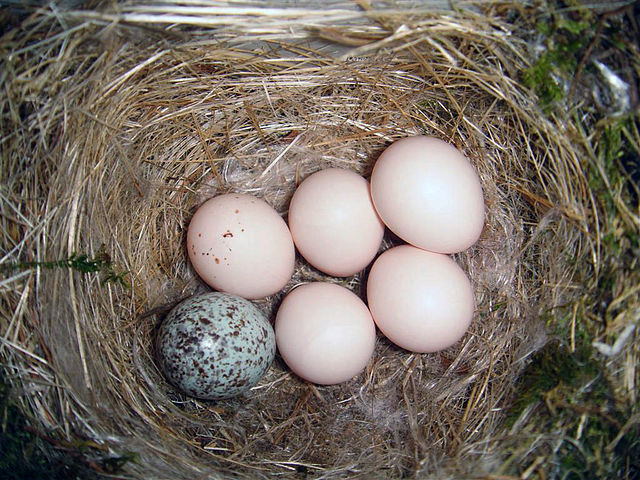
Brown-headed Cowbird (Molothrus ater) Egg in Eastern Phoebe Nest ©WikiC

Brown-headed Cowbird (Molothrus ater) Egg in Eastern Phoebe Nest ©WikiC

Recently, I have been taking some on-line courses through the School of Biblical Apologetics with the Institute for Creation Research. Some of the lessons have been about how the Lord used parables to teach many lessons. Jesses seemed to use some of them like object lessons, where you use something currently in sight. So, here is my attempt to use a parable with birds as the object.

When you observe a bird’s nest with eggs in it and they all look alike, do you assume they are all from the same bird parents? In the picture above, it is obvious that there is a “false member of the family” in the nests.

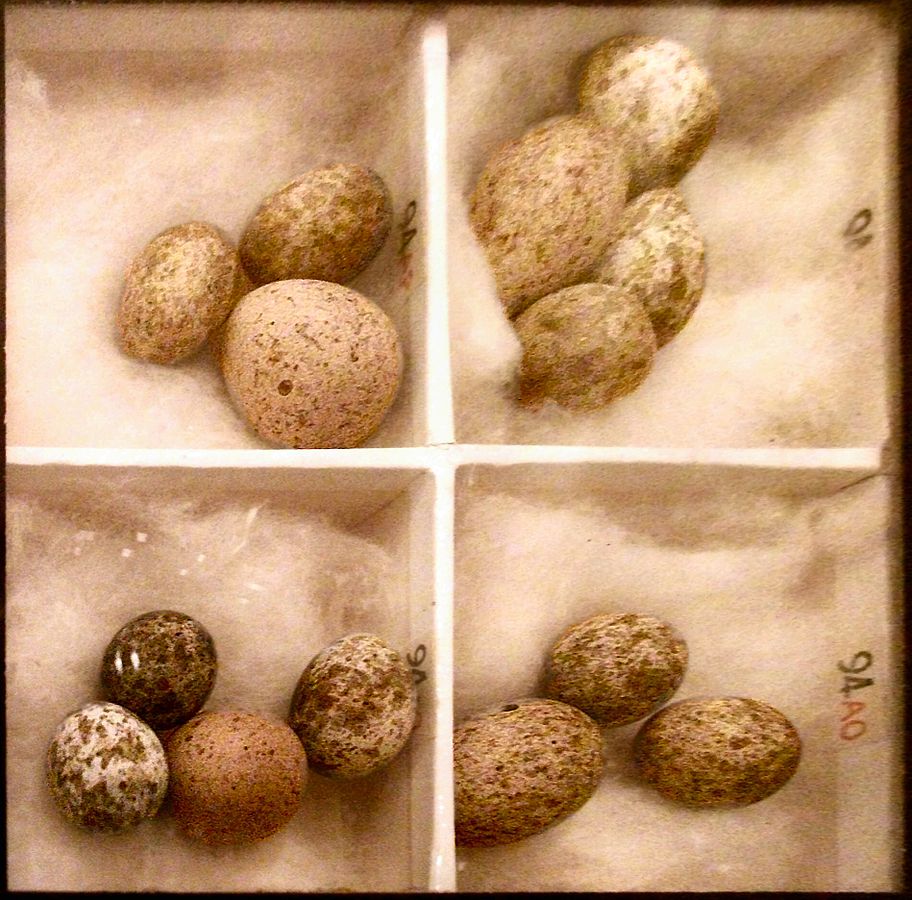
Sometimes, they really do look the same, but there is a “Brood parasite” in among them. They look so similar that you hardly notice them. Therefore the parents accept them, sit on them, and all is well for a while.

Reed Warbler eggs with Cuckoo Egg in them ©WikiC

Reed Warbler eggs with Cuckoo Egg in them ©WikiC

But, when the eggs begin to hatch, several things can happen:

Sometimes, while the chick is in the egg, it hears its adopted parents and will actually make sounds like these parents. Therefore the parents feed them, just like its own.

Sometimes, they are so determined, that they actually shove the hosts eggs or the nestlings out of the nest.

Click to see photo of chick pushing egg out of nest.

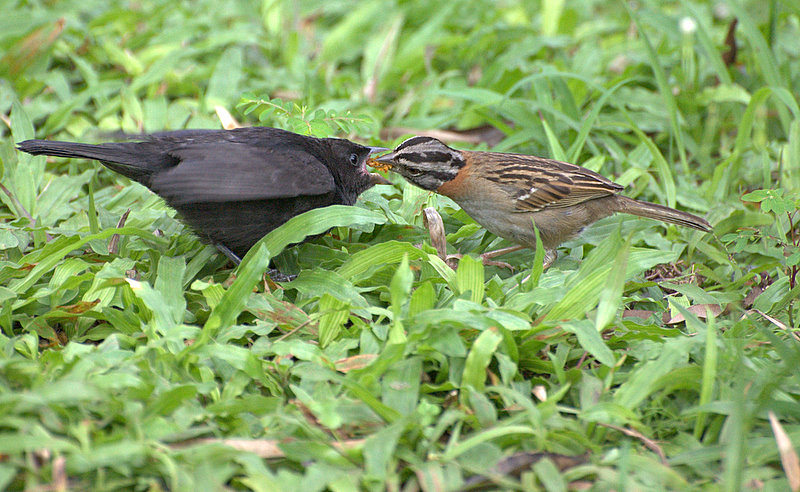
When they do begin to grow, they become much larger than the adopted parents.

A Shiny Cowbird (Molothrus bonariensis) chick being fed by a Rufous-collared Sparrow (Zonotrichia Capensis)

A Shiny Cowbird (Molothrus bonariensis) chick being fed by a Rufous-collared Sparrow (Zonotrichia Capensis)

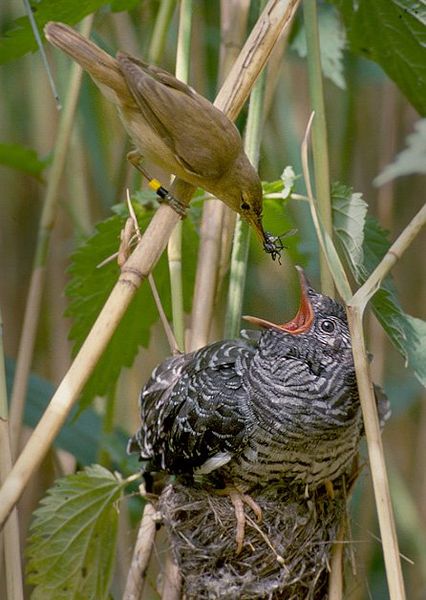
Sometimes they really grow.

Common Cuckoo (Cuculus canorus) being raised by a Reed Warbler©WikiC

Common Cuckoo (Cuculus canorus) being raised by a Reed Warbler©WikiC

Now for an application:

“But there were also false prophets among the people, even as there will be false teachers among you, who will secretly bring in destructive heresies, even denying the Lord who bought them, and bring on themselves swift destruction. And many will follow their destructive ways, because of whom the way of truth will be blasphemed.” (2 Peter 2:1-2 NKJV) (emphasis mine)

Some deny the Creation and the Creator of Genesis. Yet, they “accept” the other parts of the Bible. Many other truths of God’s Word are also changed or watered-down to fit the needs of the false teachers.

Those of us who are Christians, should be on our guard for false believers, who may learn to “talk the talk” and may “sound like us,” but they are actually bending or perverting the truth.

“These were more fair-minded than those in Thessalonica, in that they received the word with all readiness, and searched the Scriptures daily to find out whether these things were so. ” (Acts 17:11 NKJV)

“These six things the LORD hates, Yes, seven are an abomination to Him: A proud look, A lying tongue, Hands that shed innocent blood, A heart that devises wicked plans, Feet that are swift in running to evil, A false witness who speaks lies, And one who sows discord among brethren.…” (Proverbs 6:16-19 NKJV)

“Because narrow is the gate and difficult is the way which leads to life, and there are few who find it. “Beware of false prophets, who come to you in sheep’s clothing, but inwardly they are ravenous wolves.” (Matthew 7:14-15 NKJV)

“For false christs and false prophets will rise and show signs and wonders to deceive, if possible, even the elect.” (Mark 13:22 NKJV)

Let God’s Word speak for itself. The answers are in the Word of God, if one just searches for these truths.

“The fear of the LORD is the beginning of knowledge, But fools despise wisdom and instruction.” (Proverbs 1:7 NKJV)

“Cease listening to instruction, my son, And you will stray from the words of knowledge.” (Proverbs 19:27 NKJV)

(Bolding for emphasis on verses is mine)

*

Birds of the Bible

Brood Parasite – Wikipedia

Is There a God?

*

Lee’s Five Word Friday – 3/4/16

***

Secretarybird (Sagittarius serpentarius) with open beak ©WikiC

KEEP YOUR TONGUE FROM EVIL

***


Keep your tongue from evil, And your lips from speaking deceit. (Psalms 34:13 NKJV)

Secretarybird (Sagittarius serpentarius) with open beak©WikiC

*

More Daily Devotionals

*

Lee’s Four Word Thursday – 3/3/16

***

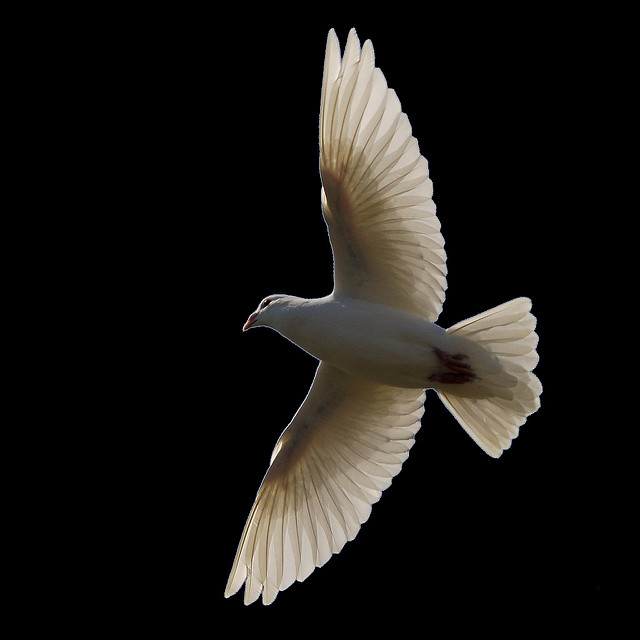
Dove Flying ©Flickr Ian Burt

I WILL COME AGAIN

***


And if I go and prepare a place for you, I will come again, and receive you unto myself; that where I am, there ye may be also. (John 14:3 KJV)

Dove Flying ©Flickr Ian Burt

*

More Daily Devotionals

*

Lee’s Three Word Wednesday – 3/2/16

***

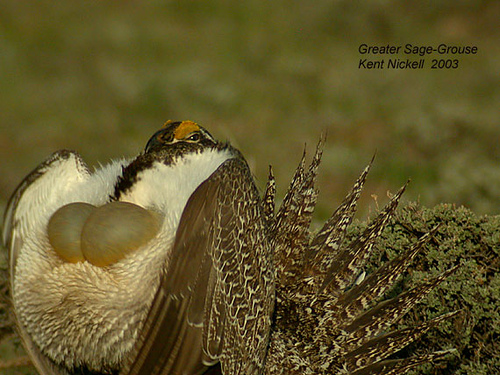
Sage Grouse (Centrocercus urophasianus) by Kent Nickel

PRIDE OF LIFE

***


For all that is in the world, the lust of the flesh, and the lust of the eyes, and the pride of life, is not of the Father, but is of the world. (1 John 2:16 KJV)

Sage Grouse (Centrocercus urophasianus) by Kent Nickel

*

More Daily Devotionals

*

Ian’s Bird of the Week – Barn Swallow


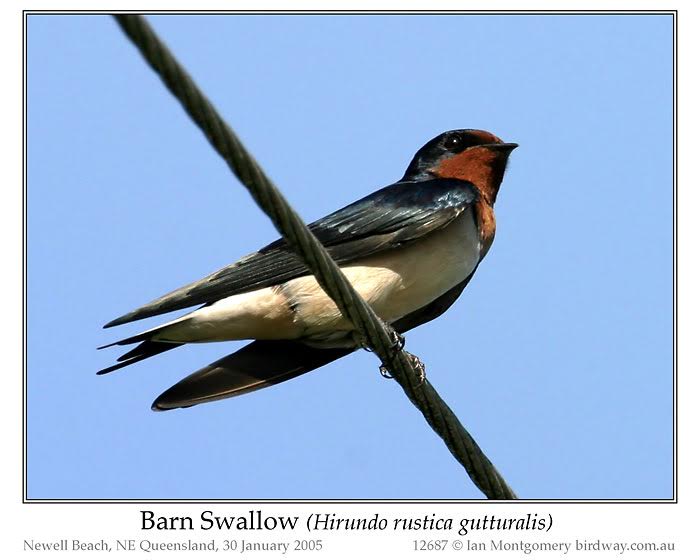
Barn Swallow (Hirundo rustica gutturalis) by Ian

Ian’s Bird of the Week – Barn Swallow ~ by Ian Montgomery

Newsletter – 3/1/16

I’ve just been making galleries of the Australasian Swallow family ‘mobile-friendly’ and noticed that the Barn Swallow has never been Bird of the Week. Although not well known in Australia or New Zealand – where it is replaced by the closely related Welcome Swallow – it is an iconic migrant species in the Northern Hemisphere. It is a welcome harbinger of Spring and recognised not just by birders but by anyone with an interest in the weather. It has an almost global range south of the Arctic Circle breeding right across Eurasia and North America and spending the northern winter in almost all of Sub-Saharan Africa, South and Southeast Asia and most of Central and South America except southern Chile and Argentina.

Relatively small numbers reach northern Australia each year so sharp-eyed birders look out for it northern Western Australia, the Top End of the Northern Territory and Northern Queensland during the Southern Summer. Eight or more races are recognised and these vary in the length of the tail streamers, the width of the diagnostic dark blue breast band and the colour of the underparts, varying from white to rufous buff. Interestingly, in Eurasia the length of the tail streamers and the width of the breast band get shorter and narrower respectively as you travel from north-west to south-east – in other words the closer you get to Australia the more like the Welcome Swallow the races become.
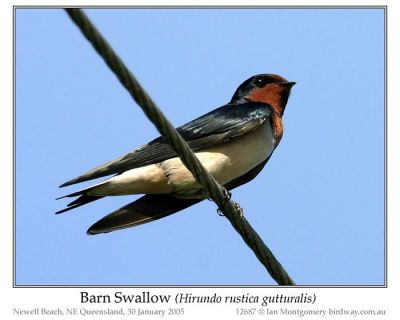
Barn Swallow (Hirundo rustica gutturalis) by Ian

The Malaysian bird in the first photo is of the Asian race gutturalis – thought to be the one that turns up in Australia – while the one in the second photo was taken at Newell Beach near Mossman north of Cairns. After migrating in the northern Autumn, the birds moult and adults lose their long tail streamers, so this is why both these birds have short tails. Gutturalis, like ‘guttural’ refers to the throat i.e. ‘-throated’ without specifying what is distinctive about the throat. Maybe it refers to the dark spot in the centre of the breast band. Newell Beach is known as a bit of a Swallow hot-spot and on this occasion, the Barn Swallow was in the company of Welcome SwallowsFairy and Tree Martins and Red-rumped Swallows (uncommon in Australia) all near the entrance to the golf course.

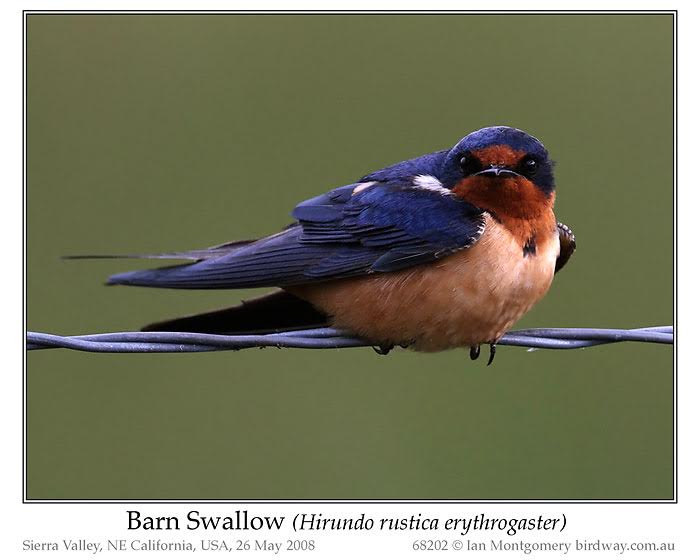
Barn Swallow (Hirundo rustica erythrogaster) by Ian

The North American race of the Barn Swallow is called erythrogaster, meaning red-bellied as in the fine specimen in the third photo. This has the dark spot in the middle of the throat too and an incomplete breast band, largely hidden in the third photo but more obvious in the two birds in the fourth photo taken about half an hour earlier in the same location. Females Barn Swallows are generally paler than males so I suppose the one on the left is a female though only one of several North American field guides that I consulted was prepared to commit itself on this gender-based distinction.

Barn Swallow (Hirundo rustica erythrogaster) by Ian

The one in the fifth photo of the nominate race rustica in Ireland in Spring shows the very white underparts and very long tail streamers of breeding adults. Because the adults moult in Autumn after migrating south, short adult tail streamers are not usually seen in the Northern Hemisphere and it is safe to assume there that birds with short streamers are juveniles.

Barn Swallow (Hirundo rustica gutturalis) by Ian

Swallows usually feed on the wing and perch above the ground. In adverse weather, they do sometimes feed on the ground and in the breeding season they land to collect mud and fibres such as grasses or horse hair to build their cup-shaped nests, sixth photo. This Spanish bird is also of the nominate race and you can see the broad breast band with no central spot. I keep mentioning this spot as, although all the field guides tell us that Welcome Swallows lack a breast band, all the birds I have photographed whether adults or juveniles have at least traces of this black spot, suggesting a close affinity with Asian Barn Swallows.
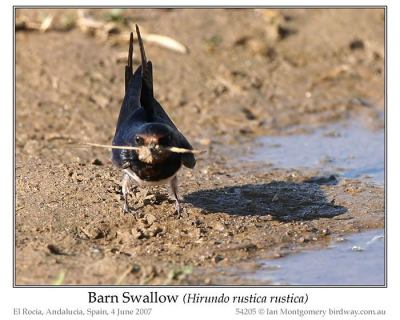
Barn Swallow (Hirundo rustica rustica) by Ian

Barn Swallows are prolific breeders and will nest up to three times in a season. Studies have shown that breeding success averages 4-7 fledglings per pair. Adult survival on migration appears to be high – up to 65% return to the same breeding site – so juvenile mortality is presumably severe. The seventh photo shows two fledglings in a concrete shelter in a bird sanctuary in Dublin waiting for the parents to return with food.
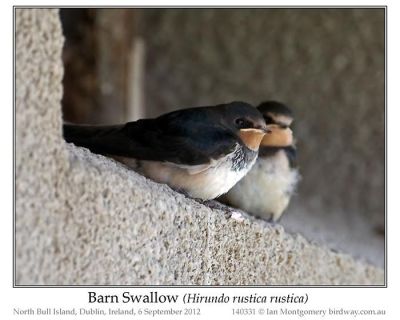
Barn Swallow (Hirundo rustica rustica) by Ian

The eight photo was taken 27 seconds later than the seventh and shows that one of the juveniles has flown out to meet an adult returning with food. Presumably such mid-air transfers help the fledglings develop their flying skills for the time when the parents abandon them to start a new brood and they have to fend for themselves.

Barn Swallow (Hirundo rustica rustica) by Ian

We now take for granted the amazing migration of small birds but for a long time the complete disappearance of Swallows was assumed to be because they hibernated in winter. The ancient Greeks including Aristotle thought that they hibernated in the mud at the bottom of ponds. We now think that that’s a bit silly as they wouldn’t be able to breathe but the sensible rationale was presumably that the bottom of deep ponds do not freeze in winter. It wasn’t until the nineteenth century that the hibernation theory was disproved. The alternative theory of being able to fly many thousands of miles, cross deserts like the Sahara and navigate at night with extraordinary precision is equally preposterous.

Welcome Swallows don’t really migrate even though they move around after breeding (‘partial migrant’) and some at least remain in the colder regions such as Tasmania and the South Island of New Zealand. So I wonder why they’re ‘Welcome’?

Meanwhile back at the website, I finally updated all the Australasian galleries. That’s 800 down and about 700 to go, so there’s light at the end of the tunnel!
Greetings,
Ian

**************************************************
Ian Montgomery, Birdway Pty Ltd,
454 Forestry Road, Bluewater, Qld 4818
Tel 0411 602 737 ian@birdway.com.au
Bird Photos http://www.birdway.com.au/
Recorder Society http://www.nqrs.org.au


Lee’s Addition:

“Even the sparrow has found a home, And the swallow a nest for herself, Where she may lay her young— Even Your altars, O LORD of hosts, My King and my God.” (Psalms 84:3 NKJV)

“Even the stork in the heavens Knows her appointed times; And the turtledove, the swift, and the swallow Observe the time of their coming. But My people do not know the judgment of the LORD.” (Jeremiah 8:7 NKJV)

Thanks, Ian, for sharing these different subspecies of the Barn Swallows. That third one looks like he has his eye Ian. Probably wondering what that big long lens is pointing at him.

Always enjoy seeing Swallows, especially the Barn Swallows.

*

Ian’s Bird of the Week

Australasian Swallow family

Birds of the Bible – Swallow

*

Lee’s Two Word Tuesday – 3/1/16

***

Rosy-faced Lovebird (Agapornis roseicollis ) A feral Rosy-faced Lovebird eating seeds in Chicago ©WikiC

GREEN HERB

***


Also, to every beast of the earth, to every bird of the air, and to everything that creeps on the earth, in which there is life, I have given every green herb for food”; and it was so. (Genesis 1:30 NKJV)

Rosy-faced Lovebird (Agapornis roseicollis ) A feral Rosy-faced Lovebird eating seeds in Chicago ©WikiC

*

More Daily Devotionals

*

Lee’s One Word Monday – 2/29/16

***

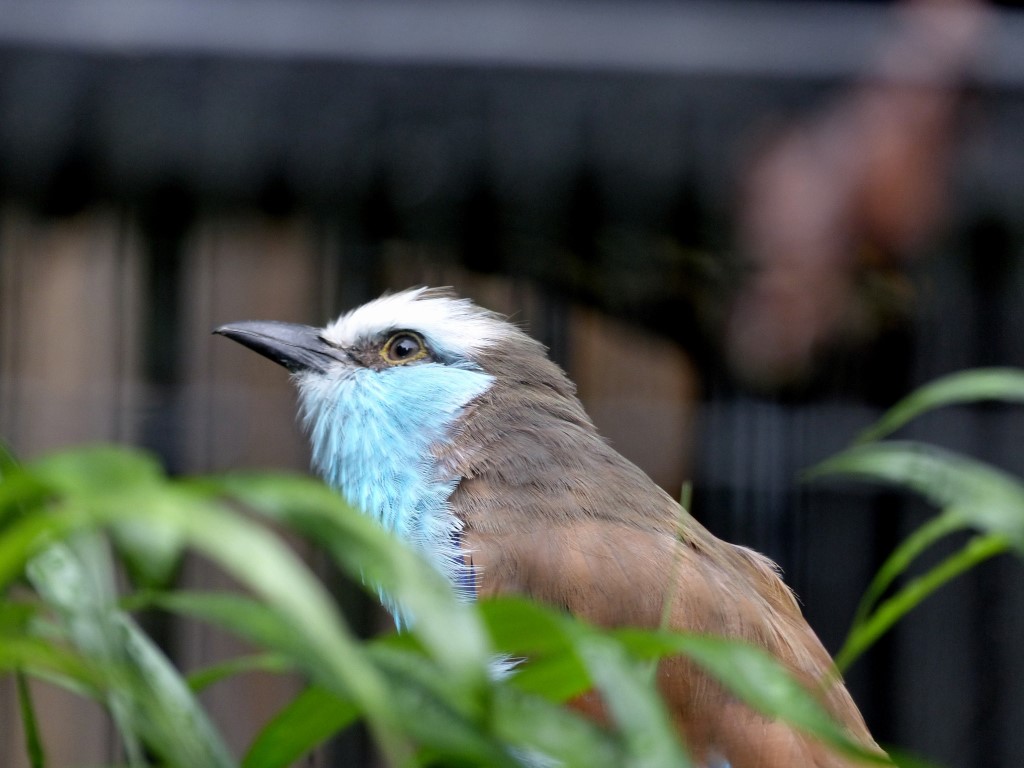
Racket-tailed Roller (Coracias spatulatus) Houston Zoo 5-6-15 by Lee

ROLL

***


“Roll your works upon the Lord [commit and trust them wholly to Him; He will cause your thoughts to become agreeable to His will, and] so shall your plans be established and succeed.” (Proverbs 16:3 AMP)

Commit thy works unto the LORD, and thy thoughts shall be established. (Proverbs 16:3 KJV)

Racket-tailed Roller (Coracias spatulatus) Houston Zoo 5-6-15 by Lee

*

More Daily Devotionals

*

Lee’s Seven Word Sunday – 2/27/16

***

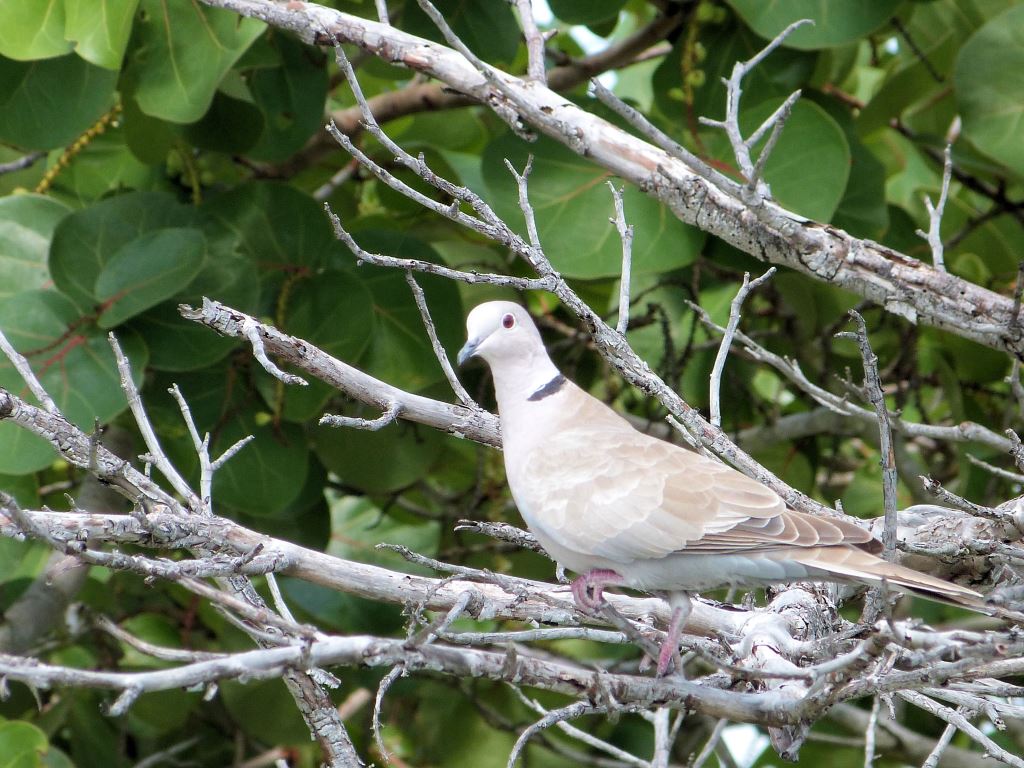
Eurasian Collared Dove (Streptopelia decaocto) by Lee at Honeymoon Is SP

NOT ASHAMED OF THE GOSPEL OF CHRIST

***


For I am not ashamed of the gospel of Christ: for it is the power of God unto salvation to every one that believeth; to the Jew first, and also to the Greek. (Romans 1:16 KJV)

Eurasian Collared Dove (Streptopelia decaocto) by Lee at Honeymoon Is. SP (Harmless as a Dove)

This week-end we are having a Missions Conference and this is the theme verse. This blog is not ashamed to mention the Gospel of Christ as most of the readers are aware. We love birds and birdwatching, but as our subtitle says: Birdwatching From A Christian Perspective.

*

More Daily Devotionals

Gospel Message

*

Sunday Inspiration – Wagtails and Pipits

Rosy Pipit (Anthus roseatus) by Nikhil Devasar

Rosy Pipit (Anthus roseatus) by Nikhil Devasar

“He hath made his wonderful works to be remembered: the LORD is gracious and full of compassion.” (Psalms 111:4 KJV)

The Motacillidae are a family of small passerine birds with medium to long tails. There are around 66 species in 6 genera and they include the wagtails, longclaws and pipits. The longclaws are entirely restricted to the Afrotropics, and the wagtails are predominantly found in Europe, Africa and Asia, with two species migrating and breeding in Alaska. The pipits have the most cosmopolitan distribution, being found across mostly in the Old World but occurring also in the Americas and oceanic islands such as New Zealand and the Falklands. Two African species, the Yellow-breasted Pipit and Sharpe’s Longclaw are sometimes placed in a separate seventh genus, Hemimacronyx, which is closely related to the longclaws.

Yellow-throated Longclaw (Macronyx croceus) ©WikiC

Yellow-throated Longclaw (Macronyx croceus) ©WikiC

Wagtails, pipits, and longclaws are slender, small to medium sized passerines, ranging from 14 to 17 centimetres in length, with short necks and long tails. They have long, pale legs with long toes and claws, particularly the hind toe which can be up to 4 cm in length in some longclaws. Overall the robust longclaws are larger than the pipits and wagtails. Longclaws can weigh as much as 64 g, whereas the weight range for pipits and wagtails is 15–31 g. The plumage of most pipits is dull brown and reminiscent of the larks, although some species have brighter plumages, particularly the Golden Pipit of north-east Africa. The adult male longclaws have brightly coloured undersides.

Citrine Wagtail (Motacilla citreola) by Nikhil Devasar

Citrine Wagtail (Motacilla citreola) by Nikhil Devasar

The wagtails often have striking plumage, including grey, black, white, and yellow. (Wikipedia with editing)
*

This slideshow requires JavaScript.

“And they that passed by reviled him, wagging their heads, And saying, Thou that destroyest the temple, and buildest it in three days, save thyself. If thou be the Son of God, come down from the cross.” (Matthew 27:39-40 KJV)

“Glorious Love” ~ Choir, Orchestra, Solo by Pastor Jerry

*

More Sunday Inspirations

Motacillidae – Wagtails, Pipits Family

Sharing The Gospel

*

Lee’s Six Word Saturday – 2/27/16

***

Atlantic Puffin (Fratercula arctica) by Michael Woodruff

GOD SHALL WIPE AWAY ALL TEARS

***


And God shall wipe away all tears from their eyes; and there shall be no more death, neither sorrow, nor crying, neither shall there be any more pain: for the former things are passed away. (Revelation 21:4 KJV)

Atlantic Puffin (Fratercula arctica) by Michael Woodruff

(I know the Puffin isn’t crying, but he looks sad. We have shed many tears this week and are looking forward to the promise above.)

*

More Daily Devotionals

*

Lee’s Five Word Friday – 2/26/16

***

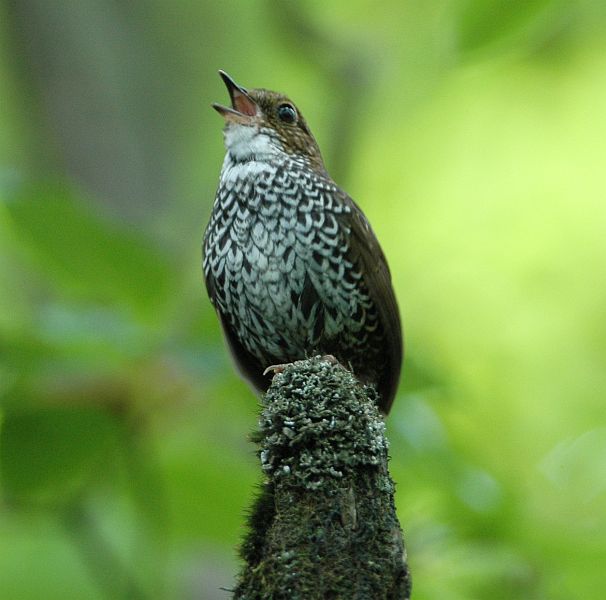
Scaly-breasted Wren-babbler (Pnoepyga albiventer) ©©

MY VOICE SHALT THOU HEAR

***


My voice shalt thou hear in the morning, O LORD; in the morning will I direct my prayer unto thee, and will look up.
(Psalms 5:3 KJV)

Scaly-breasted Wren-babbler (Pnoepyga albiventer) ©©

*

More Daily Devotionals

*