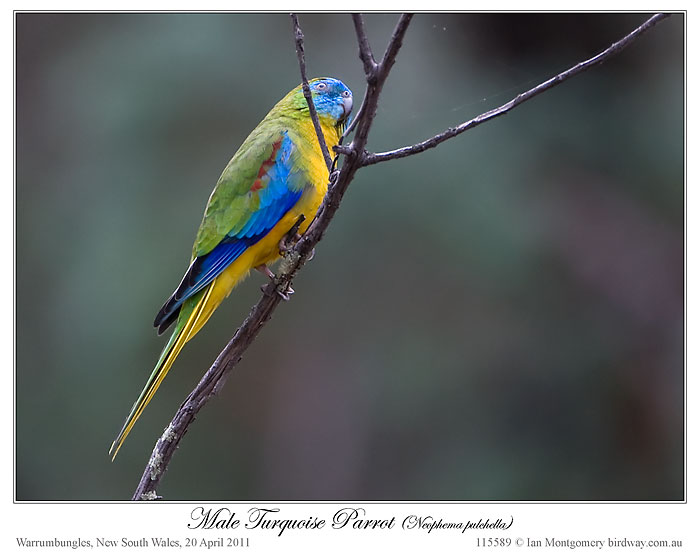
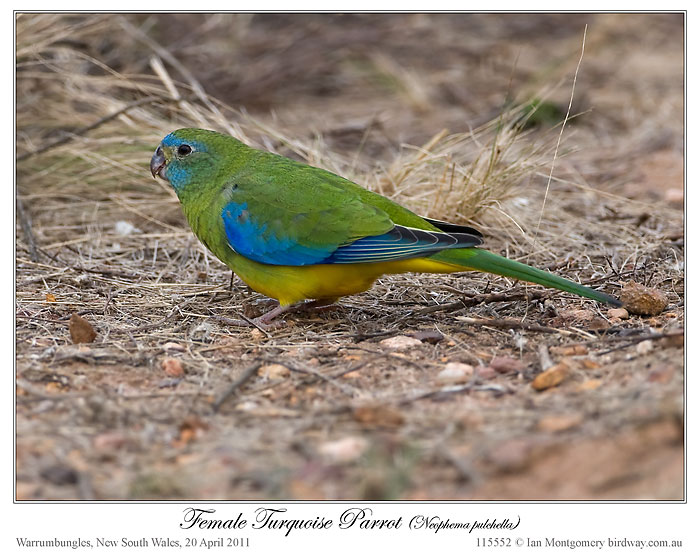
Birds Vol 1 #1 – The Australian Grass Parrakeet(Parakeet)

Elegant Parrot (Neophema petrophila) aka Australian Grass Parakeet

Elegant Parrot (Neophema petrophila) aka Australian Grass Parakeet

Birds Illustrated by Color Photography – Revisited

Vol 1. January, 1897 No. 1

*

THE AUSTRALIAN GRASS PARRAKEET (Parakeet)

I am a Parrakeet. I belong to the Parrot family. A man bought me and brought me here. It is not warm here, as it was where I came from. I almost froze coming over here. I am not kept in a cage. I stay in the house and go about as I please. There is a Kitty Cat in the house. Sometimes I ride on her back. I like that. I used to live in the grass lands. It was very warm there. I ran among the thick grass blades, and sat on the stems and ate seeds. I had a wife then. Her feathers were almost like mine. We never made nests. When we wanted a nest, we found a hole in a gum tree. I used to sing to my wife while she sat on the nest. I can mock other birds. Sometimes I warble and chirp at the same time. Then it sounds like two birds singing. My tongue is short and thick, and this helps me to talk. But I have been talking too much. My tongue is getting tired. I think I’ll have a ride on Kitty’s back. Good bye.


Elegant Parrot (Neophema elegans) WikiC

Elegant Parrot (Neophema elegans) WikiC

imgp

ARRAKEETS have a great fondness for the grass lands, where they may be seen in great numbers, running amid the thick grass blades, clinging to their stems, or feeding on their seeds. Grass seed is their constant food in their native country. In captivity they take well to canary seed, and what is remarkable, never pick food with their feet, as do other species of parrots, but always use their beaks. “They do not build a nest, but must be given a piece of wood with a rough hole in the middle, which they will fill to their liking, rejecting all soft lining of wool or cotton that you may furnish them.” Only the male sings, warbling nearly all day long, pushing his beak at times into his mate’s ear as though to give her the full benefit of his song. The lady, however, does not seem to appreciate his efforts, but generally pecks him sharply in return. A gentleman who brought a Parrakeet from Australia to England, says it suffered greatly from the cold and change of climate and was kept alive by a kind-hearted weather-beaten sailor, who kept it warm and comfortable in his bosom. It was not kept in a cage, but roamed at will about the room, enjoying greatly at times, a ride on the cat’s back. At meals he perched upon his master’s shoulder, picking the bits he liked from a plate set before him. If the weather was cold or chilly, he would pull himself up by his master’s whiskers and warm his feet by standing on his bald head. He always announced his master’s coming by a shrill call, and no matter what the hour of night, never failed to utter a note of welcome, although apparently asleep with his head tucked under his wing.
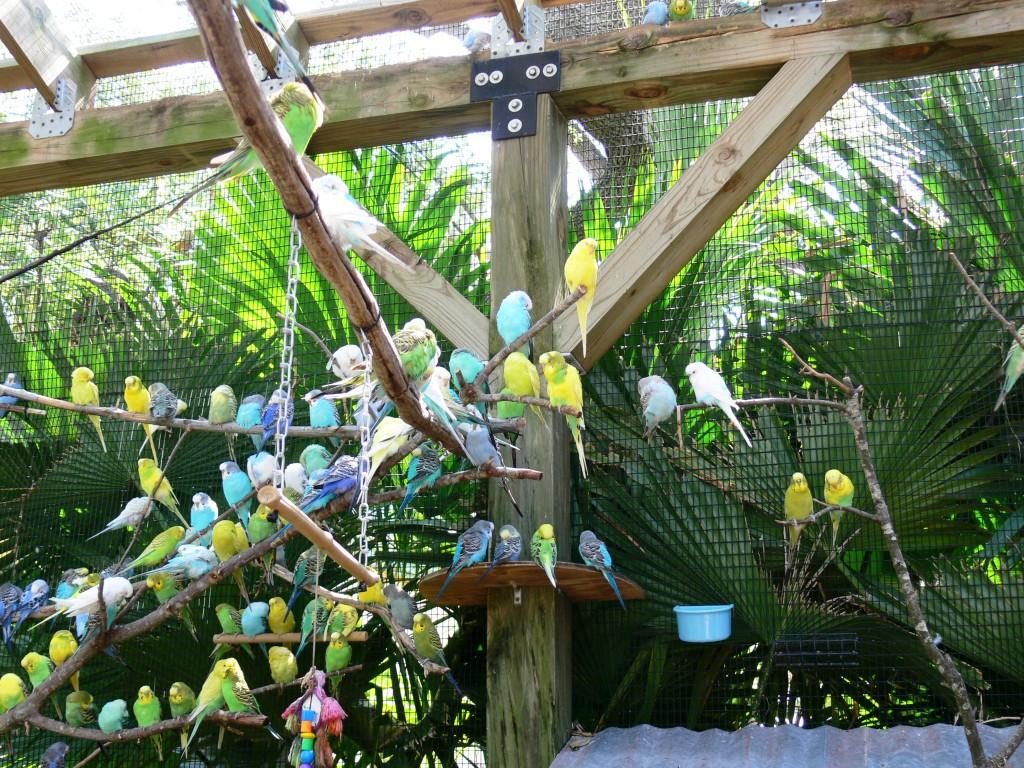

Budgerigar (Melopsittacus undulatus) by Lee LPZ

Budgerigar (Melopsittacus undulatus) by Lee LPZ


Lee’s Addition:

I am not really sure which Parakeet they are referring to in this article. Today their is not really an Australian Grass Parakeet, but the Elegant Parakeet favors the photo-drawing, but also Budgerigars also favor that drawing. At any rate, they are neat little birds and both can talk as mentioned.

Wikipedia says this about Grass Parakeets:  “Its common name is Elegant Parrot, but has also been called Elegant Parakeet, Elegant Grass Parakeet, and Grass Parrot in the past. The Elegant Parrot is 23 cm (9 in) long and predominantly golden olive in colour with a dark blue frontal band line above with lighter blue. while abdomen and vent are yellow. The female is a duller shade of olive all over and has a narrower blue frontal band. The wings are predominantly olive with outer flight feathers dark blue. The yellow edged tail has shades of olive and blue. The bill and legs are grey and the eyes dark brown. Juveniles are duller and lack the frontal bands.”

“The Budgerigar (Melopsittacus undulatus), also known as common pet parakeet or shell parakeet informally nicknamed the budgie, is a small, long-tailed, seed-eating parrot, and the only species in the Australian genus Melopsittacus. Wild budgerigars are found throughout the drier parts of Australia, where the species has survived harsh inland conditions. Naturally green and yellow with black, scalloped markings on the nape, back, and wings, breeders have created a rainbow of blues, whites, and yellows, greys, and even forms with small crests. Budgerigars are popular pets around the world due to their small size, low cost, ability to mimic human speech and playful nature.
The budgerigar is closely related to the lories and the fig parrots. Although budgerigars are often, especially in American English, called “parakeets“, this term refers to any of a number of small parrots with long, flat tails.

Alternative common names include shell parrot, warbling grass parakeet, canary parrot, zebra parrot, flight bird, scallop parrot and the alternate spellings budgerygah and betcherrygah.” (Wikipedia)
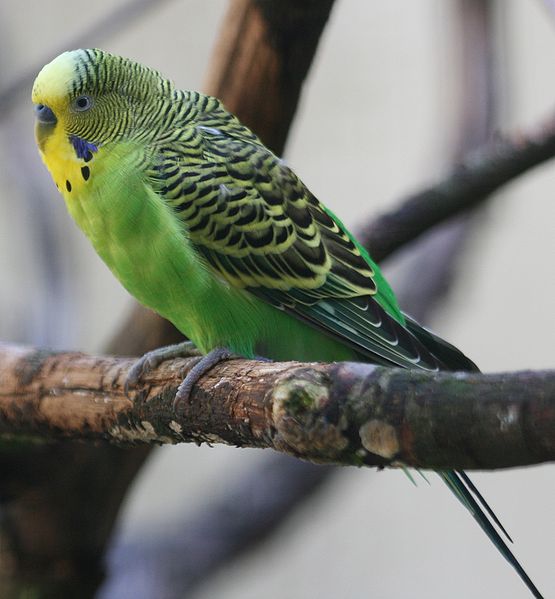
Budgerigar (Melopsittacus undulatus) WikiC

Budgerigar (Melopsittacus undulatus) WikiC

Both the Elegant Parrot (Neophema elegans) and the Budgerigar (Melopsittacus undulatus) are in the Psittacidae – Parrots Family. I lean toward the Budgerigar, but take your choice. Whatever, they are very colorful and a delight to watch and observe. The Lord put lots of color potential in the parakeet family.

Which doeth great things past finding out; yea, and wonders without number. (Job 9:10 KJV)
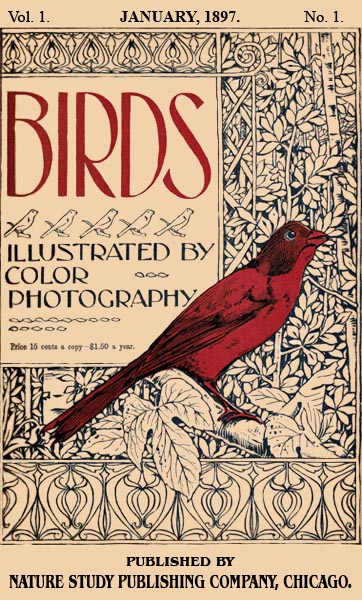
Birds Illustrated by Color Photograhy Vol 1 January 1897 No 1 - Cover

Birds Illustrated by Color Photography – Revisited – Introduction The above article is the fifth article in the monthly serial that was started in January 1897 “designed to promote Knowledge of Bird-Live.” These include Color Photography, as they call them, today they are drawings. There are at least three Volumes that have been digitized by Project Gutenberg.

To see the whole series of – Birds Illustrated by Color Photography – Revisited* (Information from Wikipedia and other internet sources)

Next Article – The Cock-Of-The-Rock

Previous Article – The Golden Pheasant

*

Gospel Presentation

*

Ian’s Bird of the Week – Red-crowned Parakeet

Red-crowned Parakeet (Cyanoramphus novaezelandiae) by Ian 1

Red-crowned Parakeet (Cyanoramphus novaezelandiae) by Ian 1

Ian’s Bird of the Week – Red-crowned Parakeet ~ by Ian Montgomery

Newsletter ~ 12/20/11

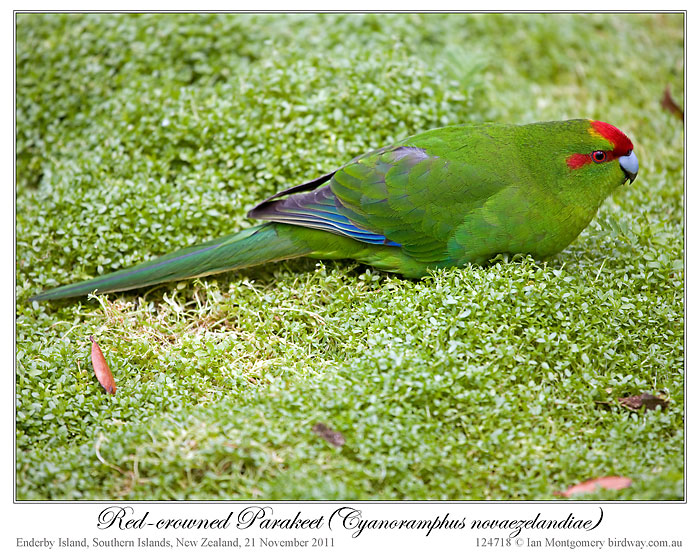
Christmas is nearly on us, so a bird in the Christmas colours of red and green seems appropriate. Here is the Red-crowned Parakeet, one of the relatively few non-seabirds encountered on the trip to the Sub-Antarctic Islands.

We found these birds at several locations on Enderby Island, one of the smaller of the Auckland Islands and the first site at which we actually landed after leaving Dunedin. Enderby Island is mainly basalt with rocky cliffs, as in the second photo, and it reminded me very much of St Paul Island in the Bering Sea that I visited three years ago. On both the vegetation is mainly tundra, though unlike the treeless St Paul Enderby has patches of very gnarled dwarf rata forest.
Red-crowned Parakeet (Cyanoramphus novaezelandiae) by Ian 2

Enderby Island by Ian 2

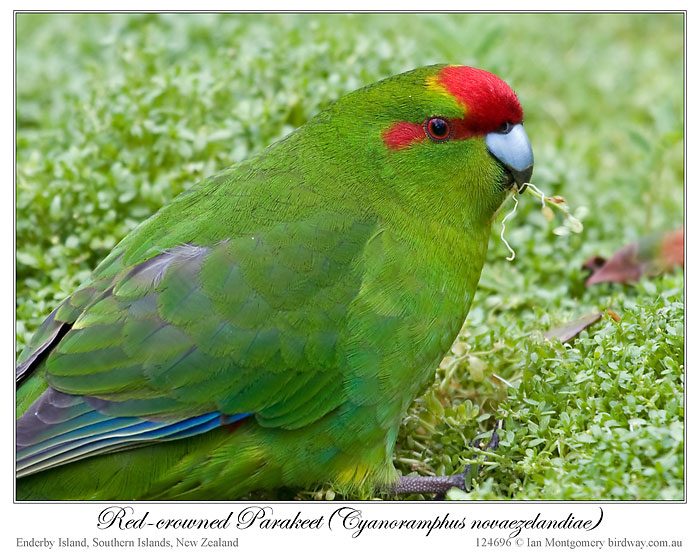
The Parakeets feed mainly on the ground and we found them both on the tundra and in the forest. They are herbivorous, and the bird in the first photo is feeding on the dense understory of the forest – the third photo shows the same bird in close-up eating very fine shoots and leaves.
Red-crowned Parakeet (Cyanoramphus novaezelandiae) by Ian 3

Red-crowned Parakeet (Cyanoramphus novaezelandiae) by Ian 3

The fourth photo shows a different bird feeding on the flower-heads of small herbs growing on the tundra near the beach where we landed.
Red-crowned Parakeet (Cyanoramphus novaezelandiae) by Ian 4

Red-crowned Parakeet (Cyanoramphus novaezelandiae) by Ian 4

I’m used to seeing parrots in more tropical locations, so it was a startling to see these small (25-28cm/10-11in long) elegant parrots in such a cold and rugged environment. They are obvious tough little birds, though their confiding habits, ground-feeding life-style and choice of low nesting sites makes them very vulnerable to introduced predators such as feral cats,rats and, in New Zealand, stoats. The Red-crowned Parakeet used to widespread throughout New Zealand but is now rare or extinct on the two main islands, though it survives well on Stewart and other offshore islands. As you can judge from the photos, the birds are very approachable and took little notice of us.
On the website, there are now nine species of penguins http://www.birdway.com.au/spheniscidae/index.htm and thirteen species of albatrosses http://www.birdway.com.au/diomedeidae/index.htm . The additional species of albatrosses include ones that were treated as sub-species by Christidis and Boles, 2008, but are now recognised as full species by Birdlife International and the IOC.
I wish you a safe and happy Christmas and best wishes
Ian


Ian Montgomery, Birdway Pty Ltd,
454 Forestry Road, Bluewater, Qld 4818
Phone: 0411 602 737 +61-411 602 737
Preferred Email: ian@birdway.com.au
Website: http://birdway.com.au


Lee’s Addition:

Thanks again, Ian, for sharing your great adventures. This parakeet, indeed, looks decked out for the colors of Christmas. Would be pretty to have a flock of them perching on a Christmas Tree. Merry Christmas to you, Ian, and our readers.

Then the angel said to them, “Do not be afraid, for behold, I bring you good tidings of great joy which will be to all people. For there is born to you this day in the city of David a Savior, who is Christ the Lord. (Luke 2:10-11 NKJV)

Check out Ian’s other Parrots and Parakeets at his Parrots & Allies Psittacidae Family page. Our Birds of the World Psittacidae Family page has more Parrot and Parakeet photos.

Ian’s Other Birds of the Week

*

Ian’s Bird of the Week – Double-eyed Fig-Parrot

Double-eyed Fig Parrot (Cyclopsitta diophthalma macleayana) by Ian

Double-eyed Fig Parrot (Cyclopsitta diophthalma macleayana) by Ian

I wonder why miniature things are so endearing. Describing something as ‘the smallest’ immediately attracts attention, so here is the smallest parrot in Australia – with one of the longest and strangest names – the Double-eyed Fig-Parrot. Strictly speaking the Cape York race of this species (marshalli) is the smallest with a length of 13cm/5in – shorter than a house sparrow. More accessible and nearly as small (14cm) is the race found in northeastern Queensland (macleayana), quite common around Cairns and on the Atherton Tableland, where the first photo was taken.

Double-eyed Fig Parrot (Cyclopsitta diophthalma macleayana) by Ian

Double-eyed Fig Parrot (Cyclopsitta diophthalma macleayana) by Ian

The races and genders are distinguishable by different facial patterns. This is a male macleayana and has a red forehead and cheek separated by a sky-blue patch and an indigo fringe to the red cheek patch. The second photo is also a male macleayana but nearly hidden in the foliage; this is typical and these birds can be hard to see as they creep around mouse-like through fruiting trees in rainforest.

Double-eyed Fig Parrot (Cyclopsitta diophthalma macleayana) by Ian

Double-eyed Fig Parrot (Cyclopsitta diophthalma macleayana) by Ian

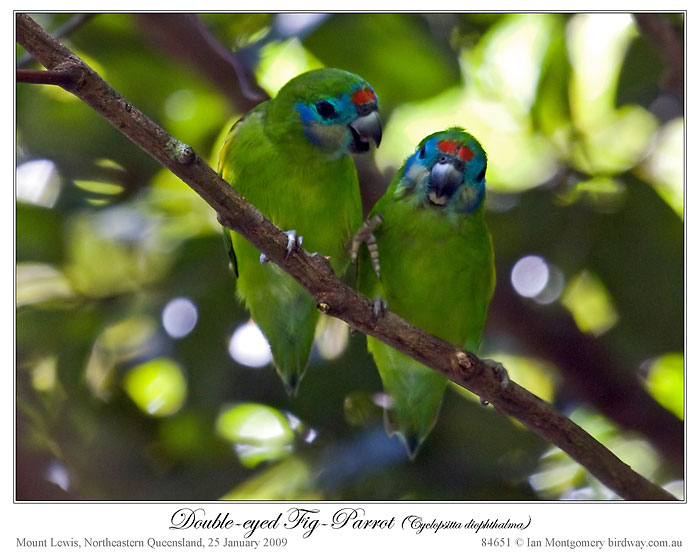
The female and juvenile macleayana are similar to the male but lacks the red cheek patch, as in the two birds in the third photo.

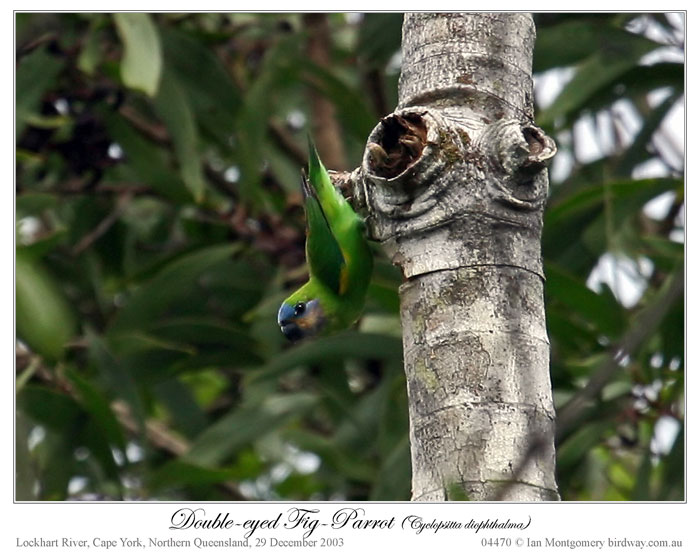
The fourth photo shows a female of the Cape York race, marshalli, with no red at all. I lack a photo of the male marshalli but it is rather similar to the male macleayana except that the red forehead and cheek patches are contiguous.

Double-eyed Fig Parrot (Cyclopsitta diophthalma marshalli) by Ian

Double-eyed Fig Parrot (Cyclopsitta diophthalma marshalli) by Ian

The third and remaining Australian race, coxeni, is the largest (16cm) and rarest – classified as endangered – and occurs in a few river valleys between Maryborough in southeast Queensland and the Macleay River in northern New South Wales. Both sexes apparently have mainly blue foreheads and small reddish cheek patches.

These three races were originally treated as separate species and known as Macleay’s or Red-browed, Coxen’s or Blue-browed and Marshall’s Fig-Parrots. Later they and five races in Papua New Guinea were lumped into a single species and acquired the common name of the nominate Double-eyed Fig-Parrot of PNG (Cyclopsitta diophthalma diophthalma). This has a dark spot near each eye, giving it its double-eyed appearance, but the name is not descriptive of the races that lack the dark spot, i.e. the three Australian races. Oh well, they got the fig bit right.

Best wishes
Ian

Ian Montgomery, Birdway Pty Ltd,
454 Forestry Road, Bluewater, Qld 4818
Phone: 0411 602 737 +61-411 602 737
Preferred Email: ian@birdway.com.au
Website: http://birdway.com.au


Lee’s Addition:
Those cute little Fig Parrots are in the Parrots – Psittacidae Family of the Psittaciformes Order which not only includes Parrot family, but also the New Zealand Parrots and Cockatoos.

He will bless those who fear the LORD, Both small and great. (Psalms 115:13 NKJV)

*

Formed By Him – Birds of Peru and Chile – II

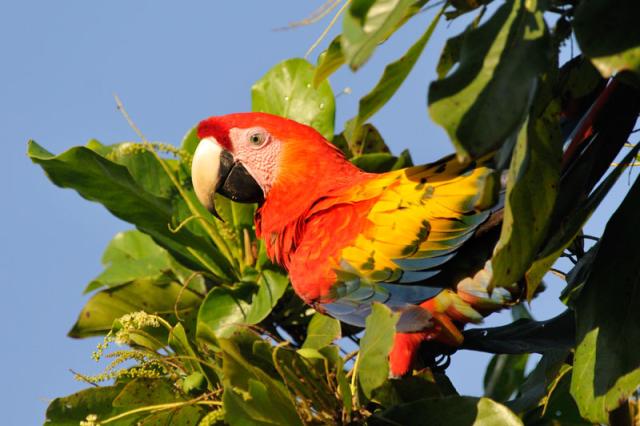
Scarlet Macaw (Ara macao) Reinier Munguia

Scarlet Macaw (Ara macao) Reinier Munguia

This is a continuation of Formed By Him – Birds of Peru and Chile – I

Since there are so many birds that could be seen by our team in Peru and Chile, I have saved two large families for Part II. The Psittacidae Family which has the Parrots, Macaws, Parakeets, Parrotlets and the Amazons. There are 53 species in Peru and 5 in Chile.

*

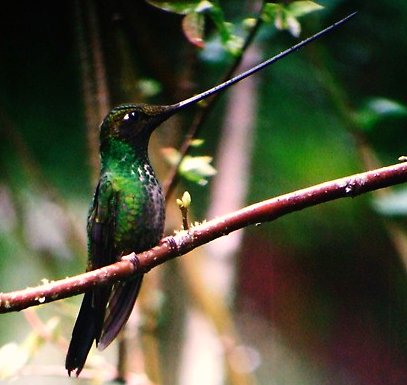
Sword-billed Hummingbird (Ensifera ensifera)©WikiC

Sword-billed Hummingbird (Ensifera ensifera)©WikiC

We did an article about the Sword-billed Hummingbird and maybe they will get to see one of them.

The Trochillidae Family which has the Hummingbirds, Sicklebills, Hermits, Lancebills, Sabrewings, Jacobin, Violetears, Mangos, Topaz, Coquettes, Thorntails, Sapphires, Woodnymphs, Goldenthroat, Emerald, Plumeleteer, Piedtails, Brilliants, Coronet, Sunbeams, Velvetbreast, Inca, Starfrontlets, Sapphirewing, Sunangel, Pufflegs, Whitetip, Racket-tail, Comets, Mountaineer, Metaltail, Thornbills, Avocetbill, Fairy, Spatuletail, Sheartail and Woodstar. All of these are in the Hummingbird family. There are 123 species in Peru and 9 in Chile.

The two country’s birds are combined in the slideshow.

*

This slideshow requires JavaScript.

*

These two countries abound in the Creative Hand of the Lord, especially when the birds of the air are observed.

They have lyre and harp, tambourine and flute and wine at their feasts, but they do not regard the deeds of the LORD, or see the work of his hands. (Isaiah 5:12 ESV)
that they may see and know, may consider and understand together, that the hand of the LORD has done this, the Holy One of Israel has created it. (Isaiah 41:20 ESV)

*

Ian’s Bird of the Week – Eastern Rosella

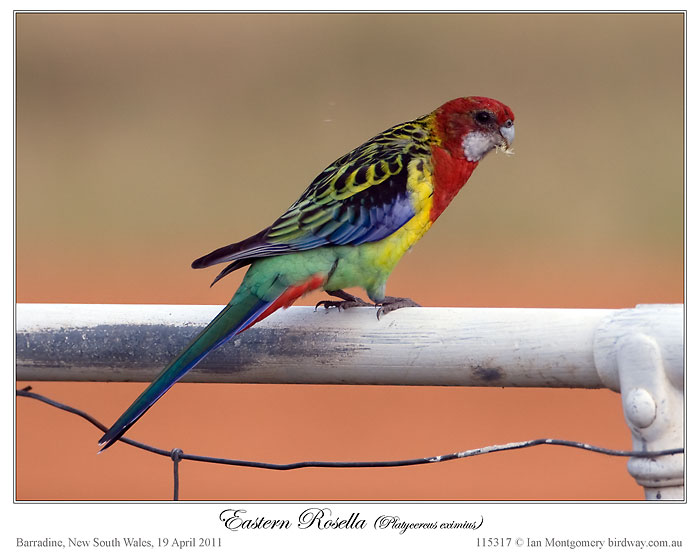
Eastern Rosella (Platycercus eximius) by Ian

Eastern Rosella (Platycercus eximius) by Ian

Ian’s Bird of the Week – Eastern Rosella ~ by Ian Montgomery

Newsletter ~ 05-04-11

In the search for the rare, elusive and/or beautiful it is easy to take the common, familiar and beautiful for granted. This is especially true when something has been used as an advertising icon and an egregious example of this is the Eastern Rosella, used as an icon in Australia for Rosella tomato sauce, soup and chutney, first image. No doubt the brilliant red head and breast of the Eastern Rosella played a part in its selection, but the Rosella company is a bit coy on the subject and mentions that Rose and Ella were the daughters of the original owners when in 1895 they bought the trademark from the makers of a eucalyptus oil cure for rheumatism.

Eastern Rosella (Platycercus eximius) by Ian

Eastern Rosella (Platycercus eximius) by Ian

When we set up camp in Barradine, New South Wales, for Easter, a pair of Eastern Rosellas were feeding on grass seed close to our camp-site and using the fence of the old Barradine race track
to reach the seed heads. The first photo shows the splendid male on the fence wire and the second photo shows the same bird on the grass. Rosellas are a bit shy usually keep their distance unless they have become used to people and I’ve had difficulty in photographing them, but this pair was fairly obliging.

Eastern Rosella (Platycercus eximius) by Ian

Eastern Rosella (Platycercus eximius) by Ian

The specific name eximius is Latin for ‘extraordinary, excellent, fine, superb’ so George Shaw, not George Bernard but keeper of the British Museum, was clearly impressed when he named it carefully in 1792. It takes Mother Nature to combine vivid primary colours without appearing garish, and I particularly like the luscious apple green of the rump, seen better in the second photo, an excellent field mark when you spot the birds flying away, as is often the case. The females are beautiful too, though not quite as bright as the males and the third photo shows the female of the pair walking along the top of the fence and the red colour of the head suffused with greenish-brown.

The Eastern Rosella is common within its relatively limited range comprising Victoria, Tasmania (where it is uncommon) most of New South Wales except the arid north-west, and extending into southeastern South Australia and southeastern Queensland. In the rest of coastal and central Queensland it is replaced by the closely related Pale-headed Rosella and the Northern Rosella, also a close relative, occurs in the Top End of the Northern Territory and northeastern Western Australia.

Eastern Rosella (Platycercus eximius) by Ian

Eastern Rosella (Platycercus eximius) by Ian

Rosella taxonomy is confused and there is uncertainty whether these three, or at least the two eastern one, should be treated as a single species as there is some cross-breeding between Eastern and Pale-headed where their ranges overlap in northern New South Wales and southeastern Queensland. At present they are retained as three species but are sometimes collectively called the white-cheeked Rosellas as distinct from the blue-cheeked Rosellas comprising the Crimson, Yellow and Adelaide Rosellas which are now generally regarded as a single species.

Links:
Pale-headed Rosella
Northern Rosella
Crimson Rosella
Yellow Rosella

Best wishes,
Ian


Ian Montgomery, Birdway Pty Ltd,
454 Forestry Road, Bluewater, Qld 4818
Phone: 0411 602 737 +61-411 602 737
Preferred Email: ian@birdway.com.au
Website: http://birdway.com.au


Lee’s Addition:

Wow! What a gorgeous bird of the Parrot – Psittacidae Family. Ian always seem to be in the right place at the right time to get many of his fantastic photos.

This bird reminds me of the coat that was made for Joseph, a coat of many colors. I wonder if the maker of the coat had looked at a Rosella or some other of creations very colorful birds to decide which colors to use.

Now Israel loved Joseph more than all his children, because he was the son of his old age: and he made him a coat of many colours. (Genesis 37:3 KJV)

*

Ian’s Bird of the Week – Turquoise Parrot

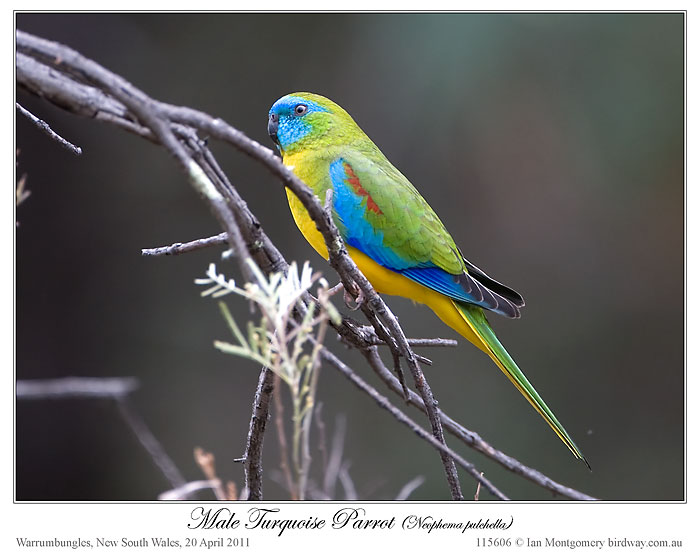
Turquoise Parrot (Neophema pulchella) by Ian

Turquoise Parrot (Neophema pulchella) by Ian

Ian’s Bird of the Week – Turquoise Parrot ~ by Ian Montgomery

Maybe I was tempting fate when last week I publicly declared my target species of the Pilliga trip to be the Turquoise Parrot, but fate was kind to me when I did the same thing with the Resplendent Quetzal on the eve of my visit to Costa Rica last year.

In truth I felt I needed a bit of help as I’ve been wanting to get reasonable photographs of these gorgeous birds since taking a very poor one of a female in the Warrumbungles in New South Wales in pre-digital days almost exactly eleven years ago. To that end I’d visited both the Warrumbungles and the Capertee Valley west of Sydney several times over the years, detoured via Warwick in Southern Queensland and camped the night in Chiltern in Northern Victoria, all places where this species has been reported.
Turquoise Parrot (Neophema pulchella) by Ian

Turquoise Parrot (Neophema pulchella) by Ian

We went to the Warrumbungles last Wednesday and we were just about to leave the second site – the Woolshed – recommended by a helpful but not optimistic ranger (‘they haven’t been seen for a month or two’) when Ivor, one of my two sharp-eyed companions, spotted a female on exactly the same powerlines as eleven years ago, but this time she flew off towards the creek without waiting to have her photo taken. A careful search of the creek revealed nothing even vaguely turquoise but eventually we found about 20 birds feeding on the grassy track on the far side.

I spent about 20 minutes sidling up to these birds as gradually as possible. The first two photos are of adult male birds, distinguishable by the reddish shouldered patches, which flew up into a shrub as I approached. The second male seems to be eyeing me quizzically as if wondering what I’m up to. The third photo is of a female feeding on the path.
Turquoise Parrot (Neophema pulchella) by Ian

Turquoise Parrot (Neophema pulchella) by Ian

Misión completa, as they said in Costa Rica, and thank you, fate.
Best wishes,
Ian

Ian Montgomery, Birdway Pty Ltd,
454 Forestry Road, Bluewater, Qld 4818
Phone: 0411 602 737 +61-411 602 737
Preferred Email: ian@birdway.com.au
Website: http://birdway.com.au

Lee’s Addition:

What a gorgeous parrot. Wow!

Ask, and it shall be given you; seek, and ye shall find; knock, and it shall be opened unto you: (Matthew 7:7 KJV)

I know last week when Ian said he was off on an adventure to find that Turquoise Parrot, I prayed and asked that he find one. I was being a little selfish because I had never seen one and was trusting that his group would spot one. Whichever, fate or prayer, it is a choice we all make. I prefer the later.

The parrots are in the Psittacidae – Parrots Family of the Psittaciformes Order.

See all of Ian’s Bird of the Week articles.

*