Consider the ravens [κορακας], for they neither sow nor reap; which neither have storehouse nor barn; and God feedeth them: how much more are ye better than the fowls? (Luke 12:24)
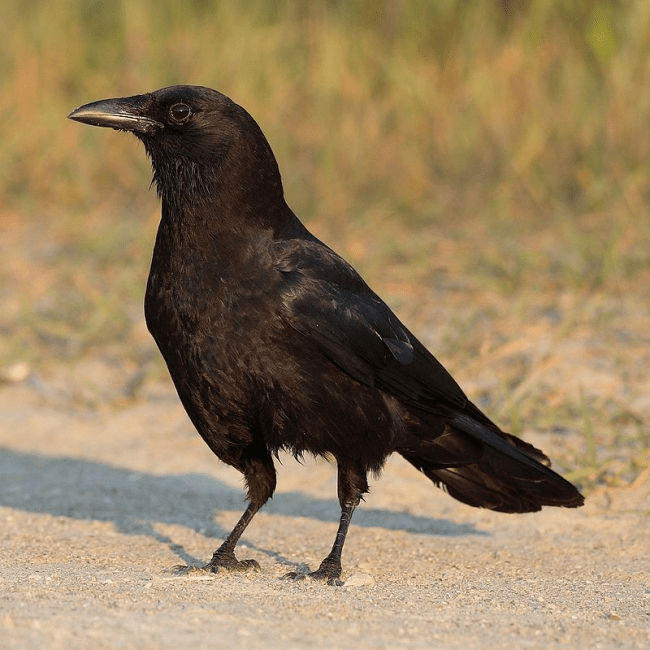
AMERICAN CROW (Wikipedia photo credit)
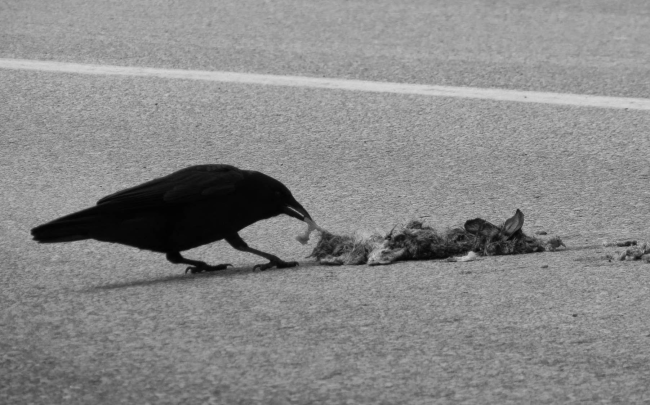
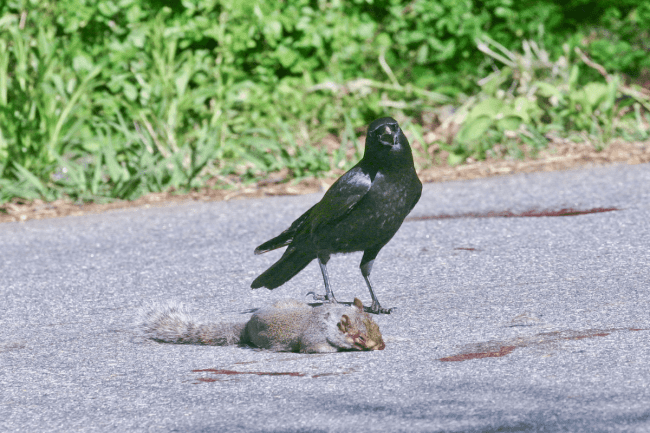
Ever seen a crow [Corvus brachyrhynchos] on a road, struggling to consume roadkill? Yesterday I approached a crow in the road, as I was commuting—the crow was struggling to pull edible portions of meat from roadkill—it looked like a squirrel.
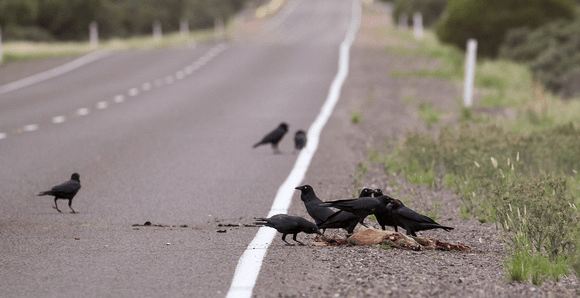
Like the Holy Land’s ravens [Corvus corax] who are mentioned by the Lord Jesus Christ Himself (in Luke 12:24), crows are famously opportunistic eaters – and their potential food sources include the cadavers of dead rodents, such as squirrels who (sadly) become roadkill in tree-populated suburban streets.
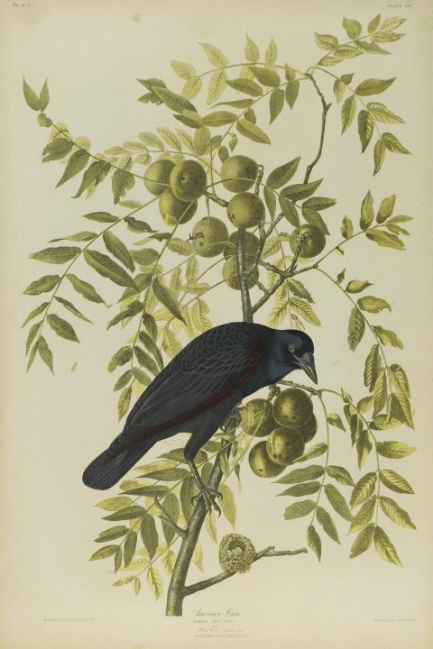
AMERICAN CROW (J. J. Audubon painting / public domain)
The crow that I saw, yesterday morning, was struggling so, to get some edible parts of the roadkill, that he (or she) did not see my car approaching—which could result in the roadkill-eating crow himself (or herself) soon becoming another example of roadkill!
So, of course, I tooted my car’s horn, with the jolting noise scaring the crow – so the crow quickly (and safely) flew away, thus escaping a roadkill fate. After my car passed through that part of the boulevard, happily, the hungry (and still living) crow returned to its roadkill meal.
Sometimes a little “beep, beep” is all that is needed to “save the day” (for a crow)!
Dan shared a video with me about a man who tries to make a Perfect Squirrel Proof Bird Feeder. If you have some time to spare, you will enjoy watching his attempt to keep the squirrels from his feeders.
I know we have all had this problem, but, I’m not sure I would go through this. Might be easier just to by a Squirrel feeder and a Bird feeder.
We were trying to find some verses to use for this, and this verse caused us a chuckle. Remember how they were flying off that contraption and heading toward the net? This could apply to that:
“You lift me up to the wind and cause me to ride on it; You spoil my success.” (Job 30:22 NKJV)
There are many applications that could be made from these diligent squirrels who kept at it until they succeeded in getting the food. Here is one:
“My brethren, count it all joy when you fall into various trials, knowing that the testing of your faith produces patience. But let patience have its perfect work, that you may be perfect and complete, lacking nothing. If any of you lacks wisdom, let him ask of God, who gives to all liberally and without reproach, and it will be given to him. [What the squirrels failed to do] But let him ask in faith, with no doubting, for he who doubts is like a wave of the sea driven and tossed by the wind.” (James 1:2-6 NKJV) {Bold and brackets mine.]
Not sure how many have heard of the “Squirrel Proof” bird feeders, but Droll Yankees make a line of them. I am not selling them, but just want you to enjoy some of the antics of squirrels trying to feed from them. Also, there is a video of someone who put Vaseline on a pole and how a determined squirrel tries to get up the pole to the feed.
The Lord sure gave the squirrels a determined spirit. Enjoy and get “tickled”!
A time to weep, and a time to laugh; … (Ecclesiastes 3:4a KJV)
Thought you might enjoy this sent to me by a friend. Not sure how it was done, but National Geographic was involved.
A couple of verses come to mind:
But God hath chosen the foolish things of the world to confound the wise; and God hath chosen the weak things of the world to confound the things which are mighty; (1 Corinthians 1:27 KJV)
Call unto me, and I will answer thee, and shew thee great and mighty things, which thou knowest not. (Jeremiah 33:3 KJV)
If he watches out for these two, how much more does God watch out for us?
Thus saith the LORD, thy redeemer, and he that formed thee from the womb, I [am] the LORD that maketh all [things]; that stretcheth forth the heavens alone; that spreadeth abroad the earth by myself; (Isaiah 44:24)
From Creation Moment’s, “Squirrels Give Age of Grand Canyon”
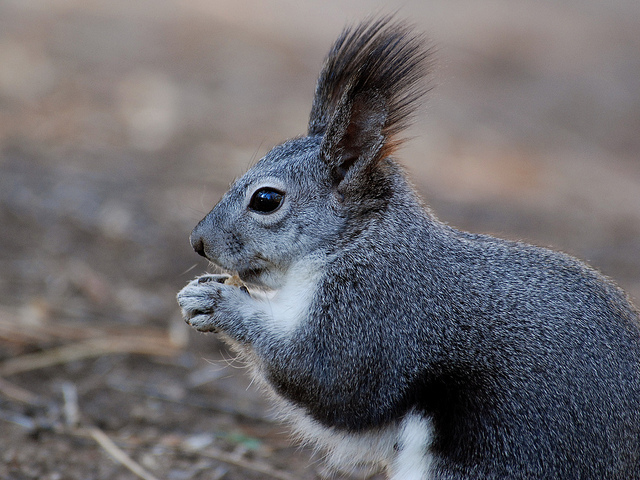
Who would have thought that squirrels would tell us how old the Grand Canyon is? Yet, creation scientists tell us that the tassel-eared squirrel, who lives near the rim of the canyon in Arizona, has done just that.
Tassel-eared squirrels are found on both the north and south rims of the canyon. Scientists have assumed that the squirrels were there before the canyon was formed, supposedly millions of years ago. However, since the canyon has kept the two populations apart for so long, the differences between them should show what millions of years of evolution will do to squirrels.
There are minor differences between the squirrels on the north rim and the south rim. But they’re not even enough to classify the squirrels as separate species. North rim squirrels have white tails and black bellies. Squirrels on the south rim have white bellies and dark tails. But many north rim squirrels have coloration like those on the south, and many on the south rim are colored like those on the north. Creation scientist Dr. John Meyer has carefully studied these squirrels. He has concluded that the squirrels on the north and south rim are actually one population that has a complete range of fur colors.
According to a law of evolution accepted by evolutionists, there should be a much larger difference between the north and south squirrels if the Grand Canyon is really millions of years old. The conclusion must be, then, that the Grand Canyon is quite young – only thousands of years old.
Prayer:
Heavenly Father, the story of human history as told in the Bible is confirmed all around us. I pray that You would call Your people and Your Church back to complete faithfulness to Your revealed Word. Amen.
Notes:
Meyer, J.R. 1985. “Origin of the Kaibab Squirrel
(from Wikipedia) “Abert’s squirrel (or tassel-eared squirrel) (Sciurus aberti) is a tree squirrel in the genus Sciurus endemic to the Rocky Mountains from United States to Mexico, with concentrations found in Arizona, The Grand Canyon, New Mexico, and southwestern Colorado.
The Abert’s squirrel is closely associated with, and nearly confined to cool, dry interior ponderosa pine forests [4]. In Arizona, ponderosa pine forests are most extensive between 5,500 and 8,500 feet (1,676–2,590 m) elevation [8]. Abert’s squirrels occur in pure ponderosa pine stands or stands with associated Gambel oak (Quercus gambelii), true pinyon (P. edulis), junipers (Juniperus spp.), quaking aspen (Populus tremuloides), and Douglas-fir (Pseudotsuga menziesii)[4]. Findley and others [9] mention that Abert’s squirrels are common in mixed conifer canyons in New Mexico.
Abert’s squirrels are 18-22.8 in (46–58 cm) long with a tail of 7-10 in (19–25 cm). The most noticeable characteristic would be their hair ear tufts, which extend up from each ear 2–3 cm. This gives this species a striking similarity to the Eurasian Red Squirrel, aside from its differing dark fur coloration. They typically have a gray coat with a white underbelly and a very noticeable rusty/reddish colored strip down their back.”




 Lee's Birdwatching Adventures Plus