Bible Birds – Thrush Introduction Article

Chestnut-bellied Rock Thrush by Peter Ericsson

Chestnut-bellied Rock Thrush by Peter Ericsson

Even the stork in the sky Knows her seasons; And the turtledove and the swift and the thrush Observe the time of their migration; But My people do not know The ordinance of the LORD. (Jeremiah 8:7 NASB)

See – Thrush Introduction)

This was duplicated by mistake.

Version 3.3 Finished – Taxonomy or Genealogy?

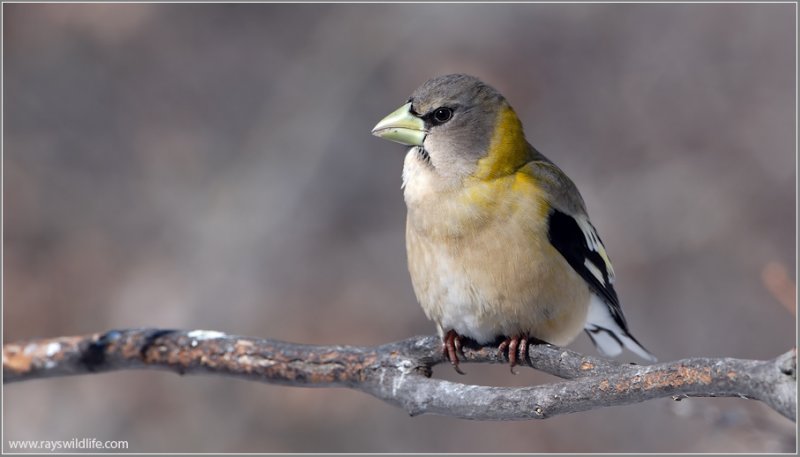
Evening Grosbeak (Hesperiphona vespertina) female by Raymond Barlow

Evening Grosbeak (Hesperiphona vespertina) female by Raymond Barlow

As I mentioned in Here We Go Again – IOC Version 3.3, I skipped doing the Fringillidae – Finches Family because of the many taxonomy changes. Well, all the others were finished and decided to dig in to those Finches. After deciding to make the changes directly on the page by cutting, moving, and re-pasting in its new position, the process began.

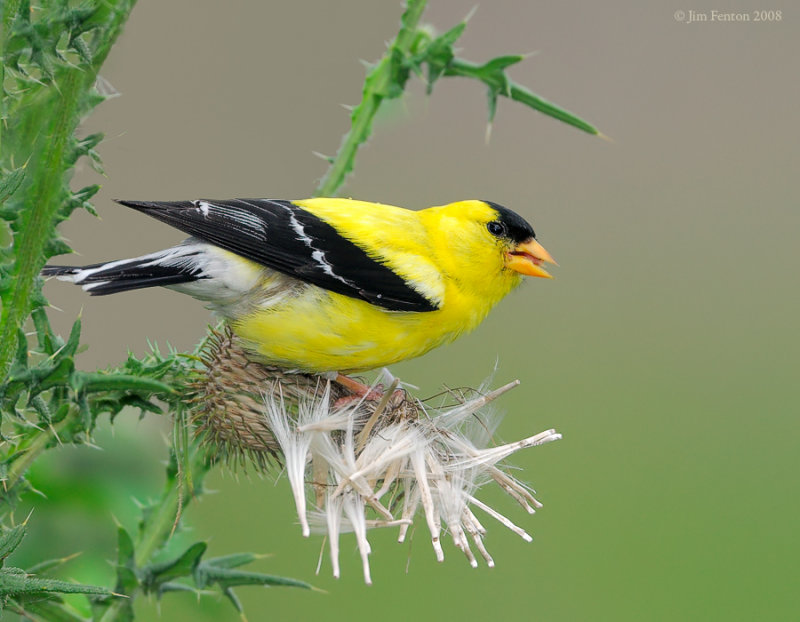
At 2:00 AM this morning I finally finished the page. I couldn’t stop in the middle with everything so juggled around, so I kept going. After some sleep, I had to chuckle about what they did to that poor Finch family. It was not just moving one genus to another spot, but it appeared that they picked and chose this one species from here and another species from a different genus. If that wasn’t challenging enough, the genus (the first name in parenthesis) was changed on quite a few birds. For example the Evening Grosbeak above was shuffled, while the American Goldfinch went from (Carduelis tristis) to (Spinus tristis)

American Goldfinch (Carduelis tristis) on Thistle by Fenton

American Goldfinch (Carduelis tristis) on Thistle by Fenton

“For I am the LORD, I do not change; (Malachi 3:6a NKJV)

All of these birds were re-named to the Spinus genus and placed in this new order:

Tibetan Serin (Spinus thibetanus)
Lawrence’s Goldfinch (Spinus lawrencei)
American Goldfinch (Spinus tristis)
Lesser Goldfinch (Spinus psaltria)
Eurasian Siskin (Spinus spinus)
Antillean Siskin (Spinus dominicensis)
Pine Siskin (Spinus pinus)
Black-capped Siskin (Spinus atriceps)
Black-headed Siskin (Spinus notatus)
Black-chinned Siskin (Spinus barbatus)
Yellow-bellied Siskin (Spinus xanthogastrus)
Olivaceous Siskin (Spinus olivaceus)
Hooded Siskin (Spinus magellanicus)
Saffron Siskin (Spinus siemiradzkii)
Yellow-faced Siskin (Spinus yarrellii)
Red Siskin (Spinus cucullatus)
Black Siskin (Spinus atratus)
Yellow-rumped Siskin (Spinus uropygialis)
Thick-billed Siskin (Spinus crassirostris)
Andean Siskin (Spinus spinescens)

If you wonder why, as I did, check out this article about The phylogenetic relationships and generic limits of finches (Fringillidae). If you scroll through, you will find there are re connections all over the place. Do I understand it, No. But summarized, they have been doing DNA studies and found out that their family tree was not what they thought.

Recently I started working on our Family Tree or Genealogy and just about tangled it up as much. One wrong branch led to another and who knows where it and Grandpa would have landed had it not been corrected. This is what they were doing to the Finches and also to the other two families that had major revamps with this latest Version 3.3. The other families were the  Accipitridae – Kites, Hawks and Eagles, and  Caprimulgidae – Nightjars. At times it felt like they had thrown all the names of those birds up in the air and let them land where ever they chose. They, those that are involved around the world, have done much research and have spent numerous hours working these changes out. They are to be commended.

I trust the next version has a little fewer changes. I need my sleep.

It is vain for you to rise up early, to sit up late, to eat the bread of sorrows: for so he giveth his beloved sleep. (Psalms 127:2 KJV)

A little sleep, a little slumber, a little folding of the hands to rest, (Proverbs 24:33 ESV)

Here We Go Again – IOC Version 3.3

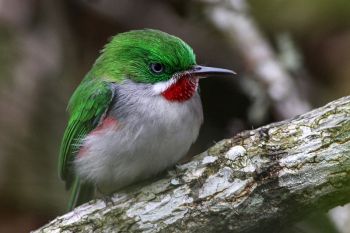
Narrow-billed Tody (Todus angustirostris) ©WikiC

Narrow-billed Tody (Todus angustirostris) ©WikiC

Well, here we go again updating the Birds of the World pages. I knew when I finally got version 3.2 finished that they would be releasing the newest updates. So, while I have been sticking close to home for several weeks while fighting a virus, the updates have been worked on. Most were routine, but 3 families; Accipitridae – Kites, Hawks and EaglesCaprimulgidae – Nightjars and the Fringillidae – Finches have undergone major Taxonomic Updates. The first two families are finished, but I still have the Finches to do. (Update 2/23 – Finished 3.3 Version – Indexes included)

There are now 10,476 extant species and 149 extinct species of birds of the world (Version 3.3), not counting supspecies. There are 40 Orders, 231 Families (plus 6 Incertae sedis), 2268 Genera, for a total of 237 Family pages to update. The first 109 pages are done (Non-Passerines), and the last 100 are finished, minus the Finches. (Don’t ask why I worked that way because I have no answer.) I have less than 40 left to do.

While I have been working on them more photos, drawings and video links have been added. I have really been putting a push on to try to get 100% of each family completed. Because it takes time and effort, I made some Awards for the effort. If 100% of the species have a photo or a video then this Award is posted:
100 Percent of Photos

If 100% completed with almost all photos, but some Drawings because Photos can’t be found, at least by me, then this is the Award:

100 Percent of Images

Then if everything is complete except nothing for an Extinct bird can be found, then this is the Award:

100 Percent of Images-Extinct

It may seem silly, but it helps to feel like something is being accomplished.

While I have been going through the families some really neat birds have been spotted and want to share some of them with you. The Narrow-billed Tody (Todus angustirostris) up at the top comes from the Todidae – Todies Family (100 %). Wikipedia says,”The todies are a family, Todidae, of Caribbean birds in the order Coraciiformes, which also includes the kingfishers, bee-eaters and rollers. The family has one genus, Todus. These are small, near passerine species of forests of the Greater Antilles: Puerto Rico, Jamaica, and Cuba, with adjacent islands, have one species each, and Hispaniola has two, the Broad-billed Tody in the lowlands (including Gonâve Island) and the Narrow-billed Tody in the highlands.” I think considering his small size, he looks like he has an “attitude.”

Fischer's Turaco (Tauraco fischeri) ©WikiC

Fischer’s Turaco (Tauraco fischeri) ©WikiC

Here is another of the Lord’s creations that just blew me away when I saw it. This Fischer’s Turaco (Tauraco fischeri) is just fantastic. The whole Musophagidae – Turacos Family (100 %) is really colorful. Again, from Wikipedia, “The turacos make up the bird family Musophagidae (literally “banana-eaters”), which includes plantain-eaters and go-away-birds. In southern Africa both turacos and go-away-birds are commonly known as louries. They are semi-zygodactylous – the fourth (outer) toe can be switched back and forth. The second and third toes, which always point forward, are conjoined in some species. Musophagids often have prominent crests and long tails; the turacos are noted for peculiar and unique pigments giving them their bright green and red feathers.”
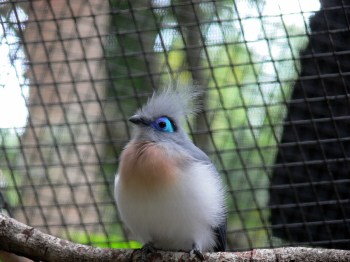
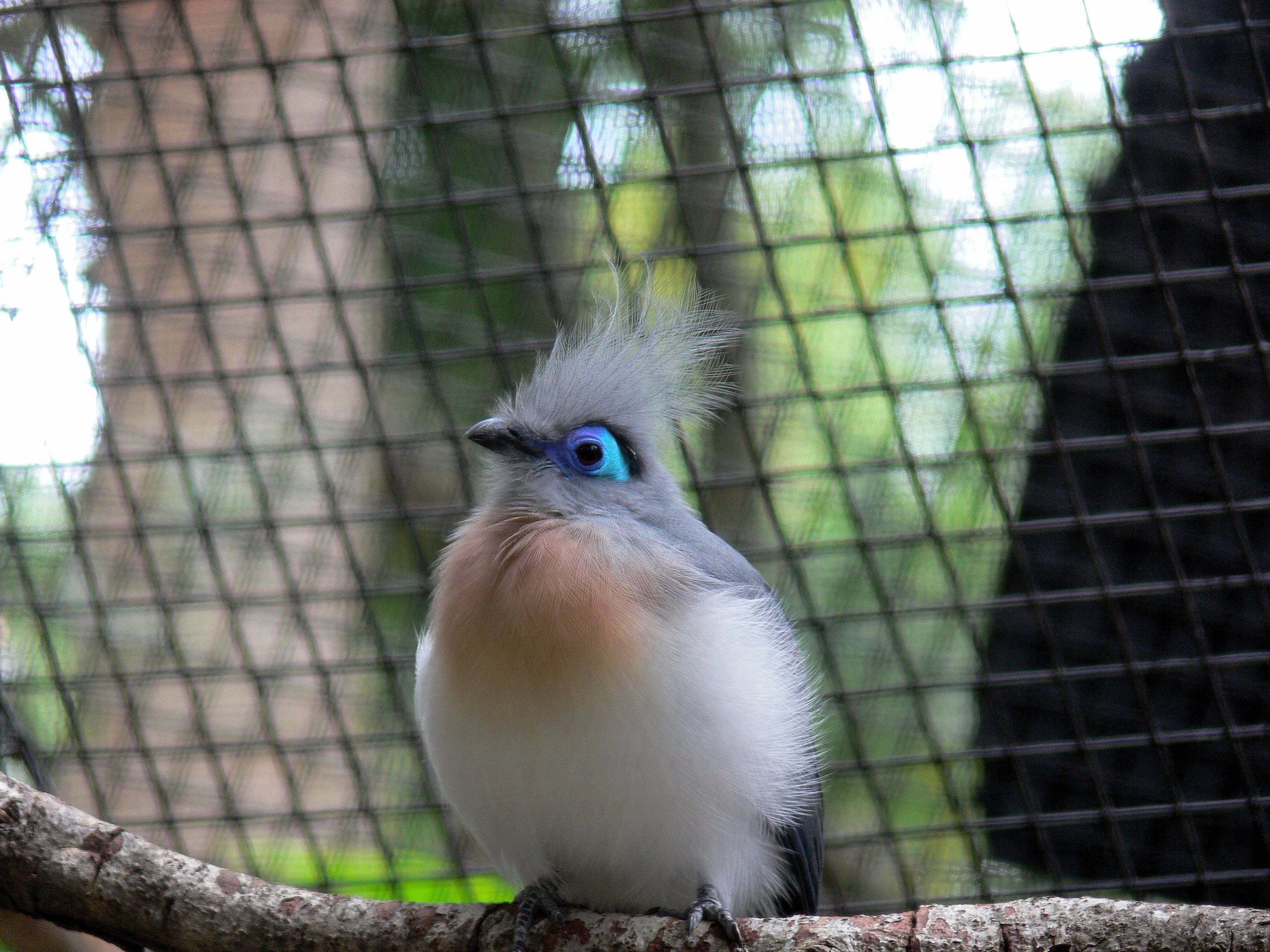
Crested Coua (Coua cristata) by Lee LPZ

Crested Coua (Coua cristata) by Lee LPZ

One sad note, we did ride over to Tampa this week to renew our annual pass to Lowry Park Zoo and found out that the beautiful Crested Couas had died. The man we were talking to didn’t go into detail, but said something tragic happened to both. That has always been one of my favorites in their aviary. Couas are members of the Cuculidae – Cuckoos Family.

Many people make list of the birds they see and that is really neat and enjoyable. Many try to see how many they see each year, in each state, county or country, etc. Doing these pages are starting to become a list of all the birds that I have seen a photo, video, or drawing of. Not sure if it counts for anything, but it is enjoyable and amazing to see the variety and beauty of God’s Omnipotent and Omniscient Hand at work. Yes, I would like to see all 10,000 plus of the birds, but it is not my main ambition in life. The verses in Matthew 16:24-26 keep coming to mind as the work has progressed.

Then said Jesus unto his disciples, If any man will come after me, let him deny himself, and take up his cross, and follow me. For whosoever will save his life shall lose it: and whosoever will lose his life for my sake shall find it. For what is a man profited, if he shall gain the whole world, and lose his own soul? or what shall a man give in exchange for his soul? (Matthew 16:24-26 KJV)

Enjoy the birds, but let their beauty draw you to their Creator.

Wordless Birds

*

Birdwatching at the Jacksonville Zoo by Dan’s Pix

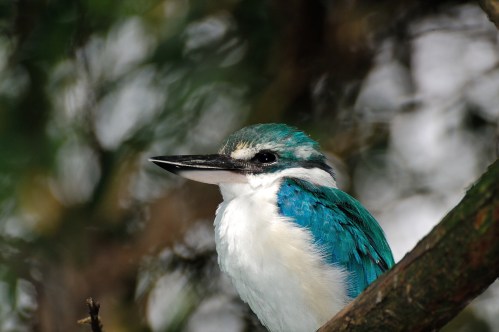
 White-collared Kingfisher by Dan's Pix

Collared Kingfisher by Dan’s Pix

As soon then as they were come to land, they saw a fire of coals there, and fish laid thereon, and bread. Jesus saith unto them, Bring of the fish which ye have now caught. Jesus saith unto them, Come and dine. And none of the disciples durst ask him, Who art thou? knowing that it was the Lord. (John 21:9-12 KJV)

We went on a trip last year and we stopped by the Jacksonville Zoo on the way. Dan recently posted his favorite photos of the zoo on his webpage, Dan’s Pix. I place my photos up on line right away, but he takes time to get them just right before they are posted. That is why his are so much better and the fact that he uses much better photography gear than I do.

I trust you will enjoy them.

Dan at Work at Jacksonville Zoo

Dan at Work at Jacksonville Zoo

Feel free to check out his other great photos – Dan’s Pix home page.

*

Video of 39 Species of Bird-of-paridise by Lab of Ornithology

Lesser Bird-of-paradise (Paradisaea minor) ©©

Lesser Bird-of-paradise (Paradisaea minor) ©©

Which doeth great things past finding out; yea, and wonders without number. (Job 9:10 KJV)

Here is a  video of 39 species of Bird-of-Paridise by Lab of Ornithology. They just released it and thought you might enjoy seeing them. There are more YouTubes of them also at Cornell Lab of Ornithology.

Bird-of-Paradise belong to the Paradisaeidae – Birds-of-paradise Family.

*

Enjoy!

*

*

Birds of the Bible – Names Study – Plover

American Golden Plover (Pluvialis dominica) at National Aviary by Lee

American Golden Plover (Pluvialis dominica) at National Aviary by Lee

From the article on Kosher Animals that we have been looking at with our Bird Name Study, the Plover is listed. I haven’t added a page for this bird so far, so let’s see what we can learn about this bird.

Under the Birds section they give a list of birds from the Septuagint and that is where we find the plover listed:

“The Septuagint versions of the lists are more helpful, as in almost all cases the bird is clearly identifiable:

charadrios (plover)”

They show that it appears in the LXX in Deuteronomy 14:18 and in Leviticus 11:19. Of course I can’t read it, but here it is from the LXX-BYZ on my e-Sword.

Deu 14:18 kaiG2532 CONJ pelekana N-ASM kaiG2532 CONJ charadrion N-ASM kaiG2532 CONJ taG3588 T-APN omoiaG3664 A-APN autoG846 D-DSM kaiG2532 CONJ porphuriona N-ASM kaiG2532 CONJ nukterida N-ASF

I do see the word charadrion in it though. Looking at my database of birds from IOC Version 3.2, the CHARADRIIFORMES Order came up. That is the Shorebirds and Allies Order. The Plover is definitely in that group. The Plovers are in the Charadriidae Family. The Plovers are there and also the Lapwings. Yet, checking the compare mode of all the Bible versions loaded, the Plover is not in any other translation. (at least in my English versions that I can read)

That bird is either translated as Lapwing or Hoopoe. This is going to take some more digging. I have already written about both of those birds.

The KJV+ uses H1744

And the stork, H2624 and the heron H601 after her kind, H4327 and the lapwing, H1744 and the bat. H5847 (Deuteronomy 14:18 KJV+)

H1744
דּוּכּיפת
dûkı̂yphath
doo-kee-fath’
Of uncertain derivation; the hoopoe or else the grouse: – lapwing.
Strong’s Hebrew and Greek Dictionaries

*

The BTSCTVM (which combines Brown Driver Briggs, Thayers, the KJV Concordance, and Strong’s TMV) has:

– Original: דּוּכּיפת
– Transliteration: Duwkiyphath
– Phonetic: doo-kee-fath’
– Definition:
1. unclean bird (probably hoopoe)
– Origin: of uncertain derivation
– TWOT entry: 414
– Part(s) of speech: Noun Feminine

– Strong’s: Of uncertain derivation; the hoopoe or else the grouse: – lapwing.
Total KJV Occurrences: 2
• lapwing, 2
Lev_11:19; Deu_14:18

From what is above, there is really no need to make a new Plover page. Since Plovers and Lapwings are in the same family, Charadriidae and many of the Scriptures say frequently, “their kind,” that is exactly what they are. “Same Kinds” (Oh, no! Did you notice they threw the “grouse” into that last definition. Later.)

We have also written about the Hoopoe, which is a totally different Order and Family.

Black-bellied Plover - Ft DeSoto 11-22-12 Thanksgiving by Lee

Black-bellied Plover – Ft DeSoto 11-22-12 Thanksgiving

Plovers are a widely distributed group of wading birds belonging to the subfamily Charadriinae. There are about 40 species in the subfamily, most of them called “plover” or “dotterel”. The closely related lapwing subfamily, Vanellinae, comprises another 20-odd species.

Plovers are found throughout the world, and are characterised by relatively short bills. They hunt by sight, rather than by feel as longer-billed waders like snipes do.

They feed mainly on insects, worms or other invertebrates, depending on habitat, which are obtained by a run-and-pause technique, rather than the steady probing of some other wader groups.

The plover group of birds has a distraction display subcategorized as false brooding, pretending to change position, to sit on an imaginary nest site.

A group of plovers may be referred to as a stand, wing, or congregation. A group of dotterels may be referred to as a trip. (Wikipedia)

Northern Lapwing (Vanellus vanellus) by Nik

Northern Lapwing (Vanellus vanellus) by Nikhil Devasar

The versions of the Bible that list the Lapwing are: AKJV, Bishops, ECB, IAV, KJV, TRC, Tyndale, UKJV, Webster and the YLT.

Here is a very interesting version of Deut. 14:16:

The bittern, and the charadrion, every one in their kind: the houp also and the bat. (Deuteronomy 14:18 DRB)

That version actually mentions the Charadrion and the “houp,” which is the Hoopoe.

If you look through the birds in the Charadriidae Family you will find that the Lord was gracious and omniscient in his creative design of those species. I trust you never tire of studying God’s Word.

In your studies about the birds and other topics in the Bible, don’t forget one of the most important verses:

For God so loved the world, that he gave his only begotten Son, that whosoever believeth in him should not perish, but have everlasting life. (John 3:16 KJV)

*
See:
Birds of the Bible

Gospel Message
*