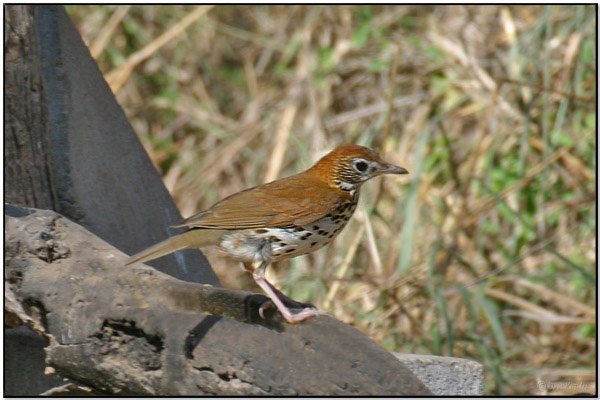
Wood Thrush (Hylocichla mustelina) by Daves BirdingPix
Storks, doves, swallows, and thrushes all know when it’s time to fly away for the winter and when to come back. But you, my people, don’t know what I demand. (Jeremiah 8:7 CEV)
I recently added the Birds of the Bible – Thrushes page. It now appears in the Sidebar and in the Birds of the Bible List. While comparing the Scripture on Jeremiah 8:7, I decided that the Thrushes deserved to be a Bird of the Bible on this blog. As you know, all birds are “Birds of the Bible,” because the Lord created them all. Mainly the ones named in particular have been given their own page. Since Jeremiah 8:7 is translated “thrush” in six Bible versions, it now has its own page.
So God created great sea creatures and every living thing that moves, with which the waters abounded, according to their kind, and every winged bird according to its kind. And God saw that it was good. (Genesis 1:21 NKJV)
Not all versions of the Bible list the Thrush in this verse, but because so many versions do, the Thrush is being added to the Birds of the Bible. The following versions and the verse are listed below:
(CEV) Storks, doves, swallows, and thrushes all know when it’s time to fly away for the winter and when to come back. But you, my people, don’t know what I demand.
(ERV) Even the birds in the sky know the right time to do things. The storks, doves, swifts, and thrushes know when it is time to fly to a new home. But my people don’t know what the LORD wants them to do.
(GNB) Even storks know when it is time to return; doves, swallows, and thrushes know when it is time to migrate. But, my people, you do not know the laws by which I rule you.
(LITV) Also the stork in the heavens knows her seasons, and the turtledove and the swallow and the thrush observe the time of their coming. But My people do not know the judgment of Jehovah.
(NAS77) “Even the stork in the sky Knows her seasons; And the turtledove and the swift and the thrush Observe the time of their migration; But My people do not know The ordinance of the LORD.
(NASB) “Even the stork in the sky Knows her seasons; And the turtledove and the swift and the thrush Observe the time of their migration; But My people do not know The ordinance of the LORD.
Chipping Sparrow (Spizella passerina) shot thru window with screen by Lee
You will show me the path of life; In Your presence is fullness of joy; At Your right hand are pleasures forevermore. (Psalms 16:11 NKJV)
Some birdwatching has been going on around the yard and neighborhood. Every once in a while, I do get away from the computer and look around, though only nearby. Yet, I have been seeing some interesting birds, especially some I have never seen in the yard. I was watering a new tree when I heard a sound I didn’t recognize at first. After searching and praying that it would come into view, I spotted a Pileated Woodpecker on a power pole. Been here 5 years and it is the first one spotted from the yard. Then I spotted 2 Chipping Sparrows yesterday and 3 today. (also a yard first) Today an American Goldfinch showed up on my feeder. All 3 of those species were new to the yard. They were kept company by 2 Cardinals, Boat-tailed Grackles, Brown-headed Cowbirds, Eurasian Collarded Doves, Mourning Doves and Red-winged Blackbirds.
Blue-winged Teal by Dan at Circle B
Dan took some photos today out at Circle B Bar Reserve while I was busy. He said there was lots of activity and many photographers taking advantage of that activity. One photo in particular caught my interest and I have included it. He also had some neat photos of an immature Black-crowned Night-Heron, but they aren’t available yet.
I am still working on updating the Birds of the World section to the IOC World Bird List, ver. 2.7. I have over 91 Families updated and started working on the Index also. The Species List of the First Name of the Birds and Genus is updated “A” through” Z”. So at least you can find the birds.
American Goldfinch (Carduelis tristis) by Lee thru window
As I have been updating, I have been adding photos to some of the families. Some of the Families that we have written about lately have also been updated even though they are beyond the 91 completed.
New Finch Species Shows Conservation, Not Macroevolution
by Brian Thomas, M.S. *
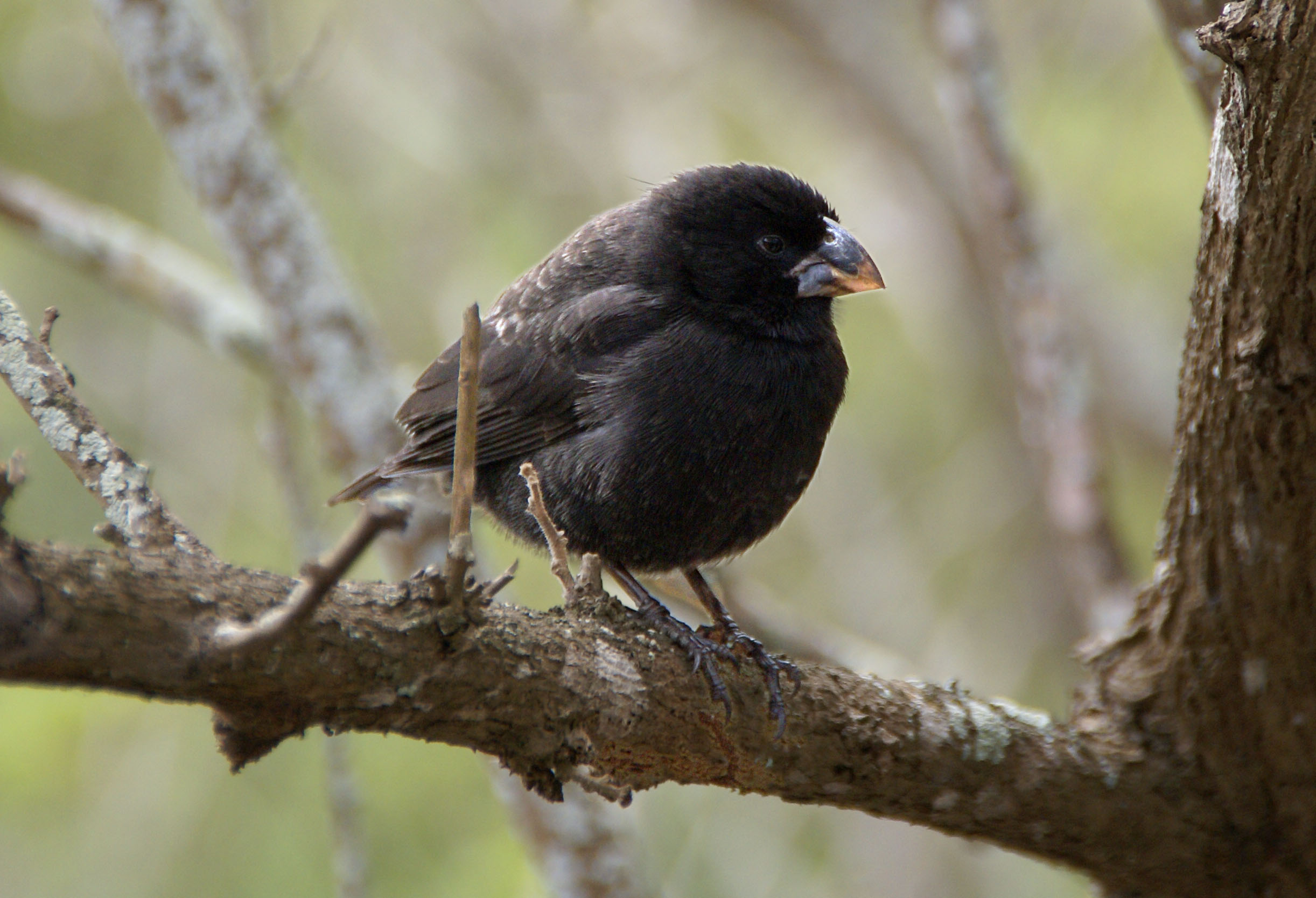
“Darwin’s finches” are a variety of small black birds that were observed and collected by British naturalist Charles Darwin during his famous voyage on the H.M.S. Beagle in the early 1800s. Years later, Darwin argued that subtle variations in their beak sizes supported his concept that all organisms share a common ancestor (a theory known as macroevolution). The finches, whose technical name is Geospiza, have since become classic evolutionary icons.
…..
In the fourth generation, “after a severe drought, the lineage was reduced to a single brother and sister, who bred with each other.”1 Their descendants have carried on the family traits. The Grants reported in a study on the birds published in Proceedings of the National Academy of Sciences that “our observations provide new insight into speciation and hence, into the origin of a new species.”2 But the details show that this new “species” is just a variation within the finch kind, and is therefore irrelevant to big-picture evolution.
Genus Geospiza contains six species, and these are usually distinguished by the songs that the males sing primarily to attract breeding partners. However, if a father bird dies while his chicks are young, and all they hear is the neighboring song of a different species, for example, young birds can learn the wrong songs. When these mature, they sing the song of, and breed with, the foster father’s species. Other scenarios result in crossbreeding between Geospiza species. ……”
Cedar Waxwing (Bombycilla cedrorum) by Daves BirdingPix
Do Migratory Birds Practice Preventative Medicine?
by Brian Thomas, M.S. *
“Before a long migration, certain birds shift from an insect diet to eating fruits such as berries. Researchers once thought that this added carbohydrate reserves as fuel for the journey. But a new study out of the University of Rhode Island suggests that the birds are interested in the fruits’ antioxidants, not their sugars.
Antioxidants are chemicals that are packed within richly colored fruit skins and are known to stabilize cellular processes. Based on research presented at the March 24th American Chemical Society meeting in San Francisco, it appears that the birds fill up on berry antioxidants for the medicinal benefits they provide to tissues that will undergo stress during the upcoming flight.
But this implies that birds use preventative medicine by instinct,….”
To read the rest of the article – CLICK HERE
And wild animals shall meet with hyenas; the wild goat shall cry to his fellow; indeed, there the night bird settles and finds for herself a resting place. (Isaiah 34:14 ESV)
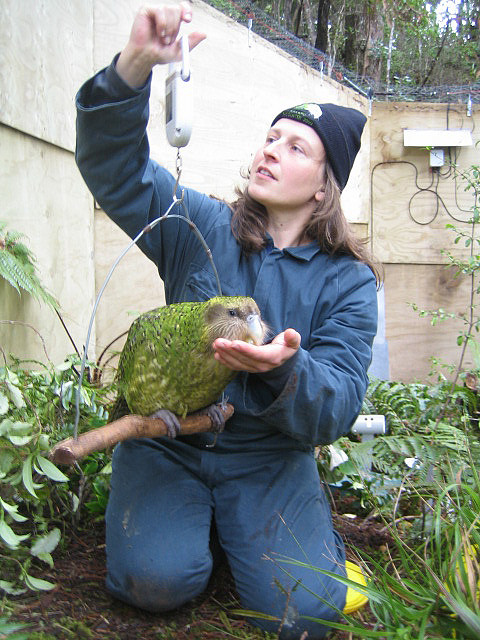
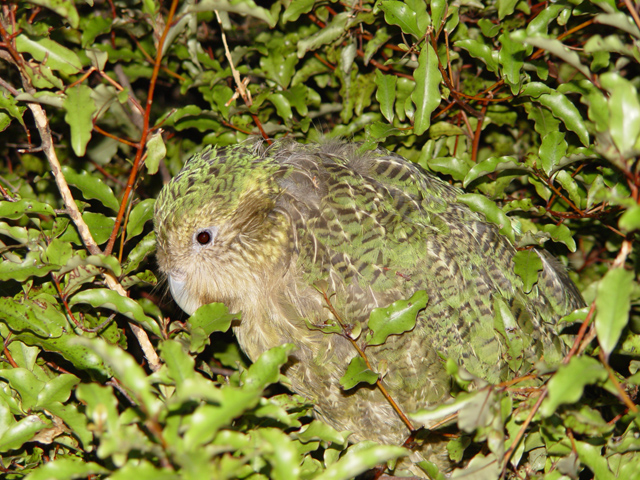
The Kakapo (Strigops habroptila) is another unique bird Formed by the Creator. The following articles will introduce you to a New Zealand bird that is extremely endangered with only about 90-120 left in the world (depending on sources). They belong to the Strigopidae Family, of which it is the only bird in the Strigops genus and keeps company with the Kea and New Zealand Kaka of the Nestor genus. The three are classified as New Zealand Parrots and belong to the Psittaciformes Order of Parrots and Cockatoos.
From Creation Moments: A Truly Strange Bird
Many, O LORD my God, are thy wonderful works which thou hast done, and thy thoughts which are to us-ward: they cannot be reckoned up in order unto thee: if I would declare and speak of them, they are more than can be numbered. (Psalms 40:5 KJV)
Though God created the entire living kingdom in only a few days, the variety and creativity of what He made seems nearly unlimited by our standards. One of the more unusual creatures He made was thought extinct until it was rediscovered in 1958.
The kakapo parrot lives in New Zealand. The most unusual parrot on Earth, it is one of only a few known parrots that prefers to sleep during the day and becomes active at night. Weighing in at five pounds, it is also the world’s heaviest parrot. It is, perhaps not surprisingly, the world’s only non-flying parrot.
The Creator’s unusual expression of inventive creativity in designing the kakapo did not end here. The mating habits of the kakapo are especially peculiar for birds. In mating season, the males gather in locations that are used year after year for mate selection. Female parrots come to these places to inspect the males to select a mate. However, in most un-bird-like fashion, the males provide absolutely no help building the nest or rearing the young.
This is what Wikipedia (with editing) has to say about the Kakapo:
“The Kakapo (Māori: kākāpō, meaning night parrot), Strigops habroptila, also called owl parrot, is a species of large (60 cm, 24 in), flightless nocturnal parrot endemic to New Zealand. It has finely blotched yellow-green plumage, a distinct facial disc of sensory, vibrissa-like feathers, a large grey beak, short legs, large feet, and wings and a tail of relatively short length. A certain combination of traits makes it unique among its kind—it is the world’s only flightless parrot, the heaviest parrot (2-4 kg, 4.5-9 lb), nocturnal, herbivorous, visibly sexually dimorphic in body size, has a low basal metabolic rate, no male parental care, and is the only parrot to have a polygynous lek breeding system. It is also possibly one of the world’s longest-living birds. Its anatomy typifies the tendency of bird evolution on oceanic islands, with few predators and abundant food: a generally robust physique, with accretion of thermodynamic efficiency at the expense of flight abilities, reduced wing muscles, and a diminished keel on the sternum.
The Kakapo is critically endangered; as of February 2010, only 120 living individuals are known, most of which have been given names.
The Kakapo has a well-developed sense of smell, which complements its nocturnal lifestyle. It can discriminate among odours while foraging; a behaviour reported for only one other parrot species. One of the most striking characteristics of the Kakapo is its pleasant and powerful odour, which has been described as musty. Given the Kakapo’s well-developed sense of smell, this scent may be a social chemosignal.”
Facts about the Kakapo from New Zealand’s Dept of Conservation:
* It is the heaviest parrot in the world. Males can weigh over two kilograms. Unique among land birds, it can store large amounts of energy as body fat.
* It is the only parrot to have a ‘lek’ mating system: males compete for ‘calling posts’ specially dug-out bowls in the earth and call (“boom”) each night in summer months for a female. The male’s low-frequency mating boom travels over several kilometres. It is the only parrot to have an inflatable thoracic air sac.
* Kākāpō breed every three to four years.
* A bird can range several kilometres in one night.
* Although it cannot fly, it is good at climbing trees.
* The birds are herbivores and eat variety of foods such as roots, leaves and fruit
* Kākāpō once ranged from near sea level to high in the mountains.
* Possibly as defence against its ancient predator – the giant eagle – the kākāpō became nocturnal and learned to remain still (‘freeze’) at times of danger.
Incline your ear, and come unto me: hear, and your soul shall live; and I will make an everlasting covenant with you, even the sure mercies of David. (Isaiah 55:3 KJV)
All insects that hear, except one, have two ears. Some insects have ears on their legs, thorax or abdomen. However, they all follow the same principle. Their ears are separated so that they can locate the source of the sound – except in one insect.
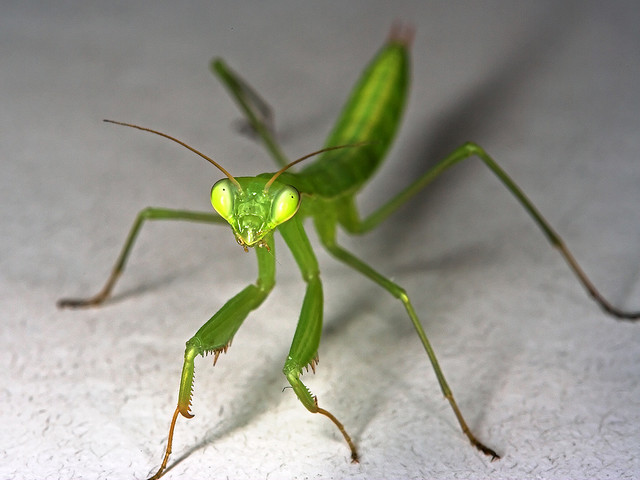
Scientists always thought the praying mantis was deaf. The 1,700 species of mantises have no structure that looks like an ear. Only after a long process of detailed study and testing did scientists finally discover that the mantis can hear. Further investigation finally led to the discovery of one of the most bizarre methods of hearing anywhere in the animal kingdom.
The mantis’s hearing organ is difficult to call an ear. Unlike any other insect, the mantis has only one hearing organ, located in a groove underneath its thorax. The teardrop shaped groove has a thinner cuticle than other parts of the body. Beneath the cuticle there is a relatively large air sac on each side of the groove. These sacs are connected to the insect’s respiratory system. Near the top of the sac are the nerves that carry the sensation of sound to the nervous system. Scientists say that this hearing organ senses ultrasonic frequencies. When researchers played a bat like sound to a mantis in flight, it immediately took an evasive flight path to escape the bat it thought it heard.
There is no limit to God’s creativity or His ability to make whatever He can imagine. We should keep this in mind, especially when some human authority tells us the Bible has made a mistake.
Prayer:
I marvel and praise You, dear Lord, as I consider the creation around me. Even as some would use the creation to deny Your existence, help me to more clearly see the excellence of all that You do, both materially and spiritually. Amen.
Notes:
Miller, Julie Ann. 1986. “Sensory surprises in platypus, mantis.” Science News, v. 129. p. 104.
Teaching them to observe all things whatsoever I have commanded you: and, lo, I am with you alway, even unto the end of the world. Amen. (Matthew 28:20 KJV)
Birds in Hymns – Get Close To Jesus
Words by Alice Larry Woodcock
Music by Alice Larry Woodcock
Get Close To Jesus
Whene’er your trials are too hard for you,
Burdens are heavy, and your friends seem few,
Go to your Savior, kneel to Him in prayer,
He’ll hear you, for He’s always there.
Refrain
Get close to Jesus, He’s your best friend; Get close to Jesus, He’ll comfort send; In times of trial, in times of fear, Get close to Jesus, He’s always near.
He is the friend above all others rare;
Even the sparrow is within His care;
Much more to you will He His love bestow
If to Him you will only go.
Refrain
Get close to Jesus, He’s your best friend; Get close to Jesus, He’ll comfort send; In times of trial, in times of fear, Get close to Jesus, He’s always near.
So for tomorrow and its needs ne’er fear;
Leave all to Him, have faith, be of good cheer;
Then go and help some others’ cross to bear,
And tell them of His wondrous care.
Refrain
Get close to Jesus, He’s your best friend; Get close to Jesus, He’ll comfort send; In times of trial, in times of fear, Get close to Jesus, He’s always near.
Are not five sparrows sold for two farthings, and not one of them is forgotten before God? But even the very hairs of your head are all numbered. Fear not therefore: ye are of more value than many sparrows. (Luke 12:6-7 KJV)
Birds in Hymns – God Sees The Little Sparrow Fall
Words by Maria Straub, 1874 (1838-1898)
Music – Providence, by Solomon W. Straub
God Sees The Little Sparrow Fall
God sees the little sparrow fall,
It meets His tender view;
If God so loves the little birds,
I know He loves me, too.
Refrain
He loves me, too, He loves me, too, I know He loves me, too; Because He loves the little things, I know He loves me, too.
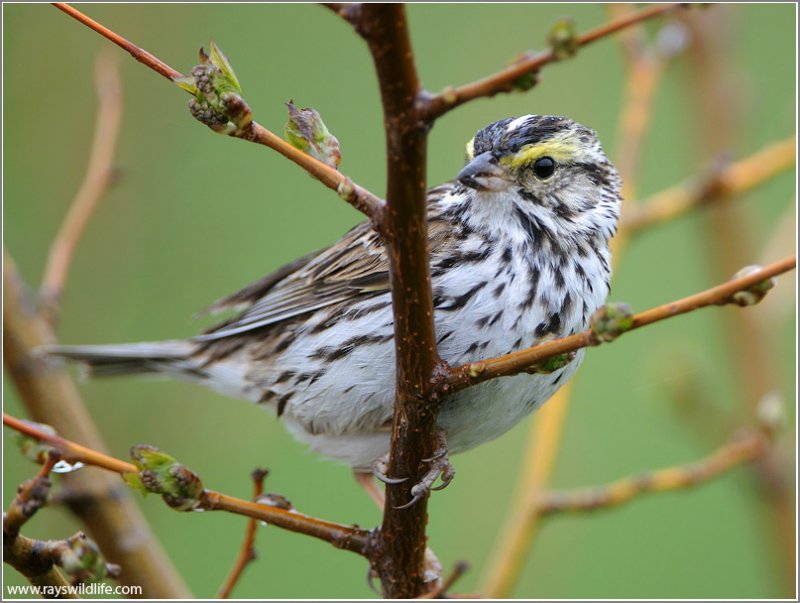
Savannah Sparrow (Passerculus sandwichensis) by Ray
He paints the lily of the field,
Perfumes each lily bell;
If He so loves the little flow’rs,
I know He loves me well.
Refrain
He loves me, too, He loves me, too, I know He loves me, too; Because He loves the little things, I know He loves me, too.
Song Sparrow in white flowers by Daves BirdingPix
God made the little birds and flow’rs,
And all things large and small;
He’ll not forget his little ones,
I know He loves them all.
Refrain
He loves me, too, He loves me, too, I know He loves me, too; Because He loves the little things, I know He loves me, too.
Water Splashing on Rocks – Point Lobos State Reserve by Daves BP
Therefore whosoever heareth these sayings of mine, and doeth them, I will liken him unto a wise man, which built his house upon a rock: (Matthew 7:24 KJV)
When the Lord created the world and all that is therein, He created the rocks and hills and the birds that He created were well adapted to live in those places. Birdwatchers through the years have observed them in this habitat of rocks, stones, cliffs, and other high rocky places. Just as Adam named the first birds, ornithologists (bird people) are still naming birds.
Searching through the latest IOC 2.7 List of Birds, I found 50 birds with “Rock” in their names. Searching the Bible for the word “Rock”, I found around 130 verses referring to a “rock” or “The Rock.” Here is a blend of the birds and some of the Scriptures verses that show the mighty Hand of God at work and the neat “Rock Birds” Formed by Him.
Here is the list of the last 25 birds with “Rock” in their name in taxonomic order with a few words about them :
O come, let us sing unto the LORD: let us make a joyful noise to the rock of our salvation. (Psalms 95:1 KJV)
Rockrunner (Achaetops pycnopygius) – The Rockrunner is a monogamous bird which means that the bird finds and breeds with one partner for the rest of its life. The bird lays between 2 to 3 eggs and they are coloured red.
The nest is built high up in the tree canopy and is protected from predators by branches and the dense green foliage.
Rock-loving Cisticola (Cisticola emini) – It is usually associated with rocky wooded terrain with interspersed patchy grass tussocks. Forages in rocks or rank vegetation for insects. Split from the Lazy Cisticola.
Rock Wren (Salpinctes obsoletus) – Their breeding habitat is dry rocky locations, including canyons, from southwestern Canada south to Costa Rica. This bird builds a cup nest in a crevice or cavity, usually among rocks.
These birds are permanent residents in the south of their range, but northern populations migrate to warmer areas from the central United States and southwest Canada southwards. They are occasional vagrants in the eastern United States.
These birds actively hunt on the ground, around and under objects, probing with their bill as their extraction tool. They mainly eat insects and spiders. Neat Video This bird’s song is a trill, becoming more varied during the nesting season.
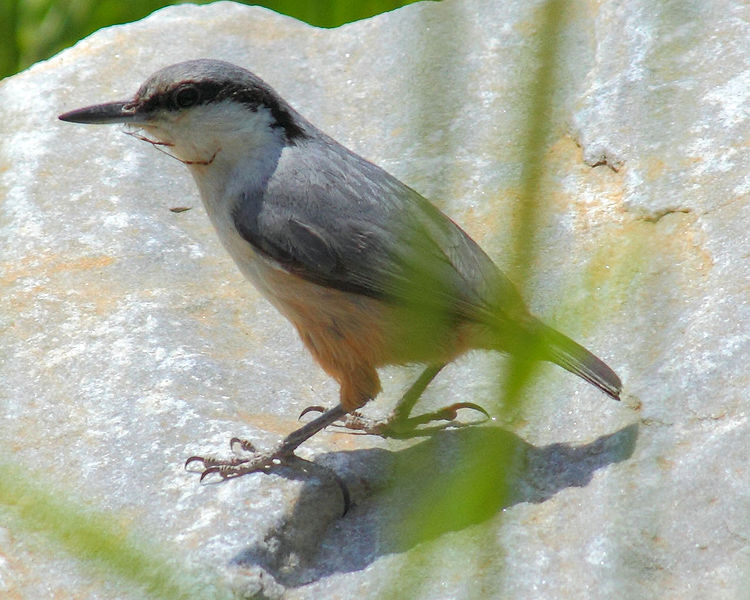
Western Rock Nuthatch (Sitta neumayer) – Video – The Western Rock Nuthatch is a bird associated with habitats with bare rocks, especially in mountainous areas. Those at the highest altitudes may move lower down in winter.
It feeds on insects and spiders in summer, supplemented with seeds and snails in winter. It feeds on the ground, and will wedge larger items in rock crevies while it hammers them open with its strong bill. It will also flycatch.
This territorial species builds a flask-shaped nest from mud, dung and hair or feathers in a rock crevice, cave, or under an overhang on a rock face. Decorative items may be pushed into crevices and cracks near the entrance to the nest. The nest is lined with softer materials and the entrance is sealed with mud. 4-10 eggs are laid, and are white speckled with yellow.
In God is my salvation and my glory: the rock of my strength, and my refuge, is in God. (Psalms 62:7 KJV)
Brown Rock Chat (Cercomela fusca) – Video – Habitat: Rocky hills, ravines, ruins of ancient tombs and forts, and in suburban compounds, occasionally visiting inhabited homes or nesting in rafters.
Brown-tailed Rock Chat (Cercomela scotocerca) – Photo – A seriously undistinguished little bird that only a birder or ornithologist would bother looking for! It’s main distinguishing feature is its brown-ness and it’s distinguished from the similar Red-tailed Chat by the fact that it’s well, browner. It’s fairly uncommon and prefers rocky bush country. It’s range extends down as far as Samburu, but the best place we’ve found to see it is near Lake Baringo where it can usually be found at the base of the basalt cliffs just West of the lake. Even there it can be difficult to spot since it blends in well against the rocks and dust, especially in the dry season when evrything looks (wait for it) brown. (Kenya Birds)
Cape Rock Thrush (Monticola rupestris) – The rock-thrushes, Monticola, are a genus of chats, medium-sized mostly insectivorous or omnivorous songbirds. All are Old World birds associated with mountainous regions.
Sentinel Rock Thrush (Monticola explorator) – Same as above – Video by Keith Short-toed Rock Thrush(Monticola brevipes) – Same as above – It is found in Angola, Botswana, Namibia, and South Africa. Its natural habitat is subtropical or tropical dry shrubland.
He brought me up also out of an horrible pit, out of the miry clay, and set my feet upon a rock, and established my goings. (Psalms 40:2 KJV)
Miombo Rock Thrush (Monticola angolensis) – Same as above Rufous-tailed Rock Thrush (Monticola saxatilis) (Common) – Same as above Little Rock Thrush (Monticola rufocinereus) – Same as above – It is found in rocky areas with some trees, and sometimes near settlements.[2][3] At 15 to 16 centimetres (5.9 to 6.3 in) this is the smallest of the rock thrushes.
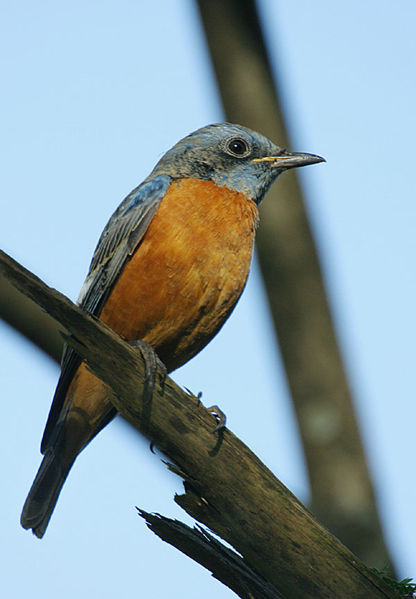
Blue Rock Thrush (Monticola solitarius) – Same as above – Blue Rock Thrush breeds in open mountainous areas, usually higher than the breeding zone of the related Rufous-tailed Rock Thrush. It nests in rock cavities and walls, and usually lays 3-5 eggs. An omnivore, the Blue Rock Thrush eats a wide variety of insects and small reptiles in addition to berries and seeds.
This is a starling-sized bird, 21–23 cm in length with a long slim bill. The summer male is unmistakable, with all blue-grey plumage apart from its darker wings. Females and immatures are much less striking, with dark brown upperparts, and paler brown scaly underparts. Both sexes lack the reddish outer tail feathers of Rock Thrush. The male Blue Rock Thrush sings a clear, melodious call that is similar to, but louder than the call of the Rock Thrush.
The Blue Rock Thrush is Malta’s national bird and is shown on the Lm 1 coins that was part of the previous currency of the country.
Chestnut-bellied Rock Thrush (Monticola rufiventris) – Same as above – It is found in Bangladesh, Bhutan, China, India, Laos, Myanmar, Nepal, Pakistan, Thailand, and Vietnam. Its natural habitat is temperate forests. Blue-capped Rock Thrush (Monticola cinclorhynchus) – Same as above Video – This thrush-like Old World flycatcher breeds in the foothills of the Himalayas and winters in the hill forests of southern India.
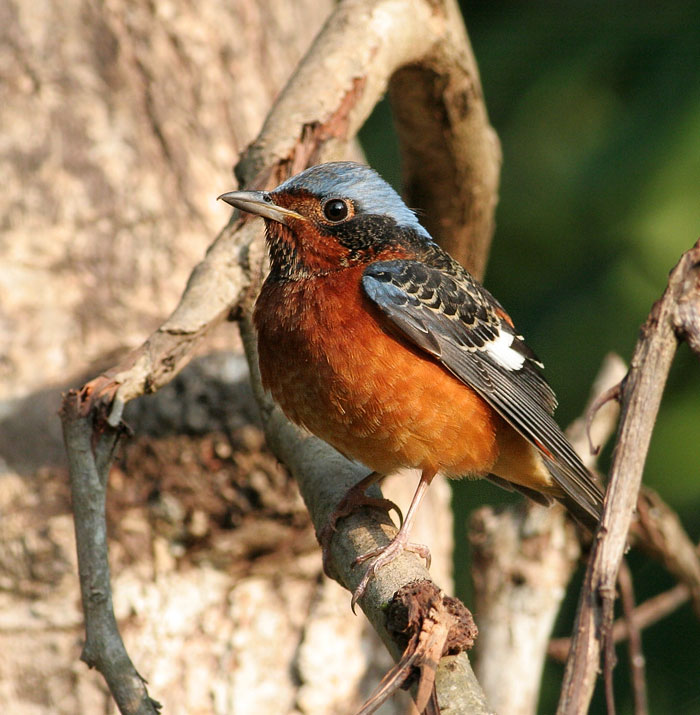
White-throated Rock Thrush by Peter Ericsson
White-throated Rock Thrush (Monticola gularis) – Same as above – It is found in Cambodia, China, Hong Kong, Japan, North Korea, South Korea, Laos, Malaysia, Myanmar, Russia, Singapore, Thailand, and Vietnam. Its natural habitat is temperate forests. Littoral Rock Thrush (Monticola imerina) – Same as above – Its natural habitats are dry savanna and subtropical or tropical dry shrubland. Forest Rock Thrush (Monticola sharpei) – Same as above – It is endemic to Madagascar.
And they remembered that God was their rock, and the high God their redeemer. (Psalms 78:35 KJV)
Rockefeller’s Sunbird (Cinnyris rockefelleri) – It is found in Democratic Republic of the Congo, possibly Burundi, and possibly Rwanda. Its natural habitats are subtropical or tropical moist montanes and subtropical or tropical high-altitude shrubland. It is threatened by habitat loss. Pale Rockfinch (Carpospiza brachydactyla) – Photo – Rock Sparrow (Petronia petronia) – This sparrow breeds on barren rocky hills from the Iberian peninsula and western north Africa across southern Europe and through central Asia. It is largely resident in the west of its range, but Asian birds migrate to more southerly areas, or move down the mountains.
As it is written, Behold, I lay in Sion a stumblingstone and rock of offence: and whosoever believeth on him shall not be ashamed. (Romans 9:33 KJV)
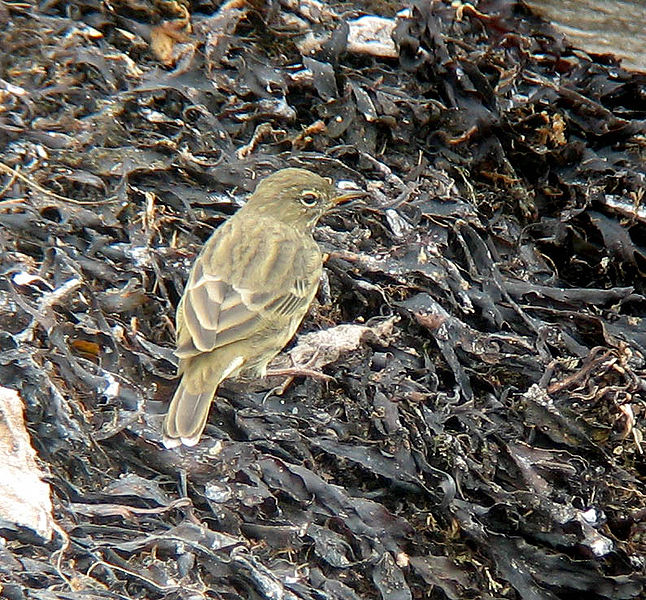
Rock Firefinch (Lagonosticta sanguinodorsalis) – Photo – It is commonly found in bushy and rocky outcrops on the Jos Plateau, Nigeria and inselbergs to the north and east. It probably feeds on grass seeds. Eurasian Rock Pipit (Anthus petrosus) – a small passerine bird species which breeds on rocky coasts of western Europe northwards from Brittany. Rock Pipits tend to be found along rocky coasts, whereas Water Pipits favour damp grassland.
African Rock Pipit (Anthus crenatus) – The Yellow-tufted Pipit, also known as the African Rock Pipit, is a species of bird in the Motacillidae family. It is found in Lesotho and South Africa. Its natural habitat is subtropical or tropical high-altitude grassland.
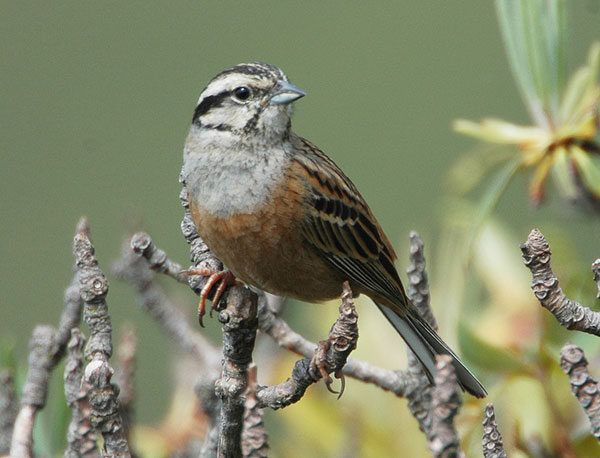
Rock Bunting (Emberiza cia) – Photo – Rock Bunting breeds in open dry rocky mountainous areas. It lays 3-5 greyish eggs in a lined nest on the ground or occasionally in a low bush. Its natural food consists of insects when feeding young, and otherwise seeds.
Doth the eagle mount up at thy command, and make her nest on high? She dwelleth and abideth on the rock, upon the crag of the rock, and the strong place. (Job 39:27-28 KJV)
For thou art my rock and my fortress; therefore for thy name’s sake lead me, and guide me. (Psalms 31:3 KJV)
There are many more verses that mention “The Rock” and there are also many more birds that live and eat in rocky places. They may not have “rock” in their name, but they were all created by The Rock, Jesus Christ.
And to make all men see what is the fellowship of the mystery, which from the beginning of the world hath been hid in God, who created all things by Jesus Christ: (Ephesians 3:9 KJV)
And did all drink the same spiritual drink: for they drank of that spiritual Rock that followed them: and that Rock was Christ. (1 Corinthians 10:4 KJV)
Information mostly from Wikipedia, but other internet sources quoted also. Names according to the IOC 2.7 version.
Ian’s Bird of the Week – Lesser Frigatebird ~ by Ian Montgomery
Newsletter – 3/2/11
This is the third of the post-cyclone Yasi birds of the week. The first dealt with survival of small birds; the second with birds like fruit-doves that move after the cyclone in search of food. Another category of birds greatly affected by cyclones are seabirds, particularly those that spend much time on the wing and these often appear in places where they are not usually seen or get blown inland, sometimes over great distances.
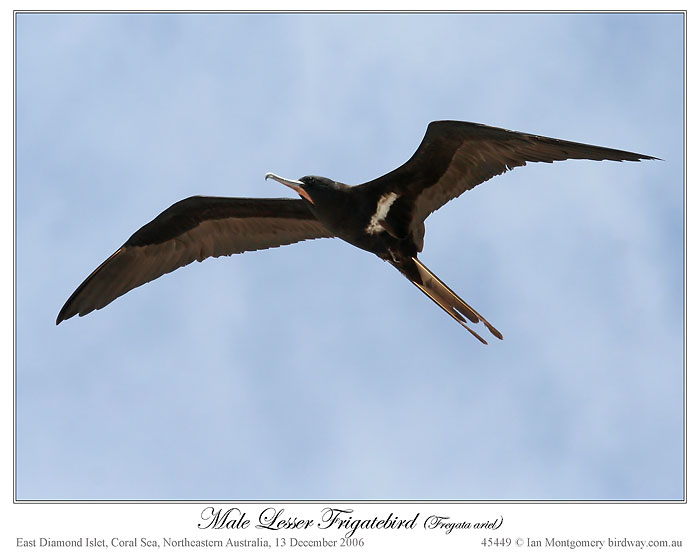
The Lesser Frigatebird is common in oceanic waters of northern Australia and breeds in colonies both on the northern mainland and on cays and islands. Adult birds are normally sedentary, remaining in the vicinity of the colonies, though immature birds may travel widely over the oceans. Frigatebirds not normally seen in places like Townsville, distant from breeding colonies, except after cyclones and cyclone Yasi was no exception with both Great and Lesser Frigatebirds being recorded along the coast. I was surprised to see a pair of Lesser Frigatebirds near my place at Bluewater, 11km from the coast and the birds looked quite out of place soaring over the hills south of the house.
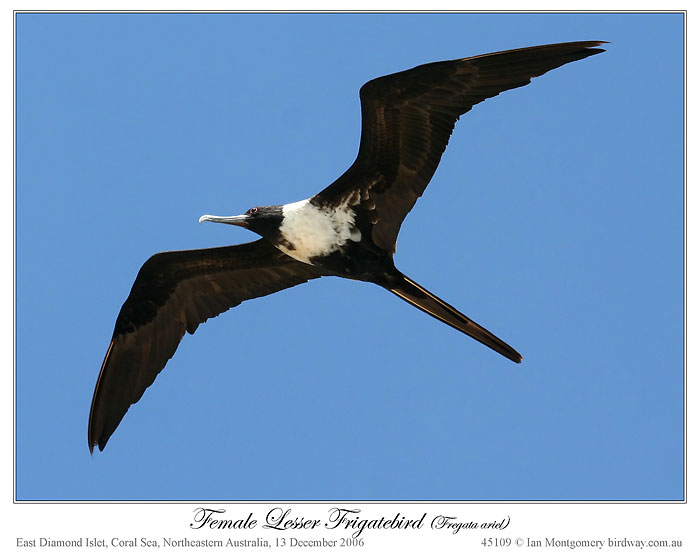
Lesser Frigatebird (Fregata ariel) female by Ian
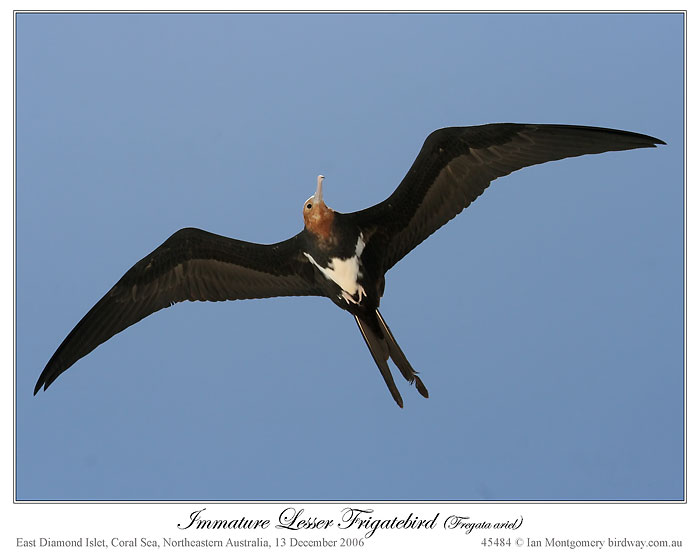
Lesser Frigatebirds are easily distinguished in all plumages from Great Frigatebirds by having white ‘armpits’ or spurs. The first photo shows a male bird, black except for these spurs and male Great Frigatebirds are entirely black. Male Frigatebirds have inflatable red throat pouches used to spectacular effect in displays (for example this male Magnificent Frigatebird in Ecuador: http://www.birdway.com.au/fregatidae/magnificent_frigatebird/source/magnif_frigatebird_27662.htm ). The second photo shows a female Lesser Frigatebird and the third an immature one.
Frigatebirds are huge. Even the Lesser, the smallest of the 5 global species, is 70-80cm/28-32in. in length with a wingspan of 1.8-1.9m/5.9-6.2 feet. They are very light for their size, having very light bones, and are adapted to soaring effortlessly in the trade winds where they are usually found. They are famous as pirates, forcing other seabirds, particularly boobies, to disgorge their prey ( http://www.birdway.com.au/fregatidae/greater_frigatebird/source/greater_frigatebird_39356.htm ), but they are also adept fishers in their own right, snatching flying fish in flight and other fish and cuttlefish from the surface of the water. They have tiny feet, useful only for perching in trees when nesting or roosting and quickly become water-logged if forced to land on water which they normally avoid. They will bathe and drink fresh water in flight ( http://www.birdway.com.au/fregatidae/greater_frigatebird/source/greater_frigatebird_40675.htm ).
Lesser Frigatebird (Fregata ariel) imm. by Ian
11km from the coast is nothing to a frigatebird and it is likely that cyclone-distributed frigatebirds can find their way home (like swifts, they often take advantage of storm fronts). Less fortunate perhaps was the Petrel recorded post-Yasi on the Atherton Tableland by Alan Gillanders, though the record for Yasi goes to a Bridled Tern rescued ‘in bad shape’ in Alice Springs by Chris Watson, probably as far away from the ocean as you can get in Australia.
The latest addition to the website is a taxonomic index of Australian birds ( http://www.birdway.com.au/aus_taxonomic.htm ), showing Orders and Families and with links to the 97 of 103 families of Australian birds represented on the website. The 6 unrepresented families are also shown but lack links. Some of these missing families are merely rare vagrants such as Northern Storm-Petrels and Leaf Warblers (the Arctic Warbler) or introductions like the Ostrich but others such as Penguins (there are only photos of African Penguins) are to be regretted and I hope to rectify this before the year is out. The other two – Scrub-birds and Sheathbills – are in the very hard baskets, and I can’t make any promises. If classification is your thing, this page is for you and you can find it under the grey navigation button ‘Indices to Australian Birds’ formerly singular. There are also instructions on the home page: http://www.birdway.com.au/index.htm#news .
The birds of the air, And the fish of the sea That pass through the paths of the seas. O LORD, our Lord, How excellent is Your name in all the earth! (Psalms 8:8-9 NKJV)
The frigatebirds are a family, Fregatidae, of seabirds. There are five species in the single genus Fregata. They are also sometimes called Man of War birds or Pirate birds. Since they are related to the pelicans, the term “frigate pelican” is also a name applied to them. They have long wings, tails and bills and the males have a red gular pouch that is inflated during the breeding season to attract a mate. They are part of the Suliformes Order.
Frigatebirds are pelagic piscivores which obtain most of their food on the wing. A small amount of their diet is obtained by robbing other seabirds, a behavior that has given the family its name, and by snatching seabird chicks. Frigatebirds are seasonally monogamous, and nest colonially. A rough nest is constructed in low trees or on the ground on remote islands. A single egg[citation needed] is laid each breeding season. The duration of parental care in frigatebirds is the longest of any bird.
Frigatebirds are found over tropical oceans and ride warm updrafts. Therefore, they can often be spotted riding weather fronts and can signal changing weather patterns.
These birds do not swim and cannot walk well, and cannot take off from a flat surface. Having the largest wingspan to body weight ratio of any bird, they are essentially aerial, able to stay aloft for more than a week, landing only to roost or breed on trees or cliffs. (Wikipedia)
Dan and I had the privilege of see a Magnificent Frigatebird flying over Ding Darling NWR.
Waves on Rocks – Point Lobos State Reserve by Daves BP
The LORD is my rock, and my fortress, and my deliverer; my God, my strength, in whom I will trust; my buckler, and the horn of my salvation, and my high tower. (Psalms 18:2 KJV)
When the Lord created the world and all that is therein, He created the rocks and hills and the birds that He created were well adapted to live in those places. Birdwatchers through the years have observed them in this habitat of rocks, stones, cliffs, and other high rocky places. Just as Adam named the first birds, ornithologists (bird people) are still naming birds.
Searching through the latest IOC 2.7 List of Birds, I found 50 birds with “Rock” in their names. Searching the Bible for the word “Rock”, I found around 130 verses referring to a “rock” or “The Rock.” Here is a blend of the birds and some of the Scriptures verses that show the mighty Hand of God at work and the neat “Rock Birds” Formed by Him.
Here is a list of the first 25 birds with “Rock” in their name in taxonomic order with a few words about them :
Rock Shag (Phalacrocorax magellanicus) by Daves BirdingPix
Rock Shag (Phalacrocorax magellanicus) – The Rock Shag usually nests on ledges on steep, bare, rocky cliffs. It normally lays 3 eggs, though nests of from 2 to 5 eggs have been seen. Nesting colonies range is size from 5 pairs to nearly 400.
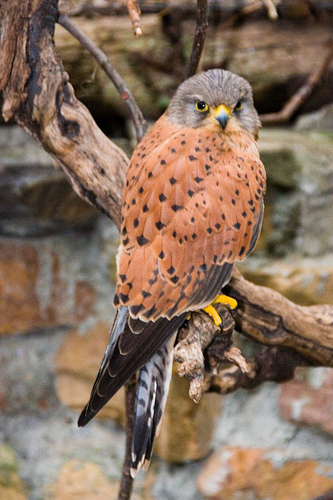
Rock Kestrel (Falco rupicolus) – It does not require woodland to be present as long as there are alternate perching and nesting sites like rocks or buildings. It will thrive in treeless steppe where there are abundant herbaceous plants and shrubs to support a population of prey animals.
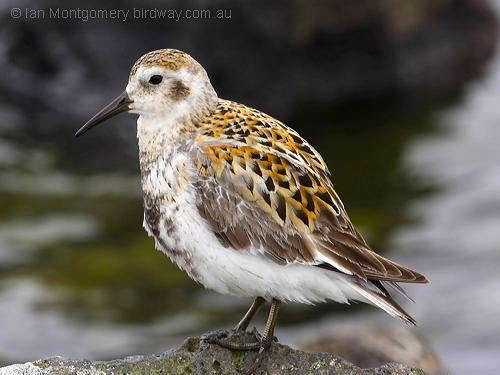
Rock Sandpiper (Calidris ptilocnemis) – They nest on the ground either elevated on rocks or in lower damp location. The males makes several scrapes; the female choose one and lays 4 eggs. Both the male and female take the responsibility for incubation. Birds migrate south to rocky ice-free Pacific coasts in winter.
Now Rizpah the daughter of Aiah took sackcloth and spread it for herself on the rock, from the beginning of harvest until the late rains poured on them from heaven. And she did not allow the birds of the air to rest on them by day nor the beasts of the field by night. (2 Samuel 21:10 NKJV)
Rock Pratincole (Glareola nuchalis) – This species shows a preference for exposed emergent rocks in large rivers and streams, sometimes also frequenting mud and sandbars by lagoons. Eggs are laid directly into shallow depressions, cracks, and on the flat tops of bare rocks surrounded by deep and sometimes fast-flowing water, or on rock ledges and under overhangings. Most nests are found within a metre or two of the water level. (Bird Life)
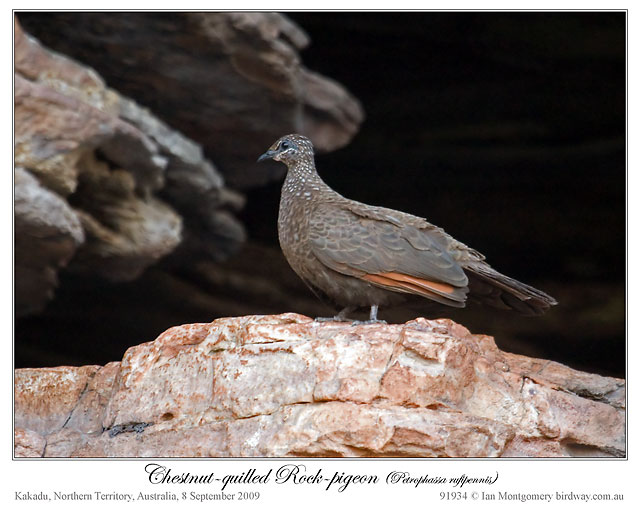
Chestnut-quilled Rock Pigeon (Petrophassa rufipennis)by Ian – found in deep sandstone gorges, rocky gullies & cliffs in the area from the Katherine Gorge to Oenpelli in the Northern Territory of Australia. – See Ian’s Bird of the Week White-quilled Rock Pigeon (Petrophassa albipennis)by Ian – Found only among the cliffs, gorges & boulder strewn sloped regions of the Kimberley Division of Western Australia & adjacent Northern Territory east to the Flora River & Stokes Range.
Rock Parrot (Neophema petrophila) by Ian- Rocky islands and coastal dune areas are the preferred habitats for this species, which is found from Robe, South Australia westwards across coastal South and Western Australia to Shark Bay.
New Zealand Rockwren (Xenicus gilviventris) by KentNickell – it is a poor flier, rarely flying more than two metres off the ground or for distances or more than 30 m. It is highly terrestrial, feeding in low scrub and open scree and rockfalls in alpine areas.
There is none holy as the LORD: for there is none beside thee: neither is there any rock like our God. (1 Samuel 2:2 KJV)
Rock Martin (Ptyonoprogne fuligula)by Ian – The Rock Martin (Ptyonoprogne fuligula) is a small passerine bird in the swallow family that is resident in Africa, and in southwestern Asia east to Pakistan. It breeds mainly in the mountains, but also at lower altitudes, especially in rocky areas and around towns, and, unlike most swallows, it is often found far from water. It is 12–15 cm (4.7–5.9 in) long, with mainly brown plumage, paler-toned on the upper breast and underwing coverts, and with white “windows” on the spread tail in flight. The sexes are similar in appearance, but juveniles have pale fringes to the upperparts and flight feathers. The northern subspecies are smaller, paler, and whiter-throated than southern African forms, and are sometimes split as a separate species, the “Pale Crag Martin”. The Rock Martin hunts along cliff faces for flying insects using a slow flight with much gliding. Its call is a soft twitter.
This martin builds a deep bowl nest on a sheltered horizontal surface, or a neat quarter-sphere against a vertical rock face or wall. The nest is constructed with mud pellets and lined with grass or feathers, and may be built on natural sites under cliff overhangs or on man-made structures such as buildings, dam walls, culverts and bridges. It is often reused for subsequent broods or in later years. This species is a solitary breeder, and is not gregarious, but small groups may breed close together in suitable locations. The two or three eggs of a typical clutch are white with brown and grey blotches, and are incubated by both adults for 16–19 days prior to hatching. Both parents then feed the chicks. Fledging takes another 22–24 days, but the young birds will return to the nest to roost for a few days after the first flight.
From the end of the earth will I cry unto thee, when my heart is overwhelmed: lead me to the rock that is higher than I. (Psalms 61:2 KJV)
The article is quite long so I am breaking it into two Parts. To see the second half – CLICK HERE
Information mostly from Wikipedia, but other internet sources quoted also.

















 Lee's Birdwatching Adventures Plus