***

Spot-billed Pelicans, Black-headed Ibises & Painted Storks nesting at Garapadu ©WikiC
THEY GATHER THEMSELVES TOGETHER
***
“The sun ariseth, they gather themselves together, and lay them down in their dens. Psalm 104:22
Wikipedia
*
Spot-billed Pelicans, Black-headed Ibises & Painted Storks nesting at Garapadu ©WikiC
“The sun ariseth, they gather themselves together, and lay them down in their dens. Psalm 104:22
Wikipedia
*

Southern Brown Kiwi (Apteryx australis) ©WikiC
“Thou makest darkness, and it is night: wherein all the beasts of the forest do creep forth.“ Psalm 104:20
Southern Brown Kiwi (Apteryx australis) ©WikiC
*

A Storks on their Nest
“Where the birds make their nests: as for the stork, the fir trees are her house.” Psalm 104:17
*

“They give drink to every beast of the field: the wild asses quench their thirst. Psalm 104:11″
*
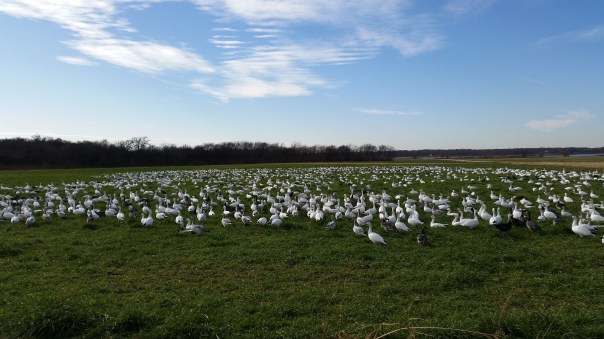
SNOW GEESE at Hagerman N.W.R. (photo by Trent)
And thou shalt teach them diligently unto thy children, and shalt talk of them when thou sittest in thine house, and when thou walkest by the way, and when thou liest down, and when thou risest up. (Deuteronomy 6:7)
USING RECREATION TO TEACH GOD’S CREATIONSHIP TO KIDS
Kids grow with imagination,
Kids learn, too, with recreation;
Moth to watch, ducks to feed,
Songs to sing, books to read —
So teach kids about creation!
And, in the process of teaching kids about creation, teach them about God’s Creatorship.
Unless the process is “boring”, most kids like to learn. Furthermore, most young children love to learn about animals — especially mammals and birds.
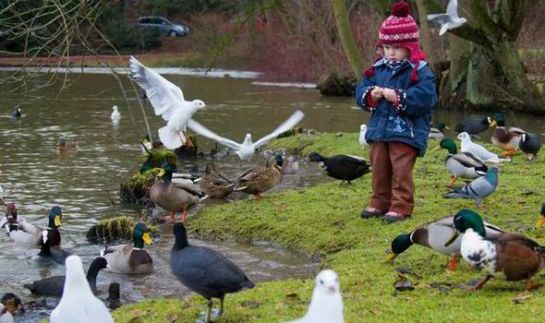
child feeding ducks (Daily Express photo)
Introducing a young child to birdwatching, therefore, can be one of the most wonderful favors one can do for such a child. In fact, teaching a child about God’s Creatorship is one of the best “inheritances” that a parent — or a grandparent (or a family friend) — can bestow to a child (Proverbs 13:22).
For an example of a child being introduced to birdwatching, see “Attracted to Genesis by Magnets and a Bird Book“, posted at http://www.icr.org/article/attracted-genesis-by-magnets-bird-book — and its uncondensed version at “Appreciating Baltimore Orioles and my First Bird Book“, posted at https://leesbird.com/2015/06/02/appreciating-baltimore-orioles-and-my-first-bird-book/ . (See also “Snow Goose, Northern Pintail, Northern Shoveler, and More“.)
CLIFF SWALLOWS: FAITHFUL AS MATES, MIGRANTS, AND MUD-MASONS
Dr. James J. S. Johnson
Thine own friend, and thy father’s friend, forsake not; neither go into thy brother’s house in the day of thy calamity: for better is a neighbor that is near than a brother far off. (Proverbs 27:10)
Alongside a rocky hillside outcropping, or under a montane cliff overhang, the mud-home “condominiums” of the Cliff Swallow (Petrochelidon pyrrhonota) reveal the presence of this gregarious and aerial-acrobatic bug-eater.
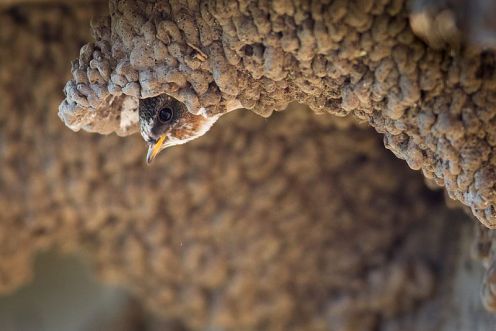
CLIFF SWALLOW inside mud-nest
National Park Service photo / public domain
On June 29th of AD1996, by Colter Bay Village Marina, in Grand Tetons National Park (Wyoming), I saw some of these, and considered how their colonial nests reminded me of the riparian (i.e., riverbank) Bank Swallow (Riparia riparia) burrows that I had seen (2 days earlier) along banks of the Snake River.
Like other swallows, the Cliff Swallow speedily zips and arcs and dives through the air, snatching and consuming many “meals on wings” – veritable “fast food” – gulping down airborne insects, again and again. (The Cliff Swallow supplements its insectivorous diet with berries and other fruits.)
However, the Cliff Swallow’s claim to fame is their colonial mud-home masonry.
“Hundreds of gourd-shaped “mud jugs” plastered to the side of a barn or under a bridge or highway overpass are a typical [colonial] nesting territory for these highly adaptable birds. Farmers heartily welcome this [summer] resident because it eats numerous flying insects that are harmful to crops. Nesting colonies may number from 800 to more than 1,000 birds. Note the dark rusty brown throat, and in flight the brown underwing linings, cinnamon buff rump, [characteristic] square tail, dusky cinnamon undertail coverts with dark centers, and whitish buff edged feathers of back and tertials. Juveniles have dusky brown upperparts and paler underparts. This [bluish-brown-black-backed] swallow has successfully expanded its range in the [American] Southwest and the West. The southwestern race [i.e., variety] displays a cinnamon forehead similar to the Cave Swallow.”
[Quoting Frederick J. Alsop III, BIRDS OF TEXAS (Smithsonian Handbooks, 2002), page 363.] Cliff Swallows closely resemble Cave Swallows (Petrochelidon fulca), but Cave Swallows have a “pale cinnamon-buff throat”, cinnamon-rust-hued throat, and a “richer cinnamon-rust rump”, according to Alsop [at page 363]. Another similar-looking swallow is the deeply-forked-tailed Barn Swallow (Hirundo rustica) which often colonizes the inside of rural barns (as well as in places where Cliff Swallows build nests) all over America’s Lower 48 states.
In fact, these 3 varieties of swallows — Cliff Swallow, Cave Swallow, and Barn Swallow – are known to hybridize, so there is no need to fret over which species name you assign to one of these swallows. [For documented examples of these mud-homebuilding swallow hybridizations, as well as many other swallow and martin hybridizations, see Dr. Eugene M. McCarthy’s HANDBOOK OF AVIAN HYBRIDS OF THE WORLD (Oxford University Press, 2006), pages 253-255.]
Other forms of “hybrid” mixing occur, involving other types of social interaction, such as the neighborliness known as “helping”:
“NEST HELPERS occur among many species, including certain kingfishers, hawks, jays, tanagers, and wrens. Helpers are generally younger adults that assist their parents in rearing nestlings. . . . Helpers generally do all of the usual nest-associated behaviors, such as building nests, incubating eggs, guarding nestlings, cleaning the nest, and feeding young. With such help, it’s not surprising that several studies have shown that [parental] pairs with nest helpers can rear more young than those without helpers. . . . While most helpers assist their parents [with the care of younger siblings], there are also many examples of adults feeding young of different species. Parent Barn Swallows may, for example, feed fledgling Cliff Swallows. Robins have been known to feed young grackles.”
[Quoting Stephen W. Kress, BIRD LIFE: A GUIDE TO THE BEHAVIOR AND BIOLOGY OF BIRDS (Racine: Golden Press, 1991), page 54, with emphasis added.]

CLIFF SWALLOW on mud-home nest
Photo credit: What-When-How.com Tutorials
The Cliff Swallow takes all of its social relationships seriously – they are characteristically monogamous, sometimes rearing 2 broods in one breeding season, and they live gregariously in large colonies. [See Stan Tekiela, BIRDS OF TEXAS FIELD GUIDE (Adventure Publications, 2004), page 125.] Also, they share information about where to get food. When some of these swallows observe other fellow-colonist swallows returning with food for their young, indicating the successful sourcing of food, those watching follow suit, following the “winners” to the place where food is readily available.
Professor Alsop describes the Cliff Swallow’s homebuilding hallmark as the construction of “one of the most complex swallow nests: a sphere of mud pellets with a tubular entrance on one side”. [Quoting Alsop, BIRDS OF TEXAS, cited above, page 363.] Unsurprisingly, Cliff Swallow nesting colonies are located near water, since water is needed by both the swallows and their insect prey. Little mud-balls used for nest-building, carried serially during nest construction, may be acquired from mud sources a mile away.
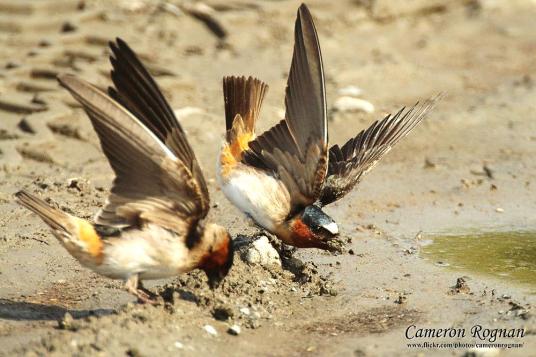
CLIFF SWALLOWS acquiring mud for nest-building
Photo credit: Cameron Rognan / Flickr
These swallows migrate, breeding all over Texas, often returning each spring to last year’s nesting sites. In fact, Cliff Sparrow migratory punctuality is famous:
“THE TIMING OF MIGRATION is [phenologically] linked to the length of day [i.e., daylight hours]. As day-length increases with the advancing spring [season], birds develop a nocturnal restlessness called “zugunruhe” [from 2 German words meaning move/migration and anxiety/restlessness]. Increased exposure to daylight leads males and females to higher hormone levels that trigger the urge to migrate [northward from South America]. Migration becomes a predictable event. Cliff Swallows of San Juan Capistrano Mission in southern California and Turkey Vultures of Hinkley, Ohio [not to be confused with Hinckley, Minnesota – “where the men are men, pansies are flowers, and the women are slightly above average”] , are noted for their punctual spring arrivals. The spring arrivals of many backyard birds, such as American Robins and Red-winged Blackbirds are equally punctual.”
[Quoting Stephen W. Kress, BIRD LIFE: A GUIDE TO THE BEHAVIOR AND BIOLOGY OF BIRDS (Racine: Golden Press, 1991), page 108. Regarding zugunruhe and photoperiod analysis, see Eberhard Gwinner, “Circannual Rhythms in Bird Migration”, Annual Review of Ecology & Systematics, 8(1):381-404 (1977), posted at http://www.annualreviews.org/doi/10.1146/annurev.es.08.110177.002121 — with an acknowledgement that “internal annual clocks” had been demonstrated earlier in hibernating Golden-mantled Ground Squirrels.]
Like other swallows, the Cliff Swallow speedily eats many “meals on wings” – veritable “fast food” – catching and eating insects in the air. The Cliff Swallow supplements its insectivorous diet with berries and other fruits.
Thus, the Cliff Swallow is faithful in mating (i.e., avian “marriage” and parenting), faithful in migrating (i.e., in the phenological punctuality of its spring migrations), and faithful in its mud-home masonry tradition. Cliff Swallows are famous for sharing and living together in harmony – like good neighbors.
><> JJSJ profjjsj@aol.com

BUFFLEHEAD male (Wikipedia)
And God blessed them, saying, Be fruitful, and multiply, and fill the waters in the seas, and let fowl multiply in the earth. (Genesis 1:22)
Bufflehead [Bucephala albeola] The bufflehead is the smallest diving duck in North America. Males weigh about 450 g (1 lb.) and females 325 g (11 oz.). Breeding males are striking with a black head glossed green and purple, a large white patch covering the back of the head, a black back, white underparts, and black wings with a large white patch covering most of the inner wing.
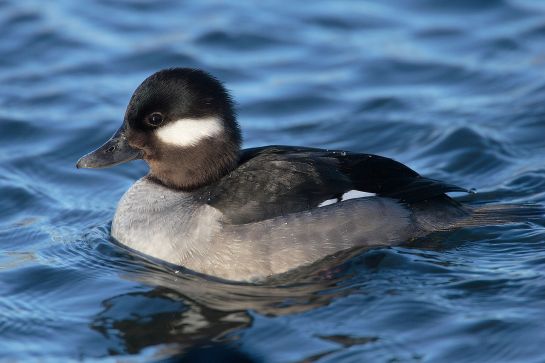
BUFFLEHEAD female (Wikipedia)
The Bufflehead female, however, is mostly brownish-hued, with grey sides and breast, white underside, and a white cheek patch that is shaped like an oval, almost like the shape of a fallen bowling pin. [See Kevin T. Karlson, “Waterfowl of North America: A Comprehensive Guide to All Species”, page 10.]
The Bufflehead’s cousins include the goldeneye ducks, such as the Common Goldeneye (Bucephala clangula) and Barrow’s Goldeneye (Bucephala islandica).
As the range map below shows, the Bufflehead breeds mostly in Alaska and Canada, migrating south into more than half of America’s Lower 48 for over-wintering.

BUFFLEHEAD range map / North America (Sea Duck Joint Venture photo)
During an over-wintering season, on March 11th of AD1996, I first saw a Bufflehead duck – it was in the part of Aransas Bay (part of the Texas Gulf coast), while visiting Aransas Bay and Aransas Bay National Wildlife Refuge.
That same day my family and I saw many other “winter Texan” migrants (as well as some year-round residents), including several “lifers”: Whooping Crane, Brown Pelican, Pelican, Least Tern, Bonaparte’s Gull, Herring Gull, Laughing Gull, American Coot, Short-billed Dowitcher, Western Sandpiper, Black Skimmer, Black-necked Stilt, American Oystercatcher, Common Goldeneye, Green-winged Teal, Cinnamon Teal, Louisiana Heron, Roseate Spoonbill, White Ibis, and Western Kingbird — not to mention many other birds seen previously elsewhere (e.g., Sandhill Crane, Blue-winged Teal, Great Blue Heron, White Pelican, Double-crested Cormorant, Common Grackle, Western Kingbird, Loggerhead Shrike, etc.)!
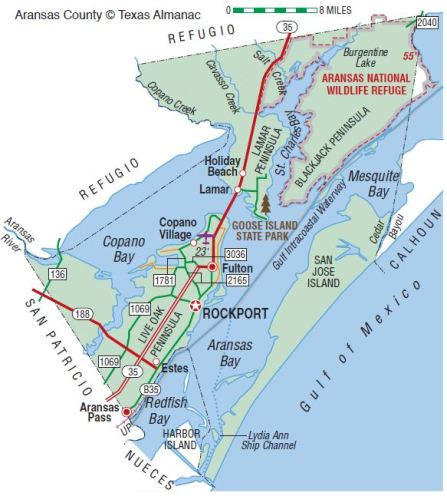
Obviously, early March (and winter in general) is a good time for coastal wetland birdwatching at Aransas Bay! What a pleasant time it was, hour after hour, witnessing Gods’ love of variety, exhibited in those beautiful bayside birds!
God loves variety — so should we! (For more on this, see my article “Valuing God’s Variety”, ACTS & FACTS, 42(9):8-9 (September 2012), posted at http://www.icr.org/article/6939 .]
So, if you get the opportunity, check out Aransas Bay National Wildlife Refuge for yourself — unless a hurricane is approaching. (It’s always good to check the weather forecast before you undertake a serious birding adventure.)
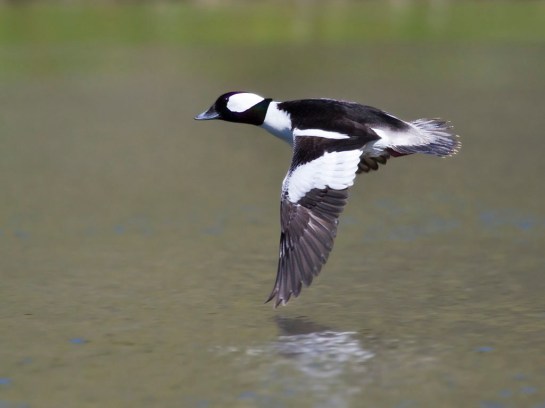
BUFFLEHEAD male in flight (Bill Bouton photo)
Dr. James J. S. Johnson
Though ye have lien among the pots, yet shall ye be as the wings of a dove covered with silver, and her feathers with yellow gold. (Psalm 68:13)

AMERICAN GOLDFINCH on thistle (Fredric D. Nisenholz / Birds & Blooms)
The psalmist referred to a special dove having silver-covered wings, with feathers sporting yellow-gold highlights (literally, flight-feathers of greenish-gold). What a beautiful dove that must be! In America, however, there is a yellow-colored finch that we are more likely to see, the AMERICAN GOLDFINCH. It too could be called greenish-gold, because its plumage varies seasonally, from lemon-yellow to a light olive-green. Goldfinches are small passerines, monogamous (i.e., male-female couples permanently paired, as if married) gregarious (i.e., they travels and feed in flocks), and they migrate to and form the outer territories of their populational ranges — although they are year-round residents in much of their American range (see Wikipedia range map below: yellow for breeding-only, green for year-round residence, blue for over-wintering only).

For me, the first time I saw one was on Friday, July 22nd AD2016, as I was driving a rent-car on a wood-flanked country road that paralleled the Susquehanna River, in Pennsylvania, near Exeter, where the next day I would speak at the Pennsylvania Keystone Family Bible Conference, in celebration of 60 years of IN GOD WE TRUST being our national motto. Here is a quick limerick in honor and appreciation of the American Goldfinch. (Speaking of our national motto, IN GOD WE TRUST, it derives from THE STAR-SPANGELD BANNER, penned by attorney Francis Scott Key, during the bombardment of Fort McHenry during the War of 1812.)

AMERICAN GOLDFINCH female, Virginia (Wikipedia / flickr.com photograph)
Dr. James J. S. Johnson
And the owl, and the night-hawk, and the cuckoo, and the hawk after his kind… (Deuteronomy 14:15)
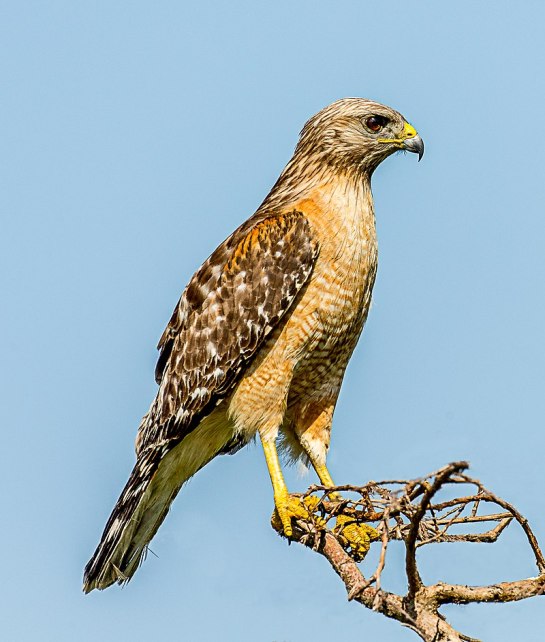
RED-SHOULDERED HAWK (Buteo lineatus) Wikipedia photo
Today a RED-SHOULDERED HAWK (Buteo lineatus) graced an enclosed garden-like area (between 2 buildings) where I work, swooping down from a rooftop, to land where the local squirrels gather fallen acorns from the nearby oak trees.
The identification was confirmed by eye-witness Don Barber, my genius cousin (and one of the best wildlife experts you could ever meet, having specialized experience with raptors). What a wonderful buteo! Notice its orange-buff underside, its white-and-dark-brown-mottled wings (sometimes with a spread wider than 3 feet!), its narrowly striped tail-band, and its very serious-looking head! What a bird! Squirrels, you better flee!
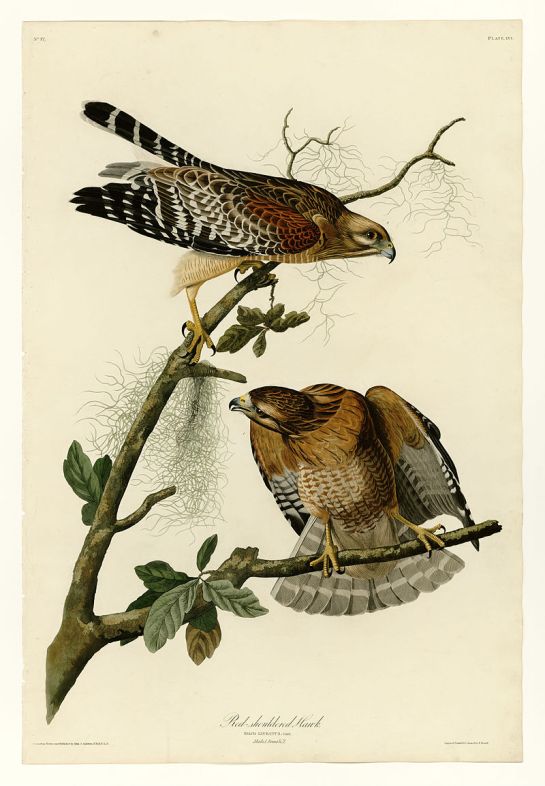
RED-SHOULDERED HAWK (J. J. Audubon)
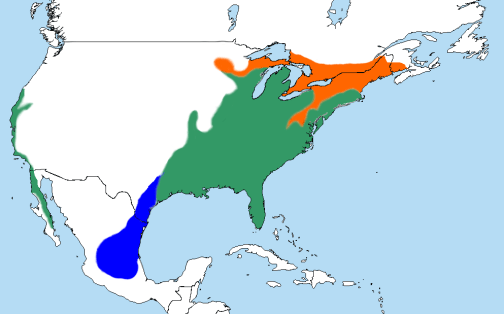
These buteos make themselves at home within the eastern half of Texas (especially during winter), and their range also includes almost all of the eastern half of America’s Lower 48 (as shown by the Wikipedia range map, below).
Regarding the red-shouldered Hawk, Roger Tory Peterson once said:
Recognized as a Buteo by ample tail and broad wings; as this species, by heavy dark bands across both sides of tail. Adults have rufous shoulder (not always visible) and pale robin-red [i.e., orange] underparts. Anotehr mark, not often shared by other Buteos, is a translucent patch or “window” toward wing-tip at base of primaries. Immatures have streaked [plumage] below, as are most other hawks.
[Quoting Roger Tory Peterson, A FIELD GUIDE TO THE BIRDS FO TEXAS AND ADJACENT STATES (Houghton Mifflin, 1988), page 62 — see also color plate illustrations facing page 60.]
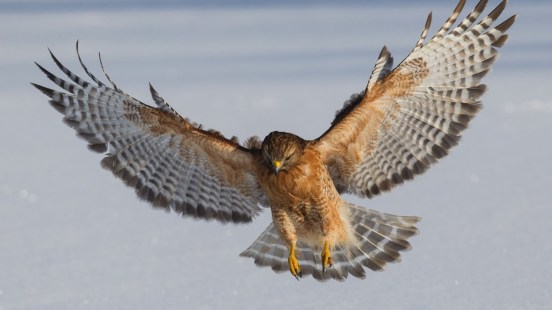
RED-SHOULDERED HAWK in Lucas, Texas (photo credit: bigdaddydog1 youtube)
Fowl Are Fair on Day Five, with Special Attention to Galliforms
Dr. James J. S. Johnson
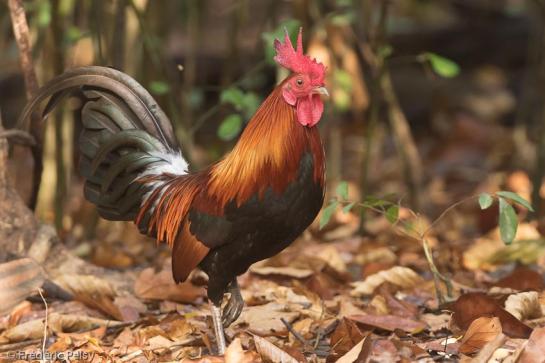
Red Junglefowl (wild equivalent of domestic chicken) Frederic Pelsey photo
And God said, Let the waters bring forth abundantly the moving creature that hath life, and fowl [‘ôph] that may fly [ye‘ôphēph] above the earth in the open firmament of heaven. And God created great whales [tannînim ha-gadolîm], and every living creature that moveth, which the waters brought forth abundantly, after their kind, and every winged fowl [‘ôph kanaph] after his kind: and God saw that it was good. And God blessed them, saying, Be fruitful, and multiply, and fill the waters in the seas, and let fowl [‘ôph] multiply in the earth. (Genesis 1:20-22)
In the Holy Bible, King James Version, the term “fowl” is repeatedly used to denote birds in general – animals who fly with wings and feathers. Nowadays, however, we usually limit the term “fowl” to refer to “waterfowl” (like ducks) or landfowl, like chickens. The latter category – landfowl – are, generally speaking, birds that stay close to the ground because their body plan is fairly heavy (which is not good for intense or prolonged flying), like chickens or turkeys. The fancy term for these landfowl is GALLIFORM, meaning shaped like a chicken.
Accordingly, God is glorified by His creation of poultry (domesticated chicken-like birds) and similar landfowl (a/k/a “gamefowl”), both being taxonomically categorized as Galliforms (i.e., birds whose physical forms that resemble big or small chickens).
Galliforms, as large ground-dwelling birds, are well-known for eating seeds and insects (both of which are often found on or near the ground). As noted above, their body weight encumbers them from flying very much or very far, although they can and do fly short distances when needed. When chased, by predators, they often run and hide (as is indicated in 1st Samuel 26:18 & 26:20). These often-domesticated birds include chicken, quails, pheasants, tragopans, argus, grouse, guineafowl, incubator birds, craciforms (such as guan, chachalaca and curassow), ptarmigan, turkey, and peafowl. 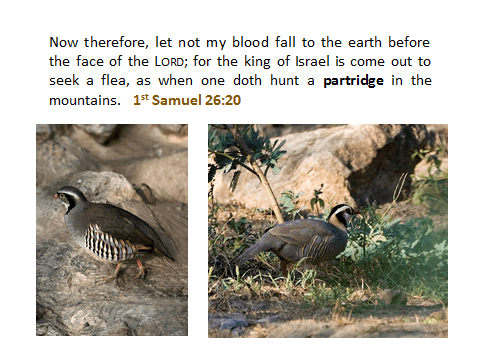
The typical icon of the galliform group (according to taxonomist Carl Linnaeus, in A.D. 1758) is Gallus gallus, a label assigned to both Asia’s wild Junglefowl and the domestic Chicken. Many of these birds, especially chickens and turkeys, are raised by humans, for their eggs or to be eaten (as meat). 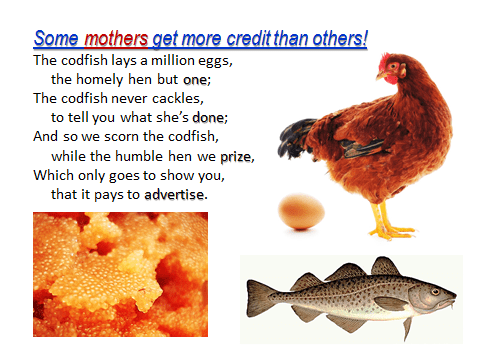
As we know from Scripture (Luke 11:12-13), poultry eggs are a truly good source of nutrition for humans, and the whites (albumen) of eggs taste better when seasoned with salt (Job 6:6).
Galliform birds mostly live mostly sedentary lives (although some seasonally migrate) in moderate climate zones of Europe, Asia, North and South America, Africa, Australia, and many islands. (Don’t expect to find them in the super-dry Sahara Desert or in super-cold Antarctica.)

AMERICAN TURKEYS Schuylkill Center for Envir’l Educ’n photo
Some of these poultry birds are usually found only live in certain parts of the world (such as wild turkeys, which are biogeographically native only to North and South America), yet they can be introduced (as immigrants) to other places that have similar climates. Because landfowl usually nest on or near the ground they are often victims to predators, including humans; accordingly it is important to avoid over-hunting them (and over-harvesting their eggs); this conservation-relevant reality (and concern) is acknowledged by Moses in Deuteronomy 22:6-7.
Amazingly, the Lord Jesus once compared His own willingness and ability, to care and protect humans, to that of a galliform – specifically, a mother hen — who uses her own body to protectively care for her own hatchling baby chicks (Matthew 23:37; Luke 13:34). How good it is to belong to Him forever!

LUKE 13:34 (Knowing-Jesus.com image)
Dr. James J. S. Johnson
Render therefore to all their dues:
tribute to whom tribute is due; custom to whom custom;
fear to whom fear; honor to whom honor. (Romans 13:7)
Christian birdwatchers have a wonderful freedom (and responsibility), due to the principle of Romans 13:7 – the duty to give credit where credit is due – and one application of that principle is that, as Biblical creationists, we can appreciate the valuable accomplishments contributed by ornithologists, even if those ornithologists are Bible-rejecting evolutionists, such as Roger Tory Peterson and George H. Harrison. Simply stated, Romans 13:7 requires us to give credit where credit is due. 
George H. Harrison with binoculars (BIRD AND BLOOMS)
Looking at an issue of BIRDS AND BLOOMS reminded me of how I have repeatedly appreciated the birdwatching expertise of George H. Harrison, an American ornithologist, whose valuable contribution to the world far exceeds that of any guitarist-lyricist-mystic who formerly used that same name.
In fact, ornithologist George Harrison teamed up with another birdwatching titan, Roger Tory Peterson, in a videotape that I formally used (when I taught “Ornithology and Avian Conservation” at Dallas Christian College), called “George Harrison’s Birds of the Backyard: Winter Into Spring” (Window on the World Video, 1989).

Perhaps two of the best-known names in American birdwatching are Roger Tory Peterson, author (and sometimes co-author) of the “Peterson Field Guides” series (published by Houghton Mifflin) and George H. Harrison (whom I first encountered as a subscriber to BIRDS AND BLOOMS magazine).
One of the most practical birdwatching books that I have ever read is George Harrison’s classic, THE BACKYARD BIRD WATCHER: THE ULTIMATE GUIDE FOR ENJOYING WILD BIRDS AT YOUR BACK DOOR (Simon & Schuster 1979).

Recently I found a blog interview of Harrison, on the National Wildlife Federation’s blog [ http://blog.nwf.org ], reporting how that book came to be written.
GEORGE H. HARRISON knew he was on to something. While serving as managing editor of National Wildlife in 1972, he heard about two U.S. Forest Service researchers in Massachusetts who were studying ways to convert suburban yards into mini-habitats for birds and other wild creatures. “Their study showed that the same basic principles wildlife managers had been using for decades—providing food, water, cover and places to raise young—worked beautifully on a smaller scale in backyards,” says Harrison.
He convinced the two researchers, Richard DeGraaf and Jack Ward Thomas, to write an article describing the steps homeowners could take to create such habitats. That article, “Invite Wildlife to Your Backyard” in the April/May 1973 issue of National Wildlife, helped provide the basis for NWF’s Certified Wildlife Habitat® program, which celebrates its 38th anniversary [in AD2011, so the Certified Wildlife Habitatprogram is 44 years old as of AD2017].
Kelly: John Strohm, then editor of National Wildlife, called the article “one of the most significant articles we’ve ever published.” Why do you think the article was important?
George: The whole concept that suburbanites and urbanites could have a backyard filled with birds and other wildlife awakened people’s need to be closer to nature. It was a timely article because in the 1970s the American public had realized that our planet was in trouble (the first Earth Day, etc.) and that nature was no longer a part of their world. “Invite Wildlife to Your Backyard” opened a whole new opportunity for people, especially families, to interact with wildlife at close range, just outside their windows. For most people, it was—and still is—the one and only way to see nature and relate to wildlife.
Kelly: How did the article change the way you garden?
George: Though I had been feeding birds in my backyard since I was a child (we were a nature family), the concepts of increasing the kinds and volume of birds and animals in my environment by providing food, cover and water caused me to design my own model backyard wildlife habitat. I am Certified Wildlife Habitat® #604. I have since designed backyard habitats in private and institutional locations.
Kelly: You’re the author of The Backyard Bird Watcher and other books for wildlife enthusiasts. When you meet people new to wildlife gardening, wondering how to get started, what advice or encouragement do you give them?
George: The easiest way to get started learning and appreciating wildlife is to establish your own backyard wildlife habitat. You can start small with a couple of bird feeders, a bird bath and some potted evergreens. If you group those three items outside a favorite window in your house, birds and other wildlife will come, I promise you.
Kelly: Why do you think the Certified Wildlife Habitat® program remains relevant today?
George: With each passing year, young people are removed farther and farther from the natural world. In Last Child in the Woods, Richard Louv documents how children are living lives that are more distant from nature than ever before in our history. Involving kids in the process of creating habitat is a way to reverse this trend.
George H. Harrison is an award-winning nature writer and photographer whose accomplishments include authoring 13 books, hosting six PBS television specials and helping to start Birds & Blooms magazine. While working at National Wildlife Federation, he served as both managing editor and field editor of National Wildlife.
[Quoting from Kelly Senser, “Habitat Chat with George H. Harrison”, NATIONAL WILDLIFE FEDERATION’S BLOG, posted at http://blog.nwf.org/2011/01/habitat-chat-with-george-h-harrison/ .]
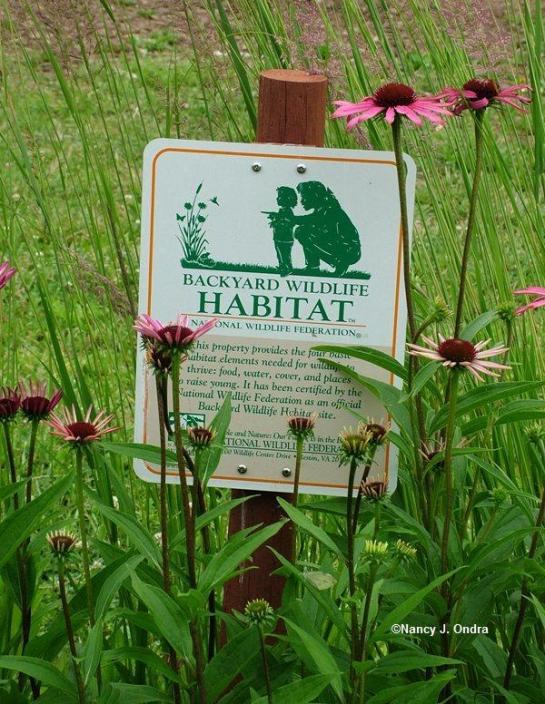
Interestingly, I recall having set up a wildlife mini-habitat, during the AD1990s (when I lived in a different part of Denton County, Texas), based on the Certified Wildlife Habitat program, which I learned about as a subscriber to NATIONAL WILDLIFE magazine.
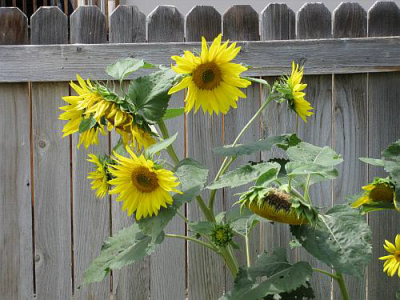
It was during that timeframe that I provided sunflower seeds (and other kinds of birdfeed) to my backyard birds, as illustrated by this poem:
BACKYARD BIRDS AND SUNFLOWER SEEDS
( © AD1997 James J. S. Johnson, used by permission )
Seeing hungry backyard birds I filled a tray with seeds;
Sparrows, juncos dined in “herds”, and jays arrived to feed;
Even cardinals, flashing red: they came, they saw, they fed.
Bills gulped! seed-hulls popped!
Some seeds spilled! some seeds dropped!
Overhead, as some bird flew, sunflower seeds did fall;
From green vines, they later grew, seedlings, green and small.
Then out popped golden faces Coloring grassy spaces;
Like baby suns of yellow, Grinning — saying “hello”!
On green stalks they climb, aiming to greet the sky;
Seed-packed in their prime, picked by birds, going by.
Thus reaps my yard what jays did sow,
New seeds, from old, sunflowers grow.
Watch I, and think on what God made
How He designed such “mutual aid”…
In my backyard, I must surmise:
The Lord, Who did this, He is wise!
[Quoting from “Here’s Seed for Thought”, including poem entitled “Backyard Birds and Sunflower Seeds”, posted at https://leesbird.com/2015/07/04/heres-seed-for-thought/ .]
Now that I live elsewhere, in a different part of Denton County (Texas), I still host a backyard bird habitat, although this one has never been registered with the National Wildlife Federation’s program (maybe I should do that?).
Since our more-than-an-acre homestead includes part of a pond (which we share with neighbors), we have the requisite water to attract ducks, geese, egrets, herons, and other wildfowl.
Our trees and bushes supply food, shelter, and nesting sites to a mix of passerines including year-round resident cardinals, blue jays, and mockingbirds, as well as mourning doves (just to name a few).

Flock of perching “winter Texan” Cedar Waxwings (Steven Schwartzman photo)
Stopover migrants, such as Cedar Waxwings, also make use of trees (and berries, such as cedar berries) in our yard, as they pass through our part of Texas, twice a year. [See “Cedar Waxwings: Winter Texas Snack on Bugs and Berries”, posted at https://leesbird.com/2017/04/05/cedar-waxwings-winter-texans-snack-on-bugs-and-berries/ .]

Trumpet Vine “wall” (acultivatednest.com image)
Furthermore, these habitat features are supplemented by our fence-line’s flowering trumpet vine “thicket” (e.g., see “Busy Spectators, Oblivious to Hummingbirds”, posted at https://leesbird.com/2016/09/14/busy-spectators-oblivious-to-hummingbirds/ ). In fact, local lizards and other wild critters constitute enough food to attract an occasional roadrunner, hawk, or kestrel, so our homeplace really is a “backyard (and front-yard, and side-yard) habitat” for wild birds, both residents and migrants.
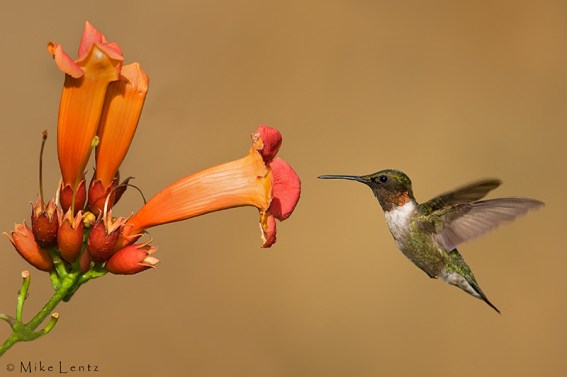
Hummingbird at Trumpet Vine blossom (Mike Lentz image)
So there you (or, I should say, the local birds), have it: “food, water, cover, and places to raise young” – the key ingredients needed for attracting wild birds to settle in and around our formerly-rural-but-now-more-suburban homeplace.
It’s good that I recently planted another juniper tree – some birds should benefit.
Of course, when we consider our obligation (under Romans 13:7, in conjunction with Romans chapter 1) to give credit where it is due, our ultimate duty – as birdwatchers, and as human creatures – is to give God credit for making (and providing habitat for) all of creation, including ourselves, as well as all birds and other creatures.
That even applies to giving God credit for what He has put into our avian neighbors, such as Mourning Doves (see “The Ghost Army”, illustratively citing Romans 13:7 & Isaiah 38:14, posted at http://www.icr.org/article/ghost-army ).
<> JJSJ profjjsj@aol.com

WHINCHAT photo credit: Parrotletsuk.typepad.com
Whinchat, Redstart, and Redchat: Debunking the “Speciation” Myth Again
Dr. James J. S. Johnson
Are not two sparrows [στρουθια] sold for a farthing? and one of them shall not fall on the ground without your Father. But the very hairs of your head are all numbered. Fear ye not therefore, ye are of more value than many sparrows [στρουθιων]. (Matthew 10:29-31)
Are not five sparrows [στρουθια] sold for two farthings, and not one of them is forgotten before God? But even the very hairs of your head are all numbered. Fear not therefore: ye are of more value than many sparrows [στρουθιων]. (Luke 12:6-7)
It’s good to know that we are worth far more, to God Himself, than many “sparrows”. However, the term “sparrows” (as quoted above) is an English translation of the New Testament Greek noun strouthion, a fairly general word for “small bird’ that can include many varieties of perching songbirds, in general, including yet not limited to the birds we label “sparrows”(1) — including the Whinchat, a sometimes inconspicuous little songbird that resembles a thrush, wheatear, or a flycatcher. (Or maybe a redstart?)

WHINCHAT Scottish Ornithologists’ Club
It was my privilege, on July 13th of AD2006, to view a Whinchat (Saxicola rubetra) among some roadside weeds, while in the fine company of my wonderful wife (Sherry) and Dr. Bill Cooper, England’s top-tier gentleman and scholar.
The bird-book that I was using, that day (as Laird Bill drove us along a motorway between Harwich and London), described the common Whinchat as follows:
Restless, short-tailed chat that perches openly on bush-tops, tall weeds and fences, flicking its wings and tail. Males in summer distinctive. Females and autumn birds can be confused with the female Stonechat, but Whinchat’s conspicuous creamy eyebrows, boldly streaked rump and white wedges at base of tail (often noticed as birds flick tail to balance in the wind) are reliable fieldmarks.
[Quoting Chris Knightley & Steve Madge, POCKET GUIDE TO THE BIRDS OF BRITAIN AND NORTH-WEST EUROPE (Yale Univ. Press, 1998), page 212.] The Whinchat is a summer migrant, visiting (and nesting in) Great Britain and much of western Europe during the spring and summer months, migrating south to northwestern Africa for the winter months. Its habits are typical of many other insect-eating passerines:
Nests on heaths, grassy moors, rough fields, damp rushy meadows and young coniferous plantations. Like Stonechat, pounces to the ground for insects, returning to same slightly elevated perch or flying quickly to another sprig nearby. Broken song mixes short musical phrases with dry churrs and distinct pauses. Call an agitated tu-tek, tu-tek-tek. Widespread on migration, often in some numbers in coastal bushes and fields.
[Again quoting Chris Knightley & Steve Madge, POCKET GUIDE TO THE BIRDS OF BRITAIN AND NORTH-WEST EUROPE (Yale Univ. Press, 1998), page 212.]
The Whinchat has other names, including Paapje (Dutch), Braunkehlchen (German), Traquet tarier (French), and Buskskvätta (Swedish: “bush chat”). [See Roger Tory Peterson, Guy Mountfort, & P.A.D. Hollom, BIRDS OF BRITAIN AND EUROPE (Houghton Mifflin / Peterson Field Guides, 5th rev. ed., 1993), pages 175-176.] Moreover, to the chagrin of taxonomic “splitters”, the Whinchat is known to hybridize with the Siberian Stonechat and the Common (European) Stonechat of western (and southern) Europe. [See Eugene McCarthy, HANDBOOK OF AVIAN HYBRIDS OF HE WORLD (Oxford, 2006), page 238.] – proving that those 3 chats descend form a common ancestor pair that survived the worldwide Flood aboard Noah’s Ark.
More surprising, to the birding community, is the capture and DNA verification (by the Lista Bird Observatory in Vest-Agder, Norway, during September AD2013) of a hybrid parented by male Common Redstart (Phoenicurus phoenicurus) and a female Whinchat (Saxicola rubetra), published in the Journal of Ornithology.(2)

Common Redstart x Whinchat HYBRID
Photograph by Jonas Langbråten
(18 Sept. AD2013, Lista Bird Observatory, Vest-Agder, Norway)
The male Redstart-Whinchat hybrid was captured by bird-banding volunteers, near the southern tip of Norway’s peninsula.
“We have a standardized bird banding project where we mark migratory birds in the spring and autumn. We have volunteer bird watchers going every hour to catch birds in mist nets to band them,” says Jan Erik Røer from the Norwegian Ornithological Society.
[Quoting Ingrid Spilde’s “Mysterious Bird was Unique Cross of Two Unrelated [sic] Species”, Science Nordic, (3-11-AD2015), at http://sciencenordic.com/mysterious-bird-was-unique-cross-two-unrelated-species . ]
The hybrid’s unofficial name is rødskvett (“redchat”), blending parts of the Norwegian words (Buskskvett and Rødstjert) for its two parents.
Needless to say, this little “redchat” has caused a lot of confusion and controversy among evolutionists at the Natural History Museum in Oslo, where the “speciation” mythology (of supposed biogenetic divergence, “13.3 million years” ago) is popularly taught, as if there was real “science” (empirical or forensic) to support that imaginary scenario.(3)
Once again the “speciation” myth of “natural selection”-advocating evolutionists, both theistic and atheistic, is debunked by the real-world evidence.
References
 Lee's Birdwatching Adventures Plus