Birds of the Bible – The Hidden Covenant – Part 2

WHEN DOES GOD MAKE A COVENANT?


Hosea 2:14 says, “Therefore, behold, I will allure her, and bring her into the wilderness, and speak comfortably unto her” Did He not allure us and bring us from the wilderness of sin? He has been so kind to us that He still comforts us with His words, songs and above all with His presence and peace that passeth all understanding. What does this verse got to with the covenant? Hosea 2:16 has the answer to it. “And I will give her vineyards from there, and the valley of Achor for a door of hope: and she shall sing there, as in the days of her youth, and as in the day when she came up out of the land of Egypt.”

So? Does it not mean that we need to sing as in the days of our youth and as we sang when we came out of Egypt? Do we sing and worship the way we used to when we first met Jesus? Who would forget the day of salvation! The day when our hearts overflowed with the joy and peace that had never been experienced ever before! Do we have the same joy over the years?

Life has not been too kind for most of us. Battered and bruised we still are trying to come to terms with living a life that is pleasing unto God. During times of trouble, murmuring and self-pity takes our priority above singing and worshipping God. Look at the fowls of the air. Rain or shine they still keep singing like preset robots. No matter what kind of weather it is, the birds never stop their concert. Is God expecting this bird-kind of worship from us? Some of us may not know this bird-kinda worship. Here is how the birds sing.
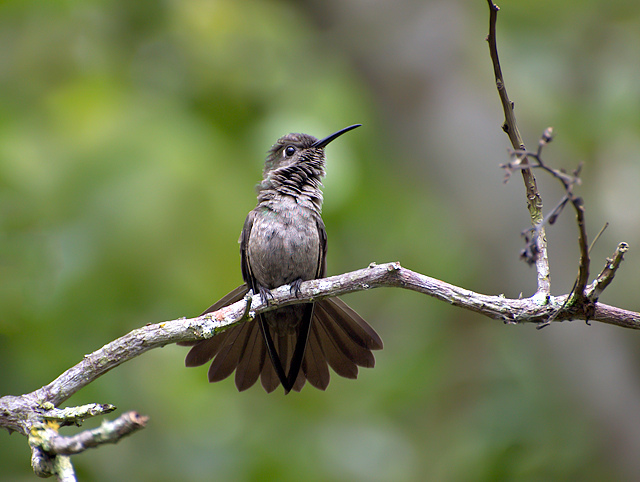
Sombre Hummingbird (Aphantochroa cirrochloris) By Dario Sanches

Sombre Hummingbird (Aphantochroa cirrochloris) By Dario Sanches

 “Early Singer”

Dawn Chorus is part of every bird’s daily routine. They never venture out in search of food before they finish their dawn chorus. Do we dawn chorus everyday or just the morn-chorus every Sunday? Do we know why birds dawn chorus?

Since they use most of their energy in singing and flying, birds have to eat once in every ten minutes like the hummingbirds, to once in couple of hours like raptors, depending upon the species,. How much energy do we use in singing for God is another question which we may have to ponder a little late!  Coming back to where we left, birds do not eat from dusk to dawn, which can be called as an everyday hibernation period. If birds don’t eat well the previous evening, the chances of staying alive to deliver the dawn chorus the next morn is very minimal. So they need to eat well to stay fit to render their dawn chorus so as to advertise that they are still alive.We boast that we worship Jesus – The Life, the way and the truth. But, do we advertise every dawn that we are still alive? God says, “I love those who love me; And those who seek me early shall find me” Proverbs 8:17.

“Those who seek me early shall find me”, which means those who don’t seek early shall not find isn’t it? How early do we seek Him? The Israelites had to collect the dew wrapped manna before sunrise, else manna would melt and they may have to starve for the day. In the beginning was the Word, and the Word was with God, and the Word was God……  And the Word was made flesh, and dwelt among us, full of grace and truth.” John 1:1 & 14. The word of God is our daily manna. In other words, Jesus is our manna. Well, how many of us collect our daily manna before sunrise? Most of us are starving in spirit, is it because we seek God when the sun is over our heads? Seek ye the LORD while he may be found, call ye upon him while he is near:” Isaiah 55:6

God expects a dawn chorus from us and not a morn chorus. Each new morn would be a great blessing, when we kneel before God before our feet touches the ground. And it would be even more blessing when we open our mouth wide to praise and worship our eternal Father before we actually utter the first word for the day. Light is better seen in the dark. Remember, that Jesus is the Light. He expects us to seek Him early and not yearly. May be God will make a covenant with us if we too start singing not just the Sunday morn chorus but the dawn chorus like birds,.

“Awake, psaltery and harp: I myself will awake early.” Psalm 108:2
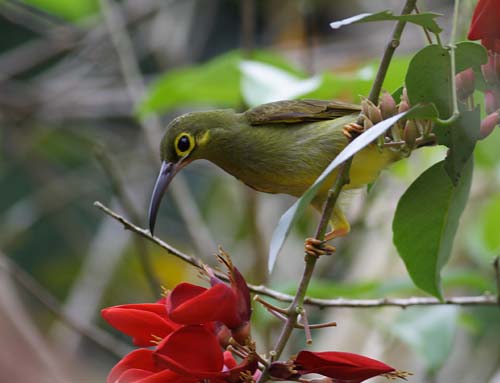
Spectacled Spiderhunter (Arachnothera flavigaster) by Peter Ericsson

Spectacled Spiderhunter (Arachnothera flavigaster) by Peter Ericsson

 “High voltage Singer”

Coming back to the question, “How much energy do we use in singing for God?” posted in the previous paragraph; it isn’t fair, yet, there is no other choice but to compare our singing with the singing of the birds. The song of a 5-gram Black-bellied Sunbird or that of a 45-gram Spectacled Spiderhunter can be heard as far as 300 to 400 meters. If they are as big as the Homo sapiens, their songs can be heard as far as 3 to 4 kilometers. If at all we sing, how loud do we sing for God? Paul and Silas sang and the earth shook inside the jail. But, these days, the singing inside a church doesn’t seem to even reach the roof of the church.

The secret lies in the noise that we make for God. All those who shouted for the Lord found immense favour from the Him.  The noise of Joshua and his men tore down the walls of Jericho. We should know the size of the walls of this mighty for, to comprehend the real power of praise. The Archeologists who excavated the burnt city, explain the walls of Jericho like this,

The fortifications of Jericho were massive.

These walls were structured on a three-tiered plan. The walls started with an earthen rampart, or embankment, which ran from ground level, upwards on an incline to a stone retaining wall. The stone retaining wall stood 12 to 15 feet in height (4-5m).

On top of the stone wall, stood another wall made of mud-bricks, 6 feet (2m) thick, and 20 to 26 feet (6-8m) high. Together, these two walls combined to form a fortification 32 to 41 feet high.

To put this into perspective, envision a 4 story tall building. Such was the height of the walls of Jericho.

On the other side of the double wall, the embankment continued to climb upwards. At the summit of the embankment, another mud-brick wall stood.

At their base, the walls of Jericho stood 46 feet (14m) above ground level outside the retaining wall. To the Israelites below, Jericho seemed impenetrable.

The illusion created by the two walls on the bottom, and the large wall at the crest of the embankment, seemed to stand nearly 10 stories in height from ground level! From this height, the Israelites must have seemed like ants, and surely were deemed no threat whatsoever.”

None of us would have faced an enemy as big as this fort of Jericho in all our life. In other words, our trials and tribulations would look much smaller compared to the walls of Jericho. If a mighty fort can buckle under the power of praise, will not our shouts of praise melt away our miseries and misfortunes? Sadly we don’t seem to use it to good effect: but birds do it with what little energy they have and that maybe the reason God chose to make covenant with them,

Maybe God will make a covenant with us if we too start singing loud like these little avian singers.

Shout to the Lord, all the earth. Psalm 100:1
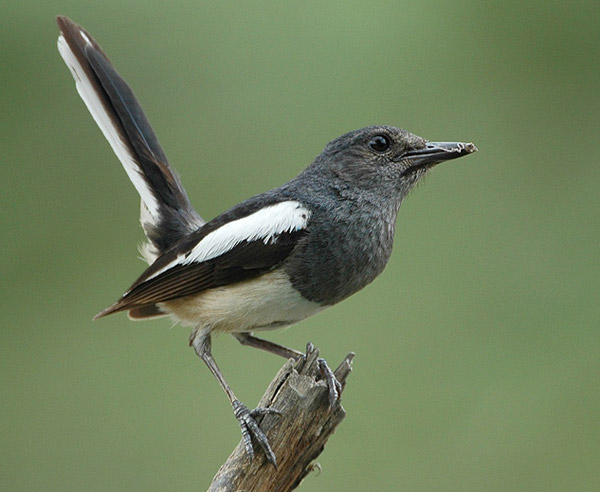
Oriental Magpie-Robin (Copsychus saularis) by Nikhil Devasar

Oriental Magpie-Robin (Copsychus saularis) by Nikhil Devasar

 “LP (Long Play) Singer”

There are birds that sing for long durations. Birds like grasshopper warbler’s solo may last for over two minutes, nightjars may “chur” nonstop for eight minutes, a skylark may belt an unbroken heartfelt song for 18 minutes and an Oriental Magpie Robins would practice singing for more than half an hour to woo a potential female. To establish territories and to court females there is a bird called Dickcissels that would spend about 70 percent of the day singing while establishing territories and courting females. How long do we sing and worship every day to woo God’s presence. For God loves to dwell among our praises and the Bible says it too.

But thou art holy, O thou that inhabitest the praises of Israel. Psalm22:3

From dawn to dusk to summer to winter, every little movement of the planets and the billions of stars, the blooming of the flowers and the fruiting of the trees, every tiny creation under the sky are set in perfect motion each following different rhythmic patterns ensuing perfect harmony. There can be no better musician that God Himself. He orchestrates the whole universe like only He alone can. And that is the reason God assigned Moses to do something which he has never done before.

Before bidding goodbye for the last time to the people whom he led from Egypt through the wilderness, Moses was entrusted the job of teaching a song to the Israelites that God had personally composed.

Now therefore write ye this song for you, and teach it the children of Israel: put it in their mouths, that this song may be a witness for me against the children of Israel.

For when I shall have brought them into the land which I swore unto their fathers, that floweth with milk and honey; and they shall have eaten and filled themselves, and waxen fat; then will they turn unto other gods, and serve them, and provoke me, and break my covenant.

And it shall come to pass, when many evils and troubles are befallen them, that this song shall testify against them as a witness; for it shall not be forgotten out of the mouths of their seed: for I know their imagination which they go about, even now, before I have brought them into the land which I swore.

Moses therefore wrote this song the same day, and taught it the children of Israel.  Deuteronomy 31:19-22

Moses did teach God’s real big song immediately to his people and that can be found in Deuteronomy 32. How would our church respond if our pastor taught us that same big song? Faces frown when worship session extends beyond the stipulated time by a few minutes and if still continues for another few more minutes, worship turn to murmur. That is ‘cause most people find themselves so restless when it comes to spending that extra few minutes in the presence of God. We measure our praise and worship but we want immeasurable blessings from God.

Maybe God wants us to sing for longer durations like our flying friends so as to make a covenant with us…

I will bless the Lord at all times: his praise shall continually be in my mouth.”Psalm 34:1
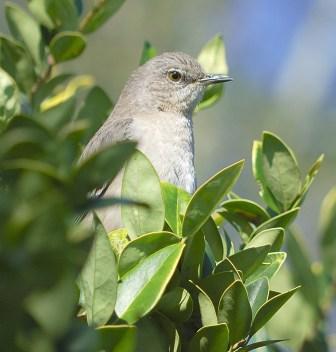
Northern Mockingbird (Mimus polyglottos) by Dan

Northern Mockingbird (Mimus polyglottos) by Dan

  “All Season Singer”

 “Above it stood the seraphims: each one had six wings; with twain he covered his face, and with twain he covered his feet, and with twain he did fly.

And one cried unto another, and said, Holy, holy, holy, is the LORD of hosts: the whole earth is full of his glory” Isaiah 6:2-3

Since creation the Cherubs and Seraphs had been singing Holy, Holy, Holy, non-stop 24×7. I wonder how they don’t get bored singing the same song for thousands of years.  Most birds sing the same family song generation after generation after generation. The Northern Mocking birds sing all through the day and many a time can be heard even during the night. These slender birds never seem to get bored with singing. They also continue to add new sounds to their repertoires all through their lives. Don’t be surprised if someone says that a male Northern Mocking bird would learn more than 200 songs in its lifetime. That is their lifestyle, singing new songs all through the day and even during nights. A single male would sing longer than a male that has a family.

We prefer to worship only when life is on a rollercoaster. Do we sing and praise God at all times, during dark times in particular? May be that is the reason why God had not made a covenant with us yet is it? The Catholic Bible says that Shadrach, Meshach and Abednego worshipped right inside the fiery furnace that was set to heat seven times more than normal. And our God who loves to dwell among praises descended down and took the three young men for a stroll right in the middle of the furnace. Wear on the garment of Praise and worship, for it is fire-proof you know! Think of Paul and Silas, who were battered and bruised for no fault and was thrown into the prison. Undeterred, they preferred to sing and praise God at the darkest hour. That’s when God shook the foundation of the prison, broke their bondage and also of the other inmates of the prison. Wear the garment of Praise and Worship and you will find that no chain can bind you or jail you…Hundreds of years passed between these two significant incidents. Sandwiched between those two incidents is another great worshipper is King David, who knew the secret of Praise and Worship and that is the reason he says, I will bless the Lord at all times: his praise shall continually be in my mouth.” Psalm 34:1

Maybe God is waiting to hear us sing at all times to make a covenant with us..

“In every thing give thanks: for this is the will of God in Christ Jesus concerning you.” 1 Thessalonians 5:18

Brown Thrasher (Toxostoma rufum) By Dan'sPix

Brown Thrasher (Toxostoma rufum) By Dan’sPix

  “New Song Singer”

Some birds sing just one song all through their lives. But there are birds that have vast repertoires of over thousands songs too… Brown thrasher can sing 2,000 songs while an Red-eyed Vireo had been recorded to have sung 20.000 songs in a day. Northern mocking birds often learn new songs. Sometimes it may end up learning about 200 new songs every year, during adulthood the male needs to improvise its singing capabilities by practicing for hours together to impress upon its probable mate. The male that sings the most complex songs are in demand among the eligible females. Most female prefer to mate with the male which sings the most complex songs since, she thinks that the male that sings the most complex songs is best suited to raise and look after the family.

Male Black-throated blue warblers that had bred and reproduced successfully would sing to its offspring to influence their vocal development. If young birds fail to learn songs from their fathers, they would starve to death. Bird vocalization is absolutely necessary for the young birds to grow into a successful adult.

How many parents take time to teach new songs to their children? How many parents feel that children should go to Sunday school regularly?  Raising a child is not about feeding clothing and sheltering alone . It is about teaching them survival traits which would help them rise into a successful parent in future.  Those survival traits include worship, prayer, tithing, knowledge in the word of God and so on. Do we teach them to sing for God? If we as parents fail to teach them the power of worship and how it can change any bad situation, who else would? We don’t have to be musically trained to teach them new songs. The least could be family prayer both at dawn and dusk. Wherein we have the habit of singing hymns and choruses that would help parents expose their children to new songs. If a father smokes in front of his children, he is sure to see one of them smoke in the near future. And if a mother gossips in front of her child, she would surely end up seeing her child gossip too.  Do we want to define machismo and femininity by smoking and gossiping? What we are is what our children are going to be. The ones who learn to worship God singing new songs even in times of trouble are the ones who are capable of overcoming any situation, bad or worse.

God doesn’t expect us to sing the same song over and over again; we have a better choice to sing new songs every day. Our God says, “Behold, I will do a new thing; now it shall spring forth; shall ye not know it? I will even make a way in the wilderness, and rivers in the desert.” Isaiah 43:19. David knew the secret of touching God’s heart. Maybe that is the reason he made it a point to sing new songs for God. We may not sing thousands of song, do but do we have the habit of singing a few new songs for God? Is that the reason why God chose to make a covenant with birds instead?

“O sing unto the Lord a new song: sing unto the Lord, all the earth.” Psalm 96:1

Indian Scimitar Babbler (Pomatorhinus horsfieldii) ©WikiC

Indian Scimitar Babbler (Pomatorhinus horsfieldii) ©WikiC

 “Corporate Singer”

Birds neither have a worship leader nor a worship team to lead them in singing. They know God’s plan in their lives. They also know that God had created them to sing and so they sing. No matter what, rain or shine, they never cease to sing. They sing on time, the time that God had set for each one of them. They do not overlap their singing instead they share space even in their singing. Homo Sapiens love to talk, talk and talk 24×7. We talk about our family and finance, sports and corruption, love and sex, marriage and divorce. At the end of the day most of all that we spoke through the day is found to be just rubbish. But birds always talk about global warming, climate change and natural disaster.

Duetting among birds not only help them stay close to each other but also to locate each other in dense foliage. Initially this behavior was thought be a battle of sexes, where duetting behavior reflects the struggle between bonding pair. But recent studies show that duetting is not about singing romantic duets but it is all about aggressive audio warfare, where it bonds a potential pair in defending territorial invasion by other bonding pairs.

Jesus said, For where two or three are gathered together in my name, there am I in the midst of them” Mathew 18:20. When two are three gather in His name do they fill the air with “gossip” or “worship?”

 This people have I formed for myself; they shall shew forth my praise.” Isaiah 43:21

God created man to just worship. But, we do every other thing except worshipping. Worse still, man’s priorities shifted from worshipping the One to be worshipped to worshipping the worship or the worship leader or the choir or the musician. Most churches feel that it’s the talent of the worship leader or the worship team or the selection of songs that is crucial in pulling off a successful worship session. It is time for us to switch on the search lights and check on how we worship God. Do we worship God in truth and in spirit? Don’t we prefer this worship leader than that worship leader? Don’t we feel that this worship team is better than the other worship team? Did we not say that the presence of God is mightier when that guy sings or plays the keyboard? Are we spiritual Christians or emotional Christians? Most believers treat church as a concert hall rather than a place of worship. That must be the reason why they prefer to listen to worship rather than to participate in worship. The reason they give, “I don’t have a good voice” God doesn’t look for a good voice but for a joyful noise.

“Make a joyful noise unto the LORD, all the earth: make a loud noise, and rejoice, and sing praise.” Psalm 98:4
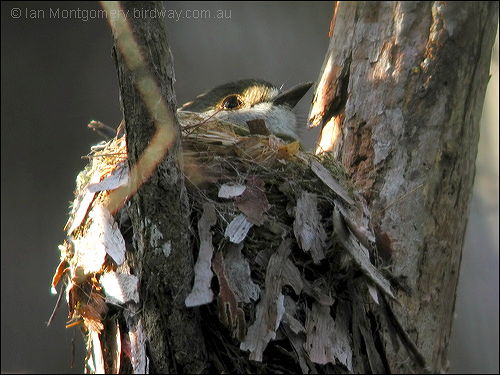
Pale-yellow Robin (Tregellasia capito) in nest by Ian

Pale-yellow Robin (Tregellasia capito) in nest by Ian

 “Silent Singer”

Most birds do not sing all through the day. As told earlier, they have a set time for their everyday concert, what researchers call as “Bird clock”. They know when to sing and when to stay silent. Do we know when to stay still and when to worship?  The Bible calls us as the “Royal Priesthood”. Bible explains the robe of the Royal Priest like this.

“Make the robe of the ephod entirely of blue cloth,

with an opening for the head in its center. There shall be a woven edge like a collar around this opening, so that it will not tear.

Make pomegranates of blue, purple and scarlet yarn around the hem of the robe, with gold bells between them. 

The gold bells and the pomegranates are to alternate around the hem of the robe.” Exodus 28:31-34

The gold bells and the pomegranates that alternate around the hem of the robe show us how to live the life of a true worshipper. Bells make noise and pomegranates stay quite. In other words the alternate arrangement of gold bells and pomegranates seems to say that we need to know when to make a joyful noise and when to keep quite. Music is also an amalgamation of notes and pause. In other words music is not complete without pause. The birds know it well and help them sync so well with the bird clock.  A royal priest also ought to know when to make noise and when to give a pause.

“And it shall be upon Aaron to minister: and his sound shall be heard when he goeth in unto the holy place before the Lord, and when he cometh out, that he die not.” Exodus 28:35

The sound of the bell should keep ringing while the priest is inside the holy place before the Lord. The sounds of the bells would die only if God slays the priest only after having found him to have sinned. This only substantiates the fact that we, the so-called royal priesthood need to make a joyful noise in His presence and if we don’t, it sounds like we are dead. We need to remember that, The dead praise not the LORD, neither any that go down into silence.” Psalm 115:17.

Of all the languages, silence is the most powerful language on the face of the earthNow that we know when to make noise, we also need to know when to pause too. The life of Jesus itself shows us importance of being still in silence. On more than one occasion Jesus did show us what silence can do. Jesus echoed the language of silence in the most profound mode on the cross of Calvary. If not for His silence, we would still be waiting for redemption. It was His silence that broke the shackles of sin to set us free from the clutches of satan. How silent are we in His presence? Do we take time to listen to Him or just go blah-blah in His presence?

Birds know when to sing their mating songs and when not to. They have a specific season for mating; unlike human beings whose birthday fall on every single day from January through December and that includes February 29th, the leap day too. Romancing for birds is seasonal, purposeful and decisive: whereas for Homo sapiens, it is more of lust than of commitment, a commitment to God’s eternal plans, per se. There is a season for everything. Do we adhere to God’s timing? In His time He makes all things beautiful and not in our time. Birds must be intrinsic to God’s time. That must be the reason for God to make a covenant with these feathered singers isn’t it?

a time to tear and a time to mend, a time to be silent and a time to speak,”  Ecclesiastes 3:7

*

Birds of the Bible – The Hidden Covenant ~ by AJ Mithra

(Written by A J – layout, photos, and sounds added by Lee)

See:

Birds of the Bible – The Hidden Covenant – Intro

Birds of the Bible – The Hidden Covenant – Part 3

Birds of the Bible

*

Yours in YESHUA,

a j mithra

Please visit us at:

*
Birds of the Bible – The Hidden Covenant – Intro

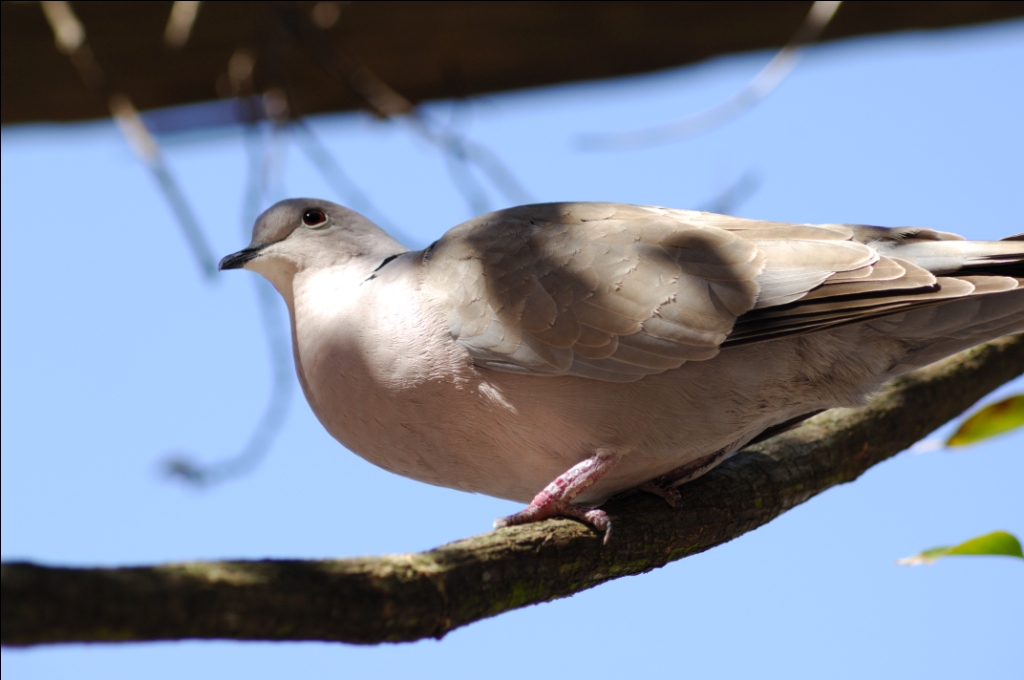
Eurasian Collared Dove (Streptopelia decaocto) by Dan

Eurasian Collared Dove (Streptopelia decaocto) by Dan

(The first of a three part article.)


The Hidden Covenant

“Berith” the Hebrew word for covenant means “a coming together” in English, appears 280 times in the Bible. Covenants may include a treaty, agreement, mutual understanding, pact, deal, alliance, pledge, promise and so on. Marriage is a covenant between two individuals. Treaty is a covenant between two states or nations. The Last will that is written by an ailing individual to pass on his /her property to his surviving spouse or children is also a covenant. We are bound by so many covenants in our everyday life. Housing and vehicle loans, debit and credit cards, driving license are all covenants.

Though each one of us is bound by a direct or an indirect covenant with an individual, an organization or a government, we long for God to make a covenant with us. Bible shows us so many covenants between individuals, kings and between leaders of a group of men; but the covenants that God made with individuals and a group of individuals are the ones which were widely meditated, preached and written about.

Somewhere down the line, over centuries after centuries after centuries, there is one covenant that was either unintentionally hopped or deliberately overlooked. This covenant may look irrelevant and immaterial, trivial and trifling; but an in-depth study of this covenant would unveil a big secret that God has for the peace and tranquility of the whole universe.

That “Berith – Covenant” is as follows…

“And in that day will I make a covenant for them with the beasts of the field, and with the fowls of heaven, and with the creeping things of the ground: and I will break the bow and the sword and the battle out of the earth, and will make them to lie down safely.” Hosea 2:18

When does God make a covenant with them?

Why would God want to make a covenant with the beasts of the field, with the fowls of the air and with the creeping things of the ground?

How could a covenant with wildlife break the bow and the sword and the battle out of the earth?

Is it possible for a covenant with wildlife, help us lie down safely?

These were the queries that rose from my mind when I read the above verse from Hosea. While I was pondering over this attention-grabbing episode of God, He slowly unraveled the crucial presence of wildlife, not just for food and clothing but for the survival of mankind as a whole.

Sitting on the balcony one morning, trying hard to gulp those recent unpleasant happenings along with her morning coffee, watching a squirrel jump from a coconut tree to a custard apple tree like a seasoned pro, my wife probed, “God could have created us like these animals. Why should we suffer like this? See how they enjoy life” Just as she was lamenting, I felt God say, “They are sinless, whereas man was born of sin”

I thought this conversation not only opened avenues of thought but also made sense on this new covenant that God uncovered a few days back. Ever since God clothed Adam and Eve with animal skin and accepted the sacrifice of Abel. God did express how imperative animals and birds are in His creation. Abel knew that there is no redemption without shedding blood. So he chose from the best among wildlife and sacrificed. And we all know how God accepted his sacrifice and rejected the sacrifice of Cain.

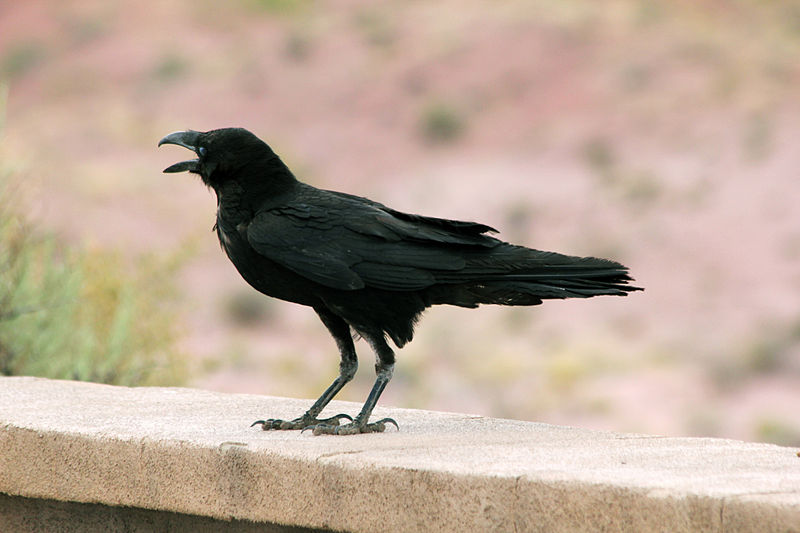
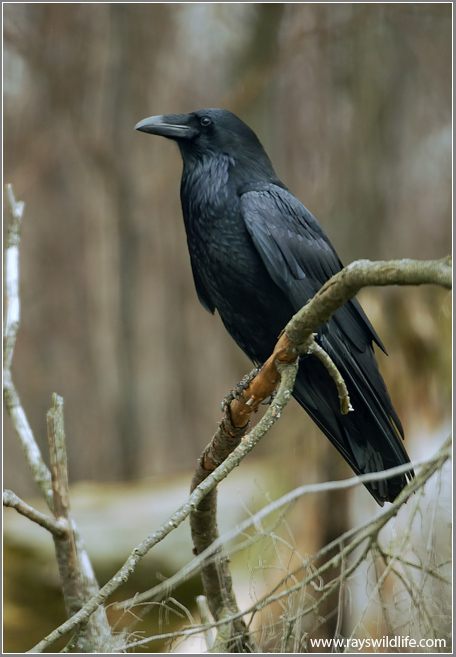
Northern Raven (Corvus corax) by Ray

Northern Raven (Corvus corax) by Ray

Noah also had to seek the help of birds to get the weather report after the flood isn’t it? And God made a covenant with Noah but not before he sacrificed from every clean beast and from every clean animal. Remember, if not for the beasts and birds God wouldn’t have placed the beautiful rainbow in the sky. If not for rainbow, we wouldn’t have studied prism in school.

God also taught Moses and Aaron, His appointed servants. about how to sacrifice, when to sacrifice and what to sacrifice. God gave them a list of clean animals and birds for sacrifice. In fact birds were sacrificed when Jesus was brought to the temple of Jerusalem after the days of purification.

“And when eight days were accomplished for the circumcising of the child, his name was called Jesus, which was so named of the angel before he was conceived in the womb.

And when the days of her purification according to the law of Moses were accomplished, they brought him to Jerusalem, to present him to the Lord;

(As it is written in the law of the Lord, Every male that openeth the womb shall be called holy to the Lord;)

And to offer a sacrifice according to that which is said in the law of the Lord, A pair of turtledoves, or two young pigeons.” Luke 2:21-24

The birds seem to have handed over the entry ticket for the Creator when He entered the temple of Jerusalem for the first time is His life on earth.

So? Does it mean that only clean beasts and birds are sinless? I thought.  If it is so, why should God send an unclean raven to feed Prophet Elijah? I wondered. Anyway, there should be a strong central theme for God to make a covenant with the beasts and the birds instead of man, whom He created in His own image.

Birds of the Bible – The Hidden Covenant ~ by A J Mithra

See:

Birds of the Bible – The Hidden Covenant – Part 2

Birds of the Bible – The Hidden Covenant – Part 3

Birds of the Bible

*

Yours in YESHUA,

a j mithra

Please visit us at:

*
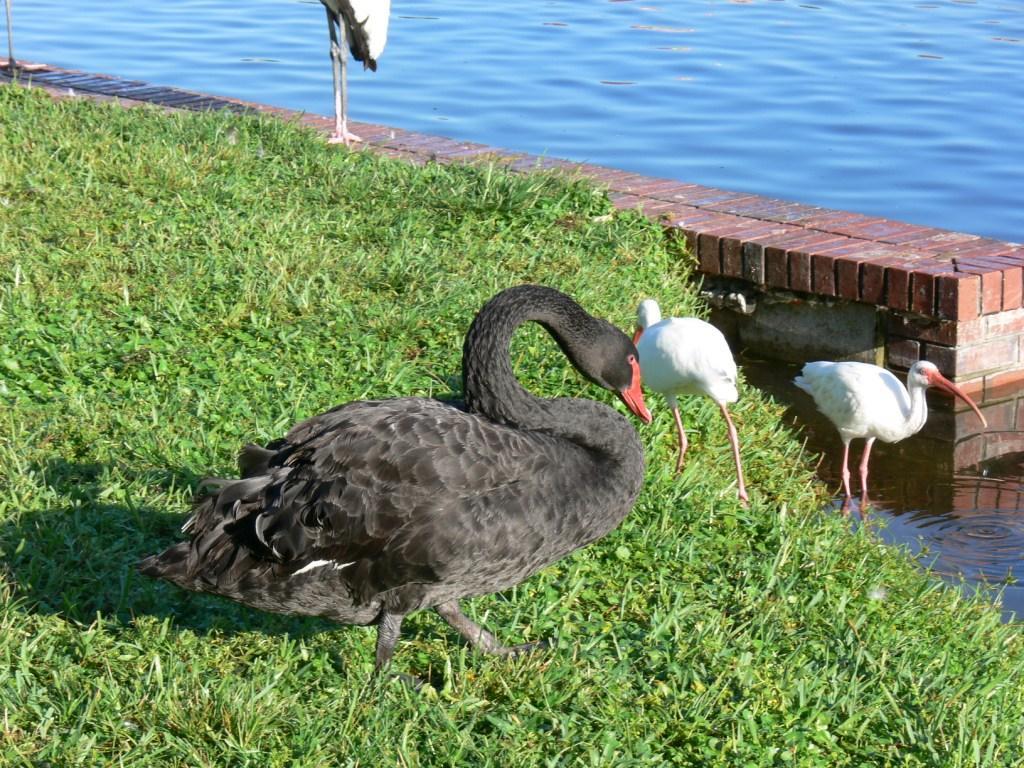
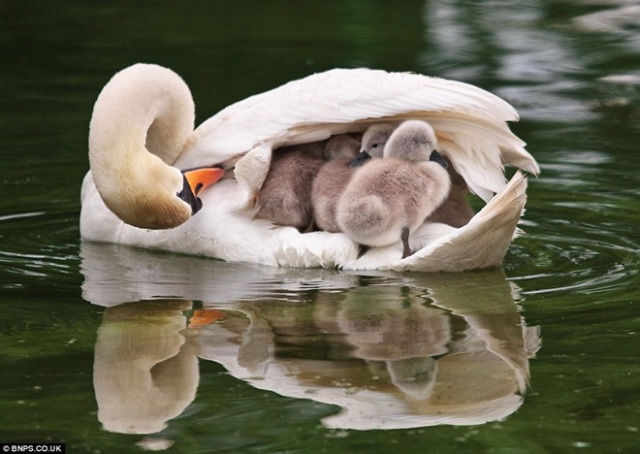
Black Swans by Bellamoon Nature

Black Swan by Lee

Black Swan by Lee

Bellamoon sent a link to some of his videos. The one below of the Black Swans and their family is super. He previously gave me permission to use his music for videos I put together, but this is better than anything I could ever do.

Several verses came to mind about “under his wings” while watching this:

Keep me as the apple of the eye, hide me under the shadow of thy wings, (Psalms 17:8 KJV)

How excellent is thy lovingkindness, O God! therefore the children of men put their trust under the shadow of thy wings. (Psalms 36:7 KJV)

He shall cover thee with his feathers, and under his wings shalt thou trust: his truth shall be thy shield and buckler. (Psalms 91:4 KJV)

He shall cover thee with his feathers, and under his wings shalt thou trust: his truth shall be thy shield and buckler. (Psalms 91:4 KJV)

O Jerusalem, Jerusalem, which killest the prophets, and stonest them that are sent unto thee; how often would I have gathered thy children together, as a hen doth gather her brood under her wings, and ye would not! (Luke 13:34 KJV)

There are verses that help us think about how kind these swans are to their young:

For thy lovingkindness is before mine eyes: and I have walked in thy truth. (Psalms 26:3 KJV)

Withhold not thou thy tender mercies from me, O LORD: let thy lovingkindness and thy truth continually preserve me. (Psalms 40:11 KJV)

Whoso is wise, and will observe these things, even they shall understand the lovingkindness of the LORD. (Psalms 107:43 KJV)

Links:

*

New Type of V-Formation

Mixed Flock of birds flying in a V Formation- Put together- ©Creative Commons

Mixed Flock of birds flying in a V Formation- Put together- ©Creative Commons

One of my readers of the blog had this in his post. After checking the internet, I found that it was free to use. So, now I am sharing it. I think it is adorable. Not sure who originally put it together, but, thank you.

When I showed it to Dan and ask him what I could write about it, he gave me the following example:

All those birds are from different species, yet they are all heading in the same direction. The Bible tells us:

And He has made from one blood every nation of men to dwell on all the face of the earth, and has determined their preappointed times and the boundaries of their dwellings, (Acts 17:26 NKJV)

Then I saw another angel flying in the midst of heaven, having the everlasting gospel to preach to those who dwell on the earth to every nation, tribe, tongue, and people—saying with a loud voice, “Fear God and give glory to Him, for the hour of His judgment has come; and worship Him who made heaven and earth, the sea and springs of water.” (Revelation 14:6-7 NKJV)

And they sang a new song, saying: “You are worthy to take the scroll, And to open its seals; For You were slain, And have redeemed us to God by Your blood Out of every tribe and tongue and people and nation, (Revelation 5:9 NKJV)

Praise the Lord that it matters not where you are from, the Lord Jesus Christ has made salvation available to “whosoever.”

*

(Lord willing that photo will be posted again.)

Birds of the Bible – Raven III

Northern Raven (Corvus corax) by Ray

Northern Raven (Corvus corax) by Ray

It has been several years since the Raven was featured in the Birds of the Bible. Let’s review the Raven’s part in the Scripture and see if we can add more details about this fantastic bird and his family members.

Ravens are mentioned eleven times in the Bible:

Then he sent out a raven, which kept going to and fro until the waters had dried up from the earth. (Genesis 8:7)
every raven after its kind, (Leviticus 11:15)
every raven after its kind; (Deuteronomy 14:14)
You shall drink from the brook, and I have commanded the ravens to feed you there.” 1Kings 17:4)
And the ravens brought him bread and meat in the morning, and bread and meat in the evening, and he drank from the brook. (1Kings 17:6)
Who provides food for the raven, When its young ones cry to God, And wander about for lack of food? (Job 38:41)
He gives to the beasts their food, and to the young ravens that cry. (Psalms 147:9)
The eye that mocks a father and scorns to obey a mother will be picked out by the ravens of the valley and eaten by the vultures. (Proverbs 30:17)
His head is like the finest gold; His locks are wavy, And black as a raven. (Song of Solomon 5:11)
But the pelican and the porcupine shall possess it, Also the owl and the raven shall dwell in it. And He shall stretch out over it The line of confusion and the stones of emptiness. (Isaiah 34:11)
Consider the ravens: they neither sow nor reap, they have neither storehouse nor barn, and yet God feeds them. Of how much more value are you than the birds! (Luke 12:24)

As you can see, the Raven is one of the more mentioned birds in God’s Word, therefore it deserves to be studied again. The  Corvidae – Crows, Jays, Ravens Family is where you will find the Raven and their kind, such as Ravens, Crows, Jackdaw, Magpies, Jays, Magpie-Jays and Ground-Jays, Treepies, Choughs and Nutcrackers. At present, there are 130 species in the family. The Raven is one of several larger-bodied members of the genus Corvus—but in Europe and North America the Northern (Common) Raven is normally implied. They have black plumage and large beaks. They are considered the most intelligent of the birds, and among the most intelligent of all animals. It appears that the Lord used the intelligence He created in the Raven to help find the food that was needed to feed Elijah, the prophet, and also to help Noah discern when the waters had dried up.

And Elijah the Tishbite, of the inhabitants of Gilead, said to Ahab, “As the LORD God of Israel lives, before whom I stand, there shall not be dew nor rain these years, except at my word.” Then the word of the LORD came to him, saying, “Get away from here and turn eastward, and hide by the Brook Cherith, which flows into the Jordan. And it will be that you shall drink from the brook, and I have commanded the ravens to feed you there.” So he went and did according to the word of the LORD, for he went and stayed by the Brook Cherith, which flows into the Jordan. The ravens brought him bread and meat in the morning, and bread and meat in the evening; and he drank from the brook. (1 Kings 17:1-6 NKJV)

Today there are thirteen (11) Ravens plus several subspecies. (IOC 3.4) There are also two extinct; the Chatham and New Zealand Ravens.

Forest Raven (Corvus tasmanicus)
Little Raven (Corvus mellori)
Australian Raven (Corvus coronoides)
Pied Crow (Corvus albus)
Brown-necked Raven (Corvus ruficollis)
Somali Crow (Corvus edithae)
Northern Raven (Corvus corax)
Chihuahuan Raven (Corvus cryptoleucus)
Fan-tailed Raven (Corvus rhipidurus)
White-necked Raven (Corvus albicollis)
Thick-billed Raven (Corvus crassirostris)

Chihuahuan Raven (Corvus cryptoleucus) ©WikiC

Chihuahuan Raven (Corvus cryptoleucus) ©WikiC

The Northern (Common) Raven, which is North America’s main Raven, began in the Old World and crossed the Bering land bridge into North America. Recent genetic studies, which examined the DNA of Northern Ravens from across the world, have determined that the birds fall into at least two clades: a California clade, found only in the southwestern United States, and a Holarctic clade, found across the rest of the northern hemisphere. Birds from both clades look alike, but the groups are genetically distinct and began to diverge.

The findings indicate that based on mitochondrial DNA, Northern Ravens from the rest of the United States are more closely related to those in Europe and Asia than to those in the California clade, and that Northern Ravens in the California clade are more closely related to the Chihuahuan Raven (C. cryptoleucus) than to those in the Holarctic clade. Ravens in the Holarctic clade are more closely related to the Pied Crow (C. albus) than they are to the California clade. Thus, the Northern Raven species as traditionally delimited is considered to be paraphyletic.

One explanation for these surprising genetic findings is that Northern Ravens settled in California and became separated from their relatives in Europe and Asia during an ice age. A group from the California clade became into a new species, the Chihuahuan Raven. Other members of the Holarctic clade arrived later in a separate migration from Asia.

A recent study of raven mitochondrial DNA showed that the isolated population from the Canary Islands is distinct from other populations. The study did not include any individuals from the North African population, and its position is therefore unclear, though its morphology is very close to the population of the Canaries (to the extent that the two are often considered part of a single subspecies). (Wikipedia with editing)

Thick-billed Raven (Corvus crassirostris) ©WikiC

Thick-billed Raven (Corvus crassirostris) ©WikiC

Wikipedia and others break the Ravens into five groups along with their allies in the True Crows division.

  • Australian and Melanesian Species – Australian Raven, Little Raven, Forest Raven
  • Eurasian and North African Species – Fan-tailed Raven, Brown-necked Raven
  • Holarctic Species – Northern (Common) and Pied Ravens
  • North and Central American Species – Chihuahuan Raven, Western Raven
  • Tropical African Species – White-necked Raven, Thick-billed Raven, Somali Crow (Dwarf Raven)
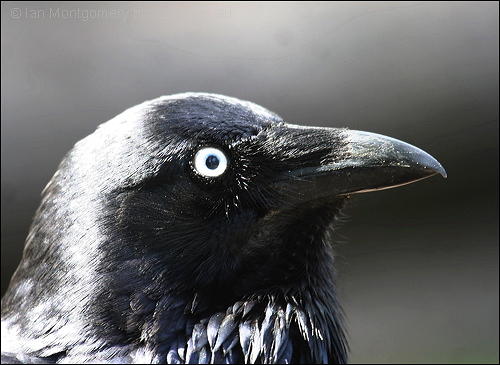
Australian Raven (Corvus coronoides) by Ian

Australian Raven (Corvus coronoides) by Ian

Other articles about the Raven:

*

Birds Of The Bible – Joy And Laughter

Laughing Kookaburra (Dacelo novaeguineae) at LPZoo

Laughing Kookaburra (Dacelo novaeguineae) by Lee

While we were at Lowry Park Zoo last week, we also had the joy of hearing the Laughing Kookaburra (Dacelo novaeguineae) sounding off with its mate. Seems like the Myna birds and the singing dogs were not the only ones in a happy mood. The two Kookaburras got to “laughing” also. They sort of set the tone to put you a joyful mood.

For You, O Lord, have made me glad by Your works; at the deeds of Your hands I joyfully sing. (Psalms 92:4 AMP) Make a joyful noise to the Lord, all the earth; break forth and sing for joy, yes, sing praises! (Psalms 98:4 AMP)

I have always enjoyed seeing the Kookaburras. When we were at the National Aviary I tried recording them, but by the time I got the camera on, they stopped. I recorded them this time but didn’t get the camera focused on them until about half way through. Oh, the challenges of birdwatching! Well, at least trying to get a recording to use on the blog anyway. When you put all the events together; the singing Bali Myna, the singing dogs, and these singing Kookaburras, it brings to mind a story in the Bible. When Paul and Silas where in prison, (behind bars) they were joyful just the same. All of these critters plus the men (Paul and Silas) are behind bars, yet they are joyful and carrying on with their lives. Could there be a lesson there for us to learn and observe?

And at midnight Paul and Silas prayed, and sang praises unto God: and the prisoners heard them. (Acts 16:25 KJV)

Consider it wholly joyful, my brethren, whenever you are enveloped in or encounter trials of any sort or fall into various temptations. (James 1:2 AMP)

We all have things come into our lives, but our attitude affects how well we handle those circumstances. Prayer is one of the best ways to find peace in the midst of trials. Knowing the Lord Jesus Christ as personal Savior is the absolute best way. I trust you know Him.

Gospel Message

*

This video has two of my photos to cover the blurred part, but the sound is the whole recording.

The Laughing Kookaburra (Dacelo novaeguineae) is a carnivorous bird in the kingfisher family Halcyonidae. Native to eastern Australia, it has also been introduced to parts of New Zealand, Tasmania and Western Australia. Male and female adults are similar in plumage, which is predominantly brown and white. A common and familiar bird, this species of kookaburra is well known for its laughing call.

There are actually 6 Kookaburras:

  • Lilac Kingfisher (Cittura cyanotis)
  • Shovel-billed Kookaburra (Clytoceyx rex)
  • Laughing Kookaburra (Dacelo novaeguineae)
  • Blue-winged Kookaburra (Dacelo leachii)
  • Spangled Kookaburra (Dacelo tyro)
  • Rufous-bellied Kookaburra (Dacelo gaudichaud)

See:

Birds of the Bible

Laughing Kookaburra – Wikipedia

Alcedinidae – Kingfishers – Family

*

Birds of the Bible – Heron’s Teaching

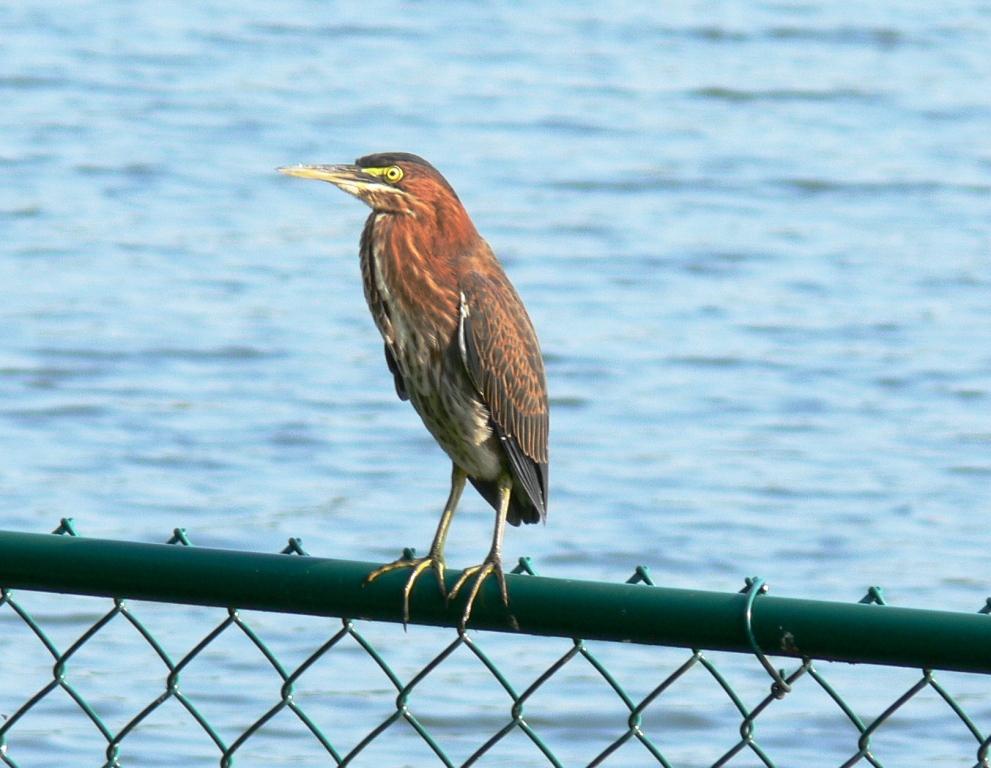
Green Heron (Butorides virescens) by Lee

Green Heron (Butorides virescens) by Lee

“But now ask the beasts, and they will teach you; And the birds of the air, and they will tell you; (Job 12:7 NKJV)

I have been thinking about that Green Heron in the video I posted a few days ago. (Green Heron Fishing With Bread) The verse above makes me think there has to be some lessons to learn from it. These are just some of my thoughts and I am sure you can come up with some of your own.

One that comes to thought right off is that bird’s patience. Are we?

These wait all upon thee; that thou mayest give them their meat in due season. That thou givest them they gather: thou openest thine hand, they are filled with good. (Psalms 104:27-28 KJV)

The verse used in the article tells how the Lord protects and provides for His creation. Will He not provide for us also. He loves us and wants to meet our needs, just as was provided for this Heron.

Look at the birds of the air, for they neither sow nor reap nor gather into barns; yet your heavenly Father feeds them. Are you not of more value than they? (Matthew 6:26 NKJV)

Another lesson is that the bird is doing something that we wouldn’t think it could do. You wonder where it learned that behavior. For us, the Lord wants us to do something, and if we are willing, we are amazed at what we can do. Things we would never think we had the capacity to do He helps us perform..

Jesus said unto him, If thou canst believe, all things are possible to him that believeth. (Mark 9:23 KJV)

I can do all things through Christ which strengtheneth me. (Philippians 4:13 KJV)

He (the heron) has a goal in mind and isn’t going to give up even though it takes several attempts to accomplish his goal. The Lord tells us to become “fishers of men” and we need to keep trying and not give up. Even when our “bread” is down to hardly anything and you think you might as well give up, you try one more time.

So then neither is he that planteth any thing, neither he that watereth; but God that giveth the increase. Now he that planteth and he that watereth are one: and every man shall receive his own reward according to his own labour. (1 Corinthians 3:7-8 KJV)

On a more light side, I am not so sure that the Heron wasn’t bordering on “gluttony.” Did you see that last part where it is swallowing the fish. Looks like it almost “bit of more than it could chew.”

But put ye on the Lord Jesus Christ, and make not provision for the flesh, to fulfil the lusts thereof. (Romans 13:14 KJV)

These are but a few and if you have some, leave a comment and share them with us.

Birds of the Bible – Herons

Birds of the Bible

Bible Birds

Wordless Birds

*

*

Birds of the Bible – Name Study – Heron

Great Blue Heron (Ardea herodias) Watching young nearby by Lee at Viera Wetlands

Great Blue Heron (Ardea herodias) Watching young nearby by Lee at Viera Wetlands

Let’s look into a name study for another Bird of the Bible – this time the Heron. Our fishing Green Heron directed my thinking towards the Heron. So, let’s see what we can find out about how they are mentioned in Scripture.

The Heron and their kind are mentioned in Leviticus and Deuteronomy in the list of “Unclean Birds” or the “Do not eat” list.

And the stork, the heron after her kind, and the lapwing, and the bat. (Leviticus 11:19 KJV)

And the stork, and the heron after her kind, and the lapwing, and the bat. (Deuteronomy 14:18 KJV)

Those are the only two references to Herons in the King James Version. But how do other versions translate this bird? That is what these name study articles do. Dig around in the Word. I use e-Sword’ s compare mode to see the different versions.

Brenton, as does the APB, DRB, ISV, and NET  has the Heron in Psalms:

There the sparrows will build their nests; and the house of the heron takes the lead among them. Psalms 104:17 Brenton)

The Bishops and CJB only use Heron in Deuteronomy, but not Leviticus.

The Phillips does not even use the word “Heron.”

Here is the Hebrew word used in these verses:

H601
אנפה
‘ănâphâh
an-aw-faw’
From H599; an unclean bird, perhaps the parrot (from its irascibility): – heron.

*

The DRB also uses Heron in Job:

The wing of the ostrich is like the wings of the heron, and of the hawk. (Job 39:13 DRB)

The GW shows Heron in these verses:

“It will become the possession of herons. It will become pools of water. I’ll sweep it with the broom of destruction,” declares the LORD of Armies. (Isaiah 14:23 GW)

Pelicans and herons will take possession of the land. Owls and crows will live there. He will stretch the measuring line of chaos and the plumb line of destruction over it. (Isaiah 34:11 GW)

Flocks will lie down in it along with animals of every kind. Even pelicans and herons will nest on top of its columns. Listen! A bird will sing in a window. The doorway will be in ruins, because the LORD will expose the cedar beams. (Zephaniah 2:14 GW)

Isaiah 14:23 uses H7090 which is:

H7090
קפּד קפּוד
qippôd qippôd
kip-pode’, kip-pode’
From H7088; a species of bird, perhaps the bittern (from its contracted form): – bittern.

Isaiah 34:11 GW and Zephaniah 2:14 GW both use the same H7090. The word is translated as “Bittern” in the KJV for all three verses. The Ardeidae- Herons, Bitterns Family consists of Heron, Egrets and Bitterns so, there doesn’t seem to be a problem there, especially since the first two verses said, “heron after her kind.” They are related.

The DRB’s (1899 Douay-Rheims Bible) translation, to me, does not seem to match the rest of the other translations.

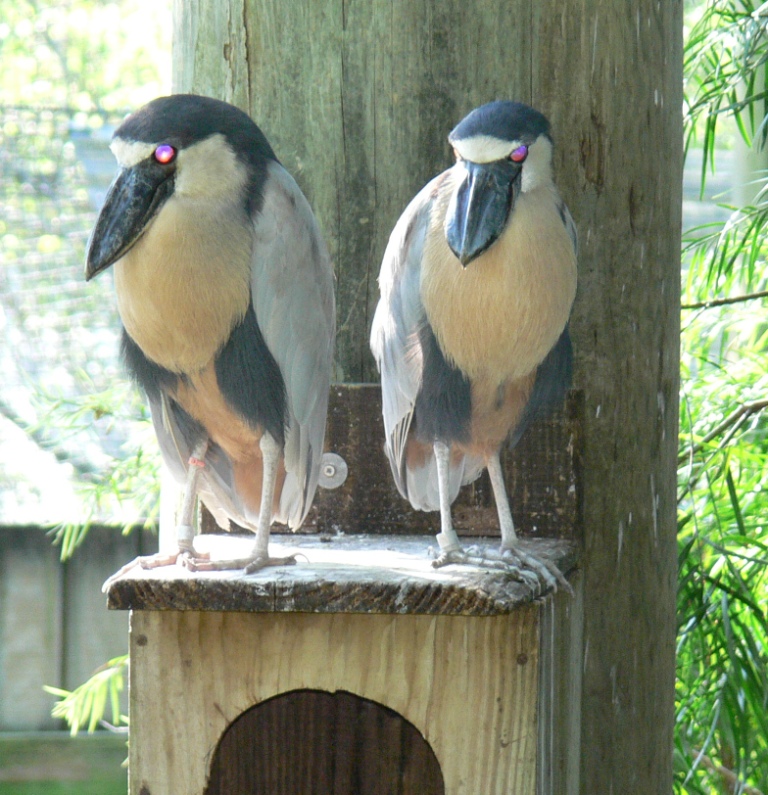
Boat-billed Heron (Cochlearius cochlearius) by Lee at LPZoo

Boat-billed Heron (Cochlearius cochlearius) by Lee at LPZoo

Herons:

The herons are long-legged freshwater and coastal birds in the family Ardeidae, with 72 recognised species (some are called “egrets” or “bitterns” instead of “heron”). Within Ardeidae, all members of the genera Botaurus and Ixobrychus are referred to as “bitterns”, and — including the Zigzag Heron or Zigzag Bittern — are a monophyletic group within the Ardeidae. However, egrets are not a biologically distinct group from the herons, and tend to be named differently because they are mainly white and/or have decorative plumes. Although egrets have the same build as herons, they tend to be smaller.

The classification of the individual heron/egret species is fraught with difficulty, and there is still no clear consensus about the correct placement of many species into either of the two major genera, Ardea and Egretta. One species formerly considered to constitute a separate monotypic family Cochlearidae, the Boat-billed Heron, is now regarded as a member of the Ardeidae.

Although herons resemble birds in some other families, such as the storks, ibises, spoonbills and cranes, they differ from these in flying with their necks retracted, not outstretched. They are also one of the bird groups that have powder down. Some members of this group nest colonially in trees, while others, notably the bitterns, use reedbeds.

Grey Heron (Ardea cinerea) by W Kwong

Grey Heron (Ardea cinerea) by W Kwong

The herons are a widespread family, they exist on all continents except Antarctica, and are present in most habitats except the coldest extremes of the Arctic, extremely high mountains and the driest deserts. Almost all species are associated with water, they are essentially non-swimming waterbirds that feed on the margins of lakes, rivers, swamps, ponds and the sea. They are predominately found in lowland areas, although some species live in alpine areas, and the majority of species occur in the tropics.

The herons are a highly mobile family, with most species being at least partially migratory. Birds are particularly inclined to disperse widely after breeding but before the annual migration where the species is colonial, searching out new feeding areas and reducing the pressures on feeding grounds near the colony. The migration typically occurs at night, usually as individuals or in small groups.

The herons and bitterns are carnivorous. The members of this family are mostly associated with wetlands and water, and feed on a variety of live aquatic prey. The diet includes a wide variety of aquatic animals, including fish, reptiles, amphibians, crustaceans, molluscs and aquatic insects. Individual species may be generalists or specialise in certain prey types, like the Yellow-crowned Night Heron, which specialises in crustaceans, particularly crabs. Many species will also opportunistically take larger prey, including birds and bird eggs, rodents, and more rarely carrion. Even more rarely there have been reports of herons eating acorns, peas and grains, but most vegetable matter consumed is accidental.

The most common hunting technique is for the bird to sit motionless on the edge of or standing in shallow water and wait until prey comes within range. (Birds of the Bible – Patient Herons) Birds may either do this from an upright posture, giving them a wider field of view for seeing prey, or from a crouched position, which is more cryptic and means the bill is closer to the prey when it is located. Having seen prey the head is moved from side to side, so that the heron can calculate the position of the prey in the water and compensate for refraction, and then the bill is used to spear the prey.

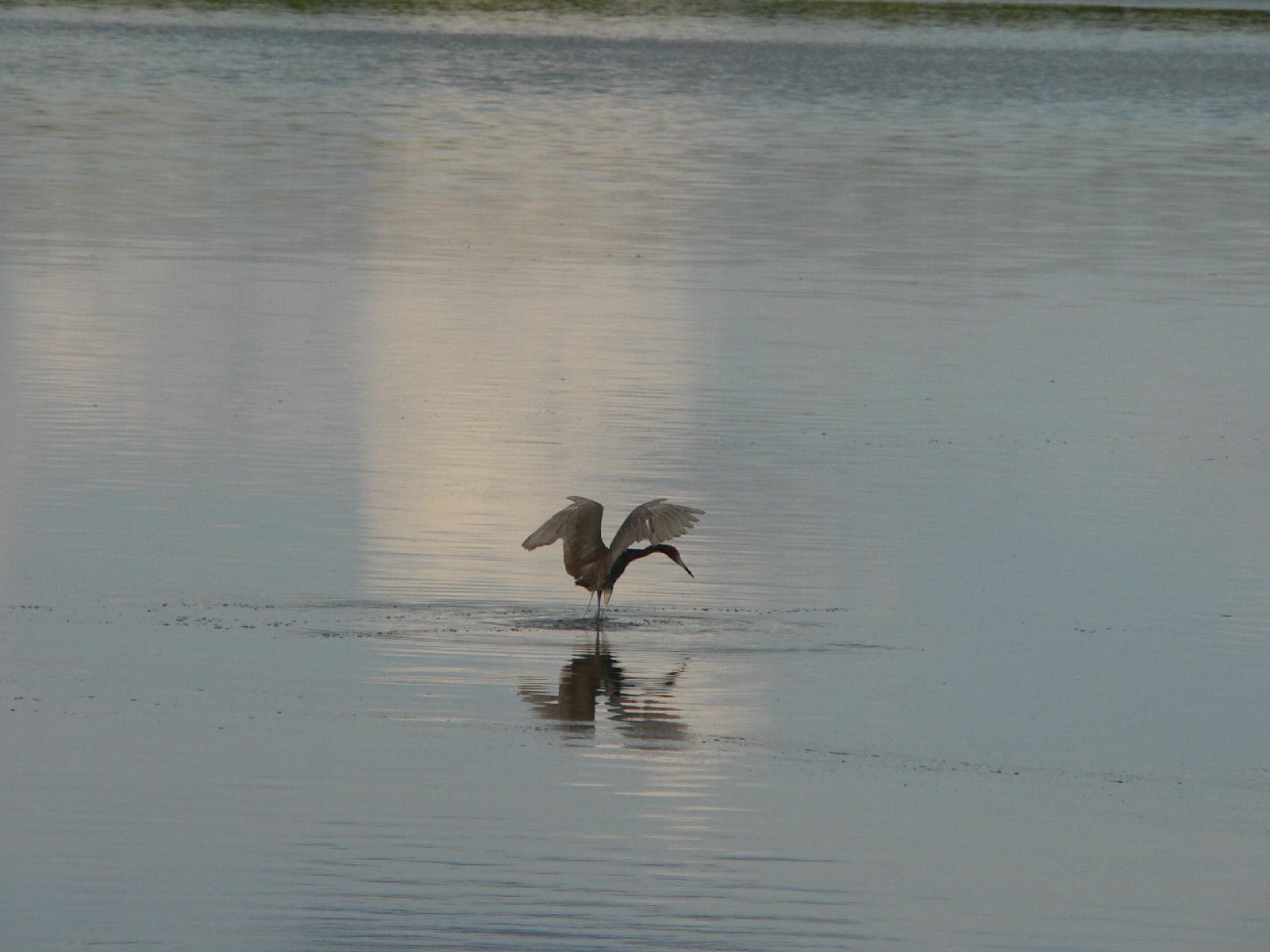
Reddish Egret scarring up breakfast

Reddish Egret scarring up breakfast

In addition to sitting and waiting, herons may feed more actively. They may walk slowly, at around or less than 60 paces a minute, snatching prey when it is observed. Other active feeding behaviours include foot stirring and probing, where the feet are used to flush out hidden prey. The wings may be used to frighten prey (or possibly attract it to shade) or to reduce glare; the most extreme example of this is exhibited by the Black Heron, which forms a full canopy with its wings over its body.

Some species of heron, such as the Little Egret and Grey Heron, have been documented using bait in order to lure prey to within striking distance. Herons may use items already in place, or actively add items to the water in order to attract fish. Items used may be man-made, such as bread; alternatively Striated Herons in the Amazon have been watched repeatedly dropping seeds, insects, flowers and leaves into the water to catch fish. (Green Heron Fishing With Bread)

(Heron information from Wikipedia with editing)

Names of Birds Study

Birds of the Bible – Herons

*

Birds of the Bible – Remembering

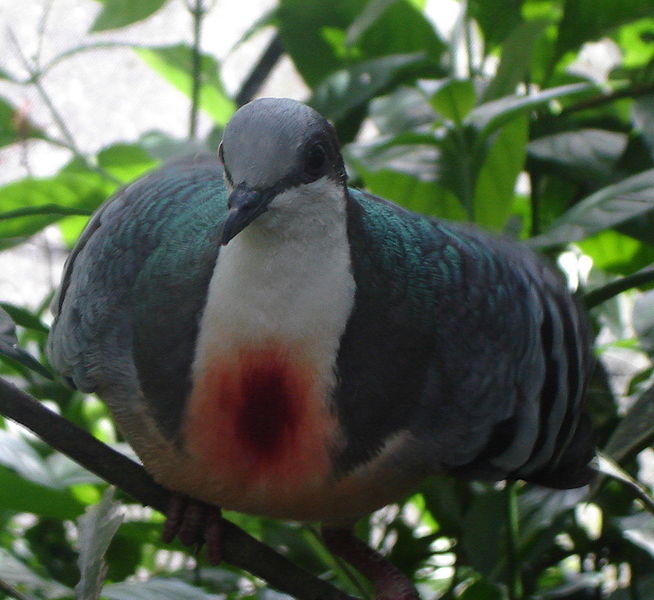
Bleeding-Heart Pigeon ©WikiC

Bleeding-Heart Pigeon ©WikiC

And God remembered Noah, and every living thing, and all the cattle that was with him in the ark: and God made a wind to pass over the earth, and the waters asswaged; (Genesis 8:1 KJV)

Today, here in the United States, is Memorial Day. A day when we remember those who have given their all in the service of our country. We honor those who we can no longer thank. As this is being written, they are laying a wreath at the tomb of the unknown soldier at Arlington National Cemetary.

My father was one of those who passed away as a result of his being in the trenches in WW I. He suffered for several years from the effects of the “mustard gas” that was sprayed on them. It is good for us to remember things and honor events.

Yesterday, in the morning service, the event of the 12 stones being taken for the Jordon River by the Israelites for a memorial was taught. That was a memorial to remind them of the way the LORD protected them and made a way for them to cross over the Jordon. It is good to remember things and honor events.

And Joshua said unto them, Pass over before the ark of the LORD your God into the midst of Jordan, and take ye up every man of you a stone upon his shoulder, according unto the number of the tribes of the children of Israel: That this may be a sign among you, that when your children ask their fathers in time to come, saying, What mean ye by these stones? Then ye shall answer them, That the waters of Jordan were cut off before the ark of the covenant of the LORD; when it passed over Jordan, the waters of Jordan were cut off: and these stones shall be for a memorial unto the children of Israel for ever. (Joshua 4:5-7 KJV)

Mourning Dove (Zenaida macroura) by Quy Tran

Mourning Dove (Zenaida macroura) by Quy Tran

Our Scripture above is where the God remembered those He was protecting from the flood that were aboard the ark. He did not forget them. In time, the waters went down and they were able to leave the ark.

And it came to pass in the six hundred and first year, in the first month, the first day of the month, that the waters were dried up from the earth; and Noah removed the covering of the ark and looked, and indeed the surface of the ground was dry. And in the second month, on the twenty-seventh day of the month, the earth was dried. Then God spoke to Noah, saying, “Go out of the ark, you and your wife, and your sons and your sons’ wives with you. Bring out with you every living thing of all flesh that is with you: birds and cattle and every creeping thing that creeps on the earth, so that they may abound on the earth, and be fruitful and multiply on the earth.” (Genesis 8:13-17 NKJV)

It does us good to remember what the God has done through His creation and protection during the flood. Just as He provided salvation for them from the flood, and only those in the ark were saved. Today, we have a Savior who said:

Jesus saith unto him, I am the way, the truth, and the life: no man cometh unto the Father, but by me. (John 14:6 KJV)

Bald Eagle Brings Nesting Material by Aesthetic Photos

Bald Eagle Brings Nesting Material by Aesthetic Photos

Happy Memorial Day! Lord Bless your day as you remember.

See:

Gospel Message

Birds of the Bible

Bible Birds

P.S. Check out this article:

‘Sarge, Will You Tell Us About God?’ – The Story of God’s Miraculous Protection of an Entire U. S. Marine Unit, From A Walk In The Word

*

Birds of the Bible – Herons On Tampa Bay

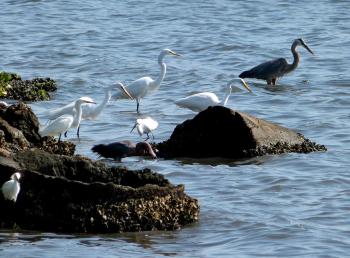
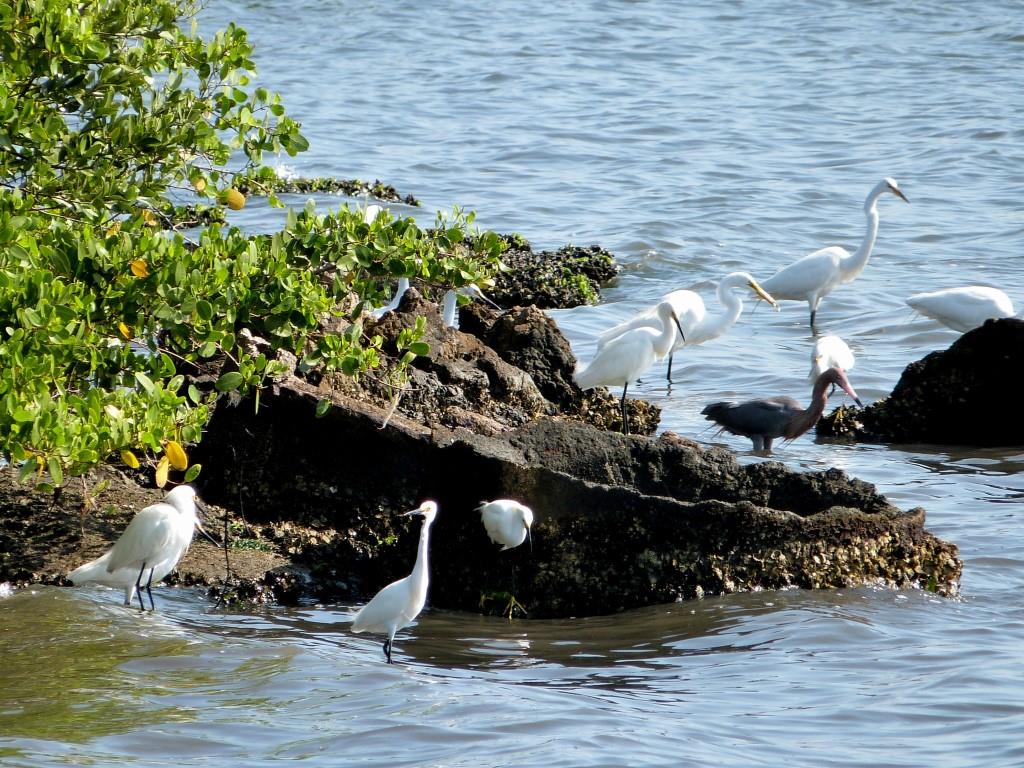
Reddish, Snowys, Greats Egrets and Great Blue Heron 5-10-13 by Lee at MacDill

Reddish, Snowys, Greats Egrets and Great Blue Heron (5-10-13) by Lee

And the stork, the heron after her kind, and the lapwing, and the bat. (Leviticus 11:19 KJV)

Herons are one of the species listed on the “Do not eat list” as we have written about before in the various Birds of the Bible – Heron articles. The first one was written back in 2008 when I first started the blog.

Since we were out birdwatching last week over in Tampa at the bay, I thought I would share some of those photos and update the Heron information some more. We saw a Great Blue Heron, several Little Blue Herons, and several others that are “after her kind” and in the same Ardeidae – Heron, Bittern  family. There were Snowy Egrets and Great Egrets fishing along with the others. The Little Blue Herons were in breeding plumage which you could tell because of their exceptionally blue beaks. (Not real clear-I was zoomed from quite a distance)

Little Blue Heron and Snowy Egrets by Lee from distance

Little Blue Heron and Snowy Egrets by Lee from distance

Herons are only mentioned twice in Scripture; Leviticus 11:19 and in Deuteronomy 14:18. That modern-day family, Ardiedae, currently has 72 members which includes not only Herons and Egrets, but also Bitterns. Some of them are grouped together like, Tiger Herons, Night Herons, Pond Herons, Reef Herons and Cattle Egrets. Not sure about the Tiger Herons but the night, pond, reef, and cattle name give you a clue as to where you might find them out and about.

And the stork, and the heron after her kind, and the lapwing, and the bat. (Deuteronomy 14:18 KJV)

The herons are long-legged freshwater and coastal birds in the family Ardeidae, (some are called “egrets” or “bitterns” instead of “heron”). Within Ardeidae, all members of the genera Botaurus and Ixobrychus are referred to as “bitterns”, and — including the Zigzag Heron or Zigzag Bittern — are a monophyletic group within the Ardeidae. However, egrets are not a biologically distinct group from the herons, and tend to be named differently because they are mainly white and/or have decorative plumes. Although egrets have the same build as herons, they tend to be smaller.

Great Egret (Ardea alba) Swallowing MacDil by Lee

Great Egret (Ardea alba) Swallowing by Lee

The classification of the individual heron/egret species is fraught with difficulty, and there is still no clear consensus about the correct placement of many species into either of the two major genera, Ardea and Egretta. Similarly, the relationship of the genera in the family is not completely resolved. However, one species formerly considered to constitute a separate monotypic family Cochlearidae, the Boat-billed Heron, is now regarded as a member of the Ardeidae.

Although herons resemble birds in some other families, such as the storks, ibises, spoonbills and cranes, they differ from these in flying with their necks retracted, not outstretched. They are also one of the bird groups that have powder down. Some members of this group nest colonially in trees, while others, notably the bitterns, use reedbeds.

The largest species of heron is the Goliath Heron, which stand up to 152 cm (60 in) tall. The necks are able to kink in an s-shape, due to the modified shape of the sixth vertebrae. The neck is able to retract and extend, and is retracted during flight, unlike most other long-necked birds. The neck is longer in the day herons than the night herons and bitterns. The legs are long and strong and in almost every species are unfeathered from the lower part of the tibia (the exception is the Zigzag Heron). In flight the legs and feet are held backward. The feet of herons have long thin toes, with three forward pointing ones and one going backward.

Reddish-Snowys-Greats Egrets -Great Blue Heron by Lee

Reddish-Snowys-Greats Egrets – Snowy in front with yellow feet

The herons are a widespread family with a cosmopolitan distribution. They exist on all continents except Antarctica, and are present in most habitats except the coldest extremes of the Arctic, extremely high mountains and the driest deserts. Almost all species are associated with water, they are essentially non-swimming waterbirds that feed on the margins of lakes, rivers, swamps, ponds and the sea. They are predominately found in lowland areas, although some species live in alpine areas, and the majority of species occur in the tropics.

While the family exhibits a range of breeding strategies, overall the herons are monogamous and mostly colonial. Most day-herons and night-herons are colonial, or partly colonial depending on circumstances, whereas the bitterns and tiger-herons are mostly solitary nesters. Colonies may contain several species as well as other types of waterbird. In a study of Little Egrets and Cattle Egrets in India the majority of the colonies surveyed contained both species. (Wikipedia with editing)

See:

Birds of the Bible

Birds of the Bible – Heron – Page

Bible Birds – Herons [younger readers]

Birds of the Bible – Herons – Article

Heron – Wikipedia

Ardeidae – Heron, Bitterns  family

*

Bible Birds – Mother Birds and Their Young – (Re-post)

My Mom and Me 26

Yesterday’s My Mom And Me – Email blog inspired me to write a new article for the Birds of the Bible For Kids. It is called:”

Bible Birds – Mother Birds and Their Young.

Please check it out. It is geared for a younger audience.

*

Birds of the Bible – Details

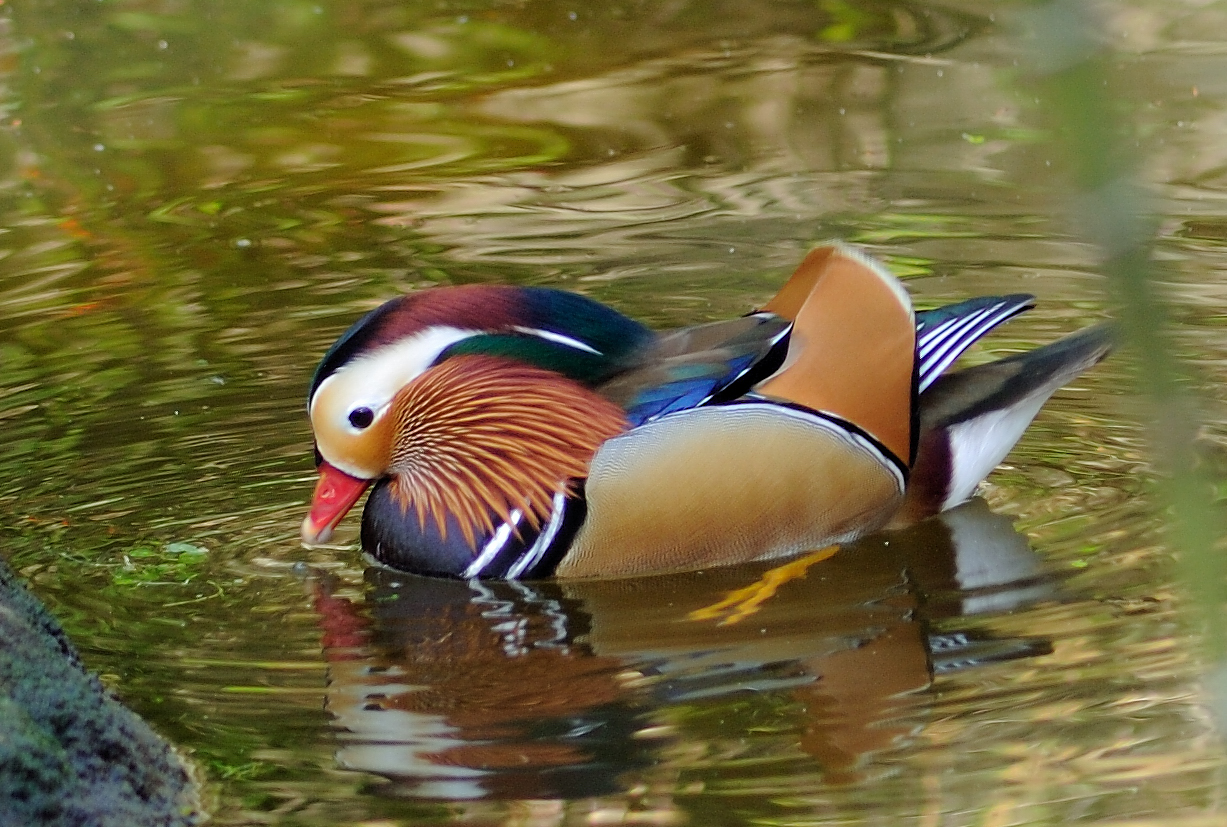
Mandarin Duck (Aix galericulata) by Dan

Mandarin Duck (Aix galericulata) by Dan

Currently, I am reading through Leviticus. When I cam to the Tabernacle, my first thoughts were, “Here we go again” with all the details about how to make it. The LORD gave Moses the details and then he shared those details with all the workers and skilled craftsmen as to how it was supposed to be prepared. It includes down to the number of rings to hold the curtains, like 50 on this side and 50 on that side, etc. The colors Gold, Blue, Purple and Scarlet are constantly mentioned.

Details, details, details. I stopped grumbling when I thought about how the LORD in His creative acts was so, “detailed.” Much of the Bible gives us details about God, the Lord, and the Holy Spirit.It is one of God’s attributes that He is so omnipotent, omniscient, understanding, etc. because He does know all the “details.”

For since the creation of the world His invisible attributes are clearly seen, being understood by the things that are made, even His eternal power and Godhead, so that they are without excuse, (Romans 1:20 NKJV)

We are told to look around us to observe creation and we can see His attributes. Think of just the birds. Are they not each different and made with so much detail. So, here is my attempt to share with you some of the neatly “detailed” birds in a slideshow. My first thoughts were of the Mandarin Duck with its lines and marks. Looks like a paintbrush was used by the Hand of our Creator. I have been trying to think of a bird that is gold, blue, purple and scarlet, but so far, it allude me. (The Mandarin Duck is close)

This slideshow is only featuring the colors and feather designs, but how about all the bills, feet, and other aspects of the birds? Enjoy these beautiful birds. (Thanks to all those who took the photos also.)

This slideshow requires JavaScript.

*

(I hardly got to the Passerines. Sorry)

See:

Birds of the Bible

Falling Plates

*