
Greater White-fronted Goose (Anser albifrons) by Nikhil Devasar
From col. Chi. Acad. Sciences. Copyrighted by
Nature Study Pub. Co., 1897, Chicago.
Greater White-fronted Goose (Anser albifrons) by Nikhil Devasar
From col. Chi. Acad. Sciences. Copyrighted by
Nature Study Pub. Co., 1897, Chicago.
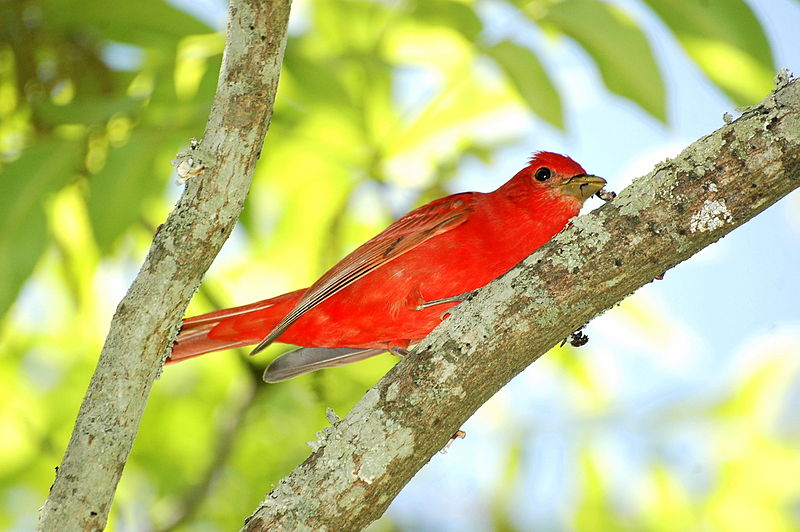
Summer Tanager (Piranga rubra) Male ©WikiC
From col. F. M. Woodruff. Copyrighted by
Nature Study Pub. Co., 1897, Chicago.
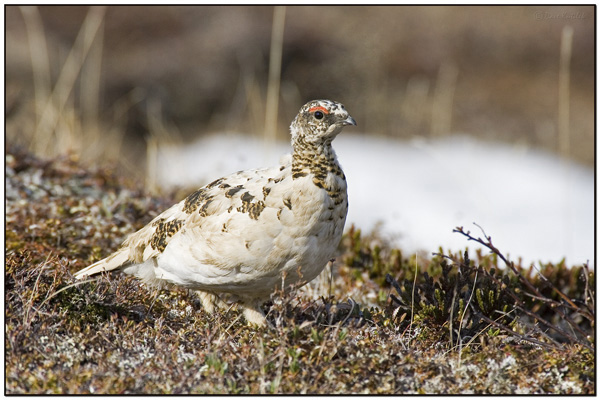
Rock Ptarmigan (Lagopus muta) by Daves BirdingPix
The Rock Ptarmigan – The Crown ~ by a j mithra
The Rock Ptarmigan is seasonally camouflaged; its feathers moult from white in winter to brown in spring or summer. The breeding male has greyish upper parts with white wings and under parts. In winter, its plumage becomes completely white except for the black tail. It can be distinguished from the winter Willow Ptarmigan (Willow Ptarmigan in North America) by habitat—the Rock Ptarmigan prefers higher elevations and more barren habitat; it is also smaller with a more delicate bill.
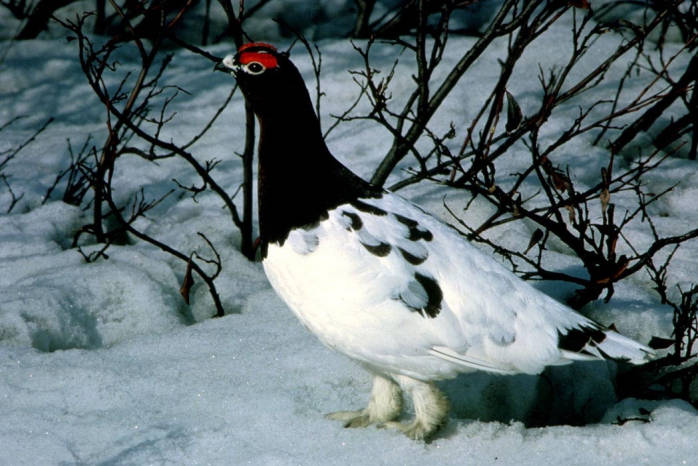
Willow Ptarmigan (Lagopus lagopus) ©USFWS
A bird that is smaller and with more delicate bill prefers higher elevation…
Interesting isn’t it?
It is when we become smaller, subdued and humble that God takes us to higher elevation.
He brought me up also out of a horrible pit, out of the miry clay, and set my feet upon a rock, and established my goings. (Psalm 40:2)
The higher elevation maybe more barren and it may have delicate bills but still this bird prefers higher elevation…
Most of us judge ourselves by what we have, failing to understand that in our weakness
“And he said unto me, My grace is sufficient for thee: for my strength is made perfect in weakness. Most gladly therefore will I rather glory in my infirmities, that the power of Christ may rest upon me.” (2 Corinthians 12:9)
His strength is complete and that is the reason He chooses the weak.
So that His name shall be glorified
But God has chosen the foolish things of the world to confound the wise; and God has chosen the weak things of the world to confound the things which are mighty; (1 Corinthians 1:27)

Rock Ptarmigan (Lagopus Muta) in winter plumage ©WikiC
The small population living on Franz Josef Land in the Russian High Arctic, overwinter during the polar night, and survives by feeding on rich vegetation on and underneath high cliffs where seabird colonies are located in summer. The Rock Ptarmigan feeds primarily on birch and willow buds and catkins when available. It will also eat various seeds, leaves, flowers and berries of other plant species. Insects are eaten by the developing young.
Apart from the comb, the male Rock Ptarmigan has no ornaments or displays that are typical for grouses in temperate regions. Studies on other grouses have shown that much variation in comb size and colour exists
between the species, and that the comb is used in courtship display and aggressive interactions between males.
This reminds us of how the colorful garment of Jesus was stripped, torn into twelve pieces and shared among the soldiers right under the cross, even as the Rock was grieving in pain for our sins..
Jesus did not have any ornaments or displays on the cross except the crown of thorns.
He bore not the crown of thorns but bore the brunt of mockery to give us the crown of eternal life isn’t it?
And after twisting together a crown of thorns, they put it on His head, and a reed in His right hand; and they knelt down before Him and mocked Him, saying, “Hail, King of the Jews!” (Matthew 27:29)

Rock Ptarmigan (Lagopus Muta) ©Wiki
Many studies have shown that there is a strong correlation between the comb size and the level of testosterone in males; one report from 1981 showed that the amount of testosterone is correlated to aggressiveness against other males. The male’s comb has been the focus of studies regarding sexual selection. Studies of a population of male Rock Ptarmigans in Scarpa Lake, Nunavut, have shown that during the first year, mating success among males was influenced by comb size and condition, and bigamous males had larger combs than monogamous males. The correlation to size disappeared after the first year, but the correlation to comb
condition remained.
This is consistent with another study of the same population of L. muta that showed that mating success overall is correlated to comb condition. Exceptions were first-time breeders, in which the size of the comb influenced mating success. The mating success is correlated to comb condition..
There is a strong correlation between the life we live for Christ and the crown that God has kept for us.
What kind of a crown would God give us?
Here are a those five crowns that God had kept for us..
God has got an “IMPERISHABLE CROWN” for those who run a faithful, unselfish race, crucifying all their earthly desires and focusing on just the cross.
Did Jesus asked us to carry our cross for this?
Know ye not that they which run in a race run all, but one receiveth the prize? So run, that ye may obtain. And every man that striveth for the mastery is temperate in all things. Now they do it to obtain a corruptible crown; but we an incorruptible. (1 Corinthians 9:24-25)
“THE CROWN OF JOY” is there for those who bring souls into His kingdom. Working towards standing as a living testimony for others to follow Christ through our selfless Christ-like lifestyle…
Are we working selflessly to bring souls to His kingdom?
For what is our hope, or joy, or crown of rejoicing? Are not even ye in the presence of our Lord Jesus Christ at his coming? For ye are our glory and joy. (1 Thessalonians 2:19-20)
Here is another crown that awaits us, that is the “THE CROWN OF RIGHTEOUSNESS”
Are you waiting anxiously for the Lord? In that case you will surely receive this crown, when Jesus, the King returns.
Henceforth there is laid up for me a crown of righteousness, which the Lord, the righteous judge, shall give me at that day: and not to me only, but unto all them also that love his appearing. (2 Timothy 4:8)
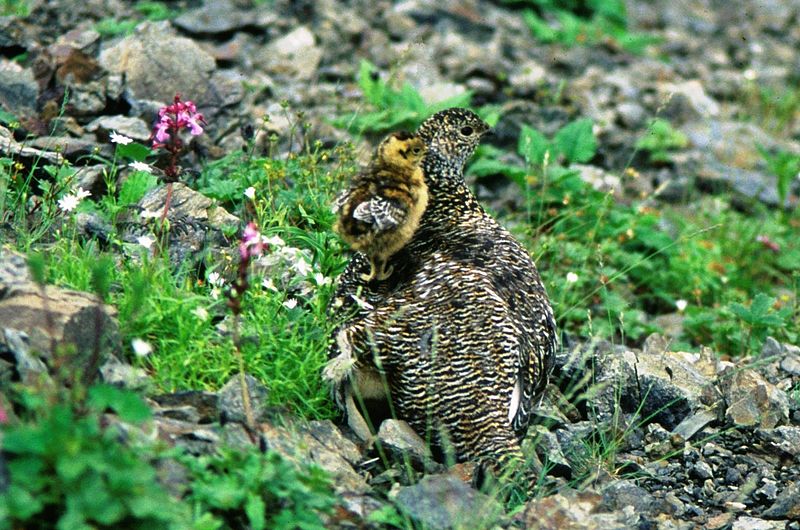
Rock Ptarmigan (Lagopus Muta) ©WikiC mother and chick
There is another crown for us, “THE CROWN OF LIFE”.
It is for those who endure temptations, trials, pain and agony for the sake of the Lord.
Blessed is the man that endureth temptation: for when he is tried, he shall receive the crown of life, which the Lord hath promised to them that love him. (James 1:12)
This crown, “THR CROWN OF GLORY” has a long price tag.
Pay and receive. Here is the bill..
The elders which are among you I exhort, who am also an elder, and a witness of the sufferings of Christ, and also a partaker of the glory that shall be revealed:
Feed the flock of God which is among you, taking the oversight thereof, not by constraint, but willingly; not for filthy lucre, but of a ready mind;
Neither as being lords over God’s heritage, but being examples to the flock.
And when the chief Shepherd shall appear, ye shall receive a crown of glory that fadeth not away. (1 Peter 5:1-4)
Now, it’s time for us to switch on our search lights to see what kind of crown do we deserve..
Have a blessed day!
Yours in YESHUA,
a j mithra
Please visit us at:
CrossTree
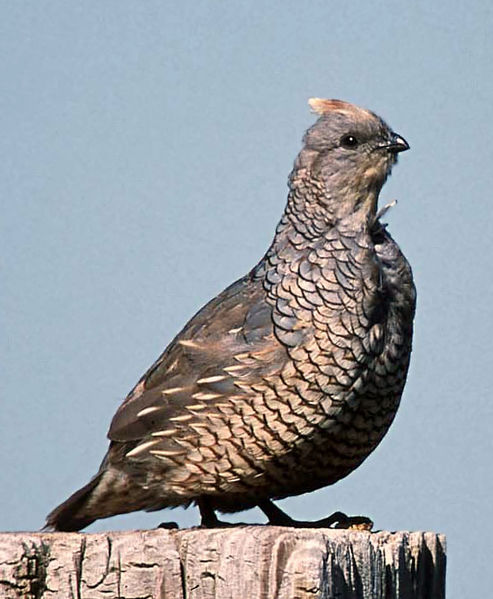
Scaled Quail (Callipepla squamata) ©WikiC
The Scaled Quail – The Cover Seeker ~ by ajmithra
The Scaled Quail (Callipepla squamata), also commonly called Blue Quail or Cottontop, is a species of the New World quail family. It is a bluish gray bird found in the arid regions of the Southwestern United States
to Central Mexico.
These birds seek for four different covers. They are as follows :
Feeding cover: Scaled Quail use grass clumps and shrubs for cover while feeding. In one study they were frequently seen crossing 82 to 165 feet (25–50 m) of bare ground. When disturbed, Scaled Quail hid in snakeweed (Gutierrezia spp.) or in grass clumps. In June and July foraging occurs on open grasslands which are not used at other times.
We have Jesus, our Good Shepherd, who makes us lie down beside still waters. But, times are fast approaching where the church may be stopped from feeding on the word of God and the church may have to hide during the times of tribulation..
Behold, the days come, saith the Lord GOD, that I will send a famine in the land, not a famine of bread, nor a thirst for water, but of hearing the words of the LORD. Amos 8:11
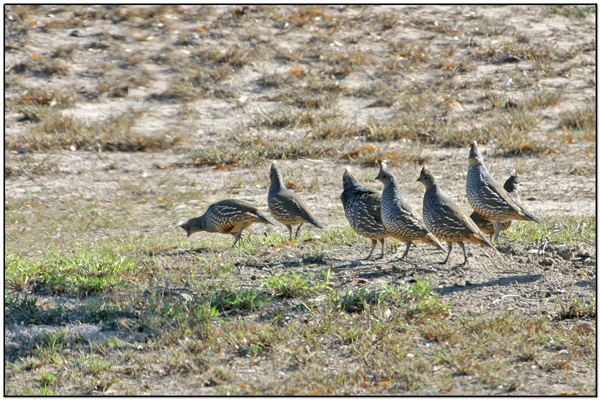
Scaled Quail (Callipepla squamata) by DavesBirdingPix
Loafing cover: Scaled Quail coveys occupy loafing or resting cover after early morning feeding periods. Scaled Quail occupy desert grassland or desert scrub with a minimum of one loafing covert per approximately 70 acres (28 ha). In northwestern Texas, loafing coverts were characterized by:
Covert heights ranged from 1.6 to 5.9 feet (0.5–1.8 m) and 2.6 to 6.9 feet (0.8–2.1 m) in diameter. Cholla formed all or part of the overhead cover of 85% of coverts, even though they were dominant
at only 12% of the study locations. In areas where Scaled Quail occur without cholla, woody species such as wolfberry (Lycium spp.) and mesquite are important for overhead cover.
In Oklahoma pinyon-juniper habitats, Scaled Quail use the shade of tree cholla (Cylindropuntia imbricata) and human-made structures. In Arizona, Scaled Quail occupied wolfberry and mesquite 1.7 to 5 feet (0.5–1.5 m) tall for loafing cover. This overhead cover provides midday shade, but is open at the base to allow easy escape from predators. In Oklahoma, winter home ranges always contained skunkbush sumac, tree cholla, or human-made structures providing overhead cover.
The highlight during the migration of millions of Israelites across the wilderness for forty years is the overhead cover that God gave them in the form of Pillar of clouds during the day and Pillar of fire during the night. Our God is the same yesterday, today and forever. There is protection for everyone for all seasons..
And there shall be a tabernacle for a shadow in the daytime from the heat, and for a place of refuge, and for a covert from storm and from rain. Isaiah 4:6
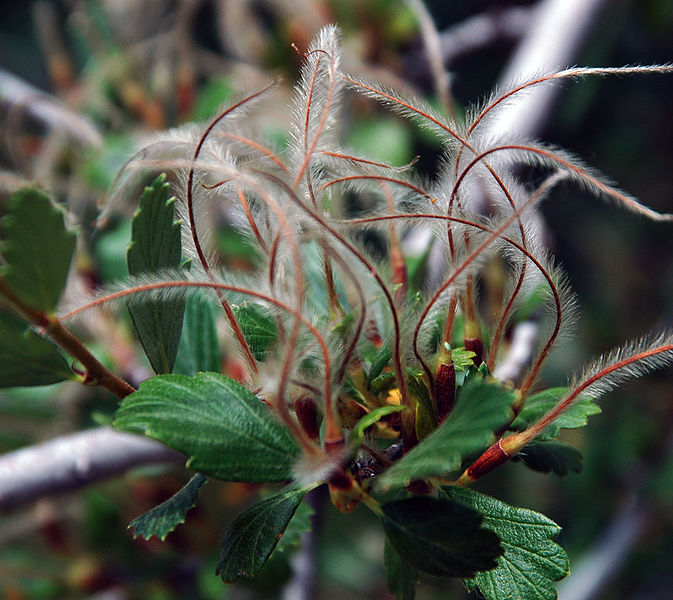
Mountain-Mahogany (Cercocarpus montanus) Cover for Scaled Quail ©WikiC
Night-roosting cover: Scaled Quail roosts were observed in yucca (Yucca angustifolia), tree cholla, and true mountain-mahogany (Cercocarpus montanus) – yucca-fragrant sumac (Rhus aromatica) vegetation types. The height of vegetation used for night roosts was less than 1.6 feet (0.5 m).
No matter wherever you are and whatever situation you are in, just remember what king David said..,
If I ascend up into heaven, thou art there: if I make my bed in hell, behold, thou art there. If I take the wings of the morning, and dwell in the uttermost parts of the sea; Even there shall thy hand lead me, and thy right hand shall hold me. Psalm 139: 8-10
Even during the darkest hour, as we stumble, confused and seeking direction, His protection and direction never seizes. He not only keeps His eyes on us, but also keeps us as the apple of His eyes. His light shall shine upon us to direct our path.
If I say, Surely the darkness shall cover me; even the night shall be light about me. Yea, the darkness hideth not from thee; but the night shineth as the day: the darkness and the light are both alike to thee.” Psalm 139:11-12
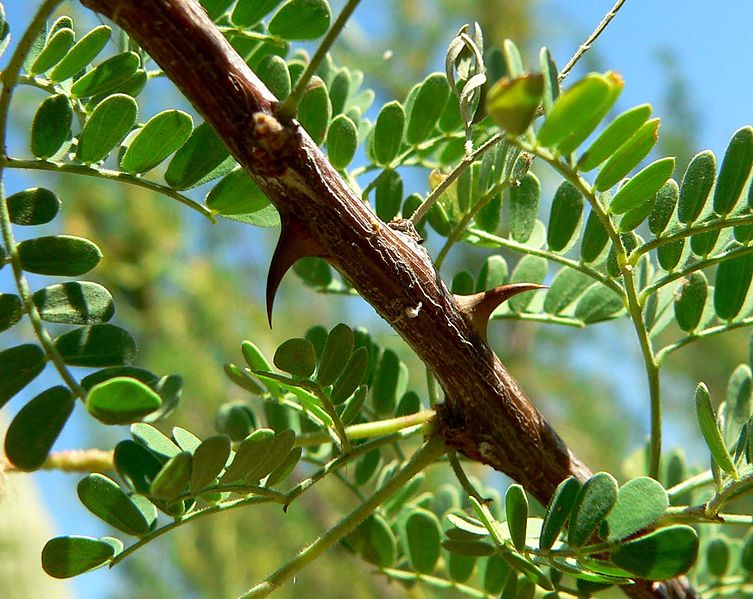
Catclaw Acacia (Acacia greggii) Cover for Scaled Quail ©WikiC
Nesting cover: In March or April winter coveys spread out into areas with less cover. This use of areas with less cover coincides with a seasonal decrease in the number of raptors in the same area.
Scaled Quail nests are constructed under tufts of grasses, and are sheltered by sagebrush (Artemisia spp.), creosotebush (Larrea tridentata), mesquite, catclaw acacia (Acacia greggii), cactus, or yucca; under
dead Russian-thistle (Salsola kali), mixed forbs, or soapweed yucca; or sheltered in old machinery or other human-made debris.
In Oklahoma, 66% of nests were in one of four situations:
In New Mexico, ordination of breeding birds and vegetative microhabitats indicated that Scaled Quail were associated with increased levels of patchiness and increased cover of mesquite and cactus.
Birds build nests in different places, sometimes in the most unusual place. But still, the chicks prefer the protection under the wings of its parents.
Where do we seek for protection?
As an eagle stirreth up her nest, fluttereth over her young, spreadeth abroad her wings, taketh them, beareth them on her wings: Deuteronomy 32:11
He shall cover thee with his feathers, and under his wings shalt thou trust: his truth shall be thy shield and buckler. Psalm 91:4
The most secure cover for our lives does not come from our million dollars life insurance policies but from assurance that God has gave us through His bloodshed, suffering and death on the cross of Calvary.
Is your Life insured in Christ?
Have a blessed day!
Yours in YESHUA,
a j mithra
Please visit us at:
*
Check out his articles here at A J Mithra and his Nuggets Pluss
*

Wood Duck – Lake Morton by Lee
O LORD, how manifold are thy works! in wisdom hast thou made them all: the earth is full of thy riches. (Psalms 104:24 KJV)
While working on Family pages, it dawned on me that very few of our photos have been used. We, Dan and I, do take quite a few photos while on our birdwatching adventures into the wild and at the zoos. Actually, I take about 4-5 more than he does on each adventure (more like 10-1). He spends his time trying to compose his shots and do all that sort of stuff. Me, I have a Program mode Panasonic Lumix that I shoot, shoot, shoot. Of course, his photos are always better and he knows how to prep them better, but I get more “action” photos. I have action of the bird moving (blurred), flying off (blurred), turning around (blurred), behind a fence (bird-blurred, fence-clear), in a tree (bird-blurred, branch with leaves-clear). Every once in a while I get a nice photo that isn’t too blurred that could be shared with you.
Another thing he has tried to teach me is the 1/3rd thing. Me, I want that bird right in the middle of my shot so that when I get home I can try to find it behind those clear fences and branches. To me, my photos are for “proof” that the bird was seen and also to try to figure out what it really was. You see, I am a “birdwatcher” and he is a “photographer.” There is a difference! You can blend the two, but there IS a different attitude at work here.
Yesterday the Our Birdwatching Photos page was created and a new tab was placed up at the top. Now, I am working on creating pages, by families, of our photos. Most will be mine, because I take more and he already has a website for his photos at Dan’s Pix. I will be copying some of his over here of course and maybe I can get some of his “unpublished” ones also.

Elegant Crested Tinamou (Eudromia elegans) at Zoo Miami by Lee
Don’t expect the greatest photos, because I am not a great photographer, but I enjoy “watching” the birds. The Lord has created so many birds that are just so beautiful and unique. The variety is amazing. The colors are breathtaking at times. The birds are adorable, cute, ugly, big, little, tall, short, evasive, calm, fidgety, graceful, etc. They sing some of the most beautiful songs and some have terrible tunes, but don’t you just enjoy watching and listening to them?
O Lord, how many and varied are Your works! In wisdom have You made them all; the earth is full of Your riches and Your creatures. (Psalms 104:24 AMP)
O the depth of the riches both of the wisdom and knowledge of God! how unsearchable are his judgments, and his ways past finding out! (Romans 11:33 KJV)
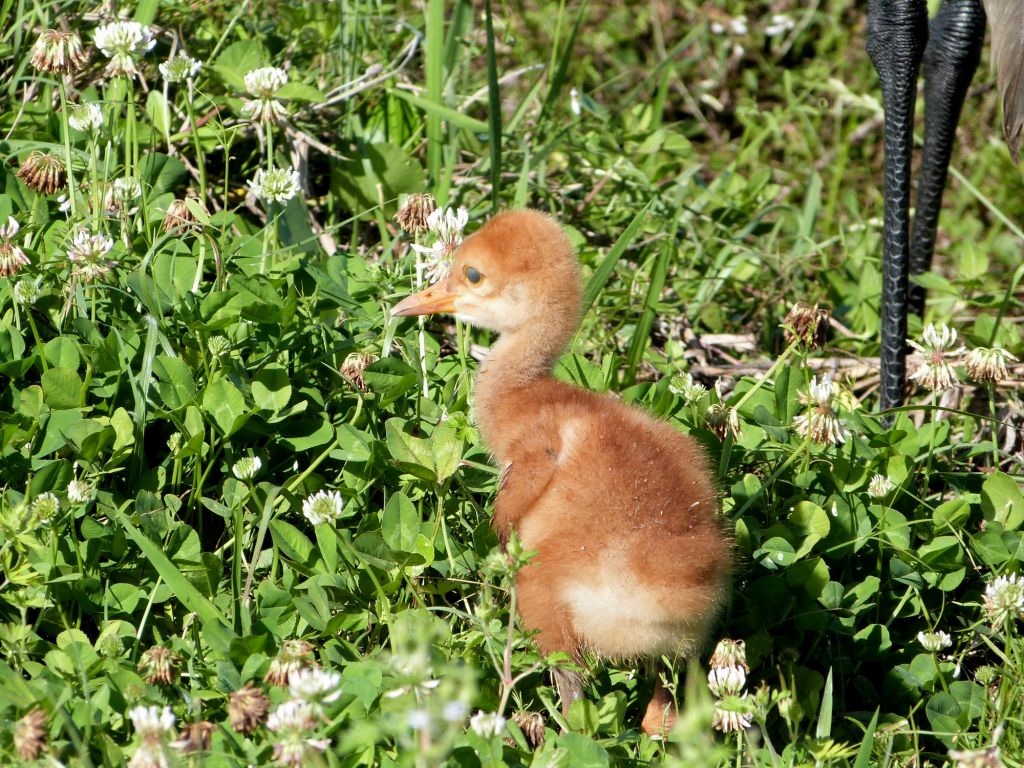
Sandhill Crane Chick at Circle B by Lee – Blurred, but isn’t it cute?
*
*
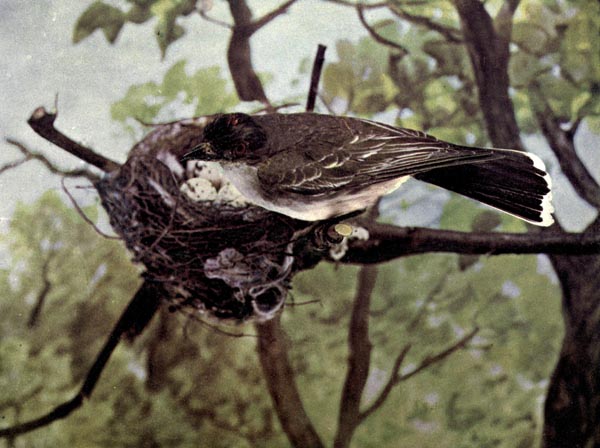
Kingbird of Birds Illustrated by Color Photography, 1897
From col. F. M. Woodruff. Copyrighted by
Nature Study Pub. Co., 1897, Chicago.
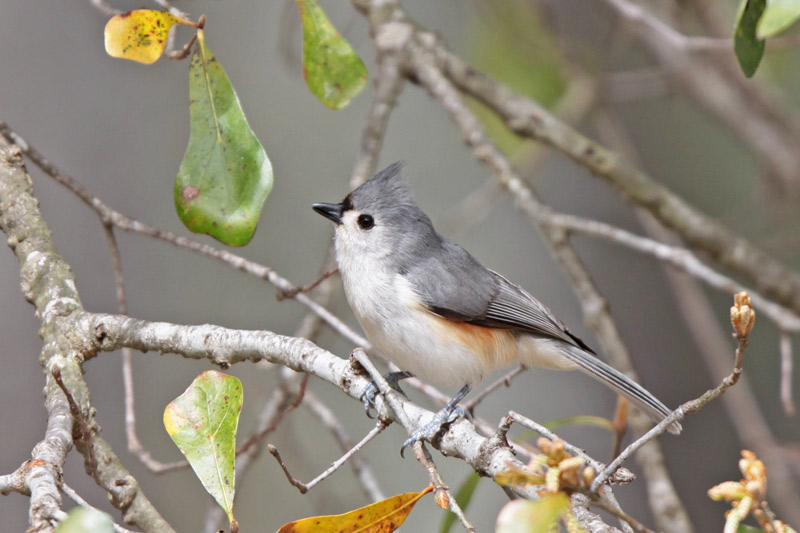
Tufted Titmouse (Baeolophus bicolor) by Margaret Sloan
I would like to introduce our newest photographer to permit permission to use her photos. While searching for the Morningbird, which Margaret had one of the very few photos of the bird, I discovered her website. She has graciously given permission to use her photos.
Margaret Sloan has her photos on PBase at
http://www.pbase.com/laumakani.
She is from Texas and has over 12,000 images online in over 1,100 galleries. Wow! It will take awhile to check it out, but what I have seen so far is very good. Please stop by her site and admire the photos of some amazing birds, plus places, spaces, and scenery. Lots to view and enjoy.
From her Birds of Costa Rica gallery:

Keel-billed Toucan (Ramphastos sulfuratus) by Margaret Sloan
From the Birds of Peru – Cotingas and Manakins gallery:

Andean Cock-of-the-rock (Rupicola peruvianus) by Margaret Sloan
From the Birds of Southeast Asia – Sunbirds, Flowerpeckers, Leafbirds:

Olive-backed Sunbird (Cinnyris jugularis) by Margaret Sloan
Closer to home – Birds of North America:
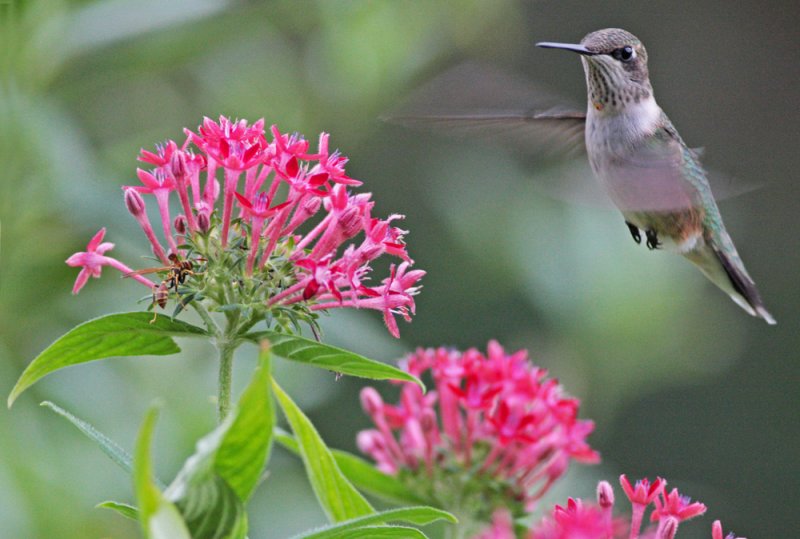
Hummingbird with Pentas by Margaret Sloan
From her Nature – Butterflies:
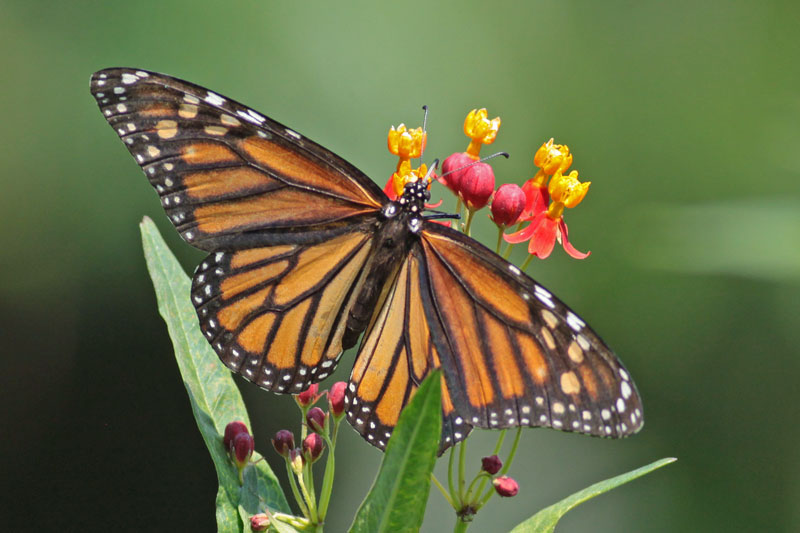
Monarch Butterfly by Margaret Sloan
These are but a few of the numerous photos she has taken of the birds and beauty around her. Thank you, Margaret, for sharing with us what you have seen through your lens. May you find many more adventures that you can take photographs of and share with us.
Who is like You, O Lord, among the gods? Who is like You, glorious in holiness, awesome in splendor, doing wonders? (Exodus 15:11 AMP)
Many, O Lord my God, are the wonderful works which You have done, and Your thoughts toward us; no one can compare with You! If I should declare and speak of them, they are too many to be numbered. (Psalms 40:5 AMP)
*
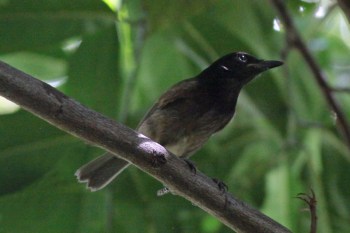
Morningbird (Colluricincla tenebrosa) by Margaret Sloan
My voice shalt thou hear in the morning, O LORD; in the morning will I direct my prayer unto thee, and will look up. (Psalms 5:3 KJV)
The Morningbird (Colluricincla tenebrosa) is a songbird species in the family Pachycephalidae. It is also known a “Brown Pitohui, Morning Bird, Morning Pitohui, Morningbird, Palau Morning Bird, Palau Morningbird, and Palau Pitohui” (Avibase) At the present time it is a bird of “Least Concern” but it is hard to find a photo of it. That is what caught my attention to it. I liked its name. A recording of the Morningbird by Todd Mark (xeno-canto) made a remark that it was the “first loud singer of dawn chorus.” That seems to be appropriate according to the name it has been given,
Evening, and morning, and at noon, will I pray, and cry aloud: and he shall hear my voice. (Psalms 55:17 KJV)
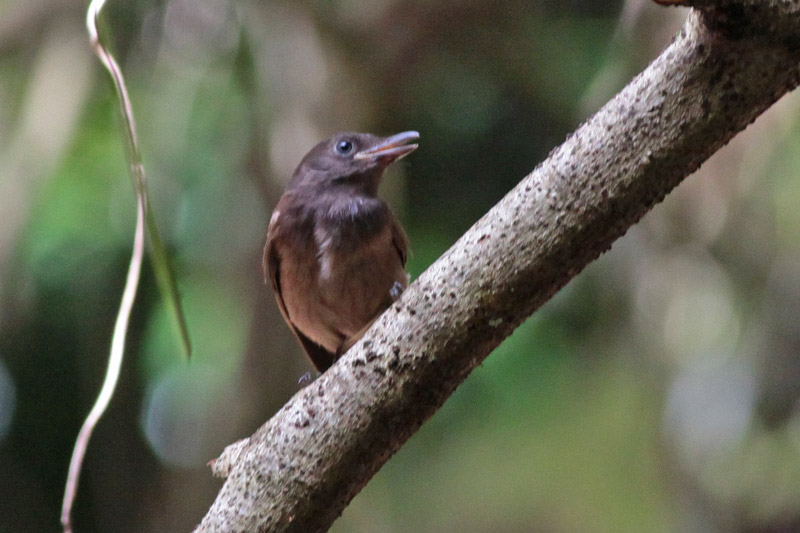
Morningbird (Colluricincla tenebrosa) by Margaret Sloan
The Morningbird is endemic to the islands of Babelthuap, Koror, Garakayo, Peleliu and Ngabad in Palau. Its natural habitat is deep primary tropical moist lowland forests. The species is non-migratory. It is apparently commoner on the smaller islands in its range. The feed principally on insects, but also take snails, berries, fruit, and seeds. They feed on or around the ground. Checking the internet, there are many birds called by that name because they sing in the morning, but very few photos. (Margaret Sloan just gave permission to use her photos of this bird, thanks.)
There are videos of a Morningbird Song. Most probably do not know that there actually is a “Morningbird.” Here is one verse of that song:
You are the blood of me
The harvest of my dreams
There’s nowhere I can find peace
And the silence won’t cease
Sorry, but just because a Morning Bird flew away, our lives should not be like those words. We can have peace and knowing the Lord Jesus Christ as your personal Savior is the only real peace anyone really receives. He is the way to peace:
Let not your heart be troubled: ye believe in God, believe also in me. In my Father’s house are many mansions: if it were not so, I would have told you. I go to prepare a place for you. And if I go and prepare a place for you, I will come again, and receive you unto myself; that where I am, there ye may be also. And whither I go ye know, and the way ye know. Thomas saith unto him, Lord, we know not whither thou goest; and how can we know the way? Jesus saith unto him, I am the way, the truth, and the life: no man cometh unto the Father, but by me. (John 14:1-6 KJV)

Palau Morningbird Pitohui © Mandy Etpison
But to You I cry, O Lord; and in the morning shall my prayer come to meet You. (Psalms 88:13 AMP)
The Morningbird (Colluricincla tenebrosa) is a member of the Pachycephalidae – Whistlers and Allies Family. There are presently 58 species that are assigned to that family by the IOC. Others place it in the Colluricinclidae family according to Wikipedia, yet I can’t find much about that family. They are closely related to the Shrike-thrushes and some sources list it as a Pitohui
(Wikipedia and other internet sources)
Links:
*

Slate-colored Red Junco of Birds Illustrated by Color Photography, 1897
Sometimes the Logic of Bird Brains Puts Humans to Shame
by Dr. James J. S. Johnson
Bird Brains, an Amazing Evidence of God’s Genius: Sometimes the Logic of Bird Brains Puts Humans to Shame by Dr. James J. S. Johnson Bird brains, in scientific fact, are amazingly logical and capable of computing power well beyond the best super-computers invented by humans.¹ This is illustrated in the behavior of all birds, — but only mallards, dark-eyed juncos (what Audubon called “snowbirds”), and a blue jay will be noted here. What began as a simple sunflower “picnic” ended with a life lesson.
Years ago I scattered sunflower seeds in my backyard, hoping that local sparrows and wintering juncos would enjoy eating them (as I would enjoy watching from my patio).² The predictable occurred, a few sunflowers grew up, sunward, and eventually they provided a “plateful” of seeds for birds that like sunflower seeds to eat. So I scattered more sunflower seeds, in hopes of a bigger crop the next year. Juncos and sparrows scurried to eat these seeds.
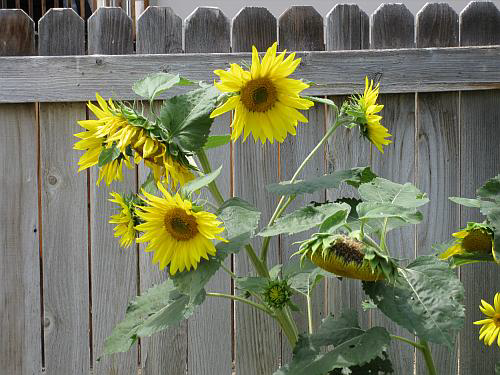
Sunflowers by J J S Johnson
But one day, to my disgust, a “bully” blue-jay invaded this happy picnic, attacking the littler birds, scaring them into hiding in nearby bushes (until the blue-jay finished gorging himself with sunflower seeds).³ What a disappointing interruption to the sunflower “picnic”!
The next day I was ready for the “bully”. When he attacked, and the little songbirds fled, I doused him with a geyser-like blast of water from my son’s “Super Soaker” — and the bully bird fled! The following day was a rerun: songbirds feast, blue-jay attacks, songbirds flee, blue-jay is sprayed by Super Soaker, it’s blue-jay’s turn to flee, then songbirds return to picnic.

Blue Jay (Cyanocitta cristata) by Daves BirdingPix
But it was the next day that I will never forget.
The sunflower seed picnic began, as before, then the “bully” blue-jay flew in to attack. This time the sparrows and juncos looked toward me (on the patio, brandishing the Super Soaker) — and they continued to eat, trustingly, obviously confident that I would blast their attacker with water! So I quickly did, praying for accuracy. (How could I let them down?)
How quickly the little songbirds recognized the human version of “providential” care, and they acted with logical confidence as they trusted that protective care. Yet God’s providential care for us is infinitely better, qualitatively and quantitatively, than the pressurized watery “doses” of protective care that those birds trusted. Bird brains are quick to learn.
Other examples could be given. At a nearby pond, Drew (my son) and I habitually fed bread-crumbs to the ducks (mallards year-round, plus scaups and widgeons during winter). One day we were behind schedule, so we drove past the pond, to our home a few blocks beyond the pond (with other houses blocking the line of sight from our house to the pond). When we arrived at our mailbox, our front yard was occupied: squawking mallards congregated on the front lawn, reminding us that we failed to feed them as usual! Even ducks recognize the sources of their needed resources. Bird brains can remember and react quickly to real problems!
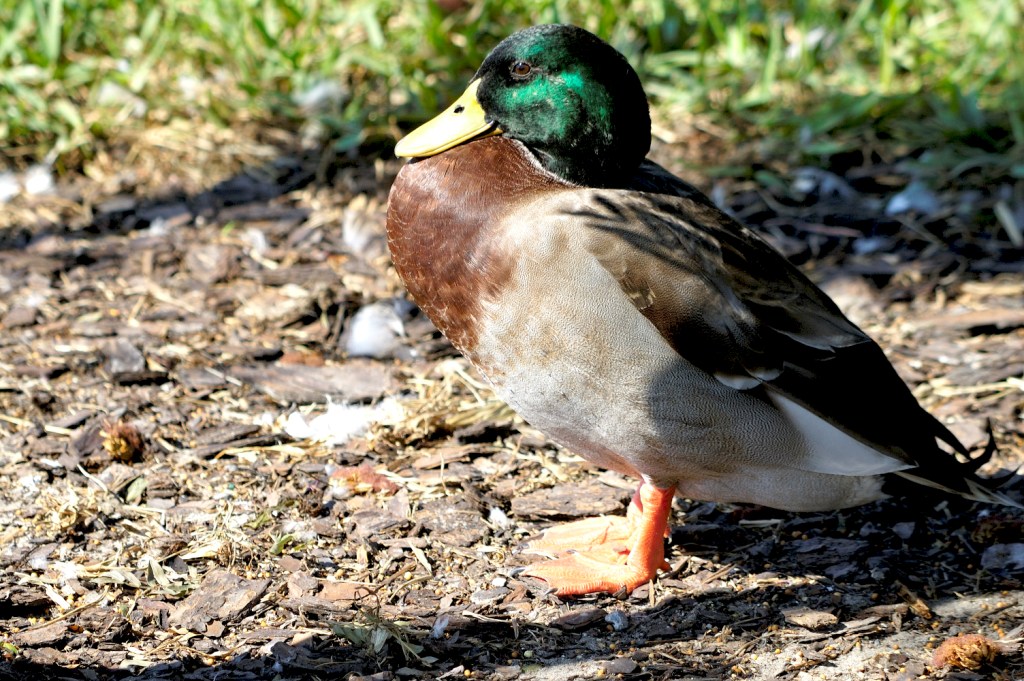
Mallard (Anas platyrhynchos) at Lake Parker By Dan’sPix
Worldwide, more amazing examples occur, in migration, bird family life activities, and in proven cases of avian learning. In short, bird brains, in a, innumerable multitude of contexts, display an entire “world” of intelligence (if not a veritable “galaxy”).
Contrastingly, human brains, although often capable of amazing intelligence, are all-too-often famous for corrupted reasoning. Tragically, corrupted reasoning in humans even displays in corruptions so extreme that the phrase “reprobate mind” snugly fits. But how can mankind, the creature with supposedly the highest level of intelligence, have such corrupted reason (and thus behave so stupidly4)? And why? It all starts with rejecting the basic truth that we are created by a holy Creator. When straining to avoid acknowledging our holy Creator, human brains display what the Bible calls a “reprobate mind”. Yet how does this happen, and why? When humans “choke” on the idea of acknowledging the providence of our Creator, they are “disapproving” the proof of God’s Creatorship. The consequence for this is severe: God gives such skeptics over to a “reprobate mind” (Romans 1:28). There is a logical connection between disapproving God’s Creatorship and being abandoned to a “reprobate mind”. That logical connection is rooted in a N.T. Greek verb, dokeô, because two words in Romans 1:28 derive from that verb:
And even as they did not like to retain [ouk edokimasan, literally “did not approve”] God in their knowledge, God gave them over to a reprobate [adokimon, literally “unapproving”] mind, to do those things which are not convenient.
The common root verb, dokeô, means “to approve”, i.e., to accept the proof of. In English we have the related words “prove”, “proof”, “probate”, “probative”, “approve”, “approbate”, etc., — to denote the two-step process of (1) considering the available evidence, and (2) accepting the truth of whatever the reliable evidence shows. These English words, like the Greek verb dokeô (and its related words), point to mankind’s mental ability to reasonably recognize and weigh evidence, using analytical logic, for arriving at sound evaluations. But this ability to reasonably evaluate can be damaged, and it is damaged whenever the proof of God’s Creatorship is irrationally disapproved. Thus, a “reprobate mind” is one that can’t discern what is right.
The tragic and even terrible reality is that being “given over” to a “reprobate mind” is a punishment for rejecting truth. It is not a punishment that follows death; it is a punishment in the here-and-now. This “mental leprosy” loses the ability to recognize true information, even to the point of self-destruction. The “reprobate mind” judgment involves losing the ability to analyze what is true and good, so truth is exchanged for a lie, good is exchanged for evil.
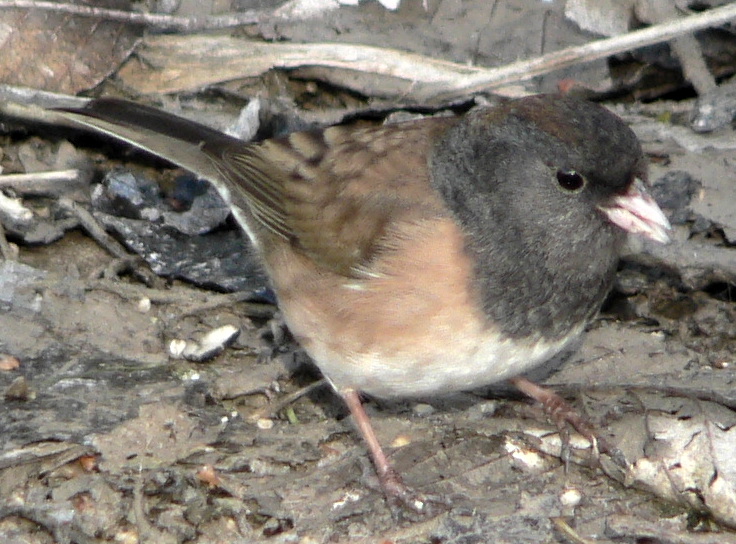
Dark-eyed Junco (Junco hyemalis oreganus) (one of the Oregon Juncos) ©WikiC
So, do the humans who reverence pond-scum, as our supposed “common ancestor”, have a right to belittle bird brains? Not at all!
When you think of God, take a lesson from the birds: recognize Who really cares for you, know Whom to trust, and be quick to take actions that demonstrate truly logical thinking. Sometimes bird brains simply put us humans to shame.5
*
¹ Werner Gitt & Karl-Heinz Vanheiden, If Animals Could Talk (Master Books, 2006); Bill Mehlert, “Birdbrains?”, Creation Ex Nihilo, 21(4):51 (September 1999); Jobe Martin, Evolution of A Creationist (BDM, 1996); Bill Cooper, ed., Paley’s Watchmaker (New Wine Press, 1997), page 42; James J. S. Johnson, “Providential Planting: The Pinyon Jay”, Creation Ex Nihilo, 19(3):24-25 (June 1997).
² Not all birders are worship-the-earth evolutionists. Mrs. Thelma Bumgardner, a public schoolteacher, taught me in 2nd grade that Biblical creation was true and evolution was a lie, as she gave me my first bird-book, which I still have. That initiation to creationist ornithology was revived, after years of evolutionist indoctrination, by a young-earth-creationist youth pastor, Bob Webel. This article thus shows another lesson: respecting God’s Creatorship is a proper use of reason, and it can be taught.
³ David Shaw, “The Good, the Bad, and the Jays”, Birds & Blooms (August/September 2009), page 35 (“Blue Jay … This species has a well-deserved reputation as a bully. They are notorious for chasing other birds from feeders and then gobbling as much as they can hold before moving off and allowing the other species to return”).
4 Steve Farrar, How to Ruin your Life by 40 (Moody, 2006), esp. at page 137.
5 James J. S. Johnson, “A Lesson from the Stork”, Days of Praise (8-22-2008). jjohnson@icr.org
(Dr. James J. S. Johnson offered this article as a guest author. Jim is now both a follower and a contributing author this blog. Thanks, for letting us use this great information and inspiration.)
More by Dr. James J. S. Johnson:
*
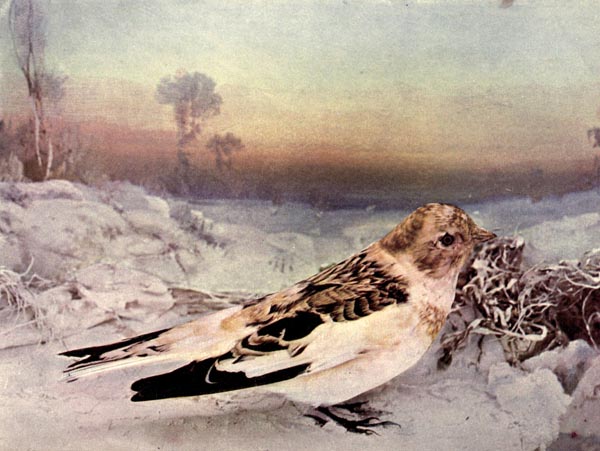
Snow Bunting of Birds Illustrated by Color Photography, 1897


