
European Kingfisher for Birds Illustrated
From col. Chi. Acad. Sciences. Copyrighted by
Nature Study Pub. Co., 1897, Chicago.
European Kingfisher for Birds Illustrated
From col. Chi. Acad. Sciences. Copyrighted by
Nature Study Pub. Co., 1897, Chicago.
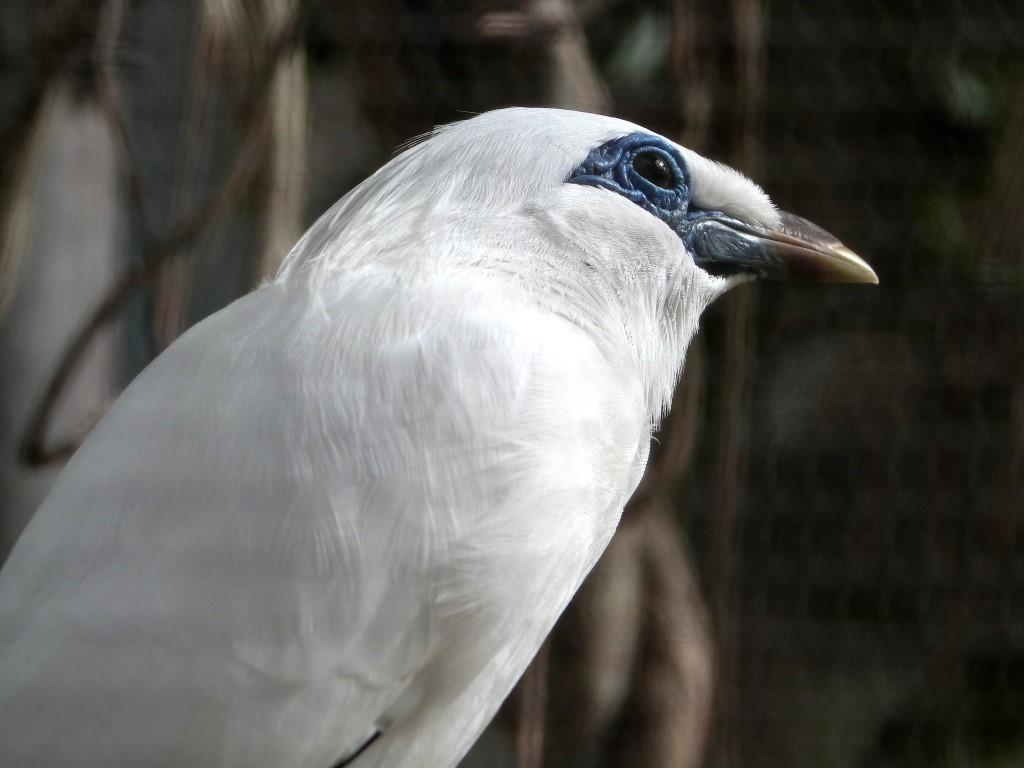
Bali Myna (Leucopsar rothschildi) by Lee
Thanks to all of you who kept me in your prayers 6 months ago when I had the “Pucker” on my retina removed. At that time, they said that for some reason cataract development would accelerate. Well, it did. Tomorrow morning, I will be having cataract surgery on my left eye. The retina has been healing for 6 months and the okay was given to have this surgery.
I am ready for it. I have seen “bi-winged” birds and extra stop lights, extra headlights on cars and other double “ghost images” because of the blurred vision. I have been struggling to see my monitor to produce my blogs. The size of the fonts has been increased to assist my ability to read the screen. Even with that, it has been challenging at times. Two blogs are scheduled; one for tomorrow and one for Tuesday. Hopefully, that will give time for this new surgery to heal.
I have also not visited as many of your blogs recently like I would have enjoyed because of this situation. Expect visits again, soon, Lord willing.
Please keep me in your thoughts and prayers tomorrow, June 24th, if you think of it. I am not expecting any problems, but any surgery has risk. The Lord already knows the outcome and I am trusting Him to be right there with me through this.
Be anxious for nothing, but in everything by prayer and supplication, with thanksgiving, let your requests be made known to God; (Philippians 4:6 NKJV)
I will sing to the LORD, Because He has dealt bountifully with me. (Psalms 13:6 NKJV)
Oh, magnify the LORD with me, And let us exalt His name together. (Psalms 34:3 NKJV)
And whatever things you ask in prayer, believing, you will receive.” (Matthew 21:22 NKJV)
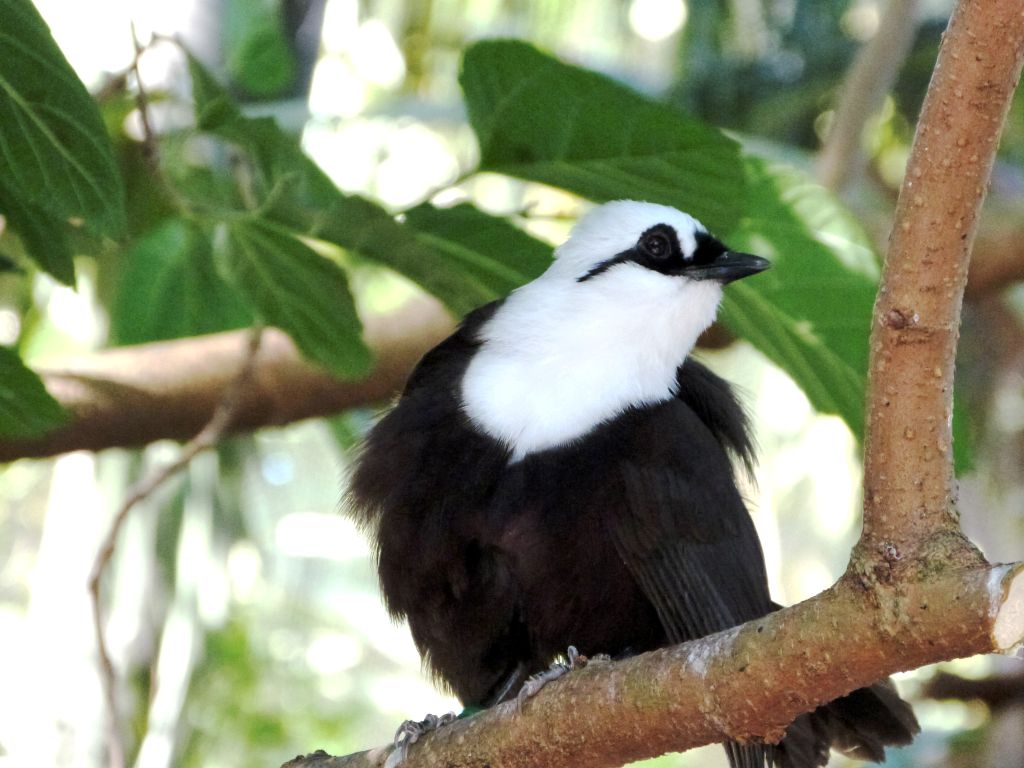
Sumatran Laughingthrush (Garrulax bicolor) “Joe Cool” by Lee
The hearing ear and the seeing eye, The LORD has made them both. (Proverbs 20:12 NKJV)
He who planted the ear, shall He not hear? He who formed the eye, shall He not see? (Psalms 94:9 NKJV)
“For His eyes are on the ways of man, And He sees all his steps. (Job 34:21 NKJV)
“I have heard of You by the hearing of the ear, But now my eye sees You. (Job 42:5 NKJV)
Open my eyes, that I may see Wondrous things from Your law. (Psalms 119:18 NKJV)
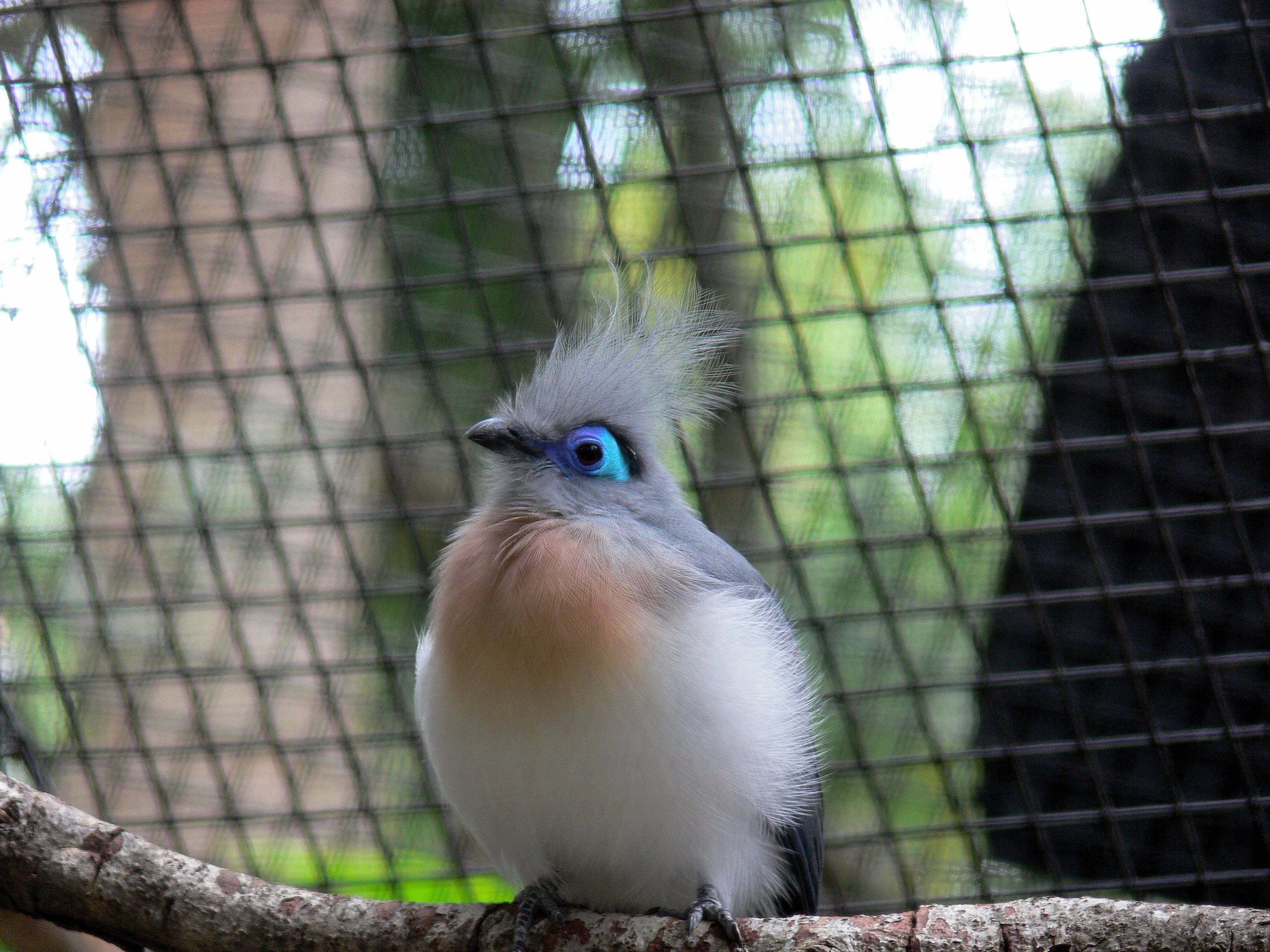
Crested Coua (Coua cristata) by Lee LPZ
Bali Myna (Leucopsar rothschildi) at Lowry Park Zoo by Lee
Yesterday, we went over to the Lowry Park Zoo for a little while and were able to record several interesting birds and the Singing Dogs from Australia. I was especially pleased to hear the Bali Myna making a neat little call or song. Here is a video of it that I put together. This is another bird from the Lord’s Creative Hand.
God created the great sea monsters and every living creature that moves, which the waters brought forth abundantly, according to their kinds, and every winged bird according to its kind. And God saw that it was good (suitable, admirable) and He approved it. (Genesis 1:21 AMP)
These photos were taken at Palm Beach Zoo last month.

Bali Myna (Leucopsar rothschildi Palm Beach Zoo by Lee
He was displaying and this is another view of him.
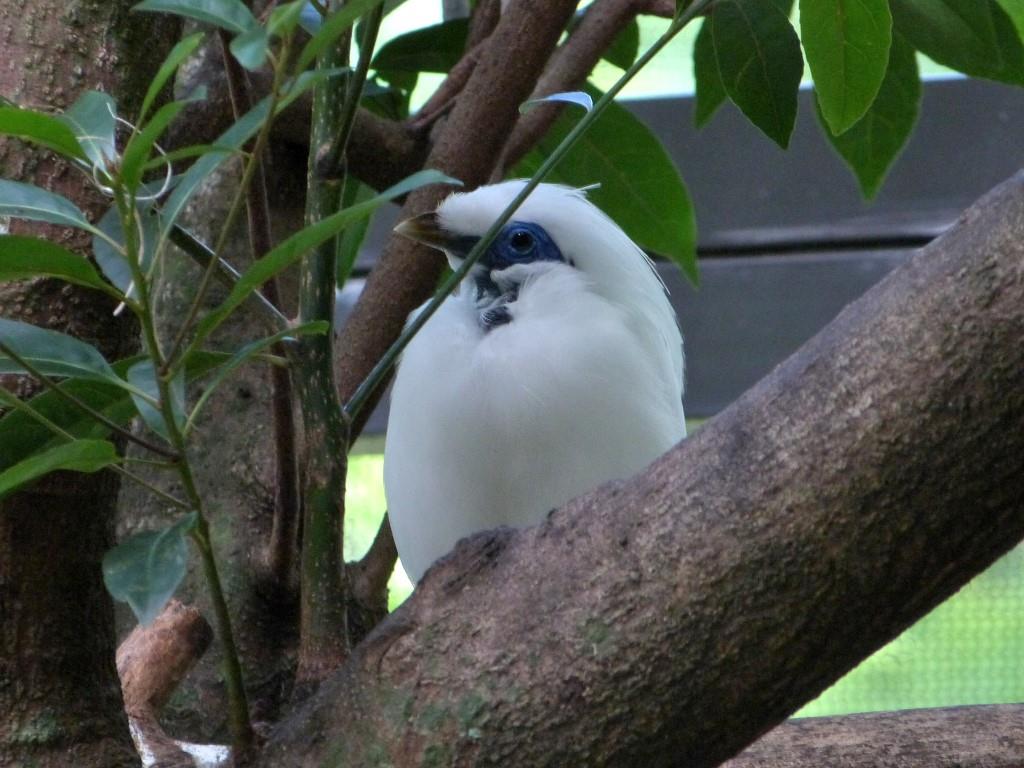
Bali Myna (Leucopsar rothschildi Palm Beach Zoo by Lee
Here is a video of the Bali Myna at Palm Beach displaying:
The Bali Myna is a highly endangered species and many of the zoos are trying to preserve them through there breeding programs.
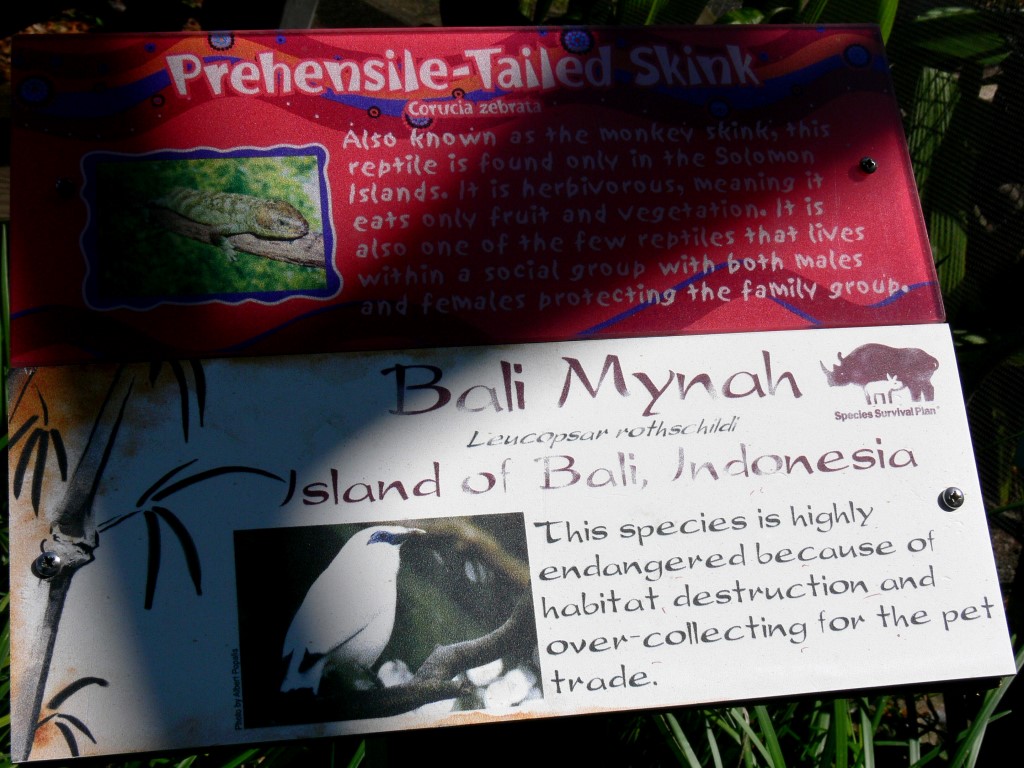
Bali Myna (Leucopsar rothschildi) Sign at LPZ
This bird is a member of the Sturnidae – Starlings Family. The Bali Myna (Leucopsar rothschildi), also known as Rothschild’s Mynah, Bali Starling, or Bali Mynah, locally known as Jalak Bali, is a medium-sized (up to 25 cm long), stocky myna, almost wholly white with a long, drooping crest, and black tips on the wings and tail. The bird has blue bare skin around the eyes, greyish legs and a yellow bill. Both sexes are similar.
The Bali Myna is restricted to the island of Bali in Indonesia, where it is the island’s only endemic vertebrate species. (An endemic subspecies, the Bali Tiger, has been extinct since 1937.) The bird was discovered in 1910, and in 1991 was designated the fauna symbol of Bali. Featured on the Indonesian 200 rupiah coin, its local name is “Jalak Bali”.
In its natural habitat it is inconspicuous, using tree tops for cover and–unlike other starlings–usually coming to the ground only to drink or to find nesting materials; this would seem to be an adaptation to its noticeability to predators when out in the open. The Bali mynah often gathers in groups when it is young to better locate food and watch out for predators. The vocalizations are a variety of sharp chattering calls and an emphatic twat.
The Bali Myna’s diet includes fruit, seeds, worms and insects.
During breeding season, males attract females by calling loudly and bobbing up and down. The birds nest in tree cavities, with the female laying and incubating two-three eggs. Both males and females bring food to the nests for chicks after hatching. (Wikipedia with editing)
Oh, I almost forgot to show you the Singing Dogs from Lowry Park Zoo. They were doing their thing causing all the others to make noise also. They are from New Guinea and music is playing in the background.
See:
Sturnidae – Starlings Family
Bali Myna – Wikipedia
Bali Myna – San Diego Zoo
New Guinea Singing Dog – Wikipedia
*
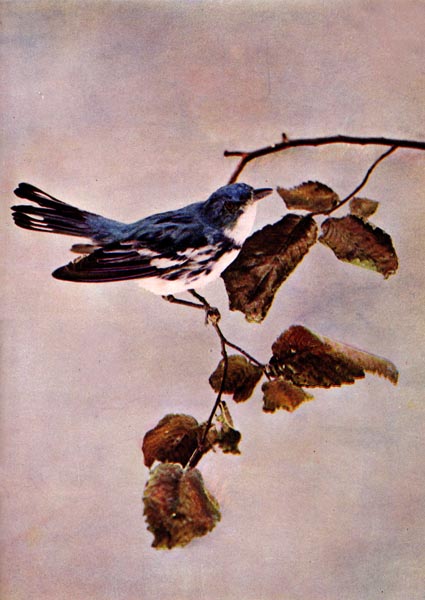
Cerulean Warbler (Setophaga cerulea) – Birds Illustrated by Color Photography
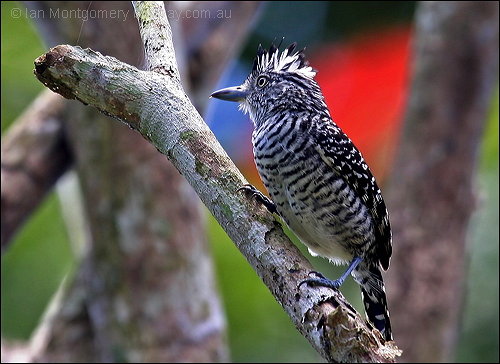
Barred Antshrike (Thamnophilus doliatus) by Ian
The Bird that Lies and Steals from Creation Moments©2013
If we confess our sins, he is faithful and just to forgive us [our] sins, and to cleanse us from all unrighteousness. (1 John 1:9 )
Many species of birds live in communities that are quite complex and even resemble human communities.
In the Amazon rainforests of Peru, 20 or more mixed species of birds will flock together in the lower levels of the rainforest canopy. Each flock has a leader and organizer – the bluish-slate ant-shrike. Each morning the ant-shrike will assemble its flock with loud calls.
This strange arrangement has a very good purpose. The ant-shrike watches over the flock like a mother watches her children. When a bird-eating hawk appears overhead, the ant-shrike shrieks a warning so that members of the flock can take cover. But as often as half the time, the ant-shrike sounds the alarm when there is no hawk. The ant-shrike sounds the alarm to distract members of the flock when he sees that they have discovered some choice insects. In this way, the ant-shrike gets up to 85 percent of its food by sounding the false hawk alarm. Nevertheless, the rest of the flock put up with his lying and thieving because of his value as a hawk watcher.
Lying and stealing are, of course, wrong for human beings. And our Creator will hold us each personally responsible for our thoughts and actions. But His Son, Jesus Christ, took our sins upon Himself so that all who believe in Him as their Lord and Savior will stand before Him cleansed of all their sins. Our Creator has promised this!
Prayer:
I thank You, Lord, that You have taken my sin upon Yourself. Help my trust to always rest in what You have done for me and not in what I think I can do to better myself before the heavenly Father. Amen.
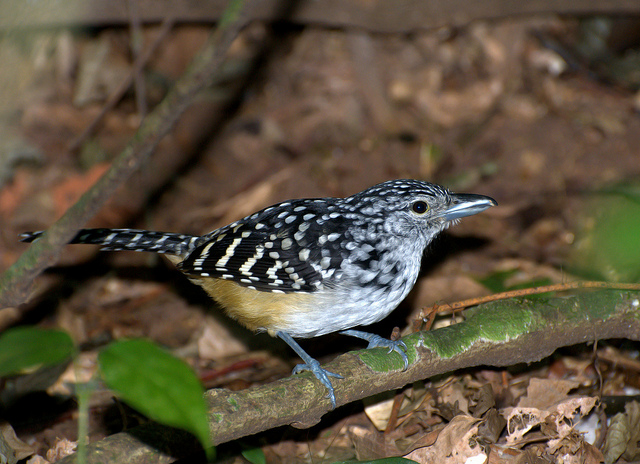
Spot-backed Antshrike (Hypoedaleus guttatus) by Dario Sanches
Lee’s Addition:
A very good lesson from our Antshrike and Creation Moments. Antshrikes belong to the Thamnophilidae – Antbirds Family. The antbird family contains over 200 species, variously called antwrens, antvireos, antbirds and antshrikes. The names refer to the relative sizes of the birds rather than any particular resemblance to the true wrens, vireos or shrikes.
The antbirds are a large family, Thamnophilidae, of passerine birds found across subtropical and tropical Central and South America, from Mexico to Argentina. There are more than 200 species, known variously as antshrikes, antwrens, antvireos, fire-eyes, bare-eyes and bushbirds. They are related to the antthrushes and antpittas (family Formicariidae), the tapaculos, the gnateaters and the ovenbirds. Despite some species’ common names, this family is not closely related to the wrens, vireos or shrikes.
Antbirds are generally small birds with rounded wings and strong legs. They have mostly sombre grey, white, brown and rufous plumage, which is sexually dimorphic in pattern and colouring. Some species communicate warnings to rivals by exposing white feather patches on their backs or shoulders. Most have heavy bills, which in many species are hooked at the tip.
Most species live in forests, although a few are found in other habitats. Insects and other arthropods form the most important part of their diet, although small vertebrates are occasionally taken. Most species feed in the understory and midstory of the forest, although a few feed in the canopy and a few on the ground. Many join mixed-species feeding flocks, and a few species are core members. To various degrees, around eighteen species specialise in following columns of army ants to eat the small invertebrates flushed by the ants, and many others may feed in this way opportunistically.

Silvery-cheeked Antshrike (Sakesphorus cristatus) by AGrosset
Antbirds are monogamous, mate for life, and defend territories. They usually lay two eggs in a nest that is either suspended from branches or supported on a branch, stump, or mound on the ground. Both parents share the tasks of incubation and of brooding and feeding the nestlings. After fledging, each parent cares exclusively for one chick.
The antbirds are a group of small to medium-sized passerines that range in size from the large Giant Antshrike to the tiny Pygmy Antwren. In general terms, “antshrikes” are relatively large-bodied birds, “antvireos” are medium-sized and chunky, while “antwrens” include most smaller species; “antbird” genera can vary greatly in size. Members of this family have short rounded wings that provide good manoeuvrability when flying in dense undergrowth. The legs are large and strong, particularly in species that are obligate ant-followers. These species are well adapted to gripping vertical stems and saplings, which are more common than horizontal branches in the undergrowth, and thus the ability to grip them is an advantage for birds following swarms of army ants. The claws of these antbirds are longer than those of species that do not follow ants, and the soles of some species have projections that are tough and gripping when the foot is clenched. Tarsus length in antbirds is related to foraging strategy. Longer tarsi typically occur in genera such as the Thamnophilus antshrikes that forage by perch-gleaning (sitting and leaning forward to snatch insects from the branch), whereas shorter tarsi typically occur in those that catch prey on the wing, such as the Thamnomanes antshrikes.
Most antbirds have proportionately large, heavy bills. Several genera of antshrike have a strongly hooked tip to the bill, and all antbirds have a notch or ‘tooth’ at the tip of the bill which helps in holding and crushing insect prey. The two genera of bushbirds have upturned chisel-like bills. (Wikipedia with editing)
Barred Antshrike – Duet Song by Jeremy Minns (xeno-canto)
Barred Antshrike – Call by Jeremy Minns (xeno-canto)
*
See:
Thamnophilidae – Antbirds Family
Antbirds – Wikipedia
*
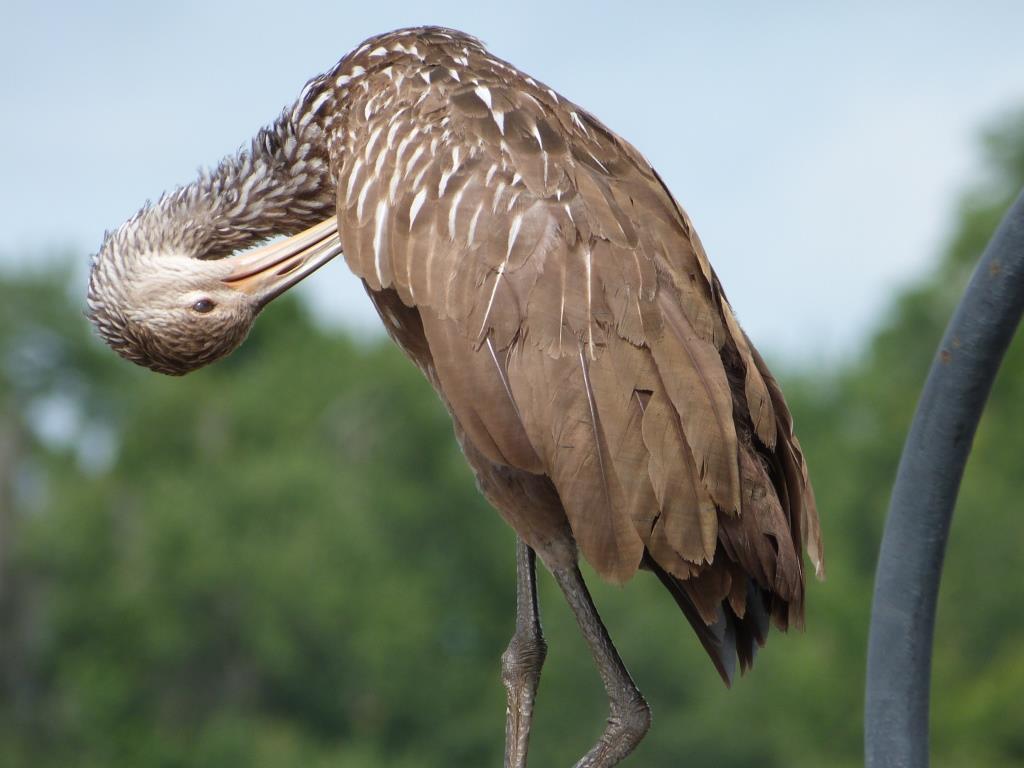
Limpkin (Aramus guarauna) Preening at Circle B
We took about an hour and a half to check out Circle B Bar Reserve again today. It was partly cloudy and around 81 degrees when we arrived. We managed to see or hear 31 species. Not bad. We had all that rain from Tropical Storm Andrea and thought maybe it would help bring in some birds. It was still pretty dry out there, but the weeds and growth sure had enjoyed all that rain we had.
Since most of our winter birds have left, we were happy with what we saw. Some of the delights and surprises were catching a video of a Carolina Wren singing right in front of us as we got out of the car. Was surprised to see 25 White Pelicans this time of the year. They went by in 3 squadrons.
By them the birds of the heavens have their home; They sing among the branches. (Psalms 104:12 NKJV)
Also, finally got a photo of the Tufted Titmouse that I have heard out there but never was able to get a glimpse of. Heading back to the car, a Swallow-tailed Kite flew over. All in all it was great. Now? It has been raining for the last 5 or 6 hours. Good thing we were there early.
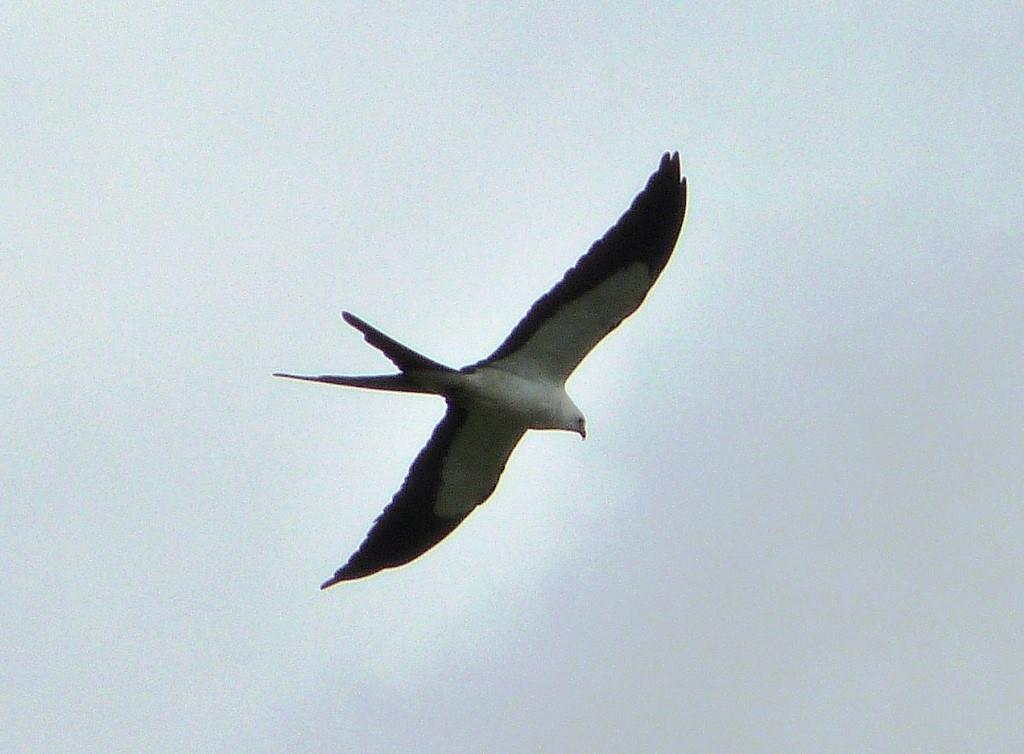
Swallow-tailed Kite (Elanoides forficatus) at Circle B
| Species | Count |
| Wood Stork | 4 |
| Anhinga | 1 |
| American White Pelican | 25 |
| Great Blue Heron | 2 |
| Great Egret | 3 |
| Snowy Egret | 1 |
| Tricolored Heron | 2 |
| Cattle Egret | 10 |
| White Ibis | 2 |
| Glossy Ibis | 4 |
| Black Vulture | 20 |
| Turkey Vulture | 5 |
| Osprey | 1 |
| Swallow-tailed Kite | 1 |
| Bald Eagle | 1 |
| Red-shouldered Hawk | 2 |
| Common Gallinule | 5 |
| Limpkin | 2 |
| Sandhill Crane | 2 |
| Mourning Dove | 2 |
| Red-bellied Woodpecker | 2 |
| Downy Woodpecker | 2 |
| Hairy Woodpecker | 1 |
| Pileated Woodpecker | 2 |
| Blue Jay | 3 |
| Fish Crow | 2 |
| Tufted Titmouse | 2 |
| Carolina Wren | 1 |
| Northern Cardinal | 4 |
| Red-winged Blackbird | 15 |
| Boat-tailed Grackle | 20 |
Update on the eye situation – I got the “All is well” for the 6-months checkup on my retina surgery and now I am scheduled June 19th to see the Eye Doctor who will do the cataract surgery. I am praying that it will be done by the end of the month. It was quite blurry out birding today.
I was using my camera as my eyes. I could tell there was something on a tree, but had no clear idea of what it was until viewed through the viewfinder and with my camera zoomed in. Hey! You do what you have to do to be able to enjoy birdwatching. And I did. The Lord let me see all of these neat birds today.
See:
*
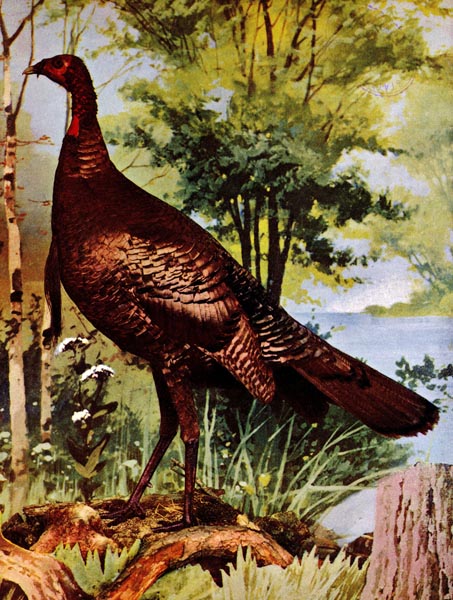
The Wild Turkey
From Col. Fred. Kaempfer.
Copyrighted by Nature Study Pub. Co., 1897, Chicago.
You have got to watch this Green Heron fishing with bread. The video speaks for itself.
Look at the birds of the air, for they neither sow nor reap nor gather into barns; yet your heavenly Father feeds them. Are you not of more value than they? (Matthew 6:26 NKJV)
*
*
*

The Belted Piping Plover
From col. F. M. Woodruff. Copyrighted by Nature Study Pub. Co., 1897, Chicago.

Sunrise at Patrick AFB by Lee
And they rose up early in the morning, and the sun shone upon the water, … (2 Kings 3:22a KJV)
We just got back from a spontaneous three day trip down to the Palm Beach Zoo, (Palm Beach, FL) and up to the Viera Wetlands (Viera, FL) and then back home yesterday. As we rode along and since I haven’t been driving because of my eye situation, I kept a list of the birds along the way. The list below was the ones I reported to e-Bird. This includes the birds that were at the Zoo, but not captives. Our loop took us down US 27 and then back up I-95, through Orlando and back across I-4 to Winter Haven. Not a bad list. The ones in bold were special finds. In fact, the Northern Rough-winged Swallow and Bank Swallow were added to my life list. I am now at 245 on their list. The list was kept for each county we went through. (It gave me something to do while riding.)
Black-bellied Whistling-Duck
Muscovy Duck (Domestic type)
Indian Peafowl (Domestic type)
Wood Stork
Magnificent Frigatebird
Double-crested Cormorant
Anhinga
Brown Pelican
Least Bittern
Great Blue Heron
Great Egret
Little Blue Heron
Tricolored Heron
Cattle Egret
Black-crowned Night-Heron
White Ibis
Glossy Ibis
White-faced Ibis
Black Vulture
Turkey Vulture
Osprey
Swallow-tailed Kite
Bald Eagle
Red-shouldered Hawk
Common Gallinule
American Coot
Sandhill Crane
Ruddy Turnstone
Sanderling
Rock Pigeon
Eurasian Collared-Dove
Mourning Dove
Belted Kingfisher
Red-bellied Woodpecker
Crested Caracara
American Crow
Fish Crow
Northern Rough-winged Swallow
Bank Swallow
Northern Mockingbird
European Starling
Northern Cardinal
Red-winged Blackbird
Common Grackle
Boat-tailed Grackle
House Sparrow
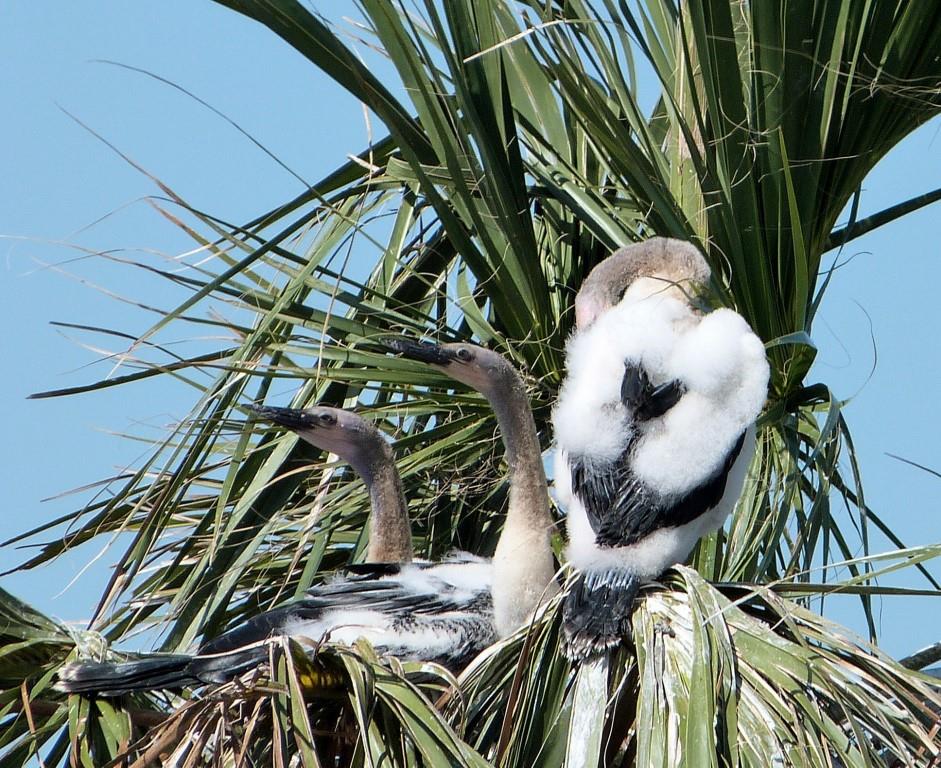
Anhinga (Anhinga anhinga) Immatures at Viera Wetland by Lee
The Viera Wetlands count is included with those above, but is the individual count just for Viera. That actually was a birdwatching destination and e-Bird likes it counted separately. It is one of our favorites over on the east side of Florida. Unfortunately, it has apparently been dry over there, plus most of the Winter Birds have gone back north. So, the birding wasn’t as plentiful as normal. Here is the list of the birds we saw. We stopped there in the afternoon on Wednesday and then visited it again Thursday before heading home. We saw 23 species altogether .
| Species Name | 15-May | 16-May |
| Black-bellied Whistling-Duck | 2 | — |
| Anhinga | 9 | 6 |
| Brown Pelican | — | 2 |
| Least Bittern | — | 1 |
| Great Blue Heron | 8 | 6 |
| Great Egret | 10 | 14 |
| Little Blue Heron | 1 | 1 |
| Tricolored Heron | 1 | 1 |
| Cattle Egret | 11 | 15 |
| White Ibis | 7 | 7 |
| Glossy Ibis | 2 | 7 |
| White-faced Ibis | — | 1 |
| Turkey Vulture | 1 | 15 |
| Osprey | — | 2 |
| Common Gallinule | 5 | 13 |
| American Coot | 8 | 4 |
| Belted Kingfisher | 1 | — |
| Red-bellied Woodpecker | 2 | — |
| Crested Caracara | 1 | — |
| Fish Crow | 1 | 2 |
| Red-winged Blackbird | 10 | 12 |
| Common Grackle | — | 3 |
| Boat-tailed Grackle | 18 | 22 |
*

Northern Crested Caracara (Caracara cheriway) at Viera Wetlands by Lee
The Crested Caracara was the best find. We had taken our photos and had stopped at the exit to put our cameras away. Dan had his in the trunk and mine was bagged when I look up and there he was right by us on the ground. Needless to say, we scrambled to get the camera back out, hoping we wouldn’t scare it off. As you can see, we got the photos of him.
I will save the Palm Beach Zoo birds and photos until another post. I took over 700, so it might take a day or two.

Great Blue Heron (Ardea herodias) Watching young nearby at Viera Wetlands
Here is what is being watched so closely:

Great Blue Heron (Ardea herodias) Young at Viera Wetlands
See:
*


