***
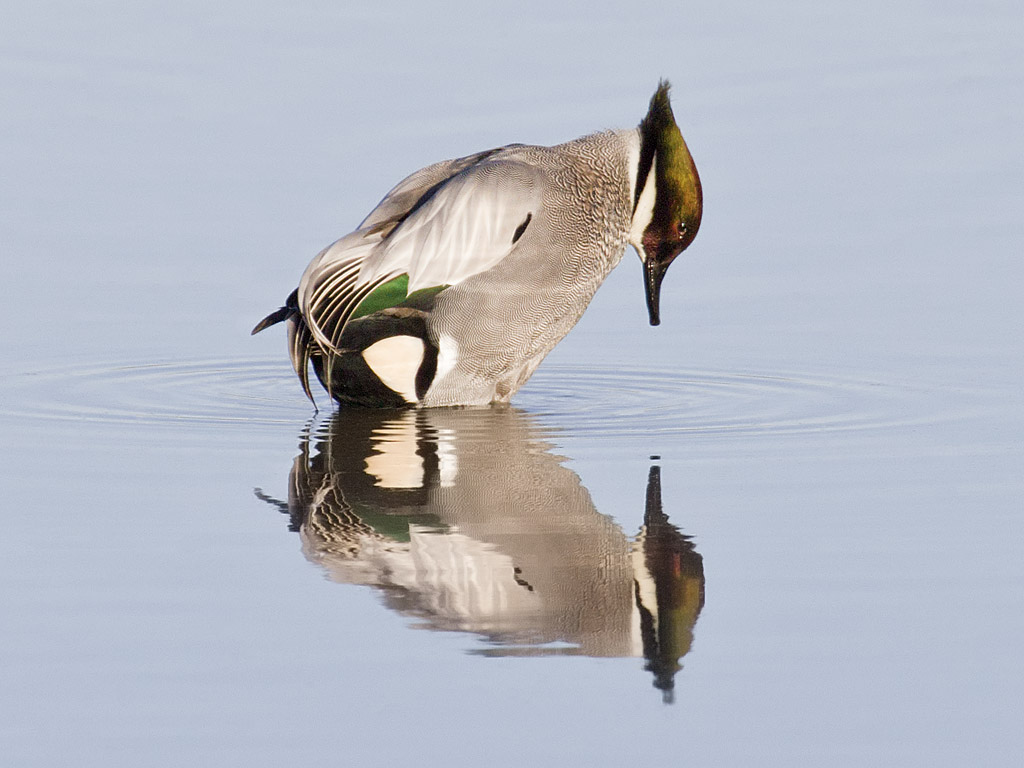
AS IN WATER FACE ANSWERETH TO FACE
***
“As in water face answereth to face, so the heart of man to man.” (Proverbs 27:19 KJV)
Falcated Duck (Anas falcata) ©WikiC
*
*
“As in water face answereth to face, so the heart of man to man.” (Proverbs 27:19 KJV)
Falcated Duck (Anas falcata) ©WikiC
*
*

Black-bellied Whistling Duck (Dendrocygna autumnalis) at Palm Beach Zoo by Lee
“And the swan, and the pelican, and the gier-eagle,” (Leviticus 11:18)
I have always enjoyed trying to whistle and today we lead off our latest Family, the Anatidae, in the Answeriformes Order. The Anatidae family has ducks, geese, swans, and a few others that add up to 173 species. The Whistling Ducks do make a whistling sound, which I notice more when they are flying. We have the Black-bellied Whistling Ducks here locally. In fact, some hang out at the pond in our housing area.

Black-bellied Whistling Duck (Dendrocygna autumnalis) by Lee at Palm Beach Zoo
Audio of a Black-bellied Whistling Duck from xeno-canto.
The Anatidae are the biological family of birds that includes ducks, geese, and swans. The family has a cosmopolitan distribution, occurring on all the world’s continents. These birds are adapted for swimming, floating on the water surface, and in some cases diving in at least shallow water. (The magpie goose is no longer considered to be part of the Anatidae, but is placed in its own family
They are generally herbivorous, and are monogamous breeders. A number of species undertake annual migrations. A few species have been domesticated for agriculture, and many others are hunted for food and recreation. Five species have become extinct since 1600, and many more are threatened with extinction.
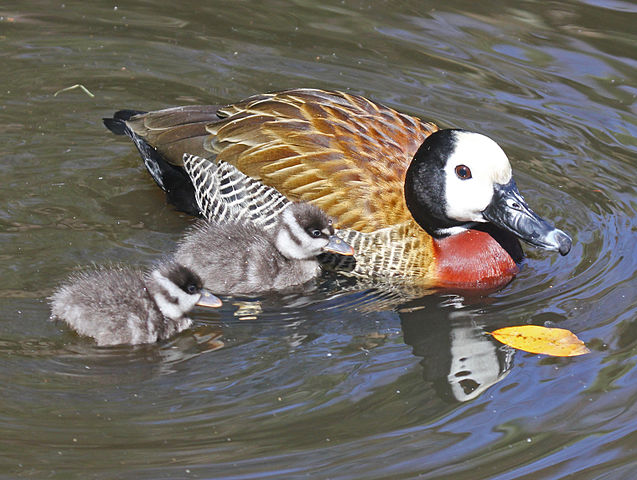
White-faced Whistling Duck (Dendrocygna viduata) ©WikiC
Whistling ducks are found in the tropics and subtropics. As their name implies, they have distinctive whistling calls. The whistling ducks have long legs and necks, and are very gregarious, flying to and from night-time roosts in large flocks. Both sexes have the same plumage, and all have a hunched appearance and black underwings in flight.

White-backed Duck (Thalassornis leuconotus) ©WikiC
The white-backed duck (Thalassornis leuconotus) is a waterbird of the family Anatidae. It is distinct from all other ducks, but most closely related to the whistling ducks in the subfamily Dendrocygninae, though also showing some similarities to the stiff-tailed ducks in the subfamily Oxyurinae. It is the only member of the genus Thalassornis.
These birds are well adapted for diving. On occasions they have been observed to stay under water for up to half a minute. They search especially for the bulbs of waterlilies. From danger, they also escape preferentially by diving; hence, the namesake white back is hardly visible in life. (Information from Wikipedia)
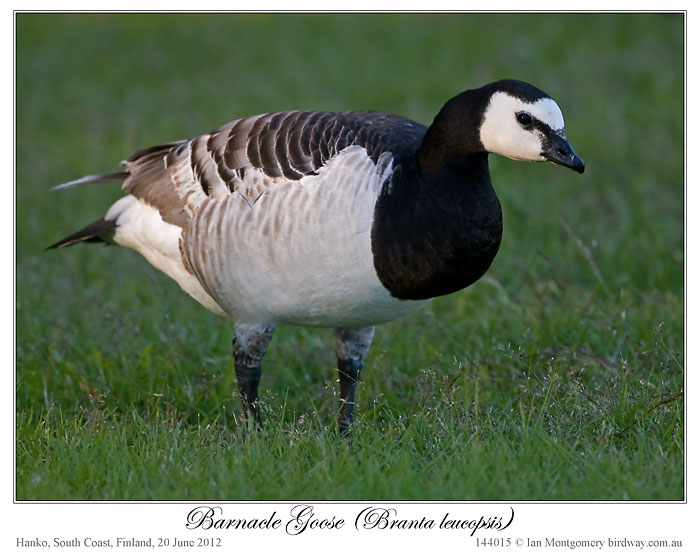
Barnacle Goose (Branta leucopsis) by Ian
The black geese of the genus Branta are waterfowl belonging to the true geese and swans subfamily Anserinae. They occur in the northern coastal regions of the Palearctic and all over North America, migrating to more southernly coasts in winter, and as resident birds in the Hawaiian Islands. Alone in the Southern Hemisphere, a self-sustaining feral population derived from introduced Canada geese is also found in New Zealand.
The scientific name Branta is a Latinised form of Old Norse Brandgás, “burnt (black) goose). The black geese derive their vernacular name for the prominent areas of black coloration found in all species. They can be distinguished from all other true geese by their legs and feet, which are black or very dark grey. Furthermore, they have black bills and large areas of black on the head and neck, with white (ochre in one species) markings that can be used to tell apart most species.[note 1] As with most geese, their undertail and uppertail coverts are white. They are also on average smaller than other geese, though some very large taxa are known, which rival the swan goose and the black-necked swan in size.
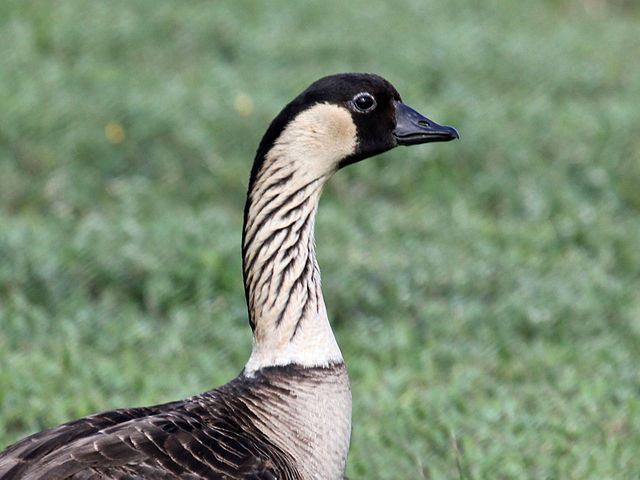
Nene (Branta sandvicensis) ©WikiC
The Nene (Branta sandvicensis), also known as nēnē and Hawaiian goose, is a species of goose endemic to the Hawaiian Islands. The official bird of the state of Hawaiʻi, the nene is exclusively found in the wild on the islands of Oahu, Maui, Kauaʻi, Molokai, and Hawaiʻi. The Hawaiian name nēnē comes from its soft call. The species name sandvicensis refers to the Sandwich Islands, an old name for the Hawaiian Islands. (Above information from Wikipedia)
The first two photos show how the different zoos call the same bird by different names. This is why the scientific name is very important. Also, Dan and I have been fortunate to have seen most of these birds either in the wild or in zoos. It is always a joy to watch the Lord’s Creations in person.
I made me pools of water, to water therewith the wood that bringeth forth trees: (Ecclesiastes 2:6)
In those pools of water, most likely you will find one of these.
“I’d Rather Have Jesus” ~ by Faith Baptist Orchestra*
*
ANSERIFORMES Order
Anatidae – Ducks, Geese & Swans Family
*
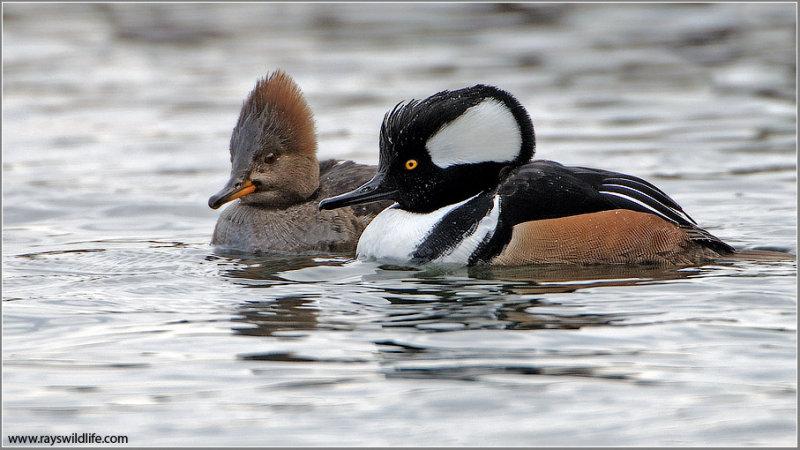
“Honour all men. Love the brotherhood. Fear God. Honour the king.” (1 Peter 2:17 KJV)
Hooded Merganser (Lophodytes cucullatus) by Ray
*
*
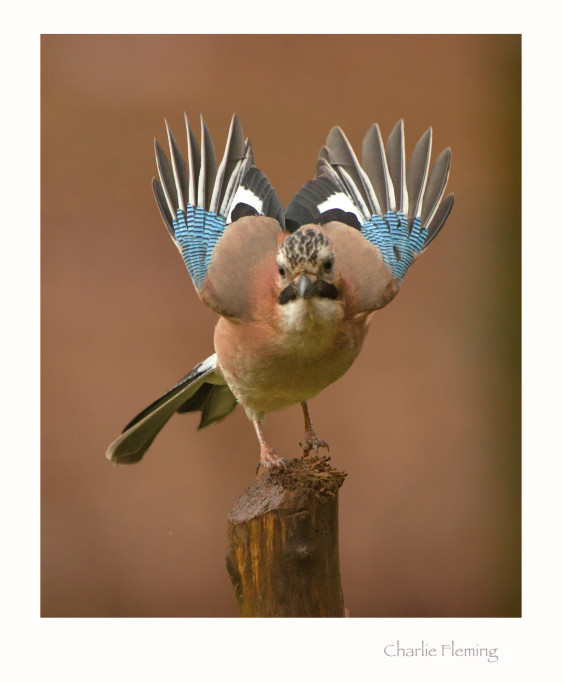
“And he [Abraham] lifted up his eyes and looked, and, lo, 3 men stood by him: and when he saw them, he ran to meet them from the tent door, and bowed himself toward the ground.” (Genesis 18:2)
Eurasian Jay ©Charlie Fleming
*
*
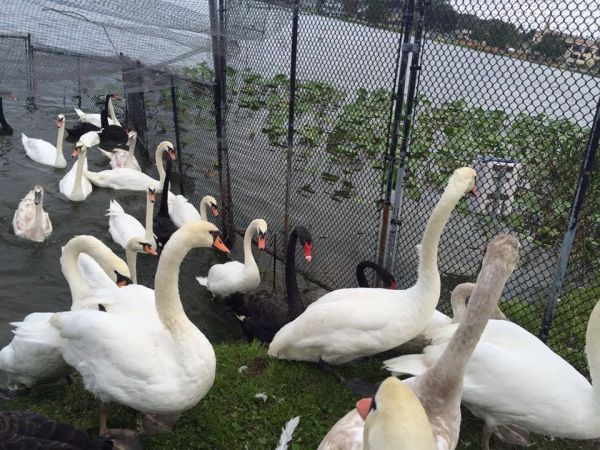
Swans Waiting For Their Check-up by the Veterinarian At Lake Morton
“And Jesus answering said unto them, They that are whole need not a physician; but they that are sick. I came not to call the righteous, but sinners to repentance.” (Luke 5:31-32 KJV)
Swans Waiting For Their Check-up by the Veterinarian At Lake Morton
*
*
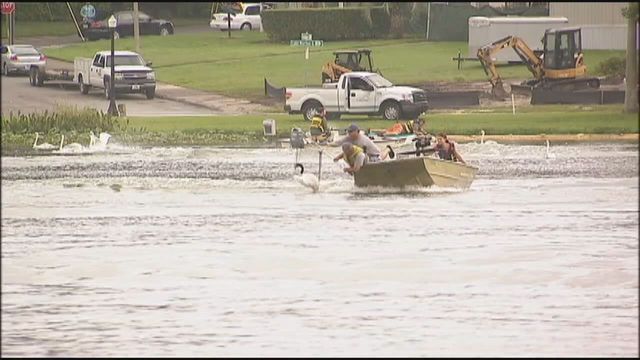
Catching Swans on Lake Morton for the Annual Roundup ©Fox13
“And the swan, and the pelican, and the gier eagle,” (Leviticus 11:18 KJV)
In 2014 I wrote about going birdwatching at Lake Morton – Lake Morton Birdwatching after Round-up . Well, they are currently in the midst of doing so again. Today’s paper mentioned the annual round-up and thought you might enjoy seeing this years version. First, here is a video from last year:
Fox 13 had this article – 36th annual Lakeland Swan Roundup Underway.
“For some reason, Steve Platt, the Lakeland Parks and Recreation guy in charge of the 2016 Swan Roundup, agreed to let me on a boat to go after the target of the morning.
This is the 36th annual swan roundup. It takes place on picturesque Lake Morton.
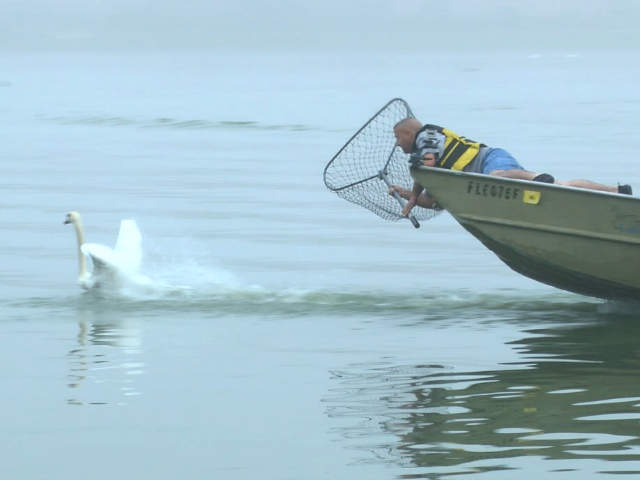
On the day one, Tuesday, city employees catch the swans. The following day, local veterinarian Dr. Patricia Mattson and her staff give the swans physicals. They weigh, vaccinate and microchip the birds.
“The Lake Morton swans are a community icon and families have been interacting with the birds for decades,” explained Bob Donahay, director of parks & recreation. “It is very important to us to make sure our Lakeland flock is doing well so we schedule the swan roundup each year with the primary purpose to check on the health of our birds.”
Dr. Mattson, and the folks who preceded her, Dr. Geoffrey Gardner and his dad, Dr. Wade Gardner, provide their services for free.
This year, the goal was to catch close to 70 swans to get them ready for their physicals on Wednesday.
“The swans are consuming too much white bread and the heavy gluten diet, with very little nutritional value, is taking a toll on Lakeland’s swan population,” Dr. Mattson offered. “Many of the swans have a calcium deficiency because they feast on bleached white bread and this is just one of the items that will be reviewed during the swans’ annual health checkup.”
I got onto the boat, laid on my stomach, and held a big fishing net in my right hand. In an instant, I was zipping across the water. There ahead, floating peacefully was the target — a beautiful white mute swan.
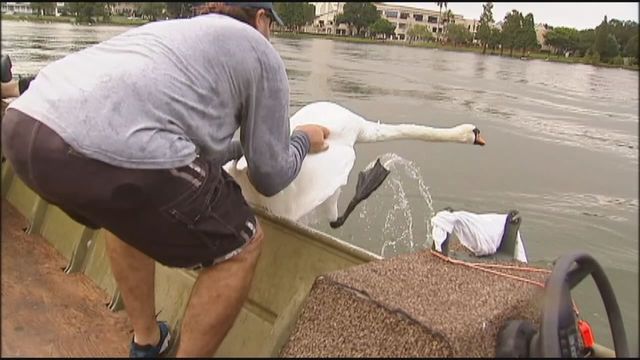
As we got closer, the swan realized something was up and began to swim faster and faster away from the rumble of the rumble of the motor. As we closed in, thinking I would never pull this off, I try to net the swan, and to my amazement, I did. It was quite an adrenaline rush.
With instruction, I grabbed the massive bird, carefully keeping its wings and big floppy feet from breaking loose of my grip. When we got back to shore, I put it into a holding pen where it will stay until tomorrow.
That’s when the real fun will begin. An assembly line of workers will take each swan one by one to the vet who will weigh it, take a blood sample, and record the findings.
After that, Lakeland’s most loved residents are good for another year.
In Genesis 1:28, originally dominion over the birds was given to Adam. That meant to care for them. I am glad that the city of Lakeland cares about their Swans.
“And God blessed them, and God said unto them, Be fruitful, and multiply, and replenish the earth, and subdue it: and have dominion over the fish of the sea, and over the fowl of the air, and over every living thing that moveth upon the earth.”
Here are links to more coverage of this event:
Lake Morton Birdwatching after Round-up
No this was not white bread in the following photos:
*
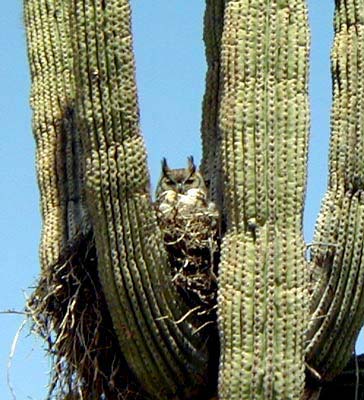
“I am like a pelican of the wilderness; I am like an owl of the desert.” (Psalms 102:6 NKJV)
Owl in the Desert ©Alan Dommy
*
*


“And this is how you shall make it: The length of the ark shall be three hundred cubits, its width fifty cubits, and its height thirty cubits.” (Genesis 6:15 NKJV)
The Fairy Tale Ark Room and Real Sized Ark by Lee and Dan
*
*
Birdwatching On The Ark Encounter – Provisions II
*
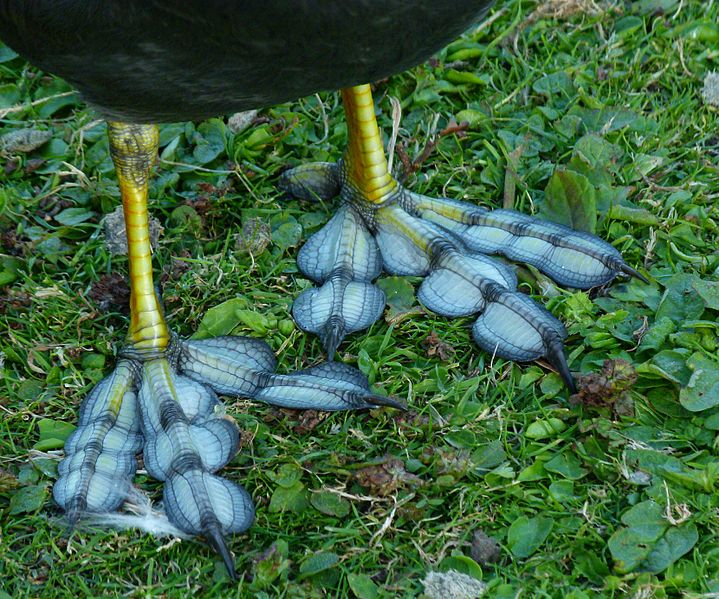
“He brought me up also out of an horrible pit, out of the miry clay, and set my feet upon a rock, and established my goings.” (Psalms 40:2 KJV)
Eurasian Coot (Fulica atra) Lobed Feet ©WikiC
*
*

Water and Food Holders for the Cages – Lee at Ark Encounter
This is the fourth blog about Birdwatching on board the Ark Encounter. The Ark Encounter is a full-sized model of the Ark that is located in Williamstown, Kentucky.
James J. S. Johnson, Dr. Jim as I call him, writes articles here, but he also has a blog called Rockdoveblog. He has been writing limericks lately, and this one fits well with today’s article.
The Floating Zoo by Dr. James J. S. Johnson
There once was a boat called the Ark:
Peep, meow, baa, hee-haw, and bark!
Its size was quite large,
As afloat went this barge:
Noah’s at-sea zoölogical park!COMMENTARY: See Genesis chapters 6 through 9.
I am sure it WAS interesting on board the Ark, with all the many critters. In the Birdwatching On Board The Ark Encounter – The Provisions I article, I showed you how they stored the food and water for them and the critters. There are more photos to show and tell you about. As the waters were lifted up, and the ark began to float, there had to be a rise in the noise level of the critters on board.
“And the flood was forty days upon the earth; and the waters increased, and bare up the ark, and it was lift up above the earth. And the waters prevailed, and were increased greatly upon the earth; and the ark went upon the face of the waters. And the waters prevailed exceedingly upon the earth; and all the high hills, that were under the whole heaven, were covered. Fifteen cubits upward did the waters prevail; and the mountains were covered.” (Genesis 7:17-20 KJV) [emphasis added]

The Fairy Tale Ark Room
Surely the critters were frightened at times, as were the humans. When the fountains of the deep broke up and the rain fell, it was not a smooth sailing cruise liner. Yet, the Lord God had given Noah the measurements and design for the Ark. Our Omninescient Creator knew exactly how the Ark would hold up during the upheavals and wave actions of all that was going on outside the Ark. (See “Lifted Up From The Earth” by Henry M. Morris, Ph.D., How Could All the Animals Get On Board Noah’s Ark? and The Survival of Noah’s Ark, John D. Morris, Ph.D.)
“In the six hundredth year of Noah’s life, in the second month, the seventeenth day of the month, the same day were all the fountains of the great deep broken up, and the windows of heaven were opened. And the rain was upon the earth forty days and forty nights.” (Genesis 7:11-12 KJV)
Most of our readers are familiar with the details of the Flood, which was universal and not a local flood, as some claim. In fact, one of the rooms at the Ark Encounter they call the “Fairy Tale Ark” room. They have a collection of children’s books and others, depicting the ark with a giraffe sticking his head out the roof, and other critters on deck. You’ve seen them. Here are our photos:


How would you provide for the people, birds and other critters for a year and at least 10 days, (see Provisions I), on those little arks? You couldn’t!!! More on this point another time.
The following is a quote from Chapter 10 of the New Answers Book 1 – Was There Really a Noah’s Ark and Flood? (Online)
“How Did Noah Care for All the Animals?
Just as God brought the animals to Noah by some form of supernatural means, He surely also prepared them for this amazing event. Creation scientists suggest that God gave the animals the ability to hibernate, as we see in many species today. Most animals react to natural disasters in ways that were designed to help them survive. It’s very possible many animals did hibernate, perhaps even supernaturally intensified by God.
Whether it was supernatural or simply a normal response to the darkness and confinement of a rocking ship, the fact that God told Noah to build rooms (“qen”—literally in Hebrew “nests”) in Genesis 6:14 implies that the animals were subdued or nesting. God also told Noah to take food for them (Genesis 6:21), which tells us that they were not in a yearlong coma either.”
“Were we able to walk through the Ark as it was being built, we would undoubtedly be amazed at the ingenious systems on board for water and food storage and distribution. As Woodmorappe explains in Noah’s Ark: A Feasibility Study, a small group of farmers today can raise thousands of cattle and other animals in a very small space. One can easily imagine all kinds of devices on the Ark that would have enabled a small number of people to feed and care for the animals, from watering to waste removal.”
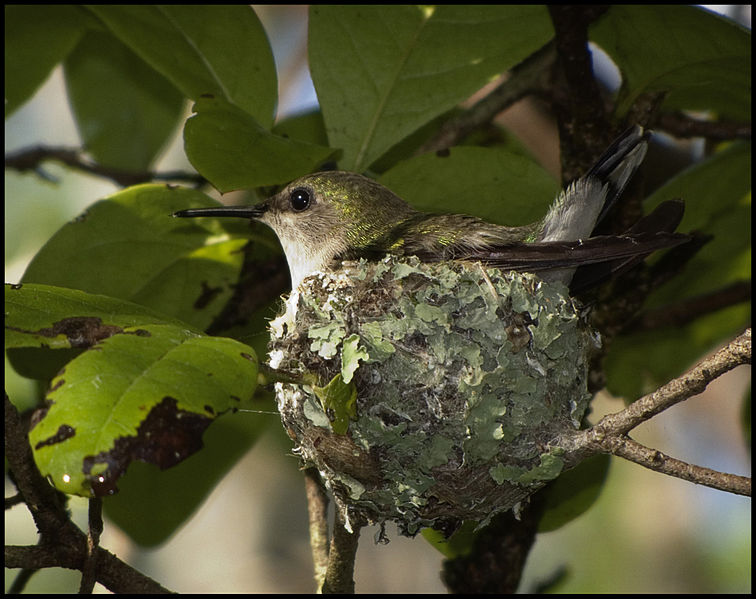
Vervain Hummingbird (Mellisuga minima) WikiC
If God did choose to have the “animals hibernate,” then, this would have required less provisions and time feeding the critters. That could be one way to stretch the food they had on board. Just from today’s behavior, we know that Hummingbirds go into a “torpor” state. Here is a quote from “How Do Hummingbirds survive Cold Nights? Hummingbirds and Torpor” (ScienceBlogs)
“Torpor is a type of deep sleep where an animal lowers its metabolic rate by as much as 95%. By doing so, a torpid hummingbird consumes up to 50 times less energy when torpid than when awake. This lowered metabolic rate also causes a cooled body temperature. A hummingbird’s night time body temperature is maintained at a hypothermic threshold that is barely sufficient to maintain life. This threshold is known as their set point and it is far below the normal daytime body temperature of 104°F or 40°C recorded for other similarly-sized birds.”
I can see again, we are going to need a Part III to this. But before we end this one, we need to not lose the fact of the applications with these provisions. Our Lord has provided us with daily provisions and meets our many needs. Yet, this Ark was for the preservation of those inside. Many were invited to get in the Ark, but they refused. Judgment was coming, they had been warned, yet they refused to heed the warnings. Then, it was too late. The Door was shut.
Today, the offer of salvation through the Lord Jesus Christ as our personal Savior is before us. Will we accept the Lord Jesus Christ as our Lord and Savior or we “fluff” it off like those who refused to enter the Ark. Judgment is coming. Many like to talk about the love part of the Lord, but there is also the judgment side. Hebrews 9:26-28 says,
“For then must he often have suffered since the foundation of the world: but now once in the end of the world hath he appeared to put away sin by the sacrifice of himself. And as it is appointed unto men once to die, but after this the judgment: So Christ was once offered to bear the sins of many; and unto them that look for him shall he appear the second time without sin unto salvation.” (Hebrews 9:26-28 KJV)
Before the Flood, man was able to look ahead to the cross, and now we look back at the cross. The Door was available the pre-flood people, they refused, except eight. Now the Door is open to us. Praise the Lord, Dan and I, along with many of you have opened the door of your hearts and let the Lord in.
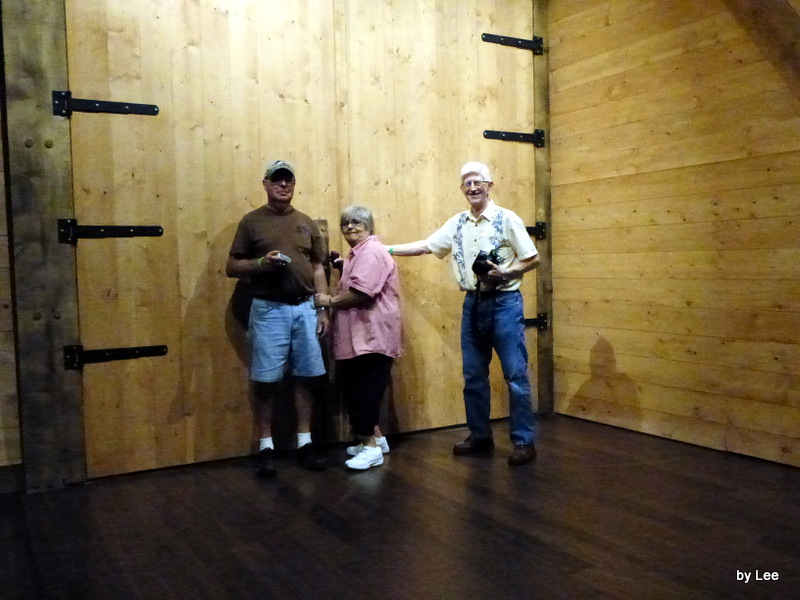
The Door at the Ark Encounter – Dan and our friends
“Then said Jesus unto them again, Verily, verily, I say unto you, I am the door of the sheep. All that ever came before me are thieves and robbers: but the sheep did not hear them. I am the door: by me if any man enter in, he shall be saved, and shall go in and out, and find pasture.” (John 10:7-9 KJV)
*
*

” To give subtilty to the simple, to the young man knowledge and discretion.” Proverbs 1:4
Emu (Dromaius novaehollandiae) Baby by WaltDaily©©
*
*
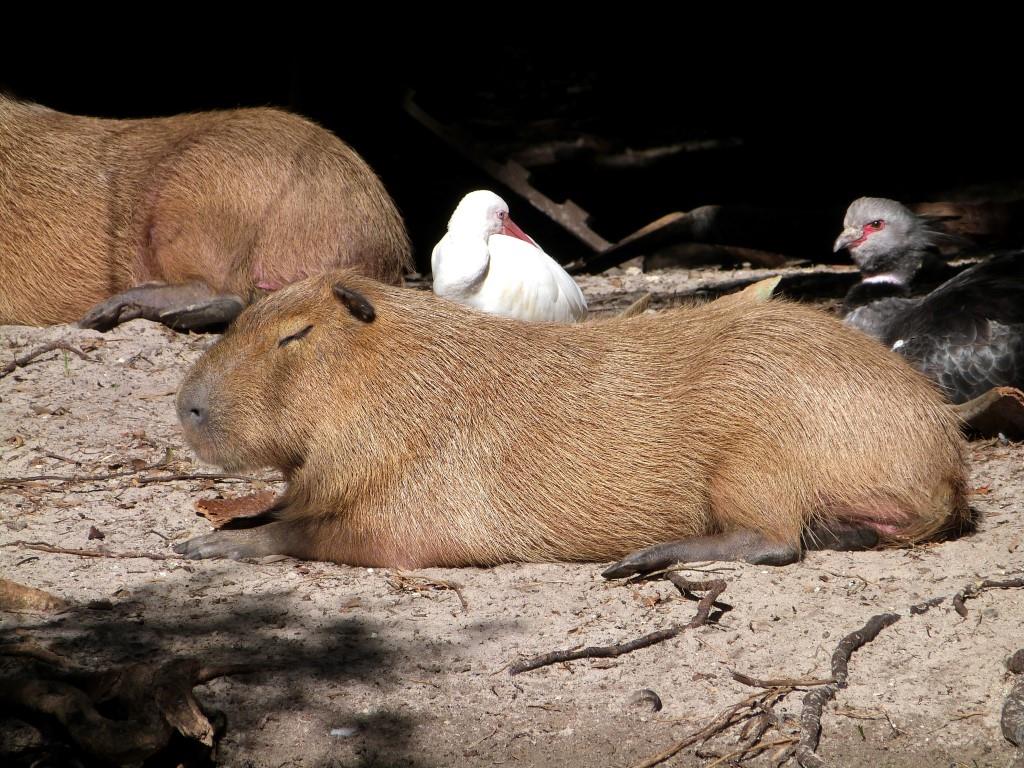
Southern Screamer with a Capybara by Lee at Palm Beach Zoo
“Constantly, night and day, he was screaming among the tombs and in the mountains, and gashing himself with stones. Seeing Jesus from a distance, he ran up and bowed down before Him;” (Mark 5:5-6 NASB)
Our next Order, the Anseriformes has three families. The Anhimidae – Screamers Family has only three members; the Horned, Northern and Southern Screamers. The Anseranatidae – Magpie Goose Family is even smaller. The Magpie Goose is the only member. The third family is huge with 173 species. That is the Anatidae Family which has Ducks, Geese, Swans and other water birds. Today, we will just do the first two families. Dan and I have seen the Southern Screamer at several zoos. Also, this audio, by zeno-canto of s Southern Screamer screaming.
“The screamers are a small clade of birds (Anhimidae). For a long time, they were thought to be most closely related to the Galliformes because of similar bills, but they are instead more closely related to ducks (family Anatidae), most closely to the magpie goose (which some DNA evidence suggests are closer to screamers than to ducks). The clade is exceptional within the living birds in lacking uncinate processes of ribs. The screamers are represented by three species, the horned screamer (Anhima cornuta), the southern screamer or crested screamer (Chauna torquata) and the northern screamer or black-necked screamer (Chauna chavaria). The birds’ skin has a layer about a quarter of an inch thick that is filled with small bubbles of air, which produce a crackling sound when pressed.” (Wikipedia with editing)
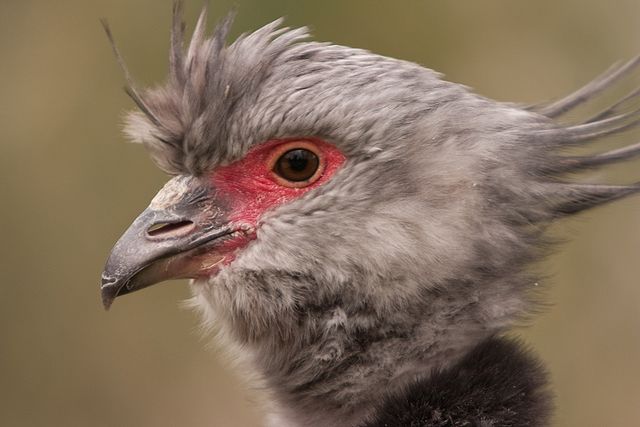
Southern Screamer (Chauna torquata) Closeup of head ©WikiC
The three species occur only in South America, ranging from Colombia to northern Argentina. They are large, bulky birds, with a small downy head, long legs and large feet which are only partially webbed. They have large spurs on their wings which are used in fights over mates and territorial disputes; these can break off in the breast of other screamers, and are regularly renewed. Unlike ducks they have a partial molt, and are able to fly throughout the year. They live in open areas and marshes with some grass and feed on water plants. One species, the southern screamer, is considered a pest as it raids crops and competes with farm birds. (Wikipedia)

Horned Screamer (Anhima cornuta) ©©Flickr WMCarlos
The Horned Screamer is a massive 84–95 cm (33–37.5 in) long, 3.5 kg (7.7 lb) bird, with a small chicken-like bill. The upperparts, head and breast are black, with white speckles on the crown, throat and wing coverts. There is a long spiny structure projecting forward from the crown. This structure is unique among birds and is not derived from a feather but is a cornified structure that is loosely attached to the skull and grows continuously while often breaking at its tip. This gives this species its name. The belly and under wing coverts are white. It has two sharp spurs on its wings, and feet which are only partially webbed.
The horned screamer’s call, as its name suggests, is a very loud U-WHO or honking YOIK-YOK.
The horned screamer is found in lowlands from Colombia, Venezuela, Brazil, Bolivia, Peru, Ecuador, Suriname, French Guiana, and Guyana. It is now extinct in Trinidad and Tobago. Despite having declined locally, it remains widespread and is fairly common overall. Its range in Brazil appears to have expanded in recent years.
It lives in well-vegetated marshes and feeds on water plants. Its nest is a large pile of floating vegetation anchored in shallow water. Three olive-brown eggs are laid, and the young, like those of most Anseriformes, can run as soon as they are hatched.

Northern Screamer (Chauna chavaria) ©WikiC
The Northern Screamer (Chauna chavaria), also known as the black-necked screamer, is a large species of bird in the small family Anhimidae, the screamers. It is a resident breeder in northern Colombia, in Chocó, Antioquia, Córdoba, Sucre, Bolívar, Magdalena, Santander, and Cesar Departments and northwestern Venezuela, in Zulia, Mérida, and Trujillo States. On average, they are 88.9 cm (35 in) long and weigh about 3.9 kg (8.6 lb).
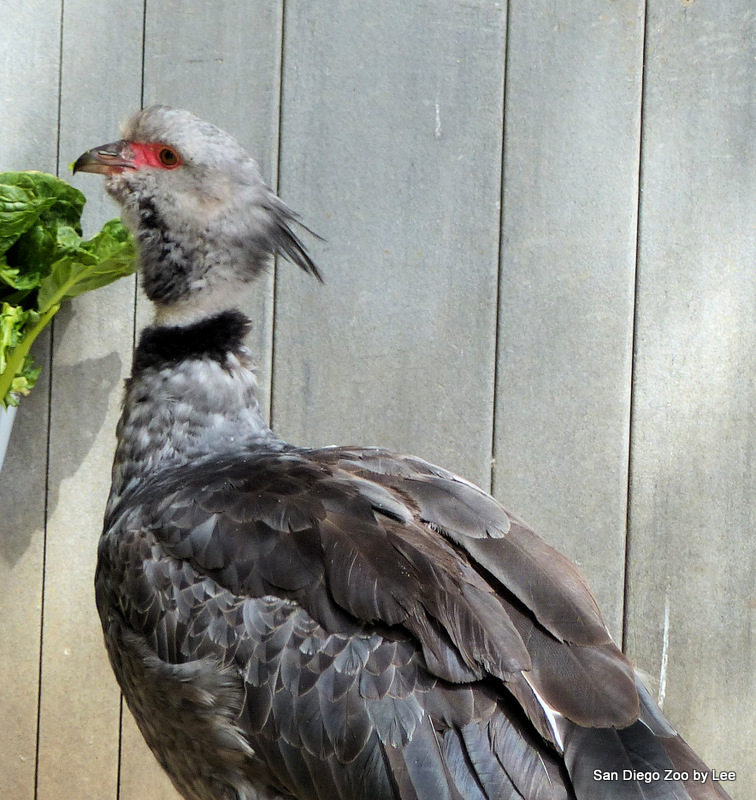
Southern Screamer (Chauna torquata) San Diego Zoo by Lee
The southern screamer averages 81–95 cm (32–37 in) long and weighs 3–5 kg (6.6–11.0 lb).[3] They are the heaviest, although not necessarily the longest, of the three screamers.[4] The wingspan is around 170 cm (67 in).[5] Among standard measurements, the wing chord measures 54 cm (21 in), the tail 23.2 cm (9.1 in), the culmen 4.5 cm (1.8 in) and the long tarsus 11 cm (4.3 in).[6] It lives in tropical and sub-tropical swamps, estuaries and watersides.
The southern screamer is a good swimmer, having partially webbed feet, but prefers to move on the ground. The bony spurs on its wings are used for protection against rival screamers and other enemies. Although it is non-migratory, it is an excellent flier. It lives in large flocks, feeding on the ground in grasslands and cultivated fields until nesting season, when birds pair off.

Magpie Goose (Anseranas semipalmata) by Ian
The Magpie Goose (Anseranas semipalmata) is a waterbird species found in coastal northern Australia and savannah in southern New Guinea. It is a unique member of the order Anseriformes, and arranged in a family and genus distinct from all other living waterfowl. The magpie goose is a resident breeder in northern Australia and in southern New Guinea. The species was once also widespread in southern Australia, but disappeared from there largely due to the drainage of the wetlands where the birds once bred.
Magpie geese are unmistakable birds with their black and white plumage and yellowish legs. The feet are only partially webbed, and the magpie goose feeds on vegetable matter in the water, as well as on land. Males are larger than females. Unlike true geese, their molt is gradual, so no flightless period results. Their voice is a loud honking. [I also think that top-knot would make it distinguishable] (All information Wikipedia with editing)
*
“And many of the people believed on him, and said, When Christ cometh, will he do more miracles than these which this man hath done?” (John 7:31 KJV)
“Jesus Wrought A Miracle of Love” ~ Solo by Paul Ebright
*
Anseranatidae – Magpie Goose Family
*
 Lee's Birdwatching Adventures Plus