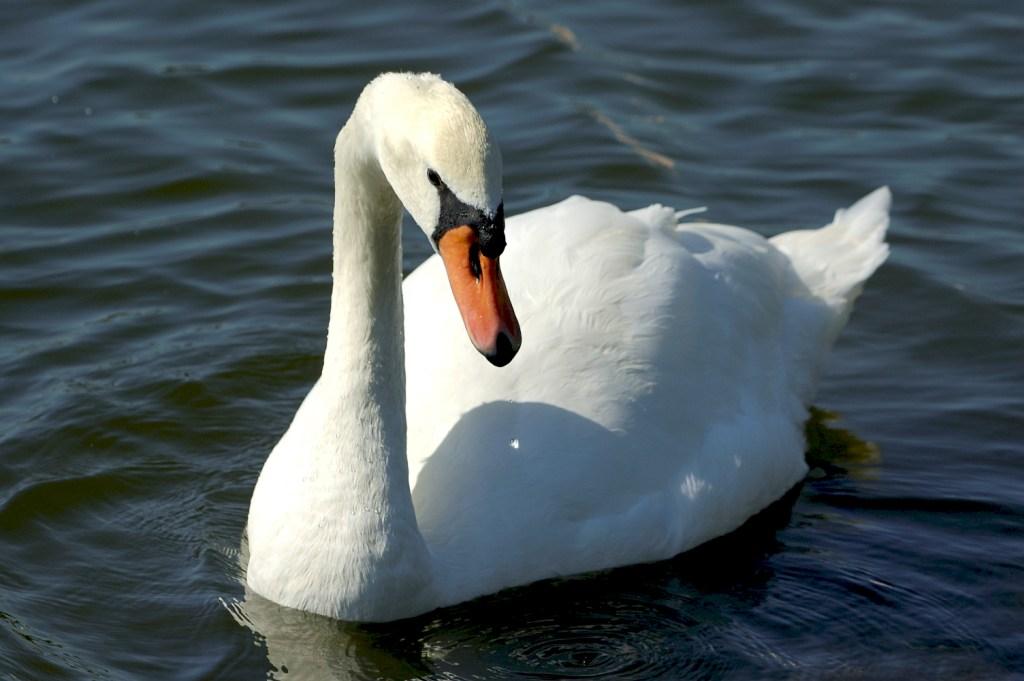
Mute Mute Swan (Cygnus olor) at Lake Morton By Dan’sPix
“So the LORD said to him, “Who has made man’s mouth? Or who makes the mute, the deaf, the seeing, or the blind? Have not I, the LORD?” (Exodus 4:11 NKJV)
“I was mute, I did not open my mouth, Because it was You who did it.” (Psalms 39:9 NKJV)
“Then great multitudes came to Him, having with them the lame, blind, mute, maimed, and many others; and they laid them down at Jesus’ feet, and He healed them.” (Matthew 15:30 NKJV)
“Then one was brought to Him who was demon-possessed, blind and mute; and He healed him, so that the blind and mute man both spoke and saw.” (Matthew 12:22 NKJV)
Avian and Attributes – Mute
MUTE, a. [L. mutus.]
1. Silent; not speaking; not uttering words, or not having the power of utterance; dumb. Mute may express temporary silence, or permanent inability to speak.
To the mute my speech is lost.
In this phrase, it denotes unable to utter words. More generally, it denotes temporarily silent; as, all sat mute.
All the heavenly choir stood mute.
2. Uttering no sound; as mute sorrow.
3. Silent; not pronounced; as a mute letter.
MUTE, n. In law, a person that stands speechless when he ought to answer or plead.
1. In grammar,a letter that represents no sound; a close articulation which intercepts the voice. Mutes are of two kinds, pure and impure. The pure mutes instantly and entirely intercept the voice, as k, p and t, in the syllables ek,ep, et. The impure mutes intercept the voice less suddenly, as the articulations are less close. Such are b,d and g, as in the syllables eb, ed,eg.
2. In music, a little utensil of wood or brass, used on a violin to deaden or soften the sounds.
MUTE, v.i. To eject the contents of the bowels, a birds.
MUTE, n. The dung of fowls.
The Mute Swan (Cygnus olor) is a species of swan and a member of the waterfowl family Anatidae. It is native to much of Eurasia, and (as a rare winter visitor) the far north of Africa. It is an introduced species in North America, Australasia and southern Africa. The name ‘mute’ derives from it being less vocal than other swan species. Measuring 125 to 170 cm (49 to 67 in) in length, this large swan is wholly white in plumage with an orange beak bordered with black. It is recognisable by its pronounced knob atop the beak, which is larger in males.
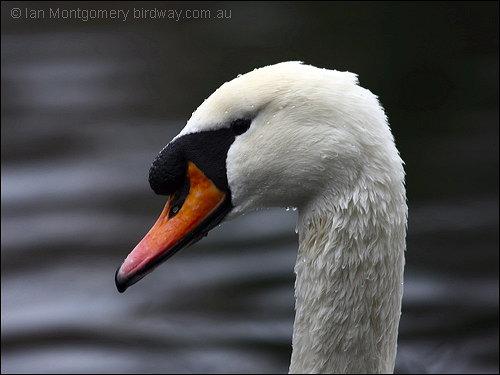
Mute Swan (Cygnus olor) by Ian
The mute swan is one of the heaviest flying birds. In several studies from Great Britain, males (known as cobs) were found to average from about 10.6 to 11.87 kg (23.4 to 26.2 lb), with a weight range of 9.2–14.3 kg (20–32 lb) while the slightly smaller females (known as pens) averaged about 8.5 to 9.67 kg (18.7 to 21.3 lb), with a weight range of 7.6–10.6 kg (17–23 lb). While the top normal weight for a big cob is roughly 15 kg (33 lb), one unusually big Polish cob weighed almost 23 kg (51 lb) and this counts as the largest weight ever verified for a flying bird, although it has been questioned whether this heavyweight could still take flight.
Young birds, called cygnets, are not the bright white of mature adults, and their bill is dull greyish-black, not orange, for the first year. The down may range from pure white to grey to buff, with grey/buff the most common. Cygnets grow quickly, reaching a size close to their adult size in approximately three months after hatching. Cygnets typically retain their grey feathers until they are at least one year old, with the down on their wings having been replaced by Flight feathers earlier that year.

Mute Swan on Nest at Lake Morton by Dan
Mute swans nest on large mounds that they build with waterside vegetation in shallow water on islands in the middle or at the very edge of a lake. They are monogamous and often reuse the same nest each year, restoring or rebuilding it as needed. Male and female swans share the care of the nest, and once the cygnets are fledged it is not uncommon to see whole families looking for food.
Birds whose first name starts with “M”
*
[Definitions from Webster’s Dictionary of American English (1828), unless noted. Bird info from Wikipedia plus.]


 Lee's Birdwatching Adventures Plus