Ian’s Bird of the Week – Freckled Duck

Freckled Duck (Stictonetta naevosa) by Ian

Freckled Duck (Stictonetta naevosa) by Ian

Ian’s Bird of the Week – Freckled Duck ~ by Ian Montgomery

Newsletter ~ 9/30/13

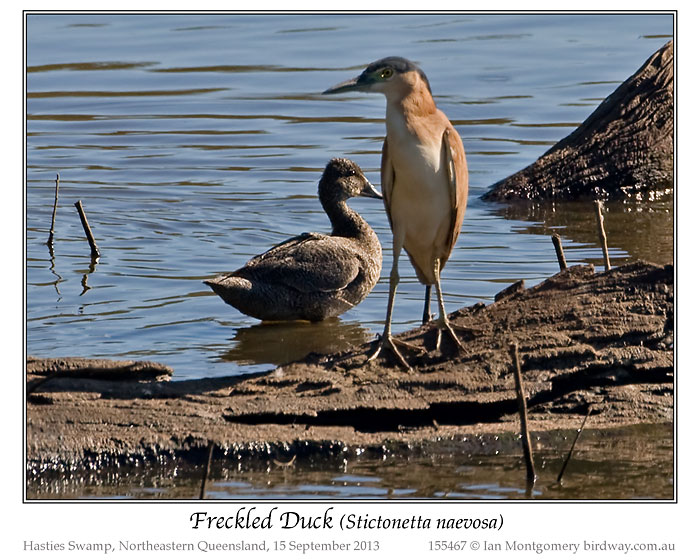
Several friends have inquired how I got on with the quest for Freckled Duck photos a fortnight ago, so here it is as bird of the week as it’s a rare and unusual duck, even if these ones didn’t want to cooperate in the portrait photo category. There were perhaps a dozen or more at the reported site of Hasties Swamp just south of Atherton town, but only two came within cooee of the hide and spent most of the day sitting on this log. Note the diagnostic ski-jump-shaped bill and the slight peak on the head of the bird on the end of the log. The duck beside this one is a Hardhead, so they’re approximately the same size.

It was a lovely day at Hasties (second photo), so it was no hardship loafing there waiting for the ducks to do something. The log the ducks liked is the farther one in this photo, but this was taken with my phone and makes it look farther away than it actually is. It’s a two storey hide, and this was taken from the upper deck, though I spent most of the time downstairs. The log was popular with various species of ducks including Pacific Blacks and Grey Teal, so the Freckled Ducks, all in non-breeding garb were easy to overlook.

Hasties Swamp, Atherton Tableland by Ian

Very occasionally, one of the ducks would swim over to a smaller log (hidden behind the branch in the second photo) and peck at a coot if it came too close. You can see the coot in the third photo.

Freckled Duck (Stictonetta naevosa) by Ian

Freckled Duck (Stictonetta naevosa) by Ian

Sometimes it would swim away to feed, but always on the other side of the log. In the fourth photo it is maybe contemplating such a foray, and is testing the water behind one of several Nankeen Night-Herons that came out to feed in the late afternoon – apparently they roost in the trees near the hide.
Freckled Duck (Stictonetta naevosa) by Ian

Freckled Duck (Stictonetta naevosa) by Ian

The fifth photo shows a distant pair of Freckled Ducks thirteen years ago in breeding condition at Werribee in Victoria and you can see the characteristic red colour of the male. The peaks look more conspicuous on both sexes, but I don’t know whether these feathers grow longer then or whether they are erectile.

Freckled Duck (Stictonetta naevosa) by Ian

Freckled Duck (Stictonetta naevosa) by Ian

So why is this rather drab duck so interesting to both birders and avian taxonomists? Firstly, it’s endemic to Australia and rare, particular in North Queensland. It’s main breeding range is in inland areas of New South Wales, Victoria, Southern Western Australia (an isolated population) and the channel country of Southwestern Queensland where breeding takes place in densely vegetated lakes and swamps, including lignum in more arid floodplains. When these areas dry out, the birds move to the coast, which is when they become easier to find. Presumably the birds currently in North Queensland (they’ve been reported in both Townsville and the Atherton Tableland) are from the Cooper’s Creek and Paroo River catchments.

Secondly, taxonomists find the Freckled Duck interesting because it has no close relatives. It is the only member of the genus Stictonetta and both morphological and DNA studies support placing it in own sub-family that diverged from other ducks and geese very early on. The name Stictonetta means ‘spotted duck’ in Greek and, in a case of tautological overkill, naevosa means ‘spot abundance’ in Latin.

I was going to include a Snake of the Week but this is getting rather long, so I’ll hold it over till next time.

Best wishes
Ian

**************************************************
Ian Montgomery, Birdway Pty Ltd,
454 Forestry Road, Bluewater, Qld 4818
Tel 0411 602 737 ian@birdway.com.au
Bird Photos http://www.birdway.com.au/
Recorder Society http://www.nqrs.org.au


Lee’s Addition:

What birdwatchers and photographers won’t go through to find those special and rare birds. Thanks, Ian, for showing us yet another interesting member of the Anatidae – Ducks, Geese & Swans Family. I am so thankful that Ian is letting me share his newsletters here on this blog. We have been introduced to numerous birds we have never have heard of, let along seen.

Check out all of Ian’s Anatidae Family photos.

Here are a few more facts about this duck from Wikipedia. The Freckled Duck (Stictonetta naevosa) is a moderately large, broad-bodied duck native to southern Australia. The duck is protected by law. Dark in colour with fine off-white speckles all over, it is most easily identified by its large head with a peaked (as opposed to rounded) crown.

The Freckled Duck feeds by dabbling in shallow water, often by wading near the edge. It prefers large, well-vegetated swamps, but moves to open water after breeding or in dry periods.

In flight, it has a distinctive rapid wing beat and holds its head low, making it appear hunchbacked. It does not turn rapidly and lands clumsily.

In dry years, the ephemeral wetlands of the Murray-Darling Basin and Lake Eyre disappear and Freckled Ducks migrate to permanent water in coastal regions. This concentration in populated areas, coupled with their habit of circling repeatedly at low altitude when disturbed (even when being shot at) makes them particularly vulnerable to hunting.

See:

Freckled Duck – Wikipedia

Ian’s Anatidae Family photos

Anatidae – Ducks, Geese & Swans Family

*
Cincinnati Zoo III

Major Mitchell's Cockatoo (Lophochroa leadbeateri) at Cincinnati Zoo 9-5-13

Major Mitchell’s Cockatoo (Lophochroa leadbeateri) at Cincinnati Zoo by Lee

I know and am acquainted with all the birds of the mountains, and the wild animals of the field are Mine and are with Me, in My mind. (Psalms 50:11 AMP)

Here are more members of the Psittaciformes Order of Parrots and Cockatoos we saw during our trip to the Cincinnati Zoo in Ohio.

They were in various areas of the Zoo. The Major Mitchell’s Cockatoo was outside enjoying himself or herself, whichever it was. The perch was in a nicely landscaped area near the entrance/exit, depending on which way you went through the zoo. For us, it was the last member of its family we saw.

Major Mitchell's Cockatoo (Lophochroa leadbeateri) at Cincinnati Zoo 9-5-13

Major Mitchell’s Cockatoo (Lophochroa leadbeateri) by Lee

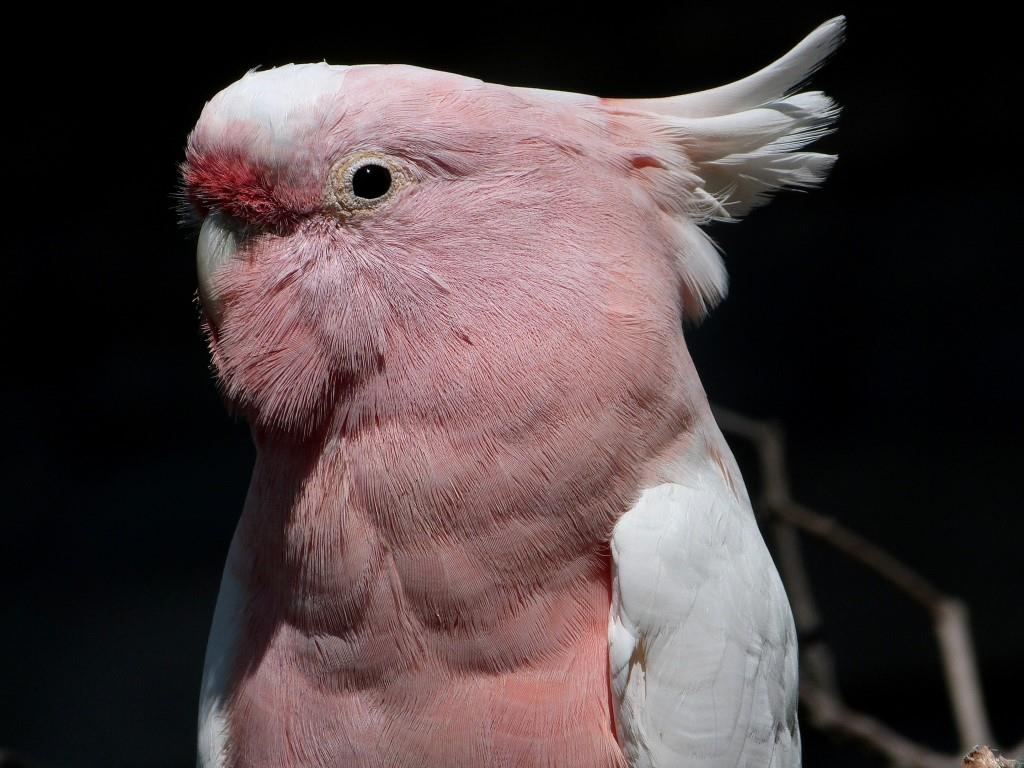
These beautiful birds are from Australia and are on the decline. They look very similar to the Galah we photographed at the Brevard Zoo, but have a lighter pink color. Both are members of the Cacatuidae – Cockatoos Family and are closely related, even nesting in the same area. There has been on occasion where the two species have interbred and produced hybridised offspring.

Major Mitchell's Cockatoo (Lophochroa leadbeateri) at Cincinnati Zoo 9-5-13 by Dan

Major Mitchell’s Cockatoo (Lophochroa leadbeateri) by Dan

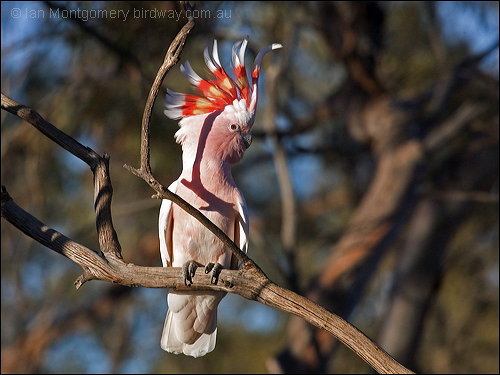
Their biggest difference is the crest that the Major Mitchell likes to pop up. Our bird didn’t show off, but Ian’s photo shows the crest raised.

Major Mitchell's Cockatoo (Lophochroa leadbeateri) By Ian

Major Mitchell’s Cockatoo (Lophochroa leadbeateri) By Ian

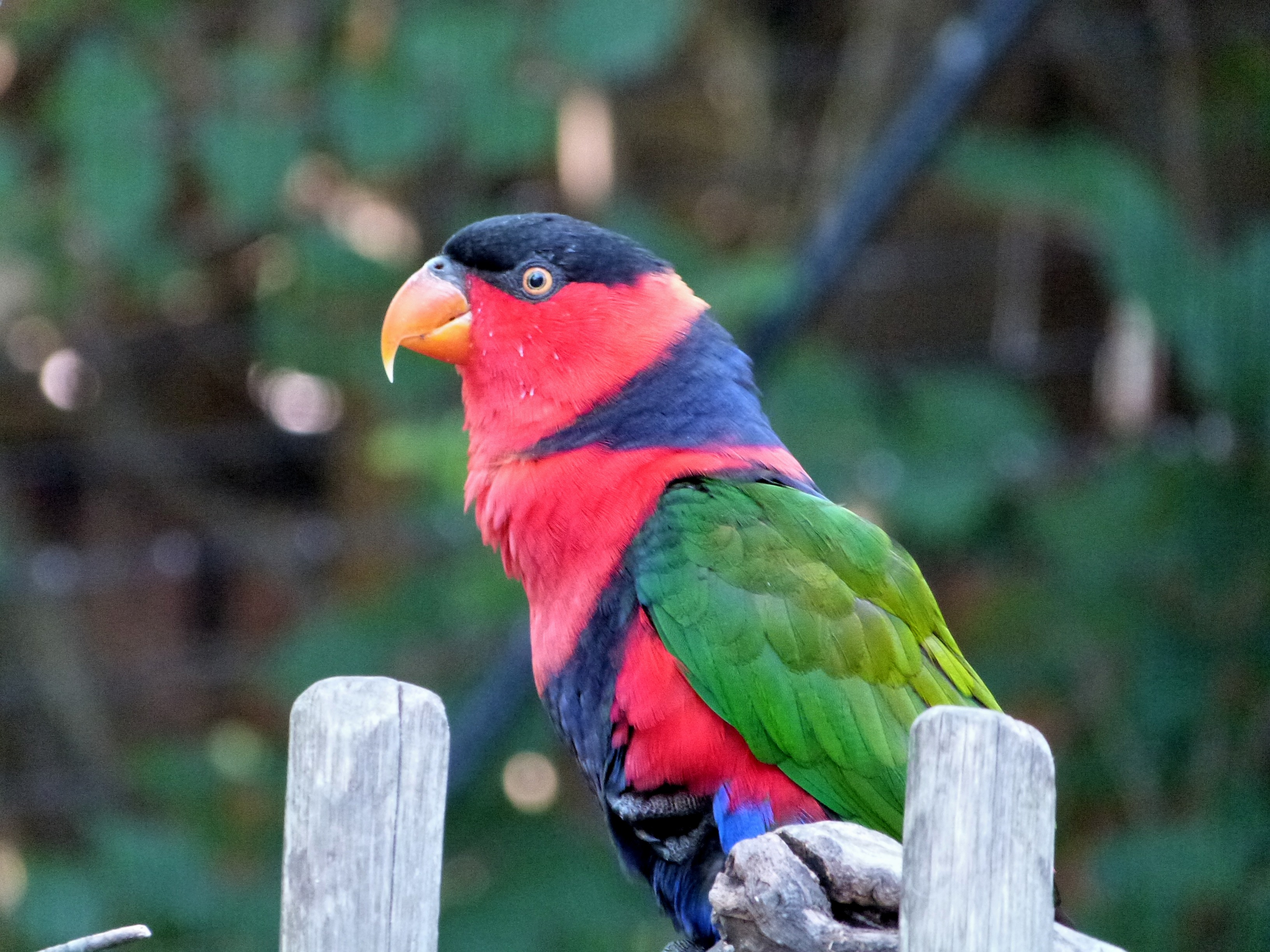
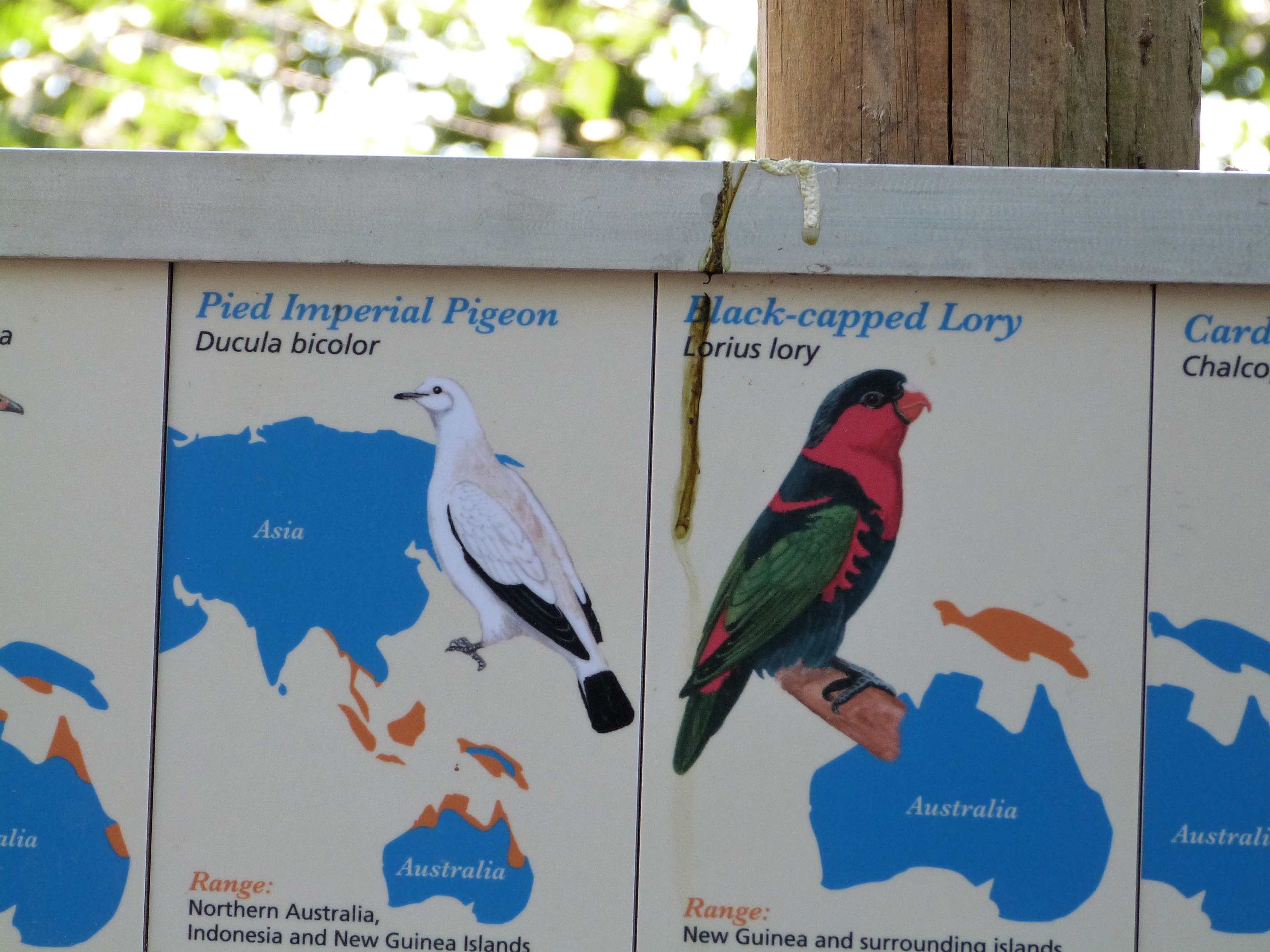
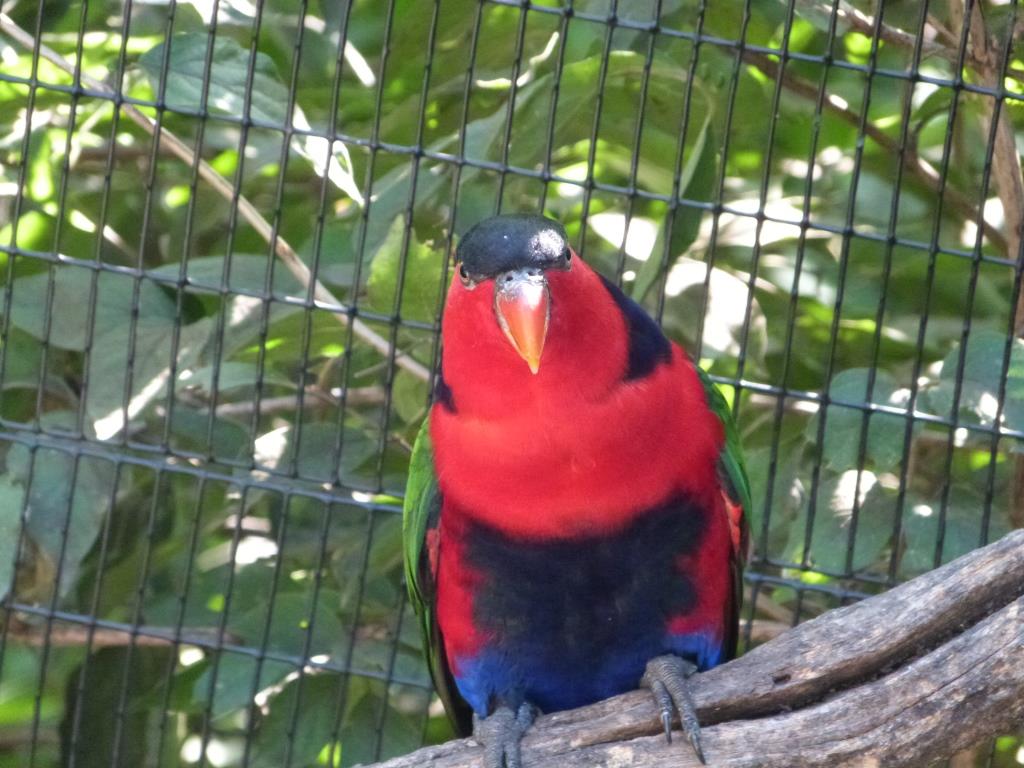
In the Lorikeet Landing area, we encountered the Black-capped Lory (Lorius lory) who also lives near Australia in New Guinea. “It is a colorful and relatively robust lory (31 cm). There are seven subspecies, all with green wings, red heads and body around the wing, a black cap, grey-black cere, yellow underwings, and blue legs and belly. Most also have a blue nape and mantle (area between wings on the back). It remains overall widespread and common

*

Black-capped Lory (Lorius lory) Cincinnati Zoo 9-5-13 by Lee

Black-capped Lory (Lorius lory) by Lee

The Black-capped Lory inhabits the primary forest and forest edges in most lowland areas up to 1000m (sporadically to 1750m), but not monsoon forest or coconut plantations. It is usually found in pairs and occasionally in groups of 10 or more. Their diet includes pollen, nectar, flowers, fruit and insects.

Black-capped Lory Sign

Black-capped Lory Sign

*

Black-capped Lory (Lorius lory) Cincinnati Zoo 9-5-13 by Lee

Black-capped Lory (Lorius lory) by Lee

(Information for Wikipedia and other Internet sources)

See:

** PS – This is a little short, but I had surgery on my neck yesterday. (Removed a cancer cell.)

Ian’s Bird of the Week – Sarus Crane

Sarus Crane (Grus antigone) by Ian Montgomery

Sarus Crane (Grus antigone) by Ian Montgomery

Ian’s Bird of the Week – Sarus Crane ~ by Ian Montgomery

Newsletter – 9/19/13

I went up to the Atherton Tableland at the weekend to photograph Freckled Ducks at Hasties Swamp where these rare birds had recently been reported. The ducks were still there perching on a log at an inconvenient distance from the hide and, although I spent several hours on three occasions in the hide, they never came any closer and I gave them a wooden spoon award for being undynamic and uncooperative. However, Sarus Cranes, which winter in fields on the Tableland were more cooperative.

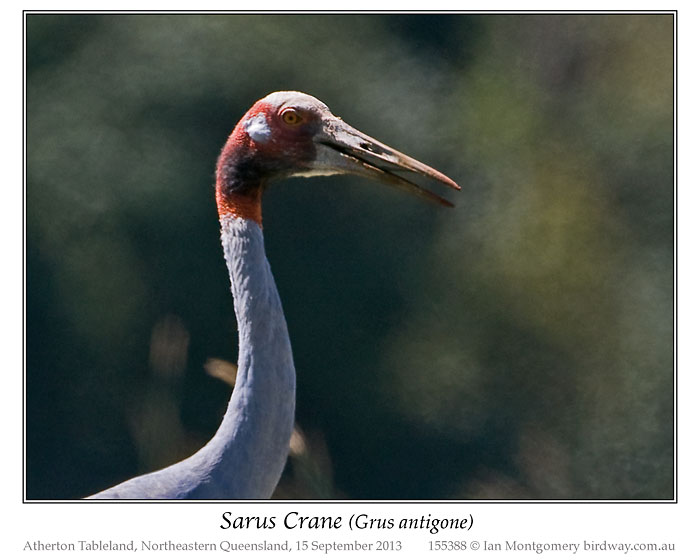
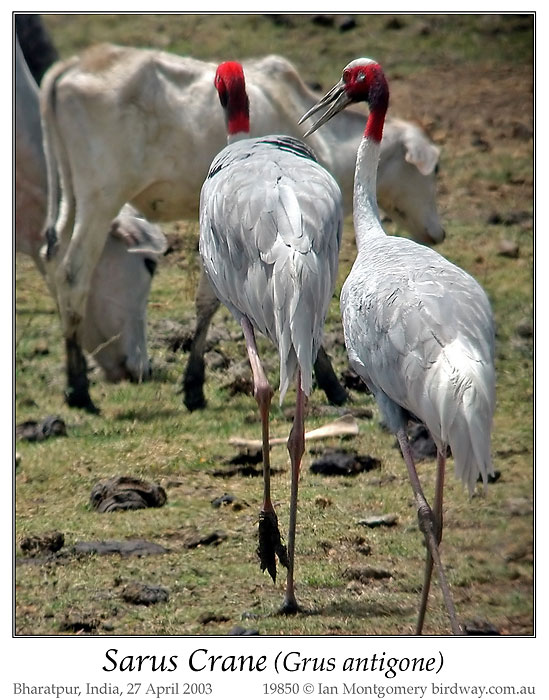
Before I tell you the odd story of their history in Australia, here is a spot-the-difference exercise comparing the Sarus Crane, first photo, with the much commoner and more widespread Brolga, second photo.

Brolga Crane (Grus rubicunda) by Ian Montgomery

Brolga Crane (Grus rubicunda) by Ian Montgomery

You have to spot only two differences: the red on the neck of the Sarus Crane extends much farther down than on the Brolga, and the Brolga has a dewlap, the flap of tissue hanging down from the chin. There is another difference: Sarus Cranes have pink legs, and Brolgas have grey ones, though this is often difficult to spot as the legs can be pinkish-grey in the Sarus Crane. Anyway, more about distinguish them later.

Sarus Crane (Grus antigone) by Ian Montgomery

Sarus Crane (Grus antigone) by Ian Montgomery

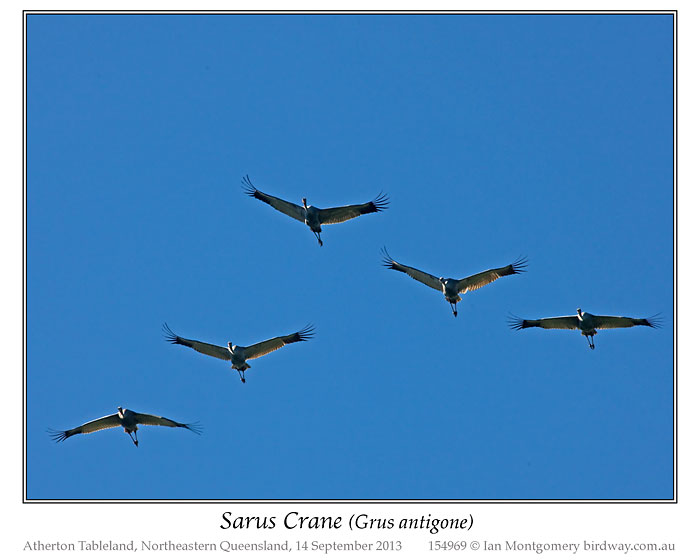
We first discovered a small party of Sarus Cranes feeding near the Malanda-Atherton Highway (opposite the upmarket Gallo chocolate and cheese place). While I was taking photos of them, a flock of about 60 joined them in the field except for 5 which obligingly flew over us, photos 3 and 4. In flight they look positively Jurassic Park-ish and make wonderful, insistent, gurgling, trumpeting noises.

Sarus Crane (Grus antigone) by Ian Montgomery

Sarus Crane (Grus antigone) by Ian Montgomery

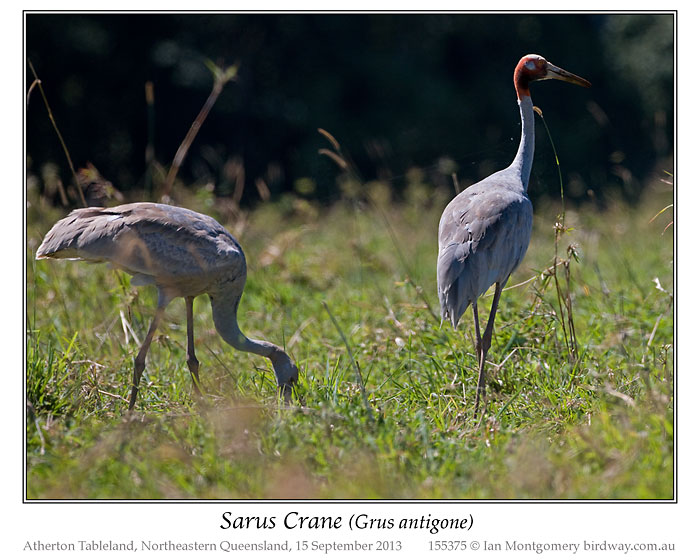
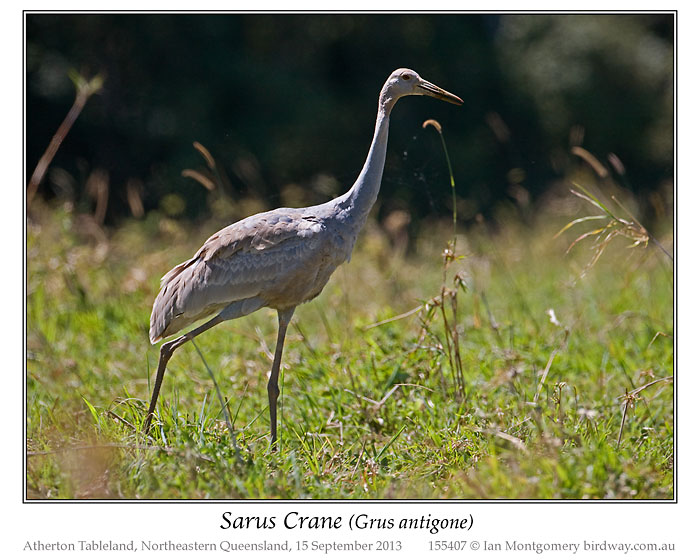
The next day, when I got bored waiting for the ducks to do something I went to Gallo for cheese and lunch and found a family, I presume, of Sarus Cranes – 2 adults and a juvenile – close to the road that goes from the Malanda-Atherton road to Yungaburra via the Curtain Fig National Park, photos 5 and 6 (the other adult is in the first photo).

Sarus Crane (Grus antigone) by Ian Montgomery

Sarus Crane (Grus antigone) by Ian Montgomery

In juvenile Sarus Cranes the red colour is replaced by buffish-cinnamon, usually darker than the one these photos.

Sarus Crane (Grus antigone) Juvenile by Ian Montgomery

Sarus Crane (Grus antigone) Juvenile by Ian Montgomery

The reason for the spot-the-difference exercise was to show that the two species are not hard to separate in the field. So, why were Sarus Cranes not positively identified in Australia until 1966 (in Normanton on the Gulf of Carpentaria)? The fashionable explanation at the time – which got unobservant birders off the hook – was they had recently colonised Australia from, presumably, Indochina, the nearest other place that they occur naturally. The Australian birds were conveniently similar to the Eastern Sarus Crane (race sharpii) that occurs there, even though it doesn’t migrate. Maybe they couldn’t cope with the sounds of war in Vietnam. It is now though that the Australian Sarus Cranes form another smaller race, gilliae, and have been here all along nesting in remote swamps on the Gulf of Carpentaria and Cape York Peninsula with at least some moving to the Atherton Tableland in winter.

Sarus Crane (Grus antigone) by Ian Montgomery

Sarus Crane (Grus antigone) by Ian Montgomery

The last photo shows the nominate race, antigone, in India. It has white tertiary feathers (the bustle) and with a length of 176cm/70in (weight to 12kg/26lbs) is the world’s tallest flying bird. The population in India is perhaps 10,000, Indochina 1,000 and Australia 5,000. It is extinct in various countries including the Philippines (probably yet another race) and Pakistan and is under threat in Indochina. The Australia population is thought to be stable and may have benefitted from clearing of land for agriculture on the Atherton Tableland.

Best wishes
Ian

**************************************************
Ian Montgomery, Birdway Pty Ltd,
454 Forestry Road, Bluewater, Qld 4818
Tel 0411 602 737 ian@birdway.com.au
Bird Photos http://www.birdway.com.au/
Recorder Society http://www.nqrs.org.au


Lee’s Addition:

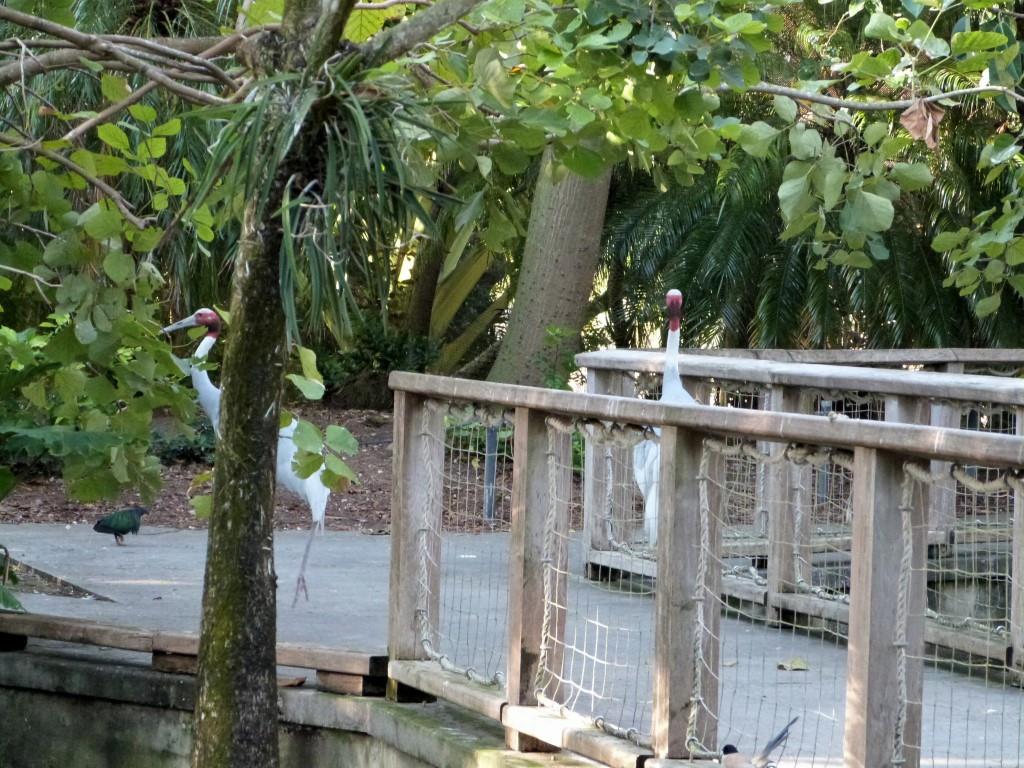
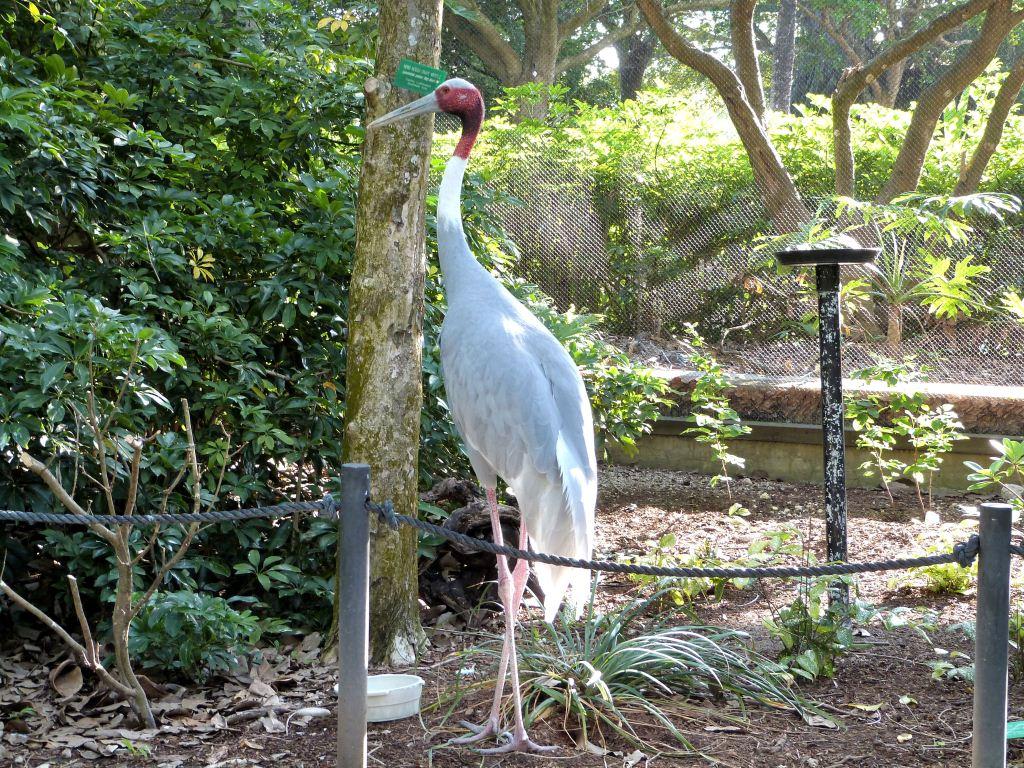
Thanks again, Ian, for sharing another great bird. I encountered my first Sarus Cranes at the Zoo Miami’s Wings of Asia Aviary. They were walking along the sidewalk, and like Ian said, they are tall. I am only 4’10” and they are over 5 feet. Needless to say, I gave them room when they walked by and also had to look up to them.

Sarus Crane (Grus antigone) by Lee at Wings of Asia

Sarus Crane (Grus antigone) by Lee at Wings of Asia

Like a crane or a swallow, so did I chatter: I did mourn as a dove: mine eyes fail with looking upward: O LORD, I am oppressed; undertake for me. (Isaiah 38:14 KJV)

Sarus and Brolga Cranes belong to the in the Gruidae – Crane Family and are also Birds of the Bible.

Sarus Crane (Grus antigone) by Lee at Wings of Asia

Sarus Crane (Grus antigone) by Lee at Wings of Asia

Yea, the stork in the heaven knoweth her appointed times; and the turtle and the crane and the swallow observe the time of their coming; but my people know not the judgment of the LORD. (Jeremiah 8:7 KJV)

See:

Ian’s Bird of the Week

Ian’s Crane Photos

Sarus Crane – Wikipedia

Gruidae – Crane Family

Birds of the Bible – Cranes

Birds of the Bible

*

Ian’s Bird of the Week – Swamp Harrier

Swamp Harrier (Circus approximans) by Ian

Ian’s Bird of the Week – Swamp Harrier by Ian Montgomery

Newsletter – 9-2-13

Recently I was having trouble finding a reasonable photo of a Swamp Harrier for Where to Find Birds in Northeastern Queensland, when I remembered an encounter that I had with this one on a beach on Bruny Island in Southeastern Tasmania in late 2011. At the time, I was on the return leg of the trip to the Sub-Antarctic Islands via New Zealand and the Harrier photos got neglected in the excitement of posting penguin, petrel, prion and parakeet photos (not to mention albatrosses but they spoil the alliteration).

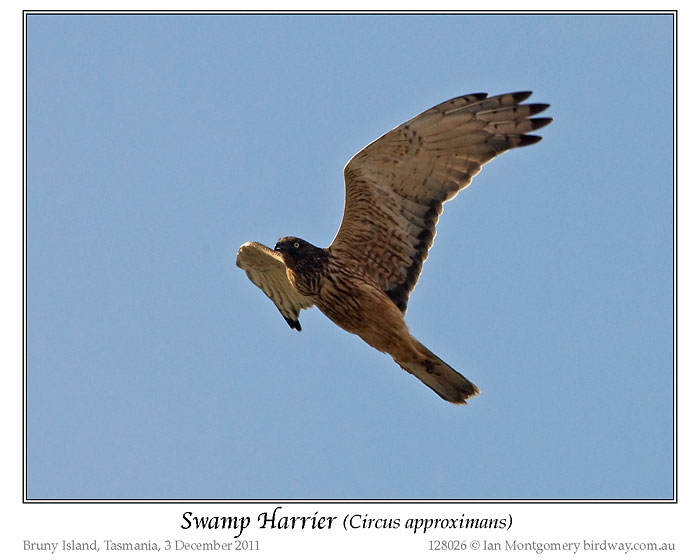
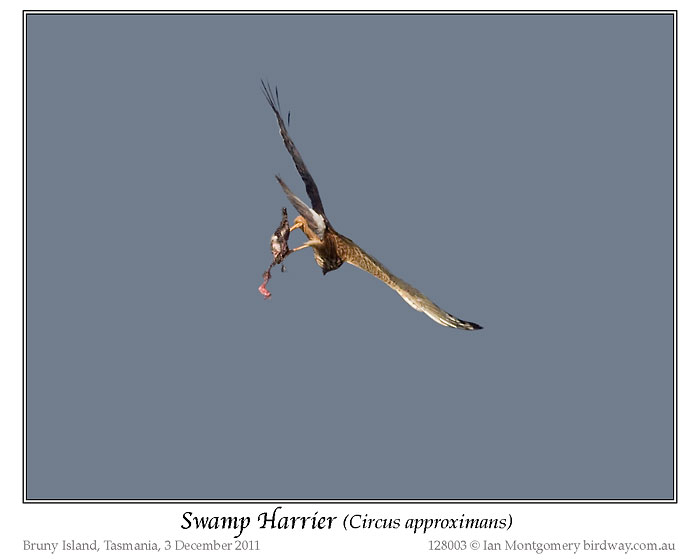
The encounter was the enactment of a minor natural tragedy that was sad to observe, and that may be a subconscious reason for the neglect. I’d actually photographed the bird first photo two minutes earlier struggling to fly into the teeth of a southerly gale and carrying an item of prey, that I couldn’t identify. The Harrier dropped it, back off to leeward and made another unsuccessful attempt to fly up-wind by flying low over the sea on the other side of me.

Swamp Harrier (Circus approximans) by Ian

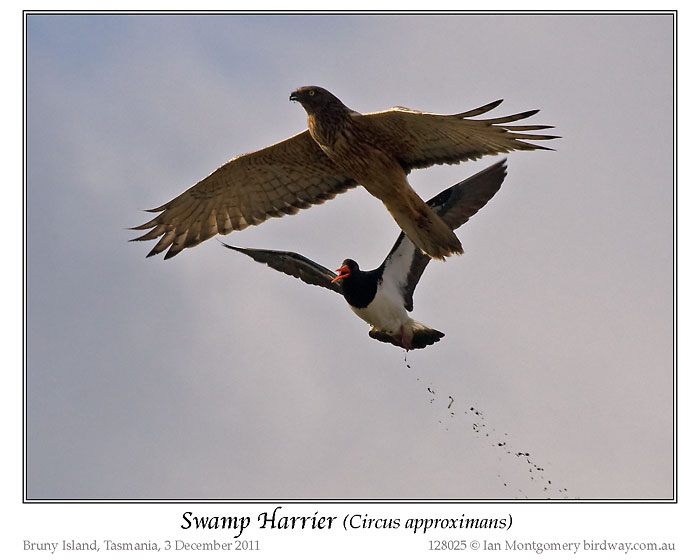
This attempt failed too, and the bird came back for another try flying more or less overhead. At that point, it was attacked by a very distraught-looking Pied Oystercatcher looking for all the world as if it was on a retaliatory bombing raid. The Oystercatcher made a couple of passes at the Harrier, which eventually gave up the struggle and flew inland across the prevailing wind. I could only assume that the item of prey was the Oystercatcher’s chick and the field guide confirmed that these look like plover chicks, camouflaged speckled brown with white bellies. Predation is a natural part of life, but it was sad that the chick died for no purpose.

Swamp Harrier (Circus approximans) by Ian

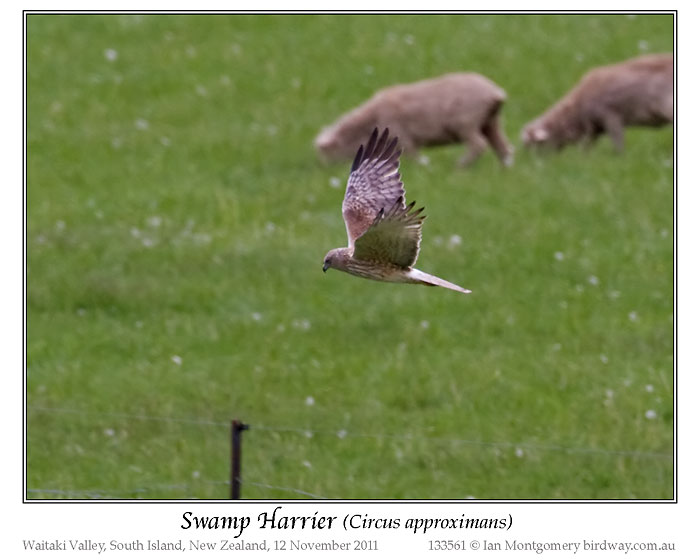
I’ve found Harriers difficult to photograph as they’re shy and normally keep their distance in flight. They are also terrestrial in their lifestyle, inhabiting tree-less plains and wetlands, hunting close to the ground and nesting and perching on the ground, usually invisible or nearly so in grass or reeds. They hunt by flying low over the land or water – quartering – and dropping suddenly to seize surprised prey (sorry, I’ve done it again) such as birds, small mammals and frogs in their long-legged talons. When quartering, they alternate between flapping their wings and gliding with the wings held in a characteristic V, like the bird in the fourth photo in an otherwise tranquil pastoral scene in New Zealand.

Swamp Harrier (Circus approximans) by Ian

Adult Swamp Harriers are brownish and streaked, with white rumps. Older males have greyish wings and grey tails, unmarked except for a sub-terminal band. Females are more rufous and have barred tails and both the Bruny Island and New Zealand birds are, I think, males. Juvenile Swamp Harriers look quite different and are rufous brown overall with pale rufous rather than white rumps, like the one in the fifth photo.

Swamp Harrier (Circus approximans) by Ian

In Australia, Swamp Harriers nest mainly in the south, including Tasmania and migrate north in winter – in North Queensland, we see them only in the winter months. In New Zealand they make local movements across Cook Strait and they turn up on various islands including Lord Howe and Norfolk. Raptors are poorly represented in New Zealand and the Swamp Harrier is the large bird of the prey, being the only breeding member of the Accipiter family (hawks, eagles, etc.), with the rarer New Zealand Falcon being the only breeding falcon. Swamp Harriers also breed in Melanesia and Polynesia as far east as Tonga. It has close relatives in Eurasia comprising the Eastern, Western, African and Madagascar Marsh Harriers.

Best wishes
Ian

**************************************************
Ian Montgomery, Birdway Pty Ltd,
454 Forestry Road, Bluewater, Qld 4818
Tel 0411 602 737 ian@birdway.com.au
Bird Photos http://www.birdway.com.au/
Recorder Society http://www.nqrs.org.au


Lee’s Addition:

And when the birds of prey swooped down upon the carcasses, Abram drove them away. (Genesis 15:11 AMP)

In this case, the Oystercatcher “drove them away.” You have to admit, that Oystercatcher looks right angry.

The Swamp Harrier is a member of the Accipitridae – Kites, Hawks & Eagles Family. There are 256 species, of which, 17 are Harriers or Harrier-hawks.

Ian already gave quite a bit of information about this beautiful bird. The diet of the Swamp Harrier is mainly ground birds and waterbirds, rabbits and other small mammals, reptiles, frogs and fish. During the Winter months harriers feed to a large extent on carrion, including roadkill.

This species nests on the ground, often in swamps, on a mound in reeds or other dense vegetation. The clutch size may range from 2 to 7, but is usually 3 or 4. The incubation period is about 33 days, with chicks fledging about 45 days after hatching. (Wikipedia)

See also:

Swamp Harrier – Wingspan

Swamp Harrier – Wikipedia

Ian’s Accipitridae Family Photos

Accipitridae – Kites, Hawks & Eagles Family

Ian’s Bird of the Week – Spotted Harrier

*

Ian’s Bird of the Week – Spiny-cheeked Honeyeater

Spiny-cheeked Honeyeater (Acanthagenys rufogularis) by Ian

Spiny-cheeked Honeyeater (Acanthagenys rufogularis) by Ian

Ian’s Bird of the Week – Spiny-cheeked Honeyeater ~ Ian Montgomery

Newsletter – 8/20/13

I’m currently preparing photos for a digital version of the book Where to Find Birds in North-East Queensland by Jo Wieneke (http://www.nqbirds.com). I’m finding that many of these have not yet featured as bird of the week, so here’s one that I came across a photo this morning that appealed to me, one of an unusual-looking honeyeater, the Spiny-cheeked, taken not long after sunrise at Gluepot, the BirdLife Australia mallee reserve in South Australia. At the time, I was spending some time each morning at a hide overlooking a drinking trough waiting for Scarlet-chested Parrots http://www.birdway.com.au/psittacidae/scarlet_chested_parrot/index.htm.

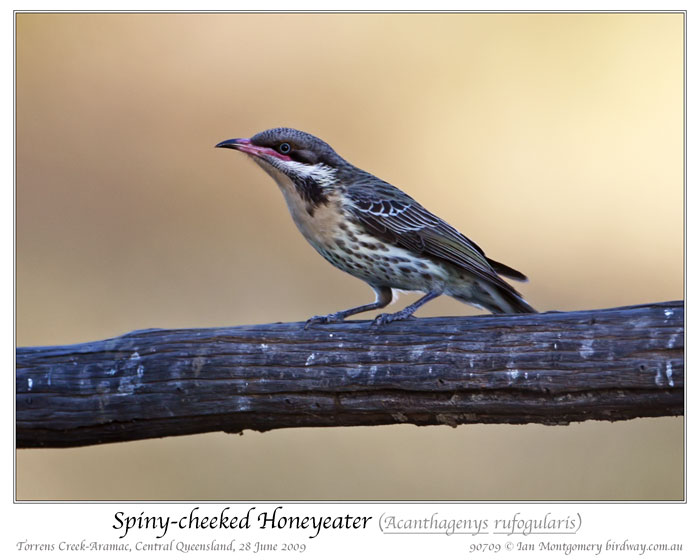
The Spiny-cheeked is a bird of dry country, so the easiest way to photograph it is as watering places, and the second photo was taken in Central Queensland south of Torrens Creek near a dam, this time close to sunset. It is a widespread and common in the more arid parts of mainland Australia except tropical Australia north of about 19ºS and Tasmania. It also occurs in scrubby coastal areas, such as southern Victoria. Like many dry-country birds it is nomadic and appears only rarely in Northeastern Queensland, though I did see one in the garden in the first house I lived in Townsville in 2002.

Spiny-cheeked Honeyeater (Acanthagenys rufogularis) by Ian

Spiny-cheeked Honeyeater (Acanthagenys rufogularis) by Ian

With a length of 23-26cm/9-10in, it’s quite large by honeyeater standards and the bare pink area on the face gives it some similarity to the Wattlebirds, also honeyeaters. Although it is the only member of the genus Acanthagenys, DNA studies have shown that it is related to both the Wattlebirds (Acanthocaera) and the Regent Honeyeater, another one with bare red skin, in this case around the eye. The Spiny-cheeked is quite vocal with a creaky, piping, rather Wattlebird-like song, often the first sign of its presence.

Feedback on the change in font was rather muted, with one in favour of the new one, one against it and one not liking the underlining of the scientific name. I can agree with all points of view and am undecided, though I’m using the new font for photos in the digital version of Jo Wieneke’s book. I’ve rather got used to it, though I’ve started putting the scientific name in grey to make the underlining less obvious as I’m constrained both by the convention of using either italics or underlining for scientific name and the lack of an italic option in an already italic-looking font. My thanks to those who took the trouble to respond.

Jo’s book has been out of print for a little while now, so the digital version is to fill the gap left by its disappearance from book shops. I’ll let you know when it is available: the aim is to publish it for Apple iBooks, Google PlayBooks and Amazon Kindle.

Best wishes
Ian

**************************************************
Ian Montgomery, Birdway Pty Ltd,
454 Forestry Road, Bluewater, Qld 4818
Tel 0411 602 737 ian@birdway.com.au
Bird Photos http://www.birdway.com.au/
Recorder Society http://www.nqrs.org.au


Lee’s Addition:

My son, eat honey because it is good, And the honeycomb which is sweet to your taste; (Pro 24:13 NKJV)

This Honeyeater belong to the Meliphagidae – Honeyeaters Family, which has 184 species. Check out Ian’s photos of this Family.

In addition to what Ian mentioned about the Spiny-cheeked Honeyeater, Wikipedia had this to say:

The honeyeater is mainly frugivorous, but will also eat nectar, blossoms, insects, reptiles, and young birds. Its habitat includes deserts, coastal scrubland, and dry woodlands. It is also found in mangroves and orchards. Its range includes most of Australia except for Tasmania, tropical Northern areas, the Southeastern coast.

The Spiny-cheeked Honeyeater is a grey-brown bird with a burnt orange throat and chest. It has grey wings edged with white, and a long tail with white tips. It has a pink, black-tipped bill.

*

Spiny-cheeked Honeyeater (Acanthagenys rufogularis) ©WikiC

Spiny-cheeked Honeyeater (Acanthagenys rufogularis) ©WikiC

*

Here is the song of a Spiny-cheeked from xeno-canto.

See:

*

Ian’s Bird of the Week – Flesh-footed Shearwater

Flesh-footed Shearwater (Puffinus carneipes) by Ian

Flesh-footed Shearwater (Puffinus carneipes) by Ian 1

Ian’s Bird of the Week – Flesh-footed Shearwater ~ by Ian Montgomery

Newsletter – 7/16/13

One night when we were in our room on Lord Howe Island, we heard a scratching noise at the front door. On investigation this proved to be a juvenile Flesh-footed Shearwater from a nearby nesting colony attracted by the light. This one, first photo, is almost complete fledged with traces of fluffy down still apparent.

In the region of 20,000 to 40,000 pairs of Flesh-footed Shearwaters nest on Lord Howe. They dig nesting burrows in the sandy soil of the forest, mainly in the lowland area where the settlement is situated. Adults come ashore under cover of darkness to nest, change incubation shifts and feed their partners and young. They make their presence known by making loud crooning noises that sometimes sound like cats fighting but during daylight, they are silent and there is usually little sign of them on the island.

Flesh-footed Shearwater (Puffinus carneipes) by Ian

Flesh-footed Shearwater (Puffinus carneipes) by Ian 2

We were there at the end of the breeding season. When the juveniles are fledged, their cosseted existence comes to an abrupt end as the adults stop coming ashore and the young are abandoned to fend for themselves. Eventually, they wander out of their burrows and (mostly) make their way to the sea to start an independent pelagic life. Lord Howe is the only colony of this species on the east coast of Australia, but there are other colonies on islands off South Australia (one), Southwest Western Australia (several), New Zealand and St Paul Island in the South Atlantic.

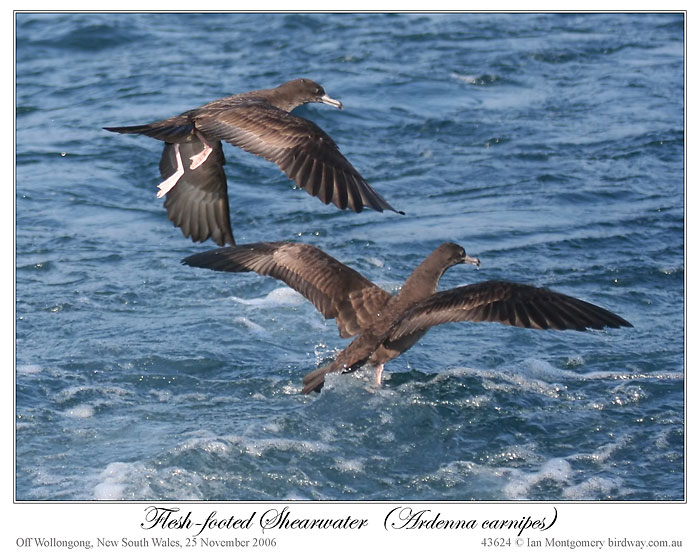
The following day, we found another fledged juvenile when we went to Ned’s beach for a snorkel, photos 2 and 3. This one seemed to have failed to make it down the beach and was presumably waiting for darkness. The Flesh-footed is one of several rather similar, mainly dark shearwaters breeding in Australian waters and the third photo shows its two-toned bill – horn-coloured with a dark tip which is its most obvious field mark.

Flesh-footed Shearwater (Puffinus carneipes) by Ian

Flesh-footed Shearwater (Puffinus carneipes) by Ian 3

Outside the breeding season, Wedge-tailed Shearwaters are pelagic and range widely in both the Pacific and Indian Ocean. Birds from Lord Howe and New Zealand migrate north to the waters off South Korea and also appear off the coast of North America. The two in the fourth photo were off Wollongong, south of Sydney, in the deep water beyond the continental shelf. In this photo you can see the two-tone bills and the pink legs and feet.

Flesh-footed Shearwater (Puffinus carneipes) by Ian

Flesh-footed Shearwater (Puffinus carneipes) by Ian 4

Here, photo 5, for comparison is a Wedge-tailed Shearwater. Note the grey bill and longer, more pointed tail. The third common species in Australia is the Short-tailed, but, true to its name, the feet extend beyond the tip of the tail in flight.

Wedge-tailed Shearwater (Puffinus pacificus) by Ian

Wedge-tailed Shearwater (Puffinus pacificus) by Ian

All these species are collectively called “muttonbirds” and were harvested in large numbers by early settlers for their eggs and oily, rather salty flesh. Clumsy on land and foolishly trusting, they were never rated as very bright. They are, however, masters of the air and sea and their annual movements around the oceans of the world ending up on tiny specks of land like Lord Howe are impressive feats of both navigation and endurance.

Best wishes
Ian

**************************************************
Ian Montgomery, Birdway Pty Ltd,
454 Forestry Road, Bluewater, Qld 4818
Tel 0411 602 737 ian@birdway.com.au
Bird Photos http://www.birdway.com.au/
Recorder Society http://www.nqrs.org.au


Lee’s Addition:

the birds of the heavens, and the fish of the sea, whatever passes along the paths of the seas. O LORD, our Lord, how majestic is your name in all the earth! (Psalms 8:8-9 ESV)

I am always amazed when I see this kind of snout on birds. What an amazing design. See: Formed By Him – Sea Birds That Drink Seawater

The family Procellariidae is a group of seabirds that comprises the fulmarine petrels, the gadfly petrels, the prions, and the shearwaters. This family is part of the bird order Procellariiformes (or tubenoses), which also includes the albatrosses, the storm-petrels, and the diving petrels.

The Flesh-footed Shearwater, Puffinus carneipes, is a small shearwater. Its plumage is black. It has pale pinkish feet, and a pale bill with a black tip. Together with the equally light-billed Pink-footed Shearwater, it forms the Hemipuffinus group, a superspecies which may or may not have an Atlantic relative in the Great Shearwater. These are large shearwaters which are among those that could be separated in the genus Ardenna.

It breeds in colonies, and has two main breeding areas: one in the South West Pacific Ocean includes Lord Howe Island (20,000 to 40,000 pairs) and northern New Zealand (50,000 to 100,000 pairs); the other is along the coast of Western Australia from Cape Leeuwin to the Recherche Archipelago. Another 600 pairs breed on St Paul Island in the Indian Ocean, as well in the Astola Island of Pakistan in the Arabian Sea. It occurs as a summer visitor in the North Pacific Ocean as far north as British Columbia. Flesh-footed shearwaters have been sighted in the Central-North Pacific, above the main Hawaiian Islands as well. (Wikipedia, with editing)

*

*

Ian’s Bird of the Week – Flock Bronzewing

Flock Bronzewing (Phaps histrionica) by Ian 1

Flock Bronzewing (Phaps histrionica) by Ian 1

Ian’s Bird of the Week – Flock Bronzewing ~ by Ian Montgomery

Newsletter – 6/30/13

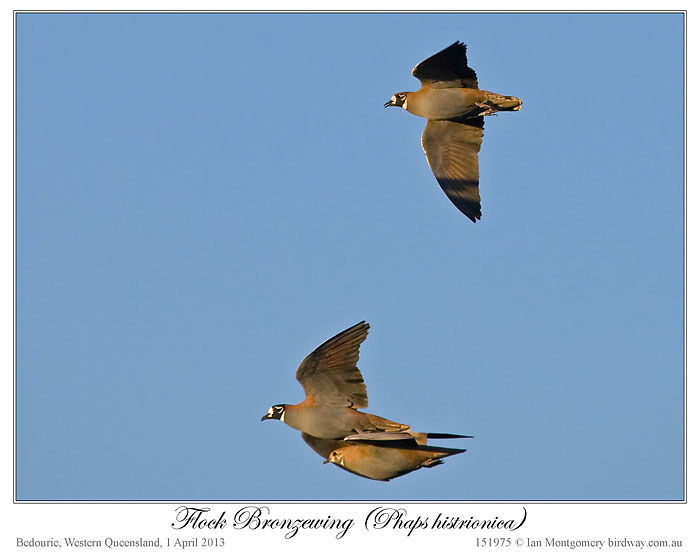
This photo of a Flock Bronzewing featured as bird of the week in June 2006. This male was one of several flocks that we saw flying across the Flinders Highway near Julia Creek late one afternoon as we were heading west towards Mount Isa and the birds, presumably, were doing their evening ritual of visiting waterholes. He obligingly decided that a pool near the road was good enough for him and landed quite close to us. This was my first, and until recently only, encounter with this enigmatic, rarely seen, nomadic pigeon of central Australia.

In 2008, this photo was published in the book 100 Birds to See Before You Die by Chandler and Couzens,, where the Flock Bronzewing featured as No 50 in the global list (No. 1 was the Ivory-billed Woodpecker). The book was one of many of this kind written after the success of the 2007 movie The Bucket List (http://www.youtube.com/watch?v=vc3mkG21ob4), the title referring to the list of things one wants to do before one ‘kicks the bucket’.

Flock Bronzewing (Phaps histrionica) by Ian 2

Flock Bronzewing (Phaps histrionica) by Ian 2

On the recent trip along the Birdsville Track, I was approaching Bedourie, the last town before Birdsville driving south from Mount Isa via Boulia, when I saw a small flock of brown birds flying swiftly near the airstrip. Their size, colour and habitat made me think, incorrectly, Australian Pratincole. A little while later, I stopped to watch two much larger flocks merge into one of about 300 individuals and start flying around the two dams near Bedourie ‘Outback’ Golf Course when I realised that the were Flock Bronzewings.

I gather that an outback golf course has natural sand bunkers – Bedourie is on the edge of the Simpson Desert – and, instead of greens, oil scrapes which make ‘a great putting surface’.The dams incidentally are called Lakes Larry and Simpson ‘after their creator’, so presumably are, unlike the bunkers, not natural.

Flock Bronzewing (Phaps histrionica) by Ian 3

Flock Bronzewing (Phaps histrionica) by Ian 3

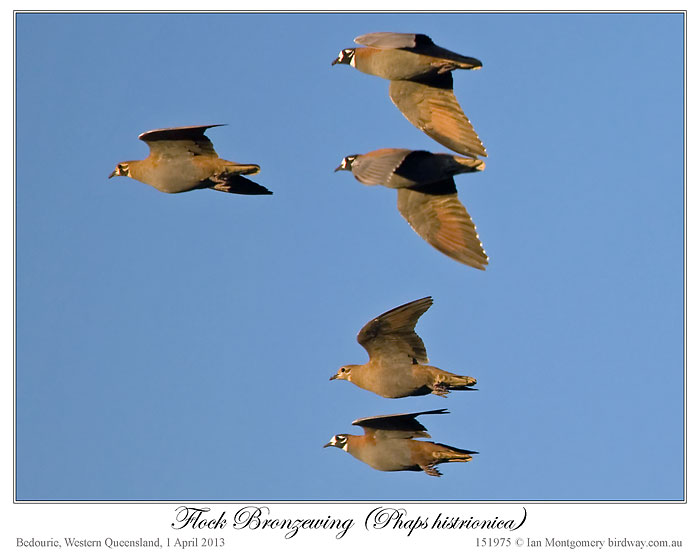
The flock, containing flew close enough to me get a reasonable shot in the evening sunlight: photos 3 and 4 are details from the same photo. Photo number 3 has two adult males with their characteristic black and white faces, while the third bird is a female or juvenile. The field guides indicate that the facial pattern of the has varying amount of black, and the juveniles are yet paler and photo number 4 shows 3 males and two other birds, one of which has only very faint markings. The scientific name histrionica refers to the harlequin pattern on the head, though histrionicus is the Latin for ‘theatrical’. (The Harlequin Duck of North America is Histrionicus histrionicus.)

Flock Bronzewing (Phaps histrionica) by Ian 4

Flock Bronzewing (Phaps histrionica) by Ian 4

Flock Bronzewings feed in the vast and sparse grasslands of the arid interior and have a history of being seen in huge numbers with 100,000 being recorded in 1931 at one waterhole and 50,000 in one flock in 1972. More recently, such large flock have not been recorded and this gave rise to concerns that the species was in steep decline. If that was the case, this decline seems to have ended, though it has been suggested that the lack of very large flocks is due to the provision of more sources of water on grazing properties. Either way, it is the case that the Flock Bronzewing is an all or nothing bird: you either see many (very rarely), or none (usually).

Does one do things on a bucket list twice or is that considered excessive? I don’t know, but I’m going to use it as an excuse for making it bird of the week a second time.

Best wishes
Ian

**************************************************
Ian Montgomery, Birdway Pty Ltd,
454 Forestry Road, Bluewater, Qld 4818
Tel 0411 602 737 ian@birdway.com.au
Bird Photos http://www.birdway.com.au/
Recorder Society http://www.nqrs.org.au


Lee’s Addition:

Also, to every beast of the earth, to every bird of the air, and to everything that creeps on the earth, in which there is life, I have given every green herb for food”; and it was so. (Genesis 1:30 NKJV)

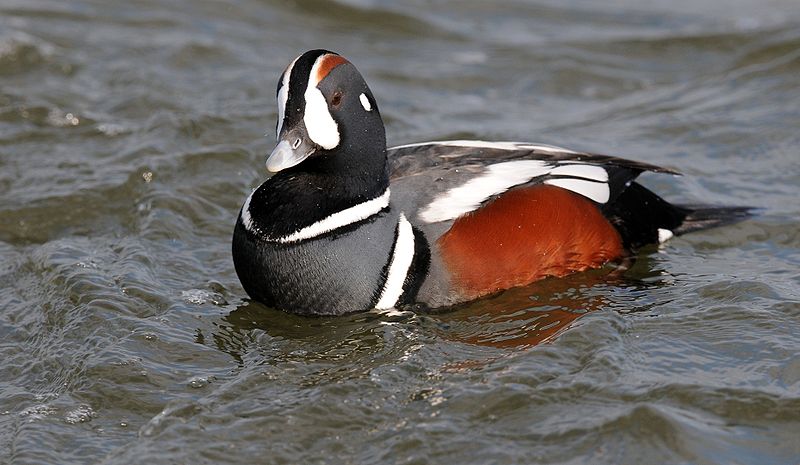
What an interesting Pigeon. Their heads are so fascinating. Plus, they do favor the Harlequin Duck’s coloration and markings. If I had a “bucket list” and there was some bird I really enjoyed seeing, I wouldn’t have any problems revisiting that bird again.

Harlequin Duck (Histrionicus histrionicus) ©WikiC

Harlequin Duck (Histrionicus histrionicus) ©WikiC

The Flock Bronzewing (Phaps histrionica), also known as the Flock Pigeon, Harlequin Bronzewing and the Harlequin Pigeon is a species of pigeon in the Columbidae family. It is endemic to drier parts of Australia. The Flock Bronzewing is the most nomadic of the Australian pigeons, and it is difficult to mistake for other Australian species. Fully-grown Flock Bronzewings can range in length from 280–305 mm with a wingspan of 189 – 216 mm. Its weight can range from 260 – 320 grams.

More than any other Australian species of pigeon, the Flock Bronzewing is adapted to the arid plains of the continent. The preferred habitat is open grassland plains, clumped grasses and small shrubs with open spaces. A major area for this type of habitat where the Flock Bronzewings are present is within the grass plains of the Barkly Tablelands.

The main source of food is the seeds of grasses, herbs and shrubs, whilst occasionally browsing on green shoots. With the introduction of cattle into the interior of Australia, the Flock Bronzewing has adapted to eating the undigested seeds from cattle dung. Some species of seed eaten include the Desert Spurge, Camel Bush, Yellow Daisy and River Grass.

The breeding season is variable and relies heavily on the availability of food. In the south of its range, they tend to breed from spring to early summer and in the north, breeding occurs from early to the middle of the dry season. The nest is a scrape in the ground, which is lined with grass and twigs, usually between the shelter of clumps of grass or shrubs. Two white eggs are incubated for 16 days, with the young capable of leaving the nest after a week. (Wikipedia with editing)

See:

*

Ian’s Bird of the Week – Hoary-headed Grebe

Birdsville Track by Ian

Birdsville Track by Ian

Ian’s Bird of the Week – Hoary-headed Grebe ~ by Ian Montgomery

Newsletter – 6/17/13

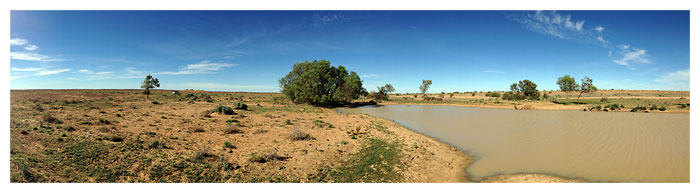
The Birdsville Track isn’t famous for its waterbirds but when we drove along it in April there had been recent rains and we were in for a few surprises. Not, happily, of the getting bogged variety, but birding ones at several spots including this one where we camped more or less in the middle of nowhere beside a small dam. That speck on the left hand side near the lone tree is my car.

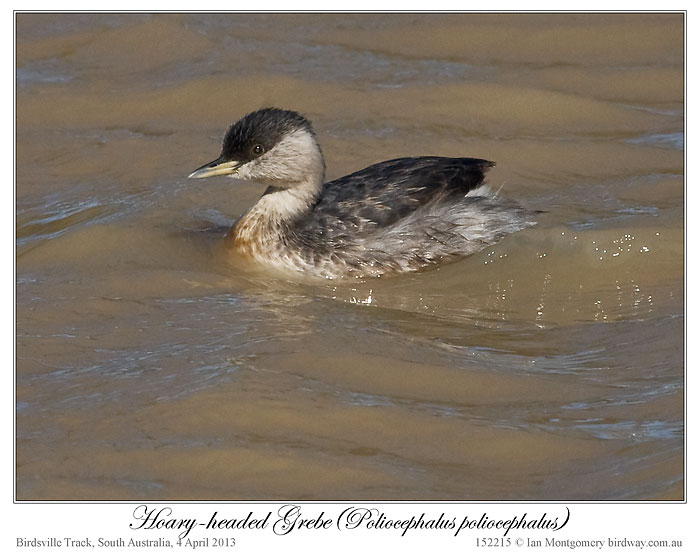
As well as some Pink-eared Ducks, there were several Hoary-headed Grebes. The ones in the first and second Grebe photos are in non-breeding or immature plumage and, although they are larger than Australasian (Little) Grebes (30cm/12in versus 25cm/10in in length) you need to use subtle field marks to distinguish them in these plumages.

Hoary-headed Grebe (Poliocephalus poliocephalus) by Ian 1

Hoary-headed Grebe (Poliocephalus poliocephalus) by Ian 1

The main field marks are: the Hoary-Headed has greyish rather than rufous-tinged flanks and whiter breast (though the bird in the first Grebe photo shows that you need to be careful with stained plumage); the border between the dark cap and pale cheeks goes below rather than through the eye in the Hoary-headed Grebe and the eyes are different in colour and pattern. The Australasian Grebe has conventional-looking eyes with yellow iris while the Hoary-headed Grebe has button-like eyes with a dark iris with a white inner and a white outer ring. This is probably easier to see in the closer bird in the second Grebe photo.

Hoary-headed Grebe (Poliocephalus poliocephalus) by Ian 2

Hoary-headed Grebe (Poliocephalus poliocephalus) by Ian 2

It’s only when you see a bird in breeding plumage with spiky pale head feathers that you understand where it gets its unusual English name (the scientific name Poliocephalus means a much more prosaic ‘grey-headed’). ‘Hoary’ literally just means ‘whitish’ but it’s an adjective that is usually applied to frost and snow so it is used as a metaphor for ‘frosty’ in the English names of 4 or 5 bird species globally. (Another example is the Hoary or Arctic Redpoll http://www.birdway.com.au/fringillidae/hoary_redpoll/index.htm which fits better geographically.) We encountered the bird in breeding plumage about a week later at Bowra Station near Cunnamulla, SW Queensland, where we spent a few nights on the way back to Townsville.

Hoary-headed Grebe (Poliocephalus poliocephalus) by Ian 3

Hoary-headed Grebe (Poliocephalus poliocephalus) by Ian 3

Grebes are almost exclusively aquatic and expert divers. Their legs are set far back on the body, so they are very awkward on land which they avoid as much as possible. They build floating nests out of water plants so they just need to haul themselves out of the water to tend the eggs and the young leave the nest soon after hatching. They usually dive rather than fly to avoid predators, though they can fly long distances if necessary to find water and the Hoary-headed Grebe, commonest in southern Australia is rather a nomad in the north. It’s closest relative is the New Zealand Grebe or ‘Dabchick’ and is the only member of the genus Poliocephalus.

Best wishes
Ian

**************************************************
Ian Montgomery, Birdway Pty Ltd,
454 Forestry Road, Bluewater, Qld 4818
Tel 0411 602 737 ian@birdway.com.au
Bird Photos http://www.birdway.com.au/
Recorder Society http://www.nqrs.org.au


Lee’s Addition:

Looks like quite a deserted place, but those are cute little Grebes. I am glad Ian gets out and about so much there in Australia. He always finds something interesting for us to learn about. Thanks, Ian, for sharing.

I will open rivers on the bare heights, and fountains in the midst of the valleys; I will make the wilderness a pool of water, and the dry land springs of water. (Isaiah 41:18 AMP)

This Grebe is in the Podicipedidae – Grebe Family. See Ian’s Grebe Family photos.

The Hoary-headed Grebe (Poliocephalus poliocephalus) is a member of the grebe family found in Australia and New Zealand. The bird takes its name from the silvery-white streaking on its black head. It is common in Australia, with a population of about 500,000. Its habitat is similar to that of the Australasian Grebe.

The Hoary-headed Grebe feeds on aquatic arthropods, mostly caught by deep diving. This species feeds during the day, and when the light is poor, forages mostly at the water surface.

Hoary-headed Grebes breed from August to January. The nests are a floating platform of water weeds, similar to that of the Australasian Grebe, and usually some distance out from shore among sparse reeds or other plants, anchored to and at least partly supported by them. A shallow depression on top is just slightly above water, so the eggs are lying in water or dampness. The eggs are concealed under pieces of wet vegetation when the incubating parent leaves so that the nest appears empty. Under full sun the covered eggs are warm and moist, often left unattended for some time. The egg’s appearance is oval, white, and soon stained brownish ochre, while the clutch is usually 2–5 eggs. Incubation is 20–24 days and egg size is 39 x 27 mm. (Wikipedia with editing)

See:

Ian’s Birds of the Week

Hoary-headed Grebe – Wikipedia

Podicipedidae – Grebe Family

Hoary-headed Grebe

*

Ian’s Bird of the Week – Lord Howe Woodhen

Lord Howe Woodhen (Gallirallus sylvestris) by Ian

Lord Howe Woodhen (Gallirallus sylvestris) by Ian

Ian’s Bird of the Week – Lord Howe Woodhen ~ By Ian Montgomery

Newsletter ~ 5/11/13

My sister Gillian and I arrived for a week’s visit to Lord Howe Island this morning. I haven’t been here since a visit with my mother on her last trip to Australia in 1992. That was in pre-digital photography days, so I am of course keen to photograph some of the local specialties. Perhaps at the top of the list is the famous flightless Lord Howe Woodhen, saved from probably extinction by a captive breeding program in the late 1970s and early 1980s. We had barely finished unpacking when a pair came past our front door to welcome us to the island.

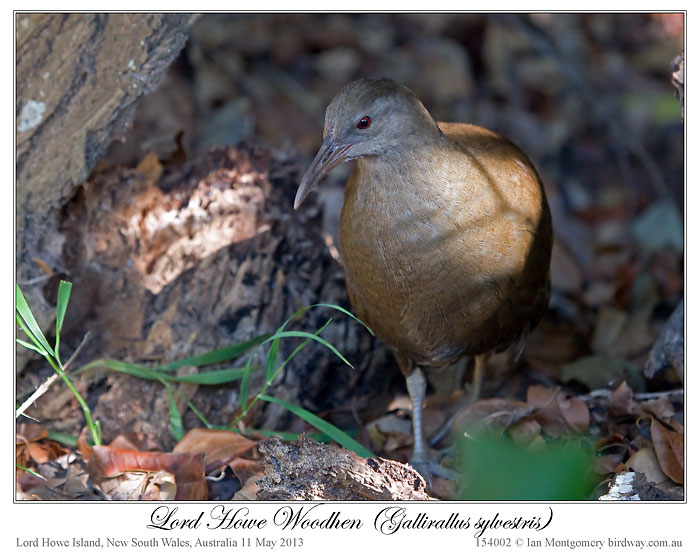
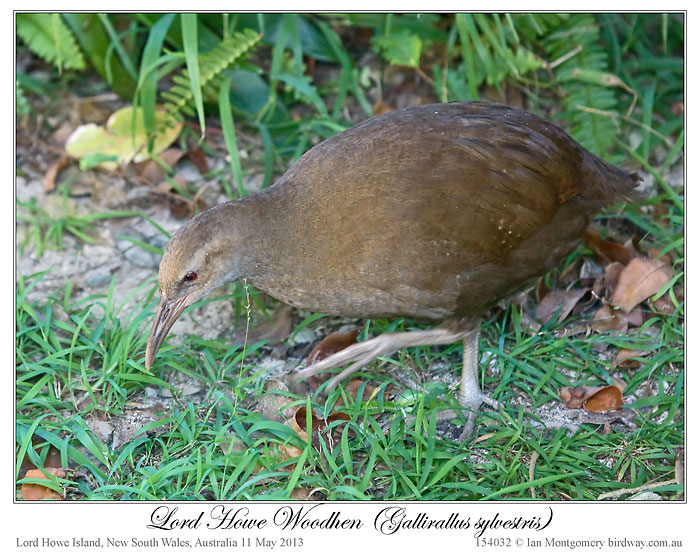
The bird in the first photo has, like many of the population of 200-300 birds, coloured legs bands to assist in monitoring the population. Its partner, second photo, lacked bands and is naturally more photogenic from a wildlife viewpoint, so I concentrated my efforts on it.

Lord Howe Woodhen (Gallirallus sylvestris) by Ian

Lord Howe Woodhen (Gallirallus sylvestris) by Ian

In the gloom of the Kentia Palm forest that covers much of the lowland of the island, the birds look greyish and are quite difficult to see. When they move into the sunlight, like the one in the third photo that has found fruit from the tree outside our room, the warm chestnut colour of the plumage becomes apparent.

Lord Howe Woodhen (Gallirallus sylvestris) by Ian

Lord Howe Woodhen (Gallirallus sylvestris) by Ian

Woodhens form permanent pair bonds and defend their territories which are several hectares in size. Both these birds are adult, recognisable by their red eyes. With a length of 36 cm/14 in these are largish rails, bigger than the related Buff-banded Rail which is also present on the island (and has also wandered past our room).

Lord Howe Woodhen (Gallirallus sylvestris) by Ian

Lord Howe Woodhen (Gallirallus sylvestris) by Ian

Being flightless, tame and good to eat the population declined seriously after the island was settled and by the 1970s only a few survived on the fairly inaccessible tops of the two tall mountains, Mounts Gower and Lidgbird when some of the birds were captured and bred in a protected enclosure in the lowland area. A fellow postgraduate student of mine at Sydney University in the 1970s, Ben Miller, played a major role in the project. You will be able to read all about it in a book, The Woodhen, due for publication next month by CSIRO Publishing and written by Clifford Frith. See http://www.publish.csiro.au/pid/7011.htm. Cliff is also a friend of mine, so I feel quite a strong connection to the Woodhen and am happy to now be able to offer it to you and include photos of it on my website.

Next target is the Providence Petrel, so wish me luck. After its extinction on Norfolk Island – where it was regarded as ‘Provident’ – it survived only on Lord Howe, though a small colony has recently become re-established on Phillip Island off Norfolk.

Best wishes
Ian

**************************************************
Ian Montgomery, Birdway Pty Ltd,
454 Forestry Road, Bluewater, Qld 4818
Tel 0411 602 737 ian@birdway.com.au
Check the latest website updates:
http://www.birdway.com.au/#updates


Lee’s Addition:

… how often would I have gathered thy children together, as a hen doth gather her brood under her wings, and ye would not! (Luke 13:34b KJV)

Never heard of a Woodhen before. Thanks, Ian, for introducing us to another one of the Lord’s creations. According to my list from IOC, there are only three Woodhens; the Lord Howe, Samoan and Makira Woodhens (The last two seem to be called woodhens only by IOC). They are in the Rallidae – Rails, Crakes & Coots Family. One other bird sometimes refered to as a Woodhen is the Weka.

“The Lord Howe Woodhen (Gallirallus sylvestris) also known as the Lord Howe Island Woodhen or Lord Howe (Island) Rail, is a flightless bird of the rail family (Rallidae). It is endemic to Lord Howe Island off the Australian coast. It is a small olive-brown bird, with a short tail and a down-curved bill. The Lord Howe Island Rail lives in sub-tropical forests, feeding on earthworms, crustaceans, fruit, and taking the eggs of shearwaters and petrels.

Woodhens mate for life and are usually encountered in pairs. They are territorial and will appear from the forest’s understory to investigate the source of any unusual noise. A mated pair will defend an area of approximately 3 hectares, with offspring being expelled from this area once grown. The population of birds is thus restricted by the amount of available territory.

Today there are about 250 birds, which may be the optimal population size for the island. (Wikipedia with editing)

See:

Ian’s Rails and Allies

Rallidae – Rails, Crakes & Coots Family

Lord Howe Woodhen – Wikipedia

Woodhen (Weka)  – Wikipedia

*

Ian’s Bird of the Week – White-throated (and Large-tailed) Nightjar

White-throated Nightjar - (Eurostopodus mystacalis) by Ian 1

Ian’s Bird of the Week – White-throated (and Large-tailed) Nightjar ~ by Ian Montgomery

Newsletter – 04-29-13

On the recent inland trip I searched without success in various places for the Spotted Nightjar, a dry country species that roosts in spinifex and open woodland. Sometimes it is to be seen on gravel roads at night, but it seems rather shy and it’s still on my wanted-to-photograph list. I’m back home in Bluewater near Townsville with my sister Gillian, also interested in birds and on a visit from Ireland, so last Tuesday we drove up to the highland mixed forest, part sclerophyll part rainforest, on the range at the end of Forestry Road where I live. She spotted the bird in the first photo which we had disturbed walking along a forest track.

This is a White-throated Nightjar, also on my wanted list as the only one I had photographed before was the one in the second photo, taken 5 years ago in the vestibule of Reef HQ, the aquarium in Townsville in the less than ideal natural surroundings of the roof supports.

White-throated Nightjar - (Eurostopodus mystacalis) by Ian 2

The sharp-eyed among you may have noticed that both photos were taken in April. This is no coincidence as this species is mainly seen here on migration and there are other reports of it turning up in strange places here, including a disused railway carriage that was used as travel accommodation for several years. Incidentally, its specific name mystacalis means ‘moustached’.

A much commoner species here is the Large-tailed Nightjar, often heard at night around Townsville in gallery forest, rainforest and mangroves. It has an unmistakable, very persistent ‘chop’ ‘chop’ call that gives it its colloquial name of Carpenter Bird or Axe Bird, and I often here it near my house, particular on moonlit nights.

Large-tailed Nightjar (Caprimulgus macrurus) by Ian 3

On the day we saw the White-throated Nightjar I had been hoping that we’d see Large-tailed Nightjars on Forestry Road when we returned home at dusk, but the White-throated got in first. So we were delighted to see 3 Large-tailed as well on the way home, including one that obligingly flew up into a tree beside the road and called to us as we illuminated it with a spotlight. I had said to Gillian a few days before that this was one of the few places I knew where you could easily see two species of Stone-curlew/Thicknee in one day after we had seen a pair of Beach Stone-curlews when we went for fish and chips at nearby Balgal Beach and then found two Bush Stone-Curlews in the garden when we returned home. I could perhaps have said the same about Nightjars. You could also say something about the irony of travelling to distant places when there are so many things to be seen in one own back yard.

Best wishes
Ian

**************************************************
Ian Montgomery, Birdway Pty Ltd,
454 Forestry Road, Bluewater, Qld 4818
Tel 0411 602 737 ian@birdway.com.au
Check the latest website updates:
http://www.birdway.com.au/#updates


Lee’s Addition:

How true it is that sometimes we find great treasure right in our own back yard. I am so thankful, Ian, that you share so many of your adventures with us. And, it is nice to share those adventures with your sister.

We have been able to see three members of the Caprimulgidae – Nightjars Family; the Common Nighthawk, Whip-poor-will and the Chuck-will’s-widow.

They are also mentioned in Scripture – Birds of the Bible – Nighthawks and Nightjars

And the owl, and the night hawk, and the cuckow, and the hawk after his kind, (Deuteronomy 14:15 KJV)

See Also:

Ian’s Caprimulgidae Family Photos

Caprimulgidae – Nightjars Family

Nightjar– Wikipedia

*

Ian’s Bird of the Week – Letter-winged Kite

Letter-winged Kite (Elanus scriptus) by Ian 1

Letter-winged Kite (Elanus scriptus) by Ian 1

Ian’s Bird of the Week – Letter-winged Kite ~ by Ian Montgomery

Newsletter ~ 4/18/13

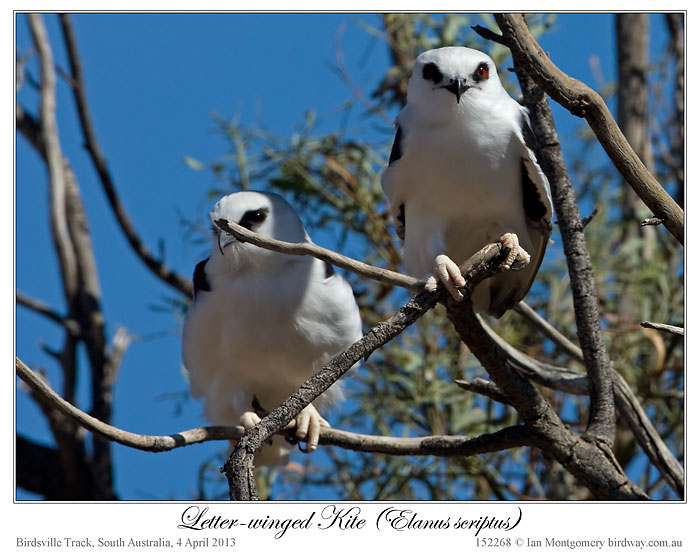
For all you patient bird of the week recipients, here is I hope a bird worth waiting for, the Letter-winged Kite, star attraction on the recent trip along the Birdsville Track in Northwestern South Australia.

The Letter-winged Kite saga that had its resolution here started in the 1970s when I was living in Surry Hills in inner city Sydney. One evening, I was walking around to the local pub, the Cricketers Arms, on Fitzroy Street a block away from busy South Dowling Street when I found a pair of Letter-winged Kites, unfazed by the traffic, landing in a small tree on the pavement. The L-shaped markings under the wing were clearly visible, so there was no doubt about the identification – I was going to the pub, not tottering home afterwards – no matter how unlikely the location for this species, usually more at home in the semi-desert of Central Australia.

I supposed at the time that they were escaped birds. I found out only later that not only are these Kites nocturnal, but that they spread far and wide in search of food from their usual, arid, home following the population crash that follows plagues of their main prey, the Long-haired Rat. Come to think of it, the rather arid open spaces of Moore Park lie on the other side of South Dowling Street, and I’m sure there are plenty of ordinary rats in Surry Hills.

Letter-winged Kite (Elanus scriptus) by Ian 2

Letter-winged Kite (Elanus scriptus) by Ian 2

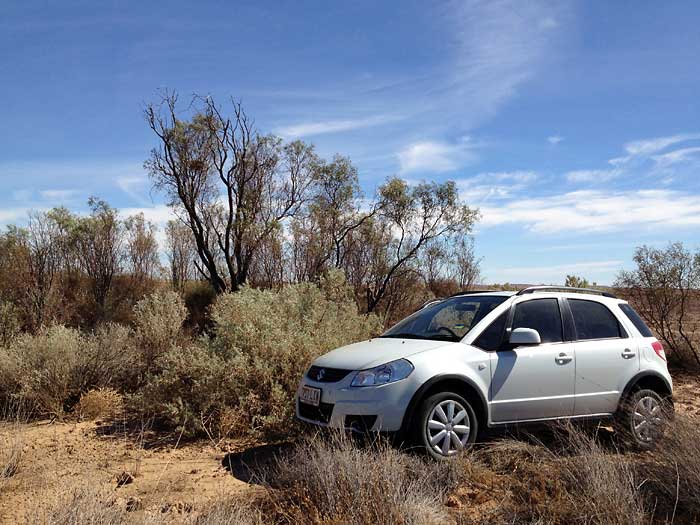
Ordinary people drive the 500km of dirt road that constitutes the legendary Birdsville Track from Birdsville in Southwestern Queensland to Marree in Northeastern South Australia (and the parallel Strzelecki Track) for the experience. Birders do it to search for elusive dry country birds, particularly the Letter-winged Kite and the Grey Falcon and both of these were top of my wanted list on this trip. Letter-winged Kites roost in trees by day, so I searched the few trees – nearly all in creek beds – along the Birdsville Track until, 252km south of Birdsville I spotted a couple of suspects, screeched to a halt in a cloud of dusk and approached them in the car. Birders have 4WD vehicles, such as my modest Suzuki SZ4, mainly so that they can use them as mobile bird hides as most birds are more tolerant of vehicles than pedestrians.

Letter-winged Kite (Elanus scriptus) by Ian 3

Letter-winged Kite (Elanus scriptus) by Ian 3

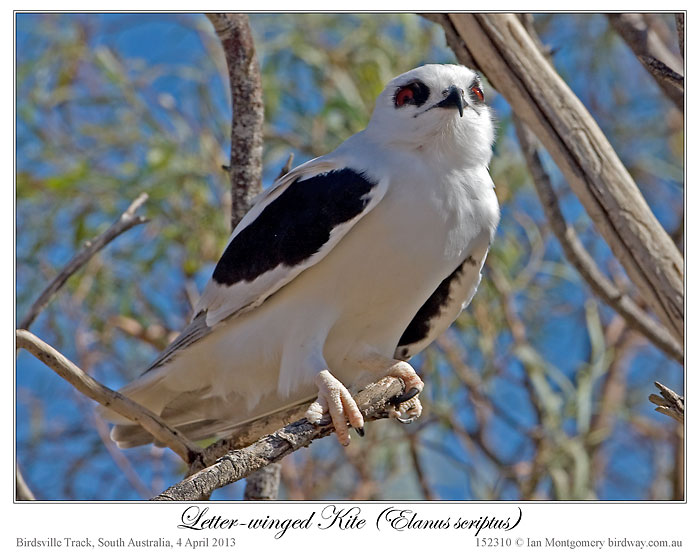
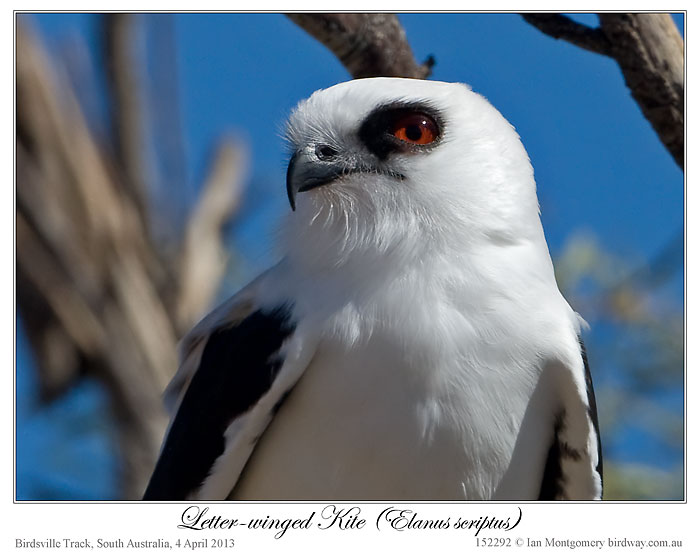
Letter-winged Kites indeed they were, but the tree was a tangle of branches and the sun was shining from behind the tree. The birds, however, seemed as unfazed by the traffic (relatively speaking) as the ones in Fitzroy Street, and let me approach to take the first photo (good lighting angle, bad branches), second photo (bad angle, good branches). Then they waited while I changed the lens from the 100-400mm to the 500mm and, eventually, looked on tolerantly while I got out of the car and did a relative close-up (third photo) and a portrait (fourth photo).

Letter-winged Kite (Elanus scriptus) by Ian 4

Letter-winged Kite (Elanus scriptus) by Ian 4

I then walked away to take a photo of the tree, the birds and a nest (I don’t know whether it was theirs) and turned around to find that they had silently vanished. If it hadn’t been for the photos definitely still on the SD card, the event might have all have been a fantasy. So I made do with a photo of the tree, the nest and the mobile bird hide, below.

 Letter-winged Kite (Elanus scriptus) by Ian 5

Letter-winged Kite (Elanus scriptus) by Ian 5

The Strzelecki Track is actually supposed to be better for Letter-winged Kites than the Birdsville, but, having found these birds, we decided to change our return travel plans from Plan B1 to Plan B2, skip the Strzelecki (similar landscape, worse road), spend a few days in the Flinders Ranges and drive home via Broken Hill, Bourke and Bowra (B2), instead of Birdsville, Bedourie and Boulia (B1).

Best wishes
Ian

**************************************************
Ian Montgomery, Birdway Pty Ltd,
454 Forestry Road, Bluewater, Qld 4818
Tel 0411 602 737 ian@birdway.com.au
Check the latest website updates:
http://www.birdway.com.au/#updates


Lee’s Addition:

And the glede, and the kite, and the vulture after his kind, (Deuteronomy 14:13 KJV)

What an awesome bird. They are beautiful. Thanks, Ian, for sharing another of your birdwatching adventures with us. His photography is fabulous also. I love that close-up in #4. Wow!

The Letter-winged Kite (Elanus scriptus) is a small, rare and irruptive Australian raptor with a core range in central Australia. The adult is a small and graceful, predominantly pale grey and white, raptor with black shoulders and red eyes. It is similar in appearance to the Black-shouldered Kite except for a very distinctive black underwing pattern of a shallow ‘M’ shape, seen when in flight. Roosting during the day in well-foliaged trees and hunting at night, it is the world’s only fully nocturnal raptor. Like all the elanid kites, it is a specialist predator of rodents, which it hunts by hovering in mid-air above grasslands and fields. (Wikipedia)

They belong to the Accipitridae Family . Check out all Ian’s Family Photos and then see the complete Accipitridae – Kites, Hawks and Eagles family list here.

See Also:

Ian’s Bird of the Week

White-tailed Kite ~ 1-7-11

Whistling Kite ~ 5-31-10

Birds of the Bible – Glede and Kites

*

Ian’s Bird of the Week – Channel-billed Cuckoo

Channel-billed Cuckoo (Scythrops novaehollandiae) by Ian

Channel-billed Cuckoo (Scythrops novaehollandiae) by Ian 1

Ian’s Bird of the Week – Channel-billed Cuckoo ~ by Ian Montgomery

Newsletter ~ 1-21-13

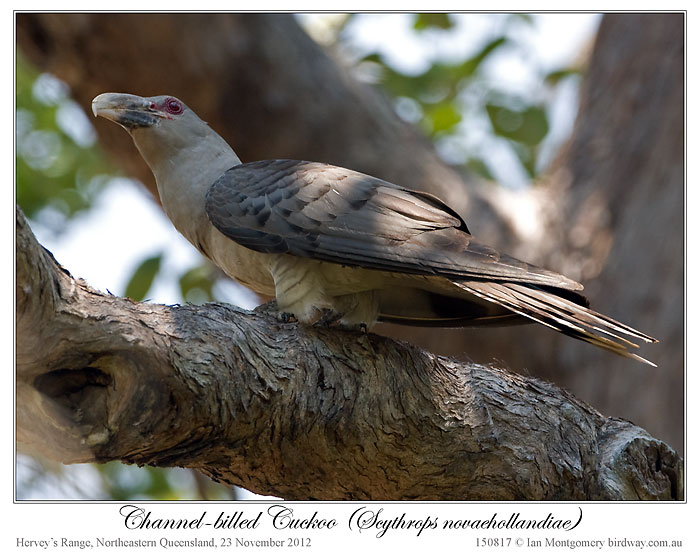
Last week, sorry fortnight, we had the Little Bronze-Cuckoo, the smallest Australian Cuckoo. Here is the Channel-billed Cuckoo, the largest parasitic cuckoo in Australia, and the world for that matter, with a length to 65cm/26in and a weight exceeding 900g/2lbs. (Coucals, such as the Pheasant Coucal , to 75cm, are larger and are now included in the Cuckoo family, but are not parasitic.)

The bird in the first photo is an adult, distinguishable by the grey back (no buff patches) and the red eye and facial skin. The genus name Scythrops means ‘angry eye’ in Greek. The second photo shows a juvenile and you can see the buff patches on the wing, head and throat, though the grey facial skin looks as if it is beginning to acquire the red colour of the adult. This photo was taken in April when the birds would about to migrate to New Guinea.

Channel-billed Cuckoo (Scythrops novaehollandiae) by Ian

Channel-billed Cuckoo (Scythrops novaehollandiae) by Ian 2

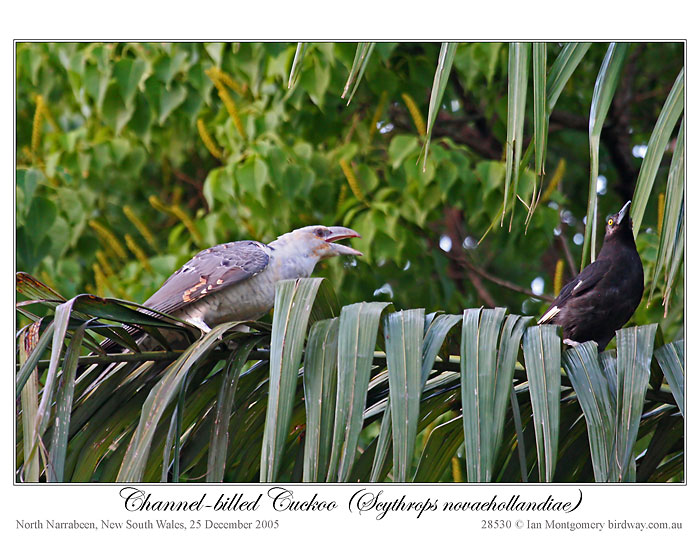
Channel-billed Cuckoos lay their large eggs in the nests of Currawongs, Crows, Ravens, Magpies and even Sparrowhawks. The third photo, which appeared as the bird of the week in 2005, shows a very demanding chick with a very nerve-wracked looking foster parent Pied Currawong in the Sydney Metropolitan Area. The adult Cuckoos may break the eggs of the host bird but the chicks do not usually evict the eggs or chicks. Instead they out-compete them for food.

Channel-billed Cuckoo (Scythrops novaehollandiae) by Ian

Channel-billed Cuckoo (Scythrops novaehollandiae) by Ian 3

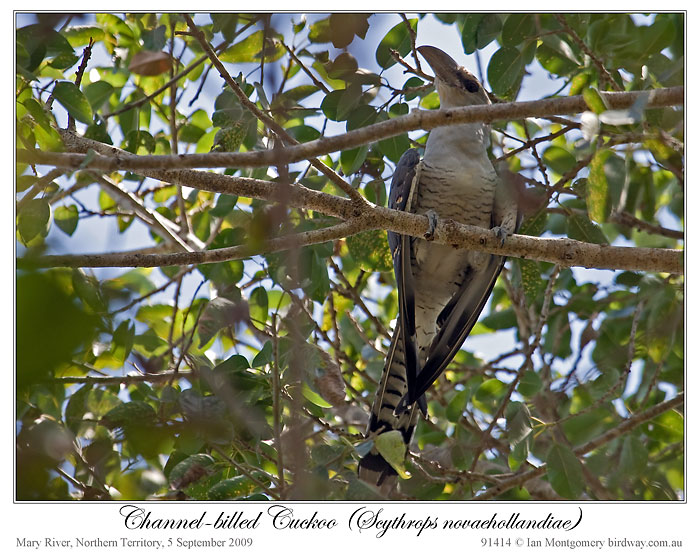
Channel-bills are mainly migratory, though some are though to remain in the Northern Territory throughout the winter. The juvenile in the fourth photo was being fed by Torresian Crow foster parents in the Top End in early September, so it would have hatched in July.

Channel-billed Cuckoo (Scythrops novaehollandiae) by Ian

Channel-billed Cuckoo (Scythrops novaehollandiae) by Ian 4

Typically of Cuckoos, Channel-bills are quite shy and usually remain hidden in foliage but their loud trumpeting calls give them away. They do fly in the open, particular before dusk and look very striking – their long tails and long pointed wings look rather raptor-like, though the large bill doesn’t, and they are often likened to flying crosses.

Best wishes
Ian

**************************************************
Ian Montgomery, Birdway Pty Ltd,
454 Forestry Road, Bluewater, Qld 4818
Tel 0411 602 737 ian@birdway.com.au
Check the latest website updates:
http://www.birdway.com.au/#updates


Lee’s Addition:

And the owl, and the night hawk, and the cuckoo, and the hawk after his kind, (Deuteronomy 14:15 KJV)

The Cuckoos are in the Cucuilidae Family and are also one of the Birds of the Bible, listed in the Unclean Birds.


See:

Ian’s Cuckoos, Coucals & Allies

Cucuilidae – Cuckoo Family

Birds of the Bible – Cuckoo

*