Cassin’s Auklet In Trouble

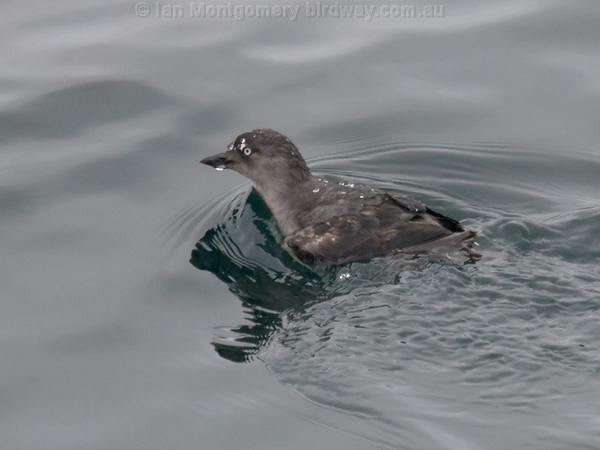
Cassin's Auklet (Ptychoramphus aleuticus) by Ian

Cassin’s Auklet (Ptychoramphus aleuticus) by Ian

While reading the Sunday paper, I noticed an article about the Cassin’s Auklet being in trouble. There is a big “die-off” happening on the West Coast that has scientist baffled. Wanted to find out about this bird, so here is some information about them.

Cassin’s Auklet (Ptychoramphus aleuticus) is a small, chunky seabird that ranges widely in the North Pacific. It nests in small burrows and because of its presence on well studied islands in British Columbia and off California it is one of the better known auks. It is named for John Cassin, a Pennsylvania businessman and naturalist.
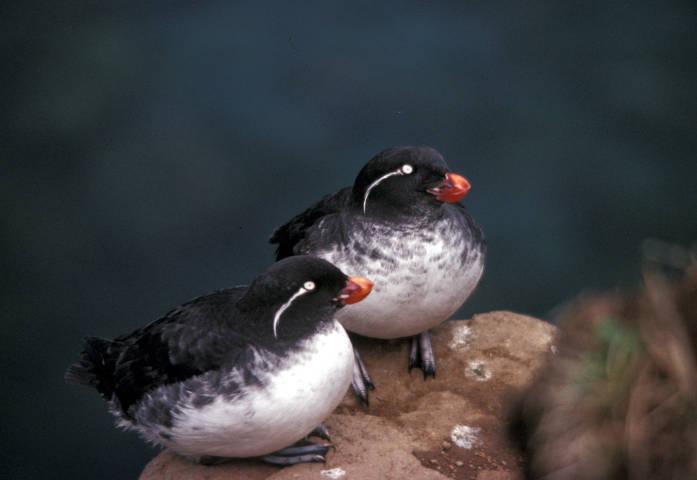
Parakeet Auklet (Aethia psittacula) ©USFWS

Parakeet Auklet (Aethia psittacula) ©USFWS

They belong to the Alcidae – Auks Family which has 25 members. There are Auks, Murres, Guillemots, Murrelets, Auklets, and Puffins in family. Auks are superficially similar to penguins having black-and-white colours, upright posture and some of their habits. Nevertheless they are not closely related to penguins,

Auks live on the open sea and only go ashore for breeding, although some species, like the common guillemot, spend a great part of the year defending their nesting spot from others.
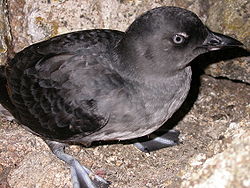
The Cassin’s Auklet are nondescript, usually dark above and pale below, with a small white mark above the eye. Its bill is overall dark with a pale spot, and its feet are blue. Unlike many other auks the Cassin’s auklet lacks dramatic breeding plumage, remaining the same over most of the year. “At sea it is usually identified by its flight, which is described as looking like a flying tennis ball”

“…Strong is thy dwellingplace, and thou puttest thy nest in a rock.” (Numbers 24:21b KJV)

The Cassin’s auklet nests in burrows on small islands, and in the southern area of its range may be found in the breeding colony year round. It either digs holes in the soil or uses natural cracks and crevices to nest in, also readily using man-made structures. Pairs will show a strong loyalty towards each other and to a nesting site for many years. Both the parents incubate the single white egg, returning to swap shifts at night to avoid being taken by predators such as the western gull or peregrine falcon. They also depart from the colony before dawn.
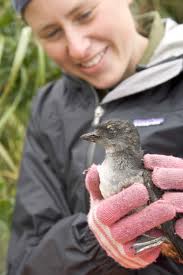
Cassin's Auklet (Ptychoramphus aleuticus) ©WiciC

Cassin’s Auklet (Ptychoramphus aleuticus) ©WiciC

At sea Cassin’s Auklets feeds offshore, in clear often pelagic water, often associating with bathymetric landmarks such as underwater canyons and upwellings. Numbers at sea may be grossly underestimated because the bird moves away from ships at a distance of more than a kilometer. Recently their distribution around Triangle Island has been determined by telemetry. It feeds by diving underwater beating its wings for propulsion, hunting down large zooplankton, especially krill. It can dive to 30 m below the surface, and by some estimates 80 m

According to the article Pacific Coast Sea Bird Die-Off Puzzles Scientists: “Scientists are trying to figure out what’s behind the deaths of seabirds that have been found by the hundreds along the Pacific Coast since October. Mass die-offs …have been reported from British Columbia to San Luis Obispo, California.

“To be this lengthy and geographically widespread, I think is kind of unprecedented,” Phillip Johnson told the reporter.

“The birds appear to be starving to death, so experts don’t believe a toxin is the culprit…. But why the birds can’t find food is a mystery.”

“Researchers say it could be the result of a successful breeding season, leading to too many young birds competing for food. Unusually violent storms might be pushing the birds into areas they’re not used to or preventing them from foraging. Or a warmer, more acidic ocean could be affecting the supply of tiny zooplankton, such as krill, that the birds eat.”

Cassin’s Auklet (Ptychoramphus aleuticus) by Ian

On December 26th of 132 dead birds found on the beach at Tillamook, Oregon, 126 were Cassin’s Auklets.

One thing is for sure, this issue has not caught the Lord by surprise. We were given dominion over the birds and part of that is to help preserve our birds. I am glad the scientist are digging into this issue to hopefully find an answer.

“And God said, Let us make man in our image, after our likeness: and let them have dominion over the fish of the sea, and over the fowl of the air, and over the cattle, and over all the earth, and over every creeping thing that creepeth upon the earth.” (Genesis 1:26 KJV)

Cool Facts from About Birds

  • The Cassin’s Auklet is the only alcid known to produce two broods in a single breeding season, at least in the southern part of the range where birds may be seen at nesting colonies every month of the year.
  • Vulnerable to predators, especially large gulls, the Cassin’s Auklet tends to visit its nest at night.
  • The Cassin’s Auklet is named for John Cassin, a Pennsylvania businessman and naturalist.
  • A group of auks has many collective nouns, including a “colony”, “loomery”, and “raft” of auks.

(Information from Wikipedia and other internet sources)

*

*

Bible Birds – Vulture Introduction

Vulture Introduction

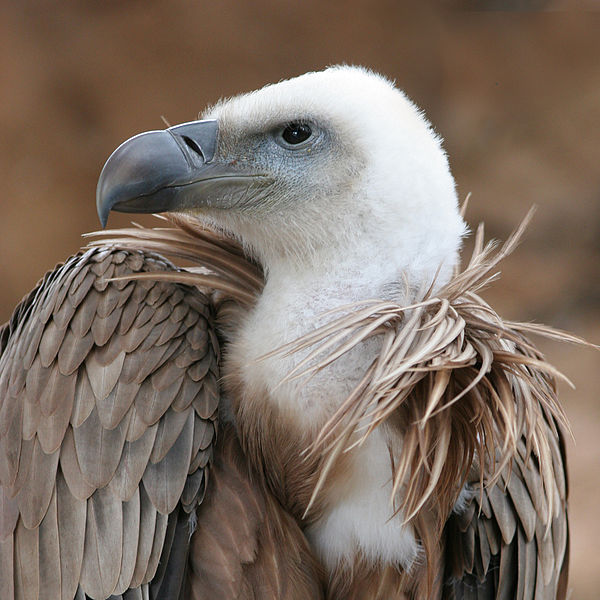
Griffon Vulture (Gyps fulvus) WikiC

Griffon Vulture (Gyps fulvus) WikiC

And these you shall regard as an abomination among the birds; they shall not be eaten, they are an abomination: the eagle, the vulture, the buzzard, (Leviticus 11:13 NKJV)

  • Christian Standard Bible (CSB) “but these are the ones you may not eat: eagles, bearded vultures, black vultures,
  • Complete Jewish Bible (CJB) “but these you are not to eat: eagles, vultures, ospreys,
  • Easy-to-Read Version (ERV) “But don’t eat any of these birds: eagles, vultures, buzzards,
  • English Standard Version (ESV) “But these are the ones that you shall not eat: the eagle, the bearded vulture, the black vulture,
  • Expanded Bible (EXB) “But do not eat these birds: eagles, vultures, black vultures, 13 red kites, falcons, any kind of kite,
  • GOD’S WORD Translation (GW) “But here are the birds that you should never eat: eagles, bearded vultures, black vultures,
  • International Children’s Bible (ICB)  “But do not eat these birds: eagles, vultures, black vultures,
  • International Standard Version (ISV) “You may eat all clean birds, 12 but you must not eat any of these: the eagle, vulture, osprey, 13 buzzard, any kind of kite,
  • Names of God Bible (NOG) “But here are the birds that you should never eat: eagles, bearded vultures, black vultures,
  • New English Translation (NET) “But do not eat these birds: eagles, vultures, black vultures,
  • New International Reader’s Version (NIRV) “But there are many birds you can’t eat. They include eagles, vultures, and black vultures.
Leviticus 11:18 and Deuteronomy 14:17 (NKJV) mention a carrion vulture. Jeremiah 12:9 mentions a speckled vulture.
 
All of these verses give us several different kinds of vultures.
vulture
bearded vulture – covered in Bible Birds – Ossifrage
black vulture
carrion vulture
speckled vulture
 
I am sure if I checked all of the translation available in BibleGateway, I would find some other type of Vulture. That might be a project you could do.
 
The vultures belong to the same family as the Buzzards recently written about. Accipitridae – Kites, Hawks & Eagles Family.
 
“A vulture is a scavenging bird of prey. The two types of vultures are the New World vultures, including the Californian and Andean condors, and the Old World vultures, including the birds that are seen scavenging on carcasses of dead animals on African plains. Some traditional Old World vultures (including the bearded vulture) are not closely related to the others, which is why the vultures are to be subdivided into three taxa rather than two. New World vultures are found in North and South America; Old World vultures are found in Europe, Africa, and Asia, meaning that between the two groups, vultures are found on every continent except Australia and Antarctica.”

White-backed Vultures (Gyps_africanus) on zebra carcass ©WikiC

From that description, again, you can see why those birds aren’t eaten. Eating something they just killed would be bad enough, but to eat things that had already died. That is not the kind of bird you would want to eat at Thanksgiving.
 
Here are some of the Vultures from around the world:

ABC’s of the Gospel


Ian’s Bird of the Week – Greater Flamingo

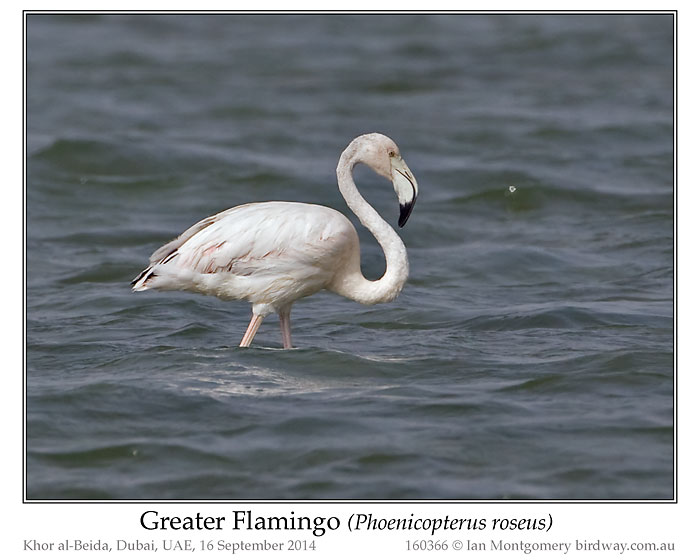
PHO-Phof Greater Flamingo (Phoenicopterus roseus) by Ian

Ian’s Bird of the Week – Greater Flamingo ~ by Ian Montgomery

Newsletter ~ 10-9-14

Here’s another species from Dubai, the Greater Flamingo. It’s well-known there, occurs in the Ra’s al-Khor wildlife sanctuary near the centre of town and is suitably iconic for a place where flamboyance is preferred to subtlety :-). We didn’t go to this sanctuary but found about 50 Flamingos feeding in the shallows near one of the Crab Plover sites that we checked at Khor al-Beida north of the city.

This spot was right beside a Sheik’s well guarded palace. Tommy warned that using a large telephoto lens there could attract unwelcome attention from the guards, so these photos were taken through the window of his 4WD. The birds in the first and second photos are adults with the pink colour of the legs and bill and the red plumage in the wings well-developed.

Greater Flamingo (Phoenicopterus roseus) by IanThe bird in the third photo is an older juvenile. The bill is still grey, the legs are just beginning to show a pink flush and there is little red showing in the wings. The full adult plumage is acquired after about three years.

Greater Flamingo (Phoenicopterus roseus) by Ian
Flamingos are a taxonomically isolated group with 6 species in a single family – Phoneicopteridae – in their own order the Phoenicopteriformes. Four of the species occur in South and Central America, with 2 Old World Species The Greater and Lesser Flamingos. The Greater Flamingo occurs in Africa, the Middle East, southern Europe and in Asia as far east as India. There is one Australian record from the Cocos (Keeling) Islands in 1988, so it has the honour of being on the Australian list.

Greetings from Strasbourg where we are having a pleasant few days in this lovely city staying with Gillian daughter Jeannine and her husband Carlos. Tomorrow we go to Barcelona by TGV en route to a couple of birding spots in the foothills of the Pyrenees where I hope to get some raptor photos to share with you. THE target species is the Bearded Vulture or Lammergeier, so I need your spiritual support and enthusiasm!

Ian


Lee’s Addition:

Now out of the ground the LORD God had formed every beast of the field and every bird of the heavens and brought them to the man to see what he would call them. And whatever the man called every living creature, that was its name. (Genesis 2:19 ESV)

Love those Flamingo, no matter what kind. There is just something about that beak and the pose they portray. Thanks again, Ian, for sharing your latest find among the avian in Dubai.

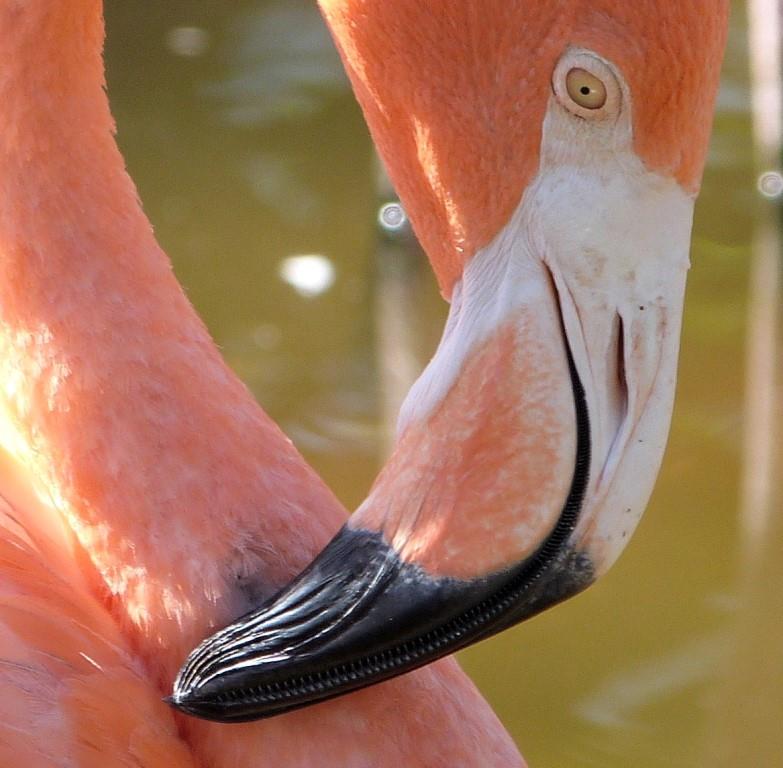
American Flamingo Beak cropped

American Flamingo Beak by Lee

Of the Flaming Family on Ian’s Birdway site, this must have been his first Flamingo. At least that is all he shows for the Phoenicopteridae Family.
*

Ian’s Birds of the Week

Ian’s Phoneicopteridae Family

Flamingos – Phoenicopteridae Family

*

Ian’s Bird of the Week – Cream-coloured Courser

Ian’s Bird of the Week – Cream-coloured Courser ~ by Ian Montgomery

Newsletter – 9/27/14

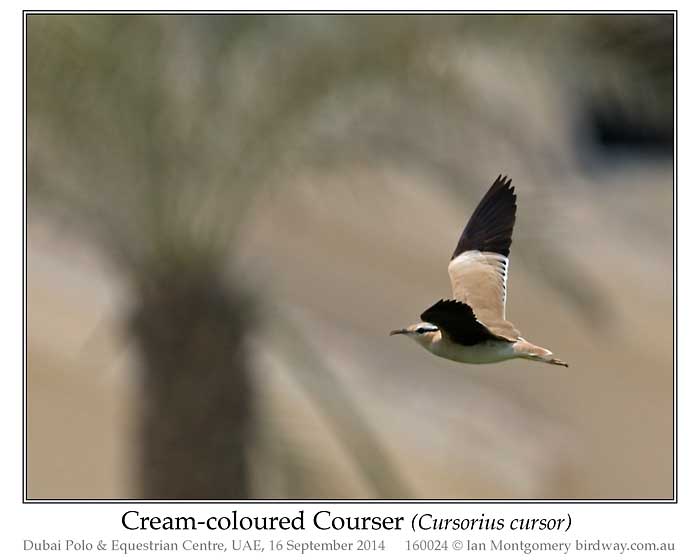
A couple of weeks ago, I said that my two target birds in Dubai were Crab Plover – which featured last week – and Cream-coloured Courser. The latter had aroused my curiosity 50 years ago when I saw it on this page of the Field Guide to Birds of Britain and Europe. Tommy Pedersen (http://www.uaebirding.com) had said that the Coursers were “possible”, so there were no guarantees.

Cream-colored Courser (Cursorius cursor) by Ian

Cream-colored Courser (Cursorius cursor) by Ian

When we set off with Tommy, we had a few hours to fill in before the tide was optimal for the Crab Plovers, so we went first to the Dubai Polo and Equestrian Centre, then to the Al Asifa Endurance Stables to look for the Coursers. They were present at both, with over 30 at the Polo Centre and another 16 at the Stables. In fact, the first photo I took in Dubai was of a very distant Courser.

Cream-colored Courser (Cursorius cursor) by Ian

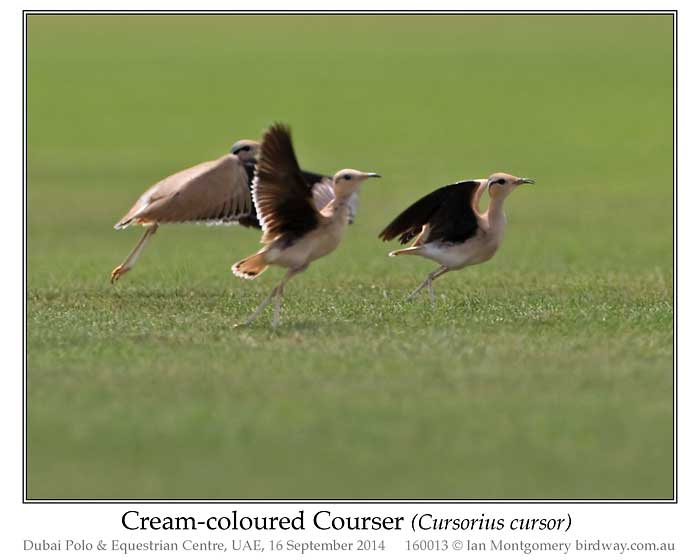
They were worth waiting 50 years for, and I think the illustration in the field guide didn’t do them justice. They’re called Coursers because they run rather than fly, second photo, the name being derived from the Latin verb currere, to run, and the generic name Cursorius means runner. The ‘sport’ of coursing – chasing hares, etc., on horse-back is derived from the same source, so there was a delightful irony in finding them at the two main equestrian locations in Dubai.​

Cream-colored Courser (Cursorius cursor) by Ian

When pressed they do take flight, third photo. In doing so, they show their striking dark wing tips and underwings and reveal similarity to pratincoles, the other members of the family Glareolidae. There is a photo of an Australian Pratincole in flight here if you want to compare them. The three taking off in the third photo seemed to be a family party as the bird in the centre is immature with patchy brown markings on the neck and only very pale stripes through the eye.

Cream-colored Courser (Cursorius cursor) by Ian

​Their preferred habitat is desert and semi-desert with or without sparse vegetation. Their breeding range includes much of North Africa and the Middle East. Many North African birds migrate across the Sahari to winter in the southern Sahara and at least part of the Middle East population migrates to Pakistan and NW India. They feed on insects and other invertebrates on the ground and will take locusts in flight. I couldn’t help but be struck by their resemblance both in colour and habitat to the Inland Dotterel of central Australia.

Cream-colored Courser (Cursorius cursor) by Ian

As promised a couple of weeks ago, I’ve started putting together a page on electronic books to provide assistance in choosing among different platforms. So far, I’ve finished the General Introduction. I still need to add more details on the actual process of purchasing ebooks from different vendors​ and I’ll let you know when that is available.

I’m still in Ireland. So far, I’ve been mainly catching up with family and friends. Next Tuesday we are going looking for Red Kites in Avoca, Co. Wicklow, so keep your fingers crossed for some photos! The Red Kite is one of the more successful Irish raptor reintroduction programs and there are now breeding populations in both the Republic, mainly Co. Wicklow south of Dublin, and in Co. Down in Northern Ireland. I do have a photo of one taken in Spain – but it would be good to get some genuine Irish ones, the real McCoy.

Greetings
Ian


Lee’s Addition:

He asked for water, she gave milk; She brought out cream in a lordly bowl. (Judges 5:25 NKJV)
He will not see the streams, The rivers flowing with honey and cream. (Job 20:17 NKJV)
When my steps were bathed with cream, And the rock poured out rivers of oil for me! (Job 29:6 NKJV)

Wow! I really like that color. It seems so rich. There are such neat birds in the Glareolidae family anyway. That last photo of the bird in flight looks like the Lord dipped its wings in paint. I am glad Ian was able to get these new photos and shared them with us.

Coloured or Colored? Again we have a difference in spelling. Ian uses one naming authority and here we use the I.O.C.’s naming. Same bird, same scientific name – Cursorius cursor. And the same beautiful bird from its Creator.

*

Ian’s Bird of the Week

Ian’s Glareolidae Family

Glareolidae – Coursers, Pratincoles

*

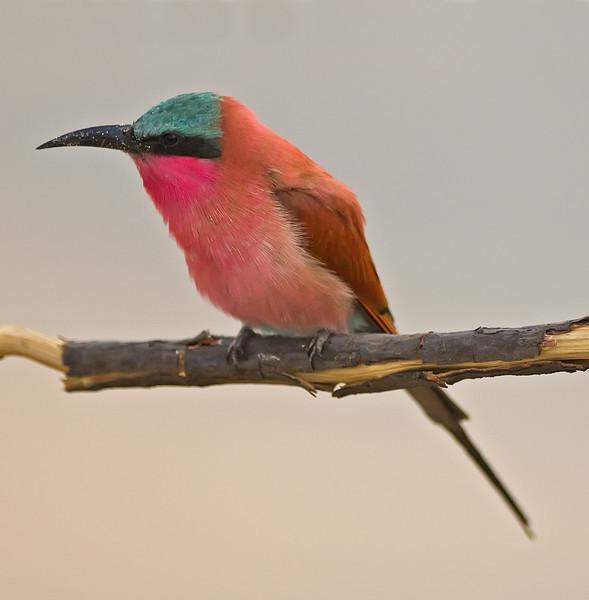
Birds of the World – Blue-cheeked Bee-eater

Southern Carmine Bee-eater (Merops nubicus) by Marc at Africaddict

Southern Carmine Bee-eater (Merops nubicus) by Marc at Africaddict

What a neat video of the Blue-cheeked Bee-eater. I have seen photos of them, but seeing birds in action is always special. There are some birds that just hit my fancy as I admire the Lord’s Handiwork. The Bee-eaters are one of those.

By Igor Byshnev

Matthew 6:25-34 NKJV
(25) “Therefore I say to you, do not worry about your life, what you will eat or what you will drink; nor about your body, what you will put on. Is not life more than food and the body more than clothing?
(26) Look at the birds of the air, for they neither sow nor reap nor gather into barns; yet your heavenly Father feeds them. Are you not of more value than they?
(27) Which of you by worrying can add one cubit to his stature?
(28) “So why do you worry about clothing? Consider the lilies of the field, how they grow: they neither toil nor spin;
(29) and yet I say to you that even Solomon in all his glory was not arrayed like one of these.
(30) Now if God so clothes the grass of the field, which today is, and tomorrow is thrown into the oven, will He not much more clothe you, O you of little faith?
(31) “Therefore do not worry, saying, ‘What shall we eat?’ or ‘What shall we drink?’ or ‘What shall we wear?’
(32) For after all these things the Gentiles seek. For your heavenly Father knows that you need all these things.
(33) But seek first the kingdom of God and His righteousness, and all these things shall be added to you.
(34) Therefore do not worry about tomorrow, for tomorrow will worry about its own things. Sufficient for the day is its own trouble.

Bee-eaters belong to the Meropidae – Bee-eaters Family which has 27 species.

As the name suggests, bee-eaters predominantly eat flying insects, especially bees and wasps, which are caught in the air by sallies from an open perch. While they pursue any type of flying insect, honey bees predominate in their diet. Hymenoptera (ants, bees and wasps) comprise from 20% to 96% of all insects eaten, with honey bees comprising approximately one-third of the Hymenoptera. (Wikipedia with editing)

Articles Mentioning Birds From This Family:

Other Websites that have photos of this Family:

Wordless Birds

*

Birdwatching Term – Nape

Blue-naped Mousebird (Urocolius macrourus) at Cincinnati Zoo)

Blue-naped Mousebird at Cincinnati Zoo)

Nape

My son, listen to your father’s discipline, and do not neglect your mother’s teachings, because discipline and teachings are a graceful garland on your head and a golden chain around your neck. (Proverbs 1:8-9 GW)

Nape – An easy definition is the back of the neck.

 Blue-naped Mousebird - Blue Nape (Back of Neck)

Blue-naped Mousebird – Blue Nape (Back of Neck)

Topography of a Bird - Bluebird - Color Key to NA Birds - Nape

Parts of Bird – Nape in Blue

Notice the Nape is between the Crown and the Back

There are quite a few birds that have colored napes that help identify them, such as Woodpeckers, Grebes, etc. Our Blue-naped Mousebird is one where the color of the “nape” is used in its name. While learning to bird watch, I kept saying (and still do) that the Lord should have placed little signs on them. That way when we look at them through binoculars, scopes, cameras, or our eyes, that we could just read the sign.

That is not the way it is, but there are many clues do that help us ID the birds. The variety of the birds with their colors and shapes keep us busy, but aren’t we thankful that He didn’t make them all alike. How boring that would be.

Here are the “-naped” birds of the world:

Chestnut-naped Francolin (Pternistis castaneicollis)
Red-naped Ibis (Pseudibis papillosa)
White-naped Crane (Grus vipio)
Black-naped Tern (Sterna sumatrana)
White-naped Pigeon (Columba albinucha)
Eastern Bronze-naped Pigeon (Columba delegorguei)
Western Bronze-naped Pigeon (Columba iriditorques)
Island Bronze-naped Pigeon (Columba malherbii)
Scaly-naped Pigeon (Patagioenas squamosa)
Red-naped Fruit Dove (Ptilinopus dohertyi)
Black-naped Fruit Dove (Ptilinopus melanospilus)
Purple-naped Lory (Lorius domicella)
White-naped Lory (Lorius albidinucha)
Blue-naped Parrot (Tanygnathus lucionensis)
Yellow-naped Amazon (Amazona auropalliata)
Scaly-naped Amazon (Amazona mercenarius)
White-naped Swift (Streptoprocne semicollaris)
Red-naped Trogon (Harpactes kasumba)
Golden-naped Barbet (Megalaima pulcherrima)
Golden-naped Woodpecker (Melanerpes chrysauchen)
Red-naped Sapsucker (Sphyrapicus nuchalis)
White-naped Woodpecker (Chrysocolaptes festivus)
Blue-naped Pitta (Hydrornis nipalensis)
Rusty-naped Pitta (Hydrornis oatesi)
Grey-naped Antpitta (Grallaria griseonucha)
Chestnut-naped Antpitta (Grallaria nuchalis)
Ochre-naped Ground Tyrant (Muscisaxicola flavinucha)
Rufous-naped Ground Tyrant (Muscisaxicola rufivertex)
White-naped Xenopsaris (Xenopsaris albinucha)
White-naped Honeyeater (Melithreptus lunatus)
Red-naped Bushshrike (Laniarius ruficeps)
Rufous-naped Whistler (Aleadryas rufinucha)
Rufous-naped Greenlet (Hylophilus semibrunneus)
Black-naped Oriole (Oriolus chinensis)
Black-naped Monarch (Hypothymis azurea)
White-naped Monarch (Carterornis pileatus)
Azure-naped Jay (Cyanocorax heilprini)
White-naped Jay (Cyanocorax cyanopogon)
Rufous-naped Tit (Periparus rufonuchalis)
White-naped Tit (Parus nuchalis)
Rufous-naped Lark (Mirafra africana)
White-naped Yuhina (Yuhina bakeri)
Rufous-naped Wren (Campylorhynchus rufinucha)
Chestnut-naped Forktail (Enicurus ruficapillus)
Purple-naped Sunbird (Hypogramma hypogrammicum)
Golden-naped Weaver (Ploceus aureonucha)
Golden-naped Finch (Pyrrhoplectes epauletta)
Blue-naped Chlorophonia (Chlorophonia cyanea)
White-naped Brush Finch (Atlapetes albinucha)
Pale-naped Brush Finch (Atlapetes pallidinucha)
Rufous-naped Brush Finch (Atlapetes latinuchus)
Golden-naped Tanager (Tangara ruficervix)
Green-naped Tanager (Tangara fucosa)
White-naped Seedeater (Dolospingus fringilloides)

*

This slideshow requires JavaScript.

*

You can see by the photos that the “nape” can be narrow or very broad. Other birds have napes that are different colors, but do not have the word “nape” in their names. Some of the Woodpeckers that have napes were include above.

Nape – All About Birds

More Birdwatching Terms

Wordless Birds

*

American Woodcock – A Wonderfully Bizarre Bird

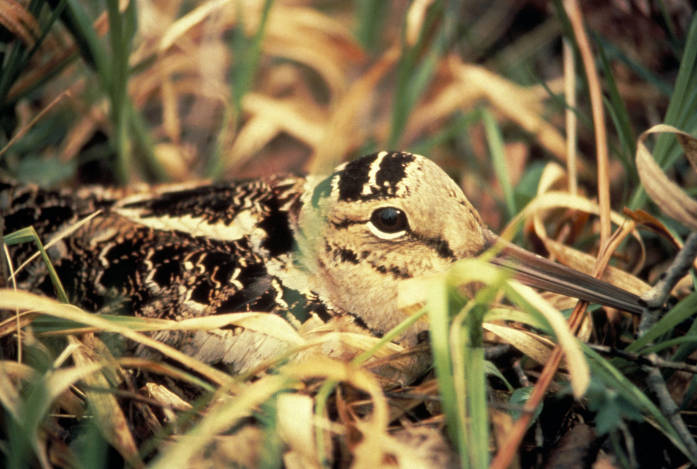
American Woodcock (Scolopax minor) on nest ©USFWS

American Woodcock (Scolopax minor) on nest ©USFWS

A Wonderfully Bizarre Bird by Tom Hennigan © 2013 Answers in Genesis – www.AnswersInGenesis.org.

The drought had been rather severe that summer, and the normally moist woodland was dry and parched. Suddenly, out of the brush, a chunky bird was frantically searching the soil for earthworms. Following behind, and looking as famished as their mama, were four of her wood-brown chicks. And as their mama stopped and probed the arid ground before her, the chicks looked on with eager expectation. But all at once, and without warning, mama bird performed an amazing feat! She lay her body flat along the ground and began drumming the surface with her wings. Minutes later, their hunger satisfied, this American Woodcock family disappeared into the dry undergrowth.

All birds reveal incredible design, but the American Woodcock has an interesting design feature in its behaviour as well.

We have been led to believe by the scientific establishment that birds, like the American Woodcock, are products of time and chance. That through natural processes and eons of time, they are the descendants of a common ancestor that sprang from the reptilian line.

On the other hand, the Word of the Creator states that birds were designed and created by Him, according to their own kind, on the fifth day. As a result, He considered them very good (Genesis 1:31).

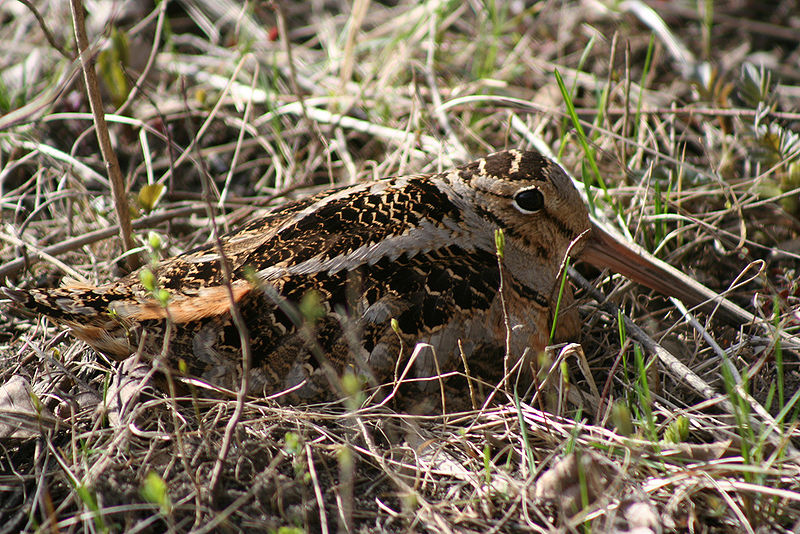
American Woodcock (Scolopax minor) ©WikiC

American Woodcock (Scolopax minor) ©WikiC

Chance vs design. Aimlessness vs plan and purpose. These are two fiercely competitive worldview’s. They are mutually exclusive. And, contrary to popular opinion, the essence of both can be described as the science of one person’s religion vs the science of another’s. Why? Because no one was there at the beginning! Scientifically speaking, the conditions of the early earth are unknown and hence cannot be duplicated. On the other hand, God was there! He is perfectly capable of communicating to His people.

When we look at His world, we find tremendous evidence of His fingerprints, so to speak—design and purpose.

For instance, how did drumming the ground bring the woodcock family from famine to feast? Amazingly enough, mama woodcock was aware of the habits of earthworms. She knew that in dry conditions, they squirm to the lower, moist depths of the soil. However, she was also aware of another quirk in their behaviour! When it rains, worms can sense the ground vibrations caused by raindrops. When this happens, they quickly propel themselves to the soil surface so they won’t drown. Therefore, when the mother beat the ground, she and her family were able to leave the area with their hunger pangs satisfied.

How did she know how to do that? What complicated series of events caused all of this information to come together in one little bird? Was it by chance and natural processes or was it creation with deliberate purpose?

Not only did it know the habits of the earthworms, this bird’s anatomy is highly complex as well. The eyes are located high on its head enabling it to see 360 degrees. Imagine being able to see, with overlapping vision allowing depth perception, both in front of and behind you. The ears are situated between the eyes and its eight-centimetre (three-inch) bill. This highly sophisticated hearing apparatus is better able to detect the sub-soil movement of its prey. Working together with its exquisitely attuned vision and hearing, are its sensitive feet. Designed to feel ground vibration, they help to pinpoint a worm’s location.

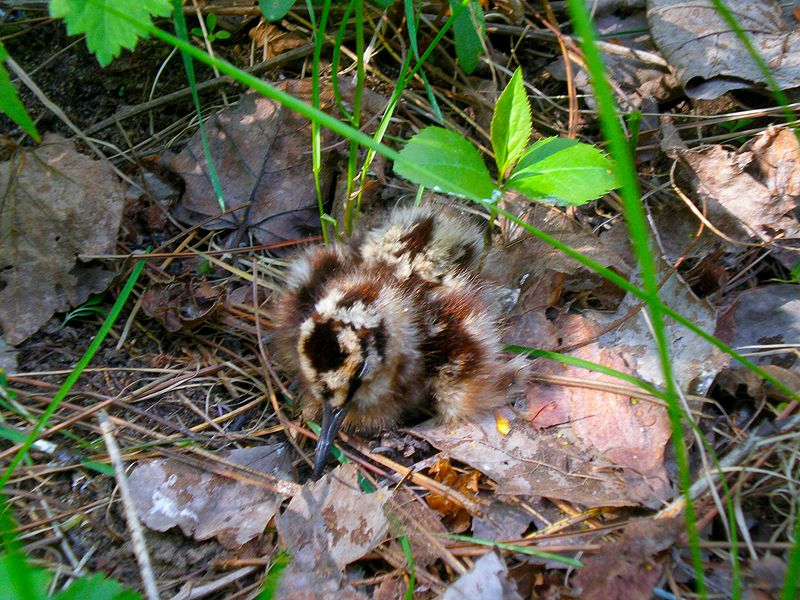
American Woodcock (Scolopax minor) chick ©WikiC

American Woodcock (Scolopax minor) chick ©WikiC

Being fairly certain that the worm is within reach, the bird pushes its bill into the ground. But this isn’t just any old bill! The flexible tip, which allows it to open and close in a tweezer fashion within tiny spaces, has highly sensitive nerve endings. It allows the woodcock to know that it has grasped its meal.
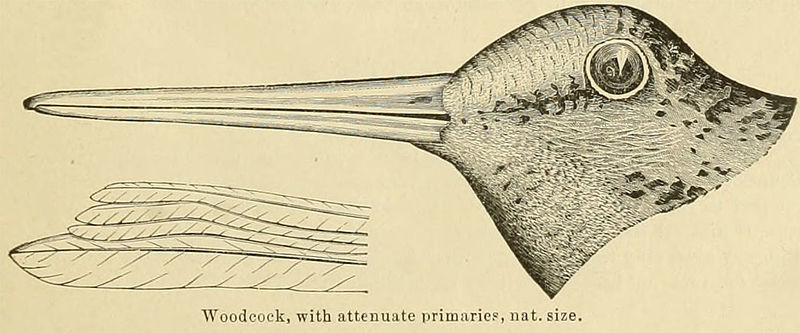
A nocturnal animal, the woodcock is probably best known for its bizarre courtship behaviour. At dusk, the male of the species will circle high in the sky on a spring night making a continual ‘twittering’ noise. At this highest point, he’ll suddenly dive in a zig-zag fashion toward the earth. It’s a most unusual display, completely captivating his mate-to-be. The three outer primary feathers not only make the strange sounds of this courting male, but also contribute greatly to his survival. When the woodcock is in danger of being discovered by a predator, it will explode from its concealment. In so doing, those feathers make such an unexpected and horrible noise, that often the predator is temporarily shocked. This brief moment is all the time the bird needs to make its escape!1

When it is realized how many of these complicated factors must come together, at the same time, just for the bird to survive, that all this could come from gradual, piecemeal evolution defies credibility.

The outdoors is chock full of unique and fascinating organisms, like the American Woodcock, just waiting to be discovered by both children and adults alike. All of creation, though now fallen from its original perfection, holds a wonder and fascination that finds its meaning in the Creator God who put it there! Evidence of His handiwork can be seen and understood. And evidence can be logically discussed in scientific circles, so be bold, be confident and be in awe of His creative abilities!

The world today needs more people who will proclaim the news in every land that Jesus Christ, the awesome Creator, came to us, lived amongst us, died and rose again for us!

‘Be strong and of a good courage; be not afraid, neither be thou dismayed: for the Lord thy God is with thee whithersoever thou goest’ (Joshua 1:9).

by Tom Hennigan September 1, 1997

Tom Hennigan, B.S., M.S.,is an environmental educator with DeRuyter Central Schools, New York. He operates a creation ministry called, ‘Genesis Moment Ministries’.

Permission from © 2013 Answers in Genesis – www.AnswersInGenesis.org.


Lee’s Addition:

The American Woodcock belongs to the Scolopacidae – Sandpipers, Snipes Family which has 96 species, of which 8 are Woodcocks.

“The American Woodcock (Scolopax minor), sometimes colloquially referred to as the Timberdoodle, is a small chunky shorebird species found primarily in the eastern half of North America. Woodcocks spend most of their time on the ground in brushy, young-forest habitats, where the birds’ brown, black, and gray plumage provides excellent camouflage.

Because of the male Woodcock’s unique, beautiful courtship flights, the bird is welcomed as a harbinger of spring in northern areas. It is also a popular game bird, with about 540,000 killed annually by some 133,000 hunters in the U.S. (Ugh!)

The American Woodcock is the only species of Woodcock inhabiting North America. Although classified with the sandpipers and shorebirds in Family Scolopacidae, the American Woodcock lives mainly in upland settings. Its many folk names include timberdoodle, bogsucker, night partridge, brush snipe, hokumpoke, and becasse.

The American Woodcock has a plump body, short legs, a large, rounded head, and a long, straight prehensile bill. Adults are 10 to 12 inches (25 to 30 cm) long and weigh 5 to 8 ounces (140 to 230 g). Females are considerably larger than males.] The bill is 2.5 to 2.75 inches (6.4 to 7.0 cm) long.

American Woodcock (Scolopax minor) 1891 ©WikiC

American Woodcock (Scolopax minor) 1891 ©WikiC

The plumage is a cryptic mix of different shades of browns, grays, and black. The chest and sides vary from yellowish white to rich tans. The nape of the head is black, with three or four crossbars of deep buff or rufous. The feet and toes, which are small and weak, are brownish gray to reddish brown.[8]

Woodcock have large eyes located high in the head, and their visual field is probably the largest of any bird, 360° in the horizontal plane and 180° in the vertical plane.

The Woodcock uses its long prehensile bill to probe in the soil for food, mainly invertebrates and especially earthworms. A unique bone-and-muscle arrangement lets the bird open and close the tip of its upper bill, or mandible, while it is sunk in the ground. Both the underside of the upper mandible and the long tongue are rough-surfaced for grasping slippery prey.

In Spring, males occupy individual singing grounds, openings near brushy cover from which they call and perform display flights at dawn and dusk, and if the light levels are high enough on moonlit nights. The male’s ground call is a short, buzzy peent. After sounding a series of ground calls, the male takes off and flies from 50 to 100 yards into the air. He descends, zigzagging and banking while singing a liquid, chirping song. This high spiralling flight produces a melodious twittering sound as air rushes through the male’s outer primary wing feathers.” (Wikipedia with editing)

Audios from xeno-canto

Links:

*

Green Heron Fishing With Bread

You have got to watch this Green Heron fishing with bread. The video speaks for itself.

Look at the birds of the air, for they neither sow nor reap nor gather into barns; yet your heavenly Father feeds them. Are you not of more value than they? (Matthew 6:26 NKJV)

*

*

Ardeidae- Herons, Bitterns

Birds of the Bible – Herons

Bible Birds – Herons

*

Birdwatching – American Coot

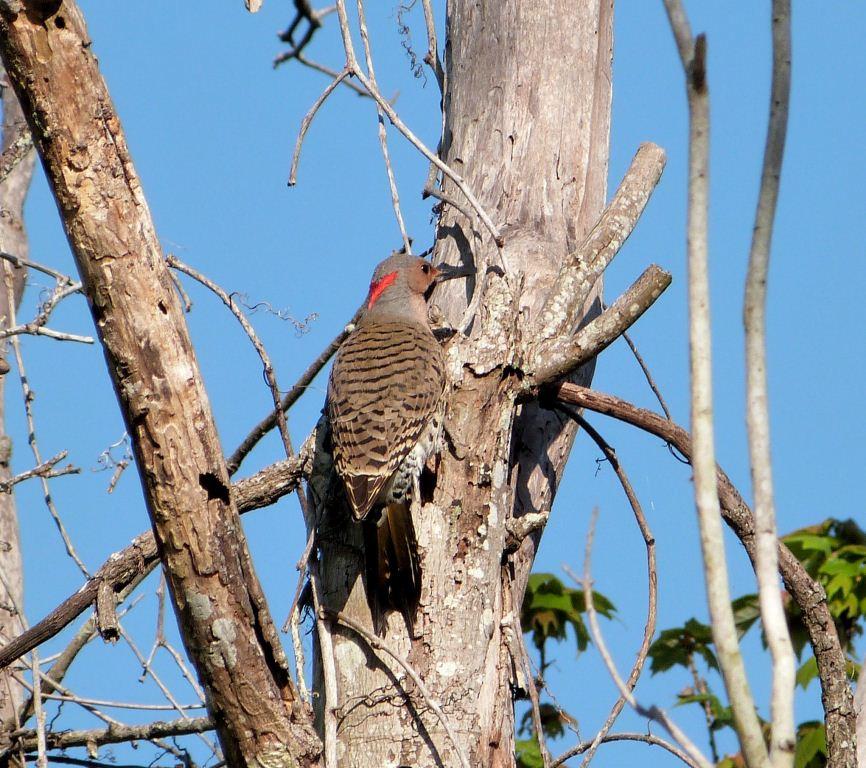
Northern Flicker cropped

Northern Flicker at S. Lake Howard by Lee

Dan and I went birdwatching last week at South Lake Howard Nature Park here in Winter Haven. We just stopped by on the way home from an errand. Captured a Northern Flicker with the camera, but the video is of the Coot’s feet. I have trying to get a photo of them because they are so different from other bird’s feet. Their feet are not webbed, but sort of flattened out. We only see them down here in the winter. See the Wikipedia information below. Apparently it helps them walk on the land, but it seems that a soft soil just under the water would be “squishy” and that may help their footing. Isn’t it neat how the Lord, in Him wisdom, provided for them in such a way.

O LORD, how manifold are your works! In wisdom have you made them all; the earth is full of your creatures. (Psalms 104:24 ESV)

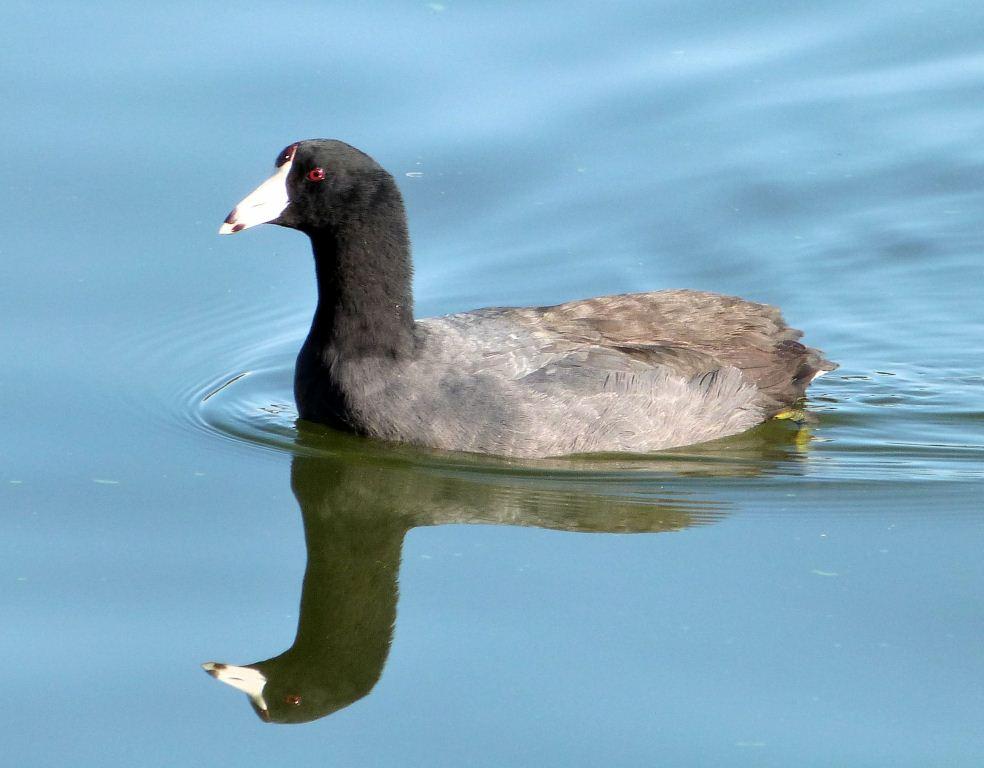
The American Coot (Fulica americana) is a bird of the Rallidae – Rails, Crakes & Coots Family. Though commonly mistaken to be ducks, American Coots come from a distinct family. Unlike ducks, Coots have broad lobes of skin that fold back with each step in order to facilitate walking on dry land. They live near water, typically inhabiting wetlands and open water bodies in North America. Groups of these black-feathered, white-billed birds are called covers or rafts. The oldest known Coot lived to be 22 years old.

The American coot is a migratory bird that occupies most of North American. They live in the Southwestern United States, Mexico, and the pacific coast year round, and only occupy the northeastern regions during the summer breeding season. In the winter they can be found as far south as Panama. They generally build floating nests and lay 8-12 eggs per clutch. American coots eat primarily algae and other aquatic plants but they do eat animals (both vertebrates and invertebrates) when available.

Much research has been done on the breeding habits of American Coots. Studies have found that mothers will preferentially feed offspring with the brightest plume feathers, a characteristic known as chick ornaments. American coots are also susceptible to conspecific brood parasitism, and identify which offspring are theirs and which are from parasitic females.

The American Coot measures 13–17 in (34–43 cm) in length and 23–28 in (58–71 cm) across the wings. Adults have a short thick white bill and white frontal shield, which usually has a reddish-brown spot near the top of the bill between the eyes. Males and females look alike, but females are smaller. Juvenile birds have olive-brown crowns and a gray body. They become adult-colored around 4 months of age

The American Coot has a variety of repeated calls and sounds. Male and female Coots make different types of calls to similar situations. Male alarm calls are “puhlk” while female alarm calls are “poonk”. Also, stressed males go “puhk-cowah” or “pow-ur” while females call “cooah”

See the Sounds page of All About Birds for the American Coot.

American Coots are found near water—reed-ringed lakes and ponds, open marshes, and sluggish rivers. They prefer freshwater environments, but may temporarily live in saltwater environments during the winter months.

The American Coot’s breeding habitat extends from marshes in southern Quebec to the Pacific coast of North America and as far south as northern South America. Birds from temperate North America east of the Rocky Mountains migrate to the southern United States and southern British Columbia. It is often a year-round resident where water remains open in winter. The number of birds that stay year-round near the northern limit of the species’ range seems to be increasing.

Autumn migration occurs from August to December, with males and non-breeders moving south before the females and juveniles. Spring migration to breeding ranges occurs from large February to mid-May, with males and older birds moving North first. There has been evidence of birds travelling as far north as Greenland and Iceland. It is a rare but regular vagrant to Europe. The American Coot is a highly gregarious species, particularly in the winter, when its flocks can number in the thousands. The picture below is just of one group of hundreds at Viera Wetlands that day (2012)

American Coot (Fulica americana) at Viera Wetlands by Lee

American Coot (Fulica americana) at Viera Wetlands by Lee

The American Coot can dive for food but can also forage and scavenge on land. It is omnivorous, eating plant material, arthropods, fish, and other aquatic animals. Its principal source of food is aquatic vegetation, especially algae. During breeding season, Coots are more likely to eat aquatic insects and mollusks—which constitute the majority of a chick’s diet.

The American Coot is a prolific builder and will create multiple structures during a single breeding season. It nests in well-concealed locations in tall reeds. There are three general types of structures: display platforms, egg nests and brood nests. Egg nests are typically 12 inches in diameter with a 12-15 inch ramp that allows the parents to enter and exit without tearing the sides of the nests. Coots will often build multiple egg nests before selecting one to lay their eggs in. Brood nests are nests that are either newly constructed or have simply been converted from old egg nests after the eggs hatch. They are simply larger egg nests. Egg and brood nests are actually elaborate rafts, and must be constantly added to in order to stay afloat. Females typically do the most work while building.

Females deposit one egg a day until the clutch is complete. Eggs are usually deposited between sunset and midnight. Typically, early season and first clutches average two more eggs than second nesting and late season clutches. Early season nests see an average of 9.0 eggs per clutch while late clutches see an average of 6.4 eggs per clutch. There is an inverse relationship between egg weights and laying sequence, wherein earlier eggs are larger than eggs laid later in the sequence. It is possible to induce a female Coot to lay more eggs than normal by either removing all or part of her clutch. Sometimes, a female may abandon the clutch if enough eggs are removed. Coots, however, do not respond to experimental addition of eggs by laying fewer eggs.

Incubation start time in the American Coot is variable, and can begin anywhere from the deposition of the first egg to after the clutch is fully deposited. Starting incubation before the entire clutch has been laid is an uncommon practice among birds. Once incubation starts it continues without interruption. Male and female Coots share incubation responsibility, but males do most of the work during the 21-day incubation period. Females will begin to re-nest clutches in an average of six days if clutches are destroyed during incubation.

Hatch order usually follows the same sequence as laying order. Regardless of clutch size, eight is the typical maximum size of a brood. Egg desertion is a frequent occurrence among Coots because females will often deposit more than eight eggs. Brood size limits incubation time, and when a certain number of chicks have hatched the remaining eggs are abandoned. The mechanism for egg abandonment has not yet been discovered. Food resource constraints may limit the number of eggs parents let hatch, or the remaining eggs may not provide enough visual or tactile stimulation to elicit incubation behavior. An American Coot can be forced to hatch more eggs than are normally laid. These additional offspring, however, suffer higher mortality rates due to inadequacy in brooding or feeding ability.

American Coot (Fulica americana) by Lee at Lk Morton

American Coot (Fulica americana) by Lee at Lk Morton

The American Coot, unlike other parasitized species, has the ability to recognize and reject conspecific parasitic chicks from their brood. Parents aggressively reject parasite chicks by pecking them vigorously, drowning them, preventing them from entering the nest, etc. They learn to recognize their own chicks by imprinting on cues from the first chick that hatches. The first-hatched chick is a reference to which parents discriminate between later-hatched chicks. Chicks that do not match the imprinted cues are then recognized as parasite chicks and are rejected.

Chick recognition reduces the costs associated with parasitism, and Coots are one of only three bird species in which this behavior has been observed. This is because hatching order is predictable in parasitized Coots—host eggs will reliably hatch before parasite eggs. In other species where hatching order is not as reliable, there is a risk of misimprinting on a parasite chick first and then rejecting their own chicks. In these species, the cost of accidentally misimprinting is greater than the benefits of rejecting parasite chicks.

The first evidence for parental selection of exaggerated, ornamental traits in offspring was found in American Coots. Black American Coot chicks have conspicuously orange-tipped ornamental plumes covering the front half of their body that are known as “chick ornaments” that eventually get bleached out after six days. This brightly colored, exaggerated trait makes Coot chicks more susceptible to predation and does not aid in thermoregulation, but remains selected for by parental choice. These plumes are not necessary for chick viability, but increased chick ornamentation increases the likelihood that a chick will be chosen as a favorite by the parents. Experimental manipulation of chick ornamentation by clipping the bright plumes have shown that parents show clear preferences for ornamented chicks over non-ornamented ones.

The American Coot is fairly aggressive in defense of its eggs and, in combination with their protected nesting habitat, undoubtedly helps reduce losses of eggs and young to all but the most determined and effective predators. American Crows, Black-billed Magpies and Forster’s Tern can sometime take eggs. Mammalian predators (including red foxes, coyotes, skunks and raccoons) are even less likely to predate coot nests, though nests are regularly destroyed in usurpation by muskrats. Conversely, the bold behavior of immature and adult coots leads to them falling prey with relative regularity once out of the breeding season. Regular, non-nesting-season predators include Great Horned Owls, Northern Harriers, Bald Eagles, Golden Eagles, American alligators, bobcats, Great Black-backed and California Gulls. In fact, Coots may locally comprise more than 80% of the Bald Eagle diet.

In culture – On the Louisiana coast, the Cajun word for coot is pouldeau, from French for “coot”, poule d’eau – literally “water hen”. Coot can be used for cooking; it is somewhat popular in Cajun cuisine, for instance as an ingredient for gumbos cooked at home by duck hunters.

(From Wikipedia and All About Birds with editing)

See also:

Birdwatching Trips

Rallidae – Rails, Crakes & Coots Family

American Coot – What Bird

American Coot – All About Birds

American Coot – Wikipedia

Birds of the World

*

Birds of the World – Subspecies With Various “Colors”

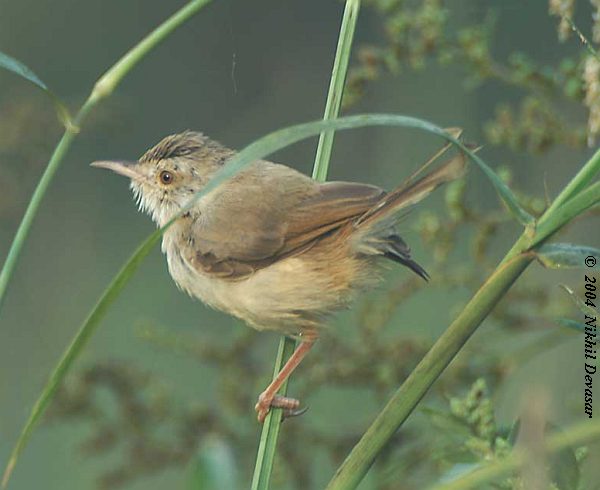
Plain Prinia (Prinia inornata) by Nikhil Devasar

Plain Prinia (Prinia inornata) by Nikhil Devasar

Out of the ground the LORD God formed every beast of the field and every bird of the sky, and brought them to the man to see what he would call them; and whatever the man called a living creature, that was its name. (Genesis 2:19 NASB)

While working on the new updates for the IOC 2.10 Version, I kept noticing the word “color” in the scientific names as I sorted and resorted the Excel spreadsheet. This is a third of the “color” articles. There are concolordiscolor, bicolor, tricolor, unicolor, quadricolor, quinticolor, multicolor,  versicolor, nocticolor, coelicolor, decolor, fumicolor, niscolor,  schisticolor,  subunicolor, sitticolor.

In the subspecies (ssp.) there are a few additional “colors” that show up – arenicolor, caelicolor, caerebicolor, cervinicolor, deserticolor, ruficolor, terricolor.   For now, let’s see what the subspecies “color” birds are. Most have just only one or two birds with that “color” name. Where a photo of the subspecies could not be found, the nominate bird is shown.

arenicolor = aren, sand + color

Bar-tailed Lark (Ammomanes cinctura arenicolor) by Keith Blomerley

The Bar-tailed Lark (Ammomanes cinctura) is a species of lark in the Alaudidae family. It is found in Afghanistan, Algeria, Cape Verde, Chad, Egypt, Iran, Iraq, Israel and Palestine, Italy, Jordan, Kuwait, Lebanon, Libya, Mali, Malta, Mauritania, Morocco, Niger, Oman, Pakistan, Saudi Arabia, Sudan, Syria, Tunisia,and Yemen. Its natural habitat is hot deserts.

I do not know Latin, nor what Scientific words mean, but I have a copy of the Latin Vulgate on my e-Sword Program. I decided to look up these words and see what I might find. While searching for “aren” I found the word “harenam” which translates to “sand.”

How precious also are thy thoughts unto me, O God! how great is the sum of them! If I should count them, they are more in number than the sand: when I awake, I am still with thee. (Psalms 139:17-18 KJV)

caelicolor = sky blue + color

caeli” translates to “heaven” in most verses.

The heavens are thine, the earth also is thine: as for the world and the fulness thereof, thou hast founded them. (Psalms 89:11 KJV)

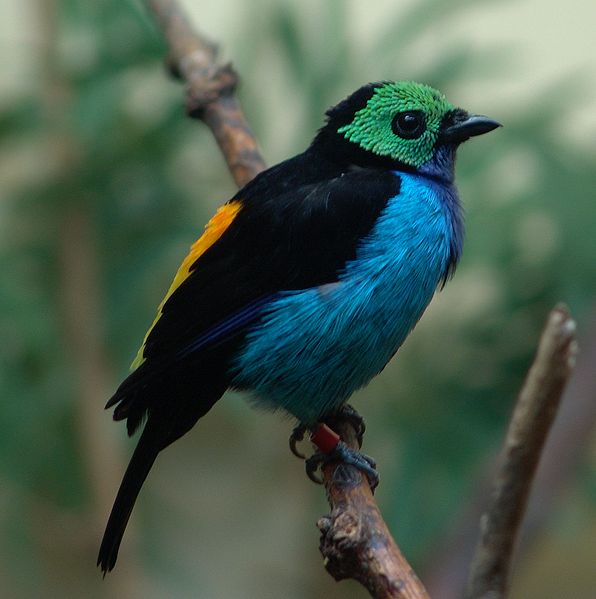
See Paradise Tanager (Tangara chilensis caelicolor)

Paradise Tanager (Tangara_chilensis) -DenverZoo-©WikiC

Paradise Tanager (Tangara_chilensis) -DenverZoo-©WikiC

caerebicolor = caer (blue) + bicolor (Having two colors)

(Couldn’t figure this one out in Latin)

Blue Dacnis (Dacnis cayana, ssp caerebicolor)

Blue Dacnis (Dacnis cayana) by Dario Sanches

Blue Dacnis (Dacnis cayana) by Dario Sanches

Velvet Flycatcher (Myiagra hebetior) also known as Dull or Lesser Shining Flycatcher
The Dull Flycatcher (Myiagra hebetior) is a species of bird in the Monarchidae family. It is endemic to Papua New Guinea. Its natural habitats are subtropical or tropical moist lowland forests and subtropical or tropical moist montanes.

cervinicolor = cervix (neck) + color

cervi” translates to “neck” in most verses. (cervis = stiff-necked)

He who is often rebuked, and hardens his neck, Will suddenly be destroyed, and that without remedy. (Proverbs 29:1 NKJV)

Shining Flycatcher (Myiagra alecto) by Ian

Shining Flycatcher (Myiagra alecto) by Ian (closest to Velvet I could find)

Velvet Flycatcher (Myiagra hebetior cervinicolor)

deserticolor = desert + color

deserti” translates to “desert” or “wilderness“.

Indian Scops Owl (Otus bakkamoena) pair by Nikhil Devasar

Indian Scops Owl (Otus bakkamoena) pair by Nikhil Devasar

Indian Scops Owl (Otus bakkamoena deserticolor) – Video IBC

“A medium (smaller than the Collared) sized scops owl with large conspicuous ear-tufts. Sandy grey-brown, spotted and mottled dark brown and black. There is also a rufous phase. Underparts light grey-buff. Has a distinct nuchal collar and also a second collar on nape. Eyes are dark brown.” (Delhibird)

Common Miner (Geositta cunicularia) ©WikiC

Common Miner (Geositta cunicularia) ©WikiC

Common Miner (Geositta cunicularia deserticolor)

“The Common Miner (Geositta cunicularia) is a passerine bird of South America, belonging to the ovenbird family. It is a ground-dwelling bird which feeds on insects and seeds. It has about 9 different subspecies, some of which may be better treated as separate species.
It is 14 to 16 cm long with a fairly long, slightly downcurved bill. The plumage varies geographically but is basically brown above and pale below with a streaked breast, pale stripe over the eye, dark edge to the ear-coverts and pale rufous bar across the wing. The tail is dark with a buff base and variable amounts of buff on the outer feathers. The trilling song is often given in flight and also varies geographically.” (Wikipedia)

Chinese White-browed Rosefinch (Carpodacus dubius deserticolor) Video by Keith Blomerley

The Chinese White-browed Rosefinch (Carpodacus dubius) is a true finch species (family Fringillidae). It is one of the rosefinches that might belong in the genus Propasser.
It is found in China and Tibet. Its natural habitats are temperate forests and temperate shrubland.

ruficolor = rufilata (Latin), rufus, reddish + color

rufi” translates to “red” or “Rufus“-a name.

In the first chariot were red horses; and in the second chariot black horses; (Zechariah 6:2 KJV)
in quadriga prima equi rufi et in quadriga secunda equi nigri (Zechariah 6:2 Vulgate)

Thekla Lark (Galerida theklae) by ©WikiC

Thekla Lark (Galerida theklae) by ©WikiC

Thekla Lark (Galerida theklae ruficolor) Video IBC

“The Thekla Lark, Galerida theklae, breeds in Iberia, northern Africa, and sub-Saharan Africa from Senegal to Somalia. It is a sedentary species. This is a common bird of dry open country, often at some altitude. It nests on the ground, laying two to six eggs. Its food is weed seeds and insects, the latter especially in the breeding season.
This is a smallish lark, slightly smaller than Skylark. It has a long spiky erectile crest. It is greyer than Skylark, and lacks the white wing and tail edged of that species.” (Wikipedia)

terricolor = terr- (dry land) or (land, earth, ground) + color

“terr+” brought up “3,147 verses found, 3547 matches” (Needless to say, I did not check them all out.) “terra” translates as above, “earth”, “land”, “ground.”

In the beginning God created the heaven and the earth. (Genesis 1:1 KJV)

Plain Prinia (Prinia inornata) by Nikhil Devasar

Plain Prinia (Prinia inornata) by Nikhil Devasar

Plain Prinia (Prinia inornata terricolor) Video IBC – Photo

“The Plain Prinia, or the Plain, or White-browed, Wren-Warbler[2] (Prinia inornata) is a small warbler in the cisticola family. It is a resident breeder from Pakistan and India to south China and southeast Asia. It was formerly included in the Tawny-flanked Prinia, Prinia subflava (Gmelin, 1789), resident in Africa south of the Sahara. The two are now usually considered to be separate species.
This skulking passerine bird is typically found in wet lowland grassland, open woodland, scrub and sometimes gardens. The Plain Prinia builds its nest in a shrub or tall grass and lays 3-6 eggs.”

White-browed Sparrow-Weaver (Plocepasser mahali) ©WikiC

White-browed Sparrow-Weaver (Plocepasser mahali) ©WikiC

White-browed Sparrow-Weaver (Plocepasser mahali terricolor) Video of (Plocepasser mahali melanorhynchus) IBC

The White-browed Sparrow-Weaver (Plocepasser mahali; Afrikaans: Koringvoël) is a predominantly brown, sparrow-sized weaver found throughout central and northcentral southern Africa. It is found in groups of two to eleven individuals consisting of one breeding pair and nonreproductive individuals.
P. m. terricolor is found towards the center of the White-Browed Sparrow-Weaver’s range, occurring predominantly in eastern Botswana.

I trust that you were not bored, but enjoyed the Latin lesson thrown in. I am always curious as to how they come up with these Scientific Names. It was interesting to find out some of these meanings. In the mean time we have seen some birds that the Lord created that we probably have never seen before. I love that Paradise Tanager the most, but the others are great also.

*

Articles for additional information:

Birds of the World

Scientific bird names explained Very good
Bird Names
Zoological Nomenclature Resource
List of Latin words with English derivatives – Wikipedia
List of Greek words with English derivatives – Wikipedia
Key to the Pronunciation and Meaning of Scientific Names of Popular Species
What’s in a Bird Family Name
CalPhotos: Browse Bird Scientific Names
North American Bird Name Origins

*

Updating The Birds of the World Again 2/24/11

Lesser Rhea (Rhea pennata tarapacensis) (Darwin's) Chicks©Arthur Grosset

Lesser Rhea (Rhea pennata tarapacensis) (Darwin’s) Chicks©Arthur Grosset

The I.O.C. has updated to Version 2.7, but they are also getting ready to release a whole new format in Version 3.0. They placed the Ver. 2.7 in a draft which includes the Subspecies. After experimenting with several different ways to present the list, I have made my choice. This means that I have been busy behind the scene working on this website. (Lee’s Birdwatching Adventures Plus)

So far I have updated the following Families:
Tinamous – Tinamidae
Ostriches – Struthionidae
Rheas – Rheidae
Cassowaries – Casuariidae
Emu – Dromaiidae

The I.O.C. is now the I.O.U. “Our goal on behalf of the International Ornithologist’s Union, formerly International Ornithological Congress (IOC), is to facilitate worldwide communication in ornithology and conservation through the consistent use of English names linked to current species taxonomy. The English names follow explicit guidelines for spelling and construction that increase clarity of application. To this end we provide a complete list of the extant bird species of the world.”

IOC World Bird List – Subspecies (Draft 1)

Supplementing the release of version 2.7 of the IOC World Bird List is a preview of our draft listing of the subspecies of the world’s birds along with the authors and dates attributed to their nomenclature.  This working draft will provide the taxonomic foundation for version 3.0.

The above quotes are from the IOC World Bird List website. Since they are making a major revision, I decided to get started on updating to match their way of listing birds. I have been using the IOC lists of World Birds since starting the Birds of the World section.

There are 233 Families of birds, which means I have 233 pages of data to update. So, I have 5 down and 228 to go. For now the indexes to the families will not change, but a few birds may not be correct until I finish. Try not to be too upset about the dust flying around as the changes are being made. Trust the 3.0 Version is close to what I am doing.

The main difference is that before only the bird was named, such as: (All photos by Bob-Nan)

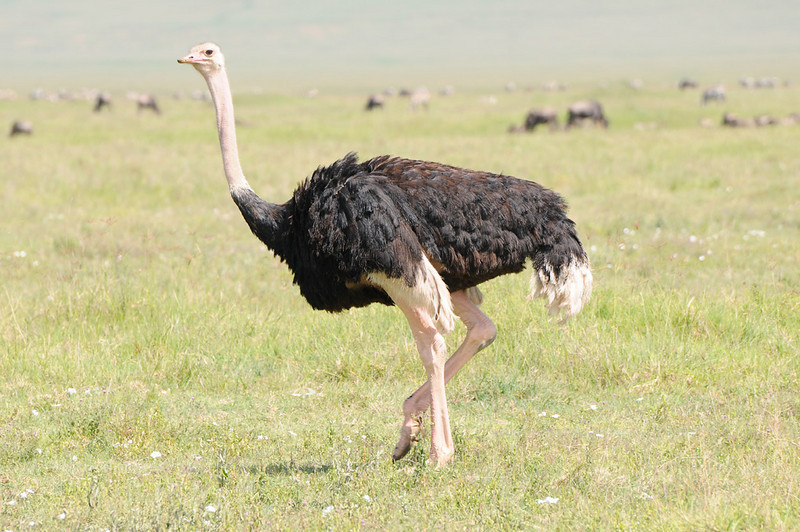
Common Ostrich (Struthio camelus)
Somali Ostrich (Struthio molybdophanes)

Now it is:

Struthio   ———- This is the Genus
Common Ostrich (Struthio camelus) ————– This is the Species
____ (Struthio camelus syriacus)  ——- This is the Subspecies
____ (Struthio camelus camelus)  ——- This is the Subspecies
____ (Struthio camelus massaicus) ——- This is the Subspecies
____ (Struthio camelus australis)  ——- This is the Subspecies
Somali Ostrich (Struthio molybdophanes) ————– This is the Species

Common Ostrich (Struthio camelus massaicus) by Bob-Nan

Common Ostrich (Struthio camelus massaicus) by Bob-Nan

I trust this helps explain the new layout for the list of world birds. It’s time for me to start kicking up some more dust as I continue with the changes. I am going straight down the list of families – Family Index. Keep checking back to see how far I have gotten. Updating all the links to the pictures and videos is the most time consuming.

It is worth it though to help you see the fantastic birds the Lord has created around this world. I personally have great pleasure working on this because I get to see so many birds that I will never personally view. Thanks to the many photographers and videographers, those that have given us permission, the ones who allow their photos to used in ©© (Creative Commons), ©WikiC (Wikipedea Commons), and others in public domain.

And out of the ground the LORD God formed every beast of the field, and every fowl of the air; and brought them unto Adam to see what he would call them: and whatsoever Adam called every living creature, that was the name thereof. (Genesis 2:19 KJV)

Remember his marvellous works that he hath done; his wonders, and the judgments of his mouth; (Psalms 105:5 KJV)

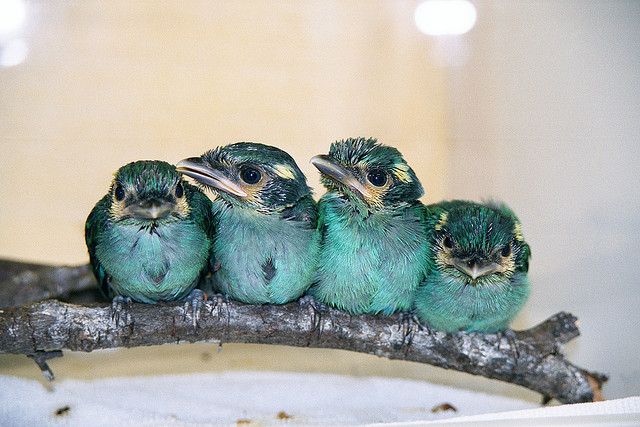
Long-tailed Broadbill (Psarisomus dalhousiae) babies ©©coracii

Long-tailed Broadbill (Psarisomus dalhousiae) babies ©©coracii

That they may see, and know, and consider, and understand together, that the hand of the LORD hath done this, and the Holy One of Israel hath created it. (Isaiah 41:20 KJV)

Let them praise the name of the LORD: for he commanded, and they were created. (Psalms 148:5 KJV)

Updated – See:

3/1/11 – Birdwatching and Still Updating

3/17/11 – Birdwatching and Still Kicking Up Dust

*

Kookaburra – Chattery Birds With A Merry Heart

Laughing Kookaburra (Dacelo novaeguineae) by Africaddict

Laughing Kookaburra (Dacelo novaeguineae) by Africaddict

A merry heart maketh a cheerful countenance: but by sorrow of the heart the spirit is broken. (Proverbs 15:13 KJV)

Blue-winged Kookaburra (Dacelo leachii) by Ian

Blue-winged Kookaburra (Dacelo leachii) by Ian

While updating the Kingfisher pages, I came across these videos about the Kookaburras that are in the same Alcedinidae Family. Thought you might enjoy watching them.

There are five Kookaburras. The Laughing Kookaburra (Dacelo novaeguineae) is probably the most well known, but there is also a Shovel-billed Kookaburra (Clytoceyx rex), Blue-winged Kookaburra (Dacelo leachii), Spangled Kookaburra (Dacelo tyro), Rufous-bellied Kookaburra (Dacelo gaudichaud).

Kookaburras are best known for their unmistakable call, which sounds uncannily like loud, echoing human laughter — good-natured, but rather hysterical, merriment in the case of the renowned Laughing Kookaburra (Dacelo novaeguineae); and maniacal cackling in the case of the slightly smaller Blue-winged Kookaburra (D. leachii). They are generally not closely associated with water, and can be found in habitats ranging from humid forest to arid savanna, but also in suburban and residential areas near running water and where food can be searched for easily.

This video is about the Laughing Kookaburra from the Blank Park Zoo

Kookaburra calls from the Cincinnati Zoo

A merry heart doeth good like a medicine: but a broken spirit drieth the bones. (Proverbs 17:22 KJV)

Some information from internet sources

Wordless Birds

*