Bible Birds – Bittern II

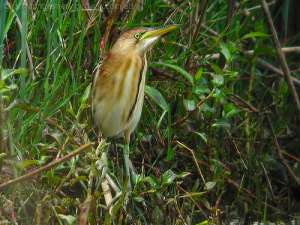
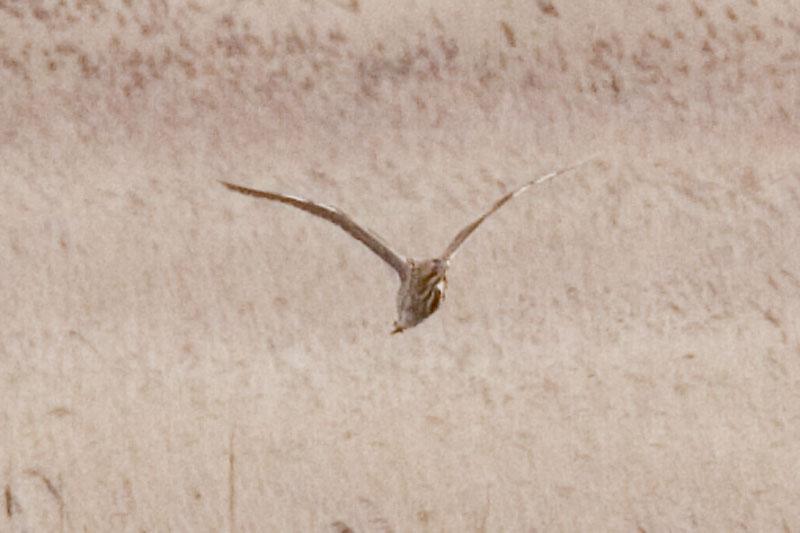
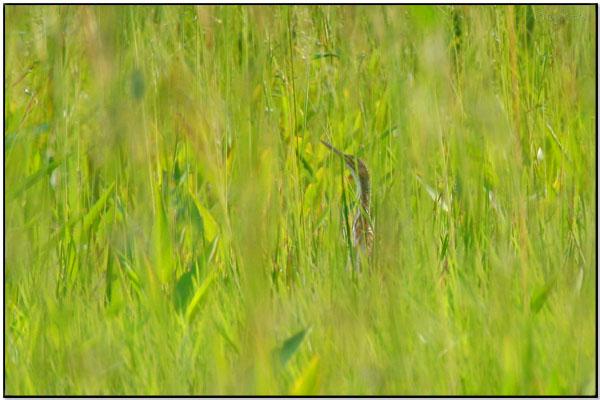
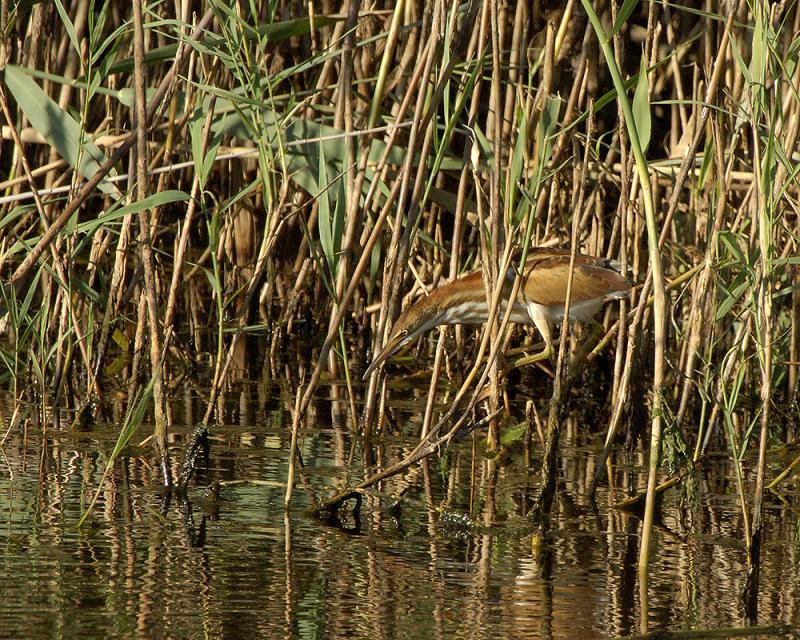
Little Bittern (Ixobrychus minutus) by Ian

Little Bittern (Ixobrychus minutus) by Ian

I will also make it a possession for the bittern, and pools of water: and I will sweep it with the besom of destruction, saith the LORD of hosts. (Isaiah 14:23 KJV)

I introduced the Bittern in the first Birds of the Bible – Bittern and now I want to add some more information about them. The Bitterns belong to the Order called Pelecaniformes which includes Ibises, Spoonbills, Herons, Bitterns, Frigatebirds, Hamerkop, Shoebills, Pelicans, Gannets, Boobies, Cormorants, Anhingas, and Darters. All of these birds like to hang out around watery places and are related. Within the Pelecaniformes order, there are different families. The Bittern is in the Ardeidae family. Below is a list of the Bitterns within this family.

Belonging to the Ardeidae family, they also have the usual long legs, long necks, and are wading birds. They are associated with water, especially in breeding season. Whereas the herons and egret stand out in the open, the bitterns like to conceal themselves in cattail and sedge marshes, bulrushes, etc. They also have shorter legs and a heavier body. Their “cryptic plumage and upright poses helps to merge with the brown upright reeds…” I’ve had the privilege to see a few of them, and they are hard to find. God has provided them with this protection and it helps them in finding their food. Fish is their favorite food, but they will also consume frogs, small snakes, and other things that pass by.

Here in North America, we only have the American and Least Bitterns. I sometimes confuse them with the smaller herons, like a Green Heron. You can tell they are in the same family (ardeidae).

Here is the sounds of an American Bittern and a Least Bittern from Stokes Bird Songs

But the cormorant and the bittern shall possess it; the owl also and the raven shall dwell in it: and he shall stretch out upon it the line of confusion, and the stones of emptiness. (Isaiah 34:11)


CLASS – AVES, Order – PELECANIFORMES, Family – ArdeidaeHerons, Bitterns

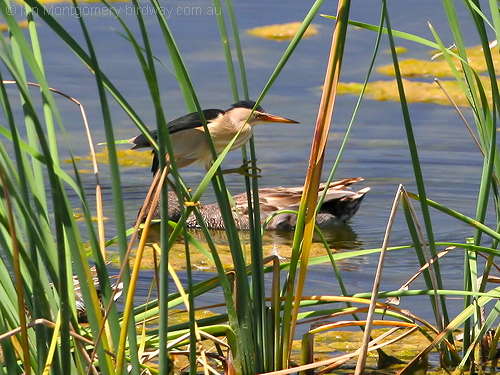
Australian Little Bittern (Ixobrychus dubius) by Ian

Australian Little Bittern (Ixobrychus dubius) by Ian

Herons, Bitterns – Ardeidae Family
Zonerodius
Forest Bittern (Zonerodius heliosylus) IBC
Botaurus
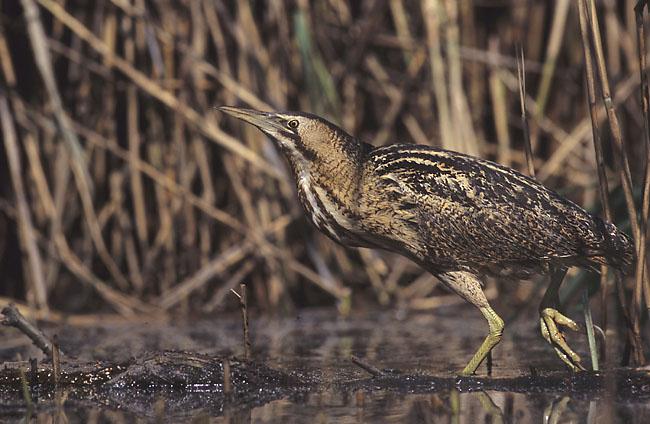
Eurasian Bittern (Botaurus stellaris) – Video
Australasian Bittern (Botaurus poiciloptilus) by Ian
American Bittern (Botaurus lentiginosus) – Video – Video2
Pinnated Bittern (Botaurus pinnatus) by Daves BirdingPix  – Video
Ixobrychus
Stripe-backed Bittern (Ixobrychus involucris) IBC
Least Bittern (Ixobrychus exilis) by Jim Fenton – Video
Little Bittern (Ixobrychus minutus) by Ian
Black-backed Bittern (Ixobrychus dubius)
New Zealand Bittern (Ixobrychus novaezelandiae †) Extinct ©WikiC Drawing
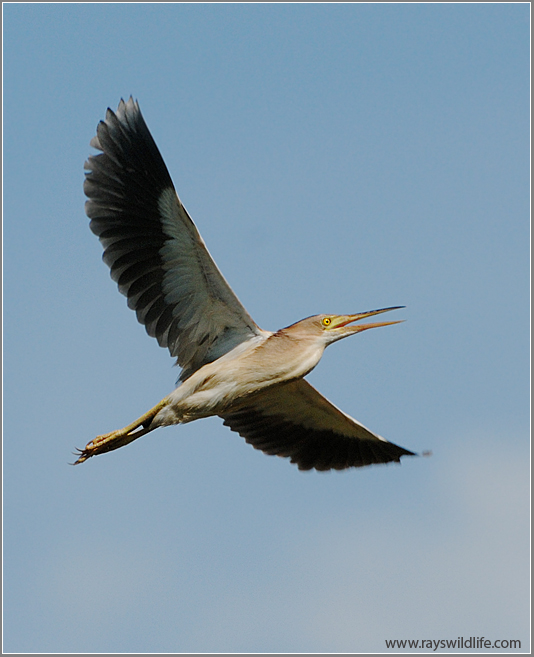
Yellow Bittern (Ixobrychus sinensis) by Ray Barlow – Video
Von Schrenck’s Bittern (Ixobrychus eurhythmus) ©WikiC
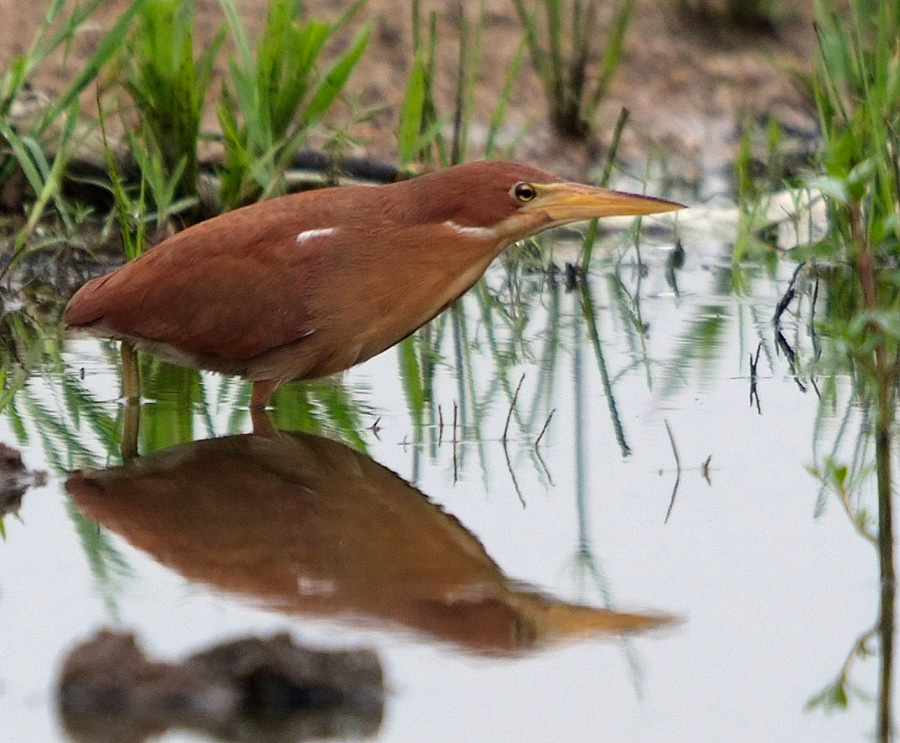
Cinnamon Bittern (Ixobrychus cinnamomeus) by Phil Kwong – Video
Dwarf Bittern (Ixobrychus sturmii) ©WikiC
Dupetor
Black Bittern (Dupetor flavicollis) by Nikhil Devasar – Video

Different Family
Sunbittern – Eurypygidae Family
Eurypyga
Sunbittern (Eurypyga helias) – Video – Video2

“Recent DNA evidence suggests that this family may in fact belong to the Pelecaniformes. From Wikipedia  They used to be in the Ciconiformes family, where most older guide books still have them. My list are from the IOC’s World Lists, 3.1 version.


Family#26 – Ardeidae

*

*

Ian’s Bird of the Week – Freckled Duck

Freckled Duck (Stictonetta naevosa) by Ian

Freckled Duck (Stictonetta naevosa) by Ian

Ian’s Bird of the Week – Freckled Duck ~ by Ian Montgomery

Newsletter ~ 9/30/13

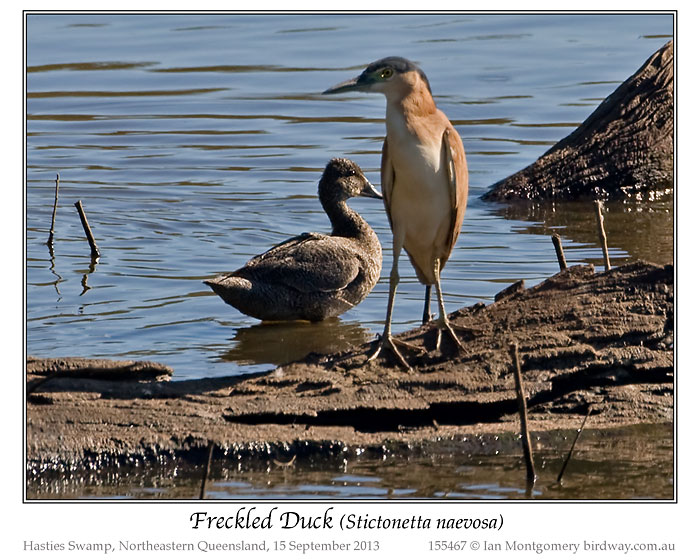
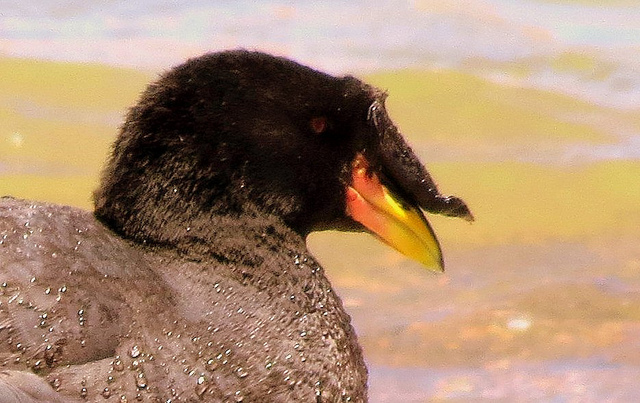
Several friends have inquired how I got on with the quest for Freckled Duck photos a fortnight ago, so here it is as bird of the week as it’s a rare and unusual duck, even if these ones didn’t want to cooperate in the portrait photo category. There were perhaps a dozen or more at the reported site of Hasties Swamp just south of Atherton town, but only two came within cooee of the hide and spent most of the day sitting on this log. Note the diagnostic ski-jump-shaped bill and the slight peak on the head of the bird on the end of the log. The duck beside this one is a Hardhead, so they’re approximately the same size.

It was a lovely day at Hasties (second photo), so it was no hardship loafing there waiting for the ducks to do something. The log the ducks liked is the farther one in this photo, but this was taken with my phone and makes it look farther away than it actually is. It’s a two storey hide, and this was taken from the upper deck, though I spent most of the time downstairs. The log was popular with various species of ducks including Pacific Blacks and Grey Teal, so the Freckled Ducks, all in non-breeding garb were easy to overlook.

Hasties Swamp, Atherton Tableland by Ian

Very occasionally, one of the ducks would swim over to a smaller log (hidden behind the branch in the second photo) and peck at a coot if it came too close. You can see the coot in the third photo.

Freckled Duck (Stictonetta naevosa) by Ian

Freckled Duck (Stictonetta naevosa) by Ian

Sometimes it would swim away to feed, but always on the other side of the log. In the fourth photo it is maybe contemplating such a foray, and is testing the water behind one of several Nankeen Night-Herons that came out to feed in the late afternoon – apparently they roost in the trees near the hide.

Freckled Duck (Stictonetta naevosa) by Ian

Freckled Duck (Stictonetta naevosa) by Ian

The fifth photo shows a distant pair of Freckled Ducks thirteen years ago in breeding condition at Werribee in Victoria and you can see the characteristic red colour of the male. The peaks look more conspicuous on both sexes, but I don’t know whether these feathers grow longer then or whether they are erectile.

Freckled Duck (Stictonetta naevosa) by Ian

Freckled Duck (Stictonetta naevosa) by Ian

So why is this rather drab duck so interesting to both birders and avian taxonomists? Firstly, it’s endemic to Australia and rare, particular in North Queensland. It’s main breeding range is in inland areas of New South Wales, Victoria, Southern Western Australia (an isolated population) and the channel country of Southwestern Queensland where breeding takes place in densely vegetated lakes and swamps, including lignum in more arid floodplains. When these areas dry out, the birds move to the coast, which is when they become easier to find. Presumably the birds currently in North Queensland (they’ve been reported in both Townsville and the Atherton Tableland) are from the Cooper’s Creek and Paroo River catchments.

Secondly, taxonomists find the Freckled Duck interesting because it has no close relatives. It is the only member of the genus Stictonetta and both morphological and DNA studies support placing it in own sub-family that diverged from other ducks and geese very early on. The name Stictonetta means ‘spotted duck’ in Greek and, in a case of tautological overkill, naevosa means ‘spot abundance’ in Latin.

I was going to include a Snake of the Week but this is getting rather long, so I’ll hold it over till next time.

Best wishes
Ian

**************************************************
Ian Montgomery, Birdway Pty Ltd,
454 Forestry Road, Bluewater, Qld 4818
Tel 0411 602 737 ian@birdway.com.au
Bird Photos http://www.birdway.com.au/
Recorder Society http://www.nqrs.org.au


Lee’s Addition:

What birdwatchers and photographers won’t go through to find those special and rare birds. Thanks, Ian, for showing us yet another interesting member of the Anatidae – Ducks, Geese & Swans Family. I am so thankful that Ian is letting me share his newsletters here on this blog. We have been introduced to numerous birds we have never have heard of, let along seen.

Check out all of Ian’s Anatidae Family photos.

Here are a few more facts about this duck from Wikipedia. The Freckled Duck (Stictonetta naevosa) is a moderately large, broad-bodied duck native to southern Australia. The duck is protected by law. Dark in colour with fine off-white speckles all over, it is most easily identified by its large head with a peaked (as opposed to rounded) crown.

The Freckled Duck feeds by dabbling in shallow water, often by wading near the edge. It prefers large, well-vegetated swamps, but moves to open water after breeding or in dry periods.

In flight, it has a distinctive rapid wing beat and holds its head low, making it appear hunchbacked. It does not turn rapidly and lands clumsily.

In dry years, the ephemeral wetlands of the Murray-Darling Basin and Lake Eyre disappear and Freckled Ducks migrate to permanent water in coastal regions. This concentration in populated areas, coupled with their habit of circling repeatedly at low altitude when disturbed (even when being shot at) makes them particularly vulnerable to hunting.

See:

Freckled Duck – Wikipedia

Ian’s Anatidae Family photos

Anatidae – Ducks, Geese & Swans Family

*

Birds of the Bible – Bitterns in Zephaniah

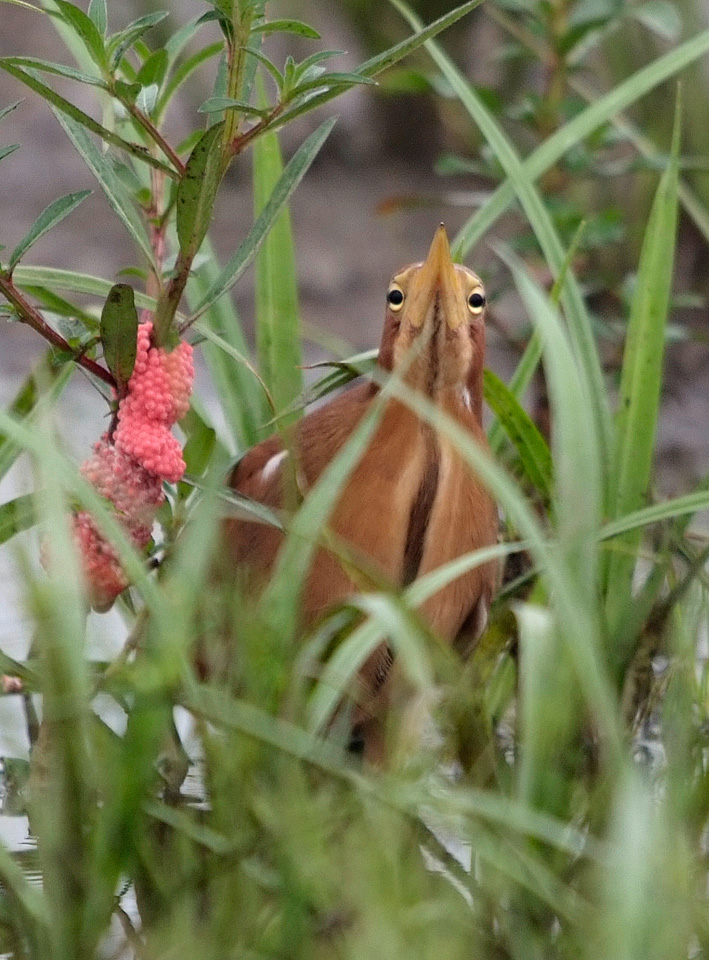
Cinnamon Bittern by Phil Kwong in Hong Kong

Cinnamon Bittern by Phil Kwong in Hong Kong

And flocks shall lie down in the midst of her, all the beasts of the nations: both the cormorant and the bittern shall lodge in the upper lintels of it; their voice shall sing in the windows; desolation shall be in the thresholds: for he shall uncover the cedar work. (Zephaniah 2:14 KJV)

This verse in Zephaniah is a bit confusing because some of the characteristics mentioned are not in line with a bittern’s normal behavior. So, let’s look into this verse a little deeper.

Pulling up my e-Sword program, I am heading to the “Compare” mode. Wow! This is going to be interesting. What a variation of birds and animals listed for that verse.

  • ACV, ASV, BBE, RV, Disciple’s, WEB – pelican and the porcupine
  • ABP, Brenton – chameleons; and hedgehogs
  • AKJV, KJV, IAV, JUB, UKJV, Webster – cormorant and the bittern
  • AMP, NAS77, NASB, YLT – pelican and the hedgehog
  • Bishops, Geneva – pellicanes and owles
  • CEV – all kinds of desert owls
  • CJB –  jackdaws and owls
  • Darby, ECB, HRB, LITV, JPS, MKJV, NKJV  – pelican and the bittern
  • DRB – bittern and the urchin
  • ERV – Owls and crows
  • ESV – owl and the hedgehog
  • GNB, MSG, NET – Owls
  • GW – pelicans and herons
  • HCSB, ISV, NIV, NRSV – desert owl and the screech owl
  • KJ2000 – vulture and the hedgehog
  • TRC – pelicans and storks

See what my mean?

Here are the Strong’s Definitions for those two word in order of occurance.

H6893
קאת
qâ’ath
kaw-ath’
From H6958; probably the pelican (from vomiting): – cormorant.

H7090
קפּד קפּוד
qippôd qippôd
kip-pode’, kip-pode’
From H7088; a species of bird, perhaps the bittern (from its contracted form): – bittern.

At least 14 versions use the “bittern” as one of the two birds. Now to look further in the verse, it mentions that they are lodged in the upper parts with their voice singing in the windows. That is where I am curious about it being a bittern. Have you heard a bittern “sing”? Here a few of their “songs” from xeno-canto.

Eurasian Bittern (Botaurus stellaris) ©WikiC

Eurasian Bittern (Botaurus stellaris) ©WikiC

Eurasian Bittern (Botaurus stellaris)

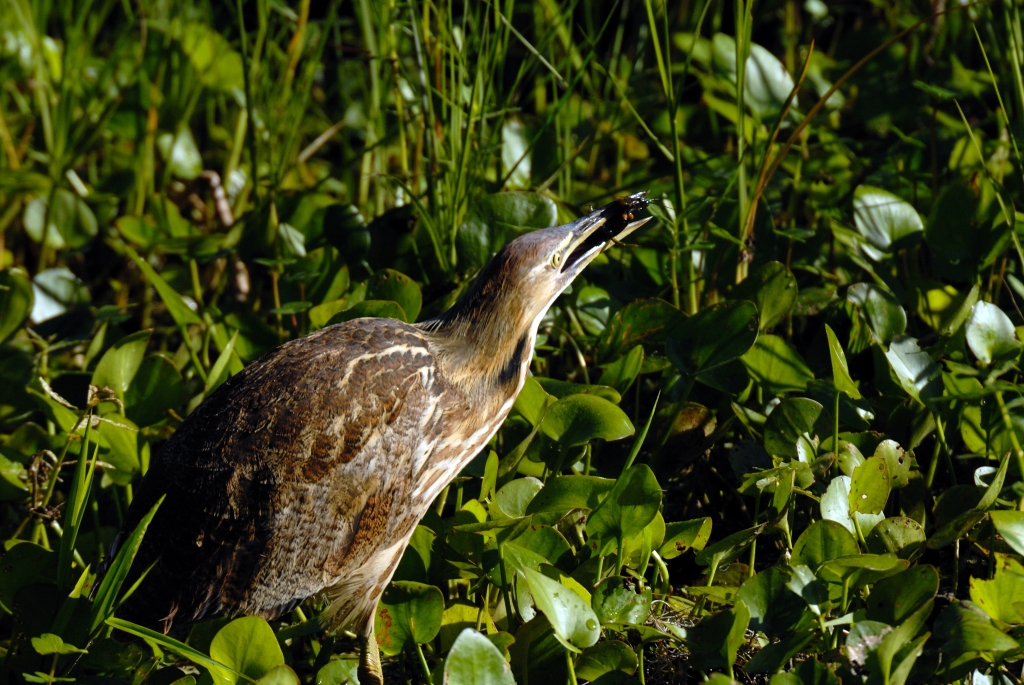
American Bittern (Botaurus lentiginosus) by Dans Pix

American Bittern (Botaurus lentiginosus) by Dans Pix

American Bittern (Botaurus lentiginosus)

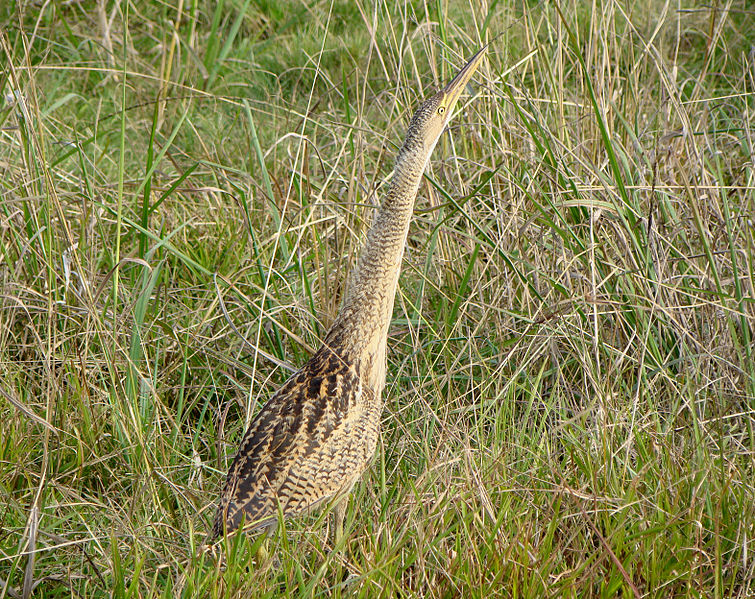
Pinnated Bittern (Botaurus pinnatus) by Daves BirdingPix ©WikiC

Pinnated Bittern (Botaurus pinnatus) by Daves BirdingPix ©WikiC

Pinnated Bittern (Botaurus pinnatus)

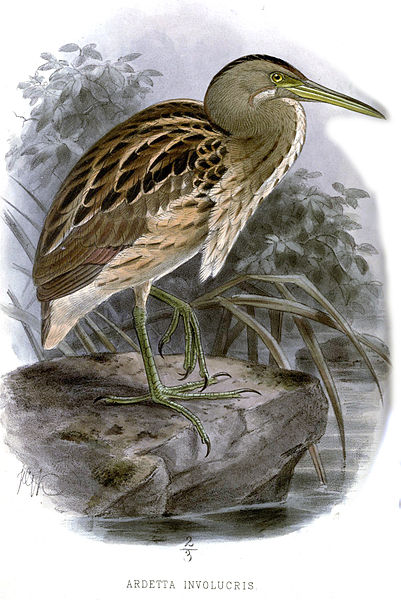
Stripe-backed Bittern (Ixobrychus involucris) ©Drawing WikiC

Stripe-backed Bittern (Ixobrychus involucris) ©Drawing WikiC

Stripe-backed Bittern (Ixobrychus involucris)

Least Bittern (Ixobrychus exilis)  by Bob-Nan

Least Bittern (Ixobrychus exilis) by Bob-Nan

Least Bittern (Ixobrychus exilis)

Least Bittern (Ixobrychus exilis)

*

I am not as concerned as to which birds were there as much as if you read the context, you realize that the birds and critters are there because the places are deserted. Like a “ghost town” you see in the movies, with creatures occupying the windows and rafters. Why? Because of the Lord’s judgement on the people. Verses 10-13 explain this:

This shall they have for their pride, because they have reproached and magnified themselves against the people of the LORD of hosts. The LORD will be terrible unto them: for he will famish all the gods of the earth; and men shall worship him, every one from his place, even all the isles of the heathen. Ye Ethiopians also, ye shall be slain by my sword. And he will stretch out his hand against the north, and destroy Assyria; and will make Nineveh a desolation, and dry like a wilderness. (Zephaniah 2:10-13 KJV)

Maybe we should heed the warnings and examples given throughout Scripture. We have a loving God and Lord who created everything and cares about it, but He is also a God of Judgment. John 3:16 tells us “For God so loved the world, that he gave his only begotten Son, that whosoever believeth in him should not perish, but have everlasting life.” But if you continue reading, you see that there is also judgment.

(17) For God sent not his Son into the world to condemn the world; but that the world through him might be saved.
(18) He that believeth on him is not condemned: but he that believeth not is condemned already, because he hath not believed in the name of the only begotten Son of God.
(19) And this is the condemnation, that light is come into the world, and men loved darkness rather than light, because their deeds were evil.
(20) For every one that doeth evil hateth the light, neither cometh to the light, lest his deeds should be reproved.
(21) But he that doeth truth cometh to the light, that his deeds may be made manifest, that they are wrought in God.
John 3:17-21 KJV

I trust you know the Lord as your personal Savior.

See:

*

The Wren Who Brought Fire

House Wren (Troglodytes aedon) by Ian

House Wren (Troglodytes aedon) by Ian

The Wren Who Brought Fire ~ from The Curious Book of Birds

THE WREN WHO BROUGHT FIRE

Cur Book of Birds letter-cENTURIES and centuries ago, when men were first made, there was no such thing as fire known in all the world. Folk had no fire with which to cook their food, and so they were obliged to eat it raw; which was very unpleasant, as you may imagine! There were no cheery fireplaces about which to sit and tell stories, or make candy or pop corn. There was no light in the darkness at night except the sun and moon and stars. There were not even candles in those days, to say nothing of gas lamps or electric lights. It is strange to think of such a world where even the grown folks, like the children and the birds, had to go to bed at dusk, because there was nothing else to do.

But the little birds, who lived nearer heaven than men, knew of the fire in the sun, and knew also what a fine thing it would be for the tribes without feathers if they could have some of the magic element.

One day the birds held a solemn meeting, when it was decided that men must have fire. Then some one must fly up to the sun and bring a firebrand thence. Who would undertake this dangerous errand? Already by sad experience the Kingfisher had felt the force of the sun’s heat, while the Eagle and the Wren, in the famous flight which they had taken together, had learned the same thing. The assembly of birds looked at one another, and there was a silence.

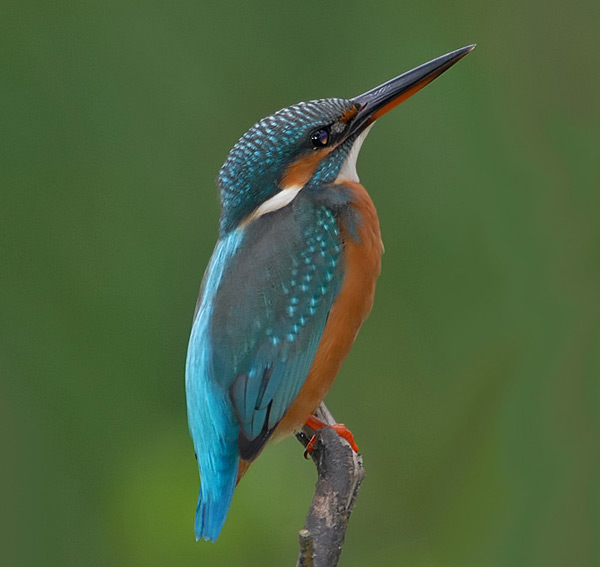
Common Kingfisher (Alcedo atthis) by W Kwong

Common Kingfisher (Alcedo atthis) by W Kwong

“I dare not go,” said the Kingfisher, trembling at the idea; “I have been up there once, and the warning I received was enough to last me for some time.”

Indian Peafowl (Pavocristatus) by Nikhil Devasar

Indian Peafowl (Pavocristatus) by Nikhil Devasar

“I cannot go,” said the Peacock, “for my plumage is too precious to risk.”
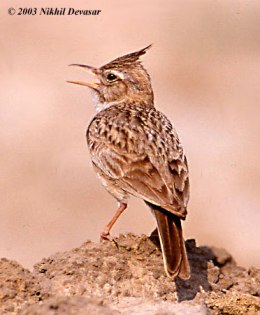
Crested Lark (Galerida cristata) by Nikhil Devasar

Crested Lark (Galerida cristata) by Nikhil Devasar

“I ought not to go,” said the Lark, “for the heat might injure my pretty voice.”

Yellow-billed Stork (Mycteria ibis) ©USFWS

Yellow-billed Stork (Mycteria ibis) ©USFWS

“I must not go,” said the Stork, “for I have promised to bring a baby to the King’s palace this evening.”

European Turtle Dove (Streptopelia turtur) ©WikiC

European Turtle Dove (Streptopelia turtur) ©WikiC

“I cannot go,” said the Dove, “for I have a nestful of little ones who depend upon me for food.”

Chipping Sparrow (Spizella passerina) by Quy Tran

Chipping Sparrow (Spizella passerina) by Quy Tran

“Nor I,” said the Sparrow, “for I am afraid.” “Nor I!” “Nor I!” “Nor I!” echoed the other birds.

Western Screech Owl (Megascops kennicottii)(captive) by Raymond Barlow

Western Screech Owl (Megascops kennicottii)(captive) by Raymond Barlow

“I will not go,” croaked the Owl, “for I simply do not wish to.”

Then up spoke the little Wren, who had been keeping in the background of late, because he was despised for his attempt to deceive the birds into electing him their king. (see King of the Birds)

Rufous-naped Wren (Campylorhynchus rufinucha) by Ray

Rufous-naped Wren (Campylorhynchus rufinucha) by Ray

“I will go,” said the Wren. “I will go and bring fire to men. I am of little use here. No one loves me. Every one despises me because of the trick which I played the Eagle, our King. No one will care if I am injured in the attempt. I will go and try.”

“Bravely spoken, little friend,” said the Eagle kindly. “I myself would go but that I am the King, and kings must not risk the lives upon which hangs the welfare of their people. Go you, little Wren, and if you are successful you will win back the respect of your brothers which you have forfeited.”

The brave little bird set out upon his errand without further words. And weak and delicate though he was, he flew and he flew up and up so sturdily that at last he reached the sun, whence he plucked a firebrand and bore it swiftly in his beak back toward the earth. Like a falling star the bright speck flashed through the air, drawing ever nearer and nearer to the cool waters of Birdland and the safety which awaited him there. The other birds gathered in a flock about their king and anxiously watched the Wren’s approach.

Suddenly the Robin cried out, “Alas! He burns! He has caught fire!” And off darted the faithful little friend to help the Wren. Sure enough, a spark from the blazing brand had fallen upon the plumage of the Wren, and his poor little wings were burning as he fluttered piteously down, still holding the fire in his beak.

American Robin (Turdus migratorius) by Daves BirdingPix

American Robin (Turdus migratorius) by Daves BirdingPix

The Robin flew up to him and said, “Well done, brother! You have succeeded. Now give me the fire and I will relieve you while you drop into the lake below us to quench the flame which threatens your life.”

So the Robin in his turn seized the firebrand in his beak and started down with it. But, like the Wren, he too was soon fluttering in the blaze of his own burning plumage, a little living firework, falling toward the earth.

Desert Lark (Ammomanes deserti) by Nikhil Devasar

Desert Lark (Ammomanes deserti) by Nikhil Devasar

Then up came the Lark, who had been watching the two unselfish birds. “Give me the brand, brother Robin,” she cried, “for your pretty feathers are all ablaze and your life is in danger.”

So it was the Lark who finally brought the fire safely to the earth and gave it to mankind. But the Robin and the Wren, when they had put out the flame which burned their feathers, appeared in the assembly of the birds, and were greeted with great applause as the heroes of the day. The Robin’s breast was scorched a brilliant red, but the poor, brave little Wren was wholly bare of plumage. All his pretty feathers had been burned away, and he stood before them shivering and piteous.

Bald Eagle (close up) Lowry Park Zoo by Lee

Bald Eagle (close up) Lowry Park Zoo by Lee

“Bravo! little Wren,” cried King Eagle. “A noble deed you have done this day, and nobly have you won back the respect of your brother birds and earned the everlasting gratitude of men. Now what shall we do to help you in your sorry plight?” After a moment’s thought he turned to the other birds and said, “Who will give a feather to help patch a covering for our brave friend?”

“I!” and “I!” and “I!” and “I!” chorused the generous birds. And in turn each came forward with a plume or a bit of down from his breast. The Robin first, who had shared his peril, brought a feather sadly scorched, but precious; the Lark next, who had helped in the time of need. The Eagle bestowed a kingly feather, the Thrush, the Nightingale,—every bird contributed except the Owl.

Great Horned Owl (Bubo virginianus) by Bob-Nan

Great Horned Owl (Bubo virginianus) by Bob-Nan

But the selfish Owl said, “I see no reason why I should give a feather. Hoot! No! The Wren brought me into trouble once, and I will not help him now. Let him go bare, for all my aid.”

“Shame! Shame!” cried the birds indignantly. “Old Master Owl, you ought to be ashamed. But if you are so selfish we will not have you in our society. Go back to your hollow tree!”

“Yes, go back to your hollow tree,” cried the Eagle sternly; “and when winter comes may you shiver with cold as you would have left the brave little Wren to shiver this day. You shall ruffle your feathers as much as you like, but you will always feel cold at heart, because your heart is selfish.”

And indeed, since that day for all his feathers the Owl has never been able to keep warm enough in his lonely hollow tree.

But the Wren became one of the happiest of all the birds, and a favorite both with his feathered brothers and with men, because of his brave deed, and because of the great fire-gift which he had brought from the sun.

Carolina Wren (Thryothorus ludovicianus)  by Quy Tran

Carolina Wren (Thryothorus ludovicianus) by Quy Tran


Lee’s Addition:

In the daytime also he led them with a cloud, and all the night with a light of fire. (Psalms 78:14 KJV)

As soon then as they were come to land, they saw a fire of coals there, and fish laid thereon, and bread. Jesus saith unto them, Bring of the fish which ye have now caught. Simon Peter went up, and drew the net to land full of great fishes, an hundred and fifty and three:… Jesus saith unto them, Come and dine. And none of the disciples durst ask him, Who art thou? knowing that it was the Lord. (John 21:9-12 KJV)

Trust you enjoyed this tale from The Curious Book of Birds. These entertaining stories were written 1903 and they are just as delightful and fun to read today.

(Photos added by me.)

Links:
House Wren (Troglodytes aedon) by Ian


Troglodytidae – Wrens Family


Painted Bunting (Passerina ciris) ©©Flickr


  Bird Tales


Curious Book of Birds - Cover


  The Curious Book of Birds


Spanish Sparrow (Passer Hispaniolensis) female ©WikiC


  Wordless Birds


*

Birds of the Bible – Swift Eagles

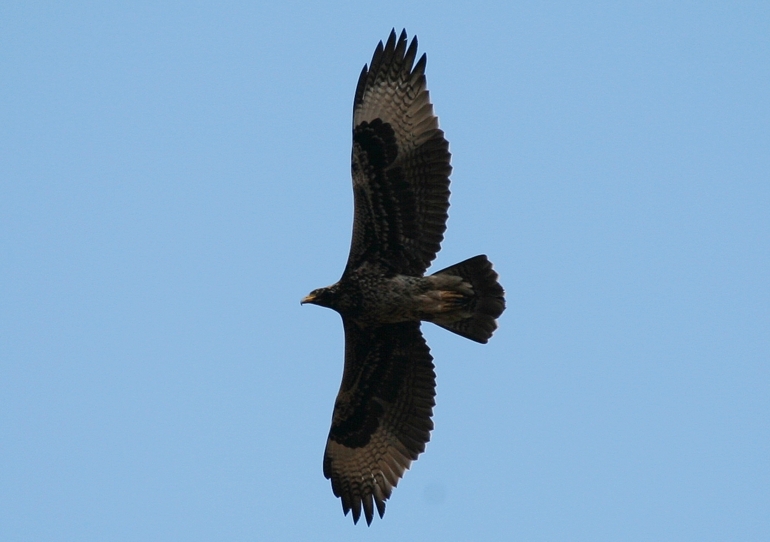
Verreaux’s Eagle (Aquila verreauxii) ©WikiC2

Verreaux’s Eagle (Aquila verreauxii) ©WikiC2

Saul and Jonathan were beloved and pleasant in their lives, And in their death they were not divided; They were swifter than eagles, They were stronger than lions. (2 Samuel 1:23 NKJV)

In my reading today of II Samuel 1, David was told of the death of King Saul and his son Jonathan. They were killed in battle with the Philistines in the last chapter (31) of I Samuel.

David takes up a lament starting in II Samuel 1:17. Even though Saul had tried to kill David on many occasions, David never desired to harm Saul, because he knew that the King was the Lord’s anointed one. Jonathan and David were the best of friends.

In verse 23, David refers to Saul and Jonathan, father and son, were together even in the battles and both were very skilled in battle. They were “stronger than lions” and won many victories. Being “swifter than eagles” could well refer to their ability to dodge the swords and arrows of battle and to come quickly to the place of the fight.

David’s use of the Eagle was because of his familiarity of them. As a shepherd, he must have watched them flying over with great speed and agility. The following Eagles are all seen in Israel and may well have been some of the ones that David was observed speeding through the sky on the way to catch a prey.

Gill – “they were swifter than eagles; in the quick dispatch of business, in hasting to the relief of the distressed, as Saul to the men of Jabeshgilead, and in the pursuit of their enemies, as of the Philistines, more than once:”

K & D  – “The light motion or swiftness of an eagle (cf. Hab_1:8), and the strength of a lion (vid., 2Sa_17:10), were the leading characteristics of the great heroes of antiquity.”

Poole – “Swifter than eagles; expeditious and nimble in pursuing their enemies, and executing their designs; which is a great commendation in a prince and in a soldier.

Stronger than lions, in regard of their bodily strength and the courage of their minds.”

Wesley – “2 Samuel 1:23

Lovely – Amiable, and obliging in their carriage and conversation, both towards one another, and towards their people: for, as for Saul’s fierce behaviour towards Jonathan, it was only a sudden passion, by which his ordinary temper was not to be measured; and for his carriage towards David, that was from that jealousy and reason of state which usually engageth even well – natured princes, to the same hostilities. But it is observable, that David speaks not a word here of his piety; but only commends him for those things which were truly in him…. Swifter, &c. – Expeditious in pursuing their enemies, and executing their designs; which is a great commendation in a prince, and in a soldier. Stronger, &c. – In regard of their bodily strength, and the courage of their mind.”

Here is a list of the Eagles seen in Israel:

This slideshow requires JavaScript.

See:

*

The Forgetful Kingfisher

Pied Kingfisher (Ceryle rudis) by Ian

Pied Kingfisher (Ceryle rudis) by Ian

The Forgetful Kingfisher ~ from The Curious Book of Birds

THE FORGETFUL KINGFISHER

Cur Book of Birds letter-iN these days the Kingfisher is a sad and solitary bird, caring not to venture far from the water where she finds her food. Up and down the river banks she goes, uttering a peculiar plaintive cry. What is she saying, and why is she so restless? The American Kingfisher is gray, but her cousin of Europe is a bird of brilliant azure with a breast of rusty red. Therefore it must have been the foreign Kingfisher who was forgetful, as you shall hear.

Long, long after the sorrows of Halcyone, the first Kingfisher, were ended, came the great storm which lasted forty days and forty nights, causing the worst flood which the world has ever known. That was a terrible time. When Father Noah hastened to build his ark, inviting the animals and birds to take refuge with him, the Kingfisher herself was glad to go aboard. For even she, protected by Æolus from the fury of winds and waters, was not safe while there was no place in all the world for her to rest foot and weary wing. So the Kingfisher fluttered in with the other birds and animals, a strange company! And there they lived all together, Noah and his arkful of pets, for many weary days, while the waters raged and the winds howled outside, and all the earth was covered fathoms deep out of sight below the waves.

But after long weeks the storm ceased, and Father Noah opened the little window in the ark and sent forth the Dove to see whether or not there was land visible on which the ark might find rest. Now after he had sent out the Dove, Noah looked about him at the other birds and animals which crowded around him eagerly, for they were growing very restless from their long confinement, and he said, “Which of you is bravest, and will dare follow our friend the Dove out into the watery world? Ah, here is the Kingfisher. Little mother, you at least, reared among the winds and waters, will not be afraid. Take wing, O Kingfisher, and see if the earth be visible. Then return quickly and bring me faithful word of what you find out yonder.”

Day was just beginning to dawn when the Kingfisher, who was then as gray as gray, flew out from the little window of the ark whence the Dove had preceded her. But hardly had she left the safe shelter of Father Noah’s floating home, when there came a tremendous whirlwind which blew her about and buffeted her until she was almost beaten into the waves, which rolled endlessly over the face of the whole earth, covering the high hills and the very mountains. The Kingfisher was greatly frightened. She could not go back into the ark, for the little window was closed, and there was no land anywhere on which she could take refuge. Just think for a moment what a dreadful situation it was! There was nothing for her to do but to fly up, straight up, out of reach from the tossing waves and dashing spray.

The Kingfisher was fresh and vigorous, and her wings were strong and powerful, for she had been resting long days in the quiet ark, eating the provisions which Father Noah had thoughtfully prepared for his many guests. So up, up she soared, above the very clouds, on into the blue ether which lies beyond. And lo! as she did so, her sober gray dress became a brilliant blue, the color caught from the azure of those clear heights. Higher and higher she flew, feeling so free and happy after her long captivity, that she quite forgot Father Noah and the errand upon which she had been sent. Up and up she went, higher than the sun, until at last she saw him rising far beneath her, a beautiful ball of fire, more dazzling, more wonderful than she had ever guessed.

“Hola!” she cried, beside herself with joy at the sight. “There is the dear sun, whom I have not seen for many days. And how near, how beautiful he is! I will fly closer still, now that I have come so near. I will observe him in all his splendor, as no other bird, not even the high-flying, sharp-eyed Eagle, has ever seen him.”

And with that the foolish Kingfisher turned her course downward, with such mad, headlong speed that she had scarcely time to feel what terrible, increasing heat shot from the sun’s rays, until she was so close upon him that it was too late to escape. Oh, but that was a dreadful moment! The feathers on her poor little breast were scorched and set afire, and she seemed in danger not only of spoiling her beautiful new blue dress but of being burned into a wretched little cinder. Horribly frightened at her danger, the Kingfisher turned once more, but this time toward the rolling waters which covered the earth. Down, down she swooped, until with the hiss of burning feathers she splashed into the cold wetness, putting out the fire which threatened to consume her. Once, twice, thrice, she dipped into the grateful coolness, flirting the drops from her blue plumage, now alas! sadly scorched.

Common Kingfisher (Alcedo atthis) by W Kwong

Common Kingfisher (Alcedo atthis) by W Kwong

When the pain of her burns was somewhat relieved she had time to think what next she should do. She longed for rest, for refuge, for Father Noah’s gentle, caressing hand to which she had grown accustomed during those stormy weeks of companionship in the ark. But where was Father Noah? Where was the ark? On all the rolling sea of water there was no movement of life, no sign of any human presence. Then the Kingfisher remembered her errand, and how carelessly she had performed it. She had been bidden to return quickly; but she had wasted many hours—she could not tell how many—in her forgetful flight. And now she was to be punished indeed, if she could not find her master and the ark of refuge.

The poor Kingfisher looked wildly about. She fluttered here and there, backward and forward, over the weary stretch of waves, crying piteously for her master. He did not answer; there was no ark to be found. The sun set and the night came on, but still she sought eagerly from east to west, from north to south, always in vain. She could never find what she had so carelessly lost.

The truth is that during her absence the Dove, who had done her errand faithfully, returned at last with the olive leaf which told of one spot upon the earth’s surface at last uncovered by the waves. Then the ark, blown hither and thither by the same storm which had driven the Kingfisher to fly upward into the ether-blue, had drifted far and far to Mount Ararat, where it ran aground. And Father Noah, disembarking with his family and all the assembled animals, had broken up the ark, intending there to build him a house out of the materials from which it was made. But this was many, many leagues from the place where the poor Kingfisher, lonely and frightened, hovered about, crying piteously for her master.

And even when the waters dried away, uncovering the earth in many places, so that the Kingfisher could alight and build herself a nest, she was never happy nor content, but to this day flies up and down the water-ways of the world piping sadly, looking eagerly for her dear master and for some traces of the ark which sheltered her. And the reflection which she makes in the water below shows an azure-blue body, like a reflection of the sky above, with some of the breast-feathers scorched to a rusty red. And now you know how it all came about.


Common Kingfisher (Alcedo atthis) by Nikhil Devasar

Common Kingfisher (Alcedo atthis) by Nikhil Devasar

Lee’s Addition:

An enjoyable Bird Tale from The Curious Book of Birds. Kingfishers belong to the Alcedinidae – Kingfishers Family.

We know the Lord created Kingfishers and gave them their colors, but it is fun to read stories about them, even if they are make-believe. The flood and the ark were true, but that is not quite how they came to fly up and down the waterways.

That they may set their hope in God, And not forget the works of God, But keep His commandments; (Psalms 78:7 NKJV)

My son, do not forget my law, But let your heart keep my commands; (Proverbs 3:1 NKJV)

Get wisdom! Get understanding! Do not forget, nor turn away from the words of my mouth. (Proverbs 4:5 NKJV)

Kingfishers have been created by a loving Creator just as we have been. We differ from the birds because we were made in God’s image. Therefore, we need to remember our teachings about God and Christ and not forget them. That also includes what your parents ask you to do also.

(Photos added by me.)

Links:

White-throated Kingfisher (Halcyon smyrnensis) by Nikhil Devasar


  Alcedinidae – Kingfishers Family


Painted Bunting (Passerina ciris) ©©Flickr


  Bird Tales


Curious Book of Birds - Cover


  The Curious Book of Birds


Spanish Sparrow (Passer Hispaniolensis) female ©WikiC


  Wordless Birds


*

The Dove – Weather Reporter… ~ Nuggets Plus

Mourning Dove (Zenaida macroura) by Quy Tran

Mourning Dove (Zenaida macroura) by Quy Tran

The Dove – Weather Reporter…
by A J Mithra
_

Nuggets Plus

Nuggets Plus

Dove sent by Noah

came at dusk with an olive leaf

and Noah knew that

the flood had receded!

God sent the dove, His Holy spirit

at dusk to the upper room

to encourage us or to help us

warn about the flood of the last days?

But as the days of Noah were, so shall also the coming of the Son of man be.”  Mathew 24:37


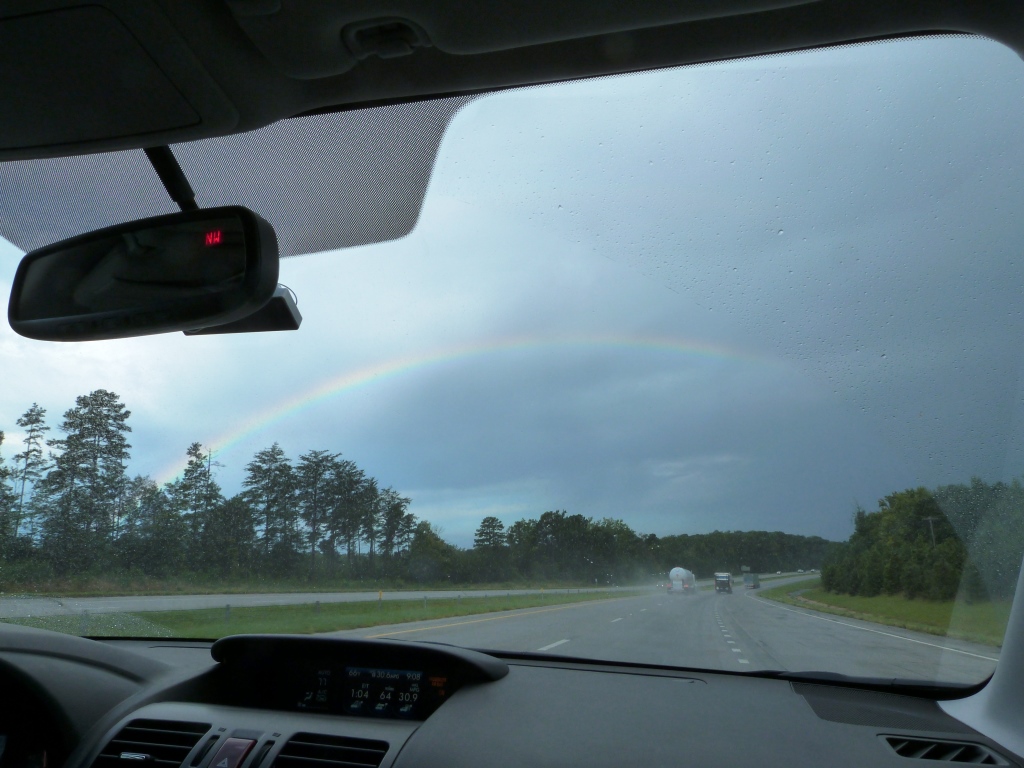
Carolina rainbow

Carolina rainbow

Lee’s Addition:

Thanks, A J, your timing is perfect as usual. We just got back from a week and a half trip to Indiana. Praise the Lord for his traveling mercies and for all of you who were praying for us as we traveled 2,300 miles. Also, we had great weather. Only one rain storm for about 10 minutes which produced a beautiful rainbow in South Carolina. More about the trip that later.

The rainbow shall be in the cloud, and I will look on it to remember the everlasting covenant between God and every living creature of all flesh that is on the earth. (Genesis 9:16 NKJV)

More Nuggets Plus

*


Birds of the Bible – Shield

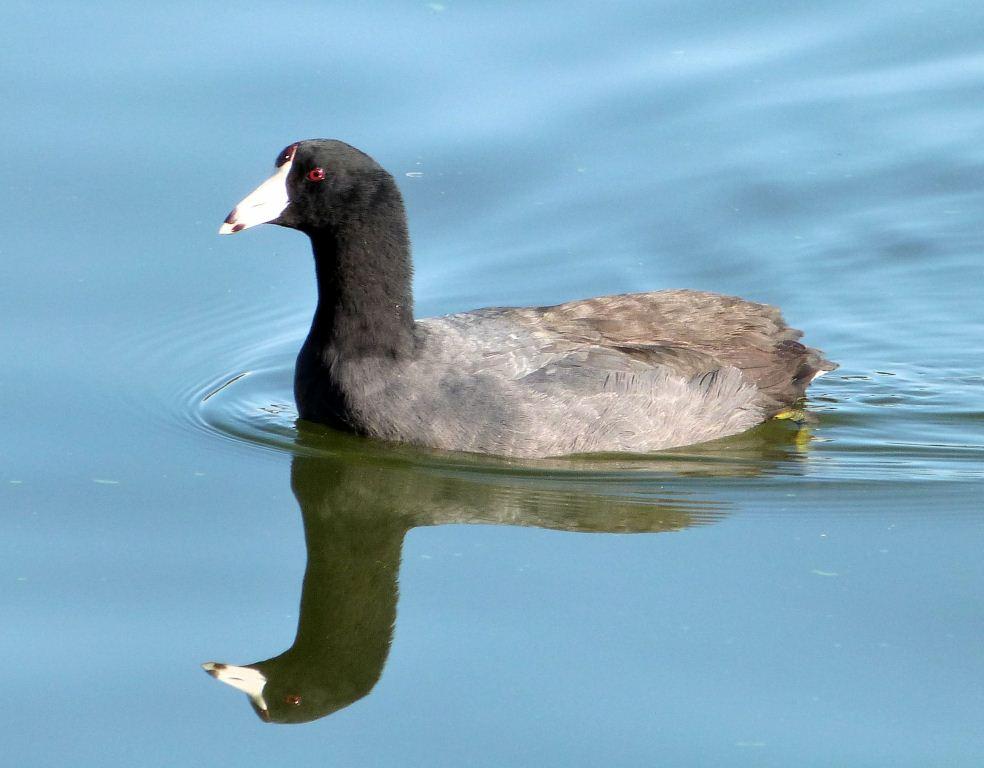
American Coot (Fulica americana) by Lee at Lk Morton

American Coot (Fulica americana) by Lee at Lk Morton

He shall cover thee with his feathers, and under his wings shalt thou trust: his truth shall be thy shield and buckler. (Psalm 91:4 KJV)

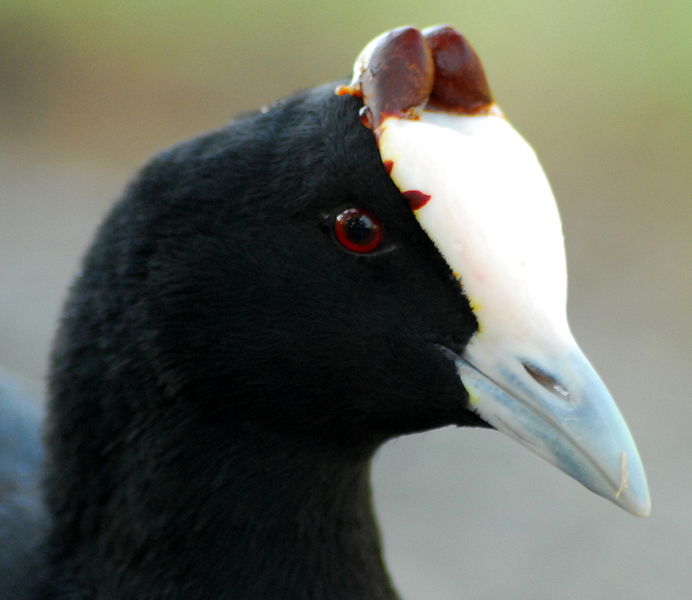
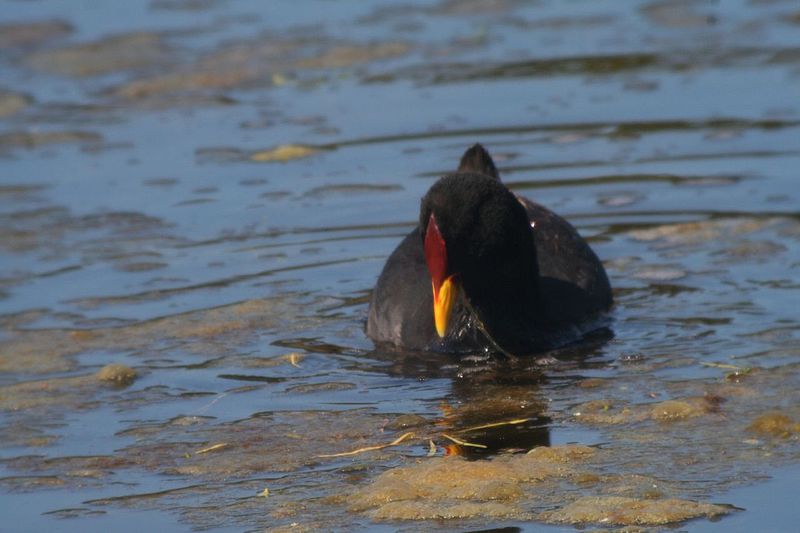
While working on the Coot article, the shield was mentioned. “Coots have prominent frontal shields or other decoration on the forehead…”

When the Lord created the Coots and many of the birds in the Rallidae – Rails, Crakes & Coots family, He gave them a frontal shield. Some Jacanas (Jacanidae – Jacanasalso have shields.

The Merriam-Webster Dictionary gives this definition: “a platelike prolongation of the base of the upper mandible over the forehead that is a characteristic feature of the coots and gallinules.”  A few coots and gallinules have a frontal shield, which is a fleshy rearward extension of the upper bill. The most complex frontal shield is found in the Horned Coot.

This slideshow requires JavaScript.


*
As you can see by the different photos, each species has a different shield, some similar, but others quite different.

Wikipedia says, “A shield is a type of personal armor, meant to intercept attacks, either by stopping projectiles such as arrows or redirecting a hit from a sword, mace, battle axe or similar weapon to the side of the shield-bearer.

Shields vary greatly in size, ranging from large panels that protect the user’s entire body to small models (such as the buckler) that were intended for hand-to-hand-combat use. Shields also vary a great deal in thickness; whereas some shields were made of relatively deep, absorbent, wooden planking to protect soldiers from the impact of spears and crossbow bolts, others were thinner and lighter and designed mainly for deflecting blade strikes.

Often shields were decorated with a painted pattern or an animal representation and these designs developed into systematized heraldic devices during high-medieval times for purposes of battlefield identification. ”

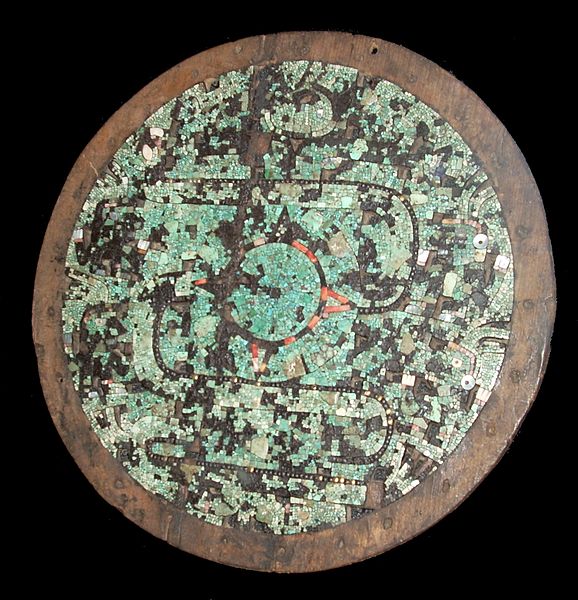
Ceremonial shield with mosaic decoration- Aztec or Mixtec-AD 1400-1521-In the British Museum ©WikiC

Ceremonial shield with mosaic decoration- Aztec or Mixtec-AD 1400-1521-In the British Museum ©WikiC

For our birds, I would think the decorated shields for identification seems the most logical. Since the Lord enjoys so much variety, we see it again displayed in these frontal shields.

At least 54 verses (depending on version) mention the word “shield” in the Bible. Psalm 91:4 above is providing refuge under feathers and wings and is protecting us with a shield of truth and faithfulness. Let’s look at some of the verses and just let His word encourage and challenge us to serve Him more.

The God of my rock; in him will I trust: he is my shield, and the horn of my salvation, my high tower, and my refuge, my saviour; thou savest me from violence. (2 Samuel 22:3 KJV)

But You, O LORD, are a shield about me, My glory, and the One who lifts my head. (Psalms 3:3 NASB)

Horned Coot (Fulica cornuta) ©©Flickr Gunnar Engblom

Horned Coot (Fulica cornuta) ©©Flickr Gunnar Engblom

Thou hast also given me the shield of thy salvation: and thy right hand hath holden me up, and thy gentleness hath made me great. (Psalms 18:35 KJV)

Our soul waiteth for the LORD: he is our help and our shield. (Psalms 33:20 KJV)

Red-knobbed Coot (Fulica cristata) Breeding ©WikiC

Red-knobbed Coot (Fulica cristata) Breeding ©WikiC

For the LORD God is a sun and shield: the LORD will give grace and glory: no good thing will he withhold from them that walk uprightly. (Psalms 84:11 KJV)

Ye that fear the LORD, trust in the LORD: he is their help and their shield. (Psalms 115:11 KJV)

Red-fronted Coot (Fulica rufifrons) ©WikiC

Red-fronted Coot (Fulica rufifrons) ©WikiC

Above all, taking the shield of faith, wherewith ye shall be able to quench all the fiery darts of the wicked. (Ephesians 6:16 KJV)

Are others able to identify us by our shield?

*

Wordless Birds

*

See:

Birds of the Bible

Rallidae – Rails, Crakes & Coots Family

Jacanidae – Jacanas Family

Birdwatching Term – Frontal Shield

*
Birdwatching – Anting

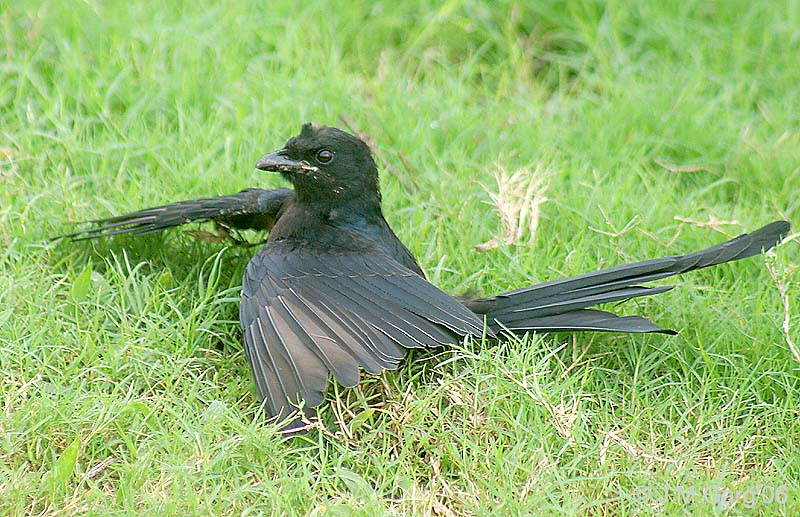
Black Drongo (Dicrurus macrocercus) Anting ©WikiC

Black Drongo (Dicrurus macrocercus) Anting ©WikiC

Consider the ravens, for they neither sow nor reap, which have neither storehouse nor barn; and God feeds them. Of how much more value are you than the birds? (Luk 12:24 NKJV)

“For animals in the wild, the medicine cabinet seems at first glance to be pretty bare, and you might think they’re just left out in the cold when it comes to finding remedies. But even with the fallen nature of our world, the Creator hasn’t left untamed creatures, like the ravens that neither sow nor reap (Luke 12:24), defenseless against all the things that ail them. In fact, He’s stocked their “closets” with a cornucopia of cures.” (From Jungle Doctors)

One of those cures is the birds “Anting” behaviour.

Anting (Excerpts from The Birder’s Handbook, p.487)

“Many different songbird species have been observed picking up single ants or small groups and rubbing them on their feathers. Less commonly, other songbirds “ant” by spreading their wings and lying on an anthill, and squirming or otherwise stimulating the ants to swarm up among their feathers.

Because the seasonal timing of anting and molting (spring and summer) often correspond, some have suggested that anting may soothe the skin during feather replacement. It seems more likely that the seasonal relationship simply reflects the greater activity of ants during those periods.”

Anting (Excerpts from Wikipedia)

In the behavior called anting, birds rub insects on their feathers, usually ants, which secrete liquids containing chemicals such as formic acid, that can act as an insecticide, miticide, fungicide, bactericide, or to make them edible by removing the distasteful acid. It possibly also supplements the bird’s own preen oil. Instead of ants, birds can also use millipedes. Over 250 species of bird have been known to ant. Most of those are Passerines.

Many theories exits as to why the birds “ant.”

It has been suggested that anting acts as way of reducing feather parasites such as mites or in controlling fungi or bacteria, although there has been little convincing support for any of the theories. It is possible that the use of certain kinds of ants indicates the importance of the chemicals they release. Some cases of anting involved the use of millipedes or caterpillars, and these too are known to release powerful defensive chemicals.

Another suggested function, based on observation of Blue Jays, is that the bird makes the insects edible, by discharging the harmful acid onto their feathers. The birds were found to show anting behaviour only if the ants had a full acid sac, and with subjects whose acid sacs had been experimentally removed, the behaviour was absent.

Finally, it has also been suggested that anting is related to feather moulting. However, the correlation may also be attributed to the greater activity of ants in summer.

Dusting with soil from ant-hills has been considered by some as equivalent to anting.

Some birds like Antbirds and Flickers not only ant, but also consume the ants as an important part of their diet. Other opportunist ant-eating birds include Sparrows, Wrens, Grouse and Starlings.

*
*

Anting (Excerpts from Audubon Society Encyclopedia of North American Birds, pps 19-20)

“John James Audubon published the first known reference to this habit in his Ornithological Biography (1831), in which he wrote of watching wild turkeys roll in ants’ nests ‘to clear their growing feathers of loose scales, and prevent ticks and other vermin from attacking them, these insects being unable to bear the odor of the earth in which ants have been.’ ”

Here are some of the birds listed in this section:

The turkeys mentioned, plus “crows; starlings and Indian mynas, magpie lark, gray thrush, Pekin robin, house sparrow, manakin and apostlebird in Australia; a Magpie in Britain; Grackles, Blue Jay, pekin robin, gray catbird, American robin, wood thrush, hermit thrush, veery, cedar waxwing, bobolink, Baltimore oriole, cardinal, rose-breasted grosbeak, black-headed grosbeak, indigo bunting, dark-eyed junco, Harris’ sparrow, white-crowned sparrow, fox sparrow, and song sparrow in America”;

“Others seen in the wild anting are: scarlet tanagers, summer tanagers, towhees…, others.” (Lack off capitalization is from the book)

Lee’s Additon:

But now ask the beasts, and they will teach you; And the birds of the air, and they will tell you; (Job 12:7 NKJV)

It appears that the birds were given instincts or knowledge, by their Creator, to protect themselves from pests and irritation. That would be a possible answer they might give us, if we were to question them. If these birds evolved, then it appears that they had to develop this habit in each country and area where the birds “ant.” Huh? As for me, I opt for a Creator giving them that knowledge rather than a chance behaviour happening in so many places.

*

*

See:

Anting – Wikipedia

Jungle Doctors (Scroll down to “Rubbing It In”) – Answers in Genesis

Birdwatching

Birds of the Bible

*

Ian’s Bird of the Week – Spiny-cheeked Honeyeater

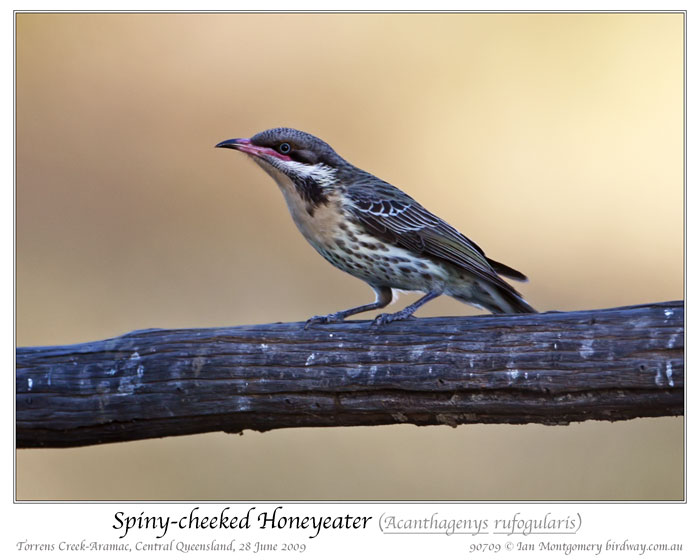
Spiny-cheeked Honeyeater (Acanthagenys rufogularis) by Ian

Spiny-cheeked Honeyeater (Acanthagenys rufogularis) by Ian

Ian’s Bird of the Week – Spiny-cheeked Honeyeater ~ Ian Montgomery

Newsletter – 8/20/13

I’m currently preparing photos for a digital version of the book Where to Find Birds in North-East Queensland by Jo Wieneke (http://www.nqbirds.com). I’m finding that many of these have not yet featured as bird of the week, so here’s one that I came across a photo this morning that appealed to me, one of an unusual-looking honeyeater, the Spiny-cheeked, taken not long after sunrise at Gluepot, the BirdLife Australia mallee reserve in South Australia. At the time, I was spending some time each morning at a hide overlooking a drinking trough waiting for Scarlet-chested Parrots http://www.birdway.com.au/psittacidae/scarlet_chested_parrot/index.htm.

The Spiny-cheeked is a bird of dry country, so the easiest way to photograph it is as watering places, and the second photo was taken in Central Queensland south of Torrens Creek near a dam, this time close to sunset. It is a widespread and common in the more arid parts of mainland Australia except tropical Australia north of about 19ºS and Tasmania. It also occurs in scrubby coastal areas, such as southern Victoria. Like many dry-country birds it is nomadic and appears only rarely in Northeastern Queensland, though I did see one in the garden in the first house I lived in Townsville in 2002.

Spiny-cheeked Honeyeater (Acanthagenys rufogularis) by Ian

Spiny-cheeked Honeyeater (Acanthagenys rufogularis) by Ian

With a length of 23-26cm/9-10in, it’s quite large by honeyeater standards and the bare pink area on the face gives it some similarity to the Wattlebirds, also honeyeaters. Although it is the only member of the genus Acanthagenys, DNA studies have shown that it is related to both the Wattlebirds (Acanthocaera) and the Regent Honeyeater, another one with bare red skin, in this case around the eye. The Spiny-cheeked is quite vocal with a creaky, piping, rather Wattlebird-like song, often the first sign of its presence.

Feedback on the change in font was rather muted, with one in favour of the new one, one against it and one not liking the underlining of the scientific name. I can agree with all points of view and am undecided, though I’m using the new font for photos in the digital version of Jo Wieneke’s book. I’ve rather got used to it, though I’ve started putting the scientific name in grey to make the underlining less obvious as I’m constrained both by the convention of using either italics or underlining for scientific name and the lack of an italic option in an already italic-looking font. My thanks to those who took the trouble to respond.

Jo’s book has been out of print for a little while now, so the digital version is to fill the gap left by its disappearance from book shops. I’ll let you know when it is available: the aim is to publish it for Apple iBooks, Google PlayBooks and Amazon Kindle.

Best wishes
Ian

**************************************************
Ian Montgomery, Birdway Pty Ltd,
454 Forestry Road, Bluewater, Qld 4818
Tel 0411 602 737 ian@birdway.com.au
Bird Photos http://www.birdway.com.au/
Recorder Society http://www.nqrs.org.au


Lee’s Addition:

My son, eat honey because it is good, And the honeycomb which is sweet to your taste; (Pro 24:13 NKJV)

This Honeyeater belong to the Meliphagidae – Honeyeaters Family, which has 184 species. Check out Ian’s photos of this Family.

In addition to what Ian mentioned about the Spiny-cheeked Honeyeater, Wikipedia had this to say:

The honeyeater is mainly frugivorous, but will also eat nectar, blossoms, insects, reptiles, and young birds. Its habitat includes deserts, coastal scrubland, and dry woodlands. It is also found in mangroves and orchards. Its range includes most of Australia except for Tasmania, tropical Northern areas, the Southeastern coast.

The Spiny-cheeked Honeyeater is a grey-brown bird with a burnt orange throat and chest. It has grey wings edged with white, and a long tail with white tips. It has a pink, black-tipped bill.

*

Spiny-cheeked Honeyeater (Acanthagenys rufogularis) ©WikiC

Spiny-cheeked Honeyeater (Acanthagenys rufogularis) ©WikiC

*

Here is the song of a Spiny-cheeked from xeno-canto.

See:

*

Birds of the Bible – Gleaning’s Noah and the Birds

Mourning Dove (Zenaida macroura) by Quy Tran

Mourning Dove (Zenaida macroura) by Quy Tran

And of every living thing of all flesh you shall bring two of every sort into the ark, to keep them alive with you; they shall be male and female. (Gen 6:19 NKJV)

After computer problems last week, we are back up and running. I reloaded my e-Sword on to a new SSD drive and decided to see how fast the searches would be. Zip! Searching for the word “bird” in the Reference Library, I came across these interesting thoughts from “Gleanings In Genesis” by Arthur W. Pink

Noah, as a Type of Christ, is being discussed in this section and the reference to caring for the birds and animals of course caught my “birdwatching eye.”

From Gleanings in Genesis, Chapter 12, Noah A Type of Christ (excerpt):

“9. The successful issue of Noah’s work, seen in “the saving of his house” (Hebrews_11:7) reminds us of the language of Hebrews_3:6, “But Christ as a son over his own house” (Hebrews_3:6). But the type goes further: Noah’s work brings blessing to all creation as is seen from the fact that the animals and birds were also preserved in the ark. Observe how beautifully this is brought out in Genesis_8:1 —”And God remembered Noah, and every living thing, and all the cattle that was with him in the ark.” So, too, the work of Christ shall yet bring blessing to the beasts of the field. At His return to the earth “the creation itself also shall be delivered from the bondage of corruption into the glorious liberty of the children of God” (Romans_8:21).

Spotted Nightingale-Thrush (Catharus dryas) ©WikiC

Spotted Nightingale-Thrush (Catharus dryas) ©WikiC

10. In Genesis_6:19 we have a hint of the animal creation being subject to Noah “And of every living thing of all flesh, two of every sort shalt thou bring into the ark, to keep them alive with thee.” We have a passing glimpse of the yet future fulfillment of this part of the type in Mark_1:13 —”And He was there in the wilderness forty days tempted of Satan; and was with the wild beasts.” Noah’s headship over all creatures comes out even more clearly in Genesis_9:2 —”And the fear of you and the dread of you shall be upon every beast of the earth, and upon every fowl of the air, upon all that moveth upon earth, and upon all the fishes of the sea; into your hand are they delivered.” How this reminds us of Psalm 8, which speaks of the future dominion of the Son of Man. “For Thou hast made Him a little lower than the angels, and hast crowned Him with glory and honor. For thou madest Him to have dominion over the works of Thy hands; Thou hast put all things under His feet (compare Hebrews_2:8), “But now we see not yet all things put under Him, all sheep and oxen, yea, and the beasts of the field; the fowl of the air and the fish of the sea!” This same thought is repeated in the Genesis narrative again and again as if with deliberate emphasis. When we read of the animals entering the Ark we are told “They went in unto Noah (not unto Noah and his family) into the Ark,” and then we are told “And the Lord shut him (not ‘them’) in” (Genesis_7:15-16). And again, on leaving the ark we read that God said unto Noah, “Every moving thing that liveth shall be meat for you; even as the green herb have I given you all things” (Genesis_9:3). So Christ is “the Heir of all things” (Hebrews_1:2).

Interesting House Finch at feeder

Interesting House Finch at feeder

11. In Gen_6:21 we find Noah presented as the great food-provider: “And take thou unto thee of all food that is eaten, and thou shalt gather it to thee; and it shall be for food for thee, and for them.” We need hardly say that this finds its complement in Christ the Bread of Life. He is God’s Manna for our souls. He is the Shewbread which was eaten by Aaron and his sons (Leviticus_24:9). He is the Old Corn of the land (Joshua_5:11). In short, it is only as we feed upon Christ as He is presented unto us in the written Word that our spiritual life is quickened and nourished.

He does great things past finding out, Yes, wonders without number. (Job 9:10 NKJV)

We have a wonderful Creator, Sustainer and Saviour in the Lord Jesus Christ. Through the use of “Types,” like Noah, and illustrations with birds and other objects, it helps us better understand many things that are beyond our grasp or understanding at times.

(Spelling of Books and bolding are mine.)

See:

Birds of the Bible

Gospel Presentation

*

Birds Of The Bible – Clinging Birds

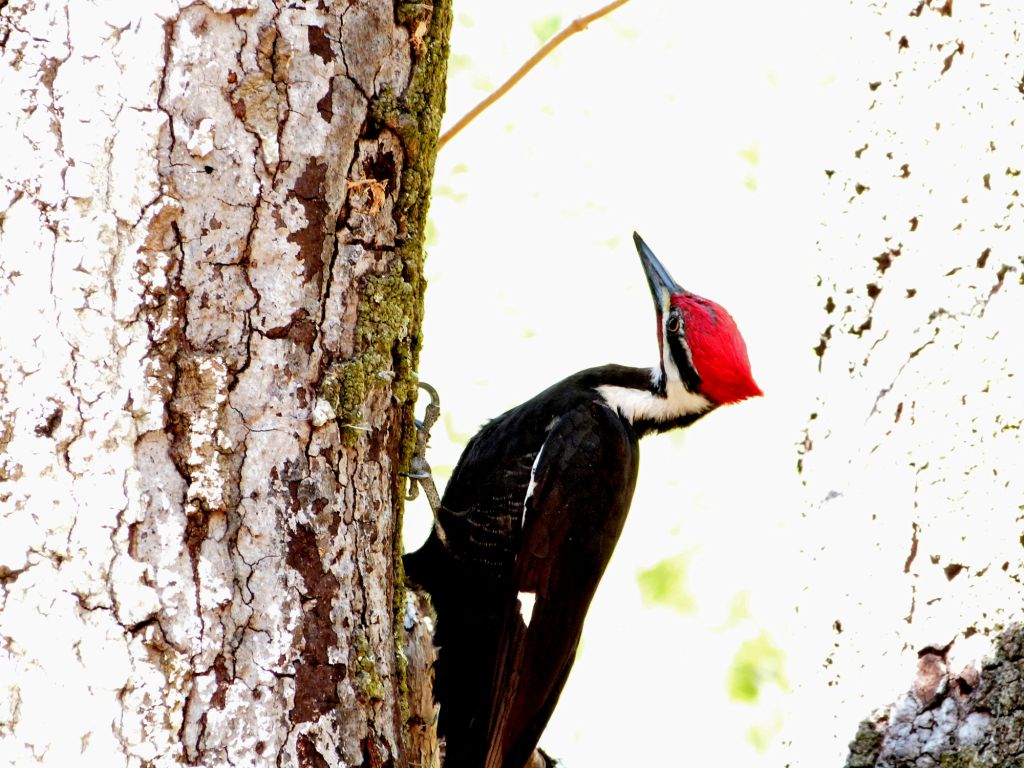
Pileated Woodpecker by Lee

Pileated Woodpecker at Circle B by Lee

But you are to cling to the LORD your God, as you have done to this day. (Joshua 23:8 NASB)

While finishing the last two chapters of Joshua, I came across the verse above. I immediately pictured a Woodpecker “clinging” to a tree. Then the following picture also came to mind. What can we learn about our “clinging birds” and us “clinging to the Lord”?

Brown-headed Barbet (Megalaima zeylanica) by Nikhil Devasar

Brown-headed Barbet (Megalaima zeylanica) by Nikhil Devasar

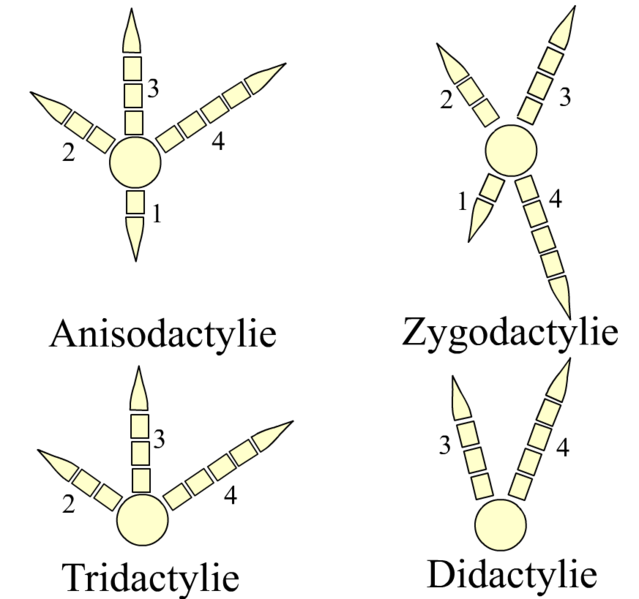
Woodpeckers were created with an ability to cling to trees with the help of the way the toes are arranged on their feet. They also use their stiffened tail feathers to keep them on the tree.”Woodpeckers, piculets and wrynecks all possess zygodactyl feet. Zygodactyl feet consist of four toes, the first (hallux) and the fourth facing backward and the second and third facing forward. This foot arrangement is good for grasping the limbs and trunks of trees. Members of this family can walk vertically up a tree trunk, which is beneficial for activities such as foraging for food or nest excavation. In addition to the strong claws and feet, woodpeckers have short strong legs. This is typical of birds that regularly forage on trunks. The tails of all woodpeckers except the piculets and wrynecks are stiffened, and when the bird perches on vertical surfaces, the tail and feet work together to support it.” (Wikipedia)

Bird Feet ©WikiC

Bird Feet ©WikiC

The following video from explorationfilm has information about the feet and tail of Woodpeckers at the beginning. The rest of the video is very interesting also.

*

*

Other birds also, like the Barbets can do some clinging also. “Nine families of largely arboreal birds make up the order Piciformes, the best-known of them being the Picidae, which includes the woodpeckers and close relatives. The Piciformes contain about 67 living genera with a little over 400 species, of which the Picidae (woodpeckers and relatives) make up about half.

In general, the Piciformes are insectivorous, although the barbets and toucans mostly eat fruit and the honeyguides are unique among birds in being able to digest beeswax (although insects make up the bulk of their diet). Nearly all Piciformes have parrot-like zygodactyl feet—two toes forward and two back, an arrangement that has obvious advantages for birds that spend much of their time on tree trunks. An exception are a few species of three-toed woodpeckers. The jacamars aside, Piciformes do not have down feathers at any age, only true feathers. They range in size from the Rufous Piculet at 8 centimetres in length, and weighing 7 grams, to the Toco Toucan, at 63 centimetres long, and weighing 680 grams. All nest in cavities and have altricial young.” (Wikipedia)

Short-toed Treecreeper (Certhia brachydactyla) ©WikiC

Short-toed Treecreeper (Certhia brachydactyla) ©WikiC

Another group of birds that “cling” are the Tree Creepers. Treecreepers measure from 12 to 18 centimetres in length. Their bills are gently down-curved and rather long, used for probing bark for insects and spiders. They often climb up tree trunks in a helical path, hopping with their feet together; their toes are long and tipped with strongly curved claws for gripping. The longer tails of the Certhia treecreepers are stiffened to use as a prop while climbing, but those of the Spotted Creeper are shorter and not stiffened. Their songs and calls are thin and high-pitched.

Most species of treecreeper occur in the Palearctic and Indomalaya ecozones, from Western Europe to Japan and India. One species occurs in North America from Alaska to Nicaragua and another has a discontinuous distribution in sub-Saharan Africa and India. All species of treecreeper are found in forest and woodland habitats. The more northerly species are partly migratory, and those found in warmer climates are thought to be resident, although information is lacking for many species.

Brown-headed Nuthatch (Sitta pusilla) ©WikiC

Brown-headed Nuthatch (Sitta pusilla) ©WikiC

One more well-known bird that clings to trees is the Nuthatch. Not only does he cling, but goes up and down the trees head first. Nuthatches are compact birds with short legs, compressed wings, and square 12-feathered tails. They have long, sturdy, pointed bills and strong toes with long claws.

We know birds can cling, how about us? When I searched the KJV on my e-Sword, the word “cling” did not show up in any verses. Switching to the NASB, which I had been reading, “cling” was found in fourteen (14) verses. Here are some of them:

You shall fear the LORD your God; you shall serve Him and cling to Him, and you shall swear by His name. “He is your praise and He is your God, who has done these great and awesome things for you which your eyes have seen. (Deuteronomy 10:20-21 NASB)

Blond-crested Woodpecker (Celeus flavescens) ©WikiC

Blond-crested Woodpecker (Celeus flavescens) ©WikiC

You shall follow the LORD your God and fear Him; and you shall keep His commandments, listen to His voice, serve Him, and cling to Him. (Deuteronomy 13:4 NASB)

Northern Flicker (Colaptes auratus) Red-shafted ©WikiC

Northern Flicker (Colaptes auratus) Red-shafted ©WikiC

I have chosen the faithful way; I have placed Your ordinances before me. I cling to Your testimonies; O LORD, do not put me to shame! I shall run the way of Your commandments, For You will enlarge my heart. (Psalms 119:30-32 NASB)

White-barred Piculet (Picumnus cirratus) ©©LeeKip

White-barred Piculet (Picumnus cirratus) ©©LeeKip

Let love be without hypocrisy. Abhor what is evil; cling to what is good. Be devoted to one another in brotherly love; give preference to one another in honor;
(Romans 12:9-10 NASB)

These are all great ways we can CLING to the Lord.

The word cling is translated several ways in our original verse:

But you are to cling to the LORD your God, as you have done to this day. (Joshua 23:8 NASB)

KJV – But cleave unto the LORD your God
AKJV – But hold to the LORD your God
BBE – But be true to the Lord your God
Bishops – But sticke fast vnto the Lorde your God,
CEV – Be as faithful to the LORD
ERV – You must continue to follow the LORD your God
GW – But you must be loyal to the LORD your God
MSG – Hold tight to GOD, your God
NET – But you must be loyal to the LORD your God

KJV+ – But cleave H1692
H1692
דּבק
dâbaq
daw-bak’
A primitive root; properly to impinge, that is, cling or adhere; figuratively to catch by pursuit: – abide, fast, cleave (fast together), follow close (hard, after), be joined (together), keep (fast), overtake, pursue hard, stick, take.

They are all good words and may we learn to “cling” to our Lord, just as the birds “cling” to the trees.

“But ask the animals — they will teach you — and the birds in the air — they will tell you; (Job 12:7 CJB)

O taste and see that the LORD is good: blessed is the man that trusteth in him. (Psalms 34:8 KJV)

*

See also:

Birds of the Bible

PICIFORMES – Woodpeckers and Allies

Picidae (woodpeckers and relatives)

Certhiidae – Treecreepers

Sittidae – Nuthatches

*