Chippy, Sweetvoice, and Dotty – Chapter 4

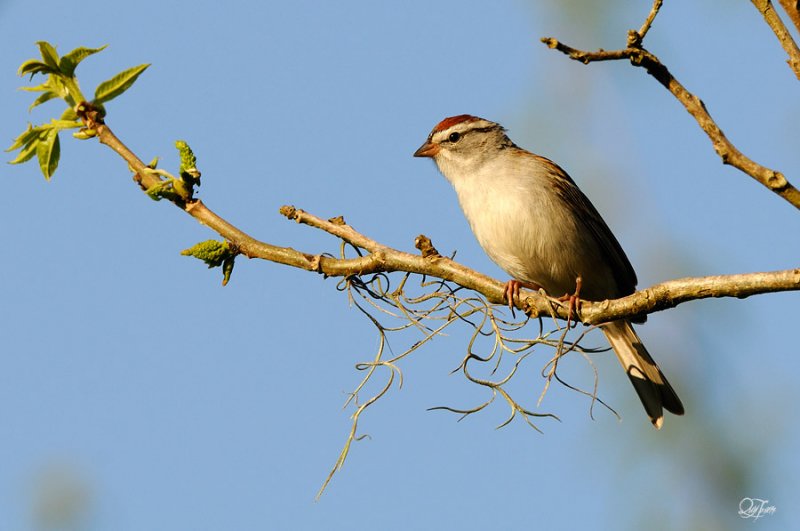
Chipping Sparrow (Spizella passerina) by Quy Tran

Chippy, Sweetvoice, and Dotty

The Chipping, Vesper and Tree Sparrows

The Burgess Bird Book For Children

*

Listen to the story read.

CHAPTER 4. Chippy, Sweetvoice, and Dotty.

For a while Jenny Wren was too busy to talk save to scold Mr. Wren for spending so much time singing instead of working. To Peter it seemed as if they were trying to fill that tree trunk with rubbish. “I should think they had enough stuff in there for half a dozen nests,” muttered Peter. “I do believe they are carrying it in for the fun of working.” Peter wasn’t far wrong in this thought, as he was to discover a little later in the season when he found Mr. Wren building another nest for which he had no use.

Finding that for the time being he could get nothing more from Jenny Wren, Peter hopped over to visit Johnny Chuck, whose home was between the roots of an old apple-tree in the far corner of the Old Orchard. Peter was still thinking of the Sparrow family; what a big family it was, yet how seldom any of them, excepting Bully the English Sparrow, were to be found in the Old Orchard.

“Hello, Johnny Chuck!” cried Peter, as he discovered Johnny sitting on his doorstep. “You’ve lived in the Old Orchard a long time, so you ought to be able to tell me something I want to know. Why is it that none of the Sparrow family excepting that noisy nuisance, Bully, build in the trees of the Old Orchard? Is it because Bully has driven all the rest out?”

Johnny Chuck shook his head. “Peter,” said he, “whatever is the matter with your ears? And whatever is the matter with your eyes?”

“Nothing,” replied Peter rather shortly. “They are as good as yours any day, Johnny Chuck.”

(Chipping Sparrow singing ©xeno-canto.org by Ian Cruickshank)

Johnny grinned. “Listen!” said Johnny. Peter listened. From a tree just a little way off came a clear “Chip, chip, chip, chip.” Peter didn’t need to be told to look. He knew without looking who was over there. He knew that voice for that of one of his oldest and best friends in the Old Orchard, a little fellow with a red-brown cap, brown back with feathers streaked with black, brownish wings and tail, a gray waistcoat and black bill, and a little white line over each eye—altogether as trim a little gentleman as Peter was acquainted with. It was Chippy, as everybody calls the Chipping Sparrow, the smallest of the family.

Chipping Sparrow (Spizella passerina) by Daves BirdingPix

Peter looked a little foolish. “I forgot all about Chippy,” said he. “Now I think of it, I have found Chippy here in the Old Orchard ever since I can remember. I never have seen his nest because I never happened to think about looking for it. Does he build a trashy nest like his cousin, Bully?”

Johnny Chuck laughed. “I should say not!” he exclaimed. “Twice Chippy and Mrs. Chippy have built their nest in this very old apple-tree. There is no trash in their nest, I can tell you! It is just as dainty as they are, and not a bit bigger than it has to be. It is made mostly of little fine, dry roots, and it is lined inside with horse-hair.”

“What’s that?” Peter’s voice sounded as it he suspected that Johnny Chuck was trying to fool him.

“It’s a fact,” said Johnny, nodding his head gravely. “Goodness knows where they find it these days, but find it they do. Here comes Chippy himself; ask him.”

Chippy and Mrs. Chippy came flitting from tree to tree until they were on a branch right over Peter and Johnny. “Hello!” cried Peter. “You folks seem very busy. Haven’t you finished building your nest yet?”

“Nearly,” replied Chippy. “It is all done but the horsehair. We are on our way up to Farmer Brown’s barnyard now to look for some. You haven’t seen any around anywhere, have you?”

Peter and Johnny shook their heads, and Peter confessed that he wouldn’t know horsehair if he saw it. He often had found hair from the coats of Reddy Fox and Old Man Coyote and Digger the Badger and Lightfoot the Deer, but hair from the coat of a horse was altogether another matter.

“It isn’t hair from the coat of a horse that we want,” cried Chippy, as he prepared to fly after Mrs. Chippy. “It is long hair from the tail or mane of a horse that we must have. It makes the very nicest kind of lining for a nest.”

Chippy and Mrs. Chippy were gone a long time, but when they did return each was carrying a long black hair. They had found what they wanted, and Mrs. Chippy was in high spirits because, as she took pains to explain to Peter, that little nest would not soon be ready for the four beautiful little blue eggs with black spots on one end she meant to lay in it.

“I just love Chippy and Mrs. Chippy,” said Peter, as they watched their two little feathered friends putting the finishing touches to the little nest far out on a branch of one of the apple-trees.
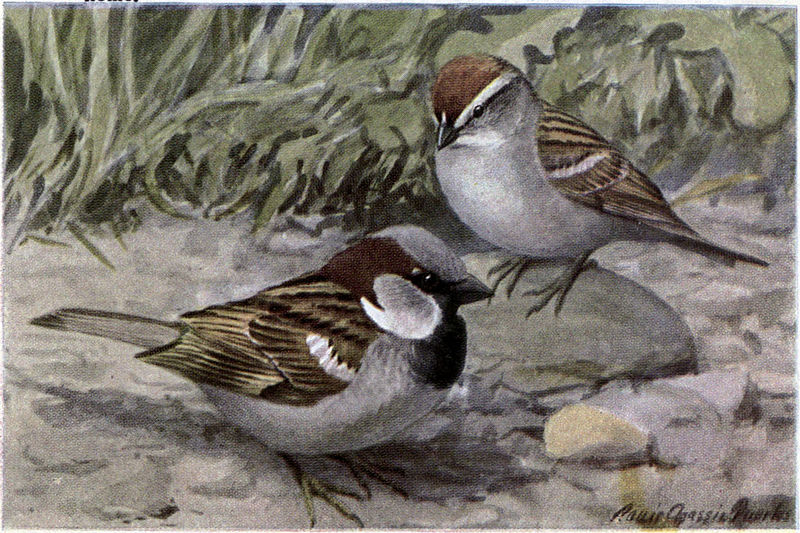
Bully the English Sparrow, Chippy the Chipping Sparrow - Burgess Bird Book ©©

Bully the English Sparrow, Chippy the Chipping Sparrow – Burgess Bird Book ©©

“Everybody does,” replied Johnny. “Everybody loves them as much as they hate Bully and his wife. Did you know that they are sometimes called Tree Sparrows? I suppose it is because they so often build their nests in trees?”

“No,” said Peter, “I didn’t. Chippy shouldn’t be called Tree Sparrow, because he has a cousin by that name.”

Johnny Chuck looked as if he doubted that, “I never heard of him,” he grunted.

Peter grinned. Here was a chance to tell Johnny Chuck something, and Peter never is happier than when he can tell folks something they don’t know. “You’d know him if you didn’t sleep all winter,” said Peter. “Dotty the Tree Sparrow spends the winter here. He left for his home in the Far North about the time you took it into your head to wake up.”

“Why do you call him Dotty?” asked Johnny Chuck.

“Because he has a little round black dot right in the middle of his breast,” replied Peter. “I don’t know why they call him Tree Sparrow; he doesn’t spend his time in the trees the way Chippy does, but I see him much oftener in low bushes or on the ground. I think Chippy has much more right to the name of Tree Sparrow than Dotty has. Now I think of it, I’ve heard Dotty called the Winter Chippy.”

“Gracious, what a mix-up!” exclaimed Johnny Chuck. “With Chippy being called a Tree Sparrow and a Tree Sparrow called Chippy, I should think folks would get all tangled up.”

“Perhaps they would,” replied Peter, “if both were here at the same time, but Chippy comes just as Dotty goes, and Dotty comes as Chippy goes. That’s a pretty good arrangement, especially as they look very much alike, excepting that Dotty is quite a little bigger than Chippy and always has that black dot, which Chippy does not have. Goodness gracious, it is time I was back in the dear Old Briar-patch! Good-by, Johnny Chuck.”
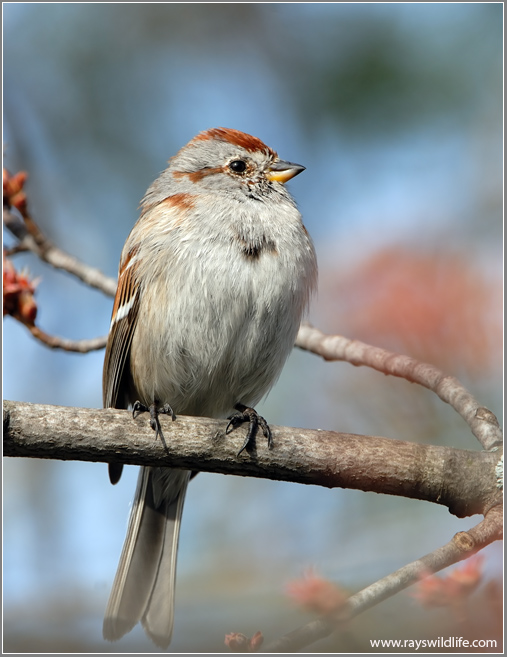
American Tree Sparrow by Ray

American Tree Sparrow by Ray

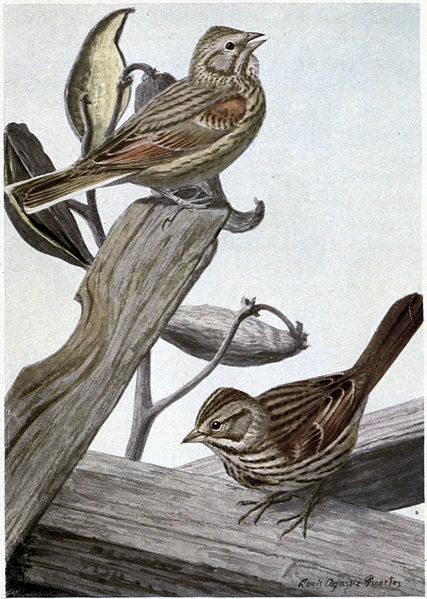
Away went Peter Rabbit, lipperty-lipperty-lip, heading for the dear Old Briar-patch. Out of the grass just ahead of him flew a rather pale, streaked little brown bird, and as he spread his tail Peter saw two white feathers on the outer edges. Those two white feathers were all Peter needed to recognize another little friend of whom he is very fond. It was Sweetvoice the Vesper Sparrow, the only one of the Sparrow family with white feathers in his tail.

“Come over to the dear Old Briar-patch and sing to me,” cried Peter.

Sweetvoice dropped down into the grass again, and when Peter came up, was very busy getting a mouthful of dry grass. “Can’t,” mumbled Sweetvoice. “Can’t do it now, Peter Rabbit. I’m too busy. It is high time our nest was finished, and Mrs. Sweetvoice will lose her patience if I don’t get this grass over there pretty quick.”

“Where is your nest; in a tree?” asked Peter innocently.

“That’s telling,” declared Sweetvoice. “Not a living soul knows where that nest is, excepting Mrs. Sweetvoice and myself. This much I will tell you, Peter: it isn’t in a tree. And I’ll tell you this much more: it is in a hoofprint of Bossy the Cow.”

“In a WHAT?” cried Peter.

“In a hoofprint of Bossy the Cow,” repeated Sweetvoice, chuckling softly. “You know when the ground was wet and soft early this spring, Bossy left deep footprints wherever she went. One of these makes the nicest kind of place for a nest. I think we have picked out the very best one on all the Green Meadows. Now run along, Peter Rabbit, and don’t bother me any more. I’ve got too much to do to sit here talking. Perhaps I’ll come over to the edge of the dear Old Briar-patch and sing to you a while just after jolly, round, red Mr. Sun goes to bed behind the Purple Hills. I just love to sing then.”

“I’ll be watching for you,” replied Peter. “You don’t love to sing any better than I love to hear you. I think that is the best time of all the day in which to sing. I mean, I think it’s the best time to hear singing,” for of course Peter himself does not sing at all.

(Vesper Sparrow singing ©xeno-canto.org by Chris Parrish)

That night, sure enough, just as the Black Shadows came creeping out over the Green Meadows, Sweetvoice, perched on the top of a bramble-bush over Peter’s head, sang over and over again the sweetest little song and kept on singing even after it was quite dark. Peter didn’t know it, but it is this habit of singing in the evening which has given Sweetvoice his name of Vesper Sparrow.

“Serve the LORD with gladness: come before his presence with singing.” (Psalms 100:2 KJV)

*

  • Who was the first new Sparrow we meet?
  • What were they busy doing?
  • Their nest was being built with what material?
  • What was the one thing needed to finish their nest?

*

  • Who was the next Sparrow that showed up?
  • Why did it confuse Johnny Chuck?
  • Why did the name “Dotty” fit for that sparrow?
  • Was Dotty or Chippy larger?

*

  • Sweetvoice is what kind of Sparrow?
  • What were these Sparrows making their nest out of?
  • Where was their nest?
  • When does Sweetvoice like to sing?

*

Are you busy doing the things that need to done? Do you sing? Most thought better of Chippy than Bully. Are more like Chippy or Bully?

Speaking to yourselves in psalms and hymns and spiritual songs, singing and making melody in your heart to the Lord; Giving thanks always for all things unto God and the Father in the name of our Lord Jesus Christ;
(Ephesians 5:19-20 KJV)

Links:

*

Links:

 Next Chapter –  Peter Learns Something He Hadn’t Guessed


Burgess-Bird-Book-for-Children


Burgess Bird Book For Children


 ABC’s of the Gospel


*

Burgess Bird Book For Children


*


Jenny Has a Good Word for Some Sparrows – Chapter 3

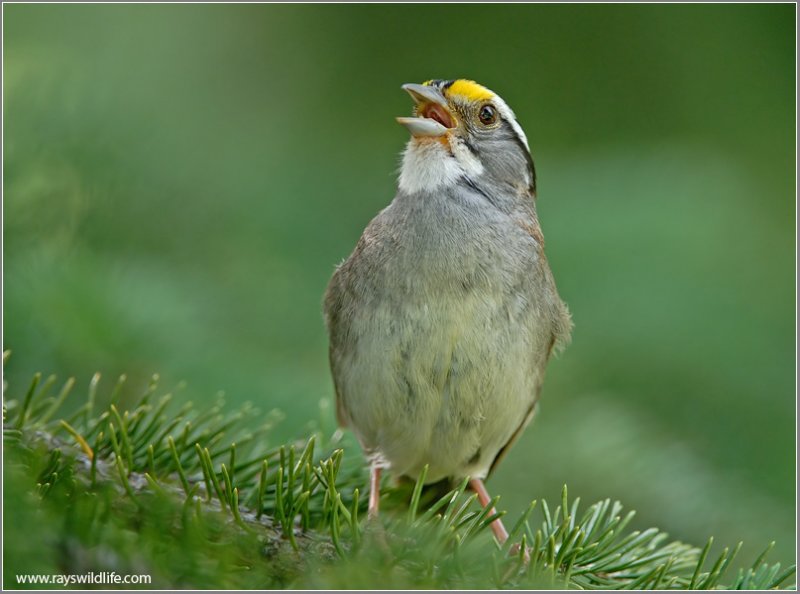
White-throated Sparrow by Ray

Jenny Has a Good Word for Some Sparrows

The Song, White-throated and Fox Sparrows.

The Burgess Bird Book For Children

*
Listen to the story read.

CHAPTER 3. Jenny Has a Good Word for Some Sparrows.

The morning after the fight between Jenny and Mr. Wren and Bully the English Sparrow found Peter Rabbit in the Old Orchard again. He was so curious to know what Jenny Wren would do for a house that nothing but some very great danger could have kept him away from there. Truth to tell, Peter was afraid that not being able to have their old house, Jenny and Mr. Wren would decide to leave the Old Orchard altogether. So it was with a great deal of relief that as he hopped over a low place in the old stone wall he heard Mr. Wren singing with all his might.

The song was coming from quite the other side of the Old Orchard from where Bully and Mrs. Bully had set up housekeeping. Peter hurried over. He found Mr. Wren right away, but at first saw nothing of Jenny. He was just about to ask after her when he caught sight of her with a tiny stick in her bill. She snapped her sharp little eyes at him, but for once her tongue was still. You see, she couldn’t talk and carry that stick at the same time. Peter watched her and saw her disappear in a little hole in a big branch of one of the old apple-trees. Hardly had she popped in than she popped out again. This time her mouth was free, and so was her tongue.

“You’d better stop singing and help me,” she said to Mr. Wren sharply. Mr. Wren obediently stopped singing and began to hunt for a tiny little twig such as Jenny had taken into that hole.

“Well!” exclaimed Peter. “It didn’t take you long to find a new house, did it?”

“Certainly not,” snapped Jenny “We can’t afford to sit around wasting time like some folk I know.”

Peter grinned and looked a little foolish, but he didn’t resent it. You see he was quite used to that sort of thing. “Aren’t you afraid that Bully will try to drive you out of that house?” he ventured.

Sweet Voice the Vesper Sparrow, Little Friend the Song Sparrow – Burgess Bird Book ©©

Jenny Wren’s sharp little eyes snapped more than ever. “I’d like to see him try!” said she. “That doorway’s too small for him to get more than his head in. And if he tries putting his head in while I’m inside, I’ll peck his eyes out! She said this so fiercely that Peter laughed right out.

“I really believe you would,” said he.

“I certainly would,” she retorted. “Now I can’t stop to talk to you, Peter Rabbit, because I’m too busy. Mr. Wren, you ought to know that that stick is too big.” Jenny snatched it out of Mr. Wren’s mouth and dropped it on the ground, while Mr. Wren meekly went to hunt for another. Jenny joined him, and as Peter watched them he understood why Jenny is so often spoken of as a feathered busybody.

For some time Peter Rabbit watched Jenny and Mr. Wren carry sticks and straws into that little hole until it seemed to him they were trying to fill the whole inside of the tree. Just watching them made Peter positively tired. Mr. Wren would stop every now and then to sing, but Jenny didn’t waste a minute. In spite of that she managed to talk just the same.

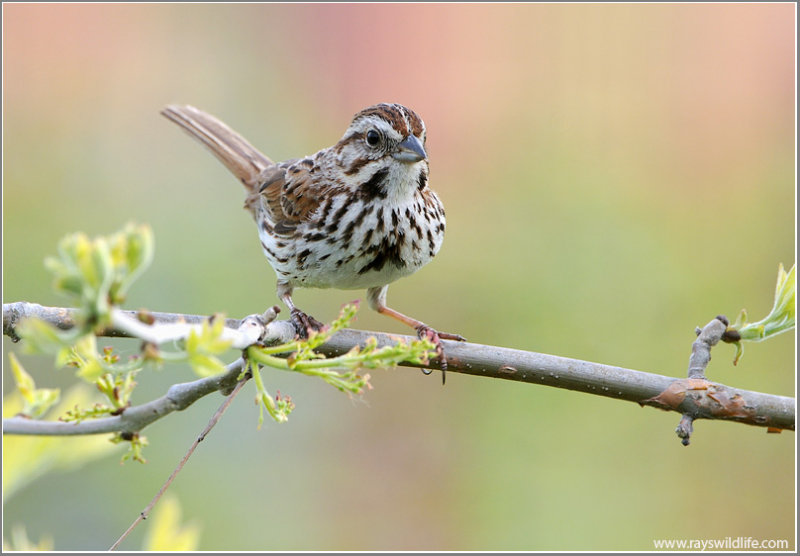
Song Sparrow by Ray

Song Sparrow by Ray

“I suppose Little Friend the Song Sparrow got here some time ago,” said she.

Peter nodded. “Yes,” said he. “I saw him only a day or two ago over by the Laughing Brook, and although he wouldn’t say so, I’m sure that he has a nest and eggs already.”

Jenny Wren jerked her tail and nodded her head vigorously. “I suppose so,” said she. “He doesn’t have to make as long a journey as we do, so he gets here sooner. Did you ever in your life see such a difference as there is between Little Friend and his cousin, Bully? Everybody loves Little Friend.”

Once more Peter nodded. “That’s right,” said he. “Everybody does love Little Friend. It makes me feel sort of all glad inside just to hear him sing. I guess it makes everybody feel that way. I wonder why we so seldom see him up here in the Old Orchard.”

“Because he likes damp places with plenty of bushes better,” replied Jenny Wren. “It wouldn’t do for everybody to like the same kind of a place. He isn’t a tree bird, anyway. He likes to be on or near the ground. You will never find his nest much above the ground, not more than a foot or two. Quite often it is on the ground. Of course I prefer Mr. Wren’s song, but I must admit that Little Friend has one of the happiest songs of any one I know. Then, too, he is so modest, just like us Wrens.”

Peter turned his head aside to hide a smile, for if there is anybody who delights in being both seen and heard it is Jenny Wren, while Little Friend the Song Sparrow is shy and retiring, content to make all the world glad with his song, but preferring to keep out of sight as much as possible.

Jenny chattered on as she hunted for some more material for her nest. “I suppose you’ve noticed,” said she, “that he and his wife dress very much alike. They don’t go in for bright colors any more than we Wrens do. They show good taste. I like the little brown caps they wear, and the way their breasts and sides are streaked with brown. Then, too, they are such useful folks. It is a pity that that nuisance of a Bully doesn’t learn something from them. I suppose they stay rather later than we do in the fall.”

“Yes,” replied Peter. “They don’t go until Jack Frost makes them. I don’t know of any one that we miss more than we do them.”

“Speaking of the sparrow family, did you see anything of Whitethroat?” asked Jenny Wren, as she rested for a moment in the doorway of her new house and looked down at Peter Rabbit.

Peter’s face brightened. “I should say I did!” he exclaimed. “He stopped for a few days on his way north. I only wish he would stay here all the time. But he seems to think there is no place like the Great Woods of the North. I could listen all day to his song. Do you know what he always seems to be saying?”

“What?” demanded Jenny.

I live happ-i-ly, happ-i-ly, happ-i-ly,” replied Peter. “I guess he must too, because he makes other people so happy.” (listen-©xeno-canto)

Jenny nodded in her usual emphatic way. “I don’t know him as well as I do some of the others,” said she, “but when I have seen him down in the South he always has appeared to me to be a perfect gentleman. He is social, too; he likes to travel with others.”

“I’ve noticed that,” said Peter. “He almost always has company when he passes through here. Some of those Sparrows are so much alike that it is hard for me to tell them apart, but I can always tell Whitethroat because he is one of the largest of the tribe and has such a lovely white throat. He really is handsome with his black and white cap and that bright yellow spot before each eye. I am told that he is very dearly loved up in the north where he makes his home. They say he sings all the time.”

Fox Sparrow (Passerella iliaca) by Ray

Fox Sparrow (Passerella iliaca) by Ray

“I suppose Scratcher the Fox Sparrow has been along too,” said Jenny. “He also started sometime before we did.”

“Yes,” replied Peter. “He spent one night in the dear Old Briar-patch. He is fine looking too, the biggest of all the Sparrow tribe, and HOW he can sing. The only thing I’ve got against him is the color of his coat. It always reminds me of Reddy Fox, and I don’t like anything that reminds me of that fellow. When he visited us I discovered something about Scratcher which I don’t believe you know.”

“What?” demanded Jenny rather sharply.

“That when he scratches among the leaves he uses both feet at once,” cried Peter triumphantly. “It’s funny to watch him.”

“Pooh! I knew that,” retorted Jenny Wren. “What do you suppose my eyes are make for? I thought you were going to tell me something I didn’t know.”

Peter looked disappointed.

The heart of the wise instructs his mouth And adds persuasiveness to his lips. Pleasant words are a honeycomb, Sweet to the soul and healing to the bones. (Proverbs 16:23-24 NASB)

*

Jenny seems to be in a kinder mood in this chapter. She has kind words about three different Sparrows. Can you name them?

What kind of sparrow was Little Friend? What kind of songs does he sing? Where does he like to live? What color cap does he have?

Our second sparrow is pictured at the top. Where was Whitethroat headed? What color is his cap? What does his song sound like? (When people use word to descrbe a song, that is called – Mnemonics.

Who is the largest sparrow? What color is Scratcher’s coat? Why is he called “Scratcher”?

Jenny is using nice words about the sparrows this time. Don’t you like to have good words spoken about you? Do you use nice words when talking about someone?

Read the two verses and think about how the Lord wants your speech.

Let the words of my mouth and the meditation of my heart Be acceptable in Your sight, O LORD, my strength and my Redeemer. (Psalms 19:14 NKJV)

Bonus – A Fox Sparrow Scratching

Links:

*

Links:

Bully the English Sparrow, Chippy the Chipping Sparrow - Burgess Bird Book ©©


  Next Chapter – Chippy, Sweetvoice, and Dotty.


Burgess-Bird-Book-for-Children


Burgess Bird Book For Children


Yellow-fronted Woodpecker (Melanerpes flavifrons) ©WikiC


*


Birdwatching Term – Mobbing

Crow on Eagles Back ©©

Maybe A Little Too Close – Crow on Eagles Back ©©

Birdwatching Term – Mobbing

In the recent article, The Old Orchard Bully – Chapter 2, the whole group of birds united to chase off the Black Cat. That is called, “mobbing.”

Some ask why don’t the bigger birds fight back? Here are a few quotes from various sources:

“This behavior – like calling your family for help – is used by many bird species. The best time to observe mobbing is spring and early summer, when breeding birds are trying to protect their nests and young. Birds including swallows, blackbirds, and even these American Crows, seen here mobbing a Red-tailed Hawk, know that there is strength and power in numbers. And they’ve learned to join forces to protect themselves. Be sure to watch the video!”

Quote from Why Don’t Hawks Fight Back? :All agreed that if a red-tailed hawk reached out and grabbed a crow with its talons, that would be the end of the crow. Or as one of the professionals put it, in scientific terms, “the crow would be toast.” But although large raptors have the necessary weapons, the energy cost of pursuing or otherwise attempting to catch a crow is normally not worth it. Crows are agile creatures and would be very difficult to catch in flight. So a hawk typically ignores the crows or flies away.”

A Great Horned Owl being mobbed!

*

Just as the Lord helps His Created critters, the Lord gives us promises about seeking His help:

But the LORD your God you shall fear; and He will deliver you from the hand of all your enemies.” (2 Kings 17:39 NKJV)

Give us help from trouble, For the help of man is useless. Through God we will do valiantly, For it is He who shall tread down our enemies. (Psalms 60:11-12 NKJV)

I have pursued my enemies and overtaken them; Neither did I turn back again till they were destroyed. (Psalms 18:37 NKJV)

O my God, I trust in You; Let me not be ashamed; Let not my enemies triumph over me. (Psalms 25:2 NKJV)

My times are in Your hand; Deliver me from the hand of my enemies, And from those who persecute me. (Psalms 31:15 NKJV)

For I will not trust in my bow, Nor shall my sword save me. But You have saved us from our enemies, And have put to shame those who hated us. In God we boast all day long, And praise Your name forever. Selah (Psalms 44:6-8 NKJV)

Some interesting links about mobbing:

Small Birds Mob Big Ones – Bird Note, with audio

Mobbing – RSPB

The Superb Fairywren – The Corporate Mob ~ by a j mithra

Birdwatching Terms

Birdwatching Tips 

Watching Birds

Wordless Birds

*


The Old Orchard Bully – Chapter 2

House Sparrow (Passer domesticus) by Nikhil

House Sparrow (Passer domesticus) by Nikhil

The Old Orchard Bully

The English or House Sparrow

The Burgess Bird Book For Children

*
Listen to the story read.

CHAPTER 2. The Old Orchard Bully.

Peter Rabbit’s eyes twinkled when Jenny Wren said that she must look her old house over to see if it was fit to live in. “I can save you that trouble,” said he.

“What do you mean?” Jenny’s voice was very sharp.

“Only that our old house is already occupied,” replied Peter. “Bully the English Sparrow has been living in it for the last two months. In fact, he already has a good-sized family there.”

“What?” screamed Jenny and Mr. Wren together. Then without even saying good-by to Peter, they flew in a great rage to see if he had told them the truth. Presently he heard them scolding as fast as their tongues could go, and this is very fast indeed.

“Much good that will do them,” chuckled Peter. “They will have to find a new house this year. All the sharp tongues in the world couldn’t budge Bully the English sparrow. My, my, my, my, just hear that racket! I think I’ll go over and see what is going on.”

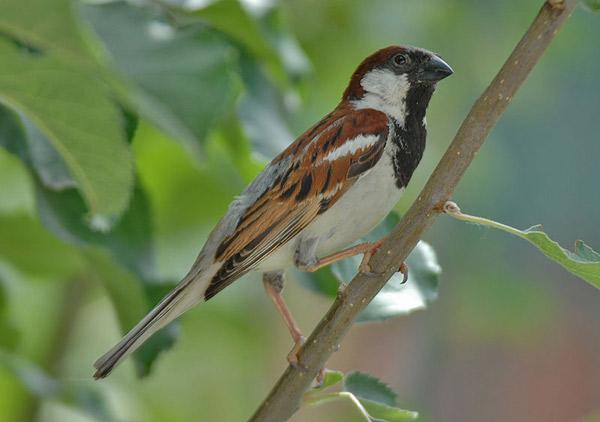
So Peter hopped to a place where he could get a good view of Jenny Wren’s old home and still not be too far from the safety of the old stone wall. Jenny Wren’s old home had been in a hole in one of the old apple-trees. Looking over to it, Peter could see Mrs. Bully sitting in the little round doorway and quite filling it. She was shrieking excitedly. Hopping and flitting from twig to twig close by were Jenny and Mr. Wren, their tails pointing almost straight up to the sky, and scolding as fast as they could make their tongues go. Flying savagely at one and then at the other, and almost drowning their voices with his own harsh cries, was Bully himself. He was perhaps one fourth larger than Mr. Wren, although he looked half again as big. But for the fact that his new spring suit was very dirty, due to his fondness for taking dust baths and the fact that he cares nothing about his personal appearance and takes no care of himself, he would have been a fairly good-looking fellow. His back was more or less of an ashy color with black and chestnut stripes. His wings were brown with a white bar on each. His throat and breast were black, and below that he was of a dirty white. The sides of his throat were white and the back of his neck chestnut.

By ruffling up his feathers and raising his wings slightly as he hopped about, he managed to make himself appear much bigger than he really was. He looked like a regular little fighting savage. The noise had brought all the other birds in the Old Orchard to see what was going on, and every one of them was screaming and urging Jenny and Mr. Wren to stand up for their rights. Not one of them had a good word for Bully and his wife. It certainly was a disgraceful neighborhood squabble.

Bully the English Sparrow, Chippy the Chipping Sparrow - Burgess Bird Book ©©

Bully the English Sparrow, Chippy the Chipping Sparrow – Burgess Bird Book ©©

Bully the English Sparrow is a born fighter. He never is happier than when he is in the midst of a fight or a fuss of some kind. The fact that all his neighbors were against him didn’t bother Bully in the least.

Jenny and Mr. Wren are no cowards, but the two together were no match for Bully. In fact, Bully did not hesitate to fly fiercely at any of the onlookers who came near enough, not even when they were twice his own size. They could have driven him from the Old Orchard had they set out to, but just by his boldness and appearance he made them afraid to try.

All the time Mrs. Bully sat in the little round doorway, encouraging him. She knew that as long as she sat there it would be impossible for either Jenny or Mr. Wren to get in. Truth to tell, she was enjoying it all, for she is as quarrelsome and as fond of fighting as is Bully himself.

“You’re a sneak! You’re a robber! That’s my house, and the sooner you get out of it the better!” shrieked Jenny Wren, jerking her tail with every word as she hopped about just out of reach of Bully.

“It may have been your house once, but it is mine now, you little snip-of-nothing!” cried Bully, rushing at her like a little fury. “Just try to put us out if you dare! You didn’t make this house in the first place, and you deserted it when you went south last fall. It’s mine now, and there isn’t anybody in the Old Orchard who can put me out.”

Peter Rabbit nodded. “He’s right there,” muttered Peter. “I don’t like him and never will, but it is true that he has a perfect right to that house. People who go off and leave things for half a year shouldn’t expect to find them just as they left them. My, my, my what a dreadful noise! Why don’t they all get together and drive Bully and Mrs. Bully out of the Old Orchard? If they don’t I’m afraid he will drive them out. No one likes to live with such quarrelsome neighbors. They don’t belong over in this country, anyway, and we would be a lot better off if they were not here. But I must say I do have to admire their spunk.”

All the time Bully was darting savagely at this one and that one and having a thoroughly good time, which is more than could be said of any one else, except Mrs. Bully.

“I’ll teach you folks to know that I am in the Old Orchard to stay!” shrieked Bully. “If you don’t like it, why don’t you fight? I am not afraid of any of you or all of you together.” This was boasting, plain boasting, but it was effective. He actually made the other birds believe it. Not one of them dared stand up to him and fight. They were content to call him a bully and all the bad names they could think of, but that did nothing to help Jenny and Mr. Wren recover their house. Calling another bad names never hurts him. Brave deeds and not brave words are what count.

Red-tailed Hawk (Buteo jamaicensis) Mobbed by Crows ©WikiC

Red-tailed Hawk (Buteo jamaicensis) Mobbed by Crows ©WikiC

How long that disgraceful squabble in the Old Orchard would have lasted had it not been for something which happened, no one knows. Right in the midst of it some one discovered Black Kitty, the cat who lives in Farmer Brown’s house, stealing up through the Old Orchard, her tail twitching and her yellow eyes glaring eagerly. She had heard that dreadful racket and suspected that in the midst of such excitement she might have a chance to catch one of the feathered folks. You can always trust Black Kitty to be on hand at a time like that.

No sooner was she discovered than everything else was forgotten. With Bully in the lead, and Jenny and Mr. Wren close behind him, all the birds turned their attention to Black Kitty. She was the enemy of all, and they straightway forgot their own quarrel. Only Mrs. Bully remained where she was, in the little round doorway of her house. She intended to take no chances, but she added her voice to the general racket. How those birds did shriek and scream! They darted down almost into the face of Black Kitty, and none went nearer than Bully the English Sparrow and Jenny Wren.

Now Black Kitty hates to be the center of so much attention. She knew that, now she had been discovered, there wasn’t a chance in the world for her to catch one of those Old Orchard folks. So, with tail still twitching angrily, she turned and, with such dignity as she could, left the Old Orchard. Clear to the edge of it the birds followed, shrieking, screaming, calling her bad names, and threatening to do all sorts of dreadful things to her, quite as if they really could.

When finally she disappeared towards Farmer Brown’s barn, those angry voices changed. It was such a funny change that Peter Rabbit laughed right out. Instead of anger there was triumph in every note as everybody returned to attend to his own affairs. Jenny and Mr. Wren seemed to have forgotten all about Bully and his wife in their old house. They flew to another part of the Old Orchard, there to talk it all over and rest and get their breath. Peter Rabbit waited to see if they would not come over near enough to him for a little more gossip. But they didn’t, and finally Peter started for his home in the dear Old Briar-patch. All the way there he chuckled as he thought of the spunky way in which Jenny and Mr. Wren had stood up for their rights.

A soft answer turns away wrath, But a harsh word stirs up anger. The tongue of the wise uses knowledge rightly, But the mouth of fools pours forth foolishness. The eyes of the LORD are in every place, Keeping watch on the evil and the good. A wholesome tongue is a tree of life, But perverseness in it breaks the spirit. (Proverbs 15:1-4 NKJV)


*

What caused all the fuss between the Sparrows and the Wrens?

Why did Bully have a right to the house?

Where had the Wrens gone?

When the cat came by, do you know what it is called when birds attack like that? It is called – Mobbing. (A simple definition of mobbing is an group of individuals around a potentially dangerous predator (the cat).

Are we suppose to get angry when things don’t go our way?

Sparrows are listed in the Bible several times and usually with a promise of God taking care of them.

Wrens are really nice birds that sing often and do raise their tail frequently.

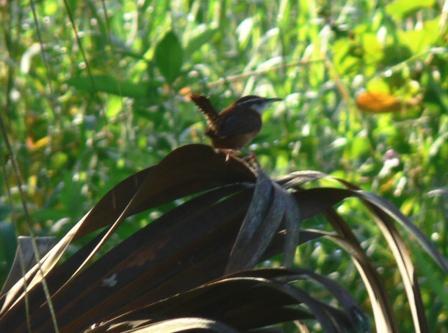
Carolina Wren by Lee at Circle B

Carolina Wren by Lee at Circle B

“Are not five sparrows sold for two copper coins? And not one of them is forgotten before God. But the very hairs of your head are all numbered. Do not fear therefore; you are of more value than many sparrows. (Luke 12:6-7 NKJV)

More:

Links:

Sweet Voice the Vesper Sparrow, Little Friend the Song Sparrow - Burgess Bird Book ©©


  Next Chapter (Jenny Has a Good Word for Some Sparrows.)


Burgess-Bird-Book-for-Children


Burgess Bird Book For Children


ABC's of the Gospel


  ABC’s of the Gospel


*

*


Birdwatching Terms – About’s Bird Bill Parts

Bird Bill Parts From About

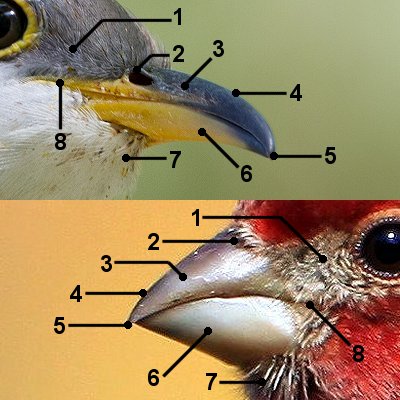
About's Bill-Parts ©Dan Pancamo/nigel

About’s Bill-Parts ©Dan Pancamo/nigel

Bird Bill Parts.  ©Dan Pancamo / nigel

The dove came to him toward evening, and behold, in her beak was a freshly picked olive leaf. So Noah knew that the water was abated from the earth. (Genesis 8:11 NASB)

A bird’s bill, also called a beak, is a critical piece of its anatomy, not only for foraging, defense, singing and other behaviors, but also for birders to make a proper identification. Depending on the bird, a bill can provide clues to far more than species: age, gender, diet and foraging behaviors can all be learned by studying a bill. By knowing the basic parts of a bill and the bird’s face and head immediately adjacent to the bill, birders can be better prepared to look for the subtle clues bills can reveal about every bird.

Overall Bill Features

Some of the most important aspects of a bird’s bill are not specific features, but the general jizz of the bill. When first studying bird bills, look for…

  • Size: How large does the bill appear in proportion to the bird’s head? Check for length as compared to the length of the head as well as the width of the bill and how that width may change along the bill’s length.
  • Shape: Bill shapes vary widely, from delicate triangles or thin, needle-like bills to thick, bulbous bills to sharply curved bills to radical shapes that include spoon-like tips or horny casques. When the shape is very unique, that can be a diagnostic clue for a bird’s identity even if other field marks cannot be seen.
  • Color: The color of a bill can be a clue for species, gender or age. Note the overall color as well as any specific markings, such as a colored tip or base, subterminal band or color differences between the top and bottom of the bill.

Specific Bill Parts

When birders can get a good look at a bill, there are a number of different parts that can yield clues about the bird’s identity, such as…

  1. Lores: While not part of the bill itself, the lores are the space between the base of a bird’s bill and the forward edge of its eyes. This area may be a different color or show a smudge or eye line that can be an identification clue.
  2. Nares: More commonly called the nostrils, the position of the nares as well as their size and shape are important to note for bird’s identities. In some types of birds, such as raptors, the nares are covered by a fleshy cere, while in others, such as many seabirds, elongated tube-like nares help filter seawater.
  3. Maxilla: Also called the upper mandible, the maxilla is the top half of a bird’s bill. Size, length and shape will vary, and some birds have knobs, fleshy wattles or other features that distinguish the maxilla.
  4. Culmen: Difficult to see on many bird species, the culmen is the center line drawn down the length of a bird’s maxilla. In some species, this can be a very distinct peak that divides the sides of the bill, while it may not be noticeable in other species.
  5. Tip: The tip of a bird’s bill may be different shapes, such as blunt or sharply pointed, depending on the bird’s general diet. Hooks are common at the tip of carnivorous birds’ bills, while many waterfowl have small bumps, called nails, on the tip of the maxilla.
  6. Mandible: The lower half of a bird’s bill is called the mandible or lower mandible. The color may vary from the maxilla either along the entire length or just at one end, and can be a great clue for identification. Some birds, such as many gulls, may show spots or other markings just on the mandible.
  7. Chin: Not directly part of the bill, the chin is the area of feathers immediately adjacent to the base of a bird’s mandible. In some species, the color of the chin may vary from the throat or face, providing a valuable identification clue.
  8. Gape: This is a fleshy area at the base of the bill where the upper and lower mandibles meet. In young birds, it is often enlarged or may seem so because the birds have not developed their mature feathers to help conceal it, and it may be brightly colored so their mouths are more noticeable when they beg for food. On some species, such as the bananaquit, the gape remains colorful on adult birds.
Bananaquit (Coereba flaveola) by Raymond Barlow

Bananaquit (Coereba flaveola) by Raymond Barlow

It can be difficult to see many of the subtle details of a bird’s bill, but understanding the different bill parts is a great way for birders to refine their identification skills and learn more about every bird they see.

Photo – Yellow-Billed Cuckoo (Above) © Dan Pancamo
Photo – House Finch (Below) © nigel

*

This is a good introduction to the bird’s bill. Look for more articles on the individual parts of the beak.

From About Birding/Wild Birds – Bird Identification

More Birdwatching Terms 

Birdwatching Tips

*


Why Use The Birds of the World?

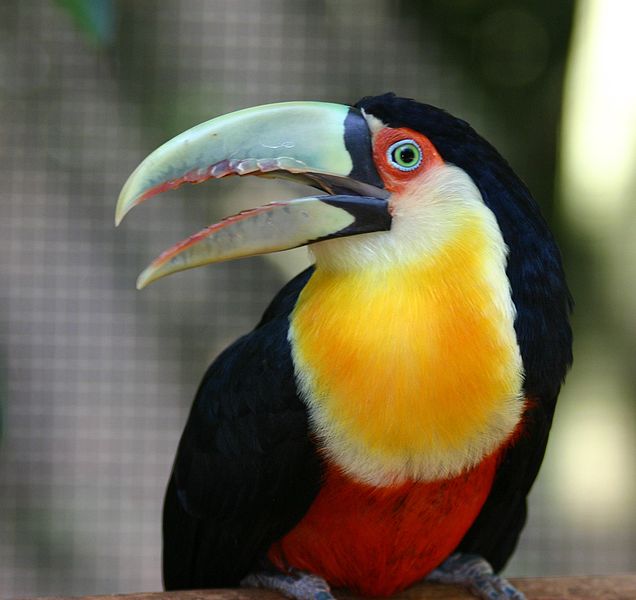
Green-billed Toucan (Ramphastos dicolorus) ©WikiC

Green-billed Toucan (Ramphastos dicolorus) ©WikiC

The list of all the Birds of the World are updated about every four months. Which we try to keep up with their (I.O.C.) newest lists.

You are probably wondering why you would need it. Let me share some things about it and then give you some ideas how it my be handy for one of your school projects.

The I.O.C. is actually the International Ornithological Committee. “Ornithological” basically means those who study birds or bird related. They maintain a list of all the birds around the world. They set standards of how to name them, what scientific classification to place the birds in, and divide them into Orders and Families, etc.

They are needed because we may call a bird by one name, yet someone in a different country or area may call it by a different name. They realize that those two names belong to the same bird. It is a very hard task to keep track of all those 10,000 plus birds, but that is what they try to do.

They give every bird an English name as a standard. Then they also want every one to spell the words the same. For instance, some people spell the “Grey” or “Gray” to mean the same color. To keep things simple, all the birds are spelled as “Grey.” That is just one example.

There are committees all over the world working on the birds of the area they live in, then those committees get together to combine all the list to make one big list. That is what was just updated.

On our Birds of the World section, you will find the birds listed by Orders (40 main classifications), then by Families (240 groups of closely related birds). The reason all of that is not duplicated here would be very time-consuming. There are hundreds of pages and thousands of photos on that site.

Wood Duck (Aix sponsa) by Dan

Wood Duck (Aix sponsa) by Dan

Projects for school or your own information:

You know the name of a bird’s name, but need to find  the Species name,  Go to the Species Index to find these choices:

If you know that it called Madagascan something, go to the First Name of Bird  index and choose the “M” page

If you know it is a Duck, go to the Last Name of Bird  index and choose the “D – Last Name” page.

The Families have four indexes to help you find the Families of birds.

When you find your bird in the right family, almost every bird has a link to a photo or video.

I will share more tips on how to use those indexes in another article.

Another reason is because we believe the Lord created all the beautiful birds and He should get all the credit.

In the beginning God created the heavens and the earth. (Genesis 1:1 NKJV)

So God created great sea creatures and every living thing that moves, with which the waters abounded, according to their kind, and every winged bird according to its kind. And God saw that it was good. (Genesis 1:21 NKJV)

*

Peterson’s Field Guide Videos Updated

Peregrine Falcon (Falco peregrinus) by Ray

Peregrine Falcon (Falco peregrinus) by Ray

Give instruction to a wise man, and he will be yet wiser: teach a just man, and he will increase in learning. (Proverbs 9:9 KJV)

Peterson Field Guide-Videos

Finished updating the missing videos for the Peterson Field Guide videos. The Vodpod company stopped supporting its videos, which was unknown to me. All of these videos were on YouTube and are now working properly again.

They are very interesting and if you haven’t seen them or at least for a while, they are worth checking out. Here are some of the titles:

How-to Videos:

Give instruction to a wise man, and he will be yet wiser: teach a just man, and he will increase in learning. (Proverbs 9:9 KJV)

How to Identify Birds
Topography (Parts of the Bird)
Bird Songs and Sounds
Range Maps

Bird Families:

Common Loon
Atlantic Puffin
Ducks, Geese, Swans
Wood Duck
Shorebirds Overview
Shorebirds ID
Gulls and Terns
Heron, Egrets, Bitterns – Updated
Wild Turkey
Raptors Overview
Raptors ID
Bald Eagle
Peregrine Falcon
Owls
Greater Roadrunner
Hummingbirds
Woodpeckers
Red-Headed Woodpecker
Flycatchers
Northern Mockingbird
Thrushes
American Robin
Warblers
Meadowlarks
Finches
Northern Cardinal
Sparrows

Enjoy! Dust is still flying as I’m still searching for other broken Vodpod videos.

*


Picture Story – Coppersmith Barbet (Observations) – Re-post

Coppersmith Barbet (Megalaima haemacephala) ©One Happy Birder

Coppersmith Barbet (Megalaima haemacephala) ©One Happy Birder

According to studies, January to June is usually the breeding season of Coppersmith Barbets found in the Indian Subcontinent. I had seen a courtship display of this species last year where the female waited patiently for the male, the male kept returning to the female with food in its beak, the male used to puff himself up, start flapping its wings and then feed the female displaying his affection to her, and then the eventually they would mate.

Recently, I observed two Coppersmith Barbets indulge in an activity which looked…. Picture Story- Coppersmith Barbet (Observations).


Lee’s Addition:

Let your speech be alway with grace, seasoned with salt, that ye may know how ye ought to answer every man. (Colossians 4:6 KJV)

The article goes on to describe this behavior as “a term ‘allobilling’ trying to find out what this behavior meant. From what i read, ‘allobilling’ is mutual mouthing between two birds.”

This mouthing is what caught my interest as a Christian. What kind of “mouthing” are we doing?

A man hath joy by the answer of his mouth: and a word spoken in due season, how good is it! (Proverbs 15:23 KJV)

Coppersmith Barbets are members of the Megalaimidae – Asian Barbets Family.

*

*


Slides From Birdwatching Lesson

Slide1

Oh that men would praise the LORD for his goodness, and for his wonderful works to the children of men! (Psalms 107:15 KJV)

Here is the Powerpoint Presentation I used yesterday, converted to JPGs. (Teaching About Birdwatching) As it was shown, each point came up as I clicked and explained the points. The two videos that were part of it; the Blue Jay calling and the Carolina Wren singing, are included. If you can use any of this presentation, you have my permission. The first slide had an audio of birds singing as the students arrived.

*

This slideshow requires JavaScript.

*

*

Teaching About Birdwatching

Birdwatching

*


Birdwatching at the Family Reunion

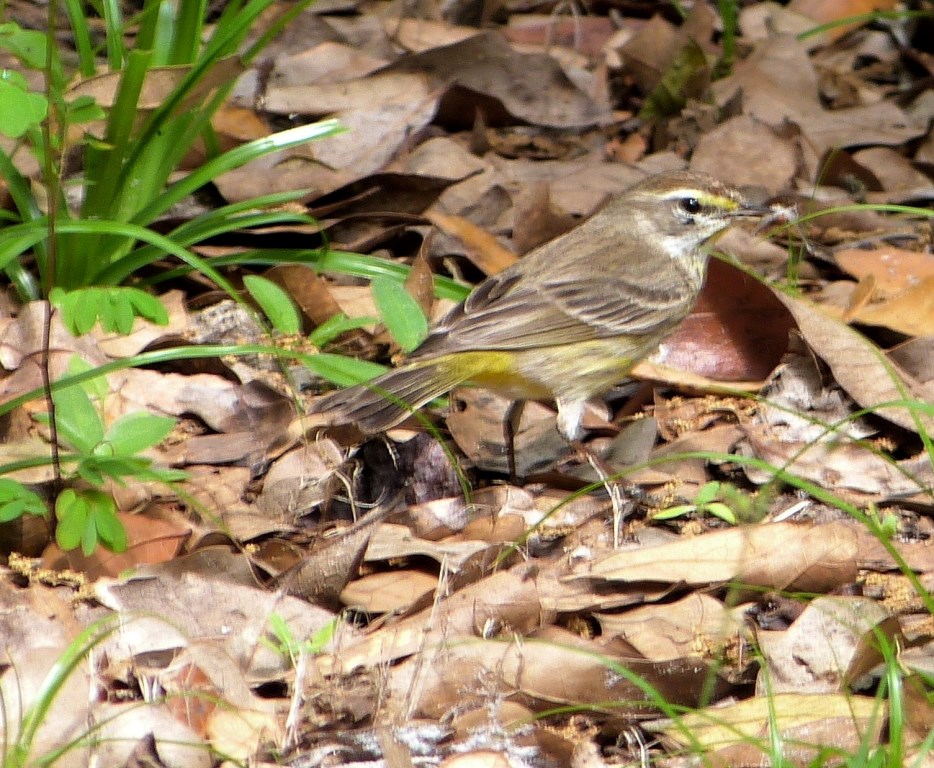
Palm Warbler

Palm Warbler

Last weekend, we had a family reunion at my brother’s place. He lives near Bushnell and Webster, FL on 5 acres of land. Since it is so wooded with Oak trees and others, I kept my camera at the ready.

We heard lots of birds, saw some and photographed even fewer. We still had a great time.

My nephew from south Florida was there with his family, so I asked four of my great-nieces and great-nephew to join me on a birdwatching adventure.  Figured I might as well start training another generation of birdwatchers. We headed off and my almost 5 yr old “chatterbox” nephew produced the first lesson. We encouraged him to “talk less” and “listen.”

Train up a child in the way he should go, And when he is old he will not depart from it. (Proverbs 22:6 NKJV)

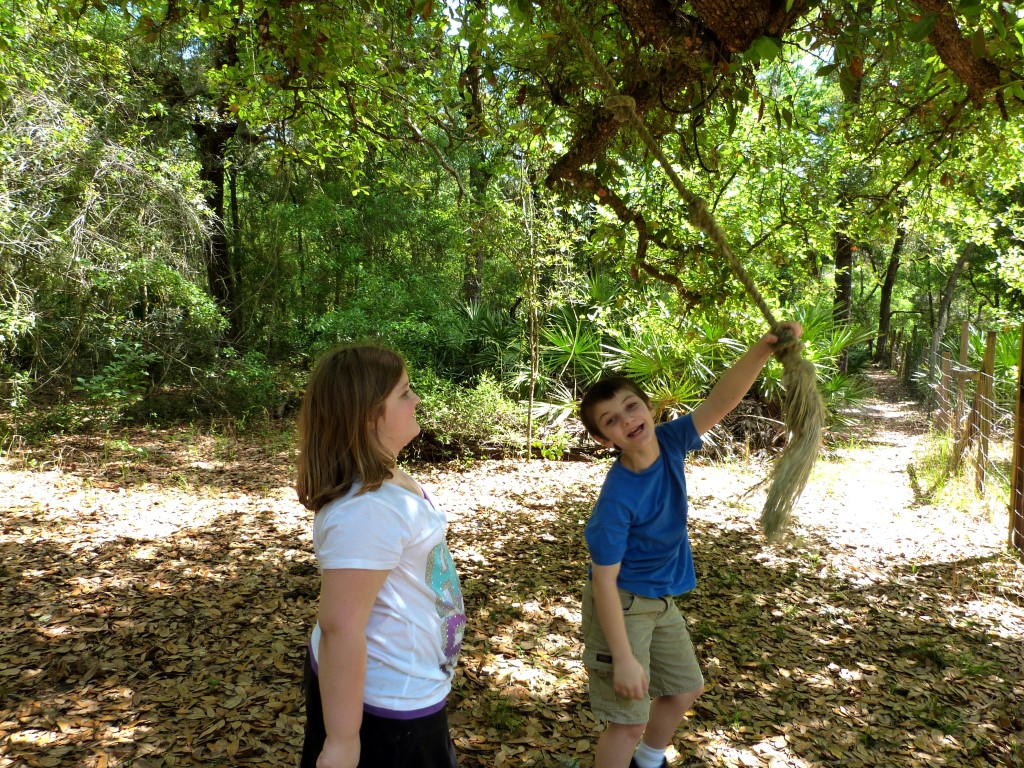
We heard several, but never saw any. (Northern Cardinal, Tufted Titmouse and a Blue Jay) When we got to the end of the property, turned right and followed the fence line. Not very far we came upon a tree with a rope hanging down with knots on it. At that point, all birdwatching and birdwatching lessons stopped.

The rope with the "Chatterbox" aboard.

The rope with the “Chatterbox” aboard.

Later, I gathered some more and off we went again. This time my great-niece and nephew from Tampa were with me. We heard those same birds, plus a Palm Warbler, and saw them very briefly. Another lesson was taught about having “soft eyes” as you look at trees. Don’t stare, just sort of look lightly and watch for movement. Fine, we turned the corner at the fence and ran into the “rope” again. That birdwatching adventure ended and another “rope adventure” began.

Oh, that men would give thanks to the LORD for His goodness, And for His wonderful works to the children of men! (Psalms 107:8 NKJV)

At the rope again.

At the rope again.

Needless to say, that “rope” became an unexpected highlight of the reunion. Every attempt to take a trip ended up there. They even loaded up my brother’s golf cart and brought a whole crew down there.

What did I eventually see and here? Let’s see; Northern Cardinal, Tufted Titmouse, Blue Jay, Carolina Wrens, Pileated Woodpecker, Ruby-throated Hummingbirds, Grey Catbird, and some Black Vultures flying overhead.

Carolina Wren

Carolina Wren

To me, one of the highlights was watching the Carolina Wrens flying into a cabinet in my brother’s pole barn. When they weren’t around, this is what I discovered:

Wren nest in a paper box.

Wren nest in a paper box.

On the next to the top shelf they had a nest in the works.

Wren nest in a Pepsi paper cup.

Wren nest in a Pepsi paper cup.

*

Wren nest in a Pepsi paper cup.

Wren nest in a Pepsi paper cup – closeup.

Talking with my sister-in-law, also a birdwatcher – who lives there, she figures that they feel safe in the pole barn because the hawks can’t fly through there and attack the nests. Several years ago on one of my visits, the Wrens had made a nest in a paper sack. There were eggs in it that time.

*

I had the blog on autopilot last week and through the week-end. My sister spent time with us before and after the reunion. Now it is time to get back to blogging.

*


Birdwatching Tips – Herons, Egrets, Bitterns

Little Blue Heron at Lake Hollingsworth

Little Blue Heron at Lake Hollingsworth

Lev 11:19  And the stork, the heron after her kind, and the lapwing, and the bat.

Peterson’s Field Guide Videos have great information about how to identify birds in the Heron, Egrets and Bittern Family. This is a very good video.
*

*

See the other video in this series:

Peterson Field Guide-Videos

*

Ardeidae- Herons, Bitterns

Birds of the Bible – Herons

Wordless Birds

*

How Birds Are Named

American Robin (Turdus migratorius) eating by Jim Fenton

American Robin (Turdus migratorius) eating by Jim Fenton

HOW BIRDS ARE NAMED

From ~ Color Key to North American Birds, by Frank M. Chapman

Birds have two kinds of names. One is a common, vernacular, or popular name; the other is a technical or scientific name. The first is usually given to the living bird by the people of the country it inhabits. The second is applied to specimens of birds by ornithologists who classify them.

Common names in their origin and use know no law. Technical names are bestowed under the system of nomenclature established by Linnæus and their formation and application are governed by certain definite, generally accepted rules. The Linnæan system, as it is now employed by most American ornithologists, provides that a bird, in addition to being grouped in a certain Class, Order, Family, etc., shall have a generic and specific name which, together, shall not be applied to any other animal.

Our Robin, therefore, is classified and named as follows:

CLASS AVES, Birds.

ORDER PASSERES, Perching Birds.

Suborder Oscines, Singing Perching Birds.

Family –Turdidæ Thrushes.

Subfamily Turdinæ Thrushes.

Genus, Turdus Thrushes.

Species, migratorius American Robin.

The Robin’s distinctive scientific name, therefore, which it alone possesses, is Turdus migratorius. There are numerous other members of the genus Turdus, but not one of them is called migratorius and this combination of names, therefore, applied to only one bird.

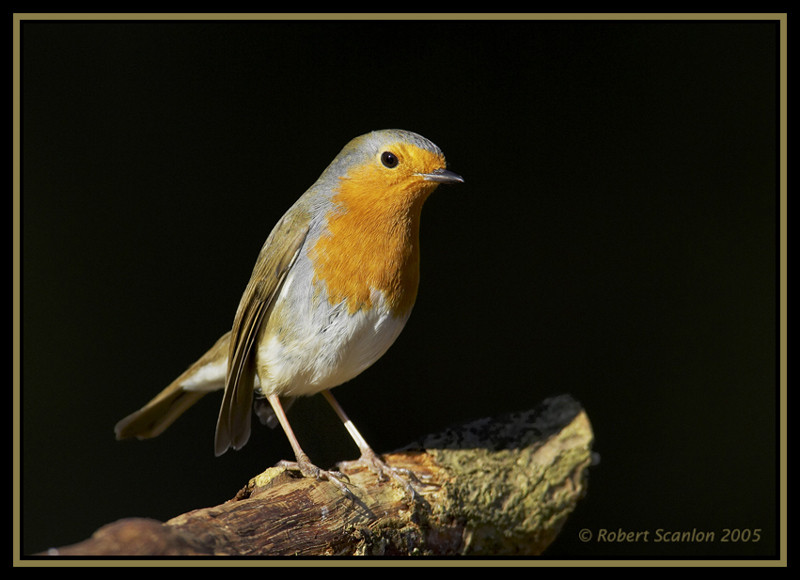
The questions Why use all these Latin terms? Why not call the bird “Robin” and be done with it? are easily answered. Widely distributed birds frequently have different names in different parts of their range. The Northern Flicker (Colaptes auratus), for instance, has over one hundred common or vernacular names. Again, the same name is often applied to wholly different birds. Our Robin (Turdus migratorius) is not even a member of the same family as the European Robin (Erithacus rubecola.) If, therefore, we should write of birds or attempt to classify them only by their common names, we should be dealing with such unfixed quantities that the result would be inaccurate and misleading. But by using one name in a language known to educated people of all countries, a writer may indicate, without danger of being misunderstood, the particular animal to which he refers. Among people speaking the same tongue, where a definite list of vernacular names of animals has been established, they can of course be used instead of the scientific names.

European Robin (Erithacus rubecula) by Robert Scanlon

European Robin (Erithacus rubecula) by Robert Scanlon

Such a list of North American birds has been prepared by the American Ornithologists’ Union. It furnishes a common as well as scientific name for each of our birds, and is the recognized standard of nomenclature among American ornithologists. The names and numbers of birds employed in this Color Key are those of the American Ornithologists’ Union’s ‘Check-List of North American Birds.’

It will be observed that in this ‘Check-List,’ and consequently in the following pages, many birds have three scientific names, a generic, specific, and subspecific. The Western Robin, for example, appears as Turdus migratorius propinquus. What is the significance of this third name?

In the days of Linnæus, and for many years after, it was supposed that a species was a distinct creation whose characters never varied. But in comparatively recent years, as specimens have been gathered from throughout the country inhabited by a species, comparison frequently shows that specimens from one part of its range differ from those taken in another part of its range. At intervening localities, however, intermediate specimens will be found connecting the extremes.

Generally, these geographical variations, as they are called, are the result of climatic conditions. For instance, in regions of heavy rainfall a bird’s colors are usually much darker than they are where the rainfall is light. Song Sparrows, for example, are palest in the desert region of Arizona, where the annual rainfall may not reach eight inches, and darkest on the coast of British Columbia and Alaska, where the annual rainfall may be over one hundred inches. In going from one region, however, to the other the gradual changes in climate are accompanied by gradual changes in the colors of the Song Sparrows, and the wide differences between Arizona and Alaska Song Sparrows are therefore bridged by a series of intermediates.

Variations of this kind are spoken of as geographic, racial, or subspecific and the birds exhibiting them are termed subspecies. In naming them a third name, or trinomial is employed, and the possession of such a name indicates at once that a bird is a geographic or racial representative of a species, with one or more representatives of which it intergrades.

Returning now to the Robin. Our eastern Robins always have the outer pair of tail-feathers tipped with white and, in adults, the back is blotched with black; while Robins from the Rocky Mountains and westward have little or no white on the outer tail-feathers, and the back is dark gray, without black blotches. These extremes are connected by intermediate specimens sharing the characters; of both eastern and western birds. We do not, therefore, treat the latter as a species, but as a subspecies, and consequently, apply to it a subspecific name or trinomial, Turdus migratorius propinquus, (propinquus, meaning nearly related.)

A further study of our eastern Robin shows that in the southern parts of its breeding range (the Carolinas and Georgia), it varies from the northern type in being smaller in size and much paler and duller in color; and to this second geographical variety is applied the name Turdus migratorius achrusterus, (achrusterus, meaning less highly colored).

After the recognition of western and southern races of the Robin under three names (trinomial) it would obviously be inconsistent to apply only two names (binomial) to our eastern bird, the former being no more subspecies of the latter than the latter is of the former. In other words, to continue to apply only generic and specific names to the Eastern Robin would imply that it was a full species, while the use of a trinomial for the Western or the Southern Robin shows them to be subspecies. As a matter of fact we know that there is but one species of true Robin in the United States, consequently in accordance with the logical and now generally accepted method, we apply to that species the name Turdus migratorius, and this is equally applicable to Robins from east, south or west. When, however, we learn that the Eastern Robin is not a species but a subspecies, we repeat the specific name by which it was made known and call it Turdus migratorius migratorius.

It may be asked, Why give names to these geographical races? Why not call Eastern, Western and Southern Robins by one name, Turdus migratorius, without regard to their climatic variations?

In reply, two excellent reasons may be given for the recognition of subspecies by name; first, because in some cases they differ from one another far more than do many species, when it would clearly be inadvisable to apply the same name to what are obviously different creatures. For example, it has lately been discovered by Mr. E. W. Nelson that the small, black-throated, brown-breasted, Quails or Bob-whites of southern Mexico, through a long series of intermediates inhabiting the intervening region, intergrade with the large, white-throated, black-and-white breasted, Bob-white of our northern states. It would be absurd to call such wholly unlike birds by the same name, nor could we give a full specific name to the Mexican Bob-white since at no place can we draw a line definitely separating it from the northern Bob-white. Furthermore, the use of only two names would conceal the remarkable fact of the intergradation of two such strikingly different birds; a fact of the first importance to students of the changing within species.

For much the same reason we should name those birds which show less pronounced variations, such as are exhibited by the Robin. Here we have a species in the making, and in tracing the relation between cause and effect, we learn something of the influences which create species. Thus, climate has been definitely proven so to alter a species, both in size and color that, as we have seen in the case of the Song Sparrows, marked climate changes are accompanied by correspondingly marked changes in the appearance of certain animals. In naming these animals we are, in effect, giving a ‘handle to the fact’ of their speciation by environment.

Bring out with you every living thing of all flesh that is with you: birds and cattle and every creeping thing that creeps on the earth, so that they may abound on the earth, and be fruitful and multiply on the earth.” So Noah went out, and his sons and his wife and his sons’ wives with him. Every animal, every creeping thing, every bird, and whatever creeps on the earth, according to their families, went out of the ark. (Genesis 8:17-19 NKJV)

Since it is evident that a bird may vary much or little, according to the governing conditions and its tendency to respond to them, no fixed rule can be laid down which shall decide just what degree of difference are deserving a name. It follows, therefore, that in some cases ornithologists do not agree upon a bird’s claim to subspecific rank.

In North America, however, questions of this kind are referred to a committee of seven experts of the American Ornithologists’ Union, and their decision establishes a nomenclature, which is accepted as the standard by other American ornithologists and which has been adopted in this volume.

Spotted Redshank (Tringa erythropus) by W Kwong

Spotted Redshank (Tringa erythropus) by W Kwong – Listed as a Recent Sighting – NARBA

Foreign birds of wholly accidental occurrence, most of which have been found in North America but once or twice, are included in the systematic list of North American birds, but are not described or figured in the body of the book, where their presence would tend to convey an erroneous impression of their North American status. Furthermore, records of the presence of birds so rare as these can be properly based on only the capture of specimens.

In the preparation of the following pages both author and artist have had full access to the collections of the American Museum of Natural History, and they are also glad to acknowledge their indebtedness to William Brewster of Cambridge, Massachusetts, to Robert Ridgway, Curator of Birds in the United States National Museum, and to C. Hart Merriam, Chief of the Biologic Survey, for the loan of specimens for description and illustration.

(Some editing to correct a few names and wording. Bolding is mine.)

Today, the I.O.C, which I use here on the blog, is now the International Ornithologist Union. They are trying to standardize an English Name and a Scientific Names for all the birds of the world.

The article is a little technical, but helps explain the naming process. As I have said previously, Adam had it a little easier. There were less species and subspecies. Now there are over 10,400 species and at present, 20,989 subspecies. God commanded the birds to multiply and they have been obeying. Now we have the challenge of trying to put names on all of them. Every time they grow a different colored feather, I think they name it either a new species or a subspecies. :o)

See:

Birds of the World

Birds of the Bible

Leaving the Ark

Seven by Seven

*