New Species?

While working on the Orders of the Birds and finding so many species of birds worldwide, I went looking for more information about them. I came across this interesting article at the ICR.org website. The bolding is mine. I trust you will find it worth the reading.

Cormorant Tree by Dan

Cormorant Tree by Dan

Do ‘New Species’ Demonstrate Darwinism?
by Various Authors
Frank Sherwin, M.A., and Brian Thomas, M.S.*

“That species undergo change in this grand system called earth is apparent, but those changes do not occur the way Charles Darwin envisioned. Living things do shift behaviors and physiologies in response to environmental (and other) pressures, but can these minor changes completely rework a creature’s essential form (a concept referred to as “macroevolution”)? Decades of research emphatically say no.

Often, small changes within a kind are referred to as “microevolution,” which has been defined as “evolution resulting from a succession of relatively small genetic variations that often cause the formation of new subspecies.”1 Creation scientists agree that small variations occur, both because they can be observed, and because it is reasonable that a wise Creator would equip His creatures with survival-enhancing capabilities. But these variations do not lead to large-scale changes between kinds. Indeed, “there is no agreement [among evolutionists] as to whether macroevolution results from the accumulation of small changes due to microevolution, or whether macroevolution is uncoupled from microevolution.”2

The confusing array of definitions for the word “species” can obscure deficiencies in Darwinian evolution. As leading scientists have admitted, “The very term ‘species’ is deeply ambiguous.”3 Harvard’s Steven Palumbi said in 1994 that “the formation of species has long represented one of the most central, yet also one of the most elusive, subjects in evolutionary biology.”4

If different species are described as essentially those forms which cannot interbreed, then new species do arise, a process called “speciation.” They do so, however, because of a loss of information–the opposite direction to what Darwinian evolution requires. “…..

To see the complete article – CLICK HERE

World Bird Lists on the Internet

There is plenty of data about the birds of the world on the internet. This site is not competing with them, but just trying to use the pages here to introduce the birds and have links to our articles and links to great pages about them on the internet.

Our emphasis is “Birdwatching from a Christian Perspective”, so, we may see things a little different from time to time. When I read so many of the articles, they tell of the birds evolving, whereas, I believe God created them and told them to go multiply and cover the earth. There has been lots of variation going on, but no “evolution” from one kind to another. So, I just read around their remarks about evolution and enjoy the information about the actual birds.

Here are some links for information on the birds of the world.

IOC World Bird List ver 2.1 – Where I got the data for my list.

Bird Families of the World, 9th edition – Used many times for references

Bird Families of the World, Allen Chartier’s photographs – Newly found

Birdingonthe.net – Lots of links for birding the internet

Checklist of the World – Many interesting links

Avibase -“Avibase is an extensive database information system about all birds of the world”

Handbook of the Birds of the World – Wikipedia’s extensive information on the birds.

Eye of the Beholder – Bird Names

Mom and Baby at Lake Hollingsworth

Mom and Baby at Lake Hollingsworth

Last week, Dan and I went to Lake Hollingsworth in Lakeland, our favorite place to go birding when we don’t have a lot of time, my legs aren’t working well, or Dan has a new, used camera to check out. That was the case, I was just checking out the normal birds for this time of the year and photographed this female mallard and her chick. In other words, there aren’t many. Most of them have gone back north to do what God commanded them to do when they came off the ark.

Then God spoke to Noah, saying, “Go out of the ark, you and your wife, and your sons and your sons’ wives with you. Bring out with you every living thing of all flesh that is with you: birds and cattle and every creeping thing that creeps on the earth, so that they may abound on the earth, and be fruitful and multiply on the earth.” So Noah went out, and his sons and his wife and his sons’ wives with him. Every animal, every creeping thing, every bird, and whatever creeps on the earth, according to their families, went out of the ark. (Genesis 8:15-19 NKJV)

So, the birds have been reproducing and reproducing and reproducing. I have been working on a project for this blog behind the scenes and it has to do with the bird families of the world. The numbers keep changing, but the count is over 10,000 species (living) worldwide. All the Birding committees work hard on putting them into Order, Families, Genus, and then giving them a  Scientific name and an English name. As I have been working on this project, I couldn’t help but think about how well the birds have obeyed.

What amazes me, is how they (Birding committees) decide how to classify them. I have a hard enough time, getting some birds just into the right family, let alone figuring them all out. Warblers being the hardest for me. Here is my idea of this whole process, from a human classification.

Smith Family:
Dad – Black hair, blue eyes, normal ears, round eyes
Mom – blond hair, green eyes, normal ears, slant eyes
Child #1 – Black hair, green eyes, ears stick out, round eyes
Child #2 – Blond hair, blue eyes, long ear lobes, slant eyes
Child #3 – Brown hair, blue eyes, normal ears, beady eyes
Child #4 – Red hair, black eyes, pointed ears, bushy eyebrows
The children grow up and each find a mate with similar characteristics, they move away and continue to have children with their same characteristics and some more variations show up. Etc, etc.

Now along come the classifying committees! Can you imagine how they would try to classify the human race?
I’ll leave that to your imagination.

To get a glimpse of my project, click List of ORDERS of the Birds in Taxonomic Order Just realize, this is a work in progress.

Ian’s Bird of the Week – Red-capped Robin

Red-capped Robin by Ian

Red-capped Robin by Ian

Ian’s Newsletter:

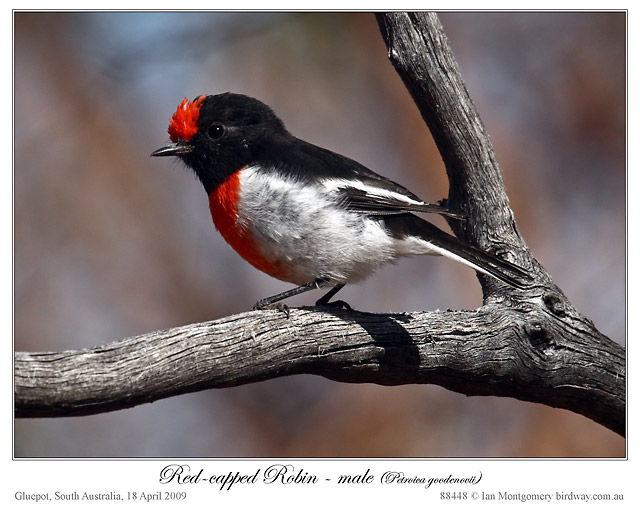
“The Red-capped Robin is the most widespread of the 5 red-breasted Robins that occur in mainland Australia. It prefers drier habitats and is found across Australia west of the Great Dividing Range and south of the Tropic of Capricornia but does not occur in Tasmania.

The red cap of the male is both distinctive and diagnostic (first photo) and even the brown female has a reddish cap (second photo) making her easier to identify than the other female Robins. With a length of 11 – 12 cm./4.3 – 4.7 in., it is the smallest of the Robins. Typically, it perches in low branches and flies down onto the ground to pick up insect prey.

Flame Robin by Ian

Flame Robin by Ian

In the early days of European settlement of the colonies, any small bird with a red breast was likely to be called a Robin after the familiar European Robin so it isn’t surprising to find that such birds are not necessarily closely related. The European Robin is a member of the Old World Flycatchers, The American Robin is a Thrush, while all the Australasian Robins belong to a separate family the Australo-Papuan Robins (Petroicidae ).

On the website, I’ve recently reorganized the galleries for:
Petrels & Shearwaters;
Bee-eaters;
and added night-time photos of:
Australian Owlet-Nightjar;
Tawny Frogmouth;
and – just for the record – Stubble Quail.

Best wishes,
Ian


Lee’s Additions:

Red-capped Robin female by Ian

Red-capped Robin female by Ian

What a cute and beautiful bird. You will have to visit Ian’s site and see all his Red-capped Robin Photos. From what I have read about them, they may be small, but they stay on the move or are defending their turf. This from Wikipedia:

“The Red-capped Robin typically perches in a prominent location low to the ground, often flicking its wings and tail. It is very active and does not stay still for long.[27] The female has been reported as being fairly tame, while the male is more wary of human contact.[28]

The Red-capped Robin is territorial during the breeding season; the area occupied has been measured between 0.25 and 1.2 ha (0.6–3 acres).[16] A pair lives and forages within their territory before dispersing in autumn.[16] The male proclaims ownership by singing loudly from a suitable perch at the territory boundary, and confronts other males with a harsh scolding call should they make an incursion.[29] Two males have been seen to face off one another 30 cm to 1 m (12–40 in) apart, flicking wings and maneuvering for position in a threat display while the female is actually incubating her eggs.”

He sends the springs into the valleys; They flow among the hills. They give drink to every beast of the field; The wild donkeys quench their thirst. By them the birds of the heavens have their home; They sing among the branches. (Psalms 104:10-12 NKJV)

There favorite food (96%) is beetles with ants most of the remainder. They do like locust, butterflies, dragon and damselflies, etc. It likes to pounce on it prey on the ground. It catches some flying, but is a specialist for ground attacks.

The sad part about this bird is the treat from loss of habitat. They used to be common in the western suburbs of Sydney, but now has almost disappeared for the there and the Sydney Basin. Other places are noticing declines of this neat Red-capped Robin. Two other threats are the feral cats and other birds raiding the nest and young.

This is of a Red-capped Robin taking on a mirror. Ignore the last part. By jezau2

See:
Ian’s Bird of the Week for more of these articles.

Ian’s Birdway Website

Birdway Images of  Global Australo-Papaun Robins – Family: Petroicidae

Australo-Papaun Robins Petroicidae by Bird Families of the World

Red-capped Robin at Wikipedia


Birds of the Bible – Eagles III

This year I have been reading through the Bible in chronological order. In Jeremiah this week, the eagle showed up in three of the verses I was reading. If you know me by now, that calls for a blog about one of my favorite “Birds of the Bible” birds.

Jeremiah, the prophet, has been warning the people of Judah and Jerusalem that they were going to be punished by God because of their worship of other gods and turning from Him. Jeremiah was always in problems because; 1) few if any believed him, 2) the false prophets were telling the people that “all was well and that they would not be punished.” 3) they tried to kill him several times, 4) when confronted with the truth, knowing they would be killed or taken captive, they still refused to give up their false religions or turn to the LORD. So by chapter 48:28 he warns them – “You who dwell in Moab, Leave the cities and dwell in the rock, And be like the dove which makes her nest In the sides of the cave’s mouth.” (NKJV) (oops! the dove is for another blog) He is telling them to “leave town.”

Jeremiah 48:40-42 says:

For thus says the LORD: “Behold, one shall fly like an eagle, And spread his wings over Moab. Kerioth is taken, And the strongholds are surprised; The mighty men’s hearts in Moab on that day shall be Like the heart of a woman in birth pangs. And Moab shall be destroyed as a people, Because he exalted himself against the LORD.

Watch the following video and decide whether you think the fish was surprised.

In Jeremiah 49:16 and 22, the eagle is mentioned again. Eagles are known to make their nest as high up as they can and these people thought by being high up in the hills, that the enemy would not get them. Then in verse 22, it refers to flying like an eagle and spreads its wings. So the enemy (Nebuchadnezzar king of Babylon and his army) was going to come over them. Now the people are finally afraid.

Your fierceness has deceived you, The pride of your heart, O you who dwell in the clefts of the rock, Who hold the height of the hill! Though you make your nest as high as the eagle, I will bring you down from there,” says the LORD. (Jeremiah 49:16 NKJV)
Behold, He shall come up and fly like the eagle, And spread His wings over Bozrah; The heart of the mighty men of Edom in that day shall be Like the heart of a woman in birth pangs. (Jeremiah 49:22 NKJV)

Another of my favorite eagle videos of the eagles wings being spread:

Even though I used my favorite videos, this was not a enjoyable experience for these people. I trust we will heed the warnings of the Bible. God loves his chosen people, Israel (and all of us), but God cannot tolerate sin or denial of Himself.

He who is often rebuked, and hardens his neck, Will suddenly be destroyed, and that without remedy. (Proverbs 29:1 NKJV)
“Come now, and let us reason together,” Says the LORD, “Though your sins are like scarlet, They shall be as white as snow; Though they are red like crimson, They shall be as wool. If you are willing and obedient, You shall eat the good of the land; But if you refuse and rebel, You shall be devoured by the sword”; For the mouth of the LORD has spoken. (Isaiah 1:18-20 NKJV)

The people of Noah’s day had over 100 years of warning, but also refused to accept God, and were devoured, not by sword, but by a flood.


See Also:
Eagles for more articles, photos, and videos
Wordless Birds

*

When I Consider! – Hummingbirds

When I Consider!

When I Consider!

“One of the fascinating and unique creatures of all creation is the common hummingbird. What is the probability that all of the unique characteristics of the Ruby-throated Hummingbird, each of which are needed for its survival, developed by some step-by-step process? A few of the hummingbird’s incredible abilities are listed below:

  1. The unique ability to fly forward, backward, upside-down, and straight up like a helicopter as no other bird can.
  2. The use of a special fringed tongue to sweep insects out from the inside of flowers. It cannot survive on nectar alone, but also needs the protein from eating insects. Without its special tongue it could never catch the insects.
  3. The ability to fly 500 miles nonstop over the gulf waters to Mexico. The hummingbird can conserve its strength for long flights by taking a prolonged rest just  prior to the flight and making every motion count in flight.
  4. The ability to go into a “torpid” condition at night by almost shutting down its metabolism. Because of its incredibly high energy activity, gram for gram the hummingbird has the greatest energy output of any warm-blooded animal. Yet at night it uses only about one fifth of its normal energy.
Ruby-throated Hummingbird by Ray's Wildlife

Ruby-throated Hummingbird by Ray’s Wildlife

The hummingbird is truly a marvel of God’s creativity.

Character Sketches, Vol.II, p.42-48″

Seek the LORD and his strength; seek his presence continually! Remember the wondrous works that he has done, his miracles, and the judgments he uttered, (Psalms 105:4-5 ESV)

A Closer Look at the Evidence, July 13, by Richard and Tina Kleiss

Error
This video doesn’t exist

To see more about Hummingbirds See:

Birds of the Bible – Bird Feeder I

Hummingbirds – Peterson Field Guide Series

Hummingbird Videos

Happy Anniversary!

Out birding and caught by the newspaper

Out birding and caught by the newspaper

Today, Dan and I are celebrating our 46th anniversary. It is hard to believe that it has been that long. We are very thankful for all the blessings the Lord has bestowed on us over the years. Are we perfect, no, but we love each other and have made a commitment to “hang in there” through good times or bad, ups or downs. The Bible tells us:

And the LORD God said, It is not good that the man should be alone; I will make him an help meet for him. (Genesis 2:18 KJV)

Me Feeding The Beggars!

Me Feeding The Beggars!

We have become a good team over the years. Even now as we go birdwatching. I love to do the birdwatching and he likes to take the photos. And that is only one of the ways we blend our personalities into one “togetherness.” Most important of all, we together and individually have “togetherness” with our Saviour, the Lord Jesus Christ.

Since this blog is about birdwatching, what can we learn from them about staying together. We find throughout the birding world and other critters, that many of the mates stick together for life.

But now ask the beasts, and they will teach you; And the birds of the air, and they will tell you; (Job 12:7 NKJV)

Dan at work-Tricolored and Stork

Dan at work-Tricolored and Stork

Here are some of the monogamous (mate for life)  birds that have been mentioned in our articles:
Birds of the Bible – Dove and Turtle-Dove
Osprey III
Swan
April Lorier’s:
Eagles and The Atmosphere of Grace
Ian’s Bird of the Week
White-browed Babbler

These are just a few I picked out, there are plenty more that mention mating for life.

Ian’s Bird of the Week – Brush and Common Bronzewings

Brush Bronzewing by Birdway

Brush Bronzewing by Birdway

I’ve just revised the Dove and Pigeon galleries on the website () and it set me thinking how many gorgeous members of this family occur in Australia. Some, like the Fruit-Doves, are spectacularly so, while others are more subtle. The subtler ones included the Bronzewings and their allies such as the Crested and Spinifex Pigeons, a group of several genera endemic to Australia and New Guinea.
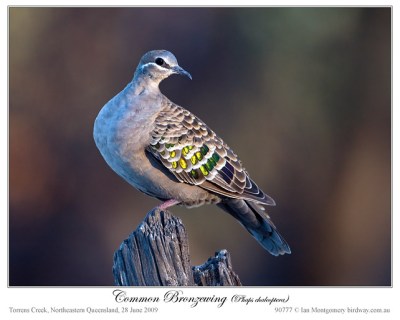
Common Bronzewing by Ian

Common Bronzewing by Ian

The Bronzewings get their name from iridescent feathers in their wing coverts. These are shown in display and at other times are not conspicuous unless the light is at the right angle, rather like the iridescent feathers of hummingbirds. The first photo shows a Brush Bronzewing which has two rows of iridescent feathers, one reddish and the other bluish green. The second photo shows a Common Bronzewing at sunset and it has several rows of bronze-green feathers and one dark blue row. This bird is a female; male Common Bronzewings have even brighter feathers.

The Brush Bronzewing occurs in scrub and forest in coastal southern Australia from Fraser Island in Queensland to Dongara in Western Australia, including Tasmania. The Common Bronzewing is widespread throughout Australia except in the driest areas such as eastern Western Australia. The Common Bronzewing in particular is wary and takes flight readily, so often the best way to observe it is at water holes. This one was photographed last Sunday while we were sitting quietly near a dam; at least 50 Common Bronzewings came in to drink and this one perched nervously on a post quite close to us before proceeding down to the water.

Best wishes, Ian

See Ian’s Bird of the Week for more of these articles.
See Ian’s Birdway Website


Lee’s additions:

Ian’s remark about the “Common Bronzewing in particular is wary and takes flight readily” caught my eye. Also Wikipedia says, “They tend to browse quietly until disturbed, then remain still, their earthy browns blending into the earth and leaf litter until the intruder approaches too closely, at which point the bronzewing takes off with an explosive burst of sudden wing clapping and feather noise, and disappears from sight within moments.” Both remarks reminded me of scripture.

They will walk after the LORD, He will roar like a lion; Indeed He will roar And His sons will come trembling from the west. They will come trembling like birds from Egypt And like doves from the land of Assyria; And I will settle them in their houses, declares the LORD. (Hosea 11:10-11 NASB)

Why do the birds tremble and seem wary of people. The reason is that God put in them the fear of man after the global flood in Noah’s day.

For since the creation of the world God’s invisible qualities—his eternal power and divine nature—have been clearly seen, being understood from what has been made, so that men are without excuse. Romans 1:20

The fact that they blend in to their surroundings is part of the Lord’s creative love for the birds. He provides for their protection.

Flock Bronzewing by Ian

Flock Bronzewing by Ian

Here is some more information about the “Bronzewing Pigeon” according to Wikipedia:
The dividing line between the bronzewings and the rock pigeons is arbitrary: essentially, rock pigeons are bronzewings without bronze on their wings. Members of the group include:

* The Common Bronzewing (Phaps calcoptera) is a large, bulky pigeon with a small head, found in all parts of Australia bar some of the deep desert, Cape York Peninsula, and urban areas. Its advertising call is an extraordinary mournful whooo repeated at metronomic intervals for an interminable length of time. Although rather wary by nature, birds in the urban fringes become quite used to humans.

* The Brush Bronzewing (Phaps elegans) is uncommon, probably threatened. Marginally smaller than the Common Bronzewing and rather secretive—except for its call, which is slightly faster and higher-pitched but maintained through the hottest days with equally monotonous determination. Brush Bronzewings nest low down, often on the ground, and are very vulnerable to feral cats and foxes.

Crested Pigeon by Ian

Crested Pigeon by Ian

* Flock Bronzewings (Phaps histrionica) roam the grasslands of the northern half of the continent. Once found in enormous flocks, they are still to be seen in their thousands. Pizzey’s description of their habits is memorable: “When locally abundant, at end of day, undulating, shearwater-like flocks fly to water, settle short distance away, and walk in. Thirsty latecomers may drop directly into water and drink while spreadeagled, before springing off.”

* Crested Pigeons (Ocyphaps lophotes) are distinctive, common, and widespread. Usually seen in small flocks in open woodlands or grasslands, it is always close to water. With the clearing of much forest and the provision of water in arid regions for cattle, Crested Pigeons have increased in number.
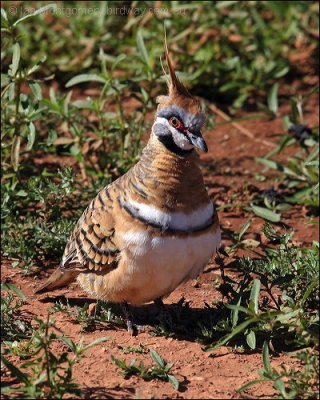
Spinifex Pigeon

Spinifex Pigeon

* The Spinifex Pigeon (Geophaps plumifera) is an unmistakable ground-dwelling small pigeon, reddish-bronze in colour and prominently crested, with a unique upright, military stance. When dirturbed it prefers to run erratically, breaking into rapid, noisy flight only if pressed. A desert specialist, it is found in the arid and semi-arid zones of the northern half of the continent.
* The Partridge Pigeon (Geophaps smithii) is a dull brown bird about 26 cm long found only in pairs or small flocks in the grasslands of northern Northern Territory and northern Western Australia.

* The Squatter Pigeon (Geophaps scripta), like the very similar Partridge Pidgeon, spends feeds, roosts, and nests on the ground, and prefers infertile sandy soils and gravel where the grass grows only thinly, allowing easy movement. Squatter Pigeons are restricted to the eastern half of Queensland and north-eastern New South Wales.

Some interesting articles about iridescent colors on birds and butterflies:

From Blue-t-ful Beetles, Birds, `n Butterflies, this quote:
“The strikingly iridescent blue seen in some butterfly, beetle, and bird feathers is well-known and enjoyed by scientists and laymen alike. This is due to creatures (and some plants) reflecting or absorbing certain frequencies of light due to the external chemical composition of their body. In past decades, it has been realized that although the color of these structures is clearly and unusually blue—no blue pigment can be found!
The South American butterfly, Morpho rhetenor, has wings composed of extremely tiny scales like all members of the Lepidoptera. Biologists magnified scales of the upper wing surface 20,000 times and saw “a regular grid of precisely constructed wedge-shaped ridges spaced at intervals of about 0.00022 mm. This pattern is repeated so accurately that the maximum deviation is only 0.00002 mm. No earthly workshop specializing in miniaturization [nanotechnology], would be able to make one single wing scale with this required precision.“1 Detailed investigation of other butterflies reveals iridescence due to “nanoscale structures that produce ultra-high reflectivity and narrow-band spectral purity.”

From God’s Rainbow in Living Color by Catherine Myers:
Unique Colors
Butterflies’ wings are covered with tiny scales that create their colors and patterns. Under a microscope, the tiny scales resemble roofing tiles that overlap in different patterns.
Wing colors originate from two sourcespigmentation (color in the scale itself) or iridescence (light from the sun that changes color as it bends within the scales). Earth tones (brown, orange, yellow, white, and black) come from pigments. Iridescent colors (blue, green, copper, silver, and gold) arise from special scales that bend light into different colors. Because the scales act like a prism and separate light into different wavelengths, some butterflies actually appear to change color during flight.

See:
Ian’s Bird of the Week for more of these articles.
Ian’s Birdway Website


Ian’s Bird of the Week – White-browed Babbler

White-Browed Babbler by Birdway

White-Browed Babbler by Birdway

“If you had a bird popularity poll with Australian birders, I imagine that Babblers would do well. I hope so anyway, as it would show that pretty colours aren’t everything and character still counts in an often superficial world!

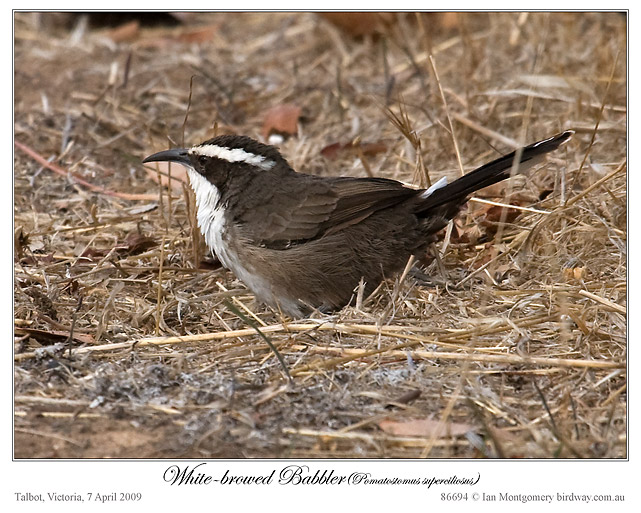
I photographed these White-browed Babblers when staying with friends in Talbot in rural Victoria northwest of Melbourne. This species is found in dry woodland in the southern half of the continent, mainly west of the Great Divide and south of the Tropic of Capricorn. Although wren-like in shape, they are much larger, the White-browed is 18-22cm./7-8.5in. in length and is the smallest of the four Australian species.

White-browed Babbler by Birdway

White-browed Babbler by Birdway

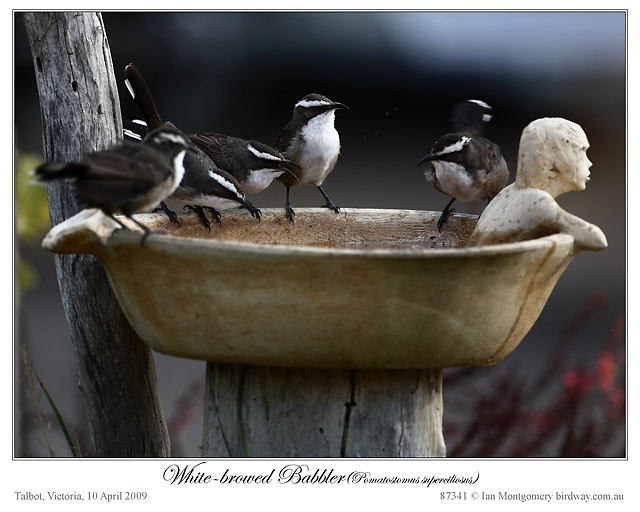
Babblers are highly social, noisy and exuberant. The live in groups of 3 to about a dozen and do everything together, including roosting, breeding and, as in the second photo, bathing. They build a number of domed nest in their territory; apparently only one of these is used for nesting, so the others are thought to be used for roosting. When disturbed by an observer, they chatter scoldingly, and move away, appearing to bounce rather than fly on their short wings. Their gregarious habits have earned them lots of common names such as Happy Family, Cackler, Go-aways, Twelve Apostles and Jumper, names applied rather indiscriminately to both this and the other widespread species, the Grey-crowned Babbler.

The four Australian species and a fifth found in PNG comprise the Australo-Papuan Babblers (family Pomatostomidae). These used to be included with the superficially similar Old World Babblers in the family Timaliidae http://www.birdway.com.au//timaliini/index.htm . It is now apparent that the two groups are not closely related.”

I’ve revised the Australo-Papuan Babblers on the website with new photos of 3 of the 4 species:
I’ve also added new photos to these waders:
Common Greenshank
Red-necked Stint
Bar-tailed Godwit
Black-tailed Godwit
Sooty Oystercatcher .
At the moment, I’m doing the ducks and have added photos, taken in Ireland, of:
Mute Swan
Tufted Duck
Eurasian Wigeon.

Please visit Ian Montgomery’s Birdway site for many interesting Birds of the World photography. He is a fantastic photographer. (Bolding by Lee)


Lee’s addition:
What an interesting bird and I love their common names – Happy Family, Cacker which bring to mind the following verses:

And my soul shall be joyful in the LORD; It shall rejoice in His salvation. (Psalms 35:9 NKJV)
Oh come, let us sing to the LORD! Let us shout joyfully to the Rock of our salvation. Let us come before His presence with thanksgiving; Let us shout joyfully to Him with psalms. For the LORD is the great God, And the great King above all gods. (Psalms 95:1-3 NKJV)”

“The Australo-Papuan or Australian babblers are endemic to Australia-New Guinea. The Australo-Papuan babblers are medium-sized terrestrial birds with sombre plumage and long decurved bills. The wings are short and round, and the tail is long and often held fanned which makes it look broad as well. The feet and legs are strong and adapted to a terrestrial existence. There is no sexual dimorphism in the plumage, which is composed of brown, russet and grey colours, often with striking white markings on the face and throat. The plumage of juvenile birds is similar to that of adults.
Five species in one genus are currently recognised, although the red-breasted subspecies rubeculus of the Grey-crowned Babbler may prove to be a separate species. Further investigation is required.

Chestnut-crowned Babbler by Birdway

Chestnut-crowned Babbler by Birdway

All five species are ground-feeding omnivores and highly social. Babblers live in family groups and small flocks of up to about 20 individuals and forage communally, calling loudly to one another all day long. They feed principally on insects and other invertebrates, but will also take seeds, fruits and small vertebrates. Most food is obtained on the ground, although they will also forage in low bushes; the Grey-crowned Babbler and New Guinea Babbler feed more extensively in vegetation than the other species. The long bill is used to probe and overturn large objects. They will also hold objects with one foot and hammer them with the bill in order to extract food.

Australo-Papuan babblers are monogamous breeders which defend territories. The breeding pair will be aided in breeding by a number of helpers from its group. A number of groups may have more than one breeding pair. Extra male helpers aid the male in his responsibilities whereas the females aid the main breeding male in hers. They have an extended breeding season. Australo-Papuan babblers construct large nests for communal roosting, and these nests may be used for breeding, or new nests may be constructed. There may be a lrage number of nests used by the group in a small area. When the female is breeding she alone uses the breeding nest. Nest construction, both of roosting and breeding nests, is undertaken by all birds in the group. Between one to six eggs are laid (the number and range varies by species) and are usually incubated by the breeding female alone (although a helper female may aid occasionally). The Breeding male and other helper males feed the breeding female during incubation. Incubation lasts between 19-25 days. The female broods the chicks until they are able to thermoregulate, and the chicks fledge after 16-23 days. After leaving the nest the chicks will continue to be fed by the adults for a number of months.”

The five species are the New Guinea Babbler, Grey-crowned Babbler, White-browed Babbler, Hall’s Babbler, and the Chestnut-crowned Babbler. (Photos are from Ian at Birdway)

*Information from Ian’s Bird of the Week newsletter, Wikipedia and other internet sources.

Check out the Bird of the Week – Introduction

See:
Ian’s Bird of the Week for more of these articles.
Ian’s Birdway Website


Ian’s Bird of the Week – Introduction

Red-capped Robin

Red-capped Robin by Birdway

Ian Montgomery of Birdway’s Birds of the World Website, who has been one of the photographers used throughout this blog, has given me permission for a new series of articles. Ian lives in Australia and is a fantastic photographer. On his website he “invites you to enjoy the beauty and fascination of wild birds with his photos of more than 1,200 species from Australia and around the World.” As of a few days ago, the “site contains more than 4,600 photos of 1,218 bird species in the wild; 581 of these are on the main Australian list of Christidis & Boles, 2008.” There is much to discover on the Birdway Website.

Every week Birdway sends out a newsletter with a Bird of the Week. The newsletters have interesting information about the bird being featured and several photos of that bird. With his permission, the Bird of the Week will be featured here, with some additions of my own at the bottom. We trust you will enjoy learning about and seeing some birds that many of us here in America do not have the privilege to see.

But now ask the beasts, and let them teach you; And the birds of the heavens, and let them tell you. (Job 12:7 NASB)

Major Mitchell's Cockatoo by Ian

Major Mitchell's Cockatoo by Ian

That is one of my favorite “bird verses.” I enjoy learning about the wonderful birds and critters that have been created. When I see their beauty and behavior, and their bad sides also, there are lessons to learn. Let’s see what we can learn through observing the different “Birds of the Week.”

I can’t say that I will only do one a week, because he has been producing the newsletter for some time. I will have a hard time picking from the past ones. I just may have to double-up.

Please visit his website – Birdway’s Birds of the World
Also, to sign up for his newsletter – CLICK HERE

Thanks you, Ian, for this privilege.

See the first Bird of the Week – White-browed Babbler

Birds of the Bible – Partridge II

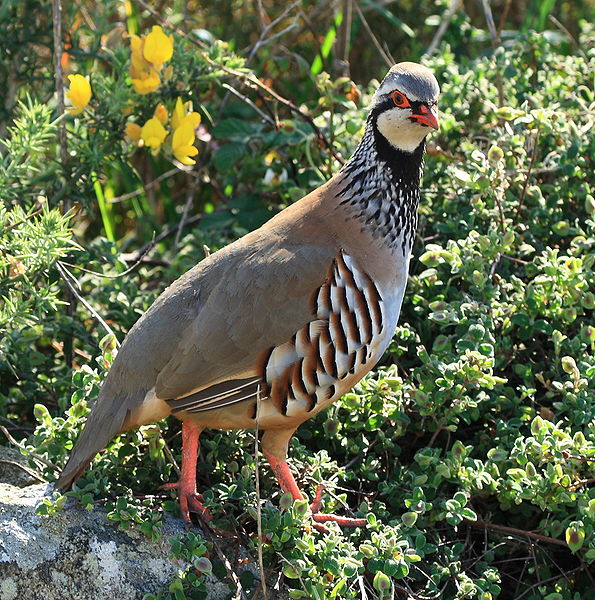
Red-legged Partridge

Red-legged Partridge

I made the following observation in the first Partridge article:
“The Partridge is only mentioned twice in Scripture. In Jeremiah, the fact is that other birds put their eggs in the nest of a partridge and then expect the nesting bird to do all the work, sitting, feeding, and fledging the chicks.”

I, the LORD, search the heart, I test the mind, Even to give every man according to his ways, According to the fruit of his doings. “As a partridge that broods but does not hatch, So is he who gets riches, but not by right; It will leave him in the midst of his days, And at his end he will be a fool.” (Jer 17:10-11)

Looking into this verse further, I would like to share some more information about it.

“3. RLP(Red-legged Partridge) will lay their own nest, but will also dump odd eggs in other species nests. Where this is a pheasant, the pheasant (as found in the UK), being probably the stupidest of all birds bar none, will hatch and “rear” the young quite happily. A grey partridge, on the other hand, will abandon the nest. Terminated. And … almost certainly does not attempt to lay again that season.”, A quote from a “Bird Forum

Curiosities: while brooding the female is very sensitive, and, if disturbed, may abandon the nest.”, about a Rock Partridge from Parco Nazionale…

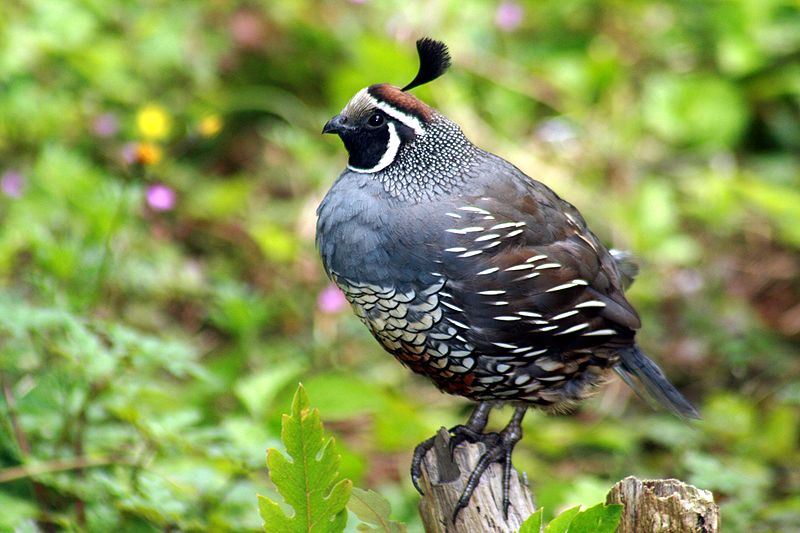
California Quail sometimes called California Partridge

California Quail sometimes called California Partridge

“In the deep woods where the California partridge nests, it is not unusual to find the eggs of that game bird in the nest of the Oregon Towhee. Mr. Cohen, of Ala- meda, records one Towhee nest four feet from the ground on a live-oak stub and containing four Towhee eggs and fifteen eggs of the partridge. Another recorded by him was on the ground, and contained three eggs of the Towhee and eighteen of the partridge. The Towhee abandoned the nest after six partridge eggs were laid, leaving the partridge to rear the brood. Inasmuch as the Towhee eggs hatch in two weeks, the young being very dark colored and naked, while the partridge eggs require three weeks and the young are lively little balls of down able to run about as soon as dry, the sacrifice of the Towhee’s brood is inevitable whenever the two are deposited in the same nest.” from Birds of California

I could give more examples, but it is obvious that the Partridges are leaving their eggs in other nests. “They are brooding but not hatching.” She is trying to raise her chicks, but not in the proper way. That is what the verse is saying, that the Lord searches the heart and tests a person’s thinking. It is then applied to making money the wrong way (crooked) and then having it disappear and then he is a “fool’ in the end.

The verses in Jeremiah 17:10-11 are in the middle of a great passage about trusting in the LORD.

(5) Thus says the LORD: “Cursed is the man who trusts in man And makes flesh his strength, Whose heart departs from the LORD.
(6) For he shall be like a shrub in the desert, And shall not see when good comes, But shall inhabit the parched places in the wilderness, In a salt land which is not inhabited.
(7) “Blessed is the man who trusts in the LORD, And whose hope is the LORD.
(8) For he shall be like a tree planted by the waters, Which spreads out its roots by the river, And will not fear when heat comes; But its leaf will be green, And will not be anxious in the year of drought, Nor will cease from yielding fruit.
(9) “The heart is deceitful above all things, And desperately wicked; Who can know it?
(10) I, the LORD, search the heart, I test the mind, Even to give every man according to his ways, According to the fruit of his doings.
(11) “As a partridge that broods but does not hatch, So is he who gets riches, but not by right; It will leave him in the midst of his days, And at his end he will be a fool.
(12) A glorious high throne from the beginning Is the place of our sanctuary.
(13) O LORD, the hope of Israel, All who forsake You shall be ashamed. “Those who depart from Me Shall be written in the earth, Because they have forsaken the LORD, The fountain of living waters.”
(14) Heal me, O LORD, and I shall be healed; Save me, and I shall be saved, For You are my praise. (Jeremiah 17:5-14 NKJV)


See:
Partridge

Birds of the Bible – Pelican Study

Great White Pelican by Birdway

Great White Pelican by Birdway

In Previous articles about the Pelicans; Birds of the Bible – Pelicans and Pelicans II they were introduced as being in the Pelecanidae family.  Here in the U.S. we have the American White Pelican and the Brown Pelican. They are listed as “unclean” in the Scriptures (Levitucus 11:18 and Deuteronomy 14:17), meaning they were not to be eaten by the Israelites.

Depending on which version of the Bible you use, “Pelican” is not always used in one, but shows up in another. That is what makes “birdwatching the Scriptures” so interesting. Take for instance Isaiah 34:11:

But the pelican and the porcupine shall possess it, Also the owl and the raven shall dwell in it. And He shall stretch out over it The line of confusion and the stones of emptiness. (NKJV)

Using e-Sword Free Bible Program’s” compare feature, observe these differences.
Pelican and porcupine – ASV, NKJV, RV
Pelican and hedgehog – NASB, NAS77, YLT
Pelican and bittern – Darby, JPS
Pelican and herons – GW
Cormorant and bittern – KJV, MKJV, Webster
Hawk and porcupine – ESV
Owls and ravens only mentioned – GNB
Owls, hawks, and wild animals – CEV
Birds of the waste land – BBE

Another interesting verse:

Flocks will lie down in her midst, All beasts which range in herds; Both the pelican and the hedgehog Will lodge in the tops of her pillars; Birds will sing in the window, Desolation will be on the threshold; For He has laid bare the cedar work. (Zephaniah 2:14 NASB)

This verse uses pelican, raven, hedgehog, owl, cormorant depending on the version.

When Nave’s Topical Bible‘s – Pelican and Torrey’s Topical Textbook‘s – Birds are referenced, it appears that they used the King James Version (KJV).

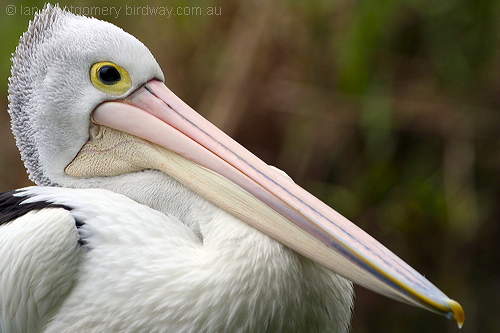
Australian Pelican by Birdway

Australian Pelican by Birdway

All of that said to help you realize as you study the Bible, looking for birds, be aware that just because it’s not found on the first search, try another version and the bird may appear. I personally prefer to use the KJV, NKJV, NASB, and ESV as my main versions. The others are fine, some better than others, but those mentioned, in my opinion, are closer to the originals. Why they vary, I am not sure. The Strong’s Hebrew and Greek Dictionaries in the KJV and NASB use H6893, which is kaw-ath’ , which means “probably the pelican (from vomiting): – cormorant.”

We do know that the Pelicans are mentioned in the Bible and I really enjoy watching them. We get to see the American White and the Brown Pelicans here in Florida. It would be neat to see the Austrailian, Dalmation, Great White, Pink-backed, Peruvian and Spot-billed Pelicans.

I also love to watch the pelicans skim over the water and also fly in formation like a squadron of bombers. I have included two videos of them skimming. Visit the Pelican Videos and Photos for more. See the Sidebar.

*All photos used with permission.


Pelican in flight in Cuba
*

*
Another by arlens47 that “Follows the flight of a pelican as he starts to go out to sea, then reverses course and lands in the water off the coast of Santa Cruz, California. Background music is Thorn Birds Theme by the Joe Reisman Orchestra.

Flight of the Pelican
*

*