Birds of the Bible – Get Off My Back

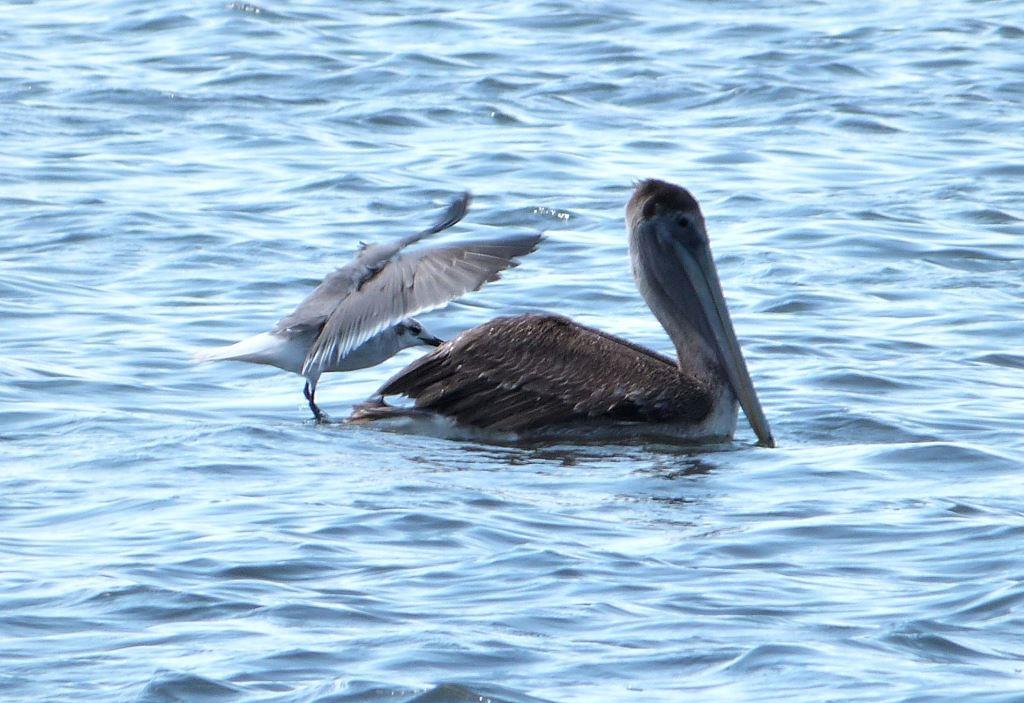
Laughing Gull landing on Brown Pelican

Laughing Gull landing on Brown Pelican

I am like a pelican of the wilderness; I am like an owl of the desert. (Psalms 102:6 NKJV)

Yesterday we were at the beach at MacDill AFB in Tampa. Apparently the fish were numerous, because the Brown Pelicans, Forster’s Tern, Laughing Gulls, Ospreys and others were diving in.

Laughing Gull landing on Brown Pelican

Laughing Gull landing on Brown Pelican

What really amazed me were the Laughing Gulls landing on the backs of the Brown Pelicans. Checking the internet to find out about this, I came across this very interesting article, The Pelican and the Gull. It appears this is a common practice for the Laughing Gull to steal some of the Pelicans food.

Here are some excerpts from that article:

One method the laughing gull has of getting food is to steal fish from another seabird that inhabits the region, the brown pelican. The laughing gull accomplishes this larceny by waiting for the brown pelican to make a successful dive….

When the pelican has a bill full of fish and water, it transfers the fish to the pouch that hangs below its bill. The pelican cannot fly away or swallow the fish until the water is drained from the pouch. Laughing gulls either circle closely above the pelican or land on the pelican’s bill or head. The gull may even give the pelican a sharp peck or two. If the pelican pays too much attention to the antics of the laughing gull and not enough attention to the delicate draining and swallowing process, the pelican may lose some of the trapped fish. The gull then swoops down and scoops up the pelican’s hard-earned catch, flying away at top speed from the scene of the crime and makes short work of his ill-gotten gains.

Of course, I could make all kinds of applications about not stealing, pecking someone on the head, or getting on their backs without permission. Because of the curse we are all under, the birds included, this kind of things happen. Eagles steal from Ospreys, Cuckoos lay eggs in other species nest, etc. For us, we know that stealing is wrong and I trust we don’t. Also, we are supposed to “love one another.” Not so sure this is being displayed here.

And be ye kind one to another, tenderhearted, forgiving one another, even as God for Christ’s sake hath forgiven you. (Ephesians 4:32 KJV)

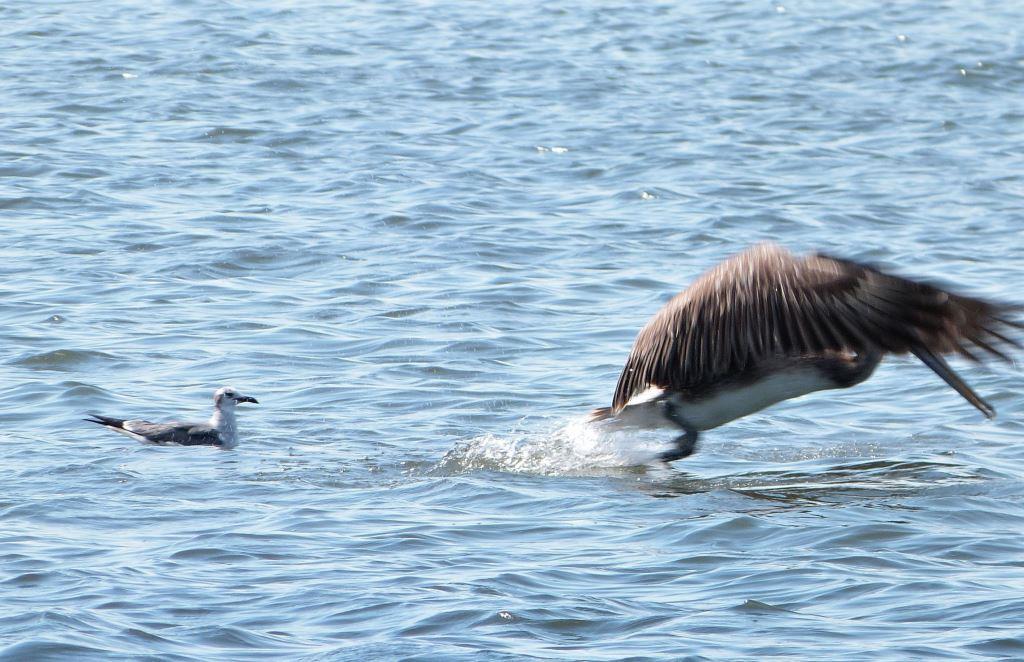
Here is another sequence of photos I took of an exchange between the Gull and the Pelican (cropped):
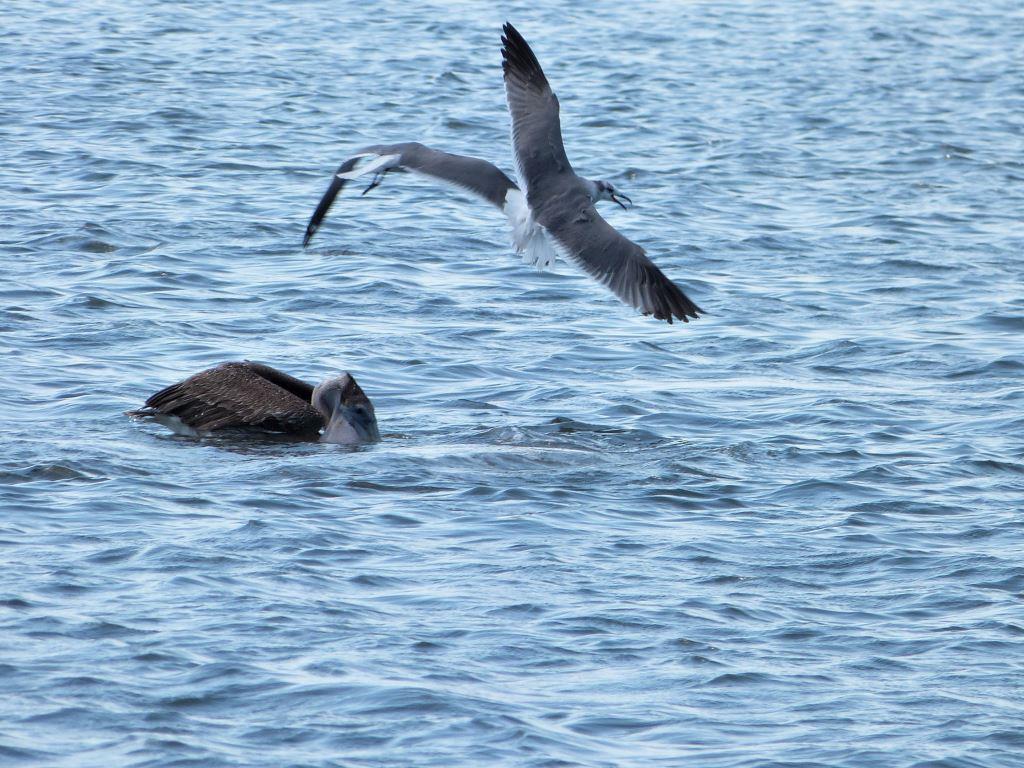
Pelican catching fish and Gull circling
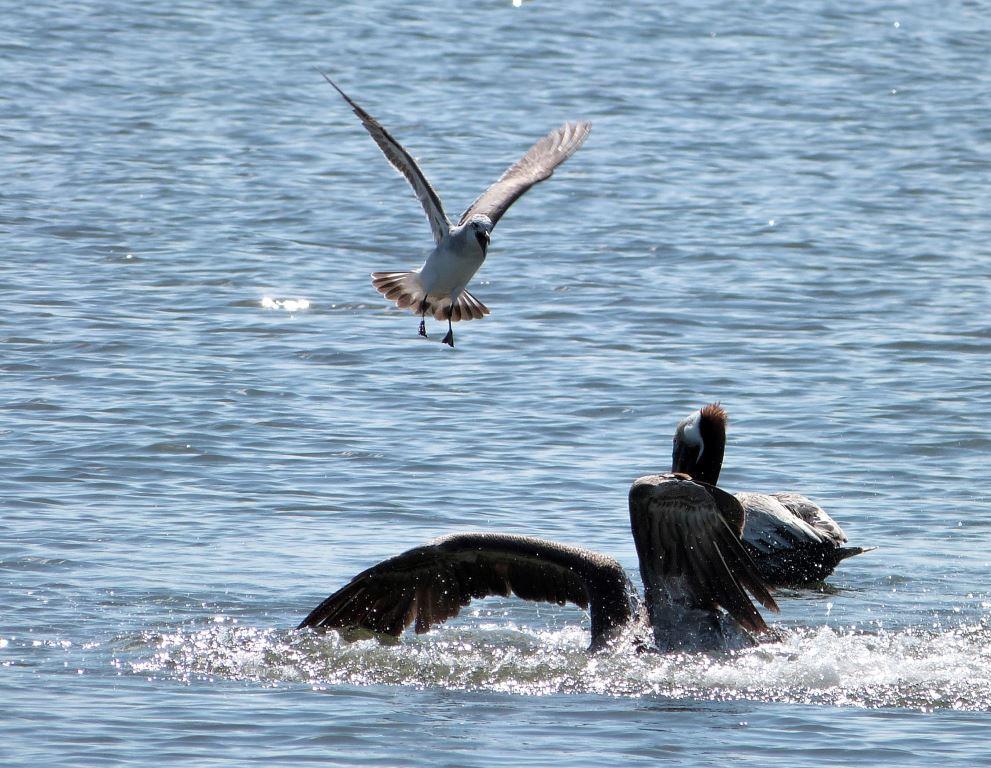
Pelican catching fish and Gull circling

Laughing Gull watching Brown Pelican preparing to land
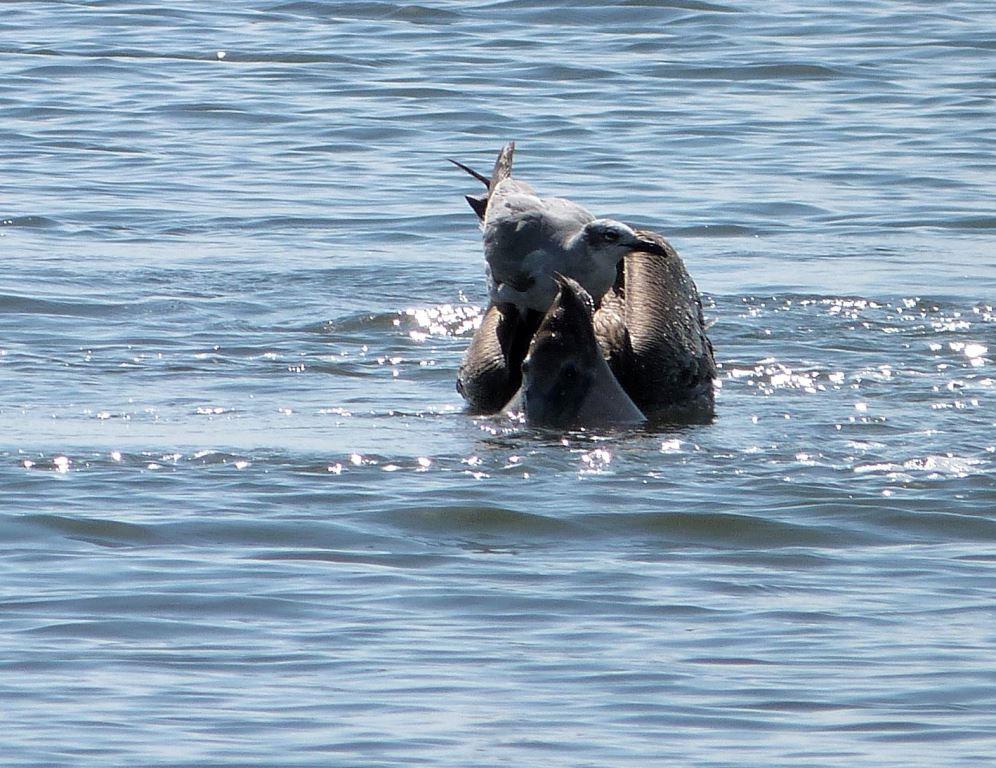
Laughing Gull watching Brown Pelican preparing to land

Laughing Gull lands on Pelican as he comes up
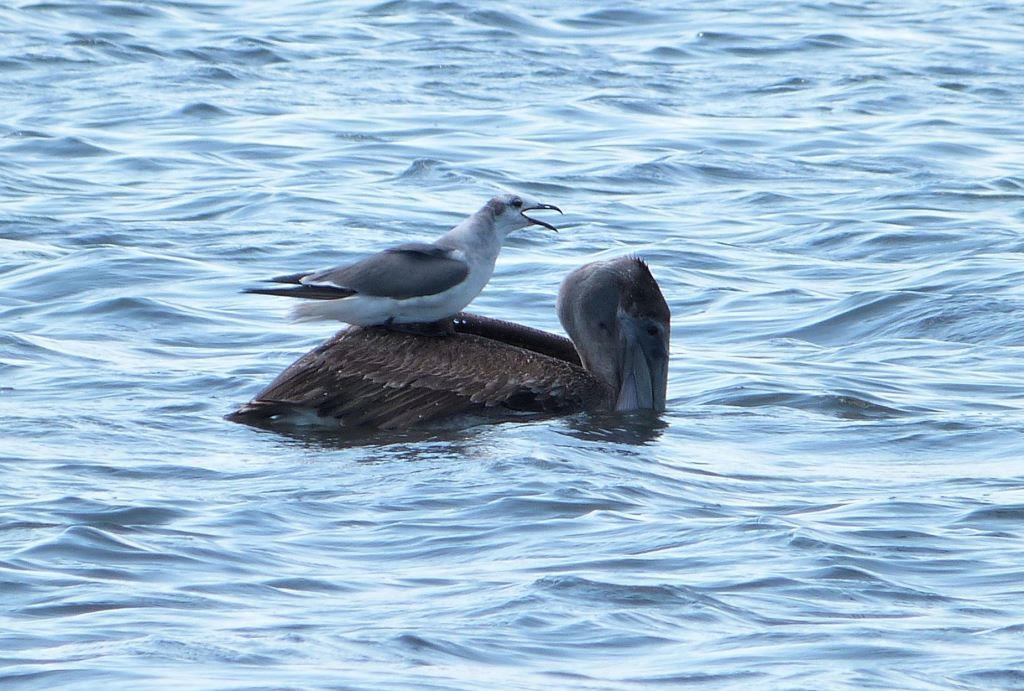
Laughing Gull lands on Pelican as he comes up

Would you hurry up
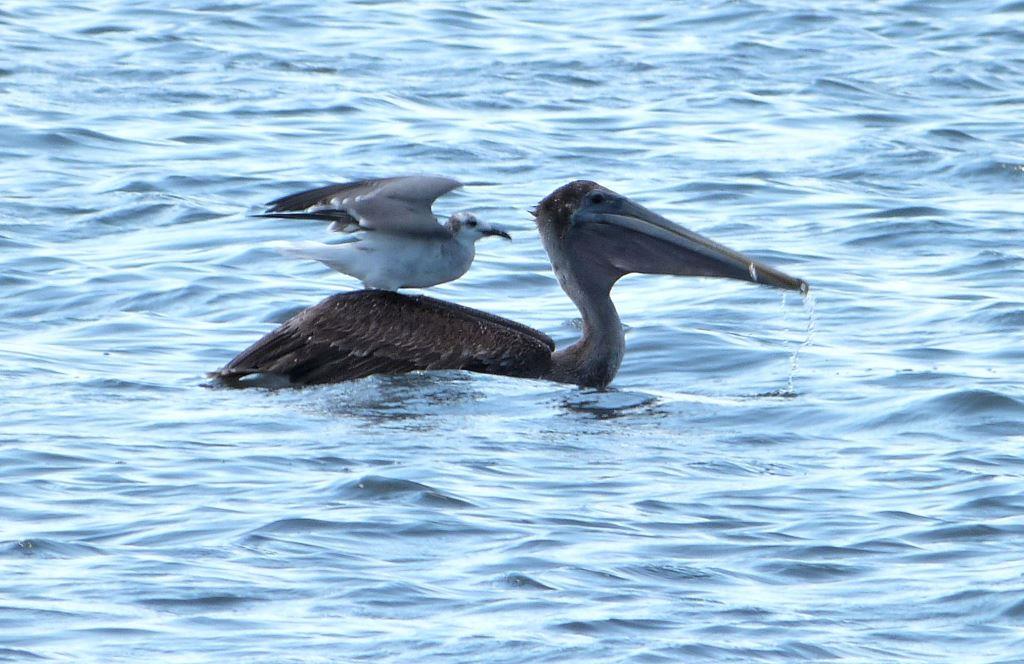
Would you hurry up

Brown Pelican and Laughing Gull - Waiting

Waiting

Brown Pelican and Laughing Gull - Slipping Off

Slipping Off

Brown Pelican leaving Laughing Gull

Watching His Food Source Leave

Maybe I can catch him

Maybe I can catch him

These photos were taken with my zoom because they were out quite a way from the shore. The following two photos were closer up as they both posed on posts for us.

Pelicans belong to the Pelecanidae – Pelicans Family and are on of the Birds of the Bible.

Mature Brown Pelican by Dan at MacDill

Mature Brown Pelican by Dan at MacDill

The Brown Pelican is the smallest of the eight species of pelican, although it is a large bird in nearly every other regard. It is 42–54 in (106–137 cm) in length, weighs from 6.1 to 12 lb (2.75 to 5.5 kg) and has a wingspan from 6.0 to 8.2 ft (1.83 to 2.5 m). Through most of its range, the brown pelican is an unmistakable bird. Like all pelicans, this species has a very large bill, 11 to 13.7 in (28 to 34.8 cm) long in this case, with a gular pouch on the bottom for draining water when it scoops out prey. The head is white but often gets a yellowish wash in adult birds. The bill is grayish overall in most birds, though breeding birds become reddish on the underside of the throat. The back, rump, and tail are streaked with gray and dark brown, sometimes with a rusty hue. In adult pelicans, the breast and belly are a blackish-brown and the legs and feet are black. The juvenile is similar but has a brownish-gray neck and white underparts.

This bird is readily distinguished from the American White Pelican by its non-white plumage, smaller size and its habit of diving for fish from the air, as opposed to co-operative fishing from the surface. The Peruvian Pelican, previously considered a subspecies of Brown Pelican, is now considered to be a separate species. It has very similar plumage to the Brown, but it is noticeably larger. The Brown and Peruvian pelicans may overlap in some areas along the Pacific coast of South America.

the ostrich, the short-eared owl, the sea gull, and the hawk after their kinds; (Deuteronomy 14:15 NKJV)
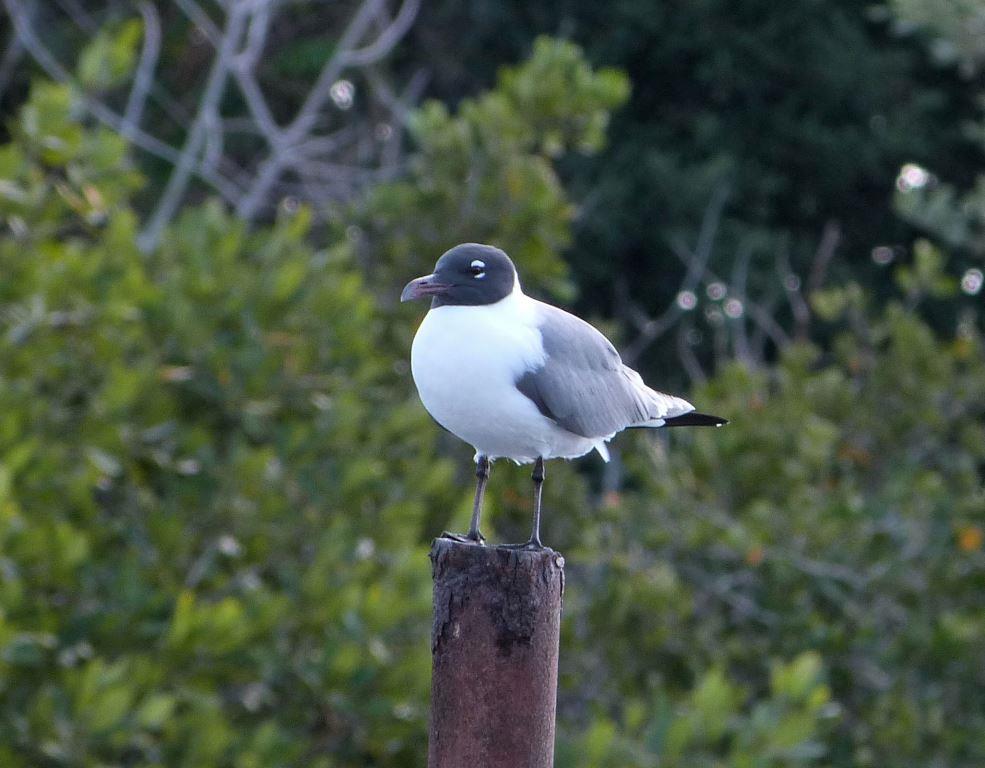
Laughing Gull on post

Laughing Gull on post by Lee

The Laughing Gull is a member of the Laridae – Gulls, Terns and Skimmers Family and is a Bird of the Bible also. The Laughing Gull (Leucophaeus atricilla) is a medium-sized gull of North and South America. It breeds on the Atlantic coast of North America, the Caribbean, and northern South America. Northernmost populations migrate further south in winter, and this species occurs as a rare vagrant to western Europe. The Laughing Gull’s English name is derived from its raucous kee-agh call, which sounds like a high-pitched laugh “ha… ha… ha…”.

This species is easy to identify. It is 14–16 in (36–41 cm) long with a 39–43 in (98–110 cm) wingspan. The summer adult’s body is white apart from the dark grey back and wings and black head. Its wings are much darker grey than all other gulls of similar size except the smaller Franklin’s Gull, and they have black tips without the white crescent shown by Franklin’s. The beak is long and red. The black hood is mostly lost in winter.

Laughing Gulls take three years to reach adult plumage. Immature birds are always darker than most similar-sized gulls other than Franklin’s. First-year birds are greyer below and have paler heads than first-year Franklin’s, and second-years can be distinguished by the wing pattern and structure. Laughing Gulls breed in coastal marshes and ponds in large colonies. The large nest, made largely from grasses, is constructed on the ground. The 3 or 4 greenish eggs are incubated for about three weeks. These are omnivores like most gulls, and they will scavenge as well as seeking suitable small prey. Like most other members of the genus Leucophaeus, the Laughing Gull was long placed in the genus Larus. (Wikipedia with editing)

Interesting Links:

*

“A Cardinal Sits With Me” ~ by Sandra Conner

“A Cardinal Sits With Me” by Sandra Conner (Re-post)

This is a delightful poem by Sandra.

*

A Cardinal Sits With Me

CARDINAL - HOLLINGSWORTH - BFPA Cardinal sits with me at end of day.
It is a bleak, unhappy time,
And I have lost my way.

He seems content to stay a while and rest,
And my front porch is cool with shade,
Sun moving to the west.

To read the rest of A Cardinal Sits With Me.

Fifth Blog Anniversary

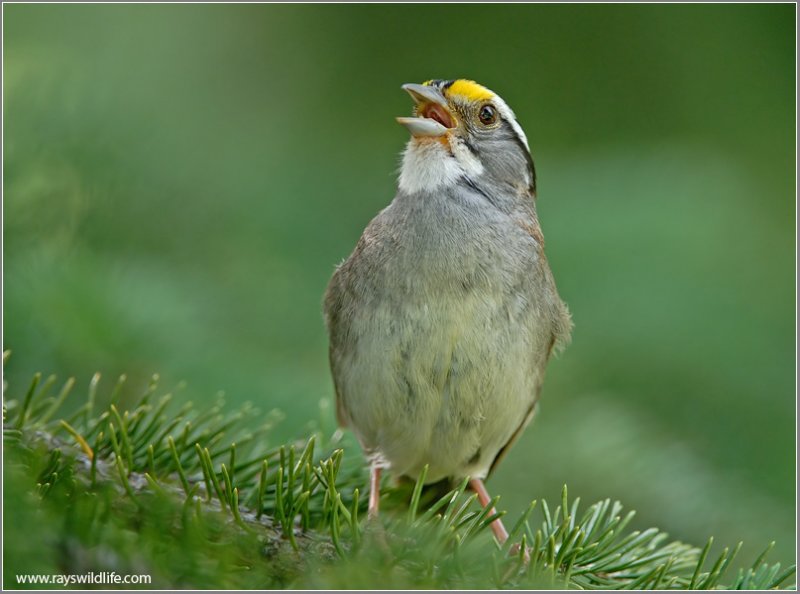
White-throated Sparrow by Ray

White-throated Sparrow by Ray Barlow

“Are not five sparrows sold for two copper coins? And not one of them is forgotten before God. (Luke 12:6 NKJV)

I just realized that this blog, Lee’s Birdwatching Adventures Plus, is now 5 years old. On February 15, 2008 I posted the first article on our church blog, The Fountain. At that time I began my own blog on Blogspot and then moved everything over here to WordPress and have been here since then. It was named Lee’s Birdwatching Adventures (original site) and later added the Plus as more articles about other topics were added.

The Fountain was a printed newsletter produced at church and it eventually became only an online version. It has developed over the years, just as this blog has. Stephen, our Assistant to the Pastor, is the reason that this blog exists. He invited me to write there and the rest is history.

When I brought the blog here, I moved all the originals also and this is that First article, Birds of the Bible Introduction. The One Year AnniversarySecond Anniversary of Blog,

In July of 2009, Ian Montgomery gave permission to reproduce his newsletters and also to use his photos. That started the Ian’s Bird of the Week series. In March of 2010, A J Mithra started doing articles for the blog. Ian is Australian and A J is Indian. We have other guest writers who add articles for the blog also.

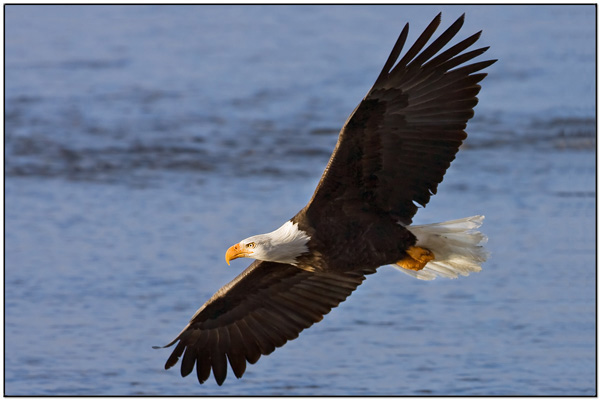
Bald Eagle flying by Dave's BirdingPix

Bald Eagle flying by Dave’s BirdingPix

Is it at your command that the eagle mounts up and makes his nest on high? (Job 39:27 ESV)

The other off-shoot blog:

The Birds of the Bible For Kids was begun in July of 2012 and is still developing. It has already had almost 5,800 views. My hearts desire is to get busy on this and show young people God’s Creative Hand though the Birds of the Bible, but written more to their level. (Update 10/3/14 – Move to Kid’s Section)

The Lord has blessed these sites way beyond what I ever imagined or prayed about when it began. The main site right now has had 868,500 views since moving it in July of 2008. All three of them added together is over a million views. Wow! Praise the Lord!

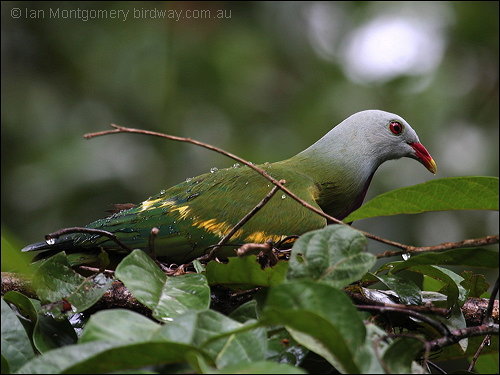
Wompoo Fruit-Dove (Ptilinopus magnificus) by Ian

Wompoo Fruit-Dove (Ptilinopus magnificus) by Ian

Though you lie down among the sheepfolds, You will be like the wings of a dove covered with silver, And her feathers with yellow gold. (Psalms 68:13 NKJV)

What about the future? Lord willing, I hope to keep finding neat things about the birds in the Bible and in the world to write about. Maybe some more writers will contribute to this adventure. Maybe more photographers and videographers will give their permission to use their images of these fantastic birds. (Of course, I really love one of my photographers, my husband, Dan) Only the Lord know the end from the beginning.

Without all of you, who stop by to read these articles and see the amazing birds, it would be useless. Thank you from the bottom of heart and may you receive a blessing from something you see and read.

I am so thankful that He has enabled me to write about His beautiful and delightful avian wonders.

give thanks in all circumstances; for this is the will of God in Christ Jesus for you. (1 Thessalonians 5:18 ESV)

Ian’s Bird of the Week – Green Rosella

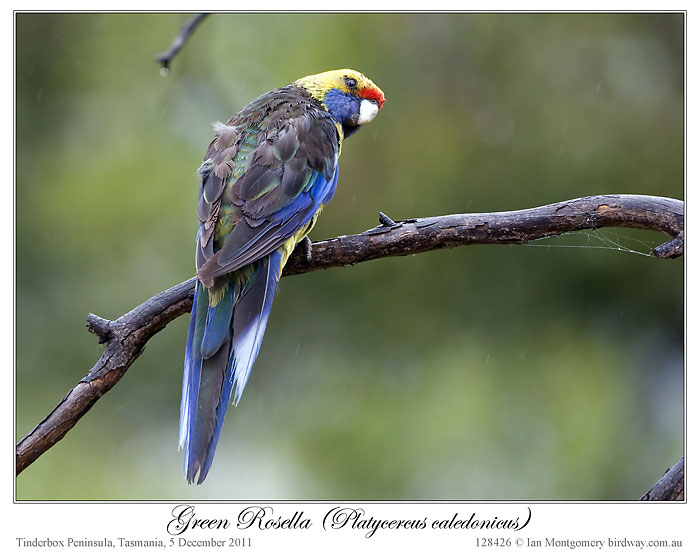
Green Rosella (Platycercus caledonicus) by Ian 1

Green Rosella (Platycercus caledonicus) by Ian 1

Ian’s Bird of the Week – Green Rosella ~ by Ian Montgomery

Newsletter ~ 2/26/13

The two recent Tasmanian birds of the week seem to have been popular so here is another one, the Green Rosella. I spent an enjoyable week in a rented campervan in Tasmanian in December 2011 on the way back from the Sub-antarctic trip chasing Tasmanian specialties. After that trip, the Tasmanian species got somewhat eclipsed by the penguins, albatrosses and other seabirds as choices for bird of the week, so I’m making amends now.

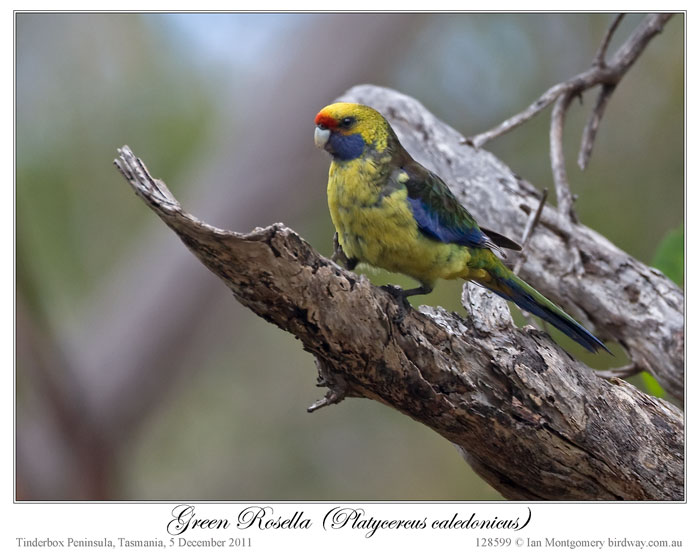
Green Rosella (Platycercus caledonicus) by Ian 2

Green Rosella (Platycercus caledonicus) by Ian 2

At up to 37cm/14.6in in length, it’s the largest of the Rosellas, being marginally larger on average than its close relative the Crimson Rosella which it replaces in Tasmania and some islands in Bass Strait. Males are generally larger than females and there are subtle between the sexes with males having relatively larger upper mandibles and broader heads (first photo) and females having more orange on the cheeks (second photo) though most of the field guides don’t distinguish between the sexes.

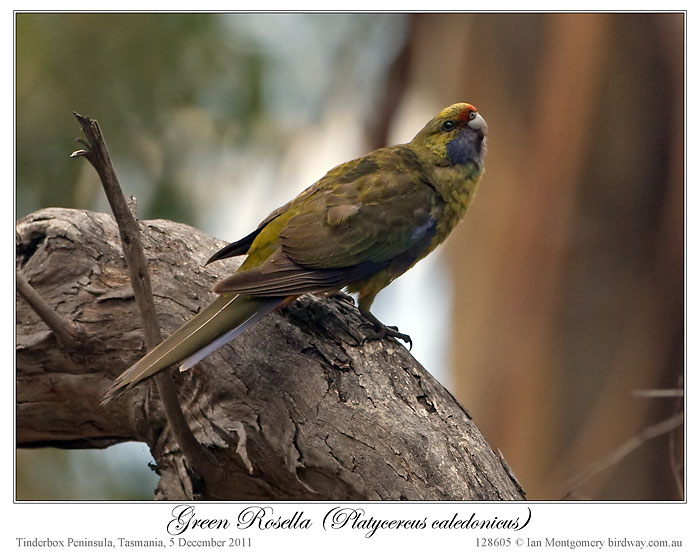
Green Rosella (Platycercus caledonicus) by Ian 3

Green Rosella (Platycercus caledonicus) by Ian 3

Juveniles, third photo, are more distinctive with duller more olive plumage and, in flight, pale wing stripes. This bird was in the company of the adult in the second photo, and the one in the first photo was in the same area, so I assumed that they comprised a family.

Green Rosellas are quite common throughout Tasmania, showing a preference for highland forest, though these ones were near the coast on the Tinderbox Peninsula south of Hobart, a good place to search for all the Tasmanian endemics.

"Yellow" Crimson Rosella (Platycercus elegans flaveolus) by Ian  4

“Yellow” Crimson Rosella (Platycercus elegans flaveolus) by Ian 4

The specific name caledonicus was used by the German naturalist Johann Gmelin in 1788, who mistakenly believed that the type specimen had been collected in New Caledonia. Confusion is the name of the game in Rosella terminology, and species boundaries have changed over the years. The Crimson Rosella has two races which differ greatly in plumage and both the ‘Yellow Rosella’ of Southwest NSW and the ‘Adelaide Rosella’ of South Australia have been regarded as separate species in the past. The Yellow Rosella (fourth photo) looks quite like the Green Rosella – and not at all like a Crimson Rosella – but the Green, given its geographical isolation, has been given the benefit of the doubt and retained as a separate species. This is just as well, politically anyway, as it’s the avian symbol of Tasmania and deserves a certain status.

Best wishes
Ian

**************************************************
Ian Montgomery, Birdway Pty Ltd,
454 Forestry Road, Bluewater, Qld 4818
Tel 0411 602 737 ian@birdway.com.au
Check the latest website updates:
http://www.birdway.com.au/#updates


Lee’s Addition:

I will teach you regarding the hand and handiwork of God; that which is with the Almighty … (Job 27:11a AMP)

The Green Rosella is sometimes referred to as the Tasmanian Rosella, probably as Ian mentioned because it is the Avian Symbol of Tasmanian. The Green and “Yellow” Crimson Rosella are part of the Psittacidae – Parrots Family. What gorgeous birds belong to this family and they show the Handiwork of the Lord at some of it’s finest.

Their diet is composed of seeds, fruit, berries and flowers, as well as insects and insect larvae. The Green Rosella is predominantly herbivorous, consuming seeds, berries, nuts and fruit, as well as flowers, but may also eat insect larvae and insects such as psyllids. They have also partaken of the berries of the common hawthorn, as well as Coprosma and Cyathodes, and even leaf buds of the Common Osier. The seeds of the Silver Wattle (Acacia dealbata) are also eaten.

The breeding season is October to January, with one brood. The nesting site is usually a hollow over 1 m (3 ft) deep in a tree trunk anywhere up to 30 m (100 ft) above the ground. A clutch of four or five white and slightly shiny eggs, measuring 30 x 24 mm, is laid. The nestlings leave the nest around five weeks after hatching and remain with their parents for another month.

See also:

(Wikipedia with editing)

*

Bible Birds – Thrush Introduction

Bible Birds – Thrush Introduction

Chestnut-bellied Rock Thrush by Peter Ericsson

Chestnut-bellied Rock Thrush by Peter Ericsson

Even the stork in the sky Knows her seasons; And the turtledove and the swift and the thrush Observe the time of their migration; But My people do not know The ordinance of the LORD. (Jeremiah 8:7 NASB)

The Thrush only appears once in the Bible. Not all versions of the Scripture translates or says that it is a Thrush. The New American Standard Bible (NASB) is one of the ones that does. Also the CEV, ERV, GNB, HRB, LITV and the NIV use the word “Thrush”.

Here is a little Greek study for you:

The Greek word (the OT was written mostly in Greek) gives the word (H5693) עגוּר -or – ‛âgûr (aw-goor’)

An unused root meaning to twitter; probably the swallow: – swallow.

Many of the different Bibles use the word Swallow, and some of those above use both the Swallow and the Thrush.

White-necked Thrush (Turdus albicollis) by Dario Sanches

White-necked Thrush (Turdus albicollis) by Dario Sanches

Both birds migrate and both “twitter.”

Listen to the song of the Wood Thrush and see if you can detect a “twitter” in its voice:

Wood Thrush (Hylocichla mustelina) by Daves BirdingPix

Wood Thrush (Hylocichla mustelina) by Daves BirdingPix

Thrushes are plump, soft-plumaged, small to medium-sized birds, inhabiting wooded areas, and are grey or brown in colour, often with speckled underparts.

They often feed on the ground or eat small fruit,  but most species also eat worms, land snails, and fruit. Many species are permanently resident in warm climes, while others migrate to higher latitudes during summer, often over considerable distances.

The songs of some species, including members of the genera Catharus, Myadestes, and Turdus, are considered to be among the most beautiful in the avian world. (Wikipedia and other internet sources)

Our verse above mentions the birds and how they KNOW when it is time to  migrate, but what about the end of the verse? The Lord uses birds and other critters as an example, BUT He is mainly trying to teach us something.

Let’s see what some of the different versions say about what we are supposed to learn from these birds.

(HCSB)  “are aware of their migration, but My people do not know the requirements of the LORD.”

(MSG) …know when it’s time to move south for winter… know when it’s time to come back again. But my people? My people know nothing, not the first thing of GOD and his rule.

(NET) …knows when it is time to move on…recognize the normal times for their migration. But my people pay no attention to what I, the LORD, require of them.

Do you know what the Lord wants you to do? Do you know Him as your Savior? If you do, are you doing what the Bible tells us we should do? Are you obeying your parents? And many other things.

The Lord loves us, just as your parents do. When you obey them aren’t you more pleased and blessed than when you don’t obey? The same is true with obeying the Word that the Lord has given us through His Word, the Bible.

See:

Wordless Birds

Bible Birds – Thrushes

*

Bible Birds – Thrush Introduction Article

Chestnut-bellied Rock Thrush by Peter Ericsson

Chestnut-bellied Rock Thrush by Peter Ericsson

Even the stork in the sky Knows her seasons; And the turtledove and the swift and the thrush Observe the time of their migration; But My people do not know The ordinance of the LORD. (Jeremiah 8:7 NASB)

See – Thrush Introduction)

This was duplicated by mistake.

Version 3.3 Finished – Taxonomy or Genealogy?

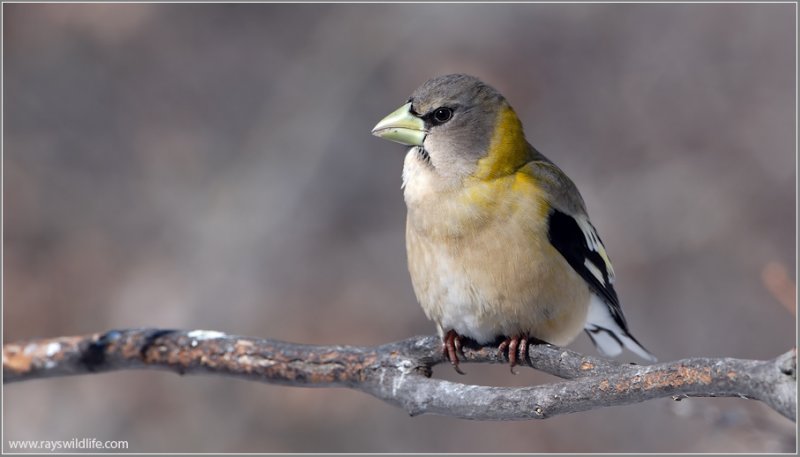
Evening Grosbeak (Hesperiphona vespertina) female by Raymond Barlow

Evening Grosbeak (Hesperiphona vespertina) female by Raymond Barlow

As I mentioned in Here We Go Again – IOC Version 3.3, I skipped doing the Fringillidae – Finches Family because of the many taxonomy changes. Well, all the others were finished and decided to dig in to those Finches. After deciding to make the changes directly on the page by cutting, moving, and re-pasting in its new position, the process began.

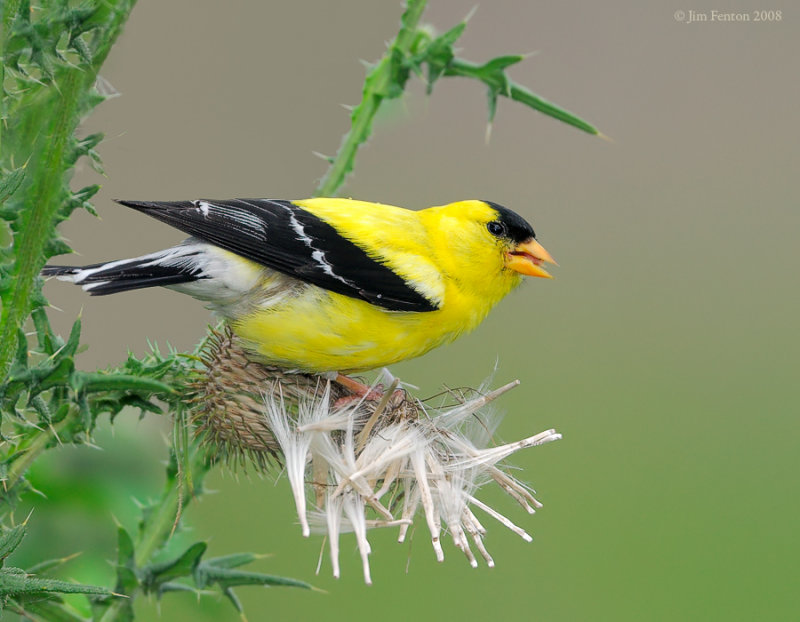
At 2:00 AM this morning I finally finished the page. I couldn’t stop in the middle with everything so juggled around, so I kept going. After some sleep, I had to chuckle about what they did to that poor Finch family. It was not just moving one genus to another spot, but it appeared that they picked and chose this one species from here and another species from a different genus. If that wasn’t challenging enough, the genus (the first name in parenthesis) was changed on quite a few birds. For example the Evening Grosbeak above was shuffled, while the American Goldfinch went from (Carduelis tristis) to (Spinus tristis)

American Goldfinch (Carduelis tristis) on Thistle by Fenton

American Goldfinch (Carduelis tristis) on Thistle by Fenton

“For I am the LORD, I do not change; (Malachi 3:6a NKJV)

All of these birds were re-named to the Spinus genus and placed in this new order:

Tibetan Serin (Spinus thibetanus)
Lawrence’s Goldfinch (Spinus lawrencei)
American Goldfinch (Spinus tristis)
Lesser Goldfinch (Spinus psaltria)
Eurasian Siskin (Spinus spinus)
Antillean Siskin (Spinus dominicensis)
Pine Siskin (Spinus pinus)
Black-capped Siskin (Spinus atriceps)
Black-headed Siskin (Spinus notatus)
Black-chinned Siskin (Spinus barbatus)
Yellow-bellied Siskin (Spinus xanthogastrus)
Olivaceous Siskin (Spinus olivaceus)
Hooded Siskin (Spinus magellanicus)
Saffron Siskin (Spinus siemiradzkii)
Yellow-faced Siskin (Spinus yarrellii)
Red Siskin (Spinus cucullatus)
Black Siskin (Spinus atratus)
Yellow-rumped Siskin (Spinus uropygialis)
Thick-billed Siskin (Spinus crassirostris)
Andean Siskin (Spinus spinescens)

If you wonder why, as I did, check out this article about The phylogenetic relationships and generic limits of finches (Fringillidae). If you scroll through, you will find there are re connections all over the place. Do I understand it, No. But summarized, they have been doing DNA studies and found out that their family tree was not what they thought.

Recently I started working on our Family Tree or Genealogy and just about tangled it up as much. One wrong branch led to another and who knows where it and Grandpa would have landed had it not been corrected. This is what they were doing to the Finches and also to the other two families that had major revamps with this latest Version 3.3. The other families were the  Accipitridae – Kites, Hawks and Eagles, and  Caprimulgidae – Nightjars. At times it felt like they had thrown all the names of those birds up in the air and let them land where ever they chose. They, those that are involved around the world, have done much research and have spent numerous hours working these changes out. They are to be commended.

I trust the next version has a little fewer changes. I need my sleep.

It is vain for you to rise up early, to sit up late, to eat the bread of sorrows: for so he giveth his beloved sleep. (Psalms 127:2 KJV)

A little sleep, a little slumber, a little folding of the hands to rest, (Proverbs 24:33 ESV)

Here We Go Again – IOC Version 3.3

Narrow-billed Tody (Todus angustirostris) ©WikiC

Narrow-billed Tody (Todus angustirostris) ©WikiC

Well, here we go again updating the Birds of the World pages. I knew when I finally got version 3.2 finished that they would be releasing the newest updates. So, while I have been sticking close to home for several weeks while fighting a virus, the updates have been worked on. Most were routine, but 3 families; Accipitridae – Kites, Hawks and EaglesCaprimulgidae – Nightjars and the Fringillidae – Finches have undergone major Taxonomic Updates. The first two families are finished, but I still have the Finches to do. (Update 2/23 – Finished 3.3 Version – Indexes included)

There are now 10,476 extant species and 149 extinct species of birds of the world (Version 3.3), not counting supspecies. There are 40 Orders, 231 Families (plus 6 Incertae sedis), 2268 Genera, for a total of 237 Family pages to update. The first 109 pages are done (Non-Passerines), and the last 100 are finished, minus the Finches. (Don’t ask why I worked that way because I have no answer.) I have less than 40 left to do.

While I have been working on them more photos, drawings and video links have been added. I have really been putting a push on to try to get 100% of each family completed. Because it takes time and effort, I made some Awards for the effort. If 100% of the species have a photo or a video then this Award is posted:

100 Percent of Photos

If 100% completed with almost all photos, but some Drawings because Photos can’t be found, at least by me, then this is the Award:

100 Percent of Images

Then if everything is complete except nothing for an Extinct bird can be found, then this is the Award:

100 Percent of Images-Extinct

It may seem silly, but it helps to feel like something is being accomplished.

While I have been going through the families some really neat birds have been spotted and want to share some of them with you. The Narrow-billed Tody (Todus angustirostris) up at the top comes from the Todidae – Todies Family (100 %). Wikipedia says,”The todies are a family, Todidae, of Caribbean birds in the order Coraciiformes, which also includes the kingfishers, bee-eaters and rollers. The family has one genus, Todus. These are small, near passerine species of forests of the Greater Antilles: Puerto Rico, Jamaica, and Cuba, with adjacent islands, have one species each, and Hispaniola has two, the Broad-billed Tody in the lowlands (including Gonâve Island) and the Narrow-billed Tody in the highlands.” I think considering his small size, he looks like he has an “attitude.”

Fischer's Turaco (Tauraco fischeri) ©WikiC

Fischer’s Turaco (Tauraco fischeri) ©WikiC

Here is another of the Lord’s creations that just blew me away when I saw it. This Fischer’s Turaco (Tauraco fischeri) is just fantastic. The whole Musophagidae – Turacos Family (100 %) is really colorful. Again, from Wikipedia, “The turacos make up the bird family Musophagidae (literally “banana-eaters”), which includes plantain-eaters and go-away-birds. In southern Africa both turacos and go-away-birds are commonly known as louries. They are semi-zygodactylous – the fourth (outer) toe can be switched back and forth. The second and third toes, which always point forward, are conjoined in some species. Musophagids often have prominent crests and long tails; the turacos are noted for peculiar and unique pigments giving them their bright green and red feathers.”

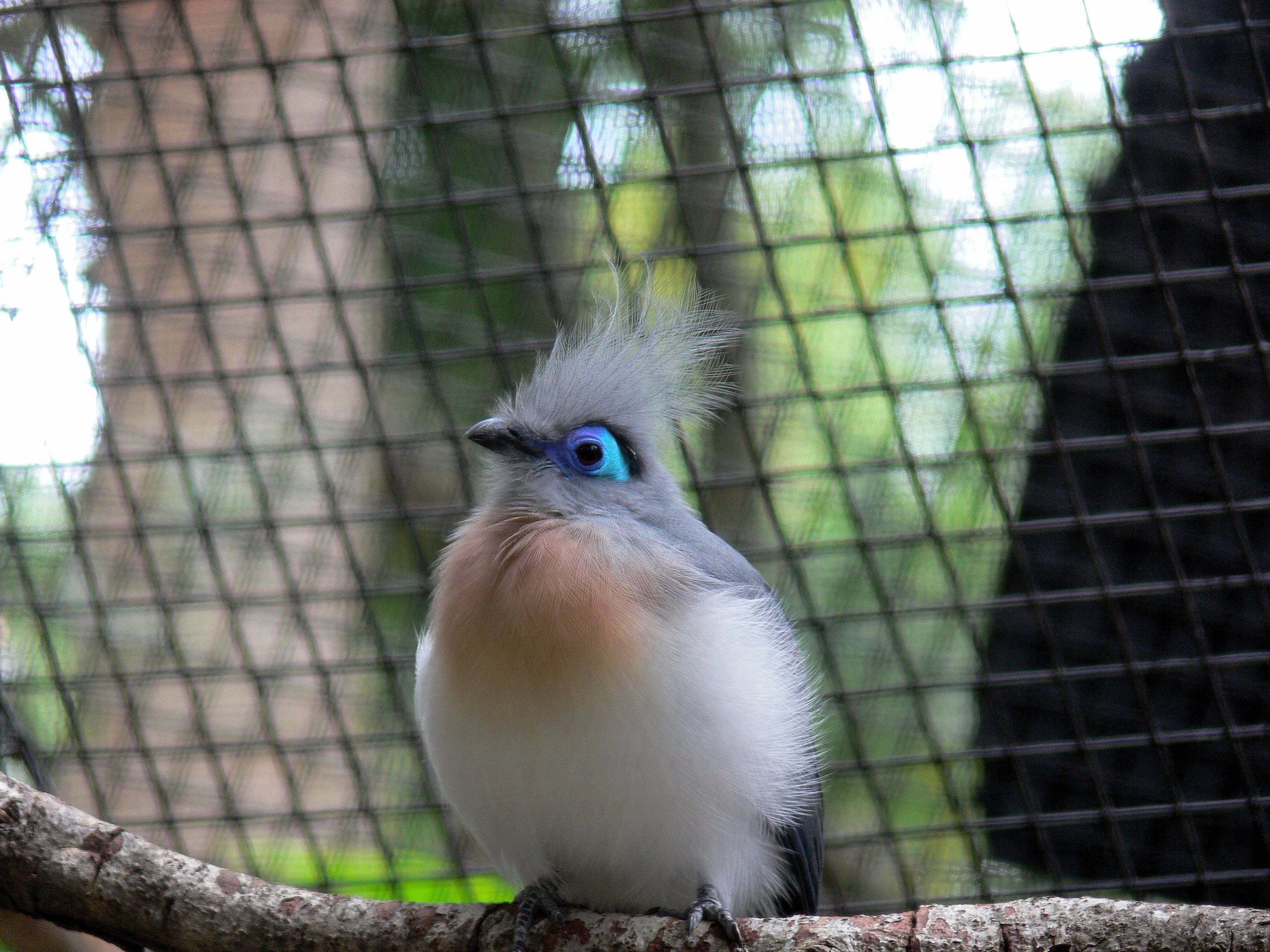
Crested Coua (Coua cristata) by Lee LPZ

Crested Coua (Coua cristata) by Lee LPZ

One sad note, we did ride over to Tampa this week to renew our annual pass to Lowry Park Zoo and found out that the beautiful Crested Couas had died. The man we were talking to didn’t go into detail, but said something tragic happened to both. That has always been one of my favorites in their aviary. Couas are members of the Cuculidae – Cuckoos Family.

Many people make list of the birds they see and that is really neat and enjoyable. Many try to see how many they see each year, in each state, county or country, etc. Doing these pages are starting to become a list of all the birds that I have seen a photo, video, or drawing of. Not sure if it counts for anything, but it is enjoyable and amazing to see the variety and beauty of God’s Omnipotent and Omniscient Hand at work. Yes, I would like to see all 10,000 plus of the birds, but it is not my main ambition in life. The verses in Matthew 16:24-26 keep coming to mind as the work has progressed.

Then said Jesus unto his disciples, If any man will come after me, let him deny himself, and take up his cross, and follow me. For whosoever will save his life shall lose it: and whosoever will lose his life for my sake shall find it. For what is a man profited, if he shall gain the whole world, and lose his own soul? or what shall a man give in exchange for his soul? (Matthew 16:24-26 KJV)

Enjoy the birds, but let their beauty draw you to their Creator.

Wordless Birds

*

One is Enough ~ by Dottie Malcolm

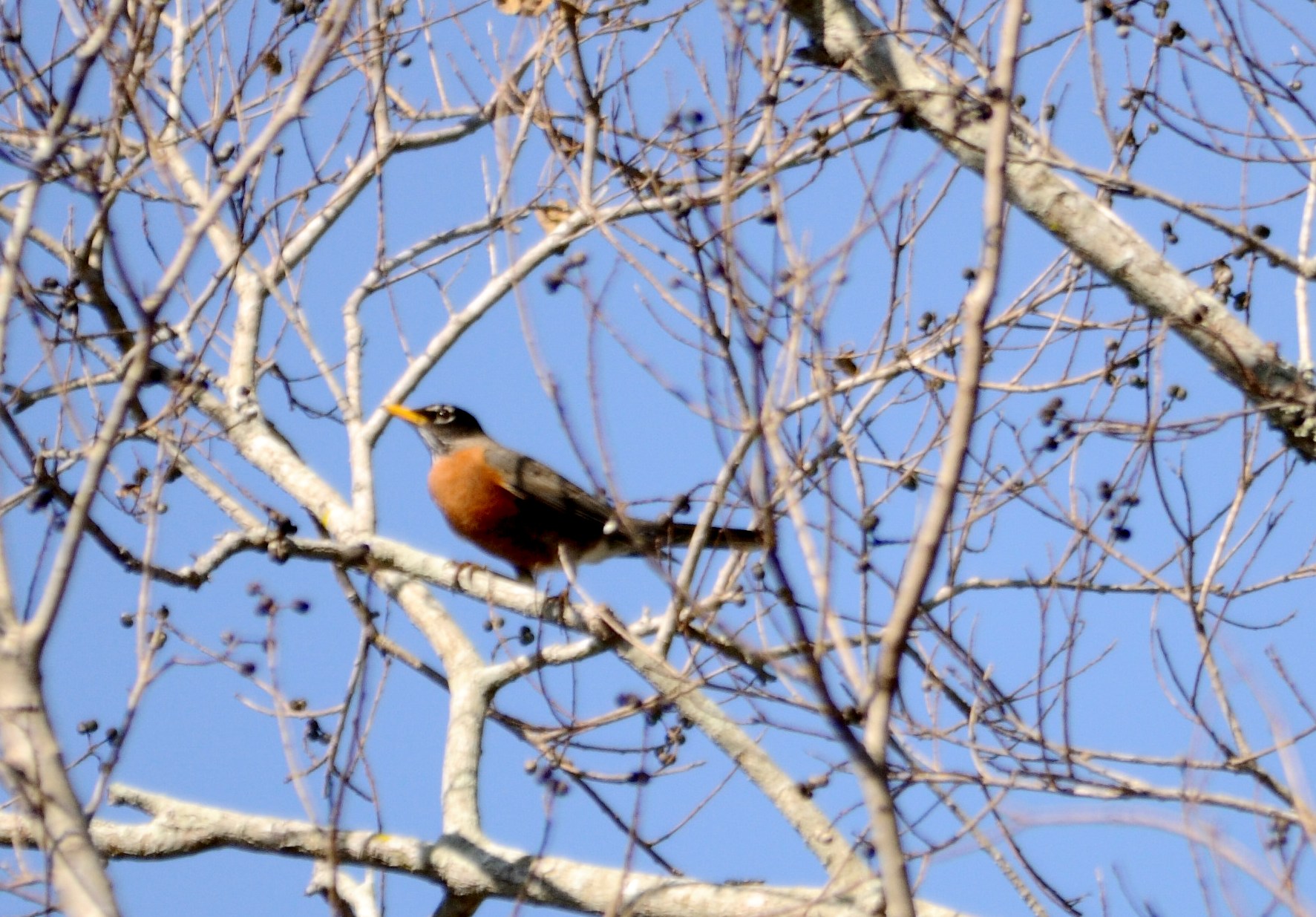
American Robin by Dan at Lake Howard

American Robin by Dan

“One is Enough” ~ by Dorothy “Dottie” Belle Malcolm

Having just returned home from a house cleaning job, my mind wasn’t about birds, but the greeting I would get from my dog Ruby. She was her usual happy, jumpy, self – anticipating a doggy treat for being left home alone.

I was not happy to find her soaking wet. This meant I had not closed the door well to the shower room and she had spent her time there during my absence. It would have been OK except my shower drips continuously – (yes, I do have a plan to have it checked out.) And this is a dog who hated to be showered! Figure that.

So anyway, I told her I needed to check the mail. And yes, she knows what this means. She ran outdoors and as we headed for the mailbox I heard a very familiar sound. We had startled a robin! Oh joy! I carefully began looking for it and found it was still hanging around a flower bed.

I don’t remember who I thanked first, the robin for being in my yard, or the Lord for sending it there!

It is the first and so far the only one I have seen in my yard this year. Recalling the year my yard was filled with them in Feb. 2010 and had told them they were all welcome back, put paid no return visits.

Having at least one, made my day. I’m not hard to please. I do hope to see it again, but if not, I’m happy anyway.

Every time I look out the window on this beautiful spring day, I will have a spirit of thanksgiving. Being able to enjoy God’s Creation is a great blessing.

One Robin is enough.

Dot Malcolm

(Feb 15, 2013)

Be glad in the LORD and rejoice, you righteous; And shout for joy, all you upright in heart! (Psalms 32:11 NKJV)


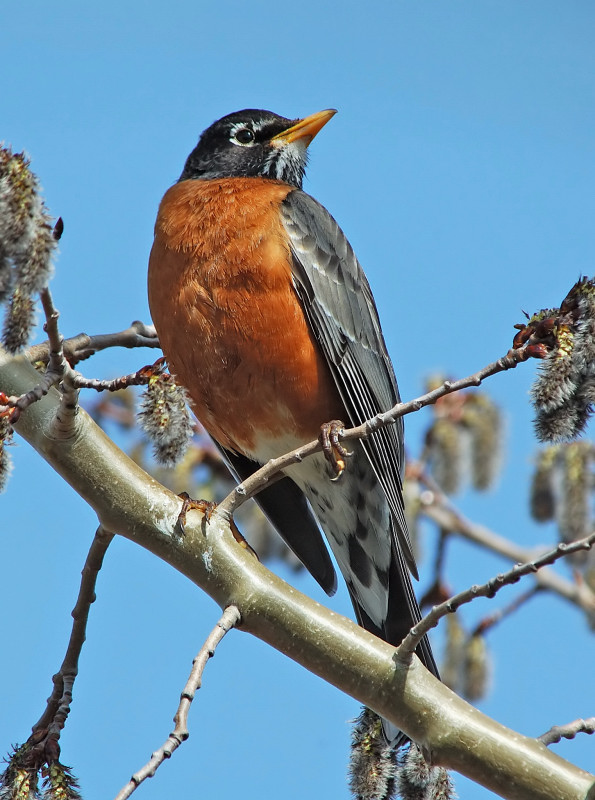
American Robin (Turdus migratorius)by Raymond Barlow

American Robin)by Raymond Barlow

Lee’s Addition:

What a great event. Dottie handed this to me Saturday morning at our annual Volunteer’s Breakfast. All those who volunteer around church are treated to a meal prepared by our Pastors and staff. Dottie has been a faithful Primary Sunday School teacher for years. Reading this story, I can see why they all love her and enjoy her teaching so much. Thank you, Dottie.

See her other articles:

*

Ian’s Bird of the Week – Tasmanian Native-hen

Ian’s Bird of the Week – Tasmanian Native-hen ~ by Ian Montgomery

Newsletter ~ 2-14-13

The last edition featured the Tasmanian endemic, the Yellow Wattlebird. A former colleague of mine, Gary, who comes from Tasmania, sent me the following recipe from this priceless book by Tasmanian author Marjorie Bligh, and I thought it might interest you, at the risk of putting you off your food.

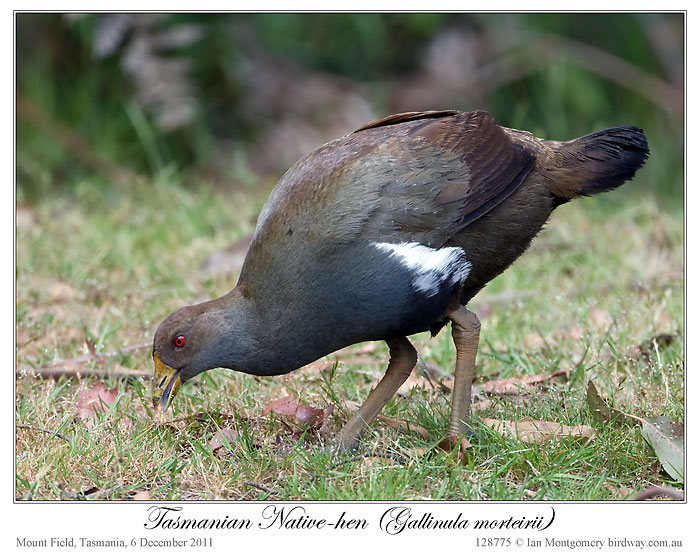
Tasmanian Nativehen (Tribonyx mortierii) by Ian 1

Marjorie Bligh

Wattle Birds

>“Brush each bird with warm butter after plucking them. (Do not clean birds in any other way; their insides are left intact.) Tie a thin slice of fat bacon over each breast. Put in a fry pan (electric) on a wire grid and cook slowly for 5 to 6 hours. Take off wire grid after 3 to 4 hours and cook in the fat that has dripped off them. Baste often. Serve on buttered toast.”

I Googled Marjorie Bligh and sent this reply to Gary:

Did you know that Marjorie Bligh is the subject of a new book entitled: Housewife Superstar: The Very Best of Marjorie Bligh? She sounds quite a woman.

How’s this for praise:

I don’t think Edna has admired anyone as much as she admires Marjorie Bligh’Barry Humphries

Would you like another Tasmanian endemic for next week’s bird?

Gary, not one to resist throwing down the gauntlet, replied: Yes […] would be especially pleased if you could manage the local endemic sub-species of emu.

Emu

Emu

This ‘restoration’ by John Keulemans was the best I could do as the request arrived about 160 years too late. So, failing that, here is another flightless Tasmanian endemic, the Tasmanian Native-hen.

Tasmanian Nativehen (Tribonyx mortierii) by Ian 3

Tasmanian Nativehen (Tribonyx mortierii) by Ian

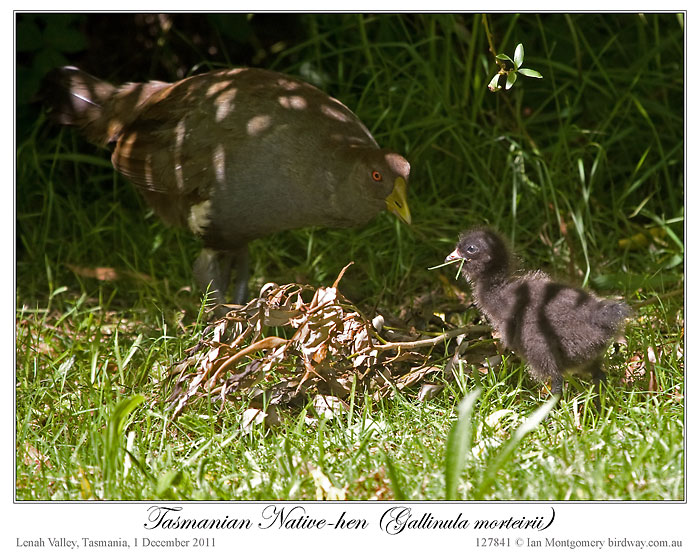
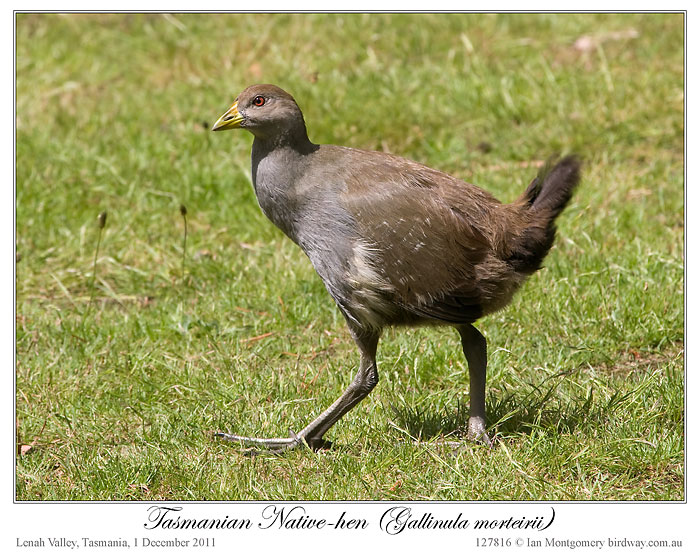
The bird in the photo is an adult with the characteristic slaty-blue breast, chestnut upper-parts and tail. Unlike the Emu, Tasmanian Native-hens remain quite common in eastern and northern Tasmania where there is plenty of suitable grassy habitat. In pre-historic times they also occurred on the mainland but like the Thylacine and the Tasmanian Devil became extinct relatively recently, perhaps as a result of the introduction of dingos.

Tasmanian Nativehen (Tribonyx mortierii) by Ian 4

Tasmanian Nativehen (Tribonyx mortierii) by Ian

They are large – up to 50 cm/20 in in length – flightless members of the family Rallidae (which includes moorhens, coots, rails and crakes). Although they can’t fly, they can swim well and can dive to escape from predators. Like other members of the family, the chicks are black and fluffy and active as soon as they are hatched. The third photo shows a young chick under the watchful eye of an adult, already grazing on the young shoots of grass and herbs that are the staple diet of the species. They also eat seeds, invertebrates and small frogs.

Tasmanian Nativehen (Tribonyx mortierii) by Ian 5

Tasmanian Nativehen (Tribonyx mortierii) by Ian

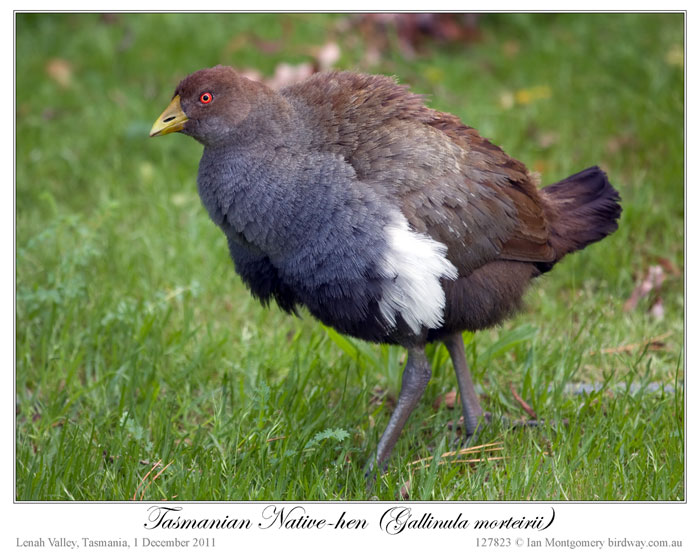
The bird in the fourth photo is a sub-adult, and has not yet achieved the full colouration of adult birds.

Tasmanian Nativehen (Tribonyx mortierii) by Ian 6

Tasmanian Nativehen (Tribonyx mortierii) by Ian

I’d always assumed that Native-hens got their name from their appearance. The Wattle Bird recipe has set me wondering whether the name had more to do with taste!

Best wishes,

Ian

**************************************************
Ian Montgomery, Birdway Pty Ltd,
454 Forestry Road, Bluewater, Qld 4818
Tel 0411 602 737 ian@birdway.com.au
Check the latest website updates:
http://www.birdway.com.au/#updates


Lee’s Addition:

Of all clean birds you may eat. (Deuteronomy 14:11 AMP)

I guess we could add this bird to the “clean birds,” but not sure about cooking it with all its innards. The Tasmanian Nativehen is a member of the Rallidae – Rails, Crakes & Coots Family. The only other Nativehen is the Black-tailed one. See all of Ian’s Rallidae Family.

I trust you are enjoying the Newsletters that Ian sends out and lets me post here are the blog. He is quite a photographer and does a lot of traveling to find interesting birds to share. Thank you, Ian.

Check out all the Bird of the Week articles by Ian. He lives down in Australia.

*

Video of 39 Species of Bird-of-paridise by Lab of Ornithology

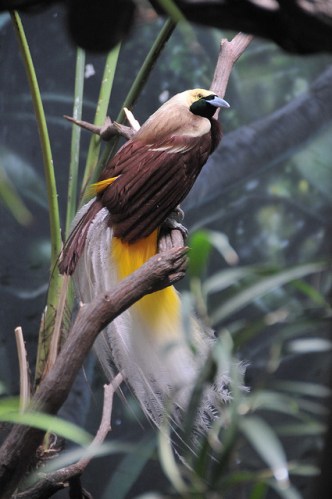
Lesser Bird-of-paradise (Paradisaea minor) ©©

Lesser Bird-of-paradise (Paradisaea minor) ©©

Which doeth great things past finding out; yea, and wonders without number. (Job 9:10 KJV)

Here is a  video of 39 species of Bird-of-Paridise by Lab of Ornithology. They just released it and thought you might enjoy seeing them. There are more YouTubes of them also at Cornell Lab of Ornithology.

Bird-of-Paradise belong to the Paradisaeidae – Birds-of-paradise Family.

*

Enjoy!

*

*

Birds of the Bible – Names Study – Plover

American Golden Plover (Pluvialis dominica) at National Aviary by Lee

American Golden Plover (Pluvialis dominica) at National Aviary by Lee

From the article on Kosher Animals that we have been looking at with our Bird Name Study, the Plover is listed. I haven’t added a page for this bird so far, so let’s see what we can learn about this bird.

Under the Birds section they give a list of birds from the Septuagint and that is where we find the plover listed:

“The Septuagint versions of the lists are more helpful, as in almost all cases the bird is clearly identifiable:

charadrios (plover)”

They show that it appears in the LXX in Deuteronomy 14:18 and in Leviticus 11:19. Of course I can’t read it, but here it is from the LXX-BYZ on my e-Sword.

Deu 14:18 kaiG2532 CONJ pelekana N-ASM kaiG2532 CONJ charadrion N-ASM kaiG2532 CONJ taG3588 T-APN omoiaG3664 A-APN autoG846 D-DSM kaiG2532 CONJ porphuriona N-ASM kaiG2532 CONJ nukterida N-ASF

I do see the word charadrion in it though. Looking at my database of birds from IOC Version 3.2, the CHARADRIIFORMES Order came up. That is the Shorebirds and Allies Order. The Plover is definitely in that group. The Plovers are in the Charadriidae Family. The Plovers are there and also the Lapwings. Yet, checking the compare mode of all the Bible versions loaded, the Plover is not in any other translation. (at least in my English versions that I can read)

That bird is either translated as Lapwing or Hoopoe. This is going to take some more digging. I have already written about both of those birds.

The KJV+ uses H1744

And the stork, H2624 and the heron H601 after her kind, H4327 and the lapwing, H1744 and the bat. H5847 (Deuteronomy 14:18 KJV+)

H1744
דּוּכּיפת
dûkı̂yphath
doo-kee-fath’
Of uncertain derivation; the hoopoe or else the grouse: – lapwing.
Strong’s Hebrew and Greek Dictionaries

*

The BTSCTVM (which combines Brown Driver Briggs, Thayers, the KJV Concordance, and Strong’s TMV) has:

– Original: דּוּכּיפת
– Transliteration: Duwkiyphath
– Phonetic: doo-kee-fath’
– Definition:
1. unclean bird (probably hoopoe)
– Origin: of uncertain derivation
– TWOT entry: 414
– Part(s) of speech: Noun Feminine

– Strong’s: Of uncertain derivation; the hoopoe or else the grouse: – lapwing.
Total KJV Occurrences: 2
• lapwing, 2
Lev_11:19; Deu_14:18

From what is above, there is really no need to make a new Plover page. Since Plovers and Lapwings are in the same family, Charadriidae and many of the Scriptures say frequently, “their kind,” that is exactly what they are. “Same Kinds” (Oh, no! Did you notice they threw the “grouse” into that last definition. Later.)

We have also written about the Hoopoe, which is a totally different Order and Family.

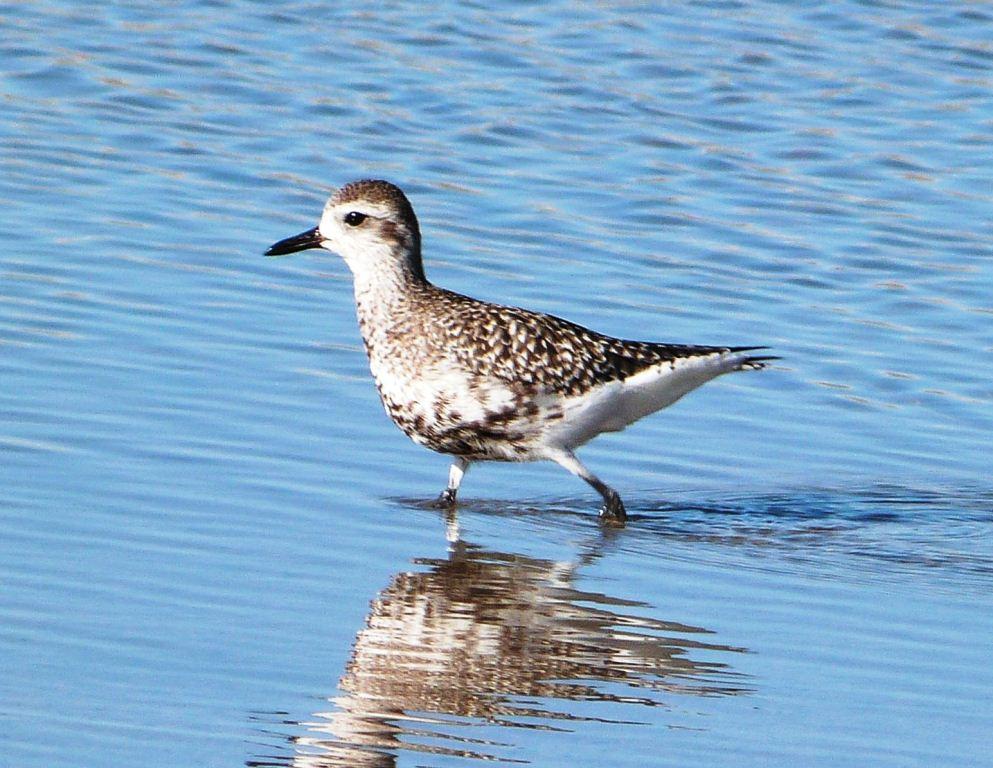
Black-bellied Plover - Ft DeSoto 11-22-12 Thanksgiving by Lee

Black-bellied Plover – Ft DeSoto 11-22-12 Thanksgiving

Plovers are a widely distributed group of wading birds belonging to the subfamily Charadriinae. There are about 40 species in the subfamily, most of them called “plover” or “dotterel”. The closely related lapwing subfamily, Vanellinae, comprises another 20-odd species.

Plovers are found throughout the world, and are characterised by relatively short bills. They hunt by sight, rather than by feel as longer-billed waders like snipes do.

They feed mainly on insects, worms or other invertebrates, depending on habitat, which are obtained by a run-and-pause technique, rather than the steady probing of some other wader groups.

The plover group of birds has a distraction display subcategorized as false brooding, pretending to change position, to sit on an imaginary nest site.

A group of plovers may be referred to as a stand, wing, or congregation. A group of dotterels may be referred to as a trip. (Wikipedia)

Northern Lapwing (Vanellus vanellus) by Nik

Northern Lapwing (Vanellus vanellus) by Nikhil Devasar

The versions of the Bible that list the Lapwing are: AKJV, Bishops, ECB, IAV, KJV, TRC, Tyndale, UKJV, Webster and the YLT.

Here is a very interesting version of Deut. 14:16:

The bittern, and the charadrion, every one in their kind: the houp also and the bat. (Deuteronomy 14:18 DRB)

That version actually mentions the Charadrion and the “houp,” which is the Hoopoe.

If you look through the birds in the Charadriidae Family you will find that the Lord was gracious and omniscient in his creative design of those species. I trust you never tire of studying God’s Word.

In your studies about the birds and other topics in the Bible, don’t forget one of the most important verses:

For God so loved the world, that he gave his only begotten Son, that whosoever believeth in him should not perish, but have everlasting life. (John 3:16 KJV)

*
See:
Birds of the Bible

Gospel Message
*