Ian’s Bird of the Week – Kagu

Ian’s Bird of the Week – Kagu ~ by Ian Montgomery

Newsletter ~ 7/5/15

Well mission accomplie thanks to your moral and spiritual support, so here is the iconic Kagu of New Caledonia after a great trip there. We went to Rivière Bleue national park about 90min drive west of the capital Noumea, meeting our excellent guide Jean-Marc Meriot at the park entrance at 7:00am. He took us straight to a Kagu territory where we had a wonderful time with these strange and fascinating birds. They were bigger than I’d expected being 50-55cm/20-22in long.
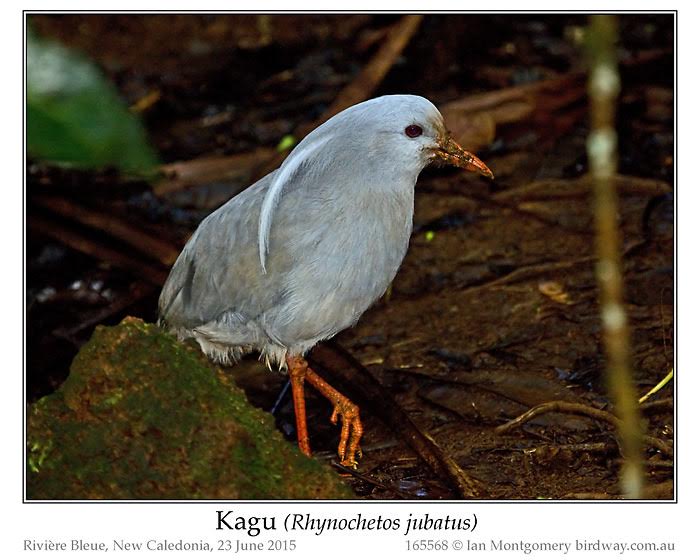
Kagu (Rhynochetos jubatus) by Ian
The first one we saw was a very shy juvenile running away through the forest so Joy and I were a bit afraid that we might have difficulty getting decent photos. We needn’t have worried as we soon encountered a family party only too willing to join in the fun, though poor light in the rainforest was a bit of a problem. It had been very wet on the previous couple of days so it was very wet underfoot, or around beak and face perhaps if you’re a Kagu and probe in the earth for your food.

Adult Kagus have very long crests that droop down their back or over their wings. There’s some disagreement about differences between the sexes in the literature, but Guy Dutson in his Birds of Melanesia says that the females have fine barring on the upper wing. If that’s the case, the bird in the first photo would be a male and the one in the female in the second. Juveniles have barring too, but much more, which confuses the situation slightly.

Kagu (Rhynochetos jubatus) by IanKagus are flightless but still have fairly long wings used for balance when rushing around and in threat displays when they show the striking black, grey and white barring on the flight feathers. The best we could get out of them was a throaty hiss when we startled them and brief views of the wings when flapped in motion, but can you see the barring just showing in the bird in the second and third photos (same individual). The one in the third photo has just grabbed an earth worm. These form an important part of the diet when the soil is damp, but they also eat lots of other invertebrates and small vertebrates such as lizards and mice. Apparently they can consume the millipedes without ill effects that other birds avoid because of the noxious substances they exude.

Kagu (Rhynochetos jubatus) by Ian

Kagus form strong pair bonds that can last for years and vigorously defend territories of about 20 hectares or 50 acres in extent. They lay a single large egg in a rough nest on the ground and the young birds can stay in the parental territory for a year or two. Both adults share incubation and feeding of the young bird.

Kagu (Rhynochetos jubatus) by Ian

This family was so tame that eventually we gave up using our expensive Canon gear – the birds were often too close to focus with a telephoto lens – and resorted to our phones. Joy took the fourth photo of me taking the fifth photo with my iPhone and I was startled to discover that the quality was nearly as good as with the Canon and the iPhone performed better in poor light. Smart phones have come a long way. I even took some videos and I’ll share one with you in due course.

Kagu (Rhynochetos jubatus) by Ian

Kagus are rated as endangered, though recent conservation efforts have improved the situation. They suffer from predation by dogs, pigs and rats and Captain Cook started the rot in 1774 when he introduced dogs. They’ve also suffered from logging of rainforest and fragmentation of their habitat by clearing. The population reached a low of perhaps 600-700 birds in 1991 but has increased since and is thought to be about 1500 now as a result of predator control and captive breeding and reintroduction.

Kagu (Rhynochetos jubatus) by Ian

Conservation is helped by its iconic status and it is widely used as symbol of New Caledonia. Here it is on the 1000 French Pacific Franc note (about 12 AUD), which of course we called the Kagu. This image shows the threat display that we failed to see properly or photograph.

The bird to its left on the note is one of the Horned Parakeets and I’ll have more to say about them in the near future. In fact one of these nearly upstaged the Kagu as photographic bird of the trip and it was only a very delightful encounter with a Kagu family in a different national park on our last full day that restored the Kagu to #1 status. So I’m going to break with tradition and have the same species as bird of the week twice running so that I can give that final chance meeting due space. The Kagu was, after all, the main reason for our visit and I haven’t had time yet to touch on its very interesting taxonomy.

Greetings
Ian

**************************************************
Ian Montgomery, Birdway Pty Ltd,
454 Forestry Road, Bluewater, Qld 4818
Tel 0411 602 737 ian@birdway.com.au
Bird Photos http://www.birdway.com.au/
Where to Find Birds in Northern Queensland: iTunesGoogle Play Kobo Books
Recorder Society http://www.nqrs.org.au


Lee’s Addition:

Keep me as the apple of the eye, hide me under the shadow of thy wings, (Psalms 17:8 KJV)

Great photos as usual, Ian. We’re glad our prayers are helping you see more of the Lord’s great birds.

I had hoped to see a Kagu at either the Houston or San Diego Zoo on this last trip. Both places had their Kagus “off exhibit.” One of them was ill, but not sure why the other one was not being shown. At least Ian was able to find them, in the wild, which is actually better.

*

*

A Pet Flamingo Named Mandy

A Pet Flamingo Named Mandy

by Emma Foster

Once there was a girl who owned a pet flamingo named Mandy. The girl’s name was Sarah and she lived in a big house with the rest of her family. One day her parents took her to a pet store across town where she saw a flamingo sitting in a bird-cage. Sarah was allowed to pick out one pet and she decided to pick out this flamingo. She named it Mandy. Mandy had one feather on her wing that was black and Sarah thought that was one of the reasons why Mandy was so special.

Today Mandy was sitting on Sarah’s father’s favorite recliner in the middle of the big family room. Mandy always loved sitting there because she had a good view out of one of the big windows. Sarah didn’t have any idea why she was sitting in the chair, but it was funny to see the cleaning lady come in with her duster and faint when she saw Mandy.

On this day the biggest window in the family room was wide open because it was a nice day outside and a small wind was blowing.

Chilean Flamingo (Phoenicopterus chilensis) ©Wiki

Mandy was sitting in Sarah’s father’s favorite recliner watching the sky when she saw birds fly by. Mandy decided to follow them and before Sarah could stop her, Mandy flew out of the window and out of sight. Sarah had never been sadder.

Sarah and her parents put up fliers around town looking for Mandy.

It was a week before Sarah passed by the zoo putting out fliers when she saw the flamingo exhibit. Inside the exhibit was Mandy! Sarah could tell because she had one black feather.

American Flamingos Many With Foot Up by Lee at Gatorland

Sarah was happy to see Mandy again, but she noticed that Mandy looked really happy with all the other flamingos. Sarah decided that Mandy should stay at the zoo with her new friends.

So, from then on, Sarah was sure to see Mandy the flamingo every day at the zoo.

The End


Lee’s Addition:

Thanks, Emma, for another bird tale. Mandy sounds like a nice pet, but sure she is enjoying being back with her friends. I could see why the cleaning lady would be shocked. Not many people have Flamingo as pets. But the Bible says:

For every kind of beast and bird, of reptile and creature of the sea, is tamed and has been tamed by mankind. But no man can tame the tongue. It is an unruly evil, full of deadly poison. With it we bless our God and Father, and with it we curse men, who have been made in the similitude of God. Out of the same mouth proceed blessing and cursing. My brethren, these things ought not to be so. (James 3:7-10 NKJV)

Check out Emma Foster’s other tales:

Kids, You Are Special
*

Ian’s Bird of the Week – Great Crested Grebe

Ian’s Bird of the Week – Great Crested Grebe ~ by Ian Montgomery

Newsletter ~ 6/20/15

I’m going to weave a tangled web of French connections around this bird of the week, but the first and most important is that in honour of Loïc, my great nephew and first child of my niece Jeannine and her husband Carlos who live in Strasbourg in Alsace. He was due today, but arrived safe and well four days early.

Clearly, a bird photographed in France was required but the choice was very limited: Carrion Crow, Common Coot or Great Crested Grebe. The latter was bird of the week in July 2007, so I toyed with the idea of Coot but, given that in the British Isles people say ‘you silly coot’ in the same tone that Australian say ‘you silly galah’ I decided that coot was better saved for a non-dedicated bird of the week.

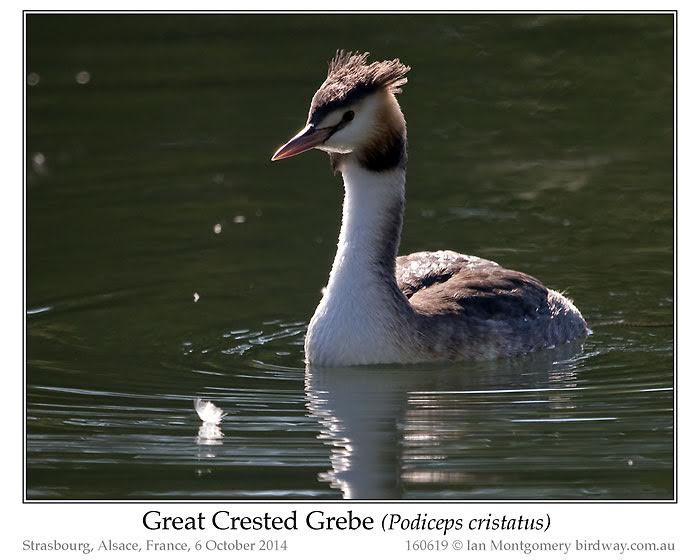
Great Crested Grebe (Podiceps cristatus) by Ian

So here is an elegant grebe in non-breeding plumage in a park near where my niece lives in Strasbourg last October. She took my sister Gillian and I there to look for some White Storks that had been nesting there, but they had already left for the winter so the grebes and coots attracted my attention instead. If my sums are correct in working back from today’s date, little Loïc would have been with us too, though probably not much older than the egg in the nest in the second photo. This egg was probably freshly laid, as Great Crested Grebes usually lay 3 or 4 eggs. Maybe it arrived early too, as the parent is busy adding nesting material to the structure.

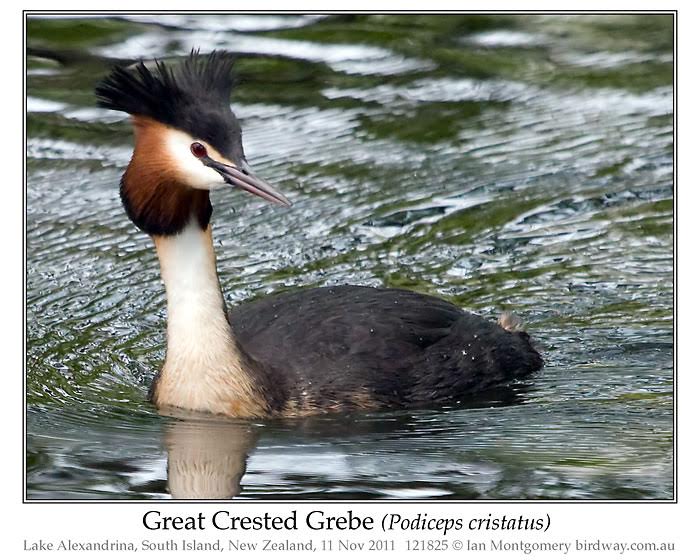
Great Crested Grebe (Podiceps cristatus) by IanThis nest was on Lake Alexandrina on the South Island of New Zealand, so it’s apparent that this species has a huge range extending from Ireland in the West and all the way through Eurasia to Australasia and in northern and southern Africa. It is however absent from the tropical regions of Africa and various tropical areas of Asia such as Indonesia.

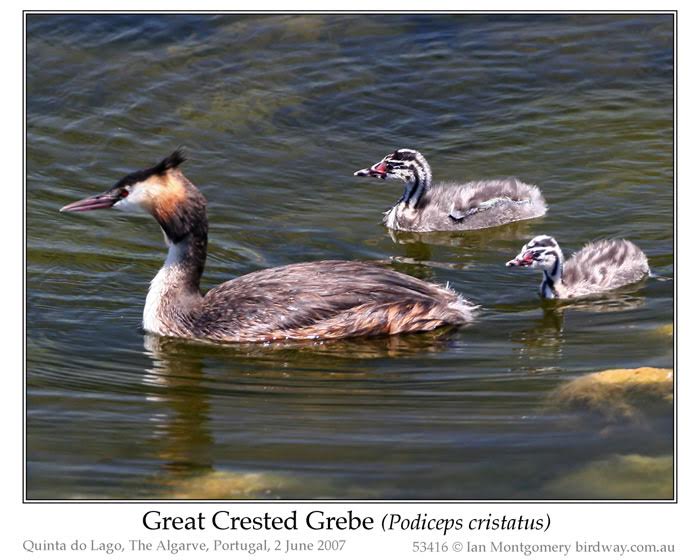
Great Crested Grebe (Podiceps cristatus) by IanThe third photo shows one of the New Zealand birds in full breeding plumage with the elongated crest and head plumes that give it scientific (cristatus), English and French name Grèbe Huppé. I’ll come back to huppé later. The 2007 bird of the week photos were of some breeding birds in Portugal and here is another one from that series: proud parent with two gorgeous striped youngsters. As this posting is celebrating a new family, I’d like to think that the photo is prophetic and that Loïc can look forward to a lovely sibling in due course.

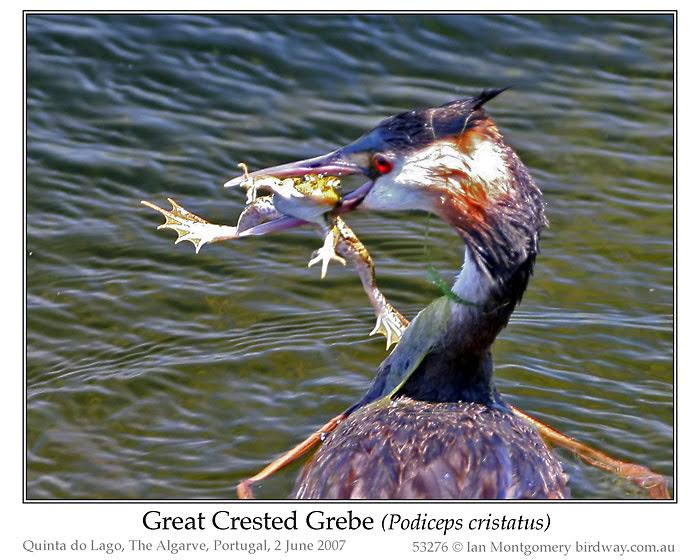
Great Crested Grebe (Podiceps cristatus) by IanGreat Crested Grebes mostly feed on fish, quite large ones at that, but this one Portugese one, fifth photo, has seized this hapless frog, whose expression seems a rather sad combination of pleading for help and accepting its fate.

Great Crested Grebe (Podiceps cristatus) by IanAnother French connection is that I’m on a flight to New Caledonia and had thought that I would be on French territory when Loïc arrived, but he decided not to wait but I will try and skype the happy trio from Noumea.

I mentioned a few weeks ago, that our primary target is the very special Kagu, a rare, crested pigeon-sized terrestrial species endemic to New Caledonia. It’s taxonomically special too, being the only member of its family (Rhynchochetidae) and belong to an order that has only one distant relative, the Sunbittern of South America (according to Birdlife International).

The Kagu is crested too, so it’s French name is – you’ve guessed it, go to the top of the class – Kagou huppé. Huppé is slang in French for upper crust, smart, posh which seems highly appropriate. So, as usual I’m relying on your spiritual and moral support to produce au autre oiseau huppé for the next bird of the week. Joy and I have booked a guide at Rivière Bleue National Park next Tuesday, its main breeding locality and pride and joy of the park.

Forty one minutes to go before we reach Noumea.
Greetings
Ian

**************************************************
Ian Montgomery, Birdway Pty Ltd,
454 Forestry Road, Bluewater, Qld 4818
Tel 0411 602 737 ian@birdway.com.au
Check the latest website updates:
http://www.birdway.com.au/#updates


Lee’s Addition:

Look at the birds of the air, for they neither sow nor reap nor gather into barns; yet your heavenly Father feeds them. Are you not of more value than they? (Matthew 6:26 NKJV)

That frog is in total shock. Yiiikess! He is thinking! What a great capture of all them, Ian. Thanks again for sharing these weekly birds of the week.

*

*

Ian’s Bird of the Week – Galah

Galah (Eolophus roseicapilla) by Ian at Birdway
Ian’s Bird of the Week – Galah ~ by Ian Montgomery

Newsletter – 6/6/15

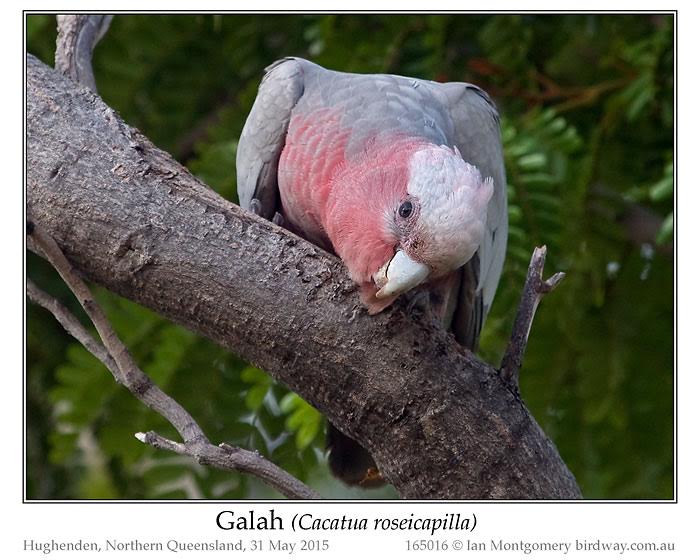
I’m back home after cutting short the camping trip in Western Queensland owing to a foot problem which made both camping and walking difficult. The foot is responding well to treatment at home in preparation for the New Caledonian trip in two weeks time. So I didn’t return with lots photos of dry country species for you but I did get treated to a fine display by an extrovert male Galah who came along to distract me while I was putting up my tent in Hughenden.

He wasn’t the only distractor; the camp site know-all gave me a lecture on the order in which to assemble my tent. The Galah was more welcome and I encouraged him, unlike the human, verbally. You can imagine the conversation going a bit like this.
‘I’ve heard that you bring birds fame and fortune with your Bird of the Week email. Can I be your bird of the week?’

‘Sorry Galah was BotW in 2006 (below). I like to have a different species each time.’

‘Ah, pleeeease!!!’ (below)

Galah (Eolophus roseicapilla) by Ian at Birdway

‘Well, okay, we’ll see. But you’ll have to do something spectacular to make it worth my while.’

‘How about this? I’ll look cute and demented at the same time.’

Galah (Eolophus roseicapilla) by Ian at Birdway

‘Mmmmh. Not bad but the juvenile Galah did that in 2006 and simultaneously begged for food.’

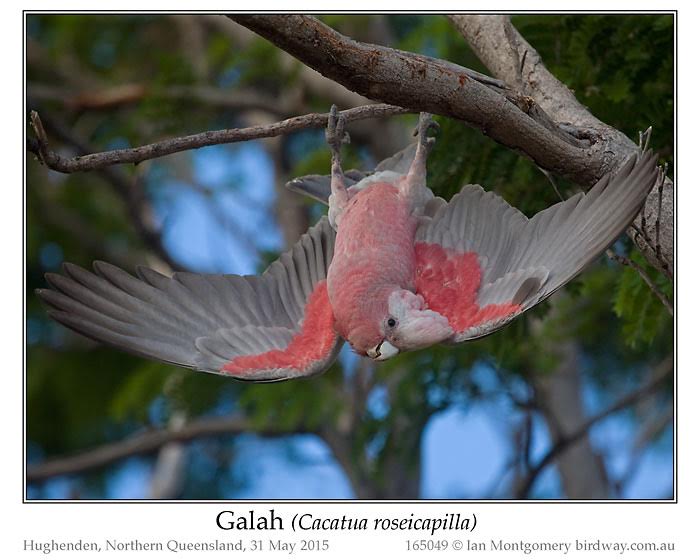
‘I can hang upside-down and look at you at the same time without losing my grip.’

Galah (Eolophus roseicapilla) by Ian at Birdway

‘That’s better! Anything else?’

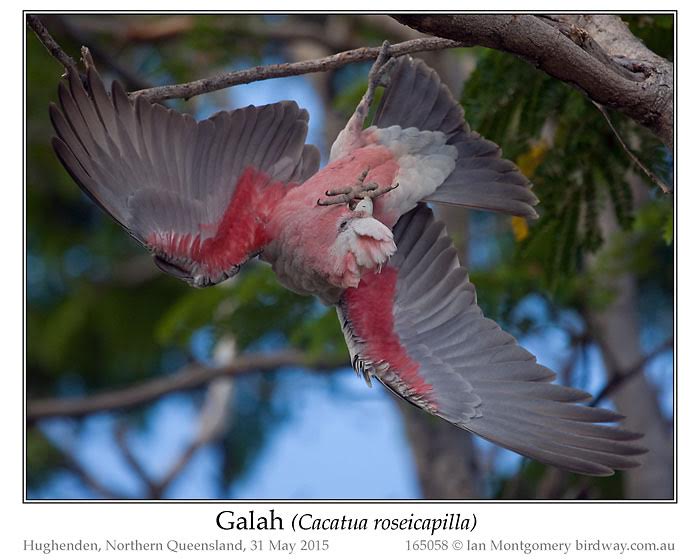
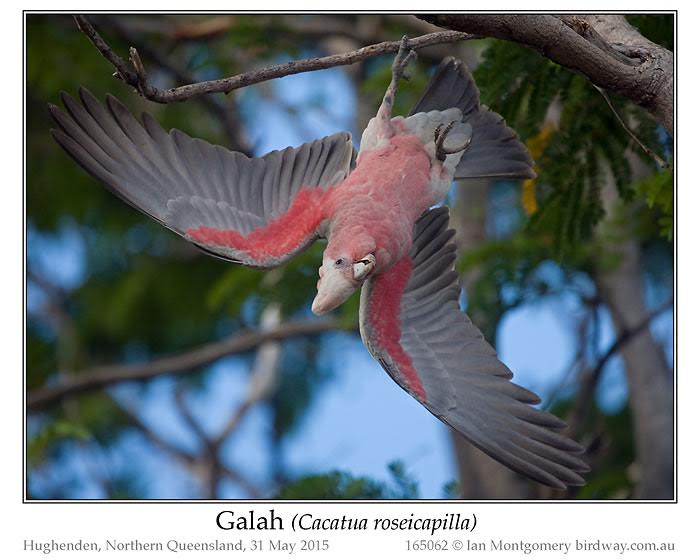
‘I can hang upside-down with just one claw, no safety net, raise my crest and nibble my other foot simultaneously without falling off.’

Galah (Eolophus roseicapilla) by Ian at Birdway

‘Now that’s impressive: you win. You can be the next bird of the week.’
‘Whoopee, thank you!!! Happy camping!’

Galah (Eolophus roseicapilla) by Ian at Birdway

At that point the camp-site know-all came along.

The Galah said: ‘Oh no! I’m out of here!’ and flew away. Despite their name, Galahs aren’t stupid.

Galah (Eolophus roseicapilla) by Ian at Birdway

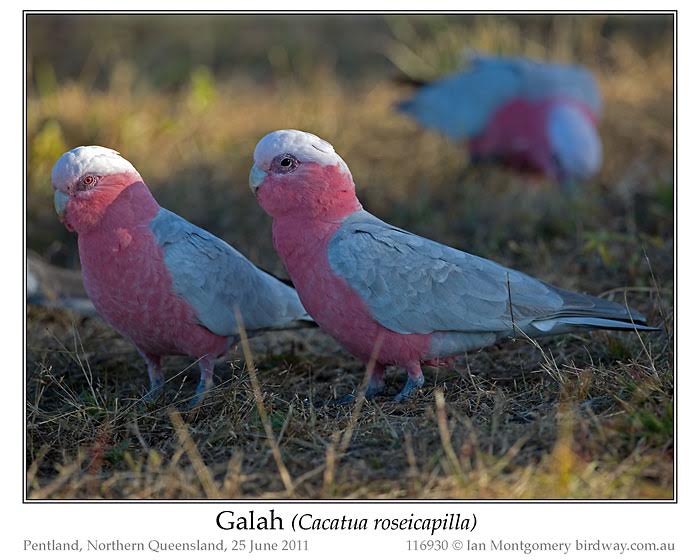
Just in case you are wondering why I said the bird was a male, it’s all in the eyes. Males have dark brown irises, females have red ones as in the photo above taken on a different occasion at Pentland not that far from Hugenden. This is also the case in Major Mitchell’s Cockatoo.

Greetings

Ian
**************************************************
Ian Montgomery, Birdway Pty Ltd,
454 Forestry Road, Bluewater, Qld 4818
Tel 0411 602 737 ian@birdway.com.au
Bird Photos http://www.birdway.com.au/

Where to Find Birds in Northern QueenslandiTunesGoogle Play Kobo Books
Recorder Society http://www.nqrs.org.au


Lee’s Addition:

The works of the LORD are great, sought out of all them that have pleasure therein. (Psalms 111:2 KJV)

What a delightful newsletter. Sorry about your foot though, Ian. We will be praying that you heal quickly so you can make that next trip. Who knows what adventure you will come back to tell us about?

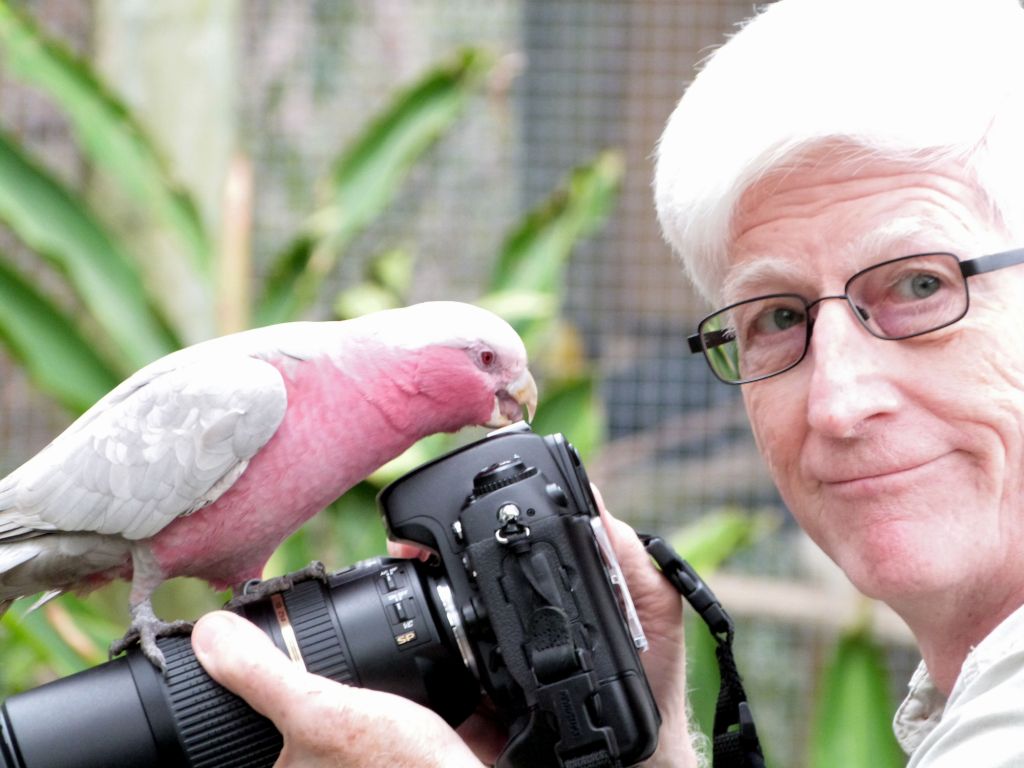
As many of my readers know, the Galah has become on of my favorite birds. Every since our encounter with the Galah at Brevard Zoo, when this photo was taken.

Galah (Eolophus roseicapilla) and Dan

Galah (Eolophus roseicapilla) and Dan

*

*

Sunday Inspiration – Worthy

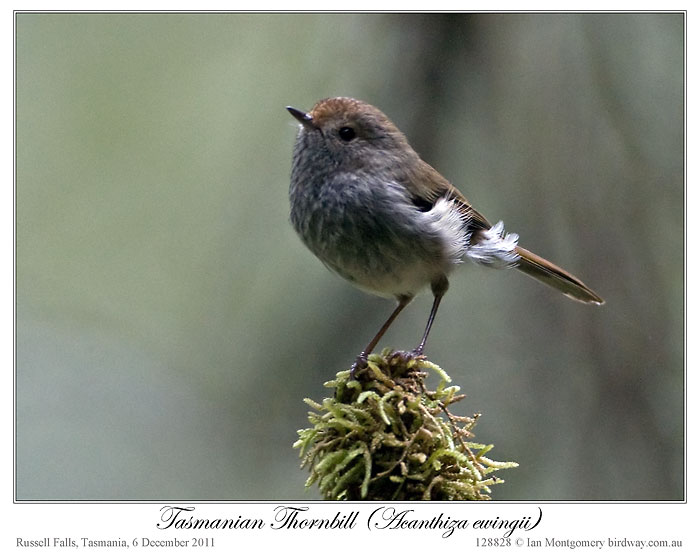
Tasmanian Thornbill (Acanthiza ewingii) by Ian 1

Tasmanian Thornbill (Acanthiza ewingii) by Ian

Whenever the living creatures give glory and honor and thanks to Him who sits on the throne, who lives forever and ever, the twenty-four elders fall down before Him who sits on the throne and worship Him who lives forever and ever, and cast their crowns before the throne, saying: “You are worthy, O Lord, To receive glory and honor and power; For You created all things, And by Your will they exist and were created.” (Revelation 4:9-11 NKJV)

There really aren’t any birds named Easter or Cross, so I decided to continue on through the Passerine Order. Actually, some of the birds in one of these families are the “Thornbills” and that is appropriate. Enjoy the Lord Creator’s avian Creations as you listen to the words and realize just how Worthy He is of our praise and honor. Happy Easter!

And they sung a new song, saying, Thou art worthy to take the book, and to open the seals thereof: for thou wast slain, and hast redeemed us to God by thy blood out of every kindred, and tongue, and people, and nation; And hast made us unto our God kings and priests: and we shall reign on the earth. And I beheld, and I heard the voice of many angels round about the throne and the beasts and the elders: and the number of them was ten thousand times ten thousand, and thousands of thousands; Saying with a loud voice, Worthy is the Lamb that was slain to receive power, and riches, and wisdom, and strength, and honour, and glory, and blessing. (Revelation 5:9-12 KJV)

This slideshow requires JavaScript.

“Worthy” ~ Faith Baptist Choir and Orchestra

*

Dasyornithidae – Bristlebirds
Pardalotidae – Pardalote
Acanthizidae – Australasian Warblers
Pomatostomidae – Australasian Babblers
Sunday Inspirations

Previous Easter Blogs:

Happy Easter
He is Risen! Happy Easter
The Creator and His Love

What A Wonderful Savior
Sunday Inspiration – Palm Birds
Happy Easter – He Is Risen

Gospel Message

*
Ian’s Bird of the Week ~ Pilotbird

Ian’s Bird of the Week ~ Pilotbird ~ by Ian Montgomery

Newsletter ~ 3/31/15

The primary targets in East Gippsland were the Sooty and Masked Owls, but there were several daytime birds on the wanted list too. One of these was the Pilotbird, a smallish – 17cm/7in long – brown, ground-dwelling bird of the mountain ranges and dense coastal scrub of southeastern Australia from just south of Sydney almost to Melbourne. I’d seen one only once before, near Mittagong in New South Wales 16 years ago, but that encounter was only a glimpse and no photography was involved.

Pilotbird (Pycnoptilus floccosus) by Ian

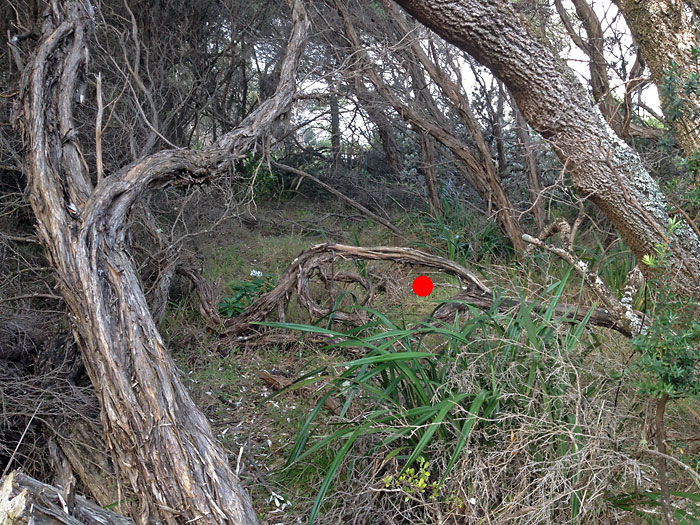
It’s an unobtrusive bird and easy to overlook, unless you know its flutey, far-carrying call, sometimes rendered as ‘guinea-a-week’. My Victorian friends knew a good spot for it in coastal scrub and we found one there with relative ease, returning the following day (first photo) to get better photos. It rummages around in thick undergrowth looking for invertebrates. The second photo has a red dot showing the exactly location, beyond the sinuous brown branch, so you can appreciate that we are lucky to be able to see anything much of it in the photo. It has unusual buff dark-edged feathers on the breast, giving it a scaly appearance. The plumage is apparently dense and silky as reflected in its scientific name: Pycnoptilus means thick-feathered, and floccosus is derived from the Latin floccus and means ‘full of flocks of wool’, which, I must admit, left me not much the wiser.

Pilotbird (Pycnoptilus floccosus) by Ian

Pilotbird (Pycnoptilus floccosus) location by Ian

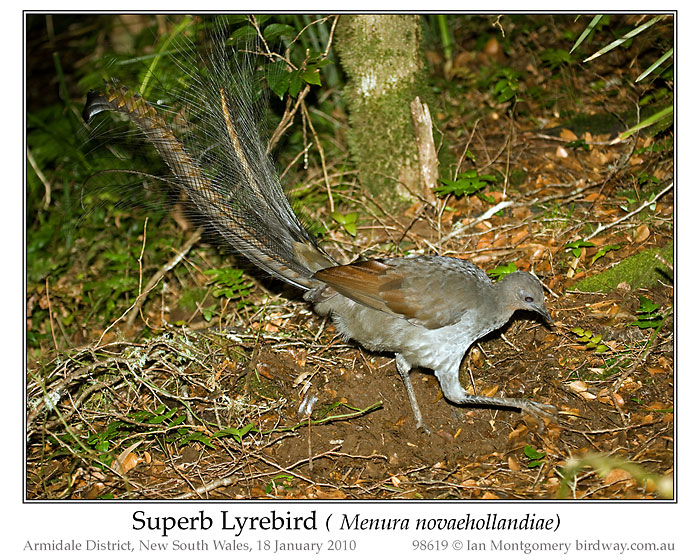
It’s common name Pilotbird arises from the bird frequently associating with Superb Lyrebirds, taking advantage of the digging habits of the latter (third photo) to snatch up revealed invertebrates. Some sources say the name Pilotbird comes from the similar habit of Pilotfish which associates with large marine predators such as sharks; other say that the Pilotbird by its call led early settlers looking for food to lyrebirds. I prefer the first explanation. Lyrebirds are very vocal in their own right and don’t need another species to advertise their presence. Lyrebirds are perhaps the world best mimics and are known to mimic Pilotbirds, and it would be easy to imagine that this attracted Pilotbirds in the first place and they then learned that this was an easy way to get dinner. We did in fact see several Superb Lyrebirds dashing across the roads of the forests where the owls lived, though the coastal scrub didn’t strike me as good lyrebird habitat.

Superb Lyrebird (Menura novaehollandiae by Ian

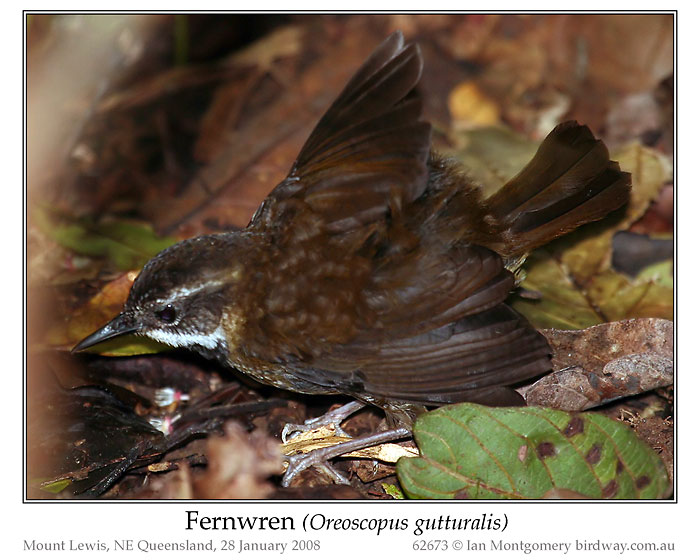
This photo of the lyrebird digging vigorously reminded me both of Scrub-turkeys and Chowchillas (fourth photo) and I wondered whether the Pilotbird had a behavioural counterpart in the forests of Northeastern Queensland. The Pilotbird is usually placed in the Acanthizidae, the family of thornbills and their allies (though it shows some affinities with the bristlebirds Dasyornithidae), so I checked up on the Fernwren (fifth photo) another brown, rummaging Acanthizid endemic to the Wet Tropics.

Chowchilla (Orthonyx spaldingii  by Ian

Sure enough, HBW (Handbook of Birds of the World) reports that the Fernwren “sometimes associates with Orange-footed Scrubfowl (Megapodius reinwardt) and Chowchilla (Orthonyx spaldingii), following in close proximity and catching prey disturbed by their feeding actions”. The Orange-footed Scrubfowl is, of course, a cousin of the Brush-turkey.

Fernwren 9Oreoscopus gutturalis)  by Ian

So maybe this week’s bird of the week should be entitled ‘small brown rummaging birds of the forest floors of eastern Australia’.

Greetings
Ian

**************************************************
Ian Montgomery, Birdway Pty Ltd,
454 Forestry Road, Bluewater, Qld 4818
Tel 0411 602 737 ian@birdway.com.au
Bird Photos http://www.birdway.com.au/


Lee’s Addition:

For you are my rock and my fortress; and for your name’s sake you lead me and guide me; (Psalms 31:3 ESV)

Teach me to do Your will; for You are my God; Your Spirit is good; lead me into the land of uprightness. (Psalms 143:10 MKJV)

What great protection colorations these birds have received from their Creator. I am sure when the birds of prey are in the area, rummaging types of birds are very thankful for their less colorful outfits.

*

*

Sunday Inspiration – Honeyeaters

Bridled Honeyeater (Lichenostomus frenatus) by Ian

Bridled Honeyeater (Lichenostomus frenatus) by Ian

How sweet are thy words unto my taste! yea, sweeter than honey to my mouth! (Psalms 119:103 KJV)

The Meliphagidae – Honeyeaters are another of our beautifully created birds in the Passerine Order to highlight. Thought about changing the sequence because of Palm Sunday, but did Palm Birds previously with Lisa Brock singing from an Easter Musical. The Words of Christ that tell of this week, and they are sweeter than honey to those of us who have accepted the Lord Jesus Christ as our Savior.

The Lord did not have to stay on the cross, but because of His Love for us, he stayed there and paid the penalty for our sins. He offers us the gift of Salvation, but we have to admit and acknowledge our sinful condition, and accept that gift. Honey is a gift from the Lord for the Honeyeaters, and they could stand and look at it all day, but they need to partake of it to do them any good. Taste comes when they accept it.

And as Moses lifted up the serpent in the wilderness, even so must the Son of man be lifted up: That whosoever believeth in him should not perish, but have eternal life. For God so loved the world, that he gave his only begotten Son, that whosoever believeth in him should not perish, but have everlasting life. For God sent not his Son into the world to condemn the world; but that the world through him might be saved. He that believeth on him is not condemned: but he that believeth not is condemned already, because he hath not believed in the name of the only begotten Son of God. And this is the condemnation, that light is come into the world, and men loved darkness rather than light, because their deeds were evil. (John 3:14-19 KJV)

This slideshow requires JavaScript.

“Blood of Jesus Medley” ~ Faith Baptist Church Choir

*

Meliphagidae – Honeyeaters
Sunday Inspiration
Beautiful Australian Birds 4 – Honeyeaters
Gospel Message

*


Ian’s Bird of the Week – Greater Sooty Owl

Ian’s Bird of the Week – Greater Sooty Owl ~ by Ian Montgomery

Newsletter ~ 3/19/15

Here is the belated and sought-after bird of the week after a great trip to Victoria. I’ve been unwell since my return a week ago, but things are fine now and the wheels of my life are turning again.

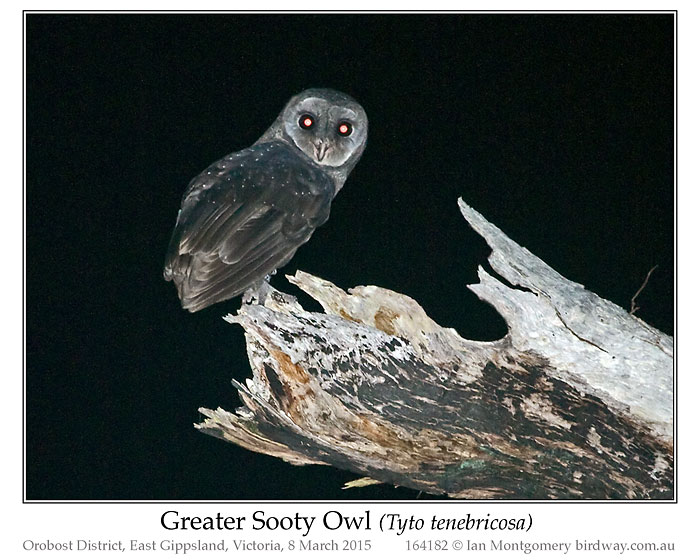
Your spiritual support and goodwill have done it again, so it’s another mission accomplished, though in English this time (having been Catalan and Spanish in the past). Actually, most credit should go to my sharp-eared, sharp-eyed, knowledgeable and passionate birding friends. With their hard work, the track record for target species in East Gippsland during our stay was fantastic. We went searching for owls on each of the three nights. The first night, we heard both Greater Sooty and Masked Owls – and the sharpest-eyed of the group saw a Masked Owl in flight. On the second night, at a different site we heard another Sooty Owl and eventually caught sight of it flying among the tall trees of the forest. It then flew over us and perched on a dead limb in the open high above us.

STI-Tyto Greater Sooty Owl (Tyto tenebricosa) by Ian

I got only this photo, discarding a second out of focus one. For the technically minded, I used manual focussing – it was too distant and the light and contrast too faint for auto focus – and guessed an exposure of 1/80sec at f5.6 and 1600 ISO using the 100-400mm zoom. As the passionate/obsessive birder would understand, it was worth travelling to Victoria for this one photo and, having taken it, misión completa (I have liked it in Spanish since finding the Resplendent Quetzel in Costa Rica in 2010) I was free to relax and enjoy whatever other gems came our way. In fact, one such, this Yellow-bellied Glider. sailed over our heads and landed in a nearby tree while we were trying to locate the calling Sooty Owl.

Yellow-bellied Glider (Petaurus australis) by Ian

These are fantastic, long-tailed, wrist-winged relatives of possums (the Striped Possum of Northeastern Queensland is in the same family, the Petauridae) and the Yellow-bellied can glide up to 150m/400ft. It is rabbit-sized with a huge bushy tail that it presumably uses as a rudder in flight. They’re called wrist-winged, to distinguish them from elbow-winged like the Great Glider, and if you look carefully in the photo you can see the black edge of the membrane attaching to the little finger of the left hand. This proved to be diagnostic as we were unsure of both its identify and of whether the large possum-like animal on the tree was the same creature as the pale form that glided over us.

They are reasonably common in suitable old growth forest in eastern Australia, though the northern race regina has a very restricted range in northeastern Queensland and is threatened by logging. Quite coincidentally, I received a request yesterday to support a petition to prevent the transferring of Tumoulin Forest Reserve near Ravenshoe to State Forest so that logging can resume. The petition is aimed directly at protecting the Yellow-bellied Glider, and if you think, like I do, that downgrading the status of nature reserves is disgraceful, then we should support it: http://www.thepetitionsite.com/851/727/614/protect-rare-possum-habitat-from-senseless-logging/.

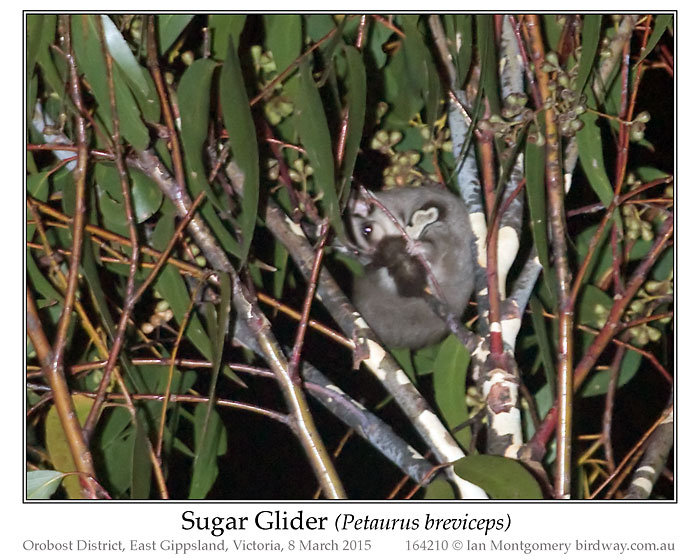
Later that evening, we returned to the Masked Owl site. We could hear one or two Masked Owls but they were wary, keeping their distance in the forest and moving away when spotlights were shone in their direction. We did, however, see one in flight and, having already photographed the Sooty Owl, I was satisfied with that, even though we did try again for photographs without success on the third night. We did, however, find this Sugar Glider, a small relative of the Yellow-bellied. It seemed to be keeping a low profile, very sensible given the presence of calling owls. Later still, we came across a juvenile Southern Boobook which flew up in front of us into a small tree beside the road. It didn’t dally for a photo, but that made it a three-owl evening which we all thought was special.

Sugar Glider (Petaurus briviceps) by Ian

I’ve barely mentioned Sooty Owls, as so much else happened that evening. There are two Australian forms: the Lesser Sooty in the wet tropics of northeastern Queensland and the Greater Sooty in eastern Australia from Eungella National Park near Mackay in Queensland to the Dandenong and Strzelecki Ranges in Victoria, both reasonably common in suitable habitat of wet, gully, forest but rarely seen. Another race, supposedly of the Greater Sooty, occurs throughout New Guinea. Currently the Lesser and Greater are treated as separate species by most authorities, though Christidis and Boles lumped them in 2008. Having one species with a disjoint range in New Guinea and eastern Australia and a closely-related separate one in between should make any student of biogeography laugh out loud, but that’s the way it is. Sooty Owls feed mainly on arboreal mammals, though they will take other prey such as birds.

Ian at work photographing Owl

Ian at work photographing Owl

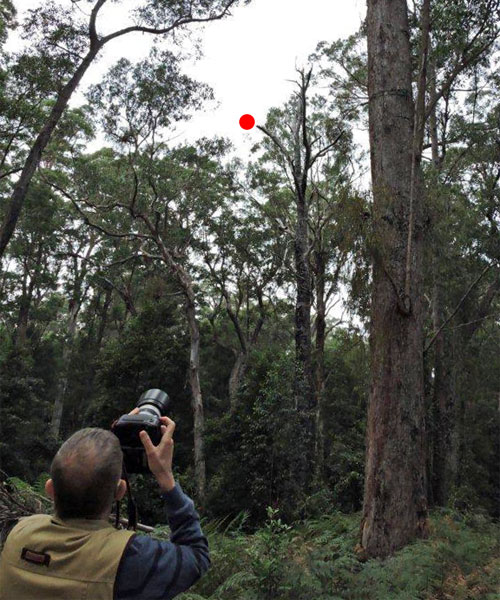
On the following day we returned to the Sooty Owl site and here is a photograph of me photographing it, the red spot showing where the bird in the photo was perched. I was surprised at how far up it was and felt very fortunate to have got the one reasonable photo. This forest also produced for us Tawny Frogmouth, Australian Owlet-Nightjar, Brush-tailed Possums, a bandicoot, a wombat and Black or Swamp Wallabies leaving us in no doubt about the value of old growth forests (reminder http://www.thepetitionsite.com/851/727/614/protect-rare-possum-habitat-from-senseless-logging/).

A few people have requested location information about the owls, but I have been sworn to secrecy by my friends as they don’t want them being disturbed too much or subjected to tapes of owl calls. So please understand my reticence.

Greetings
Ian

**************************************************
Ian Montgomery, Birdway Pty Ltd,
454 Forestry Road, Bluewater, Qld 4818
Tel 0411 602 737 ian@birdway.com.au
Bird Photos http://www.birdway.com.au/
Where to Find Birds in Northern Queensland: iTunes; Google Play Kobo Books
Recorder Society http://www.nqrs.org.au


Lee’s Addition:

the little owl, the fisher owl, and the screech owl; (Leviticus 11:17 NKJV)

What an adventure. Some birds just don’t want to be found. Thanks again, Ian, for sharing another trip with us. Glad you are feeling better.

Sooty Owls belong to the Tytonidae – Barn OIwls family which has 19 speciesIan’s Owls can be found at

http://birdway.com.au/tytonidae/index.htm and

http://birdway.com.au/strigidae/index.htm.

*

Ian’s Bird of the Week

Ian’s Birdway 

Tytonidae – Barn Owl Family

*


Ian’s Bird of the Week – Budgerigar

PSI-Psit Budgerigar (Melopsittacus undulatus) by Ian
Ian’s Bird of the Week – Budgerigar ~ by Ian Montgomery

Newsletter ~ 3/3/15

Judging by the number of emails that I received about Pied Butcherbirds, iconic species are popular and there were many interesting stories about experiences with them. So here is another, perhaps globally the most familiar Australian bird. Although it’s quite common and sometimes very abundant after good rains in the drier parts of Australia, you have to go out of your way to find it. So it it’s much less well-known as a wild bird than say other iconic species like Australian Magpie and Laughing Kookaburras that turn up in backyards.

It wasn’t until after I moved to North Queensland in 2002 that I first saw them in the wild, and that was on a trip to Moorrinya National Park between Torrens Creek and Aramac, 370km southwest of Townsville. In places like that you usually see them in small flocks of maybe 10-20 in rapid undulating flight. These make sudden turns in the sunlight showing alternately green and yellow in a characteristic and delightful display of vivid, fluorescent colour.

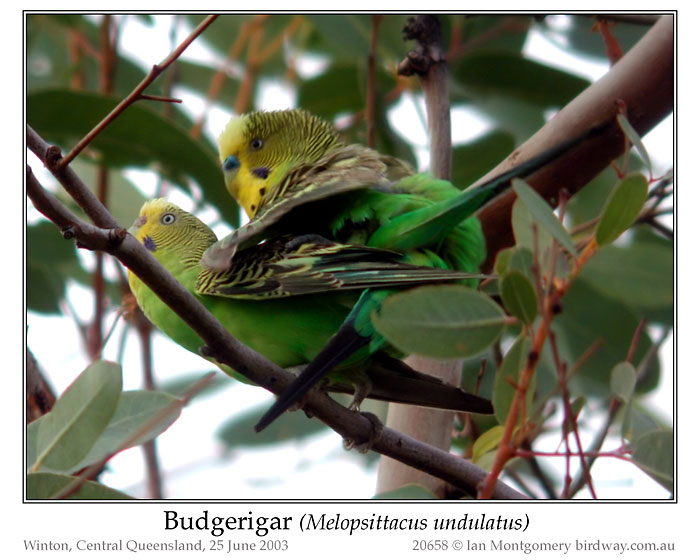
PSI-Psit Budgerigar (Melopsittacus undulatus) by Ian

The sexes can be distinguished either by differences in behaviour, sometimes subtle as in the first photo with an attentive male and a bored or playing hard to get female, or less subtly as in the second photo. Her the male is concentrating seriously, and the female is rather inscrutably either in a state of bliss or thinking of the motherland. An easier way though is by the colour of the cere – the tissue surrounding the nostrils – blue in adult males, and brown in females. Juveniles have duller plumages, barred foreheads and lack the black spots on the neck.

PSI-Psit Budgerigar (Melopsittacus undulatus) by IanAfter good inland rains, the population can explode and Budgerigars may be seen in flocks of thousands. When dry conditions return and seeds become scare, flocks wander far and wide in search of food. They move into areas beyond their normal range and can turn up in coastal areas such as near Townsville. The birds in the third photo were near Woodstock just south of Townsville on the way to Charters Towers and I have seen them near Bluewater.

Sometimes escaped cage birds turn up in odd places in strange colours, such as this almost completely white one near the Strand in Townsville. I don’t know about you, but I prefer the natural colours. I was in Ireland once for a family funeral in February and was birding on Dun Laoghaire pier in Dublin Bay on a very cold, dull winter’s day, when I spotted a bright yellow budgie looking very out-of-place among some roosting waders. It was a moment of great empathy and I thought ‘you and I should be back in sunny Australia’.

PSI-Psit Budgerigar (Melopsittacus undulatus) by IanI’m in Melbourne at the moment to visit East Gippsland next weekend with my Victorian birding pals who know of a good site for both Greater Sooty Owls and Masked Owls (both cousins of Barn Owls) near Orbost. I haven’t seen or photographed either of these, so may I request your customary friendly support and spiritual goodwill to help us find them? It would be lovely to be able to bring at least one of them to you as the next bird of the week.

Greetings
Ian

**************************************************
Ian Montgomery, Birdway Pty Ltd,
454 Forestry Road, Bluewater, Qld 4818
Tel 0411 602 737 ian@birdway.com.au
Check the latest website updates:
http://www.birdway.com.au/#updates


Lee’s Addition:

Declare His glory among the nations, His wonders among all peoples. (Psalms 96:3 NKJV)

Ian is correct, at least for me. The Budgerigar or “Budgie” as I was taught, was one of the first bird names I ever knew. Almost everyone I have ever seen was in a cage or aviary. Few have been pets and one was sitting on someone glasses look down into their lens. But, to see them in the wild where they live would be a great experience.

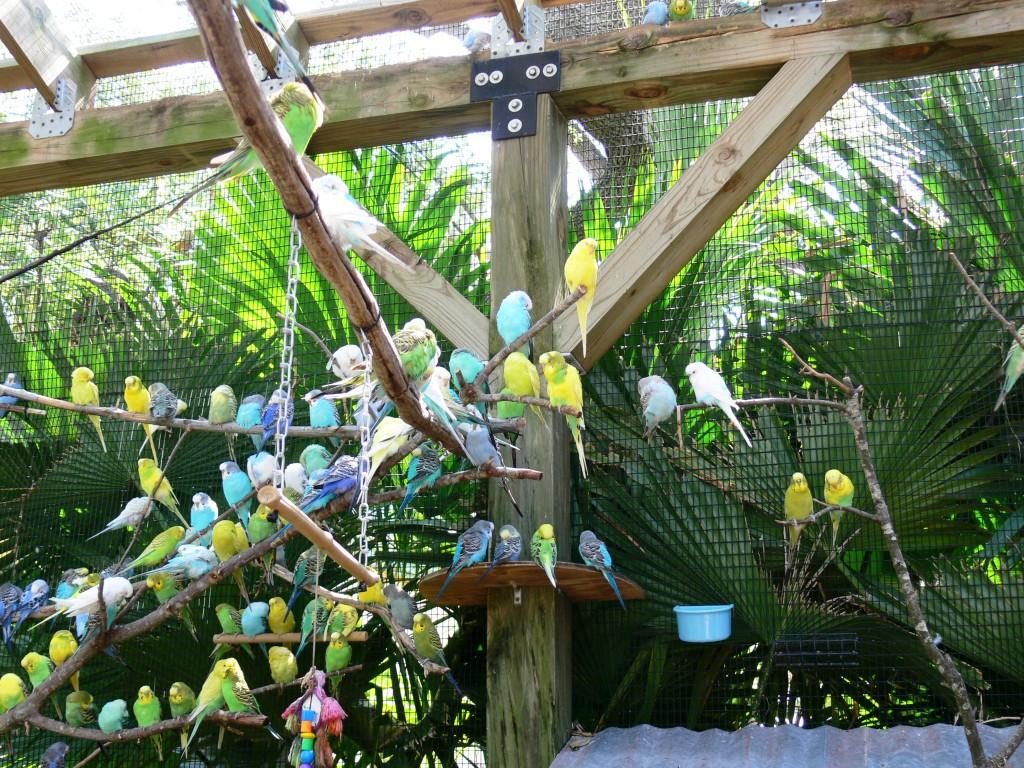
Thanks, Ian, for again sharing your adventures with us. The most I have ever seen at one time has been at Lowry Park Zoo. I’ll also be praying that Ian finds those Greater Sooty Owls and Masked Owls so that he will share them with us on another Bird of the Week.

Budgerigar (Melopsittacus undulatus) by Lee LPZ

Budgerigar (Melopsittacus undulatus) by Lee LPZ

Ian’s Birds of the Week

Ian’s Budgerigar Photos

Ian’s Psittacidae Family

Psittacidae – Parrots Family

*


Sunday Inspiration – Give Thanks

Spangled Cotinga (Cotinga cayana) ©WikiC CinZoo Photo by Greg Hume

Spangled Cotinga (Cotinga cayana) ©WikiC CinZoo Photo by Greg Hume

To the end that my glory may sing praise to thee, and not be silent. O LORD my God, I will give thanks unto thee for ever. (Psalms 30:12 KJV)

As we continue through the Passerine Families, today we arrive at Cotingidae – Cotingas Family which has 66 members and the Pipridae – Manakins Family has 52 species.

As you watch the birds you can listen to Mark Quijano sing “Give Thanks.” Mark is a newer follower of this blog and I am following his, now that we have been made aware of the each other’s blog. Our mutual draw is Our Lord Jesus Christ. I find the Lord’s Family enjoyable, wherever they may be. Mark lives in Saga City, Japan. Please check out his site “Travel Diary.”

If you have a large screen, you can do both at the same time, else, watch the birds as you listen to Mark. Or you can watch Mark sing and then start it again and listen as you watch the birds. Oh, the options I have given you today to enjoy Our Lord’s Creation and “Give Thanks” through music and birds.

This slideshow requires JavaScript.

“Give Thanks” ~ sung by Mark Quijano, his YouTube Channel

*

Sunday Inspirations

Cotingidae – Cotingas Family

Pipridae – Manakins Family

Travel Diary

Good News

*

Birds of the Bible – Gifts From Birds

Fish Crow (Corvus ossifragus) at Lake Morton By Dan'sPix

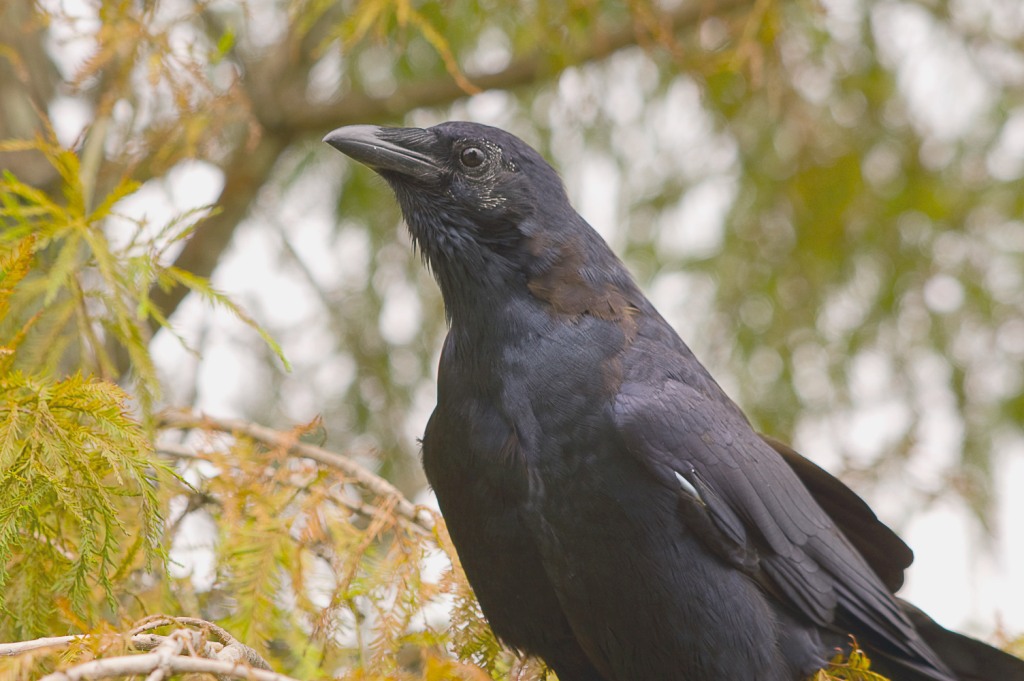
Fish Crow (Corvus ossifragus) at Lake Morton By Dan’sPix

Birds of the Bible articles have been written about Raven’s before. James J S Johnson sent a link to a news story in the BBC News Magazine about Crows that is similar to the Ravens in the Bible.

First the story. A young girl, Gabi Mann, feeds Crows and they bring her “gifts.” (nutshell version). See The girl who gets gifts from birds.

It started when she got out of the car and dropped food from her lap. The Crows grabbed it and each time she came home, they watched for her. It went from that to Gabi and her mother feeding them on a regular basis. Then, the crows started leaving various items, that could fit in their mouths, as “gifts.” Here are some of those items.

Things brought by the crows

Things brought by the crows

*

Things brought by the crows

Things brought by the crows

Does the story bring to mind a similar situation, but with Ravens bringing something to someone?

In I Kings 17, we read about the prophet Elijah who was told by the LORD to get away and hide by the Brook Cherith.

And it will be that you shall drink from the brook, and I have commanded the ravens to feed you there.” So he went and did according to the word of the LORD, for he went and stayed by the Brook Cherith, which flows into the Jordan. The ravens brought him bread and meat in the morning, and bread and meat in the evening; and he drank from the brook. (1 Kings 17:4-6 NKJV)

Ravens and Crows are both in the same family, Corvidae – Crows, Jays, Ravens, which has 130 species presently. “They are considered the most intelligent of the birds, and among the most intelligent of all animals” (Corvidae-Wikipedia).

In the Bible, our passage in I Kings says that the ravens brought him food. Checking the different translations, all the translations, except two, call them Ravens. Those two call them Crows. The ABP+ uses G2876, which Strong says:

G2876

κόραξ
korax
kor’-ax
Perhaps from G2880; a crow (from its voracity): – raven.
Total KJV occurrences: 1

The other, ISV, says, “Crows would bring him bread and meat both in the morning and in the evening, and he would drink from the brook.”

Either way, the point is, the LORD used birds from a very intelligent avian family, that He Created, to feed his prophet. Critics like to find everything they can to disprove the Bible. Yet, the Lord gives us all kinds of reasons to believe his Word, if we just open our eyes.

Those birds could have brought bits of food as well as “trinkets.”

Because that which may be known of God is manifest in them; for God hath shewed it unto them. For the invisible things of him from the creation of the world are clearly seen, being understood by the things that are made, even his eternal power and Godhead; so that they are without excuse: (Romans 1:19-20 KJV)

Fan-tailed Raven (Corvus rhipidurus) ©WikiC

Fan-tailed Raven (Corvus rhipidurus) ©WikiC

*

The girl who gets gifts from birds.

Corvidae – Crows, Jays, Ravens

Birds of the Bible – Ravens

Raven – Wikipedia

Corvidae – Wikipedia

Wordless Birds

*


European Dipper, Norway’s National Bird

White-throated Dipper (Cinclus cinclus) by Ian

White-throated Dipper (Cinclus cinclus) by Ian

European Dipper, Norway’s National Bird

by Dr. James J. S. Johnson

Take therefore no thought for the morrow: for the morrow shall take thought for the things of itself. Sufficient unto the day is the evil thereof. (Matthew 6:34)

EUROPEAN DIPPER

Luzon Bleeding-heart by Dan

Orni-Theology

The official bird of Norway is the White-throated Dipper (a/k/a European Dipper: Cinclus cinclus). Unlike the American Dipper (which is dark-black all over), it has a mix of colors: brown head, white throat/bib, chestnut belly, and blackish back and tail.

As the range map shows, this little bird is known to range over all of Norway, as a year-round resident. This bird needs running freshwater, because that is where its primary source of food resides. And Norway has lots of fast-running freshwater, especially as mountain snow melts and flows downhill, in crevices, waterfalls, streams, and other drainage pathways that lead westward to the sea.

White-throated Dipper aka European Dipper

White-throated Dipper aka European Dipper

This passerine (i.e., perching songbird) bird is thus deemed an “aquatic” bird, due to its familiar habit of dipping into freshwater for food – and “walking” across the streambed as it fishes (underwater) for insect larvae and other edible morsels found in streambeds.

Specifically, this dipper has too behavioral movements that fit its name: (1) as it perches near quick-flowing stream-waters, it often (and suddenly – some say “spasmodically”) bobs, with its tail propped up (somewhat like a wren), near the splashing water; and (2) it dives into such lotic waters, sometimes after wading into the water’s edge: then submerges itself by quickly plunging in (or diving in), with a small splash. While underwater it seems to swim, though its wings actually “fly” underwater, or (at times when the current is stronger) the submerged bird vigorously “rows” its sturdy wings, like oars, to resist the under-current, in order to steady its underwater position.

Dipper under water by Getty Images

Dipper under water by Getty Images

The Dipper can also use its strong prehensile toes (i.e., it can grip with its feet, almost like a human hand) to grab onto projecting substrates on the bottom of a stream, while simultaneously straining its muscles (and keeping its head bent down so that it can see what is on the streambed) to prevent it from rising to the water’s surface – thus giving the appearance that it is “walking on the bottom” of the stream!

While underwater the dipper collects its food (which is often “epibenthic”, i.e., located on top of the stream-bottom sediments), such as caddisfly larvae (and other insect larvae), as well as small freshwater mollusks, fish, and amphibians – and a favorite freshwater crustacean, the thin amphipod shrimp (of the genus Gammarus, a genus containing marine “scud”, estuarial, and freshwater shrimps known for their detritivorous / scavenging habits).

What a strange bird! Yet it is determined to use its anatomy and strength to get food for the day, even appearing to defy gravity while it does. It may not be a huge buffet banquet table, by our standards, but it is enough – so the bird eats what it needs, one day at a time.

Just face one day of challenges at a time – what a concept!

Take therefore no thought for the morrow: for the morrow shall take thought for the things of itself. Sufficient unto the day is the evil thereof. (Matthew 6:34)

*

Orni-theology

James J S Johnson

Dippers – Cinclidae

Good News

*