“And Ruth said, entreat me not to leave thee, or to return from following after thee; for where you go, I will go; and where you lodge, I will lodge: thy people shall be my people, and thy God my God. (Ruth 1:16)
“So God created great sea creatures and every living thing that moves, with which the waters abounded, according to their kind, and every winged bird according to its kind. And God saw that it was good.” (Genesis 1:21 NKJV)
The Procellariidae – Petrels, Shearwaters Family contains more than those two species of birds. You will be introduced to Giant Petrels, Diving Petrels, Petrels, Fulmars, Prions, and Shearwaters. The previous Petrels families shown were Storm Petrels (Oceanitidae and Hydrobatidae), and the Albatross (Diomedeidae) family also was presented. These four families make up the Procellariiformes Order. This Procellariidae group, being the largest, will take several weeks to be able to cover.
From Wikipedia – “The family Procellariidae is a group of seabirds that comprises the fulmarine petrels, the gadfly petrels, the prions, and the shearwaters. This family is part of the bird order Procellariiformes (or tubenoses), which also includes the albatrosses, the storm petrels, and the diving petrels.
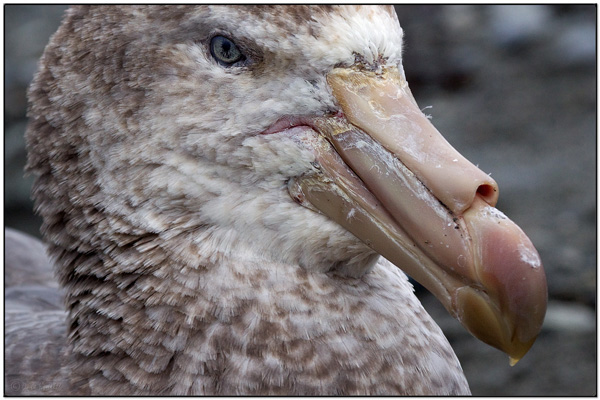
Northern Giant Petrel head close-up by Daves BirdingPix
The procellariids are the most numerous family of tubenoses, and the most diverse. They range in size from the giant petrels, which are almost as large as the albatrosses, to the prions, which are as small as the larger storm petrels. They feed on fish, squid and crustacea, with many also taking fisheries discards and carrion. All species are accomplished long-distance foragers, and many undertake long trans-equatorial migrations. They are colonial breeders, exhibiting long-term mate fidelity and site philopatry. In all species, each pair lays a single egg per breeding season. Their incubation times and chick-rearing periods are exceptionally long compared to other birds.
Many procellariids have breeding populations of over several million pairs; others number fewer than 200 birds. Humans have traditionally exploited several species of fulmar and shearwater (known as muttonbirds) for food, fuel, and bait, a practice that continues in a controlled fashion today. Several species are threatened by introduced species attacking adults and chicks in breeding colonies and by long-line fisheries.” (Wikipedia)
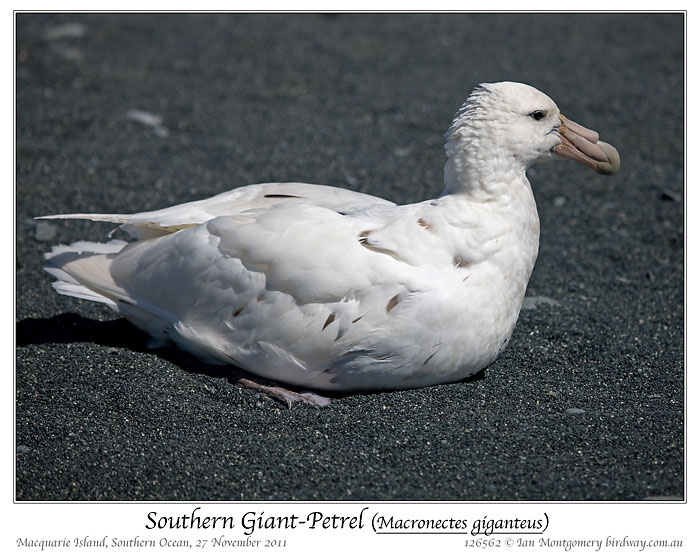
Southern Giant Petrel (Macronectes giganteus) by Ian
“Giant petrels form a genus, Macronectes, from the family Procellariidae, which consists of two species. They are the largest birds of this family. Both species are restricted to the Southern Hemisphere, and though their distributions overlap significantly, with both species breeding on the Prince Edward Islands, Crozet Islands, Kerguelen Islands, Macquarie Island and South Georgia, many southern giant petrels nest further south, with colonies as far south as Antarctica. Giant petrels are aggressive predators and scavengers, inspiring another common name, the stinker. South Sea whalers used to call them gluttons.”
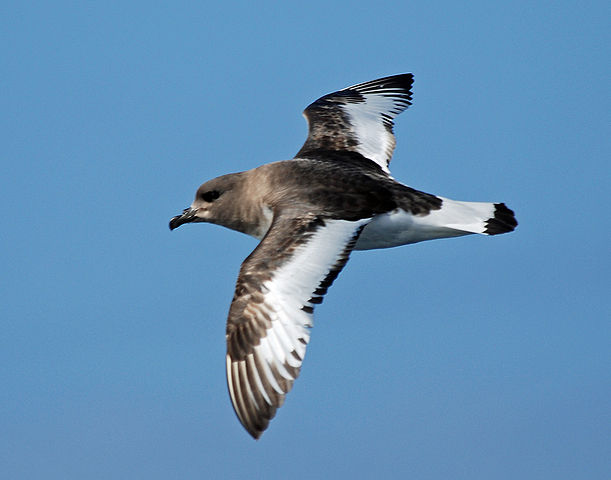
“The Antarctic petrel (Thalassoica antarctica) is a boldly marked dark brown and white petrel, found in Antarctica, most commonly in the Ross and Weddell seas. They eat Antarctic krill, fish, and small squid. They feed while swimming but can dive from both the surface and the air.”
Cape Petrel (Daption capense) by Ian
“The Cape petrel (Daption capense), also called the Cape pigeon, pintado petrel, or Cape fulmar is a common seabird of the Southern Ocean from the family Procellariidae. It is the only member of the genus Daption, and is allied to the fulmarine petrels, and the giant petrels. They are extremely common seabirds with an estimated population of around 2 million.”
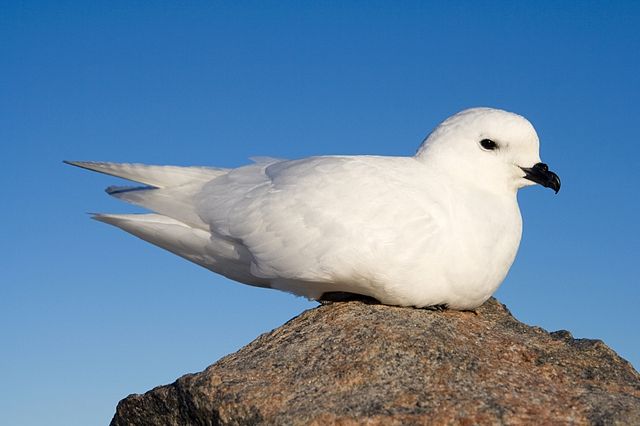
“The snow petrel (Pagodroma nivea) is the only member of the genus Pagodroma. It is one of only three birds that breed exclusively in Antarctica and has been seen at the geographic South Pole. It has the most southerly breeding distribution of any bird.
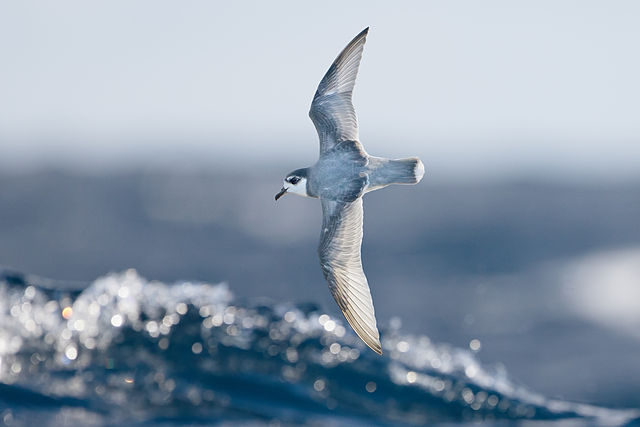
“The blue petrel (Halobaena caerulea) is a small seabird in the shearwater and petrel family Procellariidae. This small petrel is the only member of the genus Halobaena, but is closely allied to the prions.”
“Pachyptila is a genus of seabirds in the family Procellariidae and the order Procellariiformes. The members of this genus and the blue petrel form a sub-group called prions. They range throughout the southern hemisphere, often in the much cooler higher latitudes. Three species, the Broad-billed Prion (Pachyptila vittata), the Antarctic Prion (Pachyptila desolata) and the Fairy Prion (Pachyptila turtur), range into the subtropics.”
“The Kerguelen petrel (Aphrodroma brevirostris) is a small (36 cm long) slate-grey seabird. Kerguelen petrels breed colonially on remote islands; colonies are present on Gough Island in the Atlantic Ocean, and Marion Island, Prince Edward Island, Crozet Islands and Kerguelen Island in the Indian Ocean. The species attends its colonies nocturnally, breeding in burrows in wet soil. The burrows usually face away from the prevailing wind. A single egg is laid per breeding season; the egg is unusually round for the family. The egg is incubated by both parents for 49 days. After hatching the chick fledges after 60 days.”
[Quotes are from Wikipedia, with editing.]
This slideshow requires JavaScript.
*
“He alone spreads out the heavens, And treads on the waves of the sea;” (Job 9:8 NKJV)
“Wherefore she went forth out of the place where she was, and her two daughters in law with her; and they went on the way to return unto the land of Judah.” (Ruth 1:7)
“So they two went until they came to Bethlehem. And it came to pass, when they were come to Bethlehem, that all the city was moved about them, and they said, Is this Naomi? (Ruth 1:19)
“Then she arose with her daughters in law, that she might return from the country of Moab: for she had heard in the country of Moab how that the Lord had visited his people in giving them bread.” (Ruth 1:6)
“So Naomi returned, and Ruth the Moabitess, her daughter in law, with her, which returned out of the country of Moab: and they came to Bethlehem in the beginning of barley harvest.” (Ruth 1:22)
“Simon Peter saith unto them, I go a-fishing. They say unto him, We also go with thee. They went forth, and entered into a ship immediately; and that night they caught nothing. (John 21:3)
“Saying, Sir, we remember that that deceiver said, while he was yet alive, After three days I will rise again.” (Matthew 27:63 KJV)
“Now when Jesus was risen early the first day of the week, he appeared first to Mary Magdalene, out of whom he had cast seven devils. And she went and told them that had been with him, as they mourned and wept. And they, when they had heard that he was alive, and had been seen of her, believed not.” (Mark 16:9-11 KJV)
“And as they thus spake, Jesus himself stood in the midst of them, and saith unto them, Peace be unto you. But they were terrified and affrighted, and supposed that they had seen a spirit. And he said unto them, Why are ye troubled? and why do thoughts arise in your hearts? Behold my hands and my feet, that it is I myself: handle me, and see; for a spirit hath not flesh and bones, as ye see me have. And when he had thus spoken, he shewed them his hands and his feet.” (Luke 24:36-40 KJV)
“I am he that liveth, and was dead; and, behold, I am alive for evermore, Amen; and have the keys of hell and of death.” (Revelation 1:18 KJV)
We trust you are celebrating the resurrection of Our Lord today. The Lord Jesus Christ’s ability to raise Himself from death could only happen because He, the Son of Man, was also the Son of God incarnate. He came to die for our sins by paying the ransom, and through His resurrection, we can have eternal life with God the Father, God the Son, and God the Holy Spirit.
“For God so loved the world, that he gave his only begotten Son, that whosoever believeth in him should not perish, but have everlasting life. For God sent not his Son into the world to condemn the world; but that the world through him might be saved. He that believeth on him is not condemned: but he that believeth not is condemned already, because he hath not believed in the name of the only begotten Son of God. And this is the condemnation, that light is come into the world, and men loved darkness rather than light, because their deeds were evil. For every one that doeth evil hateth the light, neither cometh to the light, lest his deeds should be reproved. But he that doeth truth cometh to the light, that his deeds may be made manifest, that they are wrought in God.” (John 3:16-21 KJV)
“This is he that came by water and blood, even Jesus Christ; not by water only, but by water and blood. And it is the Spirit that beareth witness, because the Spirit is truth. For there are three that bear record in heaven, the Father, the Word, and the Holy Ghost: and these three are one.” (1 John 5:6-7 KJV)
Lord Bless you as you reflect on what this day really represents. It is not about colored eggs, bunnies, or baskets of goodies. It is about God, in the person of Jesus Christ, coming in human form, totally man without sin. He came to die for you and me as payment for our sins. It’s a gift. A very costly gift. We all have a choice to receive this gift or to refuse it. It is up to us. Thankfully, I accepted that Gift of Salvation, 57 years ago on March 20th of 1960.







 Lee's Birdwatching Adventures Plus