***

UPON THE FIRST DAY OF THE WEEK
***
“Upon the first day of the week let every one of you lay by him in store, as God hath prospered him, that there be no gatherings when I come.” (1 Corinthians 16:2 KJV)
Osprey Eating – Viera Wetlands by Dan
*
*
“Upon the first day of the week let every one of you lay by him in store, as God hath prospered him, that there be no gatherings when I come.” (1 Corinthians 16:2 KJV)
Osprey Eating – Viera Wetlands by Dan
*
*
“And it came to pass, that at even the quails came up, and covered the camp: and in the morning the dew lay round about the host.” (Exodus 16:13 KJV)
As we continue our journey through the Phasianidae Family of Pheasants and Allies, our next encounter is with more Partridges and Quails.

Grey Partridge (Perdix perdix) ©WikiC
The Perdix genus has the Grey Partridge, Daurian Partridge, and the Tibetan Partridges. Perdix is a genus of Galliform gamebirds known collectively as the ‘true partridges’. The genus name is the Latin for “partridge”, and is itself derived from Ancient Greek perdix. These birds are unrelated to the subtropical species that have been named after the partridge due to similar size and morphology. There are representatives of Perdix in most of temperate Europe and Asia. One member of the genus, the grey partridge, has been introduced to the United States and Canada for the purpose of hunting. They are closely related to grouse, koklass, quail and pheasants.
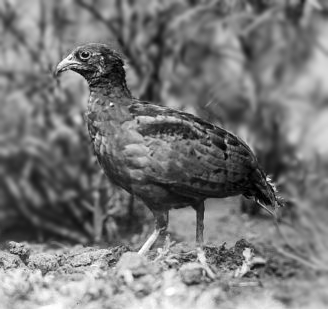
Long-billed Partridge (Rhizothera longirostris) ©WikiC
Long-billed Partridge and Hose’s Partridge belong to the Rhizothera genus. Rhizothera is a genus of bird native to Malaysia. Established by George Robert Gray in 1841.

Madagascar Partridge (Margaroperdix madagarensis) ©Drawing WikiC
Madagascan Partridge (Margaroperdix madagarensis) found only in Madagascar. Its natural habitats are subtropical or tropical moist lowland forests and subtropical or tropical moist montane forests.

Black Partridge are in genus Melanoperdix. The black partridge occurs in lowland rainforests of Peninsular Malaysia, Borneo and Sumatra in southeast Asia. It was formerly found but is long extinct on Singapore. The female usually lays five to six white eggs.

Harlequin Quail (Coturnix delegorguei) ©WikiC
The Coturnix genus has seven Quail including the Common, Japanese, Rain, Harlequin, Stubble, New Zealand and the Brown Quails.

King Quail (Excalfactoria chinensis) by Kent Nickel
The King Quail and Blue Quail are in the Excalfactoria genus.
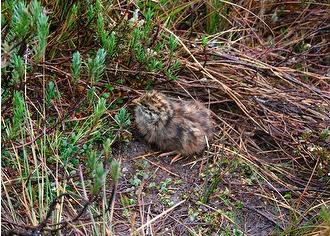
Snow Mountain Quail (Anurophasis monorthonyx) ©WikiC
The Snow Mountain Quail (Anurophasis monorthonyx) is the only one in its genus.

Painted Bush Quail (Perdicula erythrorhyncha) ©WikiC
Perdicula is made up of the Jungle Bush Quail, Rock Bush Quail, Painted Bush Quail, and the Manipur Bush Quail.
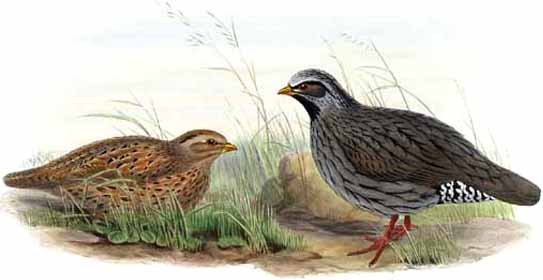
Himalayan Quail (Ophrysia superciliosa †) ©Drawing WikiC
Himalayan Quail (Ophrysia superciliosa) is another loner.
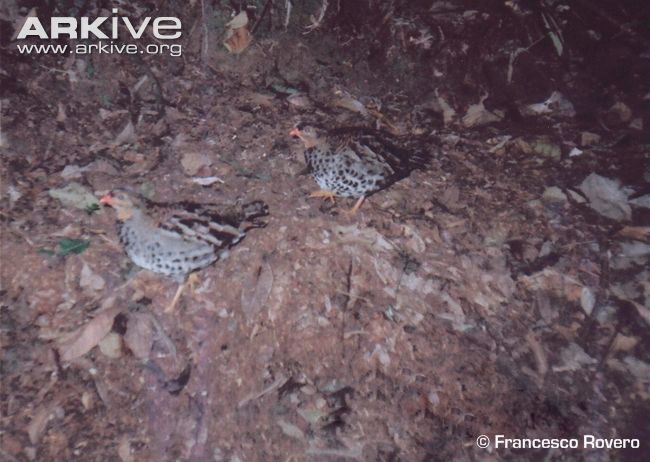
Udzungwa Forest Partridge (Xenoperdix udzungwensis) ©ARKive
The two Forest Partridges are the Udzungwa Forest Partridge and the Rubeho Forest Partridge (Xenoperdix). Both species have boldly barred plumage and a red bill. Xenoperdix are found only in forests of the Udzungwa Mountains and the Rubeho Highlands of Tanzania.
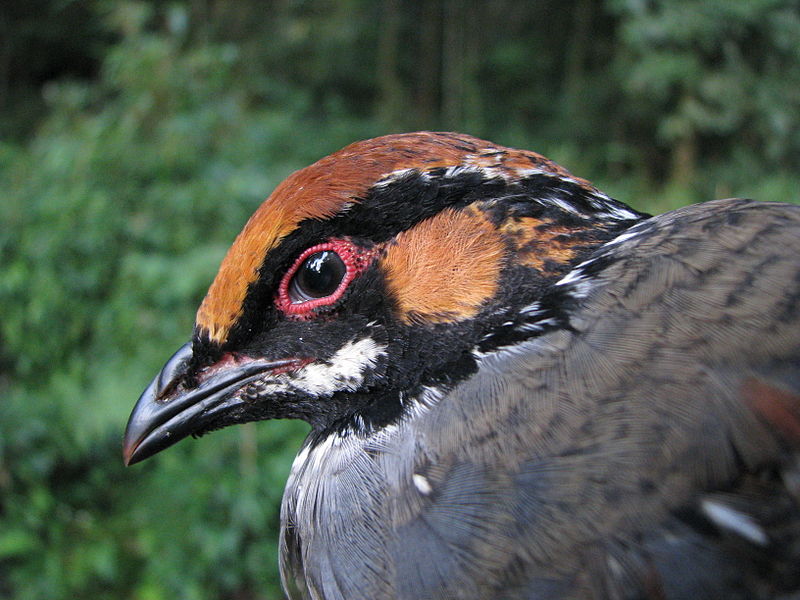
Hill Partridge (Arborophila torqueola) ©WikiC
The largest genus today are Partridges in the Arborophila group. They are the Hill, Rufous-throated, White-cheeked, Taiwan Partridge, Chestnut-breasted, Bar-backed, Sichuan, White-necklaced, Orange-necked, Chestnut-headed, Siamese, Malaysian, Roll’s, Sumatran, Grey-breasted, Chestnut-bellied, Red-billed, Red-breasted, Hainan Partridge, Chestnut-necklaced , and the Green-legged Partridge. The genus has the second most members within the Galliformes after Francolinus although Arborophila species vary very little in bodily proportions with different species varying only in colouration/patterning and overall size. These are fairly small, often brightly marked partridges found in forests of eastern and southern Asia
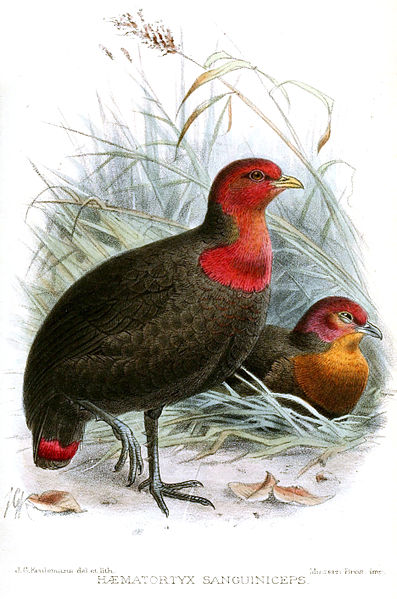
Crimson-headed Partridge (Haematortyx sanguiniceps) ©Drawing WikiC
There are three more genera with only one bird; Ferruginous Partridge (Caloperdix oculeus), Crimson-headed Partridge (Haematortyx sanguiniceps), and the Crested Partridge (Rollulus rouloul.
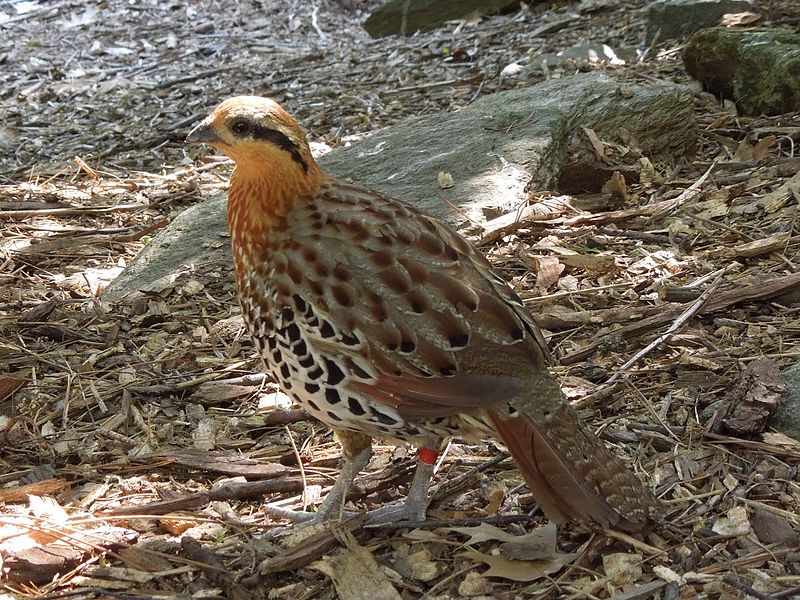
Mountain Bamboo Partridge (Bambusicola fytchii) ©WikiC at National Zoo
We finish off this week’s Avian Wonders from the Lord with the Bambusicola genus with the Mountain Bamboo Partridge, Chinese Bamboo Partridge, and the Taiwan Bamboo Partridge.
“And, Thou, Lord, in the beginning hast laid the foundation of the earth; and the heavens are the works of thine hands:” (Hebrews 1:10 KJV)
“God’s Still In Control” ~ ©Hyssongs
*
Sunday Inspiration – Pheasants and Allies I
Sunday Inspiration – Pheasants and Allies II
Sunday Inspiration – Pheasants and Allies III
Pheasants and allies – Phasianidae
Assurance: The Certainty of Salvation
*
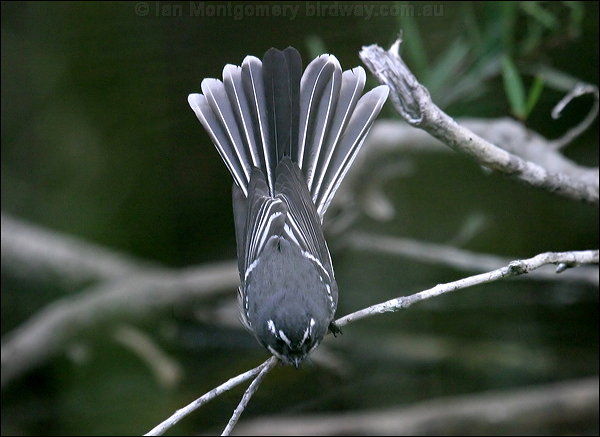
“Whose fan is in his hand, and he will throughly purge his floor, and gather his wheat into the garner; but he will burn up the chaff with unquenchable fire.
(Matthew 3:12 KJV)
Grey Fantail (Rhipidura fuliginosa) by Ian
[In this bird, his fan is in his tail.]
*
*
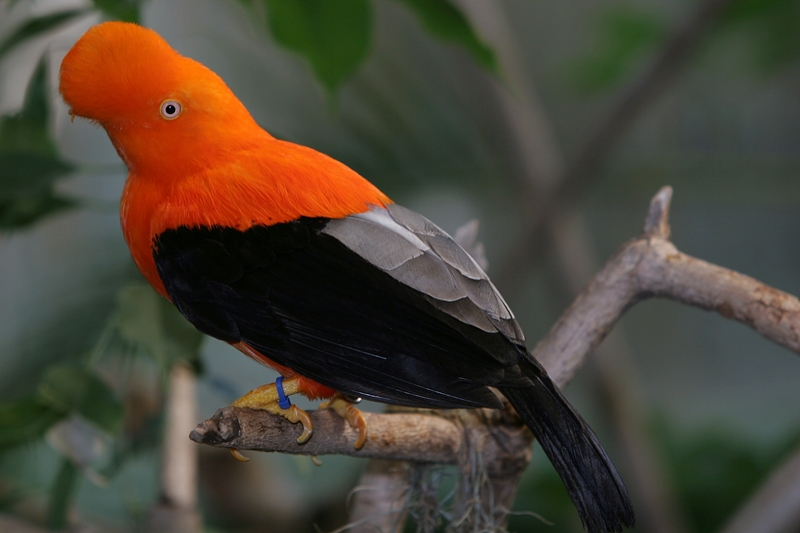
“LORD, by thy favour thou hast made my mountain to stand strong: thou didst hide thy face, and I was troubled.” (Psalms 30:7 KJV)
Andean Cock-of-the-rock (Rupicola peruvianus) by SanDiegoZoo
*
*

“Yea, the sparrow hath found an house, and the swallow a nest for herself, where she may lay her young, even thine altars, O LORD of hosts, my King, and my God.” (Psalms 84:3 KJV)
Barn Swallow by Dan Taken in a cabin in Smokies
*
*
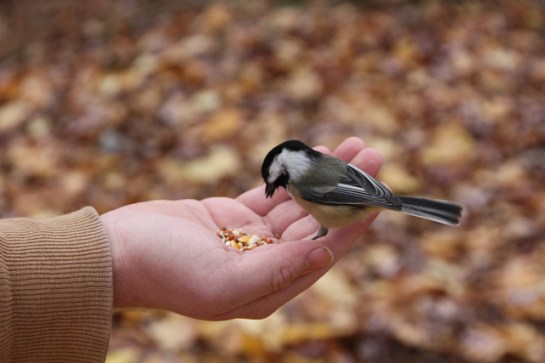
“Withhold not good from them to whom it is due, when it is in the power of thine hand to do it.” (Proverbs 3:27 KJV)
Chickadee Eating From Hand ©Flickr Ted Sakshaug
*
*

“For thou art my hope, O Lord GOD: thou art my trust from my youth.” (Psalms 71:5 KJV)
Painted Spurfowl (Galloperdix lunulata) by Nikhil Devasar
*
*
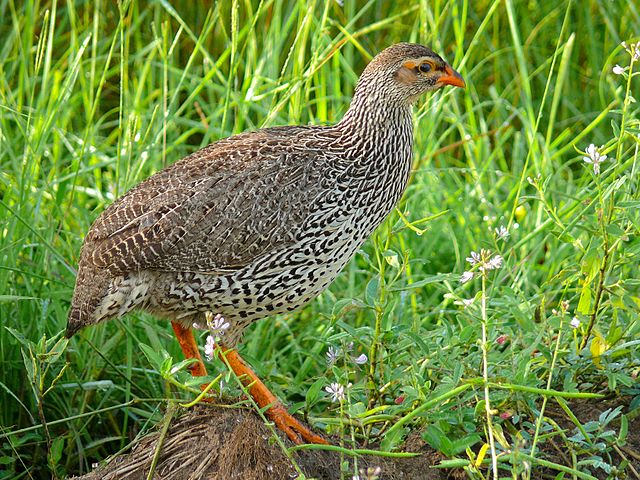
“If my step hath turned out of the way, and mine heart walked after mine eyes, and if any blot hath cleaved to mine hands;” (Job 31:7 KJV)
Heuglin’s Francolin (Pternistis icterorhynchus) ©WikiC
*
*

“And white robes were given unto every one of them; and it was said unto them, that they should rest yet for a little season, until their fellow-servants also and their brethren, that should be killed as they were, should be fulfilled.” (Revelation 6:11)
Name and Credit for Bird Photo ©AllAboutBirds – DR Franz
*
*
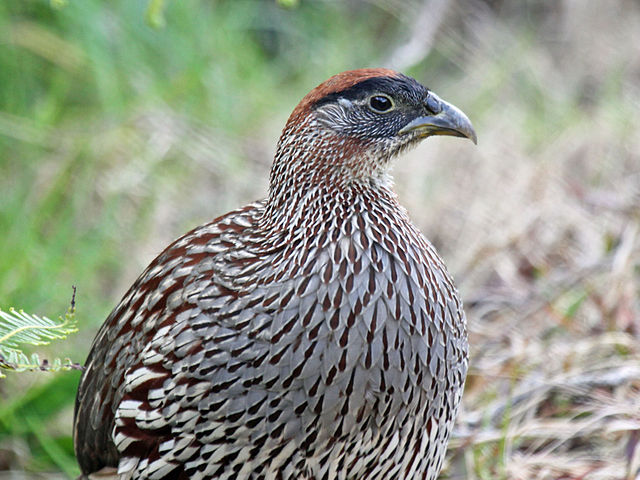
Erckel’s Francolin (Pternistis erckelii) ©WikiC
“Of fowls also of the air by sevens, the male and the female; to keep seed alive upon the face of all the earth.” (Genesis 7:3 KJV)
This Sunday’s section of the Pheasants and allies – Phasianidae Family has 32 Francolins and 8 Spurfowl contained in 5 genera.
“Francolins are birds that traditionally have been placed in the genus Francolinus, but now commonly are divided into multiple genera (see Taxonomy), although some of the major taxonomic listing sources have yet to divide them. The francolins’ closest relatives are the junglefowl, long-billed partridge, Alectoris and Coturnix. Together this monophyletic clade may warrant family status as the Gallusinidae.
When all are maintained in a single genus, it is the most diverse of the Galliformes, having by far the most members. Francolins are terrestrial (though not flightless) birds that feed on insects, vegetable matter and seeds. Most of the members have a hooked upper beak, well-suited for digging at the bases of grass tussocks and rootballs. They have wide tails with fourteen retrice feathers. Most species exhibit spurs on the tarsi.”
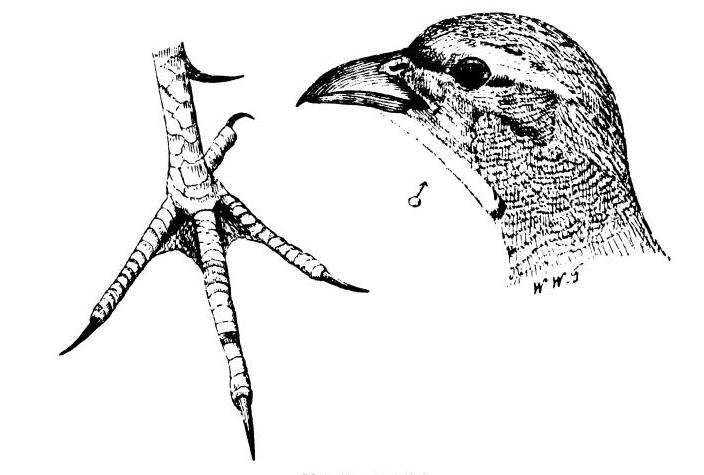
Grey Francolin (Francolinus pondicerianus) ©WikiC Spurs of the male
“Of the approximately 40 living species, the natural range of five (comprising the genus Francolinus) are restricted to Asia, while the remaining genera are restricted to Africa. Several species have been introduced to other parts of the world, notably Hawaii.” (Wikipedia, with editing)
The Francolinus genre is: Black Francolin (Francolinus francolinus), Painted Francolin (Francolinus pictus), Chinese Francolin (Francolinus pintadeanus), Grey Francolin (Francolinus pondicerianus), and the Swamp Francolin (Francolinus gularis).
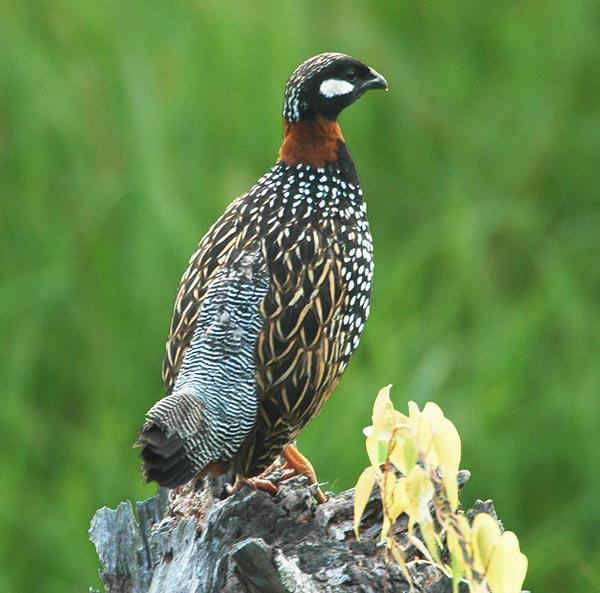
Black Francolin (Francolinus francolinus) by Nikhil Devasar
The four Peliperdix species are the Latham’s Francolin (Peliperdix lathami), Coqui Francolin (Peliperdix coqui), White-throated Francolin (Peliperdix albogularis), and the Schlegel’s Francolin (Peliperdix schlegelii)
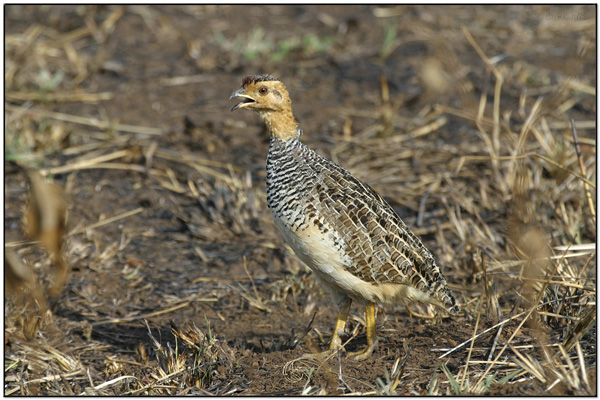
Coqui Francolin (Peliperdix coqui) by Dave’s BirdingPix
The next seven belong in the Scleroptila genre. The Ring-necked Francolin (Scleroptila streptophora), Grey-winged Francolin (Scleroptila afra), Red-winged Francolin (Scleroptila levaillantii),
Finsch’s Francolin (Scleroptila finschi), Shelley’s Francolin (Scleroptila shelleyi), Moorland Francolin (Scleroptila psilolaema), and the Orange River Francolin (Scleroptila gutturalis).
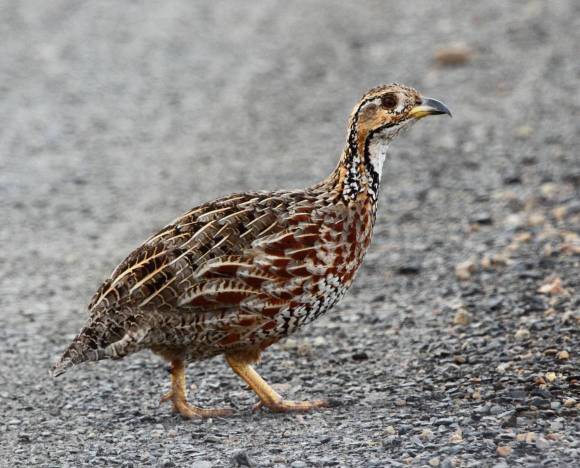
Shelley’s Francolin (Scleroptila shelleyi) ©WikiC
The lone Crested Francolin (Dendroperdix sephaena) is the one in its genre.
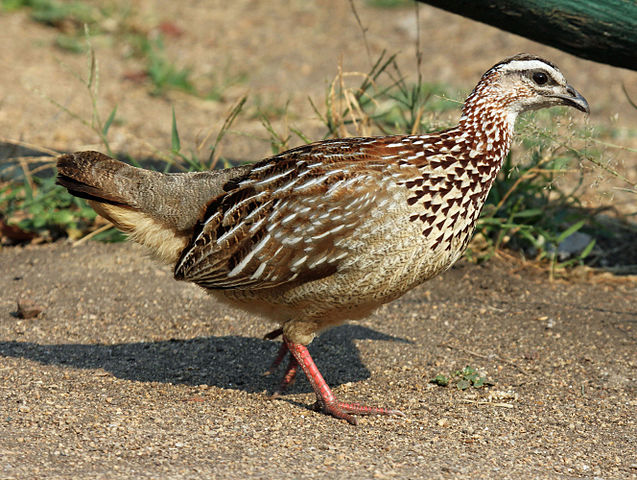
Crested Francolin (Dendroperdix sephaena) ©WikiC
The Pternistis has two names of birds in its genera. The Francolins and the Spurfowls. ” Its 23 species range through Sub-Saharan Africa. They are commonly known as francolins or spurfowl but are closely related to jungle bush quail, Alectoris rock partridges and Coturnix quail. The species are strictly monogamous, remaining mated indefinitely. They procure most of their food by digging. Partridge-francolins subsist almost entirely on roots, beans of leguminous shrubs and trees, tubers, seed, feasting opportunistically on termites, ants, locusts, flowers and fruit.
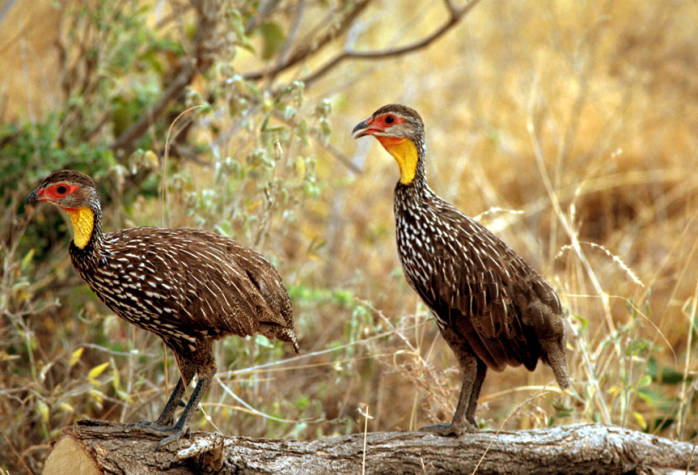
Yellow-necked Spurfowl (Pternistis leucoscepus) ©USFWS
Scaly Francolin (Pternistis squamatus), Ahanta Francolin (Pternistis ahantensis), Grey-striped Francolin (Pternistis griseostriatus), Hildebrandt’s Francolin (Pternistis hildebrandti), Double-spurred Francolin (Pternistis bicalcaratus), Heuglin’s Francolin (Pternistis icterorhynchus), Clapperton’s Francolin (Pternistis clappertoni), Harwood’s Francolin (Pternistis harwoodi), Swierstra’s Francolin (Pternistis swierstrai), Mount Cameroon Francolin (Pternistis camerunensis), Handsome Francolin (Pternistis nobilis), Jackson’s Francolin (Pternistis jacksoni), Chestnut-naped Francolin (Pternistis castaneicollis), Djibouti Francolin (Pternistis ochropectus), Erckel’s Francolin (Pternistis erckelii), Hartlaub’s Spurfowl (Pternistis hartlaubi), Red-billed Spurfowl (Pternistis adspersus), Cape Spurfowl (Pternistis capensis), Natal Spurfowl (Pternistis natalensis), Yellow-necked Spurfowl (Pternistis leucoscepus), Grey-breasted Spurfowl (Pternistis rufopictus), Red-necked Spurfowl (Pternistis afer), and Swainson’s Spurfowl (Pternistis swainsonii).
“I know all the fowls of the mountains: and the wild beasts of the field are mine.” (Psalms 50:11 KJV)
“Hiding in the Shadow of the Rock” ~ Dr. Richard Gregory
*
Sunday Inspiration – Pheasants and Allies I
Sunday Inspiration – Pheasants and Allies II
Pheasants and allies – Phasianidae
*
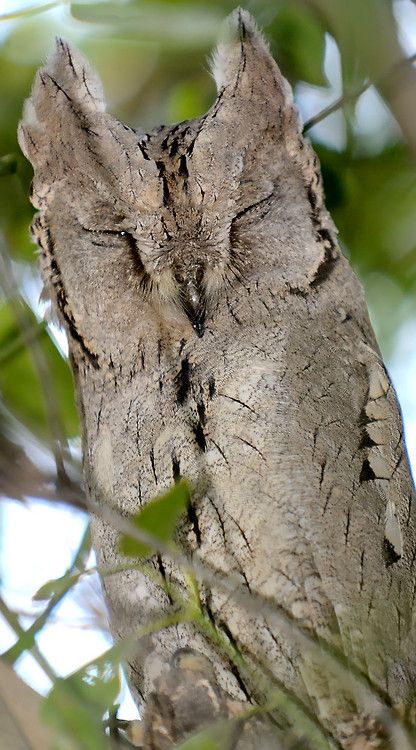
“And there sat in a window a certain young man named Eutychus, being fallen into a deep sleep; and as Paul was long preaching, he sunk down with sleep, and fell down from the third loft, and was taken up dead.” (Acts 20:9)
Napping Pallid Scops Owl by Yogesh Bhandarkar From Pinterest
*
*

“A froward man soweth strife: and a whisperer separateth chief friends. (Proverbs 16:28)
Peach-faced Lovebird, shot in Shanghai Zoo (Whispering Lovebirds) ©Feng Wei
*
*
 Lee's Birdwatching Adventures Plus