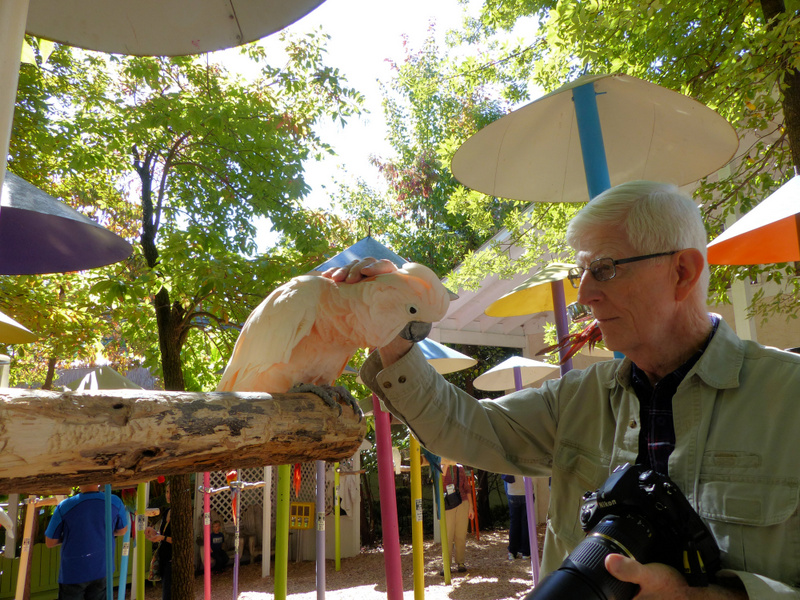
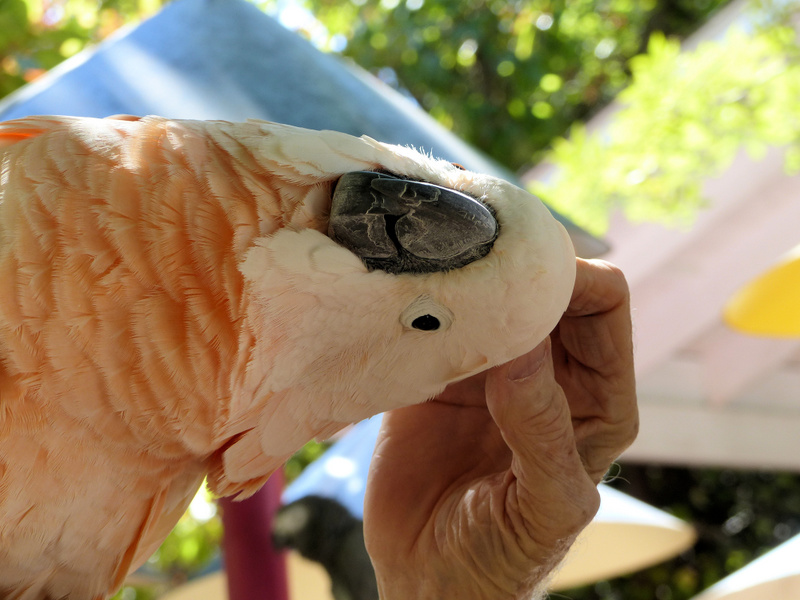
Salmon-crested Cockatoo (Cacatua moluccensis) at Parrot Mtn by Lee
As the fire burneth a wood, and as the flame setteth the mountains on fire; (Psalms 83:14 KJV)
As you may recall, Dan and I visited the Parrot Mountain and Garden of Eden in Gatlinburg, Tennessee this summer. There have been devastating fires up in the mountains in that area due to severe drought conditions. Many places have been destroyed in the Gatlingburg surrounding area. Dollywood, who has quite a collection of Eagles and Parrot Mountain with their Parrots were to close for comfort, but the Lord has been good to them and their keepers.
Salmon-crested Cockatoo (Cacatua moluccensis) at Parrot Mtn by Lee
“I know all the fowls of the mountains: and the wild beasts of the field are mine.” (Psalms 50:11 KJV)
Parrot mountain was not affected by the fires! All the birds are safe and secure! God was watching over Parrot mountain. We pray for all those who were affected by the fires. Thank you all for your concerns ! We appreciate you all and love you guys. #PrayForGatlinburg
“And ye shall take you on the first day the boughs of goodly trees, branches of palm trees, and the boughs of thick trees, and willows of the brook; and ye shall rejoice before the Lord your God seven days.” (Leviticus 23:40)
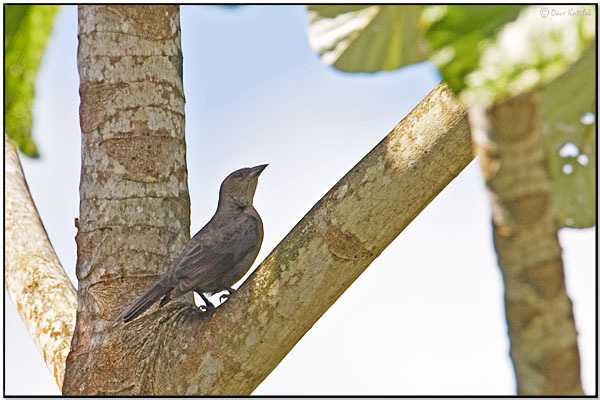
Puerto Rican Tanager (Nesospingus speculiferus) by Daves BirdingPix
“It shall be unto you a sabbath of rest, and ye shall afflict your souls: in the ninth day of the month at even,from evening unto evening, shall ye celebrate your sabbath.” (Leviticus 23:32)
“If a bird’s nest chance to be before thee in the way in any tree, or on the ground, whether they be young ones, or eggs, and the dam sitting upon the young, or upon the eggs, thou shalt not take the dam with the young:” (Deuteronomy 22:6 KJV)
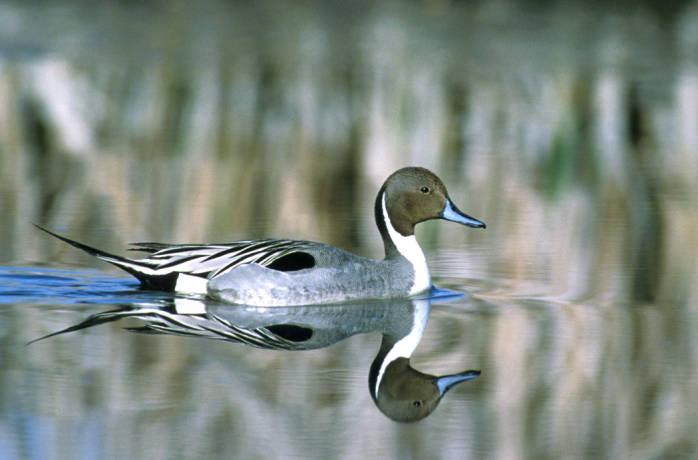
Today’s group of members from the “Ducks Plus” family, the Anatidae, are all from one Genus. The Anas according to Wikionary is: ” A taxonomic genus within the family Anatidae – various species of dabbling duck. These are probably the most common group of ducks many of us see. The genus name is the Latin for “duck”. It includes mallards, wigeons, teals, pintails and shovelers in a number of subgenera. “Dabbling” is where the duck upends itself to feed. They feed mainly on water plants, which they obtain by tipping-up in shallows—uncommonly by diving (with opened wings); they often forage near the shore for seeds and insects. The bill is flat and broad, the hindtoe unlobed. Dabbling ducks float high in the water and are swift fliers, leaping upward on noisy wings before attaining level flight, usually in compact flocks.
The mallard (/ˈmælɑːrd/ or /ˈmælərd/) or wild duck (Anas platyrhynchos) is a dabbling duck which breeds throughout the temperate and subtropical Americas, Europe, Asia, and North Africa, and has been introduced to New Zealand, Australia, Peru, Brazil, Uruguay, Argentina, Chile, the Falkland Islands and South Africa. This duck belongs to the subfamily Anatinae of the waterfowl family Anatidae.
The male birds (drakes) have a glossy green head and are grey on wings and belly, while the females (hens or ducks) have mainly brown-speckled plumage. Both sexes have an area of white-bordered black speculum feathers which commonly also include iridescent blue feathers especially among males. Mallards live in wetlands, eat water plants and small animals, and are social animals preferring to congregate in groups or flocks of varying sizes. This species is the main ancestor of most breeds of domesticated ducks. I personally think that this duck, the Mallard, was on board the Ark. He seems to have obey the command to:
“Go forth of the ark, thou, and thy wife, and thy sons, and thy sons’ wives with thee. Bring forth with thee every living thing that is with thee, of all flesh, both of fowl, and of cattle, and of every creeping thing that creepeth upon the earth; that they may breed abundantly in the earth, and be fruitful, and multiply upon the earth.” (Genesis 8:16-17 KJV)
The mallard was one of the many bird species originally described by Carl Linnaeus in his 18th-century work Systema Naturae, and still bears its original binomial name. The scientific name is from Latin Anas, “duck” and Ancient Greek platyrhynchus , “broad-billed” ( from platus, “broad” and rhunkhos, ” bill”).
But the Mallard is not the only duck in this genus, Anas. There are 48 others. As mentioned, much interbreeding has taken place, and eventually these were raised to species status. After showing you the Wood Ducks last week, their is another beauty from the Lord in this week’s group.
We have seen this Teal, but not in that breeding outfit.
Baikal Teal (Anas formosa) Zoo Miami by Lee
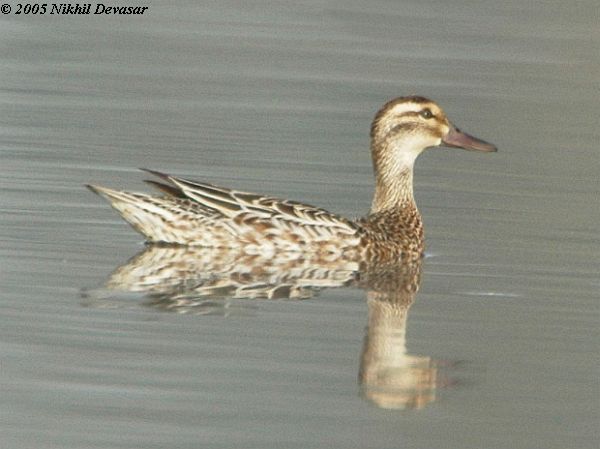
Unfortunately this genus contains “some of the world’s finest game birds: the black duck(Anas rubripes), much sought after by hunters; the mallard; the gadwall(Anas strepera); the garganey (A. querquedula); the pintail (A. acuta), perhaps the world’s most abundant waterfowl; the shoveler (Anas, or Spatula, clypeata), the “spoonbill” of hunters; the teals, races of Anas crecca and other species; the wigeons, Anas, or Mareca, americana and A.,or M., penelope. (Enclopeaedia Britannica) As you all know, I am a birdwatcher/photographer, not a hunter. I realize hunter organizations do much to maintain hunting areas and prevent over-hunting. That is a good thing, but not my “cup of tea.”
Here is a of each by last name:
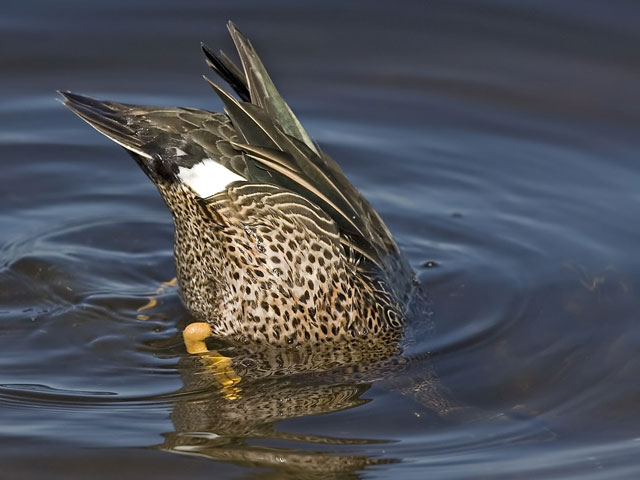
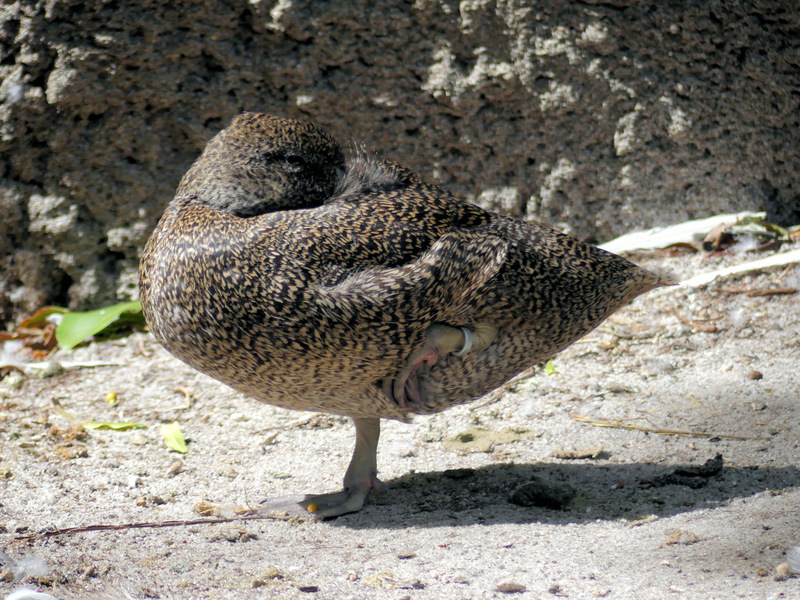
Tealsdo not totally submerge when feeding and are often seen with just their rears showing as the search for food. Because of their feeding method, teals are more buoyant than diving ducks.
The gadwall is a quieter duck, except during its courtship display.
Gadwall (Anas strepera)
*
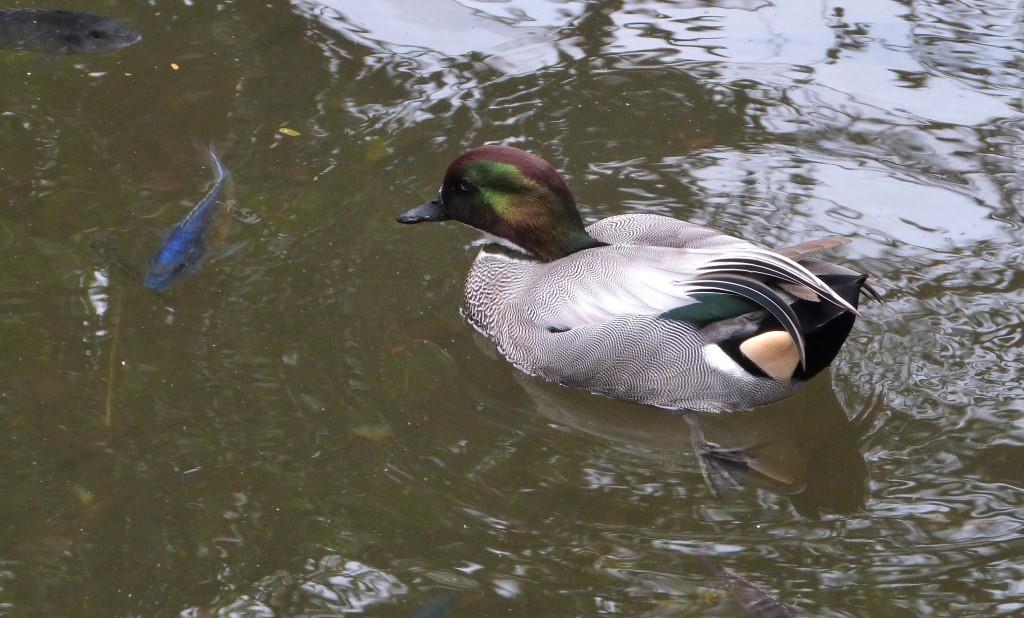
Falcated Duck (Anas falcata) at Wings of Asia by Lee
Ducks are mostly aquatic birds, mostly smaller than the swans and geese, and may be found in both fresh water and sea water.
Falcated Duck (Anas falcata), African Black Duck (Anas sparsa), American Black Duck (Anas rubripes), Mottled Duck (Anas fulvigula), Mexican Duck (Anas diazi), Hawaiian Duck (Anas wyvilliana), Laysan Duck (Anas laysanensis), Philippine Duck (Anas luzonica), Pacific Black Duck (Anas superciliosa), Indian Spot-billed Duck (Anas poecilorhyncha), Eastern Spot-billed Duck (Anas zonorhyncha), Yellow-billed Duck (Anas undulata), Meller’s Duck (Anas melleri)
*
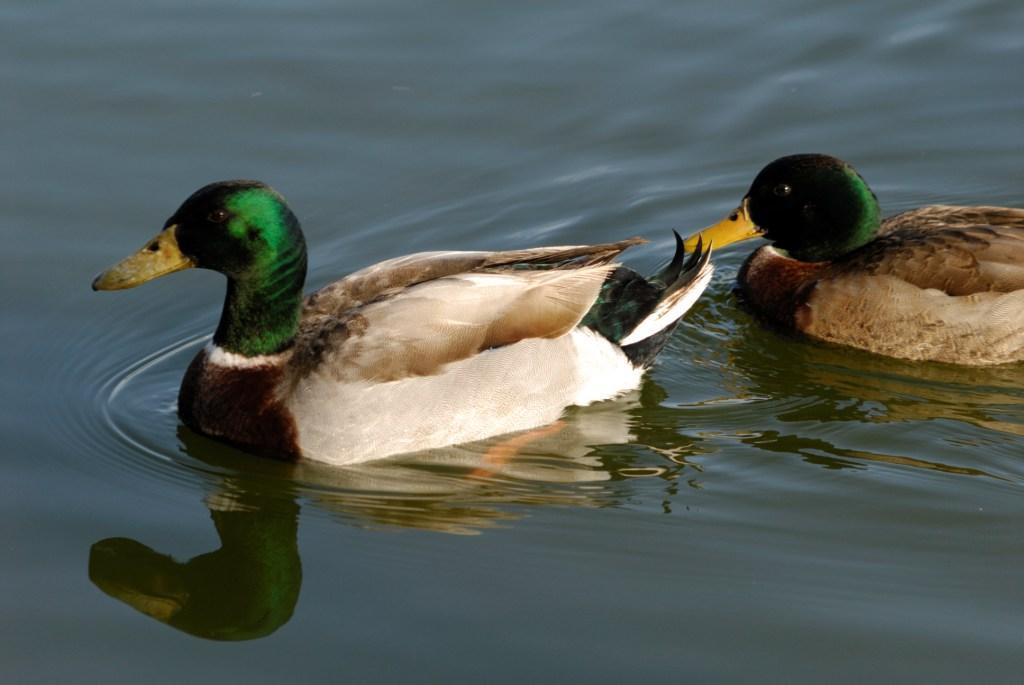
Mallards by Dan
The male mallards (drakes) have a glossy green head and are grey on wings and belly, while the females (hens or ducks) have mainly brown-speckled plumage.
Mallard (Anas platyrhynchos)
*
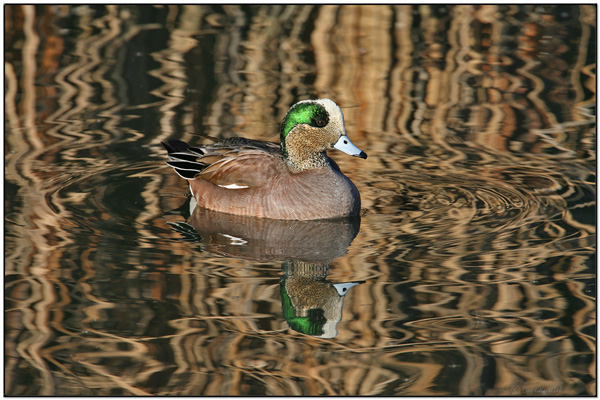
American Wigeon (Anas americana) by Daves BirdingPix
The wigeons are similarly shaped, with a steep forehead and bulbous rear to the head.
*
“And the sea arose by reason of a great wind that blew. So when they had rowed about five and twenty or thirty furlongs, they see Jesus walking on the sea, and drawing nigh unto the ship: and they were afraid. But he saith unto them, It is I; be not afraid.” (John 6:18-20 KJV)
“Ship Ahoy”~ from “Great is Thy Faithfulness” by Dr. Richard Gregory
“And when ye reap the harvest of your land, thou shalt not make clean riddance of the corners of thy field when thou reapest, neither shalt thou gather any gleaning of thy harvest: thou shalt leave them unto the poor, and to the stranger: I am the Lord your God.” (Leviticus 23:22)
“Also in the fifteenth day of the seventh month, when ye have gathered in the fruit of the land, ye shall keep a feast unto the Lord seven days: on the first day shall be a sabbath, and on the eighth day shall be a sabbath. (Leviticus 23:39)
“Enter into his gates with thanksgiving, and into his courts with praise: be thankful unto him, and bless his name. For the LORD is good; his mercy is everlasting; and his truth endureth to all generations.” (Psalms 100:4-5 KJV)
Our writer here, James J. S. Johnson, has his own blog, over at RockDoveBlog. I thought his Thanksgiving post is so interesting, that I am sharing it with you here:
Who Supplied the Food for the First Thanksgiving?
James J. S. Johnson
And that ye study to be quiet, and to do your own business, and to work with your own hands, as we commanded you; 12 That ye may walk honestly toward them that are without [outside], and that ye may have lack of nothing. (1st Thessalonians 4:11-12)
Let him that stole steal no more: but rather let him labor, working with his hands the thing which is good, that he may have to give to him that needeth. (Ephesians 4:28)
Recently my happy-hearted 5-year-old grandson was taught a little Thanksgiving song, in kindergarten. It was a catchy tune, yet some lyrics contained a PC (i.e., politically corrupt) “gotcha”. The little ditty went something like this:
The Indians brought the food; the Pilgrims set up the table…
Of course, I chose not to admonish my enthusiastic grandson that the little chorus was historically twisted – revisionist “history” in song – giving the impression that the Pilgrims were just invasive “takers”, as if the Indian natives alone provided all the food eaten during the first Thanksgiving in Plymouth. But it bugged me (and it continues to bug me) that trusting kindergartners are misled into believing…… [Read the rest of this blog]
*
Happy Thanksgiving From All of Us Here At Lee’s Birdwatching!!!







 Lee's Birdwatching Adventures Plus