—
454 Forestry Road, Bluewater, Qld 4818
Phone: 0411 602 737 +61-411 602 737
Preferred Email: ian@birdway.com.au
Lee’s Addition:
—
Lee’s Addition:
Here we go again with another anniversary of the blog. Around February 13th or so, was the 12 anniversary of Lee’s Birdwatching Adventures Plus. During this year, we hit the two million visitor mark. Wow!
Looking at all the articles written about the 11th anniversary, I’ll let this one be simple. I just reread all the comments and encouragement that you sent last year. Those were and are again so appreciated. Now, the blog has slowed down some, but we are still blogging. Because of health and our new house, most of my birding adventures seem to be out my back door. I love the avian visitors!
This year, William Wise has joined us with some very interesting articles and photos. Welcome Aboard, William!! Dr. Jim has continued to contribute articles, which are always enjoyable. Ian Montgomery is still sending posts, and Emma Forster continues to enlighten us with her stories. Me, I’ve written less, but we are still at it.
The Lord is always faithful and keeps us interested in His Creation.
Stay tuned to see what this new year of blogging will discover about our Avian Wonders from the Lord.
(9) For you know the grace of our Lord Jesus Christ, that though He was rich, yet for your sakes He became poor, that you through His poverty might become rich.
(10) And in this I give advice: It is to your advantage not only to be doing what you began and were desiring to do a year ago;
(11) but now you also must complete the doing of it; that as there was a readiness to desire it, so there also may be a completion out of what you have.
(12) For if there is first a willing mind, it is accepted according to what one has, and not according to what he does not have. (2 Corinthians 8:9-12 NKJV)
Lee’s Addition:
“While the earth remaineth, seedtime and harvest, and cold and heat, and summer and winter, and day and night shall not cease.” (Genesis 8:22 KJV)
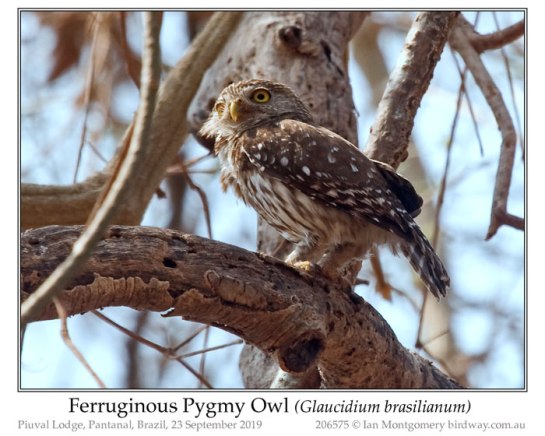
There weren’t any owls on our must-see lists for Brazil and Chile because we weren’t particularly expecting to see any. However, we ended up seeing two species at opposite ends of the size scale: the largest Brazilian owl, Great Horned Owl, and one of the smallest, the Ferruginous Pygmy Owl.
The Great Horned Owl – splendidly named the Grand-duc d’Amérique in French – is seriously big, with females, larger than males, being up to 60cm/24in in length, 1.5kg/53oz in weight, with a wing span of up to 1.5m/5ft. The Ferruginous Pygmy Owl, by comparison tiny with the (smaller) males being as short as 15cm/6in, as light as 46g/1.6oz with an average wing span of 38cm/15in.

Great Horned Owls feed mainly on mammals but are versatile and will take birds from small passerines up to geese and Great Blue Herons. Ferruginous Pygmy Owls are also versatile, make up for their small size by being quite aggressive and taking anything from insects to birds much bigger than themselves.

Their versatile diets mean both species are very adaptable and have huge ranges in the Americas. The range of the Great Horned Owl extends from Alaska and northern Canada through Central and South America as far as northern Argentina, though it sizes restricts it to hunting in open areas and it avoids rainforests such as the Amazon Basin.
The Ferruginous Pygmy Owl ranges from southern Arizona through Central America and most of South America east of the Andes (including the Amazon Basin), also as far as northern Argentina. Both incidentally illustrate the taxonomic folly of using geographical areas in names, the specific name of one referring to the American state of Virginia, and the other to Brazil.

You probably know by now that I’m attracted to symbols, hence the owls. I couldn’t resist using avian symbols of wisdom as we celebrate the beginning of a new year and a new decade. The last decade seems to have been singularly lacking in wisdom in politics and leadership, and I hope for better in the twenties. At the same time we need to be optimistic and not lose our sense of fun, so I’m sharing the experience Trish and I enjoyed of watching Peruvian Pelicans on the coast of Chile – another lesson in names – apparently enjoying skimming over the waves in the late afternoon.
On the subject of wisdom, I read an article on the (Australian) ABC website today on whether the decade actually starts on the first of January 2020 or 2021. At the start of the millennium I was one of the pedants who felt it started in 2001, but I’ve shifted my ground. I like this quote from a comment on the article by Professor Hans Noel:
“Knowledge is knowing that there was no year 0 so technically the new decade begins Jan 1 2021, not 2020.
“Wisdom is knowing that we started this system in the middle, it’s socially constructed anyway, and it feels right to treat ‘1 to 10’ as a decade, so that’s what we do.”
The ABC Language researcher Tiger Webb had the final word:
“What’s often missing from this discussion is that all calendrical systems are abstractions of human arrogance in the face of an indifferent universe.”
So have a wisdom- and fun-filled 2020 and decade!
Ian
Lee’s Addition:
Well, now there is an interesting take on this new year.
I do know that according to the Bible, there was a year zero (0):
“For in six days the LORD made heaven and earth, the sea, and all that in them is, and rested the seventh day: wherefore the LORD blessed the sabbath day, and hallowed it.”
(Exodus 20:11 KJV)
That was when TIME as we know it began.
“Go to now, ye that say, To day or to morrow we will go into such a city, and continue there a year, and buy and sell, and get gain: Whereas ye know not what shall be on the morrow. For what is your life? It is even a vapour, that appeareth for a little time, and then vanisheth away. For that ye ought to say, If the Lord will, we shall live, and do this, or that.” (James 4:13-15 KJV)
Like Ian, Happy New Year.
Well the moment is almost Christmas, so an iconic bird, or at least an iconic looking bird, is obligatory. Traditional Christmas icons such as european robins and snow flakes stubbornly persist in Australia despite the summer heat, but I have managed to find a red-breasted bird with a little real snow in the southern hemisphere. Those little white flecks in this photo are tiny snow flakes.

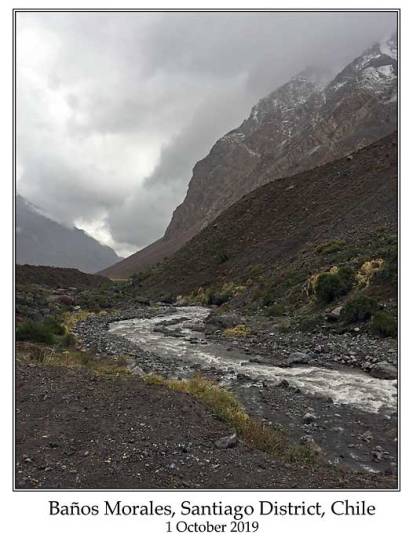
We spent out last full – and coldest – day in Chile at a place called Baños Morales at an altitude of 2,000m/6,500ft in the Andes about 100km southeast of Santiago. The intended destination was a location about a kilometre along a walking track past the end of a sealed road up a steep-sided valley where there was supposed to be Grey-breasted Seedsnipe, one of four species that make up the South American Seedsnipe family (Thinocoridae), odd dove-shaped birds related to waders.

A bitterly cold wind funnelled up the valley from the south and we found that, despite five layers of clothes, we couldn’t manage being out of the car for too long. We abandoned plans to go to the seedsnipe location and concentrated our efforts on a promising looking swampy area near the road. We didn’t find any seedsnipes but we did find various interesting, hardy birds including some Long-tailed Meadowlarks that stood out dramatically in the bleak landscape. Meadowlarks belong to the Icteridae (Birdway), a widespread American family that includes a variety of colourful birds including Caciques, Oropendolas, New World Orioles and Blackbirds – unrelated to the Eurasian Blackbird of the thrush family, Turdidae (Birdway).
Anyway this is a roundabout way of wishing you Season’s Greetings: may it be safe and enjoyable. I have another iconic bird in mind to welcome in the new decade so I’ll leave New Year Greetings until then.
Kind regards
Ian
Lee’s Addition:
Merry Christmas to you, Ian. Thanks for sharing a “Christmas iconic bird” with us. The snow makes it even more “Christmassy.” Ian, you are on a roll. Your birds of the “moment” are coming more frequently. Before long, you will have to start doing your “Bird of the Week” articles again.
“Now when Jesus was born in Bethlehem of Judaea in the days of Herod the king, behold, there came wise men from the east to Jerusalem, Saying, Where is he that is born King of the Jews? for we have seen his star in the east, and are come to worship him.” (Matthew 2:1-2 KJV)
“Then I raised my eyes and looked, and there were two women, coming with the wind in their wings; for they had wings like the wings of a stork, and they lifted up the basket between earth and heaven.” (Zechariah 5:9 NKJV)“Yea, the stork in the heaven knoweth her appointed times; and the turtle and the crane and the swallow observe the time of their coming; but my people know not the judgment of the LORD.” (Jeremiah 8:7 KJV)
Lee’s Addition:
“Is it by your understanding that the hawk soars, Stretching his wings toward the south? “Is it at your command that the eagle mounts up And makes his nest on high? “On the cliff he dwells and lodges, Upon the rocky crag, an inaccessible place. “From there he spies out food; His eyes see it from afar.” (Job 39:26-29 NASB)
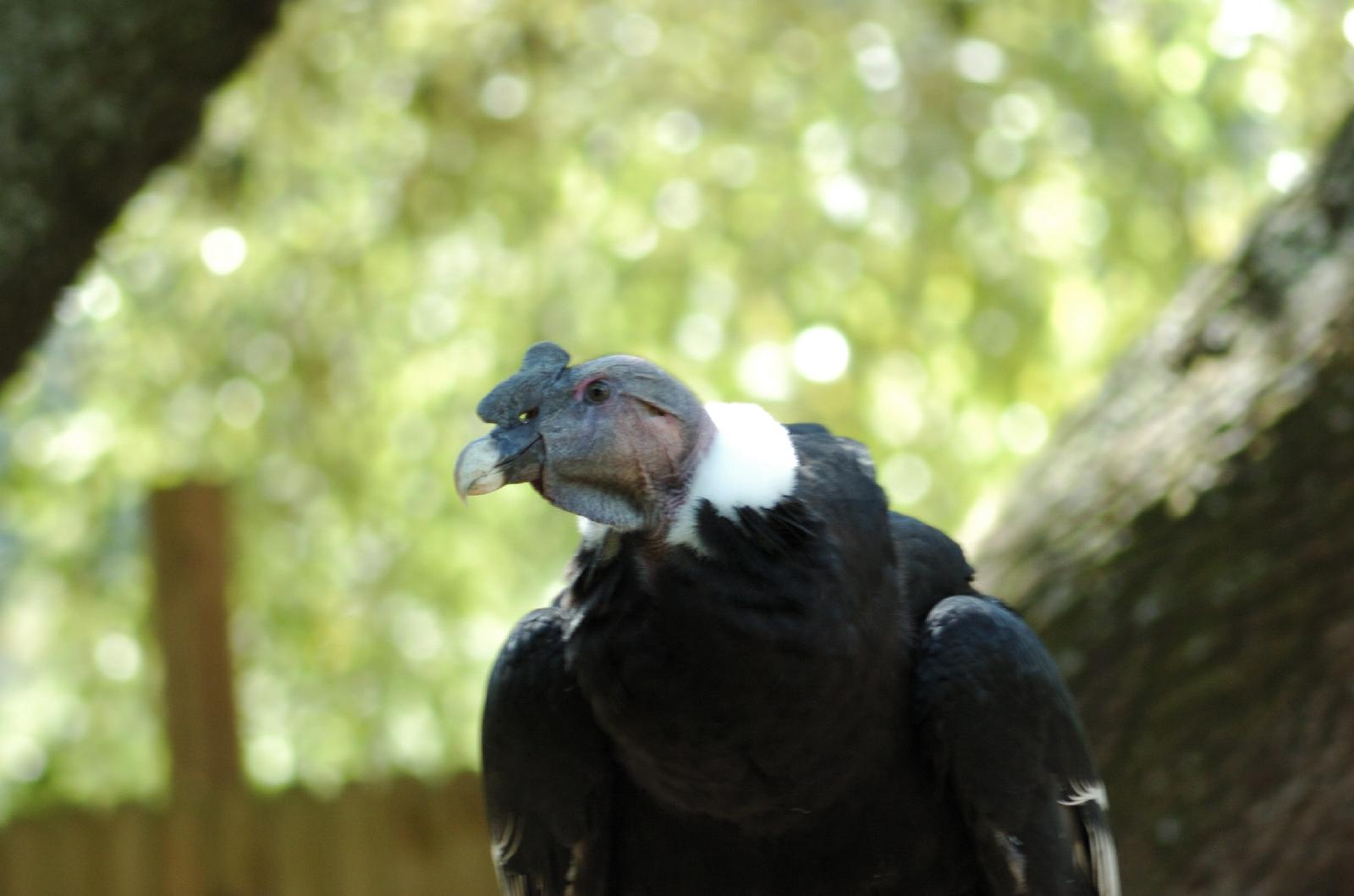
Great photos and thanks for sharing your adventure to watch and photograph this interesting birds, Ian. The Lord has created so much variety in His Avian Wonders. The birds just seem to find the niche that they were created for. I trust that we find that spot, or niche that the Lord has for us.
I have got to admit, these Condors are not the prettiest birds we have ever seen, but yet, the Creator, in His wisdom, makes no mistakes.
See more of Ian’s Bird of the Week, Moments, or whenever:
Lee’s Addition:
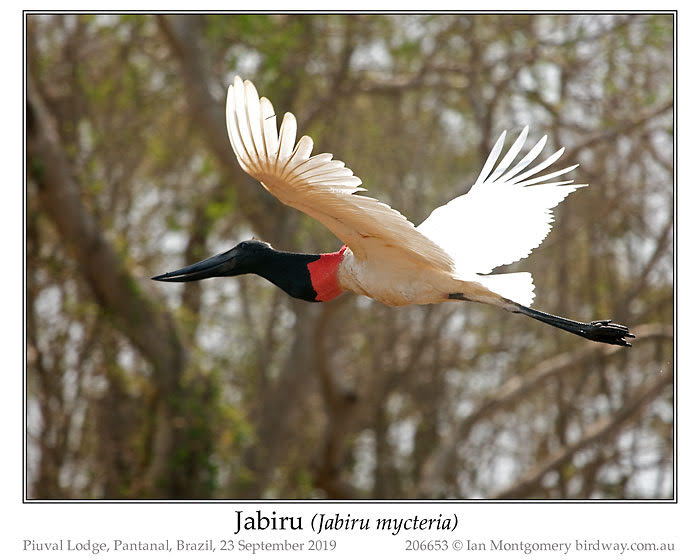
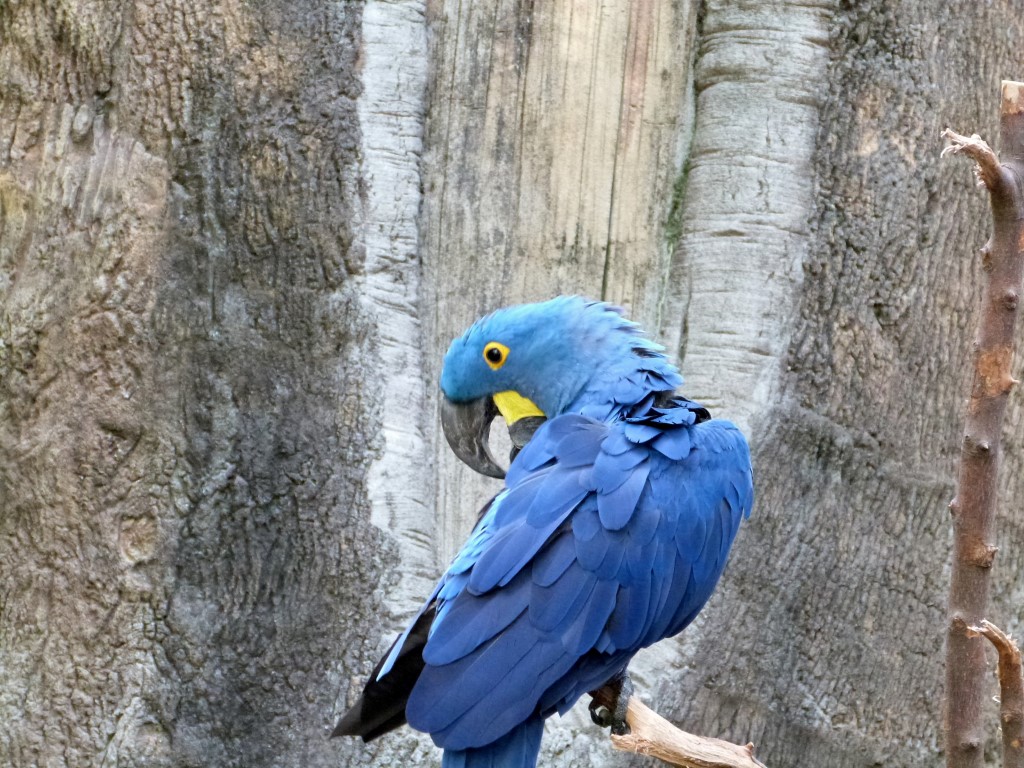
Ian’s comment, “Current population estimates are about 6,500 individual wild birds of which perhaps 5,000 are in the Pantanal.” makes one want to hop on a plane and visit that area. Wow. Your “Bird List” would grow immensely.I am alway glad when Ian stops by to show some more of his birdwatching adventures. Those Hyacinth Macaws are so neat to see. We have only seen them in Zoos, but always thankful to see more of the Creator’s magnificent birds.
“And God saw every thing that he had made, and, behold, it was very good. And the evening and the morning were the sixth day.” (Genesis 1:31 KJV)“For every kind of beasts, and of birds, and of serpents, and of things in the sea, is tamed, and hath been tamed of mankind:” (James 3:7 KJV)
“Therefore I will give thanks to You among the nations, O LORD, And I will sing praises to Your name.” (Psalms 18:49 NASB)
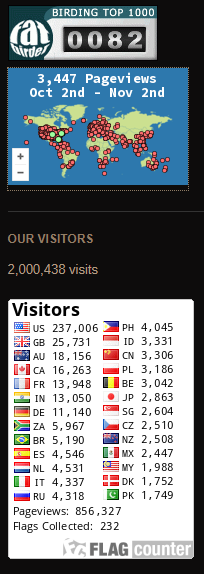
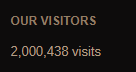
Thank You!!, Thank You!! again for all visits and views of this blog. Last night (Oct 31, 2019) sometime the counter flipped over the Two Million mark on the visitor counter on the left side of the blog.
Here’s a closer view:
On October 20th in 2013, we hit the One Million Mark. See:
Now, here we are just a tad over 6 years to the two million mark. Who ever thought that we would still be blogging after all these years. We have now been using WordPress for over 11 years, and the blog is almost 12 years old. It was begun in February 2008, but when it was moved to WordPress the counter was reset.
I am so thankful to the Lord for letting this blog be used to present His beautifully Created birds. Also, without you readers, it would not have been successful. Thank You for every visit, pages viewed, and the many comments. Those comments have come many times when I was thinking of quitting and giving up. But, just when I needed a little extra encouragement, along came a comment that was perfectly timed to keep me going.
After these many years, we have met so many people from around the world, and many have become personal friends. [At least I consider you personal friends.]
Also, those that write for the blog have made great contributions: James J.S. Johnson. or Dr. Jim, as I call him; Emma Foster and her Emma’s Stories, have been two of the newest writers used during this six year span. Also, Golden Eagle drops by occasionally. Our Ian Montgomery has provide numerous post from his birding adventures.
“God created the great sea monsters and every living creature that moves, with which the waters swarmed after their kind, and every winged bird after its kind; and God saw that it was good. God blessed them, saying, “Be fruitful and multiply, and fill the waters in the seas, and let birds multiply on the earth.” (Genesis 1:21-22 NASB)
Thank you, Lord, for giving us so many birds to learn and write about. Thank you, readers, for every visit to this blog. I trust that the Lord will allow me the wisdom, strength, and curiosity about the Avian Wonders from His Hand to keep writing about them.
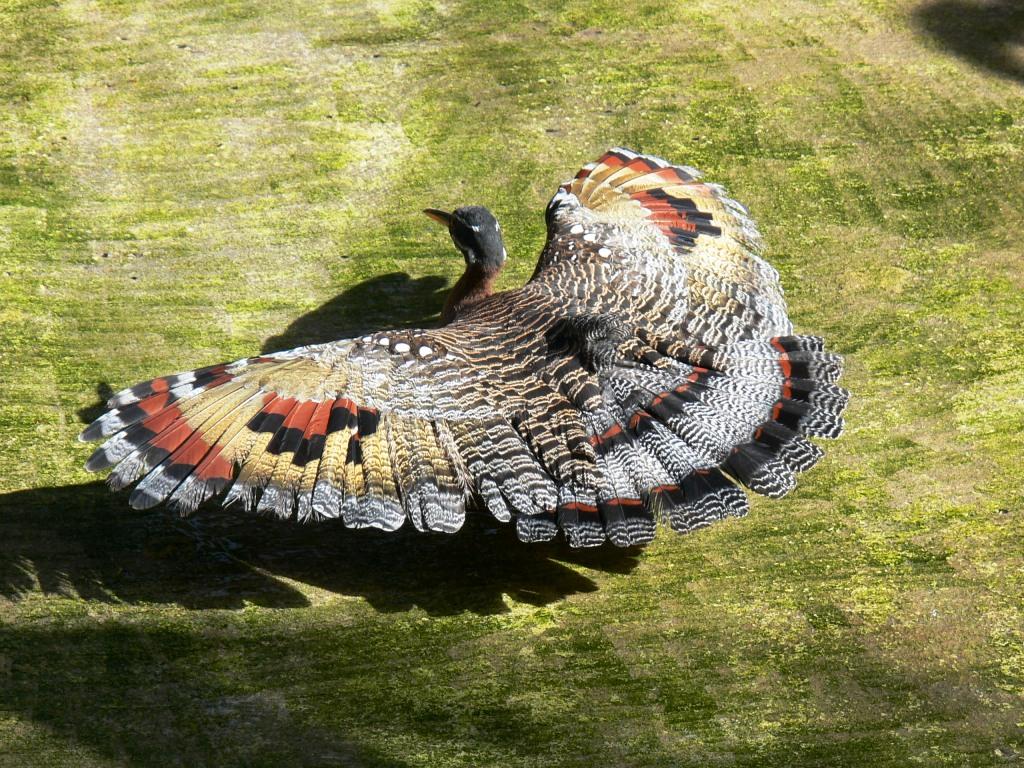
Ian’s Birds of the “Moment” always surprise me. When he wrote all the Birds of the Week posts, he was very regular. Now?? Whenever the “moment” arrives, I am delighted. So, here is his latest. The Sunbittern is also a favorite of ours. Especially, when the one at Lowry Park Zoo (Zoo Tampa now) opened its wings up for a good view.
“Splendor and majesty are before Him, Strength and beauty are in His sanctuary.| (Psalms 96:6 NASB)
“How will they preach unless they are sent? Just as it is written, “HOW BEAUTIFUL ARE THE FEET OF THOSE WHO BRING GOOD NEWS OF GOOD THINGS!” (Romans 10:15 NASB)
“… as the eagle swoops down… (Deuteronomy 28:49b NASB)
“… Like an eagle that swoops on its prey.” (Job 9:26b NASB)
“… The way of an eagle in the sky,…” (Proverbs 30:19a NASB)
“… Behold, He will mount up and swoop like an eagle and spread out His wings against Bozrah…” (Jeremiah 49:22a NASB)
Thanks, Ian. Was beginning to wonder if you had given up on birdwatching. Our adventures may become less regular, but there is always another birding adventure to inspire us. Thanks for sharing.
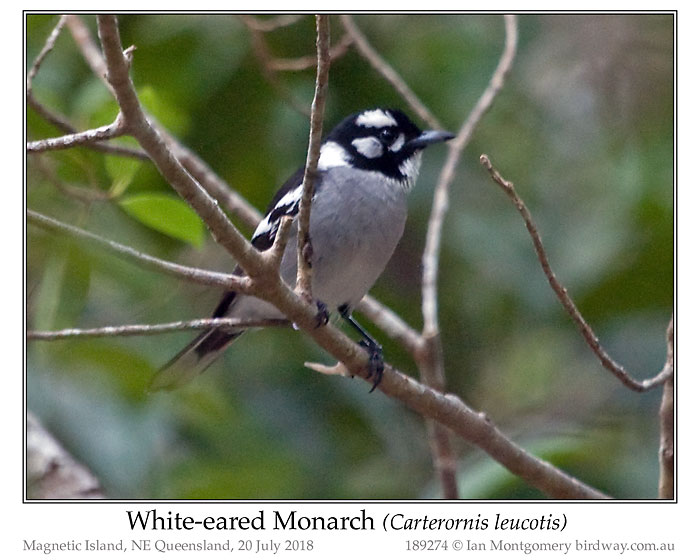
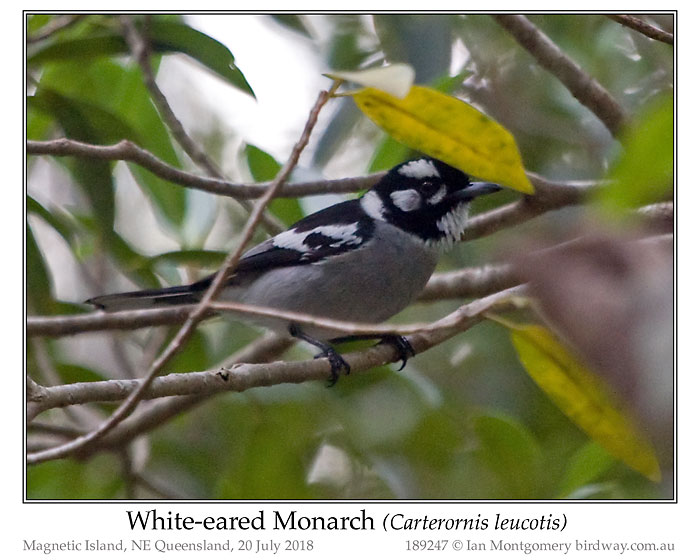
In February we had the Satin Flycatcher as bird of the moment. This is a generally uncommon member of the Monarch Flycatcher (Monarchidae) that I’d had trouble photographing until one obligingly turned up at my bird bath last October. Here is another member of the family that is also elusive, the White-eared Monarch. It’s generally rather uncommon and it tends to stay out of sight in the foliage of tall trees so spotting it is hard and photographing it is more so.
Its movements are not well understood but it tends to move from the highlands to coastal areas in winter and is mainly a winter visitor in the Townsville region. In Where to Find Birds in North-east Queensland Jo Wieneke particularly recommends the Nelly Bay end of the Nelly Bay to Arcadia walking track along Gustav Creek on Magnetic Island, where the trees are not very tall, for this and other Monarchs and Fantails.
It so happened that we were staying on Mandalay Avenue within walking distance of the start of the track last July for the weekend workshop of the North Queensland Recorder Society so I checked out the walking track before the workshop began. Sure enough, I found all the species listed in the the ebook including a couple of pairs of White-eared Monarchs so the photographic drought was at an end.
The birds I saw on that occasion were all adults. The juveniles look confusingly different with plumage in varying shades of grey rather than black and white so I’ve included a distant photo of a juvenile taken from a boat on the Daintree River north of Cairns. If nothing else it illustrates the difficulty of finding these birds in thick foliage.
It’s geographical range comprises the ranges and coasts of eastern Queensland from Cape York to just south of the New South Wales border north of the Tweed River. It’s rarer in the southern part of the range so North-eastern Queensland is the best place to look for it.
For the taxonomists, it is the only Australian member of a small genus whose other members are the striking Golden Monarch (C. chrysomela) of New Guinea, which is orange-yellow and black, and the White-naped and Tanimbar Monarchs (C. pileatus and C. castus, sometimes treated as a single species) of the Moluccas and Lesser Sundas east of New Guinea. These latter two look much more like the White-eared Monarch than the Golden Monarch both in colour and patterning, posing an interest problem for the bio-geographers.
Since publishing Diary of a Bird Photographer Volume 2 I’ve merged Volumes 1 and 2 and plan to publish the combined work at the end of this year, including all the 2019 Birds of the Moment. My more immediate aim was to produced a combined taxonomic index making it easy for me to see which species have been covered since 2002 and which are candidates for future BIrds of the Moment. This combined volume will be a free update to purchasers of Volume 2. Sales so far have been slow so if you want to encourage me with the Bird of the Moment, I’d encourage you to show your interest and take advantage of this offer.
A couple of purchasers have expressed a preference for the earlier bank transfer and Dropbox download, so if you rather do that too, just let me know Ian@birdway.com.au or ianbirdway@gmail.com and I can also arrange download through the website as an alternative to Dropbox. I’ve had inquiries about giving the ebooks as gifts: contact me if you wish to do so.
Greetings,
Ian
Lee’s Addition:
Ian’s comment, in the first paragraph, caught my interest. “It’s generally rather uncommon and it tends to stay out of sight in the foliage of tall trees so spotting it is hard and photographing it is more so.” It brought to mind the verses of trusting in the shadow of God’s protection.
“How precious is Your lovingkindness, O God! Therefore the children of men put their trust under the shadow of Your wings.” (Psalms 36:7 NKJV)
“He who dwells in the secret place of the Most High Shall abide under the shadow of the Almighty.” (Psalms 91:1 NKJV)
Ian’s “Moment” wasn’t so long this time. Thanks, Ian, for another interesting article about a beautiful bird.
Ian’s last Bird of the Moment was about the Gentoo Penguin.