
The Amazing Butterfly
Another Creation Moments video on YouTube.
The Amazing Butterfly
Another Creation Moments video on YouTube.
I received this in an e-mail, and felt compelled to reproduce it here. It is worth viewing. It is on YouTube.
“Read the narrative before viewing.
If this does not give you goose bumps, you had better see a doctor.
This is an awesome music video… Featuring a special free-flying Bald Eagle named ‘Challenger’ (in honor of the lost space shuttle crew) cared for by the non-profit American Eagle Foundation (AEF).
He’s a ‘human socialized’ bird accidentally raised by the people who rescued him – after being blown from a wild Louisiana nest in a storm as a baby in the late 1980s. Declared ‘non-releasable’ by federal and state wildlife authorities, he was trained by the AEF to perform educational free-flight demonstrations at high profile public events.
He’s the first Bald Eagle in U.S. History that learned to free-fly into stadiums, arenas and ballrooms during the singing of the Star Spangled Banner. The celebrity eagle has appeared at numerous major sporting events… Like the World Series, Pro-Bowl, All-Star game, BCS National Championship, Fiesta Bowl and Men’s Final Four, etc.
Challenger has also flown before 4 U.S. Presidents! His life story is told in a children’s storybook titled ‘Challenger, America ‘s Favorite Eagle.’
Turn on your speakers and click on link below.”
The Amazing Giraffe
Here are two different videos about the Giraffe telling about how God has created them with a special feature called the “wonder net.” This really called the “rete mirabile.” See an article I did, “Interesting Things – Why Birds Don’t Wear Socks“, from information from Creation Moments.
The first video is from Creation Moments on YouTube.
The second video is from nubeckett on YouTube and explains the “wonder net” in a little more detail.
Thou art worthy, O Lord, to receive glory and honor and power: for thou hast created all things, and for thy pleasure they are and were created. (Revelation 4:11 KJV)
Scientific classification
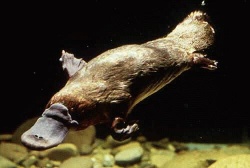
Platypus From Creation Wiki
<
| Kingdom: | Animalia |
| Phylum: | Chordata |
| Class: | Mammalia |
| Order: | Monotremata |
| Family: | Ornithorhynchidae |
| Genus: | Ornithorhynchus Blumenbach, 1800 |
| Species: | O. anatinus |
The platypus is roughly half the size of a household cat. It has a thick covering of waterproof hair over all of its body, except for its feet and bill. It is a member of the Monotreme family, which are mammals that lay eggs.
The male platypus’s body is about 20-23 inches long and the female is about 17-18 inches long. The platypus has a thick covering of waterproof hair all over its body except for the feet and bill. The platypus’s sensitive, pliable bill is a blue-gray, blackish color with the two nostril holes near the tip. The location of the nostrils allows the platypus to breath while the rest of the body stays under the water. The platypus does not have external ears. The platypus has four legs which extend horizontally from its body. This arrangement makes it walk on land with a shuffle like a lizard.
During breeding season, males can fight each other and the venom in their spurs becomes more poisonous. The platypus is the only Australian mammal known to be venomous. The female platypus lays one to three round eggs, which have soft and leathery shells, in a nest made of wet leaves and grass. In the wild, reproductive activity takes place from winter to late spring. The baby platypus suckles the milk excreted from a “milk field” on the mother’s belly; there are no nipples.
The modern platypus is found among the freshwater systems of eastern Australia. The platypus is an excellent swimmer and spends much of its time in the water. It feeds on worms and insect larvae, freshwater shrimp and crayfish that it digs out of the river-bed with its snout or catches while swimming. The platypus automatically shuts both its eyes and ears when it dives, and so relies almost entirely on its bill to find food and navigate underwater.
Evolutionists claim that the platypus is evidence of evolution since it is so strange. This is because they start with an assumption that the platypus evolved so of course they see it as evidence for that. In reality the platypus is more evidence for the amazing intelligence of God’s design. Truly only a super-Intelligent Designer could make such an amazing combination of mammalian and reptilian features in a single creature.
Here is an interesting article about the Platypus from Creation Magazine-24(2):40–43, March 2002 by Paula Weston
The platypus – Still more questions than answers for evolutionists
Buddy Davis singing about a Platypus.
It’s Designed To Do What It Does Do-Buddy Davis Song
Here is another interesting video of the Platypus from Australia
References:
Platypus – at Creation Wiki
Platypus – at Wikipedia

Canadian Geese by Mike Bader
Yea, the stork in the heaven knoweth her appointed times; and the turtle and the crane and the swallow observe the time of their coming; but my people know not the judgment of the LORD. (Jeremiah 8:7)
Doth the hawk fly by thy wisdom, and stretch her wings toward the south? (Job 39:26 KJVR)
I found this interesting article at Paul Butler’s Production Blog which has audios from Moody Radio.
“For many of us in North America, autumn is characterized by dramatic color, crisp evenings and of course, thousands of birds flying in formation to their winter homes. These features with Dr. Andy McIntosh and Donna O’Daniel look at the mechanics of flight and the science behind bird migration.”
Please listen to the two programs at:
Migration and the Mechanics of Flight – Part I and II
God’s Wonderous Creation by Carpentersdaughter is an invitation to “take a few minutes to rest in Jesus with His wonderful creation. Then get back to work.” Just thought you might enjoy it.
Video can’t be shown on WordPress from GodTube. See Below
Now therefore, let not my blood fall to the earth before the face of the LORD: for the king of Israel is come out to seek a flea, as when one doth hunt a partridge in the mountains. (1 Samuel 26:20 KJV)
In the Birds of the Bible – Partridge, I Samuel 26:20 mentioned the flea. Here are a few interesting things about the flea.
“The flea can jump 350 times its own length, a total of 13 inches. This is equivalent to our jumping 2,000 feet into the air. …” From Animals Don’t Need Technology at Creation Moments
The Crafty Flea
“Not much larger than a grain of rice, the water flea has been given such a clever defense against predators that even scientists were fooled for a while….” at Creation Moments
A Glowing Ballet (the Fireflea)
“During the mating ritual, only the males emit light. However, this is not simply random lighting. …” at Creation Moments
Swimming in Sand (tiny sand fleas)
“There might be tiny sand fleas which were washed ashore, appearing as giants next to the single-celled dinoflagellates which swim freely between the grains….” at Creation Moments
From an article, “Rats: no evolution!“, by Paula Weston at Answers in Genesis
“Undoubtedly, the rat is most infamous for its role in the spread of plague, both in the Middle Ages, and more recently, in heavily populated Third World countries. However, the rats themselves do not pass on the disease: rather, it is the fleas living on the rats which take the infection from rodent to human.
Flea is the common name for any of the small wingless insects of the order Siphonaptera. Fleas are small (1/16 to

Cat Flea
Cat Flea
1/8-inch (1.5 to 3.3 mm) long), agile, usually dark colored (for example, the reddish-brown of the cat flea), wingless insects with tube-like mouth-parts adapted to feeding on the blood of their hosts. Their bodies are laterally compressed (human anatomical terms), permitting easy movement through the hairs or feathers on the host’s body (or in the case of humans, under clothes). Their legs are long, the hind pair well adapted for jumping (vertically up to seven inches (18 cm); horizontally thirteen inches (33 cm)[1]) – around 200 times their own body length, making the flea one of the best jumpers of all known animals (in comparison to body size), second only to the froghopper. The flea body is hard, polished, and covered with many hairs and short spines directed backward, which also assists its movements on the host.
A Day at the Flea Circus from Creation Moments
“If you see a flea jump – and that’s not easy to do – you will wonder whether the flea is actually powered by springs. The amazing truth is….”
Flea Circus – Wikipedia
“A flea circus refers to a circus sideshow attraction in which fleas are attached (or appear to be attached) to miniature carts and other items, and encouraged to perform circus acts within a small housing. Fresnel lenses were provided to help visitors to view the attraction.
The first records of flea performances were from watch makers who were demonstrating their metal working skills. Flea circuses were first advertised as early as 1833 in England, and were a main carnival attraction until 1930. Some flea circuses persisted in very small venues in the United States as late as the 1960s. The flea circus at Belle Vue amusement park, Manchester, England, was still operating in 1970. Today the flea circus has largely become a lost art form, with much information about them being anecdotal or steeped in lore.” (from Wikipedia)
For every kind of beasts, and of birds, and of serpents, and of things in the sea, is tamed, and hath been tamed of mankind:
But the tongue can no man tame; it is an unruly evil, full of deadly poison.
Therewith bless we God, even the Father; and therewith curse we men, which are made after the similitude of God.
Out of the same mouth proceedeth blessing and cursing. My brethren, these things ought not so to be.
(James 3:7-10 KJV)
Copyright © 2009 by Creation Moments, Inc., P.O. Box 839, Foley, MN 56329
In the beginning God created the heavens and the earth. (Genesis 1:1 NKJV)
Check out the “Evolution vs Creation” Video series from YouTube that were produced by Zonkas. Look in the “Evolution vs Creation” Pages. Many creationists like Ken Ham are mentioned along with quotes from evolutionist like Darwin. All of them are very interesting.
1 – Introduction
2 – Blind Faith & Science in Bible – Finches mentioned
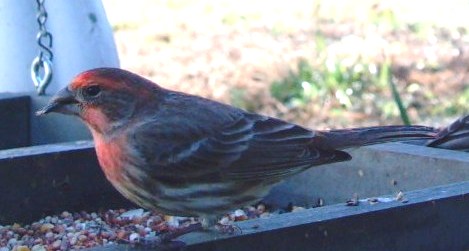
House Finch
3 – Transitional Forms
4 – We Found the Missing The Missing Link?
5 – Big Bang Theory
6 – Chemical Evolution
7 – Earth Millions of years old?
8 – Dinosaurs and the Bible
9 – Natural Selection– Much about the eye.
10 – Creationist Scientist?
11 – Evolutionary beliefs on mankind

One of my favorite articles from Creation Moments has been about why birds don’t wear socks. Now they have produced a YouTube about it and it is copied here. I was just getting ready to do some more research on it when I found this. Let’s see what can be found out.
There is an interest Pod Cast about Why Birds Stand on One Leg from BirdNote.org
Apparently the “Wonder Net” is actually called the “rete mirabile” which is Latin for “wonderful net.” It is a complex of arteries and veins that are close to each other. It uses a “countercurrent blood flow within the net (blood flowing in opposite directions.) It exchanges heat, ions, or gases between vessel walls so that the two bloodstreams within the rete maintain a gradient with respect to temperature, or concentration of gases or solutes.” (“Rete mirabile”, from Wikipedia)
In birds with webbed feet, a rete mirabile in the legs and feet transfers heat from the outgoing (hot) blood in the arteries to the incoming (cold) blood in the veins, with the net effect that the internal temperature of the feet is much closer to the ambient temperature, thus reducing heat loss. In this example the rete mirabile functions as a biological heat exchanger. A similar structure is seen in other vertebrate extremities, including the neck of the dog, in order to protect the brain when the body overheats; fishes such as tuna, whose core temperature is higher than that of the cold deep waters they inhabit; and penguins who have them in the feet, flippers and nasal passages, to limit body heat lost to the cold environments in which they live. In giraffes, a rete mirabile in the neck equalizes blood pressure when the animal bends down to drink.
“You are worthy, O Lord, To receive glory and honor and power; For You created all things, And by Your will they exist and were created.” (Revelation 4:11 NKJV)
For by Him all things were created that are in heaven and that are on earth, visible and invisible, whether thrones or dominions or principalities or powers. All things were created through Him and for Him. And He is before all things, and in Him all things consist. (Colossians 1:16-17 NKJV)
See Also: The Amazing Giraffe
Here is an interesting video fromYouTube.com -Exploration Films about the Dragonflies. It is very interesting.
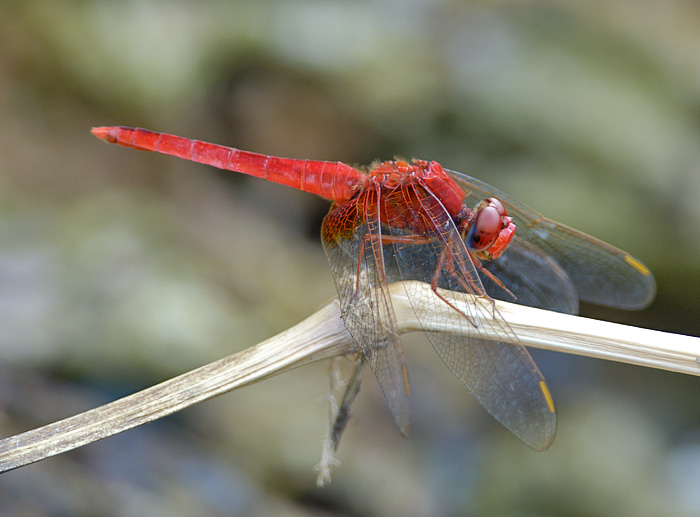
Dragonfly by Phil Kwong
Learning from the Dragonfly by Creation Moments
“Scientists studying the dragonfly are learning even more secrets of flight. Our best high-performance aircraft can barely lift themselves off the ground. However, the dragonfly can lift 15 times his own weight into the air.”
The Amazing Mosquito Hawk by Creation Moments
But ask now the beasts, and they shall teach thee; and the fowls of the air, and they shall tell thee: Or speak to the earth, and it shall teach thee: and the fishes of the sea shall declare unto thee. Who knoweth not in all these that the hand of the LORD hath wrought this?
(Job 12:7-9 KJV)
More articles from Creation Moments:
100 Foot Ferns “dragonflies had wingspans of six feet”
The Pre-Flood Atmosphere “dragonflies were the size of hawks”
From Creation Ministries International:
“Dragonflies
Dragonflies are probably the most beautiful of the flying insects. There are about 4,500 different varieties. They begin their life in water, where eggs hatch into rather ugly brown nymphs. The time spent living in water varies from a few weeks to several years, but for all the varieties the day comes when the nymph suddenly has the urge to climb out of the water. It sits for a while at the top of a piece of grass until its skin splits open and out comes a dragonfly! After waiting for its wings to become firm and dry, the dragonfly flies away, its lovely colours glinting in the sunshine.
Although they are very small, dragonflies are wonderfully designed for flying. Their two pairs of wings are very light, but strengthened by a network of tiny veins, which not only carry blood fluid to keep the wings stiff, but also nerves and oxygen. Some dragonflies beat their wings 40 times in one second! Dragonflies are like tiny helicopters—they can even fly backwards! In fact, Igor Sikorsky, who first designed helicopters, for the idea from watching dragonflies.
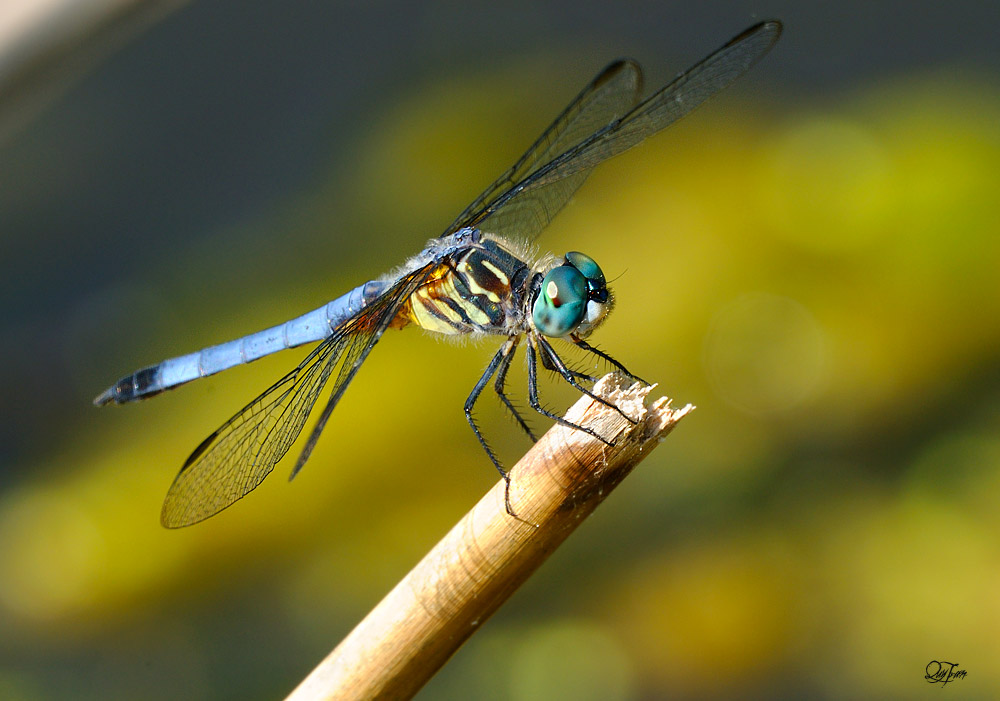
Dragonfly by QuyTran
Another wonderful thing about dragonflies is their eyes. Each pair of eyes is actually made up of as many as 30,000 separate eyes, each with its own lens! This enables the insect to see what is happening over a wide area, and spot every tiny movement without moving its head.
The supposedly oldest fossil dragonflies are just like dragonflies are now, except that they were much larger—75 centimeters (2.5 feet) from wing-tip to wing-tip! So there is no evidence that they evolved from ancestors without wings. And surely those amazing eyes did not evolve? Dragonflies are another of the many wonders of God’s creation!” From Our World (Answers for Kids.)
Astonishing acrobatics – dragonflies – by Johathan Sarfati
(Updated 4/29/09)
Dragonflies and fighter pilots – what can we learn? by Ken Ham
We went birdwatching last Thursday, the 18th of December, on a very foggy morning. We were at Circle B Bar Reserve at 7:10am. When we started it was 59 degrees F. We parked up by the new Nature Center and walked out to the “Heron Hideout” path. Here is a list of the birds observed there in the order we spotted them:
White Ibis 6+, Great Blue Herons, Killdeer, Carolina Wren, Wood Storks 75+, Palm Warblers, Yellow-rumped Warbler, Cormorants 15+, Kingfisher, Great Egrets 10+, Glossy Ibis 4+, Tricolored Herons, Eastern Phoebe, Sandhill Cranes 2, Limpkin, Pileated Woodpecker, (an Otter), Coots 10+, Pied-billed Grebe 2, Northern Harrier 1, Common Moorhens 10+, Blue-gray Gnatchatcher, Osprey 3, Roseate Spoonbills 4, Downy Woodpecker, Little Blue Herons, Tree Swallow, Green-Winged Teal, Black-bellied Whistling-Ducks, Muscovy, Red-shoulder Hawk, (what I think is a Hooded Warbler), Red-bellied Woodpecker, Redwing Blackbirds, Boat-tailed Grackles, Blue Jay, Morning Doves 5, (36 species) plus several unknowns. Not a bad 2 hours of birding.

Me, feeding the beggars!
We left there at 9:00 am and drove over to Lake Hollingsworth in Lakeland. At 9:10 most of the fog had cleared and it was up to 66 already. With bread in hand, I was attacked again by the local beggars (see photo). After the Geese, Mallards, White Ibises, Ring-billed Gulls, Boat-tailed Grackles, Common Moorhens and Purple Gallinules got my offerings, I proceeded to go see what else was around. The rest of the adventure turned up Anhingas, Cormorants, Great Blue Herons, Mottled Ducks, Great Egrets, Muscovy, Limpkins 4, Osprey 10+, Tricolored Heron 2, Pied-billed Grebes, Coots, American White Pelicans 11, Brown Pelicans 5, Little Blue Heron, Wood Storks, Black-crowned Night-Heron, Eastern Phoebe, Common Grackles, Caspian Tern. (26) Not bad for an hour of viewing.
Putting the 36 plus the 8 different ones together, gives 44 bird species and a one Otter morning. Again, I am thankful for the opportunity to view and enjoy God’s critters and see His handiwork.
Here are a few photos:
*
*
For other birdwatching trips to the Circle B Bar Reserve
*

 Lee's Birdwatching Adventures Plus