Another interesting video from “the dodo” channel.
“Bird Frozen To Metal Fence Rescued by Kind Man | This little bird landed on a fence that was so cold, his feet froze to it and he couldn’t fly away. But luckily the nicest guy came along and knew exactly what to do.”
Not sure if this bird prayed like this, but it would apply to us if we were in such a predicament as this.
“Be pleased, O LORD, to deliver me: O LORD, make haste to help me.” (Psalms 40:13 KJV)
P.S. This wouldn’t happen here in Central Florida. :)
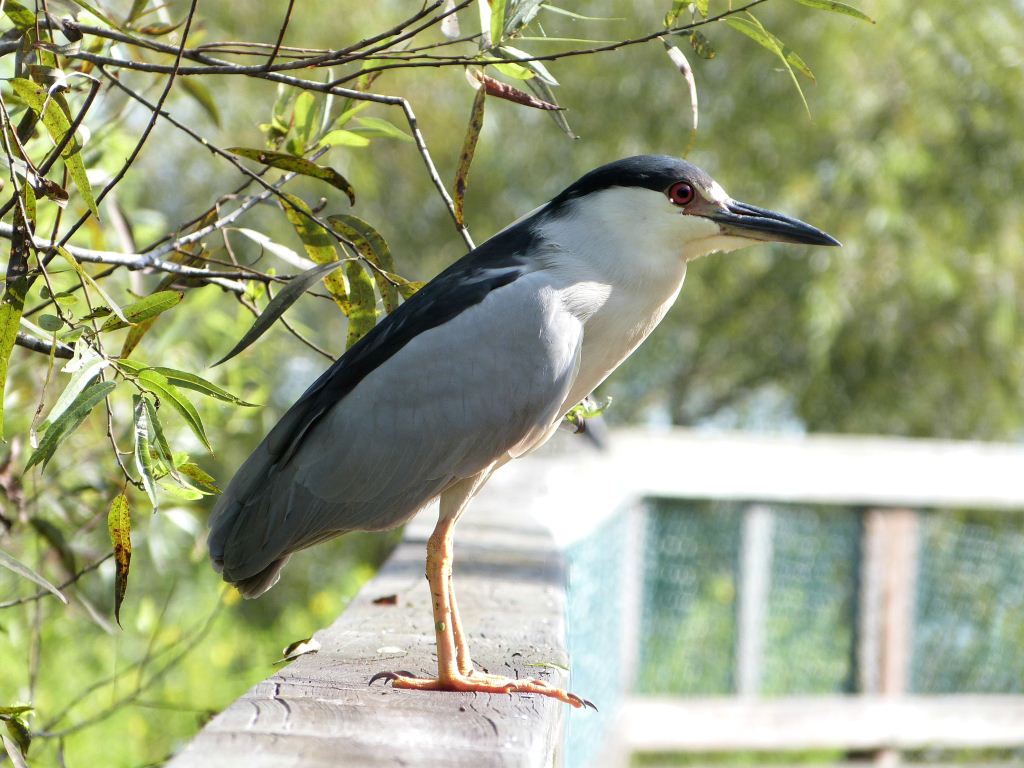
Black-Crowned Night Heron at South Lake Howard by Lee
Thought you would enjoy another bird using bread to fish:
This one is having better fortune than Simon Peter and fellow fishermen. They fished all night with no catches.
“Simon Peter saith unto them, I go a fishing. They say unto him, We also go with thee. They went forth, and entered into a ship immediately; and that night they caught nothing. But when the morning was now come, Jesus stood on the shore: but the disciples knew not that it was Jesus. Then Jesus saith unto them, Children, have ye any meat? They answered him, No.” (John 21:3-5 KJV)
These lessons start off with words, then the story. You can practice writing with the Slate Work.
“The flowers appear on the earth; the time of the singing of birds is come, …” (Song of Solomon 2:12a KJV)
LESSON LVI.
strong round dry bill worked
sends claws flit God spring
“How does the bird make the nest so strong, Willie?”
“The mother bird has her bill and her claws to work with, but she would not know how to make the nest if God did not teach her. Do you see what it is made of?”
“Yes, Willie, I see some horse-hairs and some dry grass. The old bird must have worked hard to find all the hairs, and make them into such a pretty, round nest.”
“Shall we take the nest, Rose?”
“Oh no, Willie! We must not take it; but we will come and look at it again, some time.”
“So God created great sea creatures and every living thing that moves, with which the waters abounded, according to their kind, and every winged bird according to its kind. And God saw that it was good.” (Genesis 1:21 NKJV)
Harpy Eagle (Harpia harpyja) by Lee at Zoo Miami 2014
There are many more birds that could give Garfield competition. Just thought you might enjoy seeing some of God’s Handiwork. Even if we aren’t the prettiest or most handsome person, God still loves us, even as He love all of His Creations.
For God so loved the world, that he gave his only begotten Son, that whosoever believeth in him should not perish, but have everlasting life. (John 3:16 KJV)
But Jesus said, “Let the little children come to Me, and do not forbid them; for of such is the kingdom of heaven.” (Matthew 19:14 NKJV)
American White Pelican (Pelecanus erythrorhynchos) by AestheticPhotos
“And the swan, and the pelican, and the gier eagle,” (Leviticus 11:18 KJV)
Bible Birds – Pelican Introduction
The Pelican is mentioned in three verses in the Bible (KJV). In Leviticus 11:18 and in Deuteronomy 14:17, the Pelican is listed as one of the “Do Not Eat” birds. The Jewish people, from God’s chosen people, were given a list of birds that they were not to eat. [My “Do Not Eat” birds]
In Psalms 102:6, it mentions the Pelican in the wilderness. That will be mentioned in a later article.
Pelicans are huge birds that are larger than swans and have a remarkably enormous bill. The lower part of the bill is like a large pouch or bag that can expand to hold quarts of water. The pelican places the fish they catch in this lower part of the bill.
Brown Pelican with fish in pouch and a Laughing Gull
The White Pelican was recording holding three gallons of water in that pouch. Wow! They belong to the Pelecanidae family which is in the Pelecaniformes Order. There are eight species of Pelicans:
Mature Brown Pelican by Dan at MacDill AFB
Great White Pelican, Pink-backed Pelican, Spot-billed Pelican, Dalmatian Pelican, Australian Pelican, American White Pelican, Brown Pelican, and the Peruvian Pelican.
Mixed Flock Flyiing 122717 Merritt Is NWR by Lee
Mixed Flock Flyiing 122717 Merritt Is NWR by Lee
Mixed Flock Eating 122717 Merritt Is NWR by Lee
Mature Brown Pelican by Dan at MacDill
Pelican Reaching in water – Flickr Nagarajan Kanna
Brown Pelican with fish and Laughing Gull
American White Pelican (Pelecanus erythrorhynchos) by AestheticPhotos
1. I once knew a man who was rich in his love for birds, and in their love for him. He lived in the midst of a grove full of all kinds of trees. He had no wife or children in his home.
2. He was an old man with gray beard, blue and kind eyes, and a voice that the 49 birds loved; and this was the way he made them his friends.
3. While he was at work with a rake on his nice walks in the grove, the birds came close to him to pick up the worms in the fresh earth he dug up. At first, they kept a rod or two from him, but they soon found he was a kind man, and would not hurt them, but liked to have them near him.
Eurasian Tree Sparrow (Passer montanus) by Nikhil Devasar
4. They knew this by his kind eyes and voice, which tell what is in the heart. So, day by day their faith in his love grew in them.
5. They came close to the rake. They would hop on top of it to be first at the worm. They would turn up their eyes into his when he spoke to them, as if they said, “He is a kind man; he loves us; we need not fear him.”
6. All the birds of the grove were soon his fast friends. They were on the watch for him, and would fly down from the green tree tops to greet him with their chirp.
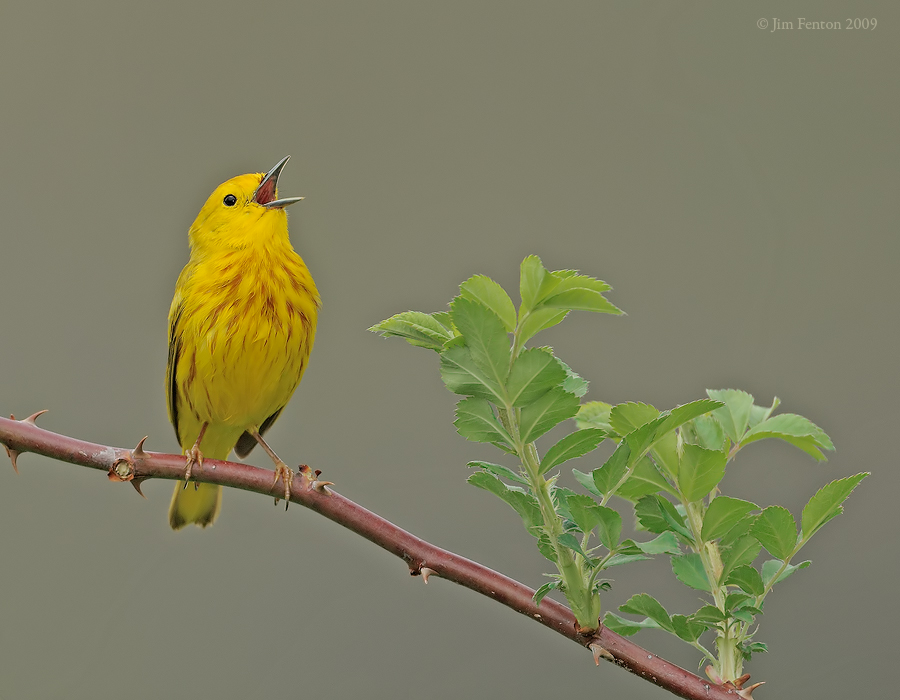
American Yellow Warbler (Dendroica aestiva) singing by J Fenton
7. When he had no work on the walks to do with his rake or his hoe, he took crusts of bread with him, and dropped the crumbs on the ground. Down they would dart on his head and feet to catch them as they fell from his hand.
8 He showed me how they loved him. He put a crust of bread in his mouth, with one end of it out of his lips. Down they came like bees at a flower, and flew off with it crumb by crumb.
9. When they thought he slept too long in the morning, they would fly in and sit on the bedpost, and call him up with their chirp.
10. They went with him to church, and while he said his prayers and sang his hymns in it, they sat in the trees, and sang their praises to the same good God who cares for them as he does for us.
11. Thus the love and trust of birds were a joy to him all his life long; and such love and trust no boy or girl can fail to win with the same kind heart, voice, and eye that he had.
Adapted from Elihu Burritt.
Yellow Warbler singing by J Fenton
With my mouth I will give thanks abundantly to the LORD; And in the midst of many I will praise Him.
(Psalms 109:30 NASB)
“He sends forth springs in the valleys; They flow between the mountains; They give drink to every beast of the field; The wild donkeys quench their thirst. Beside them the birds of the heavens dwell; They lift up their voices among the branches.” (Psalms 104:10-12 NASB)
McGuffey Readers were a series of graded primers for grade levels 1-6. They were widely used as textbooks in American schools from the mid-19th century to the mid-20th century, and are still used today in some private schools and in homeschooling.
Here is a story of The Oratorio from the Sixth Grade Reader. (From Gutenberg) Pictures are current photos.
hairbird
Noun (plural hairbirds) – bird, Spizella passerina, the chipping sparrow. [from Your Dictionary]
XI. THE MORNING ORATORIO. (90)
Wilson Flagg, 1806-1884, was born in Beverly, Mass. He pursued his academical course in Andover, at Phillips Academy, and entered Harvard College, but did not graduate. His chief Works are: “Studies in the Field and Forest,” “The Woods and Byways of New England,” and “The Birds and Seasons of New England.”
Nature, for the delight of waking eyes, has arrayed the morning heavens in the loveliest hues of beauty. Fearing to dazzle by an excess of delight, she first announces day by a faint and glimmering twilight, then sheds a purple tint over the brows of the rising morn, and infuses a transparent ruddiness throughout the atmosphere. As daylight widens, successive groups of mottled and rosy-bosomed clouds assemble on the gilded sphere, and, crowned with wreaths of fickle rainbows, spread a mirrored flush over hill, grove, and lake, and every village spire is burnished with their splendor.
At length, through crimsoned vapors, we behold the sun’s broad disk, rising with a countenance so serene that every eye may view him ere he arrays himself in his meridian brightness. Not many people who live in towns are aware of the pleasure attending a ramble near the woods and orchards at daybreak in the early part of summer. The drowsiness we feel on rising from our beds is gradually dispelled by the clear and healthful breezes of early day, and we soon experience an unusual amount of vigor and elasticity.
During the night, the stillness of all things is the circumstance that most powerfully attracts our notice, rendering us peculiarly sensitive to every accidental sound that meets the ear. In the morning, at this time of year, on the contrary, we are overpowered by the vocal and multitudinous chorus of the feathered tribe. If you would hear the commencement of this grand anthem of nature, you must rise at the very first appearance of dawn, before the twilight has formed a complete semicircle above the eastern porch of heaven.
Chipping Sparrow (Spizella passerina) by Daves BirdingPix
The first note that proceeds from the little warbling host, is the shrill chirp of the hairbird,—occasionally vocal at an hours on a warm summer night. This strain, which is a continued trilling sound, is repeated with diminishing intervals, until it becomes almost incessant. But ere the hairbird has uttered many notes, a single robin begins to warble from a neighboring orchard, soon followed by others, increasing in numbers until, by the time the eastern sky is flushed with crimson, every male, robin in the country round is singing with fervor.
It would be difficult to note the exact order in which the different birds successively begin their parts in this performance; but the bluebird, whose song is only a short, mellow warble, is heard nearly at the same time with the robin, and the song sparrow joins them soon after with his brief but finely modulated strain. The different species follow rapidly, one after another, in the chorus, until the whole welkin rings with their matin hymn of gladness.
I have often wondered that the almost simultaneous utterance of so many different notes should produce no discords, and that they should result in such complete harmony. In this multitudinous confusion of voices, no two notes are confounded, and none has sufficient duration to grate harshly with a dissimilar sound. Though each performer sings only a few strains and then makes a pause, the whole multitude succeed one another with such rapidity that we hear an uninterrupted flow of music until the broad light of day invites them to other employments.
When there is just light enough to distinguish the birds, we may observe, here and there, a single swallow perched on the roof of a barn or shed, repeating two twittering notes incessantly, with a quick turn and a hop at every note he utters. It would seem to be the design of the bird to attract the attention of his mate, and this motion seems to be made to assist her in discovering his position. As soon as the light has tempted him to fly abroad, this twittering strain is uttered more like a continued song, as he flits rapidly through the air.
But at this later moment the purple martins have commenced their more melodious chattering, so loud as to attract for a while the most of our attention. There is not a sound in nature so cheering and animating as the song of the purple martin, and none so well calculated to drive away melancholy. Though not one of the earliest voices to be heard, the chorus is perceptibly more loud and effective when this bird has united with the choir.
American Robin (Turdus migratorius) eating by Jim Fenton
When the flush of the morning has brightened into vermilion, and the place from which the sun is soon to emerge has attained a dazzling brilliancy, the robins are already less tuneful. They are now becoming busy in collecting food for their morning repast, and one by one they leave the trees, and may be seen hopping upon the tilled ground, in quest of the worms and insects that, have crept out during the night from their subterranean retreats.
Bobolink (Dolichonyx oryzivorus) by J Fenton
But as the robins grow silent, the bobolinks begin their vocal revelries; and to a fanciful mind it might seem that the robins had gradually resigned their part in the performance to the bobolinks, not one of which is heard until some of the former have concluded their songs. The little hairbird still continues his almost incessant chirping, the first to begin and the last to quit the performance. Though the voice of this bird is not very sweetly modulated, it blends harmoniously with the notes of other birds, and greatly increases the charming effect of the combination.
Eastern Wood Pewee (Contopus virens) by Raymond Barlow
It would be tedious to name all the birds that take part in this chorus; but we must not omit the pewee, with his melancholy ditty, occasionally heard like a short minor strain in an oratorio; nor the oriole, who is really one of the chief performers, and who, as his bright plumage flashes upon the sight, warbles forth a few notes so clear and mellow as to be beard above every other sound. Adding a pleasing variety to all this harmony, the lisping notes of the meadowlark, uttered in a shrill tone, and with a peculiar pensive modulation, are plainly audible, with short rests between each repetition.
There is a little brown sparrow, resembling the hairbird, save a general tint of russet in his plumage, that may be heard distinctly among the warbling host. He is rarely seen in cultivated grounds, but frequents the wild pastures, and is the bird that warbles so sweetly at midsummer, when the whortleberries are ripe, and the fields are beautifully spangled with red lilies.
There is no confusion in the notes of his song, which consists of one syllable rapidly repeated, but increasing in rapidity and rising to a higher key towards the conclusion. He sometimes prolongs his strain, when his notes are observed to rise and fall in succession. These plaintive and expressive notes are very loud and constantly uttered, during the hour that precedes the rising of the sun. A dozen warblers of this species, singing in concert, and distributed in different parts of the field, form, perhaps, the most delightful part of the woodland oratorio to which we have listened.
Carolina Wren (Thryothorus ludovicianus) by Quy Tran
At sunrise hardly a robin can be beard in the whole neighborhood, and the character of the performance has completely changed during the last half hour. The first part was more melodious and tranquilizing, the last is more brilliant and animating. The grass finches, the vireos, the wrens, and the linnets have joined their voices to the chorus, and the bobolinks are loudest in their song. But the notes of the birds in general are not so incessant as before sunrise. One by one they discontinue their lays, until at high noon the bobolink and the warbling flycatcher are almost the only vocalists to be heard in the fields.
What is a Hawk? To what Family of birds does it belong?
Harris Hawk in Training at National Aviary
Hawks are one of God’s Created Avian Wonders. The bird family of Hawks, Accipitridae, not only includes Hawks, but also Eagles, Kites, Harriers, Vultures, plus more. The Lord has given them great eyesight, hearing, and speed.
Hawks have excellent eyesight. They can see up to 8 times more clearly than the sharpest human eye. Eyesight is primarily used for hunting.
Their hearing is acute, but their sense of smell is poor.
Hawk species are known for their speed, particularly when chasing prey. During the hunt, some species of hawks can dive 240 kilometers (150 miles) per hour through the air. [Just Fun Facts]
“All hawks are almost exactly the same structurally as all other birds, and the distinguishing features that set them apart from all of the other hawks are minute. Hawks are distinguished from all other birds, especially falcons, by their broader, more rounded wings. They also have sharp, curved, hooked bills, strong feet with curved talons, and amazing sight capabilities. All hawks have uniform 20/2 vision, exactly 8 times better than a human with good eyesight! Almost all male hawks are smaller than females.” Hawks – CreationWiki [with editing]
Hawks are in the Accipitridae Family of Kites, Hawks & Eagles and you can read more about them in the Birds of the Bible – Hawk section. Hawks have claws which are used for catching their prey. Beware of these:
Red-tailed Hawk (Buteo jamaicensis) talons by Beedie
A Cooper’s Hawk captures a bird with its feet and kills it by repeated squeezing. Falcons tend to kill their prey by biting it, but Cooper’s Hawks hold their catch away from the body until it dies. [Cool Fact from All about Birds]
Hawks and the other birds in this family did not always prey (catch) other living critters. Because of sin, these avian creations from the Lord, were placed under God’s curse. One day, when that curse is removed, the birds of prey will become birds of play [with others.]
Reddy Fox wasted very little time waiting for Peter Rabbit to come out from under that pile of brush where he had hidden at Sammy Jay’s warning. After making some terrible threats just to try to frighten Peter, he trotted away to look for some Mice. Peter didn’t mind those threats at all. He was used to them. He knew that he was safe where he was, and all he had to do was to stay there until Reddy should be so far away that it would be safe to come out.
Just to pass away the time Peter took a little nap. When he awoke he sat for a few minutes trying to make up his mind where to go and what to do next. From ‘way over in the direction of the Old Pasture the voice of Blacky the Crow reached him. Peter pricked up his ears, then chuckled.
“Reddy Fox has gone back to the Old Pasture and Blacky has discovered him there,” he thought happily. You see, he understood what Blacky was saying. To you or me Blacky would have been saying simply, “Caw! Caw!” But to all the little people of the Green Forest and Green Meadows within hearing he was shouting, “Fox! Fox!”
“I wonder,” thought Peter, “where Blacky is nesting this year. Last year his nest was in a tall pine-tree not far from the edge of the Green Forest. I believe I’ll run over there and see if he has a new nest near the old one.”
So Peter scampered over to the tall pine in which was Blacky’s old nest. As he sat with his head tipped back, staring up at it, it struck him that that nest didn’t look so old, after all. In fact, it looked as if it had recently been fixed up quite like new. He was wondering about this and trying to guess what it meant, when Blacky himself alighted close to the edge of it.
There was something in his bill, though what it was Peter couldn’t see. Almost at once a black head appeared above the edge of the nest and a black bill seized the thing which Blacky had brought. Then the head disappeared and Blacky silently flew away.
“As sure as I live,” thought Peter, “that was Mrs. Blacky, and Blacky brought her some food so that she would not have to leave those eggs she must have up there. He may be the black-hearted robber every one says he is, but he certainly is a good husband. He’s a better husband than some others I know, of whom nothing but good is said. It just goes to show that there is some good in the very worst folks. Blacky is a sly old rascal. Usually he is as noisy as any one I know, but he came and went without making a sound. Now I think of it, I haven’t once heard his voice near here this spring. I guess if Farmer Brown’s boy could find this nest he would get even with Blacky for pulling up his corn. I know a lot of clever people, but no one quite so clever as Blacky the Crow. With all his badness I can’t help liking him.”
Twice, while Peter watched, Blacky returned with food for Mrs. Blacky. Then, tired of keeping still so long, Peter decided to run over to a certain place farther in the Green Forest which was seldom visited by any one. It was a place Peter usually kept away from. It was pure curiosity which led him to go there now. The discovery that Blacky the Crow was using his old nest had reminded Peter that Redtail the Hawk uses his old nest year after year, and he wanted to find out if Redtail had come back to it this year.
Halfway over to that lonesome place in the Green Forest a trim little bird flew up from the ground, hopped from branch to branch of a tree, walked along a limb, then from pure happiness threw back his head and cried, “Teacher, teacher, teacher, teacher, teacher!” each time a little louder than before. It was Teacher the Oven Bird.
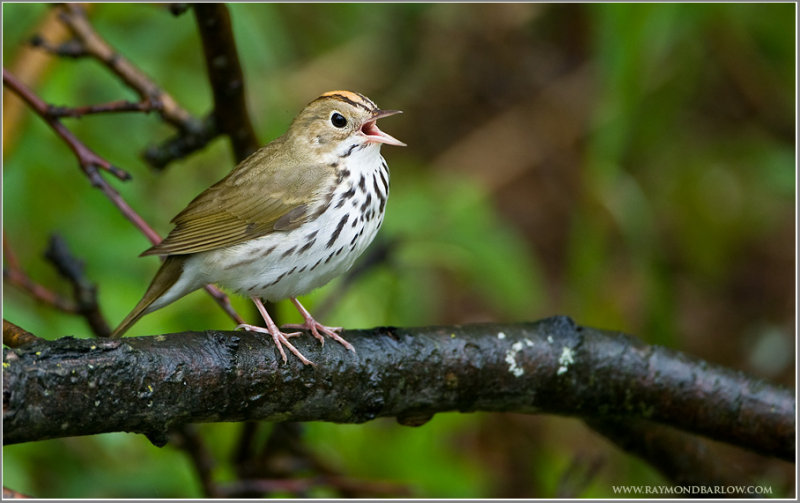
Ovenbird (Seiurus aurocapilla) by Raymond Barlow
In his delight at seeing this old friend, Peter quite forgot Redtail the Hawk. “Oh, Teacher!” cried Peter. “I’m so glad to see you again!”
Teacher stopped singing and looked down at Peter. “If you are so glad why haven’t you been over to see me before?” he demanded. “I’ve been here for some time.”
Peter looked a little foolish. “The truth is, Teacher,” said he very humbly, “I have been visiting the Old Orchard so much and learning so many things that this is the first chance I have had to come ‘way over here in the Green Forest. You see, I have been learning a lot of things about you feathered folks, things I hadn’t even guessed. There is something I wish you’d tell me, Teacher; will you?”
“That depends on what it is,” replied Teacher, eyeing Peter a little suspiciously.
“It is why you are called Oven Bird,” said Peter.
“Is that all?” asked Teacher. Then without waiting for a reply he added, “It is because of the way Mrs. Teacher and I build our nest. Some people think it is like an oven and so they call us Oven Birds. I think that is a silly name myself, quite as silly as Golden Crowned Thrush, which is what some people call me. I’m not a Thrush. I’m not even related to the Thrush family. I’m a Warbler, a Wood Warbler.”
“I suppose,” said Peter, looking at Teacher thoughtfully, “they’ve given you that name because you are dressed something like the Thrushes. That olive-green coat, and white waistcoat all streaked and spotted with black, certainly does remind me of the Thrush family. If you were not so much smaller than any of the Thrushes I should almost think you were one myself. Why, you are not very much bigger than Chippy the Chipping Sparrow, only you’ve got longer legs. I suppose that’s because you spend so much time on the ground. I think that just Teacher is the best name for you. No one who has once heard you could ever mistake you for any one else. By the way, Teacher, where did you say your nest is?”
“I didn’t say,” retorted Teacher. “What’s more, I’m not going to say.”
“Won’t you at least tell me if it is in a tree?” begged Peter.
Teacher’s eyes twinkled. “I guess it won’t do any harm to tell you that much,” said he. “No, it isn’t in a tree. It is on the ground and, if I do say it, it is as well hidden a nest as anybody can build. Oh, Peter, watch your step! Watch your step!” Teacher fairly shrieked this warning.
Peter, who had just started to hop off to his right, stopped short in sheer astonishment. Just in front of him was a tiny mound of dead leaves, and a few feet beyond Mrs. Teacher was fluttering about on the ground as if badly hurt. Peter simply didn’t know what to make of it. Once more he made a movement as if to hop. Teacher flew right down in front of him. “You’ll step on my nest!” he cried.
Peter stared, for he didn’t see any nest. He said as much.
“It’s under that little mound of leaves right in front of your feet!” cried Teacher. “I wasn’t going to tell you, but I just had to or you certainly would have stepped on it.”
Very carefully Peter walked around the little bunch of leaves and peered under them from the other side. There, sure enough, was a nest beneath them, and in it four speckled eggs. “I won’t tell a soul, Teacher. I promise you I won’t tell a soul,” declared Peter very earnestly. “I understand now why you are called Oven Bird, but I still like the name Teacher best.”
Feeling that Mr. and Mrs. Teacher would feel easier in their minds if he left them, Peter said good-by and started on for the lonesome place in the Green Forest where he knew the old nest of Redtail the Hawk had been. As he drew near the place he kept sharp watch through the treetops for a glimpse of Redtail. Presently he saw him high in the blue sky, sailing lazily in big circles. Then Peter became very, very cautious. He tiptoed forward, keeping under cover as much as possible. At last, peeping out from beneath a little hemlock-tree, he could see Redtail’s old nest. He saw right away that it was bigger than it had been when he saw it last. Suddenly there was a chorus of hungry cries and Peter saw Mrs. Redtail approaching with a Mouse in her claws. From where he sat he could see four funny heads stretched above the edge of the nest.
“Redtail is using his old nest again and has got a family already,” exclaimed Peter. “I guess this is no place for me. The sooner I get away from here the better.”
Red-tailed Hawk- Cochran Shoals Unit Chattahoochee River by SSlayton
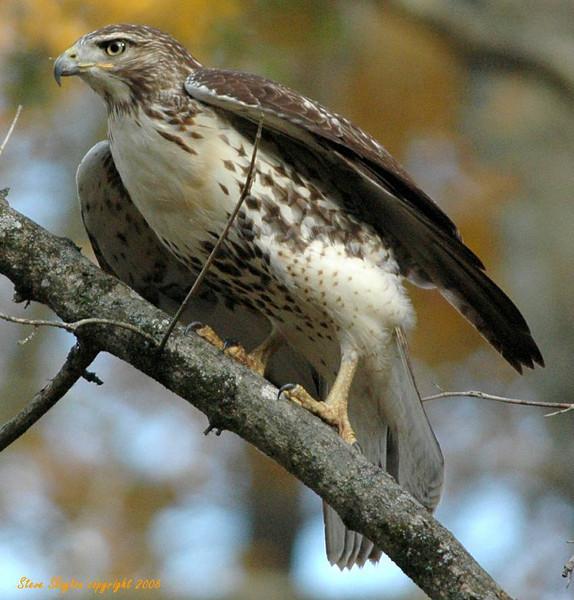
Just then Redtail himself dropped down out of the blue, blue sky and alighted on a tree close at hand. Peter decided that the best thing he could do was to sit perfectly still where he was. He had a splendid view of Redtail, and he couldn’t help but admire this big member of the Hawk family. The upper parts of his coat were a dark grayish-brown mixed with touches of chestnut color. The upper part of his breast was streaked with grayish-brown and buff, the lower part having but few streaks. Below this were black spots and bars ending in white. But it was the tail which Peter noticed most of all. It was a rich reddish-brown with a narrow black band near its end and a white tip. Peter understood at once why this big Hawk is called Redtail.
It was not until Mr. and Mrs. Redtail had gone in quest of more food for their hungry youngsters that Peter dared steal away. As soon as he felt it safe to do so, he headed for home as fast as he could go, lipperty-lipperty-lip. He knew that he wouldn’t feel safe until that lonesome place in the Green Forest was far behind.
Yet if the truth be known, Peter had less cause to worry than would have been the case had it been some other member of the Hawk family instead of Redtail. And while Redtail and his wife do sometimes catch some of their feathered and furred neighbors, and once in a while a chicken, they do vastly more good than harm.
This story gives good examples of friends watching out for friends. Also, friends love their neighbors and go for visits now and then.
“But you be watchful in all things,…” (2 Timothy 4:5a NKJV)
*
Who was the one warning the animal and bird friends?
What is a call of the Crow?
Is it good for us to warn others of danger?
What does Peter really think it says?
Who was the little bird that Peter spotted up in the tree?
Why is he called by that name?
When Peter began to leave, why did the little bird become upset?
What bird was Peter looking for, yet had to make sure that bird didn’t see him?
Why didn’t Peter want to be seen?
Who sees us all the time? Can we hide from Him?
*
“A friend loveth at all times,…” (Proverbs 17:17a KJV)
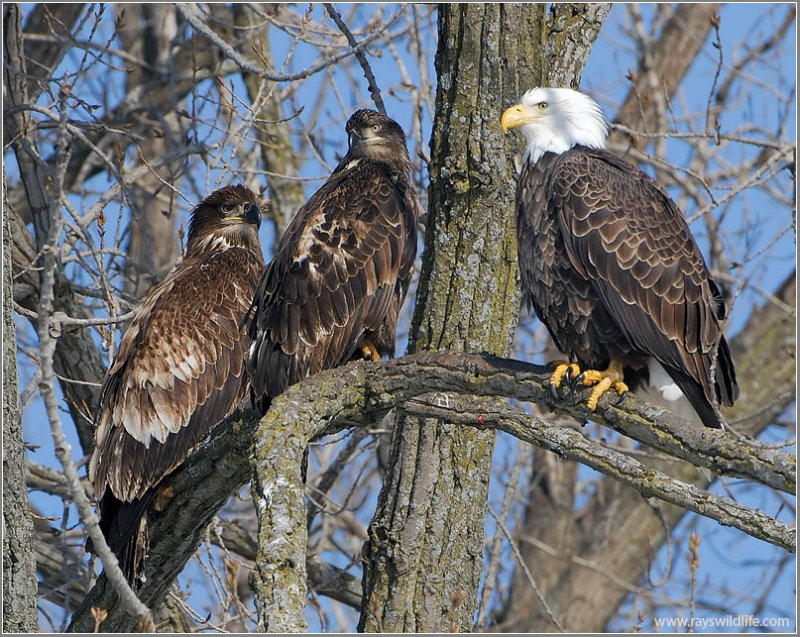
Bald Eagle (Haliaeetus leucocephalus) with youngsters by Raymond Barlow
I wonder if this adult Eagle is having problems teaching its young lessons for their future.
“But they that wait upon the LORD shall renew their strength; they shall mount up with wings as eagles; they shall run, and not be weary; and they shall walk, and not faint.” (Isaiah 40:31 KJV)
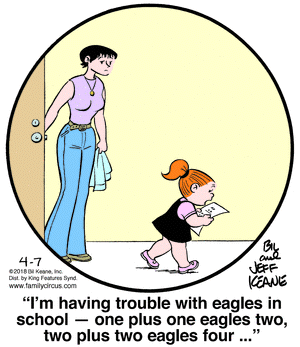
Family Circle with Eagles
This is just for your enjoyment. We all need a chuckle.
“Even the stork in the sky Knows her seasons; And the turtledove and the swift and the thrush Observe the time of their migration; But My people do not know The ordinance of the LORD.” (Jeremiah 8:7 NASB)
The different versions of the Bible, translate this verse with different birds named. Many use either the Swift or the Swallow. They are similar but are in different bird families. The Swifts are in the Apodidae family and Swallows are in the Hirundinidae Family. Mainly, the verse is saying that the birds have more wisdom than some people.
Resemblances between swifts and swallows are similar because of their lifestyles based on catching insects in flight. They were both created with that ability. Both of them migrate or fly to other areas during the seasons. They need warmer weather to have an abundance of flying insects to feast on. [eat]
Glossy Swiftlet (Collocalia esculenta) by Nikhil Devasar
The family name, Apodidae, is derived from the Greek ἄπους (ápous), meaning “footless”, a reference to the small, weak legs of these most aerial of birds. The tradition of depicting swifts without feet continued into the Middle Ages, as seen in the heraldic martlet.
Some species of swifts are among the fastest animals on the planet, with some of the fastest measured flight speeds of any bird. “Swifts are the fastest of birds. Larger species are amongst the fastest fliers in the animal kingdom, with the white-throated needletail having been reported flying at up to 169 km/h (105 mph). Even the common swift can cruise at a maximum speed of 31 metres per second (112 km/h; 70 mph). In a single year the common swift can cover at least 200,000 km.” [Wikipedia]









 Lee's Birdwatching Adventures Plus