Tonight the effects of Hurricane Matthew are causing rain and fairly gusty winds here in Central Florida. So far, Matthew is staying to the east of us, but not by much. (We just got word that it is finally shifting to the east a tad, which is good for us.) Though the Snowy Egrets will still be having a “flying feather” night. Praying for all of those people along the shore as the hurricane scrapes the coast, during tonight and into early morning. Your prayers are always welcomed.
This story is from eNature’s Blog. Many of us worry about the birds and how they make it through Hurricanes like Matthew. This information is well worth repeating.
What Happens To Birds Caught In Hurricanes Like Matthew?
Hurricane Matthew is making its way towards the US East coast after hitting Haiti and Cuba with some of the highest sustained winds and rainfall totals in recent memory.
While Matthew’s wind, rain and storm surge will certainly affect many people, some folks are also wondering about the effects the hurricane may have on birds.
Numbers are hard to come by, but it’s clear that many birds are killed outright by hurricanes. This is especially true of seabirds, which have nowhere in which to seek shelter from these storms. Beaches may be littered with seabird carcasses following major storm events. Most Atlantic hurricanes occur in late summer and early fall—and fall storms coincide with bird migration and may disrupt migration patterns severely.
Many birds get caught up in storm systems and are blown far off course, often landing in inhospitable places or simply arriving too battered and weakened to survive. Others, while not killed or displaced by storms, may starve to death because they are unable to forage while the weather is poor. The number of birds that die as a result of a major hurricanes may run into the hundreds of thousands….
But as they sailed he fell asleep: and there came down a storm of wind on the lake; and they were filled with water, and were in jeopardy. (Luke 8:23 KJV)
Behold the fowls of the air: for they sow not, neither do they reap, nor gather into barns; yet your heavenly Father feedeth them. Are ye not much better than they? (Matthew 6:26 KJV)
“The LORD is slow to anger, and great in power, and will not at all acquit the wicked: the LORD hath his way in the whirlwind and in the storm, and the clouds are the dust of his feet.” (Nahum 1:3 KJV)
“And these are they which ye shall have in abomination among the fowls; they shall not be eaten, they are an abomination: the eagle, andthe ossifrage, and the osprey,” (Leviticus 11:13)
Once there was a group of crows that lived on an island off of eastern Australia. They were New Caledonian Crows and every day one of them would leave their group of large nests in the trees to hunt for food.
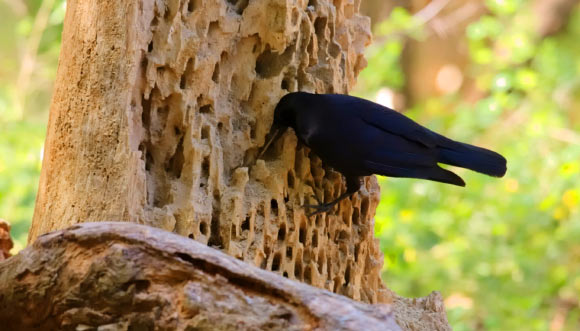
On one particular day, one of the crows named Oliver flew to a tree trunk to search for food. Oliver carefully ripped off a piece of a plant to scoop out some worms from the trunk. In order to scrape the worms out, Oliver bit the strip of the plant with his beak to give the side of it a sharp, jagged edge. After pulling out the worms, Oliver grabbed them in his beak and made ready to fly away.
But as Oliver was about to fly back to his nest he spotted two creatures he had never seen before.
New Caledonian Crow (Corvus moneduloides) by Ian Montgomery
They were tall, wearing long white things that looked like tails to Oliver. They were hiding in the bushes as if they were watching him, but because they didn’t appear as if they would attack, Oliver flew back to his nest leaving his tool behind.
The next day, Oliver returned to the same tree trunk and made another tool just like the one had constructed the previous day. But before he dug into the trunk for more worms he noticed the same creatures sitting behind the bushes and watching him make his tool. This time, they had a strange machine.
Glancing down, Oliver realized that the tool he had made yesterday was gone, and he guessed that the creatures must have taken it. Thinking, that all the creatures wanted was whatever he made, Oliver attempted an experiment. After pulling out some worms and placing them in his claws, Oliver flew close to where the creatures sat and dropped his tool. After flying away, Oliver hid and watched the creatures pick it up and examine it. It seemed that they were taking notes on the way he had shaped the tool.
The next day Oliver made another tool after digging out worms then flew back to the bushes. This time he waited in front of the bushes, and the two creatures came out from behind the bushes. Oliver remained where he was.
Eventually the two people cautiously came closer to him. The entire time they used the strange machine Oliver had seen before. Oliver watched patiently, wondering what they were doing. One threw a couple of nuts down and Oliver assumed that this was payment to him for giving them his tool. After a few minutes Oliver flew away with the nuts, still confused.
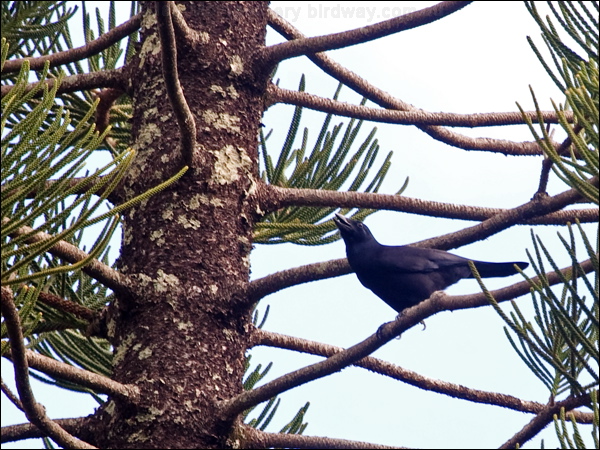
New Caledonian Crow (Corvus moneduloides) by Ian Montgomery
But what Oliver didn’t know was that the people were two scientists studying New Caledonian Crows in eastern Australia. They had been documenting exactly how Oliver had built his tool out of the plant in order to get his food. And according to studies, besides humans, crows like Oliver are the best tool makers in the world. But Oliver never knew why they were there or where the people had come from. He did, however, fly back to the other crows to explain what he had seen. The other crows appeared to be very impressed at how Oliver had become a tool entrepreneur. From then on, the other crows considered Oliver’s tools to be better than of all the others when it came to catching food.
Lee’s Addition:
“Whence then cometh wisdom? and where is the place of understanding?” (Job 28:20 KJV)
Emma has given us another Bird Tale, but this one is actually based on some research she did about this interesting bird. She didn’t tell me which articles she had read, but I found several on the internet. One link and a video are below. Some of the articles found on line try to explain this behavior as part of evolution, but as the verse above says, we know where wisdom comes from. The Lord created the birds with enough knowledge to develop this habit. Crows are known as being very intelligent.
Thanks, Emma, for a very good article. Now we know how the birds must feel when they are being “watched” by those scientist. Keep up the great stories.
This video shows the New Caledonian Crow working with his tool very successfully. His friend joins in the search for worms, but doesn’t quite have the knack of the first one. This was part of a research project of the scientist.
Elegant Crested Tinamou (Eudromia elegans) Cloud Forest at Zoo Miami by Lee
In the beginning God created the heaven and the earth. (Genesis 1:1 KJV)
We have finished up all the Passeriformes and reviewed them here with the Sunday Inspirations. That only took from February 1st of 2015 to September 25th of 2016. Of the forty orders of birds in the world, Passeriformes was the last and largest of the orders taxonomically. Today, we are going to start at the first of the bird orders. Not to panic, there is only one family in this order. We will cover it today.
Dan and I have only seen one member of this order and that was at Zoo Miami, FL
Elegant Crested Tinamou (Eudromia elegans) by Dan at Zoo Miami
“Tinamiformes is a taxonomic order of birds that are also known as Tinamou. The order is represented by only one Family Tinamidae, which consists of 47 species in 9 genera. They are short-legged, little-headed and plump-bodied. They prefer to run rather than fly to avoid danger.
The Tinamous are found only in Central and South America. They are related to the ratites (Ostriches and Rheas). Generally ground dwelling, they are found in a range of habitats from woodlands to open grassland. They prefer eating a diet of berries and seeds off the ground. They also consume insects and small animals.” (CreationWiki)
As you will notice the Tinamou are not very colorful and that is mostly because of how they live. They are very well designed by their Creator to sulk along in the underbrush.
“And God created great whales, and every living creature that moveth, which the waters brought forth abundantly, after their kind, and every winged fowl after his kind: and God saw that it was good.” (Genesis 1:21 KJV) Emphasis added
This slideshow requires JavaScript.
Go forth of the ark, thou, and thy wife, and thy sons, and thy sons’ wives with thee. Bring forth with thee every living thing that is with thee, of all flesh, both of fowl, and of cattle, and of every creeping thing that creepeth upon the earth; that they may breed abundantly in the earth, and be fruitful, and multiply upon the earth. (Genesis 8:16-17 KJV)
“And of every living thing of all flesh, two of every sort shalt thou bring into the ark, to keep them alive with thee; they shall be male and female.” (Genesis 6:19 KJV)
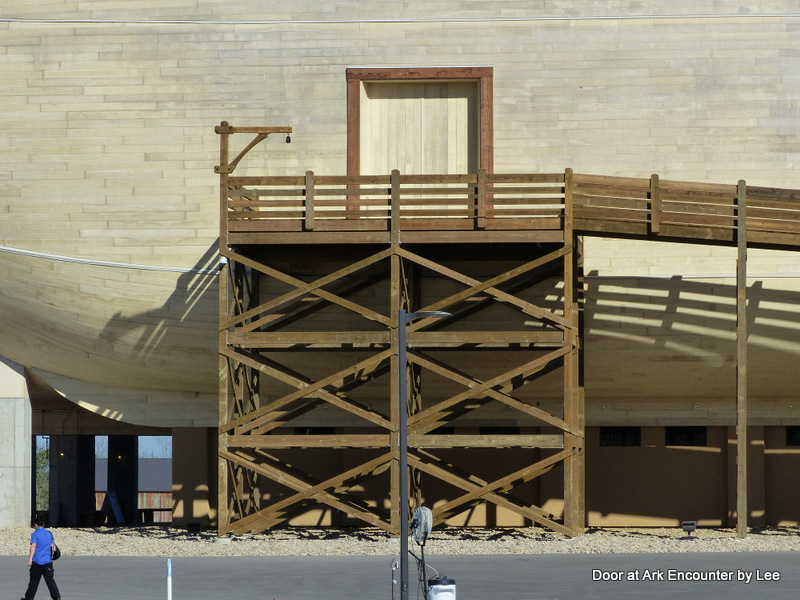
The first article about our visit to the Ark Encounter which is part of Answers in Genesis was Birdwatching On Board the Ark Encounter – The Doves. Now I would like to show you the other birds we found on the ark.
First, there are no live animals on the this ark, but there are representations of the birds. Some are beautifully sculptured, and the others were real birds that had been stuffed by a taxidermist. Having live animals on-board would be quite involved. The purpose of the Ark, in this respect, is to show how the animals would have been kept on board. More like museum displays.
Bird Enclosures at the Ark Encounter
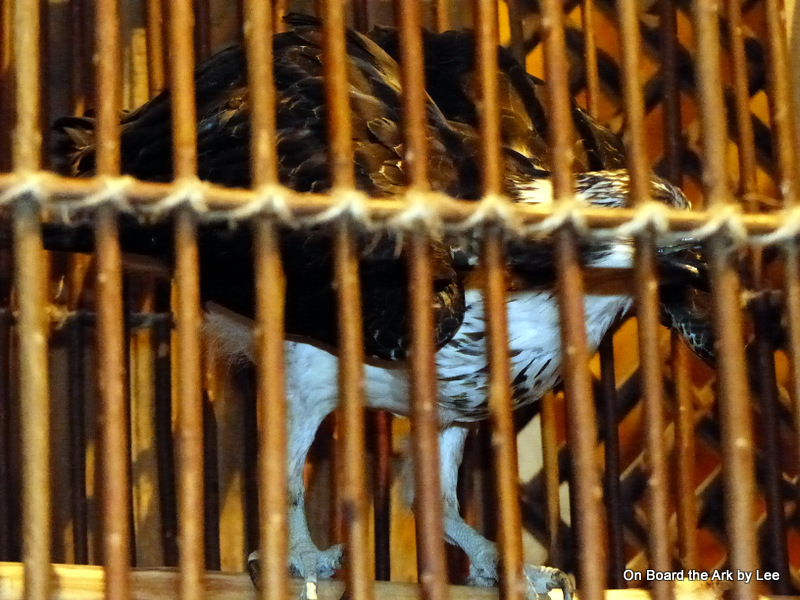
After entering the ark, there are areas where the cages or enclosures for the animals, birds, and creeping things were held. The cages for the birds were very interesting. For once, my not being able to get a shot through the cage, worked out okay. Now you can see the wood pretty good.
Bird Enclosures at the Ark Encounter – with a Hornbill
All of them were made of wood, and they were of different sizes, of course. Bigger cages for the larger birds like the Cassowary,
Bird Enclosures at the Ark Encounter – with a Cassowary
medium to large size for birds like the Sacred Ibis,
Medium to Large Enclosure for the Scarlet Ibis
and smaller yet for the Parrots.
Parrot the Ark Encounter
We also found onboard these birds: A Motmot, a Pigeon (I think), an Osprey, an Owl, a Quail, and another two that I am not sure of. Looks like one of the unknowns is some sort of water bird. If you would like to leave a reply with the names, please do. I have added the photos so they can be seen larger.
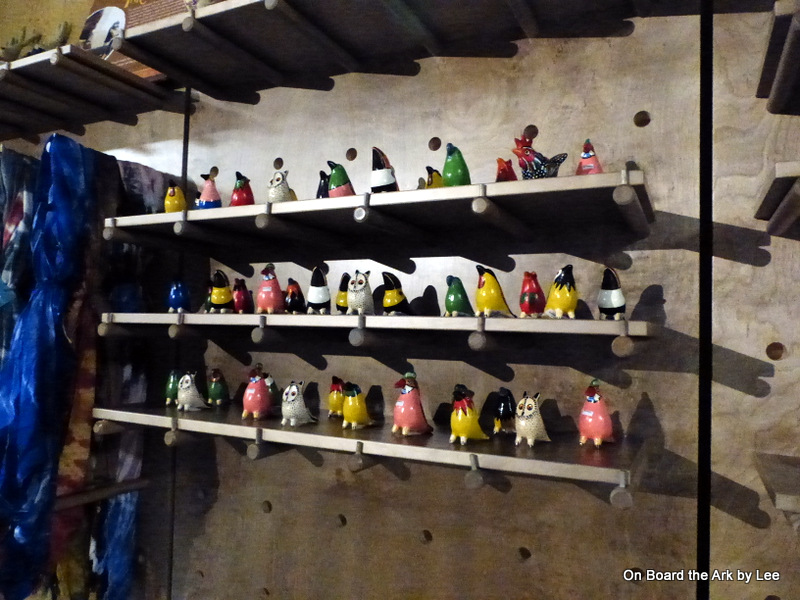
In the gift shop, I found these birds for sale. :)
Birds at the Ark Encounter Store
At the Ararat Ridge Zoo, behind the Ark, we found an Emu.
That is about the sum total of the birds we saw. Of course, the Doves that were shown in the first article. It was a little disappointed, but we understand their reasoning. There will have more about the birds and how they were provided for in another Ark Encounter article.
“Of fowls after their kind, and of cattle after their kind, of every creeping thing of the earth after his kind, two of every sort shall come unto thee, to keep them alive.” (Genesis 6:20 KJV)







 Lee's Birdwatching Adventures Plus