
Chickadee by.Birds Illustrated by Color Photography, 1897
Birds Illustrated by Color Photography – Revisited
Vol 1. May, 1897 No. 5
*
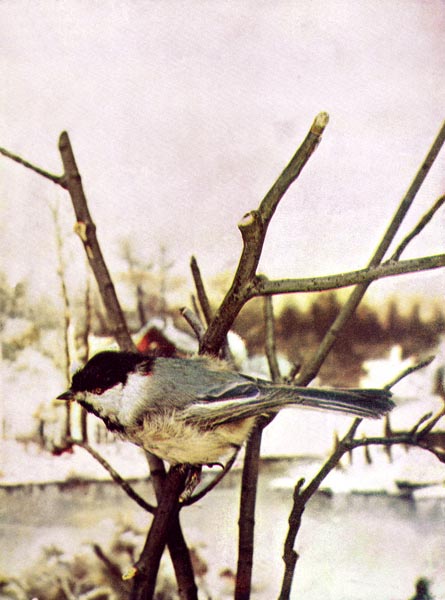
CHICKADEE.
Bird of the Merry Heart.Here is a picture of a bird that is always merry. He is a bold, saucy little fellow, too, but we all love him for it. Don’t you think he looks some like the Canada Jay that you saw in April “Birds?” I think most of you must have seen him, for he stays with us all the year, summer and winter. If you ever heard him, you surely noticed how plainly he tells you his name. Listen—“Chick-a-dee-dee; Chick-a-dee; Hear, hear me”—That’s what he says as he hops about from twig to twig in search of insects’ eggs and other bits for food. No matter how bitter the wind or how deep the snow, he is always around—the same jolly, careless little fellow, chirping and twittering his notes of good cheer.
Like the Yellow Warblers, Chickadees like best to make their home in an old stump or hole in a tree—not very high from the ground. Sometimes they dig for themselves a new hole, but this is only when they cannot find one that suits them. The Chickadee is also called Black-capped Titmouse. If you look at his picture you will see his black cap. You’ll have to ask someone why he is called Titmouse. I think Chickadee is the prettier name, don’t you? If you want to get well acquainted with this saucy little bird, you want to watch for him next winter, when most of the birds have gone south. Throw him crumbs of bread and he will soon be so tame as to come right up to the door step.
THE BLACK-CAPPED CHICKADEE.
“Chic-chickadee dee!” I saucily say; My heart it is sound, my throat it is gay! Every one that I meet I merrily greet With a chickadee dee, chickadee dee! To cheer and to cherish, on roadside and street, My cap was made jaunty, my note was made sweet.
Chickadeedee, Chickadeedee! No bird of the winter so merry and free; Yet sad is my heart, though my song one of glee, For my mate ne’er shall hear my chickadeedee.
I “chickadeedee” in forest and glade, “Day, day, day!” to the sweet country maid; From autumn to spring time I utter my song Of chickadeedee all the day long! The silence of winter my note breaks in twain, And I “chickadeedee” in sunshine and rain.
Chickadeedee Chickadeedee! No bird of the winter so merry and free; Yet sad is my heart, though my song one of glee, For my mate ne’er shall hear my chickadeedee.—C. C. M.
SAUCY little bird, so active and familiar, the Black-Capped Chickadee, is also recognized as the Black Capped Titmouse, Eastern Chickadee, and Northern Chickadee. He is found in the southern half of the eastern United States, north to or beyond forty degrees, west to eastern Texas and Indian Territory. The favorite resorts of the Chickadee are timbered districts, especially in the bottom lands, and where there are red bud trees, in the soft wood of which it excavates with ease a hollow for its nest. It is often wise enough, however, to select a cavity already made, as the deserted hole of the Downy Woodpecker, a knot hole, or a hollow fence rail.
In the winter season it is very familiar, and is seen about door yards and orchards, even in towns, gleaning its food from the kitchen remnants, where the table cloth is shaken, and wherever it may chance to find a kindly hospitality. In an article on “Birds as Protectors of Orchards,” Mr. E. H. Forbush says of the Chickadee: “There is no bird that compares with it in destroying the female canker-worm moths and their eggs.” He calculated that one Chickadee in one day would destroy 5,550 eggs, and in the twenty-five days in which the canker-worm moths run or crawl up the trees 138,750 eggs. Mr. Forbush attracted Chickadees to one orchard by feeding them in winter, and he says that in the following summer it was noticed that while trees in neighboring orchards were seriously damaged by canker-worms, and to a less degree by tent caterpillars, those in the orchard which had been frequented by the Chickadee during the winter and spring were not seriously infested, and that comparatively few of the worms and caterpillars were to be found there. His conclusion is that birds that eat eggs of insects are of the greatest value to the farmer, as they feed almost entirely on injurious insects and their eggs, and are present all winter, where other birds are absent.
The tiny nest of the Chickadee is made of all sorts of soft materials, such as wool, fur, feathers, and hair placed in holes in stumps of trees. Six to eight eggs are laid, which are white, thickly sprinkled with warm brown. Mrs. Osgood Wright tells a pretty incident of the Chickadees, thus: “In the winter of 1891-2, when the cold was severe, the snow deep, and the tree trunks often covered with ice, the Chickadees repaired in flocks daily to the kennel of our old dog Colin and fed from his dish, hopping over his back and calling Chickadee, dee, dee, in his face, a proceeding that he never in the least resented, but seemed rather to enjoy it.”
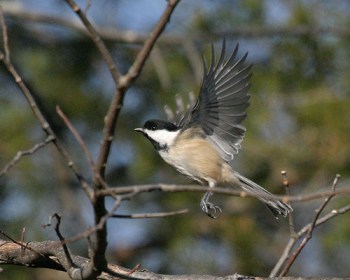
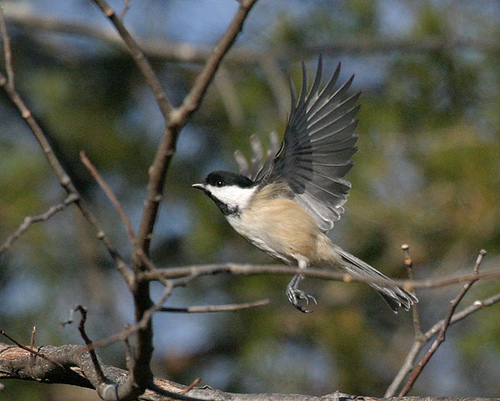
Black-capped Chickadee (Poecile atricapillus) by Kent Nickell
Lee’s Addition:
A merry heart makes a cheerful countenance, But by sorrow of the heart the spirit is broken. The heart of him who has understanding seeks knowledge, But the mouth of fools feeds on foolishness. All the days of the afflicted are evil, But he who is of a merry heart has a continual feast. Better is a little with the fear of the LORD, Than great treasure with trouble. (Proverbs 15:13-16 NKJV)
The Black-capped Chickadee (Poecile atricapillus) is a small, North American songbird, a passerine bird in the Tit, Chickadee – Paridae Family. It is the state bird of both Maine and Massachusetts in the United States, and the provincial bird of New Brunswick in Canada. It is notable for its capacity to lower its body temperature during cold winter nights, its good spatial memory to relocate the caches where it stores food, and its boldness near humans (they can feed from the hand).
On cold winter nights, these birds reduce their body temperature by up to 10–12 °C (from their normal temperature of about 42 °C) to conserve energy.[8] Such a capacity for torpor is rare in birds (or at least, rarely studied). Other bird species capable of torpor include the Common Swift Apus apus, the Common Poor-will Phalaenoptilus nuttallii, the Lesser Nighthawk Chordeiles acutipennis, and various species of hummingbirds.
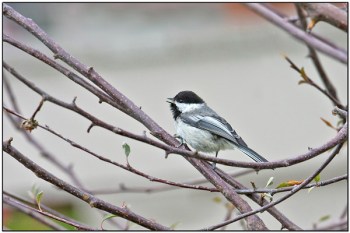
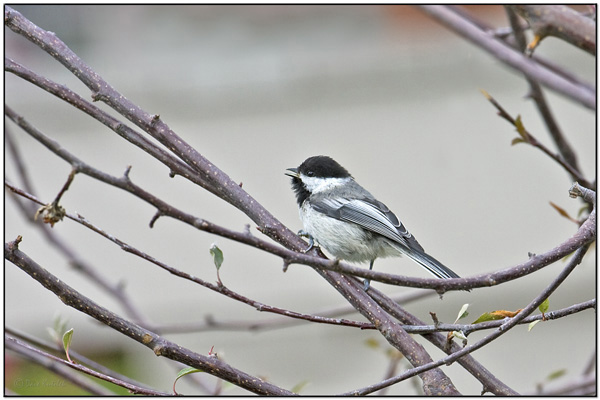
Black-capped Chickadee by Dave’s BirdingPix
The Black-capped Chickadee has a black cap and bib with white sides to the face. Its underparts are white with rusty brown on the flanks. Its back is gray and the tail is normally slate-gray. This bird has a short dark bill (8.0-9.5 mm), short rounded wings (63.5-67.5 mm) and a long tail (58–63 mm). Total body length is 12–15 cm (4.7–5.9 in), wingspan is 16–21 cm (6.3–8.3 in) and body mass is 9–14 g (0.32–0.49 oz). Sexes look alike, but males are slightly larger and longer than females.
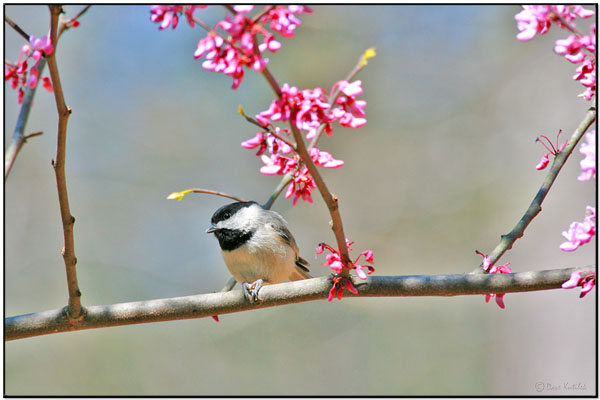
Although range can generally be used to separate them, the Black-capped Chickadee is very similar in appearance to the Carolina Chickadee. The Black-capped is larger on average but this cannot be used reliably for identification. The most obvious difference between the two is in the wing feathers. In the Black-capped Chickadee, the wing feathers have white edges that are larger and more conspicuous than those of the Carolina Chickadee.
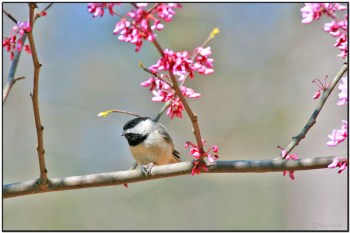
Carolina Chickadee (Poecile carolinensis) by Daves BirdingPix
A merry heart does good, like medicine, But a broken spirit dries the bones. (Proverbs 17:22 NKJV)
*
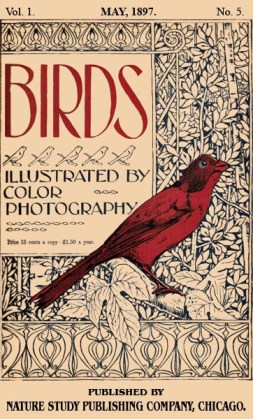
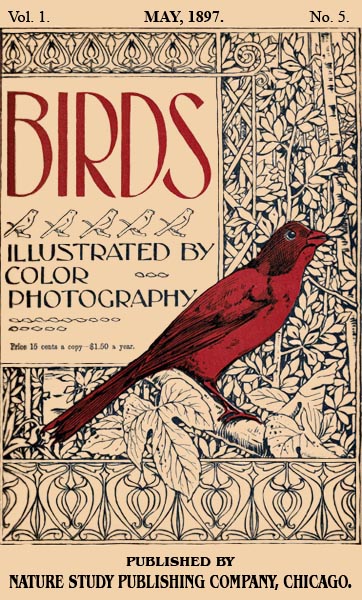
Birds Illustrated by Color Photograhy Vol 1 May, 1897 No 5 – Cover
Birds Illustrated by Color Photography – Revisited – Introduction
The above article is the first article in the monthly serial that was started in January 1897 “designed to promote Knowledge of Bird-Live.” These include Color Photography, as they call them, today they are drawings. There are at least three Volumes that have been digitized by Project Gutenberg.
To see the whole series of – Birds Illustrated by Color Photography – Revisited
*
(Information from Wikipedia and other internet sources)
Next Article – The Scissor-Tailed Flycatcher
Previous Article – The Marsh Hawk
Links:
Black-capped Chickadee – All About Birds
All About Black-capped Chickadee – Sialis
Black-capped Chickadee – National Geographic
Tit, Chickadee – Paridae Family
Black-capped Chickadee – Wikipedia
*

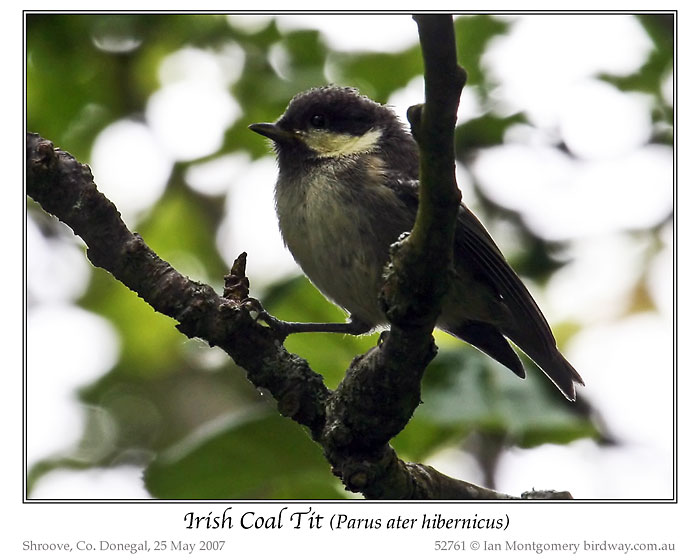 The first photo shows an adult bird, while the second one is a juvenile with drabber colours and juvenile Coal Tits tend to have yellower cheeks anyway. Incidentally, there are 21 subspecies of Coal Tit currently recognised, from the Irish one in the west to Taiwanese and Japanese ones in the east. Some authorities dispute the validity of these subspecies because of local variation.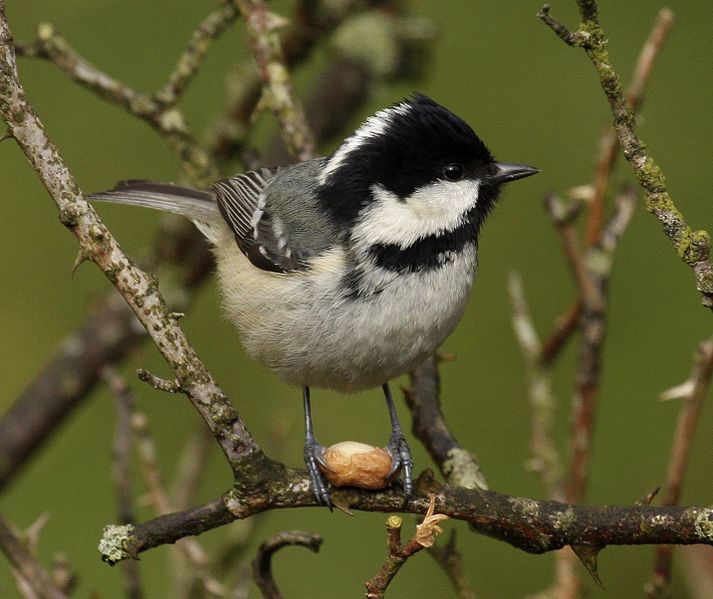


 Lee's Birdwatching Adventures Plus