New Project – Our Birdwatching Photos

Wood Duck - Lake Morton by Lee

Wood Duck – Lake Morton by Lee

O LORD, how manifold are thy works! in wisdom hast thou made them all: the earth is full of thy riches. (Psalms 104:24 KJV)

While working on Family pages, it dawned on me that very few of our photos have been used. We, Dan and I, do take quite a few photos while on our birdwatching adventures into the wild and at the zoos. Actually, I take about 4-5 more than he does on each adventure (more like 10-1). He spends his time trying to compose his shots and do all that sort of stuff. Me, I have a Program mode Panasonic Lumix that I shoot, shoot, shoot. Of course, his photos are always better and he knows how to prep them better, but I get more “action” photos. I have action of the bird moving (blurred), flying off (blurred), turning around (blurred), behind a fence (bird-blurred, fence-clear), in a tree (bird-blurred, branch with leaves-clear). Every once in a while I get a nice photo that isn’t too blurred that could be shared with you.

Another thing he has tried to teach me is the 1/3rd thing. Me, I want that bird right in the middle of my shot so that when I get home I can try to find it behind those clear fences and branches. To me, my photos are for “proof” that the bird was seen and also to try to figure out what it really was. You see, I am a “birdwatcher” and he is a “photographer.” There is a difference! You can blend the two, but there IS a different attitude at work here.

Yesterday the Our Birdwatching Photos page was created and a new tab was placed up at the top. Now, I am working on creating pages, by families, of our photos. Most will be mine, because I take more and he already has a website for his photos at Dan’s Pix. I will be copying some of his over here of course and maybe I can get some of his “unpublished” ones also.

Elegant Crested Tinamou (Eudromia elegans) Cloud Forest at Zoo Miami by Lee

Elegant Crested Tinamou (Eudromia elegans) at Zoo Miami by Lee

Don’t expect the greatest photos, because I am not a great photographer, but I enjoy “watching” the birds. The Lord has created so many birds that are just so beautiful and unique. The variety is amazing. The colors are  breathtaking at times. The birds are adorable, cute, ugly, big, little, tall, short, evasive, calm, fidgety, graceful, etc. They sing some of the most beautiful songs and some have terrible tunes, but don’t you just enjoy watching and listening to them?

O Lord, how many and varied are Your works! In wisdom have You made them all; the earth is full of Your riches and Your creatures. (Psalms 104:24 AMP)

O the depth of the riches both of the wisdom and knowledge of God! how unsearchable are his judgments, and his ways past finding out! (Romans 11:33 KJV)

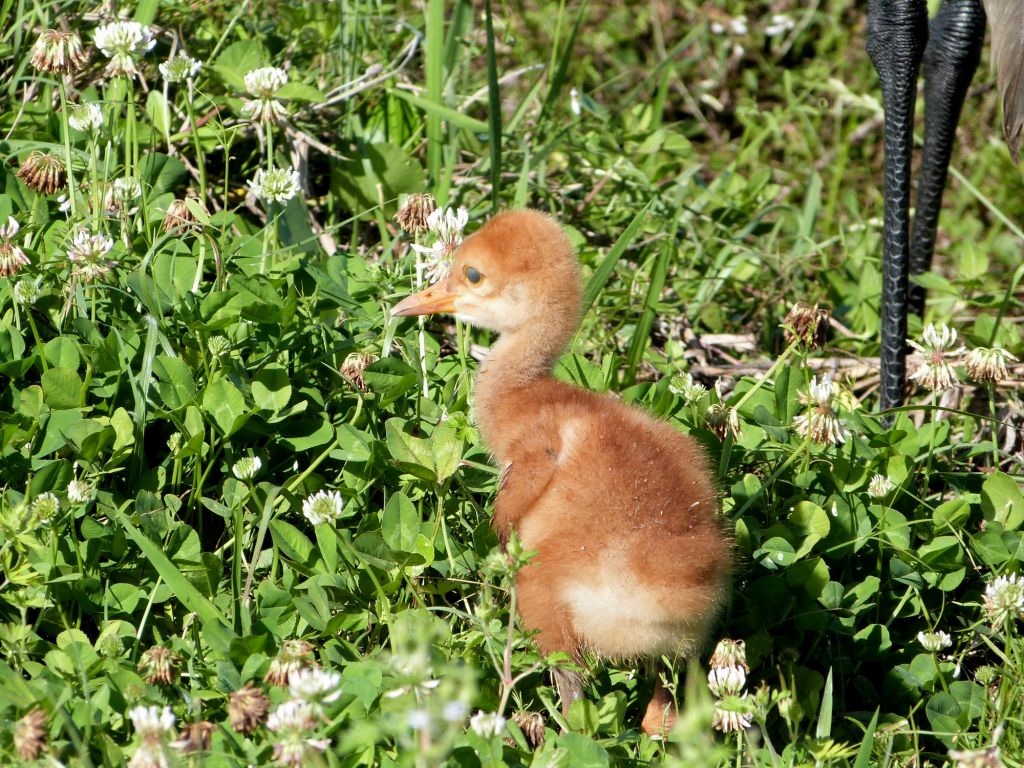
Blurred, but isn't it cute?

Sandhill Crane Chick at Circle B by Lee – Blurred, but isn’t it cute?

*

Our Birdwatching Photos

Dan’s Pix

*

Ian’s Bird of the Week – Strong-billed Honeyeater

Bird of the Week – Strong-billed Honeyeater ~ Ian Montgomery

Newsletter ~ 3-27-13

Still on the subject of Tasmanian endemics, Tasmania has 4 honeyeater that aren’t found on the mainland. We had the Yellow Wattlebird several weeks ago; the other three comprise the Yellow-throated Honeyeater and two of the seven members of the genus Melithreptus : the Black-headed Honeyeater and this week’s choice the Strong-billed Honeyeater.

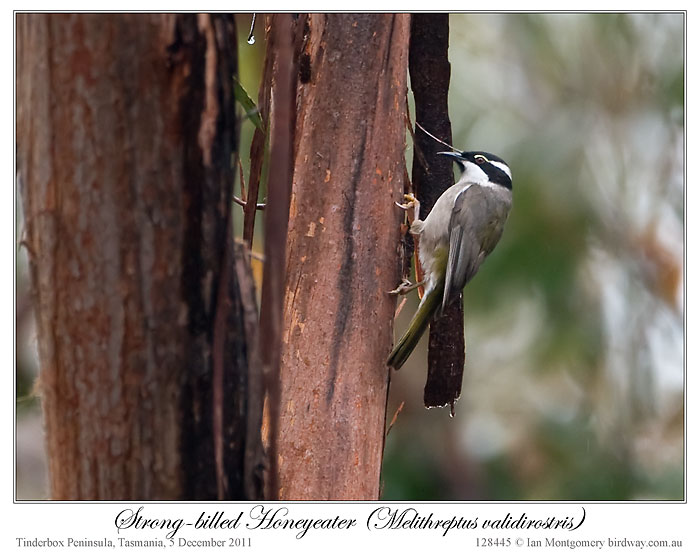
Strong-billed Honeyeater (Melithreptus validirostris) by Ian 1

Strong-billed Honeyeater (Melithreptus validirostris) by Ian 1

Melithreptus means ‘honey-fed’ and is like Meliphaga a synonym for ‘Honeyeater’ (the Honeyeater family is Meliphagidae) and most members of the Melithreptus genus feed on nectar to varying degrees. The Strong-billed is different, however, and feeds mainly on insects and other invertebrates. It uses its sturdy bill and relatively strong neck and shoulders to strip bark from tree trunks and branches and to probe coarse bark in search of prey. The bird in the first photo is in a very typical pose. Note the strong feet and long claws adapted for clinging to vertical trunks. Interestingly, there are no treecreepers in Tasmania, and the Strong-billed Honeyeater would appear to have adapted to fill the resulting void. With a length of 15-17 cm/6-6.7 in it is the largest member of the genus.

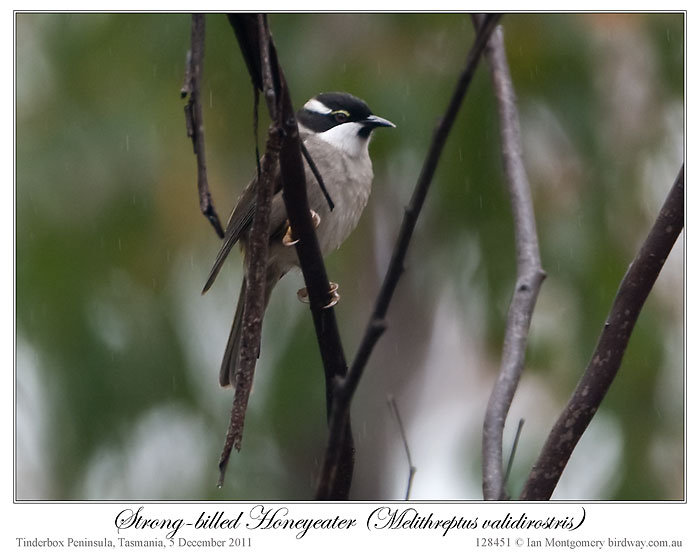
Strong-billed Honeyeater (Melithreptus validirostris) by Ian 2

Strong-billed Honeyeater (Melithreptus validirostris) by Ian 2

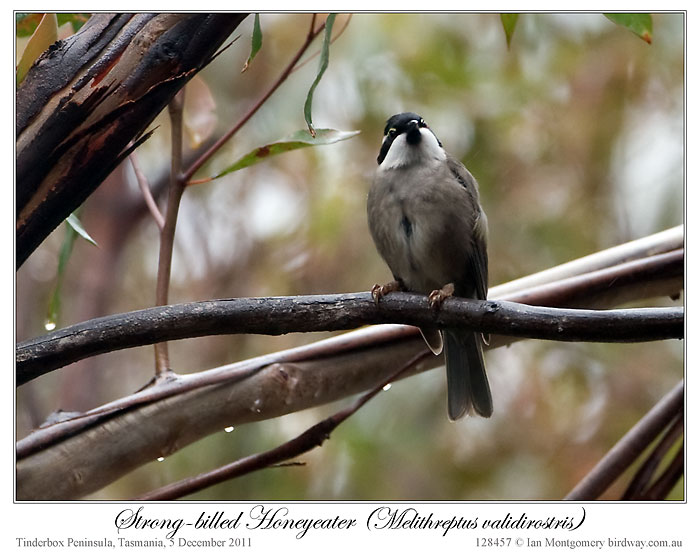
All the Melithreptus species except the Black-headed have the distinctive white stripe across the back of the head. They all have decorative eye-crescents above the eye and its colour is a field mark for distinguishing the different species, and can be whitish, blue, yellowish or red. You can see that it is whitish in these Strong-billed though it can also be pale blue.

Strong-billed Honeyeater (Melithreptus validirostris) by Ian 3

Strong-billed Honeyeater (Melithreptus validirostris) by Ian 3

Tomorrow, I’m off to Southwestern Queensland in search of dry-country birds. So I hope to be able to bring you some interesting examples of these in the coming weeks.

Best wishes
Ian

**************************************************
Ian Montgomery, Birdway Pty Ltd,
454 Forestry Road, Bluewater, Qld 4818
Tel 0411 602 737 ian@birdway.com.au
Check the latest website updates:
http://www.birdway.com.au/#updates


Lee’s Addition:

And He said to me, Son of man, eat this scroll that I give you and fill your stomach with it. Then I ate it, and it was as sweet as honey in my mouth. (Ezekiel 3:3 AMP)

I like the clean lines on that Honeyeater. Simple, but very becoming. Thanks, Ian, for introducing us to another Tazmanian bird. Not sure whats out in the Southwestern Queensland, but I am sure in the weeks to come, we will find out. Humm! Wonder what he will find?

As Ian said, the Strong-billed Honeyeater is part of the Meliphagidae – Honeyeaters Family. Check out his Meliphagidae Family. He has lots of photos of them.

See his other newsletters about the Honeyeaters:

Antbirds ~ An Interesting Family

Great Antshrike (Taraba major) by Ian

Great Antshrike (Taraba major) by Ian

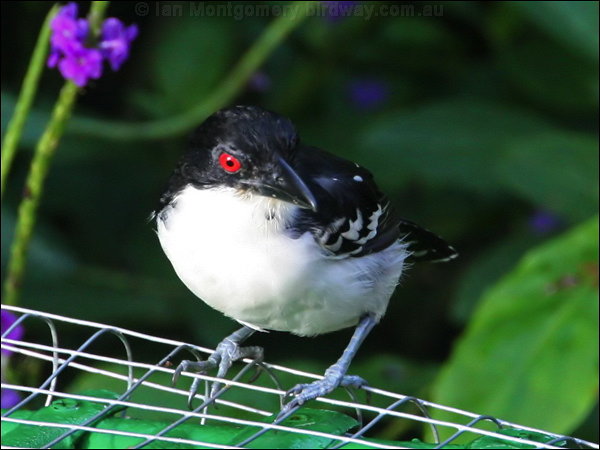
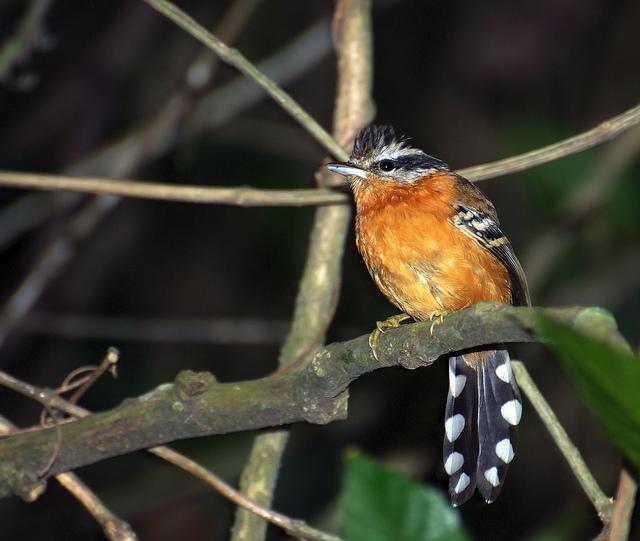
Just finished working on the Typical Antbird Family. (Thamnophilidae – Antbirds) Of the 228 species, there were only 21 links when I started a few day ago, after finishing the Tyrannidae – Tyrant Flycatchers Is Complete Minus One Bird family and article. Other than 4 species that are evading me, it is almost finished. I was side-lined Sunday evening and all day yesterday with some food poisoning. Perked up enough this evening to finish it up.

The little birds that are staying out of the camera lens are the:

If anyone knows where to find a photo of them, I would be obliged. Leave a comment if you know where they are hiding.

White-flanked Antwren (Myrmotherula axillaris) by Michael Woodruff

White-flanked Antwren (Myrmotherula axillaris) by Michael Woodruff

When you search the internet for photos, you have to be careful, I am finding out. Some searches show a picture on a page with the correct name, but the photo does not match the named bird. Won’t mention any names, but I will mention one of the more trusted sites that I use. IBC which is actually The Internet Bird Collection headed up, I believe by Josep del Hoyo. He and that group are quite experts in ornithology. They have been producing the Handbook of the Birds of the World. There are over 16 Volumes and counting. Their goal “has been to cover in detail and illustrate every species of bird in the world.” Now there is an undertaking, to say the least.

Ferruginous Antbird (Drymophila ferruginea) by Dario Sanches

Ferruginous Antbird (Drymophila ferruginea) by Dario Sanches

Back to the Antbirds. Wikipedia has this to say about them. ”

The antbirds are a large family, Thamnophilidae, of passerine birds found across subtropical and tropical Central and South America, from Mexico to Argentina. There are more than 200 species, known variously as antshrikes, antwrens, antvireos, fire-eyes, bare-eyes and bushbirds. They are related to the antthrushes and antpittas (family Formicariidae), the tapaculos, the gnateaters and the ovenbirds. Despite some species’ common names, this family is not closely related to the wrensvireos or shrikes.

Antbirds are generally small birds with rounded wings and strong legs. They have mostly sombre grey, white, brown and rufous plumage, which is sexually dimorphic in pattern and coloring.  Some species communicate warnings to rivals by exposing white feather patches on their backs or shoulders. Most have heavy bills, which in many species are hooked at the tip.

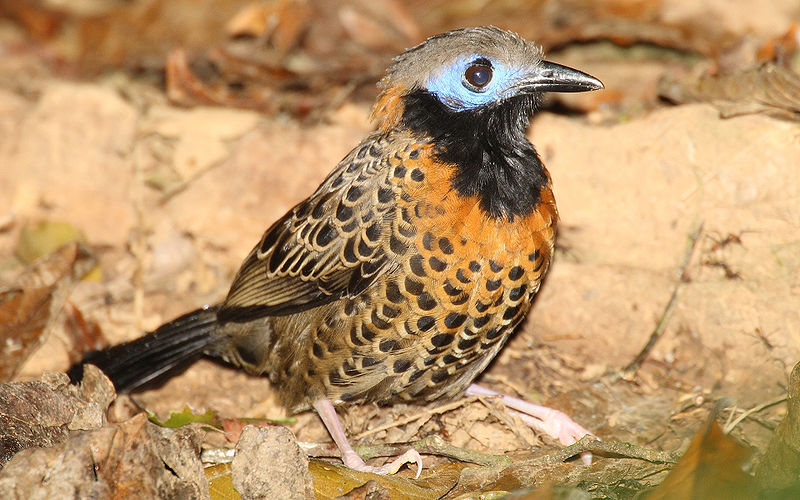
Ocellated Antbird (Phaenostictus mcleannani) ©WikiC

Ocellated Antbird (Phaenostictus mcleannani) ©WikiC

Members of this family have short rounded wings that provide good manoeuvrability when flying in dense undergrowth. The legs are large and strong, particularly in species that are obligate ant-followers. These species are well adapted to gripping vertical stems and saplings, which are more common than horizontal branches in the undergrowth, and thus the ability to grip them is an advantage for birds following swarms of army ants. The claws of these antbirds are longer than those of species that do not follow ants, and the soles of some species have projections that are tough and gripping when the foot is clenched. Tarsus length in antbirds is related to foraging strategy. Longer tarsi typically occur in genera such as the Thamnophilus antshrikes that forage by perch-gleaning (sitting and leaning forward to snatch insects from the branch), whereas shorter tarsi typically occur in those that catch prey on the wing, such as the Thamnomanes antshrikes.

Most antbirds have proportionately large, heavy bills. Several genera of antshrike have a strongly hooked tip to the bill, and all antbirds have a notch or ‘tooth’ at the tip of the bill which helps in holding and crushing insect prey. The two genera of bushbirds have upturned chisel-like bills.” (Wikipedia with editing)

Black-crested Antshrike (Sakesphorus canadensis) ©WikiC

Black-crested Antshrike (Sakesphorus canadensis) ©WikiC

It appears the Lord has created these birds with just what they need to survive in their environment. They may well be keeping the ant population in control, but some of the videos with the bird in the middle of an ant army swarm, makes you wonder who is winning.

But now ask the beasts, and they will teach you; And the birds of the air, and they will tell you; (Job 12:7 NKJV)

I know all the birds of the mountains, And the wild beasts of the field are Mine. (Psalms 50:11 NKJV)

The Bible has several things to say about the Ants:

The ants are a people not strong, Yet they prepare their food in the summer; (Proverbs 30:25 NKJV)

Go to the ant, you sluggard! Consider her ways and be wise, Which, having no captain, Overseer or ruler, Provides her supplies in the summer, And gathers her food in the harvest. How long will you slumber, O sluggard? When will you rise from your sleep? A little sleep, a little slumber, A little folding of the hands to sleep—So shall your poverty come on you like a prowler, And your need like an armed man. (Proverbs 6:6-11 NKJV)

Not being lazy and providing for yourself are two things one can learn. Also, He provides for the birds of this family by giving them an ample supply of ants and other insects, yet, they have to do the work of catching them. They are not fed directly by the Lord.

The Scripture tells us that “…my God shall supply all your need according to His riches in glory by Christ Jesus. (Philippians 4:19 NKJV). Are we suppose to sit back and just expect things to be provided for us? No, neither do the birds or animals. Yes, the Lord supplies our needs, for example, by having things grow, but they need to be picked and cooked or purchased and cooked. That is only one illustration from thousands.

White-plumed Antbird (Pithys albifrons) ©WikiC

White-plumed Antbird (Pithys albifrons) ©WikiC

Enjoy the ANTBIRD family. They are not the prettiest, but some are quite interesting.

Thamnophilidae – Antbirds

*

Tyrannidae – Tyrant Flycatchers Is Complete Minus One Bird

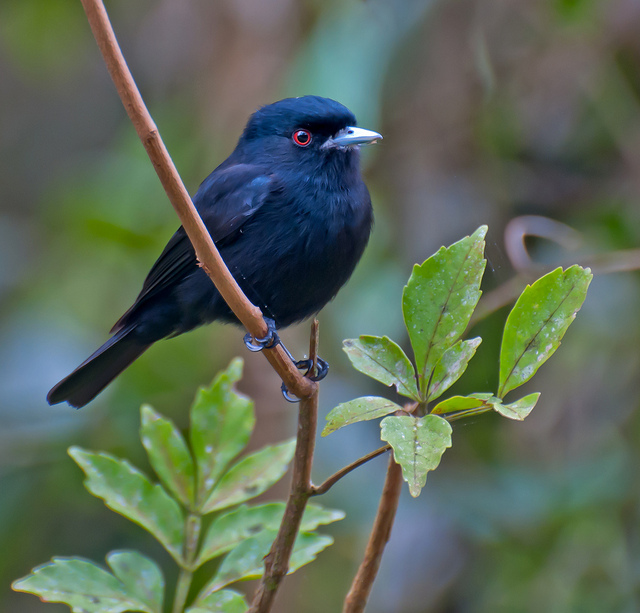
Blue-billed Black Tyrant (Knipolegus cyanirostris) by Dario Sanches

Blue-billed Black Tyrant (Knipolegus cyanirostris) by Dario Sanches

The Tyrannidae – Tyrant Flycatchers is complete minus one bird, the Spectacled BristleTyrant (Pogonotriccus orbitalis). Big deal you say? I decided to dig into that family and try to get the photos for it. I have been at it for about 3 days to find the missing 300 species. This is the largest bird family. There are 421 members there and I had already collected or found links to 121 of them.

I have searched high and low for that Spectacled Bristle Tyrant and the best I could find is a stamp with it’s photo on it. It is found in Bolivia, Colombia, Ecuador, and Peru. Its natural habitats are subtropical or tropical moist lowland forests and subtropical or tropical moist montane forests. It also referred to as the Spectacled Bristle-tyrant (Phylloscartes orbitalis) and it is said to be common. That may be true, but no one has posted a photo of that Spectacled bird.

“The tyrant flycatchers (Tyrannidae) are a clade of passerine birds which occur throughout North and South America. They are considered the largest family of birds on Earth, with more than 400 species. They are the most diverse avian family in every country in the Americas, except for the United States and Canada. As could be expected from a family this large, the members vary greatly in shape, patterns, size and colors. Some Tyrant flycatchers superficially resemble the Old World flycatchers which they are named after but are not related to. They are members of suborder Tyranni (suboscines), which do not have the sophisticated vocal capabilities of most other songbirds.” (Wikipedia)

Spectacled Tyrant (Hymenops perspicillatus) ©©Flickr Cláudio Timm

Spectacled Tyrant (Hymenops perspicillatus) ©©Flickr Cláudio Timm

That family also has another Spectacled bird, the Spectacled Tyrant (Hymenops perspicillatus).

Sometimes we are challenged to get the hardest projects finished first. This has been one of those times. Was it drudgery? No way! Even though these are not the prettiest birds, they have personality and expressions on their faces. The Lord created all these neat birds and I was enjoying seeing them. I had my internet radio playing, (Old Fashioned Christian Music Radio) and I just kept plugging away. (For hours!) Our attitudes can be enjoyable even when we are busy. I could have been “grumpy” and said, “there are too many birds to find, it will take forever” or, as I did, it was a joy to work on this page even though many bloggers will never see it.

I just kept making expressions as the various birds were viewed. I am always amazed at the variety that the Lord uses. What expression of surprise when I saw the Spectacled Tyrant above.  (He is not the one I need yet.)

And of course, Scripture comes to mind or you wonder how a word is used in His Word. These are called “tyrant” and sure enough, I found some verses with “tyrant” in them.

Eastern Kingbird (Tyrannus tyrannus) by Margaret Sloan Eating

Eastern Kingbird (Tyrannus tyrannus) by Margaret Sloan Eating

“an the prey be taken from the mighty man, Or the captives of a tyrant be rescued?” (Isaiah 49:24 NASB)

Surely, thus says the LORD, “Even the captives of the mighty man will be taken away, And the prey of the tyrant will be rescued; For I will contend with the one who contends with you, And I will save your sons. (Isaiah 49:25 NASB)

This prey in the mouth of the Tyrant family doesn’t look like he will escape.

It is always enjoyable when we finish a project. I still have about 50 Families yet to finish, but this was the largest and it feels good to accomplish something.

Praise the LORD! I will give thanks to the LORD with my whole heart, in the company of the upright, in the congregation. Great are the works of the LORD, studied by all who delight in them. Full of splendor and majesty is his work, and his righteousness endures forever. He has caused his wondrous works to be remembered; the LORD is gracious and merciful. (Psalms 111:1-4 ESV)

I will remember the works of the LORD: surely I will remember thy wonders of old. I will meditate also of all thy work, and talk of thy doings. (Psalms 77:11-12 KJV)

What better when all of life is over and we hear something like this verses

His master said to him, ‘Well done, good and faithful servant. You have been faithful over a little; I will set you over much. Enter into the joy of your master.’ (Matthew 25:21 ESV)

Enjoy looking through the Tyrannidae – Tyrant Flycatcher Family photos. There are some neat birds there to be viewed and enjoyed.

Wordless Birds

*

Margaret Sloan – New Photographer

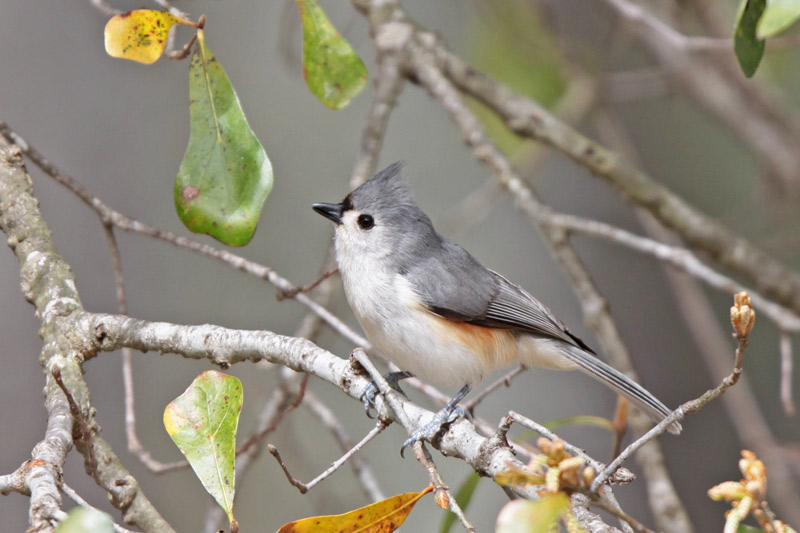
Tufted Titmouse (Baeolophus bicolor) by Margaret Sloan

Tufted Titmouse (Baeolophus bicolor) by Margaret Sloan

I would like to introduce our newest photographer to permit permission to use her photos. While searching for the Morningbird, which Margaret had one of the very few photos of the bird, I discovered her website. She has graciously given permission to use her photos.

Margaret Sloan has her photos on PBase at

http://www.pbase.com/laumakani

She is from Texas and has over 12,000 images online in over 1,100 galleries. Wow! It will take awhile to check it out, but what I have seen so far is very good. Please stop by her site and admire the photos of some amazing birds, plus places, spaces, and scenery. Lots to view and enjoy.

From her Birds of Costa Rica gallery:

Keel-billed Toucan (Ramphastos sulfuratus) by Margaret Sloan

Keel-billed Toucan (Ramphastos sulfuratus) by Margaret Sloan

From the Birds of Peru – Cotingas and Manakins gallery:

Andean Cock-of-the-rock (Rupicola peruvianus) by Margaret Sloan

Andean Cock-of-the-rock (Rupicola peruvianus) by Margaret Sloan

From the Birds of Southeast AsiaSunbirds, Flowerpeckers, Leafbirds:

Olive-backed Sunbird (Cinnyris jugularis) by Margaret Sloan

Olive-backed Sunbird (Cinnyris jugularis) by Margaret Sloan

Closer to home – Birds of North America:

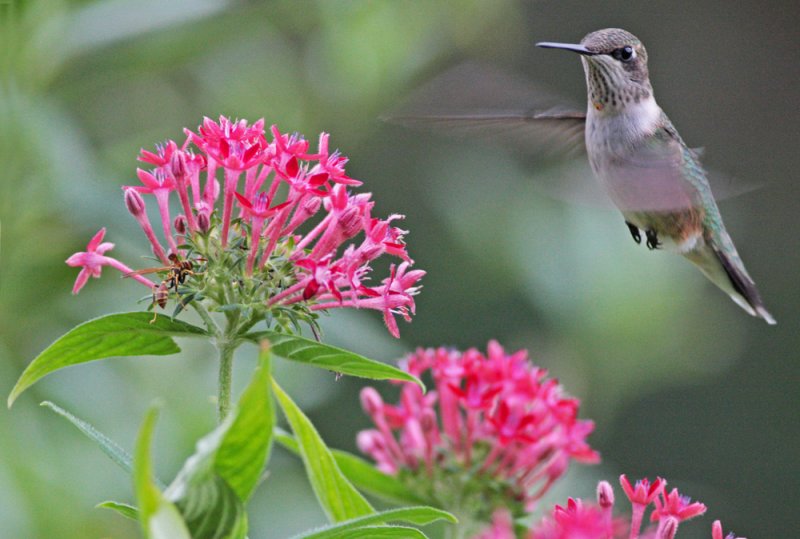
Hummingbird with Pentas by Margaret Sloan

Hummingbird with Pentas by Margaret Sloan

From her Nature Butterflies:

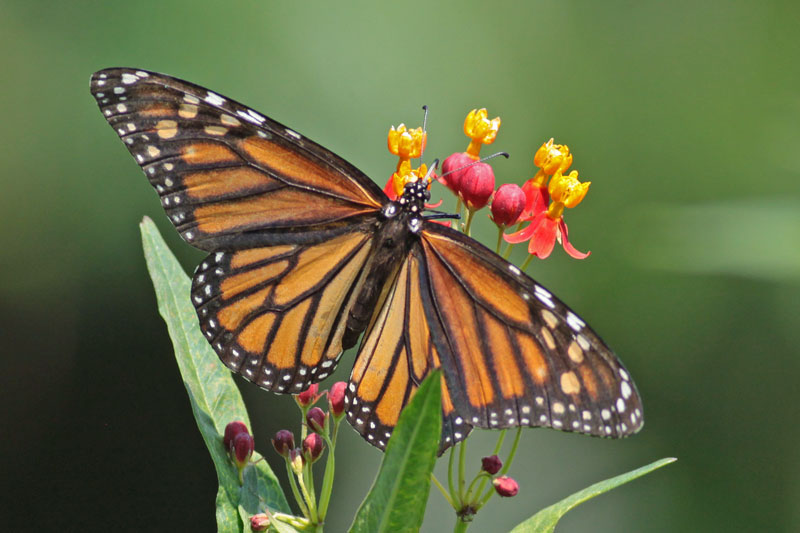
Monarch Butterfly (Danaus plexippus) by Margaret Sloan

Monarch Butterfly by Margaret Sloan

These are but a few of the numerous photos she has taken of the birds and beauty around her. Thank you, Margaret, for sharing with us what you have seen through your lens. May you find many more adventures that you can take photographs of and share with us.

Who is like You, O Lord, among the gods? Who is like You, glorious in holiness, awesome in splendor, doing wonders? (Exodus 15:11 AMP)

Many, O Lord my God, are the wonderful works which You have done, and Your thoughts toward us; no one can compare with You! If I should declare and speak of them, they are too many to be numbered. (Psalms 40:5 AMP)

*

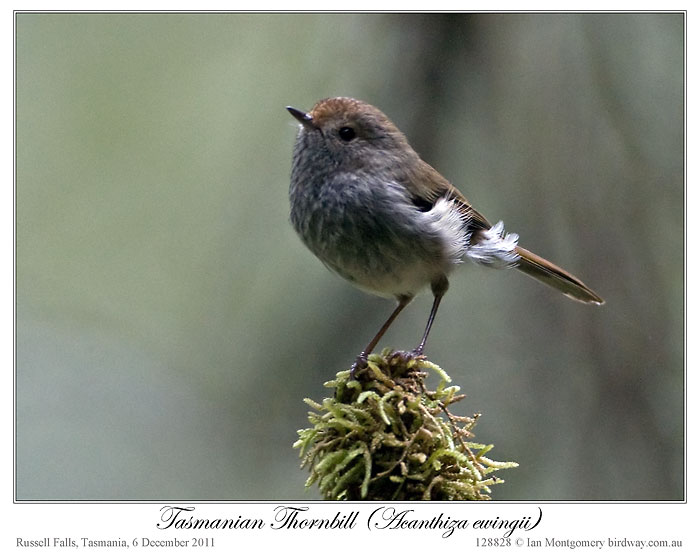
Ian’s Bird of the Week – Tasmanian Thornbill

Ian’s Bird of the Week – Tasmanian Thornbill ~ by Ian Montgomery

Newsletter ~ 3/13/13

Are you good at those spot the differences games where you need to find usually ten subtle differences between two drawings? If so, this bird of the week, another in the series of Tasmanian endemics the Tasmanian Thornbill, is for you. The first two photos are of a Tasmanian Thornbill, the third is of its closest relative the Brown Thornbill, which also occurs in Tasmania.

Tasmanian Thornbill (Acanthiza ewingii) by Ian 1

Tasmanian Thornbill (Acanthiza ewingii) by Ian

The differences are as follows. The Tasmanian Thornbill:

  • has tan rather than brownish-buff forehead
  • has shorter bill
  • has darker grey breast
  • has mottled rather than streaked breast
  • has buffish rather than whitish edges to flight feathers
  • has white rather than buff flanks
  • has longer tail
  • harsher calls and more disjointed song (otherwise very similar)
  • prefers denser, wetter habitats (we’re getting desperate here)
Tasmanian Thornbill (Acanthiza ewingii) by Ian 2

Tasmanian Thornbill (Acanthiza ewingii) by Ian

The reward? Another tick on your Australian list.

Brown Thornbill (Acanthiza pusilla) by Ian 3

Brown Thornbill (Acanthiza pusilla) by Ian

Best wishes
Ian

**************************************************
Ian Montgomery, Birdway Pty Ltd,
454 Forestry Road, Bluewater, Qld 4818
Tel 0411 602 737 ian@birdway.com.au
Check the latest website updates:
http://www.birdway.com.au/#updates


Lee’s Addition:

There are thorns and snares on the path of the crooked; the one who guards himself stays far from them. Teach a youth about the way he should go; even when he is old he will not depart from it. (Proverbs 22:5-6 HCSB)

Oh, now Ian is going to make us “work”! But that is how we learn to ID these birds and the others. Sometimes there is such a subtle difference in some of them. May we never get to the place where we don’t want to be challenged.

Here are the Calls of the Tasmanian and Brown Thornbills

Here are the Songs of the Tasmanian and Brown Thornbills

Thornbills are in the Acanthizidae family. Ian has quite a collection of them on his Thornbills & Allies page. This family, Acanthizidae – Australasian Warblers, has 65 species in it. The Acanthizidae, also known as the Australasian warblers, are a family of passerine birds which include gerygones, thornbills, and scrubwrens. The Acanthizidae consists of small to medium passerine birds, with a total length varying between 3.1 and 7.5 in (8 and 19 centimetres). They have short rounded wings, slender bills, long legs, and a short tail. Most species have olive, grey, or brown plumage, although some have patches of a brighter yellow. The smallest species of acanthizid, and indeed the smallest Australian passerine, is the Weebill, the largest is the Pilotbird.

Links:

Ian’s Birdway

xeno-canto Tasmanian Thornbill

xeno-canto Brown Thornbill

Other Ian’s Bird of the Week

Birds of the World – Furnariidae – Ovenbird Family

White-eyed Foliage-gleaner (Automolus leucophthalmus) by Dario Sanches

White-eyed Foliage-gleaner (Automolus leucophthalmus) by Dario Sanches

And thou shalt not glean thy vineyard, neither shalt thou gather every grape of thy vineyard; thou shalt leave them for the poor and stranger: I am the LORD your God. (Leviticus 19:10 KJV)

Yesterday you were introduced to the Firewood-gatherer from the Ovenbird – Furnariidae Family. Let’s look at some more things about this family. There are presently (IOC 3.3) 307 species assigned together, but it is such a diverse group. There are over 70 Genera listed. Number one, the Ovenbird, is not even a member of this family. You have to look for it in the Parulidae – New World Warblers to find it.

The Ovenbird name seems to be from the fact that many of these birds make an “oven style” nest or at least one that has an opening to enter or a covering, not the “cup type” of nest of many birds. Most are  insectivores that are mostly arboreal in nature. Insects form the majority of the diet, with some spiders, centipides, millipides and even lizards being taken as well.

They are sub-divided into subfamilies which help find them. It is the names of these birds that have caught my attention this time. Listen to these names:

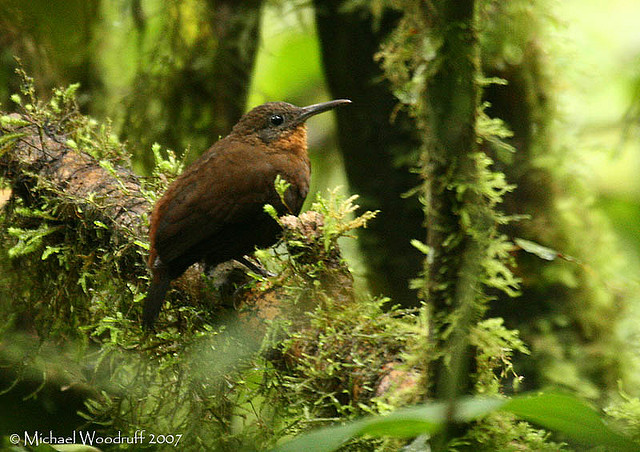
Tawny-throated Leaftosser (Sclerurus mexicanus) by Michael Woodruff

Tawny-throated Leaftosser (Sclerurus mexicanus) by Michael Woodruff

Subfamily: Sclerurinae ~~ Miners and Leaftossers

Wedge-billed Woodcreeper (Glyphorynchus spirurus) by Michael Woodruff

Wedge-billed Woodcreeper (Glyphorynchus spirurus) by Michael Woodruff

Subfamily: Dendrocolaptinae ~~ Woodcreepers

  • Tribe: Sittasomini – “intermediate” woodcreepers
  • Tribe: Dendrocolaptini – “strong-billed” woodcreepers and scythebills
Rufous Hornero (Furnarius rufus) ©WikiC

Rufous Hornero (Furnarius rufus) ©WikiC

Subfamily: Furnariinae ~~ Neotropical ovenbirds and allies

  • Xenops and Palmcreeper
  • Tribe Pygarrhichini – Treerunner, Xenops, Earthcreeper
  • Tribe Furnariini – Horneros and allies (Tuftedcheeks, Barbtail, Earthcreeper, Cinclodes, Streamcreeper, Rushbird, Reedhaunter)
  • Tribe Philydorini – Foliage-gleaners and allies (Xenops, Treehunter, Canebrake, Woodhaunter)
  • Tribe Synallaxini – Spinetails and allies (Treerunners, Barbtails, Rayaditos, Wiretail, Canasteros, Reedhaunter,Softtails, Thorntails, Firewood-gatherer, Brushrunner, Prickletail, Plushcrown, Graytails, Graveteiro)

Just reading the names you can almost image what they do. Many of them are “creepers,” “runners,” “gleaners,” “haunters,” and then others have their tail described. The tails are Barb, Spine, Wire, Soft, Thorn, Prickle and Gray. The Runners are apparently running up Trees or in the Stream. Not sure what the Miners are digging for, but maybe they are trying to find insects in the ground, whereas the Leaf-tossers are probably looking under leaves for their lunch. They don’t appear to be a “lazy” bird family.

This is a family that I could see being named by what they were doing or how their tail looked. After the birds were created, the Lord brought them to Adam to see what he would call them. What ever he decided to call them, that was their name. Maybe this is how Adam named them by observing their behaviors. Others from another family may have had a different way he named them.

Out of the ground the LORD God formed every beast of the field and every bird of the air, and brought them to Adam to see what he would call them. And whatever Adam called each living creature, that was its name. So Adam gave names to all cattle, to the birds of the air, and to every beast of the field. But for Adam there was not found a helper comparable to him. (Genesis 2:19-20 NKJV)

Some interesting articles about this family:

Birds of Brazil – Woodpeckers, Woodcreepers and Foliage-gleaners by Mark George

*

Wordless Birds

*

Bird of the World – Firewood-gatherer

Firewood-gatherer (Anumbius annumbi) ©WikiC

Firewood-gatherer (Anumbius annumbi) ©WikiC

The Firewood-gatherer (Anumbius annumbi) is a species of bird in the Furnariidae family. It is the only member of the genus Anumbius.

It is found in Argentina, Brazil, Paraguay, and Uruguay. Its natural habitats are subtropical or tropical seasonally wet or flooded lowland grassland, pastureland, and heavily degraded former forest.

It got its name because it is frequently seen carrying sticks to its nest. It interweaves thorny twigs to build its nest. It can be up to 6½ ft (2 m) tall and decorated with glass or threads. The young from the first brood may be ejected from the territory, but may help raise the second brood.

For lack of wood the fire goes out, and where there is no whisperer, quarreling ceases. (Proverbs 26:20 ESV)

Where no wood is, there the fire goeth out: so where there is no talebearer, the strife ceaseth. As coals are to burning coals, and wood to fire; so is a contentious man to kindle strife. The words of a talebearer are as wounds, and they go down into the innermost parts of the belly. (Proverbs 26:20-22 KJV)

This next verse I don’t think applies to the Firewood-gatherer bird. I am sure they don’t know one day from the other, so I am sure they do not get in trouble.

Now while the children of Israel were in the wilderness, they found a man gathering sticks on the Sabbath day. (Numbers 15:32 NKJV)

Firewood-gatherer (Anumbius annumbi) Nest ©WikiC

Firewood-gatherer (Anumbius annumbi) Nest ©WikiC

I discovered this uniquely named bird while working on Furnariidae family. After working on the Toucans, this family of 307 species is rather bland. They are mostly brownish, with little color so I was not as excited trying to find the photos. Yet, the Lord created them all, and who am I to judge them by just their outer feathers? Isn’t that true of us? We aren’t to place one person above another.

My brothers, ye should not have the faith of our Lord Jesus Christ of glory, in favoritism. For if a man with a gold ring in bright clothing comes into your synagogue, and also a poor man in dirty clothing comes in, and ye have regard for the man wearing the bright clothing, and say to him, Sit thou here well, and ye say to the poor man, Stand thou there, or sit here below my footstool, then are ye not partial among yourselves, and become judges from evil thoughts? Listen, my beloved brothers, did not God choose the poor of the world, rich in faith, and heirs of the kingdom, which he promised to those who love him? (James 2:1-5 ACV)

Even the birds can help us learn lessons that are good for us. Praise the Lord for all He does to help us serve Him better. Look around, there are lessons everywhere to be discerned and taken to heart.

(Wikipedia and other internet sources)

Anumbius annumbi (Firewood Gatherer) by Jose Ignacio, Maldonado

See:

*

Birds of the World ~ Toucan Family (Ramphastidae)

Toco Toucan (Ramphastos toco) ©WikiC

Toco Toucan (Ramphastos toco) ©WikiC

I know all the birds of the mountains, And the wild beasts of the field are Mine. (Psalms 50:11 NKJV)

While working on the Ramphastidae Family yesterday, I decided to share some of the beauty the Lord created in this group of birds. These are the Toucans, Toucanets, and Aracaris. They are just so appealing to see and wonder how the Lord comes up with so many designs and colors in His Creation. This family definitely show such variety.

This morning while reading my latest Acts & Facts, there was an article about Diversity by Dr. James J. S. Johnson, who did our guest article this week,( Bird Brains, Amazing Evidence of God’s Genius). Both are very interesting articles worth reading. But I want to quote Dr. Johnson about variety.

Two words summarize the answer: life and variety. Even in this after-Eden world, cursed and groaning as it is under the weight of sin and death, we still see a prolific and diversified creation.

Why did God design earth’s biodiversity the way that He did?

God loves life. God is the essence and ultimate origin of all forms and levels of life.1

God loves variety. God’s nature is plural, yet one, and He is the Creator of all biological diversity anywhere and everywhere on earth.2

This family catches your eye and causes a second look. Toco Toucans are familiar to many, and some of the others. (Even Toucan Sam is the cartoon mascot for Froot Loops breakfast cereal).   We had the privilege to meet “Gracie” a retired Chestnut-mandibled Toucan at the National Aviary. (National Aviary – Hospital, Breeding, and Kitchen Areas) Needless to say, that is the closest I have been to a Toucan.
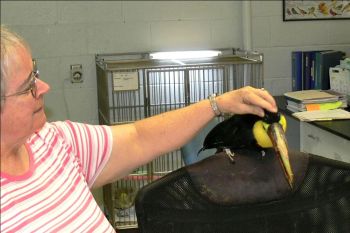
Gracie the retired Chestnut-mandibled Toucan (Ramphastos swainsonii)

Gracie the retired Chestnut-mandibled Toucan petted by Lee

The Ramphastidae Family has 5 or 6 genera, depending on sources, with Toucanets in the Aulacorhynchus and Selenidera, Mountain Toucans in the Andigena genus, Aracaris are Pteroglossus with the Saffron Toucanet added by some, and the Typical Toucans belong to the Ramphastos genus. The “Toucan” name of this bird group is derived from the Tupi word tukana, via Portuguese. They have large colorful and brightly marked bills.

Toucans range in size from the Lettered Aracari (Pteroglossus inscriptus), at 130 g (4.6 oz) and 29 cm (11.5 inches), to the Toco Toucan(Ramphastos toco), at 1.5 lb (680 g) and 29 inches (63 cm). Their bodies are short (of comparable size to a crow’s) and compact. The tail is rounded and varies in length, from half the length to the whole length of the body. The neck is short and thick. The wings are small, as they are forest-dwelling birds who only need to travel short distances.

The legs of the toucan are strong and rather short. Their toes are arranged in pairs with the first and fourth toes turned backward. The majority of toucans do not show any sexual dimorphism in their coloration.  However, the bills of female toucans are usually shorter, deeper and sometimes straighter, giving more of a “blocky” impression compared to male bills. The feathers in the genus containing the largest toucans are generally black, with touches of white, yellow, and scarlet. The underparts of the araçaris (smaller toucans) are yellow, crossed by one or more black or red bands. The toucanets have mostly green plumage with blue markings.

Toucans are native to Southern Mexico, Central and South America, and the Caribbean region. They generally live in tropical and sub-tropical regions. They make their nests in tree hollows and holes excavated by other animals such as woodpeckers—the toucan bill has very limited use as an excavation tool.

They mainly eat fruit, but will eat insects and small lizards if they become available. However, in their range, toucans are the dominant frugivores, and as such play an extremely important ecological role as vectors for seed dispersal of fruiting trees.
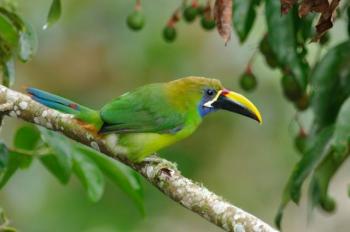
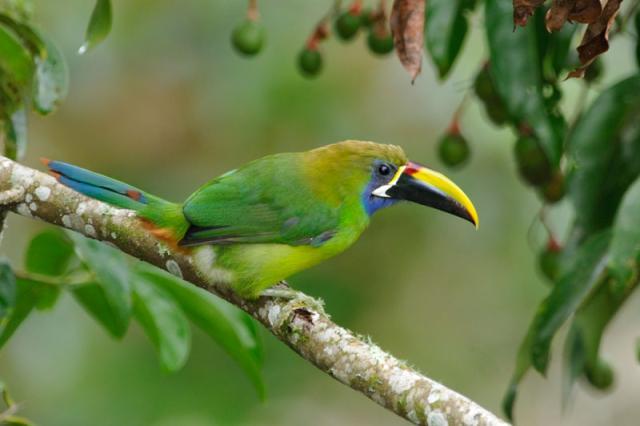
Emerald Toucanet (Aulacorhynchus prasinus) by Reinier Munguia

Emerald Toucanet (Aulacorhynchus prasinus) by Reinier Munguia

Toucanets

The green toucanets are birds from the genus Aulacorhynchus in the toucan family. They are native to Mexico, and Central and South America. All are found in humid forests and woodlands in highlands, but a few also occur in adjacent lowlands. They are relatively small toucans, 12–17 in (30–44 centimetres) long, with colorful, mainly green, plumage. They are typically seen in pairs or small groups, and sometimes follow mixed species flocks.

Wagler’s Toucanet (Aulacorhynchus wagleri)
Emerald Toucanet (Aulacorhynchus prasinus)
Blue-throated Toucanet (Aulacorhynchus caeruleogularis)
White-throated Toucanet (Aulacorhynchus albivitta)
Black-throated Toucanet (Aulacorhynchus atrogularis)
Groove-billed Toucanet (Aulacorhynchus sulcatus)
Chestnut-tipped Toucanet (Aulacorhynchus derbianus)
Tepui Toucanet (Aulacorhynchus whitelianus)
Crimson-rumped Toucanet (Aulacorhynchus haematopygus)
Yellow-browed Toucanet (Aulacorhynchus huallagae)
Blue-banded Toucanet (Aulacorhynchus coeruleicinctis)

Yellow-eared Toucanet (Selenidera spectabilis) ©WikiC

Yellow-eared Toucanet (Selenidera spectabilis) ©WikiC

Selenidera is a bird genus containing six species of dichromatic toucanets in the toucan family Ramphastidae. They are found in lowland rainforest (below 1,500 metres or 4,900 feet) in tropical South America with one species in Central America.

All the species have green upperparts, red undertail-coverts and a patch of bare blue or blue-green skin around the eye. Unlike most other toucans, the sexes are different in color. The males all have a black crown, nape, throat and breast and an orange/yellow auricular streak. The females of most species have the black sections in the male replaced by rich brown and a reduced/absent auricular streak,

Saffron Toucanet (Pteroglossus bailloni)
Yellow-eared Toucanet (Selenidera spectabilis)
Guianan Toucanet (Selenidera piperivora)
Golden-collared Toucanet (Selenidera reinwardtii)
Tawny-tufted Toucanet (Selenidera nattereri)
Gould’s Toucanet (Selenidera gouldii)
Spot-billed Toucanet (Selenidera maculirostris)
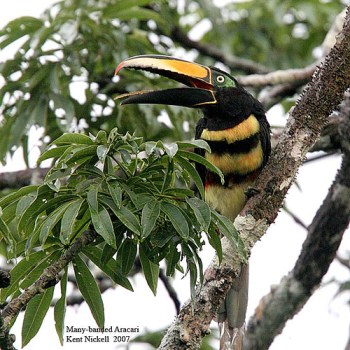
Many-banded Aracari (Pteroglossus pluricinctus) by Kent Nickel

Many-banded Aracari (Pteroglossus pluricinctus) by Kent Nickel

Aracari

An aracari or araçari is any of the medium-sized toucans that, together with the Saffron Toucanet, make up the genus Pteroglossus. They are brightly plumaged and have enormous, contrastingly patterned bills. These birds are residents in forests and woodlands in the Neotropics.

Green Aracari (Pteroglossus viridis)
Lettered Aracari (Pteroglossus inscriptus)
Red-necked Aracari (Pteroglossus bitorquatus)
Ivory-billed Aracari (Pteroglossus azara)
Brown-mandibled Aracari (Pteroglossus mariae)
Black-necked Aracari (Pteroglossus aracari)
Chestnut-eared Aracari (Pteroglossus castanotis)
Many-banded Aracari (Pteroglossus pluricinctus)
Collared Aracari (Pteroglossus torquatus)
Stripe-billed Aracari (Pteroglossus sanguineus)
Pale-mandibled Aracari (Pteroglossus erythropygius)
Fiery-billed Aracari (Pteroglossus frantzii)
Curl-crested Aracari (Pteroglossus beauharnaesii)

Plate-billed Mountain Toucan (Andigena laminirostris) by Michael Woodruff

Plate-billed Mountain Toucan (Andigena laminirostris) by Michael Woodruff

Mountain Toucans 

Andigena, the mountain toucans, is a genus of birds in the Ramphastidae family. They are found in humid highland forests in the Andes of South America, ranging from Bolivia to Venezuela. These medium-sized toucans all have olive-brown upperparts, a black crown, yellow rump, blue-grey underparts and a red vent.

Grey-breasted Mountain Toucan (Andigena hypoglauca)
Plate-billed Mountain Toucan (Andigena laminirostris)
Hooded Mountain Toucan (Andigena cucullata)
Black-billed Mountain Toucan (Andigena nigrirostris)
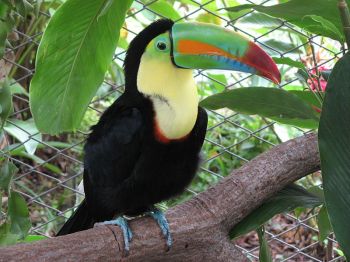
Keel-billed Toucan (Ramphastos sulfuratus) ©WikiC

Keel-billed Toucan (Ramphastos sulfuratus) ©WikiC

Toucans

Ramphastos is a genus of toucans, tropical and subtropical near passerine birds from Mexico, and Central and South America, which are brightly marked and have enormous, often colourful, bills.

This genus comprises the largest toucans, ranging from 17 to 24 in (42 to 61 centimetres) in length. All have black wings, tails and thighs, but the color of the remaining plumage depends on the exact species involved. All the species are basically fruit-eating, but will take insects and other small prey. They are arboreal and nest in tree holes laying 2–4 white eggs. They are essentially resident birds, but may take part in minor, local movements (e.g., to lower altitudes in the winter).

Green-billed Toucan (Ramphastos dicolorus)
Channel-billed Toucan (Ramphastos vitellinus)
Citron-throated Toucan (Ramphastos citreolaemus)
Choco Toucan (Ramphastos brevis)
Keel-billed Toucan (Ramphastos sulfuratus)
Toco Toucan (Ramphastos toco)
White-throated Toucan (Ramphastos tucanus)
Yellow-throated Toucan (Ramphastos ambiguus)

Enjoy the variety of these beautiful birds that have been placed here for their benefit and our enjoyment by their Creator. Clicking the links will reveal some that are at various websites besides the ones here.

And let the beauty of the LORD our God be upon us, And establish the work of our hands for us; Yes, establish the work of our hands. (Psalms 90:17 NKJV)

Splendor and majesty are before him; strength and beauty are in his sanctuary. (Psalms 96:6 ESV)

(Wikipedia and other internet sources)

See Also:

Toucan – Ramphastidae Family

Toucans (Ramphastidae) – IBC

Toucan – Ramphastidae – Wikipedia

  • Genus Aulacorhynchus—green toucanets (6–15 species)
  • Genus Selenidera—dichromatic toucanets (6 species)
  • Genus Andigena—mountain toucans (4 species)
  • Genus Pteroglossus—araçaris (14 species, incl. Saffron Toucanet)
  • Genus Ramphastos—Typical toucans (about 8 species)

Wordless Birds

*

This slideshow requires JavaScript.

Birds of the Bible – Get Off My Back

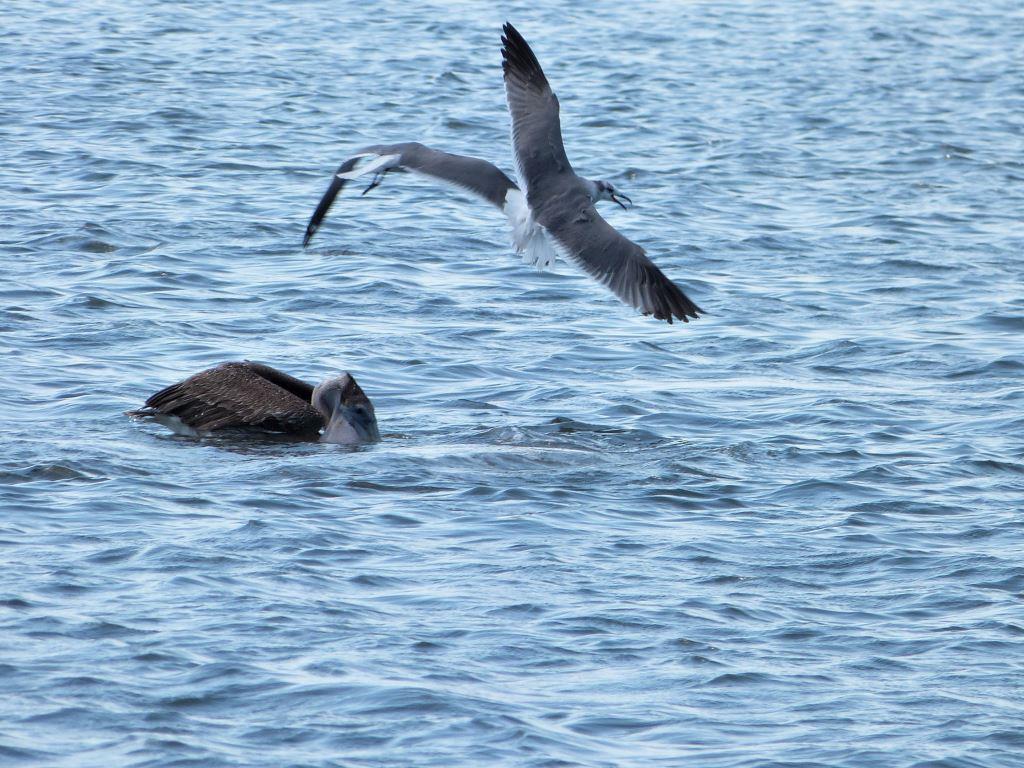
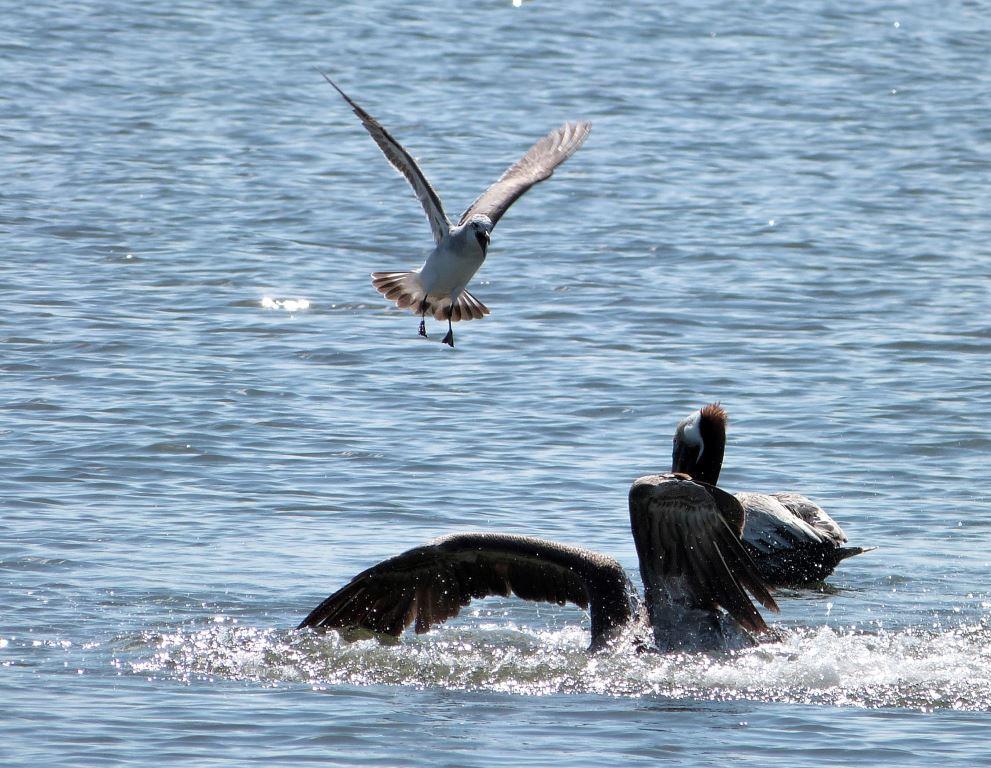
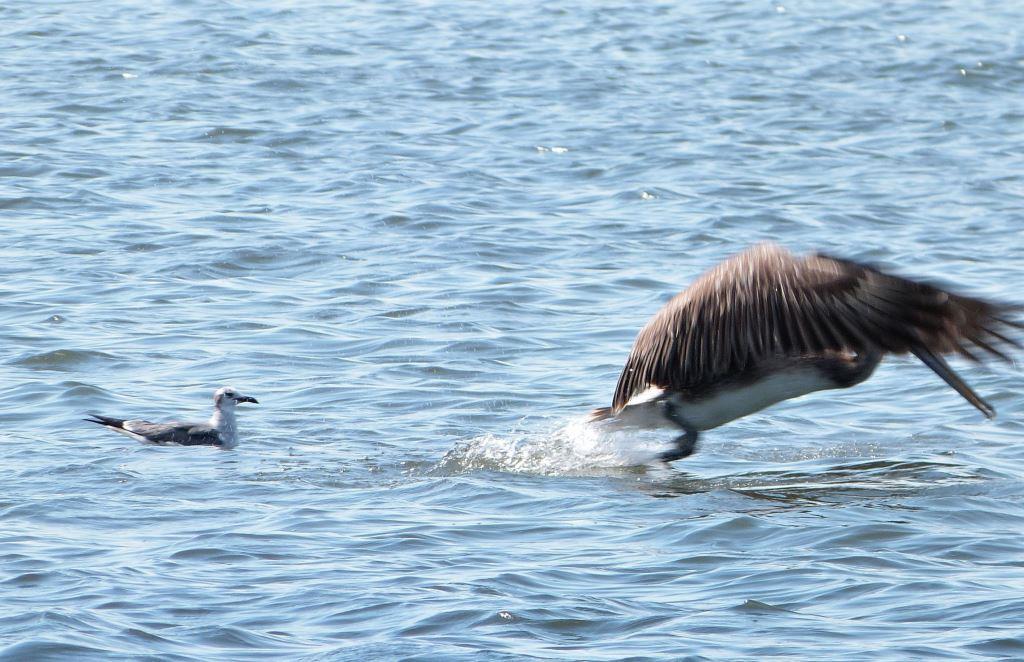
Laughing Gull landing on Brown Pelican

Laughing Gull landing on Brown Pelican

I am like a pelican of the wilderness; I am like an owl of the desert. (Psalms 102:6 NKJV)

Yesterday we were at the beach at MacDill AFB in Tampa. Apparently the fish were numerous, because the Brown Pelicans, Forster’s Tern, Laughing Gulls, Ospreys and others were diving in.

Laughing Gull landing on Brown Pelican

Laughing Gull landing on Brown Pelican

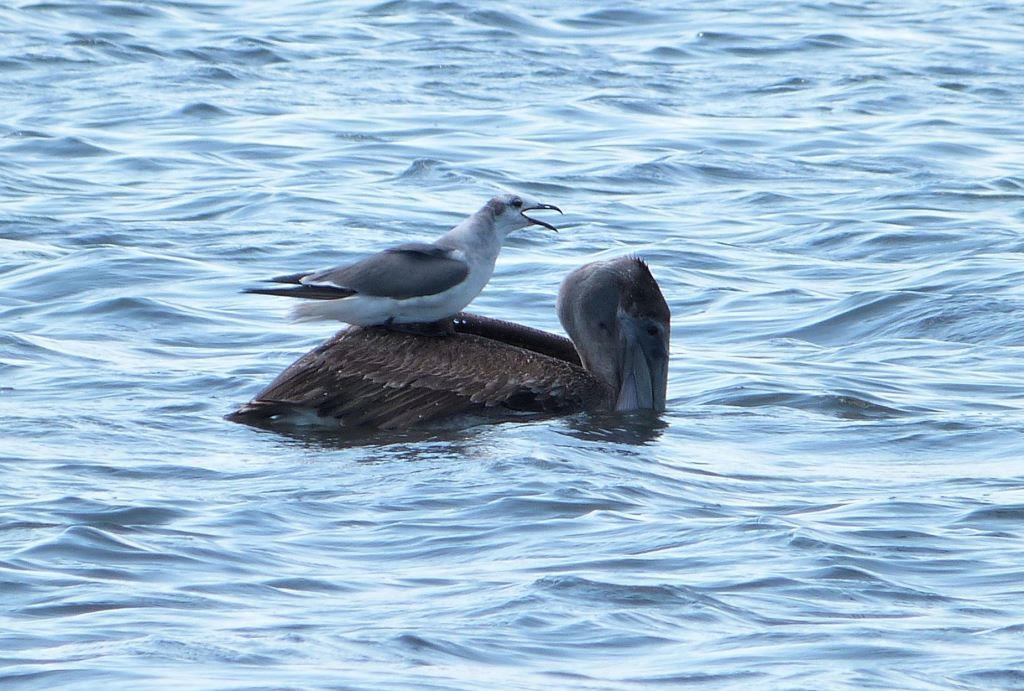
What really amazed me were the Laughing Gulls landing on the backs of the Brown Pelicans. Checking the internet to find out about this, I came across this very interesting article, The Pelican and the Gull. It appears this is a common practice for the Laughing Gull to steal some of the Pelicans food.

Here are some excerpts from that article:

One method the laughing gull has of getting food is to steal fish from another seabird that inhabits the region, the brown pelican. The laughing gull accomplishes this larceny by waiting for the brown pelican to make a successful dive….

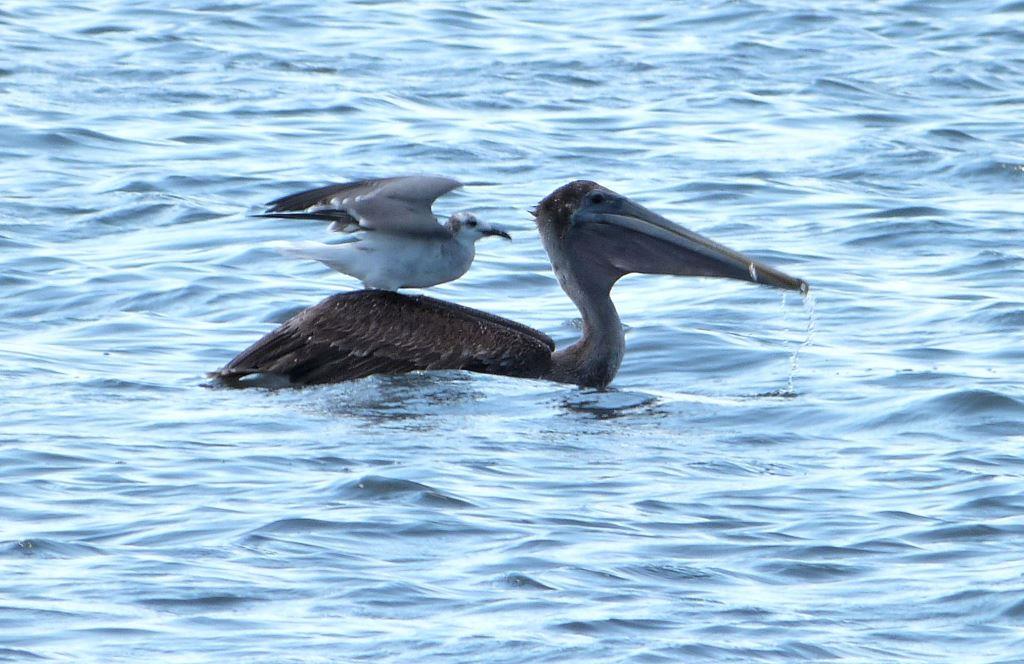
When the pelican has a bill full of fish and water, it transfers the fish to the pouch that hangs below its bill. The pelican cannot fly away or swallow the fish until the water is drained from the pouch. Laughing gulls either circle closely above the pelican or land on the pelican’s bill or head. The gull may even give the pelican a sharp peck or two. If the pelican pays too much attention to the antics of the laughing gull and not enough attention to the delicate draining and swallowing process, the pelican may lose some of the trapped fish. The gull then swoops down and scoops up the pelican’s hard-earned catch, flying away at top speed from the scene of the crime and makes short work of his ill-gotten gains.

Of course, I could make all kinds of applications about not stealing, pecking someone on the head, or getting on their backs without permission. Because of the curse we are all under, the birds included, this kind of things happen. Eagles steal from Ospreys, Cuckoos lay eggs in other species nest, etc. For us, we know that stealing is wrong and I trust we don’t. Also, we are supposed to “love one another.” Not so sure this is being displayed here.

And be ye kind one to another, tenderhearted, forgiving one another, even as God for Christ’s sake hath forgiven you. (Ephesians 4:32 KJV)

Here is another sequence of photos I took of an exchange between the Gull and the Pelican (cropped):

Pelican catching fish and Gull circling

Pelican catching fish and Gull circling

Laughing Gull watching Brown Pelican preparing to land

Laughing Gull watching Brown Pelican preparing to land

Laughing Gull lands on Pelican as he comes up

Laughing Gull lands on Pelican as he comes up

Would you hurry up

Would you hurry up

Brown Pelican and Laughing Gull - Waiting

Waiting

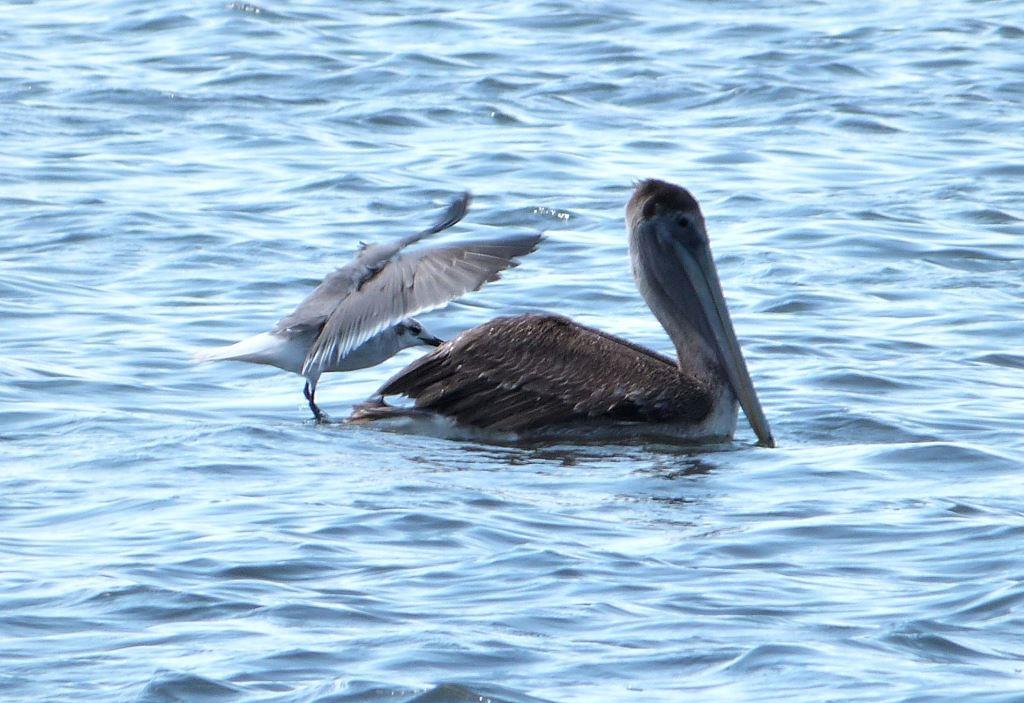
Brown Pelican and Laughing Gull - Slipping Off

Slipping Off

Brown Pelican leaving Laughing Gull

Watching His Food Source Leave

Maybe I can catch him

Maybe I can catch him

These photos were taken with my zoom because they were out quite a way from the shore. The following two photos were closer up as they both posed on posts for us.

Pelicans belong to the Pelecanidae – Pelicans Family and are on of the Birds of the Bible.

Mature Brown Pelican by Dan at MacDill

Mature Brown Pelican by Dan at MacDill

The Brown Pelican is the smallest of the eight species of pelican, although it is a large bird in nearly every other regard. It is 42–54 in (106–137 cm) in length, weighs from 6.1 to 12 lb (2.75 to 5.5 kg) and has a wingspan from 6.0 to 8.2 ft (1.83 to 2.5 m). Through most of its range, the brown pelican is an unmistakable bird. Like all pelicans, this species has a very large bill, 11 to 13.7 in (28 to 34.8 cm) long in this case, with a gular pouch on the bottom for draining water when it scoops out prey. The head is white but often gets a yellowish wash in adult birds. The bill is grayish overall in most birds, though breeding birds become reddish on the underside of the throat. The back, rump, and tail are streaked with gray and dark brown, sometimes with a rusty hue. In adult pelicans, the breast and belly are a blackish-brown and the legs and feet are black. The juvenile is similar but has a brownish-gray neck and white underparts.

This bird is readily distinguished from the American White Pelican by its non-white plumage, smaller size and its habit of diving for fish from the air, as opposed to co-operative fishing from the surface. The Peruvian Pelican, previously considered a subspecies of Brown Pelican, is now considered to be a separate species. It has very similar plumage to the Brown, but it is noticeably larger. The Brown and Peruvian pelicans may overlap in some areas along the Pacific coast of South America.

the ostrich, the short-eared owl, the sea gull, and the hawk after their kinds; (Deuteronomy 14:15 NKJV)

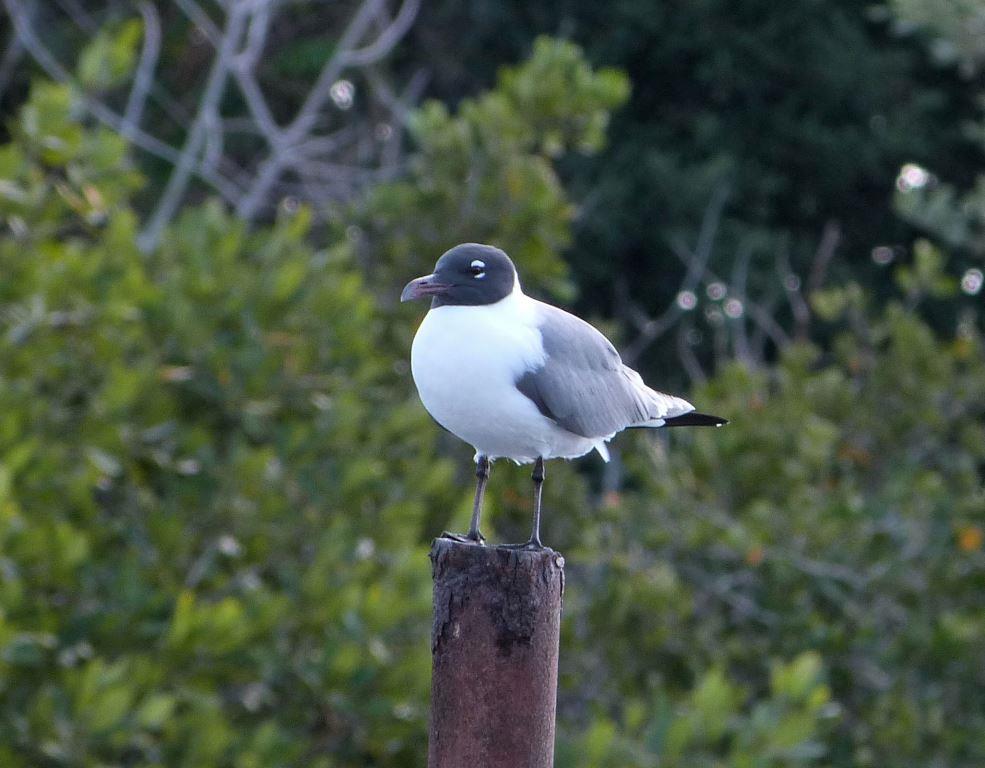
Laughing Gull on post

Laughing Gull on post by Lee

The Laughing Gull is a member of the Laridae – Gulls, Terns and Skimmers Family and is a Bird of the Bible also. The Laughing Gull (Leucophaeus atricilla) is a medium-sized gull of North and South America. It breeds on the Atlantic coast of North America, the Caribbean, and northern South America. Northernmost populations migrate further south in winter, and this species occurs as a rare vagrant to western Europe. The Laughing Gull’s English name is derived from its raucous kee-agh call, which sounds like a high-pitched laugh “ha… ha… ha…”.

This species is easy to identify. It is 14–16 in (36–41 cm) long with a 39–43 in (98–110 cm) wingspan. The summer adult’s body is white apart from the dark grey back and wings and black head. Its wings are much darker grey than all other gulls of similar size except the smaller Franklin’s Gull, and they have black tips without the white crescent shown by Franklin’s. The beak is long and red. The black hood is mostly lost in winter.

Laughing Gulls take three years to reach adult plumage. Immature birds are always darker than most similar-sized gulls other than Franklin’s. First-year birds are greyer below and have paler heads than first-year Franklin’s, and second-years can be distinguished by the wing pattern and structure. Laughing Gulls breed in coastal marshes and ponds in large colonies. The large nest, made largely from grasses, is constructed on the ground. The 3 or 4 greenish eggs are incubated for about three weeks. These are omnivores like most gulls, and they will scavenge as well as seeking suitable small prey. Like most other members of the genus Leucophaeus, the Laughing Gull was long placed in the genus Larus. (Wikipedia with editing)

Interesting Links:

*

Ian’s Bird of the Week – Green Rosella

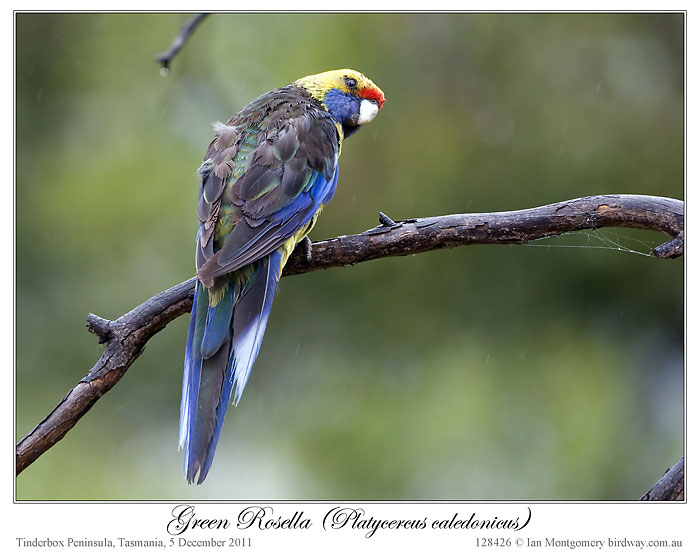
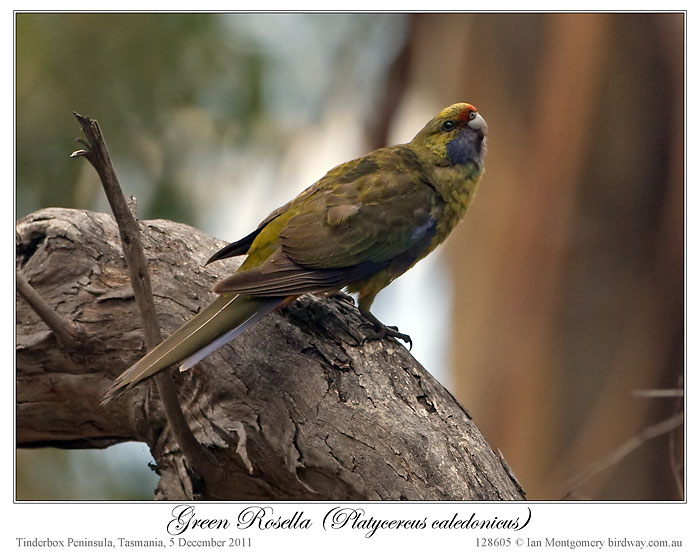
Green Rosella (Platycercus caledonicus) by Ian 1

Green Rosella (Platycercus caledonicus) by Ian 1

Ian’s Bird of the Week – Green Rosella ~ by Ian Montgomery

Newsletter ~ 2/26/13

The two recent Tasmanian birds of the week seem to have been popular so here is another one, the Green Rosella. I spent an enjoyable week in a rented campervan in Tasmanian in December 2011 on the way back from the Sub-antarctic trip chasing Tasmanian specialties. After that trip, the Tasmanian species got somewhat eclipsed by the penguins, albatrosses and other seabirds as choices for bird of the week, so I’m making amends now.

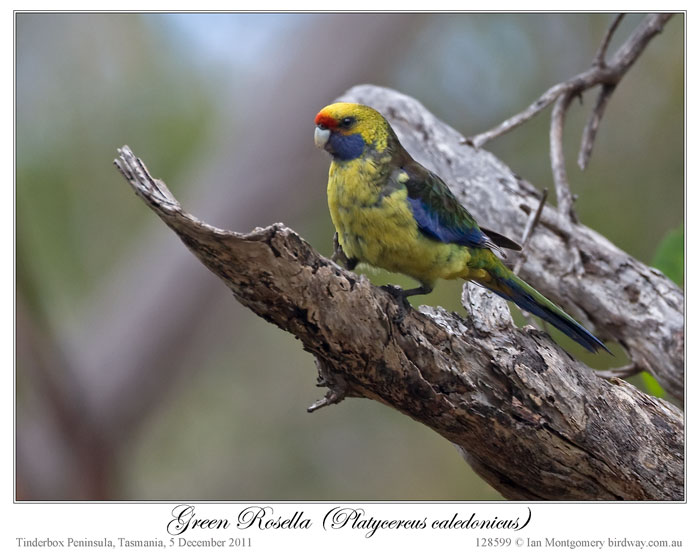
Green Rosella (Platycercus caledonicus) by Ian 2

Green Rosella (Platycercus caledonicus) by Ian 2

At up to 37cm/14.6in in length, it’s the largest of the Rosellas, being marginally larger on average than its close relative the Crimson Rosella which it replaces in Tasmania and some islands in Bass Strait. Males are generally larger than females and there are subtle between the sexes with males having relatively larger upper mandibles and broader heads (first photo) and females having more orange on the cheeks (second photo) though most of the field guides don’t distinguish between the sexes.

Green Rosella (Platycercus caledonicus) by Ian 3

Green Rosella (Platycercus caledonicus) by Ian 3

Juveniles, third photo, are more distinctive with duller more olive plumage and, in flight, pale wing stripes. This bird was in the company of the adult in the second photo, and the one in the first photo was in the same area, so I assumed that they comprised a family.

Green Rosellas are quite common throughout Tasmania, showing a preference for highland forest, though these ones were near the coast on the Tinderbox Peninsula south of Hobart, a good place to search for all the Tasmanian endemics.

"Yellow" Crimson Rosella (Platycercus elegans flaveolus) by Ian  4

“Yellow” Crimson Rosella (Platycercus elegans flaveolus) by Ian 4

The specific name caledonicus was used by the German naturalist Johann Gmelin in 1788, who mistakenly believed that the type specimen had been collected in New Caledonia. Confusion is the name of the game in Rosella terminology, and species boundaries have changed over the years. The Crimson Rosella has two races which differ greatly in plumage and both the ‘Yellow Rosella’ of Southwest NSW and the ‘Adelaide Rosella’ of South Australia have been regarded as separate species in the past. The Yellow Rosella (fourth photo) looks quite like the Green Rosella – and not at all like a Crimson Rosella – but the Green, given its geographical isolation, has been given the benefit of the doubt and retained as a separate species. This is just as well, politically anyway, as it’s the avian symbol of Tasmania and deserves a certain status.

Best wishes
Ian

**************************************************
Ian Montgomery, Birdway Pty Ltd,
454 Forestry Road, Bluewater, Qld 4818
Tel 0411 602 737 ian@birdway.com.au
Check the latest website updates:
http://www.birdway.com.au/#updates


Lee’s Addition:

I will teach you regarding the hand and handiwork of God; that which is with the Almighty … (Job 27:11a AMP)

The Green Rosella is sometimes referred to as the Tasmanian Rosella, probably as Ian mentioned because it is the Avian Symbol of Tasmanian. The Green and “Yellow” Crimson Rosella are part of the Psittacidae – Parrots Family. What gorgeous birds belong to this family and they show the Handiwork of the Lord at some of it’s finest.

Their diet is composed of seeds, fruit, berries and flowers, as well as insects and insect larvae. The Green Rosella is predominantly herbivorous, consuming seeds, berries, nuts and fruit, as well as flowers, but may also eat insect larvae and insects such as psyllids. They have also partaken of the berries of the common hawthorn, as well as Coprosma and Cyathodes, and even leaf buds of the Common Osier. The seeds of the Silver Wattle (Acacia dealbata) are also eaten.

The breeding season is October to January, with one brood. The nesting site is usually a hollow over 1 m (3 ft) deep in a tree trunk anywhere up to 30 m (100 ft) above the ground. A clutch of four or five white and slightly shiny eggs, measuring 30 x 24 mm, is laid. The nestlings leave the nest around five weeks after hatching and remain with their parents for another month.

See also:

(Wikipedia with editing)

*

Here We Go Again – IOC Version 3.3

Narrow-billed Tody (Todus angustirostris) ©WikiC

Narrow-billed Tody (Todus angustirostris) ©WikiC

Well, here we go again updating the Birds of the World pages. I knew when I finally got version 3.2 finished that they would be releasing the newest updates. So, while I have been sticking close to home for several weeks while fighting a virus, the updates have been worked on. Most were routine, but 3 families; Accipitridae – Kites, Hawks and EaglesCaprimulgidae – Nightjars and the Fringillidae – Finches have undergone major Taxonomic Updates. The first two families are finished, but I still have the Finches to do. (Update 2/23 – Finished 3.3 Version – Indexes included)

There are now 10,476 extant species and 149 extinct species of birds of the world (Version 3.3), not counting supspecies. There are 40 Orders, 231 Families (plus 6 Incertae sedis), 2268 Genera, for a total of 237 Family pages to update. The first 109 pages are done (Non-Passerines), and the last 100 are finished, minus the Finches. (Don’t ask why I worked that way because I have no answer.) I have less than 40 left to do.

While I have been working on them more photos, drawings and video links have been added. I have really been putting a push on to try to get 100% of each family completed. Because it takes time and effort, I made some Awards for the effort. If 100% of the species have a photo or a video then this Award is posted:

100 Percent of Photos

If 100% completed with almost all photos, but some Drawings because Photos can’t be found, at least by me, then this is the Award:

100 Percent of Images

Then if everything is complete except nothing for an Extinct bird can be found, then this is the Award:

100 Percent of Images-Extinct

It may seem silly, but it helps to feel like something is being accomplished.

While I have been going through the families some really neat birds have been spotted and want to share some of them with you. The Narrow-billed Tody (Todus angustirostris) up at the top comes from the Todidae – Todies Family (100 %). Wikipedia says,”The todies are a family, Todidae, of Caribbean birds in the order Coraciiformes, which also includes the kingfishers, bee-eaters and rollers. The family has one genus, Todus. These are small, near passerine species of forests of the Greater Antilles: Puerto Rico, Jamaica, and Cuba, with adjacent islands, have one species each, and Hispaniola has two, the Broad-billed Tody in the lowlands (including Gonâve Island) and the Narrow-billed Tody in the highlands.” I think considering his small size, he looks like he has an “attitude.”

Fischer's Turaco (Tauraco fischeri) ©WikiC

Fischer’s Turaco (Tauraco fischeri) ©WikiC

Here is another of the Lord’s creations that just blew me away when I saw it. This Fischer’s Turaco (Tauraco fischeri) is just fantastic. The whole Musophagidae – Turacos Family (100 %) is really colorful. Again, from Wikipedia, “The turacos make up the bird family Musophagidae (literally “banana-eaters”), which includes plantain-eaters and go-away-birds. In southern Africa both turacos and go-away-birds are commonly known as louries. They are semi-zygodactylous – the fourth (outer) toe can be switched back and forth. The second and third toes, which always point forward, are conjoined in some species. Musophagids often have prominent crests and long tails; the turacos are noted for peculiar and unique pigments giving them their bright green and red feathers.”

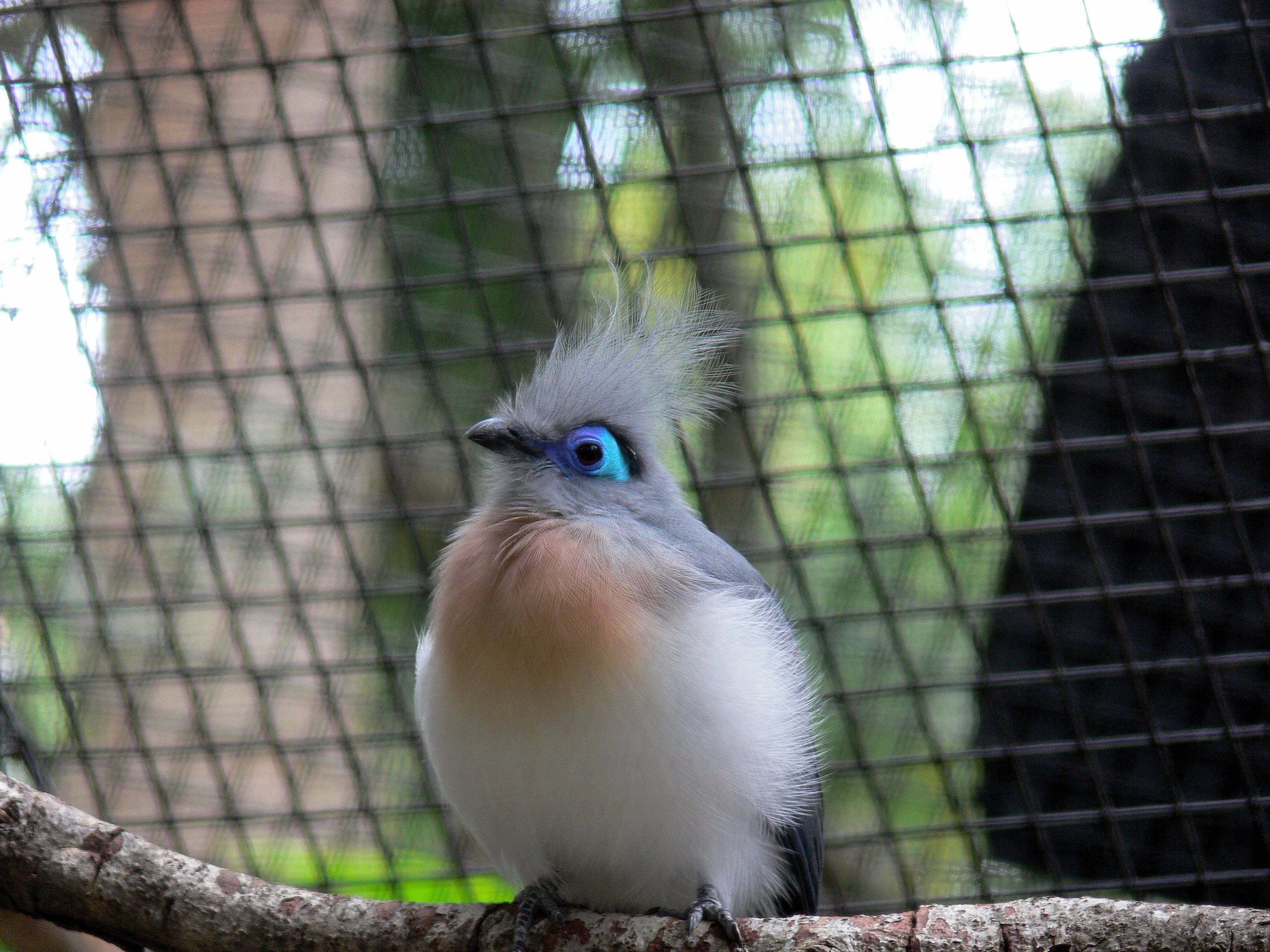
Crested Coua (Coua cristata) by Lee LPZ

Crested Coua (Coua cristata) by Lee LPZ

One sad note, we did ride over to Tampa this week to renew our annual pass to Lowry Park Zoo and found out that the beautiful Crested Couas had died. The man we were talking to didn’t go into detail, but said something tragic happened to both. That has always been one of my favorites in their aviary. Couas are members of the Cuculidae – Cuckoos Family.

Many people make list of the birds they see and that is really neat and enjoyable. Many try to see how many they see each year, in each state, county or country, etc. Doing these pages are starting to become a list of all the birds that I have seen a photo, video, or drawing of. Not sure if it counts for anything, but it is enjoyable and amazing to see the variety and beauty of God’s Omnipotent and Omniscient Hand at work. Yes, I would like to see all 10,000 plus of the birds, but it is not my main ambition in life. The verses in Matthew 16:24-26 keep coming to mind as the work has progressed.

Then said Jesus unto his disciples, If any man will come after me, let him deny himself, and take up his cross, and follow me. For whosoever will save his life shall lose it: and whosoever will lose his life for my sake shall find it. For what is a man profited, if he shall gain the whole world, and lose his own soul? or what shall a man give in exchange for his soul? (Matthew 16:24-26 KJV)

Enjoy the birds, but let their beauty draw you to their Creator.

Wordless Birds

*