***

BETTER THAN SILVER AND GOLD
***
A good name is to be more desired than great wealth, Favor is better than silver and gold. (Proverbs 22:1 NASB)
Silver-eared Leiothrix (Leiothrix argentauris) by Ian
*
*
A good name is to be more desired than great wealth, Favor is better than silver and gold. (Proverbs 22:1 NASB)
Silver-eared Leiothrix (Leiothrix argentauris) by Ian
*
*

Great Egret on Alligator at Gatorland 3-8-16 by Lee
“Therefore be careful how you walk, not as unwise men but as wise,” (Ephesians 5:15 NASB)
You saw this photo in Lee’s Three Word Wednesday, but now here is a video of these birds catching their “Taxi Rides” there at Gatorland, FL.
In the first part of the video, notice the Great Egret gives the gator a nudge to get moving and the gator raises its head up. I didn’t realize that the Great Blue Heron was standing on that same alligators submerged tail. Talking to one of the workers, she said every once in a while the gators get hungry. Birds are playing a very dangerous game, in my opinion.
Most times these alligators and birds get along fine. People are tossing food to them and so they abide each other. It is amazing how different critters get along. I can only imagine how it must have been when they were first created. There was no desire of the gators to eat the birds. Today, under the curse, it is a totally different situation. That condition shall come again in the future.
“The wolf also shall dwell with the lamb, The leopard shall lie down with the young goat, The calf and the young lion and the fatling together; And a little child shall lead them. The cow and the bear shall graze; Their young ones shall lie down together; And the lion shall eat straw like the ox. (Isaiah 11:6-7 NKJV)
*
*
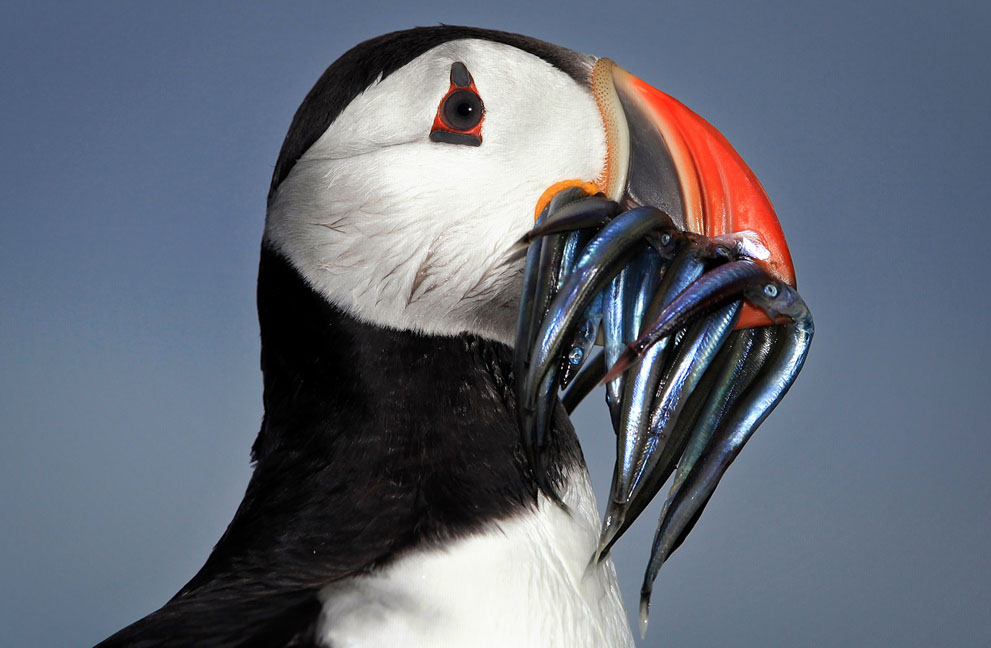
For he and all who were with him were astonished at the catch of fish which they had taken; (Luke 5:9 NKJV)
Puffin with Sand Eels
*
*
For no other foundation can anyone lay than that which is laid, which is Jesus Christ. (1 Corinthians 3:11 NKJV)
Great Egret on Alligator at Gatorland 3-8-16 by Lee
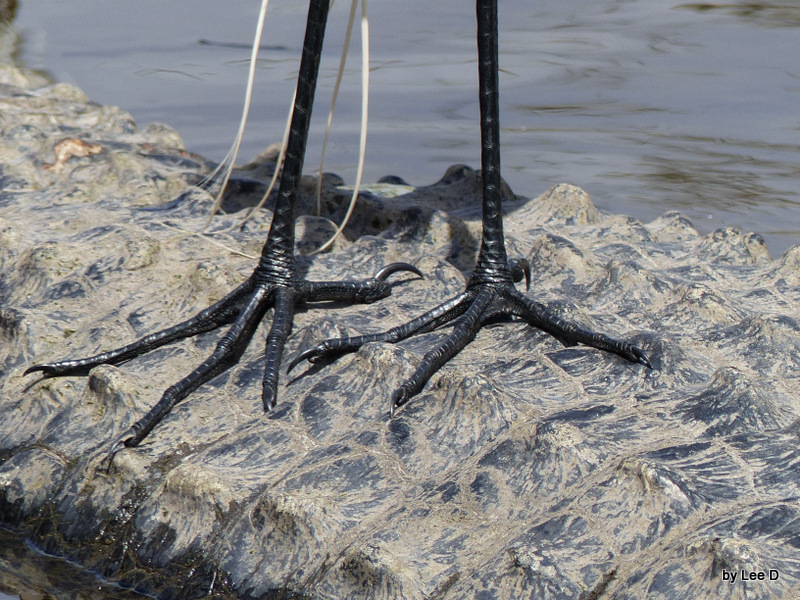
Great Egret on Alligator at Gatorland Close-up 3-8-16
*
*

O LORD our Lord, how excellent is thy name in all the earth! (Psalms 8:9 KJV)
Flamingo at Gatorland – 3/8/16 by Lee
*
*

Jesus Helps Me – Cover
I was contacted by Shelton Interactive on behalf of Callie Grant, the founder of Graham Blanchard, asked if I would review a children’s book by the title: Jesus Helps Me. She knew this blog is Christian based and about birds.
Jesus Helps Me is Christian and about birds. This book is another one in their Knowing My God series.
To begin with, the book is made to be handled by young children. The pages are very colorful, the photos of the bird are great. The verses are simple enough that a child can understand them, and are teaching good Biblical Truths.
As you turn the well made pages (thick, that can be handled by a youngster without tearing); they are colorful, have a bird photo and a simple description or information about the bird, and have a verse or partial verse that is spread over several pages. The page color is different each time you turn a page. That is for teaching colors to the young children.
The book is for babies, toddlers and young children. They suggested reading to babies because they thrive “just hearing your voice as you read the Bible passage in this book.” Toddlers can be shown and told about the birds and colors as a learning tool, besides the verses. As the children advance in age, they can be taught more about those verse to increase their knowledge.
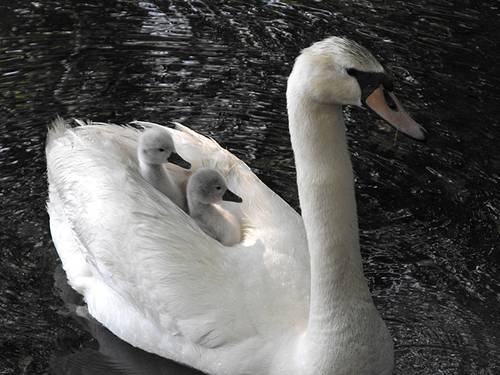
Mute Swan
As I was reviewing this book, besides the book teaching the little ones about verses, birds, colors, etc., I had another thought. What a great way to start training “new birdwatchers.” And, from a Christian perspective, no less. :)
Jesus mentioned the “little children” in many verses. In Matthew 18:2-5, Jesus taught this lesson:
“And Jesus called a little child unto him, and set him in the midst of them, And said, Verily I say unto you, Except ye be converted, and become as little children, ye shall not enter into the kingdom of heaven. Whosoever therefore shall humble himself as this little child, the same is greatest in the kingdom of heaven. And whoso shall receive one such little child in my name receiveth me. (Matthew 18:2-5 KJV)”
For more information, you can contact, www.grahamblanchard.com

Listen (consent and submit) to the words of the wise, and apply your mind to my knowledge; (Proverbs 22:17 AMP)
Common Starling (Sturnus vulgaris) with young ©©
*
*

The eyes of all wait upon thee; and thou givest them their meat in due season. (Psalms 145:15 KJV)
White-eyed Vireo (Vireo griseus) close-up ©©joule_e
*
*
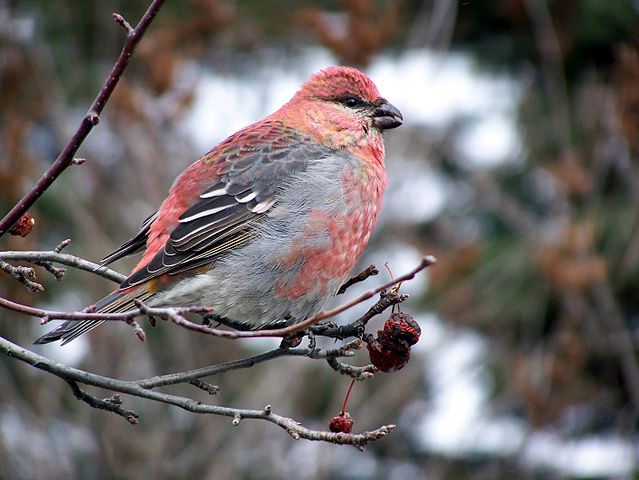
Pine Grosbeak (Pinicola enucleator) ©WikiC
The LORD is good to all: and his tender mercies are over all his works. All thy works shall praise thee, O LORD; and thy saints shall bless thee. (Psalms 145:9-10 KJV)
The Fringillidae – Finches are another large family. With 225 species, the Sunday Inspiration will again have to be divided. This first group includes the Fringilla, Mycerobas, Hesperiphona, Coccothraustes, Eophona, Pinicola, Pyrrhulla, Leucosticte and Carpodacus genus. That is a total of 61 beautiful creations for Our Lord to check out. So, let’s see who they are.
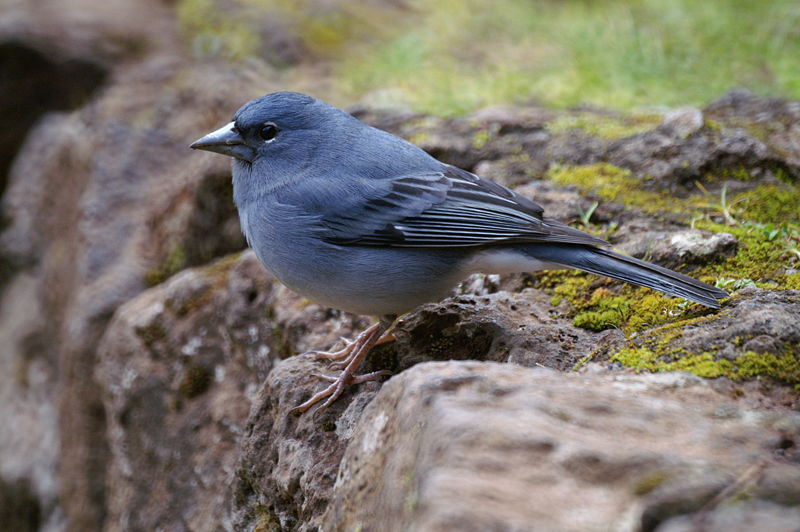
Blue Chaffinch (Fringilla teydea) ©WikiC
The first three are from the Fringilla genus. Common Chaffinch, Blue Chaffinch and Brambling. The Chaffinch and Brambling breed in much of Europe, across Asia to Siberia and in northwest Africa. It prefers open woodland and often forages on the ground.
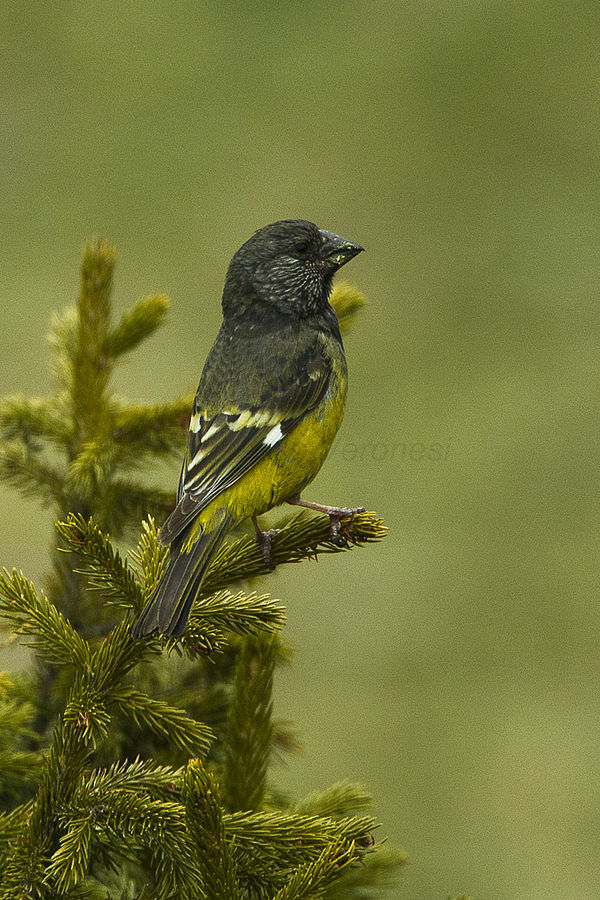
White-winged Grosbeak (Mycerobas carnipes) ©WikiC
The Mycerobas grosbeaks are a genus of finch in the Fringillidae family. They are colorful finches and are at 20–23 cm the largest species in the family. They are found in the southern Himalayas and across into China.
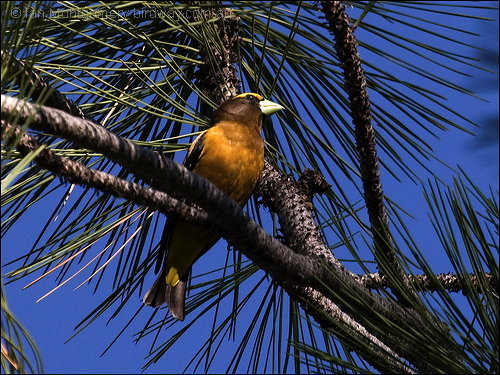
Evening Grosbeak (Hesperiphona vespertinus) by Ian
Hesperiphona is a genus of grosbeaks in the family Fringillidae (the true finches). This genus is native to the New World.
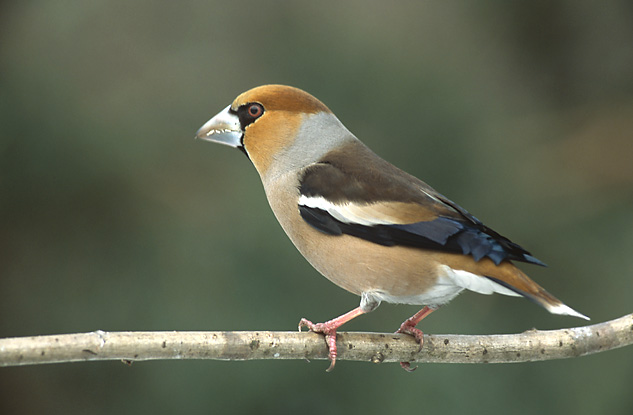
Hawfinch (Coccothraustes coccothraustes) ©WikiC
The Hawfinch, along with the Chinese and Japanese Grosbeaks, and Pine Grosbeak are more of the closely related Grosbeak group.
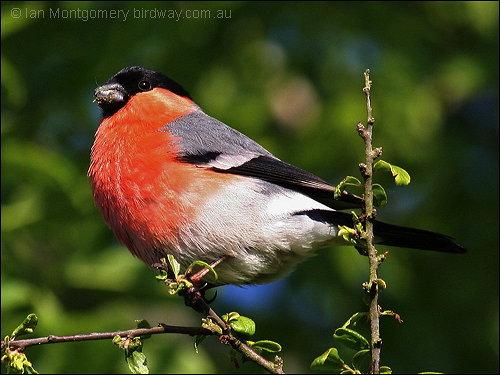
Eurasian Bullfinch (Pyrrhula) by Ian
The seven Bullfinches (Pyrrhula) have glossy black wings and tail feathers. They show a white rump. The legs and feet are fleshy brown. Their short, swollen bill is adapted to eat buds, and is black except for the brown bullfinch, which has a grey or greenish-grey bill. The males can be distinguished by their orange or red breast. Some species have a black cap. All species occur in Asia.
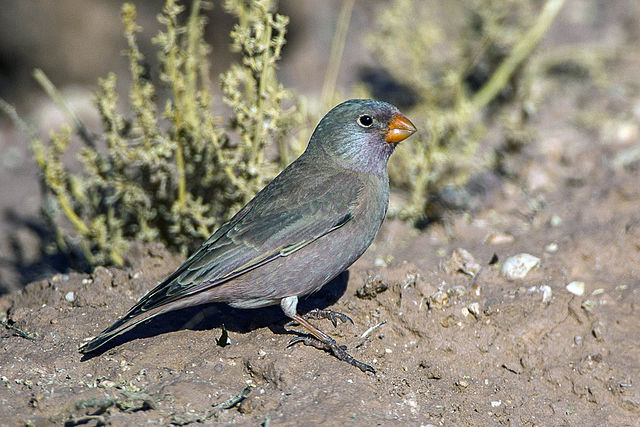
Trumpeter Finch (Bucanetes githagineus) ©WikiC
These next five genus only have six birds; Bucanetes, Agraphospiza, Callacanthis, Pyrrhoplectes, Procarduelis.

Grey-crowned Rosy Finch (Leucosticte tephrocotis) by Ian
The mountain finches are birds in the genus Leucosticte from the true finch family, Fringillidae. This genus also includes the rosy finches, named from their pinkish plumage.
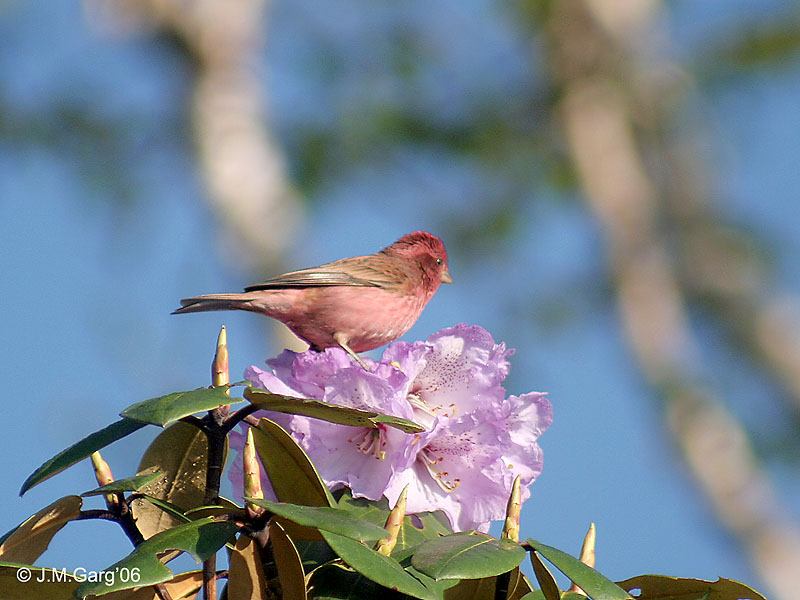
Pink-browed Rosefinch (Carpodacus rodochroa) ©Wiki
The rosefinches are a genus, Carpodacus, of passerine birds in the finch family Fringillidae. Most are called “rosefinches” and as the word implies, have various shades of red in their plumage. The common rosefinch is frequently called the “rosefinch”.
The Carpodacus rosefinches occur throughout Eurasia, but the greatest diversity is found in the Sino-Himalayas suggesting that the species originated in this region.
*
“Surely goodness and mercy shall follow me all the days of my life: and I will dwell in the house of the LORD for ever.” (Psalms 23:6 KJV)
“But I will sing of thy power; yea, I will sing aloud of thy mercy in the morning:” (Psalms 59:16a KJV)
“Mercies Anew” ~ by Lisa Brock, accompanied by Jill Foster
*
*

Behold, I shew you a mystery; We shall not all sleep, but we shall all be changed, In a moment, in the twinkling of an eye, at the last trump: for the trumpet shall sound, and the dead shall be raised incorruptible, and we shall be changed. (1 Corinthians 15:51-52 KJV)
Common Potoo (Nyctibius griseus) ©Jullan Iondono
*
*
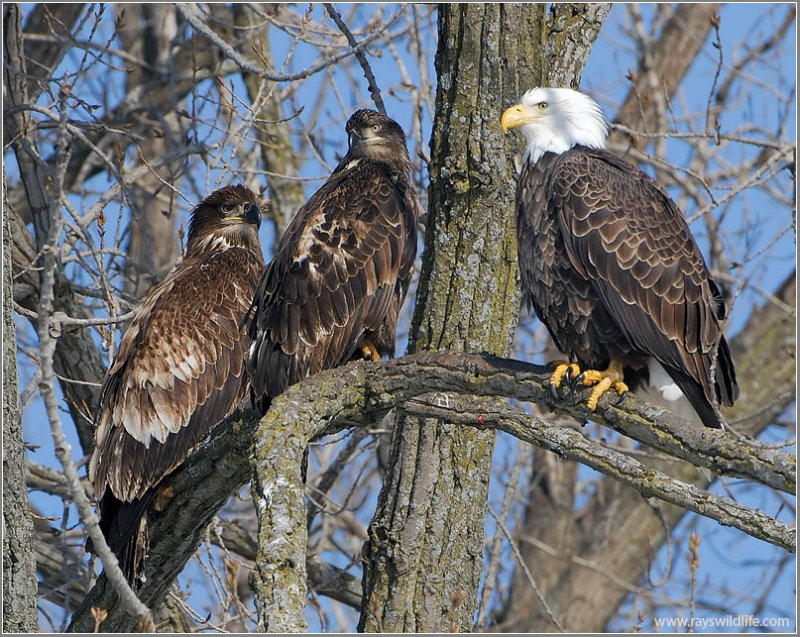
Bald Eagle (Haliaeetus leucocephalus) with youngsters by Raymond Barlow
I would like to share a very interesting post from, “Read the Best Books First,” called, The Teachable Moment. Hannah Hancock is a member of our church and writes a blog. But this article, The Teachable Moment is very well worth reading. She, and her husband, Cody, are in the process of adopting some children. What people may say, is what makes this article so relevant to all of us.
My husband and I are adopting. I don’t talk about it much here on the blog because that’s not what this particular blog is about. I enjoy reading other adoption blogs, and I’ve found a lot of helpful information by reading them and been encouraged by them too, but that’s just not what I’m about in this space.But today, I’m “seizing the teachable moment” as some would say because I’m not very good at doing it in the actual moment.A few weeks ago, a very sweet lady approached my husband and me to ask how the adoption was going or if we’d had any news and what the process was going to look like. This has become pretty standard fare, and most of the time, I think I’m used to it. And despite the fact that I’ve had people asking me why we don’t just have”… continue reading The Teachable Moment
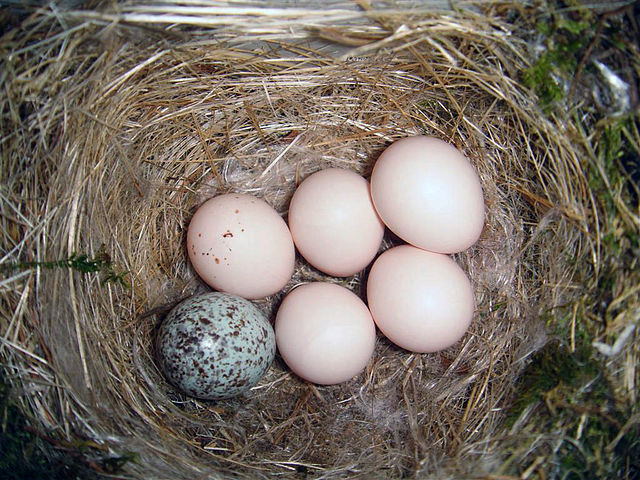
Brown-headed Cowbird (Molothrus ater) Egg in Eastern Phoebe Nest ©WikiC
Recently, I have been taking some on-line courses through the School of Biblical Apologetics with the Institute for Creation Research. Some of the lessons have been about how the Lord used parables to teach many lessons. Jesses seemed to use some of them like object lessons, where you use something currently in sight. So, here is my attempt to use a parable with birds as the object.
When you observe a bird’s nest with eggs in it and they all look alike, do you assume they are all from the same bird parents? In the picture above, it is obvious that there is a “false member of the family” in the nests.
Sometimes, they really do look the same, but there is a “Brood parasite” in among them. They look so similar that you hardly notice them. Therefore the parents accept them, sit on them, and all is well for a while.
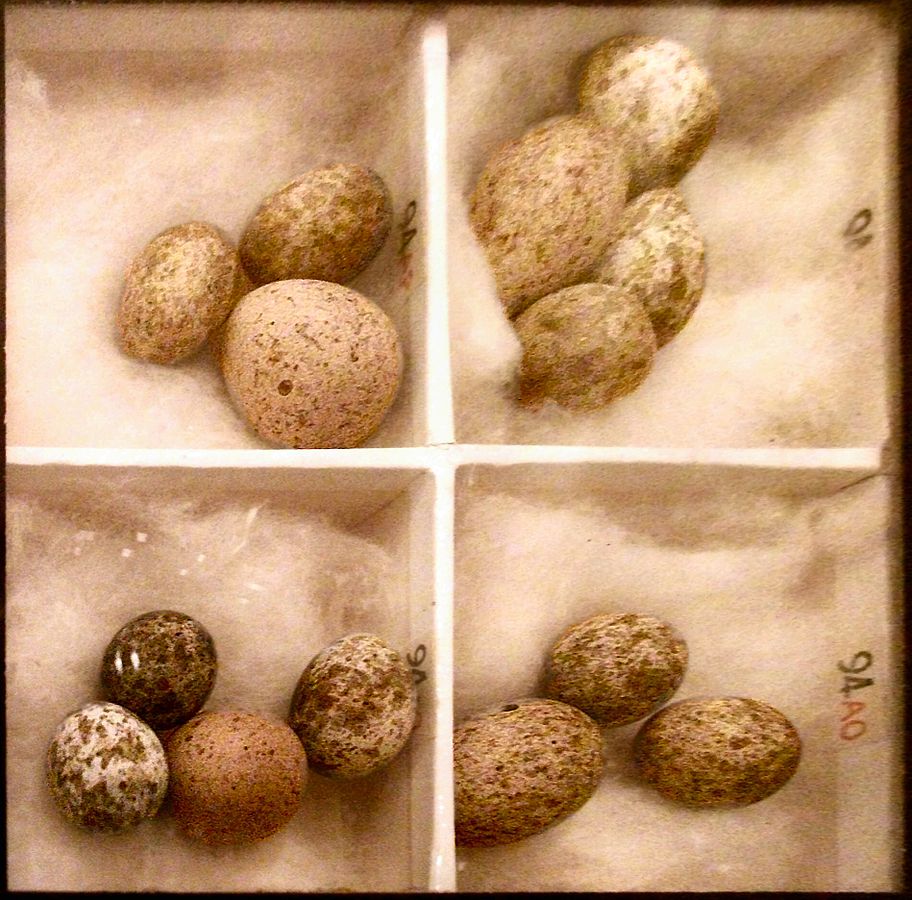
Reed Warbler eggs with Cuckoo Egg in them ©WikiC
But, when the eggs begin to hatch, several things can happen:
Sometimes, while the chick is in the egg, it hears its adopted parents and will actually make sounds like these parents. Therefore the parents feed them, just like its own.
Sometimes, they are so determined, that they actually shove the hosts eggs or the nestlings out of the nest.
Click to see photo of chick pushing egg out of nest.
When they do begin to grow, they become much larger than the adopted parents.
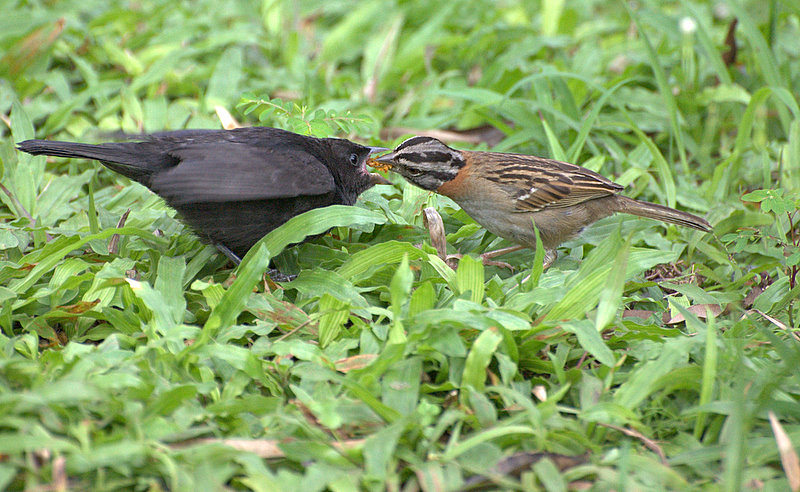
A Shiny Cowbird (Molothrus bonariensis) chick being fed by a Rufous-collared Sparrow (Zonotrichia Capensis)
Sometimes they really grow.
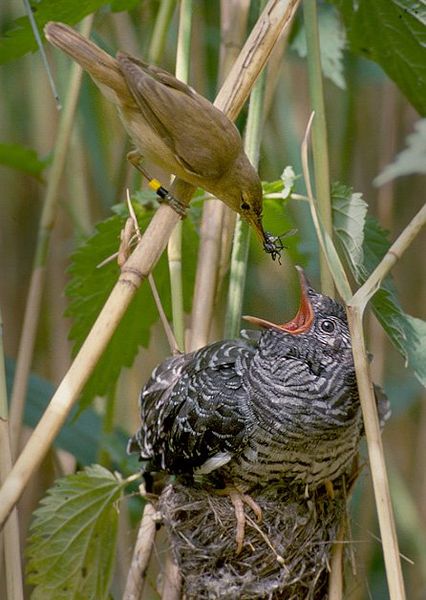
Common Cuckoo (Cuculus canorus) being raised by a Reed Warbler©WikiC
Now for an application:
“But there were also false prophets among the people, even as there will be false teachers among you, who will secretly bring in destructive heresies, even denying the Lord who bought them, and bring on themselves swift destruction. And many will follow their destructive ways, because of whom the way of truth will be blasphemed.” (2 Peter 2:1-2 NKJV) (emphasis mine)
Some deny the Creation and the Creator of Genesis. Yet, they “accept” the other parts of the Bible. Many other truths of God’s Word are also changed or watered-down to fit the needs of the false teachers.
Those of us who are Christians, should be on our guard for false believers, who may learn to “talk the talk” and may “sound like us,” but they are actually bending or perverting the truth.
“These were more fair-minded than those in Thessalonica, in that they received the word with all readiness, and searched the Scriptures daily to find out whether these things were so. ” (Acts 17:11 NKJV)
“These six things the LORD hates, Yes, seven are an abomination to Him: A proud look, A lying tongue, Hands that shed innocent blood, A heart that devises wicked plans, Feet that are swift in running to evil, A false witness who speaks lies, And one who sows discord among brethren.…” (Proverbs 6:16-19 NKJV)
“Because narrow is the gate and difficult is the way which leads to life, and there are few who find it. “Beware of false prophets, who come to you in sheep’s clothing, but inwardly they are ravenous wolves.” (Matthew 7:14-15 NKJV)
“For false christs and false prophets will rise and show signs and wonders to deceive, if possible, even the elect.” (Mark 13:22 NKJV)
Let God’s Word speak for itself. The answers are in the Word of God, if one just searches for these truths.
“The fear of the LORD is the beginning of knowledge, But fools despise wisdom and instruction.” (Proverbs 1:7 NKJV)
“Cease listening to instruction, my son, And you will stray from the words of knowledge.” (Proverbs 19:27 NKJV)
(Bolding for emphasis on verses is mine)
*
Brood Parasite – Wikipedia
*
 Lee's Birdwatching Adventures Plus