***
HEDGED ME ABOUT
***
“He hath hedged me about, that I cannot get out: he hath made my chain heavy.” (Lamentations 3:7 KJV)
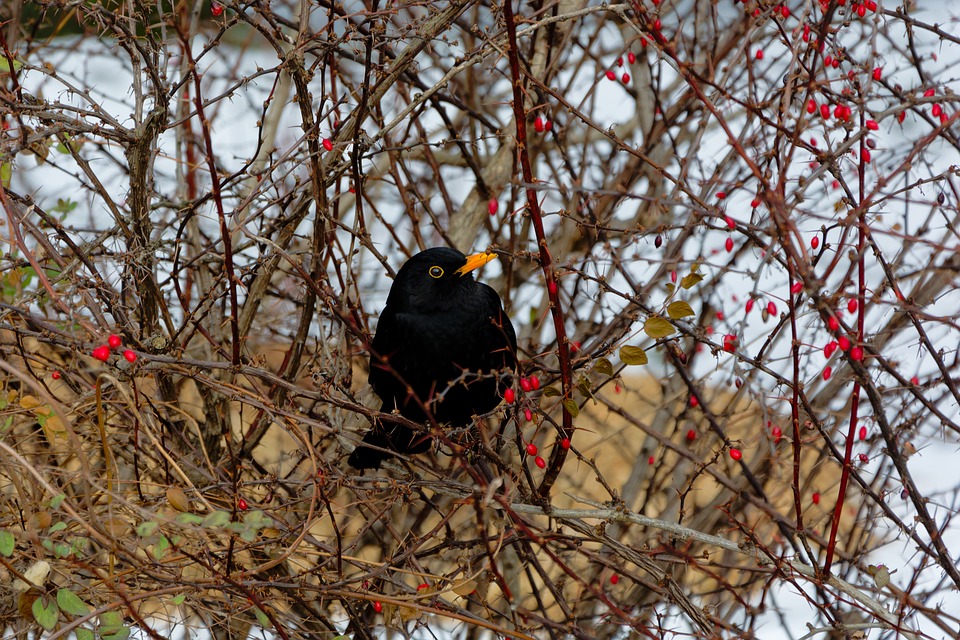
Blackbird Hedge Thorns Winter Bird ©Freegreatpicture
*
*
“He hath hedged me about, that I cannot get out: he hath made my chain heavy.” (Lamentations 3:7 KJV)
Blackbird Hedge Thorns Winter Bird ©Freegreatpicture
*
*
WHY BIRDWATCHING IS WORTHWHILE
3 Lessons from a Box Turtle: Independence, Patience, and Frugality
Dr. James J. S. Johnson
Peter seeing him [i.e., the apostle John] saith to Jesus, Lord, and what shall this man [i.e., John] do? Jesus saith unto him [i.e., Peter], If I will that he tarry till I come, what is that to thee? Follow thou Me. (John 21:21-22)
Peter was quick to check on what others would or should be doing, but the Lord reminded Peter that personal accountability is more important. Yes, our lives are interdependent – however, practicing independence (especially as it applies to individual accountability) is an important life skill. And that is also true of how box turtles live their humble lives, providing an object lesson to birdwatchers. Plus, turtles provide 2 more lessons for birdwatchers, as we shall see.
Turtle traits and birdwatching? Life lessons?
Recently I was reading an ecology perspective (a few excerpts of which are quoted hereinbelow) about the life of a Box Turtle – and it reminded me of 3 reasons why I enjoy birdwatching. [By the way, for a short video on Eastern Box Turtles, see https://www.youtube.com/watch?v=-blYc9GkyFs .]
Specifically, birding is a worthy investment for economic reasons – and because it encourages recreational independence, and patient resilience. More on those three reasons below. (Of course, there are other worthy reasons for birdwatching – perhaps I will address them some other time.)

BOX TURTLE LIVING: DON’T WORRY, BE HAPPY.
Imagine driving down a country road, where a turtle is slowly crossing – you try to avoid squashing the poor reptile, by swerving to miss it. Being a slow pedestrian, in traffic contexts, is a distinct disadvantage. However, the turtle’s slowness is more of an advantage, most of the time, because its independent lifestyle is never in a rush to “keep up with the Joneses”.
Instead of allowing the image of a lethargic, indifferent creature to mislead you [as you consider the lifestyle of a rural turtle], envision these pedestrians as animals enviably insulated form [most of ] the vagaries of their setting. In fact, land tortoises seem more divorced form environmental stresses than any other Appalachian vertebrate.
The turtle’s habitat provides our first hint of its independence. Box turtles live in a variety of terrestrial situations—though permanent water does not seem to be a requirement. High densities of these reptiles commonly occur in woodlots with large trees, canopy gaps, and a diversified ground cover. The turtles bask in openings in the canopy and munch on a variety of short plants. The close ground cover of woody shrubs and leaf litter provide shelter. To feed and bask, box turtles also frequently enter open areas adjacent to the woods. . . . .
[Quoting George Constanz, “Box Turtle’s Independence”, in HOLLOWS, PEEPERS, & HIGHLANDERS: AN APPALCAHIAN MOUNTAIN ECOLOGY, 2nd ed. (W. Va. Univ. Press, 2004), page 127, emphasis added.]

Another one of the box turtle’s built-in advantages is its patient resilience – it can survive a “tough neighborhood”, climatologically speaking. (Patience, of course, is a benefit for any birder.)
One environmental condition [that] turtles do respond to is a cold snap in autumn. Box turtles enter hibernation with the first killing frost. A wet fall [i.e., a rainy autumn] without a sudden freeze provides good conditions for entering hibernation. Dry weather, which makes digging difficult, and a sudden freeze may trap some individuals above ground. Surprisingly, box turtles do not hibernate below the frost line, but remain dormant at depths of up to five inches below the leaf litter. . . . .
Members of the genus Terrapene, which includes the eastern box turtle, hibernate in shallow terrestrial burrows that feature a vertical extension to the surface. In cold spells, turtles turn their heads farthest from the opening. In Ohio, the average turtle spends 142 days in a burrow under three inches of leaf litter with its plastron [i.e., the ventral (“belly”) surface of the turtle’s shell] recessed two inches into the soil. In such shallow retreats, box turtles are exposed to freezing temperatures, yet they usually survive. Able to supercool to only -1.1 C [i.e., just below freezing] this strategy cannot be its entire secret [of winter weather survival]. . . .
In an astounding adaptation [i.e., an amazing design-feature that fits the turtle for filling that habitat], the box turtle is able to survive the freezing of 58 percent of its body water for seventy-three hours, making the box turtle the largest animal known to exhibit freeze-tolerance. . . . .
[Quoting George Constanz, HOLLOWS, PEEPERS, & HIGHLANDERS: AN APPALCAHIAN MOUNTAIN ECOLOGY, 2nd ed. (W. Va. Univ. Press, 2004), pages 128-129.] In other words, turtles wait during “tough times” – and their patience is routinely rewarded. (Likewise, birdwatchers who are patient and still are more likely to enjoy seeing the birds, especially if binoculars are handy – as opposed to scaring the birds off (by movements that startle them) due to spectator impatience.

A third advantageous trait of the box turtle is its metabolic frugality – turtles are slow to spend their energy, so that means they don’t need to eat a lot to replenish spent energy!
A box turtle’s daily behavior seems to be divorced form the caprice of its immediate environment. The condition of a turtle at any particular time appears more an integration of its past experiences than a reflection of its present stresses [due to three of the turtle’s anatomical/physiological design-features]. . . . .
Most obviously, a box turtle’s shell takes the edge off environmental extremes by buffering its body from environmental stresses such as heat and drought. During severe drought, the tortoises do not concentrate around creeks—they merely seek moist sites within their home ranges, make a form [i.e., a depressions in surface vegetation, descending into only about one inch of topsoil] under a pile of leaves, and rest peacefully. Second, their forms and hinged plastrons protect and conceal them from what few predators they do have, such as raccoons. And third, box turtles have a low metabolism. Coupling that with omnivorous food habits, they enjoy a high supply—low demand economy and do not need to hustle. They eat insects, earthworms, strawberries, [other] fruits, mushrooms, and many other foods, yet they burn these calories slowly. In these ways, box turtles enjoy a tremendous hedge against environmental stresses.
[Quoting George Constanz, HOLLOWS, PEEPERS, & HIGHLANDERS: AN APPALCAHIAN MOUNTAIN ECOLOGY, 2nd ed. (W. Va. Univ. Press, 2004), page 131, emphasis added.]
In other words, the box turtle is frugal about metabolically “spending” its food energy – if it doesn’t spend a lot it doesn’t need a lot to live on. As the old saying goes, which surely applies to animal metabolism: “if your output exceeds your input, your upkeep is your downfall”.
So how does this apply to birdwatching?
First, just as turtles are relatively independent, birdwatching is a pastime for those who are independent – there is no need for popular approval for birdwatching. Birdwatching can be done as a group, yet it also can be done individually. Is birding “popular”? Forget about “peer pressure” or “fashionableness” – birdwatching is worthwhile whether it is “in season” or “out of season”. Independent-minded people are often birdwatchers, because birding is a wonderful avocation regardless of whether others do or do not appreciate it.
Second, just as turtles are patient and calm, birdwatching requires patience for best viewing results.
Third, just as turtles are economical in their metabolic “spending” habits, birdwatching is a pastime that is perfect for people of modest means, as well as for people of surplus means who are frugal with their resources. Many “hobbies” are expensive – but not birdwatching!
Although it is certainly possible to spend a lot of money (as a birdwatching), such as by taking a birding vacation to Costa Rica, a lot of birdwatching opportunities can be enjoyed with just a bird-book, binoculars, notepad, and pen. Having an inexpensive “hobby” provides a very real economic freedom – so one need not worry about the cost of birdwatching! Furthermore, many educational resources, about birds, are available (free of charge) on the Internet, including the God-honoring blogsite LEESBIRD.COM !
So, enjoy your birdwatching opportunities – it’s good for practicing independence (instead of trying to “keep up with the Joneses”), it develops your patience, and it’s economically responsible!
><> JJSJ
PHOTO CREDITS:
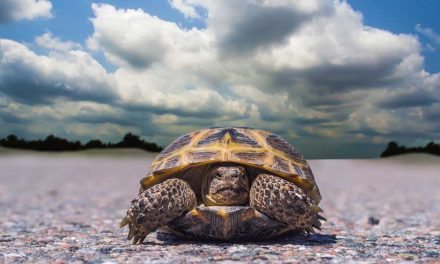
Box Turtle on cloudy day: Animal Hub
Eastern Box Turtle near grass: Mark Swanson
Eastern Box Turtle close-up: Matt Reinbold
Eastern Box Turtle in leaves: Wikipedia
5 Eastern Box Turtles video: https://www.youtube.com/watch?v=-blYc9GkyFs
Dr. James J. S. Johnson

Great is the Lord, and greatly to be praised; and His greatness is unsearchable. One generation shall praise Thy works to another, and shall declare Thy mighty acts. I will speak of the glorious honor of Thy majesty, and of Thy wondrous works. (Psalm 145:3-5)
Hiking up and down forest trails, while birdwatching at a wildlife refuge, can be an opportunity to praise God’s works to another generation – if the adventure is used to explain God’s mighty deeds to a grandchild. And the grandparent-grandchild outing need not be a “big deal”, by worldly standards, in order for it to become a treasured time that counts for eternity (Matthew 6:19-21). Of course, God’s works include the birds He made.
The Hebrew text of Psalm 145:4 (translated “One generation shall praise Thy works to another, and shall declare Thy mighty acts”) can be translated as “Generation, unto generation, shall intensively extol Thy works and shall explain Thy mighty doings”. Part of grandparenting, therefore, involves praising God’s works to another generation, as well as explaining God’s mighty deeds. Since “His greatness is unsearchable”, there are countless opportunities for applying this mandate to wildlife-viewing recreation activities.
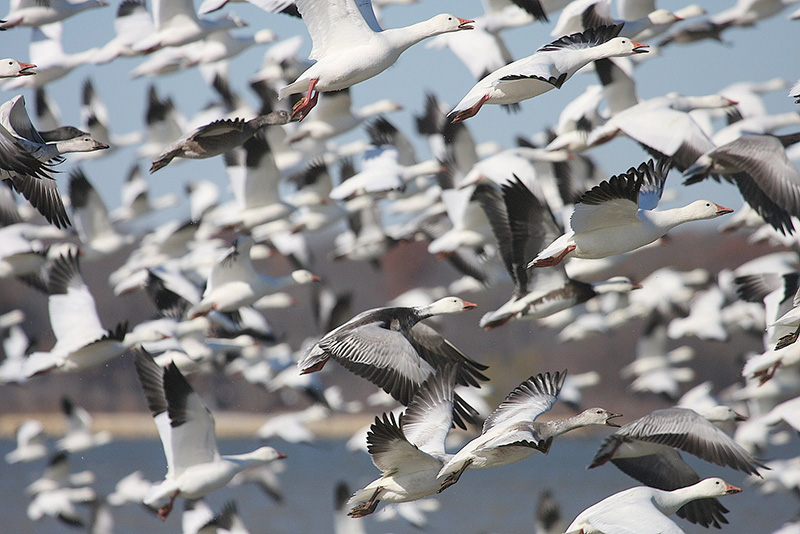
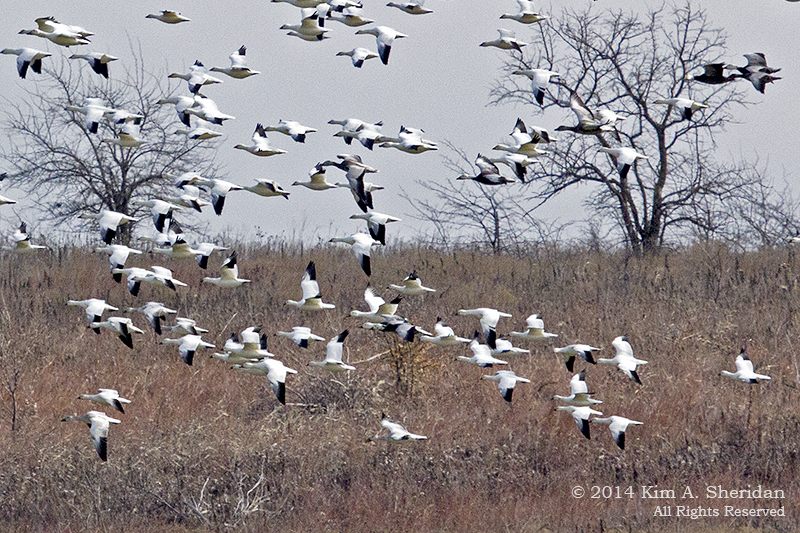
Imagine seeing an open prairie field — or a freshwater lake — covered by what looks like (from a distance) a blanket of unmelted snow – only to recognize that the “blanket” of white is actually a huge flock of migratory Snow Geese – totaling almost 4,000 in one flock, spread over two adjacent fields!

Gregarious flock of Snow Geese at Hagerman NWR (Photo credit: Trent)
Of course, a winter stopover haven that hosts literally thousands of Snow Goose migrants, unsurprisingly, hosts many other birds, providing (for the observant birdwatcher) a mix of other “winter Texans”, migratory transients, and year-round residents — such as American Pipit, Northern Pintail, American Coot, Mallard, Great Blue Heron, Northern Shoveler, Ring-billed Gull, Eastern Bluebird, Hermit Thrush, Northern Mockingbird, Northern Cardinal, Lesser Scaup, Turkey Vulture, sparrows, sandpipers, hawks, and more.
All of those, about a week ago, I saw at Hagerman National Wildlife Refuge (“Hagerman N.W.R.”) in Grayson County, Texas, a few miles west of Sherman. Specifically, on a Wednesday (12-21-AD2016), when local schools were closed for Christmas holiday (i.e., what secularists call “winter break”), an adventure of birding and hiking was undertaken, there, by Trent (one of my grandsons) and me, after we both fueled ourselves with a generous array of Buffalo hot wings (at the WINGSTOP restaurant in nearby Sherman).
The Hagerman N.W.R. acreage (more than 11,000 acres!) is located just south of the Big Mineral Arm of Lake Texoma, the large “lake” (which is actually a lacustrine reservoir formed by the U.S. Army Corps of Engineers’ Denison Dam, built on the Red River) that separates southern Oklahoma from north Texas. [To learn more about Hagerman N.W.R., (website provided by the U.S. Fish & Wildlife Service ), and Hagerman National Wildlife Refuge web article provided by Wikipedia.]
Of those birds viewed, amidst several lengthy treks along the wooded hiking trails, a few are noted below: Snow Goose, Northern Pintail, and Northern Shoveler.
1. SNOW GOOSE
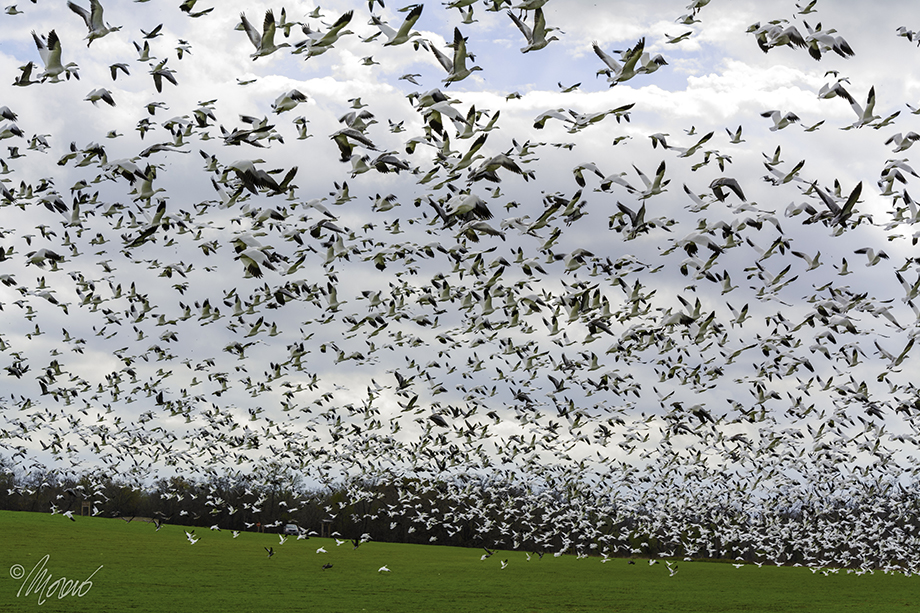
Due to how God programmed Snow Goose bioengineering, no air traffic control team is needed — even though in-flight traffic occurs with lots of motion in very close quarters!
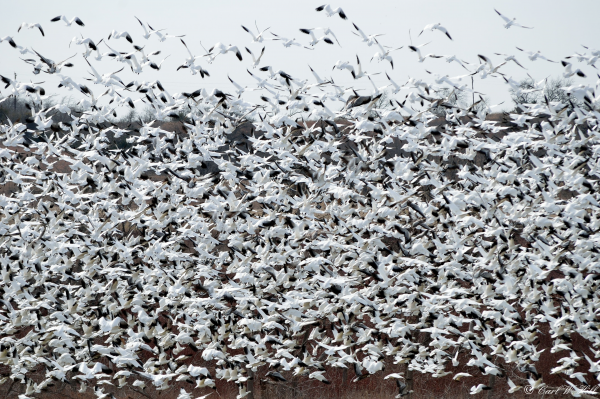
SNOW GOOSE (Anser caerulescens)
The Snow Goose is the almost-all-white “winter Texan” goose that dominated the fields of Hagerman N.W.R. when Trent and I visited that forest-blended-with-grassland earlier this month. (In biome ecology terms, this refuge is located in a pond-pocked hilly region that transitions the Piney Woods forestland of East Texas with the prairie grasslands of Oklahoma.)
Highly gregarious throughout the year, breeding in closely-packed colonies on the Arctic tundra. … Has well-defined migration routes to and from winter quarters. Arrival in winter quarters [such as arrival in Texas] varies with each population, some having quite long stop-overs en route, whereas others move quickly onwards; generally, however, northward spring migration is slower than the autumn one. Winter flocks often attain tens of thousands in coastal farmland [yet, in the case of Hagerman N.W.R., which is inland, the total winter flock is now about 4,000]. Roosts on water, swimming freely, but feeds by grazing, usually pulling out plants by roots, rather than by grazing off tops. Mixes freely with other geese [e.g., Ross’s Goose] on winter grounds, although main portions of flocks keep separate. Even on breeding grounds, other Arctic geese may nest in fairly close proximity and occasional wild hybrids have been recorded with such species as Ross’s [Geese], White-fronted [Geese], and Canada Geese. … On winter grounds resort to cultivation [e.g., Hagerman N.W.R., which is agricultural land, interspersed with deciduous forests and sprinkled here and there with traditional Texas-style “horsehead pump” oil wells], fields of sprouting corn, pasture and stubble fields in lowland coastal zones are favoured.
[Quoting Steve Madge, Waterfowl: An Identification Guide to the Ducks, Geese and Swans of the World (Houghton Mifflin, 1988), page 143 – see also plate 6 illustration by Hilary Burn, page 36.]
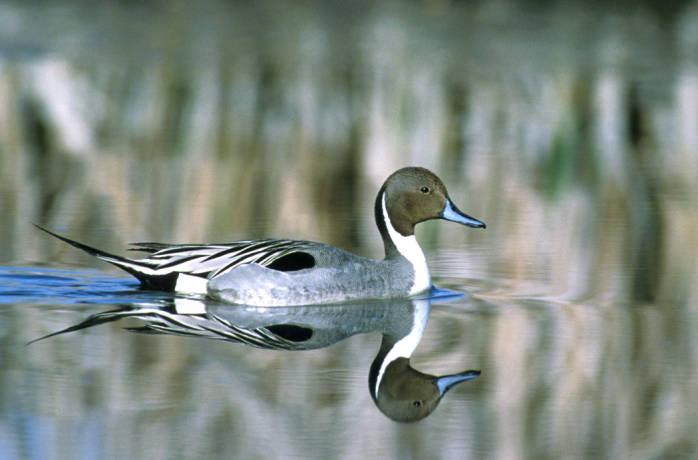
2. NORTHERN PINTAIL
What a graceful duck! Watch it glide quietly through pond-water. What dabbler dignity!

NORTHERN PINTAIL (Anas acuta)
The most plentiful duck that we saw, when we visited various parts (but not all) of Hagerman N.W.R., was the Northern Pintail, another migratory “winter Texan”.
Abundant, esp. in [American] West. Widespread on shallow freshwater wetlands, often in large flocks; also salt marshes, grainfields in winter. Wary; flight fast, agile. Slender neck, rounded [dark, almost black] head, blue-gray bill, gray legs. Male has long, pointed tail [hence the name “pintail”]; brown head with white line on neck extending from breast; green speculum [i.e., colorful patch of plumage on the outer wing secondary feathers]. Female mottled brown; bronze speculum with white rear border. Juv[enile] and eclipse male like female.
[Quoting Jack L. Griggs, American Bird Conservancy’s Field Guide to All the Birds of North America (HarperCollins, 1997), page 33. Other than the thousands of Snow Geese, the most common bird we saw, when we visited Hagerman N.W.R., was the Northern Pintail. Many of these ducks were congregating in the ponded areas near “horsehead” oil pump sites.
3. NORTHERN SHOVELER
Notice how the pair’s coloring is like a Mallard pair, but not those large spatula-like bills!

NORTHERN SHOVELER (Anas clypeata)
Perhaps my favorite duck, of those I’ve seen at Hagerman N.W.R., is the Northern Shoveler. The male shoveler has an iridescent green head (like a Mallard), rusty sides (like a Ruddy Duck), a white breast, and a shovel-like (or spoon-like) bill. These ducks feed mostly “by filtering tiny aquatic insects and plants from the water’s surface with its bill”. [Quoting Stan Tekiela, BIRDS OF TEXAS FIELD GUIDE (Adventure Publications, 2004), page 332-333. A well-named dabbler, this duck’s bill is unlikely to be confused with any other duck. The marshy wetlands at Hagerman provide an ideal winter home for the Shoveler.
Usually found in pairs or small parties, but large concentrations form at migration stop-over waters. Indirectly mixes with other dabbling ducks, but generally keeps apart in discrete gatherings. … Feeds by dabbling [i.e., bobbing upside-down underwater] and sifting in shallow water, swinging bill from side to side over surface [straining wee crustaceans and seeds, as if its bill was a colander!], often immersing head and neck and sometimes up-ending; feeds chiefly while swimming, but also while wading. Loafing birds gather on banks and shores close to feeding waters. Swims buoyantly, with rear end high and fore parts low, the heavy bill often touching surface of water. Walks awkwardly. Flight fast and agile, rising suddenly from surface with whirring wings. Most populations highly migratory, arriving on breeding grounds from mid March onwards and departing again in August. … Favours shallow freshwater lakes [and ponds] and marshes with areas of open water, emergent and fringe vegetation and muddy margins.
[Quoting Steve Madge, Waterfowl: An Identification Guide to the Ducks, Geese and Swans of the World (Houghton Mifflin, 1988), page 236 – see also plate 33 illustration by Hilary Burn, page 91.] For more photographs of the Northern Shoveler, see “’D’ is for Duck, Dabblers and Divers: ‘D’ Birds, Part 1.
What an enjoyable day!
All in all, it was a good day to trek some birdwatching trails — good for physical exercise, good for intellectual adventure, and good for spiritual appreciation for our great Creator-God, the almighty and majestic Provider of every form of life that lives, whether big or small. Each minute of a nature hike is a “teachable moment” (Deuteronomy 6:6-7), for those with eyes to see.
And, as part of good preparation for the outing, it was good to start the day’s recreational activities with a more-than-we-could-eat feast of WINGSTOP Buffalo hot wings, seasoned fries, and iced tea. (Of course, we took home what we didn’t then eat, plus we took home some good memories and Trent’s photographs.)

PHOTO CREDITS:
Snow Goose flock in flight by Kim A. Sheridan:
Snow Goose flock in flight (close-up) by Pottsboro Chamber of Commerce:
Gregarious flock of Snow Geese at Hagerman NWR by Trent (grandson)
Snow Geese at Hagerman NWR winter stopover by Kim A. Sheridan:
Migratory Snow Geese at Hagerman NWR by LakeTexoma.com:
Northern Shoveler (male & female) by Pinterest.com:
Gregarious Snow Geese in Flight at Hagerman NWR by Moreno:
Wing Stop (Singapore) photo: Snapytrend
Great is the Lord, and greatly to be praised; and His greatness is unsearchable. One generation shall praise Thy works to another, and shall declare [i.e., explain] Thy mighty acts. I will speak of the glorious honor of Thy majesty, and of Thy wondrous works. (Psalm 145:3-5)
*
“O thou afflicted, tossed with tempest, and not comforted, behold, I will lay thy stones with fair colors, and lay thy foundations with sapphires. (Isaiah 54:11)
“
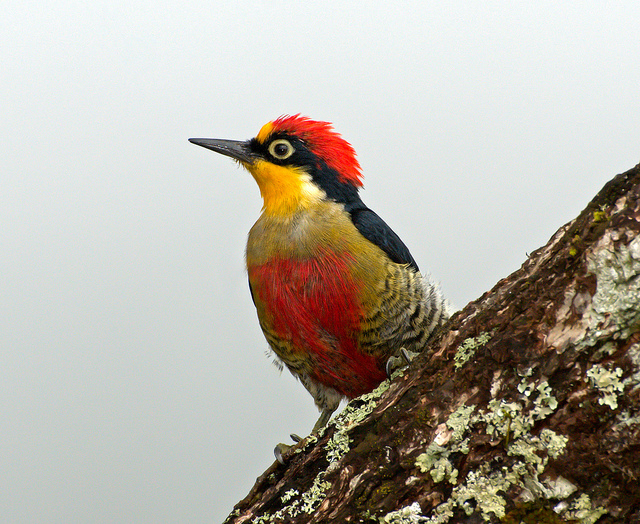
Yellow-fronted Woodpecker (Melanerpes flavifrons) by Dario Sanches
*
*
Dr. James J. S. Johnson 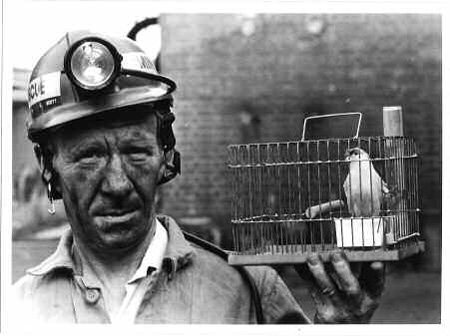
Canary “recruited” for Mining Safety (U.K. gov’t/public domain)
Son of man, I have made thee a watchman unto the house of Israel: therefore hear the word at my mouth, and give them warning from me. (Ezekiel 3:17)
It’s good to have warning devices – like smoke detectors — that monitor environmental conditions, to give us an alarm if a deadly danger is imminent. However, long before humans invented mechanical safety monitoring devices, God had installed creatures all over the planet, with traits that equip them to serve us a safety monitors who can alarm us humans regarding environmental hazards.
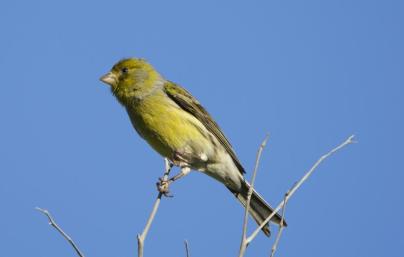
ISLAND CANARY photo credit: HBW Alive
CANARIES, AS AIR QUALITY MONITORS
The Canary (Serinus canaria, a/k/a the “Island Canary” or “Wild Canary”) is an amazingly valuable finch. For generations it has been commonly known, at least within the mining community, that canaries are good safety indicators — serving as caged air quality monitors – if the air is becoming dangerous, the Canary provides the alarm, signaling (by its distress) that it’s time to evacuate(!).
BIRDS AS DANGER SIGNALS – Until 1992 miners used to take a caged canary underground to warn them of dangerous gases [such as carbon monoxide] in the mine. The bird would react to poisons in the air before miners became aware of them. … Canaries were used [by] rescue teams in coal mines to detect poisonous carbon monoxide gas. Reacting more rapidly than humans, their fluttering and other [behavioral] signs of distress gave warning when [dangerous] gas was present. Oxygen was also carried to help birds recover. No detecting apparatus was so reliable and canaries were used until 1992 when new electronic equipment, which can also meter the concentration of gas, was introduced.
[Quoting Colin Harrison & Howard Loxton, THE BIRD: MASTER OF FLIGHT (Hauppauge, NY: Barron’s Educational Series, 1993), page 277.] Perhaps we should not be surprised that canaries have been used as “watchdogs”, in mines, to give warning of dangers – the word “canary” points to the historic discovery of that species of yellow-and-brown finches, in the Canary Islands (and Madeira and the Azores), by Spanish conquistadores. The term “Canary Islands” means “dog islands”, i.e., canine islands, so it makes sense, philologically speaking, that canaries have been harnessed to serve humans as air quality “watchdogs”.
On 1478, when the Spanish invaded the Canaries, they started to export these birds throughout Europe. There followed intensive rearing in captivity, giving rise to the remarkable varieties of forms with their great varieties of forms with their great variety of plumage coloration.
[Quoting Gionfranco Bologna, SIMON & SCHUSTER’S GUIDE TO BIRDS OF THE WORLD (London: Fireside Books, 1990; edited by John Bull), page 365-366.]

Yellow Canary (Crithagra flaviventris) Male ©WikiC
But what is a Canary? Do we see them – or their cousins – in America?
The original Canary (Serinus canaria) is a small yellow and brown species of finch with a lively manner and a cheerful song. The familiar yellow bird of today is the result of controlled breeding [i.e., real “selection” of phenotype-coded genotypes, by human breeders] usually suppressing the dark pigments in the plumage. Breeding has also produced a wide range of color in shades and mixtures of white, red (which needs a carotene-rich diet to maintain the color), green and brown, tufted headcaps and variations in body shape. Birds produced by crossbreeding with Red Hooded Siskins (to produce red) and Mules (hybrids with other finches such as the Goldfinch and Linnet), are not taxonomically true canaries but are exhibited as such. The Roller, Malinois and Spanish Timbrado are considered the most musical breeds.
[Quoting Colin Harrison & Howard Loxton, THE BIRD: MASTER OF FLIGHT (Hauppauge, NY: Barron’s Educational Series, 1993), page 236.] Thus, within the extended “family” of finches, the American Goldfinch (Carduelis tristis) is a cousin to the wild Canary (Serinus canaria) of the Canary Islands.
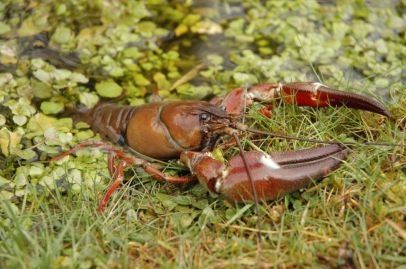
CRAYFISH crawling out of drainage ditch water photo credit: Aaron LeSieur
CRAYFISH, AS WATER QUALITY MONITORS
While caged Canaries can monitor the underground air quality, Crayfish (e.g., Procambus, Orconectes, Cambarus, Fallicambarus, & Faxonella species) serve as water quality monitors. (This is a service that I especially appreciate, having previously served the Texas Natural Resource Conservation Commission and the Trinity River Authority of Texas, as a Certified Water Quality Monitor, and having taught a course in Environmental Limnology at Dallas Christian College, back in the AD1990s.)
Just as canaries are sensitive to airborne poisons, crayfish (called “crawfish” by Louisiana Cajuns, as well as “mudbugs”) serve as indicators of lotic freshwater quality, as well as indicating the freshwater quality of lacustrine margins and muddy-water bayous.
[C]rawfishes have proved to be good indicators of the health of streams and other aquatic ecosystems [such as drainage ditches] and are of great interest to environmental biologists. Because the lives of these creatures are tied so closely to water, pollution and lowered water quality often lead to loss of crawfish populations over both small and large areas. Some studies suggest tha talmsot half the species of eastern American crawfishes suffer from increasingly poor water quality and rapid loss of their aquatic habitats to agriculture or human housing development. A few species in other states appear to have become extinct [i.e., locally or regionally extirpated], and several others – including some in Louisiana – could disappear within the next few decades.
[Quoting Jerry G. Walls, CRAWFISHES OF LOUISIANA (Baton Rouge: Louisiana State University Press, 2009), page 1.] For further (and very comprehensive) details, on the need for relatively pure freshwater, for successful crayfish habitats, see Walls’ book (CRAWFISHES OF LOUISIANA), at pages 34-37 & 52-54.
As a youth, I learned to observe and appreciate (and catch) crayfish, in rural Baltimore County (Maryland), as reported elsewhere — see “Catching Crayfish, a Lesson in Over-Reacting”. These wetland-loving freshwater decapods are true shellfish, creative constructions of crustacean beauty, exhibiting God’s bioengineering brilliance.
So America’s Crayfish, which come in a variety of species, are water quality monitors, indicating by their presence (or absence) whether the freshwaters in streams and drainage ditches are relatively healthy.
Consequently, in recent years, I have been glad to see the mud “chimneys” of crayfish, on the sides of a drainage ditch that runs runoff rainwater alongside my front yard, in the shadow of my mailbox. Even gladder, I was, when I saw active crayfish, darting here and there in the pooled up rainwater-runoff water that accumulates in that drainage ditch. In other words, the crayfish in my front yard’s drainage ditch are (by their very lives!) signaling me that the drainage ditch has fairly “healthy” freshwater quality! As a former Certified Water Quality Monitor, I was happy for the crayfish’s monitoring “report”.
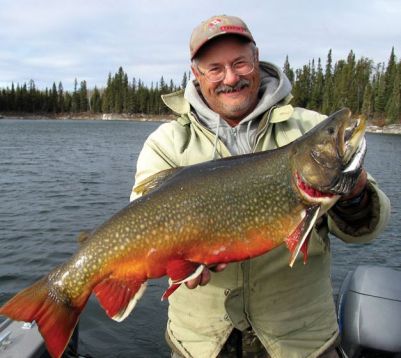
BROOK TROUT ( photo credit: troutster.com )
BROOK TROUT, AS WATER QUALITY MONITORS
Of course, the Crayfish is not the only indicator of freshwater quality. Another example is the Brook Trout (Salvelinus fontinalis – a/k/a “brook charr”, “speckled trout”, “mud trout”, etc.), a salmonid famous for inhabiting freshwater streams, as its name suggests. It prefers ponds and streams with clean, clear, cold waters.
The importance of Brook Trout, to mankind, is illustrated by the fact that it is the official fish of 9 states: Michigan (where a potamodromous [fish that migrate only within contiguous freshwaters] population in Lake Superior is called “coaster trout”), New Hampshire, New Jersey, New York, North Carolina, Pennsylvania, Vermont, Virginia, and West Virginia – plus it is Nova Scotia’s official “provincial fish”.
Since the Brook Trout thrives only in clean freshwater, it too is an indicator – a water quality monitor of sorts – whose presence exhibits that its home-waters are relatively healthy, i.e., unpolluted.
The brook trout (Salvelinus fontinalis) is a small, brilliantly colored freshwater fish native to clear, cold streams and rivers in the headwaters of the [Chesapeake] Bay watershed. … There fish thrive in clear, silt-free, well-shaded freshwater streams with numerous pools and a substrate made of mixed gravel, cobble and sand. Because brook trout are not tolerant of water temperatures above 75 degrees Fahrenheit, they are rarely found in developed areas. . . .
In addition to being noted for their recreational value [as a “prized game fish”], brook trout are also very significant biologically [i.e., ecologically]. Because they require pristine, stable habitat with high water quality conditions, brook trout are viewed as indicators of the biological integrity of streams. As the water quality in headwater streams has declined so have brook trout populations.
[Quoting Kathy Reshetiloff, “Got Brook Trout? Then You’ve Also Got a Healthy Stream”, CHESAPEAKE BAY JOURNAL, 26(8):40 (November 2016). For further (and more comprehensive) details regarding how urban, agricultural, and/or industrial development routinely reduces water quality in affected stream-waters, review Kathy Reshetiloff’s article (cited above), regarding streamside vegetation impacts, sedimentation, rate changes to waterflow, water temperature impacts, acidic runoff, erosion impacts, etc.
In sum, if your stream-water hosts healthy Brook Trout, the stream-water itself is healthy! Like a water quality monitoring device, these salmonids detect and report (by their populational successes or failures) lotic freshwater quality.
FINISHING THOUGHTS: It’s good to have an “early warning” system, a safety monitor who provides a timely alarm of approaching danger. And yet we who have God’s Gospel, the Gospel of Christ’s redemptive grace, are obligated to warn others about the realities of eternity – woe unto whoever shuts his or her ears to the good news of Christ the Redeemer. The time to secure one’s proper relationship to God, through Christ, is now: today is the day of salvation!
He heard the sound of the trumpet, and took not warning; his blood shall be upon him; but he who takes warning shall deliver his soul. (Ezekiel 33:5)
Whom [i.e., Christ] we preach, warning every man, and teaching every man in all wisdom, that we may present every man perfect in Christ Jesus. (Colossians 1:28)
For He saith, I have heard thee in a time accepted, and in the day of salvation have I helped thee: behold, now is the accepted time; behold, now is the day of salvation. (2nd Corinthians 6:2)
*
Catching Crayfish, a Lesson in Over-Reacting
*

“Now Israel loved Joseph more than all his children, because he was the son of his old age: and he made him a coat of many colors. (Genesis 37:3)
Green Jay (cyanocorax luxuosus) by DavesBP
*
*
APPRECIATING WHITE IBISES (AND OTHER BIRDS IN FLORIDA)
Dr. James J. S. Johnson

All flesh is not the same flesh: but there is one kind of flesh of men, another flesh of beasts, another of fishes, and another of birds. (1st Corinthians 15:39)
Christian birdwatchers can enjoy the variety that God has given to our planet, including many different animal kinds, and a multifarious diversity within that larger diversity, such as the enormous variety that we can see in the realm of birds. [See “Valuing God’s Variety”, posted at http://www.icr.org/article/valuing-gods-variety .] One such example follows, viewed (and appreciated) in coastal Florida, on a day when I saw more than 2 dozen different birds. The American White Ibis (Eudocimus albus) — a/k/a White Ibis — is a wading shorebird that frequents the shorelands of America’s Southeast coastlines, clockwise from Virginia’s shores to those of the Gulf of Mexico, from Florida to Texas (and south of that, e.g., Mexico and the Caribbean islands).
And St. Petersburg (Florida) is not deficient when it comes to the White Ibis.

WHITE IBISES at Webel backyard (photo by Marcia Webel)
These waders are easy to recognize – their plumage is all white, except for black wingtips (usually visible only when their wings are outstretched, as in flight); also, they have long, thin red legs (with knees that bend backwards), a long, decurved (i.e., curved downward) reddish-orange bill, and a red face. The White Ibis probes in shallow water with its bill, feeling around for potential prey.
[The White Ibis] uses freshwater or saltwater wetlands and the nearby open shallow water [as hunting grounds, when seeking food].
Feeding is primarily by rapid, tactile probing in exposed or submerged mud while slowly walking. Ibises may also sweep the partially open bill form side to side in water over 10 cm (4 in) deep, snapping down when they feel a prey item. The sweep feeding may be accompanied by foot stirring to scare fish and crustaceans [like crayfish] up into the water column, and/or fully extending a wing to shade the water and provided a perceived refuge for fish. They take advantage of almost any ephemeral source of food and may be seen probing in shallow marshes, willow or sawgrass-lined ponds, the soggy spots of an interstate highway median, or wet agricultural land. This ibis [i.e., the White Ibis] usually feeds in flocks [e.g., a dozen or more]. When feeding on the exposed soil surface, they select their prey items by vision rather than by feel.
Prey includes small crabs (particularly hermit crabs), aquatic insects and [their] larvae, crayfish, snails, clams, worms, frogs, and small fish. They become particularly adept at catching coquina clams exposed at the surface by strong surf. Small prey is swallowed with a forward thrust of the head, while larger items are dismembered by stabbing and biting. Indigestible parts are cast as pellets. Ibises steal large prey from each other [shame on them!] and are sometimes the thief and sometimes the victim with other wading birds [such as the Wood Stork].
Other wading birds as well as kingfishers use feeding ibises as beaters to flush [out] prey, and ibises [like cattle egrets] use livestock [such as cattle] as beaters. Nestling become salt stressed when fed prey from salt water or brackish water; thus, accessible shallow freshwater feeding sites are required for successful reproduction [of thriving offspring].
Recent studies have shown that the White Ibis and [the] Glossy Ibis partition food resources by [non-competitively – so much for Darwinist “survival-of-the-fittest” theory!] selecting different foods when feeding outside the breeding season. White Ibises feeding in flooded ricefields avoid competition by feeding selectively in muddy fields on 48% crabs, 37% aquatic insects, and 15% fish. The Glossy Ibis feeds in shallow flooded fields on a diet composed of 58% grains, 26% insects, and 15% crabs.
[Quoting David W. Nellis, Common Coastal Birds of Florida and the Caribbean (Sarasota, FL: Pineapple Press, 2001), page 151.]
The White Ibis belongs to the same created “kind” (see Genesis 1:21) as the brilliant-vermillion-colored Scarlet Ibis (Eudocimus ruber), which it is known to hybridize with, e.g., in central Venezuela and coastal Colombia.
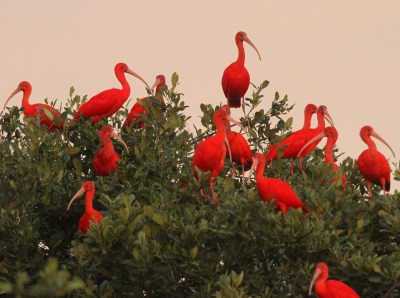
SCARLET IBIS Rookery (photo by Steve Bird’s Wildlife)
White Ibises are usually wild (i.e., non-domesticated), probing beaches and pondshores for prey, such as small fish, aquatic insects, and their favorite marsh-water crustacean: crayfish! However, ibises are teachable! — they can easily learn to trust kind-hearted humans, such as those who feed them bread crumbs in Florida. [For an example, see Lee Dusing’s “Birdwatching at Lake Morton, Finally”.]

White Ibises at Lake Morton (photo by Lee Dusing)
Some may actually eat from your hand; others may keep a “safe” distance as they rush forward to grab up bread morsels tossed to them, at parks or in backyards. These shorebirds also search the lawns of residential properties, seeking (and often finding) large insects – such as beetles – to acquire needed protein-rich food.

White Ibises (Webel backyard; Marcia Webel photo)
During 3 days following Thanksgiving (in AD2016) – Sunday, Monday, and Tuesday – I was privileged to see and feed White Ibis visitors who came to the backyard of Chaplain Bob and Marcia Webel, in St. Petersburg (Florida).
Most of the birding occurred as Chaplain Bob and I sat at the Webels’ patio table, while we both used binoculars (and drank coffee), drank coffee, and ate breakfast prepared by Marcia Webel (whose political humor is second to none!) — as we leisurely enjoyed the avian acrobatics that the birds performed at (and near) the pond that borders the Webels’ backyard, in conjunction with discussing how wonderful God is. [For previous birding reports, of birdwatching at the same location, see Pond-side Birdwatching in Florida I and Pond-side Birdwatching in Florida II , Pond-side Birdwatching In Florida III.]
What a variety-filled birdwatching bonanza it was!
On the Monday following Thanksgiving (i.e., 11-28-AD2016), I observed – in addition to more than a dozen White Ibises (unto many of which I fed bread crumb and/or popcorn) – the following birds, on the pond (they say “lake”) behind the Webels’ house, either in the pondwater or on the pondshores: Muscovy Duck; Mallard; Double-crested Cormorant; Osprey (a/k/a Fish Hawk); Roseate Spoonbill; Wood Stork; Snowy Egret; Great White Egret; Belted Kingfisher; some green parrots (these were dark-headed, but otherwise green); Anhinga, Great Blue Heron; Green Heron; Tri-colored Heron [a/k/a Louisiana Heron]; Pied-billed Grebe; Black Vulture; Common Moorhen [a/k/a Swamp Chicken — what Lee Dusing calls the “Candy Corn Bird”, due to its red bill that is tipped with yellow]; and Boat-tailed Grackle. Breadcrumbs are preferred over popcorn, as far as avian appetites were concerned, at least by White Ibises and Wood Storks – although turtles were happy to snap up popcorn that landed in the pond’s shallow shorewaters.
Also, I saw a dark-colored River Otter in the wild – occasionally surfacing and re-surfacing near the center of the pond. (Never before had I seen one in the wild, so Marcia Webel prayed that I would get to see one during this visit.) And, at least once, I had a good view of the otter’s face, as he surfaced to eat something he (or she) had caught.
In the front yard we also heard (and later saw) a Blue Jay. Later that day, at Madeira Beach/John’s Pass, I also saw Brown Pelicans, various seagulls, and a few dolphins.

LAUGHING GULL with caught fish (photo by Richard Seaman)
On Tuesday morning we saw many of the same birds (as seen on Monday), on or near the same pond – plus Ring-billed Gulls, a very noisy Limpkin, and a Red-shouldered Hawk. Later on Tuesday, at Passa-Grille Beach, I saw Rock Doves (i.e., pigeons), Laughing Gulls, Caspian Terns, and some kind of sandpipers.
As Chaplain Bob noted, every birdwatching day (in the Webel backyard) is similar to other such days, in many ways, yet every birdwatching day is also uniquely different. (That reminds me of snowflakes — they are all similar, yet also unique. In fact, that is much moreso true of us humans — we have much in common, yet God made each of us unique.)
That’s a lot of variety squashed into a couple of fast-flying days in St. Petersburg.
Now that was a birdwatching adventure, reminding me how God loves variety — even among birds!
James J. S. Johnson, JD, ThD, MSGeog

Black-capped Chickadee on snowy branch (BGSmith/Shutterstock photo)
And He [i.e., the Lord] said unto me, My grace is sufficient for thee: for My strength is made perfect in weakness. Most gladly therefore will I rather glory in my infirmities, that the power of Christ may rest upon me. (2nd Corinthians 12:9)
The Black-capped Chickadee (Parus atricapillus, a/k/a Poecile atricapillus) is the official state bird of both Maine and Massachusetts, and it resides in both of those states (and several others) throughout the year.

Black-capped Chickadee (Birdzilla.com)
These relatively plump titmouse-like birds are small – only about 4½ inches long. And, as this YouTube video clip shows, this wee bird is decidedly quick and cute!
For a charming introduction to this boreal beauty, see Lee Dusing’s post titled “Black-capped Chickadees Fed by Hand” (featuring Lesley the Bird Nerd), posted at https://leesbird.com/2015/12/08/black-capped-chickadees-fed-by-hand/ !
Decades ago, I saw Black-capped Chickadees, for the first time, in Falmouth (near Portland), Maine – at the Gilsland Farm Sanctuary (now called “Gilsland Farm Audubon Center”), on May 31st of AD1995, while attending the annual national meeting of the Society of Wetlands Scientists.
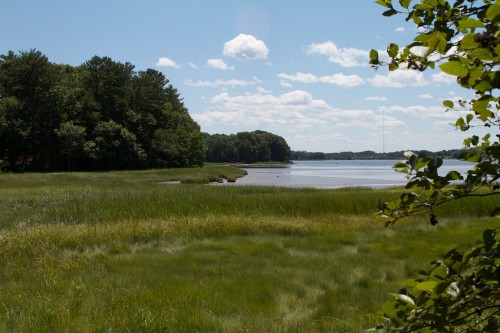
Gilsland Farm Audubon Center wetland habitat (photo: Real Family Camping)
The Black-capped Chickadee has a fairly large range, in most of the northern half of North America, as is shown on a Terry Sohl range map (which map is not shown below, because Mr. Sohl, as a self-described “hardcore atheist”, does not want his maps associated with a Christian blogsite).
The Black-capped Chickadee has some American “cousins”, including(but not limited to) the Chestnut-capped Chickadee (Parus rufescens) of the American West, the Mountain Chickadee (Parus gambeli) of the American West (and Canada’s southwest), the Carolina Chickadee (Parus carolinensis) of the USA’s Southeast, and the Boreal Chickadee (Parus hudsonicus) of Canada, Alaska, and New England.
[Regarding chickadee ranges, see Herbert S. Zim & Ira N. Gabrielson, “Black-capped Chickadee”, in A GUIDE TO FAMILIAR AMERICAN BIRDS (Golden Press, 1987; updated revision by Chandler S. Robbins), page 78; Roger Tory Peterson & Virginia Marie Peterson, EASTERN BIRDS: A FIELD GUIDE TO THE BIRDS OF EASTERN AND CENTRAL NORTH AMERICA (Boston: Houghton Mifflin, 1980), pages 210-211 & M246-M248; Roger Tory Peterson & Virginia Marie Peterson, WESTERN BIRDS: A FIELD GUIDE TO THE BIRDS OF WESTERN NORTH AMERICA (Boston: Houghton Mifflin, 1990), pages 258-259 & M279-M280.]
That year I was in the Portland area, primarily to present an ecology/conservation science research paper, regarding how U.S. government agencies (especially the U.S. Army Corps of Engineers) define and scientifically identify “wetland” properties, for federal regulatory jurisdiction purposes. [See James J. S. Johnson, “Delineating Wetlands: Hydrophilic Plants, Hydric Soils, and Wetland Hydrology”, in Proceedings of the Wetlands Scientists 16th Annual Meeting (Boston, Massachusetts, spring/summer 1995).]
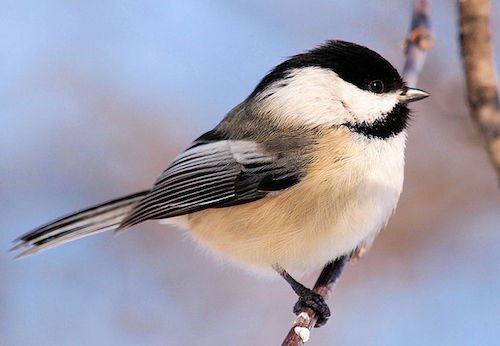
Black-capped Chickadee perching (Alain Wolf / Wikipedia)
For a birder, visiting the Gilsland Farm Sanctuary was an interactive treasure trove. The avian habitat sanctuary hosts various stands of white ash, red maple, spruce, quaking aspen, and white birch, as well as mature oaks and hemlocks. That day, in a variety to meadow-and-forest-edge habitat contexts (e.g., marshy meadows, apple orchard, wet woods and mixed forest edges, shrubland, pond water and shoreline, tidal mudflats of the Presumpscot River estuary), I viewed bobolinks, meadowlarks, herons, egrets, hawks, nuthatches, finches, etc.
For me, however, the 2 “lifers” were the marsh-loving icterid Bobolink and the tiny-yet-tough Black-capped Chickadee. The weather was warm enough, so thoughts of winter weather did not occur. However, many of the birds that my wife and I saw, that sunny day, would fly south, a few months later, to migrate away from the severe cold that Maine experiences when winter months arrive.

Black-capped Chickadee, toughing out winter weather
But not the Black-capped Chickadee! — it is tiny, yet it is tough — residing year-round in Maine, soldiering through the windchill and snowfall, annually illustrating how God has designed some passerine birds to display cold-climate-enduring resilience. Sometimes this wonderful design, and its operations in the real world, is noticed by ecology-analyzing naturalists – even if such naturalists (such as ecologist Kathie Fiveash, who is quoted hereinbelow) fail to accredit God with the providential design and construction of the winged wonders that they observe.
In the fall black-capped chickadees come together in small territorial flocks that will feed together all winter. If you walk in the woods or along the roads [in Maine, such as on Isle au Haut, in Acadia National Park – from where this quoted author writes], you are likely to find a flock feeding actively in the trees, calling to each other as they move about in search of food. These tiny, energetic creatures are preparing to face the frigid temperatures, daunting storms, and long nights of he Maine winter. The summer songbirds have left the coast of Maine, choosing the dangers [and potential blessings] of a migratory journey over the dangers of prolonged cold and darkness. The small songbirds that remain—juncos, kinglets, nuthatches and chickadees chief among them—must manage to stay warm and find sufficient food to survive an entire [winter] season in conditions that could extinguish a human life [if unprotected] in one night.
The black-capped chickadee, Maine’s state bird, is a common and cheerful presence [in Maine] all year. It lives throughout northern North America. With its black cap and bib, white cheeks, gray back, buffy sides, round head, and signature chickadee-dee-dee call, this little bird is unmistakable. Despite their small size [and relatively high metabolism], chickadees are long-lived; the oldest known wild chickadee was over twelve years old[!]. Chickadees are curious and sociable—you can, with a little patience, get a chickadee to land on your hand if you stand quietly with a palm full of sunflower seeds. But since a chickadee weighs less than half an ounce—about the same as four pennies—you will feel mainly the scratch of tiny claws.
Chickadees mate for life. Unmated birds find partners in the feeding flocks that form in autumn. In late winter, males begin to sing their sweet two-note song, and the winter flocks break up.
Chickadee pairs claim territories and, as spring arrives, excavate cavity nests [often made with moss, leaves, and grasses] in rotten snags [i.e., rotten yet standing timber, either dead or half-dead wood, such as tree stumps], often in birch [because its bark remains intact while the inner wood rots into softness]. The female lays about eight eggs and incubates them for two weeks while the male brings her food. When the naked chicks hatch, the mother broods them until they grow downy feathers. Then both parents feed the quickly maturing [i.e., growth-spurt-exhibiting] babies. The young leave the nest at about sixteen days but stay on the breeding territory for another month before heading off on their own. In the fall, chickadees gather again in small flocks that will stay together during the winter.
[Quoting Kathie Fiveash, “Black-capped Chickadees (Poecile atricapillus)”, in ISLAND NATURALIST (Stonington, ME: Penobscot Books, 2015), pages 171-172.] These habits (of chickadee family formation, nest-building, care of eggs and hatchlings, etc.) have been observed by other ornithologists, e.g., Donald Stokes, who similarly reports these behaviors in his chapter “Black-capped Chickadee”, within A GUIDE TO BIRD BEHAVIOR, VOLUME I (Boston: Little, Brown & Co., 1979), pages 161-173, — as well as Stan Tekiela, who likewise summarizes chickadee behaviors in his BIRDS OF MAINE FIELD GUIDE (Cambridge, MN: Adventure Publications, 2002), pages 188-189].
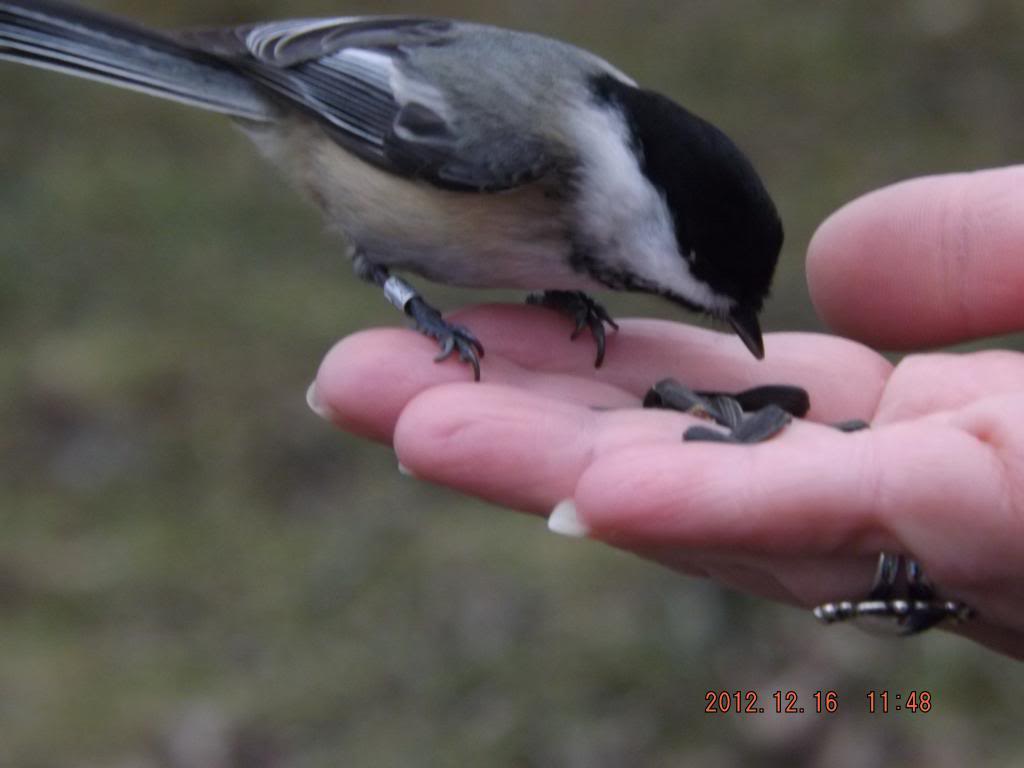
Black-capped Chickadee, eating seeds from hand
Of course, chickadees must eat – and they eat a lot! – because their energetic activities continuously demand food-fuel, to power their fast-paced lifestyles. Consequently, chickadees cannot afford to be too “picky” about what they eat; so, if it’s edible and nutritious, it’s like to be eaten by chickadees!
Chickadees eat insects [including insect eggs], spiders, berries, and seeds [of trees, weeds, or other plant-life]. The feed by gleaning the foliage and bark of trees, often hanging acrobatically upside down on twigs [and small branches]. They come readily to [artificial] feeders, and prefer nutritious black-oil sunflower seeds. As chickadees feed, they call to each other constantly. If you listen carefully you can hear many different vocalizations other than the familiar chickadee-dee-dee [call].
All fall, chickadees stash food in various places—bark, dead leaves, knotholes [in trees], etc. A chickadee can remember hundreds of different locations and retrieve stored food as needed.
Every year, in order to clear their brains for the new information they will need to remember, chickadees actually refresh their brains [according to research findings, apparently] by allowing neurons that held old knowledge to die, replacing them with new neurons. [This allows for some bird seeds to be “forgotten”, so those seeds can germinate, unretrieved, to produce a new generation of whatever kind of plant-life those seeds program for!] Chickadees feed constantly through the short winter days. A feeding flock of chickadees is often joined by other species like kinglets and nuthatches, which depend on the chickadees for food location and warnings of [predatory] danger.
[Quoting Kathie Fiveash, “Black-capped Chickadees (Poecile atricapillus)”, in ISLAND NATURALIST (Stonington, ME: Penobscot Books, 2015), page 172.]

Black-capped Chickadee approaching birdseed (photo credit: birdfeeders.com)
But how do these miniscule marvels stay warm enough to tolerate the winter weather of Maine? God has equipped them for cold climate conditions!
Staying warm in winter is a huge challenge for a tiny creature like a chickadee. The smaller the animal, the greater the ratio of [heat-losing] body surface area to [heat-retaining] body mass, and the more heat is lost.
Chickadees are adapted [JJSJ note: as an evolutionists, she says “adapted” – but I would say “purposefully designed and bio-engineered”] to conserve heat and find enough food to fuel their tiny bodies.
Except on the coldest nights, chickadees roost alone, tucking themselves into small cavities or dense foliage with their heads under their wings. They puff up their feathers to maximize the insulation of their tiny down coats. They constrict the blood vessels directly under their skins to reduce heat loss. On the coldest nights, chickadees may roost communally, taking advantage of the warmth of other bodies. Amazingly [i.e., providentially], a chickadee can lower its body temperature by as much as fourteen degrees [Fahrenheit] from its normal temperature of 110 degrees [Fahrenheit], decreasing metabolic rate to conserve energy. This temporary lowering of body temperature, called torpor [which hummingbirds are also noted for], is rare among birds.
[Quoting Kathie Fiveash, “Black-capped Chickadees (Poecile atricapillus)”, in ISLAND NATURALIST (Stonington, ME: Penobscot Books, 2015), pages 172-173.]
So, how do Black-capped Chickadees “tough it out”, during the cold climate conditions of boreal winters, in the northern parts of America (and up into Canada)?
Quite simply they utilize what God has providentially bio-engineered into their physical traits and programmed behavior skills – which serves as a preparation-for-winter “package” that is “grace sufficient” for the challenges of life. By God’s providential grace, therefore, the Black-capped Chickadee is tiny yet tough – tough enough to make it through winter weather, so there is no need to fly south for the winter.

Black-capped Chickadee and berries (statesymbolsusa.org)
Thankfully, the Creator-God Who made these wee chickadees, with programming and provisions to succeed, generation after generation, also provides us with what we need to succeed, so long as we define our “success” in Biblical terms.
And He [i.e., the Lord] said unto me, My grace is sufficient for thee: for My strength is made perfect in weakness. Most gladly therefore will I rather glory in my infirmities, that the power of Christ may rest upon me. (2nd Corinthians 12:9)
 Lee's Birdwatching Adventures Plus