Songs In The Night From The Mockingbird

Northern Mockingbird (Mimus polyglottos) By Dan'sPix

Northern Mockingbird (Mimus polyglottos) By Dan

who teaches us more than the beasts of the earth and makes us wiser than the birds of the heavens?’ (Job 35:11 ESV)

Orni-Theology

Orni-Theology

Recently.a friend was telling me about a bird that has been singing every night. He said that it begins around 3 AM and continues for hours. He was frustrated by the bird’s behavior. After discussing it, we came to the conclusion that it is a Northern Mockingbird. They have one with a nest in their yard.

We used to have one that had a nest in the bush outside our bedroom window when we lived in south Florida. Whenever the babies were born, our Mockingbird started its “songs in the night.” The songs are pleasant, but in the middle of the night, the urge to throw a pillow out the window sounds tempting.

Northern Mockingbird (Mimus polyglottos) Juvenile ©WikiC

Northern Mockingbird (Mimus polyglottos) Juvenile ©WikiC

Northern Mockingbirds are members of the Mimidae – Mockingbirds, Thrashers Family. They are the only Mockingbird in North America and are the state bird in Arkansas, Florida, Mississippi, Tennessee and Texas, and formerly the state bird of South Carolina. They are omnivore, meaning it eats fruits and insects.

The Northern Mockingbird is a medium-sized mimid that has long legs and tail. Both males and females look alike. Its upper parts are colored gray, while its underparts have a white or whitish-gray color. It has parallel wing bars on the half of the wings connected near the white patch giving it a distinctive appearance in flight. The iris is usually a light green-yellow or a yellow, but there have been instances of an orange color. The bill is black with a brownish black appearance at the base. The juvenile appearance is marked by its streaks on its back, distinguished spots and streaks on its chest, and a gray or grayish-green iris. Northern Mockingbirds measure from 8.1 to 11.0 in (20.5 to 28 cm) including a tail almost as long as its body.

Although many species of bird imitate the vocalizations of other birds, the Northern Mockingbird is the best known in North America for doing so. It imitates not only birds, but also other animals and mechanical sounds such as car alarms. As convincing as these imitations may be to humans, they often fail to fool other birds. (Wikipedia with editing)
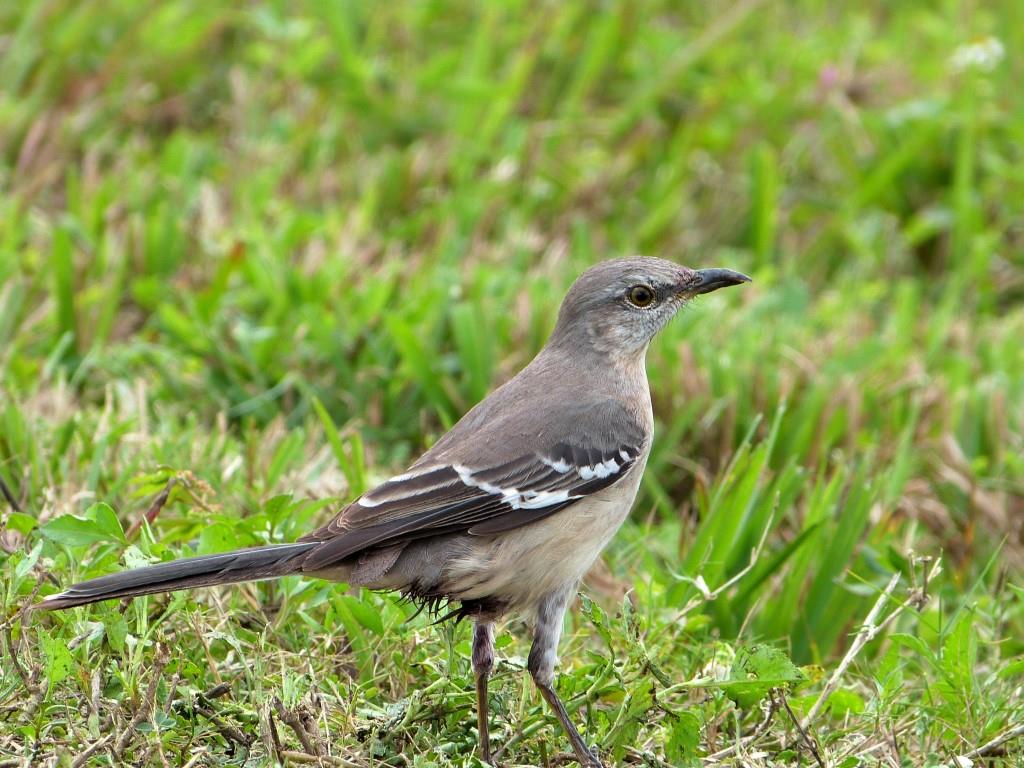
Northern Mockingbird Viera Wetlands

Northern Mockingbird Viera Wetlands by Lee

What is interesting about the Bible verse above is that the verse has been used many times before, but I have not used the previous verse. Here are the two verses together.

But no one says, ‘Where is God my Maker, Who gives songs in the night, Who teaches us more than the beasts of the earth, And makes us wiser than the birds of heaven?’ (Job 35:10-11 NKJV)

God our Maker and the Lord our Savior gives us songs in the night when all is well. Apparently, the Mockingbird is happy or joyful as he sings his songs in the night. We can learn from the songster of the night.

Looking at other verses, what can cause us to not have songs in the night?

The LORD will command His lovingkindness in the daytime, And in the night His song shall be with me— A prayer to the God of my life. (Psalms 42:8 NKJV)

Are we praying and staying in communication with the Lord? When sin creeps in, the songs stop ringing out.

You shall have a song as in the night when a holy feast is kept, and gladness of heart, as when one sets out to the sound of the flute to go to the mountain of the LORD, to the Rock of Israel. (Isaiah 30:29 ESV)

When we have Communion, our pastor always asks us to make sure our fellowship with the Lord and others is clear. When all is straightened out, then we can have our “feast” (communion) with a clear forgiven spirit.

About midnight Paul and Silas were praying and singing hymns to God, and the prisoners were listening to them, (Acts 16:25 ESV)

Even when circumstances are not what we would like are we still “praying and singing hymns to God”?

Why we should sing night or day:

speaking to one another in psalms and hymns and spiritual songs, singing and making melody in your heart to the Lord, (Ephesians 5:19 NKJV)

Let the word of Christ dwell in you richly in all wisdom, teaching and admonishing one another in psalms and hymns and spiritual songs, singing with grace in your hearts to the Lord. And whatever you do in word or deed, do all in the name of the Lord Jesus, giving thanks to God the Father through Him. (Colossians 3:16-17 NKJV)

*

*

Also:

*

Birds of the Bible – Crowned Cranes

Grey Crowned Crane (Balearica regulorum gibbericeps) Jax Zoo by Lee

Grey Crowned Crane (Balearica regulorum gibbericeps) Jax Zoo by Lee

Like a crane or a swallow, so did I chatter: I did mourn as a dove: mine eyes fail with looking upward: O LORD, I am oppressed; undertake for me. (Isaiah 38:14 KJV)

Originally this was going to be about the Grey Crowned Crane at Jacksonville Zoo and other zoos, but the bird genus Balearica (also called the crowned cranes) consists of two living species in the crane family Gruidae: the Black Crowned Crane (B. pavonina) and the Grey Crowned Crane (B. regulorum). The species today occur only in Africa, south of the Sahara Desert, and are the only cranes that can nest in trees. This habitat is one reason why the relatively small Balearica cranes are believed to closely resemble the ancestral members of the Gruidae. Like all cranes, they eat insects, reptiles, and small mammals.

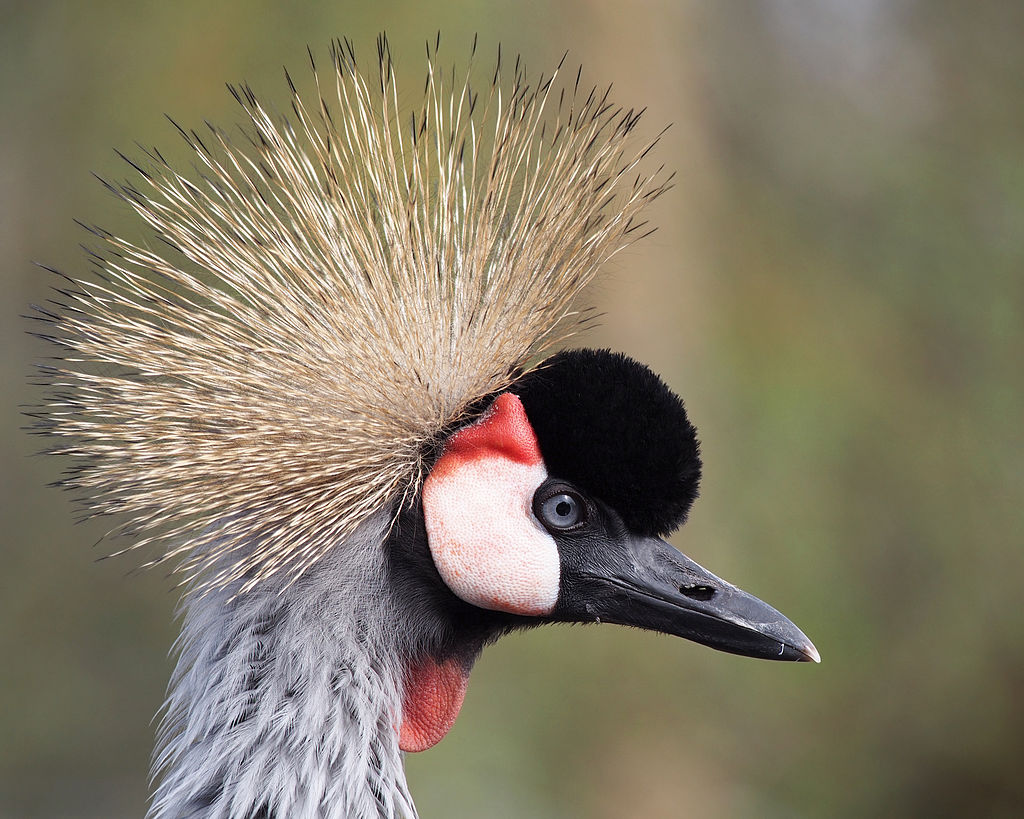
While looking for information, I realized my first impression was incorrect. The Grey Crowned has a grey crown, so while searching our photos the Black Crowned also had the same color crown. At first, I thought I had mislabeled them. Searching Wikipedia, I found these two super photos and decided to share them. You can see that the face is unique in each.

Grey Crowned Crane (Balearica regulorum) ©WikiC

Grey Crowned Crane (Balearica regulorum) ©WikiC

The Grey has the red at the top of the patch on its cheek.

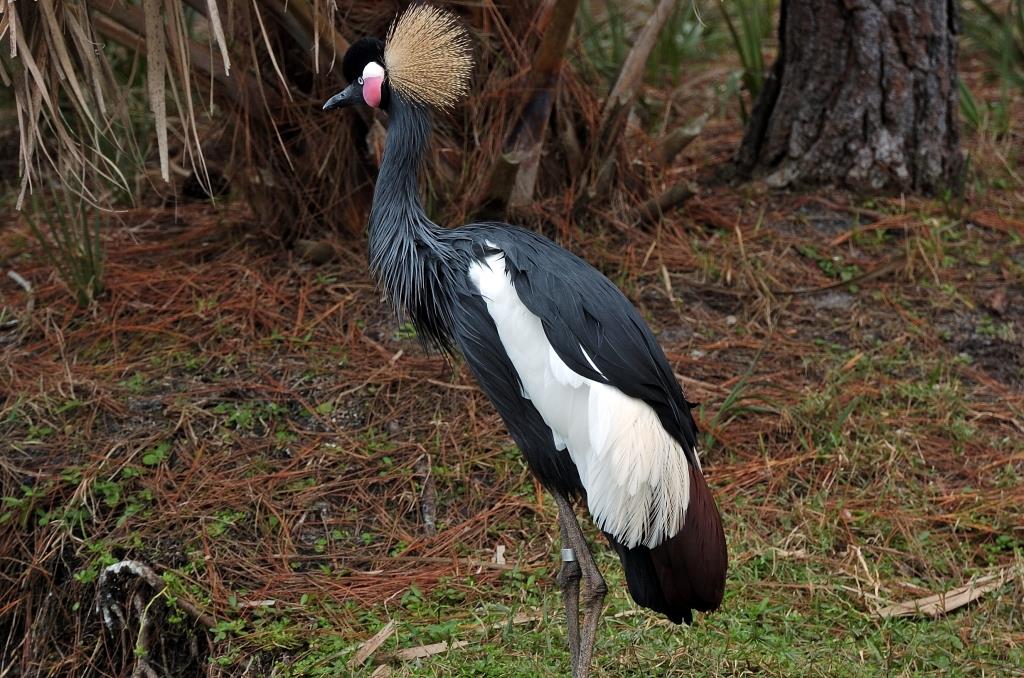
Black Crowned Crane (Balearica pavonina) ©WikiC

Black Crowned Crane (Balearica pavonina) ©WikiC

The Black has the red or pink at the bottom of that cheek.

Also, one has a grey neck and the other a black neck. Ahah! That’s where the name comes from. Man names the birds, but God created them and I think it is neat that He helps us identify them. My opinion is that the Lord should have hung name tags on the birds, so that when we have them in our binoculars or scoped we could just read the sign. But God:

Which doeth great things past finding out; yea, and wonders without number. (Job 9:10 KJV)

O the depth of the riches both of the wisdom and knowledge of God! how unsearchable are his judgments, and his ways past finding out! (Romans 11:33 KJV)

There are other things about them, but this was interesting for me. For me, I will have to keep observing and learning. May none of us every get “bored” watching the Lord’s Creations.

Black Crowned Crane (Balearica pavonina pavonina) (West African) by Dan at Brevard Zoo

Black Crowned Crane (Balearica pavonina pavonina) (West African) by Dan at Brevard Zoo

*

Yea, the stork in the heaven knoweth her appointed times; and the turtle and the crane and the swallow observe the time of their coming; but my people know not the judgment of the LORD. (Jeremiah 8:7 KJV)

This slideshow requires JavaScript.

*

Birds of the Bible – Cranes

Gruidae – Crane Family

Birds of the Bible

Brevard Zoo – Black Crowned Crane

Jacksonville Zoo – Grey Crowned Crane

Grey Crowned Crane – Wikipedia

Black Crowned Crane – Wikipedia

*

Kingfisher Chick Receiving Its First Fish ~ Re-blog

Blue-eared Kingfisher (Alcedo meninting) by Nikhil Devasar

Blue-eared Kingfisher (Alcedo meninting) by Nikhil Devasar

Look at the birds of the air, for they neither sow nor reap nor gather into barns; yet your heavenly Father feeds them. Are you not of more value than they? (Matthew 6:26 NKJV)

This is a very interesting video of a Kingfisher male leaving the nest, as the chick comes out of the shell. The mother Kingfisher arrives with its first meal of fish. Notice that the throat turns dark as it feeds. I do not know which Kingfisher this is as it was not listed.

Posted on Dear Kitty, Some Blog.

*

*

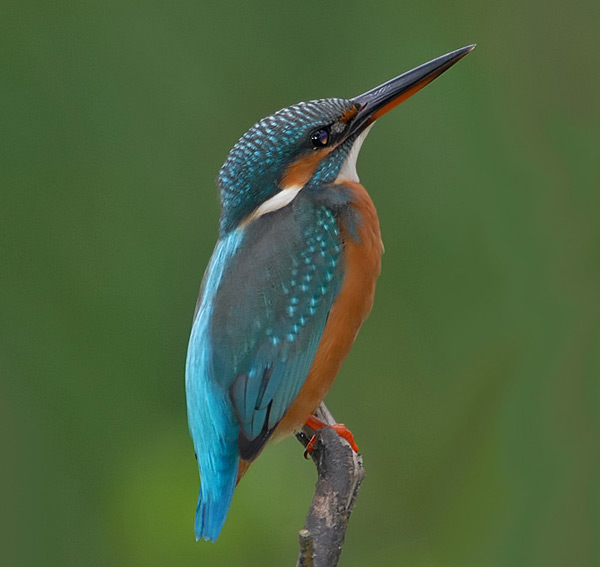
Common Kingfisher (Alcedo atthis) by Nikhil Devasar

Common Kingfisher (Alcedo atthis) by Nikhil Devasar

And Jesus said unto them, Come ye after me, and I will make you to become fishers of men. (Mark 1:17 KJV)

Kingfishers are members of the Alcedinidae – Kingfishers Family.

*

Alcedinidae – Kingfishers Family

Birds of the World

Birds of the Bible

Wordless Birds

*


Australian King Parrot by Bellamoon Nature

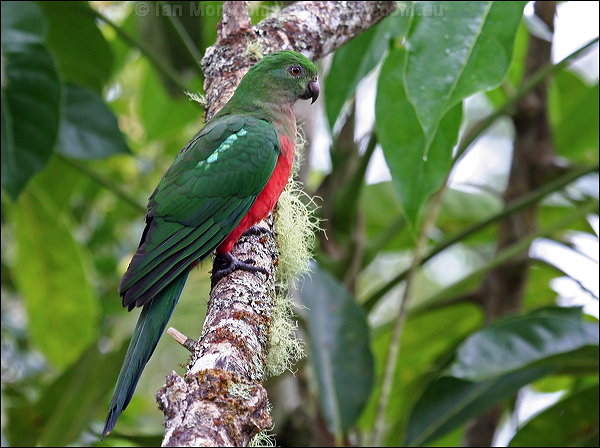
Australian King Parrot (Alisterus scapularis) Female by Ian

Australian King Parrot (Alisterus scapularis) Female by Ian

For God is the King of all the earth: sing ye praises with understanding. (Psalms 47:7 KJV)

Australian King Parrot by Bellamoonnature

*

KING PARROT – One of the most spectacular, brilliantly coloured of all parrots endemic to Eastern Australia. Male king parrots are the only Australian parrot with a completely red head, females have a green head and breast. Found in humid and heavily forested regions. Thank you for viewing Enjoy!

“Some birds are not meant to be caged, that’s all. Their feathers are too bright, their songs too sweet and wild. So you let them go, or when you open the cage to feed them they somehow fly out past you. And the part of you that knows it was wrong to imprison them in the first place rejoices, but still, the place where you live is that much more drab and empty for their departure.” – Stephen King.

“In order to see birds it is necessary to become part of the silence” – Robert Lynd

Australian King Parrots belong to the Psittacidae – Parrots Family.

Australian King Parrots range from North and Central to Southern Victoria. They are frequently seen in small groups with various species of rosella. Further from their normal eastern upland habitat, they are also found in Canberra during winter, the outer western suburbs and north shore of Sydney, and the Carnarvon Gorge in Central Queensland

There are three species of king parrots – medium-sized parrots in the genus Alisterus; the Australian King Parrot (Alisterus scapularis), the Papuan King Parrot (Alisterus chloropterus), and the Moluccan King Parrot (Alisterus amboinensis). The three species are found in Eastern Australia, New Guinea, and Indonesian islands including the Maluku islands respectively. Predominantly of red and green plumage, the long tailed parrots are related to the genera Aprosmictus and Polytelis.

(Information – Bellamoonnature and Wikipedia)


Moluccan King Parrot (Alisterus amboinensis) ©WikiC - Brevard_Zoo

Moluccan King Parrot (Alisterus amboinensis) ©WikiC – Brevard_Zoo

Let us come before his presence with thanksgiving, and make a joyful noise unto him with psalms. For the LORD is a great God, and a great King above all gods. (Psalms 95:2-3 KJV)

Lee’s Addition:

I trust you enjoy this video by Bellamoon. My computer is off line, in fact, not even set up. A new flooring is being installed in that room and it is getting a new coat of paint. So it will be down for several days. This is being scheduled ahead of time.

*
Bellamoonnature – YouTube

Ian’s Australian King Parrots

Psittacidae – Parrots Family

Australian King Parrot – Wikipedia

Birds of the World

*

I.O.C. Version 4.2 Updated

Spotted Elachura (Elachura formosa) ©Drawing WikiC

Spotted Elachura (Elachura formosa) formerly Spotted Wren-Babbler ©Drawing WikiC

So God created great sea creatures and every living thing that moves, with which the waters abounded, according to their kind, and every winged bird according to its kind. And God saw that it was good. And God blessed them, saying, “Be fruitful and multiply, and fill the waters in the seas, and let birds multiply on the earth.” So the evening and the morning were the fifth day. (Genesis 1:21-23 NKJV)

It has been time again for the International Ornithologists’ Union to update their IOC World Bird List. Version 4.2 was released last week and this site has been updated.

We are now up to 10,530 living species, 20,964 subspecies, in 40 Orders, 233 Families (plus 5 uncertain families) and 2273 Genera flying or swimming around the globe. They are still doing as commanded by the Lord to reproduce and keeping the ornithologist busy naming, renaming, and rearranging them.

This time they renamed one and moved it to a new family just for it. The Spotted Wren-Babbler (Spelaeornis formosus) was in the Timaliidae Family. It has been renamed the Spotted Elachura (Elachura formosa) and placed in its own Elachuridae Family. (I do not have permission yet to post a photo.)

Version 4.2 also took the Lark Family and tossed it up in the air and rearranged it. See the Alaudidae – Larks Family. The DNA researches are keeping them busy keeping up with how the birds bred. Some of the scientifc names were changed:

Madagascan Lark (Mirafra hova) now (Eremopterix hova)
White-winged Lark  (Melanocorypha leucoptera ) now (Alauda leucoptera)
Sand Lark (Calandrella raytal) now (Alaudala raytal)
Lesser Short-toed Lark (Calandrella rufescens) now (Alaudala rufescens)
Somali Short-toed Lark (Calandrella somalica) now (Alaudala somalica)
Athi Short-toed Lark (Calandrella athensis) now (Alaudala athensis)
Short-tailed Lark (Pseudalaemon fremantlii) now (Spizocorys fremantlii)

Version 4.2 made some minor spelling changes and added 13 species and deleted one.

Timneh Parrot (Psittacus timneh) ADD
Blue-bearded Helmetcrest (Oxypogon cyanolaemus) ADD
White-bearded Helmetcrest (Oxypogon lindenii) ADD
Buffy Helmetcrest (Oxypogon stuebelii) ADD
Acre Tody-Tyrant (Hemitriccus cohnhafti) ADD NEW
White-rumped Sirystes (Sirystes albocinereus) ADD
Todd’s Sirystes (Sirystes subcanescens) ADD
Negro Stipple-throated Antwren (Epinecrophylla pyrrhonota) ADD
Madeira Stipple-throated Antwren (Epinecrophylla amazonica) ADD
Snethlage’s Antpitta (Hylopezus paraensis) ADD
Alta Floresta Antpitta (Hylopezus whittakeri) ADD
Dusky Leaftosser (Sclerurus obscurior) ADD
Sidamo Lark (Heteromirafra sidamoensis) DEL
Tropeiro Seedeater (Sporophila beltoni) ADD

We now have 10,530 named of the Lord’s avian creations to enjoy and try to catch a glimpse of, and capture with a camera or video.

See:

Go out and have a great birdwatching adventure!

*

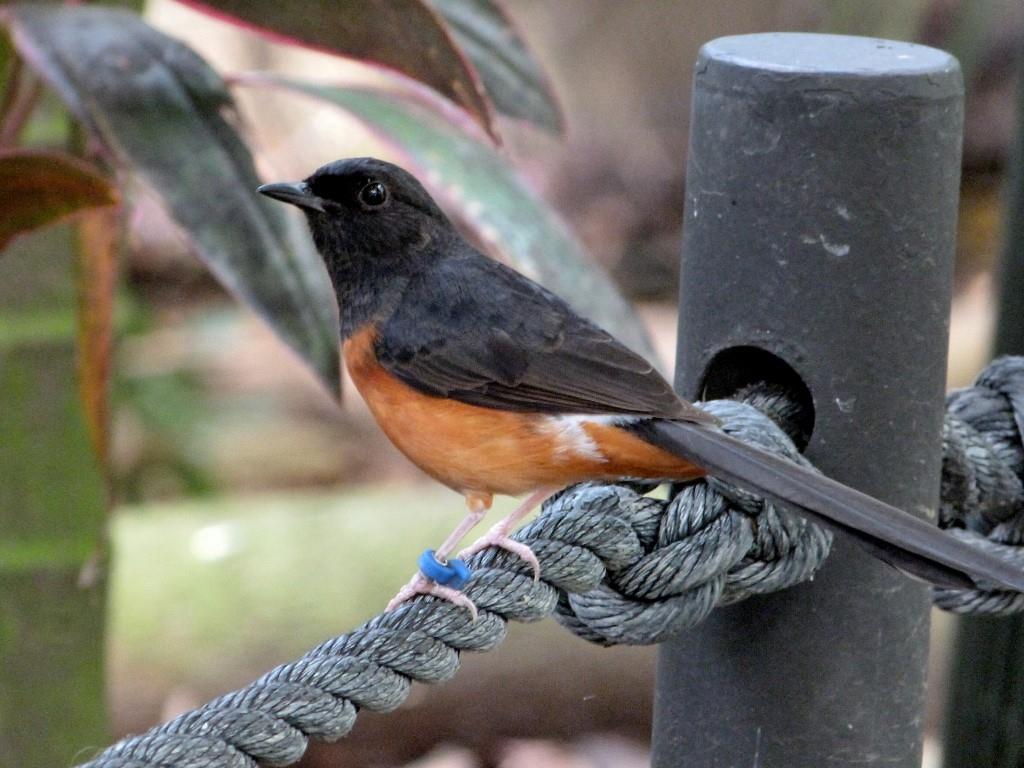
White-rumped Shama at Zoo Miami

White-rumped Shama (Copsychus malabaricus)  at Zoo Miami - Lee

White-rumped Shama (Copsychus malabaricus) at Zoo Miami – Lee

Even the stork in the sky Knows her seasons; And the turtledove and the swift and the thrush Observe the time of their migration; But My people do not know The ordinance of the LORD. (Jeremiah 8:7 NASB)

The White-rumped Shama (Copsychus malabaricus) is a small passerine bird of the family Muscicapidae. Native to densely vegetated habitats in the Indian Subcontinent and Southeast Asia, its popularity as a cage-bird and songster has led to it being introduced elsewhere.

It was formerly classified as a member of the thrush family, Turdidae, causing it to be commonly known as the White-rumped Shama Thrush or simply Shama Thrush.

They typically weigh between 28 and 34 g (1.0 and 1.2 oz) and are around 23–28 cm (9–11 in) in length. Males are glossy black with a chestnut belly and white feathers on the rump and outer tail. Females are more greyish-brown, and are typically shorter than males. Both sexes have a black bill and pink feet. Juveniles have a greyish-brown colouration, similar to that of the females, with a blotchy or spotted chest.

The voice of this species is rich and melodious which made them popular as cage birds in South Asia with the tradition continuing in parts of Southeast Asia. It is loud and clear, with a variety of phrases, and often mimics other birds. They also make a ‘Tck’ call in alarm or when foraging. One of the first recordings of a bird song that was ever made was of this species. This recording was made in 1889 from a captive individual using an Edison wax cylinder by Ludwig Koch in Germany. (Wikipedia)

Here is a video of the Shama singing the second day we were at the Wings of Asia aviary at the Zoo. The pair have a nest and I think the chicks have hatched. (Senior moment-I don’t remember what they told me.)

The LORD is my strength and my shield; my heart trusted in him, and I am helped: therefore my heart greatly rejoiceth; and with my song will I praise him. (Psalms 28:7 KJV)

I am kicking up dust again behind the scenes. The new IOC 4.2 list came out while we were at the zoo. So far I have 237 pages updated, all but the Lark family. They added a new family and are scrambling the Larks around. I am now preparing to do the indexes.  The new 4.2 count is 10,530 species in the world. Stay tuned.

Birds of the World – Families – done

Birds of the Bible – Thrush

White-rumped Shama – Wikipedia

*

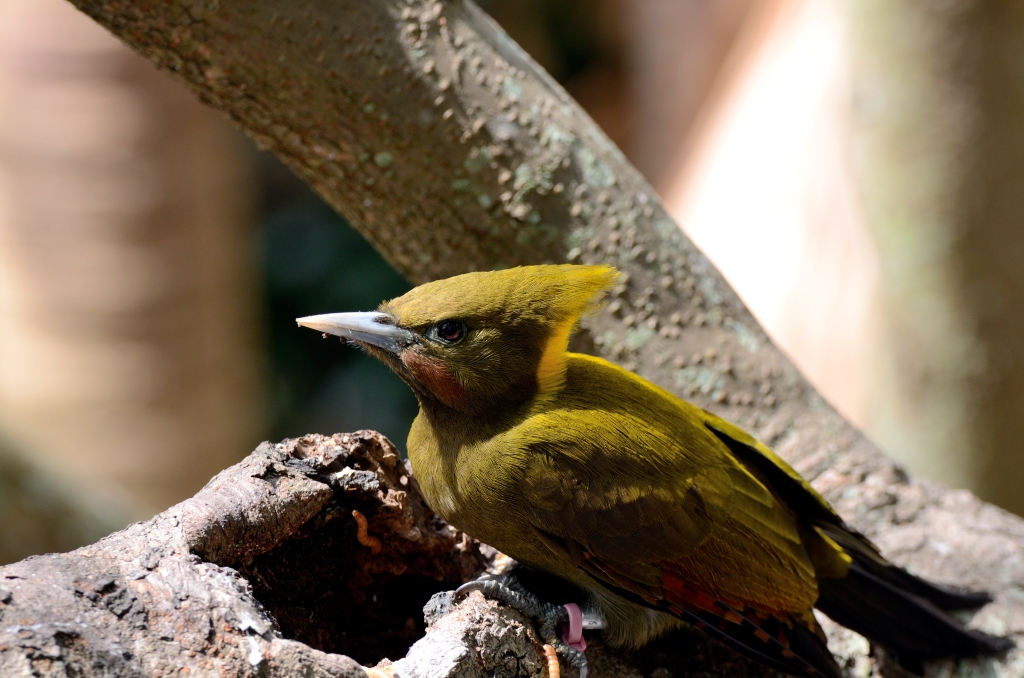
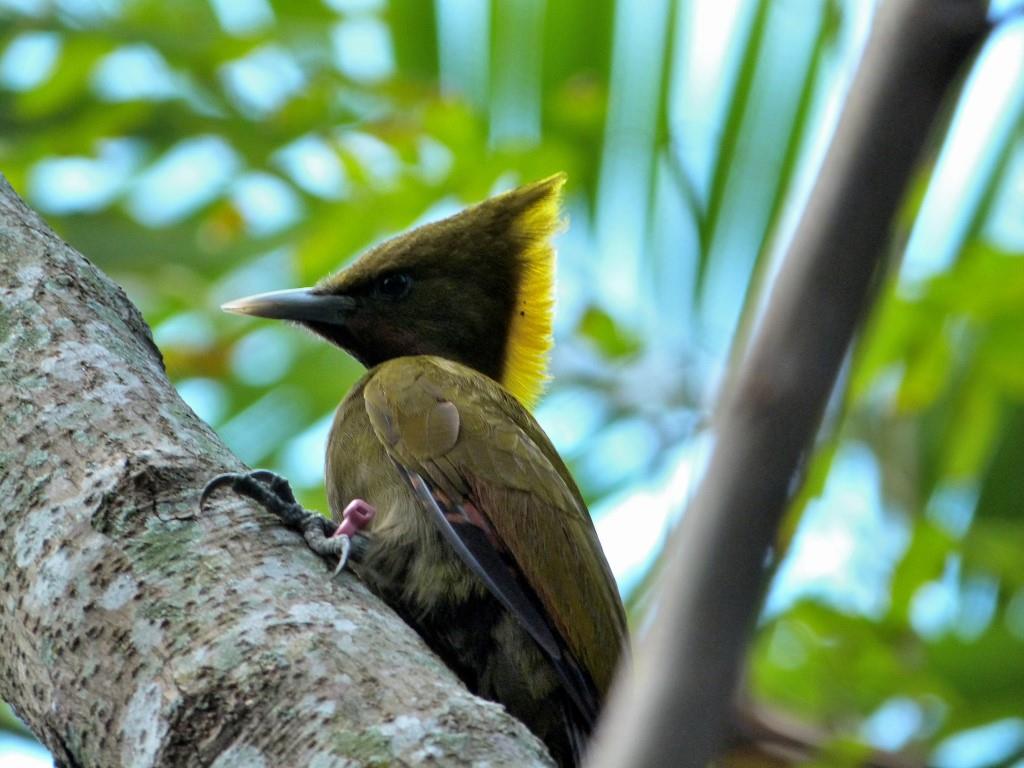
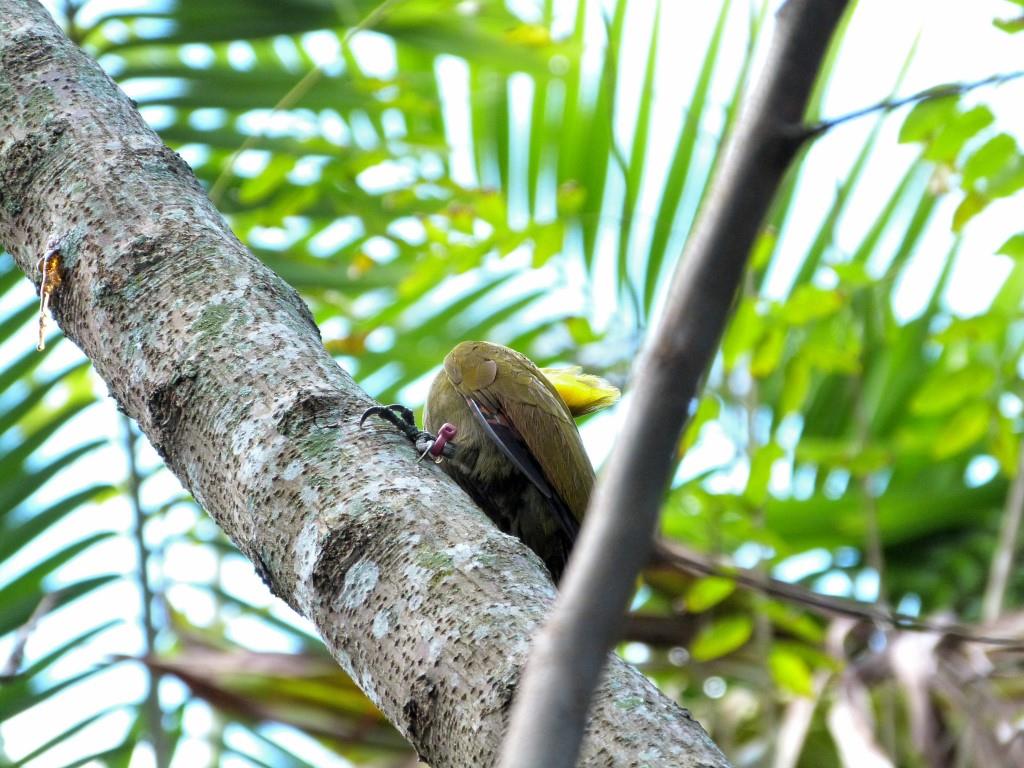
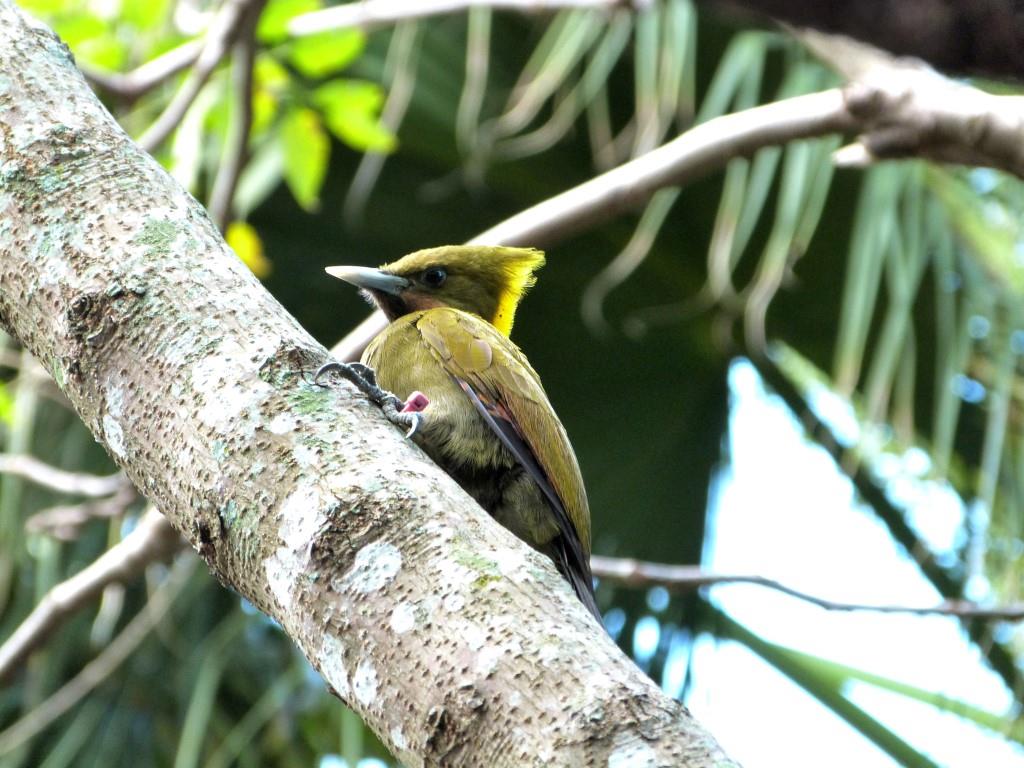
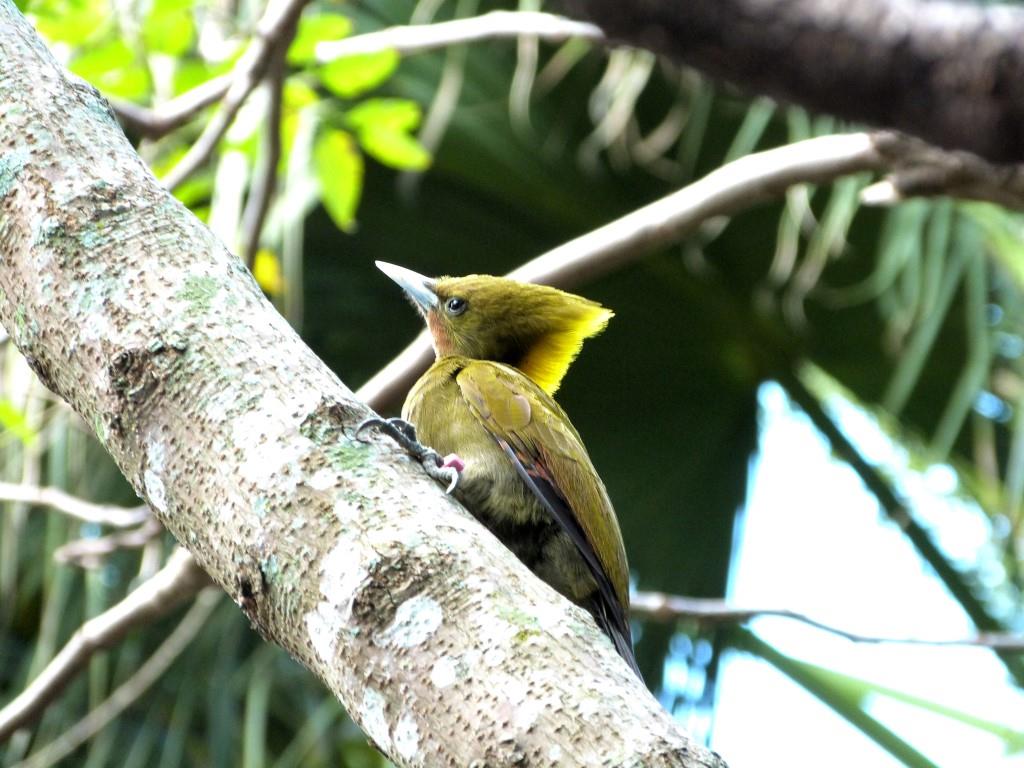
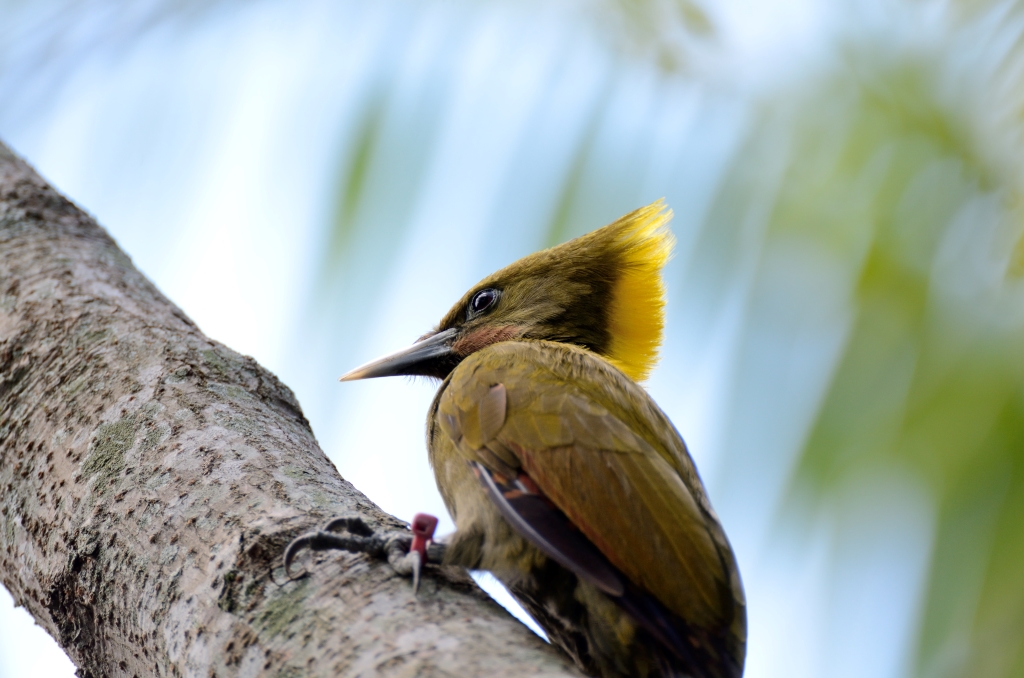
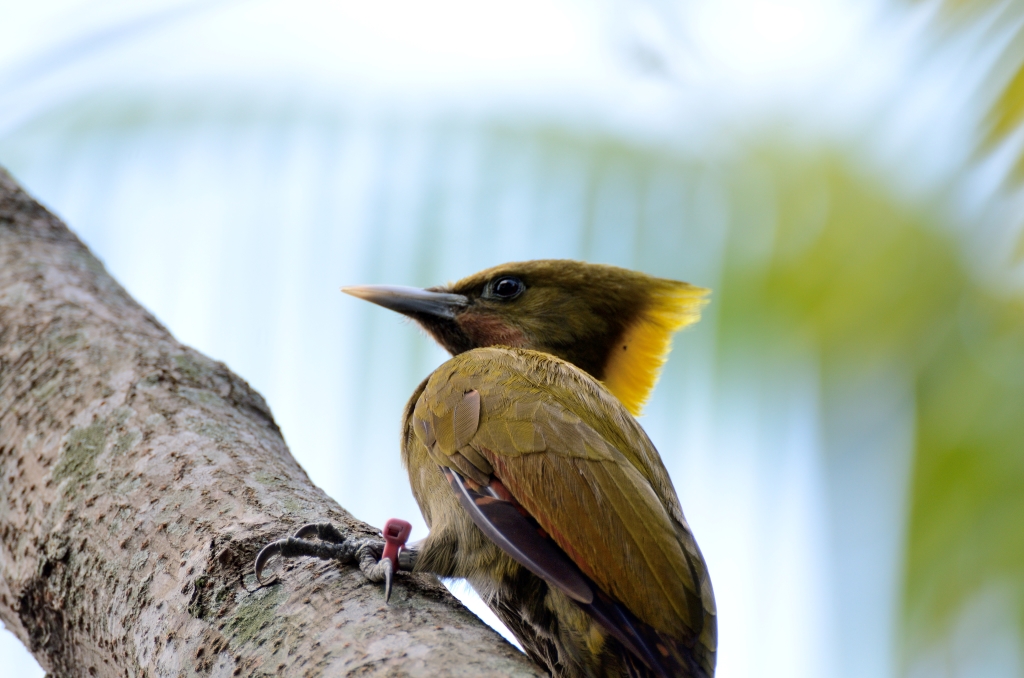
Zoo Miami’s Greater Yellownape

Greater Yellownape (Chrysophlegma flavinucha) female Zoo Miami by Lee

Greater Yellownape (Chrysophlegma flavinucha) female Zoo Miami by Lee

For they will be a graceful ornament on your head, And chains about your neck. (Proverbs 1:9 NKJV)

Here is one of my favorites at Zoo Miami’s Wings of Asia Aviary. They have 87 species and they are all my favorites, but this one is further up the scale. This is a Greater Yellownape (Chrysophlegma flavinucha) female and believe it is the only Yellownape there at present.

Dan and I went back down to Zoo Miami this week and spent two days just in the Aviary. When we were there earlier this year, most of my photos did not come out well. After some adjustments to my Panasonic Lumix FZ47 point-n-shoot (which I shoot in “program mode”), things didn’t do much better at first the first day. More adjustments and these came out better. Tuesday night in the motel, Dan made some more fixes. Yesterday, I finally got some really nice photos which I will share later.

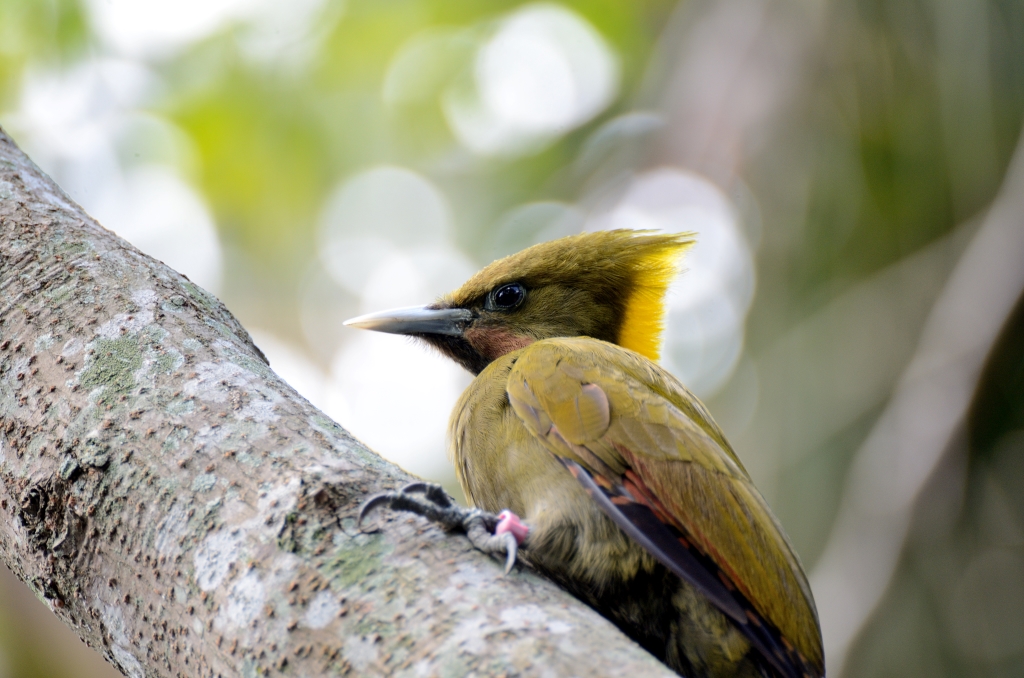
Greater Yellownape (Chrysophlegma flavinucha) female Zoo Miami by Dan

Greater Yellownape (Chrysophlegma flavinucha) female Zoo Miami by Dan

My son, keep your father’s command, And do not forsake the law of your mother. Bind them continually upon your heart; Tie them around your neck. (Proverbs 6:20-21 NKJV)

For those of you into photography, the problem is that the Aviary is well landscaped with lots of trees and is covered with its wire mesh. My ISO and lens speed were to low to compensate for the environment. My camera normally does well when I am “outdoors” and not in an aviary. (As for ISOs and F-stops, I don’t know much them. I would rather study about the birds and let Dan worry about the camera.)

Back to our Yellownape. This is another neat creation from its Creator. They belong to the Woodpecker – Picidae Family. At the aviary, they call it the Greater Yellow Naped Woodpecker.

List of birds at Wings of Asia - Greater Yellow Nape

List of birds at Wings of Asia – Greater Yellownape

From a copy of their list, you can tell it is a female and the only one. The list has the number of males first, then number of females and then the third number is unknown sex. Every day they check on the birds and try to find each one. If after 3 days a bird isn’t spotted, then a real search begins. By following the counters around, who were very friendly and willing to help with names of birds, many of the birds come out and into view. Could it be because the counters have food with them? In fact some of the birds make themself right at home on the cart.

Counters with friends

Counters with friends

*

Counters with friends making themselves at home

Counters with friends making themselves at home

*

Counters with friends making themselves at home

Counters with friends making themselves at home

*

Actually the Yellownape came in close the second day, but I failed to get her photo, but Dan captured her in the second photo as she was eating worms from the hole in the tree. The worker had just placed some worms there to bring the birds in closer so they could be counted.

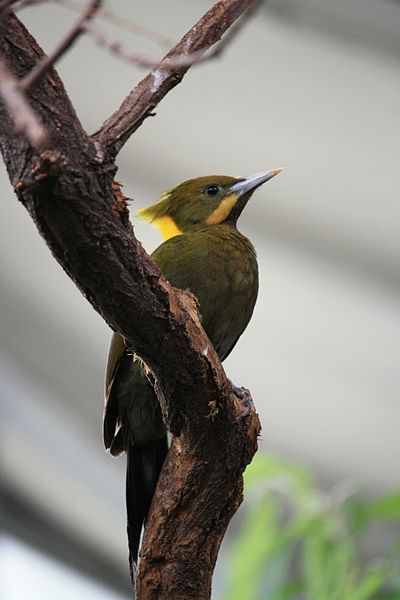
The Greater Yellownape is a large, olive-green woodpecker with prominent yellow-crested nape and throat. Dark olive-green with grey underparts. Crown brownish and flight feathers chestnut barred with black. Bill often looks whitish. “Nape” is the back or base of the neck area. See Birdwatching Term – Nape

It is found in Bangladesh, Bhutan, Cambodia, China, India, Indonesia, Laos, Malaysia, Myanmar, Nepal, Thailand, and Vietnam. Its natural habitats are subtropical or tropical moist lowland forests and subtropical or tropical moist montane forests. (Wikipedia)

Included in the photos below is a photo of a male from Wikipedia. Notice his line on his chin is more yellow than the female. Here is more of a rusty color.

Here are the photos of the Greater Yellownape (Chrysophlegma flavinucha).

“And he arose and came to his father. But when he was still a great way off, his father saw him and had compassion, and ran and fell on his neck and kissed him. …It was right that we should make merry and be glad, for your brother was dead and is alive again, and was lost and is found.’ ” (Luke 15:20, 32 NKJV)

See:

*

Peru’s Marvellous Hummingbird – Updated

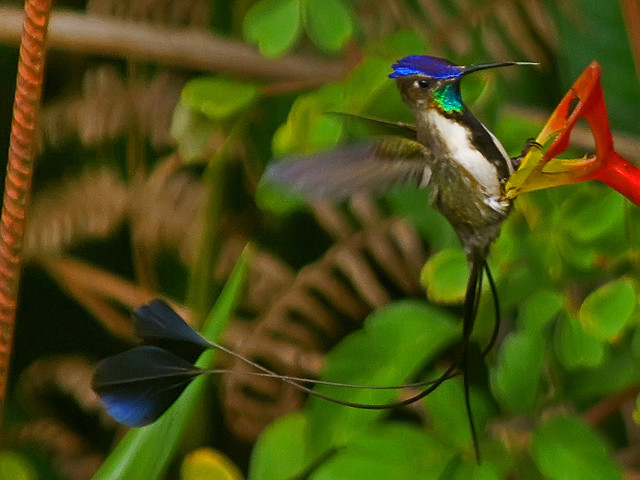
Marvelous Spatuletail (Loddigesia mirabilis)©©

Marvelous Spatuletail (Loddigesia mirabilis)©©

Peru’s Marvellous Hummingbird

(from Creation Moments)

In that day the LORD of hosts will be for a crown of glory and a diadem of beauty to the remnant of His people. (Isaiah 28:5)

In 1835, when scientists first saw Peru’s most unusual hummingbird, they were so overcome with its beauty that they gave it the name “Marvellous.” This little bird treats the eye to iridescent green, yellow, orange, and purple feathers. But its most unusual feature is its tail. While most birds have eight to twelve tail feathers, the Marvellous hummingbird has only four. Two of these are long, pointed, thorn-like feathers that don’t seem to help much in flying or landing. The other two feathers are truly marvellous. They are six inches long, three times the length of the bird’s two-inch body. On the end of these two long narrow feathers are large feather fans that nearly equal the surface area of its wings.

Marvelous Spatuletail (Loddigesia mirabilis) ©©

Marvelous Spatuletail (Loddigesia mirabilis) ©©

Astonishingly, the Marvelous hummingbird has complete control of these feathers. At rest, the bird perches with these two feathers hanging down an inch or so from its body, and then crossing them until they are horizontal. In flight and landing they provide remarkable maneuverability. During mating, the hummingbird moves them as semaphores. Interestingly enough, evolutionists admit that they are stumped as to why these unusual feathers should have evolved.

One look at our creation clearly shows that our Creator appreciates beauty. But even the beautiful Marvelous hummingbird is but a poor and cloudy hint of the beauty of our Creator Himself.

Prayer:
Dear Father, help me treat the beauty You have created as You would have me to do. Let me be filled with thanksgiving to You for it, and let it remind me that You are the source of all that is truly beautiful. In Jesus’ Name. Amen.
Notes:
Crawford H. Greenewalt. The Marvelous Hummingbird Rediscovered. National Geographic, Vol. 130, No. 1. P. 98-101.”

©Creation Moments 2014


*

Lee’s Addition:

This was originally done in 2010, but needs to be re-blogged again. Also, the YouTube above was added. It is astonishing to watch the little bird in action. Thanks to one of our readers who found the video to add to their site. See The Vine Vigil.

The Marvellous Hummingbird is now the Marvelous Spatuletail (Loddigesia mirabilis). It is in the Hummingbird Family (Trochilidae) and is part of the Apodiformes Order.

Marvelous Spatuletail (Loddigesia mirabilis) ©WikiC-Gould_Troch._pl._161

Marvelous Spatuletail (Loddigesia mirabilis) ©WikiC-Gould_Troch._pl._161

The Marvelous (also Marvellous) Spatuletail (hummingbird), Loddigesia mirabilis, is a medium-sized (up to 5.9 in/15 cm long) white, green and bronze hummingbird adorned with blue crest feathers, a brilliant turquoise gorget, and a black line on its white underparts. It is the only member of the monotypic genus Loddigesia.

A Peruvian endemic, this species is found in the forest edge of the Río Utcubamba region. It was first reported in 1835 by the bird collector Andrew Matthews for George Loddiges. The Marvellous Spatuletail is unique among birds, for it has just four feathers in its tail. Its most remarkable feature is the male’s two long racquet-shaped outer tail feathers that cross each other and end in large violet-blue discs or “spatules”. He can move them independently.

Information gathered from Creation Moments, Wikipedia, and YouTube.

Wordless Birds

Peru’s Marvellous Hummmingbird – The Vine Vigil

*

*


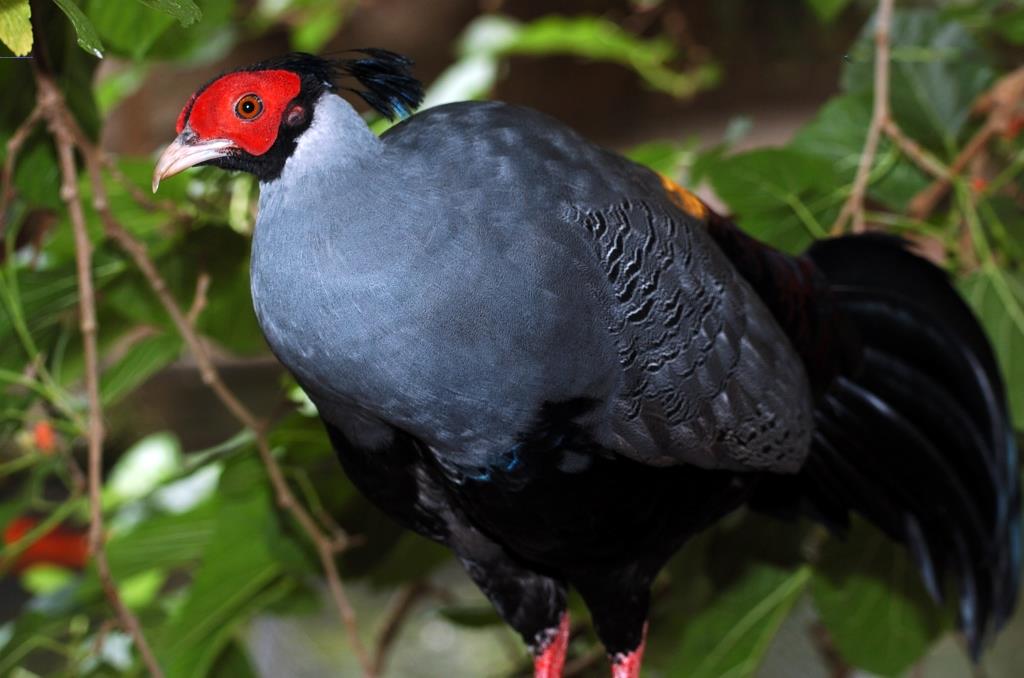
Siamese Fireback by Dan

Siamese Fireback by Dan's Pix

Siamese Fireback by Dan’s Pix at Zoo Miami

As the partridge sitteth on eggs, and hatcheth them not; so he that getteth riches, and not by right, shall leave them in the midst of his days, and at his end shall be a fool. (Jeremiah 17:11 KJV)

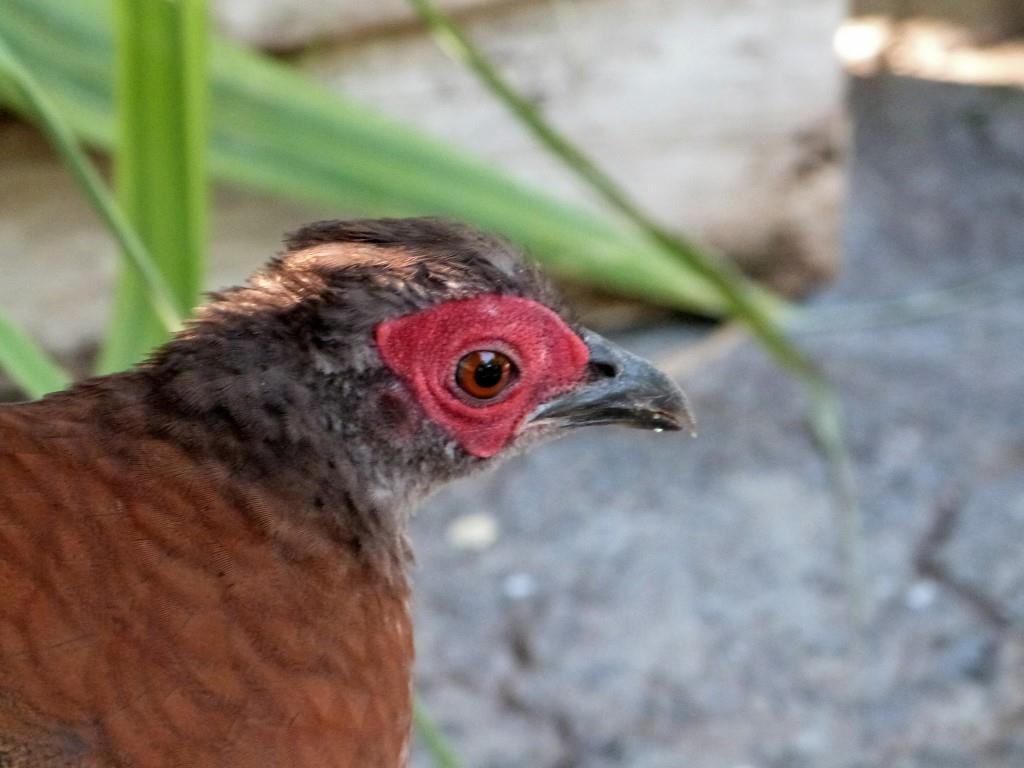
I was browsing through some of Dan’s photos on his Dan’s Pix site and came across the Siamese Fireback. We saw this bird in the Wings of Asia Aviary at Zoo Miami. This is another of the Lord’s interesting creations.

The Siamese Fireback (Lophura diardi) also known as Diard’s Fireback is a fairly large, approximately 31.5 in (80 cm) long, pheasant. The male has a grey plumage with an extensive red facial skin, crimson legs and feet, ornamental black crest feathers, reddish brown iris and long curved blackish tail. The female is a brown bird with blackish wing and tail feathers.

The Siamese Fireback is distributed to the lowland and evergreen forests of Cambodia, Laos, Thailand and Vietnam in Southeast Asia. Very dense forests, bamboo and evergreen from sea-level to 2,000 feet. This species is also designated as the national bird of Thailand.

Siamese Fireback (Lophura diardi) ©WikiC

Siamese Fireback (Lophura diardi) ©WikiC (You can see the yellow on its back)

The female usually lays between four to eight rosy eggs. They have a more subtle coloration that helps them blend into the area while nesting.

Siamese Fireback (Lophura diardi) female by Lee ZM

Siamese Fireback (Lophura diardi) female by Lee ZM

Where there is no wood, the fire goes out; And where there is no talebearer, strife ceases. (Proverbs 26:20 NKJV)

Siamese Fireback (Lophura diardi) female by Lee ZM

Siamese Fireback (Lophura diardi) female by Lee ZM

The scientific name commemorates the French naturalist Pierre-Médard Diard. (Information from various internet sources.)

The three Firebacks are part of the Phasianidae – Pheasants, Fowl & Allies Family. Partridges, Pheasants, Grouse, Quail, Francolin, Peafowl, Peacocks and others make up this family.

Crestless Fireback (Lophura erythrophthalma) IBC

Crested Fireback (Lophura ignita)

Siamese Fireback (Lophura diardi) by Dan’s Pix

Also:

*

Birds of the World – Magnificent Riflebird

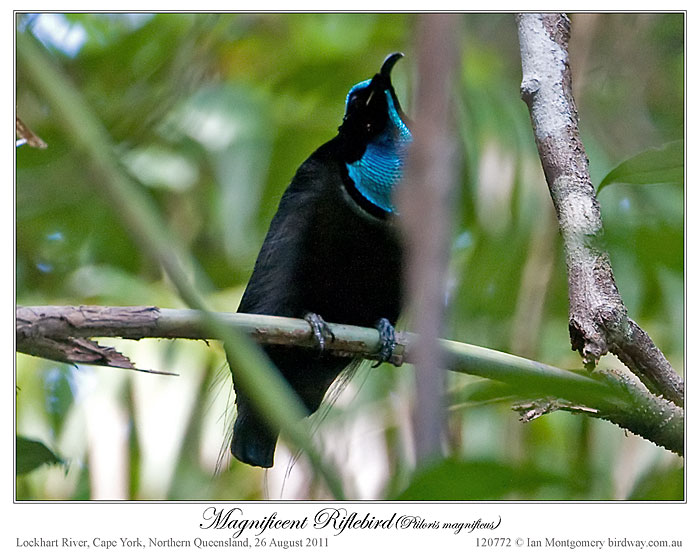
Magnificent Riflebird (Ptiloris magnificus) by Ian

Magnificent Riflebird (Ptiloris magnificus) by Ian

Let them praise the name of the LORD: for his name alone is excellent; his glory is above the earth and heaven. (Psa 148:13 KJV)

The Magnificent Riflebird is a member of the Paradisaeidae – Birds-of-paradise Family. They are a family of birds that really showcase the Lord’s Creative Hand.

The Magnificent Riflebird (Ptiloris magnificus) is a medium-sized (up to 34 cm long) passerine bird of the Paradisaeidae family. The male is velvet-black bird of paradise with elongated black filamental flank plumes, an iridescent blue-green crown, a wide, triangle-shaped breast shield, and on central tail feathers. It has a black curved bill, yellow mouth, blackish feet and a dark brown iris. The female is brownish with dark spots and buff bars below.

The Magnificent Riflebird is widely distributed throughout lowland rainforests of New Guinea and far Northeastern Australia. The diet consists mainly of fruits and arthropods.

Males perform solitary courtship displays on a ‘dancing perch’. During these displays, the male fully extends his wings and raises his tail; he hops upward while swinging his head from side to side, showing off his metallic blue-green breast shield. Multiple females will observe these displays. Females subsequently build nests, incubate, brood, and feed young without male assistance. (Wikipedia with editing)

The Lab of Ornithology produced this clip.

*

Praise him for his mighty acts: praise him according to his excellent greatness. (Psa 150:2 KJV)

P.S. I am off on a birdwatching adventure, but wanted to share this with you. More about our adventure later.

*

Paradisaeidae – Birds-of-paradise Family

Ian’s Bird of the Week – Magnificent Riflebird

Magnificent Riflebird – Wikipedia

*

Odds and Ends – Jan 2014

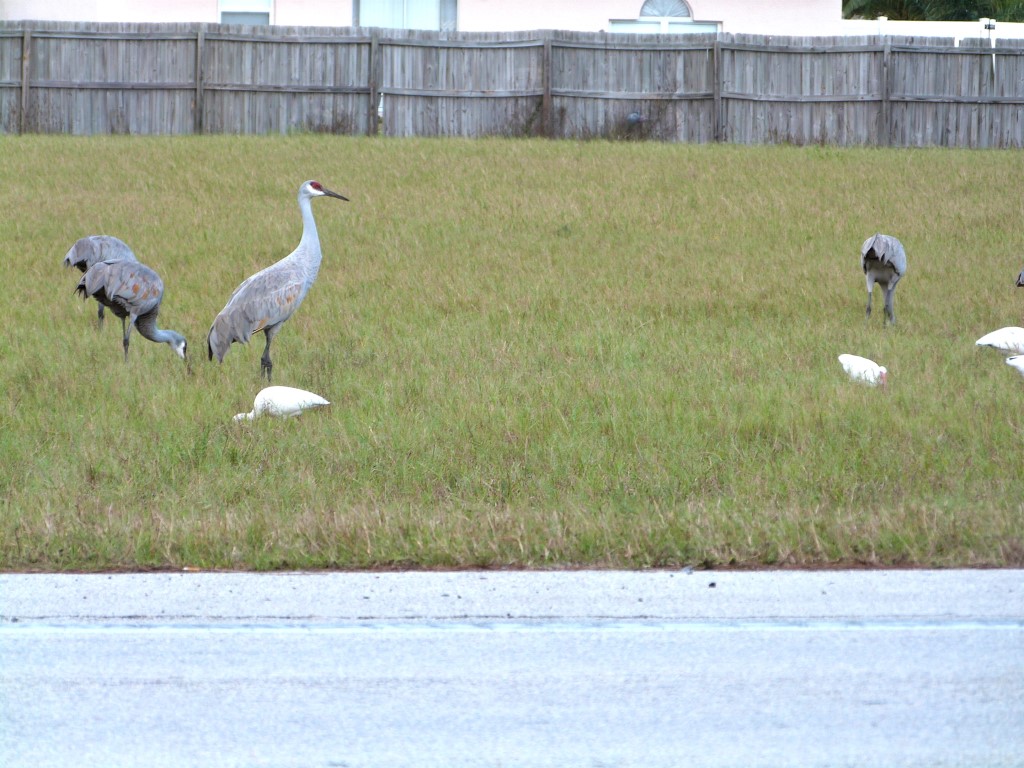
Sandhill Cranes and American White Ibis by Lee across street

Sandhill Cranes and American White Ibis by Lee across street

I am behind the scene kicking up dust again. The new I.O.C. World Bird List Version 4.1 just came out on the 7th. Yesterday, they finally released the Excel spreadsheet to update our sites. As you may know, I use the IOC’s list for my Birds of the World lists. So each page has to be updated, even if it is only changing 3.5 to 4.1. It still has to be done. There are around 350 pages involved.

There now 10,518 extant species and 150 extinct species of birds of the world (Version 4.1), with subspecies (20,976) and annotations. Classification of 40 Orders, 232 Families (plus 5 Incertae sedis), 2274 Genera are included. They added 12 new species and deleted one.

Superb Parrot (Polytelis swainsonii) by Ian

Superb Parrot (Polytelis swainsonii) by Ian

One of the big changes is in the Taxonomic orders of the Parrots and Falcons. They are now placed just before the Passerines and right after the Woodpeckers. I have that much done and am now starting on the Passeriformes Order. (Those are the perching birds and also the largest Order) Another big change is a reshuffling of the Muscicapidae – Chats, Old World Flycatchers family. (It is on my “to do” list :o) )

In the mean time, we had the privilege of seeing 22 Sandhill Cranes feeding across the street from my backyard a few days back. Then today, we spotted that same group feeding about a 1/2 mile down the road. Two more groups were spotted of 7 and 4. That is about the most I have ever seen in one day.

Did you enjoy the Sunday Inspiration – Eagles I posted Sunday? I am thinking about making that a weekly post. Either using photos of different families or some theme like “Rock Birds” in a slideshow and play a song related to the Rock of our salvation, etc. Sundays are busy for us and I don’t always post on that day. It is a day of “rest” you know.

On Duty Sandhill Crane by Lee

On Duty Sandhill Crane by Lee

By the way, when Sandhills eat, there is always at least one who is on guard and watches over the others. Brings to mind a couple of verses.

Obey those who rule over you, and be submissive, for they watch out for your souls, as those who must give account. Let them do so with joy and not with grief, for that would be unprofitable for you. (Hebrews 13:17 NKJV)

Therefore humble yourselves under the mighty hand of God, that He may exalt you in due time, casting all your care upon Him, for He cares for you. (1 Peter 5:6-7 NKJV)

Back to the dust, I have work to do.

*

Bird of the World – Blue-Cheeked Bee-eater

What a neat video of the Blue-cheeked Bee-eater. I have seen photos of them, but seeing birds in action is always special. There are some birds that just hit my fancy as I admire the Lord’s Handiwork. The Bee-eaters are one of those.

By Igor Byshnev

Matthew 6:25-34 NKJV
(25) “Therefore I say to you, do not worry about your life, what you will eat or what you will drink; nor about your body, what you will put on. Is not life more than food and the body more than clothing?
(26) Look at the birds of the air, for they neither sow nor reap nor gather into barns; yet your heavenly Father feeds them. Are you not of more value than they?
(27) Which of you by worrying can add one cubit to his stature?
(28) “So why do you worry about clothing? Consider the lilies of the field, how they grow: they neither toil nor spin;
(29) and yet I say to you that even Solomon in all his glory was not arrayed like one of these.
(30) Now if God so clothes the grass of the field, which today is, and tomorrow is thrown into the oven, will He not much more clothe you, O you of little faith?
(31) “Therefore do not worry, saying, ‘What shall we eat?’ or ‘What shall we drink?’ or ‘What shall we wear?’
(32) For after all these things the Gentiles seek. For your heavenly Father knows that you need all these things.
(33) But seek first the kingdom of God and His righteousness, and all these things shall be added to you.
(34) Therefore do not worry about tomorrow, for tomorrow will worry about its own things. Sufficient for the day is its own trouble.

Bee-eaters belong to the Meropidae – Bee-eaters Family which has 27 species.

As the name suggests, bee-eaters predominantly eat flying insects, especially bees and wasps, which are caught in the air by sallies from an open perch. While they pursue any type of flying insect, honey bees predominate in their diet. Hymenoptera (ants, bees and wasps) comprise from 20% to 96% of all insects eaten, with honey bees comprising approximately one-third of the Hymenoptera. (Wikipedia with editing)

Articles Mentioning Birds From This Family:

Other Websites that have photos of this Family:

Gideon

*