***

YOUNG
***
“I have been young, and now am old; yet have I not seen the righteous forsaken, nor his seed begging bread.” (Psalms 37:25 KJV)
Maned-Australian Wood Duck (Chenonetta jubata) Ducklings ©WikiC
*
*
“I have been young, and now am old; yet have I not seen the righteous forsaken, nor his seed begging bread.” (Psalms 37:25 KJV)
Maned-Australian Wood Duck (Chenonetta jubata) Ducklings ©WikiC
*
*
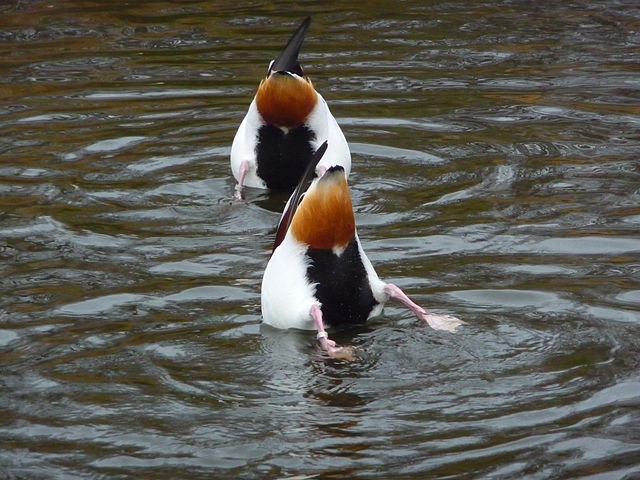
“And I will surely hide my face in that day for all the evils which they shall have wrought, in that they are turned unto other gods.” (Deu 31:18 KJV)
Common Shelduck (Tadorna tadorna) Dabbling ©WikiC
*
*
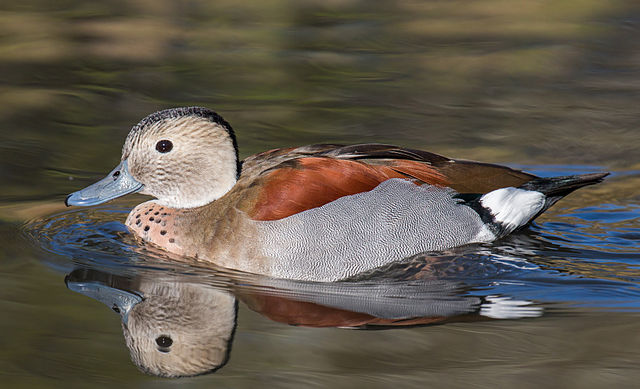
Ringed Teal (Callonetta leucophrys ©WikiC
And God created great whales, and every living creature that moveth, which the waters brought forth abundantly, after their kind, and every winged fowl after his kind: and God saw that it was good. And God blessed them, saying, Be fruitful, and multiply, and fill the waters in the seas, and let fowl multiply in the earth. (Gen 1:21-22 KJV)
Today we only have 22 more Anatidae family members to show you, but it will take 14 different genera to present them. The largest and the first genus, with 7 species, is the Shelducks.

Raja Shelduck (Tadorna radjah) at Wing of Asia by Dan
Shelducks are large birds in the Tadorna genus. Many consider them as intermediate between geese and ducks in size. The sexes are colored slightly differently in most species, and all have a characteristic upperwing coloration in flight: the tertiary remiges form a green speculum, the secondaries and primaries are black, and the coverts (forewing) are white. Their diet consists of small shore animals (winkles, crabs etc.) as well as grasses and other plants.
The genus name comes from the French name Tadorne for the common shelduck. It may originally derive from Celtic roots meaning “pied waterfowl”, essentially the same as the English “shelduck”
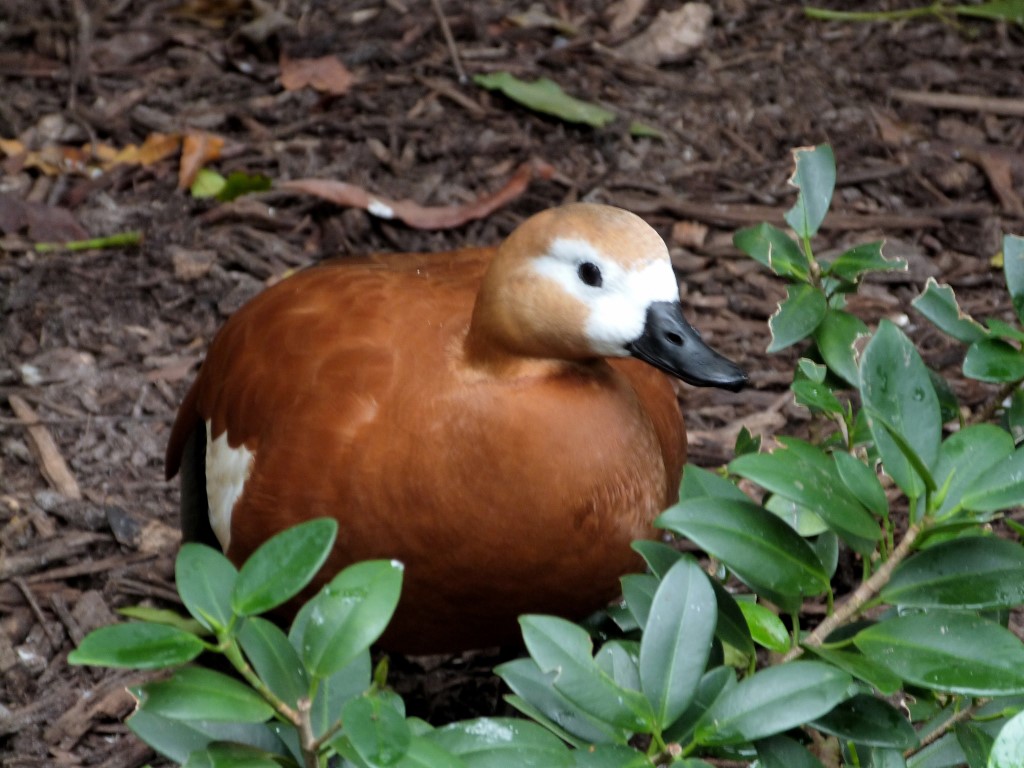
Ruddy Shelduck (Tadorna ferruginea) at Wings of Asia by Lee
Common Shelduck (Tadorna tadorna)
Raja Shelduck (Tadorna radjah)
Ruddy Shelduck (Tadorna ferruginea)
South African Shelduck (Tadorna cana)
Australian Shelduck (Tadorna tadornoides)
Paradise Shelduck (Tadorna variegata)
Crested Shelduck (Tadorna cristata)
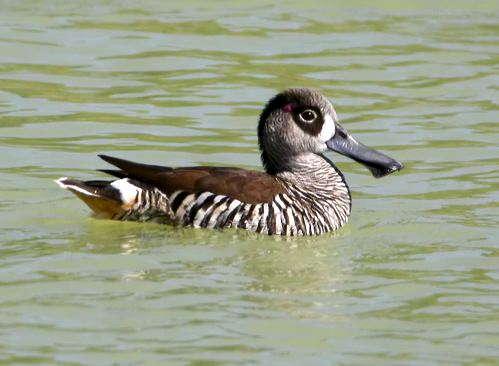
Pink-eared Duck (Malacorhynchus membranaceus) by Ian
Each of the next 5 Ducks and Teals are the only ones in their genus.
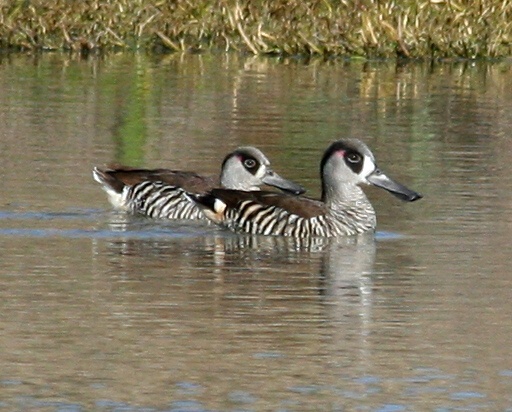
Pink-eared Duck (Malacorhynchus membranaceus) ©WikiC
Pink-eared Duck (Malacorhynchus membranaceus)

Salvadori’s Teal (Salvadorina waigiuensis) ©Drawing WikiC
Salvadori’s Teal (Salvadoran waigiuensis)
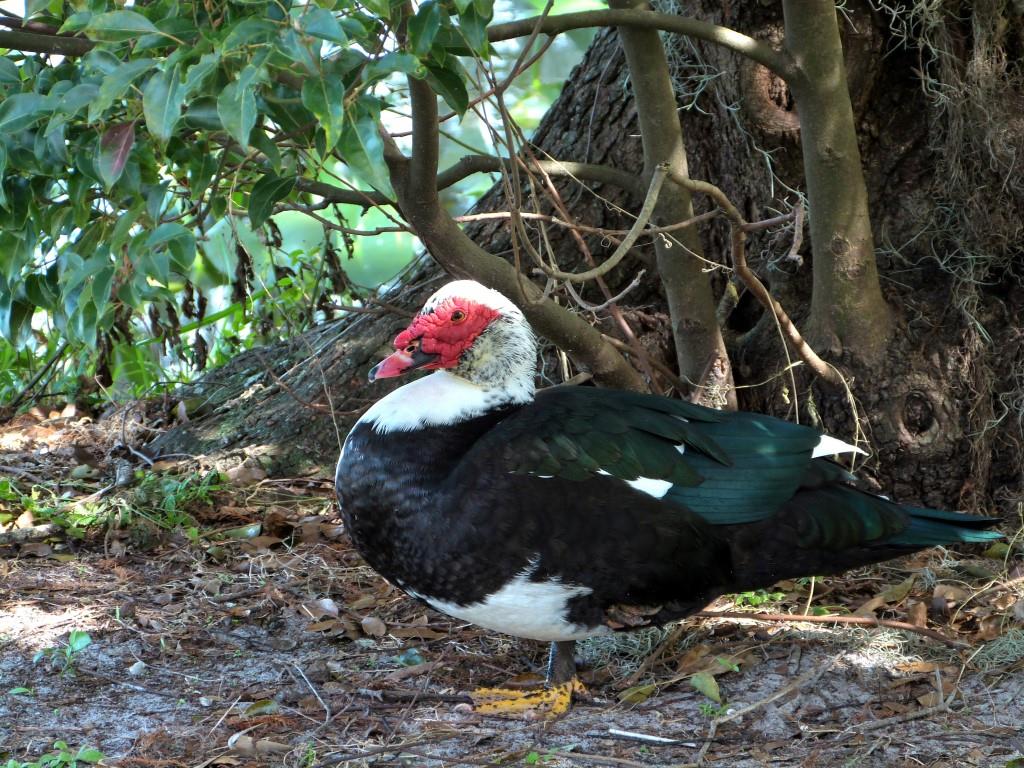
Muscovy Duck (Cairina moschata)
Muscovy Duck (Cairina moschata)

White-winged Duck (Asarcornis scutulata) by Nikhil
White-winged Duck (Asarcornis scutulata)

Hartlaub’s Duck (Pteronetta hartlaubii) ©WikiC
Hartlaub’s Duck (Pteronetta hartlaubii)
Two of my favorite Ducks, which we get to see often, are the Wood and Mandarin Ducks in the Aix genus. The Wood Ducks are local to us and are a treat to see their evidence of the Master’s Hand. Their cousin, the Mandarin Ducks are in many zoos and Lakeland, FL (right near here) placed some in one of their lakes.
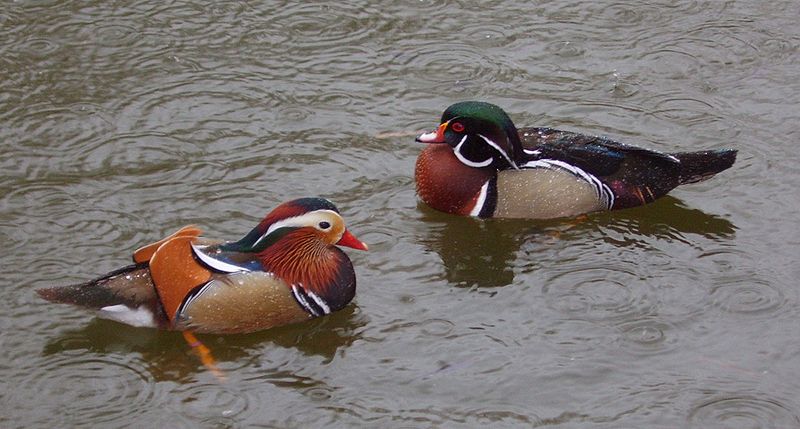
Wood Duck and Mandarin Duck
Wood Duck (Aix sponsa)
Mandarin Duck (Aix galericulata)
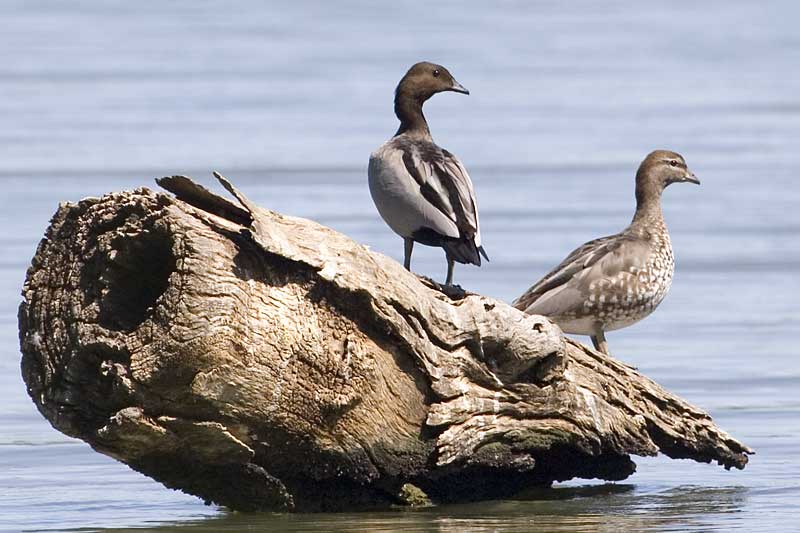
Maned Duck (Chenonetta jubata) ©AGrosset
The Maned Duck is again an only species in its genus, the Chenonetta.
Maned Duck (Chenonetta jubata)

Cotton Pygmy Goose (Nettapus coromandelianus) by Lee
The Pygmy Geese are only three, but are in two different genera. The Nerthus and the Nettapus.
African Pygmy Goose (Nerthus auritus)
Cotton Pygmy Goose (Nettapus coromandelianus)
Green Pygmy Goose (Nettapus pulchellus)
The last four for today are in four genera, and include two Teals and two Ducks.

Brazilian Teal (Amazonetta brasiliensis) ©WikiC
Brazilian Teal (Amazonetta brasiliensis)

Ringed Teal (Callonetta leucophrys) by Dan at Zoo Miami
Ringed Teal (Callonetta leucophrys)

Crested Duck (Lophonetta specularioides) ©WikiC
Crested Duck (Lophonetta specularioides) EXTINCT

Bronze-winged Duck (Speculanas specularis) ©WikiC
Bronze-winged Duck (Speculanas specularis)
One of the comments made last week mentioned that they didn’t realize how many Ducks and family members there are. Here are a couple of “Duck Facts”:
The duck is a number of species in the Anatidae family of birds. They are related to swans and geese.
These Facts are from Fun Duck Facts for Kids (and adults)
There is a path which no fowl knoweth, and which the vulture’s eye hath not seen: (Job 28:7 KJV)
“God’s Greatness Medley” ~ Faith Baptist Orchestra
*
Anatidae – Ducks, Geese and Swans Family
Sunday Inspiration – Whistling, White-backed Ducks, and Geese
Sunday Inspiration – Geese and Swans
Sunday Inspiration – Duck and Geese
*
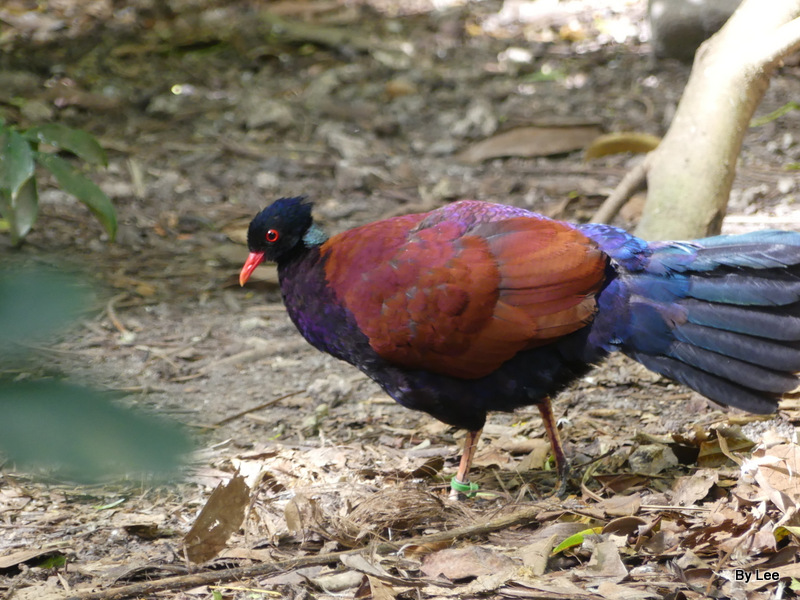
Mystery Bird at Zoo Miami by Lee
“My son, keep thy father’s commandment, and forsake not the law of thy mother: Bind them continually upon thine heart, and tie them about thy neck.” (Pro 6:20-21 KJV)
Finally sat down and started naming my photos from our latest trip to Zoo Miami’s Wings of Asia Aviary. Since we spent the whole day, just in that Aviary, except for lunch, the photos are not in any order. Ducks especially have a way of swimming by and then another, then back they come again. Most of you photographers know how it is. And as I’ve always stated, I wish the Lord had hung name tags on birds so we could more easily identify them. :o)
I was fortunate to receive a list of the current birds from the workers, which has been a huge help. With at least 500 birds and 88 species in one aviary, it can get complicated putting names on the right birds.
I had gone through these photos before I came to the one above:
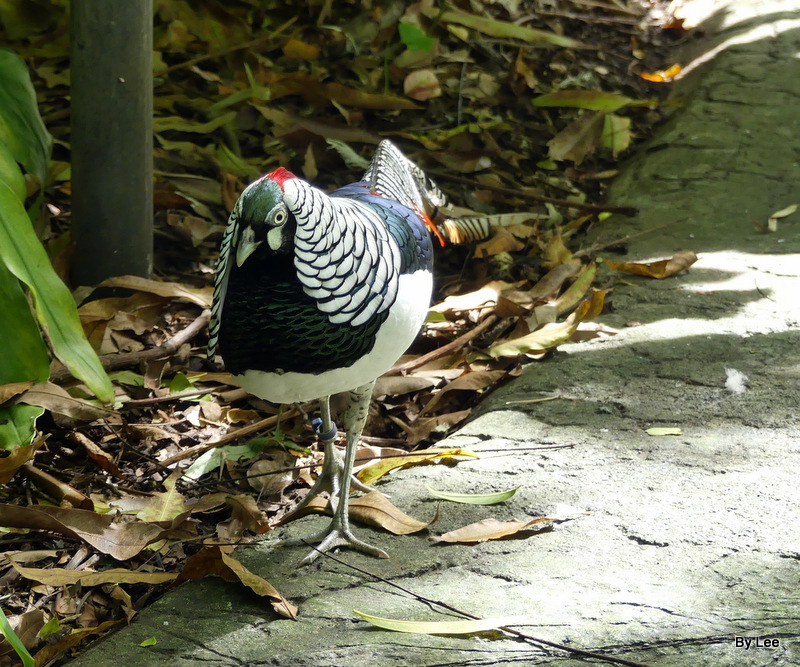
Lady Amherst’s Pheasant (Chrysolophus amherstiae) Zoo Miami by Lee
Now there is a beautifully designed avian wonder from the Creator. More about this bird later.
The Siamese Fireback is also in the Pheasant family.
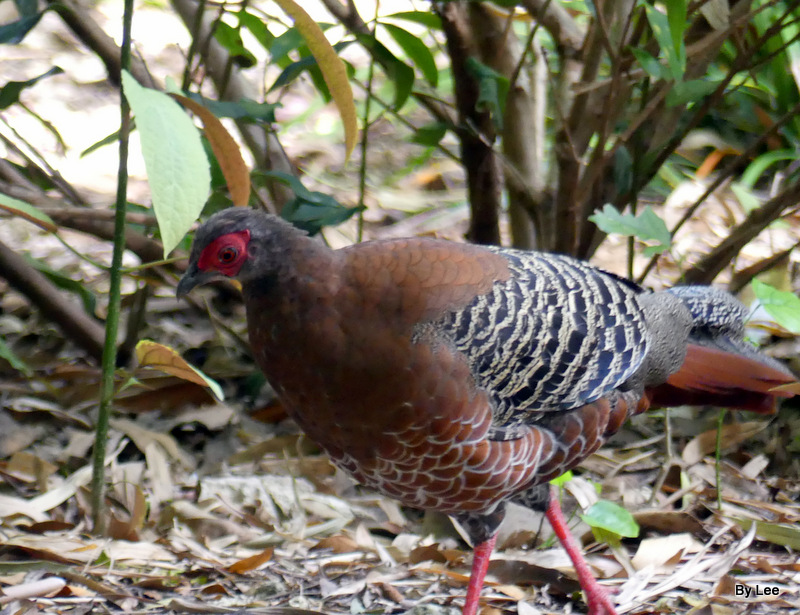
Siamese Fireback (Lophura diardi) Zoo Miami by Lee
So, when our mystery bird showed up, which family do you think I kept looking through? The Pheasants and allies – Phasianidae Family. I searched high and low.
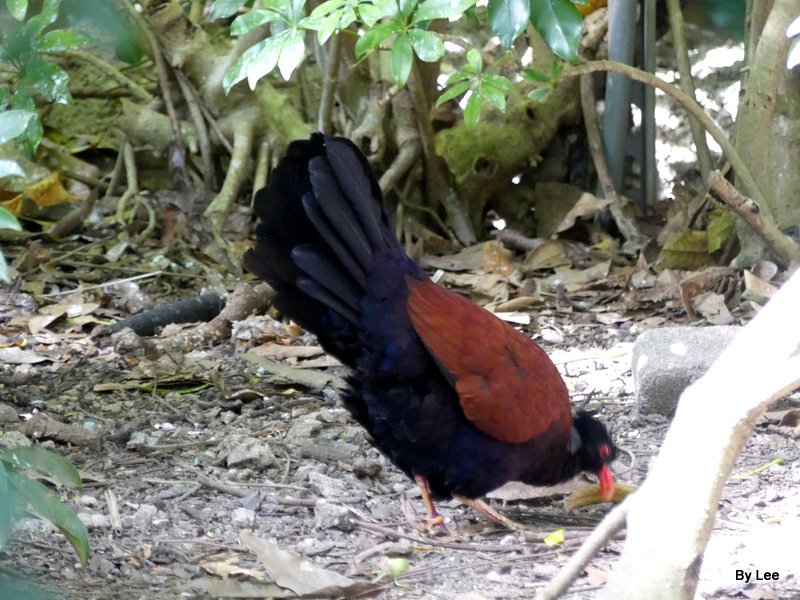
Guess what this bird is!
Can you guess what this bird is?

Mystery Bird and a Red-vented Bulbul at the Zoo
I about fell out of my computer chair when I found out.

Maybe a close up of the face will help. Zoo Miami by Lee
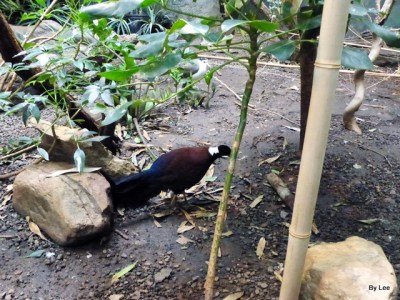
Our Mystery Bird turns out to actually be a Pigeon!!!. This is a Pheasant Pigeon (Otidiphaps nobilis) [Green-naped Pheasant Pigeon] as Zoo Miami calls it.
Pheasant Pigeon (Otidiphaps nobilis) (Green-naped) Zoo Miami by Lee
“The pheasant pigeon (Otidiphaps nobilis) is a genus of large terrestrial pigeon found in the primary rainforests of New Guinea and nearby islands. It ranges primarily over hilly and lower mountain areas, but can also be found in lowlands.
There are four species, [actually subspecies] which differ primarily in the presence or absence of a small crest and in the colour of the nape. The two best known are the western nominate (O. nobilis) with a greenish nape and O. n. aruensis from the Aru Islands with a white nape. [We saw this at the Cincinnati Zoo] The two remaining species, O. n. cervicalis from the eastern part of its range and O. n. insularis from Fergusson Island, have a grey nape and a black nape (concolour with the remaining black neck) respectively.” [Wikipedia with editing]
Pheasant Pigeon [White-naped] (Otidiphaps nobilis) Cincinnati Zoo 2016 – Lee
*

“Her children arise up, and call her blessed.” (Proverbs 31:28a)
Birds Calling Out ©DailyMail
*
*

“Gaius mine host, and of the whole church, saluteth you. ” (Rom 16:23A KJV)
IN HONOR OF ALL OF OUR BRAVE VETERANS!!
Bald Eagle and a Flag
*
Sunday Inspiration – Veteran’s Day
*
 Ian’s Bird of the Week – Crimson Finch ~ by Ian Montgomery
Newsletter – 11/10/16
Crimson Finch featured as bird of the week a little over eight years ago, but I’ve decided to have it again as a pair appeared in my backyard several weeks ago, the first time I’ve seen any in Bluewater.
Shortly earlier, I’d seen what looked like a female Satin Flycatcher having a splash in the pool. Satin Flycatchers are rare in North Queensland, though they do show up sometimes on migration. This one didn’t hang around for a photo while I got the camera, so I headed off around the property looking for it. Female Satin Flycatchers are notorious difficult to separate from their slightly duller cousins, female Leaden Flycatchers, so a photograph is essential not only for identification but also to convince anyone else.
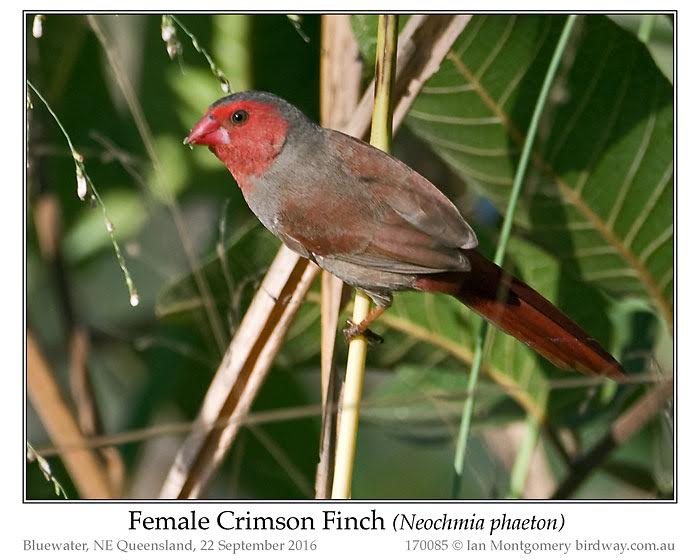
I didn’t find the Flycatcher, but I found the Crimson Finches, male in the first photo and female in the second, feeding on some unseasonable Guinea Grass. We’ve had an odd dry season with not much but sufficient rain at intervals to confuse some of the local plants – Guinea Grass usually seeds here at the end of the wet season (April). In North Queensland, Crimson Finches are usually found in dense grassland near wetlands, and these two were only about 50m from Bluewater Creek, which was still running at the time.

A couple of weeks later I photographed this very young Crimson Finch at the Townsville Town Common. When I approached, it was being fed by an adult male, who flew off leaving the young bird to its fate. You can see the very pale gape, typical of very young birds. Young Crimson Finches just have a reddish flush in the wings and tail.
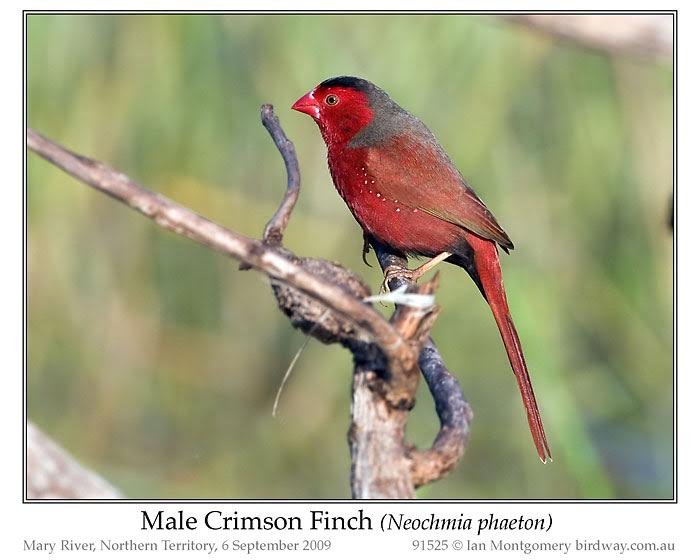
A few days after seeing the pair of Crimson Finches in the backyard, a male Crimson Finch obligingly appeared beside the pool when I was having a swim. I thought the plumage was more intensely coloured and with strong white spots on the flanks than the male member of the earlier pair – more like the one in the fourth photo. I wondered whether they were different individuals, with the first one being younger than the second. The one in the fourth photo was taken on a trip to the Northern Territory and northern Western Australia in 2009.
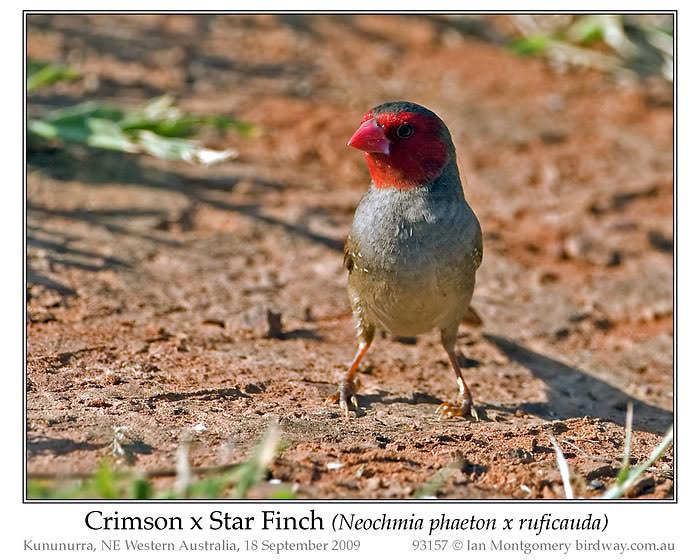
On that same trip, I photographed this odd-looking individual at Kununurra. We decided that it was a hybrid between a Crimson Finch and a Star Finch, both of which were present at the time and both of which belong to the same genus, Neochmia, which includes two other Australian species: Red-browed and Plum-headed Finches.
I don’t really keep a yard list as such. If I did, the day I found the Crimson Finches would have been notable. Apart from the possible Satin Flycatcher, later that afternoon I flushed a female King Quail. This time I was armed not with the camera but a brush cutter as part of the fire season preparations.
Several weeks later I had the rest of the long grass cut by a man with a tractor. After he had finished, I went down to inspect the result and spotted a Blue-winged Kookaburra pouncing on something in the cut grass. This proved to be the King Quail, which flew off at high speed pursued by the Kookaburra. The Quail landed safely in some long grass and the Kookaburra perched in a nearby tree. If you ever tried to flush a quail a second time, you’ll know how elusive they are on the ground, so I hope the Kookaburra didn’t have quail for lunch.
Greetings
Ian
Lee’s Addition:
“Which indeed is the least of all seeds: but when it is grown, it is the greatest among herbs, and becometh a tree, so that the birds of the air come and lodge in the branches thereof.” (Mat 13:32 KJV)
Thanks again, Ian for another beautiful avian wonder for us to enjoy. That hybrid is quite interesting also. We have seen the Star Finch before, but this is an interesting mix. Also, glad you are putting these Birds of the Week out again.
*
Estrildidae – Waxbills, Munias and allies
*

“The words of king Lemuel, the prophecy that his mother taught him.” (Proverbs 31:14)
Mourning Collared Dove (Streptopelia decipiens) With Young ©WikiC
*
*
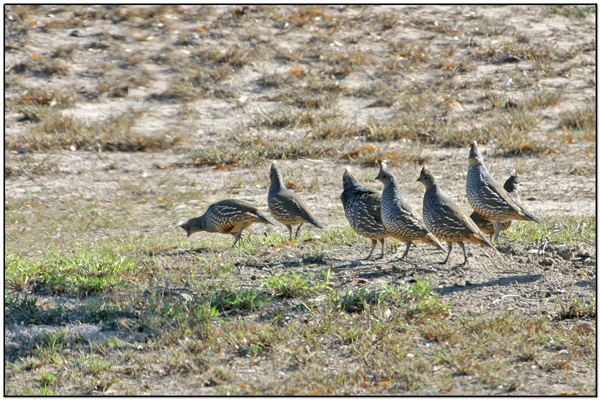
“And there went forth a wind from the LORD, and brought quails from the sea, and let them fall by the camp, as it were a day’s journey on this side, and as it were a day’s journey on the other side, round about the camp, and as it were two cubits high upon the face of the earth.” (Numbers 11:31 KJV)
Scaled Quail (Callipepla squamata) by DavesBirdingPix
*
*
“Blessings are upon the head of the just, but violence covereth the mouth of the wicked.” (PROVERBS 10:6)

Is that an egret, standing on top of my head?*
Photo credit: Marcia Webel (St. Petersburg, Florida)
(*Actually, the egret was perching upon branches behind me, not atop my head.)
It is a blessing to use our heads, to watch birds, such as egrets.
As noted in Part 1 of the “E” Birds “E” is for Eiders, Eagles, (of which there are many varieties), Eagle-owls, Egrets, Emus, Eagle-owls, Egrets, Euphonias, Elaenias, Eremomelas, Elepaios, Earthcreepers, and Emerald hummingbirds — plus whatever other birds there are, that have names that begin with the letter E.
In this Part 2 (reviewing “E” birds), 2 categories of “E” birds are considered: Egrets and Emus.
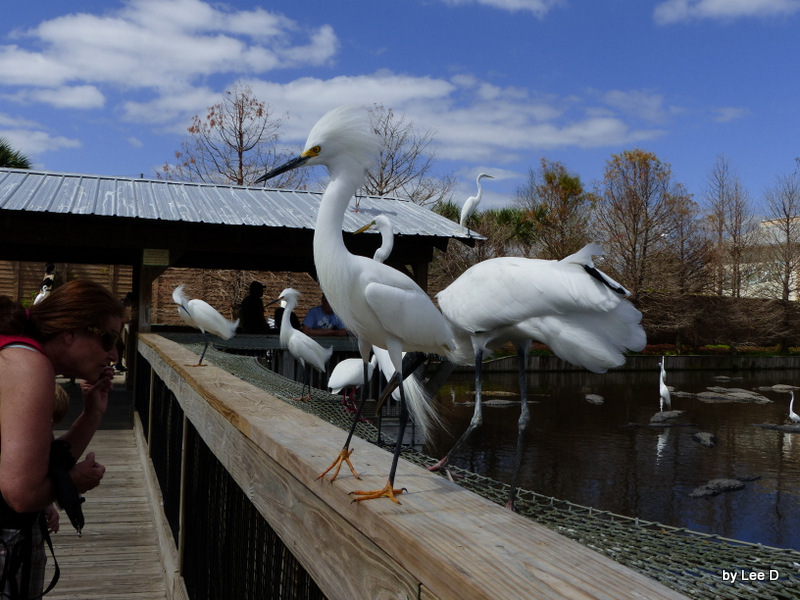
Snowy Egret at Gatorland by Lee
EGRETS
Regarding Egrets, see, e.g., Lee Dusing’s “Egrets and Heron Catching the Gator Taxis” as well as her “Baby Snowy Egrets at Gatorland”.
It is truly amazing to see egrets seeking food, at Florida’s Gatorland, while presumptively and precariously perched atop the backs of drifting/semi-submerged alligators. As ornithologist Lee Dusing once observed:
Most times these alligators and birds get along fine. People are tossing food to them and so they abide each other. It is amazing how different critters get along. I can only imagine how it must have been when they were first created. There was no desire of the gators to eat the birds. Today, under the curse, it is a totally different situation.
[Quoting Lee Dusing’s “Egrets and Heron Catching the Gator Taxis”, See also my report on how Cattle Egrets practice “mutual aid” with various terrestrial herbivores, in “Cattle Egrets, Cattle, and Other Herbivore Neighbors”.
Since those egrets have been described, as just noted, previously, not much will be added here, regarding them, except for a few comments regarding their distribution, i.e., regarding the ranges they inhabit.

Great White Egrets (photo by Bence Mate)
The Great White Egret (Ardea alba) is well-known in North America, as the range map below shows, but most of America only hosts this tall egret during the winter months.
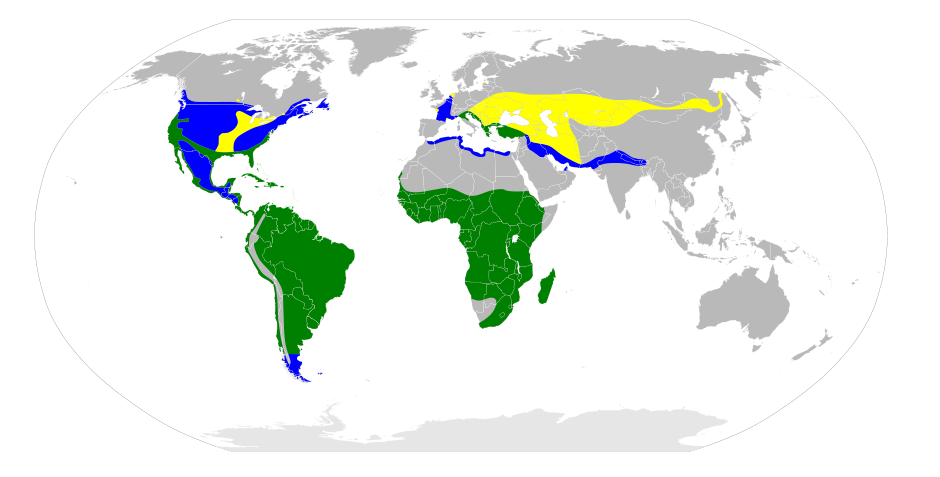
Great White Egret range map (Wikipedia)
Yellow = breeding; Green = year-round; Blue = wintering
Breeding occurs mostly in the Mississippi River watershed corridor states, with a swath of the Southwest and southern coasts providing year-round habitat of this long-legged shorebird.
A tall and stately bird, the Great [White] Egret slowly stalks shallow [waters of] wetlands looking for small fish [or frogs, or snakes, etc.] to spear [or grab] with its long sharp bill. Nests in colonies of up to 100 birds. Now protected [legally], they were hunted to near extinction in the 1800s and early 1900s for their long white plumage.
[Quoting Stan Tekiela, BIRD OF TEXAS FIELD GUIDE (Cambridge, MN: Adventure Publications, 2004), page 371.]
Another familiar white-feathered egret, in America, is the Snowy Egret.
The Snowy Egret (Egretta thula) is a small-scale heron with snowy white plumage, famous for its “golden slippers”.
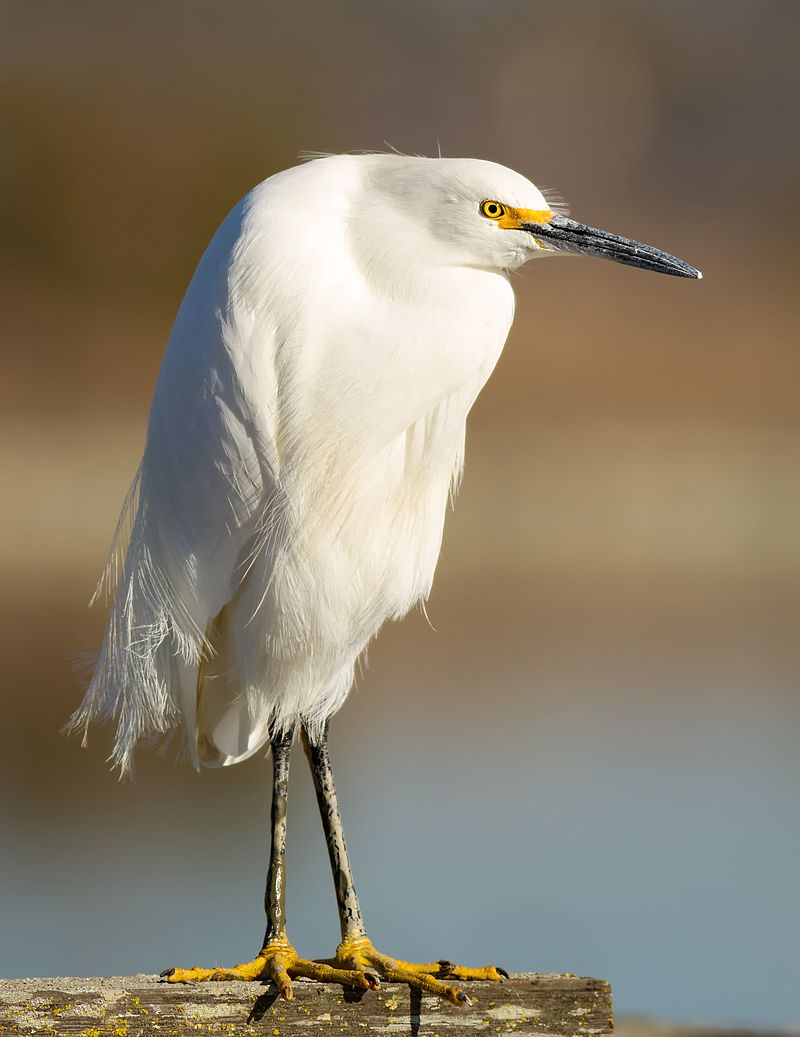
Snowy Egret (Wikipedia)
Like the resourceful Cattle Egret (mentioned above — see coverage of this wide-ranged and herbivore-helping egret,) the Snowy Egret is small in size, as herons and egrets go. However, unlike the Cattle Egret, its feathers are all white, and its feet are a mustard-yellow (or goldenrod yellow) in color. The Snowy Egret is a wetland bird – preferring swamps (including mangrove swamps), pondshores, marshlands (including saltmarshes), island shores, and estuaries (including tidal mudflats).
As shown below, the Snowy Egret has a breeding range that includes some patches of America, mostly in part of the Northwest and in the drainage basin of the Mississippi River. Also, the Snowy Egret is a year-round resident of America’s Atlantic coast and America’s Gulf of Mexico coast.
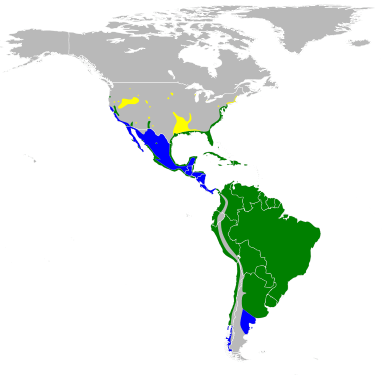
Snowy Egret range map (Wikipedia)
Yellow = breeding; Green = year-round; Blue = wintering
More than a century ago the Snowy Egret (as well as the Flamingo, the Roseate Spoonbill, various cranes, ducks, geese, swans, other members of the heron-egret family, doves, as well as insectivorous passerine migrants, etc.) was wastefully being hunted for its fancy feathers, jeopardizing the entire American population — until the Migratory Bird Treaty was enacted (and was enforced).
Regarding the Migratory Bird Treaty’s historic importance, see “Looking Back 100 Years, at the Migratory Bird Treaty: A Bird’s-eye View of How It was Hatched”.
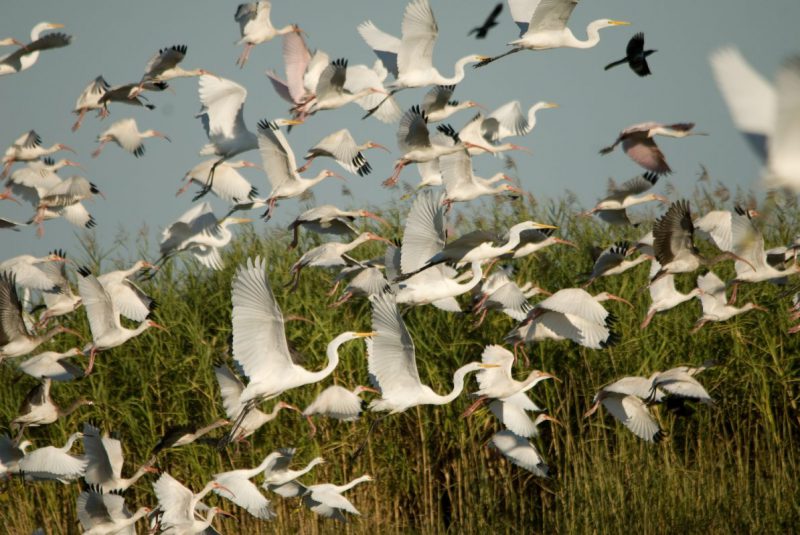
Great White Egret, Snowy Egret, White Ibis,Roseate Spoonbill, and
Great-tailed Grackle, flying over coastal marshland (Photo credit: Eric Ripma)
Thankfully, populations of egrets (and other long-legged, long-necked birds, such as cranes, herons, flamingo, roseate spoonbill, ibis, etc.) have rebounded, since passage (100 years ago) and enforcement of the Migratory Bird Treaty.
EMUS
Regarding Australia’s Emu (as well as regarding other ratites, including the smallest ratite — New Zealand’s kiwi), see ornithology professor Lee Dusing’s “Sunday Inspiration: Ostrich, Rhea, Cassowary, Emu & Kiwi”.
Also, for a close-up (albeit abrupt) perspective on an Emu, see “Lee’s Five Word Friday: 9/16/16”.
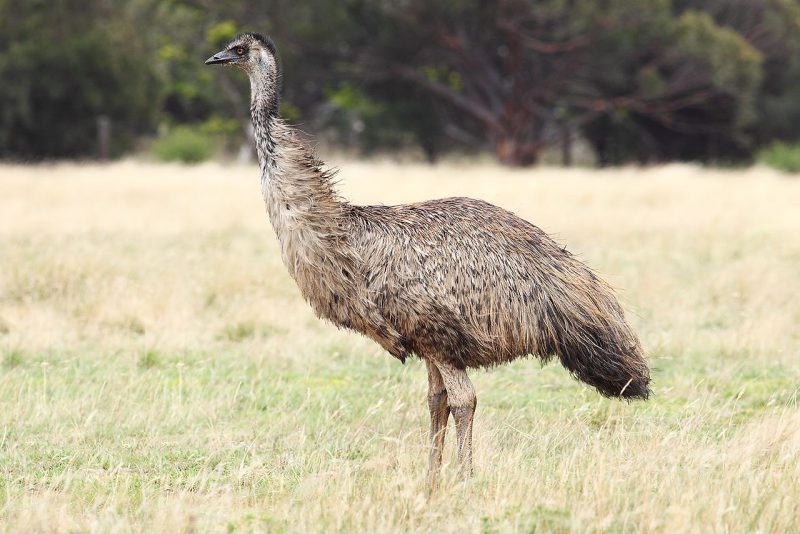
Emu (Dromaius novahollandiae) in the wild (Wikipedia)
The Emu is the second-largest (non-extinct) bird, by height; only the Ostrich is taller. By weight the Emu is the world’s third-largest bird, weighing less than the Ostrich and anther ratite “cousin”, the double-wattled Southern Cassowary.
The Emu has an over-all height of about 180 cm. (70”); to the top of the back it measures about 100 cm. (40”); it can weigh up to 55 kg. (120 lbs.) and have a beak up to 12 cm. long (5”). The body is very bulky, the coloring of the plumage brownish. The feet have three toes [each]. … The nest [typically located in scrubby steppe grassland habitat] is a hollow in the ground near a shrub, and it is covered with leaves, grass, et cetera. Various females lay 15-25 eggs, which are incubated by the male for 52-60 days [during with time the male loses a lot of weight, due to not eating], depending on the interruptions made by the male to find food and water. The nestlings, which have a distinctive white and brown-striped plumage, achieve complete development and sexual maturity within 2 or 3 years. The Emu can run at speeds of up to 50 kph. (30 mph.).
[Quoting Gianfranco Bologna, SIMON & SCHUSTER’S GUIDE TO BIRDS (Simon & Schuster, 1981; edited by John Bull), page 143.]
Since the Emu was described previously (as noted in the previous sentence), no more will be added here, other than to note that the Emu’s native range covers most of Australia. (Also, emus have been, and now are, raised commercially in America, for their meat, for oil, or sometimes as part of investment scams.)
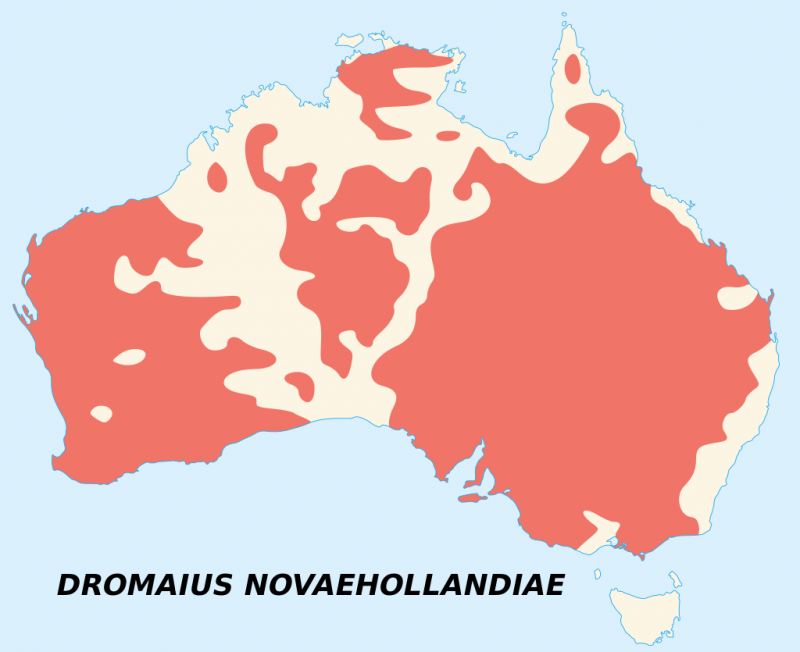
Emu range map (Wikipedia)
In recent years I have observed, in the wild, many varieties of Egrets – especially Great White Egret, Snowy Egret, and Cattle Egret. Also, on a few occasions I have observed (very close up) domesticated Emus – and they are not fully “tame” even when they are “domesticated”. All of these birds, which range in size, are marvels in motion — examples of God’s super-genius bioengineering.
Whenever we look at such feathered creatures, we should be amazed, and we should admire God’s handiwork, — because God has given us the ability to use our minds (which are somehow linked to the physical “hardware” of our heads, especially our eyes and brains). In a sense, we have such birds “on our heads”, as we think through the blessings God has given, due to Him creating such birds.
So, if our minds are renewed to proper reverence of God, as the Creator of all creation (Revelation 4:11), our “heads” can empirically accept and analyze these visual blessings, as feathered exhibits displaying God’s glory.
“Blessings are upon the head of the just, but violence covereth the mouth of the wicked.” (PROVERBS 10:6)
God willing, the next contribution to this alphabetic series will be some “F birds” – perhaps some of these: Fairywrens, Falcons, Fantails, Fernbirds, Fieldwrens, Figbirds, Finches, Firetails, Fiscals, Flamebacks, Flamingos, Flatbills, Flowerpeckers, Flycatchers, Foliage-gleaners, Forktails, Francolins, Friarbirds, Frigatebirds, Frogmouths, Fruiteaters, Fulmars, Fulvettas, etc.! Meanwhile, enjoy using your eyes (and the rest of your head) to appreciate the blessings and privileges of daily life, including opportunities to observe God’s avian wonders, like egrets and emus.
><> JJSJ
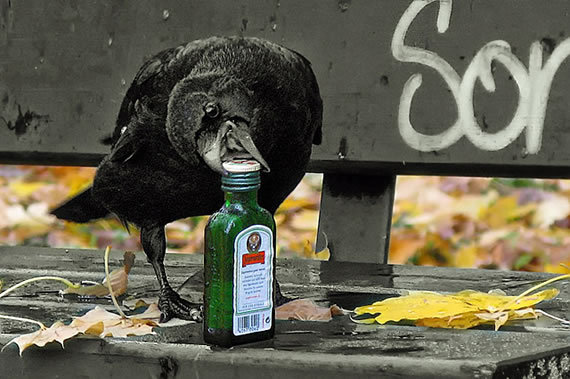
“It is not for kings, O Lemuel, it is not for kings to drink wine; nor for princes strong drink:” (Proverbs 31:4)
Crow Trying To Drink ©Cutest Paw
*
*
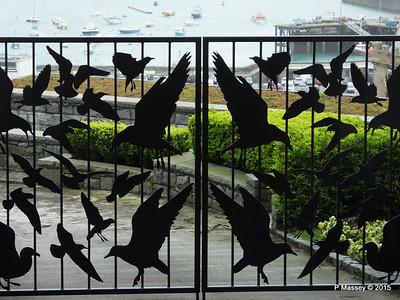
“Her husband is known in the gates, when he sitteth among the elders of the land.” (Proverbs 31:23)
Birds on Gate – St. Peter Port ©Oriana
*
*

