***
THEY GATHER THEMSELVES TOGETHER
***
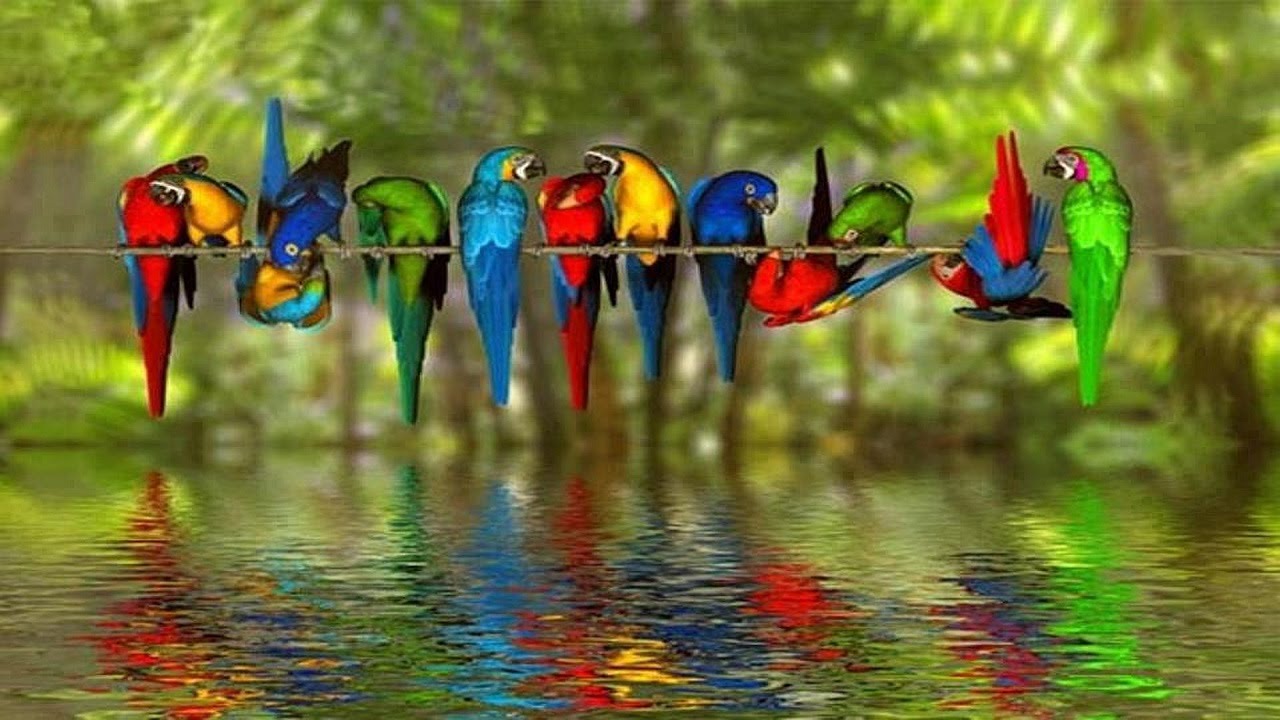
“The sun ariseth, they gather themselves together, and lay them down in their dens.” (Psalm 104:22)
Gathering of Parrots ©I.Ytimg
*
*
“The sun ariseth, they gather themselves together, and lay them down in their dens.” (Psalm 104:22)
Gathering of Parrots ©I.Ytimg
*
*
“Thou makest darkness, and it is night wherein all the beasts of the forest do creep forth.” (Psalm 104:20)
Birds at Night – ©BirdFeeders.com
*
*
“Where the birds make their nests: as for the stork, the fir trees are her house.” (Psalm 104:17)
Storks At Their Nest ©Science Photo Library
*
*
*
Dr. James J. S. Johnson

EURASIAN JAY (photo by Richard Steel)
And Joshua wrote these words in the book of the law of God, and took a great stone, and set it up there under an oak that was by the sanctuary of the LORD. (Joshua 24:26)

Oak Leaves (southern Finland – public domain)
Oaks are well-known for foliage that provides shade from sunlight. However, for birds, oak trees are probably more appreciated for their branches and their acorns – branches for nesting and perching, and acorns for eating.
One bird that loves acorns, for eating, is the Eurasian Jay (Garrulus glandarius). These jays are called Geai des chênes in French, meaning “jay of the oaks”.
For some youtube footage, showing some Eurasian Jays eating quite energetically, see https://www.youtube.com/watch?v=Kkx2mDE4pGc — “Crazy Jays” by Paul Dinning), one group photo from which youtube video is shown (below).

Eurasian Jays foraging (from Paul Dinning’s “Crazy Jays” youtube)
Busy, busy, busy! There is nothing lackadaisical about how these jays hunt for food!
A fairly shy but common woodland bird seen in highest numbers in autumn; Jays shuttle between the ‘home wood’ and the district’s oak trees to gather in supplies of acorns for the winter. In longer flights the wingbeats are fluttering and the flight course slow and unsteady. Flying along a woodland edge it glides in gentle undulations. … Breeds in both deciduous and coniferous trees favouring coppice and stands of young spruce or pine trees, has also colonized parks and suburban areas. Feeds on insects, tree fruits, eggs and young of passerines etc.
[Quoting Lars Jonsson, BIRDS OF EUROPE WITH NORTH AFRICA AND THE MIDDLE EAST (Princeton University Press, 1993), page 488, emphasis added.] These jays are called Geai des chênes in French, meaning “jay of the oaks”.

Eurasian Jay (Garrulus glandarius) / credit: Nat’l Geo
Acorns are the nuts produced by oak trees. As seeds, they are ready for planting, capable of producing a new generation of oak trees. Like other nuts, acorns are often eaten, by animals (including birds and squirrels) and some humans! Nuts are even mentioned in Scripture as food worthy of cultivation, valuable enough to be used in gift-giving (see Genesis 43:11 & Song of Solomon 6:11).

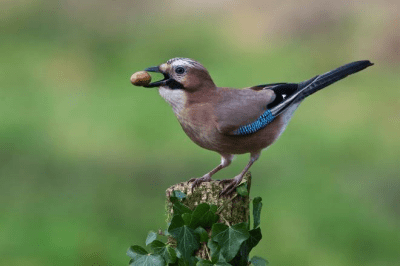
Eurasian Jay with acorn (by Hans-Jorg Hellwig)
On the 7th of July AD2006, in a park-like tall-treed area next to a restaurant at Haikko Manor, Finland (about 3-to-4 miles from Porvoo, on Finland’s southern coast), my wife and I watched an energetic Eurasian Jay, hopping about, foraging – then it decided, for a moment, to perch upon a rock. (A passer-by took a photograph of my wife and me, just before we walked through the parking lot toward the restaurant, by which we saw the busy “Jay of the Oaks” – the Eurasian Jay.)

JJSJ & wife Sherry, July 7th 2006 (Haikko Manor, near Porvoo, Finland)
But when I tried to photograph the Eurasian Jay, using the same camera, it hopped sideways, flitting about, so quickly I missed getting a focus – and then it then flew away. Was it camera-shy? Or was it just humans-shy, regardless of any camera? (It didn’t say.) But busy it was, and it appeared to find a few bugs to eat, just before it flew off.

Eurasian Jay in flight (by Lennart Hessel)
Regardless, it was fun while it lasted – watching the colorful Jay hop and hunt for acorns (and bugs), then rest briefly upon a rock, then flit away, to somewhere under the huge, dark, old-growth oak trees (mixed with occasional clusters of birch and evergreen trees) that shaded the lawn, in the garden-like area next to the Finnish restaurant.
Suffice it to say: southern Finland is stunningly, refreshingly, relaxingly beautiful, beyond words — and a wonderful, clean, marvelous, splendid, country for birding.

Eurasian Jay with acorn (by Phil Winter)
The Jay of Eurasia is a permanent resident of virtually all but the northern-most parts of Europe, plus various swaths of Asia (see range map below), so it is no surprise to see one hopping sideways under shady oak trees, in a wooded park, near coastal Porvoo.

Eurasian Jay range map (Wikipedia)
This oak-loving corvid is colorful, matching this bird-book’s description:
Pigeon-sized [i.e., about 13 inches long]. Colourful woodland corvid, notoriously shy and wary – generally glimpsed as a coloured bird with black tail and white rump [who] flashes through the trees, screeching its harsh warning. Typical call is a dry, rasping skaak, a familiar woodland sound. Adult: Overall pinkish-brown coloration is relieved by the beautiful shining blue shoulder patch and thick black moustache. All plumages similar. Noisy and excitable; short crest is readily erected, exposing dark streaking. Flight: Action is hesitantly undulating on broad, blunt wings; rising birds initially show black tail contrasting with white rump and wing flashes, and bright blue shoulder patches. Unlikely to be confused [with any other local bird], but compare similar-sized Hoopoe. From below, the black tail contrast with pinkish-brown body.
• Common woodland bird, but especially with oaks – acorns a favourite food
• In recent decades, has moved increasingly into towns; in many city parks, has become bold and fearless
• Feeds on ground, jauntily hopping sideways as it searches for acorns [or insects or berries, such as blackberries]
• Their long persecution by gamekeepers as an egg-thief [i.e., snatching eggs of other birds] belies their importance as a planter of forests; Jays bury acorns throughout the autumn – indeed a single Jay can plant 3,000 acorns in a month
• Rarely seen far from the shelter of trees, a party usually breaks cover one at a time, hurriedly flapping across a clearing or valley
• As well as its angry screeches, wide repertoire of calls includes a buzzard-like mewing note [as well as other calls demonstrating mimicry].
[Quoting Chris Kightley, Steve Madge, & Dave Nurney, POCKET GUIDE TO THE BIRDS OF BRITAIN AND NORTH-WEST EUROPE (Yale University Press, 1998), page 264, emphasis added.]
Thus, as both an eater and planter of oak-seeds (which is what acorns are), the Eurasian Jay’s behavior is not unlike that of the Pinyon Jay, which both eats and plants Pinyon Pine seeds, in America’s Great West. [See “Providential Planting: The Pinyon Jay”, CREATION EX NIHILO, 19(3):24-25 (June 1997), posted at http://creation.com/providential-planting .]

Eurasian Jay perching (by Luc Viatour)
What clever birds God has made these busy woodland-dwelling corvids to be!
Who knows? Maybe my wife and I will get to re-visit Scandinavia, sometime, for more birdwatching. If so, I hope to see another Eurasian Jay – that colorful character that the French rightly call Geai des chênes: “jay of the oaks”. ><> JJSJ profjjsj@aol.com

Eurasian Jay, taking a bow (by Charlie Fleming)
*
More article from James J. S. Johnson
*
“This is the LORD’S doing; it is marvellous in our eyes. ” (Psalms 118:23 KJV)
Marvelous Spatuletail (Loddigesia mirabilis) ©©Dubi Shapiro
*
*
“By them shall the fowls of the heaven have their habitation, which sing among the branches.” (Psalms 104:12 KJV)
Birds Singing from BeliefNet
*
*
“Gavest thou the goodly wings unto the peacocks? or wings and feathers unto the ostrich? Which leaveth her eggs in the earth, and warmeth them in dust, And forgetteth that the foot may crush them, or that the wild beast may break them. She is hardened against her young ones, as though they were not hers: her labor is in vain without fear; Because God hath deprived her of wisdom, neither hath he imparted to her understanding. What time she lifteth up herself on high, she scorneth the horse and his rider.” (Job 39:13-18)
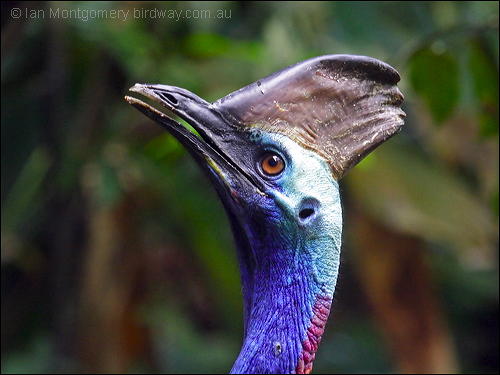
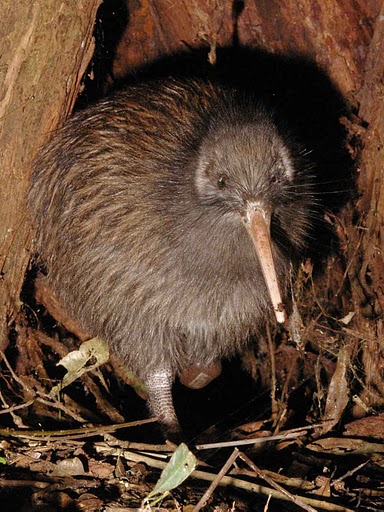
Today we have thirteen (13) birds that are in four (4) Orders with a total of five (5) families. As mentioned before, these will be much easier than the LARGE Passeriformes Order that took months to view. Our Orders are the Struthioniformes, with one (1) family, Struthionidae that has two (2) Ostritches; the Rheiformes has one (1) family, Rheidae, with two (2) Rheas; and then the Casuariiformes Order has two (2) families, Casuariidae with three (3) Cassowaries and the Dromiidae family with a solo Emu; Apterygiformes Order with the Apterygidae family with five (5) Kiwis.
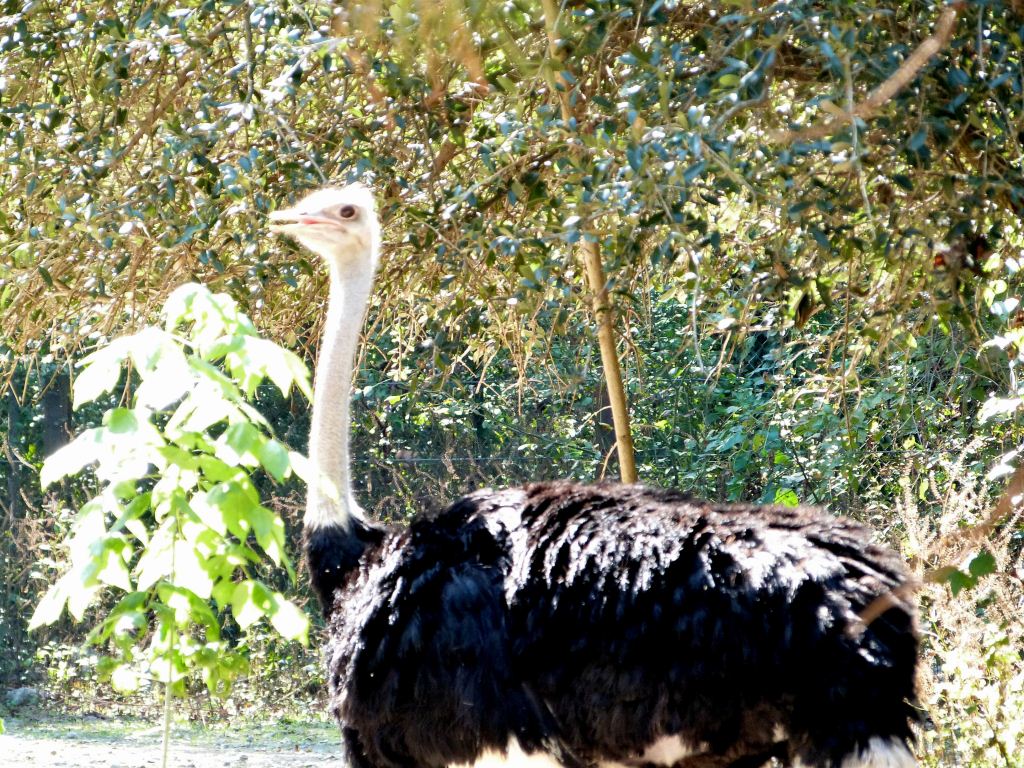
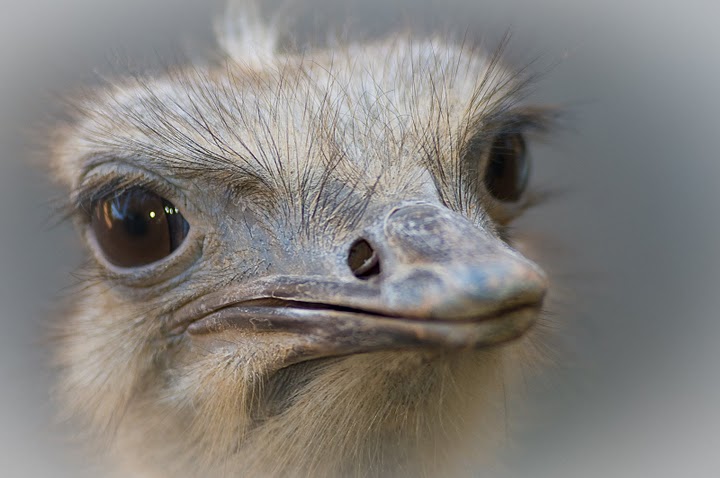
Struthioniformes, with one (1) family, Struthionidae that has two (2) Ostritches – “Ostriches are large, non-flying birds that live in Africa. Besides in their natural environment, ostriches are often breed as farm animals because some people like to eat their meat, eggs or to wear fashion products made of their skin. Although they are killed for commercial purposes, they are not endangered. There are around 2 million ostriches that can be found around the globe.” (SoftSchools)
Rheiformes has one (1) family, Rheidae, with two (2) Rheas – “Rhea is a member of the group of flightless birds. This is the largest bird in the South America. There are two species of rhea: Greater or American Rhea and Lesser or Darwin’s Rhea. They differ in size and in type of habitat they inhabit. Rhea can be found in open grasslands, pampas and woodlands of Argentina, Uruguay, Bolivia, Paraguay, Chile, Peru and Brazil. Rhea is also kept on farms because of its meat, eggs and skin. Number of rhea in the wild is decreased due to habitat loss, but they are still not listed as endangered species.” (SoftSchools with editing)
Casuariiformes Order has two (2) families, Casuariidae with three (3) Cassowaries – “The bird order Casuariiformes has four surviving members: the three species of cassowary, and the only remaining species of emu. The emus are classified in the family Dromaiidae, while the cassowaries are all located within the Casuariidae family. All four members of the order are very large flightless birds native to Australia-New Guinea.” (Wikipedia)
Apterygiformes Order with the Apterygidae family with five (5) Kiwis – “Kiwi (pronounced /kiːwiː/) or kiwis are flightless birds native to New Zealand, in the genus Apteryx and family Apterygidae. At around the size of a domestic chicken, kiwi are by far the smallest living ratites (which also consist of ostriches, emus, rheas, and cassowaries), and lay the largest egg in relation to their body size of any species of bird in the world. DNA sequence comparisons have yielded the surprising conclusion that kiwi are much more closely related to the extinct Malagasy elephant birds than to the moa with which they shared New Zealand. There are five recognized species. All species have been negatively affected by historic deforestation but currently the remaining large areas of their forest habitat are well protected in reserves and national parks. At present, the greatest threat to their survival is predation by invasive mammalian predators.
Kiwi is the nickname used internationally for people from New Zealand,[1] as well as being a relatively common self-reference. The name derives from the kiwi, a flightless bird, which is native to, and the national symbol of, New Zealand. Unlike many demographic labels, its usage is not considered offensive; it is generally viewed as a symbol of pride and endearment for the people of New Zealand..” (Wikipedia with editing)
“And we have seen and do testify that the Father sent the Son to be the Saviour of the world. Whosoever shall confess that Jesus is the Son of God, God dwelleth in him, and he in God.”
(1 John 4:14-15 KJV)
“Hosanna, Messiah Has Come” ~ Choir and Solo by Lisa Brock
*
“And Noah went in, and his sons, and his wife, and his sons’ wives with him, into the ark, because of the waters of the flood. Of clean beasts, and of beasts that are not clean, and of fowls, and of every thing that creepeth upon the earth, There went in two and two unto Noah into the ark, the male and the female, as God had commanded Noah. ” (Genesis 7:7-9 KJV)
I wonder if all the workers at the zoos every had the idea they were doing something similar to what had done in the past? Adam, his family, the animals, birds, and critters were placed in the ark to protect them from the flood. From the reports I seen, it seems the critters have all survived. Hurricane is still along the South Carolina coast as this is produced.
Just thought you might enjoy watching and reading some of the articles about the zoo animals during this storm. For us here, the sun is shining and the wind is down to an occasional breeze. Praise the Lord for His protection.
What St Augustine Alligator Farm And Zoological Park did for their animals before Hurricane came by:
Some interesting articles to check out:
Jacksonville Fire Rescue Dept. helps Jacksonville Zoo
What Zoos Do To Prepare For Natural Disasters
Animals in Florida Zoo Hunker Down For Hurricane Matthew
FAQ: Animal Safety & Hurricane Matthew
*
“He maketh the storm a calm, so that the waves thereof are still.” (Psalms 107:29 KJV)
Flocks Settling at the Shore by Lee
Praise the Lord, Hurricane Matthew is departing our area and the seas are calming back down. Thanks for all the prayers. Our Haitian and Bahamian friends need much prayer as they try to rebuild their lives.
*
*
“For he commandeth, and raiseth the stormy wind, which lifteth up the waves thereof.” (Psalms 107:25 KJV)
Snowy Egret (Egretta thula) In The Wind ©Flickr Andrea Westmoreland
*
Tonight the effects of Hurricane Matthew are causing rain and fairly gusty winds here in Central Florida. So far, Matthew is staying to the east of us, but not by much. (We just got word that it is finally shifting to the east a tad, which is good for us.) Though the Snowy Egrets will still be having a “flying feather” night. Praying for all of those people along the shore as the hurricane scrapes the coast, during tonight and into early morning. Your prayers are always welcomed.
*
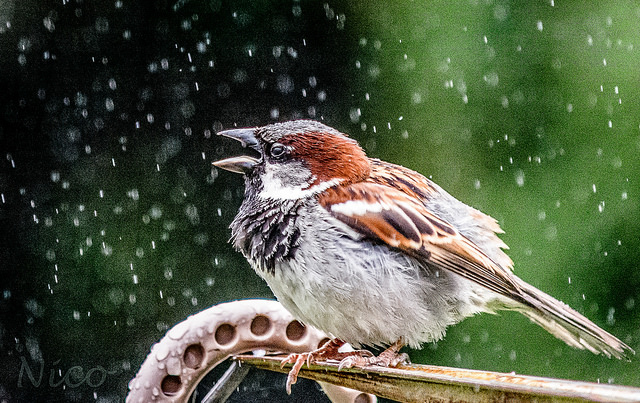
“I would hasten my escape from the windy storm and tempest.” (Psalms 55:8 KJV)
House Sparrow (Passer domesticus) In Rain ©Flickr Nicole Nicky
*
*
This story is from eNature’s Blog. Many of us worry about the birds and how they make it through Hurricanes like Matthew. This information is well worth repeating.
Hurricane Matthew is making its way towards the US East coast after hitting Haiti and Cuba with some of the highest sustained winds and rainfall totals in recent memory.
While Matthew’s wind, rain and storm surge will certainly affect many people, some folks are also wondering about the effects the hurricane may have on birds.
Numbers are hard to come by, but it’s clear that many birds are killed outright by hurricanes. This is especially true of seabirds, which have nowhere in which to seek shelter from these storms. Beaches may be littered with seabird carcasses following major storm events. Most Atlantic hurricanes occur in late summer and early fall—and fall storms coincide with bird migration and may disrupt migration patterns severely.
Many birds get caught up in storm systems and are blown far off course, often landing in inhospitable places or simply arriving too battered and weakened to survive. Others, while not killed or displaced by storms, may starve to death because they are unable to forage while the weather is poor. The number of birds that die as a result of a major hurricanes may run into the hundreds of thousands….
But as they sailed he fell asleep: and there came down a storm of wind on the lake; and they were filled with water, and were in jeopardy. (Luke 8:23 KJV)
Behold the fowls of the air: for they sow not, neither do they reap, nor gather into barns; yet your heavenly Father feedeth them. Are ye not much better than they? (Matthew 6:26 KJV)
*