Look at the birds of the air, for they neither sow nor reap nor gather into barns; yet your heavenly Father feeds them. Are you not of more value than they?
(Matthew 6:26 NKJV)
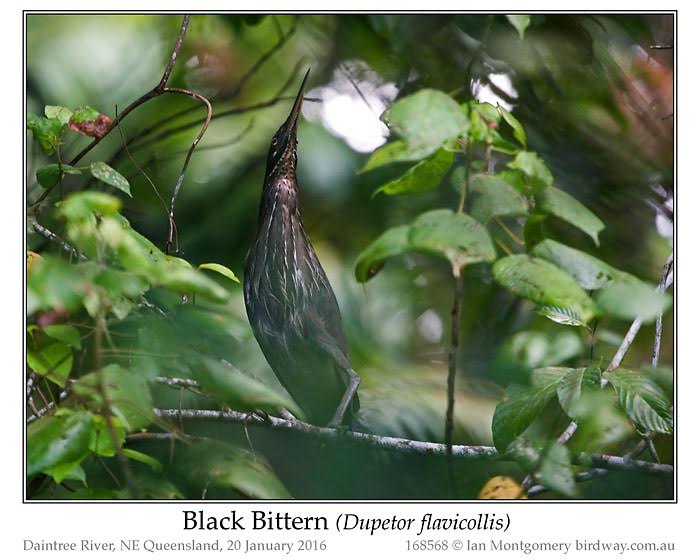
Well, thanks to your moral and spiritual support yet again, here is the Black Bittern. This bogey bird was the North Queensland bird that I’ve spent the most time trying unsuccessfully to photograph since the Red-necked Crake. Ian Worcester (“Sauce”) of Daintree River Wild Watch, knows the wildlife of the Daintree River like the back of his hand and took us straight to an active Black Bittern nest where we disturbed this female (females have browner plumage than males) who retreated into the depths of the tree and adopted the frozen posture so typical of bitterns. You can see from the greenish blur in the bottom half of the photo that I had to take this photo through a small gap in the vegetation.
With the Black Bittern spell broken within minutes of leaving the wharf, I was free to relax and enjoy the view and whatever else the trip had to offer, while hoping for more and better Bittern photos of course. We left the wharf at about 6:30am and I took this view looking up the river at 6:42am after photographing the Bittern.
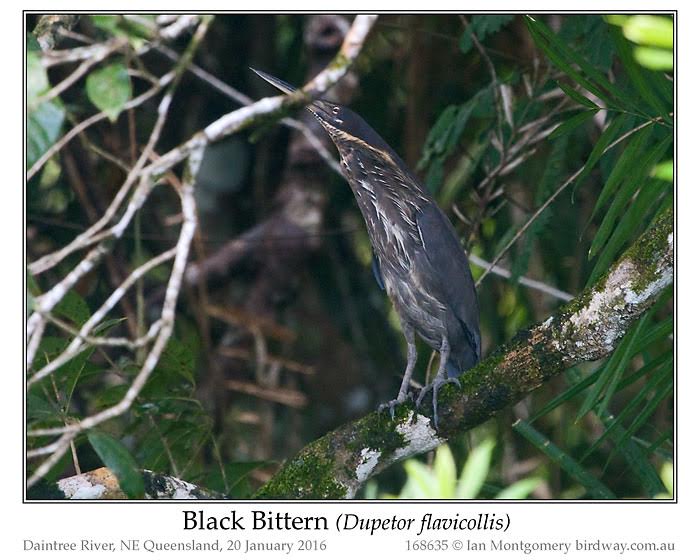
We continued up the river and into Stewarts Creek and visited the nests of a few more bitterns and of a couple of Great-billed Herons. We saw a couple of Bitterns flying away, as usual, and it was over an hour before the male in this photo hung around long enough for a photo. The male has blackish plumage with a slight blue sheen and buff streaks below the head. Both sexes share incubation and care of the young and this one had left the nest like the first one and moved to the back of the tree where he also froze.
Looking from the bright area on the river into the deep shadows of the riverine forest made the birds extraordinarily difficult to see. The photo below is a full-frame image from a 400mm telephoto lens and the bird is almost invisible. The bill and neck stripe of the bird were aligned so perfectly with the twig behind that I couldn’t help wonder whether it was deliberate. The rest of the body just looked like a limb of a tree.
Here is one of the nests, an untidy collection of sticks wedged in a branch 4 or 5 metres above the surface of the river. Something white is just visible in the nest, but I can’t tell whether it’s an egg or a fluffy chick.
Anyway, that was it for Black Bittern photos. We went out a second time later in the morning and revisited a couple of the nests including the one near the wharf, but we didn’t see any more birds. I’ve since discovered from Handbook of Birds of the World that Black Bitterns are “crepuscular and nocturnal with peak activity at dusk and dawn” so that may be why. None of the Australian field guides mention this and maybe this is why I’ve had difficulty finding them before.
Deliver me, O LORD, from mine enemies: I flee unto thee to hide me. (Psalms 143:9 KJV)
Thanks, Ian, and, yes, I was selfishly praying that you would find “your bird” this time. Every time you succeed, we get to see another great series of avian photos.
When the Lord created these Black Bitterns, He definitely had their protection in mind. Did you all notice that 4th photo? You can hardly find the Bittern. He looks like a branch.
Which doeth great things past finding out; yea, and wonders without number. (Job 9:10 KJV)
I am currently taking a Ladies Bible study, “Disciples Prayer Life.” One of our lessons suggested using some of the different names of God while praying. There is quite a list of God’s names in our lesson. Some of them are:
God (Elohim) – Sovereign, Power, Creator
Lord (Adonai) – Master, Ruler, Owner
Jehovah (the self-existing Lord) – eternal, changeless, faithful
The Lord our Provider (Jehovah-Jireh)
The Lord our Peace (Jehovah-Shalom)
The Lord who is there (Jehovah-Shammah)
It is this last one, Jehovah-Shammah, that has really caught my interest. As you can see, it means “The Lord who is there.”
When we read Genesis 1:1, it begins with “In the beginning, God…” The word for God here is Elohim – אֱלֹהִים , ‘ĕlôhı̂ym, el-o-heem’ There is much to be said about this, but, for now, that is not my purpose. The Lord God is the Creator, Sovereign and all-powerful. God has no beginning, or ending, He is the Alpha and the Omega.
Because God has always been, the word, Jehovah-Shammah, “The Lord who is there” is also true. God’s Word chose not to use that word here.
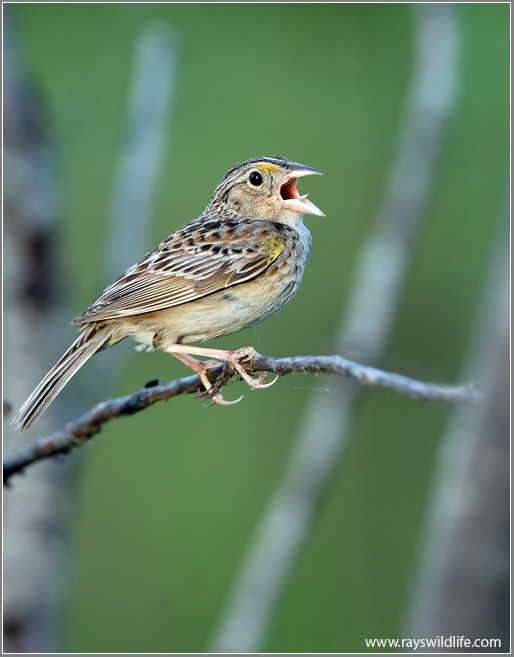
Grasshopper Sparrow (Ammodramus savannarum) by Ray
All of this to explain a passage about the sparrows, which I have used many times before, that could have used the word ” Jehovah-Shammah.”
“Are not two sparrows sold for a farthing? and one of them shall not fall on the ground without your Father. But the very hairs of your head are all numbered. Fear ye not therefore, ye are of more value than many sparrows.” (Matthew 10:29-31 KJV) (emphasis mine)
When a sparrow or any bird falls and/or dies, their Father, knows all about it because HE IS THERE.
If a fallen sparrow is noticed by the Father, who is there, should we not receive comfort from knowing that our Lord God knows and sees us also. As that passage goes on, there is comfort given to us because we are of more value than the birds. We, mankind, were made in the image of God, animals and birds were not. Because of sin, the Lord Jesus Christ, God’s Son, provided salvation for us. It cost the Lord His blood to save us from our sins. We have a choice whether to receive that Sacrifice or not.
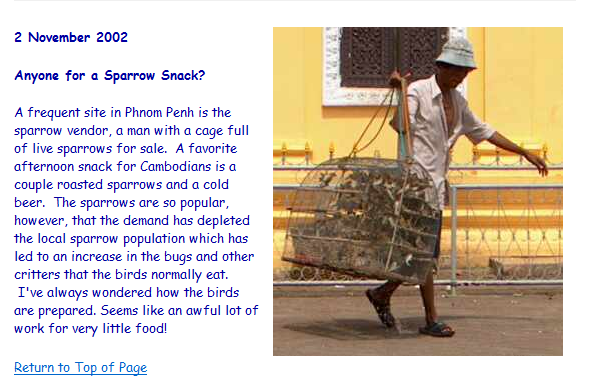
Anyone for a Sparrow Snack?
Every since I saw this photo, Matthew 10:29, has meant more to me than just a bird dying of old age. That whole cage is packed with sparrows to be eaten. That sickens me, but maybe I eat things that sicken others in another culture. I just found another photo of a roasted sparrow. I refuse to post it.
I love Sparrows of all kinds and the other birds. Most of all, I am thankful for a Creator God who cares for those birds and for us. When we KNOW that the Lord IS THERE, we can have comfort knowing we can pray and bring our requests to the Lord, knowing that He cares and already knows all about our needs.
Then God said, “Let the waters abound with an abundance of living creatures, and let birds fly above the earth across the face of the firmament of the heavens.” (Genesis 1:20 NKJV)
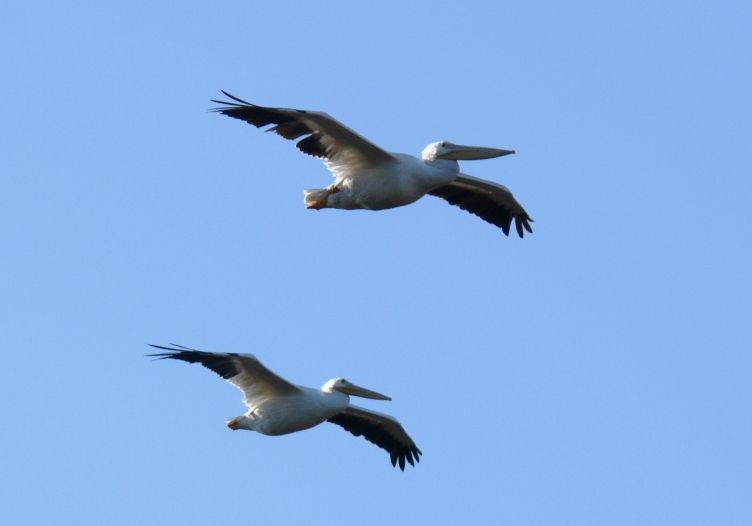
American White Pelican (Pelecanus erythrorhynchos) by Lee at Circle B Bar Reserve
Yea, the sparrow hath found an house, and the swallow a nest for herself, where she may lay her young, even thine altars, O LORD of hosts, my King, and my God. (Psalms 84:3 KJV)
My friend, Sandra Conner, over at The Right Word Makes All The Difference, has come up with a new kooky experiment. Instead of, or in addition to, her Six Word Saturday posts, she came up with this schedule:
Now, this week, I got a really kooky idea. Why not do a post every day of the week — each day receiving its own number of words?
Monday = One-Word Post
Tuesday = Two-Word Post
Wednesday = Three-Word Post
Thursday = Four-Word Post
Friday = Five-Word Post
Saturday = Six-Word Post
Sunday = Seven-Word Post
So that’s what I’m going to do for the next three weeks. Now, I will be posting other regular posts as well, as the mood strikes me, but I’m going to challenge myself to say something relevant — or at least that means something to me — in the restricted number of words for each day.
She has challenged us to try to do the same for three weeks. Many times she inserts a picture along with six words on Saturdays. I think I will take the challenge, except the photos or videos here will be, you guessed it, birds. Also, something honoring the Lord.
Since it’s late Sunday evening, I’ll give it a try. Watch for the next post.
Are not two sparrows sold for a farthing? and one of them shall not fall on the ground without your Father. (Matthew 10:29 KJV)
Our Lord mentions Sparrows in six verses of the Bible. There are various reasons why, but one of them has to do with how He knows if one of His sparrows dies. If the Lord, Our Creator, cares about a little sparrow falling, how much more does the Lord God care about His people?
“They are also known as true sparrows, or Old World sparrows, names also used for a genus of the family, Passer. They are distinct from the American sparrows, which although similar in appearance are placed in the family Emberizidae, and from a few other birds sharing their name, such as the Java Sparrow. Many species nest on buildings, and the House and Eurasian Tree Sparrows in particular inhabit cities in large numbers, so sparrows may be the most familiar of all wild birds. They are primarily seed-eaters, though they also consume small insects. Some species scavenge for food around cities and, like gulls or Rock Doves, will happily eat virtually anything in small quantities.”
“Generally, sparrows are small, plump, brown-grey birds with short tails and stubby, powerful beaks. The differences between sparrow species can be subtle. Members of this family range in size from the Chestnut Sparrow (Passer eminibey), at 11.4 cm (4.5 in) and 13.4 grams (0.47 oz), to the Parrot-billed Sparrow (Passer gongonensis), at 18 cm (7.1 in) and 42 grams (1.5 oz). Sparrows are physically similar to other seed-eating birds, such as finches, but have a vestigial dorsal outer primary feather and an extra bone in the tongue. This bone, the preglossale, helps stiffen the tongue when holding seeds. Other helps towards eating seeds are specialized bills and elongated and specialized alimentary canals.” (Wikipedia with editing)
This slideshow requires JavaScript.
Are not five sparrows sold for two farthings, and not one of them is forgotten before God? But even the very hairs of your head are all numbered. Fear not therefore: ye are of more value than many sparrows. (Luke 12:6-7 KJV)
I know this hymn “His Eye Is On The Sparrow” has been used before, but this family of sparrows cannot be present without it being played. Forgive the repetition. :)
“His Eye Is On The Sparrow” by Don Marsh Orchestra
But they that wait upon the LORD shall renew their strength; they shall mount up with wings as eagles; they shall run, and not be weary; and they shall walk, and not faint. (Isaiah 40:31 KJV)
Bald Eagle on Old Bartow Rd – 2
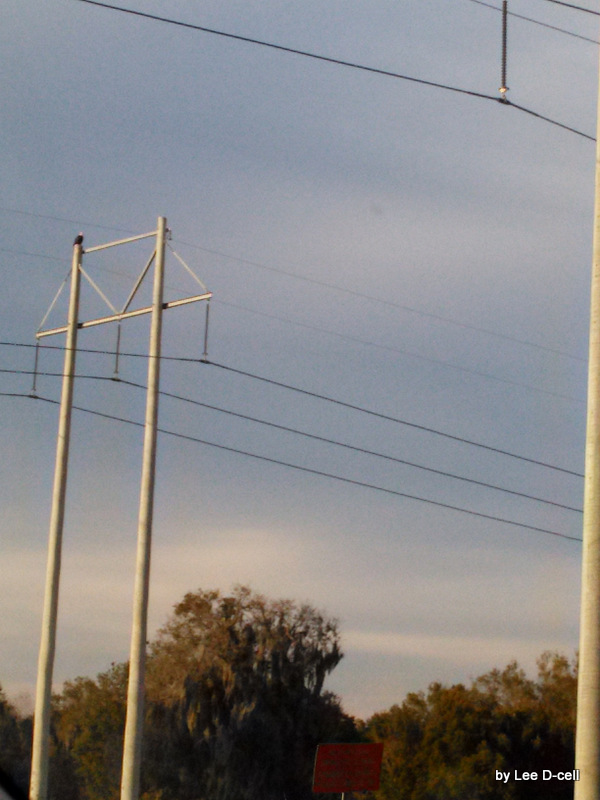
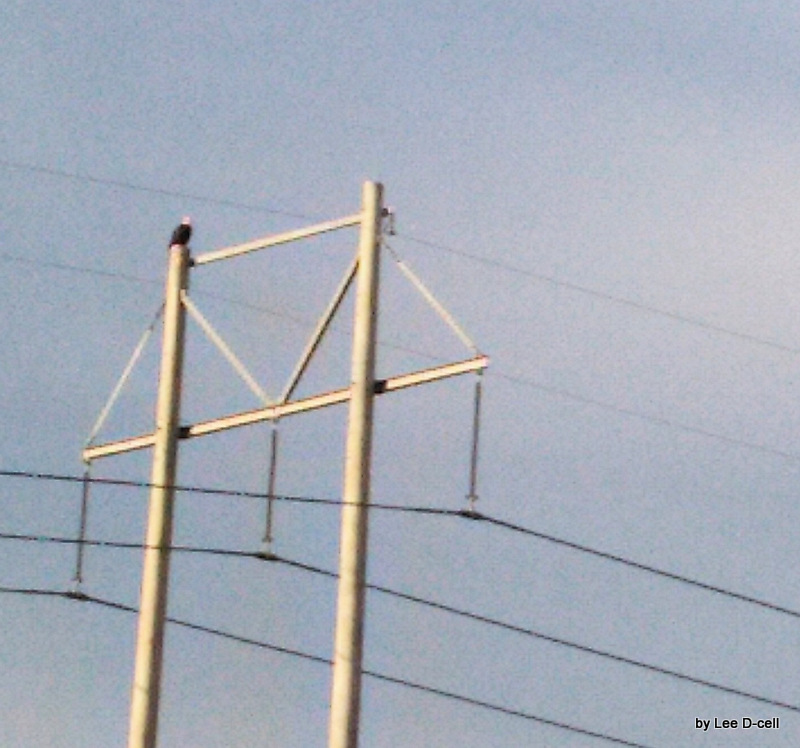
Last evening while on the way back from Bartow, a seven mile journey, we spotted not one, not two, but three Bald Eagles. Unfortunately, I again did not have anything with me except the cell phone. Dan was able to slow down a little, but with someone coming, we could not stop.
Bald Eagle on Old Bartow Rd- 2
Here are my attempts to show two of the eagles. These are more “proof shots” than good photos. The other Bald Eagle caught us by surprise down the road another 1/2 mile or so. I had put my phone back down. :(
Bald Eagle on Old Bartow Rd – 2
We have been rather busy lately and haven’t had time to go birdwatching. But, the Lord knows how to give us unexpected blessings along the way to brighten our days.
It is of the LORD’S mercies that we are not consumed, because his compassions fail not. They are new every morning: great is thy faithfulness. (Lamentations 3:22-23 KJV)
Bald Eagle on Old Bartow Road – 2 – cropped
The blessing of the LORD, it maketh rich, and he addeth no sorrow with it. (Proverbs 10:22 KJV)
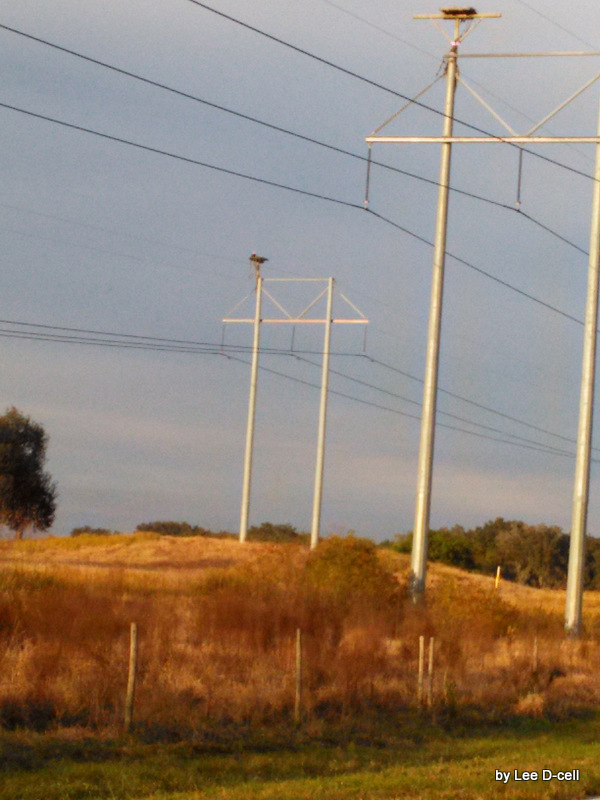
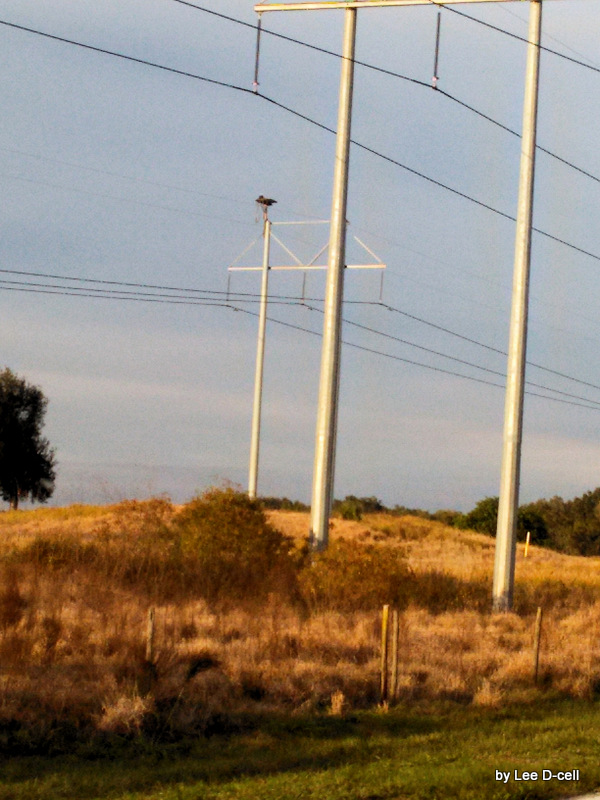
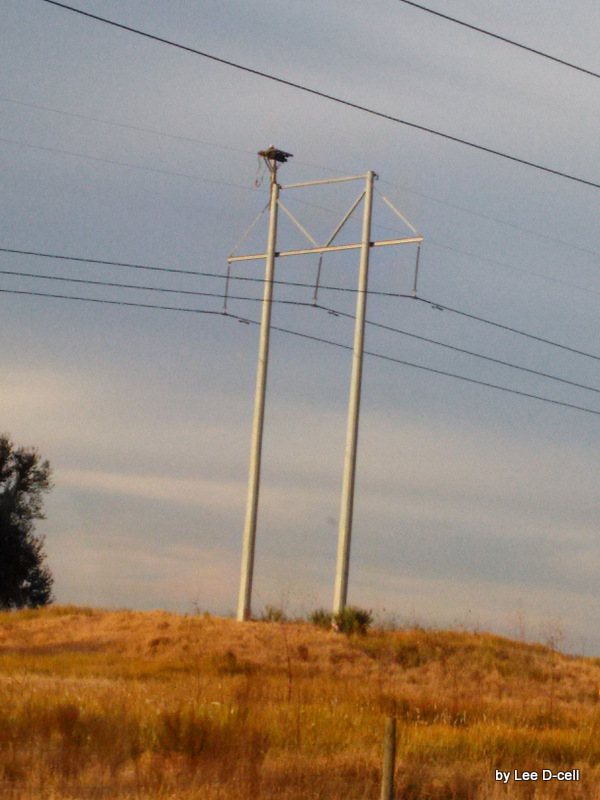
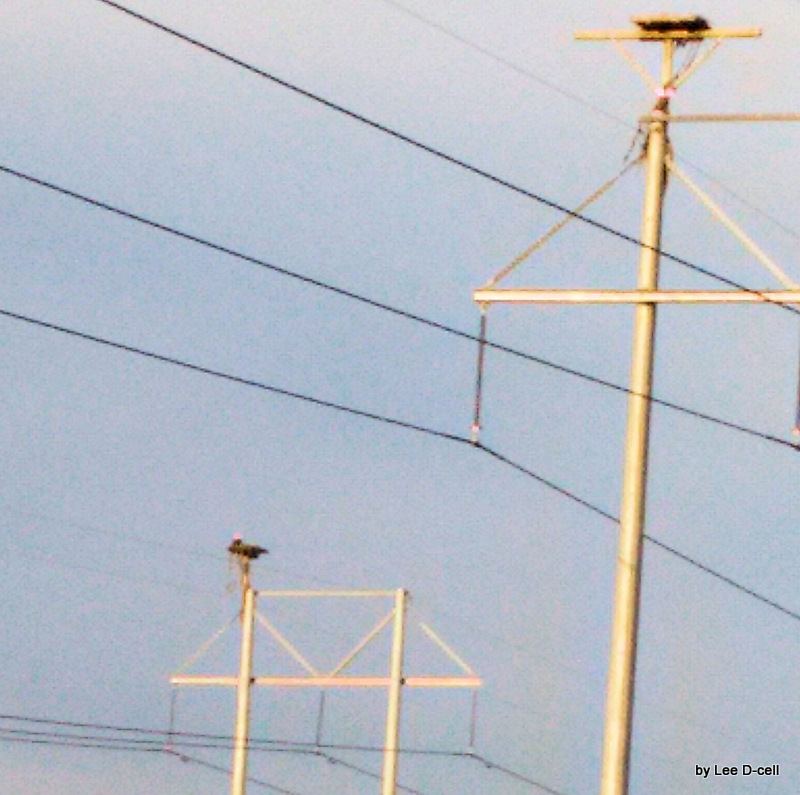
I have shown photos of the Old Bartow Road before. Because of the decline in Ospreys, many years ago, they placed platforms on top of various power poles. These are some of them. The Osprey come back from about the middle of January on through February. They raise their young on the platforms and then around May to June they seem to disappear. Polk County has numerous Bald Eagles come down for the winter and are one of my favorite “snow birds” (that is a term for our winter human vistors). Since most of the Osprey haven’t arrived yet, the Bald Eagles have been sitting on these lately. Not sure who will give way when the Osprey do arrive. Hummm!
Osprey Road by Dan – (Old Bartow Road)
Actually, the fact that these platforms were placed are a good thing and shows one of the responsibilities that man was given by the Lord. Man was given dominion over the earth and the critters included. Dominion did not mean dominance, but one of the meanings is to help preserve them.
So God created man in His own image; in the image of God He created him; male and female He created them. Then God blessed them, and God said to them, “Be fruitful and multiply; fill the earth and subdue it; have dominion over the fish of the sea, over the birds of the air, and over every living thing that moves on the earth.” (Genesis 1:27-28 NKJV)
And the stork, the heron after her kind, and the lapwing, and the bat. (Leviticus 11:19 KJV)
Great Blue Heron camouflaged by Lee
And the stork, and the heron after her kind, and the lapwing, and the bat. (Deuteronomy 14:18 KJV)
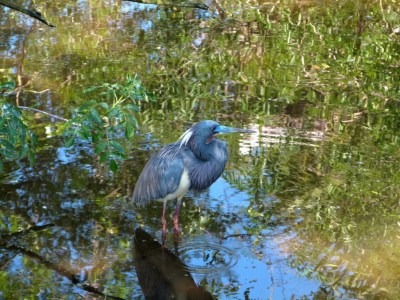
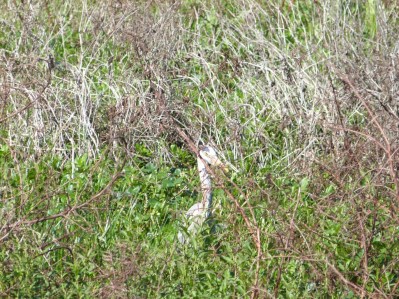
The original Birds of the Bible – Heron article was posted on July 17, 2008. Seems like it’s time for an update and to keep our Heron family visible. Actually, some of the family members are very good at hiding or blending in with their surroundings. Their Creator, the Lord Jesus Christ, designed them to be slim like the reeds they hide in, called camouflage, and gave them the ability to move back and forth again like reeds. Notice the Tricolored Heron in the first photo. Even though he is blue, the sky color reflecting in the water actually is helping keep him “hidden in plain view.”
Around the World the Ardeidae family, now with 72 species, includes Herons (46), Egrets (9) and Bitterns (15). From Thayer Birding Software, “Most herons nest in dense or dispersed colonies; a few species, including most bitterns, are solitary. Nests are platforms of interlocked sticks in trees or piles of vegetation in reeds or on the ground, built mainly or entirely by the female of material brought by the male.”
Most of the Herons rest and fly with their necks in an “S” curve. They can be seen along or in the edges of water fishing. Many stand perfectly still looking in the water and then thrust with a quick movement to either spear or catch their prey. You can see that in the video I posted yesterday.
This video of a Great Egret was watching something so intently. Also, notice how his neck sways like they do in the tall grass or reeds. Egrets are part of the Heron Family group.
Herons amaze me in how perfectly still they stand and wait. They seem so patient to me. Herons are on the “unclean” list of birds found in Leviticus 11:19 and Deuteronomy 14:18. Because they are so “patient” and “wait,” it reminds me of:
Rest in the LORD, and wait patiently for him: fret not thyself because of him who prospereth in his way, because of the man who bringeth wicked devices to pass. (Psalms 37:7 KJV)
And so, after he had patiently endured, he obtained the promise. (Hebrews 6:15 KJV)
The eyes of all wait upon thee; and thou givest them their meat in due season (Psalms 145:15 KJV
And of course our great verse from last week:
But they that wait upon the LORD shall renew their strength; they shall mount up with wings as eagles; they shall run, and not be weary; and they shall walk, and not faint. (Isaiah 40:31 KJV)
Hymns mention “waiting” and being “still” and “patient. Here is a favorite:
Be Still, My Soul by Katharina von Schlegel,
1697-Trans. By Jane L. Borthwick, 1813-1897
Be still, my soul: the Lord is on thy side;
Bear patiently the cross of grief or pain;
Leave to thy God to order and provide;
In ev’ry change He faithful will remain.
Be still, my soul: thy best, thy heav’nly Friend
Thro’ thorny ways leads to a joyful end.
Be still, my soul: thy God doth undertake
To guide the future as He has the past.
Thy hope, thy confidence let nothing shake;
All now mysterious shall be bright at last.
Be still, my soul: the waves and winds still know
His voice who ruled them while He dwelt below.
Be still, my soul: the hour is hast’ning on
When we shall be forever with the Lord,
When disappointment, grief, and fear are gone,
Sorrow forgot, love’s purest joys restored.
Be still, my soul: when change and tears are past,
All safe and blessed we shall meet at last.
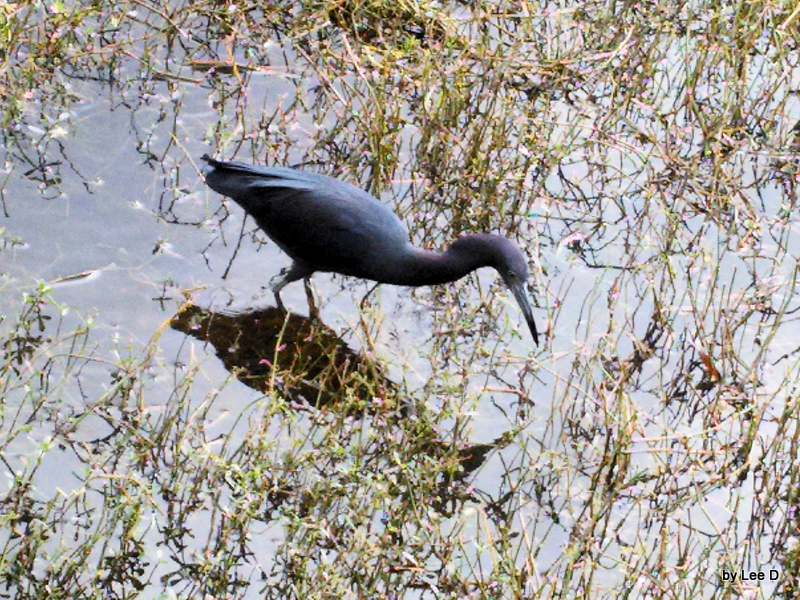
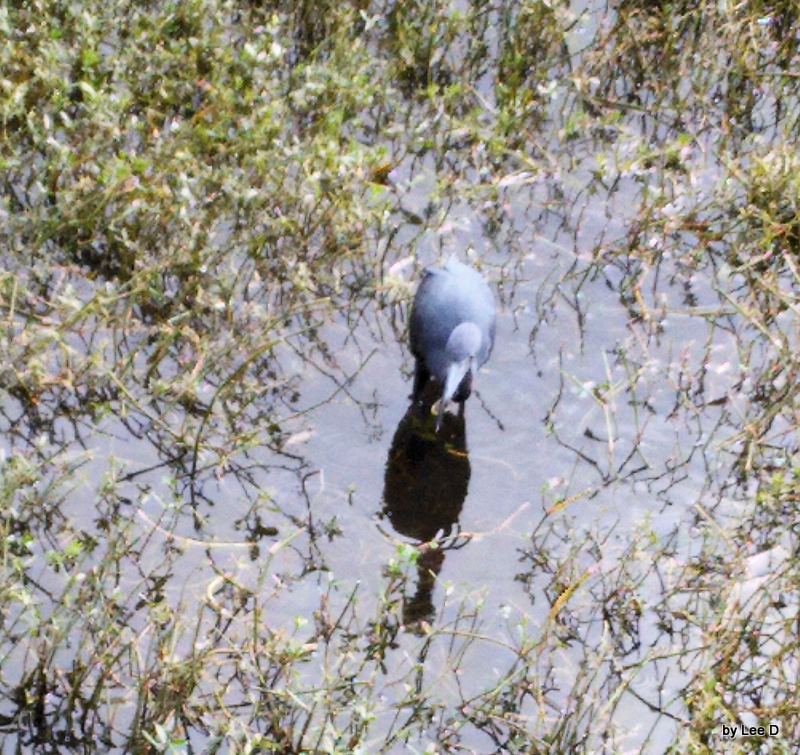
Recently we were on our way home from shopping and stopped in the little park at the south side of Lake Howard. All we had with us were our phones. Not much was going on, but one Little Blue Heron was searching for his lunch. It was interesting watching him move his head from side to side. Not sure if the bird was looking around the plants or just trying to see better. It was an overcast day. Our special Avian Wonder this time from the creator is this Little Blue Heron.
The “Little Blues,” as I many times refer to them, are another favorite of mine to watch here in central Florida. This one just seemed so intent on what he was doing, that it reminded me of the verse about the lady who was diligently searching for a coin. How diligently do we search God’s Word?
Either what woman having ten pieces of silver, if she lose one piece, doth not light a candle, and sweep the house, and seek diligently till she find it? (Luke 15:8 KJV)
And you will seek Me and find Me, when you search for Me with all your heart. (Jeremiah 29:13 NKJV)
Little Blue Heron with catch at S. Lake Howard Park
Bad photo, but you can see the results of one of his searches.
The Little Blue Heron “stalks its prey methodically in shallow water, often running as it does so. It eats fish, frogs, crustaceans, small rodents and insects.” (Wikipedia)







 Lee's Birdwatching Adventures Plus