ALASKA’S BALD EAGLE
Dr. James J. S. Johnson
Associate Professor of Apologetics, ICR ( jjohnson@icr.org )
The ecological world of Southeastern Alaska hosts a diversity of animals — creatures of the air (like the Bald Eagle), creatures of the land (like the Alaskan Moose), as well as creatures of its freshwater rivers and streams (like Pacific Salmon), lakes and ponds (like Rainbow Trout). This article will look at one of those creatures, the Bald Eagle.
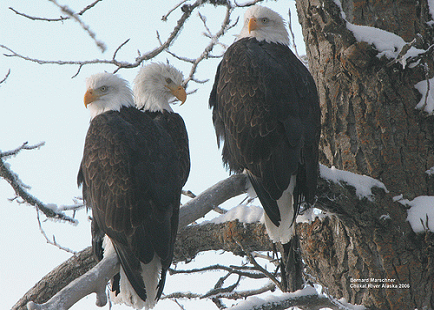
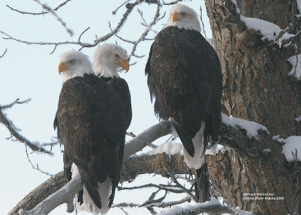
The national bird of the United States of America, since 1782, is the bald eagle. The backside of many quarter-dollar coins (the silver coins which most Americans call “quarters”) show an American bald eagle with outstretched wings. Mexico’s most famous eagle is the golden eagle, which is a kind of “cousin” to the bald eagle. The bald eagle’s scientific name is “Haliaeetus leuocephalus”, meaning “white-headed sea-eagle” (which is a very accurate name). The adult bald eagles have their heads (including their neck area) covered in white feathers, and also their tail feathers are white; the rest of the adult bald eagle’s feathers are black or blackish-grey. Their sharp curl-ended beaks and their talons (feet) are yellow. A bald eagle is fully grown in about four or five years after its hatching.
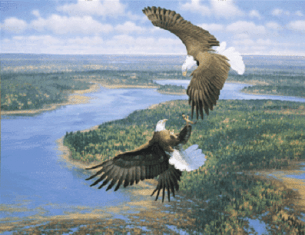 How big is the adult bald eagle? The bald eagles is a very large bird; it often weighs about ten pounds, though it may weigh as much as thirteen pounds. The bald eagle, when fully grown, is almost three feet long and its wingspan can be as wide as six or seven feet when fully spread out! The tough-looking eagles have a voice that seems almost silly when compared with their rough toughness – their voices make sounds like thin squealing or squeaky cackling.
Where do bald eagles live? Eagles sometimes migrate, flying south to avoid super-cold weather in Canada’s inland forests. However, many bald eagles, especially those which live near coastal waters, do not migrate at all. Bald eagles like to live on land near waters where fish (their favorite food) live, such on seacoasts, by rivers, by large lakes, or in marshy areas where flowing stream-waters provide homes for fish. Bald eagles usually live in shoreline areas where cold water flows nearby, such as where snow-melt-watered mountain creeks empty into a estuarial bay ( a place where flowing freshwater mixes with tide-washing ocean water).
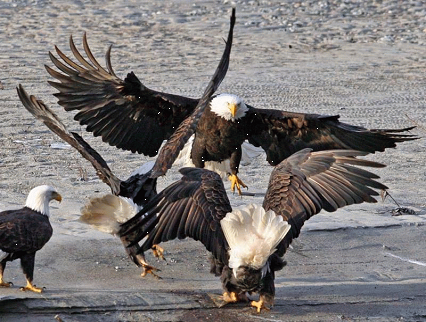
The highest concentration (most crowded gathering) of bald eagles in the world is in southeast Alaska, where the Chilkat River empties into the tidewaters near the town of Haines, a picture-postcard coastal town originally founded as a Presbyterian mission. At the Chilkat River’s emptying point more than 3,000 bald eagles congregate annually, during autumn, for an all-you-can-eat salmon feast. What do bald eagles like to eat? Bald eagles are hawk-like “birds of prey”, meaning that they like to eat meat from smaller animals (like fish) that they hunt and kill for food. Bald eagles especially like to eat salmon when then return to coastal streams and rivers during spawning seasons! (After salmon reproduce fertilized eggs for the next generation of salmon, the parents salmon are fatally exhausted (so tired out that they are dying) and they move about in shallow water where it is easy for bald eagles to see them and to grab them for food). If an eagle has an adequate food supply, which the eagles of Alaska usually do, they can live for twenty or thirty years, or may even live for forty years!
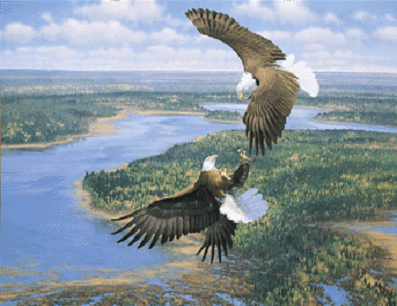
 Bald eagles have super-human eyesight (eyes able to see distances much farther than humans can see). Their eyes are so sharp that the eagles can chase fish swimming near the surface of water, then zoom down near the water surface to grab the unsuspecting fish with their extra-strong talons (clawed-feet-like legs that can clutch things as if they were hands), then fly away with the fish to eat it (or to share it with its family). An adult eagle’s beak is about two inches long and about one inch deep at its hook-like curled tip. The sharp curled tip of the beak can rip into a fish easily, for eating convenience. Sometimes bald eagles, while flying, will attack another fish-catching bird, the osprey (also called “fish hawk”), in order to get caught fish that the osprey is carrying. Sometimes an osprey will intentionally drop its fish so that the eagle will fly down to catch the dropping fish; this allows the osprey to escape the attacking eagle – it’s better for the osprey to lose a fish than to lose its life! Bald eagles eat other small animals, including other fish, ducks, seagulls, and other birds.
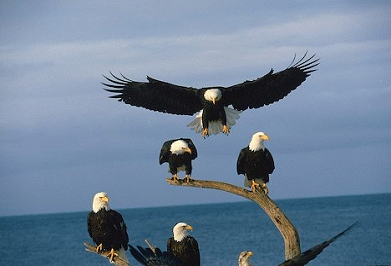
Where can eagles be easily seen? In the coastal forestlands of southeastern Alaska (especially Juneau, Alaska’s capital city), many of the trees that cover sloping hillsides near the shoreline of rivers or bays of water are often filled with perching bald eagles. The bald eagle prefers to make its nest in a tall tree, where sticks are gathered and arranged to provide the bald eagle family with a huge house of sticks and other materials. 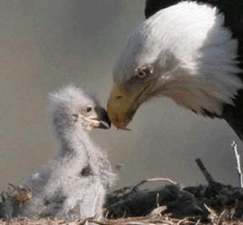 (Another kind of eagle, the golden eagle, prefers to make its home in rocky places on top of cliffs, and sometimes bald eagles do the same. Baby golden eagles and baby bald eagles lookalike, but if the eaglet grows up to have a white head and a white tail it is a bald eagle.) From the roadside, if you look up at the trees that are near Juneau’s shoreline, you will see many bald eagles perched in the high branches of those dark evergreen trees. The eagles are easy to see, because their bald heads contrast in color against the dark green trees, so the trees look like Christmas trees decorated in popcorn balls, except that the white spots that look like popcorn are really the heads of the bald eagles!
What kind of family life do eagles have? Usually an eagle family has a father eagle and a mother eagle (who both act like they are “married” to each other), and a small number of hatched eagle children (one, two, or three) until the smaller eagles grow up large enough to fly away and start their own families (with mates for themselves). Unlike many animals, the mother eagles are usually larger in size than the father eagles. Bald eagle mates usually try to have one or more new eagle babies each spring. After the eggs are laid the parent eagles take turns incubating them, to keep them warm enough to grow until it is time for hatching out of their eggs. Whenever parent eagles walk around near the eggs they walk very cautiously. Of course, if they did not, many eagle eggs would be accidentally broken by careless contact with a sharp eagle talon!
When eagles are grown up, at about four years of age, they find a mate to start a family with; so, a fully grown male eagle and a fully grown female eagle become an eagle pair, kind of like getting 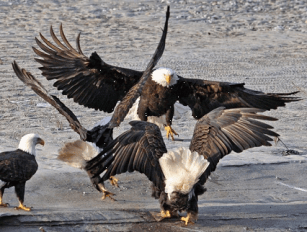 married to each other. The eagle couple will stay together as long as they both live (unless one is captured and prevented from returning to its mate). Not all birds stay with their mates for life, but the bald eagle does. The eagle couple will soon become parents, with the female eagle becoming a mother by laying large white fertile eggs that will one day hatch into baby eagles – called eaglets. The baby eagles are very hungry but they cannot fly to get their own food, just as many other kinds of babies need their parents to care for them, and protect them, and feed them.
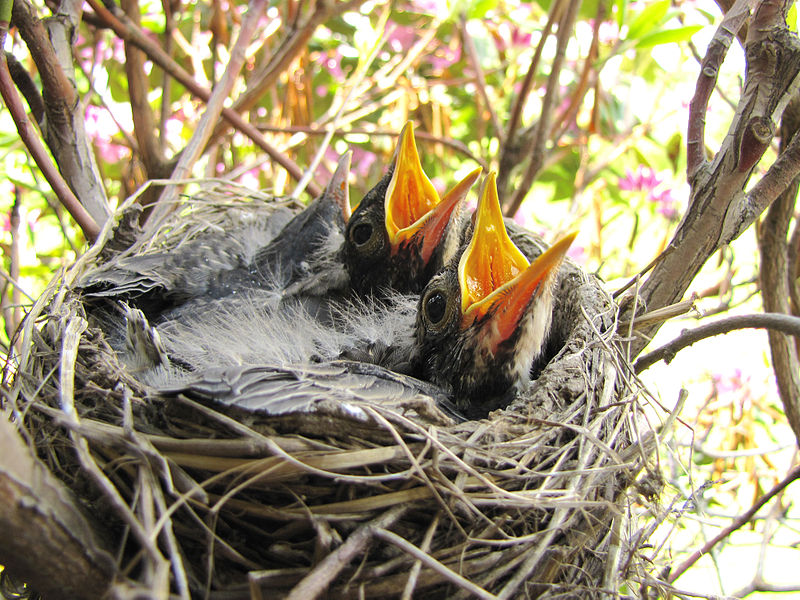
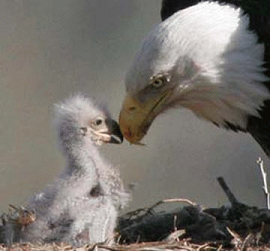
The parent eagles are very protective of their baby eaglets; they will attack any other bird that flies too close to the eagle nest, so ravens, gulls, and hawks better stay away and respect the eagle family’s privacy! The baby eagles do not have “bald”-looking heads, because their heads do not have white feathers. Baby eagles are blotchy brown-grey colored and begin their hatchling life with light grey-colored fuzzy feathers called “down”. Young eagles are called nestlings during the time that they live in their parents’ nest. It takes a while for the little eaglets to grow enough strength in their little wings so they can be ready to fly like their parents.
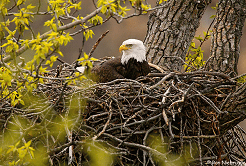 When a young eagle finally learns to fly it is called a fledgling. Eagles are such heavy birds that they don’t
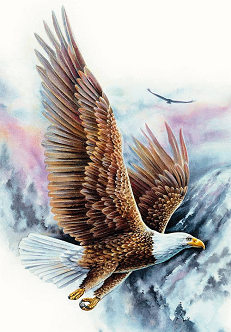
 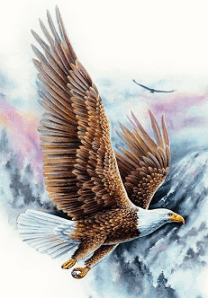 build their houses, called “nests”, near the ground. Eagles build their nests high up in trees or on top of rocky mountains or cliffs, so that they can jump out into the air and glide on rising warm air currents. Some air currents are made of warm rising air, so an eagle can jump into such warm air and “ride” it up like an elevator, then the eagle can glide from one air current to another , until it wants to fly down. These rising air currents are called “thermals”. The eagle that soars on a thermal is mostly at rest, because he is trusting the thermal to carry him along for a “ride” in the air. The eagle soaring on such a thermal air current is a reminder of how we should trust and depend upon God to carry us through life’s adventures, as we travel from one day to the next. By “riding” on upwardly spiraling thermal air currents eagles can save their energy, because too much wing-flapping can waste an eagle’s energy and cause it to get too tired to fly. Like eagles, we can waste a lot of energy if we fail to depend on God, because worrying and distrusting God wastes a lot of mental energy and emotions! (See Isaiah 40:31.)
But they that wait upon the LORD shall renew their strength; they shall mount up with wings as eagles; they shall run, and not be weary; and they shall walk, and not faint. (Isa 40:31 KJV)
By conserving (carefully using, not wasting) his energy, the bald eagle can flap his wings only when he needs to, and he can rise to very high places in the air, which also means that the eagles can reach high places on top of mountains or cliffs that other animals cannot reach. So an eagles’ nest (called an “eyrie”) can be far away from egg-eating animals that might bother parent eagles and try to eat their eggs before they have a chance to hatch into baby eaglets (the baby eaglets are called “hatchlings” when they first hatch). Bald eagles, like other kinds of eagles, often live in rocky places in high places, so it is not surprising that people (including Biblical authors) compare highness with flying and nesting behaviors of eagles.
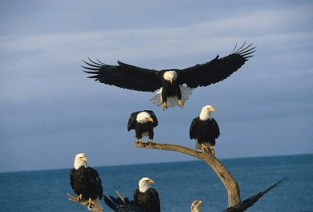 One example of highness being compared to the nesting habits of eagles is found in the Bible, in the Book of Obadiah 1:3-4, where the eagle is described as a creature that lives in high places, much closer to the stars than do most other animals (or people). Another Old Testament book in the Bible, the Book of Job, refers (at 39:27) to the eagle as mounting up into the air by God’s command (because God programs eagles to fly up into the air the way that they do), and as nesting in high places (because God programs eagles to do this also).
The pride of thine heart hath deceived thee, thou that dwellest in the clefts of the rock, whose habitation is high; that saith in his heart, Who shall bring me down to the ground? Though thou exalt thyself as the eagle, and though thou set thy nest among the stars, thence will I bring thee down, saith the LORD. (Oba 1:3-4 KJV)
Doth the eagle mount up at thy command, and make her nest on high? (Job 39:27 KJV)
Eagles are good parents, training their sons and daughters to live like eagles (see Deuteronomy 32:11). Eagles can fly, like dive-bombing airplanes, at great speeds (see 2nd Samuel 1:23 and Lamentations 4:19). Their strength is renewed from time to time, as their feather-cover adjusts to their growing bodies (see Isaiah 40:31 and Psalms 103:5). Eagles are known for their gracefulness and dignity (see Proverbs 30:19). In fact, eagles fly very high in the air as a matter of habit – above most other birds (see Proverbs 23:5).
During winter bald eagles like to live near seacoasts or near large fast-moving rivers where fish are abundant. Often, bald eagles must migrate south to avoid wintering in places where the food supply is too sparse or the weather is too harsh. During spring, when the new baby eagles are hatched from eggs, bald eagles usually prefer to live in northern lands, such as Alaska and Canada, but some start their springtime families as far south as California on the West Coast and as far south as Virginia on the East Coast. Since a thermal spring keeps the Chilkat River warm enough to prevent it from freezing in late summer and early autumn, many salmon continue to congregate in that unfrozen river during the autumn – this is like an “all-you-can-eat” salmon dinner for Alaskan bald eagles!
One place other than Alaska where bald eagles are easily seen in the later summer is along certain parts of the Snake River near Jackson Hole, Wyoming (part of the Grand Tetons National Park), in nests built in the tops of old dead trees along the river’s forested shoreline. Of course, bald eagles are usually so high up in a tree (or soaring up in the air) that you really need to use binoculars (holding them with steady hands) to see the bald eagle’s colors, wings, talons, stern-looking face, curled beak, and clawed talons. Maybe learning about the salmon feasts of the Alaska bald eagles has made you hungry for some Alaska salmon! If so, you might visit my favorite salmon bake feasting-place, “Gold Creek Salmon Bake” a few miles outside of Juneau, Alaska, an Alaskan rainforest all-you-can-eat place near an old abandoned gold mine. But, if that’s not convenient for you at the moment, you might try buying some fresh salmon filets from your local grocery store, – and your family can enjoy a healthy protein-rich meal – a feast fit for the Bald Eagle, America’s national bird!
[The above text on Alaska’s Eagle is adapted from James J. S. Johnson’s “The Bald Eagle”; © AD2001-AD2013 James J. S. Johnson, here reprinted/used by permission.]
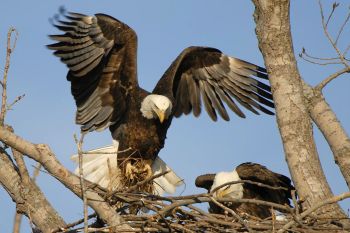
Bald Eagle Brings Nesting Material by Aesthetic Photos
Lee’s Addition:
What an interesting, informative and challenging article about the Bald Eagles. Thank you, Dr. Johnson, for giving permission to post it here.
I am looking forward to some more articles that he will be sharing with us here.
See also:
Institute For Christian Research
Dr. James J. S. Johnson – Guest Author
Birds of the Bible – Eagles
Accipitridae – Kites, Hawks and Eagles
*