Hope Kindled by God’s Creation

“The land is as the garden of Eden before them,  and behind them a desolate wilderness; yea, and nothing shall escape them.”  Joel 2:3

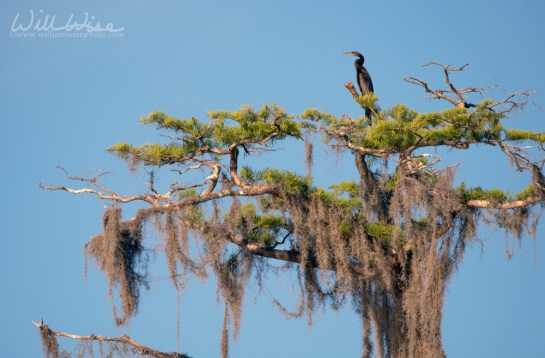
As we look about, it can seem all is being laid waste in our society. A virus cancelling church services, political rivalries, racial unrest, lawlessness… all so troubling. But while paddling through the swamp during the coronavirus quarantine, suddenly the Holy Spirit caused hope to spring up in my heart as I watched an Anhinga perched upon a young cypress tree. God’s creation – and God’s Word – restored hope in my heart!

Anhinga bird perched atop a cypress tree with Spanish Moss; Okefenokee Swamp National Wildlife Refuge in Georgia, USA. ©www.williamwisephoto.com.

The naturalists of old write of towering cypress – some as high as 120 feet – standing guard for centuries in the Okefenokee Swamp. But all that changed in the early 20th century. All were laid low. It began in 1909: the pristine Okefenokee began to bustle with cacophony of industry as logging skidders, sawmills and railroad tracks invaded the Swamp. The trees – and the birds! – were gone.

C.T. Trowell wrote, “Systematically, the Hebards extended their logging operations across the Okefenokee. Extending south from Hopkins to Cravens Island in 1912, they reached Pine Island and Mixons Hammock by 1915. Within a year they were cutting the timber between Mixons Hammock and Minnies Island and the railroad was extended across Jones Island to Billys Island. Between 1922 and 1926, they logged the cypress around Floyds Island.”

A young Cypress Tree reaches toward the sky in the Okefenokee National Wildlife Refuge, Georgia. ©www.williamwisephoto.com.

Would the Okefenokee ever recover? Cypress trees grow very slowly. At a reported growth rate of only about a foot per year in their early stages, it could take 300 to 500 years for the Cypresses of the Okefenokee to once again tower over the habitat as they did prior to 1909. But with the establishment of the Okefenokee as a National Wildlife Refuge in 1937, the healing has begun.Today, there are already some scenic waterways through the Okefenokee – tall cypresses mirrored in the tanin-darkened waters – that hint at these former days.

“But fear not, O land; be glad and rejoice: for the Lord will do great things. Be not afraid, ye beasts of the field: for the pastures of the wilderness do spring, for the tree beareth her fruit, the fig tree and the vine do yield their strength. And I will restore to you the years that the locust hath eaten the cankerworm, and the caterpiller, and the palmerworm.”  Joel 2:21-25

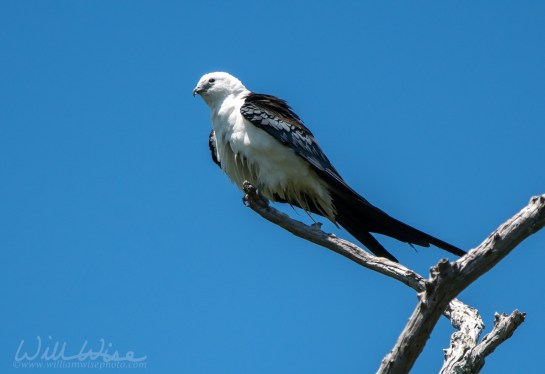
The birds have returned! Swallow-tailed Kite; Okefenokee National Wildlife Refuge, Georgia. May, 2020. ©www.williamwisephoto.com.

So if there is hope of restoration kindled in the heart upon looking at a young Cypress tree, how much more for our society upon looking at God’s Word! There is a hope that things laid bare can one day live again and be renewed to their former glory. If not in this lifetime, certainly in the next.

As Christians, we cease not to pray for our nations, nor forget the restoration that awaits in the New Earth for those who trust and hope in Jesus Christ!


Hi, I’m wildlife photographer and nature writer William Wise. I was saved under a campus ministry while studying wildlife biology at the University of Georgia. My love of the outdoors quickly turned into a love for the Creator and His works. I’m currently an animal shelter director and live in Athens, Georgia with my wife and two teenage daughters, who are all also actively involved in ministry. Creation Speaks is my teaching ministry that glorifies our Creator and teaches the truth of creation.  — “What a wildly wonderful world, God! You made it all, with Wisdom at Your side, made earth overflow with your wonderful creations.” Psalms 104, The Message.

Alaskans Alcids, Designed by God for Flowing through Both ‘Oceans’

Alaskan Alcids:  Efficiently Designed by God for Flowing through Both ‘Oceans’

Dr. James J. S. Johnson

CommonMurre-aloft-Alaska.TomIngram-photo

COMMON MURRE Tom Ingram photo

And God said, Let the waters bring forth abundantly the moving creature that hath life, and fowl that may fly above the earth in the open firmament of heaven.  And God created great whales, and every living creature that moveth, which the waters brought forth abundantly, after their kind, and every winged fowl after his kind: and God saw that it was good.  And God blessed them, saying, Be fruitful, and multiply, and fill the waters in the seas, and let fowl multiply in the earth.  (Genesis 1:20-22)

About a year ago (specifically, July 19th AD2019), this writer saw–for the first time–Atlantic puffins in the wild.  These cute clown-faced alcids were flying near (and sometimes resting upon) the cliff-dominated isle of Staffa, often plunging into coastal waters for fish.  That privileged birdwatching experience is reported on this blogsite at  “Birdwatching at Staffa, Near Iona:  Puffins, Shags, and Herring Gulls” [posted at https://leesbird.com/2019/07/22/birdwatching-at-staffa-puffins-shags-more/ ].

In this blogpost, however, it is alcids near the coastal waters of Alaska (and thus the northern Pacific Ocean) that are the subject of our attention.

Recent research, on the flying behavior of Alaskan alcids—auk-like birds (such as murres, guillemots, and puffins)—shows how Earth has two kinds of fluid-filled “oceans”, the liquid ocean of sea-water and the gaseous “ocean” of air.(1),(2),(3)

The study reveals that these birds, from the Alcidae family which includes puffins, murres and their relatives, produce efficient propulsive wakes while flying and swimming. This means that the animals likely spend relatively low amounts of metabolic energy when creating the force [that] they need to move in both air and water.(1)

Common-Murre-raft-Alaska.TikiJoe-photo

COMMON MURRE Tiki Joe photo

Maybe you don’t think of Earth’s atmosphere as an “ocean” of air, but a creation science pioneer, Matthew Maury, did. In fact, Maury is famous for his scientific breakthroughs in oceanography, which analyzes ocean sea-water dynamics—and also in meteorology, which analyzes atmospheric dynamics.(3)

The two oceans of air and water. Our planet is invested with two great oceans; one visible, the other invisible; one underfoot, the other overhead; one entirely envelopes it, the other covers about two-thirds of its surface. All the water of the one weighs about 400 times as much as all the air of the other.(3)

It’s all about fluid mechanics, including avian applications for efficient motions inside both “oceans”. The study included videographic documentation of flying, diving, and swimming by murres, guillemots, and puffins.

Puffin-sailing-aloft-Alaska.PeterStahl-photo

PUFFIN catching wind like a sailboat (Peter Stahl photo)

Study animals were common murres (Uria aalge, Pontoppidan 1763), pigeon guillemots (Cepphus Columba, Pallas 1811), horned puffins (Fratercula corniculata, Naumann 1821), and tufted puffins (Fratercula corniculate, Pallas 1769). Filming of aquatic flight was performed at the Alaska SeaLife Center in Seward, Alaska. … At the time of this study, the exhibit contained 12 horned puffins, 10 tufted puffins, 4 pigeon guillemots, and 6 common murres. Individuals of each species of alcid regularly swam past the viewing window. … Given the clear contrasts between these two behaviors, we differentiate between horizontal (trajectory <10 deg) and descending aquatic flight (trajectory >20 deg). The birds swam on their own volition and selected their own swimming speeds and descent angles. Videos of aquatic flight of all four species were taken ….(2)

But would evolution predict that alcids are fitted for such efficiency?

Birds that use their wings for ‘flight’ in both air and water are expected to fly poorly in each fluid relative to single-fluid specialists; that is, these jacks-of-all-trades should be the masters of none.(2)

But the evolutionists guessed wrong when they suspected that these Alsakan alcids would be inefficient when moving in both fluid “oceans”.

Alcids exhibit exceptional dive performance while retaining aerial flight. We hypothesized that alcids maintain efficient Strouhal numbers and stroke velocities across air and water, allowing them to mitigate the costs of their ‘fluid generalism’. We show that alcids cruise at Strouhal numbers between 0.10 and 0.40 – on par with single-fluid specialists – in both air and water but flap their wings ~ 50% slower in water. Thus, these species either contract their muscles at inefficient velocities or maintain a two-geared muscle system, highlighting a clear cost to using the same morphology for locomotion in two fluids. Additionally, alcids varied stroke-plane angle between air and water and chord angle during aquatic flight, expanding their performance envelope.(2)
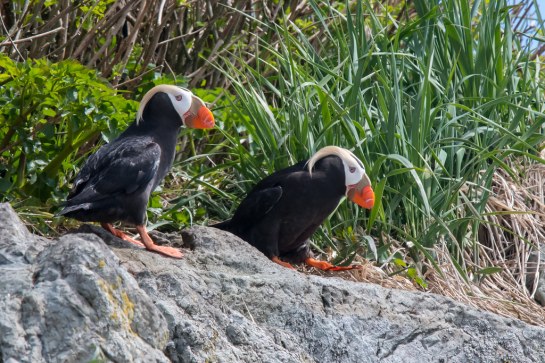
Tufted-Puffins-Alaska.TimMelling-photo

TUFTED PUFFINS Tim Melling photo

Thus, because God designed alcids to move in both fluids—liquid sea-water and gaseous air currents—God brilliantly programmed how they move in those two fluid environments.(4)

This mobile efficiency surprises evolutionists, but not Biblical creationists.

Interestingly, birds in the family Alcidae (puffins, murres, and their relatives) seem to contradict the notion of a trade-off between aerial and aquatic flight performance.(2)

Biomechanics is the field of biology that studies the action of internal and external forces on the living body, especially the skeletal system. Also called bioengineering, this fascinating area analyzes biological design and the physical forces associated with humans and animals. If ever there was evidence for creation on a macroscopic scale (Romans 1:20), it would be the vast array of creatures all over the world marvelously designed to move in and fill their environments based on these amazing design features.(8)

In fact, long ago, the Scriptures mentioned the magnificent ability of birds to fly, taking advantage of flowing air currents according to their availability.(5)

It should never surprise Christians to learn that God has carefully and caringly designed and bioengineered birds (including cute little alcids like puffins, murres, adn guillemots!)—all over the world—to fit and to fill their respective habitats, even in this fallen world.

Also it should not surprise Christians when evolutionists fail to give God credit for His handiwork—because not having “eyes to see” God’s Creatorship, evolutionists routinely imagine optimized biological behaviors (like alcids swimming, diving, and flying) as accidental products of “evolution”—as if merely using the word “evolution” somehow justifies believing that blind mindless luck did it all.(6),(7)
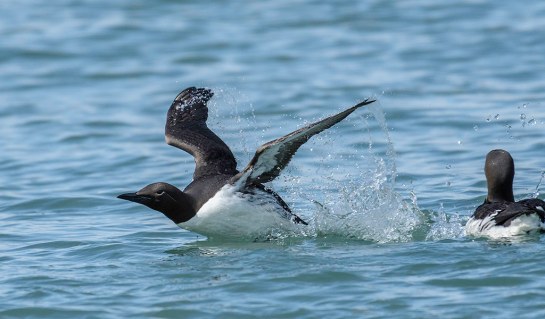
Common-Murre-liftoff-from-sea.TkiJoe-photo

COMMON MURRE liftoff form sea (Tiki Joe photo)

References

  1. Staff writer. 2020. Scientists Shed New Light on How Seabirds Cruise through Air and Water. Science Daily (June 30, 2020), posted at https://www.sciencedaily.com/releases/2020/06/200630193211.htm .
  2. Lapsansky, A., D. Zatz, and B. W. Tobalske. 2020. Alcids ‘Fly’ at Efficient Strouhal Numbers in Both Air and Water, But Vary Stroke Velocity and Angle. Posted on eLife (June 30, 2020), posted https://elifesciences.org/articles/55774 .
  3. Maury, M. F. 1855. The Physical Geography of the Sea and its Meteorology. Mineola, NY: Dover Publications, Inc. (2003 reprint of Harvard University Press’s Belknap Press 1963 edition, including some revisions from Maury’s 8th edition published in 1861), 23-37, with quotations from page 23.
  4. Enticott, J., and D. Tipling. 1997. Seabirds of the World. Mechanicsburg, PA: Stackpole Books, 213-227, especially pages 214-217 (murres and guillemots) & 226-227 (puffins). See also Kikuchi, D. M., Y. Watanuki, N. Sato, et al. 2015. Strouhal Number in Flying and Swimming in Rhinocerous Auklets Cerorhinca monocerata. Journal of Avian Biology. 46:406-411. Penguins, like alcids, “fly” underwater. Watanuki, Y., S. Wanless, M. Harris, et al. 2006. Swim Speeds and Stroke Patterns in Wing-propelled Divers: A Comparison among Alcids and Penguins. Journal of Experimental Biology. 209:12117-1230.
  5. The Hebrew verb paras used in Job 39:26, for the hawk’s wind-harnessing flight, is also used in Isaiah 33:23, to describe wind-harnessing of boat-sails in sea-water. See Johnson, J. J. S. 2018. Hawks and Eagles Launching Skyward. Acts & Facts. 47(4):21, posted at https://www.icr.org/article/hawks-eagles-launching-skyward , especially at Footnote # 5. Eagles can fly, like dive-bombing airplanes, at great speeds (see 2 Samuel 1:23 and Lamentations 4:19). See also Johnson, J. J. S. 2008. Alaska’s Coastal Rainforests and Two of its Rangers, the Bald Eagle and the Alaska Moose. (Dallas: NWD Press/RCCL’s Radiance of the Seas), pages 10-11.
  6. 1 Timothy 6:
  7. Johnson, J. S. 2010. Survival of the Fitted: God’s Providential Programming. Acts & Facts. 39(10):17-18, posted at https://www.icr.org/article/survival-fitted-gods-providential-programming .
  8. Sherwin, F. 2017. Architecture and Engineering in Created Creatures. Acts & Facts. 46(10):10-12, posted at https://www.icr.org/article/architecture-engineering-created-creatures .

Scotland-jjsj.Signet-LawLibrary

Pyrrhuloxia-Cardinal Hybrid’s Plumage Matches 4th of July’s Fireworks Theme

Pyrrhuloxia-Cardinal Hybrid’s Plumage Matches 4th of July’s Fireworks Theme

Dr. James J. S. Johnson

And if it seem evil unto you to serve the LORD, choose you this day whom ye will serve; whether the gods which your fathers served that were on the other side of the flood, or the gods of the Amorites, in whose land ye dwell: but as for me and my house, we will serve the LORD. (Joshua 24:15)

The Star Spangled Banner has been celebrated for many generations as America’s national anthem. Especially on the 4th of July we expect to sing (or hear) the Star-Spangled Banner, the lyrics of which were penned by a godly Christian lawyer, Francis Scott Key, while he was detained aboard a British ship during the bombardment of Fort McHenry, during the War of 1812.

StarSpangled-Banner.singing-PresidentTrump

So, it seems fitting that red, the color of military fireworks (i.e., “the rockets red glare”), and black, the color of the night sky (i.e., “gave proof through the night”) would be associated with the 4th of July. And, in a birdwatching-associated way, black and red did help me to appreciate America’s independence, last weekend, when I watched a special bird eating seeds from a birdfeeder.

Pyrrhuloxia-Cardinal-hybrid.TroyCorman-photo

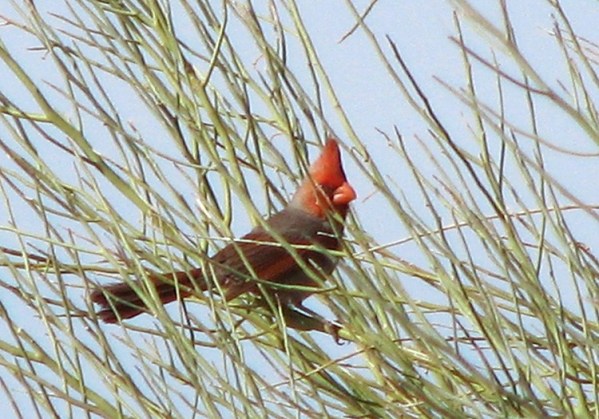
Cardinal X Pyrrhuloxia hybrid

Photo credit: Troy Corman AD2012 (Maricopa County, Arizona)

With a black facemask, it looked like a cardinal—yet it had a lot of black and grey, like a Pyrrhuloxia (a/k/a “Black Cardinal” or “Desert Cardinal”). Yet this bird’s plumage was highlighted with cardinal scarlet, plus it had a mostly orange-hued beak, not the yellow beak of a Pyrrhuloxia. It was not a female cardinal—female cardinals have tannish-brown plumage, sometimes with yellowish tones, highlighted by scarlet accenting. In other words, what I saw was a HYBRID, offspring of a Northern Cardinal (Cardinalis cardinalis) and a Pyrrhuloxia (Cardinalis sinuatus). Such hybrids have been seen before in Arizona, Texas (including one visiting ICR’s Dallas campus), and apparently also in Oklahoma.

Pyrrhuloxia-Cardinal-hybrid.JanetJohnson-BrenhamTX

Pyrrhuloxia-Cardinal Hybrid photo credit: Janet Johnson (Brenham, TX) / Cornell Lab

For example, the Cornell Lab posts the following report by Janet Johnson (of Brenham, Texas), with a photograph of a hybrid that looks very much like what I saw last weekend (except what I saw was more blackish and less light-grey):

“I believe this bird is a Cardinal/Pyrrhuloxia hybrid. He is a beautiful, clear gray color like the Pyrrhuloxia with red on his tail, wings, and crest, but with a black mask like the Northern Cardinal. His bill is more like the Cardinal, being more orange than yellow. He also has red mottling down his breast like the Pyrrhuloxia.”

What a beautiful, fireworks-feathered, patriotic, dignified, crested seed-eater!

This patriotic post now concludes with a link to a video clip providing a 2nd Amendment-oriented variation of the Star-Spangled Banner, by the Black Rifle Coffee Company (which employs U.S. veterans, and makes several varieties of bold, strong coffee!):

https://www.youtube.com/watch?v=DHLlwiLebkc

(Make sure the audio volume is up enow.)

FortMcHenry-aerial-photo.MDgovernor's-office

Fort McHenry (public domain; aerial photo)


Creation Moment’s – Tool Users That Are Something To Crow About

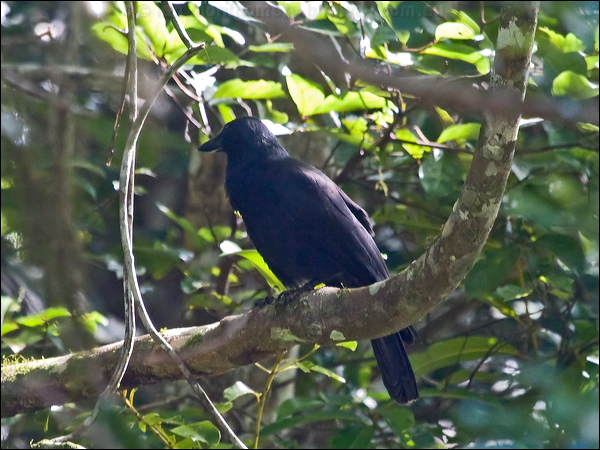
New Caledonian Crow (Corvus moneduloides) by Ian Montgomery

Genesis 4:22

And Zillah, she also bare Tubal-cain, an instructor of every artificer in brass and iron: and the sister of Tubal-cain was Naamah.”

Many creatures have been found that use sticks, leaves and other items as tools. Chimpanzee parents teach their youngsters to poke sticks in termite holes to get termites. However, no animal has shown an instinctive tendency to make and use tools, until now.
Caledonian crows are among the known tool-users. A pair of captive New Caledonian crows were having trouble incubating their four eggs. So researchers decided to incubate and raise the young crows themselves. Upon hatching, the young crows were separated into two pairs. One pair received lessons on how to use twigs to poke food out of slots. The other pair received no lessons, nor were they allowed to see their siblings using tools. When they were given sticks and leaves, they spontaneously began using the twigs to poke food out of a slot. One of them also tore a leaf into a food poker. After evaluating all the behavioral data, researchers concluded that while crows have a natural tendency to make and use tools, they also learn how to make improved tools from their elders.

Tool making is not what separates man from animals, although we can make tools far superior to those made by animals. The Bible tells us that the earliest man was made in the image of God and that the earliest generations of man were already making iron tools.

Prayer: Father, thank You for making me for a relationship with You and making a relationship possible through Christ. Amen.

Author: Paul A. Bartz

Ref: Science News, 1/15/05, p. 38, S. Milius, “Crow Tools.” Image: New Caledonian crow (PD)

© 2020 Creation Moments. (Used with permission)


Lee’s Addition:

We have had several previous articles about the tool usage of birds:

Birds of the Bible – Uniquely Created Tools

Interesting Things – Fleas, Birds and Tools

The Best Toolmakers in the World by Emma Foster

The Crow and the Screwdriver – by Emma Foster

*

Hope for Hard Times


Jesus And Birds – Birds Not Sowing

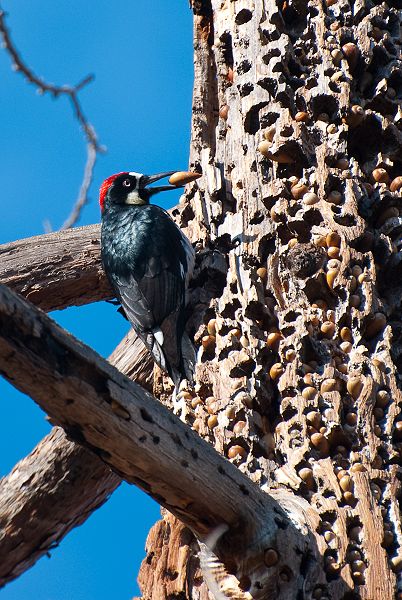
Acorn Woodpecker (Melanerpes formicivorus) with Hoard or Grainary WikiC

Acorn Woodpecker (Melanerpes formicivorus) with Hoard or Grainary WikiC

Wow! Where does time go? With all this craziness over the Coronavirus and the uneasiness of our country, time gets away from me. Maybe I need to listen to what Jesus was saying about not being anxious. This is the 4th mention of birds by the Lord while here on earth. 1st Cleansing Of Temple was the last in this series. That was back in May.

“For this reason I say to you, do not be worried about your life, as to what you will eat or what you will drink; nor for your body, as to what you will put on. Is not life more than food, and the body more than clothing? “Look at the birds of the air, that they do not sow, nor reap nor gather into barns, and yet your heavenly Father feeds them. Are you not worth much more than they?” (Matthew 6:25-26 NASB) [emphasis mine]

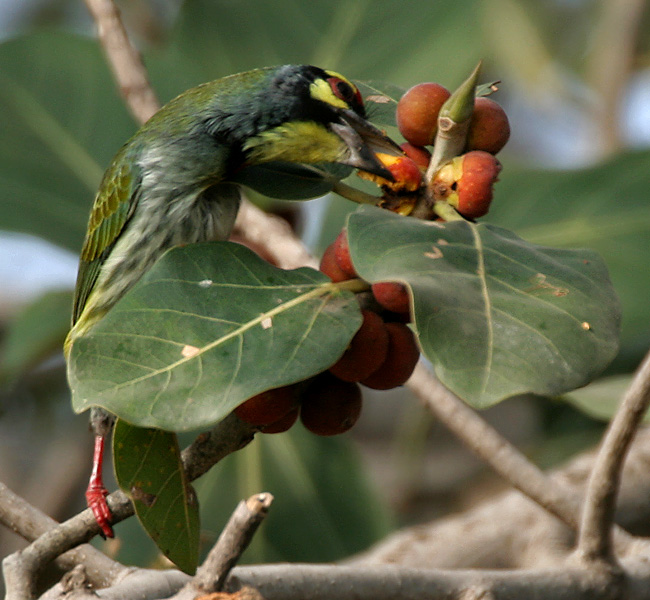
Coppersmith Barbet (Megalaima haemacephala) ©WikiC Feeding

Coppersmith Barbet (Psilopogon haemacephala) ©WikiC Feeding

This time we have the much quoted, and taught, lesson about the feeding of birds of the air. Mathew 6:25-34 is a favorite passage of mine. The Lord encourages us to relax and put our trust in Him. LOOK!!! at the birds, I take great care of them. I WILL ALSO take great care of you!!

Clothes? Look how HE feeds and dresses the birds! Even the plants, are so beautiful.

“And who of you by being worried can add a single hour to his life? “And why are you worried about clothing? Observe how the lilies of the field grow; they do not toil nor do they spin, yet I say to you that not even Solomon in all his glory clothed himself like one of these.” (Matthew 6:27-29 NASB)

QUIT WORRYING!

“But if God so clothes the grass of the field, which is alive today and tomorrow is thrown into the furnace, will He not much more clothe you? You of little faith!Do not worry then, saying, ‘What will we eat?’ or ‘What will we drink?’ or ‘What will we wear for clothing?‘ “For the Gentiles eagerly seek all these things; for your heavenly Father knows that you need all these things.” (Matthew 6:30-32 NASB)

So, how do we quit worring, Look to Jesus and His Kingdom. First by accepting Him as our Savior, and then learning to trust fully in His care and provisions. No, the food won’t fall out of heaven, but the Lord will provide us the means of providing what we can. Then we need to depend on Him to provide whatelse we need. (Not always what we want)

“But seek first His kingdom and His righteousness, and all these things will be added to you. “So do not worry about tomorrow; for tomorrow will care for itself. Each day has enough trouble of its own.” (Matthew 6:33-34 NASB)

Gospel Message


Serpents and Doves

Author’s note: if you’re terrified of snakes, don’t scroll past the first four paragraphs!

Matthew 10:16 “Behold, I send you forth as sheep in the midst of wolves: be ye therefore wise as serpents, and harmless as doves.”

Mourning Dove. Walton County, Georgia. March 24, 2017. ©www.williamwisephoto.com.

Jesus threw an interesting paradox before us when he preached, “Be wise as serpents, and harmless as doves.” The outcome of combining these two critters can be quite perilous… primarily for the dove! Snakes are often found raiding birds’ nests, seeking to devour eggs and chicks. So why this conflicting counsel from our Lord?

A.B. Bruce writes, “The serpent is the emblem of cunning, the dove of simplicity. No creatures can be more unlike; yet Jesus requires of His disciples to be at once serpents in cautiousness, and doves in simplicity of aim and purity of heart. These qualities are not easy to combine; yet the combination is not impossible.”

Christians must have serpent-like wisdom and shrewdness in order to make a stand for righteousness in the arena of worldly politics and social unrest; yet have dove-like care and compassion to peacefully present the gospel and welcome the sin-suffering into the flock of God.

The apostle Paul was wise-as-a-serpent when utilizing his status as a Roman citizen to escape being mauled by a crowd and unlawfully flogged by the local police. Yet, his dove nature remained on top as he stood for Christ while on trial, even though it may not have been advantageous to his personal outcome. And it may have been a prudent idea for Peter to distance himself from a leader that was arrested for insurrection, but the serpent devoured the dove as he publicly declared thrice, “I know not the man.”

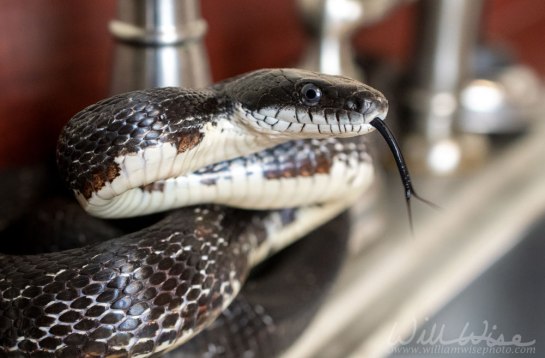
Eastern Ratsnake coiled in a kitchen sink. Pantherophis alleghaniensis is a common snake found in the eastern United States. Walton County, Georgia. June 30, 2020. ©www.williamwisephoto.com.

Losing the Balance…

I was a bit saddened this past week to watch events unfold in our small town. Citizens from our city, as well as agitators from out-of-town, gathered to condemn our public safety officers and demand the defunding of the police department. But that is not what saddened me, for peaceful protests are the American way.

Another group of citizens – many from the local churches – also gathered to show support for our people in uniform. Here was the perfect Christian balance: the “dove nature” desired peace and unity in our community; and the “wise-as-serpents nature” was making a stand for righteousness in the political arena. But as passions rose, the serpent began to swallow the dove…

One gentleman who identified himself as local Christian minister, had his microphone snatched away by a protester. In frustration, the minister shoved the protester to the ground. Of course, the media was there to photograph the incident and title it, “Preacher Assaults Protester.” Sadly, the serpent had swallowed the dove when the Christian man lost his temper.

SORRY FOR THE GRAPHIC CONTENT, BUT IT EXEMPLIFIES THE DAMAGE DONE WHEN THE SERPENT OUTWITS THE DOVE IN OUR CHRISTIAN CHARACTER. Eastern Ratsnake devouring a Mockingbird; Walton County, Georgia. August 13, 2019. ©www.williamwisephoto.com.

Let us at least be doves…

A.B. Bruce continues, “Happy are they who can be both serpent and dove; but if we cannot, let us at least be doves. The dove must come before the serpent in our esteem, and in the development of our character. If we invert the order, the dove will be devoured by the serpent: the cause of truth and righteousness will be betrayed out of a base regard to self-preservation and worldly advantage.”

The recent social and political issues are causing a rise among many. Passions are brewing and blood is even boiling. Yet as Christians, we must remember to balance our serpent-like shrewdness while engaged in this arena, with our dove-like nature to win the lost to Christ. For what does it profit if we win the worldly battles, but lose many souls? If we can’t balance the serpent/dove natures, let us at least be doves.


Hi, I’m wildlife photographer and nature writer William Wise. I was saved under a campus ministry while studying wildlife biology at the University of Georgia. My love of the outdoors quickly turned into a love for the Creator and His works. I’m currently an animal shelter director and live in Athens, Georgia with my wife and two teenage daughters, who are all also actively involved in ministry. Creation Speaks is my teaching ministry that glorifies our Creator and teaches the truth of creation.  — “What a wildly wonderful world, God! You made it all, with Wisdom at Your side, made earth overflow with your wonderful creations.” Psalms 104, The Message.

Bobble-Body or Gaze Stablization

A friend placed this video on my Facebook. Another friend commented that instead of a bobble-head, it seems to have a bobble-body. That appears to be a very appropriate name for this Kingfisher’s actions.

Kingfisher, which aired on the BBC’s Winterwatch

Audubon’s comments had this remark about this birds video:

“Here’s an experiment: While reading this sentence, shake your head back and forth, and then nod up and down. Notice how the words on your screen remain in focus? Congratulations, you just experienced “gaze stabilization.

It’s this natural ability that allows us to maintain a clear line of vision even when our bodies are in motion.”

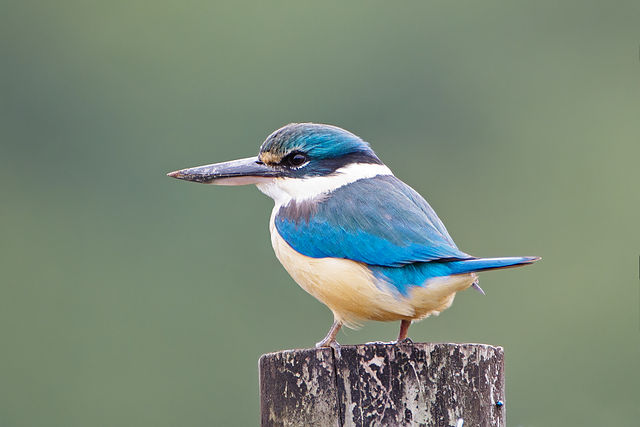
Sacred Kingfisher (Todiramphus sanctus) ©WikiC

“Gaze stabilization found in nature has inspired modern technologies, such as those used to stabilize images in cameras and drones. “Any cameras that films movies have image stabilization,” Dickman says.” Read this whole artcle at For Birds, a Steady Head Is the Key to Incredible Focus

Gazing, or keeping our eyes focused on things, is mention frequently in Scripture.

“Look up at the heavens and see; gaze at the clouds so high above you.” (Job 35:5 NIV)

Stephen Gazed: “But he, being full of the Holy Spirit, gazed into heaven and saw the glory of God, and Jesus standing at the right hand of God, and said, “Look! I see the heavens opened and the Son of Man standing at the right hand of God!” (Acts 7:55-56 NKJV)

Common Kingfisher (Alcedo atthis) by Ian

“He has regarded the prayer of the destitute And has not despised their prayer. This will be written for the generation to come, That a people yet to be created may praise the LORD. For He looked down from His holy height; From heaven the LORD gazed upon the earth, To hear the groaning of the prisoner, To set free those who were doomed to death,” (Psalms 102:17-20 NASB)

“At Lystra a man was sitting who had no strength in his feet, lame from his mother’s womb, who had never walked. This man was listening to Paul as he spoke, who, when he had fixed his gaze on him and had seen that he had faith to be made well, said with a loud voice, “Stand upright on your feet.” And he leaped up and began to walk.” (Acts 14:8-10 NASB)

Where are we gazing?

“Therefore, since we have so great a cloud of witnesses surrounding us, let us also lay aside every encumbrance and the sin which so easily entangles us, and let us run with endurance the race that is set before us, fixing our eyes on Jesus, the author and perfecter of faith, who for the joy set before Him endured the cross, despising the shame, and has sat down at the right hand of the throne of God.” (Hebrews 12:1-2 NASB)

What will you do with Jesus?

Which One Do I Feed First?

I have been a subscriber to Alois Absenger. He is a great photographer in Southeast Styria, I believe. I could not resist sharing his latest photo.

Which One Do I Feed First?

11 Mouths to feed ©Alois Absenger

11 Mouths to feed ©Alois Absenger

“For this reason I say to you, do not be worried about your life, as to what you will eat or what you will drink; nor for your body, as to what you will put on. Is not life more than food, and the body more than clothing? “Look at the birds of the air, that they do not sow, nor reap nor gather into barns, and yet your heavenly Father feeds them. Are you not worth much more than they?” (Matthew 6:25-26 NASB)

Check out his site at: https://aloisabsenger.wordpress.com/2020/06/19/11-hungrige-kohlmeisen/

Joy in the Sharing

Psalm 51:12 Restore unto me the joy of thy salvation

Female Northern Cardinal; Okefenokee Swamp National Wildlife Refuge, Georgia. March, 2020 ©www.williamwisephoto.com.

“What kind of a bird is that?” a friend at church asked excitedly while pointing toward a nearby tree. It was just a typical female Northern Cardinal, yet I experienced a spark of joy as I provided the answer! Not because a cardinal is an overly exciting bird, but simply because someone asked me about a bird!

Over time, things can become stale. When migration ends and we’re left with the usual summertime residents, birding can become boring. As our bird lists get longer, lifers are harder to come by and our joy wanes.

In much the same way, our Christianity can also become lukewarm over time. The joy fades with the same Bible reading plan year after year; the same pastor standing in the pulpit Sunday after Sunday; the same few members doing all the work. Church activities become just another check box on the daily to-do list. Is that you?

In the book Good Birders Still Don’t Wear White, bird guide Carlos A. Bethancourt gives us a clue how to break that boredom and restore joy: “When I see the joy and delight on the faces of the birders – some first-timers to the neotropics – I often think back to my first sighting of that species, and it’s nearly as exhilarating for me as if it were my lifer as well. My excitement is in the sharing.

The Lord Jesus commissioned us to “Go into all the world and preach the gospel.” This command wasn’t solely for the growth of the church, but for our own sakes! Jesus knows the exciting rejuvenation and joy that we’d experience in sharing the gospel. There is nothing better than stepping out in faith and sharing your testimony with a stranger to exhilarate your Christian walk. Has your Christianity become lukewarm, stale, or boring? The joy is in the sharing!

Luke 15:10 Likewise, I say unto you, there is joy in the presence of the angels of God over one sinner that repenteth.


Hi, I’m wildlife photographer and nature writer William Wise. I was saved under a campus ministry while studying wildlife biology at the University of Georgia. My love of the outdoors quickly turned into a love for the Creator and His works. I’m currently an animal shelter director and live in Athens, Georgia with my wife and two teenage daughters, who are all also actively involved in ministry. Creation Speaks is my teaching ministry that glorifies our Creator and teaches the truth of creation.  — “What a wildly wonderful world, God! You made it all, with Wisdom at Your side, made earth overflow with your wonderful creations.” Psalms 104, The Message.

Bird Song Hero: Learning Game

Bird Song Hero: Learning Game is from Cornell Lab of Ornithology

“Oh give thanks to the LORD, call upon His name; Make known His deeds among the peoples. Sing to Him, sing praises to Him; Speak of all His wonders.” (1 Chronicles 16:8-9 NASB)

For the full challenge, including the Bird Song Hero Ultimate round and free bird song downloads, visit: http://biology.allaboutbirds.org/bird….

Thought you might enjoy this challenge.

Various Birds From Creation Moments

Creation Moments has articles frequently about birds. I seem to get behind in checking my mail, so they sort of “pile up.” Today’s post is excerpts, with links to some of those posts.

Dueling Bird Songs

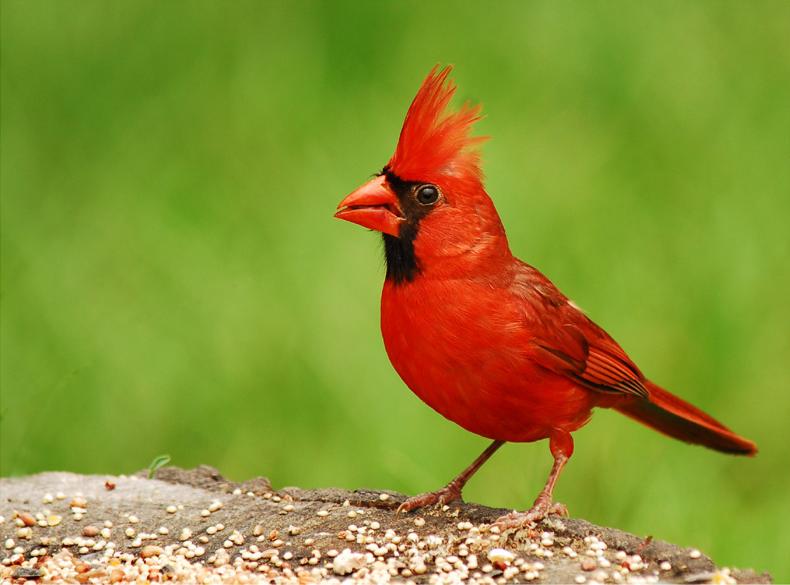
Northern Cardinal (Cardinalis cardinalis) - ©WikiC

Northern Cardinal (Cardinalis cardinalis) – ©WikiC

The flowers appear on the earth; the time of the singing of birds is come, and the voice of the turtle is heard in our land;…” Song of Solomon 2:12

“There is a lot more to bird song than meets the ear. Digital recording and computer technology have enabled researchers to study, in detail, various song-birds’ reactions to neighboring birds’ songs.

“In most species, singing is the male’s job. There is much more going on when he sings than simply establishing territory or attracting a mate. Researchers refer to one characteristic of bird song as “song matching.” While a male bird doesn’t like another male in his territory, he is more tolerant of a related male in a neighboring territory than of a complete stranger. A male will challenge a stranger by repeating the stranger’s song……”

Continued at Dueling Bird Songs


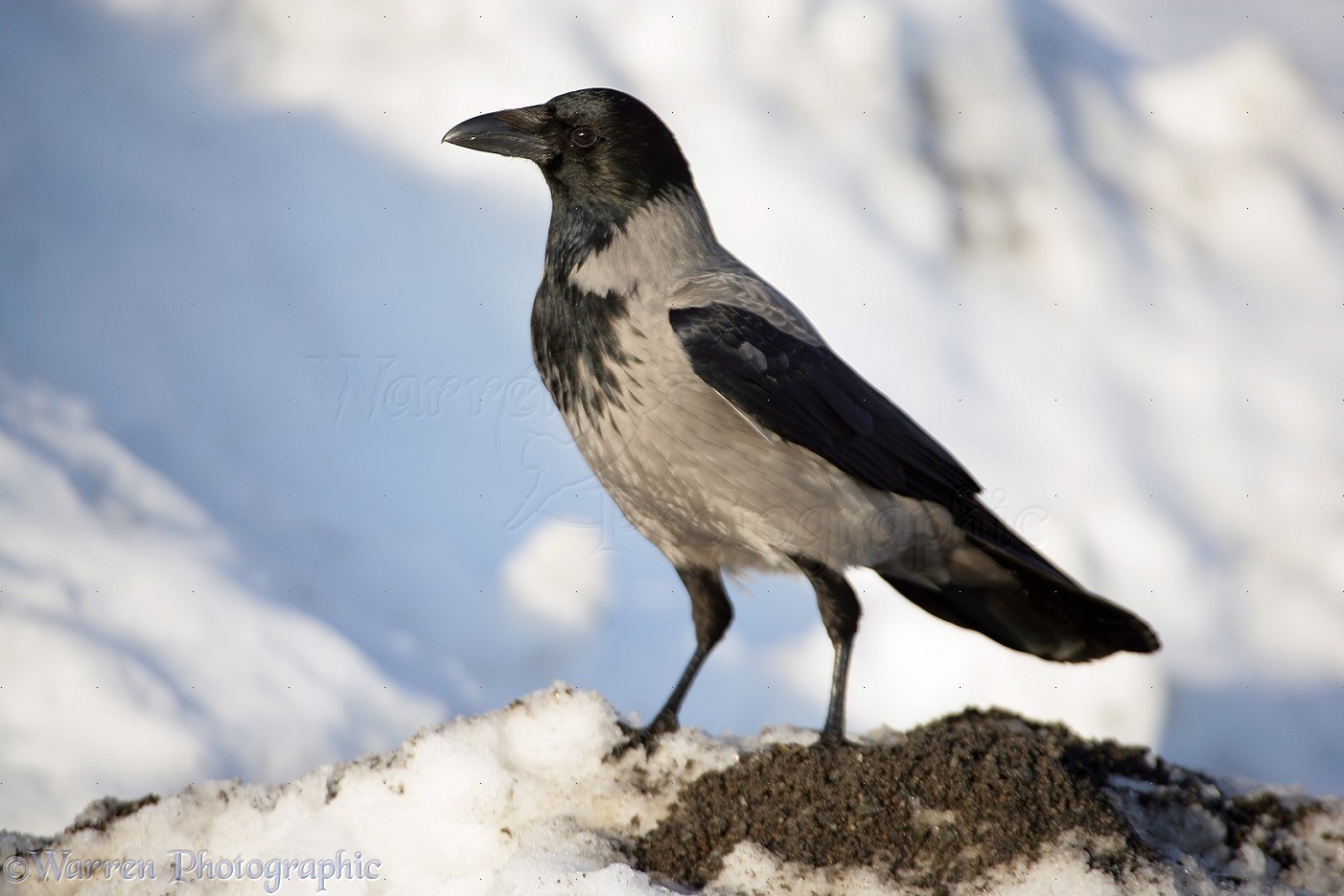
Hooded Crow. Warren Photographic

Are European Crows Evolving?

“And God created … every winged fowl after his kind…” Genesis 1:21

“A recent report on the Science Alert website discussed the evolution of two species of crow in Europe. The two species concerned are the carrion crow, which is black, and the grey-hooded crow. These crows are very different in appearance. They both populate continental Europe, with the grey-hoods in the East and the carrion crows in the West. Their boundary appears to be approximately where Germany’s Elbe River is. At this overlap point, it is possible for birds of the two species to interbreed. The hybrid birds are themselves fertile, which, while unusual for hybrids, is by no means unknown…..”

Continued at Are European Crows Evolving?


An Old Dead Bird And An Egg

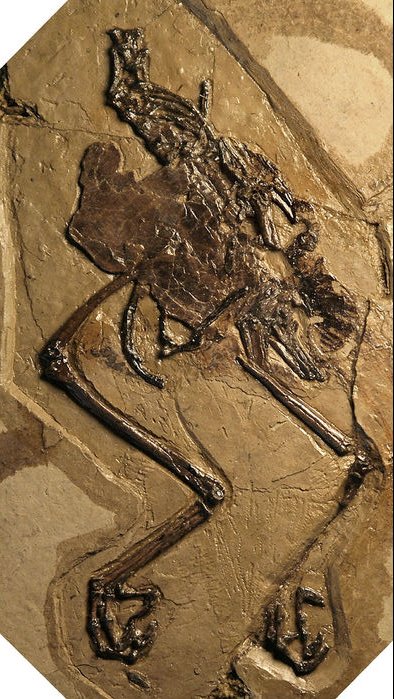
Fossil-Avimaia Schweitzerae With Unlaid Egg ©WikiC

Fossil-Avimaia Schweitzerae With Unlaid Egg ©WikiC

“And God blessed them, saying, Be fruitful, and multiply, and fill the waters in the seas, and let fowl multiply in the earth.” Genesis 1:22

“I like to keep ducks because I love their eggs. Last summer, one of my ducks became ill, with eggs trapped inside her. Despite my best efforts, she died. Scientists believe the same thing may have happened to a specimen of Avimaia. This fossil, dated by evolutionists at 110 million years old, had evidence of an unlaid egg inside it.” ..

“These deep-time ages do not make sense in the light of the creatures’ appearances. For example, the fact that the avimaia fossil has this unlaid egg within it suggests that the process of egg laying has not changed for these birds, which even evolutionists are having to admit must have co-existed with the very type of dinosaurs which supposedly evolved into them……”

Continued at AN OLD DEAD BIRD AND AN EGG

You can find more of these type articles in the Interesting Things and When I Consider

Who Paints The Leaves?

Hoatzin Bird: Evidence Against Evolutionary Ideas – Answers

Hoatzin(Opisthocomushoazin) by Kent Nickel

Hoatzin(Opisthocomushoazin) by Kent Nickel

Hoatzin Bird: Evidence Against Evolutionary Ideas from Answers in Genesis, by Harry F. Sanders, III

Answers in Genesis has a very interesting article about the Hoatzin Bird on line. See Hoatzin Bird: Evidence Against Evolutionary Ideas, by Harry F. Sanders, III.

I would like to share a few quotes from the article, trusting that you will follow the link to read the full article. The Hoatzin is one of those birds that the evolutionist can’t figure out what to do with. It is not a typical bird that can be neatly tucked into a family or an order. Evolutionist try so hard to convince us that dinosaurs evolved into birds, that they are really puzzled about this unique Avian Wonder from Our Creator.

“The hoatzin is a very unique bird, something of a conglomeration of traits typical of birds, reptiles, and even mammals. As a bird, it shares characteristics typical of birds such as being warm-blooded, having feathers, and so on. It is roughly the size of a turkey, with a colorful, crested head and long tail feathers. However, its most interesting and unique features are distinctly un-birdlike.”

The Hoatzin history is traced through Africa mainly, and then found in France, Brazil, and Columbia. Yet, all they find is a single bone or two in each place, and come up with their conclusions.

“The enigmatic Opisthocomus (hoatzin) still cannot be confidently placed, but some putative sister relationships can be rejected.”10 The hoatzins unique traits and obvious discontinuity from other birds have completely impeded any evolutionary attempt to classify it. Evolutionary scientists have no explanation for the origin of the hoatzin, despite numerous attempts to create a phylogenetic tree that will fit them.”

Hoatzin ( Opisthocomus hoazin) by Ian

“Let them praise the name of the LORD: for he commanded, and they were created.” (Psalms 148:5 KJV)

One of the paragraph headings tells the whole story, at least as I see it. “Designed to Do What It Does Do” It eats leaves only, has a claw on wing when born, has a unique stomach and digestive system,

“Even ignoring the devastating blow hoatzin deals to Archaeopteryx as a transitional form, it causes evolutionists other significant problems, as evidenced by the trouble it gives to their cladistic models. They simply cannot determine what its ancestor was. However, if they would pause long enough to consider Genesis 1, they might recognize that hoatzin likely is its own created kind and thus its ancestor was a hoatzin.29

[Above quotes from the article Hoatzin Bird: Evidence Against Evolutionary Ideas]

From Wikipedia: “The hoatzin (Opisthocomus hoazin), also known as the reptile birdskunk birdstinkbird, or Canje pheasant, is a species of tropical bird found in swamps, riparian forests, and mangroves of the Amazon and the Orinoco basins in South America. It is notable for having chicks that have claws on two of their wing digits.

It is the only member of the genus Opisthocomus (Ancient Greek: “long hair behind”, referring to its large crest). This is the only extant genus in the family Opisthocomidae. The taxonomic position of this family has been greatly debated by specialists, and is still far from clear.”

Hoatzin

Interesting Birds – Hoatzin

Hoatzin – The Stinker

Opisthocomidae – Hoatzin