***
BEEN YOUNG
***
“I have been young, and now am old; yet have I not seen the righteous forsaken, nor his seed begging bread.” (Psalms 37:25 KJV)
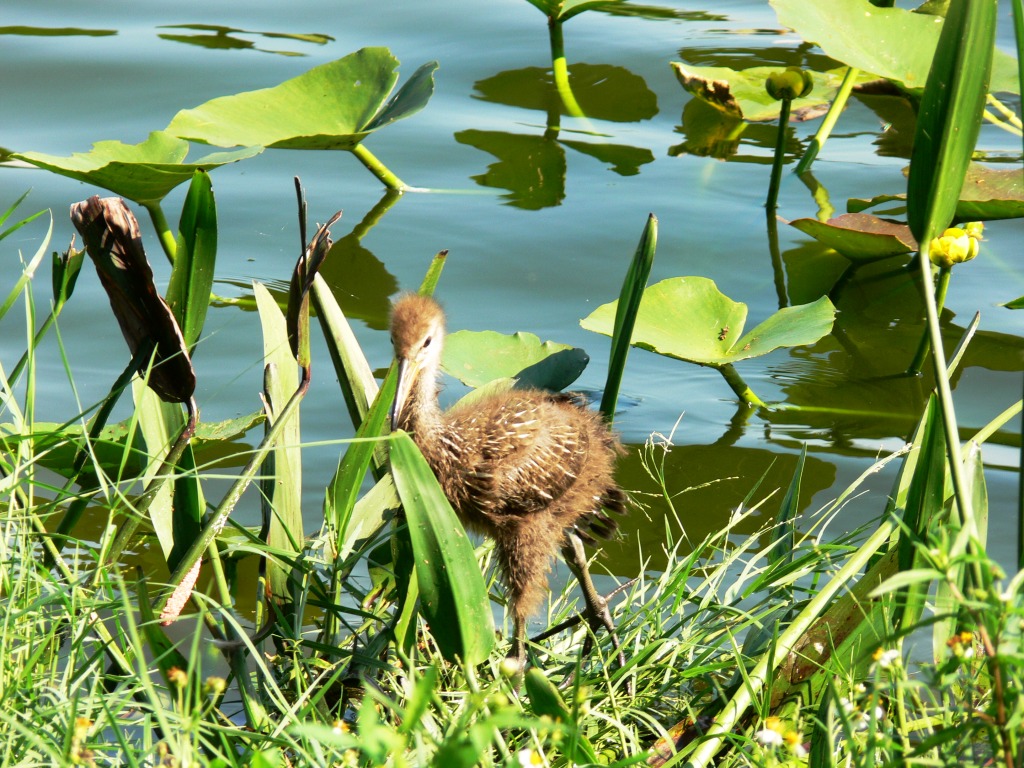
Limpkin (Aramus guarauna pictus) baby taken 9-12-11 by Lee
*
*
“I have been young, and now am old; yet have I not seen the righteous forsaken, nor his seed begging bread.” (Psalms 37:25 KJV)
Limpkin (Aramus guarauna pictus) baby taken 9-12-11 by Lee
*
*

“God, who at sundry times and in divers manners spake in time past unto the fathers by the prophets,” (Hebrews 1:1 KJV)
Fan-tailed Raven (Corvus rhipidurus) ©WikiC
Elijah the Prophet was fed by Ravens
*
*
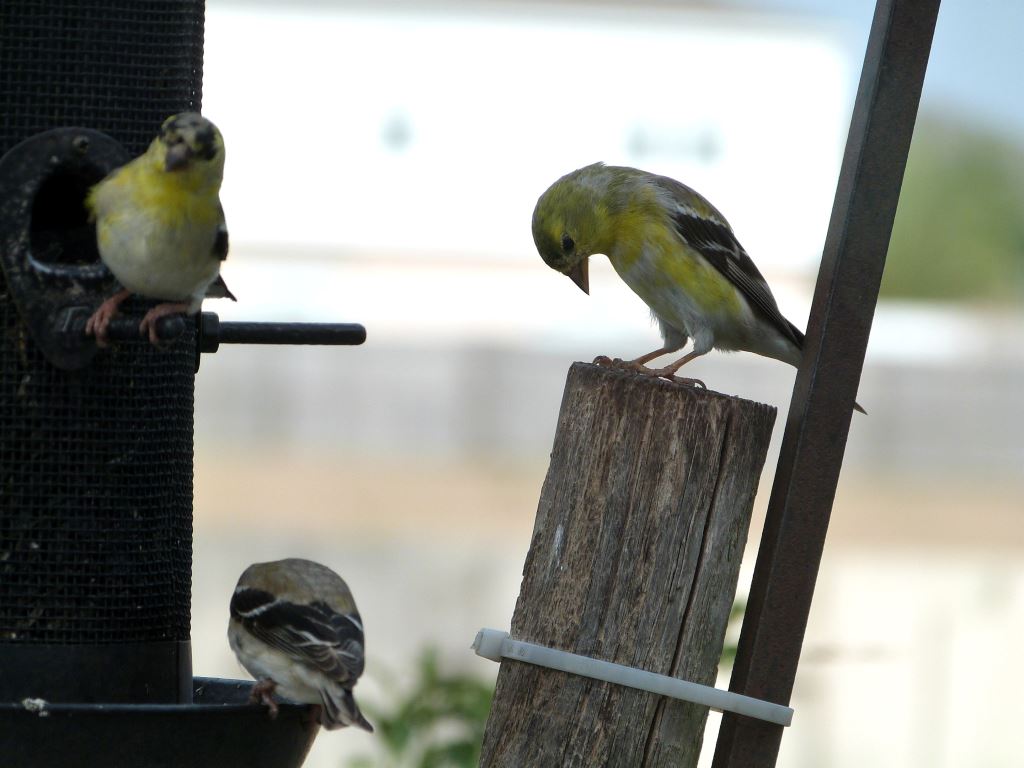
“Cease not to give thanks for you, making mention of you in my prayers;” (Ephesians 1:16 KJV)
Goldfinch Praying for a turn at the feeder.
Thanks again for all of you who have been praying for me as I recover from my back surgery. I do give thanks to the Lord for you.
*
*
“Not that I speak in respect of want: for I have learned, in whatsoever state I am, therewith to be content.
(Philippians 4:11 KJV)
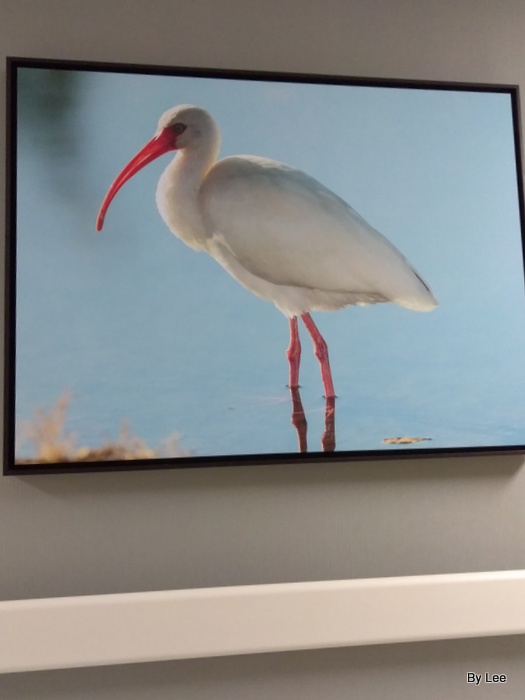
White Ibis Photo outside my room at Sea Pines Rehab Hospital
(Photos were 3′ x 4′ on the walls)
*
*
Palaces Are Known For Both Tattletales And Wagtails
Dr. James J. S. Johnson
Curse not the king, no not in thy thought; and curse not the rich in thy bedchamber: for a bird of the air shall carry the voice, and that which hath wings shall tell the matter. (Ecclesiastes 10:20)
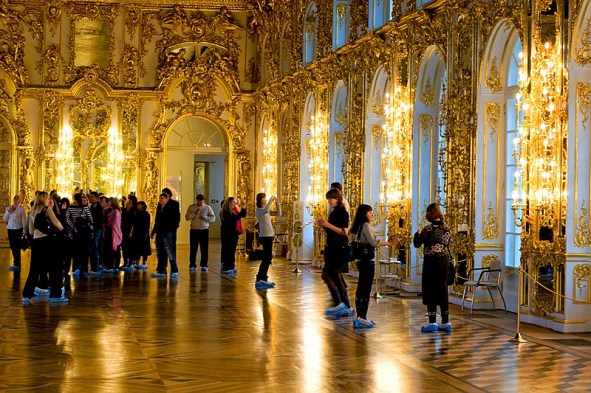
Royal palaces are known to attract (and to house) some of God’s winged wonders, and Catherine’s Palace — one of the imperial Russian palaces — is no exception. (And not all palace-dwelling birds there are tattle-tales, although some are wagtails!)

Catherine’s Palace is a royal mansion – a “summer palace” — in Pushkin (a/k/a Tsarskoye Selo), about 19 miles south of St. Petersburg (f/k/a Leningrad), Russia, which my wife and I visited on July 9th of AD2006. The imposingly-humongous-yet-flourishingly-ornate, embellishment-heavy, exquisitely dignified architecture is classified as Rococo (i.e., late Baroque), and a ton of wealth is built into its many construction details and decorative displays. The palace was originally commissioned by Empress Catherine I (AD1717) but was extravagantly modified (during AD1752-AD1756) at the direction of Empress Elizabeth Petrovna, Catherine’s daughter (who was 1 of Catherine’s 2 children who survived to adulthood, the other 10 dying young), and afterwards by Emperor Alexander I, Catherine’s grandson. Before German invaders destroyed the palace’s interior, during World War II, Russian archivists had documented the interior of the palace; those records were used (after the war) to repair and restore some, but not all, of this historic and opulent mansion.
Yet one of the most magnificent treasures, of Catherine’s Palace, survives to this very day — hidden in plain view — skipping merrily in the yards and fields adjacent to Catherine’s Palace: the WHITE WAGTAIL.

The White Wagtail (Motacilla alba), a mostly grey bird (of a grey tone similar to that of many mockingbirds) with a black head (and bib) that contrasts with white “eye-mask” plumage, plus blue and white striping on its wings and tail-feathers. This small black-white-and-grey passerine, cousin to the pipits, is named for its most famous behavior: wagging its tail.
Slim black and white bird with a long, constantly wagging tail. Frequently seen beside water but equally in fields, farmyards, parks, [recreational] playing fields, roadsides, rooftops. The [subspecies variety called the] Pied Wagtail (race yarrellii) is resident [of the] British Isles, although a very few nest on adjacent continental coasts. Nominate White (race albus) nests throughout Europe [from the Iberian Peninsula to the Ural Mountains, including the Baltic Sea coastlands including Russia’s St. Petersburg – but only summering in the northern half of Europe], and is scarce but regular passage migrant to Britain (March-May / August / October).
[Quoting Chris Knightley, Steve Madge, & Dave Nurney, POCKET GUIDE TO THE BIRDS OF BRITAIN AND NORTH-WEST EUROPE (London & New Haven, Yale Univ. Press, 1998), page 201. See also, accord, Lars Jonsson, BIRDS OF EUROPE, WITH NORTH AFRICA AND THE MIDDLE EAST (Princeton University Press, 1993), page 372-373.]

For me, the Wagtail’s characteristic tail-wagging reminds me of a happy pet dog, such as a French Poodle or Labrador Retriever. Every child should have happy memories of a happy dog’s companionship – I’m thankful that my childhood memories include such happy times. Wagtails themselves enjoy their own version of companionship; they are monogamous, sharing nest duties (e.g., constructing the nest together, taking turns to incubate their unhatched eggs, and taking turns feeding the hatchlings), and they defend their own family’s territory.

What do wagtails eat? A mix of adult and larval insects (e.g., flies, midges, cranflies, mayflies, caterpillars, moths, dragonflies, beetles, aquatic insect larvae), spiders, earthworms, tiny fish fry (as it wades in shallow water), a few seeds, and sometimes small snails.
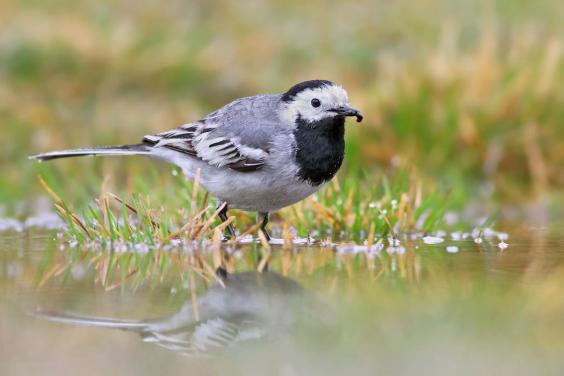
The White Wagtail also bobs his head while walking, somewhat like how city-dwelling pigeons do.
Walks or runs [sometimes making quick dashes] with nodding head, sudden lunges and flycatching leaps. In flight, can be picked out at distance by long tail and conspicuously dipping action, with distinct bursts of wingbeats. Flight call characteristic: a loud tchiz-ick; also utters an emphatic tsu-weeI. Lively, twittering song. In winter, forms large roosts in reedbeds, towns, etc.
[Quoting Chris Knightley, Steve Madge, & Dave Nurney, POCKET GUIDE TO THE BIRDS OF BRITAIN AND NORTH-WEST EUROPE (London & New Haven, Yale Univ. Press, 1998), page 201.]
So, if you ever get to visit Catherine’s Palace, in Pushkin (outside of St. Petersburg), Russia, as we did on July 9th of AD2006, do enjoy all the golden glitter and ivory opulence — but don’t forget to also keep an eye open for a bird wagging its tail, maybe foraging on the manicured lawns nearby, or hunting near other less glamorous buildings — you might see an avian treasure, the White Wagtail! ><> JJSJ profjjsj@aol.com


“If thine enemy be hungry, give him bread to eat; and if he be thirsty, give him water to drink:” (Proverbs 25:21 KJV)
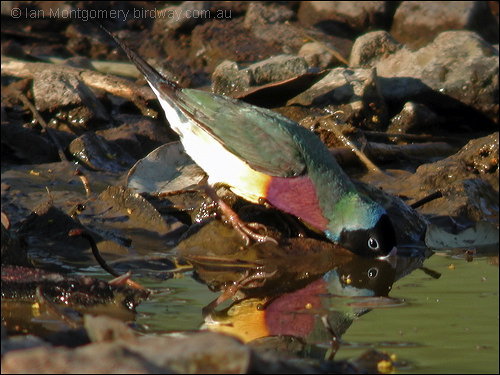
Gouldian Finch (Erythrura gouldiae) by Ian
*
*

“And the man bowed down his head, and worshipped the LORD.” (Genesis 24:26 KJV)
Crimson-backed Flameback-©SamindaDeSilva-Flickr
*
UPDATE – Praise the Lord, I am back home again. After two weeks in the Rehabilitation Hospital, I was healthy and strong enough to be released. Got home late Monday. I am still regaining my strength and will have some physical training at home for several weeks. Yet, Praise, I am back home. Yeah! Thanks for all the prayer and thoughts.
*
BARNACLE GOOSE BIOGEOGRAPHY: WHAT’S GOOD FOR THE GOOSE MAY INCLUDE RELOCATING (AWAY FROM BREEDING GROUNDS TOO CLOSE TO RUSSIA’S H-BOMB TESTING SITE!)
Dr. James J. S. Johnson 
And Solomon’s provision for one day was 30 measures of fine flour, and 60 measures of meal, 10 fat oxen, and 20 oxen out of the pastures, and 100 sheep, beside harts, and roebucks, and fallow-deer, and fatted fowl. (1st Kings 4:22-23)
Are geese alluded to in Scripture, although not by the name “goose”? Maybe. King Solomon was famous for providing banquets on a daily basis, including “fatted fowl” – which likely included geese, according to British zookeeper-zoölogist George Cansdale:
[Consider the likely] possibility that domestic geese were the fatted fowl — Heb. barburim — supplied daily to Solomon’s table. . . . This wild goose [i.e., the Greylag Goose, mixed with all geese that hybridize with it] breeds naturally in N. and central Europe and may have first been domesticated there. It was kept, perhaps already fully domesticated, very early in Ancient Egypt and Mesopotamia, probably as a resutl of trapping some of the many winter migrants. . . . [Although we don’t know] when they first reached Palestine … [carved] ivories of the eleventh century B.C. from Megiddo illustrate tame geese beiogn tended, and this is the century before Solomon, so there is no doubt that they were available [to King Solomon, who procured resources from neighboring regions in Europe, Asia, and Africa].
[Quoting George S. Cansdale, ALL THE ANIMALS OF THE BIBLE LANDS (Zondervan, 1976), page ; see contextual discussion at pages 178-180.]
The mostly-migratory Barnacle Goose is a favorite of many birdwatchers in northern Europe. It is more likley to be seen during its wintering months, unless one ventures above the Arctic Circle. (The exception is a Barnacle Goose population residing in Baltic Sea coastlands, which appears content to dwell there year-round – see range map below.)

In my sporadic wanderings, during years past, specifically on July 7th of AD2006 – I saw several Barnacle Geese (Branta leucopsis) strolling about in Kaivopuisto Park, by the Helsinki Harbor, in Finland.

This migratory goose, which during the summer is common in (and near) Helsinki’s Kaivopuisto Park (where I saw some loitering and lounging on the park grass), has been described as follows:
An immaculate, sociable little goose, only slightly larger than a Mallard. Tiny bill and a white face peering out of black ‘balaclava’ diagnostic. Unlike the much larger Canada Goose, black extends over [its] breast and body is grey (not brown). All [seasonal] plumages similar, but juvenile duller with plain, unbarred flanks. Feral or escaped [e.g., from British zoos] birds are also frequent at inland sites in England [e.g., Leeds Castle, in Kent, where I visited in AD2003], often [mixed] with Canadas [i.e., with Canada Geese].
[Quoting Chris Knightley, Steve Madge, & Dave Nurney, POCKET GUIDE TO THE BIRDS OF BRITAIN AND NORTH-WEST EUROPE (London & New Haven, Yale Univ. Press, 1998), page 31.]
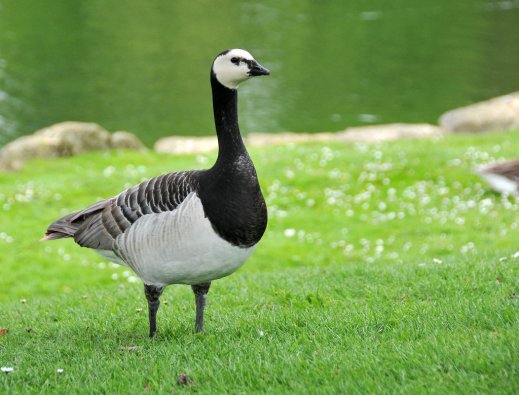
Like other geese, these birds know how to use their voices:
Noisy, even when feeding, their high-pitched, yelping barks [!] reaching a crescendo as the shimmering flock rises – sounds not unlike a pack of chasing hounds.
[Quoting Knightley, Madge, & Nurney, POCKET GUIDE TO THE BIRDS OF BRITAIN AND NORTH-WEST EUROPE, page 31.] These geese are herbivores — feeding mostly on grasses, leaves, roots, tubers, aquatic plants, and/or agricultural crops (such as grains grown in northern Europe’s farmlands), and their digestive processes adi in seed dispersals. Predators of Barnacle Geese – especially during the breeding season — include Peregrine Falcons, Arctic Foxes, and Polar Bears.
Besides Sweden’s (and other) Baltic coastlands, these cool-weather-loving geese habitually summer in the Arctic’s far north, including breeding grounds in Iceland, Svalbard, Greenland, and Russia’s arctic archipelago Novaya Zemla (and on the Siberian coast just south of Novaya Zemla).
Students of the Cold War can appreciate that Novaya Zemla was a scary place to be on October 30th of AD1961, when the USSR tested its RDS-220 hydrogen bomb “Ivan” (a/k/a Tsar Bomba (Russian Царь-бомба, i.e., “Tsar Bomb”), the largest man-made explosion detonated in world history.

Based on migratory habits the Barnacle Gees were likely absent when the blast occurred — but what was it like, during the next spring, when the geese would have migrated north, to their usual breeding grounds in Novaya Zemla? Some emigrants of the Novaya Zemla-breeding population of Barnacle Geese, however, relocated to and colonized (from their ancestral breeding grounds in Russia’s Novaya Zemla) various coastlands around the Baltic Sea’s northern shores, i.e., they now summer upon islands or coastlands of Sweden, Finland, Denmark, and Estonia (and afterwards winter within and near the Netherlands).
Meanwhile, during winter, other Barnacle Goose populations (such as those that breed in Iceland or Greenland) migrate to the much milder “Western Isles” of Scotland (i.e., the Hebrides, e.g., Islay) — or on the western coast of Ireland — or in the Solway Firth region of the England-Scotland border.

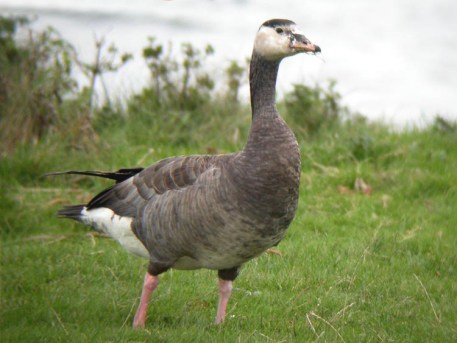
Of course, many “species” of geese descend from the ancestral pairs of goose-kind that survived the Genesis Flood aboard Noah’s Ark. Consider, for example, the photograph below (by David Appleton), showing a goose standing in grass of Holkham Park (in Norfolk, England) — which appears to be a Barnacle Goose X Greylag Goose hybrid.
Meanwhile, if I was a Barnacle Goose – and thank God that He created me to be me, instead! – I’d prefer Helsinki’s Kaivopuisto Park as my year-round home habitat, rather than summer in Novaya Zemla. (As far as I’m concerned, let the Arctic Ocean polar bears have that arctic archipelago!) ><> JJSJ profjjsj@aol.com

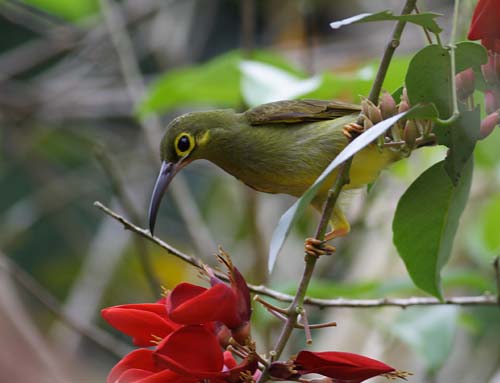
“The statutes of the LORD are right, rejoicing the heart: the commandment of the LORD is pure, enlightening the eyes.” (Psalms 19:8 KJV)
Spectacled Spiderhunter (Arachnothera flavigaster) by Peter Ericsson
*
UPDATE – I am scheduled to be released, and heading home today. Praise the Lord and thank you all so much for your thoughts and prayers. I’ll be on a walker for awhile, but I’ll be home. :)
*
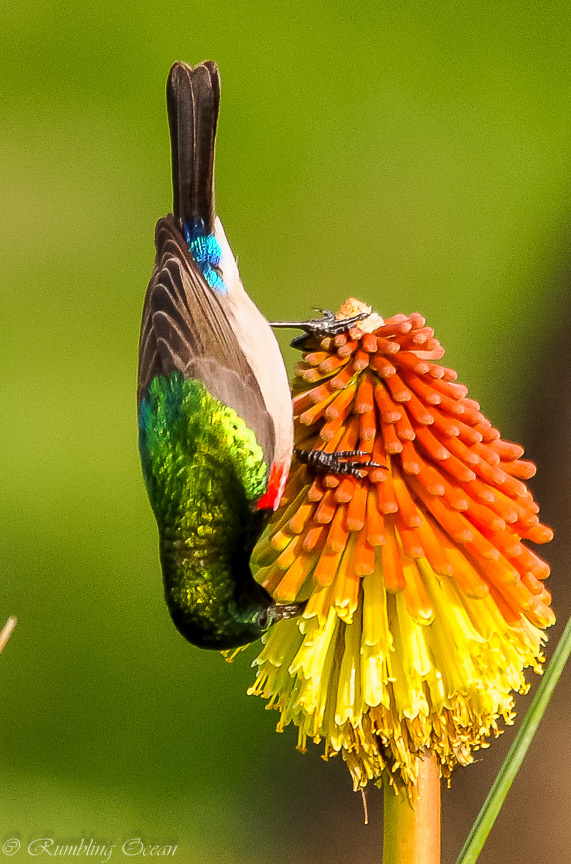
“From the rising of the sun unto the going down of the same the LORD’S name is to be praised.” (Psalms 113:3 KJV)
Lesser Double-collared Sunbird enjoying a Kniphofia flower ©©Rambling Ocean-Boeta.
*
*
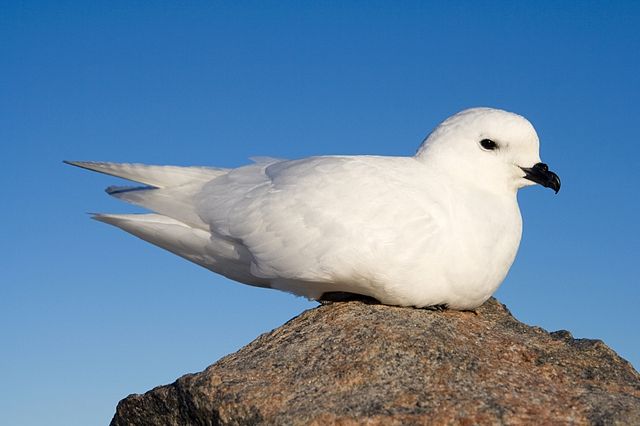
“He sitteth alone and keepeth silence, because he hath borne it upon him.
(Lamentations 3:28 KJV)
Snow Petrel (Pagodroma nivea) ©WikiC
*
*

Roadrunner bites Rattlesnake
“But be it so, I did not burden you: nevertheless, being crafty, I caught you with guile.
(2 Corinthians 12:16 KJV)
Roadrunner bites Rattlesnake ©Pinterest
*
P.S. Praise the Lord and thanks for the prayers. I am supposed to be released from the Sea Pines Rebabilitation Hospital on Monday. My back is healing and my strenght is returning to my legs daily.
*

