“And God blessed the seventh day, and sanctified it: because that in it he had rested from all his work which God created and made.” (Genesis 2:3)
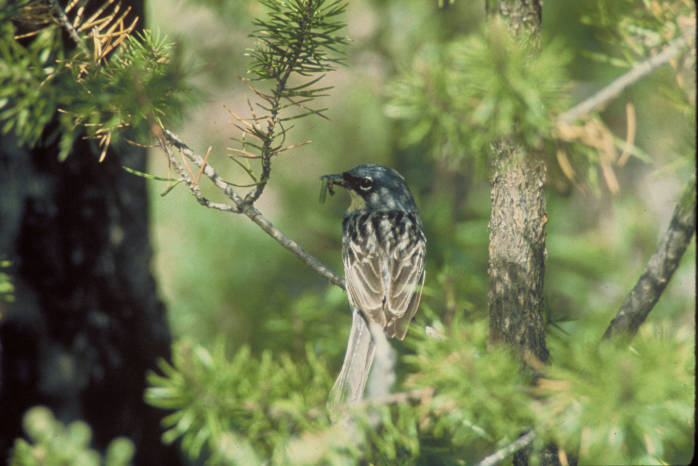
Myles Willard is an avid bird watcher, award-winning nature photographer and long-time friend of Creation Moments. Myles has given us hundreds of breathtaking nature photos, one of which accompanies the printed transcript of today’s program at the Creation Moments website.
The reason I’m telling you about him today is because of an unexpected discovery he made while looking out the window of his home in Michigan. Each fall he meticulously tracks and logs the number of migrating warblers that stop by for a rest in the big cedar tree in his yard. After tracking the activity of over 1,500 warblers for 18 years, he was surprised to see a statistically significant dip in the number of birds stopping by that occurred on every seventh day!
Did these migrating birds have a built-in instinct that somehow made them follow the biblical principle of a Sabbath rest? We are not saying, of course, that the warblers were knowingly obeying God’s fourth commandment. However, if God worked for six days and then rested on the seventh, why would it be hard to believe that God gave these birds a cycle of six days of work followed by a seventh day of rest?
According to the account given in the book Inspired Evidence: Only One Designer, “It would seem that Myles Willard, science teacher, nature photographer and bird watcher, has found and documented such a pattern.”
Prayer:
Oh Lord, thank You for doing all the work necessary for our salvation so we can rest securely in the knowledge that – by grace through faith – we can have eternal life! Amen.
Notes:
Myles Willard, The Rest Is History, monograph, 2008. Cited in Inspired Evidence: Only One Reality by Julie Von Vett and Bruce Malone, April 29 (Search for the Truth Publications, 2012). Photo: One of Myles Willard’s superb photos. Used with permission.
Great Blue Heron (Ardea herodias) Sleeping at Circle B by Lee
Huh? Maybe this Great Blue Heron was off on his schedule. It was not taken on a Sunday, as we don’t go birdwatching on Sundays. We rest on Sunday and attend church, so, why wouldn’t the birds rest also? This article is very interesting. I am sure “evolutionists” would discount it, but those records that Myles kept, are worth considering, and I doubt he just made these statistics up.
“Then the king commanded to call the magicians, and the astrologers, and the sorcerers, and the Chaldeans, for to shew the king his dreams. So they came and stood before the king.” (Daniel 2:2 KJV)
Ian’s Bird of the Week – Red Kite ~ by Ian Montgomery
Newsletter – 8/18/2016
Definitely bird of the month at the moment, I regret. Recently one of my cataracts worsened quickly, making it difficult to observe birds, take and edit photos: very discouraging to say the least. Thanks to the wonders of modern medicine, I had the offending lens replaced ten days ago, resulting in a spectacular improvement in my eye sight. Now I’m looking forward to getting the other one done this coming Monday.
The Red Kite, like the Common Buzzard in the last edition of bird of the week, is another good news story in the recent history of raptors in Ireland. This time its recovery is a result of a successful reintroduction, rather than natural recolonisation with parallel reintroductions by the Irish Golden Eagle Trust in Co. Wicklow south of Dublin and by the RSPB in Co. Down south of Belfast, starting in 2007 and 2008 respectively. Introduced pairs nested successfully in both counties in 2010, and Irish-born Red Kites nested successfully in these counties in 2012 and 2013. In 2014, there were 16 pairs in Co. Down and in 2015 there were 47 pairs in Co. Wicklow, 2 pairs in Co. Wexford and 4 pairs in Dublin-Meath so the population seems to be thriving despite some deaths from rodenticides – Red Kites are partial to carrion.
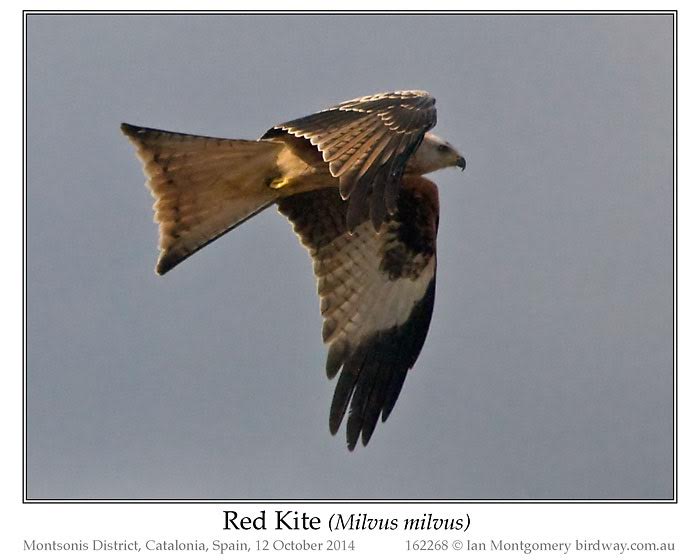
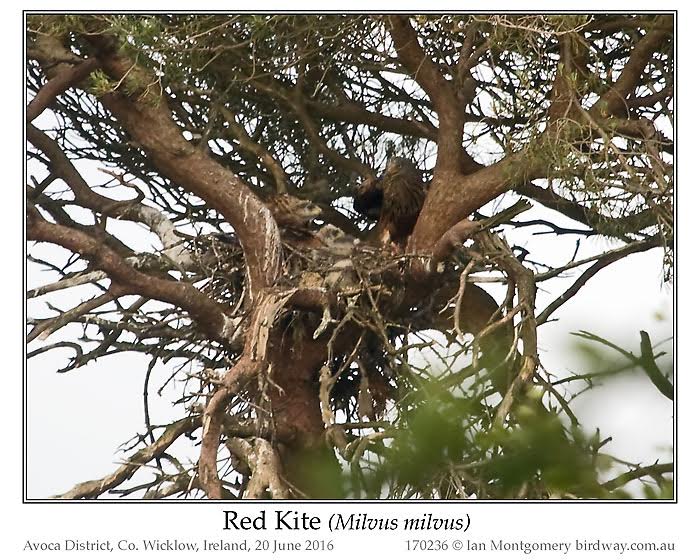
I had photographed Red Kites in Spain and Andorra in 2007 and 2014 (first photo), but I was keen to see them in Ireland too. The best place to see them in Co. Wicklow is in Avoca, where there is a winter roost which contained more than 60 birds in the 2015-2016 winter. I went there with my cousin Jean in June and after a distant view of a bird hunting along the Avoca River, she took me to another (secret) location where she had seen a pair of birds in March. Sure enough the birds were still there and nesting in a pine tree.
We were of course anxious not to disturb the pair, so we parked at some distance from the nest and observed it from the car. So I make no apologies for the distance at which photos 2,3 and 4 were taken. No. 2 shows an adult bird flying towards the nest carrying food. No. 3 shows the same bird on the right of the nest being watched by two nestlings on the left. One of the nestlings looks nearly fledged while the second is less well-developed and still has downy white feathers. No. 4 shows the adult flying away from the nest still carrying the food, watched by the nestlings. The colour of the adult matches that of the tree but the blue wing tags give its location away.
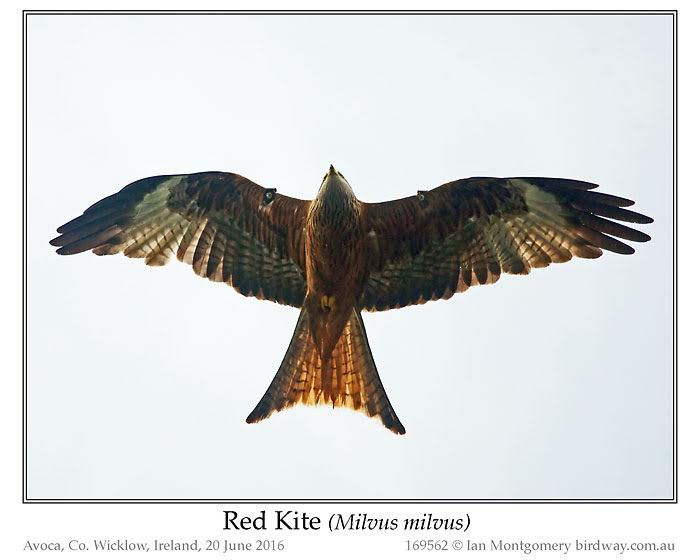
We wondered whether the adult was wary of us sitting in the car but it returned to the nest two minutes later and we drove away leaving them all in peace. By this time it was late evening so we drove back to Avoca village to see whether any non-breeding birds were using the roost. We parked in the car park opposite the church on the main street and were treated to several kites – and a Common Buzzard – circling over the town.. The one in the last photo flew right over our heads in the car park. You can see the wing tags on this one too.
And the vulture, and the kite after his kind; (Leviticus 11:14 KJV)
I had begun to wonder where Ian had disappeared to. Concerned he may have been sick or hurt. Now we know. Thanks, Ian, for telling us about your cataract problem. Been there, done that. What a difference it makes when they put the lens implant in. Like you, I need one more, but mine isn’t “ripe” yet, as they tell me.
What a beautiful Kite. That last photo is my favorite!
“Them hath he filled with wisdom of heart, to work all manner of work, of the engraver, and of the cunning workman, and of the embroiderer, in blue, and in purple, in scarlet, and in fine linen, and of the weaver, even of them that do any work, and of those that devise cunning work.” (Exodus 35:35 KJV)
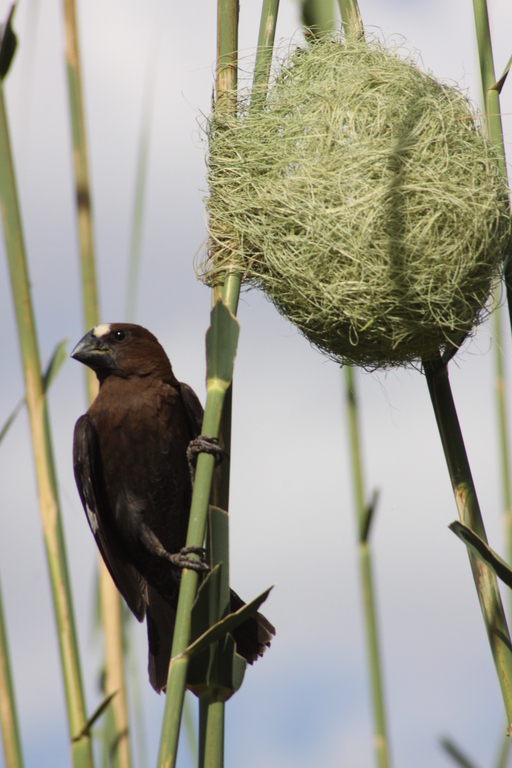
Thick-billed Weaver (Amblyospiza albifrons) – male with nest
“For the Son of man is as a man taking a far journey, who left his house, and gave authority to his servants, and to every man his work, and commanded the porter to watch.” Mark 13:34
If you have ever traveled to a distant city on vacation, you know how much planning you have to do before you leave. And, of course, you need to know where you are going and the route you must follow to get there. But the creatures we’ll be talking about today know exactly how to get where they are going. In fact, they were born with an internal GPS system to show them the way.
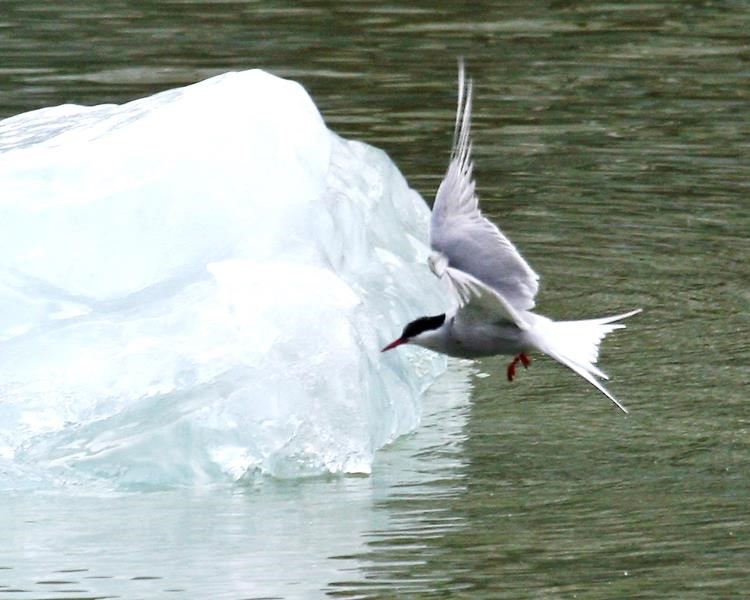
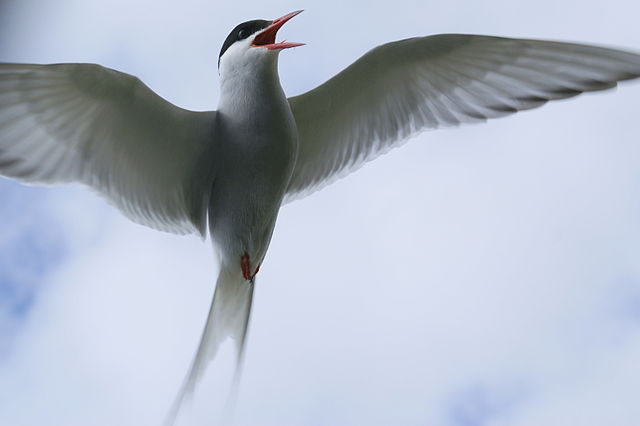
In his book, Billions of Missing Links, Dr. Geoffrey Simmons devotes an entire chapter to the topic of migration. He begins by telling how baby loggerhead turtles migrate 8,000 miles across the Atlantic Ocean. But that’s a short trip compared to the staggering 25,000 miles that arctic terns fly each year. That’s like flying completely around the Earth at the equator!
As Dr. Simmons points out, “Every species seems to know how to prepare for the arduous trip far in advance, but no one knows how they acquire the capability.” After describing all the preparations migrating birds must take care of, he writes: “One would think all these preparations had to have come as a whole package. There is way too much purposeful change for random mutations.”
How true! And even though Dr. Simmons is not a creationist, we have come to the exact same conclusion – namely, that animal migrations could not have come about slowly by trial and error, as Darwinian theory would have us believe.
Prayer: Oh Lord, though I may get lost while going on a long trip, Your creatures never seem to lose their way. You have boggled my mind once again! Amen.
Notes:
Geoffrey Simmons, M.D., Billions of Missing Links, pp. 165-169 (Harvest House Publishers, 2007).
“And the angel of the LORD appeared unto him in a flame of fire out of the midst of a bush: and he looked, and, behold, the bush burned with fire, and the bush was not consumed.” (Exodus 3:2 KJV)
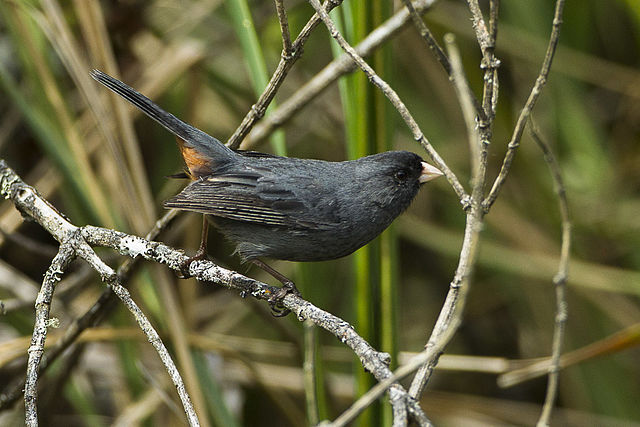
We have arrived at the last the Thraupidae family of Tanagers and close family relatives. We begin with the Cuban Bullfinch (Melopyrrha nigra) is a songbird species of the monotypic genus Melopyrrha. Sometimes classified in the bunting and American sparrow family (Emberizidae), more recent studies have shown it to be part of the tanager family (Thraupidae). Therein, it belongs to the lineage of tholospizan “finches”, which also includes the famous Darwin’s finches. They are found in the Cayman Islands, there only on Grand Cayman, and Cuba. Its natural habitats are subtropical or tropical moist lowland forests, subtropical or tropical moist montane forests, and heavily degraded former forest.
The next two genera, Dolospingus, found in Brazil, Colombia, and Venezuela. Its natural habitat is subtropical or tropical dry shrubland, and Catamenia also from South America, are Seedeaters.
Yellow-faced Grassquit (Tiaris olivaceus) by Kent Nickell
Six Grassquits, from Tiaris and Loxipasser genera are from Central and South America. The Yellow-faced Grassquits are interesting because “During courtship, the male vibrates his wings as he sings his subdued song, sitting only 1–2 in (2.5–5.1 cm) away so the female can properly hear him. The roughly globular nest, built by the female, is made of grass and weed stems compacted into a thick mass, and lined with pieces of grass inflorescences and bast fibre. It has a side entrance and is placed usually less than 30 cm (12 in) above the ground, often among grass or weeds on a road or river embankment.” (Wikipedia) Grassquits are known for making covered nests.
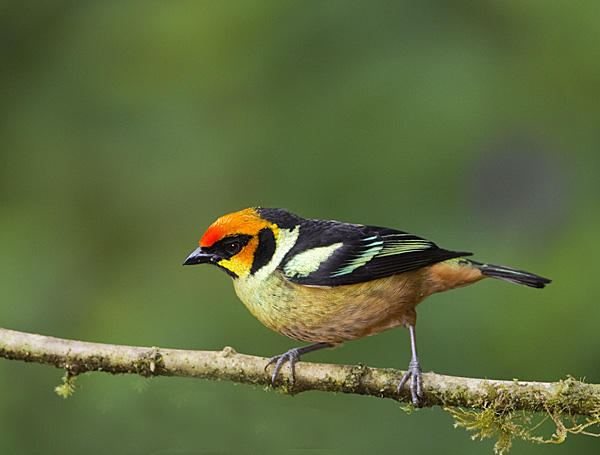
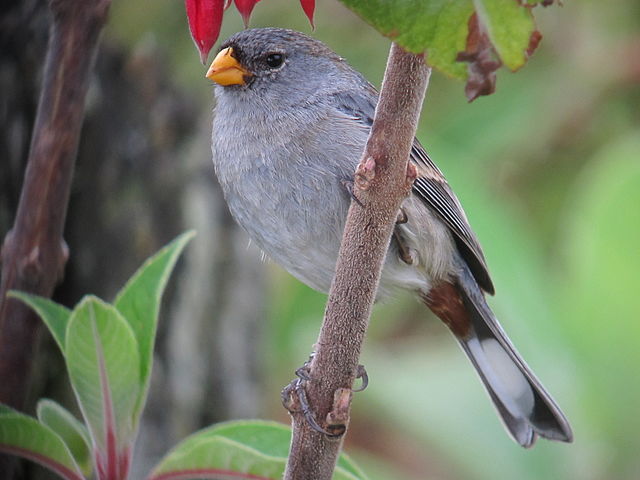
Most of the rest of the family are similar in that just a few birds are in each genus. The the Bullfinches, Loxigilla; Ground Finches, Geospiza; Cactus Finches, Geospiza; Tree Finches, Camarhynchus; Warbler-Finches, Certhidea; and then five Tanagers in three genera.
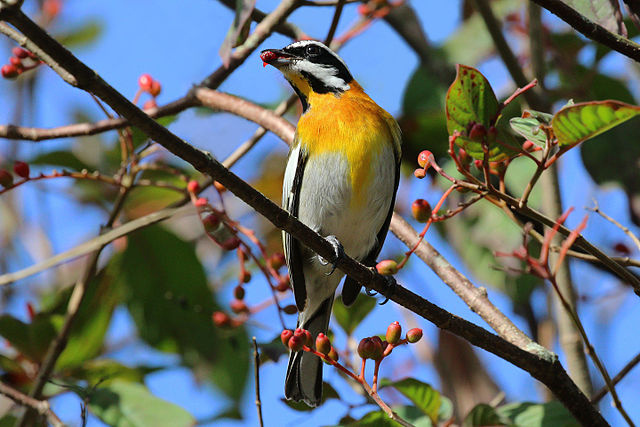
There are four “Spindalis is a genus consisting of four non-migratory bird species. The genus is considered endemic to the Greater Antilles; a population on Cozumel Island, off the Yucatán Peninsula’s east coast, is part of that island’s West Indian fauna. Spindalis males are characterized by bright plumage while females are duller and have a different coloration. (Wikipedia) As usual, this helps hide her while sitting on the nest. Also shows the Lord’s concern for all of His Creation.
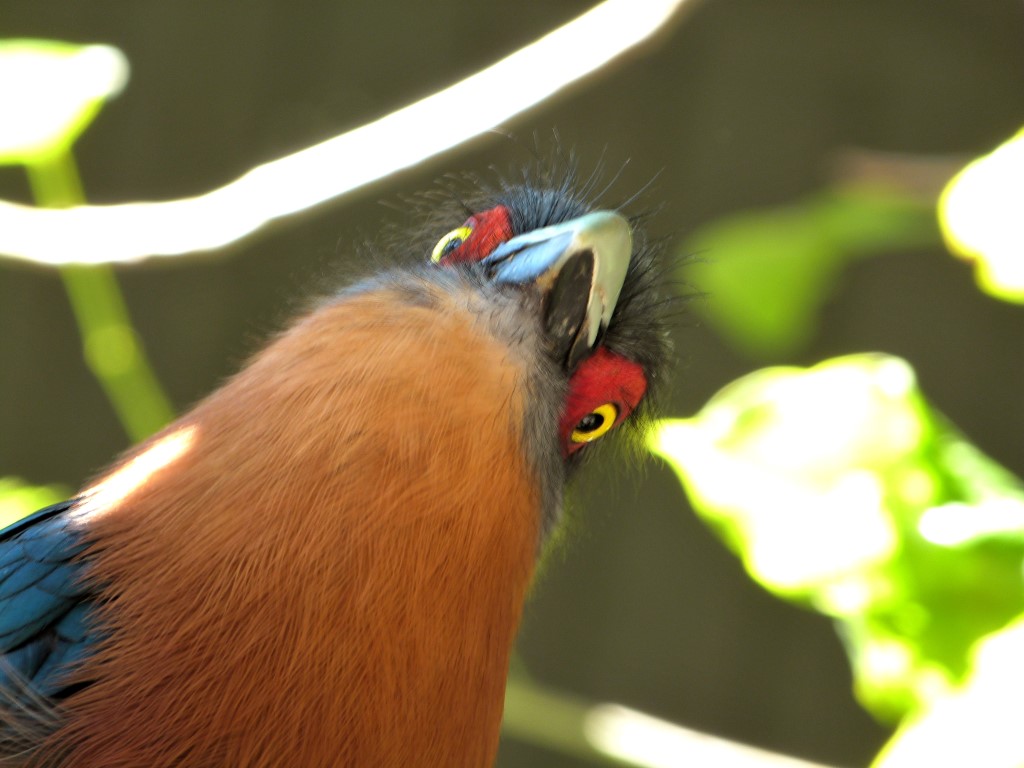
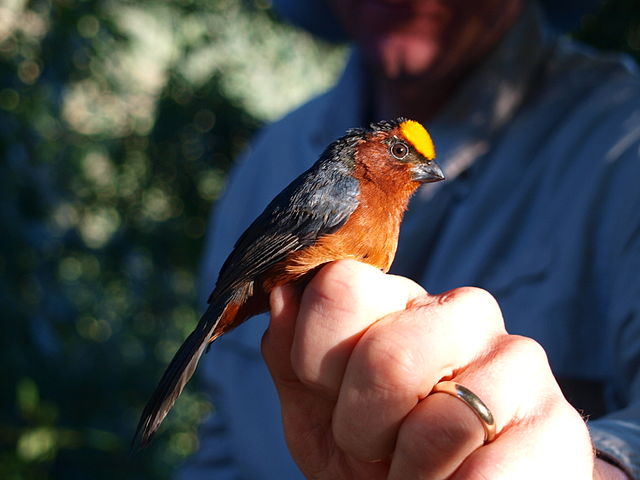
The next to last bird in the Thraupidae Family is an very interesting bird and I’ll let Wikipedia give the details. “The plushcap is one of the most distinctive of all Neotropical passerines in terms of both its appearance and behavior. The plushcap (Catamblyrhynchus diadema) was in its own family until recently when it was grouped with the tanagers. It is very distinct both physically and in terms of behavior. The bill is broad and black. The body is a chestnut color with a bright golden-yellow forecrown. The forecrown is made up of stiff feathers. It has been speculated that these short, dense feathers are less susceptible to feather wear and more resistant to moisture than typical feathers. This may be an adaptation for its specialized feeding mode [sounds like Wisdom from their Creator], in which it probes into dense whorls of bamboo for its prey items (Hilty et al. 1979). Juveniles are just duller versions of their parents. They are found at high elevations from northern Venezuela south to Argentina, including the coastal mountains of Venezuela and the Andes of Colombia, Ecuador, Peru, Bolivia, and extreme northwestern Argentina. They live in montane forests and secondary forests near bamboo. They forage for insects inside the bamboo. They will eat small insects, berries, and small plant matter. The overall length averages 14 cm (5.5 in) and weigh averages 14.1 grams (0.5 oz).”
“The bird is very distinct and is not confused with many other birds. It stands out from the other tanagers, only possibly being confused with the golden-crowned tanager despite the golden-crowned tanager being blue. The species is found in Argentina, Bolivia, Colombia, Ecuador, Peru, and Venezuela. Its natural habitat is humid montane forests and it is always found in close association with Chusquea bamboo. It is typically found at an elevation 1,800 to 3,500 m.”
This slideshow requires JavaScript.
But none of these things move me, neither count I my life dear unto myself, so that I might finish my course with joy, and the ministry, which I have received of the Lord Jesus, to testify the gospel of the grace of God. (Acts 20:24 KJV)
“And wheresoever the children of men dwell, the beasts of the field and the fowls of the heaven hath he given into thine hand, and hath made thee ruler over them all. Thou art this head of gold. (Daniel 2:38 KJV)









 Lee's Birdwatching Adventures Plus