Oh that men would praise the LORD for his goodness, and for his wonderful works to the children of men! (Psalms 107:15 KJV)
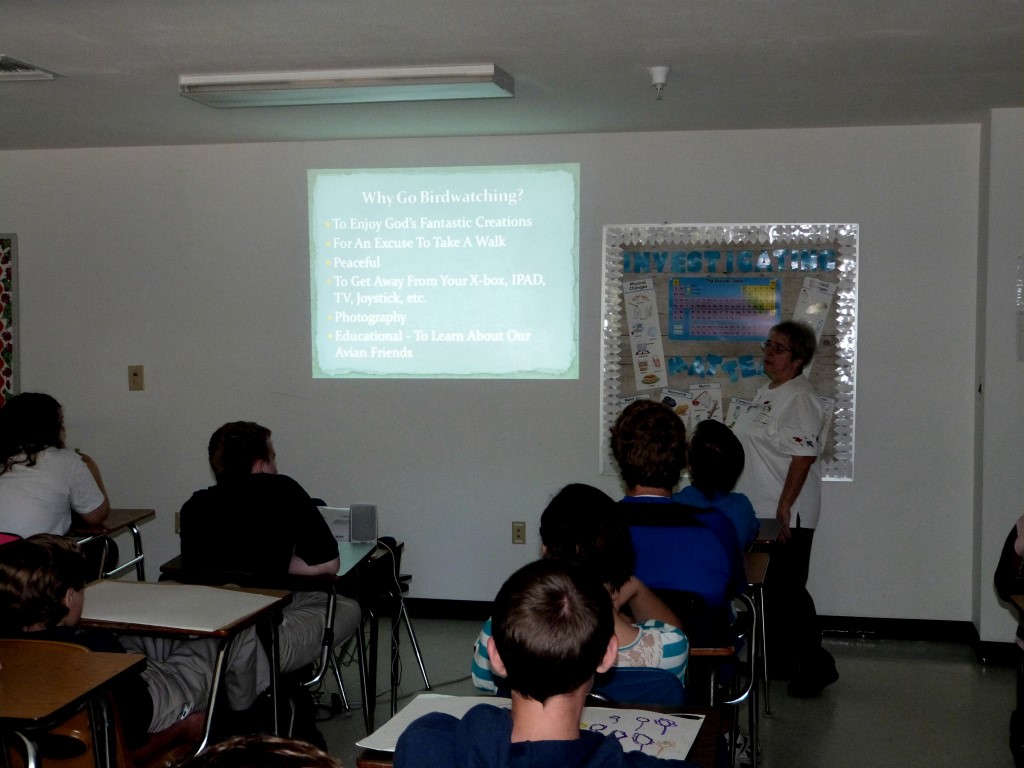
Here is the Powerpoint Presentation I used yesterday, converted to JPGs. (Teaching About Birdwatching) As it was shown, each point came up as I clicked and explained the points. The two videos that were part of it; the Blue Jay calling and the Carolina Wren singing, are included. If you can use any of this presentation, you have my permission. The first slide had an audio of birds singing as the students arrived.
Give instruction to a wise man and he will be yet wiser; teach a righteous man (one upright and in right standing with God) and he will increase in learning. (Proverbs 9:9 AMP)
Hear instruction and be wise, and do not refuse or neglect it. (Proverbs 8:33 AMP)
I have been busy the last few days getting a Powerpoint Presentation ready. Today, I had the privilege of introducing Birdwatching to two classes at Winter Haven Christian School. One class was 9th and 10th graders and the other was 6th and 7th graders. This was their last full day before their summer break. This was a diversion for them.
Both classes seemed interested and maybe some of them will become future birdwatchers. We always try to spark an interest in our next generations coming behind us.
Dan was along and took a few photos while I did the presentation. He was also the one who helped carry things in.
I also tried to encourage those who may be interested in the photographic side of birdwatching.
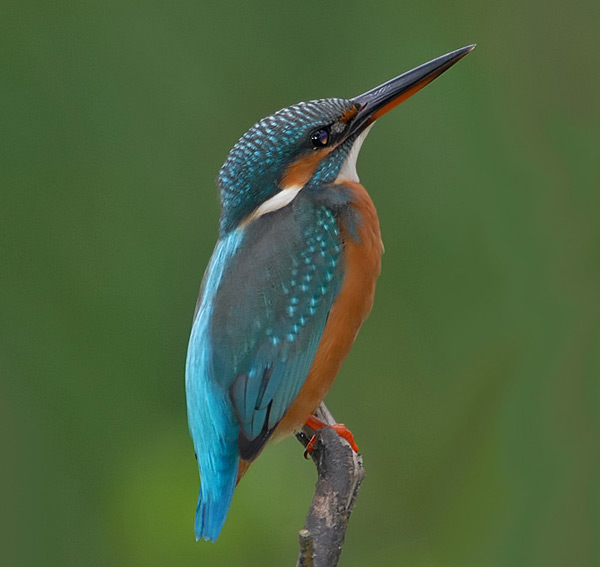
Blue-eared Kingfisher (Alcedo meninting) by Nikhil Devasar
Look at the birds of the air, for they neither sow nor reap nor gather into barns; yet your heavenly Father feeds them. Are you not of more value than they? (Matthew 6:26 NKJV)
This is a very interesting video of a Kingfisher male leaving the nest, as the chick comes out of the shell. The mother Kingfisher arrives with its first meal of fish. Notice that the throat turns dark as it feeds. I do not know which Kingfisher this is as it was not listed.
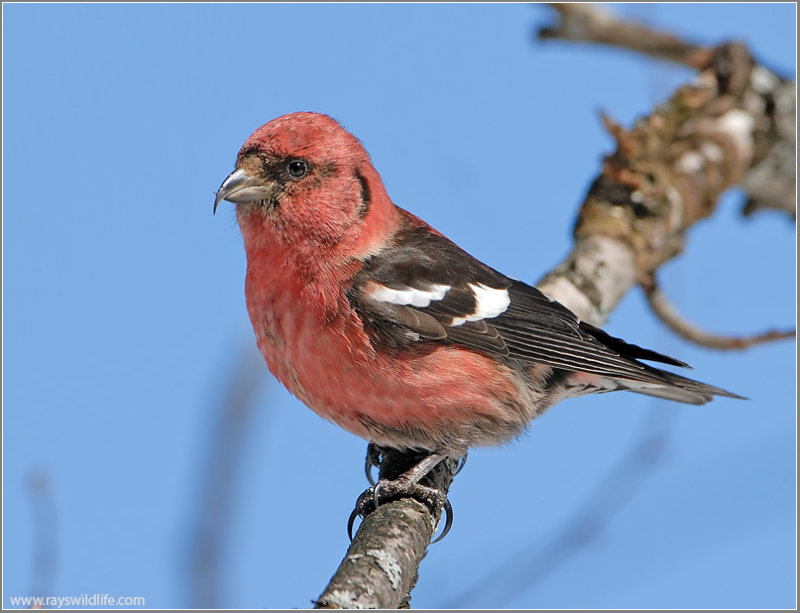
Two-barred Crossbill (Loxia leucoptera)(White-winged) by Raymond Barlow
And he bearing his cross went forth into a place called the place of a skull, which is called in the Hebrew Golgotha: (John 19:17 KJV)
While thinking of the music for today’s Inspiration, my search began with “Cross” birds, but there aren’t that many with “Cross” in their name, so the “Hill” birds were added also.
When Christ died on the “cross” on a “hill” called Calvary, He became the Perfect Sacrifice for my sins and yours. Praise the Lord. May we think about His Love for us as we watch some of His creation.
“You are the light of the world. A city that is set on a hill cannot be hidden. Nor do they light a lamp and put it under a basket, but on a lampstand, and it gives light to all who are in the house. Let your light so shine before men, that they may see your good works and glorify your Father in heaven. (Matthew 5:14-16 NKJV)
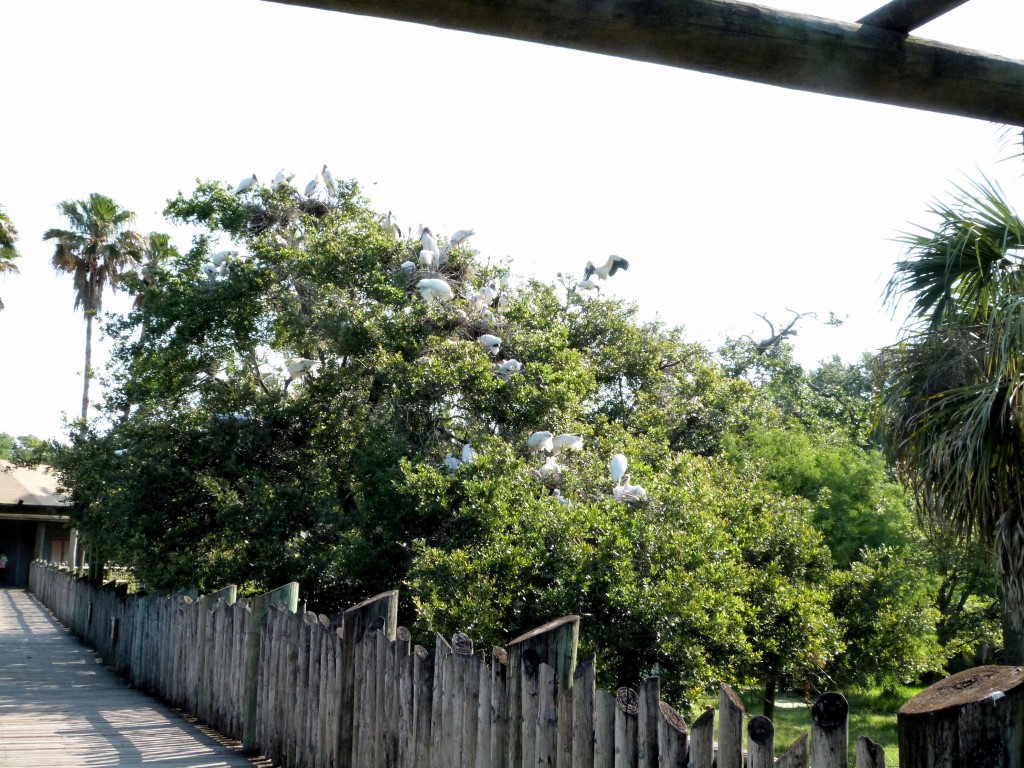
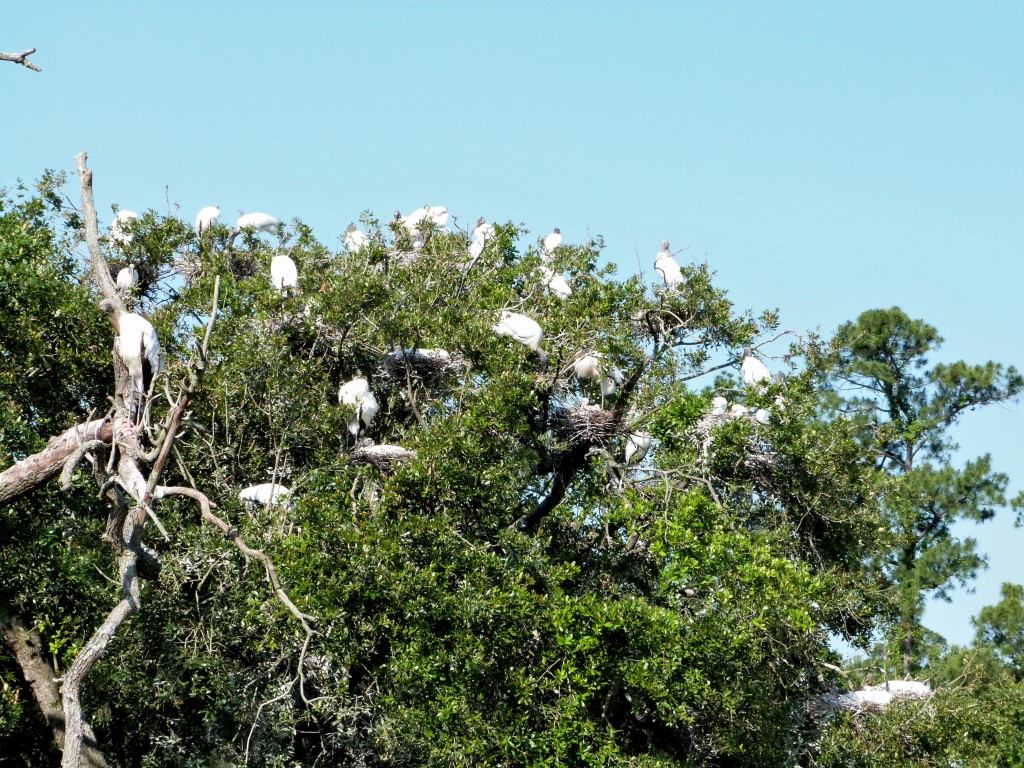
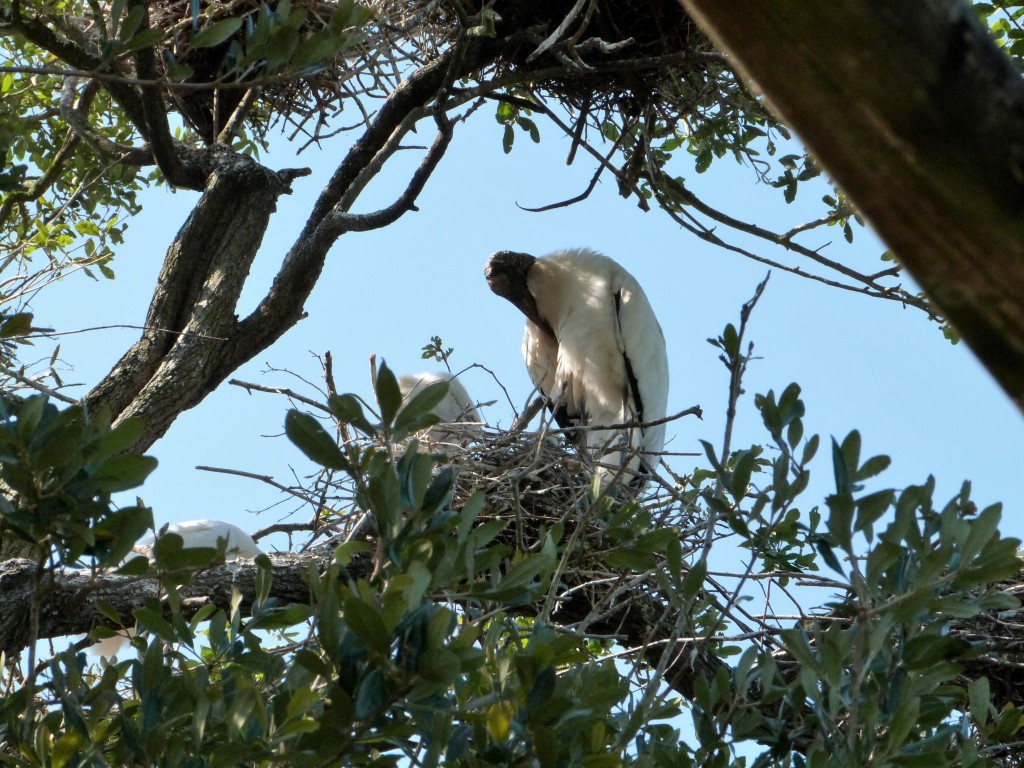
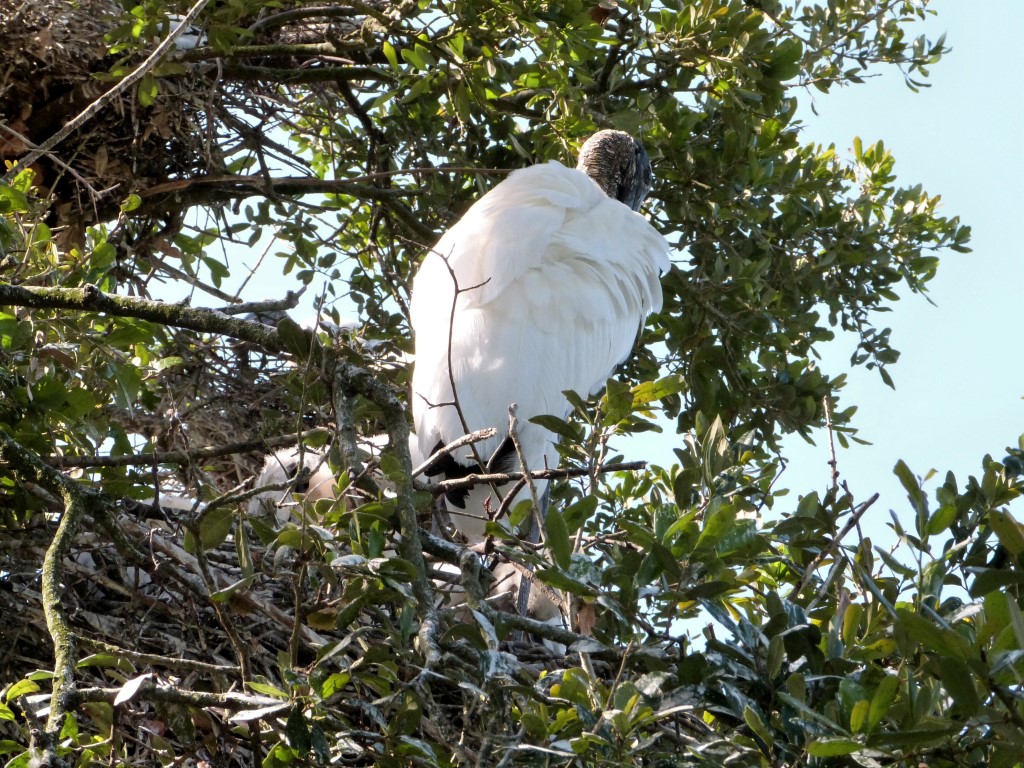
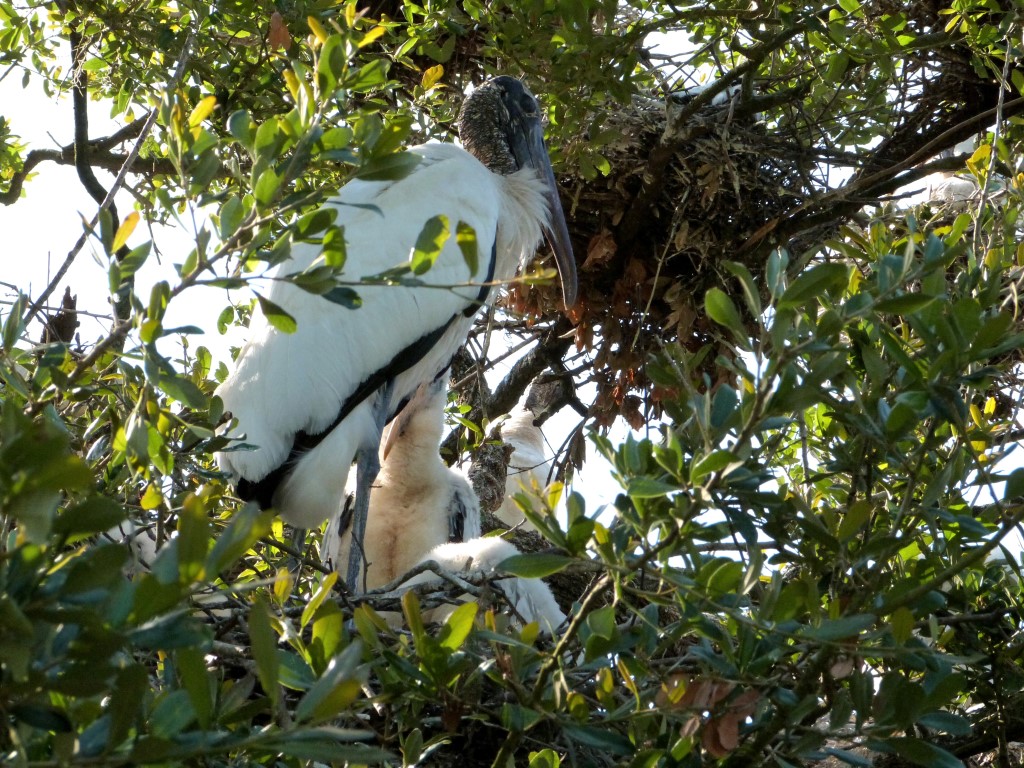
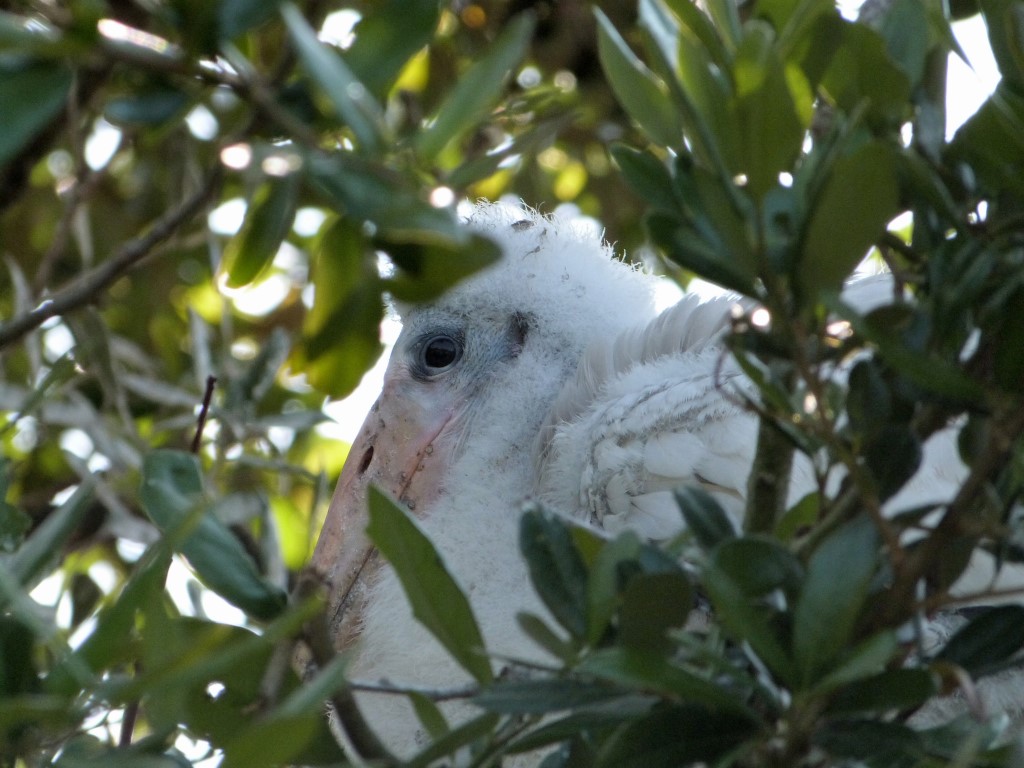
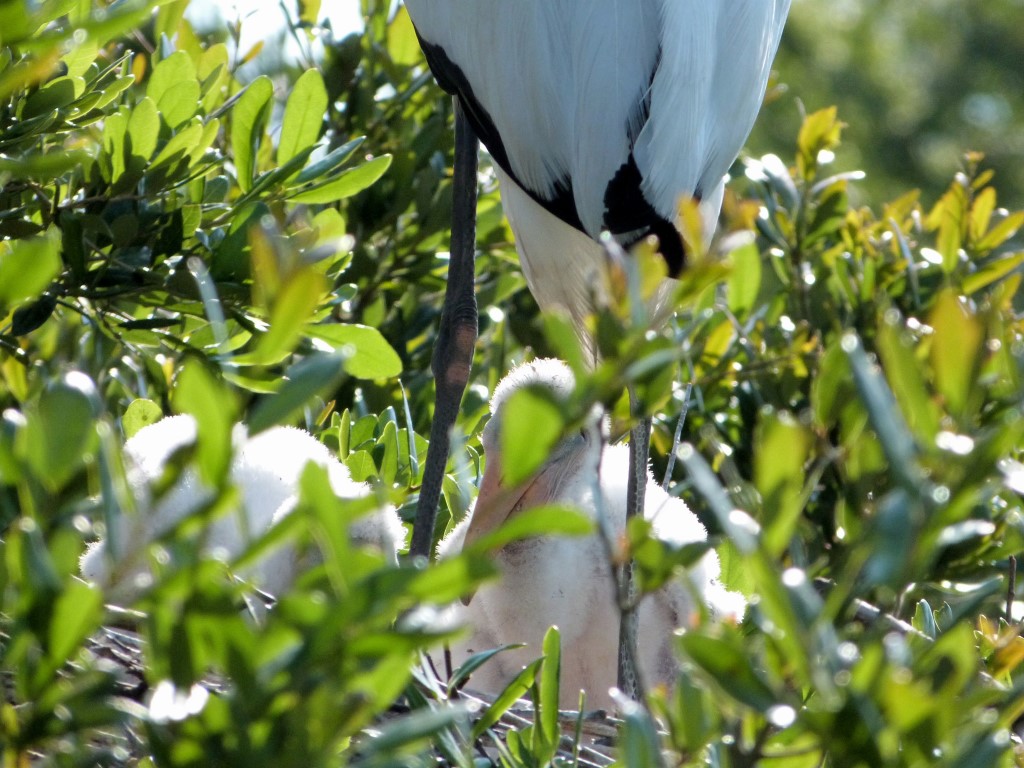
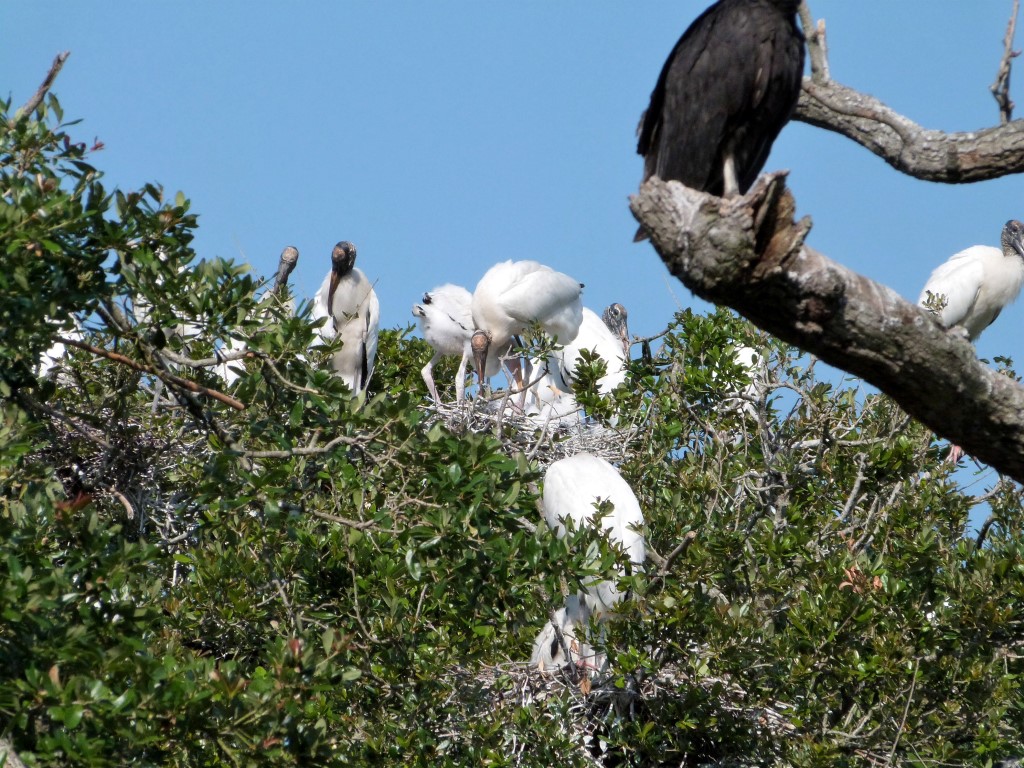
Wood Stork (Mycteria americana) with Chicks Jax Zoo by Lee
Yea, the stork in the heaven knoweth her appointed times; and the turtle and the crane and the swallow observe the time of their coming; but my people know not the judgment of the LORD. (Jeremiah 8:7 KJV)
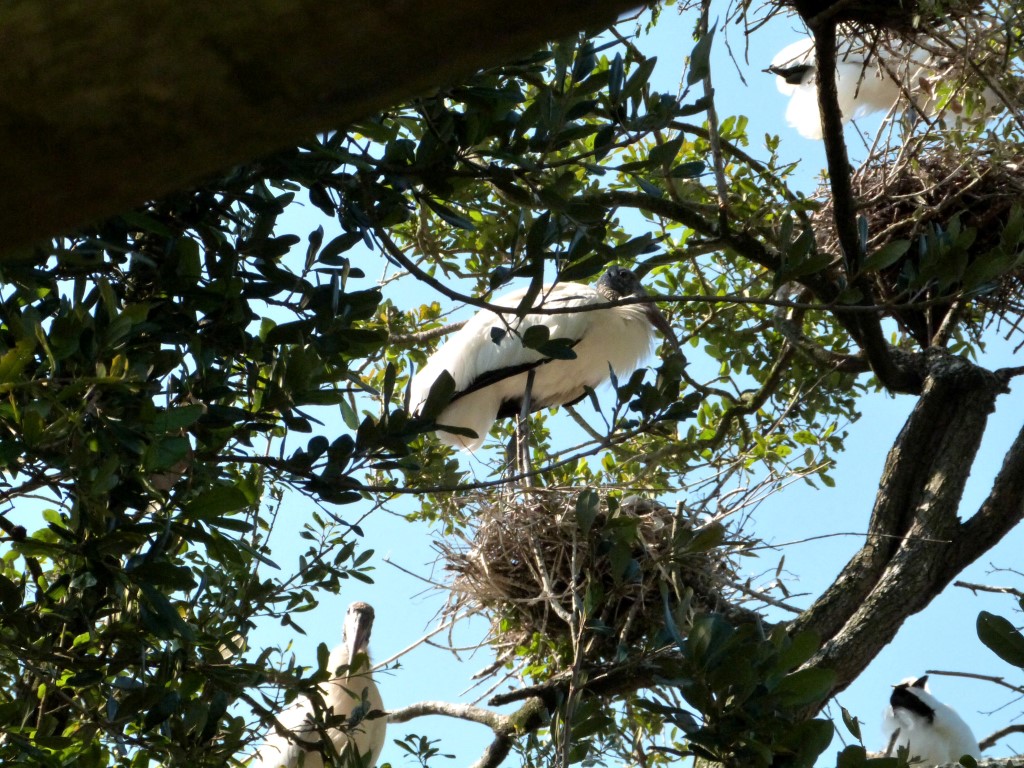
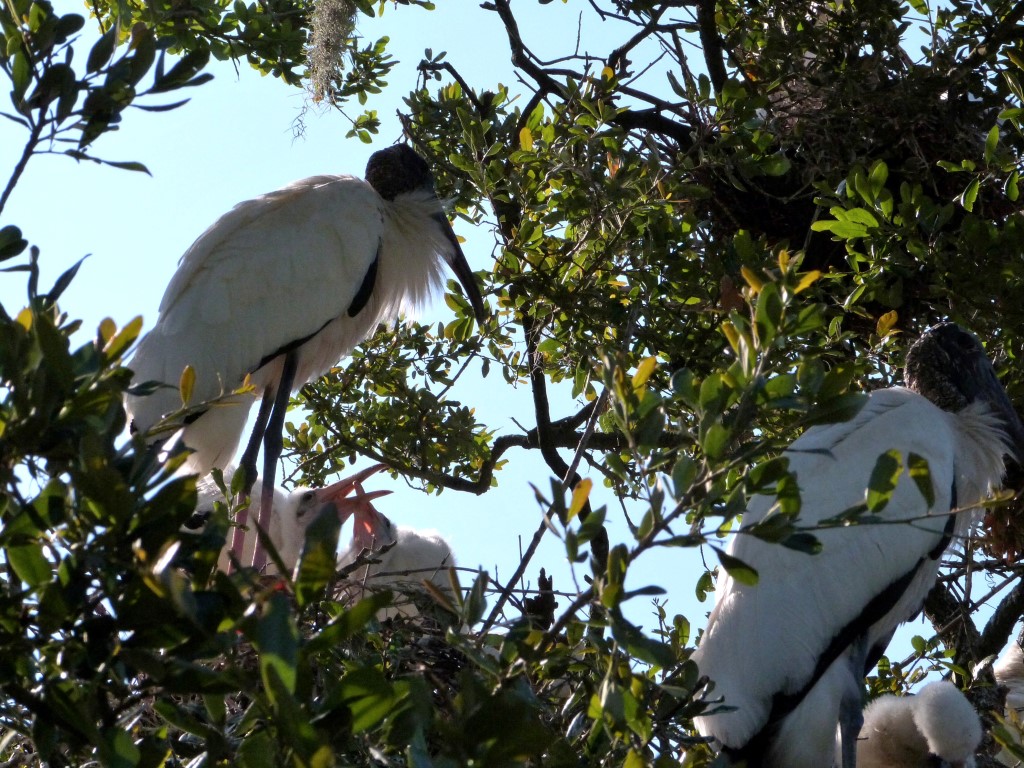
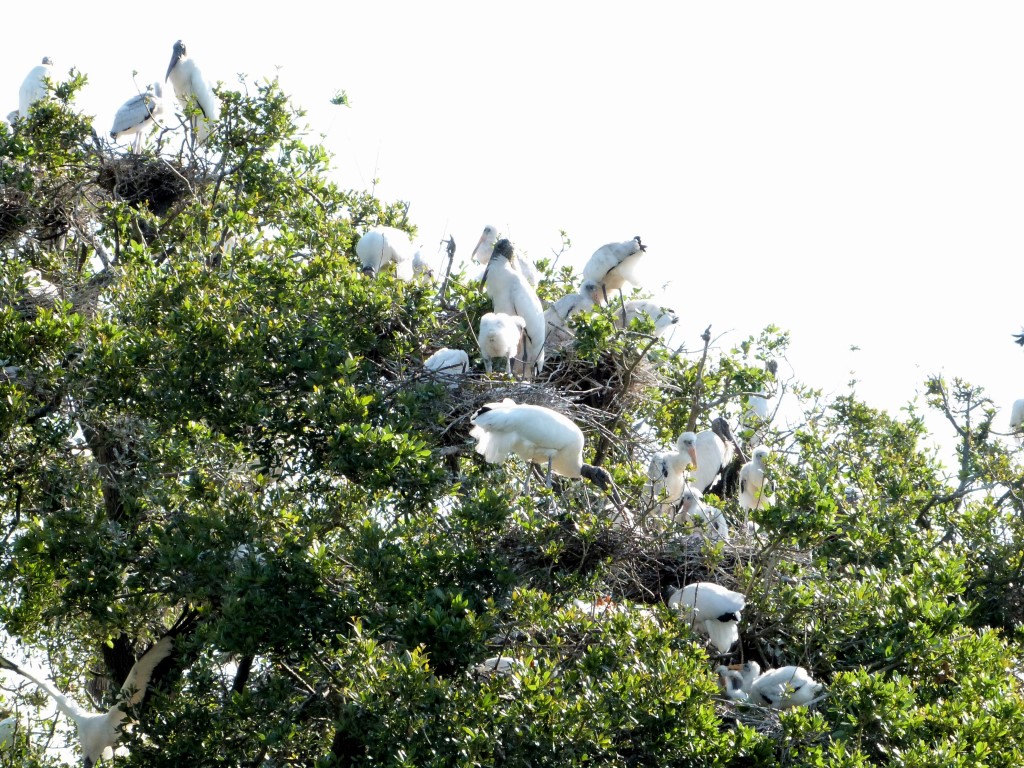
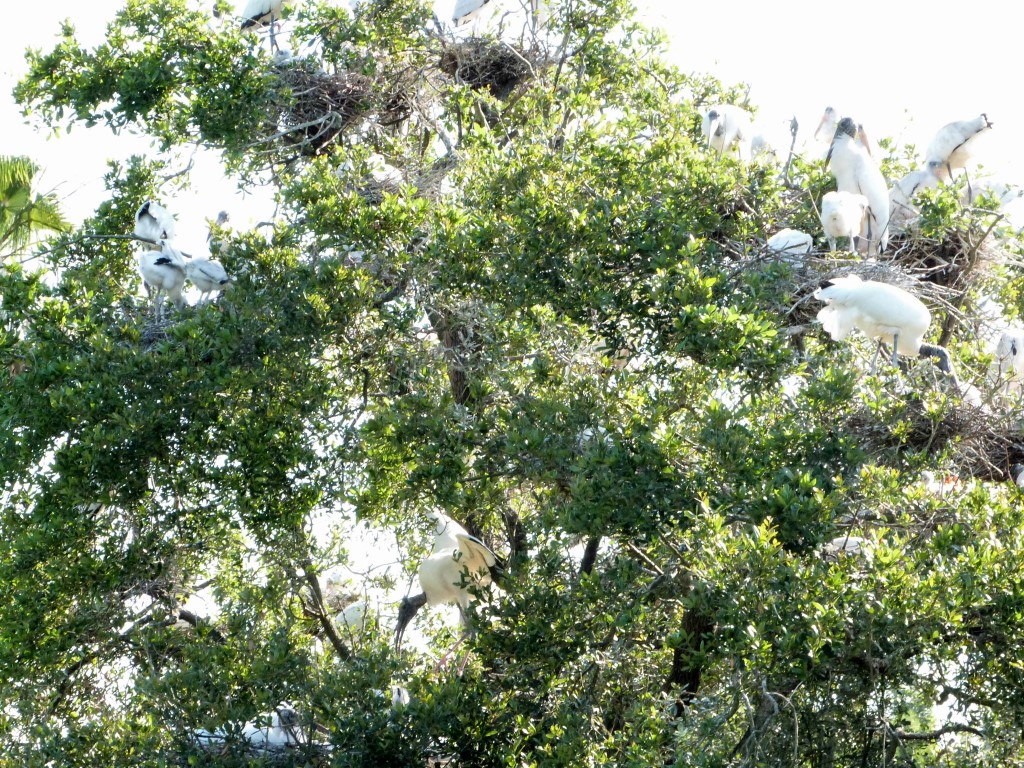
Last week while we were at the Jacksonville Zoo, we noticed a tree loaded with Wood Stork nests. It was hard to miss as you could hear it from far away. As you watch the videos, you will hear the noise coming from all the nest. The tree was right by the boardwalk, so we were very close to them.
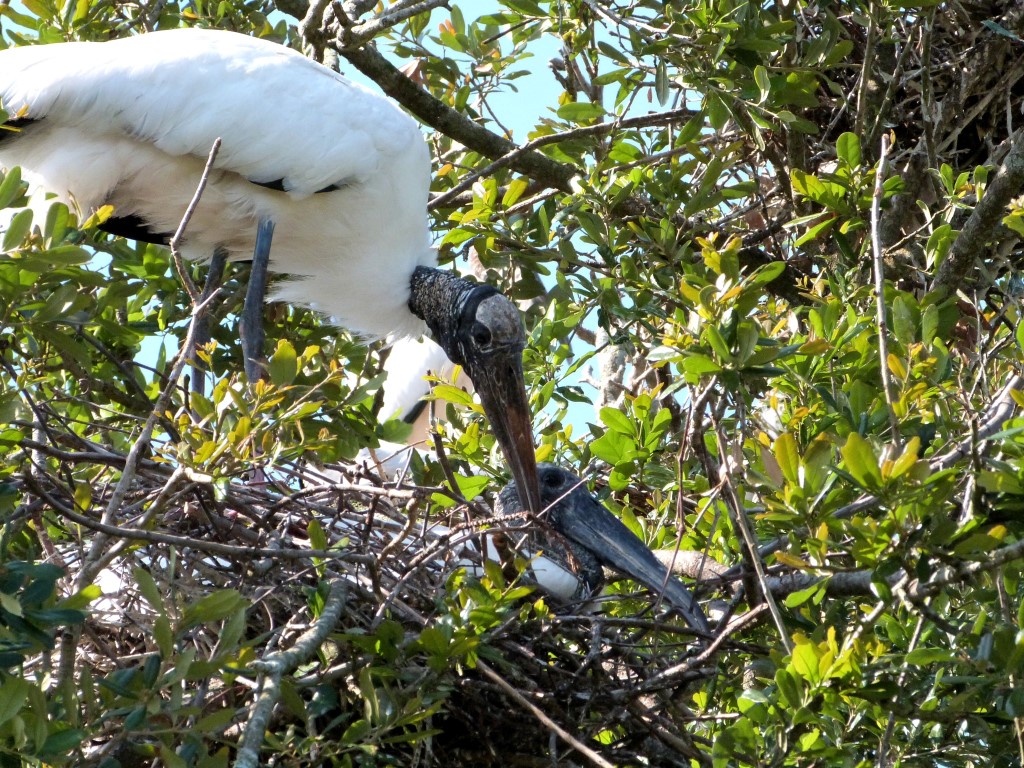
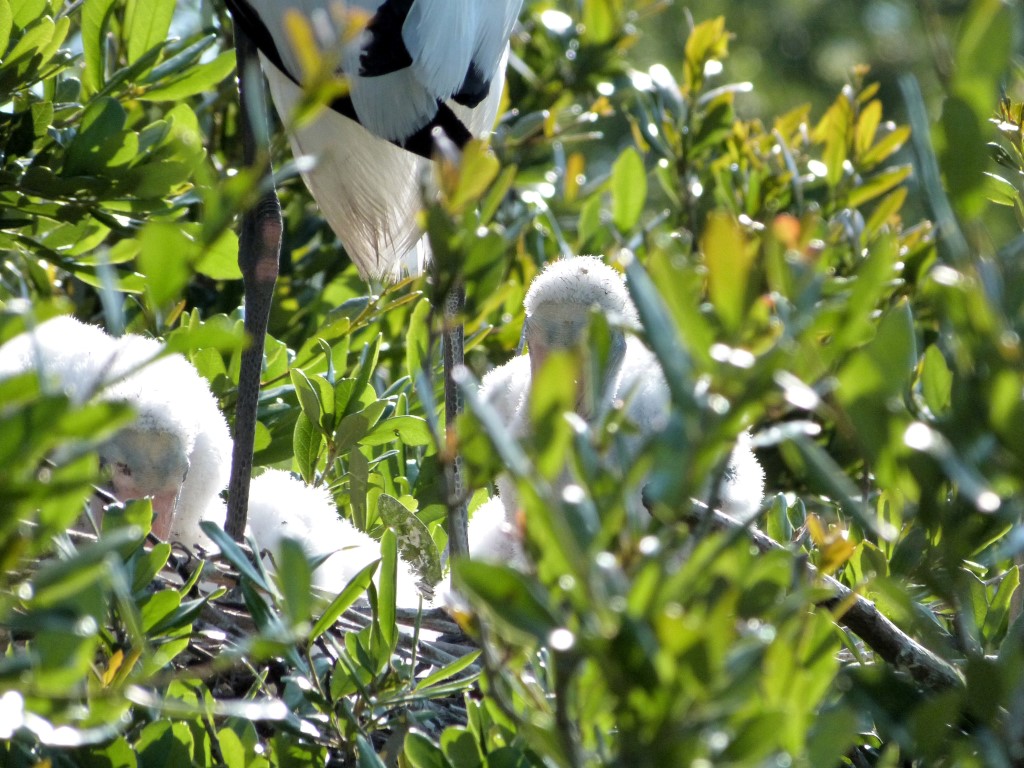
Wood Stork (Mycteria americana) with Chicks Jax Zoo by Lee
Where the birds make their nests: as for the stork, the fir trees are her house. (Psalms 104:17 KJV)
Wood Storks are part of the Ciconiidae – Storks Family and are also mentioned several times in Scripture. That makes them one of the Birds of the Bible – Storks. We are fortunate in that we get to see Wood Storks quite frequently here in Polk County, Florida, especially out at the Circle B Bar Reserve. Circle B is one of my favorite places to go birdwatching. Yet, I have never seen the nest up close like this.
Here is a combined video of the noisy tree: (Ignore the talking in the background, listen to the noisy birds.)
*
Sing unto him a new song; play skilfully with a loud noise. (Psalms 33:3 KJV)
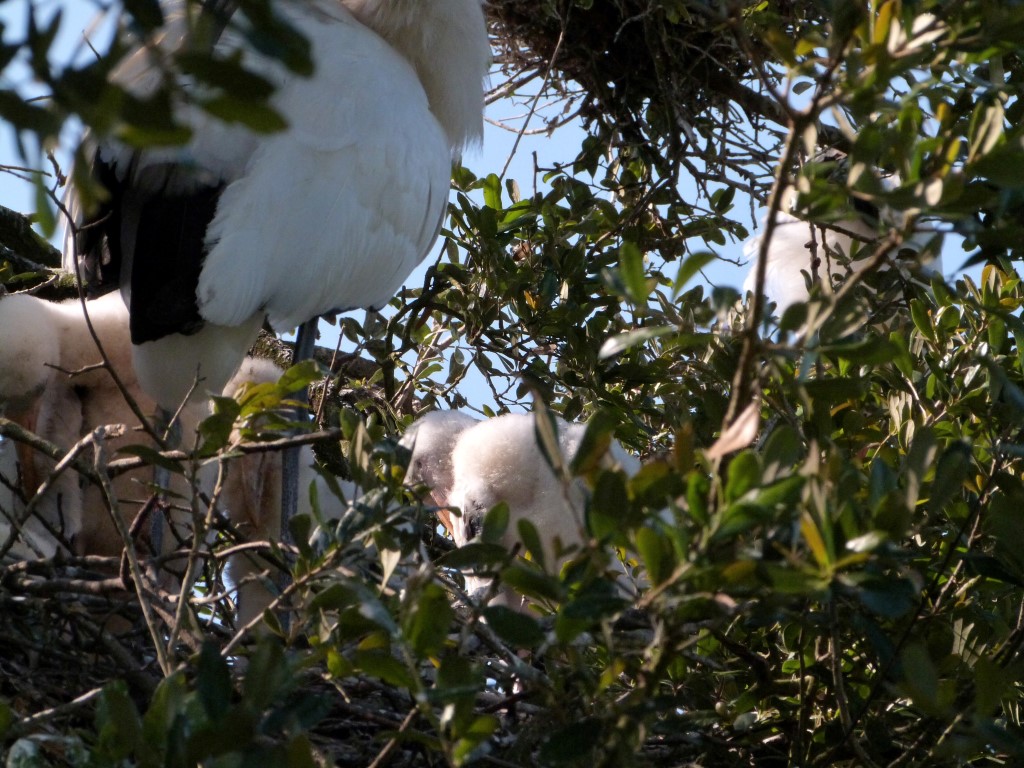
After taking photos and videos, I found three young one showing how the noise was produced. Now multiply that by all the other nest with young ones doing the same thing.
Error
This video doesn’t exist
O come, let us sing unto the LORD: let us make a joyful noise to the rock of our salvation. (Psalms 95:1 KJV)
*
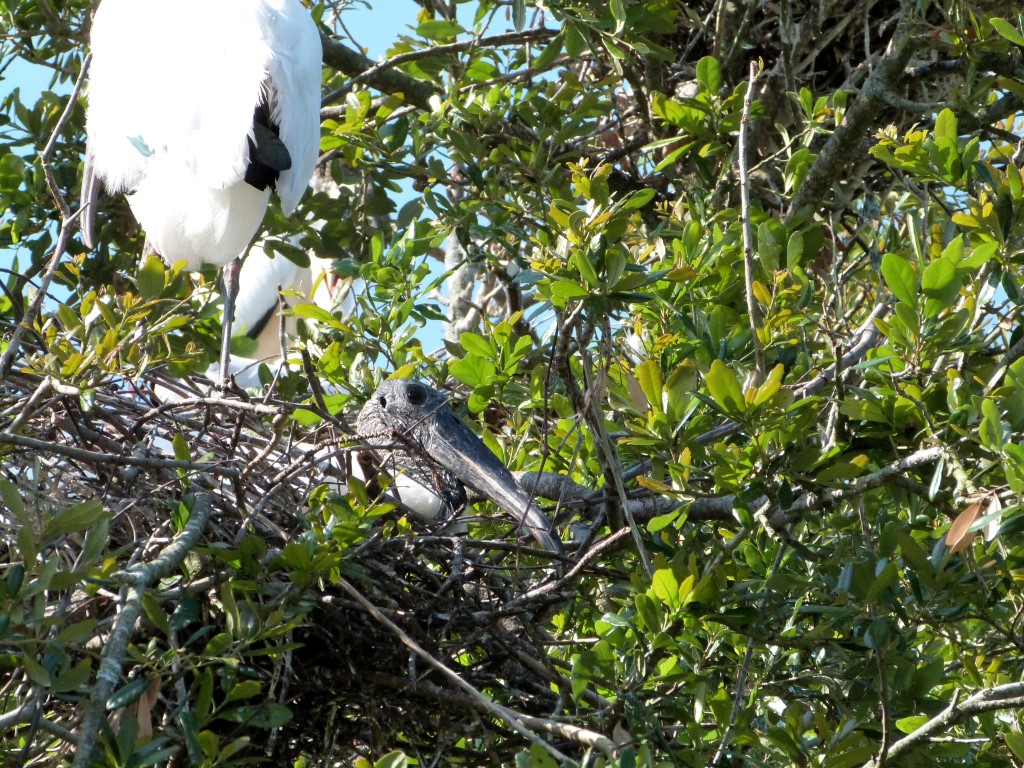
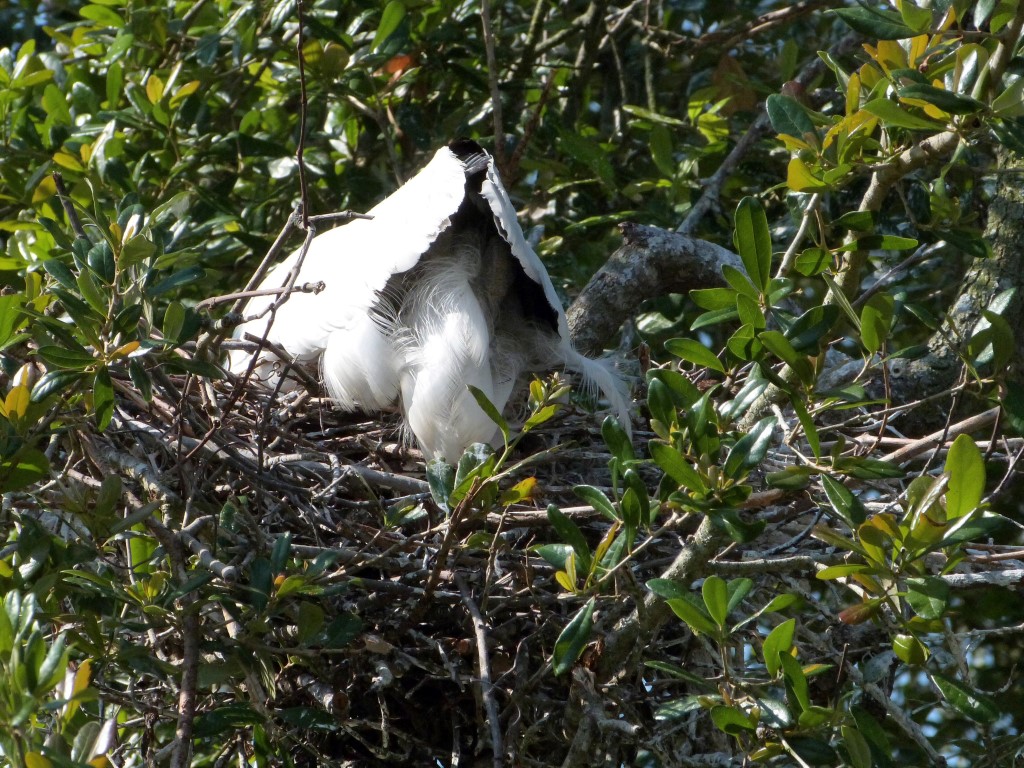
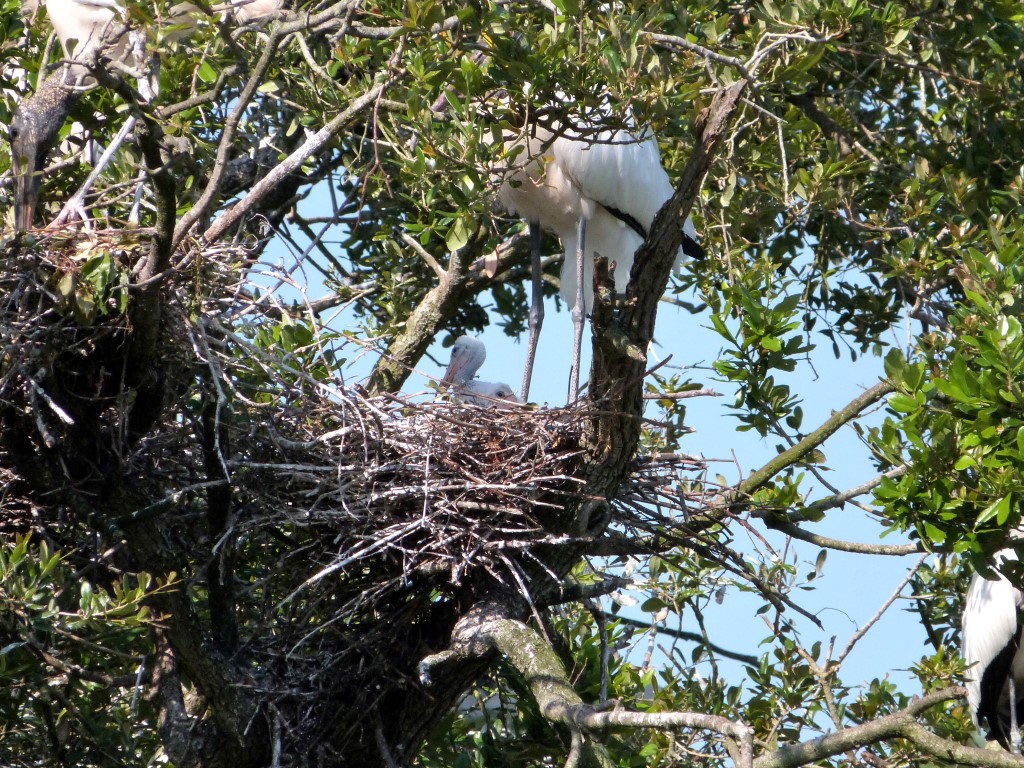
Hope you don’t mind seeing some of the photos also. These are set up so you can see them larger. Enjoy the Lord’s Creation in the form of Wood Storks.
Wood Stork (Mycteria americana) with Chicks Jax Zoo by Lee
Wood Stork (Mycteria americana) with Chicks Jax Zoo by Lee
Wood Stork (Mycteria americana) with Chicks Jax Zoo by Lee
Wood Stork Chicks – Noisy
Wood Stork (Mycteria americana) with Chicks Jax Zoo by Lee
Wood Stork (Mycteria americana) with Chicks Jax Zoo by Lee
Marabou Stork (Leptoptilos crumenifer) with chicks-Jax Zoo by Lee
Where the birds make their nests: as for the stork, the fir trees are her house. (Psalms 104:17 KJV)
We just got back from a trip to Jacksonville, FL and a visit to the Jacksonville Zoo. I haven’t had time to go through the photos yet, but wanted to share two of the videos.
The first one is two Marabou Stork chicks with a parent. They are not any better looking as a youngster than their parents are. We see them at the Lowry Park Zoo frequently, but never saw them with a chick.
The Marabou Stork (Leptoptilos crumeniferus) is a large wading bird in the Ciconiidae – Storks Family. It breeds in Africa south of the Sahara, in both wet and arid habitats, often near human habitation, especially waste tips. It is sometimes called the “Undertaker Bird” due to its shape from behind: cloak-like wings and back, skinny white legs, and sometimes a large white mass of “hair”. It has one of the largest wing spans of any bird. (Wikipedia)
*
*
The the second video is of an Inca Tern preening. I love those “whiskers.”
The Inca Tern (Larosterna inca) is a seabird in the Laridae – Gulls, Terns and Skimmers – Family. It is the only member of the genus Larosterna.
This uniquely plumaged bird breeds on the coasts of Peru and Chile, and is restricted to the Humboldt current. It can be identified by its dark grey body, white moustache on both sides of its head, and red-orange beak and feet.*
*
This is short because we are still unpacking. The Lord gave us a great trip and traveling mercies. I have many nice videos and photos to share. Stay tuned.
A week ago, we went to Lake Morton in Lakeland for half hour or so. Several of the Swans were sitting on nest and a Peking Duck or a White Mallard was working on her nest. She kept adding twigs and grass to the nest and then walked away.
Have you ever watched a bird build or work on a nest? They add the “walls” and a “floor” and some birds like Weavers, make a “roof” over their nest.
As I watched the bird working on her nest, it reminded me of what was going on at our house. As I mentioned last week, our house was in “disarray” while our “spare” bedroom and two other areas were being worked on. Many spare rooms become a collection of “stuff.” (At least our is)
Behold, the days come, that all that is in thine house, and that which thy fathers have laid up in store until this day, shall be carried to Babylon: nothing shall be left, saith the LORD. (Isaiah 39:6 KJV)
This was a warning to the Israelites. We all know that there are good things put in “store.”
Upon the first day of the week let every one of you lay by him in store, as God hath prospered him, that there be no gatherings when I come. (1 Corinthians 16:2 KJV)
Laying up in store for themselves a good foundation against the time to come, that they may lay hold on eternal life. (1 Timothy 6:19 KJV)
Back to our nest. This verse: “Even the stork in the sky knows her appointed seasons, and the dove, the swift and the thrush observe the time of their migration. But my people do not know the requirements of the LORD.” (Jeremiah 8:7 NIV)
Another lesson we can learn from our birds. They do not load their nest with stuff. Some add colorful threads now and then, but there are no hat racks or closets with different feathers hanging. They do not have to decide what color feather they to wear today. No cooking utensils to worry about. No suitcase ready to pack when it become time to migrate. When it is time to go, they go.
American Robin (Turdus migratorius) with youngstersby Raymond Barlow
Must be a lesson there. I am a bit of a pack-rat and it has been interesting around here lately. Especially when all did not go as planned. A mix-up caused a delay, so the disarray has continued longer than expected. Now that the floor is finally completed, I am trying to de-clutter some as “things” are returned to the “spare” room. At least the computer is back up and running. Yeah!
Yep! The birds have the right idea. Lord bless you all as you face your challenges. Maybe the birds will have a hint to help you also.
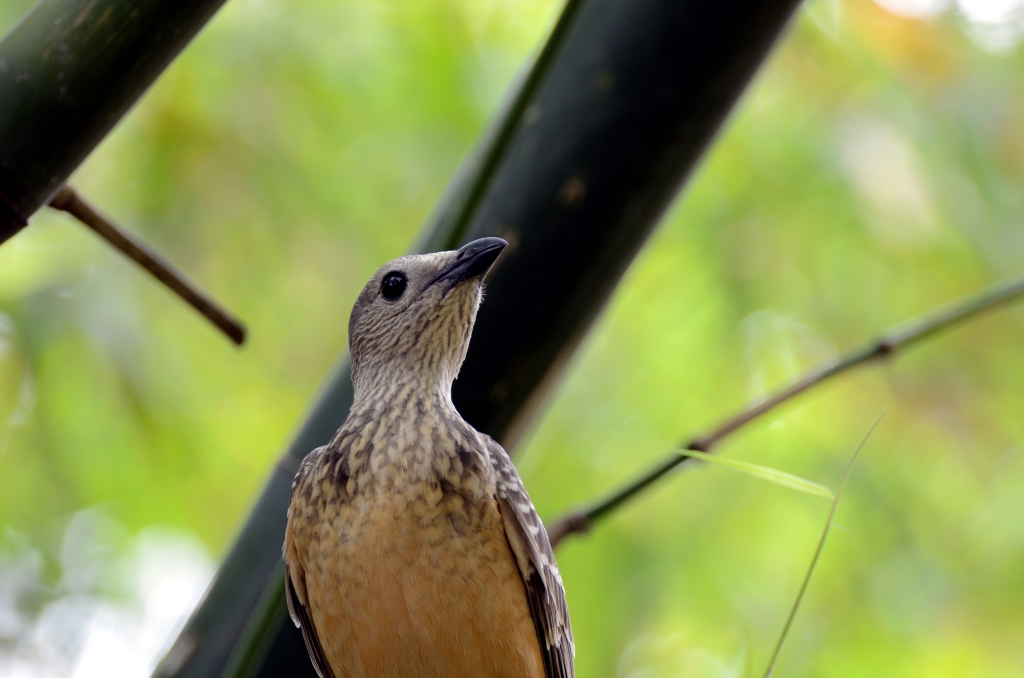
Fawn-breasted Bowerbird (Chlamydera cerviniventris) Zoo Miami by Lee
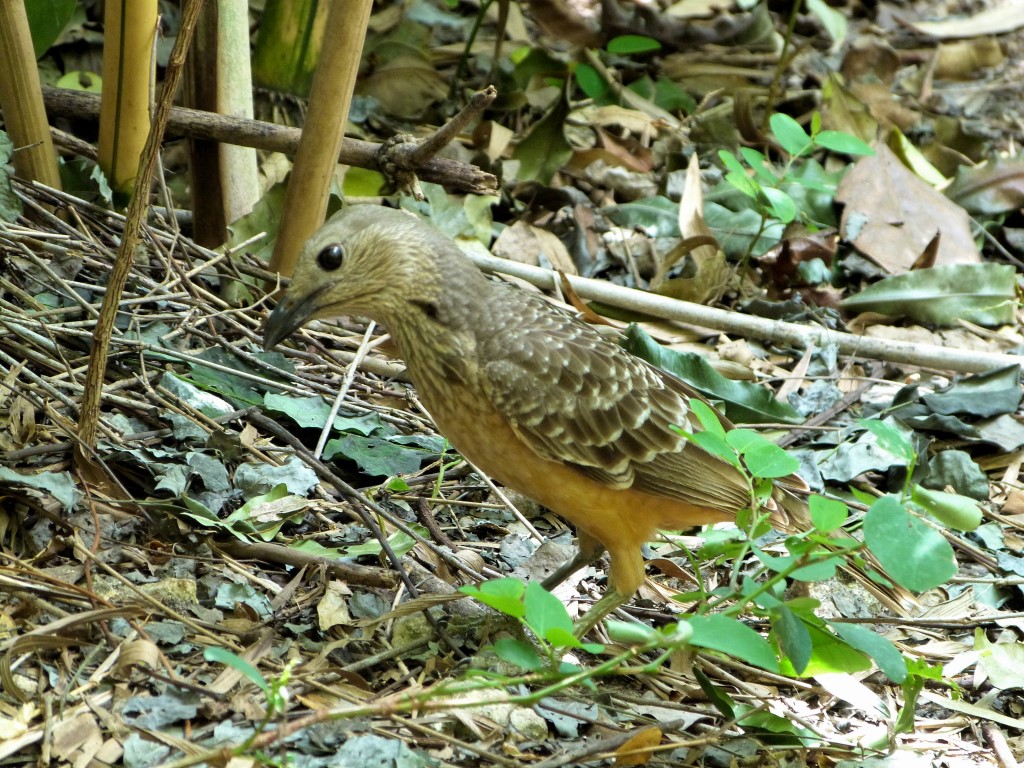
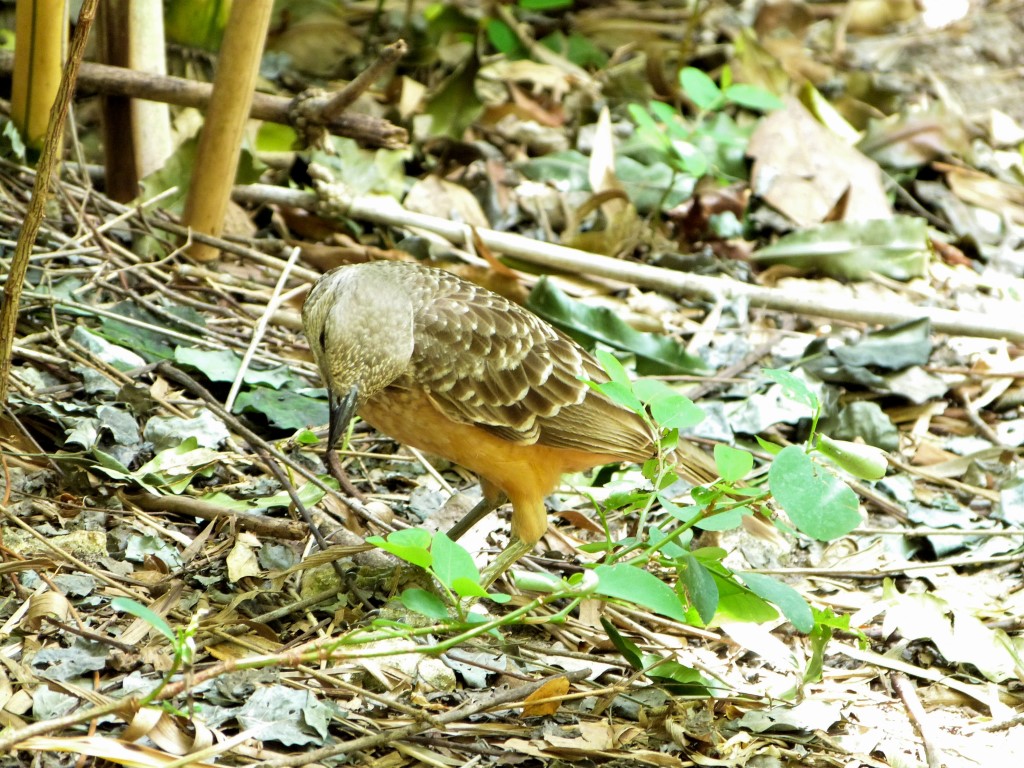
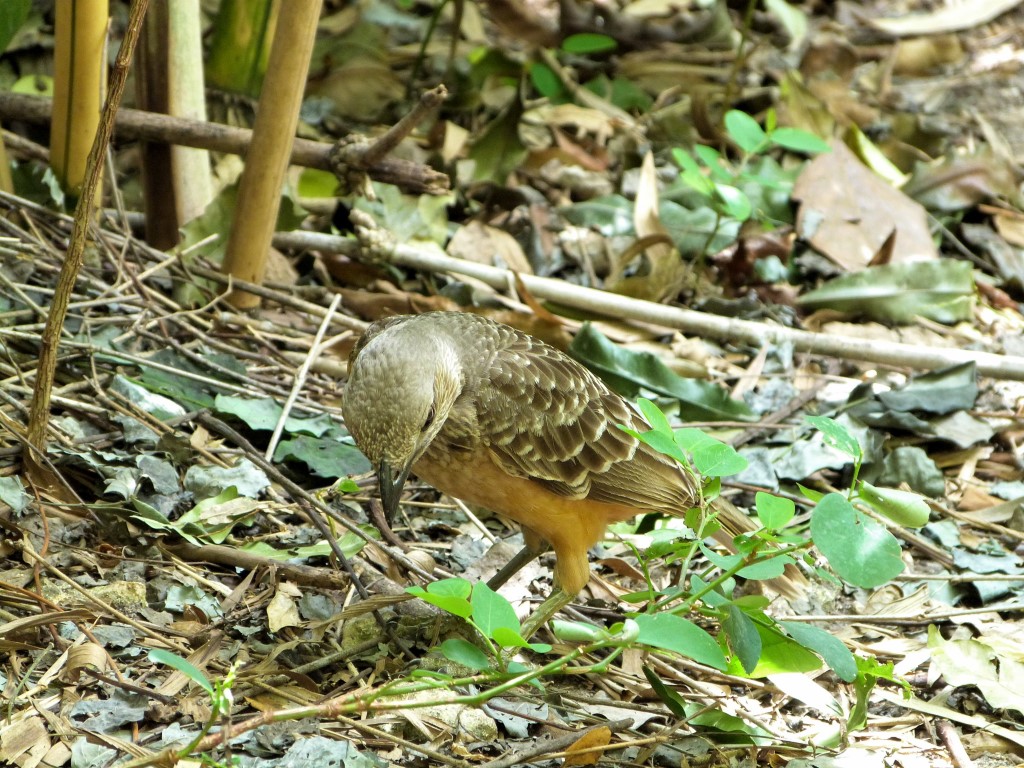
One of the neatest thing to watch on this last trip to the Wings of Asia Aviary at Zoo Miami was the Fawn-breasted Bowerbird working on his bower. “The bower itself is that of “avenue-type” with two sides of wall of sticks and usually decorated with green-colored berries.” In his case, he had green leaves laid out in front.
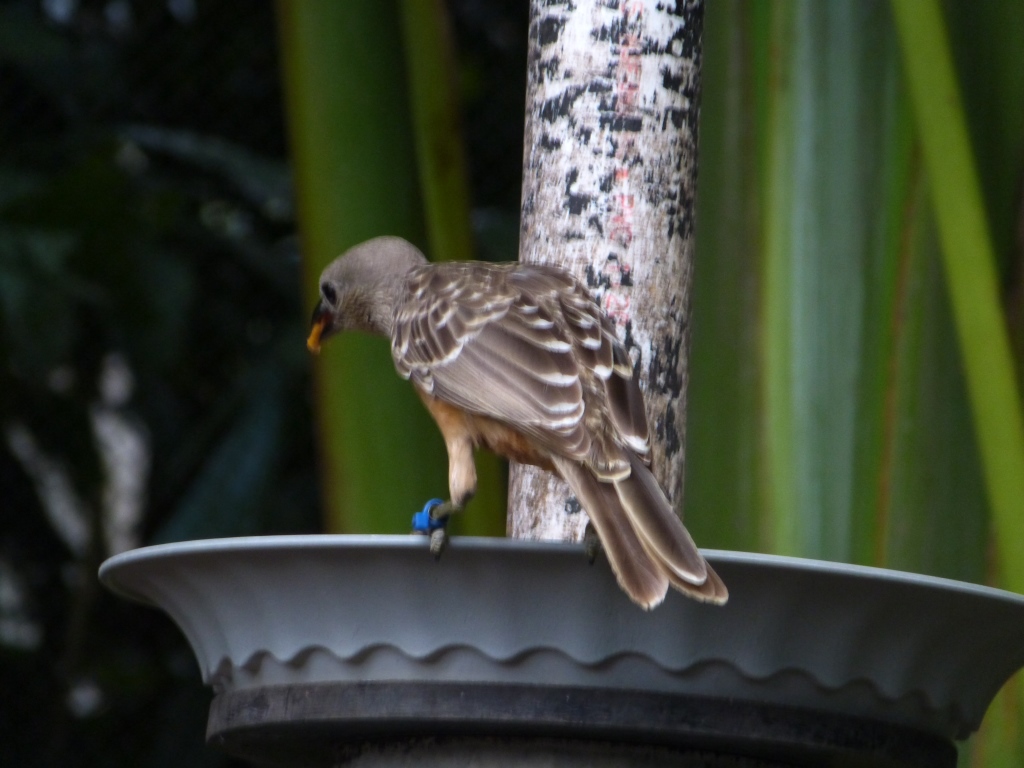
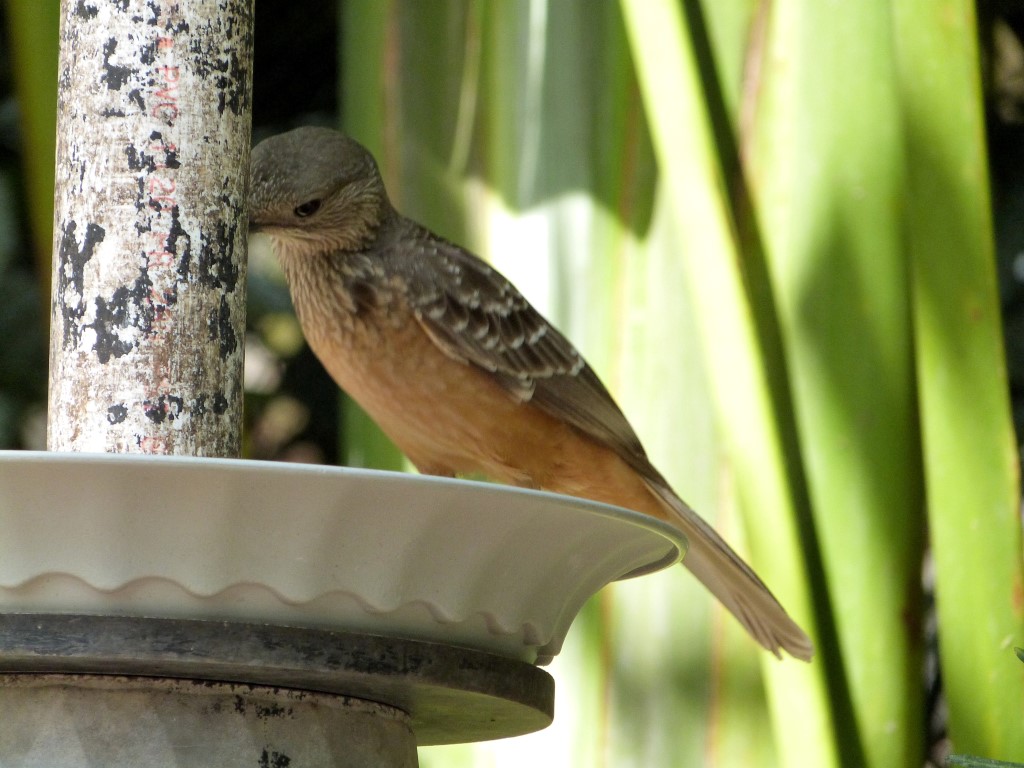
The Fawn-breasted Bowerbird (Chlamydera cerviniventris) is a medium-sized, up to 13 in (32 cm) long, bowerbird with a greyish brown spotted white plumage, a black bill, dark brown iris, yellow mouth and an orange buff below. Both sexes are similar. The female is slightly smaller than the male.
The Fawn-breasted Bowerbird is distributed in New Guinea and northern Australia, where it inhabits the tropical forests, mangroves, savanna woodlands and forest edges. Its diet consists mainly of figs, fruits and insects. The nest is a loose cup made of small sticks up in a tree. The bower itself is that of “avenue-type” with two sides of wall of sticks and usually decorated with green-colored berries. (Wikipedia with editing)
Fawn-breasted Bowerbird by Dan ZM
The Bowerbirds are in the Ptilonorhynchidae-Bowerbird Family. There are twenty species in the family, of which, 16 are Bowerbirds.
*
Here are two video clips of him working on the bower. Notice how he goes in and out the other end of the bower. Unfortunately we were only able to view it from the side. One shot he is actually placing the stick upright in the ground. (I recorded him for a bit and then Dan came along. As I was explaining it to him, I got tickled, so ignore the snorts.) I was absolutely amazed watching this bird, which the Lord created, knowing how to make his bower chamber.
*
*
Did you notice the birds chirping and singing in the background. It is so peaceful in that aviary. The birds have so much room and places to hang out. You actually “bird watch” there.
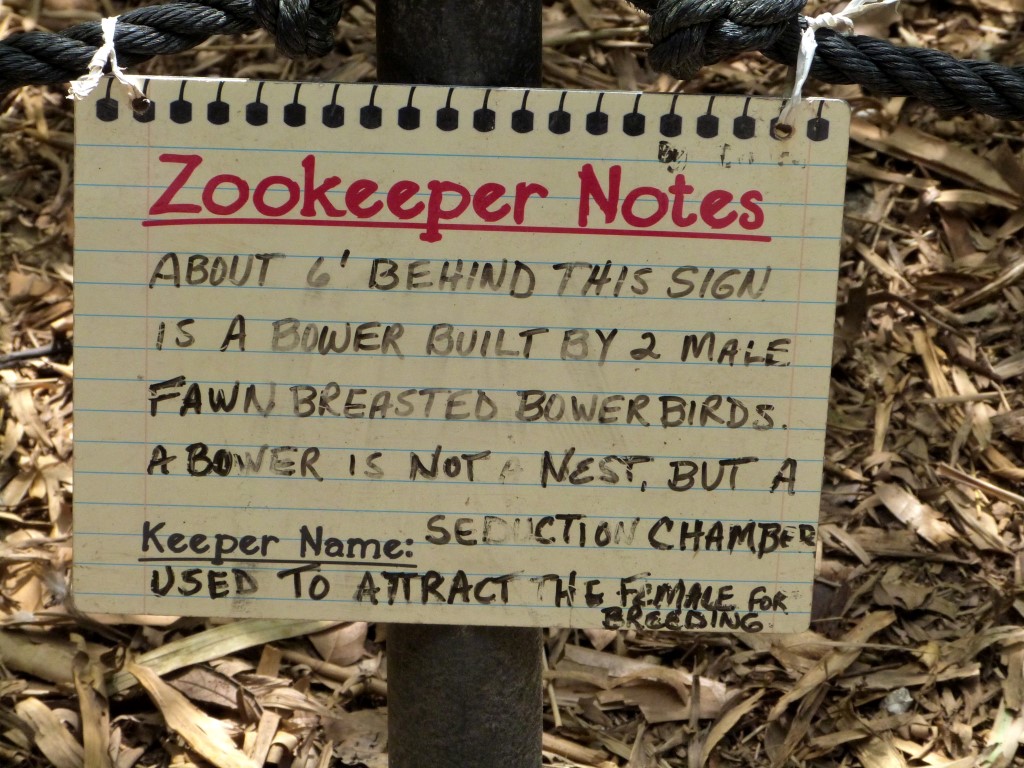
Fawn-breasted Bowerbird (Chlamydera cerviniventris) Sign Zoo Miami by Lee
Bring out with you every living thing of all flesh that is with you: birds and cattle and every creeping thing that creeps on the earth, so that they may abound on the earth, and be fruitful and multiply on the earth.” (Genesis 8:17 NKJV)
This is the sign telling about the Bowerbird and their name for it; a “Seduction Chamber.” We know that the Lord commanded the birds to reproduce and this bird is only following instructions. He builds his bower to entice a female to be his mate.
We were discussing this and several verses came to our minds:
My son, if sinners entice you, Do not consent. (Proverbs 1:10 NKJV)
And you shall stone him with stones until he dies, because he sought to entice you away from the LORD your God, who brought you out of the land of Egypt, from the house of bondage. (Deuteronomy 13:10 NKJV)
And then if any man shall say to you, Lo, here is Christ; or, lo, he is there; believe him not: For false Christs and false prophets shall rise, and shall shew signs and wonders, to seduce, if it were possible, even the elect. (Mark 13:21-22 KJV)
And this is the promise that he hath promised us, even eternal life. These things have I written unto you concerning them that seduce you. (1 John 2:25-26 KJV)
The Fawn-breasted is fine in what he is doing, but we can learn by watching and taking heed for ourselves.
But ask now the beasts, and they shall teach thee; and the fowls of the air, and they shall tell thee: (Job 12:7 KJV)
*
Fawn-breasted Bowerbird by Dan Zoo Miami
Fawn-breasted Bowerbird (Chlamydera cerviniventris) Zoo Miami by Lee
Fawn-breasted Bowerbird (Chlamydera cerviniventris) Zoo Miami by Lee
Picking up material
Trying to find just the right one
Trying to find just the right one
Trying to find just the right one
Trying to find just the right one
Side view of bower
Closer view
Fawn-breasted Bowerbird as entrance. Notice the leaves for decoration.
Fawn-breasted Bowerbird Zoo Miami by Lee
Fawn-breasted Bowerbird (Chlamydera cerviniventris) Sign Zoo Miami by Lee
Getting ready to enter the back end.
You can only see his tail
Fawn-breasted Bowerbird Zoo Miami by Lee
Fawn-breasted Bowerbird (Chlamydera cerviniventris) Zoo Miami by Lee
Fawn-breasted Bowerbird (Chlamydera cerviniventris) Zoo Miami by Lee
Fawn-breasted Bowerbird (Chlamydera cerviniventris) Zoo Miami by Lee
Fawn-breasted Bowerbird (Chlamydera cerviniventris) Zoo Miami by Lee
Opening at back of bower
Fawn-breasted Bowerbird (Chlamydera cerviniventris) Zoo Miami by Lee
Fawn-breasted Bowerbird (Chlamydera cerviniventris) Zoo Miami by Lee
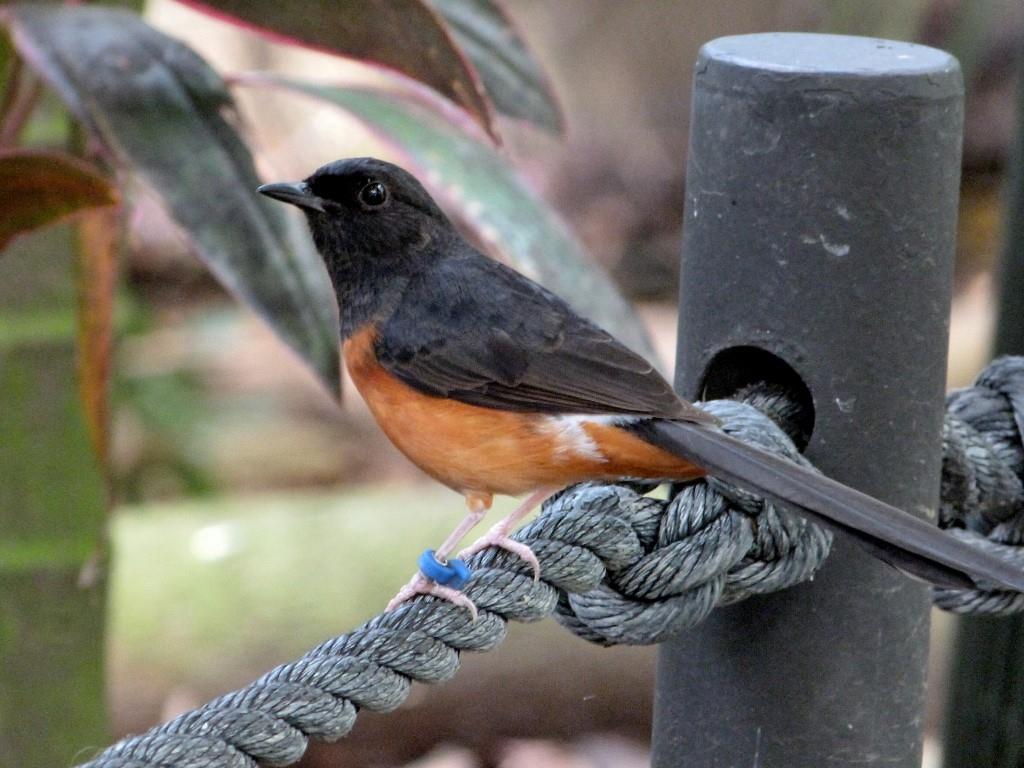
White-rumped Shama (Copsychus malabaricus) at Zoo Miami – Lee
Even the stork in the sky Knows her seasons; And the turtledove and the swift and the thrush Observe the time of their migration; But My people do not know The ordinance of the LORD. (Jeremiah 8:7 NASB)
The White-rumped Shama (Copsychus malabaricus) is a small passerine bird of the family Muscicapidae. Native to densely vegetated habitats in the Indian Subcontinent and Southeast Asia, its popularity as a cage-bird and songster has led to it being introduced elsewhere.
It was formerly classified as a member of the thrush family, Turdidae, causing it to be commonly known as the White-rumped Shama Thrush or simply Shama Thrush.
They typically weigh between 28 and 34 g (1.0 and 1.2 oz) and are around 23–28 cm (9–11 in) in length. Males are glossy black with a chestnut belly and white feathers on the rump and outer tail. Females are more greyish-brown, and are typically shorter than males. Both sexes have a black bill and pink feet. Juveniles have a greyish-brown colouration, similar to that of the females, with a blotchy or spotted chest.
The voice of this species is rich and melodious which made them popular as cage birds in South Asia with the tradition continuing in parts of Southeast Asia. It is loud and clear, with a variety of phrases, and often mimics other birds. They also make a ‘Tck’ call in alarm or when foraging. One of the first recordings of a bird song that was ever made was of this species. This recording was made in 1889 from a captive individual using an Edison wax cylinder by Ludwig Koch in Germany. (Wikipedia)
Here is a video of the Shama singing the second day we were at the Wings of Asia aviary at the Zoo. The pair have a nest and I think the chicks have hatched. (Senior moment-I don’t remember what they told me.)
The LORD is my strength and my shield; my heart trusted in him, and I am helped: therefore my heart greatly rejoiceth; and with my song will I praise him. (Psalms 28:7 KJV)
I am kicking up dust again behind the scenes. The new IOC 4.2 list came out while we were at the zoo. So far I have 237 pages updated, all but the Lark family. They added a new family and are scrambling the Larks around. I am now preparing to do the indexes. The new 4.2 count is 10,530 species in the world. Stay tuned.
In that day the LORD of hosts will be for a crown of glory and a diadem of beauty to the remnant of His people. (Isaiah 28:5)
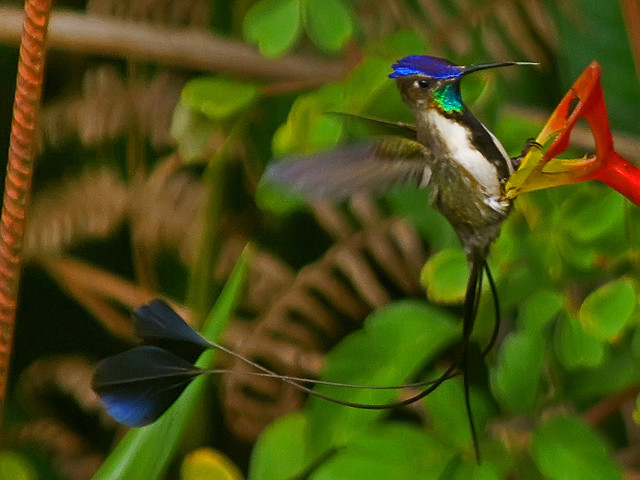
In 1835, when scientists first saw Peru’s most unusual hummingbird, they were so overcome with its beauty that they gave it the name “Marvellous.” This little bird treats the eye to iridescent green, yellow, orange, and purple feathers. But its most unusual feature is its tail. While most birds have eight to twelve tail feathers, the Marvellous hummingbird has only four. Two of these are long, pointed, thorn-like feathers that don’t seem to help much in flying or landing. The other two feathers are truly marvellous. They are six inches long, three times the length of the bird’s two-inch body. On the end of these two long narrow feathers are large feather fans that nearly equal the surface area of its wings.
Astonishingly, the Marvelous hummingbird has complete control of these feathers. At rest, the bird perches with these two feathers hanging down an inch or so from its body, and then crossing them until they are horizontal. In flight and landing they provide remarkable maneuverability. During mating, the hummingbird moves them as semaphores. Interestingly enough, evolutionists admit that they are stumped as to why these unusual feathers should have evolved.
One look at our creation clearly shows that our Creator appreciates beauty. But even the beautiful Marvelous hummingbird is but a poor and cloudy hint of the beauty of our Creator Himself.
Prayer:
Dear Father, help me treat the beauty You have created as You would have me to do. Let me be filled with thanksgiving to You for it, and let it remind me that You are the source of all that is truly beautiful. In Jesus’ Name. Amen.
Notes:
Crawford H. Greenewalt. The Marvelous Hummingbird Rediscovered. National Geographic, Vol. 130, No. 1. P. 98-101.”
This was originally done in 2010, but needs to be re-blogged again. Also, the YouTube above was added. It is astonishing to watch the little bird in action. Thanks to one of our readers who found the video to add to their site. See The Vine Vigil.
The Marvelous (also Marvellous) Spatuletail (hummingbird), Loddigesia mirabilis, is a medium-sized (up to 5.9 in/15 cm long) white, green and bronze hummingbird adorned with blue crest feathers, a brilliant turquoise gorget, and a black line on its white underparts. It is the only member of the monotypic genus Loddigesia.
A Peruvian endemic, this species is found in the forest edge of the Río Utcubamba region. It was first reported in 1835 by the bird collector Andrew Matthews for George Loddiges. The Marvellous Spatuletail is unique among birds, for it has just four feathers in its tail. Its most remarkable feature is the male’s two long racquet-shaped outer tail feathers that cross each other and end in large violet-blue discs or “spatules”. He can move them independently.
Information gathered from Creation Moments, Wikipedia, and YouTube.
Last weekend, we had a family reunion at my brother’s place. He lives near Bushnell and Webster, FL on 5 acres of land. Since it is so wooded with Oak trees and others, I kept my camera at the ready.
We heard lots of birds, saw some and photographed even fewer. We still had a great time.
My nephew from south Florida was there with his family, so I asked four of my great-nieces and great-nephew to join me on a birdwatching adventure. Figured I might as well start training another generation of birdwatchers. We headed off and my almost 5 yr old “chatterbox” nephew produced the first lesson. We encouraged him to “talk less” and “listen.”
Train up a child in the way he should go, And when he is old he will not depart from it. (Proverbs 22:6 NKJV)
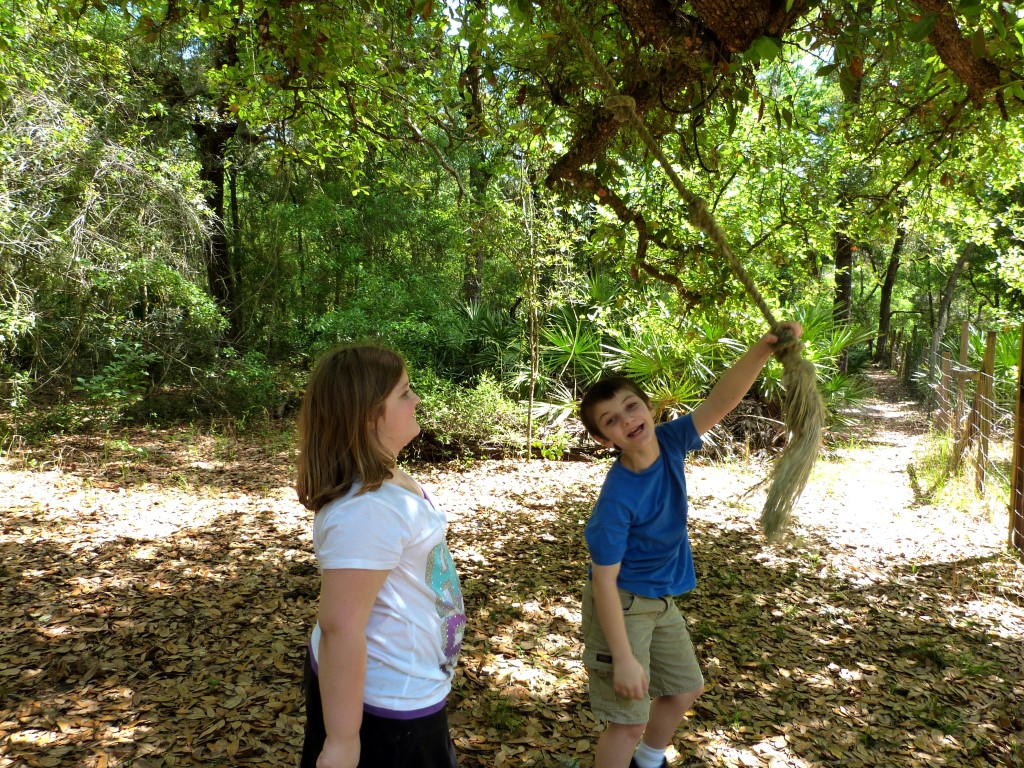
We heard several, but never saw any. (Northern Cardinal, Tufted Titmouse and a Blue Jay) When we got to the end of the property, turned right and followed the fence line. Not very far we came upon a tree with a rope hanging down with knots on it. At that point, all birdwatching and birdwatching lessons stopped.
The rope with the “Chatterbox” aboard.
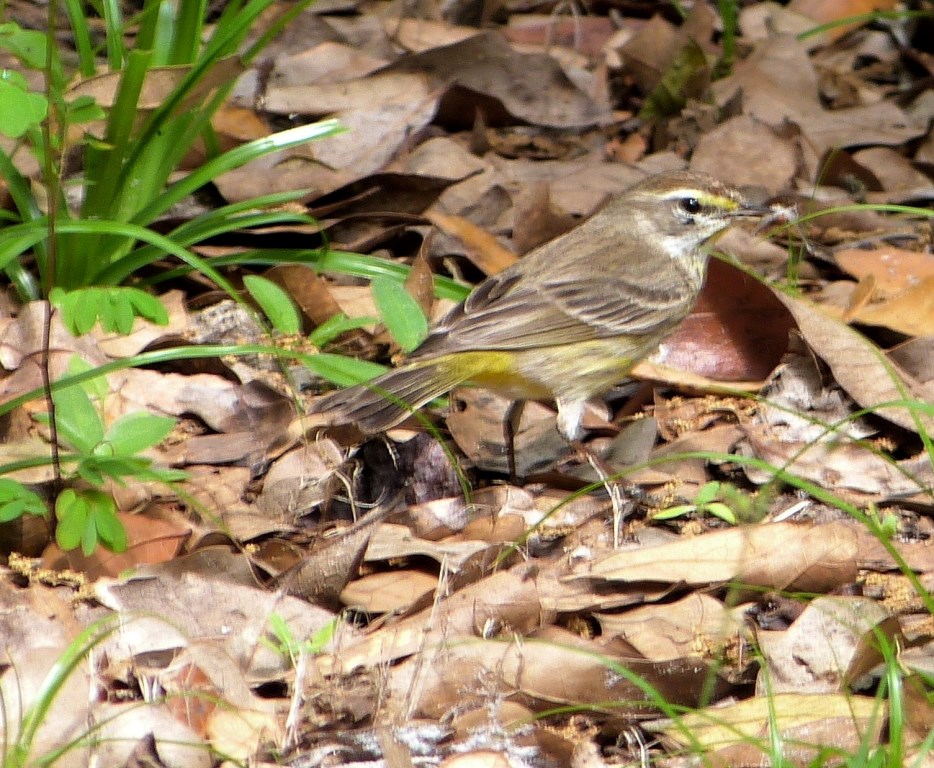
Later, I gathered some more and off we went again. This time my great-niece and nephew from Tampa were with me. We heard those same birds, plus a Palm Warbler, and saw them very briefly. Another lesson was taught about having “soft eyes” as you look at trees. Don’t stare, just sort of look lightly and watch for movement. Fine, we turned the corner at the fence and ran into the “rope” again. That birdwatching adventure ended and another “rope adventure” began.
Oh, that men would give thanks to the LORD for His goodness, And for His wonderful works to the children of men! (Psalms 107:8 NKJV)
At the rope again.
Needless to say, that “rope” became an unexpected highlight of the reunion. Every attempt to take a trip ended up there. They even loaded up my brother’s golf cart and brought a whole crew down there.
What did I eventually see and here? Let’s see; Northern Cardinal, Tufted Titmouse, Blue Jay, Carolina Wrens, Pileated Woodpecker, Ruby-throated Hummingbirds, Grey Catbird, and some Black Vultures flying overhead.
Carolina Wren
To me, one of the highlights was watching the Carolina Wrens flying into a cabinet in my brother’s pole barn. When they weren’t around, this is what I discovered:
Wren nest in a paper box.
On the next to the top shelf they had a nest in the works.
Wren nest in a Pepsi paper cup.
*
Wren nest in a Pepsi paper cup – closeup.
Talking with my sister-in-law, also a birdwatcher – who lives there, she figures that they feel safe in the pole barn because the hawks can’t fly through there and attack the nests. Several years ago on one of my visits, the Wrens had made a nest in a paper sack. There were eggs in it that time.
*
I had the blog on autopilot last week and through the week-end. My sister spent time with us before and after the reunion. Now it is time to get back to blogging.
Where the birds make their nests: as for the stork, the fir trees are her house. (Psalms 104:17 KJV)
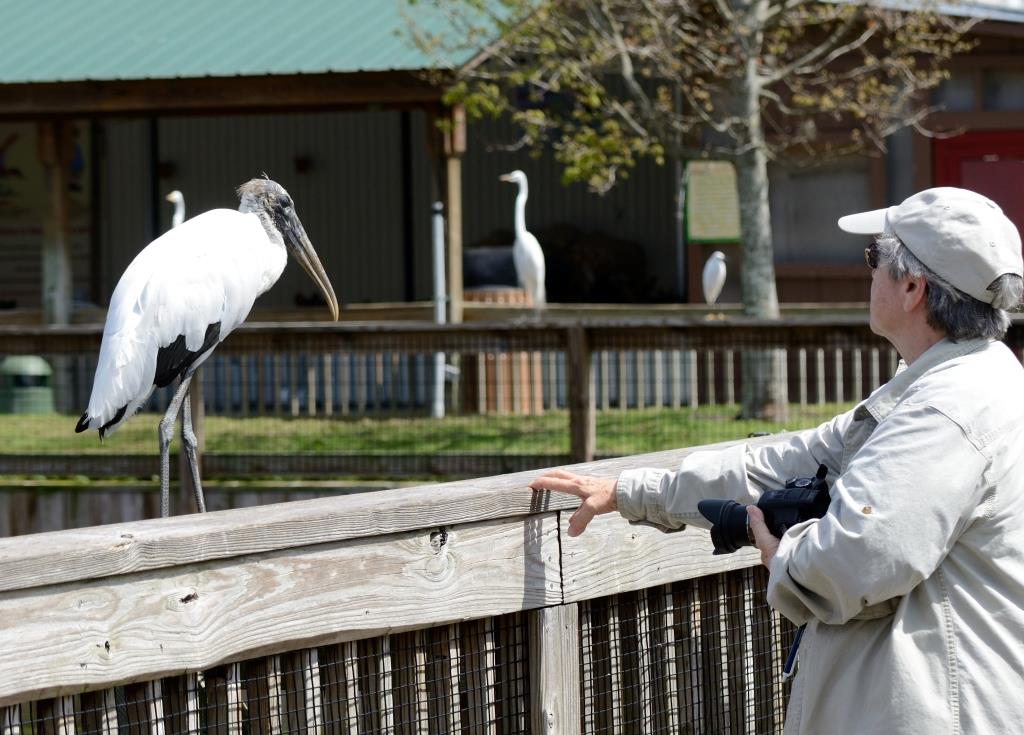
As you can see, these birds at Gatorland can get quite personal. I had been photographing this Wood Stork when Dan took my picture. My hand was about a foot from his beak. On the rail behind us there is a Great Egret and a Snowy.
Lee with Wood Stork at Gatorland by Dan
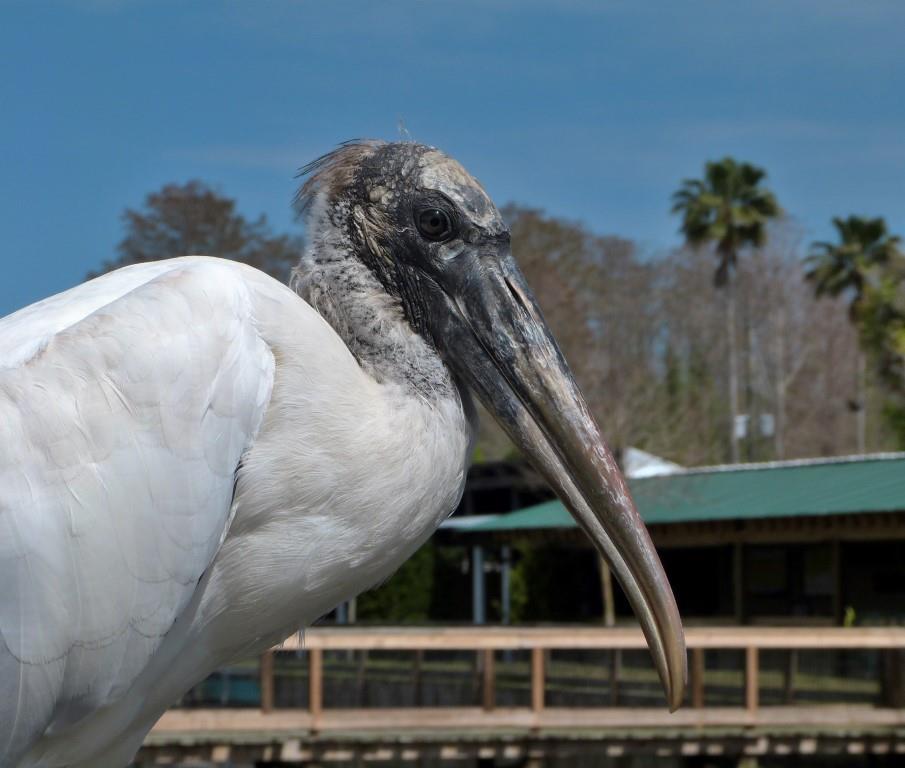
Thought maybe you might like to see what photos I had been taking of that Wood Stork. They were really close-up needless to say. I have been known to be closer. (Me Feeding a Stork)
Wood Stork Close-up by Lee
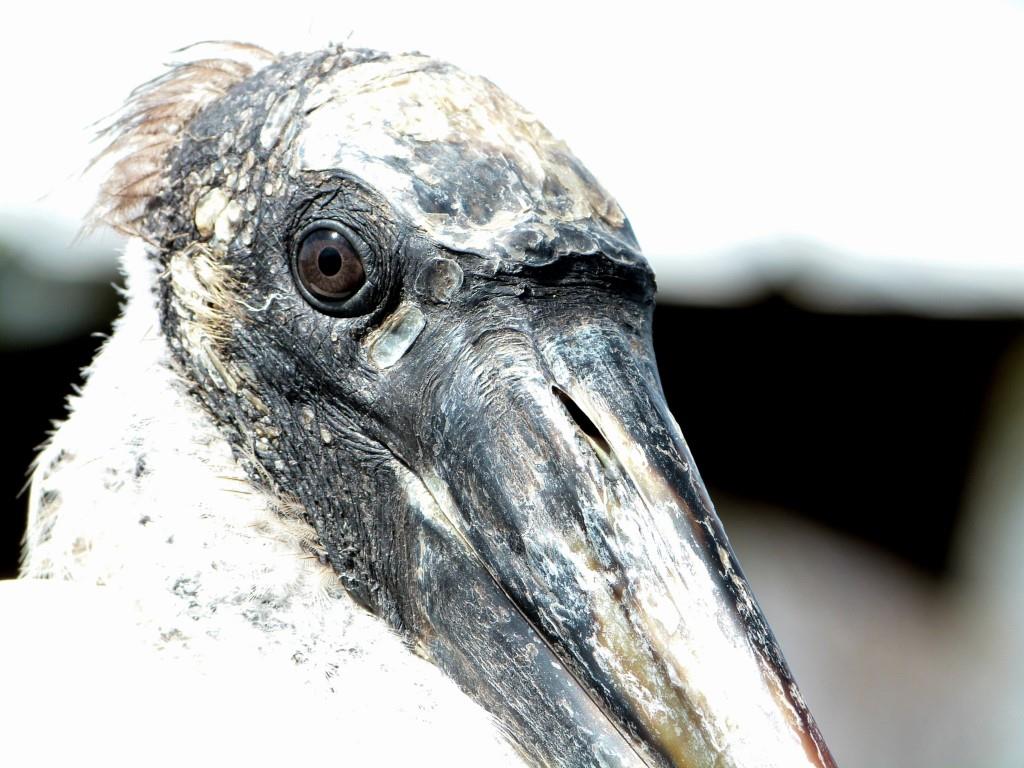
How about a little closer – zoomed in:
Wood Stork Face Close-up by Lee
*
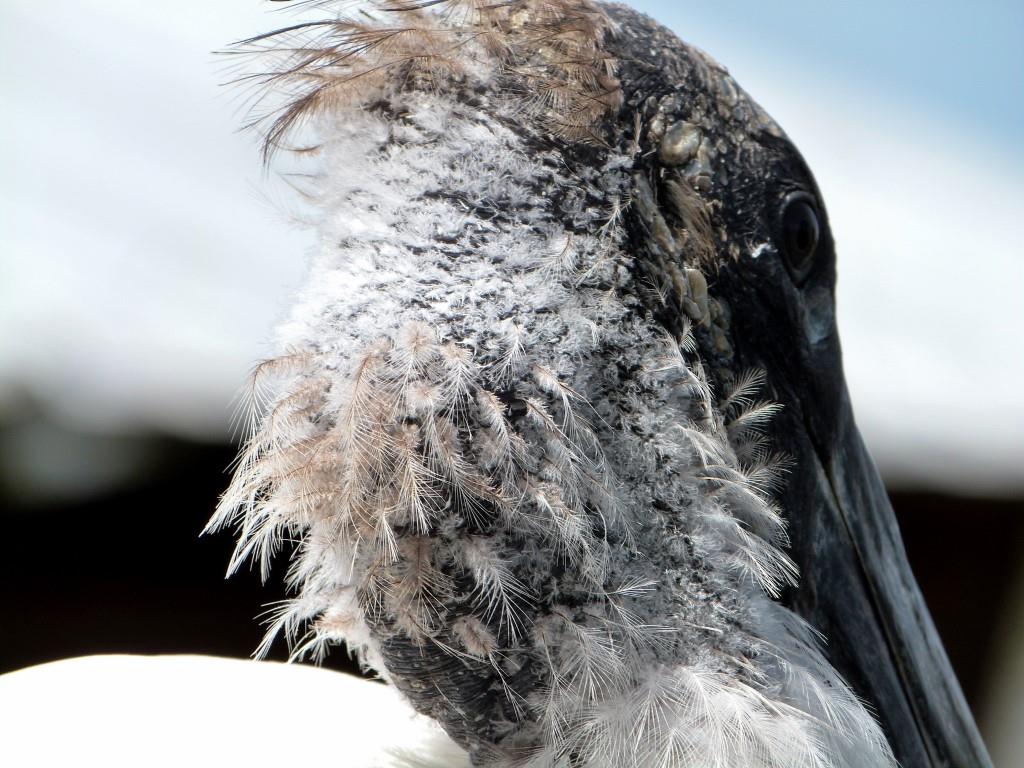
Wood Stork Neck Close-up by Lee
*
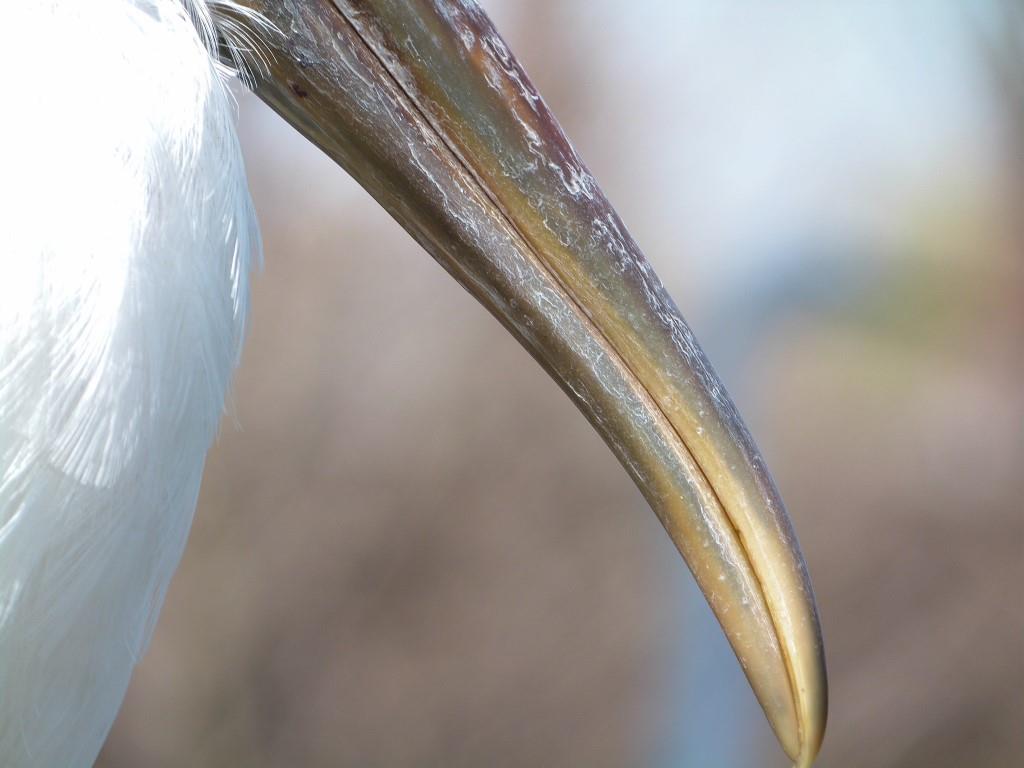
Wood Stork Beak Close-up by Lee
*
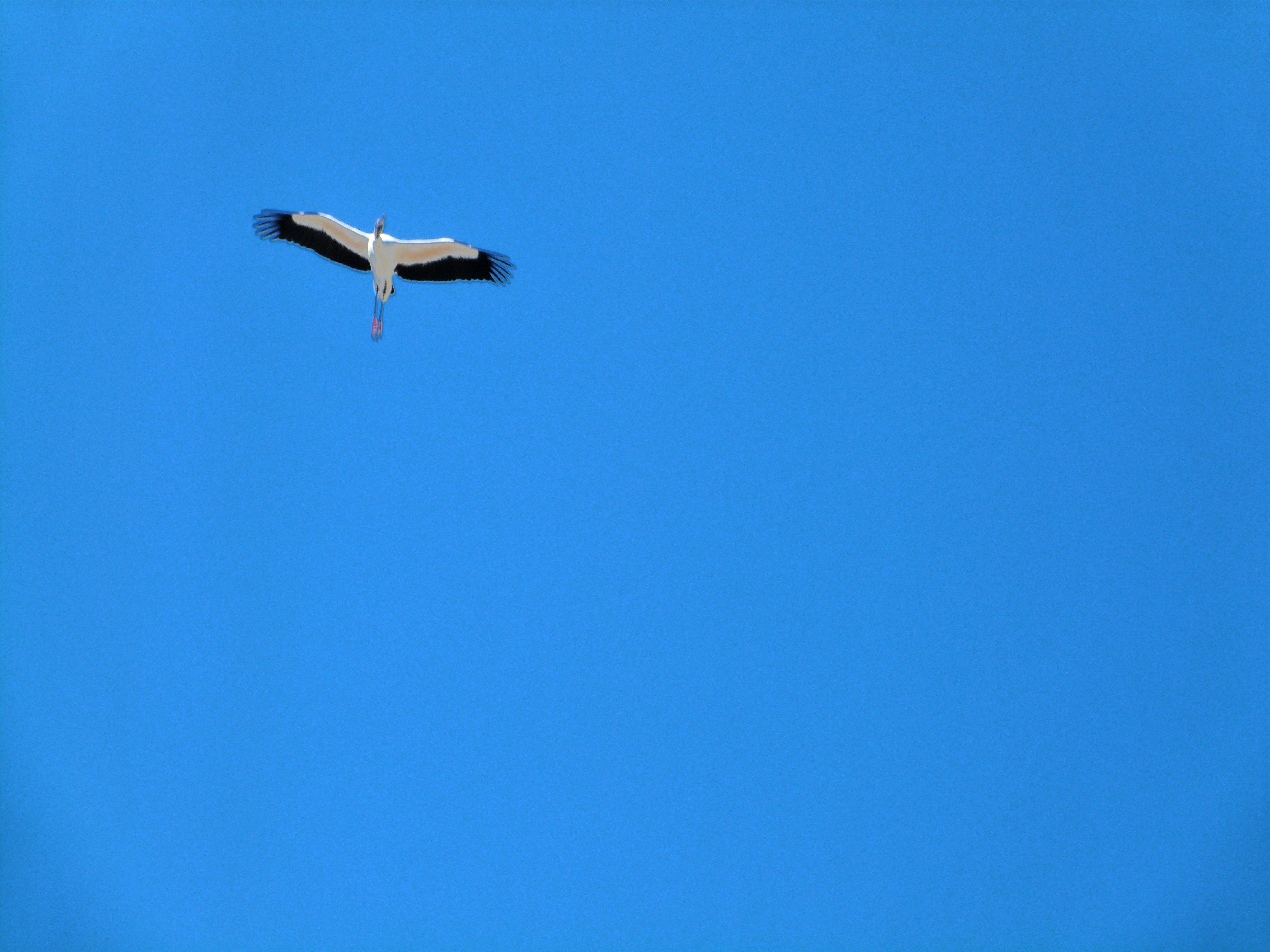
What always amazed about the Wood Storks is that to me they are “ugly”, but when they fly, they are so graceful. Isn’t that the way with us. The Lord made us all, birds and humans, but when we look at someone, there is always somethig that we can find to compliment them on.
This photo was just caught as one flew over, not in focus, but you can see their beauty.
Wood Stork overhead at Gatorland
Yea, the stork in the heaven knoweth her appointed times; and the turtle and the crane and the swallow observe the time of their coming; but my people know not the judgment of the LORD. (Jeremiah 8:7 KJV)
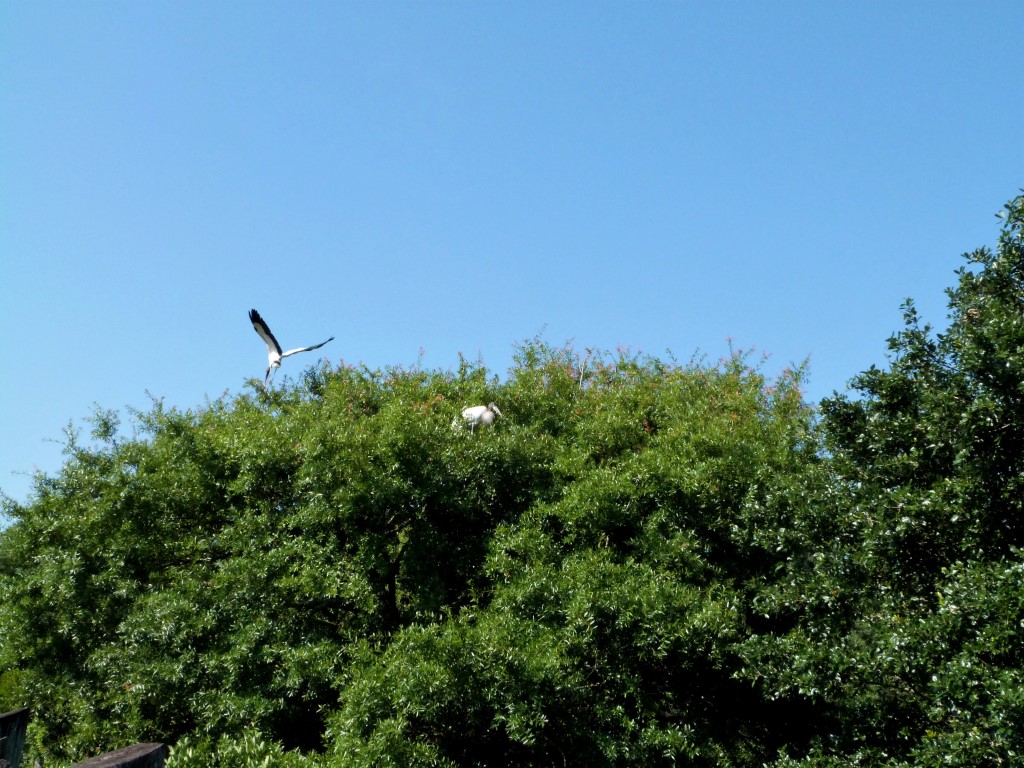
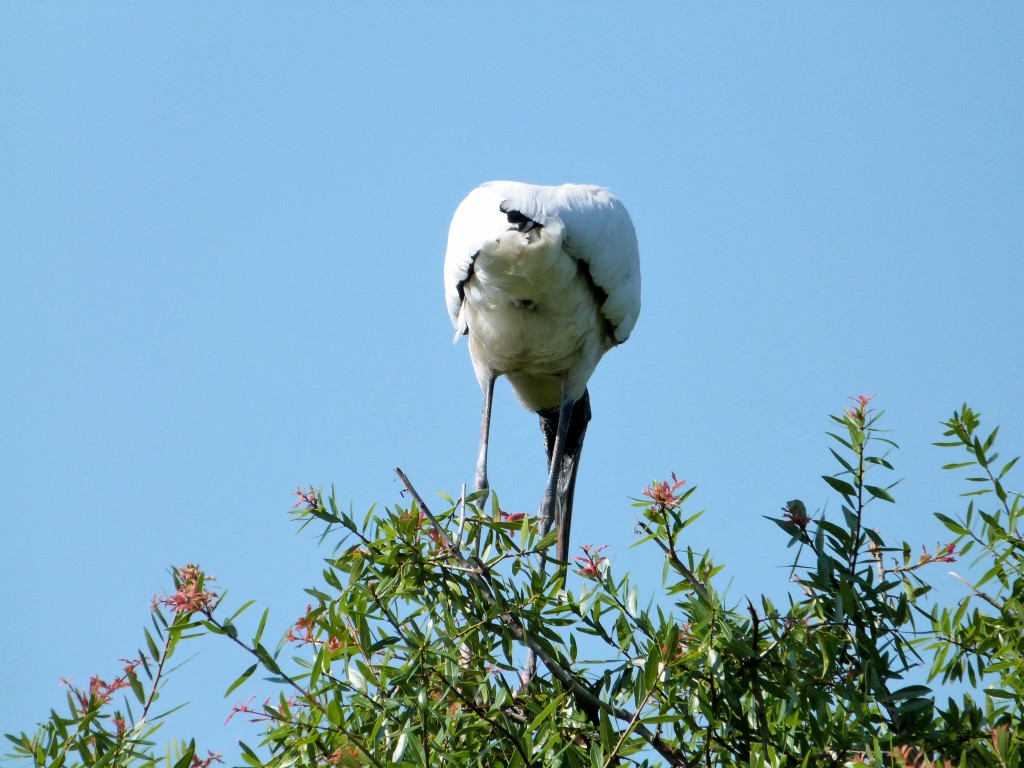
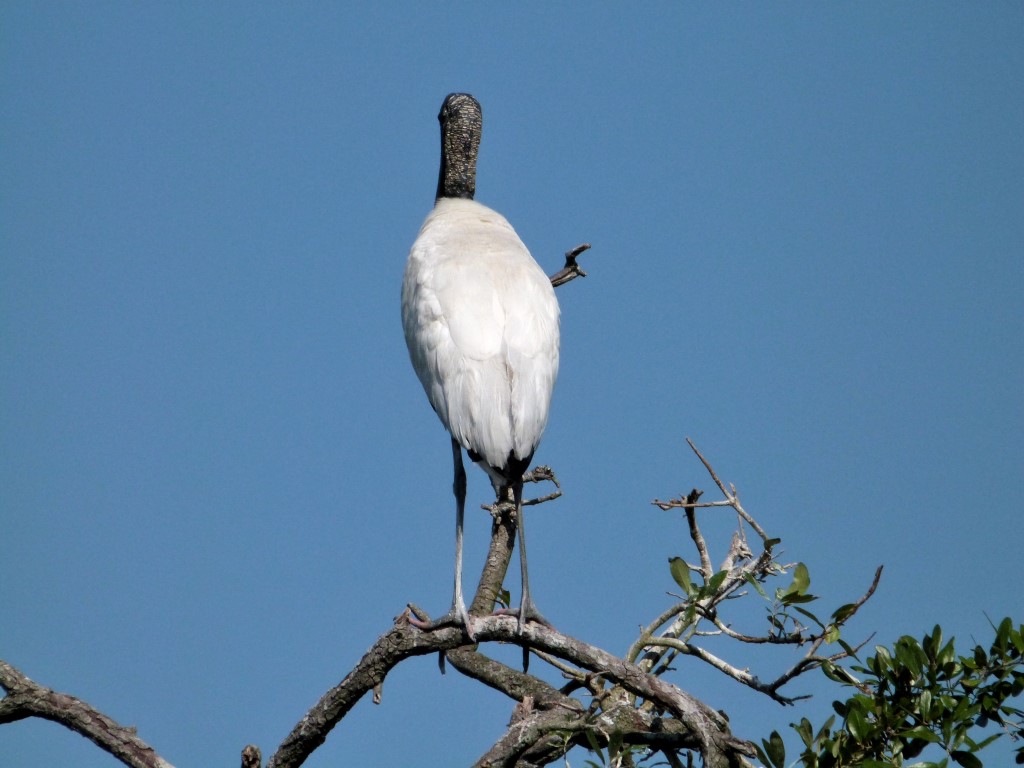
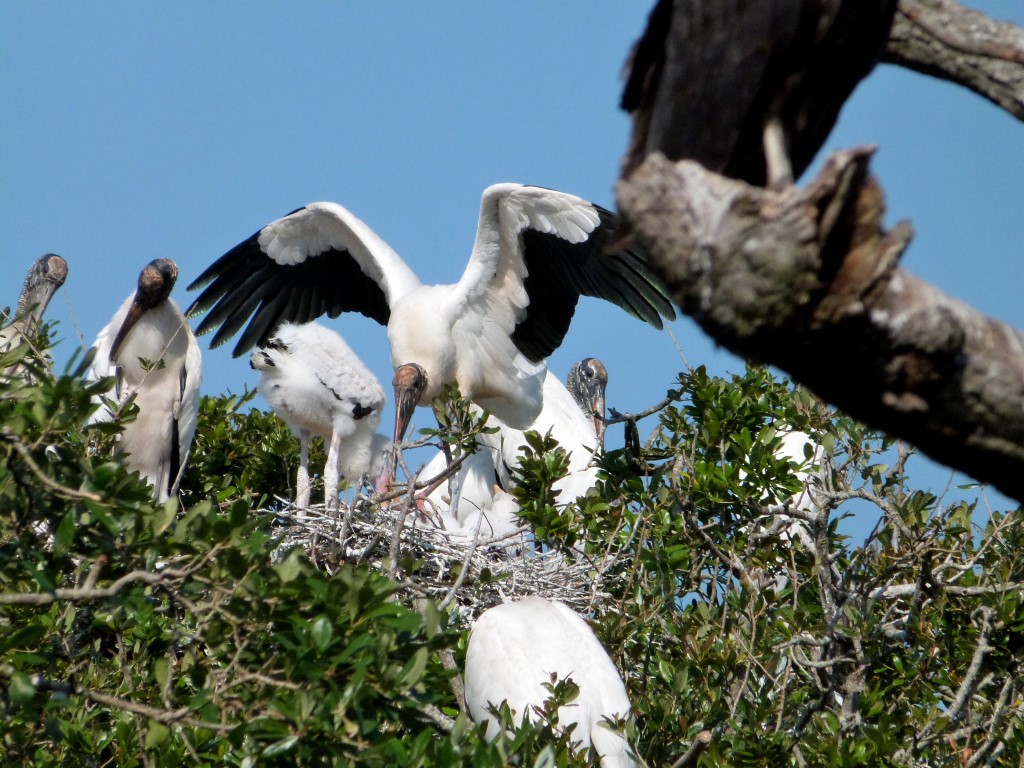
Below are the photos taken of the Wood Storks around Gatorland. The ones in the distant were zoomed in from across the pond (see that photo). Later, we walked around on the other side of the pond and got them closer.
(Disclaimer, I am not a photographer, but a birdwatcher. So, don’t expect super shots, but just trying to show different parts of the Wood Storks.)






















 Lee's Birdwatching Adventures Plus