Latest Wood Stork Encounter

Wood Stork at Lake Morton by Lee

Wood Stork at Lake Morton by Lee

I know all the birds of the mountains (and Lake Morton) , And the wild beasts of the field are Mine. (Psalms 50:11 NKJV)

We finally had a chance to take a short birdwatching adventure to Lake Morton over in Lakeland. I have been battling a cold and cough for the last three weeks. Our trips to Lake Morton don’t require much walking and it is one of the few places that people feed the birds.

When someone parks their car, before they can get across the street, the birds start walking towards them. Needless to say, the birds are expecting something.
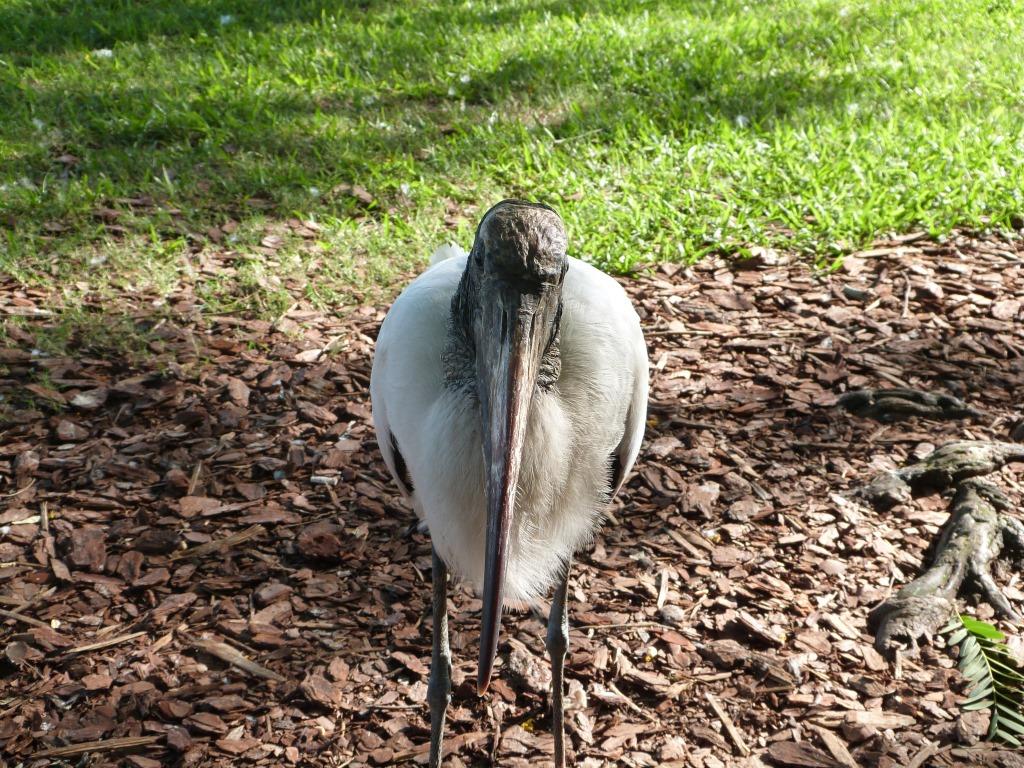
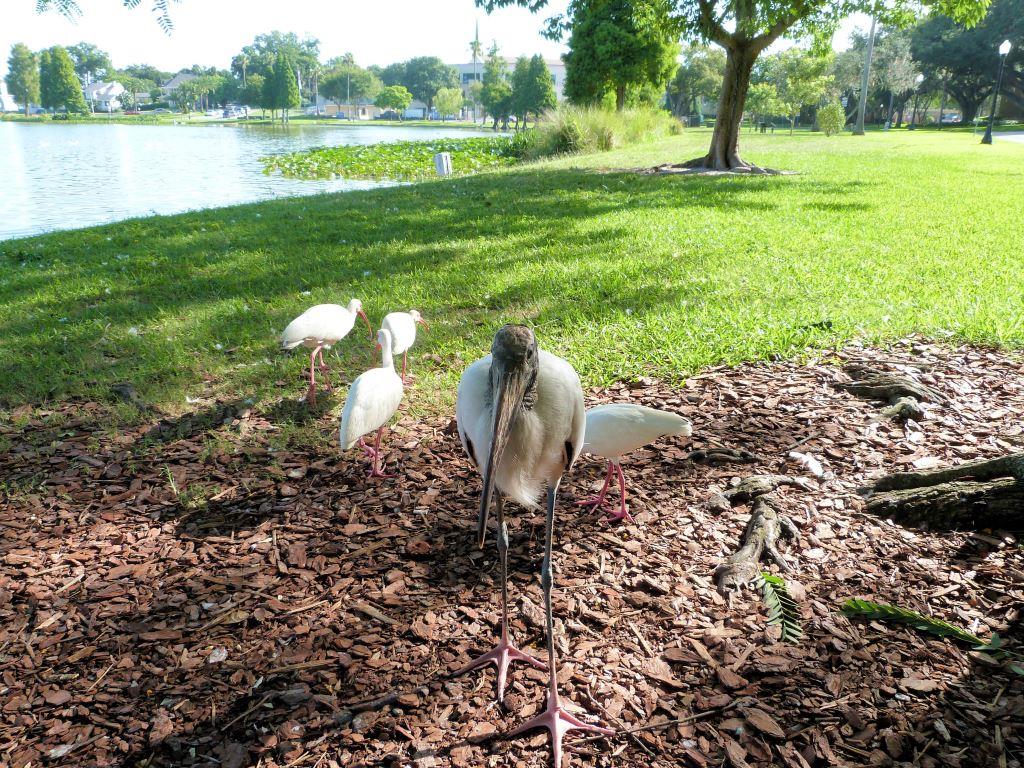
Wood Stork up close by Lee at Lake Morton

Wood Stork up close by Lee at Lake Morton

As I was walking across the street, here they came; Wood Stork in the lead because of its long legs, White Ibises next, followed by the waddling shorter legged birds – Mute Swans, Mallards, Muscovy Duck and then the fly-ins – Boat-tailed Grackles and the Gulls. The Wood Stork met me at the curb.

Of course when you have a treat for them, you become the “Pied Piper.” Apparently, someone must have recently fed them, because they were gathered loosely together. Once I got to the table and sat down, the group gathered around. I was enjoying them so much, I didn’t take many photos then.
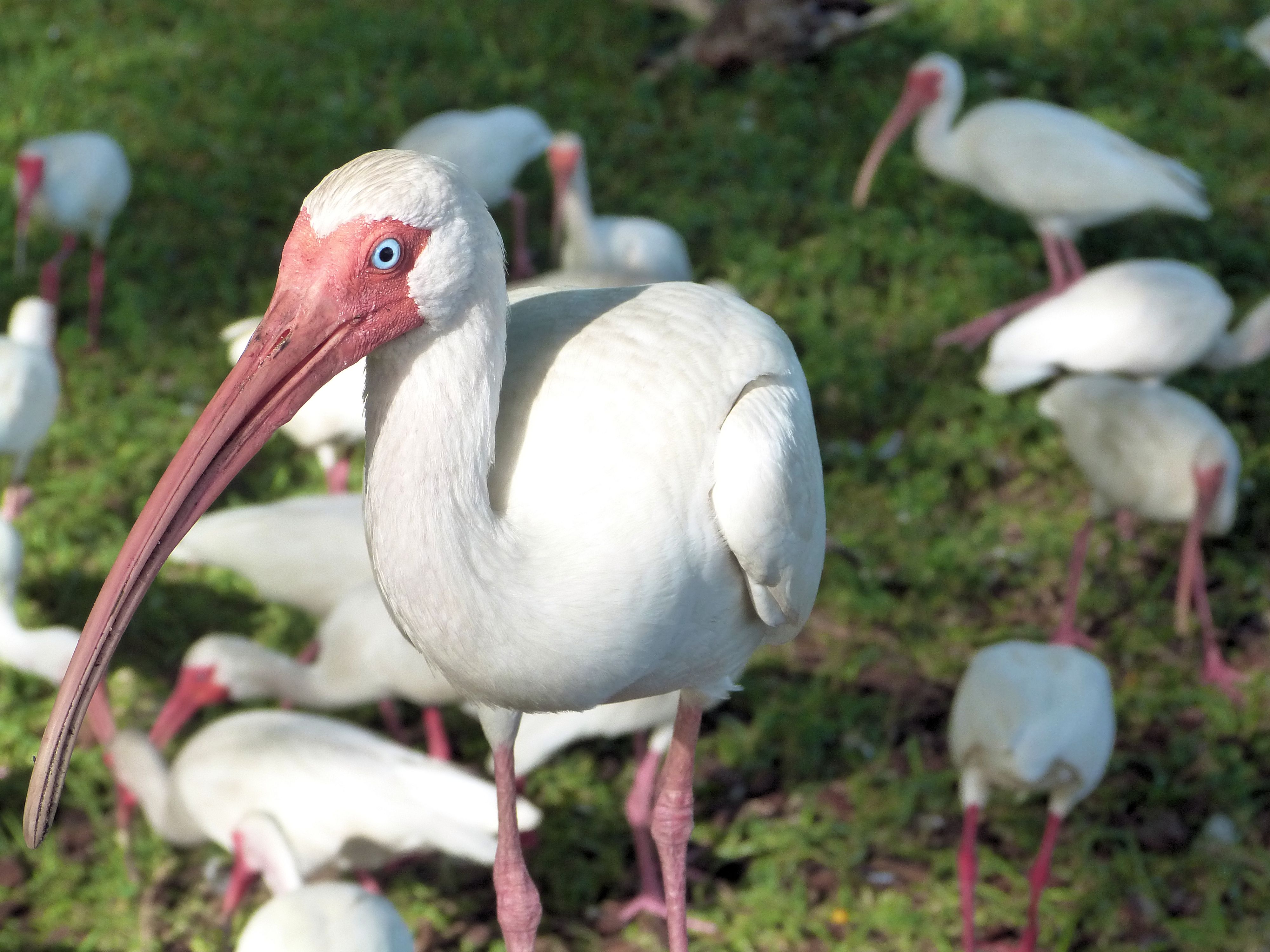
White Ibis on Table by Lee

American White Ibis on Table by Lee

Once the food gave out, of which I didn’t have much to begin with, they moseyed off to rest in the shade until the next visitor with a bag of goodies came. One White Ibis hopped upon the table behind me, but too late because the bag was empty. Took its photo, but it was almost too close.
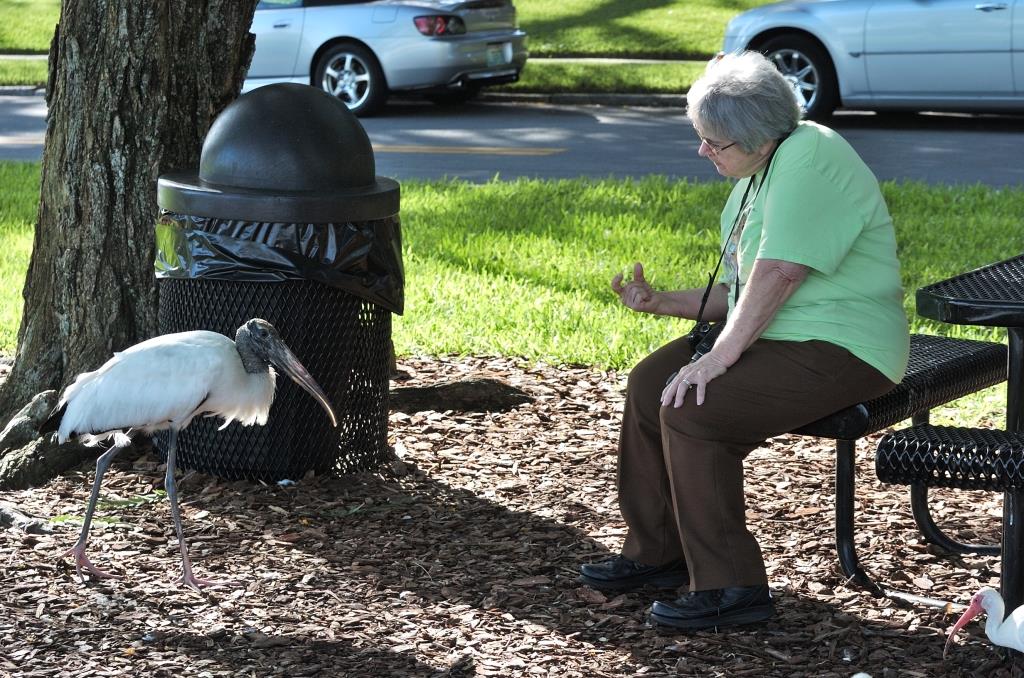
Woodstork & Lee by Dan at Lake Morton

Woodstork & Lee by Dan at Lake Morton

One of the resident Wood Storks walked up in front of me and stood there. I reassured him that I had nothing else, but he (or she) just stayed there. I started talking to it, motioned to come closer, and it did. I could have reached out and touched the Wood Stork, but chose not to with that long beak. Have you ever heard a Wood Stork’s beak “snap” when it grabs food? It is loud. No, I like my fingers!
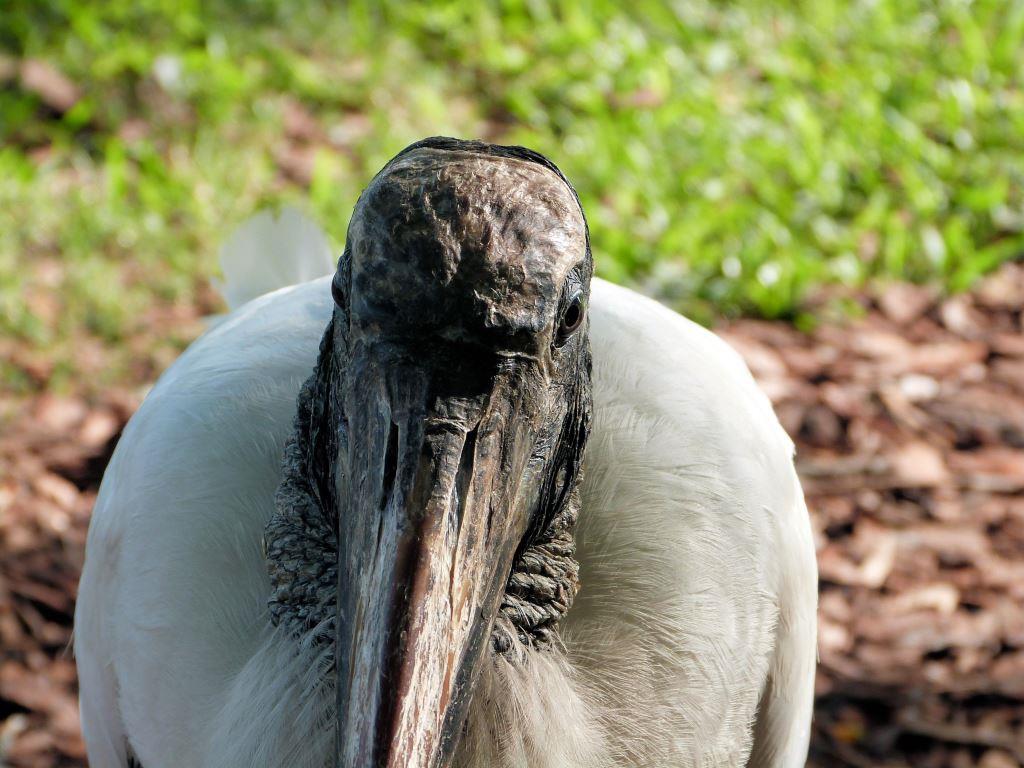
Wood Stork close-up by Lee at Lake Morton

Wood Stork close-up by Lee at Lake Morton

We sat face to face for about 4 minutes of so; me talking and him just standing there looking at me.

Even though they are “ugly,” they are really neat. Have you ever seen a Wood Stork in the air? They are so beautiful and graceful, but up this close? I assured him that the Lord had created him and that He makes no mistakes.

Great is our Lord, and mighty in power; His understanding is infinite. (Psalms 147:5 NKJV)
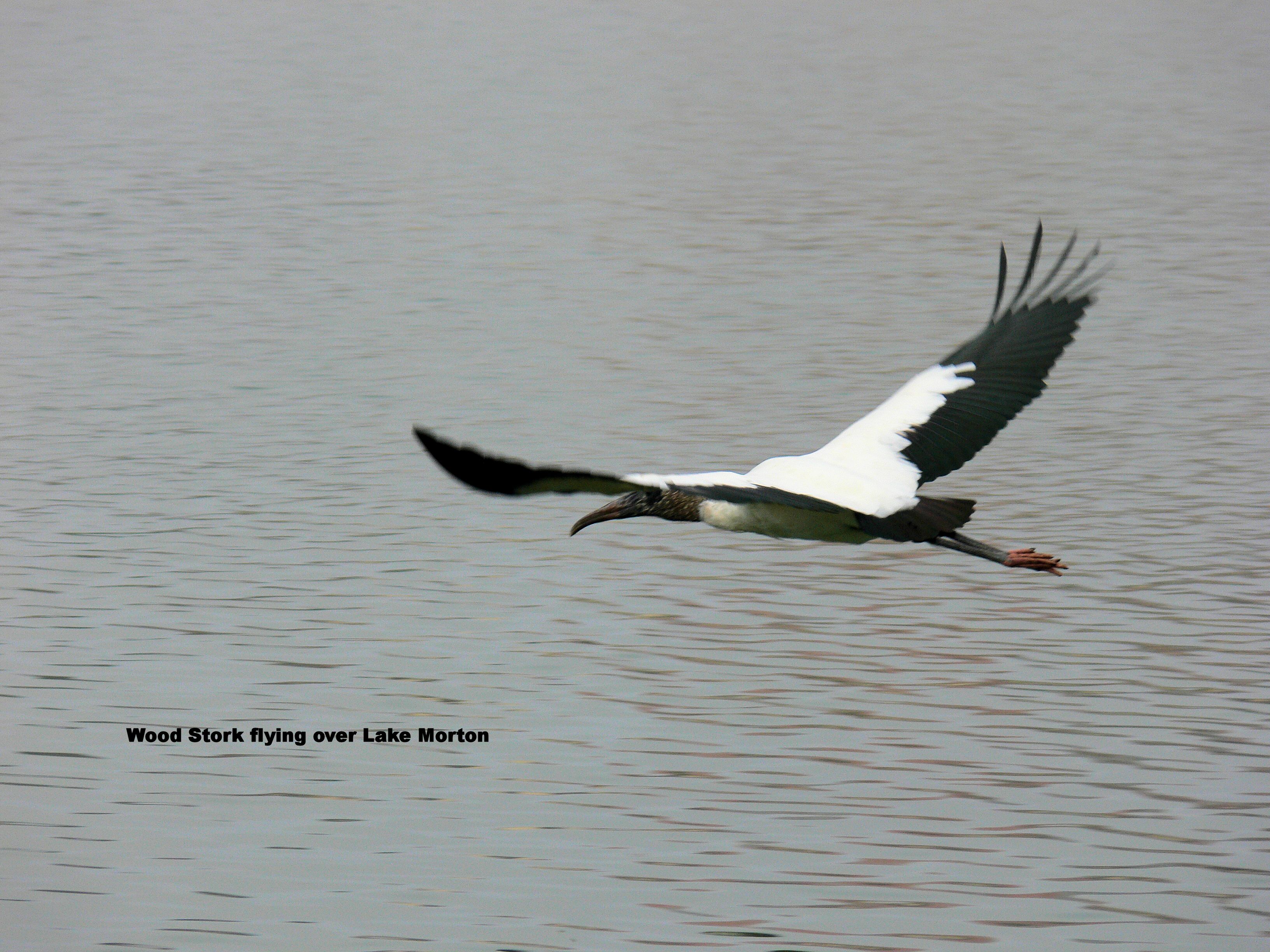
Wood Stork flying over Lake Morton by Lee 2009

Wood Stork flying over Lake Morton by Lee 2009

 The wings of the ostrich wave proudly, But are her wings and pinions like the kindly stork’s? (Job 39:13 NKJV)

Wood Storks belong to the Ciconiidae – Storks Family and are also one of our Birds of the Bible.

Oh, I almost forgot. Since the Wood Stork was so close, I took a close up of its feet.
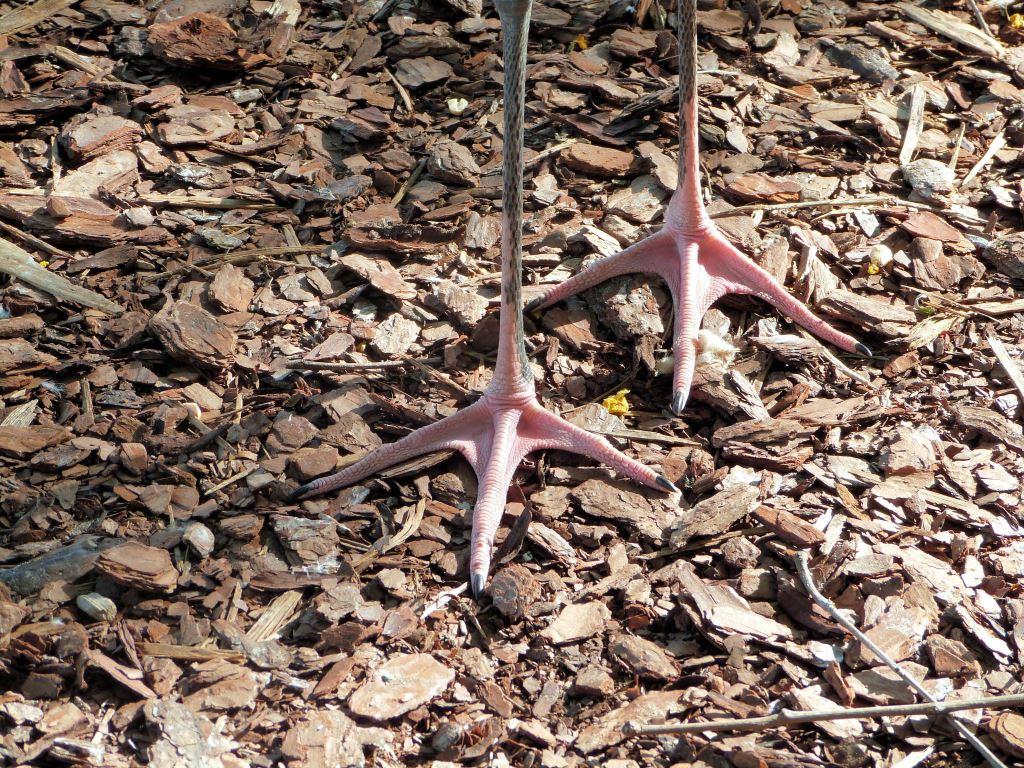
Wood Stork's Feet by Lee

Wood Stork’s Feet by Lee

*

*


Great Blue Heron: Patient, Prompt, and (Rarely) Pugnacious

Great Blue Heron by Dan

Great Blue Heron

Great Blue Heron: Patient, Prompt, and (Rarely) Pugnacious

by Dr. James J. S. Johnson

Luzon Bleeding-heart by Dan

Orni-Theology

The heron family (family Ardeidae, which also includes bitterns and some egrets) and their cousins include some of my favorite long-legged wading birds:  great blue herons, green herons, grey herons, tri-colored herons, night herons, great white egrets, and cattle egrets.


Reddish-Snowys-Greats Egrets -Great Blue Heron all MacDill by Lee

Reddish-Snowys-Greats Egrets -Great Blue Heron by Lee

Their often smaller cousins (of the family Egretta) include the reddish egret, little blue heron, and the snowy egret.  Of these many regard the great blue heron (Ardea herodias) as a favorite:

“For most of us, sightings of great blue herons are confined to a glimpse of the bird as it flies slowly and steadily overhead, wings arching gracefully down with each beat, neck bent back, and feet trailing behind.  At other times we see it on its feeding grounds, standing motionless and staring intently into shallow water, or wading with measured steps as it searches for prey.” [Quoting from “Great Blue Heron”, by Donald & Lillian Stokes, in Bird Behavior, Volume III (Little, Brown & Co., 1989), page 25.]

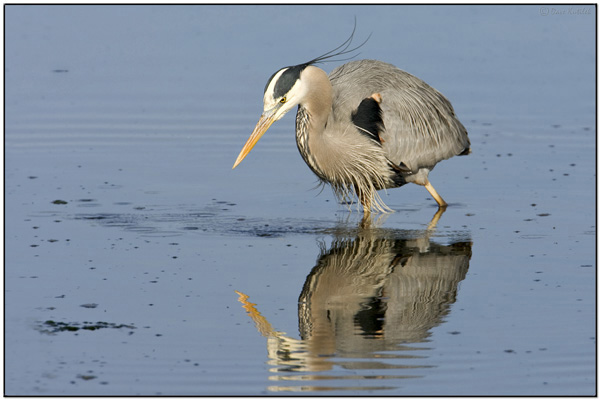
Great Blue Heron by Dave's Pix

Great Blue Heron by Dave’s Pix

The Holy Bible mentions “herons” twice, in Leviticus 11:19 and in Deuteronomy 14:18 (both times translating the Hebrew noun ’anaphah), in Mosaic lists of ritually “unclean” birds.   The bird’s Hebrew name is based on a verb (’anaph) meaning “to snort” or “to be angry”.  Herons can be aggressive, and their almost-violent habit of “zapping” their prey could appear to resemble an aggressor angrily striking at unsuspecting victim. The more likely behavior that matches the Hebrew name, however, is the aggressive defense of a heron’s feeding grounds:

“Defense of feeding territories is commonly seen and involves aerial chases, Frahnk-calls, and aggressive [body language] displays, such as Upright, Bill-down-upright, Bent-neck.  Fighting rarely occurs, but when it does it can be violent, with one bird landing on the back of the other and either bird stabbing the other with its bill.” [Quoting from “Great Blue Heron”, by Donald & Lillian Stokes, above, page 30.]

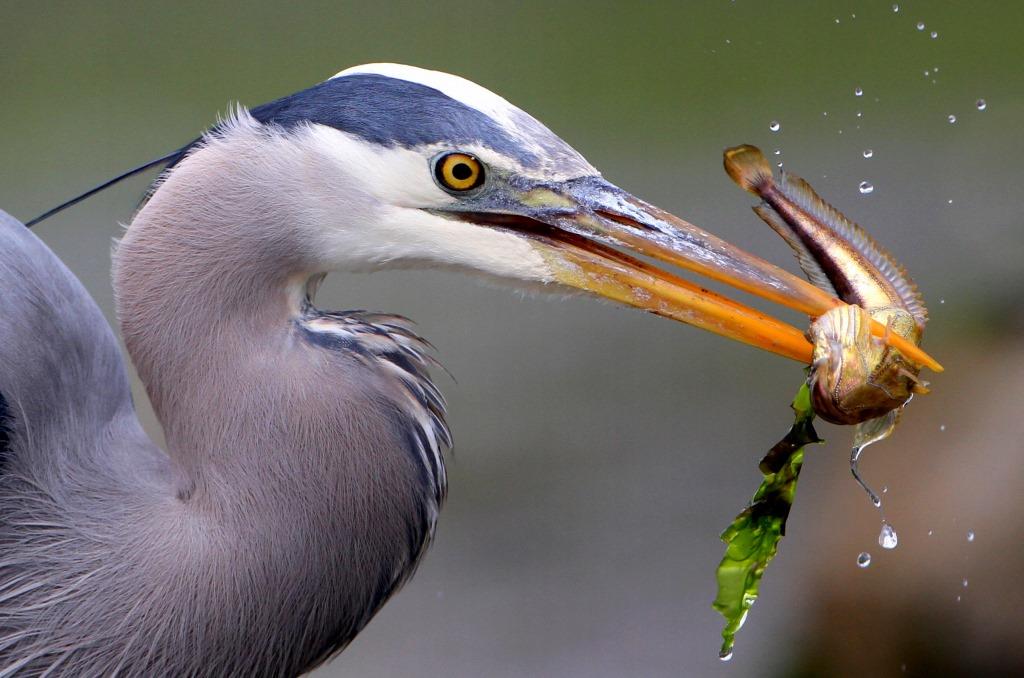
Yet do not imagine that the great blue heron is an erratic hothead that has no self-control, because its self-restraint, when seeking a meal at the shoreline of a pond, is so self-contained that the heron resembles a statue, for many minutes if necessary. Then, zap!  The statue suddenly fast-forwards his sharp beak toward a hapless fish or frog,   —  and instantly the heron is gulping down his dinner!

Great Blue Heron with fish ©© winnu on Flickr

This ability to strike like lightning, yet the choice to withhold doing so (unless the time for doing so is obvious), reminds us of the New Testament directive:  “be ye angry, and sin not” (Ephesians 4:26).

Also, in spiritual matters (Ephesians 6:12), we are exhorted to “contend earnestly” for the Biblical faith (Jude 1:3), in ways that do not involve flesh-and-blood fighting.  Such spiritual conflicts require both the patience and promptness of a sniper (or an opportunistic great blue heron)!   Yes, there may even come a time for the use of physical force, when the stakes are high enough –  remember how the Lord Jesus cleansed the Temple with a whip!  —  but most of the time our anger should be suppressed, with heron-like patience, in order to achieve the most worthy goals in life.

><> JJSJ

See:

Orni-Theology
Ardeidae- Herons, Bitterns
Birds of the Bible –  Herons
Dr. James J. S. Johnson – Guest Writer

*


Sunday Inspiration – Sparrows II

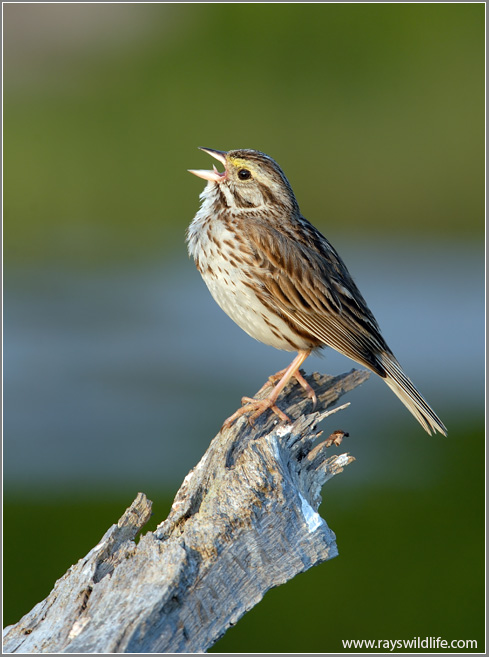
Savannah Sparrow singing by Ray

Savannah Sparrow singing by Raymond Barlow

Even the sparrow finds a home, and the swallow a nest for herself, where she may lay her young, at your altars, O LORD of hosts, my King and my God. Blessed are those who dwell in your house, ever singing your praise! Selah. (Psalms 84:3-4 ESV)

I know we used the Sparrows before with an orchestra playing “His Eye Is On The Sparrow, but this special by Kathy Lisby from Faith, is so good, I just have to share it.

*

This slideshow requires JavaScript.

*

“His Eye Is On The Sparrow ” – by Kathy Lisby

*

Fixed Daddy’s Bedtime Bird Stories

Daddys Bedtime Story Images (1)

Daddy’s Bedtime Bird Stories had some broken links because of a change in Gutenberg’s policy. They do not want links to their articles and photos. Long story short, I fixed them and now they should be okay. I also added photo links since I had to redo all of them. Here are the stories so far. I realized there are many stories yet to be told yet. Stay tuned!

(If you should find any broken links, please leave a comment on that story so it can be fixed. Thanks.)

These are the ones available for reading:

*

Links:

Painted Bunting (Passerina ciris) ©©Flickr


  Bird Tales


  Daddy’s Bedtime Bird Stories


Spanish Sparrow (Passer Hispaniolensis) female ©WikiC


  Wordless Birds


*

Wings To Paradise II

Then God said, “Let the waters abound with an abundance of living creatures, and let birds fly above the earth across the face of the firmament of the heavens.” (Genesis 1:20 NKJV

What a fantastic video – WOW! It is a bit long, but worth every minute of it. This is the 2nd one. See Part I  How can anyone watch these birds flying and not realize they have a fantastic Creator? This was produced by Wittydud on YouTube *

I know all the birds of the mountains, And the wild beasts of the field are Mine. (Psalms 50:11 NKJV)

*

Wordless Birds

*

Wings To Paradise I

Then God said, “Let the waters abound with an abundance of living creatures, and let birds fly above the earth across the face of the firmament of the heavens.” (Genesis 1:20 NKJV

What a fantastic video – WOW! It is a bit long, but worth every minute of it.

How can anyone watch these birds flying and not realize they have a fantastic Creator?

This was produced by Wittydud on YouTube

*

*

I know all the birds of the mountains, And the wild beasts of the field are Mine. (Psalms 50:11 NKJV)

*

Who Paints The Leaves?

*

Bird Tales – Summertime Reading

Caribbean Dove (Leptotila jamaicensis) ©WikiC

Caribbean Dove (Leptotila jamaicensis) ©WikiC

So I said, “Oh, that I had wings like a dove! I would fly away and be at rest. (Psalms 55:6 NKJV)

(Just published this on the other site “Birds of the Bible For Kids” and thought you might also enjoy reading these stories. Maybe you have children or grandchildren that would enjoy you reading to them.)

Now that school is out for most students, it’s time for reading. Why not check out some of the stories about birds. Here are some that you may have missed while you were busy studying during the school year.

Western Screech Owl (Megascops kennicottii)(captive) by Raymond Barlow

Western Screech Owl (Megascops kennicottii)(captive) by Raymond Barlow

And He said, “My Presence wiIl go with you, and I will give you rest.” (Exodus 33:14 NKJV)

Stories From Young Writers:

Mrs. Patterson’s Parrot – by Emma Foster

George The Hummingbird – by Emma Foster

*

Stories From The Past:

The Curious Book of Birds

Daddy’s Bedtime Bird Stories

(Being updated – fixing broken links and polishing them. Stay tuned.)

Enjoy taking a break!

*


Sunday Inspiration – Birds and Peace

White Pelicans in Flight - Circle B Bar by Dan

White Pelicans in Flight – Circle B Bar by Dan

Grace be unto you, and peace, from God our Father, and from the Lord Jesus Christ. (1 Corinthians 1:3 KJV)

Today’s is more about the song that Sean is playing. “I’d Rather Have Jesus Than Anything.” These photos are of birds and places we have had the privilege of visiting to watch the marvelous avian wonders that the Lord Jesus Christ Created. The Lord gives us a peace as we live for Him that is hard to put into words. Maybe as you watch these photos (Lord knows, I’m no photographer, just a birdwatcher who carries a camera) that you can sense the peace I have as I go birdwatching. Also, the Lord has given me a great husband that enjoys seeing these birds as well as I do and he IS a good photographer.

You can know this peace also, when you accept the Lord as your personal Savior.

For God so loved the world, that he gave his only begotten Son, that whosoever believeth in him should not perish, but have everlasting life. (John 3:16 KJV)

And the peace of God, which passeth all understanding, shall keep your hearts and minds through Christ Jesus. (Philippians 4:7 KJV)

This slideshow requires JavaScript.

*

“I’d Rather Have Jesus” by Sean Fielder (from Faith Baptist Church)

*

The photos in this slideshow and the ones on the other site are not quite the same.

*

Birds of Spain – Vimeo

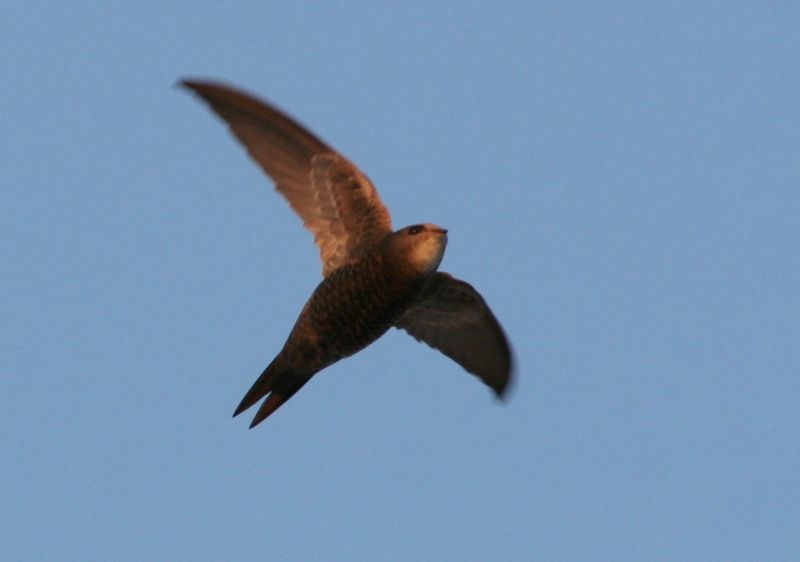
Pallid Swift, Apus pallidus, in flight over Tarifa, Spain ©WikiC

Pallid Swift, Apus pallidus, in flight over Tarifa, Spain ©WikiC

Thought you might enjoy a video of the birds that make Spain their home. Paul wanted to journey to Spain. These type of birds would have greeted him. Also, my good friends, Tim and Pam, are missionaries there.

whenever I journey to Spain, I shall come to you. For I hope to see you on my journey, and to be helped on my way there by you, if first I may enjoy your company for a while….  Therefore, when I have performed this and have sealed to them this fruit, I shall go by way of you to Spain.  (Romans 15:24,28 NKJV)

*

*

Birds of the World

Wordless Birds

Vimeo – The birds of Spain from Wildglimpses

*

Songs In The Night From The Mockingbird

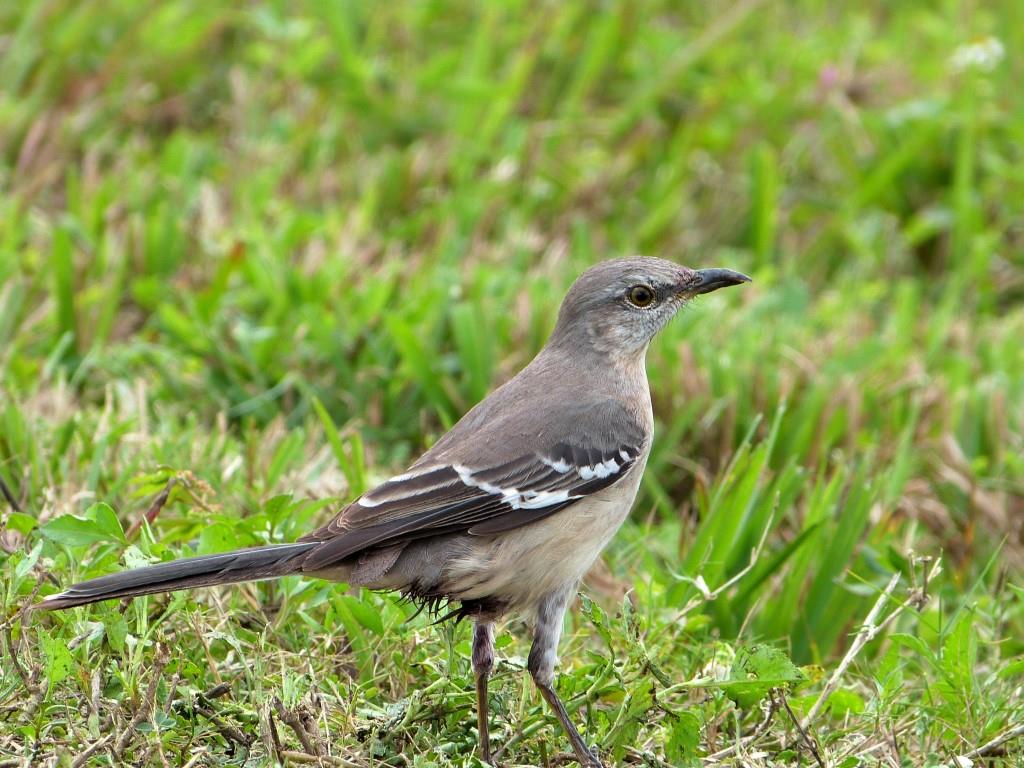
Northern Mockingbird (Mimus polyglottos) By Dan'sPix

Northern Mockingbird (Mimus polyglottos) By Dan

who teaches us more than the beasts of the earth and makes us wiser than the birds of the heavens?’ (Job 35:11 ESV)

Orni-Theology

Orni-Theology

Recently.a friend was telling me about a bird that has been singing every night. He said that it begins around 3 AM and continues for hours. He was frustrated by the bird’s behavior. After discussing it, we came to the conclusion that it is a Northern Mockingbird. They have one with a nest in their yard.

We used to have one that had a nest in the bush outside our bedroom window when we lived in south Florida. Whenever the babies were born, our Mockingbird started its “songs in the night.” The songs are pleasant, but in the middle of the night, the urge to throw a pillow out the window sounds tempting.

Northern Mockingbird (Mimus polyglottos) Juvenile ©WikiC

Northern Mockingbird (Mimus polyglottos) Juvenile ©WikiC

Northern Mockingbirds are members of the Mimidae – Mockingbirds, Thrashers Family. They are the only Mockingbird in North America and are the state bird in Arkansas, Florida, Mississippi, Tennessee and Texas, and formerly the state bird of South Carolina. They are omnivore, meaning it eats fruits and insects.

The Northern Mockingbird is a medium-sized mimid that has long legs and tail. Both males and females look alike. Its upper parts are colored gray, while its underparts have a white or whitish-gray color. It has parallel wing bars on the half of the wings connected near the white patch giving it a distinctive appearance in flight. The iris is usually a light green-yellow or a yellow, but there have been instances of an orange color. The bill is black with a brownish black appearance at the base. The juvenile appearance is marked by its streaks on its back, distinguished spots and streaks on its chest, and a gray or grayish-green iris. Northern Mockingbirds measure from 8.1 to 11.0 in (20.5 to 28 cm) including a tail almost as long as its body.

Although many species of bird imitate the vocalizations of other birds, the Northern Mockingbird is the best known in North America for doing so. It imitates not only birds, but also other animals and mechanical sounds such as car alarms. As convincing as these imitations may be to humans, they often fail to fool other birds. (Wikipedia with editing)

Northern Mockingbird Viera Wetlands

Northern Mockingbird Viera Wetlands by Lee

What is interesting about the Bible verse above is that the verse has been used many times before, but I have not used the previous verse. Here are the two verses together.

But no one says, ‘Where is God my Maker, Who gives songs in the night, Who teaches us more than the beasts of the earth, And makes us wiser than the birds of heaven?’ (Job 35:10-11 NKJV)

God our Maker and the Lord our Savior gives us songs in the night when all is well. Apparently, the Mockingbird is happy or joyful as he sings his songs in the night. We can learn from the songster of the night.

Looking at other verses, what can cause us to not have songs in the night?

The LORD will command His lovingkindness in the daytime, And in the night His song shall be with me— A prayer to the God of my life. (Psalms 42:8 NKJV)

Are we praying and staying in communication with the Lord? When sin creeps in, the songs stop ringing out.

You shall have a song as in the night when a holy feast is kept, and gladness of heart, as when one sets out to the sound of the flute to go to the mountain of the LORD, to the Rock of Israel. (Isaiah 30:29 ESV)

When we have Communion, our pastor always asks us to make sure our fellowship with the Lord and others is clear. When all is straightened out, then we can have our “feast” (communion) with a clear forgiven spirit.

About midnight Paul and Silas were praying and singing hymns to God, and the prisoners were listening to them, (Acts 16:25 ESV)

Even when circumstances are not what we would like are we still “praying and singing hymns to God”?

Why we should sing night or day:

speaking to one another in psalms and hymns and spiritual songs, singing and making melody in your heart to the Lord, (Ephesians 5:19 NKJV)

Let the word of Christ dwell in you richly in all wisdom, teaching and admonishing one another in psalms and hymns and spiritual songs, singing with grace in your hearts to the Lord. And whatever you do in word or deed, do all in the name of the Lord Jesus, giving thanks to God the Father through Him. (Colossians 3:16-17 NKJV)

*

*

Also:

*

Orni-Theology Introduction

Orni-Theology with Luzon Bleeding-heart by Dan

Orni-Theology with Luzon Bleeding-heart by Dan

In the last blog, the term “Orni-Theology” was introduced. (Orni-theology ~ The Master Carpenter) Since then, an Orni-Theology page has been established. There will be links there to the various articles that will feature some bird or bird characteristics with an application and challenge to principles from the Bible, with verses, that we should be applying to our lives.

Orni-Theology with Luzon Bleeding-heart by Dan

Orni-Theology

Also, each article that is of an Orni-Theology category will have this thumbnail attached. (Clicking the thumbnail will take you to the Orni-Theology page)

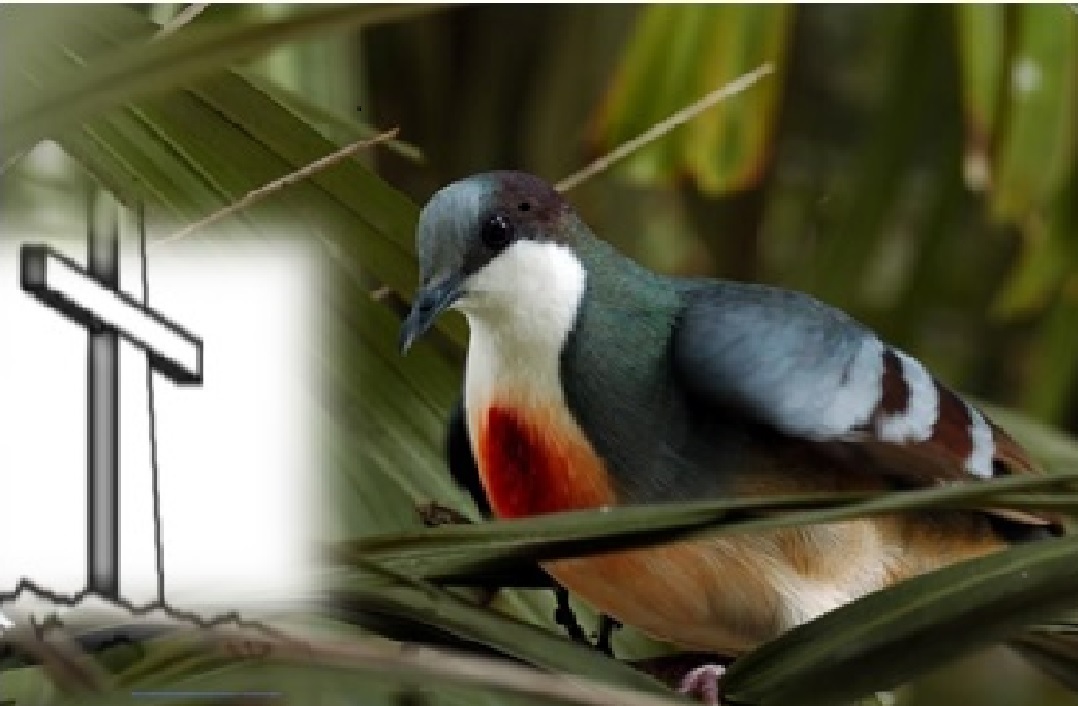
The Luzan Bleeding-heart above was chosen as our theme bird and I blended a cross with the photo. I can think of many illustrations just using that bird.

Wikipedia says, the Luzon Bleeding-heart (Gallicolumba luzonica) is one of a number of species of ground dove in the genus Gallicolumba that are called “bleeding-hearts”. They get this name from a splash of vivid red colour at the centre of their white breasts. The Luzon Bleeding-heart is the species in which this feature is most pronounced, and on first sight it is hard to believe that the bird has not recently been wounded. A reddish hue that extends down the belly furthers the illusion of blood having run down the bird’s front.

The species is endemic to the island of Luzon, Philippines. They eat seeds, berries and grubs. They are shy and secretive, and very quiet, and rarely leave the ground except when nesting. Unlike the other bleeding-hearts, they usually lay two eggs in each clutch.

The article below by Landry mentions that when the birds display, that the male rushes toward the female, stops, lowers his tail and then “throws his breast upwards so that the vivid blood mark is fully presented frontally.” He then bows and coos.

The application this time has to do with its appearance and behavior. Oh, my, where should I begin?

when your heart is lifted up, and you forget the LORD your God who brought you out of the land of Egypt, from the house of bondage; (Deuteronomy 8:14 NKJV)

That verse could indicate that pride was in control and not the Lord. We know that is not good.

These verses could indicate subjection to the Lord. We look to the Lord with our hearts lifted up, but bow in honor to Him.

My defense is of God, Who saves the upright in heart. (Psalms 7:10 NKJV)

The sacrifices of God are a broken spirit, A broken and a contrite heart— These, O God, You will not despise. (Psalms 51:17 NKJV)

I am sure you could come up with many applications also and Luzan Bleeding-heart will most likely be revisited again.

(This is an idea of how these articles will try to honor our Lord’s Fantastically Created birds and challenge us with our own relationship to Him.)

*

*

Orni-theology ~ The Master Carpenter

Master Carpenter 1

Whether you’re a bird person or not, this is stunning!!!

Not to detract from the sheer magic of it, but in practical terms.

How MANY trips would a bird have to make with that tiny little quantity of mud/clay it could carry? (and how far from the nest is the source?) Look at the pictures keeping this in mind.

This slideshow requires JavaScript.

If you take the construction of a circular bowl in your stride as instinctive, how does the bird come up with the windbreak/entrance design that shields the eggs/chicks from the elements, and at what point in fashioning the bowl do they start to construct it?

Master Carpenter 14
Even if you think you could build this…try it without using your hands!

Master Carpenter 15

And now…stop to consider this:

Where did the knowledge to do this come from?

TRULY THERE HAS TO BE A “MASTER CARPENTER”.

Orni-Theology with Luzan Bleeding-heart by Dan

Orni-Theology

*

This was received in an email again today from friends at I.C.R. It has been sent to me many times, but this makes a good article to start a new section of this blog. “Orni-theology”

In John Stott’s The Birds Our Teachers, Stott says, “So over the years I have been trying to develop a new branch of science, which a friend and I have jocularly called “orni-theology’, or the theology of birds. It is founded on an important biblical principle namely that in the beginning God made man, male and female, in his own image and gave us dominion of the earth and its creation.” (pg 10)

Then God said, “Let the earth bring forth the living creature according to its kind: cattle and creeping thing and beast of the earth, each according to its kind”; and it was so. And God made the beast of the earth according to its kind, cattle according to its kind, and everything that creeps on the earth according to its kind. And God saw that it was good. Then God said, “Let Us make man in Our image, according to Our likeness; let them have dominion over the fish of the sea, over the birds of the air, and over the cattle, over all the earth and over every creeping thing that creeps on the earth.” So God created man in His own image; in the image of God He created him; male and female He created them. Then God blessed them, and God said to them, “Be fruitful and multiply; fill the earth and subdue it; have dominion over the fish of the sea, over the birds of the air, and over every living thing that moves on the earth.” (Genesis 1:24-28 NKJV)

As far as I know, the term “Orni-Theology” is not copyrighted. We have been doing “Orni-Theology” blogs from the beginning, but this is the perfect name for those articles. The Birds of the Bible articles are about specific birds named in Scripture, where as Orni-Theology articles have a principle of a bird’s behavior applied in relation to Scripture.

A J Mithra’s articles have been great examples of “Orni-Theology. He introduced us to a bird and it’s behavior and challenged us with God’s Word to behave that way.

Give a few days as a new page is developed and added to the tabs at the top.

*