Lee’s Six Word Saturday – 4/2/16

***

Raven Feeding ©Flickr Josh More

FOR THEY NEITHER SOW NOR REAP

***


Consider the ravens, for they neither sow nor reap, which have neither storehouse nor barn; and God feeds them. Of how much more value are you than the birds? (Luke 12:24 NKJV)

Raven Feeding ©Flickr Josh More

*

More Daily Devotionals

*

“A” is for Avocet and Albatross: “A” Birds, Part 1

“A” is for Avocet and Albatross: “A” Birds, Part 1

James J. S. Johnson

American Avocet (Recurvirostra americana) by Jim Fenton

American Avocet (Recurvirostra americana) by Jim Fenton

“A” is for Avocets, Albatrosses, Accipiters, and Alcids (including Auklets and the Atlantic Puffin), — plus Antbirds and a few other birds omitted here. This study now bravely begins an alphabet-based series on birds, starting with a quick introduction to 4 types of birds that start with the letter “A”   –    followed by a few observations of alphabetic patterns in Scripture (exhibited initially by Psalm 119:1-8)   –   then followed by specific information on avocets, albatrosses, accipiters, and alcids. Due to the length of this review, the “A” birds (just mentioned) will be considered in two parts: Part 1, Avocets and Albatrosses, — and Part 2 (in the near future, God willing), Accipiter hawks and Alcids.

Red-necked Avocets ©WikiC

Red-necked Avocet at shore ©WikiC

Avocets” are shorebirds, known for wading into the salty or brackish tidewaters, on skinny stilt-like legs, picking at food with thin upward-curving (the opposite of “decurved”) bills.  Avocets include American Avocet (Recurvirostra americana), Pied Avocet (Recurvirostra avosetta), Red-necked Avocet (Recurvirostra novaehollandiae), and Andean Avocet (Recurvirostra andina).

Avocets are often grouped with other shorebirds that have similar morphology (shape), who occupy similar eco-niches (similar ecological contexts) and have somewhat similar eating habits – the fancy word for that category of shorebirds is “Recurvirostrids” – a group that includes avocets and stilts.  (For a listing on these shorebirds, with photographs, see Lee’s “Recurvirostridae: Stilts, Avocets

Later, in this article, one avocet will receive special attention, the American Avocet (Recurvirostra americana).
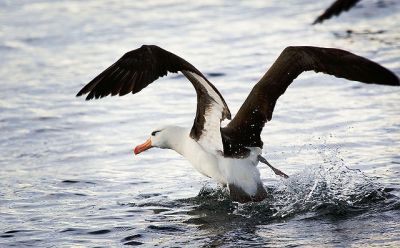
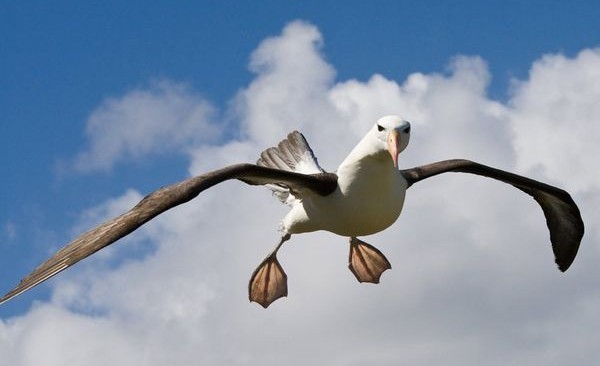
Black-browed Albatross launching into flight from the sea

Black-browed Albatross launching into flight from the sea

[Black-browed Albatross, launching into flight from the sea]

Albatross” is a large tube-nosed seabird type  –  sometimes called “gooney birds” — typically ranging over open-ocean waters, that includes about 20 different species, such as Snowy Albatross (Diomedea exulans, a/k/a Wandering Albatross or White-winged Albatross), Black-footed Albatross (Phoebastria nigripes), Light-mantled Albatross (Phoebetria palpebrata, a/k/a Grey-mantled Albatross), the Atlantic Yellow-nosed Albatross (Thalassarche chlororhynchos), Laysan Albatross (Phoebastria immutabilis), Steller’s Albatross (Phoebastria albatrus, a/k/a Short-tailed Albatross, known for eating juvenile squid), etc.

Regarding albatrosses as a “family” group, with photographs of more than 20 species of albatrosses, see Lee’s “Diomedeidae: Albatrosses.  “Gooney birds” are obviously designed by flying over oceans.  However, on land they can ambulate as they need to, although they may appear “goofy” on shore, as they appear to hobble (or waddle) along, upon their large webbed feet. Yet they live for many decades (e.g., up to 60 years!), unless their natural lives are cut short by a predator.

http://siliconvalley.corriere.it/files/2015/12/black-browed-albatross-flying.jpg

Albatross (Diomedea) ©Unknown from Siliconvalley

*

Albatross Study from Ian Montgomery

Albatross Study from Ian Montgomery

For examples of albatross studies, provided by Australian ornithologist Ian Montgomery, see “Ian’s Bird of the Week: Royal Albatross”,  —  and “Ian’s Stamp of the Week: Antipodean Albatross”,   —  and “Ian’s Bird of the Week: Light-mantled Albatross”,  — and “Ian’s Bird of the Week: Campbell / Black-browed AlbatrossLater, in this article, one albatross will receive special attention, Steller’s Albatross (Phoebastria albatrus).

ALPHABETS CAN BE HELPFUL FOR ACROSTIC-BASED LISTINGS

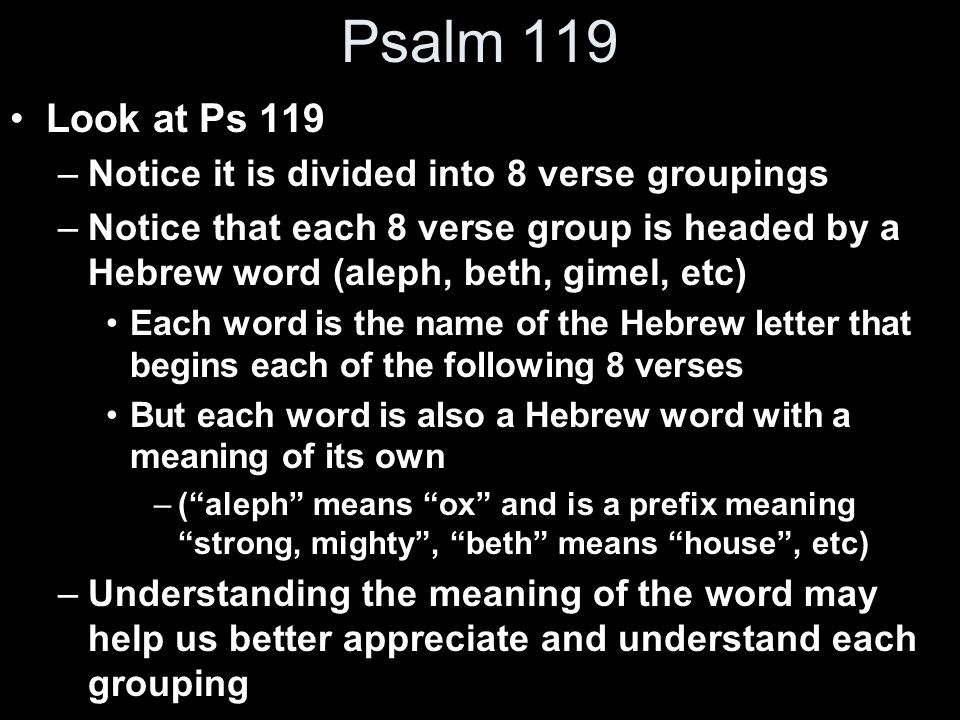
Using an alphabet, to organize a sequence of information, has Biblical precedent.  The perfect example is the “acrostic” pattern of Psalm 119, the longest psalm (having 176 verses!), which has 22 sections (comprised of 8 verses per section), representing the 22 letters of the Hebrew alphabet. (Compare that to English, which has 26 alphabet letters, and Norwegian, which has 29 alphabet letters.)

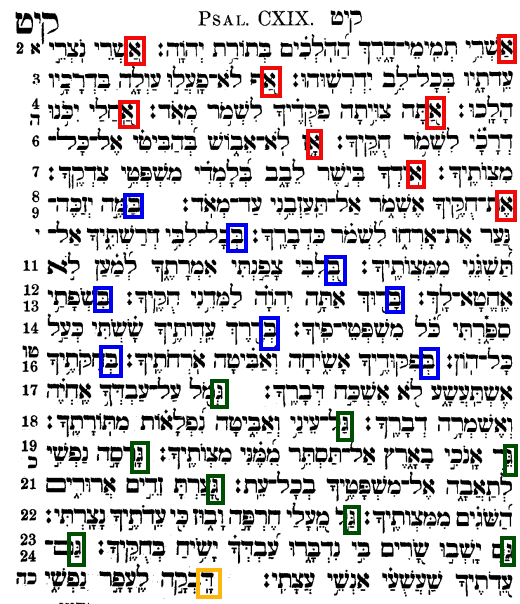
The sentences in each section start with the same Hebrew  letter, so Verses 1-8 start with ALEPH, Verses 9-16 start with BETH, Verse 17-24 start with GIMEL, and so forth.  Here are the first 8 verses in Psalm 119, each sentence of which starts with ALEPH  [an inaudible guttural consonant, usually transliterated into English as an apostrophe that looks like a backwards C = ’ , i.e., like a closed single-quotation mark].  ALEPH is the first letter in the Hebrew alphabet, so each verse literally starts with that letter as the first letter in the first word (although the first Hebrew word may be differently placed in the English translation’s sentence):
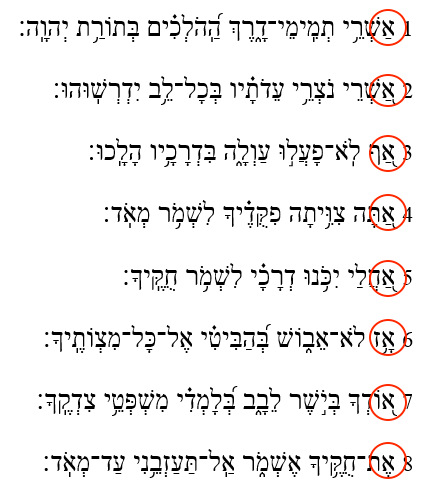
Alphabet in Hebrew of Psalm 119

Blessed [’asherê] are the undefiled in the way, who walk in the law of the Lord.

Blessed [’asherê] are they that keep His testimonies, and that seek Him with the whole heart.

Yea [’aph], they also do no iniquity: they walk in His ways.

Thou [’atah] hast commanded us to keep Thy precepts diligently.

O-that [’aḥalai] my ways were directed to keep Thy statutes!

Then [’az] shall I not be ashamed, when I have respect unto all Thy commandments.

I-will-praise-thee [’ôdekâ] with uprightness of heart, when I shall have learned Thy righteous judgments.

Thy-statutes [’et-uqqekâ] I will keep; O forsake me not utterly.

Interestingly, Verses 1-3 are narrated in the third person (referring to God as “He”, “Him”, etc.), but Verses 4-8 are addressed to God (“Thou”, “Thy”, “Thee”) in the second person.  Certainly the psalmist appreciates God’s truth as He has  kindly and authoritatively provided it unto His favorite creature, Adam’s race!

Most English Bibles show how the Hebrew alphabet is used to divide Psalm 119 into those 22 sections, although it requires looking at the Hebrew text to see how this was actually done.  Psalm 119 is not the only acrostic psalm – there are others (see Psalms 9, 10, 25, 34, 37, 111, 112, 145).  In fact, there is a hidden-in-plain-view message in Psalm 145, which deliberately omits the Hebrew letter nûn (that matches our “N”), but that unusual usage of an intentionally incomplete acrostic must wait another day to be explained.

“In the common form of acrostic found in Old Testament Poetry, each line or stanza begins with a letter of the Hebrew alphabet, in order. This literary form may have been intended as an aid to memory, but more likely it was a poetic way of saying that a total coverage of the subject was being offered — as we would say, ‘from A to Z.’ Acrostics occur in Psalms 111 and 112, where each letter begins a line; in Psalms 25, 34, and 145, where each letter begins a half-verse; in Psalm 37, Proverbs 31:10-31, and Lamentations 1, 2, and 4, where each letter begins a whole verse; and in Lamentations 3, where each letter begins three verses. Psalm 119 is the most elaborate demonstration of the acrostic method where, in each section of eight verses, the same opening letter is used, and the twenty-two sections of the psalm move through the Hebrew alphabet, letter after letter.” [Quoting J. Alec Motyer, “Acrostic”, in The New International Dictionary of the Bible (Zondervan, 1987), page 12.]
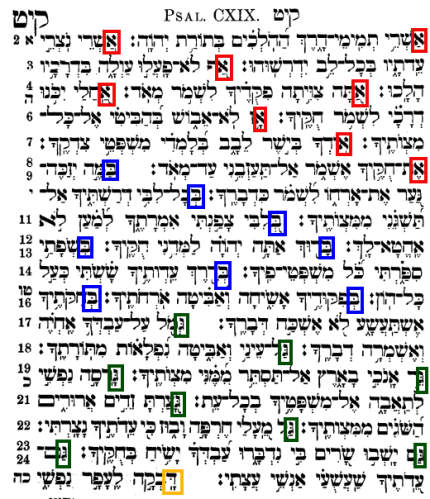
Hebrew Alphabet Acrostic of Psalm 119 ©Zondervan

Hebrew Alphabet Acrostic of Psalm 119 ©Zondervan

Psalm 119 is all about God’s revelation of truth – especially truth about Himself – to mankind (in a comprehensive “A to Z” panorama).  The most important revelation of truth that God has given to us, and the most authoritative form of truth we have, is the Holy Bible – the Scriptures.  (In fact, it appears that Scripture is referred to 176 times within Psalm 119, since 6 verses twice allude to Scriptures.)  Accordingly, Psalm 119 is dominated by references to the Scriptures – using terms like “the law of the LORD”, “Thy Word”, “Thy commandments”, “Thy testimonies”, “Thy statutes”, “Thy judgments”, etc.
Psalm 119 Study Photo

Psalm 119 Study Photo

Of the 176 verses in Psalm 119 there appear to be only 6 verses (actually, there are only 5 exceptions) that omit a direct reference to the Scriptures:   Verses 3, 37, 90, 91, 122, and 132.  Yet, even so, each (of those “exceptions”) refers to some form of God’s general or special revelation:  “His ways” and “Thy way” (in Verses 3 & 37, yet God’s ways are only known to us by His creation, His Word, His incarnation, and His providences, all of which are forms of God revealing truth to us); “Thy faithfulness” (in Verse 90, yet God’s faithfulness is only known to us by His creation, His Word, His incarnation, and His providences, all of which are forms of God revealing truth to us); “Thy ordinances” (in Verse 91, is not really an exception, because it translates for mishpat, a Hebrew noun repeatedly translated as “judgment(s)”, elsewhere in Psalm 119); “surety” (in Verse 122, is the Hebrew verb ‘arōbh, functioning as a noun, yet the concept of God as our “surety” is comparable to His “faithfulness”, noted in Verse 90); and “Thy name” (shemekâ, in Verse 132, which divine name itself reveals God’s character (in the Old Testament Hebrew name for God) as the eternal Being, YHWH, as is emphasized in Exodus 3:14 and further in John 8:58).

Regarding God’s name, the incarnation has revealed God to us as Emmanuel (“God with us”), the Lord Jesus Christ (Philippians 2:9-11).  Accordingly, by His name as the incarnate God (i.e., Jesus the Christ), God’s name is necessarily implied even by how we count time on Earth, every time we refer to what year it is, — because the years are denominated as “B.C.” (“before Christ”) and “A.D.” (“anno Domini= “year of our Lord [Jesus Christ]”), ubiquitously reminding us that God has revealed Himself, on Earth, via Christ’s incarnation and earthly ministry!).
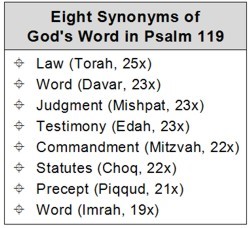

Eight Synonyms of Gods Word in Psalm 119

Dusty Bible

In short, Psalm 119 teaches that God reveals truth, and we should expect that we learn 97% of it from the Holy Bible!  (Romans chapter 1 emphasizes that we are taught, by the physical creation, about God’s majestic power and glorious wisdom, and that the message of God’s creation is so strong that to ignore it is to do so “without excuse”.)  Also, since the Hebrew letter ALEPH is derived from the Hebrew word for “ox” (which exemplifies might), it is noteworthy that the first 8 verses of Psalm 119 emphasize who powerfully God’s Word strengthens us for holy living (see Hebrews 4:12).

Now back to the “A” birds (Part 1), Avocets and Albatrosses.

American Avocet - Family group visiting lentic shore

American Avocet – Family group visiting lentic shore

The American Avocet (Recurvirostra americana), like many shorebirds, thrives upon the available edibles on beaches swept back-and-forth by coastal tidewaters.  This dignified shorebird, with its long skinny bill, long skinny legs, and its cinnamon-to-salmon summer plumage (on its head and neck), has already been described by ornithologist Lee Dusing – see “Birds, Volume 2, #1: The American Avocet.

The breeding range of the American Avocet includes most of the states in the western half of America’s “lower 48” states, plus some of western inland Canada (southern Alberta and Saskatchewan, and part of Manitoba), with the breeding range situated mostly in Montana, North and South Dakota, Nebraska, Wyoming, Colorado, southern Idaho, western Oregon, northern Utah, New Mexico, far western Oklahoma, and the Texas Panhandle.  Some breeding avocets have also been sighted in Minnesota.

Avocets migrate south for the winter, either to Florida or to Mexico.  Their migratory passage travels occur in between their wintering and breeding ranges, covering large parts of Texas, Arizona, California, Nevada, Utah, and Idaho.

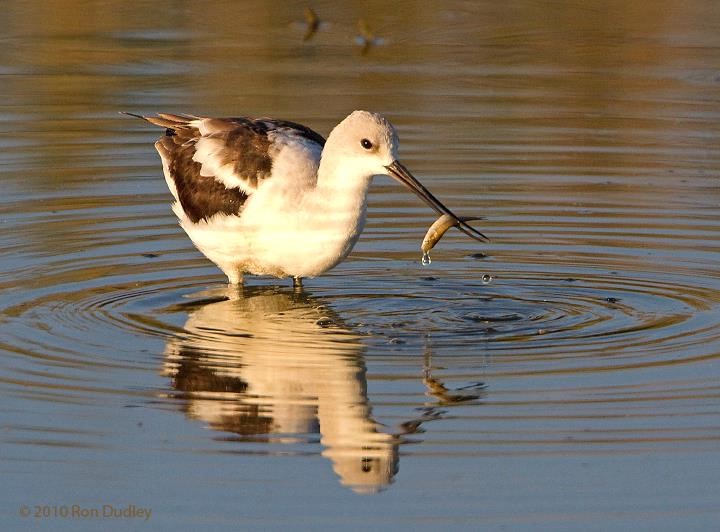
Avocets, being shorebirds, like to eat fish that venture close enough to the shoreline to get caught in the quick bill of an avocet.

Do not think that avocets are merely passive, waiting for food to swim or drift by where they stand, in the shallow water of a pond or lake.

Avocets poke their long stick-like bills into the water, then flex their bills back and forth in the water, stirring the water so that nearby creatures – such as water bugs and crustaceans – are agitated into motion that reveals their presence.   Seeing such creatures reactively move, avocets use their long bills to clamp down on an entrée, such as a small fish!

Avocets also enjoy eating aquatic plants (especially their nutritious seeds) that emerge above the shoreline’s water surface.
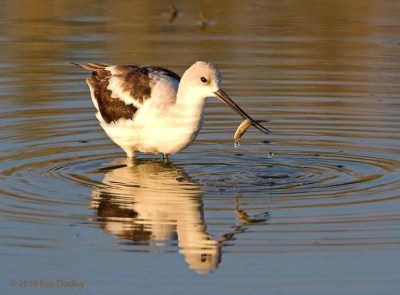
American Avocet

American Avocet “Gone fishin” – photo by Ron Dudley

Now for another “A” bird:  the Albatross, specifically Steller’s Albatross, a shorebird that has been listed as “endangered” since AD2000.

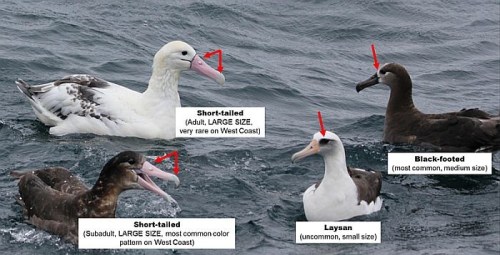
The Steller’s Albatross (Phoebastria albatrus, a/k/a Short-tailed Albatross, formerly known taxonomically as Diomeda albatrus) is an North Pacific Ocean-ranging albatross.  This albatross was originally named for the 18th century (AD) German naturalist Georg Steller, for whom the Steller’s Jay is also named.  Georg Steller is likewise the namesake of Steller’s Eider and Steller’s Sea Eagle (and even of two pinniped marine mammals, the Steller’s Sea Lion and the now-extinct Steller’s Sea Cow).  Regarding Georg Steller’s scientific career and “stellar” accomplishments (pardon the pun), see Steller’s Jay: A Lesson in Choosing What Is Valuable.
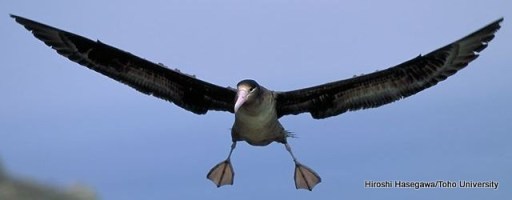
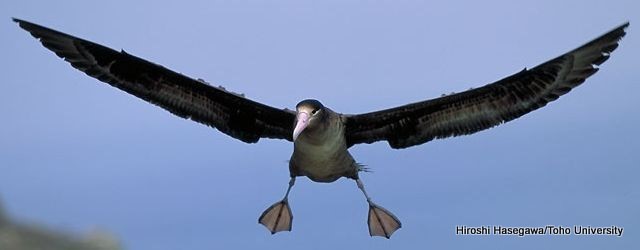
Steller’s Albatross ©U.S. Fish & Wildlife Service

The U.S. Fish & Wildlife Service describes the Steller’s Albatross as follows:

“With a wingspan of over 2 meters (over 7 feet), the short-tailed albatross is the largest seabird in the North Pacific. Its long, narrow wings are adapted to soaring low over the ocean. It is best distinguished from other albatrosses by its large, bubblegum-pink bill. Young birds also have the large pink bill, but their feathers are dark chocolate brown, gradually turning white as the bird ages. Adults have an entirely white back, white or light gold head and back of neck, and black and white wings. …

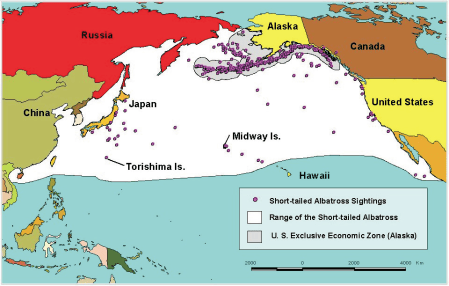
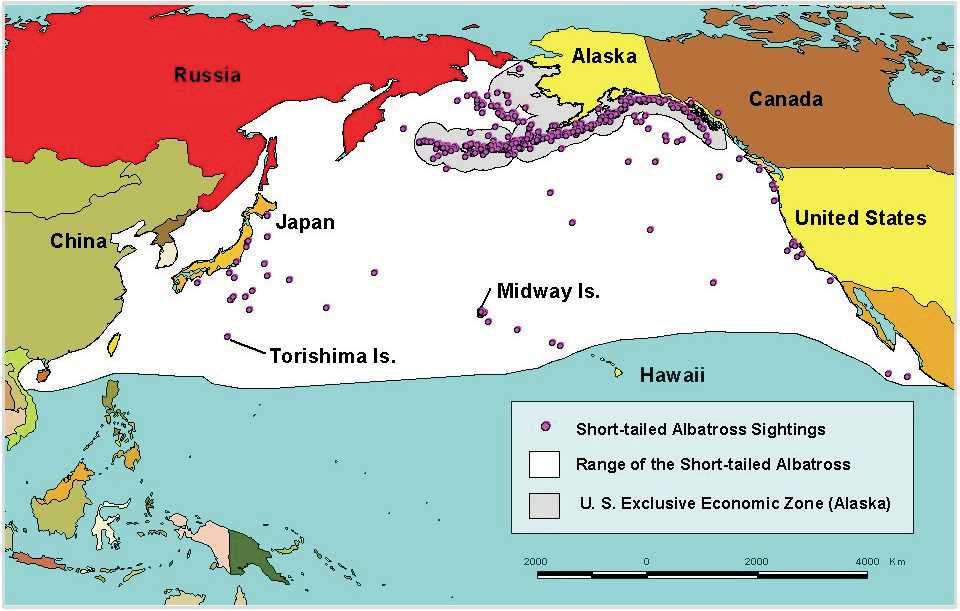
Historically, millions of short-tailed albatrosses bred in the western North Pacific on several islands south of the main islands of Japan. Only two breeding colonies remain active today: Torishima Island and Minami-kojima Island, Japan. In addition, a single nest was recently found on Yomejima Island of the Ogasawara Island group in Japan. Single nests also occasionally occur on Midway Island, HI. Short-tailed albatrosses forage widely across the temperate and subarctic North Pacific, and can be seen in the Gulf of Alaska, along the Aleutian Islands, and in the Bering Sea. The world population is currently estimated to be about 1200 birds and is increasing. …

Like many seabirds, short-tailed albatrosses are slow to reproduce and are long-lived, with some known to be over 40 years old. They begin breeding at about 7 or 8 years, and mate for life. Short-tailed albatrosses nest on sloping grassy terraces on two rugged, isolated, windswept islands in Japan. Pairs lay a single egg each year in October or November. Eggs hatch in late December through early January. Chicks remain near the nest for about 5 months, fledging in June. After breeding, short-tailed albatrosses move to feeding areas in the North Pacific. When feeding, albatrosses alight on the ocean surface and seize their prey, including squid, fish, and shrimp.”

[Quoting USF&W, “Short-tailed Albatross (Phoebastria albatrus)”, February 2001 pamphlet, page 1 of 2.]

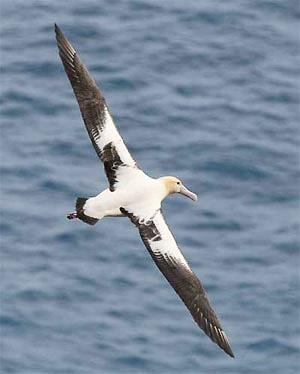
Steller’s Albatross 2©U.S. Fish & Wildlife Service
Steller’s Albatross 3©U.S. Fish & Wildlife Service
Short-tailed Albatross Map

The Steller’s Albatross, under the name Short-tailed Albatross, has been officially listed as “endangered” (under the Endangered Species Act of 1973) throughout its North Pacific range, as promulgated in 65 F.R. 46643 (Volume 65 of the Federal Register, page 46643-46654, issued 31 July 2000), in conjunction with implementing aspects of the wildlife protection treaty called “CITES” (Convention on International Trade in Endangered Species of Wild Fauna and Flora).

This means that the Steller’s Albatross, and products of its body parts, may not be freely traded (i.e., apart from an appropriate governmental license), regardless of whether they were “taken” from the wild in America — or “taken” from the wild in any other country that is a ratifying signatory of the CITES treaty (which prohibits the trafficking of endangered species and products produced therefrom).

So, if anyone offers to sell you a fancy hat, adorned with Steller’s Albatross feathers – and claims that the bird was obtained outside the United States, don’t buy it!   (It’s contraband, unpermitted possession of which is a federal crime!)

Ironically, as a result of an earlier “administrative error”, this albatross was officially listed as “endangered” throughout its range “except in the United States”! — Way to go, bureaucrats!

At this point we will break our review of the above-mentioned “A” birds.  In “Part 2” of these “A birds” we will review Accipiter hawks and Alcids, God willing!

<> JJSJ

*

“A” is for Accipiter and Alcid: “A” Bird, Part 2

Diomedeidae: Albatrosses

Ian’s Bird of the Week: Royal Albatross

Ian’s Stamp of the Week: Antipodean Albatross

Ian’s Bird of the Week: Light-mantled Albatross

Ian’s Bird of the Week: Campbell / Black-browed Albatross.

Steller’s Jay: A Lesson in Choosing What Is Valuable

Recurvirostridae: Stilts, Avocets

*

Hummingbirds! – by Brian Thomas, M.S.

Scintillant Hummingbird (Selasphorus scintilla) in Flight by Raymond Barlow

Scintillant Hummingbird (Selasphorus scintilla) in Flight by Raymond Barlow

That they may see, and know, and consider, and understand together, that the hand of the LORD hath done this, and the Holy One of Israel hath created it. (Isaiah 41:20 KJV)

I wanted to share an article from the latest Acts and Facts. Acts and Facts is a monthly magazine from the Institute for Creation Research. Here are a few quotes from “Hummingbirds!”, by Brian Thomas, M.S.

Magnificent Hummingbird (Eugenes fulgens) by Judd Patterson

Magnificent Hummingbird (Eugenes fulgens) by Judd Patterson

“Who doesn’t pause to marvel when a hummingbird flies by? These tiny, colorful birds perform amazing aerobatic feats, and yet some very smart scientists insist that mere natural forces mimicked a real engineer to construct these fascinating flyers. Authors of a Nature paper on hummingbird flight wrote in 2005 that “the selective pressure on hummingbird ancestors was probably for increased efficiency.”1 They imagine that hummingbirds….”

Violet-headed Hummingbird (Klais guimeti) by Michael Woodruff

Violet-headed Hummingbird (Klais guimeti) by Michael Woodruff

“Hummingbird beaks, bones, and feathers differ from those of all other living or extinct bird kinds.3 Their wings don’t fold in the middle. Instead,….”

Fiery-throated Hummingbird (Panterpe insignis) by Raymond Barlow

Fiery-throated Hummingbird (Panterpe insignis) by Raymond Barlow

“New hummingbird research has revealed other fascinating features. Birds generate a lot of heat when they fly. Considering their speed, you might expect hummingbirds….”

To read the article  CLICK HERE.

*

Acts and Facts

“Hummingbirds!”, by Brian Thomas

Institute for Creation Research

Trochilidae – Hummingbirds Family

*

Lee’s Five Word Friday – 4/1/16

***

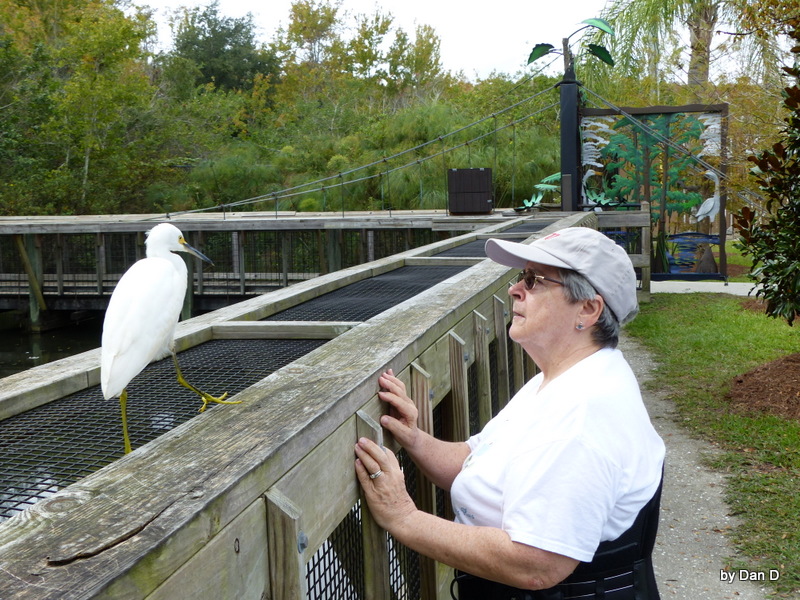
Snowy Egret and Lee Gatorland by Dan

TO THE GLORY OF GOD

***


Whether therefore ye eat, or drink, or whatsoever ye do, do all to the glory of God. (1 Corinthians 10:31 KJV)

Snowy Egret and Lee at Gatorland by Dan (even birdwatching)

*

More Daily Devotionals

*

Lee’s Four Word Thurday – 3/31/16

***

Black-crowned Night Heron (Nycticorax nycticorax) Jax Zoo by Lee

THE LOVE OF GOD

***


And the Lord direct your hearts into the love of God, and into the patient waiting for Christ. (2 Thessalonians 3:5 KJV)

Black-crowned Night Heron (Nycticorax nycticorax) Jax Zoo by Lee

*

More Daily Devotionals

*

Lee’s Three Word Wednesday – 3/30/16

***

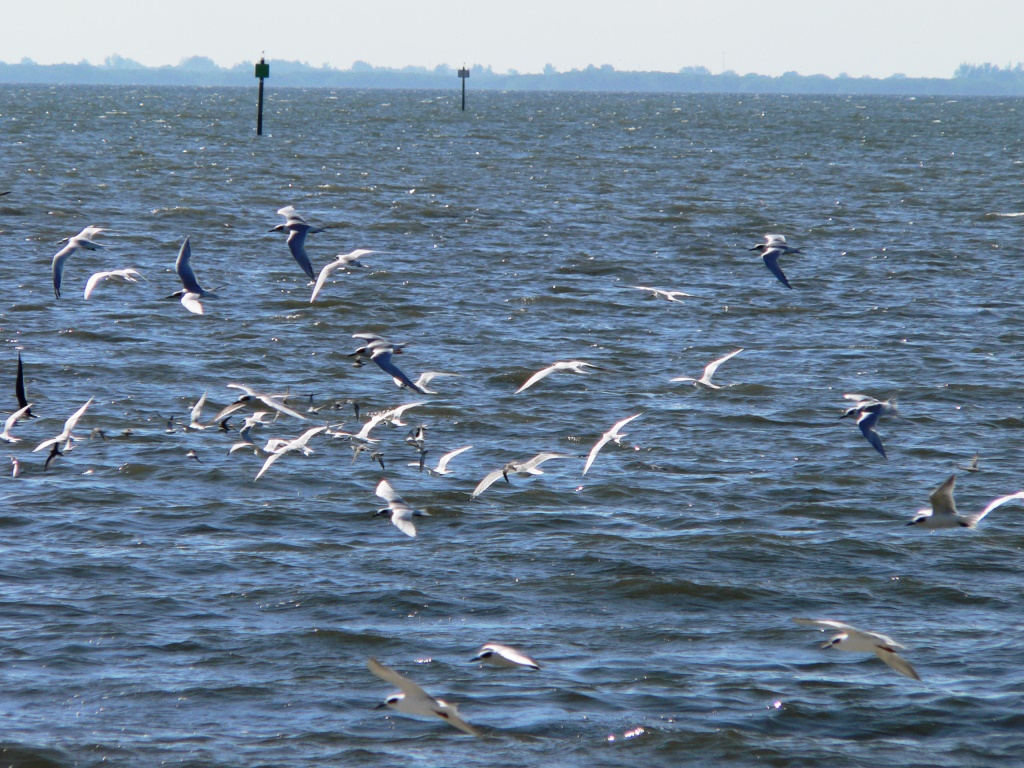
Birds Flying over Tampa Bay by Lee

WE FLY AWAY

***


The days of our years are threescore years and ten; and if by reason of strength they be fourscore years, yet is their strength labour and sorrow; for it is soon cut off, and we fly away. (Psalms 90:10 KJV)

Birds Flying over Tampa Bay by Lee

*

More Daily Devotionals

*

Arctic Terns Set Mileage Records As Frequent Fliers

Artic Terns 1
ARCTIC   TERNS   SET   MILEAGE   RECORDS   AS   FREQUENT   FLIERS

Dr. James J. S. Johnson

For  the  kingdom  of  heaven  is  as  a  man  travelling  into  a  far country… (Matthew  25:14a)

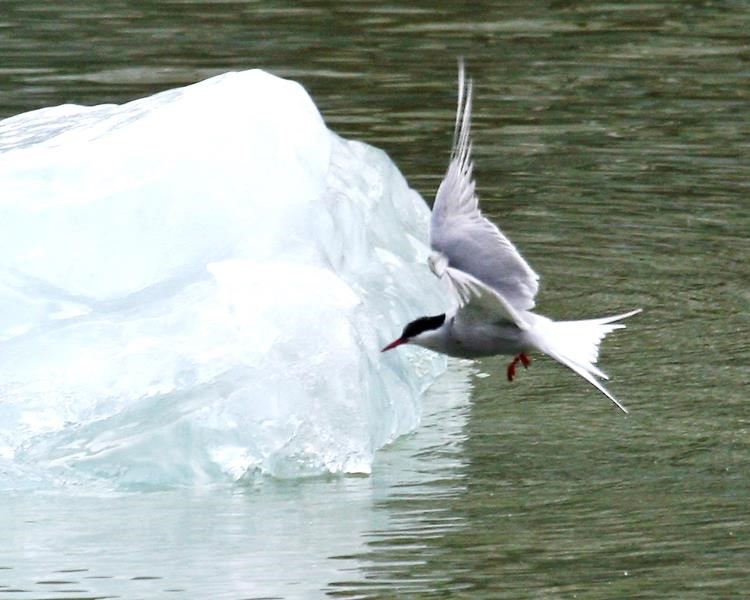
Arctic Terns (Sterna paradisaea), which weigh only about a quarter-pound,  are the ultimate example of global migrants, accomplishing the longest-known migrations, every year, from near  the top of the world to near the bottom, then vice versa.  In fact, some Arctic Terns fly >50,000 miles in their pole-to-pole-and-then-back-again migration!  (And, if an Artic Tern lives 30 years, as some do, that could mean about 1½ million miles on his or her lifetime “odometer”, which is comparable to 3 round trips to the moon (i.e., that’s like 3 times, to the moon and back again)!

Imagine how inconvenient it would be for a bird to arrive at the South Pole during May or June, when the weather is freezing cold and food is scarce. Or imagine a similar scenario at the North Pole during November or December, when the weather there is harshest. Thankfully, arctic terns follow the opposite schedule, synchronizing with temperature and seasonal food availability.

Why? These birds are purposefully preprogrammed to operate by these schedules; God fitted them to do so. This programming is critical for these migratory birds to travel over the Atlantic Ocean from the Arctic to the Antarctic, and vice versa, every year. At more than 40,000 miles round trip, they are the ultimate frequent fliers! A recent study pointed out:

The study of long-distance migration provides insights into the habits and performance of organisms at the limit of their physical abilities.

The Arctic tern Sterna paradisaea is the epitome of such behavior; despite its small size (<125 g), banding recoveries and at-sea surveys suggest that its annual migration from boreal and high Arctic breeding grounds to the Southern Ocean may be the longest seasonal movement of any animal. Our tracking of 11 Arctic terns fitted with miniature (1.4-g) geolocators revealed that these birds do indeed travel huge distances (more than 80,000 km [>50,000 miles] annually for some individuals).…

Arctic terns clearly target regions of high marine productivity both as stopover and wintering areas, and exploit prevailing global wind systems to reduce flight costs on long-distance commutes.

Ecologically speaking, it’s all a demonstration of “survival of the fitted”. Arctic terns, like all birds, survive because they are divinely fitted to survive all of the interactive factors in their diverse and geographically extensive environments.

Providentially, the arctic terns select season-synched flight times that repeatedly avoid the harsh winter months at both the North and South Poles. Likewise, the terns select flight plans that take advantage of global wind patterns and incorporate helpful stopovers for rest and refueling.

Timing factors are interactive throughout this cyclical migration: the seasonal weather cycle, wind patterns influenced by daily rotation of the earth, food availability influenced by annual seasons, and the reproductive cycle of the terns themselves.

In all of this, providential programming is both complicated and critical!

[Quoting James J. S. Johnson, “Survival of the Fitted: God’s Providential Programming”, Acts & Facts, 39 (10): 17-18 (October 2010), quoting Carsten Egevang, et al., “Tracking of Arctic terns Sterna paradisaea reveals longest animal migration”, in Proceedings of the National Academy of Sciences, 107(5): 2078-2081 (2010).  See also Greenland Institute of Natural Resources, “The Longest Animal Migration in the World Revealed” (press release, n.d.), quoting Carsten Egevang —  and “The Arctic Tern Migration Project” website — showing “the impressive journey of the Arctic tern from the breeding grounds in Greenland to Antarctica and back in this Google Earth Tour combining maps, animations and photos”.]

Artic Tern near Iceberg

Fair Use photo credit:

Arctic Terns are circumpolar, i.e., their range largely covers the polar regions.  Its “normal” turfs include its breeding grounds, spread variously over Arctic lands (like Iceland and Greenland), as well as the sub-Arctic parts of Eurasia (such as Schleswig-Holstein, Germany) and North America, —  plus its migratory “timeshare” stopover lodgings,  — plus its Antarctica wintering grounds (such as Wilkes Land), including “down under” islands near Antarctica, such as Weddell Sea islands or New Zealand’s South Island.

Thus, the historic fame of Thingvellir, Iceland not only derives from hosting the annual Althing events (ever since Viking times), but also from hosting the critical-habitat nesting activities of breeding Arctic Terns!

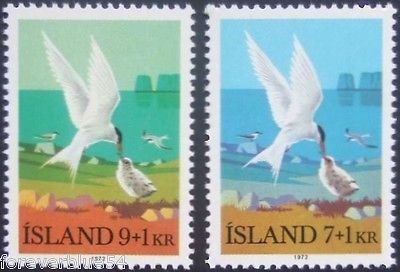
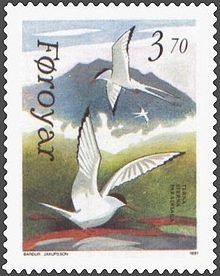
Unsurprisingly, these noble and courageous seabirds have been celebrated by postage artists and philatelists alike in Nordic countries (and quasi-autonomous jurisdictions), such as the Åland, the Færoe Islands, Finland, Iceland, Sweden   —   as well as in Canada  —  and in other countries (or quasi-countries, like the Isle of Man) that appreciate either the Arctic or Antarctic activities of this globe-flier.

Stamp 1 Stamp 2 Stamp 3

Stamp 4 Stamp 5


Yet even the ever-traveling Arctic Terns have their share of enemies – such as predatory Arctic Foxes who are happy to raid Arctic Tern nests, if they can.  But, Arctic Terns won’t tolerate such predatory thefts without a fight – the Arctic Tern colony defenders will challenge (“mob”) such foxes!         ><> JJSJ


Picture1

Fair Use photo credit: 

Artic Fox and Artic Tern b©Arkive

Fair Use photo credit: 

*

Orni-theology

James J. S. Johnson

Arctic Tern Family – Laridae

*


Lee’s Two Word Tuesday – 3/29/16

***

Brown-throated Wattle-eye (Platysteira cyanea) ©WikiC

TEACH THEE

***


I will instruct thee and teach thee in the way which thou shalt go: I will guide thee with mine eye. (Psalms 32:8 KJV)

Brown-throated Wattle-eye (Platysteira cyanea) Male ©WikiC

*

More Daily Devotionals

*

Lee’s One Word Monday – 3/28/16

***

Wood Duck by Dan at Lake Hollingsworth

Wood Duck by Dan at Lake Hollingsworth

Wood Duck (Aix sponsa) by Dan

Wood Duck (Aix sponsa) by Dan

NAME

***


Out of the ground the LORD God formed every beast of the field and every bird of the air, and brought them to Adam to see what he would call them. And whatever Adam called each living creature, that was its name. (Genesis 2:19 NKJV)

*

More Daily Devotionals

*

He Is Risen – Resurrection Week

All week, we have been presenting prophesy that told of the coming of the Messiah, mainly about His work and purpose for Coming. With these two videos, you can see a picture of how so much prophesy and fulfillment come together.

The Lord Jesus Christ, the Creator of All, had to come because of the sin of man in the garden, against God. It began with the first prophecy given in Genesis 3:15, where a redeemer needed to come to pay the price for sin, so that mankind could be redeemed.

And I will put enmity between thee and the woman, and between thy seed and her seed; it shall bruise thy head, and thou shalt bruise his heel. Unto the woman he said, I will greatly multiply thy sorrow and thy conception; in sorrow thou shalt bring forth children; and thy desire shall be to thy husband, and he shall rule over thee. And unto Adam he said, Because thou hast hearkened unto the voice of thy wife, and hast eaten of the tree, of which I commanded thee, saying, Thou shalt not eat of it: cursed is the ground for thy sake; in sorrow shalt thou eat of it all the days of thy life; Thorns also and thistles shall it bring forth to thee; and thou shalt eat the herb of the field; In the sweat of thy face shalt thou eat bread, till thou return unto the ground; for out of it wast thou taken: for dust thou art, and unto dust shalt thou return. (Genesis 3:15-19 KJV)

BUT GOD SENT HIS ONLY SON TO REDEEM US

That whosoever believeth in him should not perish, but have eternal life. For God so loved the world, that he gave his only begotten Son, that whosoever believeth in him should not perish, but have everlasting life. For God sent not his Son into the world to condemn the world; but that the world through him might be saved. He that believeth on him is not condemned: but he that believeth not is condemned already, because he hath not believed in the name of the only begotten Son of God. And this is the condemnation, that light is come into the world, and men loved darkness rather than light, because their deeds were evil. For every one that doeth evil hateth the light, neither cometh to the light, lest his deeds should be reproved. (John 3:15-20 KJV)

*

Gospel Message

“What Will You Do With Jesus”?

Riding on a Donkey – Resurrection Week

30 Pieces of Silver – Resurrection Week

The Suffering Messiah – Resurrection Week

It Is Finished – Resurrection Week

Rich Man’s Grave – Resurrection Week

He Is Not Here – Resurrection Week

(Videos and accompanying by Sean Fielder )


Lee’s Six Word Saturday – 3-26-16

***

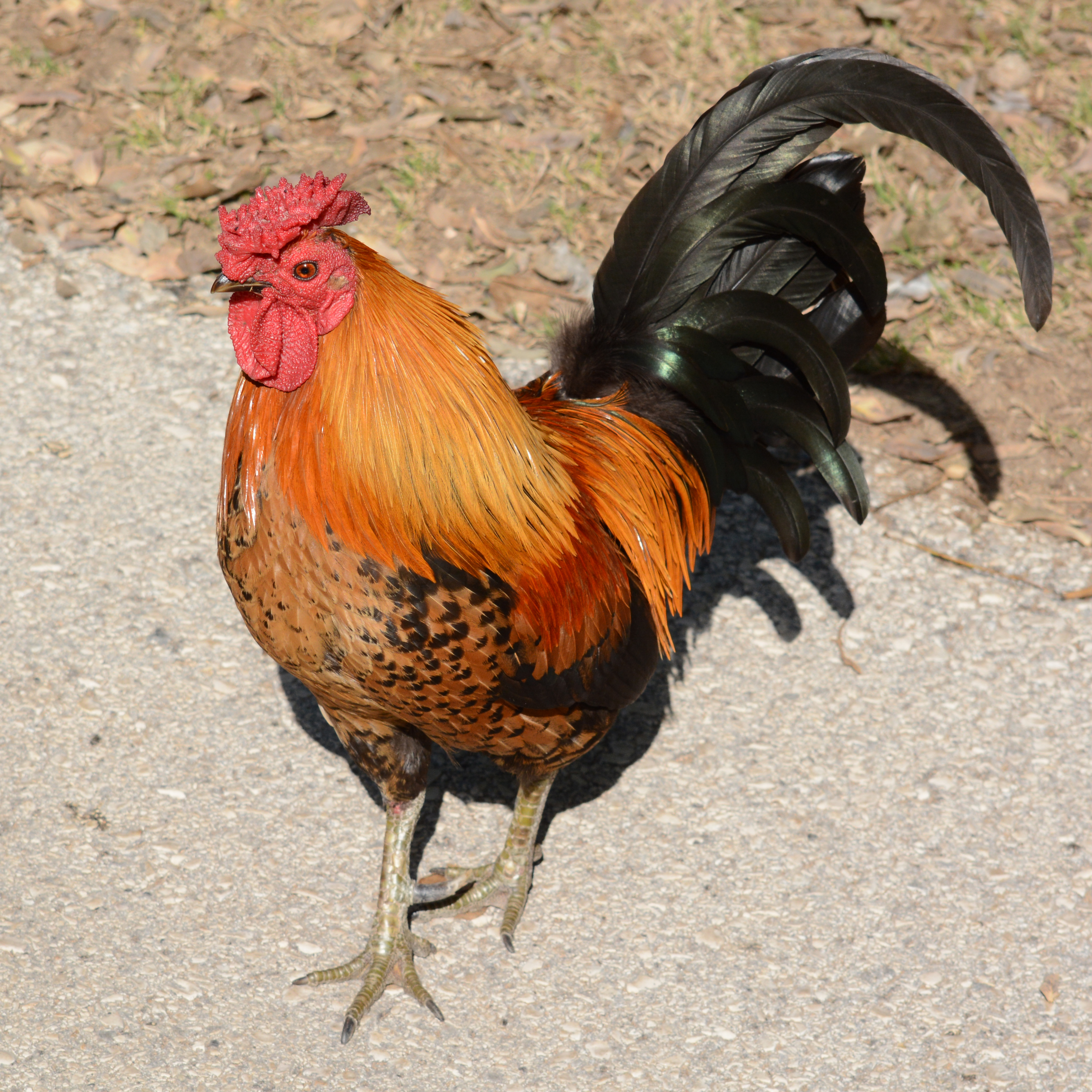
Gallic Chicken (Gallus gallus domesticus) ©WikiC

Gallic Chicken (Gallus gallus domesticus) ©WikiC

THE ROOSTER WHO TATTLED ON PETER

***

The Olivet Discourse concludes with Christ prophetically announcing His own crucifixion at the upcoming Passover festival (Matthew 26:2).  Obviously the Passover feast (which the ritualistic Jews had culturally transformed into a religious festival) is a Messianic type that foreshadowed Jesus the Christ (1st Corinthians 5:7), the unique Lamb of God [23] Who takes away the sin of the world (John 1:29).  The Passover continues to be mentioned by Matthew, from its celebration by Christ, in the “upper room” (Matthew 26:20-29), through the events of Christ’s crucifixion, which was the ultimate Passover, teleologically speaking.

Again, Christ is the great Shepherd of the “sheep” (i.e., believers, called “the flock of God” in 1st Peter 5:2), and He refers to His disciples as His “sheep” (Matthew 26:31) which He protects, redemptively, as He satisfies the prophecy of Zechariah 13:7.

The Matthew reports a disappointing incident in the life of the usually bold apostle Peter:  Peter’s betrayal of Christ, as predicted by Christ.

Of course, this is the famous tattle-tale rooster, Gallus gallus domesticus —  featured within Flag That Bird! – (Part 1)

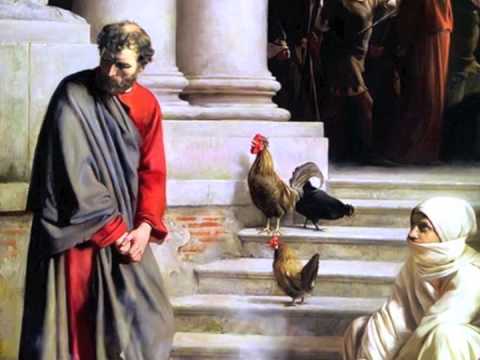
This display of Peter’s imperfect courage and loyalty (even though his inward belief never failed) is linked to the thrice-crowing of a “cock” [alektôr], i.e., a rooster (Matthew 26:34), the last allusion to an animal in Matthew’s Gospel.  What a sad note to end with!

Peter's Denial

Peter’s Denial

Yet, dispensationally speaking (i.e., in light of Romans chapters 9-11), the temporary failure of Peter, then, illustrates how the Jewish nation temporally failed to courageously and loyally endorse its Messiah, when He first came to them (John 1:10-11).  But God’s rejection of unbelieving Israel is only temporary, as Romans chapter 11 indicates (see especially Romans 11:25).

Matthew’s Gospel documents who the Jewish nation failed her Messiah, so the newly promised “Church”-building (Matthew 16:17-18) program was established by God, as He put His workings through Israel on “hold”.

But the predicted thrice-crowing of the rooster [24] is not the last animal lesson in Christ’s cosmic curriculum.  While we serve our Lord, daily (by His grace), we know and await that glorious day when He shall return to His own creation, not meekly riding a donkey with its colt, but triumphantly and powerfully galloping—on a white “horse” [hippos]—to Earth as Kings of kings and Lord of lords (Revelation 19:11-16)!

After the rooster crowed thrice (Matthew 26:69-75)—showing Peter’s moral weakness and Christ’s prophetic foreknowledge,–Christ  offered Himself up, for our sins, as the true Lamb of God (Matthew chapter 27). After He fulfilled the “sign of Jonah”—rising from the dead (!) triumphing over death itself (Matthew chapter 28),—Christ visited His disciples and charged them (and us in their wake) with the Great Commission (Matthew 28:18-20).

Meanwhile, as we await the eschatological consummation of God’s foreordained plan for Earth history (which always fits His divine foreknowledge and decision-making – 1st Peter 1:2-4 & Romans 8:18-30), we are equipped by His indwelling Spirit (Romans 8:9-1), and by His holy Scriptures (2nd Peter 2:16-21), which provide us with revealed truth even more sure than the miraculous experience that Peter had, seeing Christ’s glory, when Peter was an eye-witness on the Mount of Transfiguration (2nd Peter 1:16-19).

May we appreciate Christ’s glory and truth as we treasure that “more sure word of prophecy”, the written Word of God which reveals to us the living Word of God!

<> JJSJ

*

More Daily Devotionals

Flag That Bird – Part 1

Peter’s Denial Photo

He Is Not Here – Resurrection Week

Prophesied:

But he answered and said unto them, An evil and adulterous generation seeketh after a sign; and there shall no sign be given to it, but the sign of the prophet Jonas: For as Jonas was three days and three nights in the whale’s belly; so shall the Son of man be three days and three nights in the heart of the earth. The men of Nineveh shall rise in judgment with this generation, and shall condemn it: because they repented at the preaching of Jonas; and, behold, a greater than Jonas is here. (Matthew 12:39-41 KJV)

Jerusalem Tomb of the Garden ©WikiC

Jerusalem Tomb of the Garden ©WikiC

And there was Mary Magdalene, and the other Mary, sitting over against the sepulchre. Now the next day, that followed the day of the preparation, the chief priests and Pharisees came together unto Pilate, Saying, Sir, we remember that that deceiver said, while he was yet alive, After three days I will rise again. Command therefore that the sepulchre be made sure until the third day, lest his disciples come by night, and steal him away, and say unto the people, He is risen from the dead: so the last error shall be worse than the first. Pilate said unto them, Ye have a watch: go your way, make it as sure as ye can. So they went, and made the sepulchre sure, sealing the stone, and setting a watch.
(Matthew 27:61-66 KJV)

Garden Tomb at Parrot Mountain by Lee

Garden Tomb at Parrot Mountain by Lee

Fulfilled:

In the end of the sabbath, as it began to dawn toward the first day of the week, came Mary Magdalene and the other Mary to see the sepulchre. And, behold, there was a great earthquake: for the angel of the Lord descended from heaven, and came and rolled back the stone from the door, and sat upon it. His countenance was like lightning, and his raiment white as snow: And for fear of him the keepers did shake, and became as dead men. And the angel answered and said unto the women, Fear not ye: for I know that ye seek Jesus, which was crucified. He is not here: for he is risen, as he said. Come, see the place where the Lord lay. (Matthew 28:1-6 KJV)

And they found the stone rolled away from the sepulchre. And they entered in, and found not the body of the Lord Jesus. And it came to pass, as they were much perplexed thereabout, behold, two men stood by them in shining garments: And as they were afraid, and bowed down their faces to the earth, they said unto them, Why seek ye the living among the dead? He is not here, but is risen: remember how he spake unto you when he was yet in Galilee, Saying, The Son of man must be delivered into the hands of sinful men, and be crucified, and the third day rise again. And they remembered his words, (Luke 24:2-8 KJV)

(John Gill Exposition) – Matthew 28:6
He is not here,…. In the grave, where he was laid, and these women saw him laid: he was dead, but is now alive; he was laid in the grave, but God would not leave him there, nor suffer him to see corruption:

for he is risen, as he said; not stolen away, as the chief priests hired the soldiers to say he was; nor removed to another place, as Mary Magdalene first thought, when she found him gone; but he was risen from the dead, by the power of his Father, and by his own power, as he had before said he should. In one of Beza’s exemplars it is added, “to you”; for the words that Christ said in Galilee, that he should be delivered into the hands of sinful men, and be crucified, and rise again, the third day, were said in the presence and hearing of these women, and to them, as well as to the disciples; see Luke_24:6. This clause is left out in the Persic version: it follows,

come see the place where the Lord lay; the Lord both of angels and men: the Syriac and Persic versions read, “our Lord”. The Arabic and Ethiopic versions leave out the word “Lord”, and only read “he”. Christ, as the Son of God, lay in the bosom of his Father, and in the arms of his love, from all eternity; as mediator, he lay in the womb of God’s purposes and decrees, being his elect, in whom his soul delighted; as man, he lay in the womb of the virgin; and, as an example to his people, he lay, when baptized, in the waters of Jordan; and as the language of the ordinance of the Lord’s supper is, “come see my hands, and my feet”; that of baptism is, “come see the place where the Lord lay”: but here it regards the grave, in which the body of Christ had been laid; and the women are invited by the angel to go along with him, into the sepulchre, to see the place where he had lain; to assure them the more of the truth of his resurrection, that they might, with their own eyes, see that he was gone, who before had beheld where, and how he was laid; as also to affect them with the condescending grace of Christ, in making his grave with the wicked, and with the rich in his death; as well as to strengthen their faith in their discharge from sin and condemnation by Christ, who was risen for their justification; as also to let them see that the grave was perfumed and sanctified by him; and he was risen as the first fruits and pledge of them that slept.

*

Riding on a Donkey – Resurrection Week

30 Pieces of Silver – Resurrection Week

The Suffering Messiah – Resurrection Week

It Is Finished – Resurrection Week

Rich Man’s Grave – Resurrection Week

Gospel Message