One thousand shall flee at the rebuke of one; at the rebuke of five shall ye flee: till ye be left as a beacon upon the top of a mountain, and as an ensign on an hill. (Isaiah 30:17)
But if we walk in the light, as he is in the light, we have fellowship one with another, and the blood of Jesus Christ his Son cleanseth us from all sin. (1 John 1:7 KJV)
Thou visitest the earth, and waterest it: thou greatly enrichest it with the river of God, which is full of water: thou preparest them corn, when thou hast so provided for it. (Psalms 65:9 KJV)
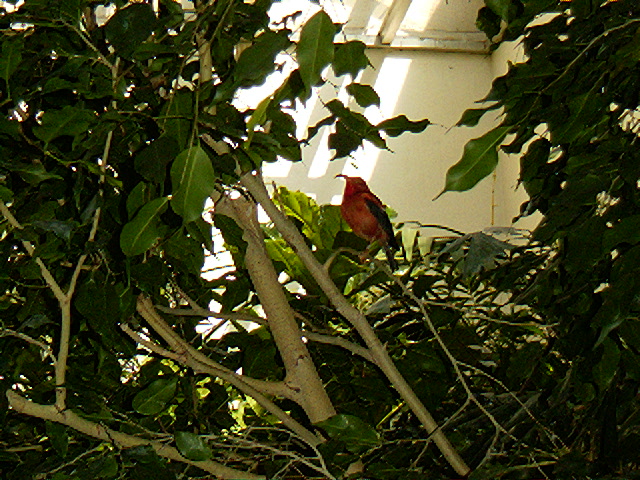
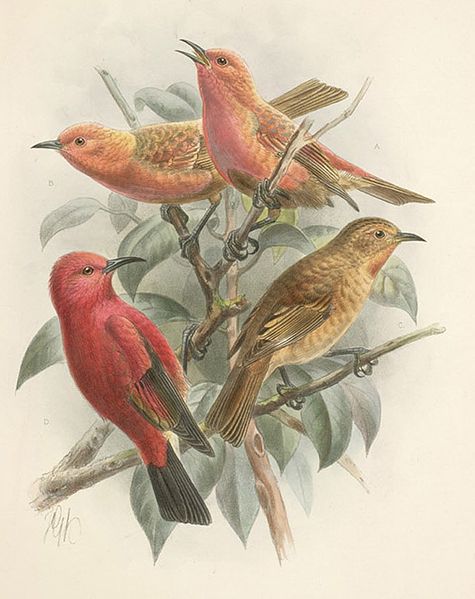
Last week, you were introduced to the Finch – Fringillidae Family part I. This week we will continue working our way through the 225 beautiful species of the family. I ended with the Carpodacus genus, because this weeks group has many Hawaiian birds with around fifteen of them now extinct.
The Poo-uli, Kakawahie,Lesser Koa Finch, Greater Koa Finch, Kona Grosbeak, Ou, Lanai Hookbill, Hawaii Mamo, Black Mamo, Ula-ai-hawane, Laysan Honeycreeper, Greater Amakihi, Lesser Akialoa, Oahu Akialoa, Kauai Akialoa, Maui-nui Akialoa, Oahu Nukupuu and Oahu Akepa are all listed as extinct. From that group only the Iiwi (Drepanis coccinea), Akohekohe (Palmeria dolei) and Apapane (Himatione sanguinea) are still living.
Finches II is only featuring these thirty-nine birds, mainly from Hawaii, with fifteen extinct. Why are they becoming extinct, let’s see if we can find out. Wikipedia has this to say, “Some 20 species (that number includes early extinctions not counted today) of Hawaiian honeycreeper have become extinct in the recent past, and many more in earlier times, between the arrival of the Polynesians who introduced the first rats, chickens, pigs, and dogs, and hunted and converted habitat for agriculture.
This whole group is referred to as Hawaiian honeycreepers are small, passerine birds endemic to Hawaiʻi. They are closely related to the rosefinches in the genus Carpodacus. Their great morphological diversity is the result of adaptive radiation in an insular environment. “Adaptive radiation is a rapid phenomenon because the variation is fully observable in many wild populations. Since macroevolutionary hypotheses of simple-to-complex evolutionary progress require vast eons, alterations produced by adaptive radiation occur quickly by comparison.” (by Brian Thomas, M.S. – ICR article)
The male Hawaiian honeycreepers are more brightly colored than the females in the Psittirostrini, but in the Hemignathini, they often look very similar. The flowers of the native ʻōhiʻa lehua (Metrosideros polymorpha) are favored by a number of nectarivorous honeycreepers. Many species of this subfamily have been noted to have a plumage odor that has been termed the “Drepanidine odor”, and is suspected to have a role in making the bird distasteful to predators. (Wikipedia with editing)
The wide range of bills in this group, from thick, finch-like bills to slender, downcurved bills for probing flowers have arisen through adaptive radiation. (Wikipedia with editing) The Lord graciously allowed these birds with beaks to meet their needs.
Which doeth great things past finding out; yea, and wonders without number. (Job 9:10 KJV)
“Of fowls after their kind, and of cattle after their kind, of every creeping thing of the earth after his kind, two of every sort shall come unto thee, to keep them alive.” Genesis 6:20
Most spiders use their silk to make webs to catch prey. But there’s one spider that spins its silk to make a virtually waterproof sack and fills it with air bubbles so it can survive underwater for hours at a time. In fact, the air-filled sack is so efficient, it allows this air-breathing spider to live virtually its whole life a few inches below the water’s surface.
The Spider That Thinks It’s a Scuba Diver
Scientists have known about the diving bell spider for a long time. But a few years ago they discovered that this silken sack is actually able to produce its own air supply. Acting much like a fish’s gills, the finely woven sack draws oxygen from the water while letting nitrogen exit the diving bell.
Evolutionists can’t explain how the spider learned how to scuba dive and produce silk that makes the diving bell virtually waterproof. Oh, they will say what they always say – natural selection and mutations over millions of years. But creationists have no need of such far-fetched explanations.
The Creator showed His fondness for this spider by giving it what it needs to avoid predators above the water while feeding upon underwater creatures. Now, think about how much more our Creator loves each one of us. He gave us the gift of His Son, who lived a sinless life and then died as a spotless sacrifice on our behalf so we would be found holy and blameless in God’s sight through faith in Christ.
Prayer:
Heavenly Father, thank You for providing such a great gift that cost You so much! I don’t deserve such a gift, but I humbly accept the love You poured out on me through Jesus Christ. Amen.
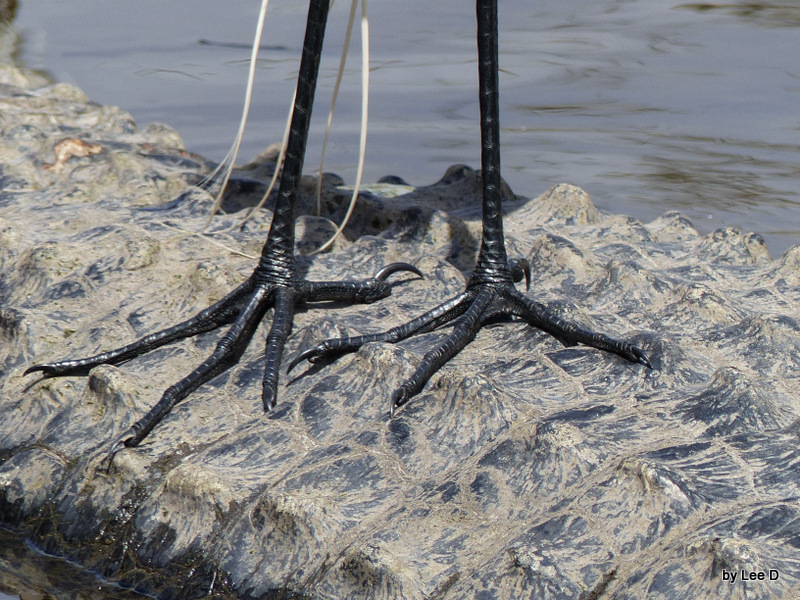
Great Egret on Alligator at Gatorland 3-8-16 by Lee
“Therefore be careful how you walk, not as unwise men but as wise,” (Ephesians 5:15 NASB)
You saw this photo in Lee’s Three Word Wednesday, but now here is a video of these birds catching their “Taxi Rides” there at Gatorland, FL.
In the first part of the video, notice the Great Egret gives the gator a nudge to get moving and the gator raises its head up. I didn’t realize that the Great Blue Heron was standing on that same alligators submerged tail. Talking to one of the workers, she said every once in a while the gators get hungry. Birds are playing a very dangerous game, in my opinion.
Most times these alligators and birds get along fine. People are tossing food to them and so they abide each other. It is amazing how different critters get along. I can only imagine how it must have been when they were first created. There was no desire of the gators to eat the birds. Today, under the curse, it is a totally different situation. That condition shall come again in the future.
“The wolf also shall dwell with the lamb, The leopard shall lie down with the young goat, The calf and the young lion and the fatling together; And a little child shall lead them. The cow and the bear shall graze; Their young ones shall lie down together; And the lion shall eat straw like the ox. (Isaiah 11:6-7 NKJV)






 Lee's Birdwatching Adventures Plus