For I am not ashamed of the gospel of Christ: for it is the power of God unto salvation to every one that believeth; to the Jew first, and also to the Greek. (Romans 1:16 KJV)
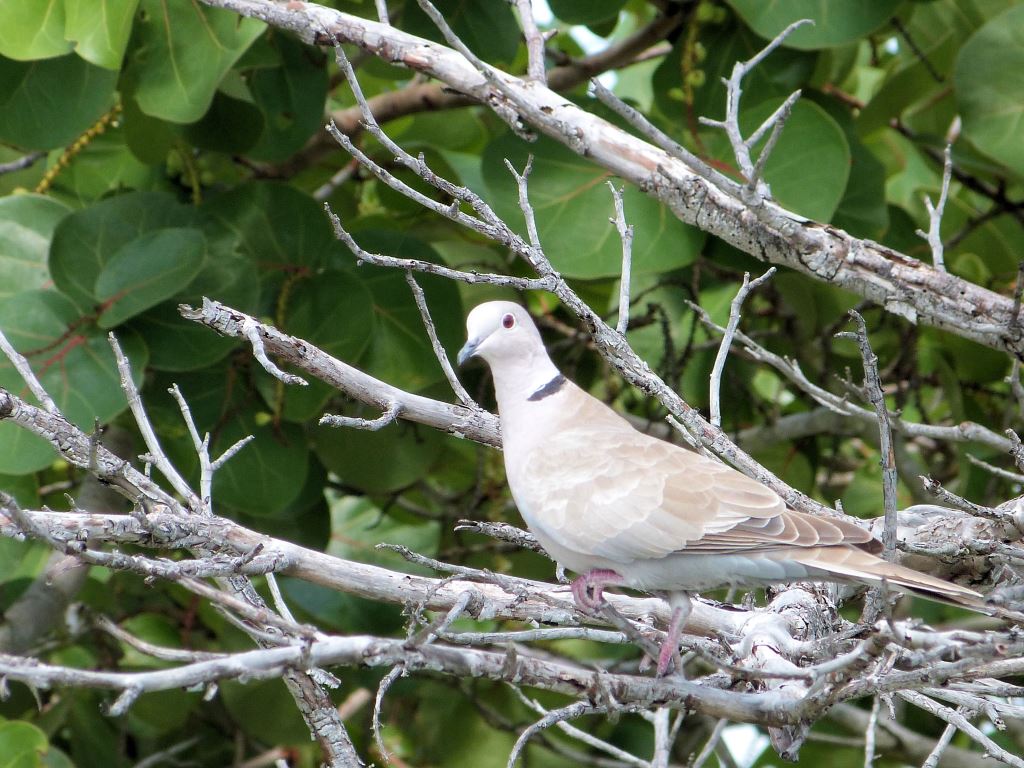
Eurasian Collared Dove (Streptopelia decaocto) by Lee at Honeymoon Is. SP (Harmless as a Dove)
This week-end we are having a Missions Conference and this is the theme verse. This blog is not ashamed to mention the Gospel of Christ as most of the readers are aware. We love birds and birdwatching, but as our subtitle says: Birdwatching From A Christian Perspective.
“He hath made his wonderful works to be remembered: the LORD is gracious and full of compassion.” (Psalms 111:4 KJV)
The Motacillidae are a family of small passerine birds with medium to long tails. There are around 66 species in 6 genera and they include the wagtails, longclaws and pipits. The longclaws are entirely restricted to the Afrotropics, and the wagtails are predominantly found in Europe, Africa and Asia, with two species migrating and breeding in Alaska. The pipits have the most cosmopolitan distribution, being found across mostly in the Old World but occurring also in the Americas and oceanic islands such as New Zealand and the Falklands. Two African species, the Yellow-breasted Pipit and Sharpe’s Longclaw are sometimes placed in a separate seventh genus, Hemimacronyx, which is closely related to the longclaws.
Wagtails, pipits, and longclaws are slender, small to medium sized passerines, ranging from 14 to 17 centimetres in length, with short necks and long tails. They have long, pale legs with long toes and claws, particularly the hind toe which can be up to 4 cm in length in some longclaws. Overall the robust longclaws are larger than the pipits and wagtails. Longclaws can weigh as much as 64 g, whereas the weight range for pipits and wagtails is 15–31 g. The plumage of most pipits is dull brown and reminiscent of the larks, although some species have brighter plumages, particularly the Golden Pipit of north-east Africa. The adult male longclaws have brightly coloured undersides.
Citrine Wagtail (Motacilla citreola) by Nikhil Devasar
The wagtails often have striking plumage, including grey, black, white, and yellow. (Wikipedia with editing)
*
This slideshow requires JavaScript.
“And they that passed by reviled him, wagging their heads, And saying, Thou that destroyest the temple, and buildest it in three days, save thyself. If thou be the Son of God, come down from the cross.” (Matthew 27:39-40 KJV)
“Glorious Love” ~ Choir, Orchestra, Solo by Pastor Jerry
And God shall wipe away all tears from their eyes; and there shall be no more death, neither sorrow, nor crying, neither shall there be any more pain: for the former things are passed away. (Revelation 21:4 KJV)
Atlantic Puffin (Fratercula arctica) by Michael Woodruff
(I know the Puffin isn’t crying, but he looks sad. We have shed many tears this week and are looking forward to the promise above.)
Then shall the righteous shine forth as the sun in the kingdom of their Father. Who hath ears to hear, let him hear. (Matthew 13:43 KJV)
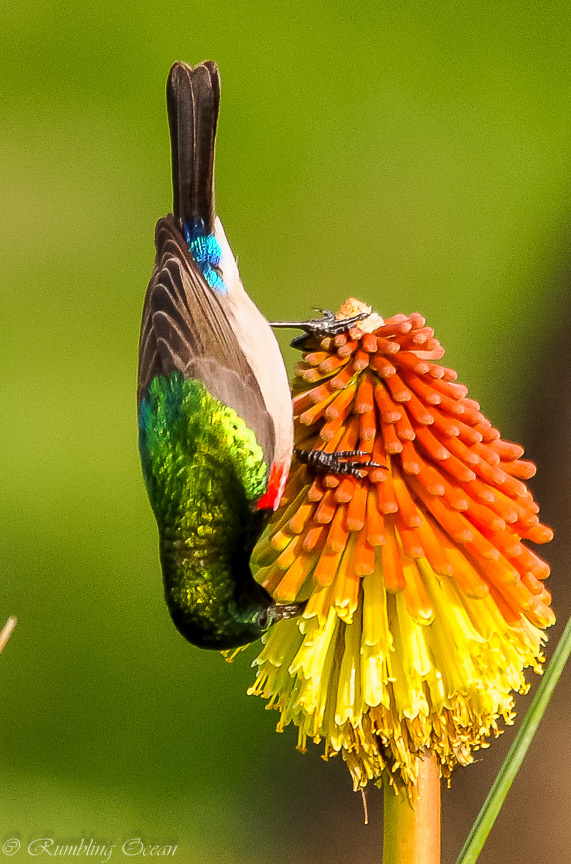
In the daily devotional yesterday, I forgot to give you a link to my friend’s website. They gave me permission to use it, but I forgot to give him credit for his beautiful photography.
I have fixed my over-site by providing the link. Our Rumbling Ocean is a site I have been following for some time and have become friends with them. They have a son who is featured very often. We have all been watching him grow up. They live on the East Coast of South Africa and are within 150 m of the ocean. Check out their blogs at:
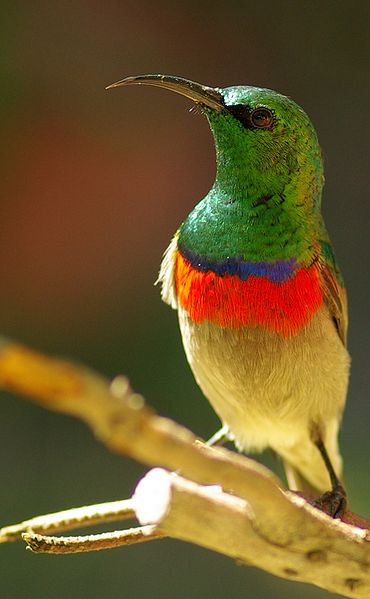
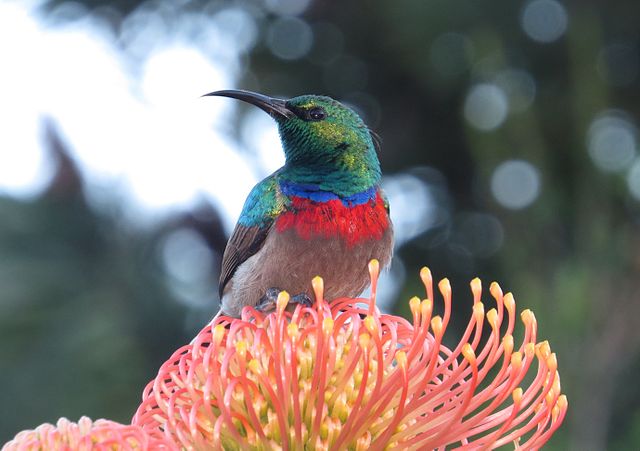
Now, let me tell you a little bit about that beautiful bird that the Lord created. The scientific name is Cinnyris chalybeus, and as is common, they have several names given to a bird. Locally, there in South Africa, it is known as the Lesser Double-collared Sunbird. The I.O.C. uses the name, Southern Double-collared Sunbird (Cinnyris chalybeus).
“The southern double-collared sunbird or lesser double-collared sunbird (Cinnyris chalybeus) is a small passerine bird which breeds in southern South Africa. It is mainly resident, but partially migratory in the north-east of its range.” This Sunbird is part of the Nectariniidae – Sunbirds Family. This family was featured in the Sunday Inspiration – Sunbirds in August.
“This sunbird is common in gardens, fynbos, forests and coastal scrub. The southern double-collared sunbird breeds from April to December, depending on region. The closed oval nest is constructed from grass, lichen and other plant material, bound together with spider webs. It has a side entrance which sometimes has a porch, and is lined with wool, plant down and feathers.”
“The southern double-collared sunbird is 12 cm long. The adult male has a glossy, metallic green head, throat upper breast and back. It has a brilliant red band across the chest, separated from the green breast by a narrow metallic blue band. The rest of the underparts are whitish. When displaying, yellow feather tufts can be seen on the shoulders. As with other sunbirds the bill is long and decurved. The bill, legs and feet are black. The eye is dark brown. The male can be distinguished from the similar greater double-collared sunbird by its smaller size, narrower red chest band and shorter bill.
The female southern double-collared sunbird has brown upperparts and yellowish-grey underparts. The juvenile resembles the female. The female is greyer below than the female orange-breasted sunbird, and darker below than the female dusky sunbird.”
“The southern double-collared sunbird is usually seen singly or in small groups. Its flight is fast and direct on short wings. It lives mainly on nectar from flowers, but takes some fruit, and, especially when feeding young, insects and spiders. It can take nectar by hovering like a hummingbird, but usually perches to feed most of the time.
The call is a hard chee-chee, and the song is high-pitched jumble of tinkling notes, rising and falling in pitch and tempo for 3–5 seconds or more.” (Quoted material is from Wikipedia with editing.) I also think Rambling Oceans photos are better, but I had only asked permission for the one. :(
Therefore we are always confident, knowing that, whilst we are at home in the body, we are absent from the Lord: (For we walk by faith, not by sight:) We are confident, I say, and willing rather to be absent from the body, and to be present with the Lord. (2 Corinthians 5:6-8 KJV)
Dan and I have been privileged to have close friends over the years. As you move to new locations, the Lord helps you develop more “best friend” relationships. Here, Jim and Phyllis, have become more of our “best friends.” Yesterday, Jim (James) Foster, went home “to be with Our Lord.”
Jim and Phyllis Looking at Baby Gallinule at Lake Hollingsworth
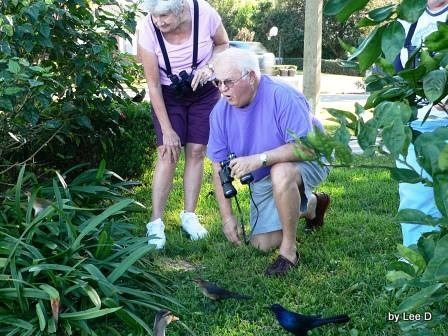
Over the years, Jim and Phyllis have joined us in some of our birdwatching adventures, and so, in honor of those great times together, I’d like to share some of those photos. This is also, to help ease the loss we feel at his “home going.”
Dan, Jim and Phyllis at MacDill AFB Shore
Jim is enjoying the delights of heaven and of being in the presence with the Lord. It is those of us here, that are sad and happy at the same time.
Jim and Emma Foster – Work Day 2011
Also, you are familiar with our great stories from Emma Foster. This is her grandfather. She, and all of her family will appreciate your prayers.
Jim and Phyllis were always ready and willing to volunteer for VBS and other events at church. Most of the time, it was in the kitchen area.
Jim with Pastor Pete and Emma at Window
But I would not have you to be ignorant, brethren, concerning them which are asleep, that ye sorrow not, even as others which have no hope. For if we believe that Jesus died and rose again, even so them also which sleep in Jesus will God bring with him. (1 Thessalonians 4:13-14 KJV)
And as Jesus passed forth from thence, he saw a man, named Matthew, sitting at the receipt of custom: and he saith unto him, “Follow me!” And he arose, and followed him. (Matthew 9:9 KJV)
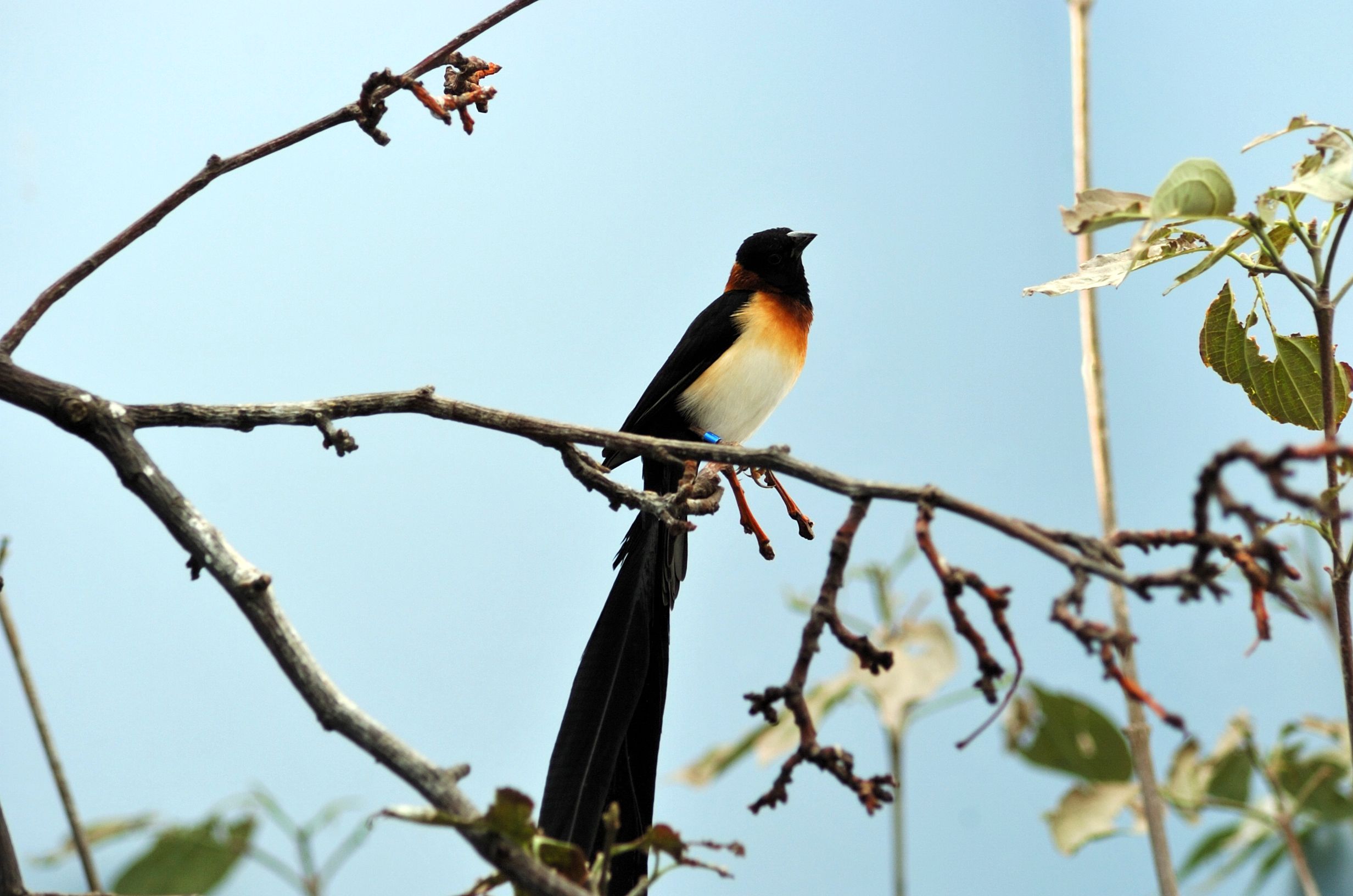
Long-tailed Paradise Whydah by Dan at the National Aviary
Better is little with the fear of the LORD than great treasure and trouble therewith. (Proverbs 15:16 KJV)
Our next families in our Passeriformes Order are small families. Because they are small in number does not mean they are small in beauty. I love the song, “Little Is Much When God Is In It.” Maybe because I am short. :) Sometimes these small groups are a result of the ornithologists not being sure which family to include them. As they (ornithologists) keep doing DNA studies, more shuffling in families will occur.
Our largest family, Viduidae, today has twenty species of Indigobirds, Whydahs, and a Cuckoo-finch. We saw our first Whydah at the National Aviary in Pittsburg, PA. It is appropriately called a Long-tailed Paradise Whydah. You can see its long tail, worn by males, in the photo. These are finch-like birds which usually have black or indigo predominating in their plumage.
All are brood parasites, which lay their eggs in the nests of estrildid finch species; most indigobirds use fire-finches as hosts, whereas the paradise whydahs chose pytilias. Unlike the cuckoo, the indigobirds and whydahs do not destroy the host’s eggs.
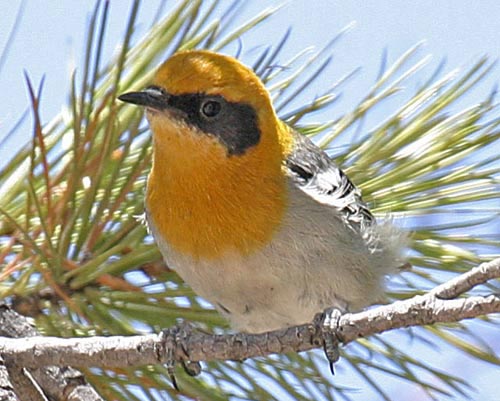
The Olive Warbler is the solo member of his family, (Peucedramidae), but there are several sub-species. This species breeds from southern Arizona and New Mexico, USA, south through Mexico to Nicaragua. It is the only bird family endemic to North America (including Central America).
It is an insectivorous species of coniferous forests. Though it is often said to be non-migratory,[3] most New Mexican birds leave the state from November to late February. It lays 3–4 eggs in a tree nest”. (Wikipedia)
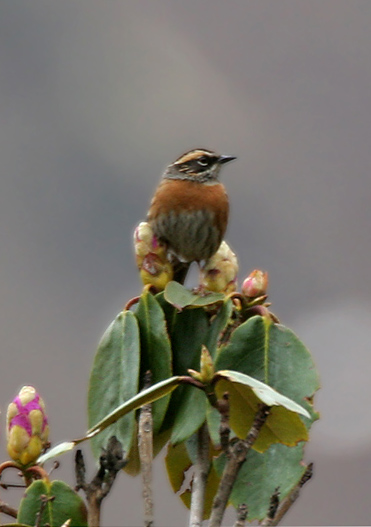
The Prunellidae – Accentors Family has thirteen members named Accentors and one Dunnock, of the genus, Prunella. All but the Dunnock and the Japanese Accentor are inhabitants of the mountainous regions of Europe and Asia; these two also occur in lowland areas, as does the Siberian Accentor in the far north of Siberia. This genus is not strongly migratory, but they will leave the coldest parts of their range in winter, and make altitudinal movements.
Their typical habitat is mountainous regions in an area far above the tree-line, but below the snow-line. The Himalayan accentor can be found as high as 17,000 ft above sea level when breeding, however, most accentors breed in scrub vegetation at lower levels. Most species migrate downwards to spend the winter, with only some being hardy enough to remain. Accentors spend the majority of their time in the undergrowth and even when flushed, stay low to the ground until reaching cover. (Wikipedia)
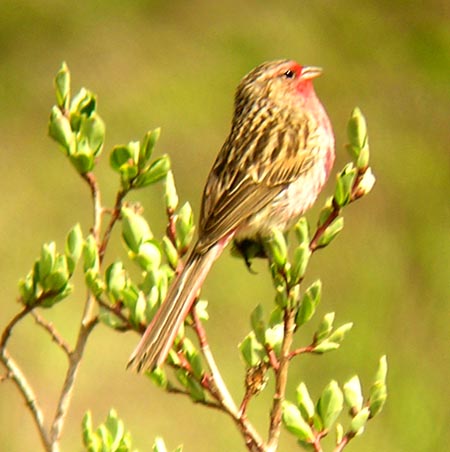
Skipping over the Wagtails and Pipits (covered next week), our last bird, the Przevalski’s Finch (Urocynchramus pylzowi), is again in a family by itself.
The Przevalski’s Finch or Przewalski’s Finch (Urocynchramus pylzowi) is an unusual passerine bird from the mountains of central-west China. The species is named for Nikolai Przhevalsky, the Russian explorer who described it. Its taxonomic affinities were unclear for a long time, giving rise to other common names, the Pink-tailed Bunting and the Przewalski’s Rosefinch. In 2000 it was proposed that it should in fact be regarded neither as a finch nor a bunting, but as the only member of the family Urocynchramidae,
Przewalski’s Finch is a small bird similar in appearance to the Long-tailed Rosefinch. The tail is long and – quite unlike in typical finches – graduated, with the outer feathers much shorter than the central ones. The sexes are sexually dimorphic, with the males having bright pink on the throat, breast and belly. Both sexes have brown streaked plumage on the back and wings. The bill is thinner than those of the rosefinches. (Wikipedia)
This slideshow requires JavaScript.
But Jesus said, Suffer little children, and forbid them not, to come unto me: for of such is the kingdom of heaven. (Matthew 19:14 KJV)









 Lee's Birdwatching Adventures Plus