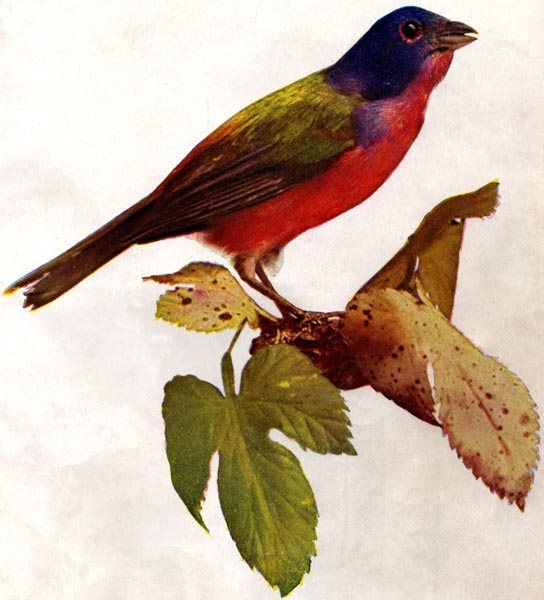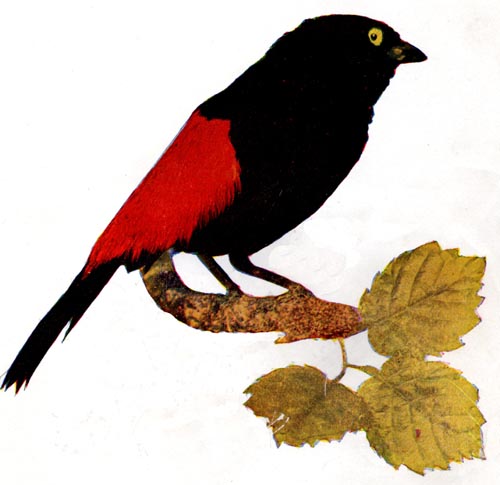
Birds Vol 1 #1 – The Red-Rumped Tanager (Scarlet-Rumped or ?)

Red-Rumped Tanager

Red-Rumped Tanager

Birds Illustrated by Color Photography – Revisited

Vol 1. January, 1897 No. 1

*

THE RED-RUMPED TANAGER.

I have just been singing my morning song, and I wish you could have heard it. I think you would have liked it.

I always sing very early in the morning. I sing because I am happy, and the people like to hear me.

My home is near a small stream, where there are low woods and underbrush along its banks.

There is an old dead tree there, and just before the sun is up I fly to this tree.

I sit on one of the branches and sing for about half an hour. Then I fly away to get my breakfast.

I am very fond of fruit. Bananas grow where I live, and I like them best of all.

I eat insects, and sometimes I fly to the rice fields and swing on the stalks and eat rice.

The people say I do much harm to the rice, but I do not see why it is wrong for me to eat it, for I think there is enough for all.

I must go now and get my breakfast. If you ever come to see me I will sing to you.

I will show you my wife, too. She looks just like me. Be sure to get up very early. If you do not, you will be too late for my song.


“Birds, Birds! ye are beautiful things,
With your earth-treading feet and your cloud-cleaving wings.
Where shall man wander, and where shall he dwell—
Beautiful birds—that ye come not as well?
Ye have nests on the mountain, all rugged and stark,
Ye have nests in the forest, all tangled and dark;
Ye build and ye brood ‘neath the cottagers’ eaves,
And ye sleep on the sod, ’mid the bonnie green leaves;
Ye hide in the heather, ye lurk in the brake,
Ye dine in the sweet flags that shadow the lake;
Ye skim where the stream parts the orchard decked land,
Ye dance where the foam sweeps the desolate strand.”


Silver-beaked Tanager Through wire cage at Lowry Park Zoo by Lee

Silver-beaked Tanager Through wire cage at Lowry Park Zoo by Lee


THE RED-RUMPED TANAGER.

imga1

N American family, the Tanagers are mostly birds of very brilliant plumage. There are 300 species, a few being tropical birds. They are found in British and French Guiana, living in the latter country in open spots of dwellings and feeding on bananas and other fruits. They are also said to do much harm in the rice fields.

In “The Auk,” of July, 1893, Mr. George K. Cherrie, of the Field Museum, says of the Red-Rumped Tanager:

“During my stay at Boruca and Palmar, (the last of February) the breeding season was at its height, and I observed many of the Costa Rica Red-Rumps nesting. In almost every instance where possible I collected both parents of the nests, and in the majority of cases found the males wearing the same dress as the females. In a few instances the male was in mottled plumage, evidently just assuming the adult phase, and in a lesser number of examples the male was in fully adult plumage—velvety black and crimson red. From the above it is clear that the males begin to breed before they attain fully adult plumage, and that they retain the dress of the female until, at least, the beginning of the second year.

“While on this trip I had many proofs that, in spite of its rich plumage, and being a bird of the tropics, it is well worthy to hold a place of honor among the song birds. And if the bird chooses an early hour and a secluded spot for expressing its happiness, the melody is none the less delightful. At the little village of Buenos Aires, on the Rio Grande of Terraba, I heard the song more frequently than at any other point. Close by the ranch house at which we were staying, there is a small stream bordered by low woods and underbrush, that formed a favorite resort for the birds. Just below the ranch is a convenient spot where we took our morning bath. I was always there just as the day was breaking. On the opposite bank was a small open space in the brush occupied by the limbs of a dead tree. On one of these branches, and always the same one, was the spot chosen by a Red-rump to pour forth his morning song. Some mornings I found him busy with his music when I arrived, and again he would be a few minutes behind me. Sometimes he would come from one direction, sometimes from another, but he always alighted at the same spot and then lost no time in commencing his song. While singing, the body was swayed to and fro, much after the manner of a canary while singing. The song would last for perhaps half an hour, and then away the singer would go. I have not enough musical ability to describe the song, but will say that often I remained standing quietly for a long time, only that I might listen to the music.”


Lee’s Addition:

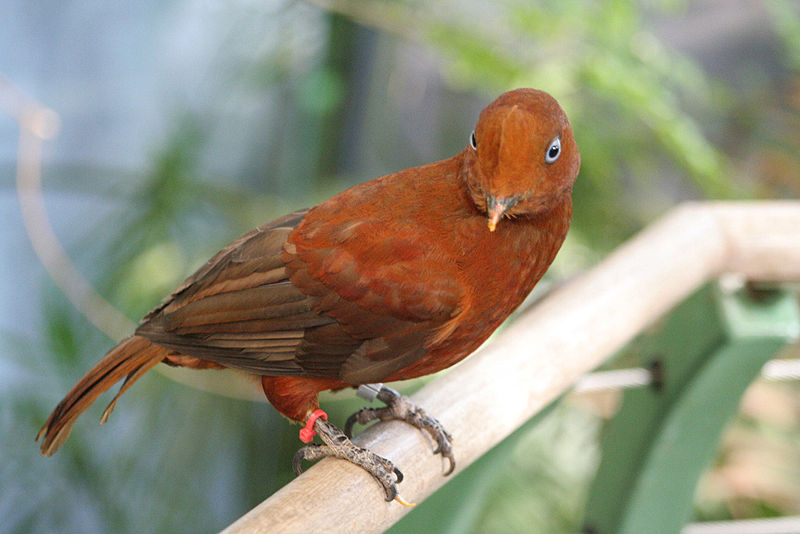
The Red-Rumped Tanager has of course been renamed and renamed again. Tracking this bird was not too difficult because of its “red-rump.” It appears the bird became known as the Scarlet-rumped Tanager and now recently has been split into two species. According to Wikipedia – “The Cherrie’s TanagerRamphocelus costaricensis, is a medium-sized passerine bird. This tanager is a resident breeder in the Pacific lowlands of Costa Rica and western Panama. This bird was formerly known as the Scarlet-rumped Tanager, but was split as a separate species from the Caribbean form, which was itself renamed as Passerini’s Tanager,Ramphocelus passerinii. While most authorities have accepted this split, there are notable exceptions (e.g. the Howard and Moore checklist).

So now you see why I have so much “fun” every three months updating my Birds of the World pages when the IOC (International Ornithologists’ Union) updates their Birds of the World List. That is the standard used for this site.

Take you choice. Is it the Passerini’s Tanager (Ramphocelus passerinii)?

Passerini's Tanager (Ramphocelus passerinii) Male ©BirdPhotos.com

Passerini’s Tanager (Ramphocelus passerinii) Male ©BirdPhotos.com

Passerini’s Tanager (Ramphocelus passerinii) Xeno-canto org

Or is it the Cherrie’s Tanager (Ramphocelus costaricensis)?
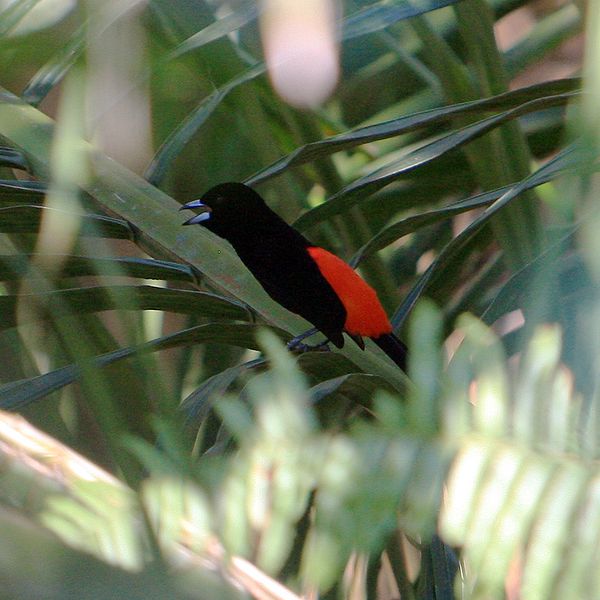
Cherrie's Tanager (Ramphocelus costaricensis) WikiC

Cherrie’s Tanager (Ramphocelus costaricensis) WikiC

Cherrie’s Tanager (Ramphocelus costaricensis) xeno-canto.org

Or is it the Flame-rumped Tanager (Ramphocelus flammigerus)?

Flame-rumped Tanager (Ramphocelus flammigerus) ©WikiC

Flame-rumped Tanager (Ramphocelus flammigerus) ©WikiC

Flame-rumped Tanager (Ramphocelus flammigerus) by xeno-canto.org

Which ever one you choose, they are all in the same Genus called Ramphocelus. They are silver-beaked tanagers and are found in Central and South America. They all like fruit and insects and are closely related.

Crimson-collared Tanager (Ramphocelus sanguinolentus )
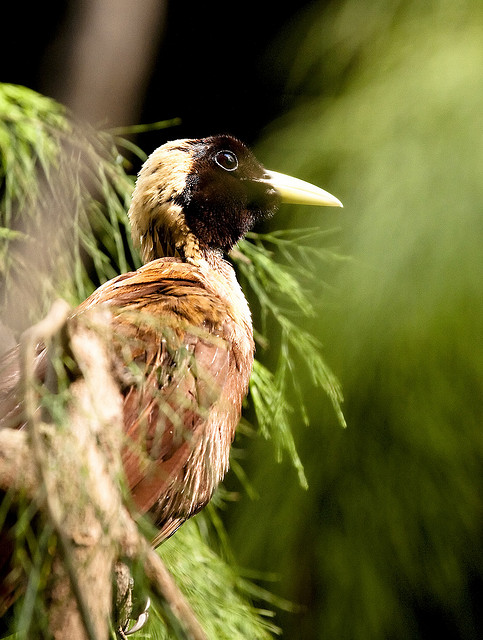
Masked Crimson Tanager (Ramphocelus nigrogularis )
Crimson-backed Tanager (Ramphocelus dimidiatus )
Huallaga Tanager (Ramphocelus melanogaster )
Silver-beaked Tanager (Ramphocelus carbo )
Brazilian Tanager (Ramphocelus bresilia )
Passerini’s Tanager (Ramphocelus passerinii )
Cherrie’s Tanager (Ramphocelus costaricensis )
Flame-rumped Tanager (Ramphocelus flammigerus )
Lemon-rumped Tanager (Ramphocelus icteronotus )

And they stripped him, and put on him a scarlet robe. And when they had platted a crown of thorns, they put it upon his head, and a reed in his right hand: and they bowed the knee before him, and mocked him, saying, Hail, King of the Jews! (Matthew 27:28-29 KJV)
Birds Illustrated by Color Photograhy Vol 1 January 1897 No 1 - Cover

Birds Illustrated by Color Photography – Revisited – Introduction

The above article is the eighth article in the monthly serial that was started in January 1897 “designed to promote Knowledge of Bird-Live.” These include Color Photography, as they call them, today they are drawings. There are at least three Volumes that have been digitized by Project Gutenberg.

To see the whole series of – Birds Illustrated by Color Photography – Revisited

*

(Information from Wikipedia and other internet sources)

Next Article – The Golden Oriole

Previous Article – The Yellow Throated Toucan

ABC’s of the Gospel

Links:

Birds of the World

Tanagers and Allies – Thraupidae Family

Ramphocelus – Wikipedia

*


Birds Vol 1 #1 – The Yellow Throated or (Black-mandibled) Toucan

Black-mandibled Toucan (Ramphastos ambiguus) for the Birds Illustrated article

Yellow Throated Toucan for the Birds Illustrated article

Birds Illustrated by Color Photography – Revisited

Vol 1. January, 1897 No. 1

*

THE YELLOW THROATED TOUCAN

(Ramphastos ambiguus) or Black-mandibled) Toucan

.

I am a Toucan and I live in a very warm country.

See my handsome black coat and my yellow vest.

My toes are like a parrot’s, two in front and two behind.

They help me to hold to the limbs.

Look at my large beak. It looks heavy but it is not, as it is filled with air cells. These make it very light. Do you like my blue eyes?

My nest is very hard to find. If I tell you where it is, you will not take the eggs, will you? It is in a hollow limb of a very high tree.

I am very fond of fruit, and for this reason the people on the plantations do not like me very well.

I can fly very fast, but I cannot get along so well on the ground. I keep my feet far apart and hop.

I like to sit in the top of the tallest trees. Then I am not afraid. Nothing can reach me there but a rifle ball.

I do not like the owl, he is so ugly. When we find an owl we get in a circle around him and snap our great beaks, and jerk our tails up and down and scream. He is very much afraid of us.

The people where I live like our yellow breasts. They wear them on their heads, and also put them on the ends of their bows.

We sometimes sit together in a tree and snap our beaks and shout. This is why we have been called “Preacher Birds.”

We can scream so loud that we may be heard a mile away. Our song is “Tucano! Tucano!”

I think it is a pretty song, but the people do not like it very much.

Chestnut-mandibled Toucan (Ramphastos swainsonii) by Ian

Chestnut-mandibled Toucan (Ramphastos swainsonii) by Ian


THE YELLOW THROATED TOUCAN.

imgt

HE Toucans are a numerous race of South American birds, at once recognizable by the prodigious size of their beaks and by the richness of their plumage. “These birds are very common,” says Prince Von Wied, “in all parts of the extensive forests of the Brazils and are killed for the table in large numbers during the cool seasons. Their eggs are deposited in the hollow limbs and holes of the colossal trees, so common in the tropical forests, but their nests are very difficult to find. The egg is said to be white. They are very fond of fruit, oranges, guavas and plantains, and when these fruits are ripe make sad havoc among the neighboring plantations. In return for these depredations the planter eats their flesh, which is very delicate.”

The flight of these birds is easy and graceful, sweeping with facility over the loftiest trees of their native forests, their strangely developed bills being no encumbrance to them, replete as they are with a tissue of air-filled cells rendering them very light and even buoyant.

On the ground they get along with a rather awkward hopping movement, their legs being kept widely apart. In ascending a tree they do not climb but mount from one branch to another with a series of jumps, ascending to the tops of the very loftiest trees, safe from every missile except a rifle ball. They have a habit of sitting on the branches in flocks, lifting their bills, clattering them together, and shouting hoarsely all the while, from which custom the natives call them Preacher-birds. Sometimes the whole party, including the sentinel, set up a simultaneous yell so deafeningly loud that it can be heard a mile. They are very loquacious birds and are often discovered through their perpetual chattering. Their cry resembles the word “Tucano,” which has given origin to the peculiar name.

When settling itself to sleep, the Toucan packs itself up in a very systematic manner, supporting its huge beak by resting it on its back, and tucking it completely among the feathers, while it doubles its tail across its back just as if it moved on hinges. So completely is the large bill hidden among the feathers, that hardly a trace of it is visible in spite of its great size and bright color, so that the bird when sleeping looks like a great ball of loose feathers.

Sir R. Owen concludes that the large beak is of service in masticating food compensating for the absence of any grinding structures in the intestinal tract.

Says a naturalist: “We turned into a gloomy forest and for some time saw nothing but a huge brown moth, which looked almost like a bat on the wing. Suddenly we heard high upon the trees a short shrieking sort of noise ending in a hiss, and our guide became excited and said, “Toucan!” The birds were very wary and made off. They are much in quest and often shot at. At last we caught sight of a pair, but they were at the top of such a high tree that they were out of range. Presently, when I had about lost hope, I heard loud calls, and three birds came and settled in a low bush in the middle of the path.”

(Edited)

Gracie the retired Chestnut-mandibled Toucan (Ramphastos swainsonii)

Gracie the retired Chestnut-mandibled Toucan (Ramphastos swainsonii)


Lee’s Addition:

Today the Yellow Throated Toucan is also referred to as the Black-mandibled Toucan, at least by the IOC list of World Birds and the Internet Bird Collection. Actually, there are several Toucans that have a yellow throat and hope this is the one referred to in the 1897 article. The way they keep changing the names and splitting the species, the Chestnut-mandibled is also in that species.

What a fantastic bird and such an amazing creation from the Lord. Such a beautiful beak and yet so light.

All things were made through Him, and without Him nothing was made that was made. (John 1:3 NKJV)

All of these Toucans have Yellow Throats:
Chestnut-mandibled Toucan (Ramphastos swainsonii) Lee petting at National Aviary
Rainbow-billed Toucan (Ramphastos sulfuratus) IBC
Choco Toucan (Ramphastos brevis) IBC
Channel-billed Toucan (Ramphastos vitellinus) IBC
Black-mandibled Toucan (Ramphastos ambiguus) IBC

Toucans are members of the family Ramphastidae of near passerine birds from the Neotropics. The Ramphastidae family is most closely related to the American barbets. They are brightly marked and have large, often colorful bills. The family includes five genera and about forty different species. The name of this bird group is derived from the Tupi word tukana, via Portuguese.

Toucans range in size from the Lettered Aracari (Pteroglossus inscriptus), at 130 g (4.6 oz) and 29 cm (11.5 inches), to the Toco Toucan (Ramphastos toco), at 680 g (1.5 lb) and 63 cm (29 inches). Their bodies are short (of comparable size to a crow’s) and compact. The tail is rounded and varies in length, from half the length to the whole length of the body. The neck is short and thick. The wings are small, as they are forest-dwelling birds who only need to travel short distances, and are often of about the same span as the bill-tip-to-tail-tip measurements of the bird.

The colourful and large bill, which in some large species measures more than half the length of the body, is the hallmark of toucans. Despite its size, the toucan is very light, being composed of bone struts filled with spongy tissue of keratin between them. The bill has forward-facing serrations resembling teeth, which historically led naturalists to believe that toucans captured fish and were primarily carnivorous; today it is known that they eat mostly fruit. Researchers have discovered that the large bill of the toucan is a highly efficient thermoregulation system, though its size may still be advantageous in other ways. It does aid in their feeding behavior (as they sit in one spot and reach for all fruit in range, thereby reducing energy expenditure), and it has also been theorized that the bill may intimidate smaller birds, so that the toucan may plunder nests undisturbed. Also, the beak allows the bird to reach deep into tree-holes to access food unavailable to other birds, and also to ransack suspended nests built by smaller birds. However, as there is no sexual dimorphism in coloration it is unlikely to be a sexual signal.
A toucan’s tongue is long (up to 14–15 cm, or 6 inches), narrow, grey, and singularly frayed on each side, adding to its sensitivity as an organ of taste.

A structural complex probably unique to toucans involves the modification of several tail vertebrae. The rear three vertebrae are fused and attached to the spine by a ball and socket joint. Because of this, toucans may snap their tail forwards until it touches the head. This is the posture in which they sleep, often appearing simply as a ball of feathers, with the tip of the tail sticking out over the head.

Toucans are primarily frugivorous (fruit eating), but are opportunistically omnivorous and will take prey such as insects and small lizards. Captive toucans have been reported to actively hunt insects in their cages, and it is possible to keep toucans on an insect-only diet. They also plunder nests of smaller birds, taking eggs and nestlings. This probably provides a crucial addition of protein to their diet. However, in their range, toucans are the dominant frugivores, and as such play an extremely important ecological role as vectors for seed dispersal of fruiting trees. Often when eating small fruits, toucans will throw their heads back and allow the fruit to roll into their throats before swallowing.

*

Birds Illustrated by Color Photograhy Vol 1 January 1897 No 1 - Cover

Birds Illustrated by Color Photography – Revisited – Introduction

The above article is the second article in the monthly serial that was started in January 1897 “designed to promote Knowledge of Bird-Live.” These include Color Photography, as they call them, today they are drawings. There are at least three Volumes that have been digitized by Project Gutenberg.

To see the whole series of – Birds Illustrated by Color Photography – Revisited

*

(Information from Wikipedia and other internet sources)

Next Article – The Red-Rumped Tanager

Previous Article – The Red Bird Of Paradise

Wordless Toucan

*

Birds Vol 1 #1 – The Red Bird Of Paradise

Red Bird of Paradise

Red Bird of Paradise

Birds Illustrated by Color Photography – Revisited

Vol 1. January, 1897 No. 1

*

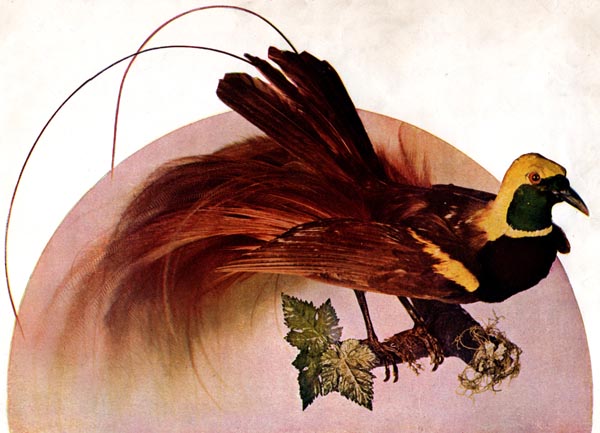
THE RED BIRD OF PARADISE.

My home is on an island where it is very warm. I fly among the tall trees and eat fruit and insects.

See my beautiful feathers. The ladies like to wear them in their hats.

The feathers of my wife are brown, but she has no long tail feathers.

My wife thinks my plumes are very beautiful.

When we have a party, we go with our wives to a tall tree. We spread our beautiful plumes while our wives sit and watch us.

Sometimes a man finds our tree and builds a hut among the lower branches.

(edited-birds are not hunted for feathers as much today.)

They also thought we lived on the dews of heaven and the honey of flowers. This is why we are called the Birds of Paradise.


“Upon its waving feathers poised in air,
Feathers, or rather clouds of golden down,
With streamers thrown luxuriantly out
In all the wantonness of winged wealth.”


Red Bird-of-paradise (Paradisaea rubra) ©©PetePictures

Red Bird-of-paradise (Paradisaea rubra) ©©PetePictures

THE RED BIRD OF PARADISE.

imgb

IRDS of Paradise are found only in New Guinea and on the neighboring islands. The species presented here is found only on a few islands.

In former days very singular ideas prevailed concerning these birds and the most extravagant tales were told of the life they led in their native lands. The natives of New Guinea, in preparing their skins for exportation, had removed all traces of legs, so that it was popularly supposed they possessed none, and on account of their want of feet and their great beauty, were called the Birds of Paradise, retaining, it was thought, the forms they had borne in the Garden of Eden, living upon dew or ether, through which it was imagined they perpetually floated by the aid of their long cloud-like plumage.

Of one in confinement Dr. Bennett says: “I observed the bird, before eating a grasshopper, place the insect upon the perch, keep it firmly fixed by the claws, and, divesting it of the legs, wings, etc., devour it with the head always first. It rarely alights upon the ground, and so proud is the creature of its elegant dress that it never permits a soil to remain upon it, frequently spreading out its wings and feathers, regarding its splendid self in every direction.”

The sounds uttered by this bird are very peculiar, resembling somewhat the cawing of the Raven, but change gradually to a varied scale in musical gradations, like he, hi, ho, how! He frequently raises his voice, sending forth notes of such power as to be heard at a long distance. These notes are whackwhack, uttered in a barking tone, the last being a low note in conclusion.

While creeping amongst the branches in search of insects, he utters a soft clucking note. During the entire day he flies incessantly from one tree to another, perching but a few moments, and concealing himself among the foliage at the least suspicion of danger.

In Bennett’s “Wanderings” is an entertaining description of Mr. Beale’s bird at Maceo. “This elegant bird,” he says, “has a light, playful, and graceful manner, with an arch and impudent look, dances about when a visitor approaches the cage, and seems delighted at being made an object of admiration. It bathes twice daily, and after performing its ablutions throws its delicate feathers up nearly over its head, the quills of which have a peculiar structure, enabling the bird to effect this object. To watch this bird make its toilet is one of the most interesting sights of nature; the vanity which inspires its every movement, the rapturous delight with which it views its enchanting self, its arch look when demanding the spectator’s admiration, are all pardonable in a delicate creature so richly embellished, so neat and cleanly, so fastidious in its tastes, so scrupulously exact in its observances, and so winning in all its ways.”

Says a traveler in New Guinea: “As we were drawing near a small grove of teak-trees, our eyes were dazzled with a sight more beautiful than any I had yet beheld. It was that of a Bird of Paradise moving through the bright light of the morning sun. I now saw that the birds must be seen alive in their native forests, in order to fully comprehend the poetic beauty of the words Birds of Paradise. They seem the inhabitants of a fairer world than ours, things that have wandered in some way from their home, and found the earth to show us something of the beauty of worlds beyond.”

[youtube-http://youtu.be/y6fsLW8JQtA]
*


Lee’s Addition:

Red Bird-of-paradise (Paradisaea rubra, also Cendrawasih Merah), is a bird-of-paradise in the genus Paradisaea, family Paradisaeidae.

Large, up to 13 in (33 cm) long, brown and yellow with a dark brown iris, grey legs and yellow bill. The male has an emerald green face, a pair of elongated black corkscrew-shaped tail wires, dark green feather pompoms above each eye and a train of glossy crimson red plumes with whitish tips at either side of the breast. The male measures up to 28.3 in (72 cm) long, including the ornamental red plumes that require at least six years to fully attain. The female is similar but smaller in size, with a dark brown face and has no ornamental red plumes. The diet consists mainly of fruits, berries and arthropods.

An Indonesian endemic, the Red Bird-of-paradise is distributed to lowland rainforests of Waigeo and Batanta islands of Raja Ampat, West Papua. This species shares its home with another bird-of-paradise, the Wilson’s Bird-of-paradise. Hybridisation between these two species is not recorded but is expected because it is recorded for many other birds of paradise.

He that hath an ear, let him hear what the Spirit saith unto the churches; To him that overcometh will I give to eat of the tree of life, which is in the midst of the paradise of God. (Revelation 2:7 KJV)

*
Birds Illustrated by Color Photograhy Vol 1 January 1897 No 1 - Cover

Birds Illustrated by Color Photography – Revisited – Introduction

The above article is the seventh article in the monthly serial that was started in January 1897 “designed to promote Knowledge of Bird-Live.” These include Color Photography, as they call them, today they are drawings. There are at least three Volumes that have been digitized by Project Gutenberg.

To see the whole series of – Birds Illustrated by Color Photography – Revisited

*

(Information from Wikipedia and other internet sources)

Next Article – The Yellow Throated Toucan

Previous Article – The Cock-Of-The-Rock

Gospel Presentation

Links:

Red Bird-of-paradise Bank Note Photo – Java (Indonesia)

Red Bird-of-paradise – ARKive

Red Bird-of-paradise flying Photo

Red Bird-of-paradise – Wikipedia

*


Birds Vol 1 #1 – The Cock-Of-The-Rock

Birds Illustrated by Color Photography – Revisited

Vol 1. January, 1897 No. 1

*

Cock-of-th-Rock

Cock-of-th-Rock


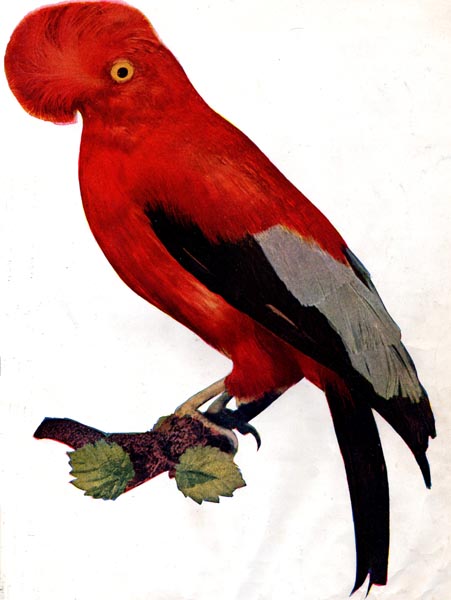
THE COCK-OF-THE-ROCK.

imgtHE Cock-of-the-Rock lives in Guiana. Its nest is found among the rocks. T. K. Salmon says: “I once went to see the breeding place of the Cock-of-the-Rock; and a darker or wilder place I have never been in. Following up a mountain stream the gorge became gradually more enclosed and more rocky, till I arrived at the mouth of a cave with high rock on each side, and overshadowed by high trees, into which the sun never penetrated. All was wet and dark, and the only sound heard was the rushing of the water over the rocks. We had hardly become accustomed to the gloom when a nest was found, a dark bird stealing away from what seemed to be a lump of mud upon the face of the rock. This was a nest of the Cock-of-the-Rock, containing two eggs; it was built upon a projecting piece, the body being made of mud or clay, then a few sticks, and on the top lined with green moss. It was about five feet from the water. I did not see the male bird, and, indeed, I have rarely ever seen the male and female birds together, though I have seen both sexes in separate flocks.”

The eggs are described as pale buff with various sized spots of shades from red-brown to pale lilac.

It is a solitary and wary bird, feeding before sunrise and after sunset and hiding through the day in sombre ravines.

Robert Schomburgh describes its dance as follows:

“While traversing the mountains of Western Guiana we fell in with a pack of these splendid birds, which gave me the opportunity of being an eye witness of their dancing, an accomplishment which I had hitherto regarded as a fable. We cautiously approached their ballet ground and place of meeting, which lay some little distance from the road. The stage, if we may so call it, measured from four to five feet in diameter; every blade of grass had been removed and the ground was as smooth as if leveled by human hands. On this space we saw one of the birds dance and jump about, while the others evidently played the part of admiring spectators. At one moment it expanded its wings, threw its head in the air, or spread out its tail like a peacock scratching the ground with its foot; all this took place with a sort of hopping gait, until tired, when on emitting a peculiar note, its place was immediately filled by another performer. In this manner the different birds went through their terpsichorean exercises, each retiring to its place among the spectators, who had settled on the low bushes near the theatre of operations. We counted ten males and two females in the flock. The noise of a breaking stick unfortunately raised an alarm, when the whole company of dancers immediately flew off.”

The Cock-Of-The-Rock video by IBirdCollection


Guianan Cock-of-the-rock (Rupicola rupicola) ©©lolodoc

Guianan Cock-of-the-rock (Rupicola rupicola) ©©lolodoc

Lee’s Addition:

I removed one paragraph that talked about natives killing some of them. The Cock-of the-Rock is an interesting bird. Just their appearance tickles me. They don’t seem to have a beak. There are two Cock-of-the-rocks; the Guianan and the Andean which is the National Bird of Peru.

“The Cock-of-the-rock, which compose the genus Rupicola, are South American cotingid birds. They are found in tropical and subtropical rainforests close to rocky areas, where they build their nests. Like some other cotingids, they have a complex court behaviour, performing impressive lek displays.

Andean Cock-of-the-rock (Rupicola peruvianus) by ©Wiki Closeup

Andean Cock-of-the-rock (Rupicola peruvianus) by ©Wiki Closeup

The males are magnificent birds, not only because of their bright orange or red colors, but also because of their very prominent fan-shaped crests. The far duller females are overall brownish. They are wary animals and primarily feed on fruits and berries.” (Wikipedia)

Andean Cock-of-the-rock (Rupicola peruvianus) female by SanDiegoZoo

Andean Cock-of-the-rock (Rupicola peruvianus) female by SanDiegoZoo

The Cotingidae – Cotingas Family is where you will find the Cock-of-the-Rocks. “The cotingas are a large family of passerine bird species found in Central America and tropical South America. Cotingas are birds of forests or forest edges, which mostly eat fruit or insects and fruit. Comparatively little is known about this diverse group, although all have broad bills with hooked tips, rounded wings, and strong legs. They may be the most diverse passerine family in body size, ranging from the 8-cm Kinglet Calyptura to the 50-cm male Amazonian Umbrellabird, although the smaller bird may not be a true cotinga.

The males of many species, such as the cock-of-the-rocks, are brightly coloured, or decorated with plumes or wattles, like the umbrellabirds, with their umbrella-like crest and long throat wattles. Some, like the bellbirds and the Screaming Piha, have distinctive and far-carrying calls. The females of most species are duller than the males.

Most species are polygynous, and only the females care for the eggs and young. Both brilliant male colors and loud vocalizations are the result of sexual selection. Many have striking courtship displays, often grouped together in leks. In such canopy-dwelling genera as Carpodectes, Cotinga, and Xipholena, males gather high in a single tree or in adjacent trees, but male cocks-of-the-rock, as befits their more terrestrial lives, give their elaborate displays in leks on the ground.

On the other hand, the Purple-throated Fruitcrow lives in mixed groups in which one female lays an egg and the others help provide insects to the chick.

Nests differ greatly. Many species lay a single egg in a nest so flimsy that the egg can be seen from underneath. This may make the nests hard for predators to find. Fruiteaters build more solid cup nests, and the cocks-of-the-rock attach their mud nests to cliffs.”

Birds Illustrated by Color Photograhy Vol 1 January 1897 No 1 - Cover

Birds Illustrated by Color Photography – Revisited  – Introduction

The above article is the sixth article in the monthly serial that was started in January 1897 “designed to promote Knowledge of Bird-Live.” These include Color Photography, as they call them, today they are drawings. There are at least three Volumes that have been digitized by Project Gutenberg.

To see the whole series of – Birds Illustrated by Color Photography – Revisited 

*

(Information from Wikipedia and other internet sources)

Next Article – The Red Bird Of Paradise

Previous Article – The Australian Grass Parrakeet

*

ABC’s Of The Gospel

Links:

Cotingidae – Cotingas Family

Cock-of-the-rock – Wikipedia

Cotinga – Wikipedia

*


Birds Vol 1 #1 – The Australian Grass Parrakeet(Parakeet)

Elegant Parrot (Neophema petrophila) aka Australian Grass Parakeet

Elegant Parrot (Neophema petrophila) aka Australian Grass Parakeet

Birds Illustrated by Color Photography – Revisited

Vol 1. January, 1897 No. 1

*

THE AUSTRALIAN GRASS PARRAKEET (Parakeet)

I am a Parrakeet. I belong to the Parrot family. A man bought me and brought me here. It is not warm here, as it was where I came from. I almost froze coming over here. I am not kept in a cage. I stay in the house and go about as I please. There is a Kitty Cat in the house. Sometimes I ride on her back. I like that. I used to live in the grass lands. It was very warm there. I ran among the thick grass blades, and sat on the stems and ate seeds. I had a wife then. Her feathers were almost like mine. We never made nests. When we wanted a nest, we found a hole in a gum tree. I used to sing to my wife while she sat on the nest. I can mock other birds. Sometimes I warble and chirp at the same time. Then it sounds like two birds singing. My tongue is short and thick, and this helps me to talk. But I have been talking too much. My tongue is getting tired. I think I’ll have a ride on Kitty’s back. Good bye.


Elegant Parrot (Neophema elegans) WikiC

Elegant Parrot (Neophema elegans) WikiC

imgp

ARRAKEETS have a great fondness for the grass lands, where they may be seen in great numbers, running amid the thick grass blades, clinging to their stems, or feeding on their seeds. Grass seed is their constant food in their native country. In captivity they take well to canary seed, and what is remarkable, never pick food with their feet, as do other species of parrots, but always use their beaks. “They do not build a nest, but must be given a piece of wood with a rough hole in the middle, which they will fill to their liking, rejecting all soft lining of wool or cotton that you may furnish them.” Only the male sings, warbling nearly all day long, pushing his beak at times into his mate’s ear as though to give her the full benefit of his song. The lady, however, does not seem to appreciate his efforts, but generally pecks him sharply in return. A gentleman who brought a Parrakeet from Australia to England, says it suffered greatly from the cold and change of climate and was kept alive by a kind-hearted weather-beaten sailor, who kept it warm and comfortable in his bosom. It was not kept in a cage, but roamed at will about the room, enjoying greatly at times, a ride on the cat’s back. At meals he perched upon his master’s shoulder, picking the bits he liked from a plate set before him. If the weather was cold or chilly, he would pull himself up by his master’s whiskers and warm his feet by standing on his bald head. He always announced his master’s coming by a shrill call, and no matter what the hour of night, never failed to utter a note of welcome, although apparently asleep with his head tucked under his wing.


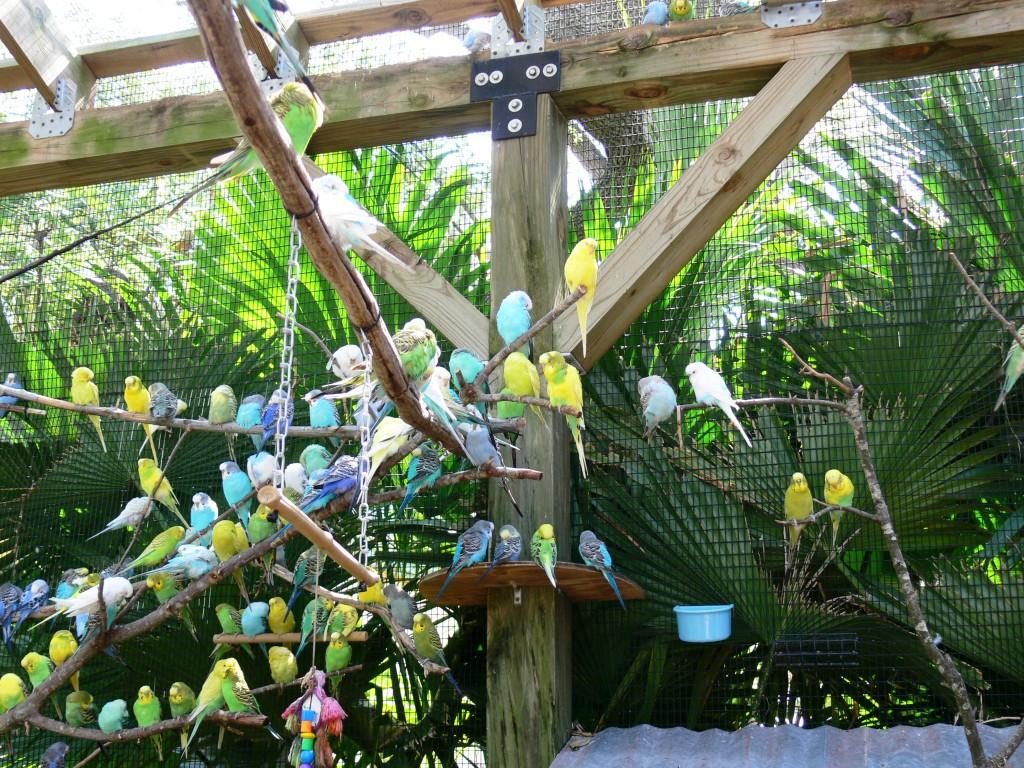
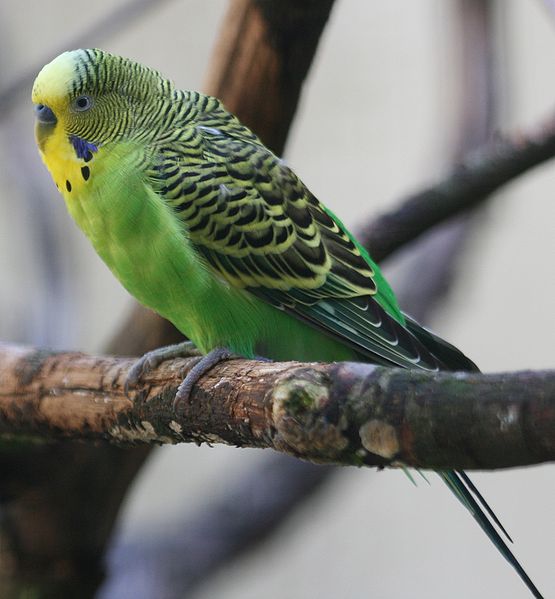
Budgerigar (Melopsittacus undulatus) by Lee LPZ

Budgerigar (Melopsittacus undulatus) by Lee LPZ


Lee’s Addition:

I am not really sure which Parakeet they are referring to in this article. Today their is not really an Australian Grass Parakeet, but the Elegant Parakeet favors the photo-drawing, but also Budgerigars also favor that drawing. At any rate, they are neat little birds and both can talk as mentioned.

Wikipedia says this about Grass Parakeets:  “Its common name is Elegant Parrot, but has also been called Elegant Parakeet, Elegant Grass Parakeet, and Grass Parrot in the past. The Elegant Parrot is 23 cm (9 in) long and predominantly golden olive in colour with a dark blue frontal band line above with lighter blue. while abdomen and vent are yellow. The female is a duller shade of olive all over and has a narrower blue frontal band. The wings are predominantly olive with outer flight feathers dark blue. The yellow edged tail has shades of olive and blue. The bill and legs are grey and the eyes dark brown. Juveniles are duller and lack the frontal bands.”

“The Budgerigar (Melopsittacus undulatus), also known as common pet parakeet or shell parakeet informally nicknamed the budgie, is a small, long-tailed, seed-eating parrot, and the only species in the Australian genus Melopsittacus. Wild budgerigars are found throughout the drier parts of Australia, where the species has survived harsh inland conditions. Naturally green and yellow with black, scalloped markings on the nape, back, and wings, breeders have created a rainbow of blues, whites, and yellows, greys, and even forms with small crests. Budgerigars are popular pets around the world due to their small size, low cost, ability to mimic human speech and playful nature.
The budgerigar is closely related to the lories and the fig parrots. Although budgerigars are often, especially in American English, called “parakeets“, this term refers to any of a number of small parrots with long, flat tails.

Alternative common names include shell parrot, warbling grass parakeet, canary parrot, zebra parrot, flight bird, scallop parrot and the alternate spellings budgerygah and betcherrygah.” (Wikipedia)

Budgerigar (Melopsittacus undulatus) WikiC

Budgerigar (Melopsittacus undulatus) WikiC

Both the Elegant Parrot (Neophema elegans) and the Budgerigar (Melopsittacus undulatus) are in the Psittacidae – Parrots Family. I lean toward the Budgerigar, but take your choice. Whatever, they are very colorful and a delight to watch and observe. The Lord put lots of color potential in the parakeet family.

Which doeth great things past finding out; yea, and wonders without number. (Job 9:10 KJV)

Birds Illustrated by Color Photograhy Vol 1 January 1897 No 1 - Cover

Birds Illustrated by Color Photography – Revisited – Introduction The above article is the fifth article in the monthly serial that was started in January 1897 “designed to promote Knowledge of Bird-Live.” These include Color Photography, as they call them, today they are drawings. There are at least three Volumes that have been digitized by Project Gutenberg.

To see the whole series of – Birds Illustrated by Color Photography – Revisited* (Information from Wikipedia and other internet sources)

Next Article – The Cock-Of-The-Rock

Previous Article – The Golden Pheasant

*

Gospel Presentation

*

Birds Vol 1 #1 – The Golden Pheasant

Golden Pheasant (Chrysolophus pictus)

Golden Pheasant (Chrysolophus pictus)

Birds Illustrated by Color Photography – Revisited

Vol 1. January, 1897 No. 1

*

THE GOLDEN PHEASANT

They call me the Golden Pheasant, because I have a golden crest. It is like a king’s crown. Don’t you think my dress is beautiful enough for a king?

See the large ruff around my neck. I can raise and lower it as I please.

I am a very large bird. I am fourteen inches tall and twenty-eight inches long. I can step right over your little robins and meadow larks and blue jays and not touch them.

Sometimes people get some of our eggs and put them under an old hen. By and by little pheasants hatch out, and the hen is very good to them. She watches over them and feeds them, but they do not wish to stay with her; they like their wild life. If they are not well fed they will fly away.

I have a wife. Her feathers are beginning to grow like mine. In a few years she will look as I do. We like to have our nests by a fallen tree.

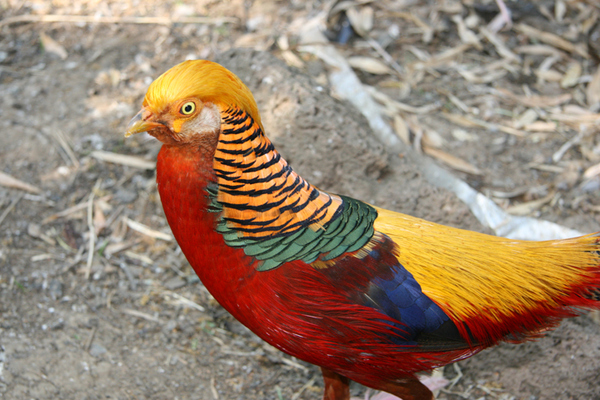
Golden Pheasant (Chrysolophus pictus) WikiC

Golden Pheasant (Chrysolophus pictus) WikiC


imgt

HE well-known Chinese Pheasant, which we have named the Golden Pheasant, as well as its more sober-colored cousin, the Silver Pheasant, has its home in Eastern Asia.

China is pre-eminently the land of Pheasants; for, besides those just mentioned, several other species of the same family are found there. Japan comes next to China as a pheasant country and there are some in India.

In China the Golden Pheasant is a great favorite, not only for its splendid plumage and elegant form, but for the excellence of its flesh, which is said to surpass even that of the common pheasant. It has been introduced into Europe, but is fitted only for the aviary.

For purposes of the table it is not likely to come into general use, as there are great difficulties in the way of breeding it in sufficient numbers, and one feels a natural repugnance to the killing of so beautiful a bird for the sake of eating it. The magnificent colors belong only to the male, the female being reddish brown, spotted and marked with a darker hue. The tail of the female is short. The statement is made, however, that some hens kept for six years by Lady Essex gradually assumed an attire like that of the males.

Fly-fishers highly esteem the crest and feathers on the back of the neck of the male, as many of the artificial baits owe their chief beauty to the Golden Pheasant.

According to Latham, it is called by the Chinese Keuki, or Keukee, a word which means gold flower fowl.

Golden Pheasant (Chrysolophus pictus) Male ©© NotMicroButSoft

Golden Pheasant (Chrysolophus pictus) Male ©© NotMicroButSoft


“A merry welcome to thee, glittering bird!
Lover of summer flowers and sunny things!
A night hath passed since my young buds have heard
The music of thy rainbow-colored wings—
Wings that flash spangles out where’er they quiver,
Like sunlight rushing o’er a river.”


Lee’s Addition:

What a beautiful bird. I am glad in 2012 that birds are not used for their feathers as much as they were back in the 1800’s. I’ve noticed in the first articles how the birds mentioned are either caged, captive, eaten or their feathers used for hats and other uses. Man was given dominion over the animals and are allowed to eat them, but I still like to see them out and about freely flying.

For You meet him with the blessings of goodness; You set a crown of pure gold upon his head. (Psalms 21:3 NKJV)

Now when He had taken the scroll, the four living creatures and the twenty-four elders fell down before the Lamb, each having a harp, and golden bowls full of incense, which are the prayers of the saints. (Revelation 5:8 NKJV)

The Golden Pheasant or “Chinese Pheasant”, (Chrysolophus pictus) is a gamebird of the order Galliformes (gallinaceous birds) and the family Phasianidae. It is native to forests in mountainous areas of western China but feral populations have been established in the United Kingdom and elsewhere.

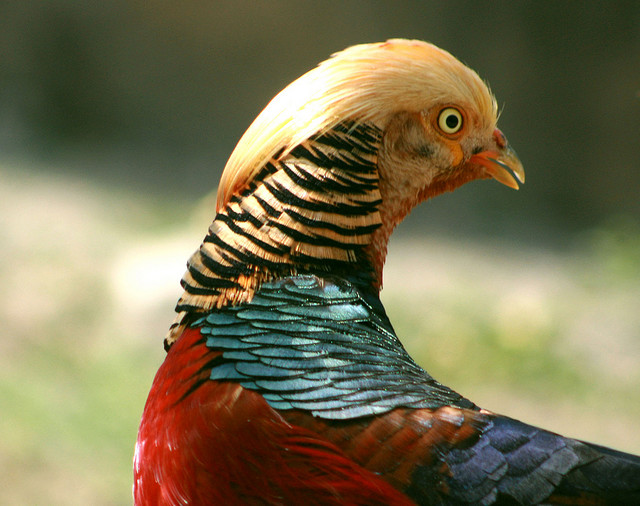
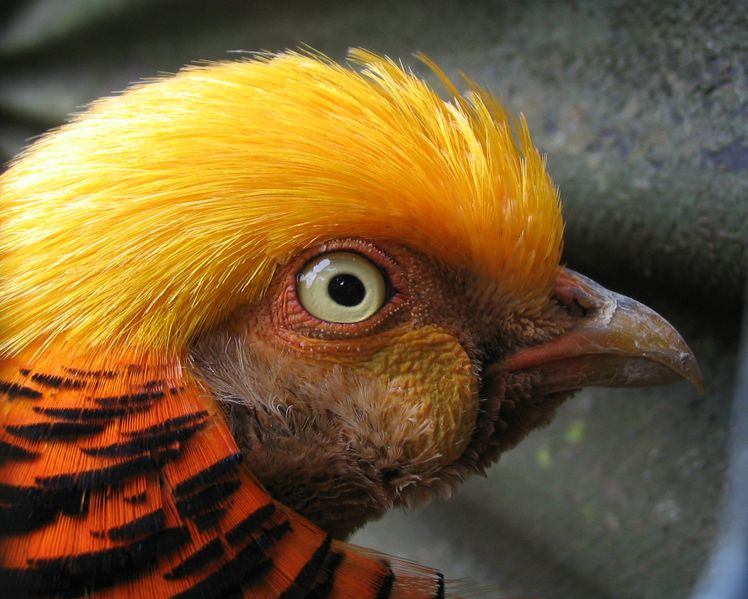
The adult male is 35.4-41.3 in (90–105 cm) in length, its tail accounting for two-thirds of the total length. It is unmistakable with its golden crest and rump and bright red body. The deep orange “cape” can be spread in display, appearing as an alternating black and orange fan that covers all of the face except its bright yellow eye, with a pinpoint black pupil.

Golden Pheasant (Chrysolophus pictus) ©WikiC

Golden Pheasant (Chrysolophus pictus) ©WikiC

Males have a golden-yellow crest with a hint of red at the tip. The face, throat, chin, and the sides of neck are rusty tan. The wattles and orbital skin are both yellow in colour, and the ruff or cape is light orange. The upper back is green and the rest of the back and rump are golden-yellow in colour. The tertiaries are blue whereas the scapulars are dark red. Another characteristic of the male plumage is the central tail feathers which are black spotted with cinnamon as well as the tip of the tail being a cinnamon buff. The upper tail coverts are the same colour as the central tail feathers. Males also have a scarlet breast, and scarlet and light chestnut flanks and underparts. Lower legs and feet are a dull yellow.

The female (hen) is much less showy, with a duller mottled brown plumage similar to that of the female Common Pheasant. She is darker and more slender than the hen of that species, with a proportionately longer tail (half her 60–80 cm length). The female’s breast and sides are barred buff and blackish brown, and the abdomen is plain buff. She has a buff face and throat. Some abnormal females may later in their lifetime get some male plumage. Lower legs and feet are a dull yellow.

Both males and females have yellow legs and yellow bills.

Despite the male’s showy appearance, these hardy birds are very difficult to see in their natural habitat, which is dense, dark young conifer forests with sparse undergrowth. Consequently, little is known of their behaviour in the wild.

They feed on the ground on grain, leaves and invertebrates, but roost in trees at night. While they can fly, they prefer to run: but if startled they can suddenly burst upwards at great speed, with a distinctive wing sound.

The Golden Pheasant is commonly found in zoos and aviaries, but often as impure specimens that have the similar Lady Amherst’s Pheasant in their lineage. (Wikipedia)

Birds Illustrated by Color Photograhy Vol 1 January 1897 No 1 - Cover

Birds Illustrated by Color Photography – Revisited  – Introduction

The above article is the third article in the monthly serial that was started in January 1897 “designed to promote Knowledge of Bird-Live.” These include Color Photography, as they call them, today they are drawings. There are at least three Volumes that have been digitized by Project Gutenberg.

To see the whole series of – Birds Illustrated by Color Photography – Revisited 

*

(Information from Wikipedia and other internet sources)

Next Article – The Australian Grass Parrakeet

Previous Article – Mandarin Duck

Links:

Phasianidae – Pheasants, Fowl & Allies
Galliformes Order
Golden Pheasant – Wikipedia
Golden Pheasant – ARKive

Gospel Presentation

*

Birds Vol 1 #1 – The Mandarin Duck

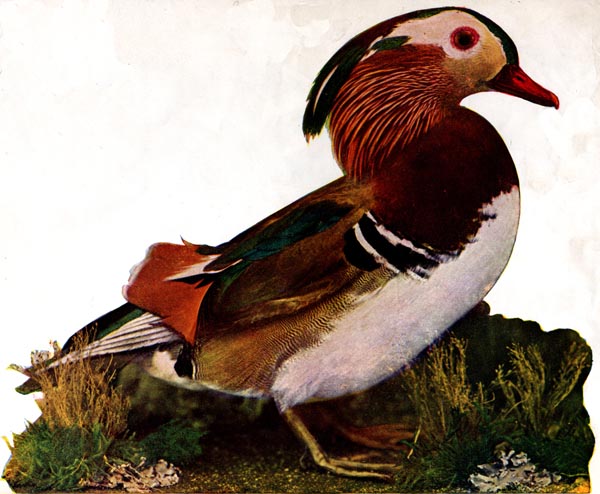
Mandarin Duck

Mandarin Duck

Birds Illustrated by Color Photography – Revisited

Vol 1. January, 1897 No. 1

*

THE MANDARIN DUCK.

A Letter from China.

Quack! Quack! I got in just in time.

I came as fast as I could, as I was afraid of being whipped. You see I live in a boat with a great many other ducks.

My master and his family live in the boat too. Isn’t that a funny place to live in?

We stay in all night. Waking up early in the morning, we cry Quack! Quack! until we wake the master.

He gets up and opens the gate for us and out we tumble into the water. We are in such a hurry that we fall over each other. We swim about awhile and then we go to shore for breakfast.

There are wet places near the shore where we find worms, grubs, and roots. When evening comes the master blows a whistle. Then we know it is time to come home.

We start as soon as we hear it, and hurry, because the last duck in gets a whipping. It does not hurt much but we do not like it, so we all try to get home first.

I have web feet, but I perch like other birds on the branches of the trees near the river.

My feathers are beautiful in the sunlight. My wife always sits near me. Her dress is not like mine. It is brown and grey.

From May to August I lose my bright feathers, then I put on a dress like my wife’s.

My master’s family are Chinese, and they are very queer. They would not sell me for anything, as they would not like to have me leave China.

Sometimes a pair of us are put in a gay cage and carried to a wedding. After the wedding we are given to the bride and groom.

I hear the master’s whistle again. He wants me to come in and go to bed. Quack! Quack! Good bye!

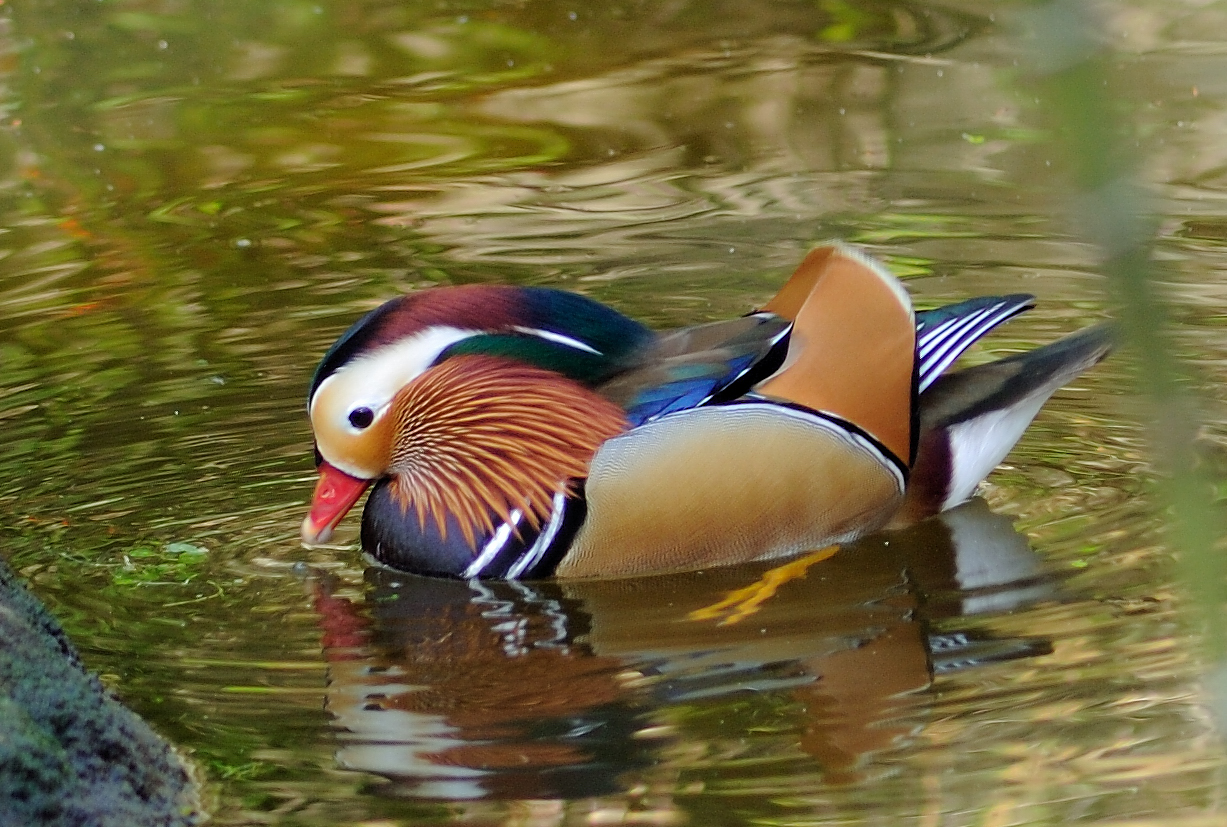
Mandarin Duck (Aix galericulata) by S Slayton

Mandarin Duck (Aix galericulata) by S Slayton

THE MANDARIN DUCK.

imga1

MORE magnificently clothed bird,” says Wood, “than the male Chinese Mandarin Duck, can hardly be found, when in health and full nuptial plumage. They are natives of China and Japan, and are held in such high esteem by the Chinese that they can hardly be obtained at any price, the natives having a singular dislike to seeing the birds pass into the possession of Europeans.”

Though web-footed, the birds have the power of perching and it is a curious sight to watch them on the branches of trees overhanging the pond in which they live, the male and female being always close together, the one gorgeous in purple, green, white, and chestnut, and the other soberly appareled in brown and grey. This handsome plumage the male loses during four months of the year, from May to August, when he throws off his fine crest, his wing-fans, and all his brilliant colors, assuming the sober tinted dress of his mate. The Summer Duck of America bears a close resemblance to the Mandarin Duck, both in plumage and manners, and at certain times of the year is hardly to be distinguished from that bird.

The foreign duck has been successfully reared in Zoological Gardens, some being hatched under the parent bird and others under a domestic hen, the latter hatching the eggs three days in advance of the former.

“The Chinese,” says Dr. Bennett, “highly esteem the Mandarin Duck, which exhibits, as they think, a most striking example of conjugal attachment and fidelity. A pair of them are frequently placed in a gaily decorated cage and carried in their marriage processions, to be presented to the bride and groom as worthy objects of emulation.”

“I could more easily,” wrote a friend of Dr. Bennett’s in China to whom he had expressed his desire for a pair of these birds, “send you two live Mandarins than a pair of Mandarin Ducks.”

Concerning their attachment and fidelity to one another, Dr. Bennett recites the following:

“Mr. Beale’s aviary at Maceo one day was broken open and the male bird stolen from the side of its mate. She refused to be comforted, and, retiring to the farthest part of the aviary, sat disconsolate, rarely partaking of food, and giving no attention to her soiled and rumpled plumage. In vain did another handsome drake endeavor to console her for her loss. After some time the stolen bird was found in the quarters of a miserable Chinaman, and at once restored to its mate. As soon as he recognized his abode he began to flap his wings and quack vehemently. She heard his voice and almost quacked to screaming with ecstasy, both expressing their joy by crossing necks and quacking in concert. The next morning he fell upon the unfortunate drake who had made consolatory advances to his mate, pecked out his eyes and so injured him that the poor fellow died in the course of a few days.”

According to Schrenck, this species appears in the countries watered by the Amoor about May, and departs again at the end of August; at this season it is always met with in small or large flocks, which are so extremely shy that they rarely come within gunshot. Whilst on the wing these parties crowd closely together in front, the birds in the rear occupying a comparatively free space.

Mandarin Duck (Aix galericulata) LPZoo by Dan

Mandarin Duck (Aix galericulata) LPZoo by Dan


Lee’s Addition:

The Mandarin Duck is in the Anatidae – Ducks, Geese & Swans Family of the Answeriformes Order.  Along with the Wood Duck, these ducks just amaze me in their creation. When the Lord created them, He must have had a very neat paint brush. They are so gorgeous! Every time I see them they almost bring tears to my eyes.

The Mandarin Duck (Aix galericulata), or just Mandarin, is a medium-sized perching duck, closely related to the North American Wood Duck. It is 16-19 in (41–49 cm) long with a 25.5-29.5 in (65–75 cm) wingspan.

The adult male is a striking and unmistakable bird. It has a red bill, large white crescent above the eye and reddish face and “whiskers”. The breast is purple with two vertical white bars, and the flanks ruddy, with two orange “sails” at the back. The female is similar to female Wood Duck, with a white eye-ring and stripe running back from the eye, but is paler below, has a small white flank stripe, and a pale tip to its bill. The Mandarin ducklings are almost identical in look to Wood ducklings, and appear very similar to Mallard ducklings. The ducklings can be distinguished from Mallard ducklings because the eye-stripe of Mandarin ducklings (and Wood ducklings) stops at the eye, while in Mallard ducklings it reaches all the way to the bill.

Unlike other species of ducks, most Mandarin drakes reunite with the hens they mated with along with their offsprings after the eggs have hatched and even share scout duties in watching the ducklings closely. However, even with both parents securing the ducklings, most of them do not survive to adulthood.

Mandarins may form small flocks in winter.

Mandarin Ducks, which are referred to by the Chinese as Yuan-yang (simplified Chinese: 鸳鸯; traditional Chinese: 鴛鴦; pinyin: yuān yāng), where yuan() and yang() respectively stand for male and female Mandarin Ducks.

In traditional Chinese culture, Mandarin Ducks represent a life-time couple, unlike many other species of ducks. Hence they are frequently featured in Chinese art and are regarded as a symbol of conjugal affection and fidelity.

But now ask the beasts, and they will teach you; And the birds of the air, and they will tell you; (Job 12:7 NKJV)

A Chinese proverb for loving couples uses the Mandarin Duck as a metaphor: “Two mandarin ducks playing in water” (simplified Chinese: 鸳鸯戏水; traditional Chinese: 鴛鴦戲水; pinyin: yuān yāng xì shuǐ). The Mandarin Duck symbol is also used in Chinese weddings, because in traditional Chinese lore they symbolize wedded bliss and fidelity.

Because the male and female plumages of the Mandarin Duck are so unalike, yuan-yang is frequently used colloquially in Cantonese to mean an “odd couple” or “unlikely pair” – a mixture of two different types of same category. For example,yuanyang (drink) and yuan-yang fried rice.

Birds Illustrated by Color Photograhy Vol 1 January 1897 No 1 - Cover

Birds Illustrated by Color Photography – Revisited – Introduction

The above article is the third article in the monthly serial that was started in January 1897 “designed to promote Knowledge of Bird-Live.” These include Color Photography, as they call them, today they are drawings. There are at least three Volumes that have been digitized by Project Gutenberg.

To see the whole series of – Birds Illustrated by Color Photography – Revisited

*

(Information from Wikipedia and other internet sources)

Next Article – The Golden Pheasant

Previous Article – The Resplendent Trogon (Quetzal)

Links:

Photos of Mandarin Ducks

Mandarin Duck – Wikipedia

Birds of the World – Anatidae – Ducks, Geese & Swans

Wordless Birds

*


Birds Vol 1 #1 – The Resplendent Trogon (Quetzal)

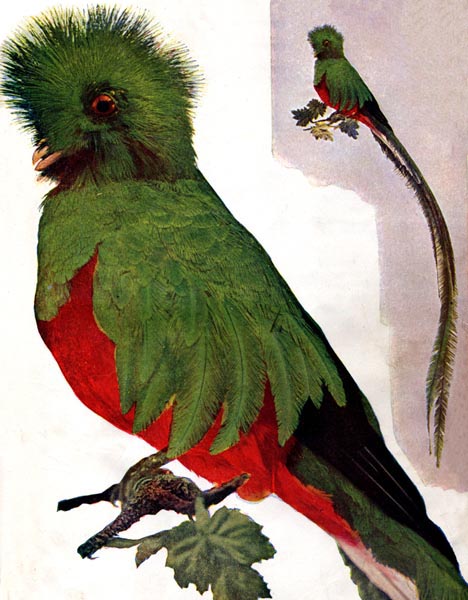
Resplendent (Trogon) Quetzal (Pharomachrus mocinno)

Resplendent (Trogon) Quetzal (Pharomachrus mocinno)

Birds Illustrated by Color Photography – Revisited

Vol 1. January, 1897 No. 1

*

THE RESPLENDENT TROGON

A Letter to Little Boys and Girls of the United States.

Is it cold where you live, little boys and girls? It is not where I live. Don’t you think my feathers grew in the bright sunshine?

My home is way down where the big oceans almost meet. The sun is almost straight overhead every noon.

I live in the woods, way back where the trees are tall and thick. I don’t fly around much, but sit on a limb of a tree way up high.

Don’t you think my red breast looks pretty among the green leaves?

When I see a fly or a berry I dart down after it. My long tail streams out behind like four ribbons. I wish you could see me. My tail never gets in the way.

Wouldn’t you like to have me sit on your shoulder, little boy? You see my tail would reach almost to the ground.

If you went out into the street with me on your shoulder, I would call whe-oowhe-oo, the way I do in the woods.

All the little boys and girls playing near would look around and say, “What is that noise?” Then they would see you and me and run up fast and say, “Where did you get that bird?”

The little girls would want to pull out my tail feathers to put around their hats. You would not let them, would you?

I have a mate. I think she is very nice. Her tail is not so long as mine. Would you like to see her too? She lays eggs every year, and sits on them till little birds hatch out. They are just like us, but they have to grow and get dressed in the pretty feathers like ours. They look like little dumplings when they come out of the eggs.

But they are all right. They get very hungry and we carry them lots of things to eat, so they can grow fast.

Your friend,
R. T.

Resplendent Quetzal (Pharomachrus mocinno) Reinier Munguia

Resplendent Quetzal (Pharomachrus mocinno) Reinier Munguia

THE RESPLENDENT TROGON

imgrESPLENDENT Trogons (Quetzals) are natives of Central America. There are fifty kinds, and this is the largest. A systematic account of the superb tribe has been given by Mr. Gould, the only naturalist who has made himself fully acquainted with them.

Of all birds there are few which excite so much admiration as the Resplendent Trogon.

The skin is so singularly thin that it has been not inaptly compared to wet blotting paper, and the plumage has so light a hold upon the skin that when the bird is shot the feathers are plentifully struck from their sockets by its fall and the blows which it receives from the branches as it comes to the ground.

Its eggs, of a pale bluish-green, were first procured by Mr. Robert Owen. Its chief home is in the mountains near Coban in Vera Paz, but it also inhabits forests in other parts of Guatemala at an elevation of from 6,000 to 9,000 feet.

From Mr. Salvin’s account of his shooting in Vera Paz we extract the following hunting story:

“My companions are ahead and Filipe comes back to say that they have heard a quesal (Resplendent Trogon). Of course, being anxious to watch as well as to shoot one of these birds myself, I immediately hurry to the spot. I have not to wait long. A distant clattering noise indicates that the bird is on the wing. He settles—a splendid male—on the bough of a tree not seventy yards from where we are hidden. It sits almost motionless on its perch, the body remaining in the same position, the head only moving from side to side. The tail does not hang quite perpendicularly, the angle between the true tail and the vertical being perhaps as much as fifteen or twenty degrees. The tail is occasionally jerked open and closed again, and now and then slightly raised, causing the long tail coverts to vibrate gracefully. I have not seen all. A ripe fruit catches the quesal’s eye and he darts from his perch, plucks the berry, and returns to his former position. This is done with a degree of elegance that defies description. A low whistle from Capriano calls the bird near, and a moment afterward it is in my hand—the first quesal I have seen (…).”

The above anecdote is very beautiful and graphic, but we read the last sentence with pain. We wish to go on record with this our first number as being unreconciled to the ruthless killing of the birds. He who said, not a sparrow “shall fall on the ground without your Father,” did not intend such birds to be killed, but to beautify the earth.

The cries of the quesal are various. They consist principally of a low note, whe-oowhe-oo, which the bird repeats, whistling it softly at first, then gradually swelling it into a loud and not unmelodious cry. This is often succeeded by a long note, which begins low and after swelling dies away as it began. Other cries are harsh and discordant. The flight of the Trogon is rapid and straight. The long tail feathers, which never seem to be in the way, stream after him. The bird is never found except in forests of the loftiest trees, the lower branches of which, being high above the ground, seem to be its favorite resort. Its food consists principally of fruit, but occasionally a caterpillar is found in its stomach.

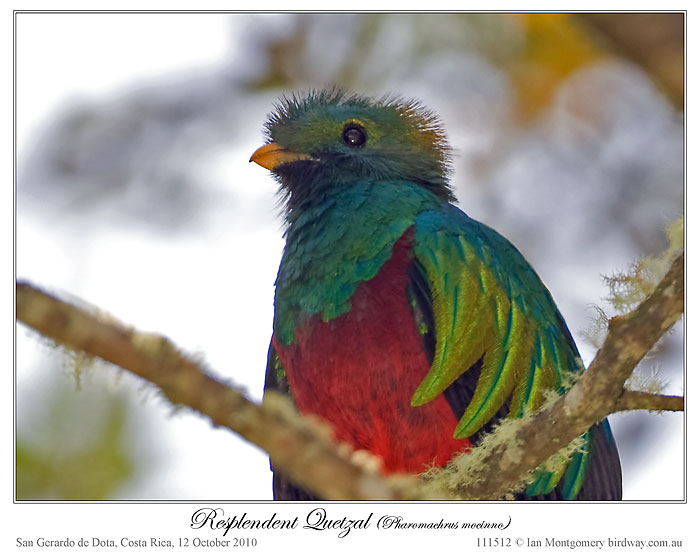
Resplendent Quetzal (Pharomachrus mocinno) by Ian

Resplendent Quetzal (Pharomachrus mocinno) by Ian


Lee’s Addition:

The Resplendent is in the Trogan Family, but today it is called the Resplendent Quetzal (Pharomachrus mocinno). Along with the writer, needless killing of birds is uncalled for, but back in 1897 the ladies liked feathers in their hats. Thankfully, that practice has been stopped for the most part, but how many birds have become extinct or near extinct because of it? What a fantastic bird the Lord created with these long tails.

For man also does not know his time: Like fish taken in a cruel net, Like birds caught in a snare, So the sons of men are snared in an evil time, When it falls suddenly upon them. (Ecclesiastes 9:12 NKJV)

Birds Illustrated by Color Photograhy Vol 1 January 1897 No 1 - Cover

Birds Illustrated by Color Photograhy Vol 1 January 1897 No 1 – Cover

Birds Illustrated by Color Photography – Revisited – Introduction

The above article is the second article in the monthly serial that was started in January 1897 “designed to promote Knowledge of Bird-Live.” These include Color Photography, as they call them, today they are drawings. There are at least three Volumes that have been digitized by Project Gutenberg.

To see the whole series of – Birds Illustrated by Color Photography – Revisited

*

The Resplendent Quetzal is one of 43 species in the Trogonidae – Trogons Family in the Trogoniformes Order. Of the 7 Genus, only two have Quetzals and the other five have Trogons.

The word “trogon” is Greek for “nibbling” and refers to the fact that these birds gnaw holes in trees to make their nests.

The Resplendent Quetzal, Pharomachrus mocinno, is a bird in the trogon family. It is found from southern Mexico to western Panama (unlike the other quetzals of the genus Pharomachrus, which are found in South America and eastern Panama). It is well known for its colorful plumage. There are two subspecies, P. m. mocinno and P. m. costaricensis.

This species is 36–40 cm (14–16 in) long, plus up to 65 cm (26 in) of tail streamer for the male, and weighs about 210 g (7 oz). It is the largest representative of the trogon order. The subspecies costaricensis is slightly smaller than the nominate race and has shorter narrower tail plumes.

This quetzal plays an important role in Mesoamerican mythologies. The Resplendent Quetzal is Guatemala’s national bird, and an image of it is on the flag and coat of arms of Guatemala. It is also the name of the local currency (abbreviation GTQ).

1989 Half Quetzal

1989 Half Quetzal

Trogons are residents of tropical forests worldwide, with the greatest diversity in the Neotropics. The genus Apaloderma contains the three African species, Harpactes and Apalharpactes are Asian, and the remaining four genera are found in Central and South America.

They feed on insects and fruit, and their broad bills and weak legs reflect their diet and arboreal habits. Although their flight is fast, they are reluctant to fly any distance. Trogons are generally not migratory, although some species undertake partial local movements.

Trogons have soft, often colourful, feathers with distinctive male and female plumage. They are the only type of animal with a heterodactyl toe arrangement.

The trogons are insectivorous, usually hunting from a perch. They nest in holes dug into trees or termite nests, laying 2-4 white or pastel-coloured eggs.

The majority of trogons are birds of tropical and subtropical forests. They have a cosmopolitan distribution in the worlds wet tropics, being found in the Americas, Africa and Asia. A few species are distributed into the temperate zone, with one species, the Elegant Trogon, reaching the south of the United States specifically southern Arizona and the surrounding area. Some species, particularly the quetzals, are adapted to cooler montane forest.

The trogons as a family are fairly uniform in appearance, they have compact bodies with long tails (very long in the case of the quetzals), and short necks. Trogons range in size from the 23 cm, 40 gram Scarlet-rumped Trogon to the 40 cm, 210 gram Resplendent Quetzal (not including the male quetzal’s 3-foot-long (0.91 m) tail streamers). Their legs and feet are weak and short, and trogons are essentially unable to walk beyond a very occasional shuffle along a branch. They are even incapable of turning around on a branch without using their wings. The ratio of leg muscle to body weight in trogons is only 3 percent, the lowest known ratio of any bird.

(Information from Wikipedia and other internet sources)

Next Article – The Mandarin Duck

Previous Article – The Nonpareil – Painted Bunting

Wordless Birds

Links:

Ian’s Bird of the Week – Resplendent Quetzal
Ian’s Bird of the Week – Violaceous Trogon
Trogons & Quetzel Photos – Ian’s Birdway
Resplendent Quetzal Photos on Aves – Wikipedia
Resplendent Quetzal Wikipedia
Trogon Family – Wikipedia
Birds of the World – Trogonidae

*

Birds Vol 1 #1 – Nonpareil – Painted Bunting

Painted Bunting (Passerina ciris) - Drawing

Painted Bunting (Passerina ciris) – Drawing

Birds Illustrated by Color Photography – Revisited

Vol 1. January, 1897 No. 1

*

THE NONPAREIL

I am called the Nonpareil because there is no other bird equal to me.

I have many names. Some call me the “Painted Finch” or “Painted Bunting.” Others call me “The Pope,” because I wear a purple hood.

I live in a cage, eat seeds, and am very fond of flies and spiders.

Sometimes they let me out of the cage and I fly about the room and catch flies. I like to catch them while they are flying.

When I am tired I stop and sing. There is a vase of flowers in front of the mirror.

I fly to this vase where I can see myself in the glass. Then I sing as loud as I can. They like to hear me sing.

I take a bath every day and how I do make the water fly!

I used to live in the woods where there were many birds like me. We built our nests in bushes, hedges, and low trees. How happy we were.

My cage is pretty but I wish I could go back to my home in the woods.

*

“Sweet warblers of the sunny hours,
Forever on the wing,
I love thee as I love the flowers,
The sunlight and the spring.

They come like pleasant memories
In summer’s joyous time,
And sing their gushing melodies,
As I would sing a rhyme.

In the green and quiet places,
Where the golden sunlight falls,
We sit with smiling faces
To list their silver calls.

And when their holy anthems
Come pealing through the air,
Our hearts leap forth to meet them
With a blessing and a prayer.

Amid the morning’s fragrant dew,
Amid the mists of even,
They warble on as if they drew
Their music down from heaven.

How sweetly sounds each mellow note
Beneath the moon’s pale ray,
When dying zephyrs rise and float
Like lovers’ sighs away!”

Painted Bunting (Passerina ciris) ©©Flickr

Painted Bunting (Passerina ciris) ©©Flickr

*

THE NONPAREIL.

So full of fight is this little bird, that the bird trappers take advantage of his disposition to make him a prisoner. They place a decoy bird on a cage trap in the attitude of defense, and when it is discovered by the bird an attack at once follows, and the fighter soon finds himself caught.

They are a great favorite for the cage, being preferred by many to the Canary. Whatever he may lack as a songster he more than makes up by his wonderful beauty. These birds are very easily tamed, the female, even in the wild state, being so gentle that she allows herself to be lifted from the nest. They are also called the “Painted Finch” or “Painted Bunting”. They are found in our Southern States and Mexico. They are very numerous in the State of Louisiana and especially about the City of New Orleans, where they are greatly admired by the French inhabitants, who, true to their native instincts, admire anything with gay colors. As the first name indicates, he has no equal, perhaps, among the songsters for beauty of dress. On account of this purple hood, he is called by the French “Le Pape”, meaning The Pope.

The bird makes its appearance in the Southern States the last of April and, during the breeding season, which lasts until July, two broods are raised. The nests are made of fine grass and rest in the crotches of twigs of the low bushes and hedges. The eggs have a dull or pearly-white ground and are marked with blotches and dots of purplish and reddish brown.

It is very pleasing to watch the numerous changes which the feathers undergo before the male bird attains his full beauty of color. The young birds of both sexes during the first season are of a fine olive green color on the upper parts and a pale yellow below. The female undergoes no material change in color except becoming darker as she grows older. The male, on the contrary, is three seasons in obtaining his full variety of colors. In the second season the blue begins to show on his head and the red also makes its appearance in spots on the breast. The third year he attains his full beauty.

Their favorite resorts are small thickets of low trees and bushes, and when singing they select the highest branches of the bush. They are passionately fond of flies and insects and also eat seeds and rice.

Thousands of these birds are trapped for the cage, and sold annually to our northern people and also in Europe. They are comparatively cheap, even in our northern bird markets, as most of them are exchanged for our Canaries and imported birds that cannot be sent directly to the south on account of climatic conditions.

Many a northern lady, while visiting the orange groves of Florida, becomes enchanted with the Nonpareil in his wild state.

imgsWEET warblers of the sunny hours,

Forever on the wing,
I love thee as I love the flowers,
The sunlight and the spring.

They come like pleasant memories
In summer’s joyous time,
And sing their gushing melodies,
As I would sing a rhyme.

In the green and quiet places,
Where the golden sunlight falls,
We sit with smiling faces
To list their silver calls.

And when their holy anthems
Come pealing through the air,
Our hearts leap forth to meet them
With a blessing and a prayer.

Amid the morning’s fragrant dew,
Amid the mists of even,
They warble on as if they drew
Their music down from heaven.

How sweetly sounds each mellow note
Beneath the moon’s pale ray,
When dying zephyrs rise and float
Like lovers’ sighs away!”

Painted Bunting (Passerina ciris) ©WikiC

Painted Bunting (Passerina ciris) ©WikiC


Lee’s Addition:

The Painted Bunting (Passerina ciris), as it is called today, is in the Cardinalidae – Grosbeaks, Saltators & Allies Family of the Passeriformes or Songbirds Order. My first encounter with one was while I was sitting at my computer and looking out the window and a male Painted Bunting was on my feeder. I did a double-take. I have loved this bird every since. It is one of my favorites. Their colors remind me of our promise of the rainbow.

I set My rainbow in the cloud, and it shall be for the sign of the covenant between Me and the earth. It shall be, when I bring a cloud over the earth, that the rainbow shall be seen in the cloud; and I will remember My covenant which is between Me and you and every living creature of all flesh; the waters shall never again become a flood to destroy all flesh. The rainbow shall be in the cloud, and I will look on it to remember the everlasting covenant between God and every living creature of all flesh that is on the earth.” (Genesis 9:13-16 NKJV)

*

Birds Illustrated by Color Photograhy Vol 1 January 1897 No 1 - Cover

Birds Illustrated by Color Photograhy Vol 1 January 1897 No 1 – Cover

Birds Illustrated by Color Photography – Revisited – Introduction

The above article is the first article in the monthly serial that was started in January 1897 “designed to promote Knowledge of Bird-Live.” These include Color Photography, as they call them, today they are drawings. There are at least three Volumes that have been digitized by Project Gutenberg.

To see the whole series of – Birds Illustrated by Color Photography – Revisited

An index of all the birds and the links will become active as the articles are “Revisited” here.

Next article – The Resplendent Trogon (Quetzel)

Wordless Birds

Links

Painted Bunting Species Account – Cornell Lab of Ornithology
Painted Bunting – Passerina ciris – USGS Patuxent Bird Identification InfoCenter
Painted Bunting – Wikipedia
Painted Bunting Information – South Dakota Birds and Birding