Birdwatching Term – Lobed Feet

Giant Coot (Fulica gigantea) Loped Feet ©©Flickr

Giant Coot (Fulica gigantea) Loped Feet ©©Flickr

Lobed Feet

Thou hast enlarged my steps under me, that my feet did not slip. (Psalms 18:36 KJV)

In the Coot article  they said: “Like other rails, they have long, lobed toes that are well adapted to soft, uneven surfaces. Coots have strong legs and can walk and run fast.”

Answers gives this definition: “Feet that have toes with stiff scale-covered flaps that extend to provide a surface analogous to webbing on a duck as an aid in swimming.”

The Lord designed these “lobed feet” to help the birds walk over uneven ground, in and out of water. He cares about all His creatures.

American Coot - from Color Key To North American Birds

American Coot – from Color Key To North American Birds

This Drawing from Color Key To North American Birds helps you to see their feet better.

It is neat to watch them walk around and see those “big feet.”

This video I took shows their feet.

*

*

See:

*

Child’s Book of Water Birds ~ The Teal

The Teal

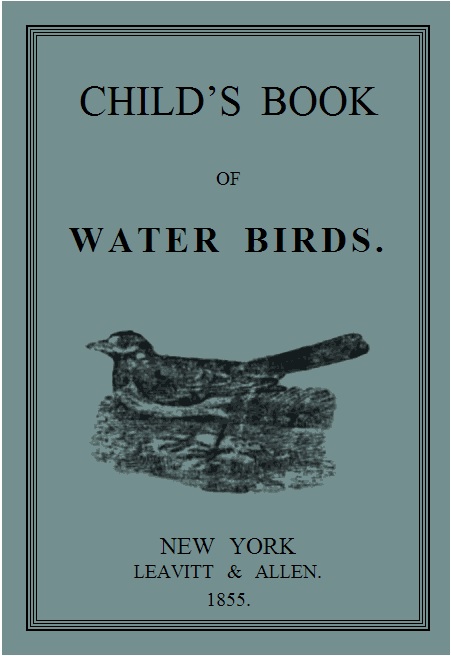
Child's Book of Water Birds - Book Cover

Child’s Book of Water Birds – Book Cover

***

Childs Bk of Water Birds titlebird

NEW YORK

LEAVITT & ALLEN.

1855.

***

Welcome to the Updated Child’s Book of Water Birds, by Anonymous. It was written in 1855 and this is 2013. That is 158 years ago.

*
*
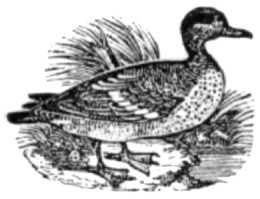
Childs Bk of Water Birds teal

THE TEAL.

The Teal is the smallest of the ducks. The Green-winged Teal is the American. It feeds on fresh-water insects, seeds, and aquatic plants. When fat it is considered a great luxury. It is almost always seen on well furnished tables. It generally feeds at night. It flies very swiftly, and utters a whistling cry.

***

*

Male Green-winged Teal at Lowry Park Zoo, Tampa, FL

*

Update:

This dabbling duck (the Green-winged Teal) flies south in the winter and will form large flocks.

This is the smallest North American dabbling duck. The male has grey flanks and back, with a yellow rear end and a white-edged green feathers. It has a chestnut head with a green eye patch.  a vertical white stripe on side of breast. The females are light brown.

Green-winged Teal (Anas carolinensis) Pair ©WikiC

14 Green-winged Teal (Anas carolinensis) Pair ©WikiC

*

It is a common duck of sheltered wetlands, usually feeds by dabbling for plant food or grazing.  It nests on the ground, near water and under cover.

This is a noisy species. The male has a clear whistle, whereas the female has a feeble “quack”.

We also have Blue-winged Teals and Cinnamon Teals here in America.

***

See the other five Child’s Book of Water Birds:

The Swan

The Coot

The Dabchick

The Goose

The Oyster Catcher

*

Green-winged Teal – WhatBird

Blue-winged Teal – WhatBird

Cinnamon Teal – WhatBird

Birdwatching Terms – Dabbling duck

Bible Birds

Wordless Birds

*
Child's Book of Water Birds - Levit and Allen
*** PROJECT GUTENBERG EBOOK CHILD'S BOOK OF WATER BIRDS ***

*

Child’s Book of Water Birds ~ The Dabchick

The Dabchick

Child's Book of Water Birds - Book Cover

Child’s Book of Water Birds – Book Cover

***

Childs Bk of Water Birds titlebird

NEW YORK

LEAVITT & ALLEN.

1855.

***

Welcome to the Updated Child’s Book of Water Birds, by Anonymous. It was written in 1855 and this is 2013. That is 158 years ago.

*
*
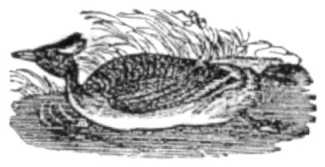
Childs Bk of Water Birds dabchick

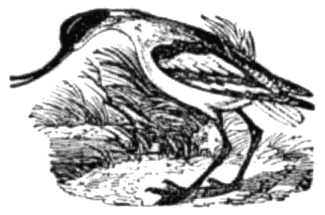
THE DABCHICK.

The Dabchick is a very timid bird, and when alarmed instantly dives, after which it is useless to look after the bird. It is easily domesticated, and is often seen placed as an ornament to ponds, where it swims about very merrily, and seems to enjoy a game of hide and seek with any one who is attempting to watch its movements.

*

Little Grebe (Tachybaptus ruficollis) by Nikhil Devasar

Little Grebe (Tachybaptus ruficollis) by Nikhil Devasar

Update:

The Little Grebe (Tachybaptus ruficollis), also known as Dabchick, is a member of the Grebe family of water birds. At 9 to 11.4 in (23 to 29 cm) in length it is the smallest European member of its family. It is commonly found in open bodies of water across most of its range. Also, there is a New Zealand Grebe (Dabchick).

It is a small water bird with a pointed bill. In summer, the adult is dark above with its rich, rufous colour neck, cheeks and flanks (sides), and bright yellow gape (mouth). Non-breeding and juvenile birds are a dirty brownish grey.

It is an excellent swimmer and diver and chases its fish and aquatic prey underwater. It uses the vegetation skilfully as a hiding place.  it nests at the water’s edge, since its legs are set very far back and it cannot walk well. The young leave the nest and can swim soon after hatching, and chicks are often carried on the backs of the swimming adults.

If a bird’s nest should chance to be before you in the way, in any tree or on the ground, with young ones or eggs, and the mother bird is sitting on the young or on the eggs, you shall not take the mother bird with the young. (Deu 22:6 AMP)

The Little Grebe’s breeding call, given singly or in duet, is a trilled repeated weet-weet-weet or wee-wee-wee which sounds like a horse whinnying.

***

See the other five Child’s Book of Water Birds:

The Swan

The Coot

The Teal

The Goose

The Oyster Catcher

*

Grebe family

New Zealand Grebe (Dabchick)

Little Grebe – Wikipedia

Bible Birds

Wordless Birds

*
Child's Book of Water Birds - Levit and Allen

Back Cover

*** PROJECT GUTENBERG EBOOK CHILD'S BOOK OF WATER BIRDS ***

*

Child’s Book of Water Birds ~ The Coot

The Coot

Child's Book of Water Birds - Book Cover

Child’s Book of Water Birds – Book Cover

***

Childs Bk of Water Birds titlebird

NEW YORK

LEAVITT & ALLEN.

1855.

***
Welcome to the Updated Child’s Book of Water Birds, by Anonymous. It was written in 1855 and this is 2013. That is 158 years ago.
*
Childs Bk of Water Birds coot

THE COOT.

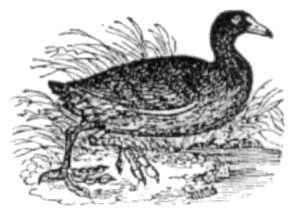
The Coot is generally found in large sheets of water, particularly if shaded by trees. The nest is a mass of flags, reeds, and grass, usually at the water’s edge, but sometimes actually in the water. The Coot’s eggs are generally seven in number. They are of a greenish-white, spotted.

*

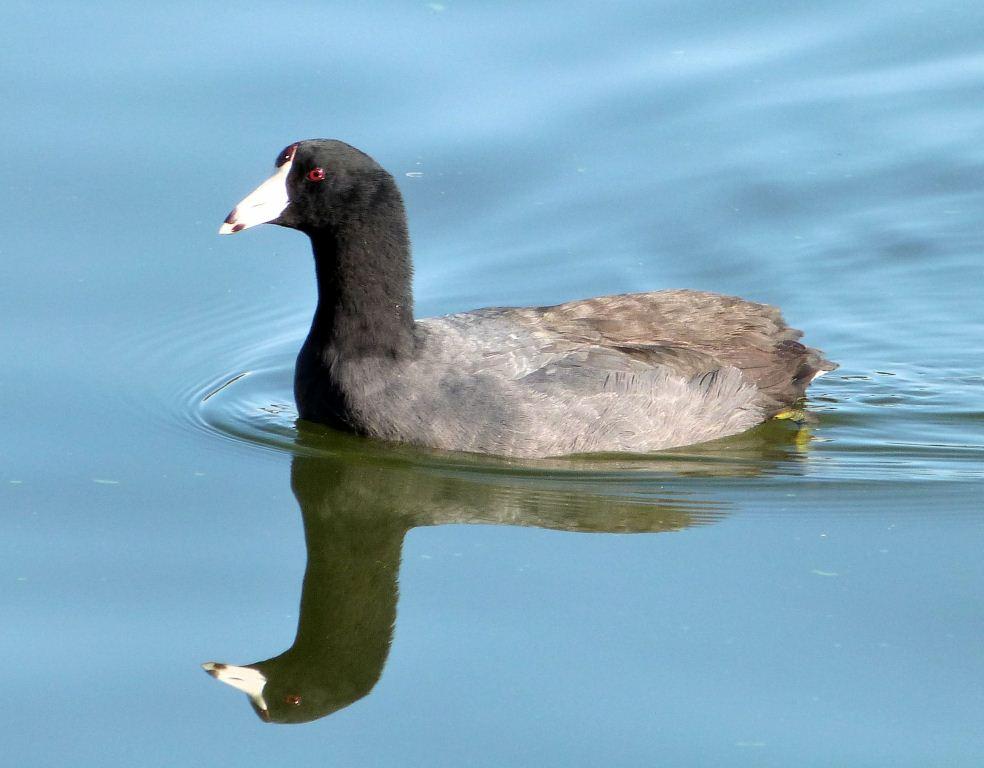
American Coot (Fulica americana) by Lee at Lk Morton

American Coot (Fulica americana) by Lee at Lk Morton

Update:

Coots are medium-sized birds that belong to the Raillidae – Rail Family. There are twelve (12) different Coots around the world.

They have mostly black feathers and can be seen swimming in open water. Coots have prominent frontal shields or other decoration on the forehead, with red to dark red eyes and coloured bills. Many, but not all, have white on the under tail.

Coots eat plants, eggs and some small animals. The defend their nest when they have babies. A group of Coots are called a “covert” or  “cover.”

Like other rails, they have long, lobed toes that are well adapted to soft, uneven surfaces. Coots have strong legs and can walk and run fast. This video shows their feet.

*


*

****

See the other five Child’s Book of Water Birds:

The Swan

The Dabchick

The Teal

The Goose

The Oyster Catcher

*

Rallidae – Rails, Crakes & Coots Family

American Coot – All About Birds

Bible Birds

Wordless Birds

*
Child's Book of Water Birds - Levit and Allen

Back Cover

*** PROJECT GUTENBERG EBOOK CHILD'S BOOK OF WATER BIRDS ***

*

Child’s Book of Water Birds ~ The Swan

The Swan

Child's Book of Water Birds - Book Cover

Child’s Book of Water Birds – Book Cover

***

Childs Bk of Water Birds titlebird

NEW YORK

LEAVITT & ALLEN.

1855.

***

Welcome to the Updated Child’s Book of Water Birds, by Anonymous. It was written in 1855 and this is 2013. That is 158 years ago.

*
Childs Bk of Water Birds swan

THE SWAN.

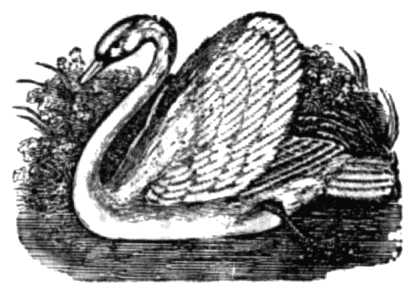
The Swan is a very beautiful bird. It is generally white, though a black swan has been discovered in Australia. It is not very often seen in this country. It was brought from Asia and Eastern Europe into England—from whence, most probably, a few specimens have been introduced into this country. The Swan is very graceful in the water, but on land it is an awkward waddler.

*

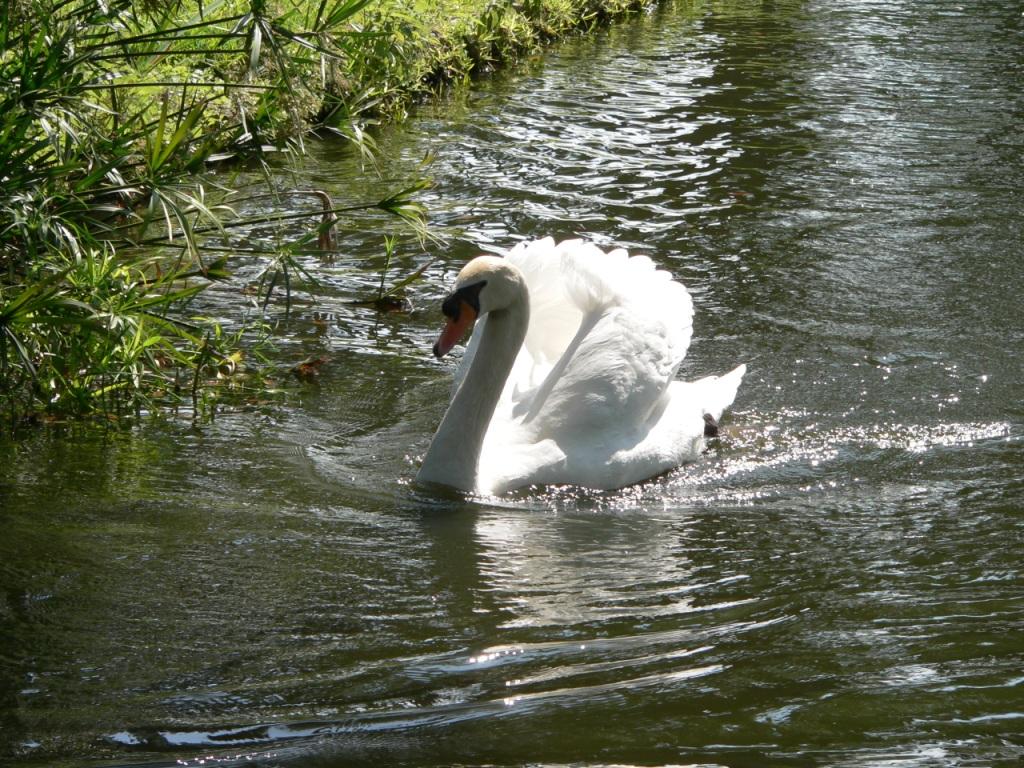
Swan at Bok Tower

Swan at Bok Tower

Update:

Swans are the largest member of the Water Birds family Swans. They are also among the largest flying birds. Some Swans have a wingspan almost 10 ft (3 m).

A group of swans is called a bevy or a wedge in flight. Swans feed in the water and on land.

The nest is on the ground near water. Average egg size (for the mute swan) is 4.4 X 2.9 in (113×74 mm), weighing 11 oz (340 g), in a clutch size of 4 to 7. Swans are very protective of their nest.

The Swan is one of the Bible Birds. (See Bible Birds – Swans)

And the swan, and the pelican, and the gier eagle, (Leviticus 11:18 KJV)

***

See the other five Child’s Book of Water Birds:

The Coot

The Dabchick

The Teal

The Goose

The Oyster Catcher

*

Anatidae – Swan Family

Bible Birds – Swans

Bible Birds

Wordless Birds


*

*
Child's Book of Water Birds - Levit and Allen
*** PROJECT GUTENBERG EBOOK CHILD'S BOOK OF WATER BIRDS ***

*

Vol 2, #6 – The Ring-necked Pheasant

Common Pheasant (Phasianus colchicus) "Ring-necked" for Birds Illustrated

Common Pheasant (Phasianus colchicus) “Ring-necked” for Birds Illustrated

From col. Chi. Acad. Sciences. Copyrighted by
Nature Study Pub. Co., 1897, Chicago.

THE RING-NECKED PHEASANT.

(RELOCATED – CLICK HERE)

Bible Birds – Hawk Migration

Sharp-shinned Hawk (Accipiter striatus) ©USFWS

Sharp-shinned Hawk (Accipiter striatus) ©USFWS

Is it by your understanding that the hawk soars and spreads his wings toward the south? (Job 39:26 ESV)

Job was being asked by the Lord if he knew how and why the Hawk knows that it needs to go south for the winter. The Lord is smarter than we are and when He created the birds, He gave them instincts (knowledge) to do certain tasks. He put within the Hawks and other birds that migrate (travel to other areas) the knowledge of when and where to go.

Why do they migrate? There are various reasons why they travel, many great distances, for the winter or summer. The weather turns cold in the northern part of the world (northern hemisphere) in the winter and many birds cannot survive in really cold weather. In the summer, those birds go back north, because it gets cold down where they spent the winter. (The seasons are reversed in the northern and southern hemispheres.) So, some birds just keep going north and south each year so they can live in warm weather.

Other birds move around or migrate because their food supply ends and they go to the next area to be able to feed themselves. The Lord promised the birds and animals to provide for them, but He does not “spoon-feed” them. They have to go where He has provided for them.

And to all the animals on the earth and to every bird of the air and to everything that creeps on the ground–to everything in which there is the breath of life–I have given every green plant for food. And it was so. (Genesis 1:30 AMP)

A tree in Daniel has this promise given about it:

Its leaves were fair and its fruit abundant, and in it was food for all. The living creatures of the field found shade under it, and the birds of the sky dwelt in its branches; and all flesh was fed from it.  (Daniel 4:12 AMP)

Crane Hawk (Geranospiza caerulescens) ©WikiC

Crane Hawk (Geranospiza caerulescens) ©WikiC

Look at the birds of the air; they neither sow nor reap nor gather into barns, and yet your heavenly Father keeps feeding them. Are you not worth much more than they? (Matthew 6:26 AMP)

Those are very good promises by the Lord, the Creator, that He will provide for them. That last verse also gives you and I the promise that He will also provide for us, because we are worth more. He loves us and has given us much more. See The Wordless Birds.

We will tell more things about the Hawks in other Bible Bird – Hawks articles.

See Also:

*

Updated: The Bible Birds Cormorant Page

The Bible Birds – Cormorants page has been updated. A Gallery of photos of Cormorants and others in their family was added. The Cormorants belong to the Family – Phalacrocoracidae – Cormorants, shags which has 41 members. Also additional links were added.

This slideshow requires JavaScript.


*

Bible Birds are the Birds of the Bible Birds written with to Younger Folks and those who are “Young at Heart”. As other pages are updated, a post will announce them also.

*

Updated: The Bible Bird Owls Page

Just finished the Bible Birds – Owls page. A Photo gallery and some Fun Facts were added.

This slideshow requires JavaScript.


Bible Birds are the Birds of the Bible Birds written with to Younger Folks and those who are “Young at Heart”. As other pages are updated, a post will announce them also.

*

Bible Birds – Mother Birds and Their Young – (Re-post)

My Mom and Me 26

Yesterday’s My Mom And Me – Email blog inspired me to write a new article for the Birds of the Bible For Kids. It is called:”

Bible Birds – Mother Birds and Their Young.

Please check it out. It is geared for a younger audience.

*

Bible Birds – Mother Birds and Their Young

My Mom and Us

My Mom and Us

Yesterday, in My Mom and Me – Photos, you saw many photos of Mother Animals and Mother Birds with their young ones. Does the Bible mention mother birds and their young or eggs. Yes, it does.

“If a bird’s nest happens to be before you along the way, in any tree or on the ground, with young ones or eggs, with the mother sitting on the young or on the eggs, you shall not take the mother with the young;

you shall surely let the mother go, and take the young for yourself, that it may be well with you and that you may prolong your days. (Deuteronomy 22:6-7 NKJV)

That is very interesting verse. It tells us not to take both the mother and the young or eggs. Do you know why? Look at the last verse; it says “may be well with you and you will prolong your days (live longer). Do you know another reason not to take both? The Lord commanded the animals and birds to have babies and fill the earth. If you kill them both, then none of that family will be able to have more baby birds or the young will not get to grow up and have baby birds. Soon, there wouldn’t be any more of those kinds of birds and they would become “extinct.”

The Lord told us from the very beginning of the Bible to have “dominion” over the birds and animals. That does not mean to be mean to them, but more like to watch over them and care for them. That is what our verse above is telling us. Not to destroy all of them, but to leave some of the family alive to carry on.

Gather the people–men, women, children, and foreigners living within your gates–so that they may listen and learn to fear the LORD your God and be careful to follow all the words of this law. (Deuteronomy 31:12 HCSB)

Wordless Birds

See:

More Bible Birds

*

Bible Birds – Swallow Introduction

Red-rumped Swallow (Cecropis daurica) by Nikhil Devasar

Red-rumped Swallow (Cecropis daurica) by Nikhil Devasar

Even the stork in the heavens Knows her appointed times; And the turtledove, the swift, and the swallow Observe the time of their coming. But My people do not know the judgment of the LORD. (Jeremiah 8:7 NKJV)

Previously, we introduced the Thrush and used the above verse. Today, we will look at that same verse, but from a different version of Scripture that translates the bird as a Swallow. Here is the same little Greek study for you: The Greek word (the OT was written mostly in Greek) gives the word (H5693) עגוּר -or – ‛âgûr (aw-goor’) An unused root meaning to twitter; probably the swallow: – swallow. Translations using the word Swallow, have more than one verse that refers to the bird. The New King James Version has these other verses:

Even the sparrow has found a home, And the swallow a nest for herself, Where she may lay her young— Even Your altars, O LORD of hosts, My King and my God. (Psalms 84:3 NKJV) Like a flitting sparrow, like a flying swallow, So a curse without cause shall not alight. (Proverbs 26:2 NKJV) Like a crane or a swallow, so I chattered; I mourned like a dove; My eyes fail from looking upward. O LORD, I am oppressed; Undertake for me! (Isaiah 38:14 NKJV)

So there are at least four verses with the Swallow listed. The Swallows belong to the Hirundinidae – Swallows, martins Family. There are 88 members in the family at present. Many times in the Bible they mention a bird‘s name and then say “after its kind.” For now, let’s just same that it means all of those species in that family. The Swallows also have Saw-wings and Martins in the family. They live on all the continents except Antarctica.

This family is known for their aerial feeding. taking flying insects on the wing. Swallows hunt insects on the wing because they were designed with a slender, streamlined body and long pointed wings, which allow great maneuverability and endurance, as well as frequent periods of gliding. Their body shape allows for very efficient flight, which costs 50-75% less for swallows than equivalent passerines of the same size. Swallows usually forage at around 18.6-25 mph (30–40 km/h), although they are capable of reaching speeds of between 31-40 mph (50–65 km/h) when traveling.

The legs are short, and their feet were created for perching rather than walking, as the front toes are partially joined at the base. Swallows are capable of walking and even running, but they do so with a shuffling, waddling gait. The leg muscles of the river martins (Pseudochelidon) are stronger and more robust than those of other swallows.

The most common plumage is glossy dark blue or green above and plain or streaked underparts, often white or rufous. Species which burrow or live in dry or mountainous areas are often matte brown above (e.g. Sand Martin and Crag Martin). The typical song of swallows is a simple, sometimes musical twittering.
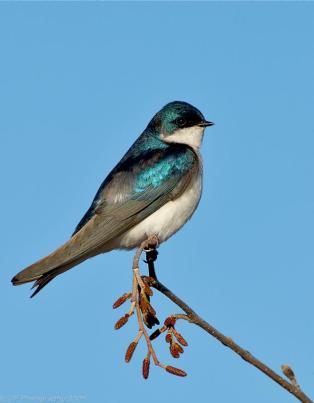
Tree Swallow (Tachycineta bicolor) by J Fenton

Tree Swallow (Tachycineta bicolor) by J Fenton

Our verse above mentions the birds and how they KNOW when it is time to migrate, but what about the end of the verse? The Lord uses birds and other critters as an example, BUT He is mainly trying to teach us something.

Let’s see what some of the different versions say about what we are supposed to learn from these birds.

(HCSB)  ”are aware of their migration, but My people do not know the requirements of the LORD.”

(MSG) …know when it’s time to move south for winter… know when it’s time to come back again. But my people? My people know nothing, not the first thing of GOD and his rule.

(NET) …knows when it is time to move on…recognize the normal times for their migration. But my people pay no attention to what I, the LORD, require of them.

Do you know what the Lord wants you to do? Do you know Him as your Savior? If you do, are you doing what the Bible tells us we should do? Are you obeying your parents? And doing what the Lord wants you to do?.

The Lord loves us, just as your parents do. When you obey them you are happier and blessed. When you do not obey, are you happy or sad? The same is true with obeying the Word that the Lord has given us through His Word, the Bible.

See:

*