***

A SONG OF PRAISE TO OUR GOD
***
He put a new song in my mouth, a song of praise to our God; Many will see and fear And will trust in the LORD. (Psalms 40:3 NASB)
American Yellow Warbler (Dendroica aestiva) singing by Jim Fenton
*
*
He put a new song in my mouth, a song of praise to our God; Many will see and fear And will trust in the LORD. (Psalms 40:3 NASB)
American Yellow Warbler (Dendroica aestiva) singing by Jim Fenton
*
*

“But those who wait on the LORD Shall renew their strength; They shall mount up with wings like eagles, They shall run and not be weary, They shall walk and not faint.” (Isaiah 40:31 NKJV)
Bald Eagle (Haliaeetus leucocephalus) Flying by Aesthetic Photos
*
*
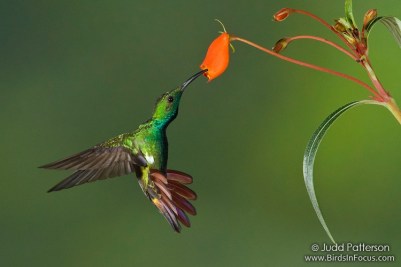
Green-breasted Mango (Anthracothorax prevostii) by Judd Patterson
Many, O LORD my God, are the wonders which You have done, And Your thoughts toward us; There is none to compare with You. If I would declare and speak of them, They would be too numerous to count.
(Psalms 40:5 NASB)
Green-breasted Mango (Anthracothorax prevostii) by Judd Patterson
*
*
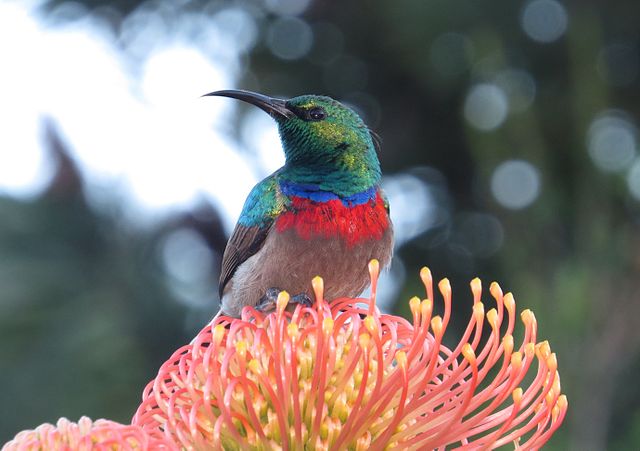
Southern Double-collared Sunbird (Cinnyris chalybeus) ©WikiC
Look at the birds of the air, for they neither sow nor reap nor gather into barns; yet your heavenly Father feeds them. Are you not of more value than they?
(Matthew 6:26 NKJV)
*
*
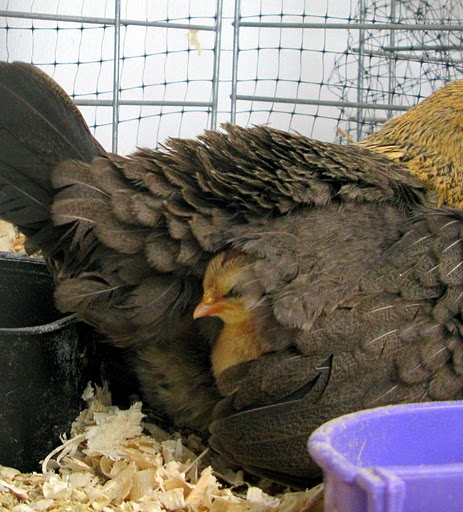
He shall cover you with His feathers, And under His wings you shall take refuge; His truth shall be your shield and buckler. (Psalms 91:4 NKJV)
Baby Chick Peeping Out From Under His Mom’s Wing – ©©
*
*

White-crowned Sparrow (Zonotrichia leucophrys) ©USFWS
I am currently taking a Ladies Bible study, “Disciples Prayer Life.” One of our lessons suggested using some of the different names of God while praying. There is quite a list of God’s names in our lesson. Some of them are:
It is this last one, Jehovah-Shammah, that has really caught my interest. As you can see, it means “The Lord who is there.”
When we read Genesis 1:1, it begins with “In the beginning, God…” The word for God here is Elohim – אֱלֹהִים , ‘ĕlôhı̂ym, el-o-heem’ There is much to be said about this, but, for now, that is not my purpose. The Lord God is the Creator, Sovereign and all-powerful. God has no beginning, or ending, He is the Alpha and the Omega.
Because God has always been, the word, Jehovah-Shammah, “The Lord who is there” is also true. God’s Word chose not to use that word here.
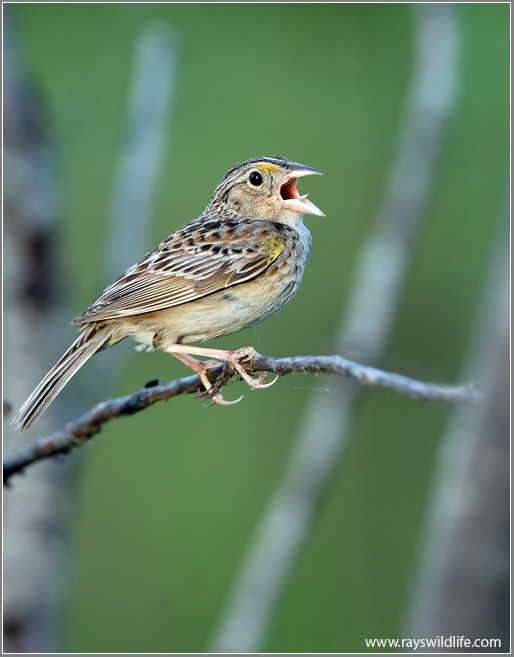
Grasshopper Sparrow (Ammodramus savannarum) by Ray
All of this to explain a passage about the sparrows, which I have used many times before, that could have used the word ” Jehovah-Shammah.”
“Are not two sparrows sold for a farthing? and one of them shall not fall on the ground without your Father. But the very hairs of your head are all numbered. Fear ye not therefore, ye are of more value than many sparrows.” (Matthew 10:29-31 KJV) (emphasis mine)
When a sparrow or any bird falls and/or dies, their Father, knows all about it because HE IS THERE.
If a fallen sparrow is noticed by the Father, who is there, should we not receive comfort from knowing that our Lord God knows and sees us also. As that passage goes on, there is comfort given to us because we are of more value than the birds. We, mankind, were made in the image of God, animals and birds were not. Because of sin, the Lord Jesus Christ, God’s Son, provided salvation for us. It cost the Lord His blood to save us from our sins. We have a choice whether to receive that Sacrifice or not.
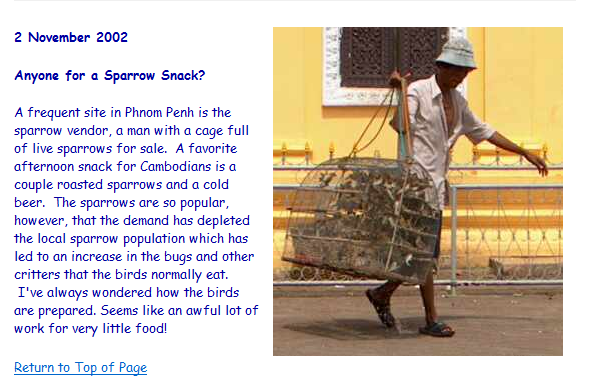
Anyone for a Sparrow Snack?
Every since I saw this photo, Matthew 10:29, has meant more to me than just a bird dying of old age. That whole cage is packed with sparrows to be eaten. That sickens me, but maybe I eat things that sicken others in another culture. I just found another photo of a roasted sparrow. I refuse to post it.
I love Sparrows of all kinds and the other birds. Most of all, I am thankful for a Creator God who cares for those birds and for us. When we KNOW that the Lord IS THERE, we can have comfort knowing we can pray and bring our requests to the Lord, knowing that He cares and already knows all about our needs.
*
Birds of the Bible – Worry and Sparrows
*
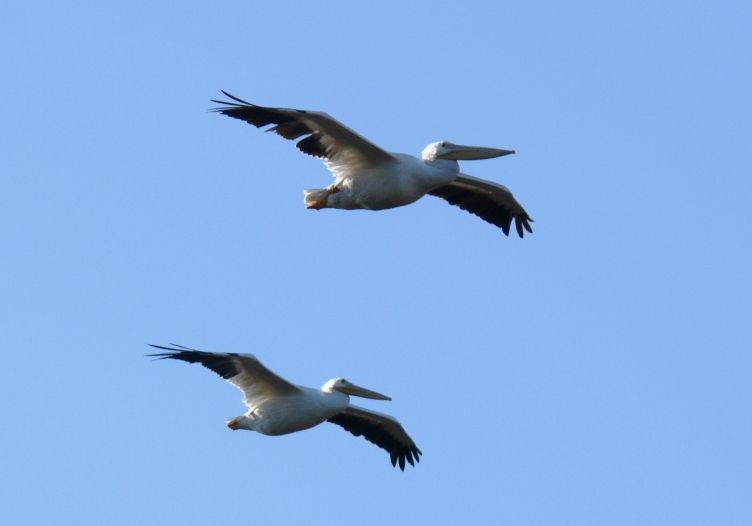
Then God said, “Let the waters abound with an abundance of living creatures, and let birds fly above the earth across the face of the firmament of the heavens.” (Genesis 1:20 NKJV)
American White Pelican (Pelecanus erythrorhynchos) by Lee at Circle B Bar Reserve
*
*
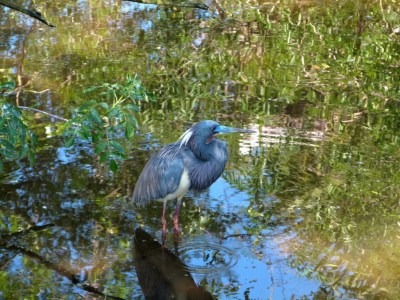
Tricolored Heron at Gatorland by Lee
And the stork, the heron after her kind, and the lapwing, and the bat. (Leviticus 11:19 KJV)
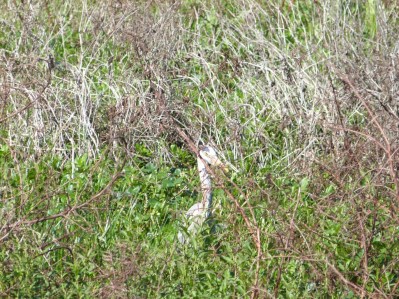
Great Blue Heron camouflaged by Lee
And the stork, and the heron after her kind, and the lapwing, and the bat. (Deuteronomy 14:18 KJV)
The original Birds of the Bible – Heron article was posted on July 17, 2008. Seems like it’s time for an update and to keep our Heron family visible. Actually, some of the family members are very good at hiding or blending in with their surroundings. Their Creator, the Lord Jesus Christ, designed them to be slim like the reeds they hide in, called camouflage, and gave them the ability to move back and forth again like reeds. Notice the Tricolored Heron in the first photo. Even though he is blue, the sky color reflecting in the water actually is helping keep him “hidden in plain view.”
CLASS – AVES, Order – PELECANIFORMES, Family – Ardeidae – Herons, Bitterns, Egrets
Here in central Florida we can see many Herons, such as the:
(Click link for photo from Dan’s website)
Great Blue Heron (L46″ Wingspan 72″)
Little Blue Heron (L24 Wingspan 40″)
Tri-colored Heron (L26 Wingspan 36″)
Green Heron (L18″ Wingspan 26)
Black-crowned Night Heron (L25″ Wingspan 26″)
Yellow-crowned Night Heron (L24″ Wingspan 42″)
Around the World the Ardeidae family, now with 72 species, includes Herons (46), Egrets (9) and Bitterns (15). From Thayer Birding Software, “Most herons nest in dense or dispersed colonies; a few species, including most bitterns, are solitary. Nests are platforms of interlocked sticks in trees or piles of vegetation in reeds or on the ground, built mainly or entirely by the female of material brought by the male.”
Most of the Herons rest and fly with their necks in an “S” curve. They can be seen along or in the edges of water fishing. Many stand perfectly still looking in the water and then thrust with a quick movement to either spear or catch their prey. You can see that in the video I posted yesterday.
This video of a Great Egret was watching something so intently. Also, notice how his neck sways like they do in the tall grass or reeds. Egrets are part of the Heron Family group.
Herons amaze me in how perfectly still they stand and wait. They seem so patient to me. Herons are on the “unclean” list of birds found in Leviticus 11:19 and Deuteronomy 14:18. Because they are so “patient” and “wait,” it reminds me of:
Rest in the LORD, and wait patiently for him: fret not thyself because of him who prospereth in his way, because of the man who bringeth wicked devices to pass. (Psalms 37:7 KJV)
And so, after he had patiently endured, he obtained the promise. (Hebrews 6:15 KJV)
The eyes of all wait upon thee; and thou givest them their meat in due season (Psalms 145:15 KJV
And of course our great verse from last week:
But they that wait upon the LORD shall renew their strength; they shall mount up with wings as eagles; they shall run, and not be weary; and they shall walk, and not faint. (Isaiah 40:31 KJV)
Hymns mention “waiting” and being “still” and “patient. Here is a favorite:
Be Still, My Soul by Katharina von Schlegel,
1697-Trans. By Jane L. Borthwick, 1813-1897
Be still, my soul: the Lord is on thy side;
Bear patiently the cross of grief or pain;
Leave to thy God to order and provide;
In ev’ry change He faithful will remain.
Be still, my soul: thy best, thy heav’nly Friend
Thro’ thorny ways leads to a joyful end.
Be still, my soul: thy God doth undertake
To guide the future as He has the past.
Thy hope, thy confidence let nothing shake;
All now mysterious shall be bright at last.
Be still, my soul: the waves and winds still know
His voice who ruled them while He dwelt below.
Be still, my soul: the hour is hast’ning on
When we shall be forever with the Lord,
When disappointment, grief, and fear are gone,
Sorrow forgot, love’s purest joys restored.
Be still, my soul: when change and tears are past,
All safe and blessed we shall meet at last.
*
Ardeidae – Herons, Bitterns, Egrets

Bald Eagle (Haliaeetus leucocephalus) by Aesthetic Photos
That very hour the word was fulfilled concerning Nebuchadnezzar; he was driven from men and ate grass like oxen; his body was wet with the dew of heaven till his hair had grown like eagles’ feathers and his nails like birds’ claws. (Daniel 4:33 NKJV emphasis mine)
What an interesting verse to read in the Bible. Most of you know what an Eagle looks like, because Eagles fly to many countries.
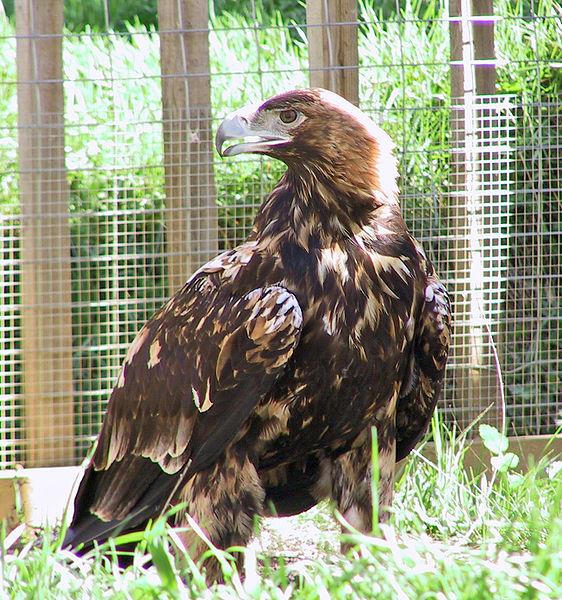
Adalbert’s Eagle Aquila adalberti) ©WikiC
Whose hair was going to grow so long that it would be as long as eagles’ feathers?

Sea Eagle (Haliaeetus pelagicus) Feet by Lee at National Aviary
This is what a person looks like with long nails:

Long nails like a bird’s claws
Whose fingernails and toenails was going to grow so long that they would look like bird claws?
The person that verse is referring to is Nebuchadnezzar. He was the King of Babylon in 605 BC – 562 BC. The Lord God had placed him in power to rule over the whole world, but he had forgotten to give God the credit. He started saying things like:
Do you know what that is called? Pride! The King was failing to give God the credit for making him the ruler, having majesty, and ability to build his royal place.
Do we have a false pride? Yes, we may do great things. You may make 100% on a test, earn a high award, or receive some other great recognition. Are you swelling up with pride? Have you thanked your parents, friends, or, if you know the Lord as Savior, the Lord for helping you achieve your success?
We should be thankful for the abilities that we have. Thank the Lord for helping you remember those answers to get the 100%. Thank Him for allowing you to earn that award. Thank the Lord for being recognized for something you did that was great.
Thank the Lord even if you didn’t get 100%, a trophy, award, or other prize. If you did your best, that is all He can expect you to do. If you didn’t do your best, then ask the Lord to help you do better the next time something comes up.
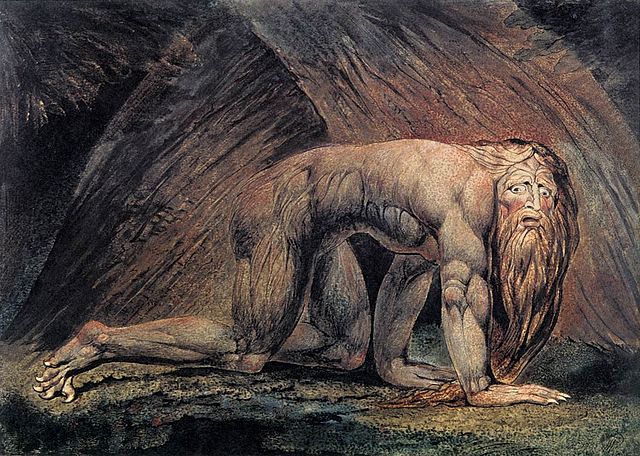
Nebuchadnezzar – showing the king during his bout of insanity by William Blake ©WikiC
Yes, after the Lord sent Nebuchadnezzar out to the field with an animal’s heart, eating grass, growing long hair like eagle’s feathers, and his nails growing long like bird’s claws, He finally looked to the Lord God.
Now I, Nebuchadnezzar, praise and extol and honor the King of heaven, all of whose works are truth, and His ways justice. And those who walk in pride He is able to put down. (Daniel 4:37 NKJV)
*
*

Bald Eagle at Lowry Park Zoo by Lee
That very hour the word was fulfilled concerning Nebuchadnezzar; he was driven from men and ate grass like oxen; his body was wet with the dew of heaven till his hair had grown like eagles’ feathers and his nails like birds’ claws. (Daniel 4:33 NKJV)
This Birds of the Bible Scripture was mentioned over five years ago and it’s time to update and review. “Repetition aids learning” they say. Also, I am currently reading through Daniel again.
Many times the birds mentioned in the Bible are listed as “clean or unclean” or as an “object lesson” to teach some truth. This time the mention of Eagle feathers and birds’ claws are used as a description of a man’s appearance and there is a lesson to be learned here.
So, who was this man? It is actually a very important king, King Nebuchadnezzar of Babylon. The information about the King is found throughout the book of Daniel. To make the story short, the king had a dream and wanted an interpretation of that dream. Not only did he want his dreams interpreted, but he wanted the interpreter to tell him what the dream was about. The wise men and others told the king that was impossible, so the king commanded to kill them. Daniel prayed to God that He would reveal the dream and it’s interpretation to him so he could tell it to the King. God answered that prayer and Daniel was able to reveal it to King Nebuchadnezzar.
King Nebuchadnezzar was the first world ruler and God had given the king great power. Later on, the king’s pride takes over and he thinks he has made this kingdom and does not give God the credit. He even has a great statue made of himself and demands that all fall down and worship him.
Back to making this short. In Daniel chapter 4 the king has another dream and Daniel (Belteshazzar) prays for revelation and again interprets the dream. Daniel 4:9 to 4:18 tells the dream. (Birds are mentions several times in it.) Then Daniel interprets the dream in Daniel 4:19-33. Basically, the Most High is going to let the king learn humility and get rid of the pride that he has.
The king spoke, saying, “Is not this great Babylon, that I have built for a royal dwelling by my mighty power and for the honor of my majesty? (Daniel 4:30 NKJV, emphasis mine)
For seven years, or time periods, will his kingdom be departed from him. He will be out in the field, “eating grass like oxen” and “until you know that the Most High rules in the kingdom of men, and gives it to whomever He chooses.” It is during this time that his hair will grow like “eagles’ feathers and his nails like birds’ claws.”
Sea Eagle (Haliaeetus pelagicus) Feet by Lee at National Aviary
That was the short version, now before we find out if the King learned from this, we will go a little further.
Summarized Bible – “Conclusion: God has power to humble the haughtiest of men who would in their pride act in competition with Him. Those so confident of their own sufficiency will be brought sooner or later to own God’s dominion over them and their own utter weakness. Many have been brought to themselves by being made beside themselves.”

Harpy Eagle (Harpia harpyja) by Lee at Zoo Miami 2014
Daniel & the Revelation by Uriah Smith: “The King’s Self-exaltation and Humiliation.–Nebuchadnezzar failed to profit by the warning he had received, yet God bore with him twelve months longer before the blow fell. All that time he cherished pride in his heart, and at length it reached a climax beyond which God could not suffer it to pass. The king was walking in the palace, and as he looked forth upon the splendors of that wonder of the world, great Babylon, the beauty of kingdoms, he forgot the source of all his strength, and greatness, and exclaimed, “Is not this great Babylon, that I have built?” Archaeologists have found the ruins of that ancient city, which Sir Frederic Kenyon describes in the following sentences:
“These confirmed the generally wrecked character of the site, but also revealed much as to its plan, architecture, and ornamentation. The buildings found were almost wholly the work of Nebuchadnezzar, who rebuilt the previous city most extensively, his own enormous palace (‘this great Babylon that I have build for the house of the kingdom by the might of my power and for the honor of my majesty’) being the most conspicuous building of all.” [3]
The time had come for Nebuchadnezzar’s humiliation. A voice from heaven again announced the threatened judgement, and divine providence proceeded immediately to execute it. His reason departed. No longer the pomp and glory of his great city charmed him. God with a touch of His finger took away his capability to appreciate and enjoy it. He forsook the dwellings of men, and sought a home and companionship among the beasts of the field.”
[3] Sir Frederic Kenyon, The Bible and Archaeology, p. 126.
Long nails like a bird’s claws
Day by Day by F. B. Meyer – “But how marvelous the contrast between those proud and vaunting words, and the ascriptions of humble homage and praise in Dan_4:34-37! If God could produce such a result on the haughty king of Babylon, is there any sinner He cannot subdue? May not the stern discipline to which some lives are subjected be intended to subdue their proud wills and bring them to similar confessions?”
Did King Nebuchadnezzar learn his lesson?
And at the end of the time I, Nebuchadnezzar, lifted my eyes to heaven, and my understanding returned to me; and I blessed the Most High and praised and honored Him who lives forever: For His dominion is an everlasting dominion, And His kingdom is from generation to generation. All the inhabitants of the earth are reputed as nothing; He does according to His will in the army of heaven And among the inhabitants of the earth. No one can restrain His hand Or say to Him, “What have You done?” At the same time my reason returned to me, and for the glory of my kingdom, my honor and splendor returned to me. My counselors and nobles resorted to me, I was restored to my kingdom, and excellent majesty was added to me. Now I, Nebuchadnezzar, praise and extol and honor the King of heaven, all of whose works are truth, and His ways justice. And those who walk in pride He is able to put down. (Daniel 4:34-37 NKJV)
May we all watch our pride and realize that:
“A man’s pride will bring him low, But the humble in spirit will retain honor.” (Proverbs 29:23 NKJV)
*
Birds of the Bible – Hair Like Eagle’s Feathers – original
*
That which was from the beginning, which we have heard, which we have seen with our eyes, which we have looked upon, and our hands have handled, of the Word of life; (1 John 1:1 KJV)
Please Click Here To See The Card
Here is the video they used with it:
*
A friend sent this to me and I trust you also are as moved by it as I am. Tears are still flowing as I type this.

Red-billed Oxpecker (Buphagus erythrorynchus) by Africaddict
Then He answered them, saying, “Which of you, having a donkey or an ox that has fallen into a pit, will not immediately pull him out on the Sabbath day?” (Luke 14:5 NKJV)
This Sunday’s continuation of the Passerines (Songbirds) bring us to two more families, one small with only 2 species of Oxpeckers and the other, the large Thrush family with 167 members.
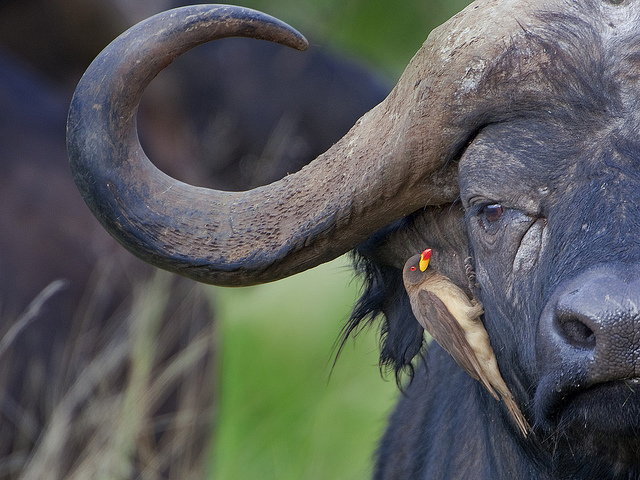
Yellow-billed Oxpecker with Water Buffalo ©©
The oxpeckers are two species of bird which make up the family Buphagidae. Oxpeckers are endemic to the savanna of Sub-Saharan Africa. Both the English and scientific names arise from their habit of perching on large mammals (both wild and domesticated) such as cattle or rhinoceroses, and eating ticks, botfly larvae, and other parasites.
Oxpeckers feed exclusively on the backs of large mammals. Certain species are seemingly preferred, whereas others, like the Lichtenstein’s hartebeest or Topi are generally avoided. Smaller antelope such as lechwe, duikers and reedbuck are also avoided, the smallest regularly used species is the Impala, probably because of the heavy tick load and social nature of that species. In many parts of their range they now feed on cattle, but avoid camels. They feed on ectoparasites, particularly ticks, as well as insects infecting wounds and the flesh and blood of some wounds as well. (Info from Wikipedia)

Orange-headed Thrush (Geokichla citrina) ©WikiC
Thrushes are medium-sized mostly insectivorous or omnivorous birds. The genus, Turdus, is the largest genus of the thrush family, Turdidae.
The Turdus genus has a cosmopolitan distribution, with species in the Americas, Europe, Asia, Africa and Australia. Several species have also colonized some oceanic islands, and two species have been introduced to New Zealand. Some New World species are called robins, the most famous of which is the American robin. Several species are migratory.
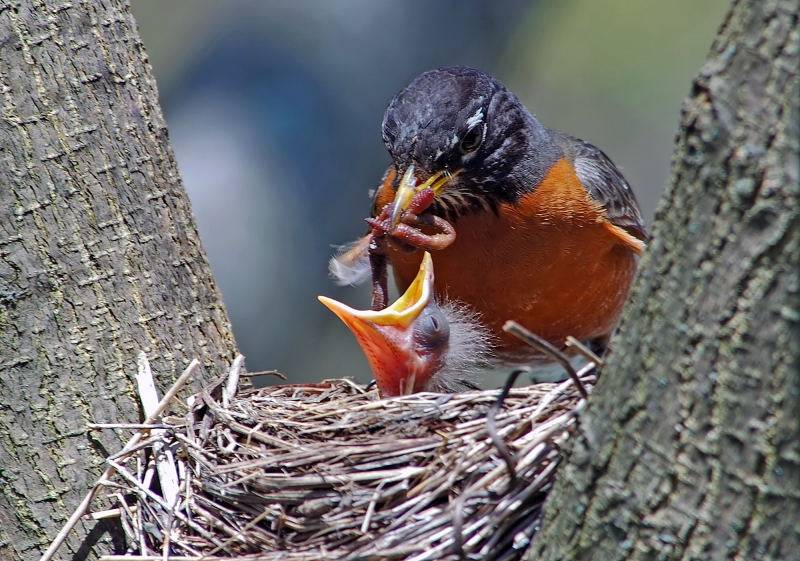
American Robin (Turdus migratorius)with youngsters by Raymond Barlow
They are insectivorous, but most species also eat worms, land snails, and fruit. Many species are permanently resident in warm climes, while others migrate to higher latitudes during summer, often over considerable distances.
Thrushes build cup-shaped nests, sometimes lining them with mud. They lay two to five speckled eggs, sometimes laying two or more clutches per year. Both parents help in raising the young.
The songs of some species, including members of the genera Catharus, Myadestes, and Turdus, are considered to be among the most beautiful in the avian world. (Info from Wikipedia)
“Even the stork in the sky Knows her seasons; And the turtledove and the swift and the thrush Observe the time of their migration; But My people do not know The ordinance of the LORD. (Jeremiah 8:7 NASB)
“I Heard The Bells With Peace On Earth” – with Jessie Padgett, Angel Long and the FX Girls
*
Faith Baptist has just recently started posting our services on YouTube. Here is last Sunday’s Message (Dec 6, 2015) if you would like to watch it. We have a great pastor and church. He is doing a Christmas theme during December.
*
Buphagidae – Oxpeckers Family
Turdidae – Thrushes Family
PASSERIFORMES Order
Birds of the Bible – Bluebirds
*
 Lee's Birdwatching Adventures Plus