Bible Birds – Dove, Turtledove and Pigeon’s Introduction

Common Pigeon -aka Rock(Columba livia) by Daves BirdingPix

Common Pigeon -aka Rock(Columba livia) by Daves BirdingPix

Bible Birds – Dove, Turtledove and Pigeon’s Introduction

Doves are in the Columbidae Family of the Columbiformes Order

They are walking birds, feeding both on the ground and in trees; bill slender, grooved, nostrils opening in a fleshy membrane; tail variable, short and square, or long and pointed; feet stout, often reddish. Color usually grayish brown. Call-notes a characteristic cooing.

Sound from xeno-canto.

Mourning Dove (Zenaida macroura) 2 Neal Addy Gallery

Mourning Dove (Zenaida macroura) 2 Neal Addy Gallery

Family Columbidae includes some 310 species. In general the terms “dove” and “pigeon” are used somewhat interchangeably. In ornithological practice, there is a tendency for “dove” to be used for smaller species and “pigeon” for larger ones, but this is in no way consistently applied, and historically the common names for these birds involve a great deal of variation between the terms “dove” and “pigeon.” This family occurs worldwide, but the greatest variety is in Indomalaya and Australasia. Young doves and pigeons are called “squabs.”

Pigeons and doves are stout-bodied birds with short necks, and have short slender bills with a fleshy cere. The species commonly referred to just as “pigeon” is the Feral Rock Pigeon, common in many cities.

Doves and pigeons build relatively flimsy nests from sticks and other debris, which may be placed in trees, on ledges or on the ground, depending on species. They lay one or two eggs, and both parents care for the young, which leave the nest after 7 to 28 days. Doves feed on seeds, fruit and plants. Unlike most other birds, the doves and pigeons produce “crop milk”, which is secreted by a sloughing of fluid-filled cells from the lining of the crop. Both parents produce this highly nutritious substance to feed to the young.

Victoria Crowned Pigeon (Goura victoria) by Lee at Zoo Miami

Victoria Crowned Pigeon (Goura victoria) by Lee at Zoo Miami

Pigeons and doves exhibit considerable variations in size. The largest species is the crowned pigeon of New Guinea, which is nearly turkey-sized, at a weight of 4.4-8.8 lb (2-4 kg) The smallest is the New World ground-dove of the genus Columbina, which is the same size as a House Sparrow and weighs as little as 22 g. With a total length of more than 19 in (50 cm) and weight of almost 2 lb (1 kg), the largest arboreal species is the Marquesan Imperial Pigeon, while the Dwarf Fruit Dove, which may measure as little as 5.1 in (13 cm), has a marginally smaller total length than any other species from this family. Smaller species tend to be known as doves, while larger species as pigeons.

Overall, the Columbidae tend to have short bills and legs, and small heads on large compact bodies. They have a habit of head bobbing was shown to be due to their natural desire to keep their vision constant. The wings are large and have low wing loadings; pigeons have strong wing muscles (wing muscles comprise 31–44% of their body weight) and are amongst the strongest fliers of all birds. They are also highly maneuverable in flight.

Superb Fruit Dove (Ptilinopus superbus) by Ian

Superb Fruit Dove (Ptilinopus superbus) by Ian

The plumage (feathers and colors) of the family is variable. Granivorous (seed eater) species tend to have dull plumage, with a few exceptions, whereas the frugivorous (fruit eater) species have brightly-coloured plumage. The Ptilinopus fruit doves are some of the brightest coloured pigeons, with the three endemic species of Fiji and the Indian Ocean Alectroenas being amongst the brightest coloured. In addition to bright colours pigeons may sport crests or other ornamentation.

Seeds and fruit form the major component of the diet of pigeons and doves. In fact, the family can be divided into the seed-eating or granivorous species (subfamily Columbinae) and the fruit-eating or frugivorous species (the other four subfamilies). The granivorous typically feed on seed found on the ground, whereas the species that feed on fruit and mast tend to feed in trees.

Now when the days of her purification according to the law of Moses were completed, they brought Him to Jerusalem to present Him to the Lord (as it is written in the law of the Lord, “EVERY MALE WHO OPENS THE WOMB SHALL BE CALLED HOLY TO THE LORD” ), and to offer a sacrifice according to what is said in the law of the Lord, “A PAIR OF TURTLEDOVES OR TWO YOUNG PIGEONS.” (Luke 2:22-24 NKJV)

In the Bible (Old Testament), doves or young pigeons were acceptable burnt offerings for those who couldn’t afford a more expensive animal. In the book of Genesis, Noah sent out a dove after the great flood in order to determine how far the floodwaters had receded. Dove is also a term of endearment in the Song of Songs and elsewhere.

When He had been baptized, Jesus came up immediately from the water; and behold, the heavens were opened to Him, and He saw the Spirit of God descending like a dove and alighting upon Him. (Matthew 3:16 NKJV)

Jesus’ parents sacrificed doves on his behalf after his circumcision (Luke 2:24). Later the Holy Spirit descended upon Jesus at his baptism like a dove (Matthew 3:16), and subsequently, the “peace dove” became a common Christian symbol of the Holy Spirit.

(Information from Wikipedia and other internet sources.)

See:

Bible Birds

Bible Birds – Doves and Pigeons

Columbidae Family

Wordless Birds

*

Birds of the Bible – Job 38 – 39

Common Ostrich (Struthio camelus) Memphis Zoo by Lee

Common Ostrich (Struthio camelus) Memphis Zoo by Lee

Dan and I have been reading through Job for our devotions. Today was Job 38 and 39. Wow! All of Job’s “friends” have been trying to persuade Job how wrong and unrighteous he is and Job has been trying to figure out why he is being punished, yet defending his righteousness.

Finally in Job 38, God speaks. Job has been asking to speak to God about his situation. (From the Today in the Word, Vol II, Day 28) “So, when Job finally gets the audience with the Lord that he requested, he is not the one asking the questions!  Instead, like a prosecuting attorney, the Lord fires off the questions and informs Job ‘You will answer me’ (38:3). God challenges Job’s insinuation that He wasn’t administering justice fairly. This interrogation covers Job 38 and 39, but it could be paraphrased in this one penetrating question: ‘Were you present at creation?’ ”

If you haven’t read Job lately and especially Chapter 38 and 39, it worth reading.

Northern Raven (Corvus corax) by Ray

Northern Raven (Corvus corax) by Ray

Anyway, within those two chapters, God mentions the Raven and the Ostrich.

Can you hunt the prey for the lion, or satisfy the appetite of the young lions, when they crouch in their dens or lie in wait in their thicket? Who provides for the raven its prey, when its young ones cry to God for help, and wander about for lack of food? (Job 38:39-41 ESV)

Then in the next chapter God tells about the Ostrich that He created:

The wings of the ostrich wave proudly, but are they the pinions and plumage of love? For she leaves her eggs to the earth and lets them be warmed on the ground, forgetting that a foot may crush them and that the wild beast may trample them. She deals cruelly with her young, as if they were not hers; though her labor be in vain, yet she has no fear, because God has made her forget wisdom and given her no share in understanding. When she rouses herself to flee, she laughs at the horse and his rider. (Job 39:13-18 ESV)

Both of these birds have been covered in other Birds of the Bible articles, but just wanted to share them with you again. We know that God provides for the birds and He has promised to provide for His own, Christians. He also, makes birds different, at His will. Who are we to question His knowledge and wisdom. The same is true with us who know the Lord. He gives each of us different talents and abilities. We are not to question why He made us thus.

Birds of the Bible

Birds of the Bible – Ravens

Birds of the Bible – Ostrich

The Gospel Message

*

Birds and Hurricanes

Isaac Aug 24, 2012 - Satellite

Isaac Aug 24, 2012 – Satellite

We here in central Florida are keeping an eye to the south of us as Tropical Storm Isaac marches up this way. They are predicting it to become a hurricane before it gets in this area. We expect rain, but not a direct hit. But! As I told Dan, “until the storm parks at the end of its journey, anything goes.” Do we worry, no, not as Christians. Do we prepare? Yes.

I just filled the feeders extra full for the birds to get a nice meal before they hunker down for what ever passes our way. Where will they go? What will they do? Those are some interesting questions. Let’s see what has been written about that.

How Birds Stay Safe During Hurricanes, “Where Do Birds Go During Hurricanes?” is an interesting article from Birding.com. They tell about the “a sharp drop in barometric pressure” that warns the birds of coming storms. God has given them senses and instincts to prepare.

If they don’t have babies or nest, they are likely to fly to safer regions. Larger birds can stay ahead of the storm. Others have to fly hard, or land and take cover. When the Lord created the birds, He gave them a locking mechanism on their legs and feet. When they perch, their feet sort of lock and that keeps them from falling off while sleeping or from being blown away. Of course, a 80 mph wind or more will get to a point that even they can’t hold on. They also have the chance the tree could be toppled. They also mention that shorebirds tend to go inland.

What Happens To Birds When Hurricanes Hit? from eNature.com says, “Numbers are hard to come by, but it’s clear that many birds are killed outright by hurricanes. This is especially true of seabirds, which have nowhere in which to seek shelter from these storms. Beaches may be littered with seabird carcasses following major storm events. Most Atlantic hurricanes occur in late summer and early fall—and fall storms coincide with bird migration and may disrupt migration patterns severely.” So, the outcome is not always good. One thing we do know from Scripture:

Are not five sparrows sold for two farthings, and not one of them is forgotten before God? But even the very hairs of your head are all numbered. Fear not therefore: ye are of more value than many sparrows. (Luke 12:6-7 KJV)

Are not two sparrows sold for a farthing? and one of them shall not fall on the ground without your Father. But the very hairs of your head are all numbered. Fear ye not therefore, ye are of more value than many sparrows. (Matthew 10:29-31 KJV)

The Lord know all about the deaths, but when they were created, they were given abilities, like above, to protect themselves as best they can.

So God created the great sea creatures and every living creature that moves, with which the waters swarm, according to their kinds, and every winged bird according to its kind. And God saw that it was good. And God blessed them, saying, “Be fruitful and multiply and fill the waters in the seas, and let birds multiply on the earth.” And there was evening and there was morning, the fifth day. (Genesis 1:21-23 ESV)

He has blessed them and told them to reproduce. Would He let them all be wiped out? I don’t think so. Yes, a few will fall.

Hurricane Charley damage at Captiva, Trees stripped.

Hurricane Charley damage at Captiva, Trees stripped.

After the storm, the birds have problems especially if the fruits and vegetables are destroyed. Also, trees, which provide shelter and places for nest might be in short supply. For those of who feed birds, after the storm, if you still have any feeders, they need to be filled up. Also, clean water needs to be provided.

One plus from a storm is that the Life List of birdwatchers could be increased. Many times birds are blown out of their area or off course. This provides a chance to see birds not normally seen. Seabirds can get caught up in the Eye of the storm and carried inland. Thus giving birdwatchers rare treats to see birds.

You can read those and other articles about the birds in a storm on the internet. I am no expert, nor do I claim to be. What I do know is that God loves them, maybe not with the same love He has for us, but He Cares. If He Cares for them, you can rest assured, we are more valuable in His Sight. He will help us humans as we go through the Hurricanes also.

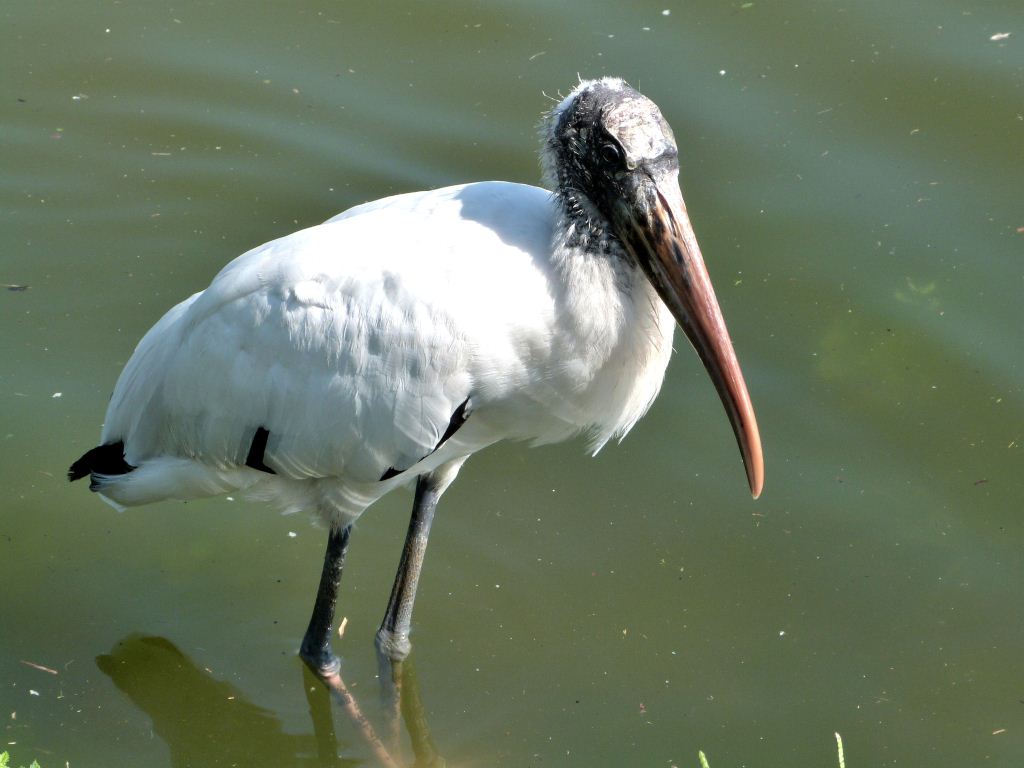
Wood Stork - Lake Morton 6-28-12 by Lee (105)

Wood Stork – Lake Morton 6-28-12 by Lee (105)

Links:

How Birds Stay Safe During Hurricanes

What Happens To Birds When Hurricanes Hit?

Birds Versus Hurricanes – Here

What Happens to Birds in Hurricanes

Seven Things to Know About How Hurricanes Affect Wildlife – NWF

How Do Hurricanes Affect Birds – Audubon

Signs That Animals Show Before a Natural Disaster

Signs That Animals Show Before a Natural Disaster – eHow

Even the birds in the sky know the right time to do things. The storks, doves, swifts, and thrushes know when it is time to fly to a new home. But my people don’t know what the LORD wants them to do. (Jeremiah 8:7 ERV)

*

Birds of the Bible – Jeremiah 8:7

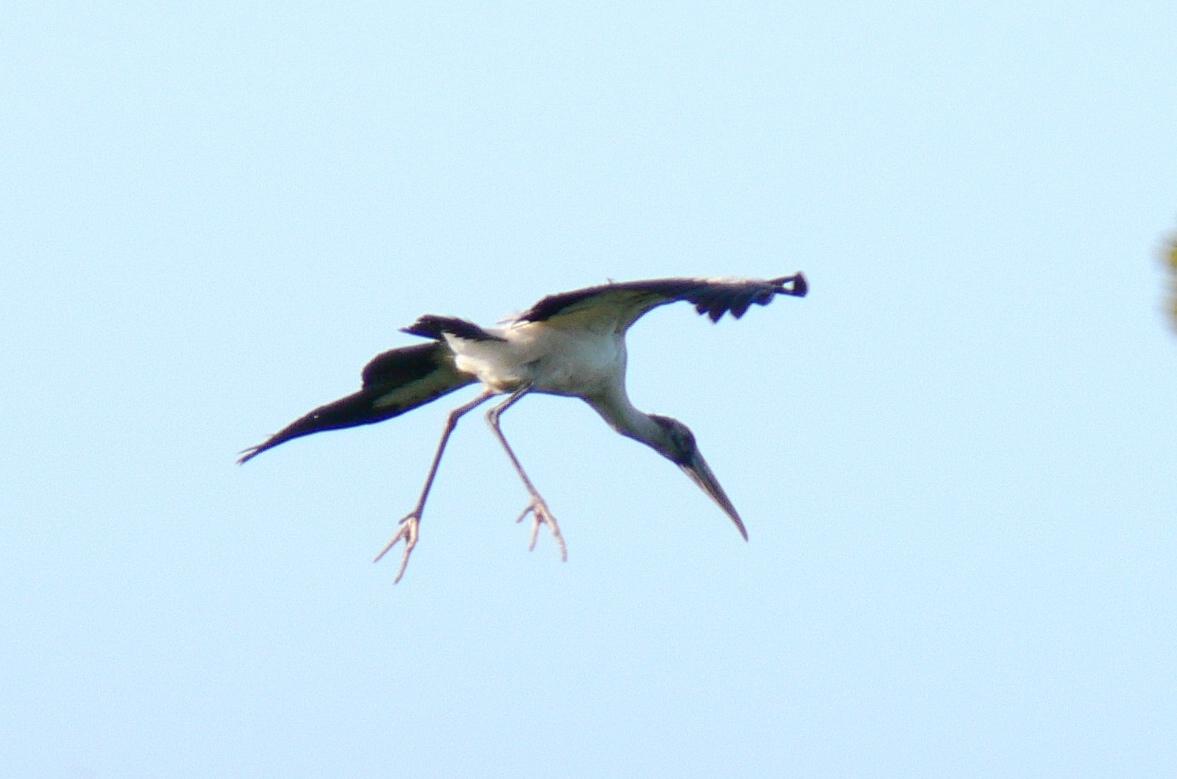
Wood Stork with landing gear down

Wood Stork with landing gear down

Jeremiah 8:7 has been used in several Birds of the Bible articles before. See Birds of the Bible:

So what else can be found out about that verse? Those of you that follow this blog know that I enjoy digging into the Bible with my e-Sword program. It is a free program that can be downloaded. It has different versions of the Bible that can be downloaded free or some with a small fee. Also available are dictionaries, commentaries, maps, notes, references and STEP additions. For the price, FREE, it is hard to beat. There are also links to other sites to get even more add-ons. Check out their LINKS page. Two favorites of mine are the ESS and the Bible Support sites.

The Bible tells us to study the Bible and we should. I try to read several chapters every day and meditate on what I read. Then along with that I like to dig deeper into Scripture and mine some great promises and truths out. Then other times, like this article, I am just digging out the birds mentioned in the different versions of this verse. I don’t endorse every version I have loaded on my e-Sword, but I do like to compare all of them.

But continue thou in the things which thou hast learned and hast been assured of, knowing of whom thou hast learned them; And that from a child thou hast known the holy scriptures, which are able to make thee wise unto salvation through faith which is in Christ Jesus. All scripture is given by inspiration of God, and is profitable for doctrine, for reproof, for correction, for instruction in righteousness: That the man of God may be perfect, throughly furnished unto all good works. (2 Timothy 3:14-17 KJV)

Well, back to Jeremiah 8:7. Here’s the verse:

Yea, the stork in the heaven knoweth her appointed times; and the turtle and the crane and the swallow observe the time of their coming; but my people know not the judgment of the LORD. (Jeremiah 8:7 KJV)

Using the “Compare” mode, let’s see which birds are mentioned. Most mention the Stork, Turtle or Turtle-dove, Swallow, and the Crane. It is referring to them having the knowledge to know when to migrate, but “but my people know not the rules of the LORD.” (ESV) See the other articles for more details.

*

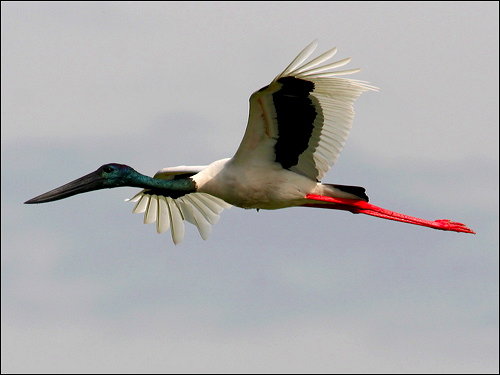
Black-necked Stork (Jabiru) (Ephippiorhynchus asiaticus) by Ian

Black-necked Stork (Jabiru) (Ephippiorhynchus asiaticus) by Ian

The H####’s are from Strong’s Hebrew and Greek Dictionaries. Using the KJV+ for the numbers.
H2624
חסידה
chăsı̂ydâh
khas-ee-daw’
Feminine of H2623; the kind (maternal) bird, that is, a stork: – X feather, stork.

Stork or storks – every version except two – DRB (kite), MSG (see bottom)
*

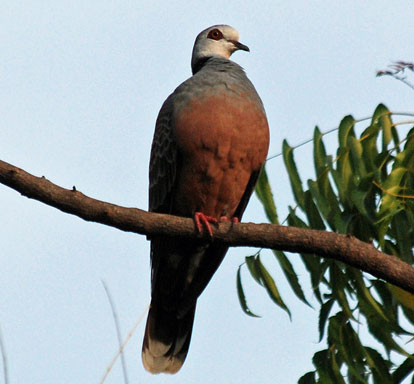
Adamawa Turtle Dove (Streptopelia hypopyrrha) ©WikiC

Adamawa Turtle Dove (Streptopelia hypopyrrha) ©WikiC

H8449
תּר תּור
tôr tôr
tore, tore
Probably the same as H8447; a ring dove, often (figuratively) as a term of endearment: – (turtle) dove.

Dove, Turtle, Turtle-doves, Mourning Doves – same family, no problem
*

Welcome Swallow (Hirundo neoxena) by Ian

Welcome Swallow (Hirundo neoxena) by Ian

H5693
עגוּר
‛âgûr
aw-goor’
Passive participle (but with active sense) of an unused root meaning to twitter; probably the swallow: – swallow.

Swallow – most versions
Swift – instead of Swift – ERV, NASB, NAS77, NIV, NIrV
Swift and Swallow – NKJV
The Swift and the Swallow both behave alike in some ways even though they are not in the same family. I even confuse them at times.
*

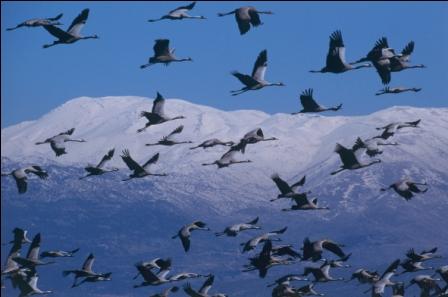
Crane Migration over Israel

Crane Migration over Israel

H5483
סס סוּס
sûs sûs
soos, soos
From an unused root meaning to skip (properly for joy); a horse (as leaping); also a swallow (from its rapid flight): – crane, horse ([-back, -hoof]).
Now we see where two different birds could be used. From here on the different versions begin to differ.

Crane – Most use Crane, but here are some of the differences
Sparrows – APB, Brenton
Thrushes – CEV, ERV, ECB, GNB, LITV, NAS77, NASB
Quite a difference in the birds here.
*

Eastern Bluebird (Sialia sialis) by S Slayton

Eastern Bluebird (Sialia sialis) by S Slayton

I saved the most interesting translation till last. Actually, it is a paraphrase and not a true translation. It does give me three more named birds. So far I haven’t seen them anywhere else, so for now they will not get their own page.

Cranes know when it’s time to move south for winter. And robins, warblers, and bluebirds know when it’s time to come back again. But my people? My people know nothing, not the first thing of GOD and his rule. (Jeremiah 8:7 MSG)

Does it matter if there is a difference in these versions? Yes and no. Yes, the Bible should be translated as close to the original as possible. No, in the sense that all these birds were given the knowledge to migrate by the Lord. And the truth of people not knowing the truth about God and what He wants for their lives. The birds obey, man doesn’t.

See More Birds of the Bible

Thought:

The method I used to study this verse can be applied to any verse or passage you wish to dig into. I used the Strong’s Hebrew and Greek because, of course, I have no clue as to what those word are. But using those help me/you understand the meaning of the word as it was originally written or as close as we can get to it. As our language has changed over the years, our meanings have also changed. It helps to read other versions when studying the Bible. I know some don’t agree and I won’t go there. The Lord has many truths to find in His Word. Maybe you like plants or animals, or like to study one person at a time, or a promise and the different ways it is presented, whatever. Study.

Gospel Message

*

Bible Birds – Heron’s Introduction

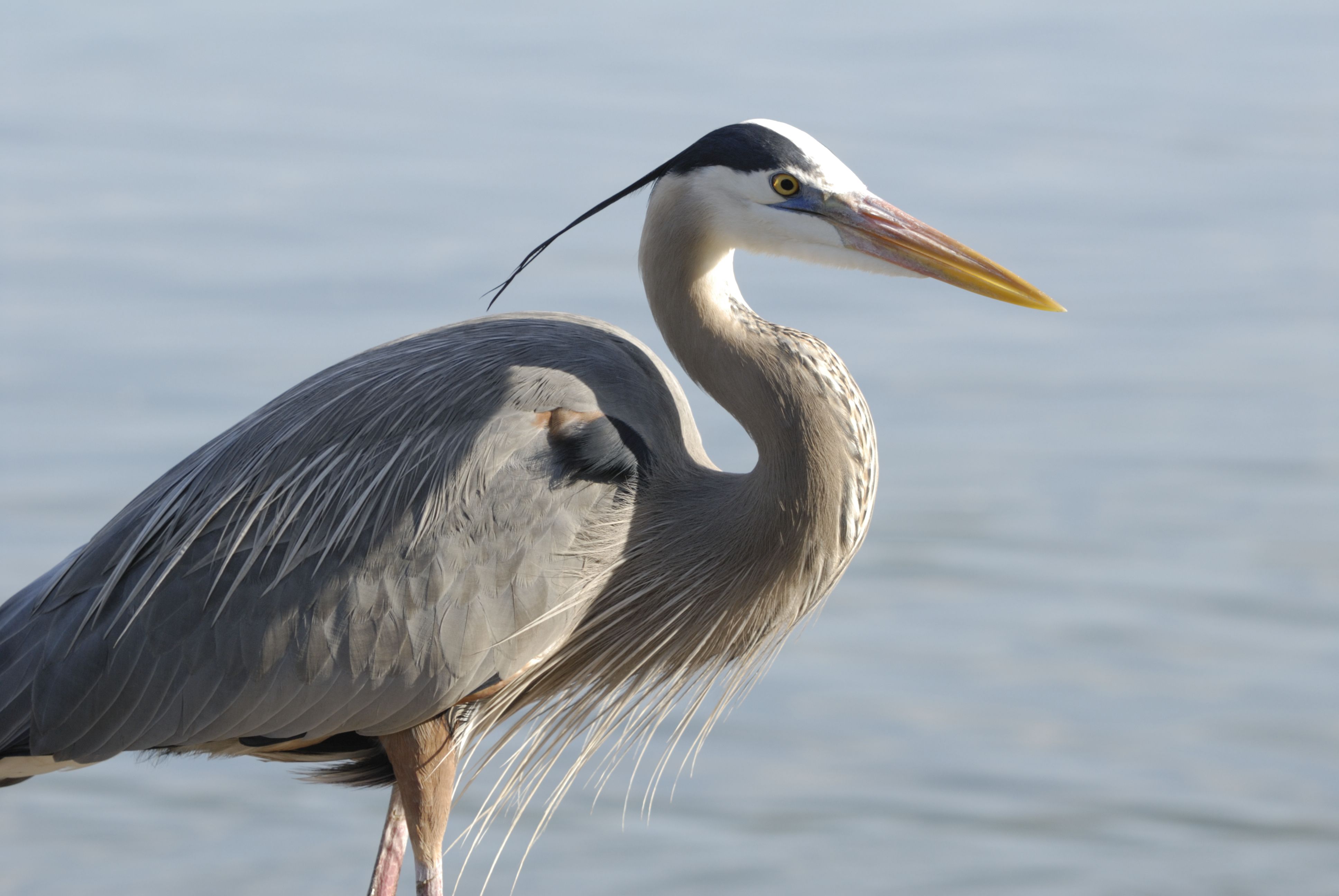
Great Blue Heron by Dan

Great Blue Heron by Dan

Bible Birds – Heron’s Introduction

And the stork, the heron after her kind, and the lapwing, and the bat. (Leviticus 11:19)

Herons belong to the Family of Herons, Bitterns and Egrets called Ardeidae. There are 72 different types of Bitterns and Egrets, but most the species are the Herons. When the Bible says “after her kind” they are referring to that whole family of birds.

The herons are long-legged freshwater and coastal birds in the family Ardeidae, (some are called “egrets” or “bitterns” instead of “heron”). Within Ardeidae, all members of the genera Botaurus and Ixobrychus are referred to as “bitterns”, and Zigzag Heron or Zigzag Bittern. However, egrets are not a separate group from the herons, and tend to be named differently because they are mainly white and/or have decorative plumes. Although egrets have the same build as the larger herons, they tend to be smaller.

Although herons look like birds in some other families, such as the storks, ibises, spoonbills and cranes, they differ from these in flying with their necks retracted, not outstretched.

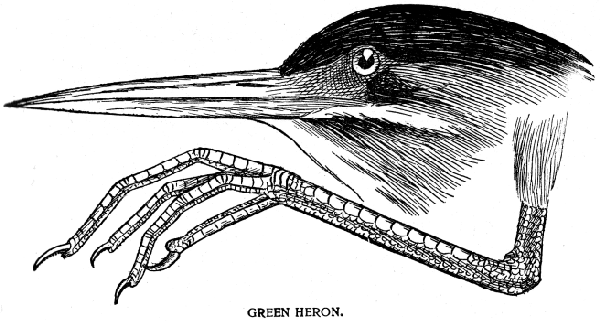
Green Heron - From Color Key

Green Heron – From Color Key

HERONS, EGRETS, AND BITTERNS. Ardeidæ.

Bill usually straight and sharply pointed; lores naked; head feathered; tarsus with transverse scales; middle toe-nail pectinate or with a comblike edge. (From Color Key to North American Birds, by Frank M. Chapman)

The herons are medium to large sized birds with long legs and necks. The smallest species is usually considered the Little Bittern, which can measure under 12 in (30 cm) in length, although all the species in the Ixobrychus genus are small and many broadly overlap in size. The largest species of heron is the Goliath Heron, which stand up to 60 in (152 cm) tall. The necks are able to kink in an s-shape, due to the modified shape of the sixth vertebrae. The neck is able to retract and extend, and is retracted during flight, unlike most other long-necked birds. The neck is longer in the day herons than the night herons and bitterns. The legs are long and strong and in almost every species are unfeathered. In flight the legs and feet are held backward. The feet of herons have long thin toes, with three forward pointing ones and one going backward.

Tricolored Heron Immature Lake Morton 8-3-12

Tricolored Heron Immature Lake Morton 8-3-12

The bill is generally long and harpoon like. It can vary from extremely fine, as in the Agami Heron, to thick as in the Grey Heron. The most atypical bill is owned by the Boat-billed Heron

Boat-billed Heron (Cochlearius cochlearius) Lowry Park Zoo 9-15-12

Boat-billed Heron (Cochlearius cochlearius) Lowry Park Zoo 9-15-12

which has a broad thick bill. The bill, as well as other bare parts of the body, is usually yellow, black or brown coloured, although this colour can vary during the breeding season. The wings are broad and long, with 10-11 primaries primaries feathers (the Boat-billed Heron has only nine), 15-20 secondaries and 12 rectrices (10 in the bitterns). The feathers of the herons are soft and the plumage is usually blue, black, brown, grey or white, and can often be strikingly complex.

the stork, the heron of any kind; the hoopoe and the bat. (Deuteronomy 14:18 ESV)

The Herons listed in Leviticus 11 and Deuteronomy 14 were on a list of birds that were not to be eaten.
*

More Bible Birds

Bible Birds – Herons

Wordless Birds
*

Nuggets Plus – Bleeding Mom Pelican..

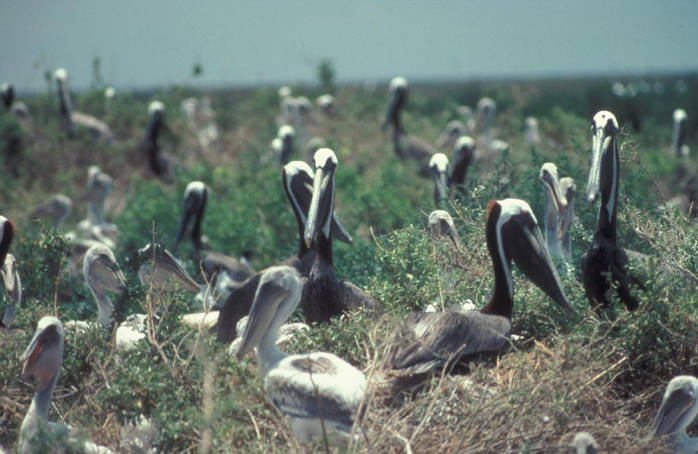
Brown Pelican (Pelecanus occidentalis) rookery ©USFWS

Brown Pelican (Pelecanus occidentalis) rookery ©USFWS

Bleeding Mom Pelican.. ~ by a j mithra

The Mom pelican
regurgitates food for her babies,
and in doing so,

Nuggets Plus

Nuggets Plus

blood from the macerated fish
spots her snowy white breast –
hence giving the impression
of piercing her own chest
to let blood as food for her young…
Do you know that our Lord Jesus
doesn’t give us regurgitated food.
But, let Him to be pierced
on the cross and shed His blood..
to give Himself as the Living bread…

“I am the living bread which came down from heaven: if any man eat of this bread, he shall live for ever: and the bread that I will give is my flesh, which I will give for the life of the world.” John 6:51

Yours in YESHUA,

a j mithra

Please visit us at:

Crosstree

ajmithra21

See More Nuggets Plus

*

Birds of the Bible – Descending Like A Dove

When I have my devotions, I sit in a chair by the window that faces the bird feeders. So while reading, I notice the birds busily getting their daily quota of my seed. I have been reading currently through the Gospels and keep coming upon when Jesus was baptized and the “Spirit of God descended like a dove?” That phrase is in all four Gospels; Matthew 3:16; Mark 1:10, Luke 3:22 and in John 1:32.

I have 3 or 4 Mourning Doves and a group of 9-11 Eurasian Collared Doves that come to eat quite frequently at about the time I am reading. So I have been noticing them more lately. They sort of flutter down to the feeders. The Red-winged Blackbirds and the Boat-tailed Grackles seem to sail in and then put on their brakes to land. The few House Sparrows don’t seem to flutter like the Doves either.

When He had been baptized, Jesus came up immediately from the water; and behold, the heavens were opened to Him, and He saw the Spirit of God descending like a dove and alighting upon Him. (Matthew 3:16 NKJV)

Barnes says – “The Spirit of God – See Mat_3:11. This was the third person of the Trinity, descending upon him in the form of a dove, Luk_3:22. The dove, among the Jews, was the symbol of purity of heart, harmlessness, and gentleness, Mat_10:16; compare Psa_55:6-7. The form chosen here was doubtless an emblem of the innocence, meekness, and tenderness of the Saviour. The gift of the Holy Spirit, in this manner, was the public approbation of Jesus Joh_1:33, and a sign of his being set apart to the office of the Messiah. We are not to suppose that there was any change done in the moral character of Jesus, but only that he was publicly set apart to his work, and solemnly approved by God in the office to which he was appointed.”

Pulpit Commentary – “The dove-Spirit on Christ. “Descending like a dove, and lighting upon him.” Comparing the accounts given by the evangelists, it still remains uncertain whether what was seen by John actually had the form of a dove, or hovered or brooded as a descending bird does. But for our fixed associations, and the familiar comments, we should be more willing to see that the brooding, resting, abiding of the Spirit on Jesus, is the thing intended to be set prominently before us by the figure. It will be safer, perhaps, to fix attention on both the explanations.”

Doves in Israel

Doves in Israel ©©

And immediately, coming up from the water, He saw the heavens parting and the Spirit descending upon Him like a dove. (Mark 1:10 NKJV)

Matthew Henry – “(2.) He saw the Spirit like a dove descending upon him. Note, Then we may see heaven opened to us, when we perceive the Spirit descending and working upon us. God’s good work in us is the surest evidence of his good will towards us, and his preparations for us. Justin Martyr says, that when Christ was baptized, a fire was kindled in Jordan: and it is an ancient tradition, that a great light shone round the place; for the Spirit brings both light and heat.”

Bible Knowledge Comm. – “Second, He saw the Spirit descending on Him like a dove, in a visible dovelike form, not in a dovelike way (cf. Luk_3:22). The dove imagery probably symbolized the Spirit’s creative activity (cf. Gen_1:2). In Old Testament times the Spirit came on certain people to empower them for service (e.g., Exo_31:3; Jdg_3:10; Jdg_11:29; 1Sa_19:20, 1Sa_19:23). The coming of the Spirit on Jesus empowered Him for His messianic mission (cf. Act_10:38) and the task of baptizing others with the Spirit, as John predicted (Mar_1:8).”

J Vernon McGee – “Mark 1:10-11 – Here we see the Trinity brought together in a very definite way. We see the Lord Jesus, the second Person of the Godhead; the Spirit of God who descends like a dove upon Him—the Spirit is the third Person of the Godhead; and the voice from heaven saying, “Thou art my beloved Son” is that of the Father, the first Person of the Godhead. So the Trinity is brought to our attention. And this, by the way, is heaven’s seal upon the Person and dedication of Jesus.   You will notice that things are happening very fast here. He is the Servant. John the Baptist is the one who introduces Him, and then God the Father identifies Him and puts His seal upon Him. Next the temptation will initiate Him.”

Mourning Dove (Zenaida macroura) by Quy Tran

Mourning Dove (Zenaida macroura) by Quy Tran

And the Holy Spirit descended in bodily form like a dove upon Him, and a voice came from heaven which said, “You are My beloved Son; in You I am well pleased.” (Luke 3:22 NKJV)

Life Application Study Bible – “Luke 3:21-22 – Theologians have long been troubled by Jesus’ allowing himself to be baptized by John. After all, this baptism was for sinners. Why, then, did Jesus do it? He did it because he is both God and human—he underwent baptism and even death as only a human could; he lived a sinless life and rose from the dead as only God could. This baptism by John in the Jordan River was another step in his identification with us sinful people; and the arrival of the dove signifies God’s approval. Now Jesus would officially begin his ministry as God’s beloved Son walking the dusty roads of Israel. When you are hurting, depressed, broken, remember: You have a Savior who understands your humanity. When you sin, remember: He has paid the price for your disobedience.

This is one of several places in Scripture where all the members of the Trinity are mentioned—Father, Son, and Holy Spirit. In the traditional words of the church, the one God exists in three persons but one substance, coeternal and coequal. No explanation can adequately portray the power and intricacy of this unique relationship. There are no perfect analogies in nature because there is no other relationship like the Trinity.

Gill – “like a dove upon him; either in the form of a dove, or this corporeal form, whatever it was, descended and hovered on him as a dove does:”

I did not know Him; but that He should be revealed to Israel, therefore I came baptizing with water.” And John bore witness, saying, “I saw the Spirit descending from heaven like a dove, and He remained upon Him. I did not know Him, but He who sent me to baptize with water said to me, ‘Upon whom you see the Spirit descending, and remaining on Him, this is He who baptizes with the Holy Spirit.’ And I have seen and testified that this is the Son of God.” (John 1:31-34 NKJV)

Ironside – “Then John says, “This is he of whom I said, After me cometh a man which is preferred before me: for he was before me. And I knew him not” (vv. 30-31a). Evidently he had been out in company where Jesus was, but he did not understand that this was the Messiah until now. He “knew him not: but that he should be made manifest to Israel, therefore am I come baptizing with water. And John bare record, saying, I saw the Spirit descending from heaven like a dove”-you see this event takes place after the baptism, which is not referred to here, but is mentioned in other Gospels-”I saw the Spirit descending from heaven like a dove, and it abode upon him. And I knew him not: but he that sent me to baptize with water, the same said unto me, Upon whom thou shalt see the Spirit descending, and remaining upon him, the same is he which baptizeth with the Holy Ghost” (vv. 31-33). The great work that John was sent to do was nearing an end. Now here is the climax: “I saw and bare record that this is the Son of God.” Did John really know that? Yes, he did-“I saw, and bare record that this is the Son of God” (v. 34). Do you know that, dear friend? Have you trusted Him for yourself? Oh, if you have never trusted Him before, won’t you come to God, owning your sin? “Behold the Lamb of God, which taketh away the sin of the world.”

*** From the above remarks from the different commentaries and the four verses, it seems that the Dove descending on Christ and resting there is for several reason. John the Baptist had been told to look for that sign so that he would know who the Messiah was. Also, the verse help reveal the work of the Trinity, especially the Holy Spirit (our Dove). And most important of all, those verse point to Our Savior or “the Lamb of God, which taketh away the sin of the world.” I trust you know Him as your personal Savior.

The next time I watch a Dove landing, I am sure what I have just gleaned from these writers and my reading of the Bible will bring to mind Jesus’ baptism and the how the Holy Spirit descended like a Dove and God speaking from heaven, confirming that He is the Son of God.

Quotes are from my e-Sword program.

See ~ Birds of the Bible – Doves

Sharing The Gospel

*

Video by  CherokeePhoenix

*

I know these are not Doves, but Gulls, but they remind me of the Dove’s landings at my feeders.

*

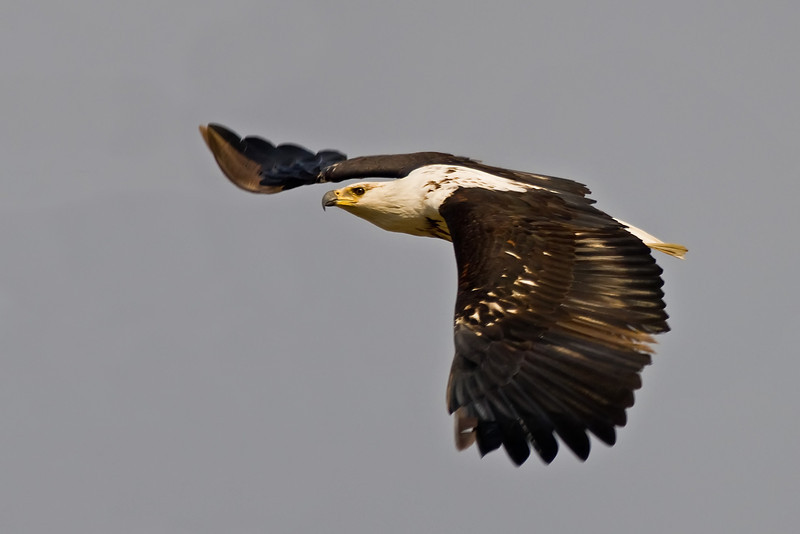
Ms. Theresa’s Thoughts – Eagles’ Wings

African Fish Eagle (Haliaeetus vocifer) by Africaddict

Ms. Theresa’s Thoughts – Eagles’ Wings

You have seen what I did to the Egyptians, and how I bore you on eagles’ wings and brought you to Myself. (Exodus 19:4 NKJV)

How sweet and loving is God that takes such good care of not only the birds but us as well. But the only way we are brought to God is accepting Him as our Lord and Savior.

*

Wordless Birds

*

Ms. Theresa’s Thoughts – Nests

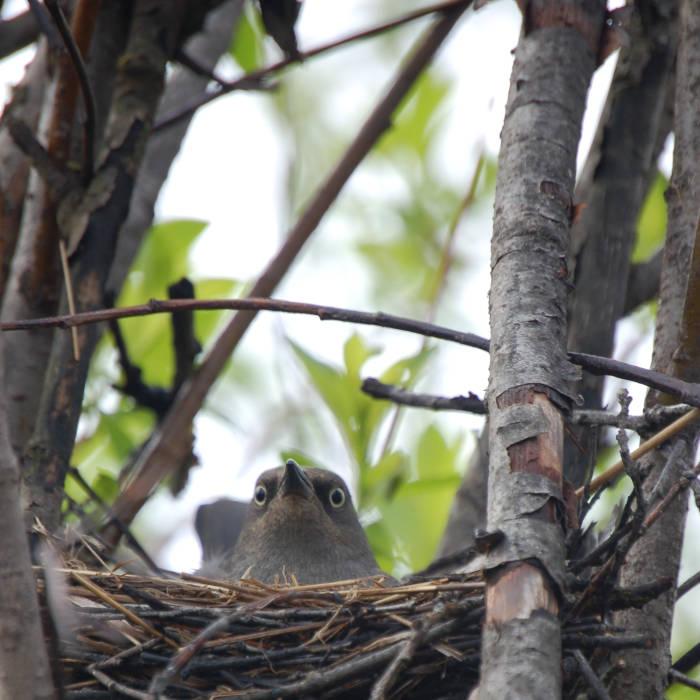
Rusty Blackbird (Euphagus carolinus) on nest ©USFWS

Rusty Blackbird (Euphagus carolinus) on nest ©USFWS

Ms. Theresa’s Thoughts – Nests

Where the birds make their nests; The stork has her home in the fir trees. (Psalms 104:17 NKJV)

How unique the wisdom God gave the birds to make their nests out of small twigs and such sort of reminds me of the Three Little Pigs Fable.

One of them built out of wood, one built out of straw and the wise one built out of bricks. Only the bricks withstood the Big Bad Wolf.

As the bird’s nest withstands all kinds of fowl (bad) weather (no pun intended), her nest stays there till her young are raised and ready to go on their own.

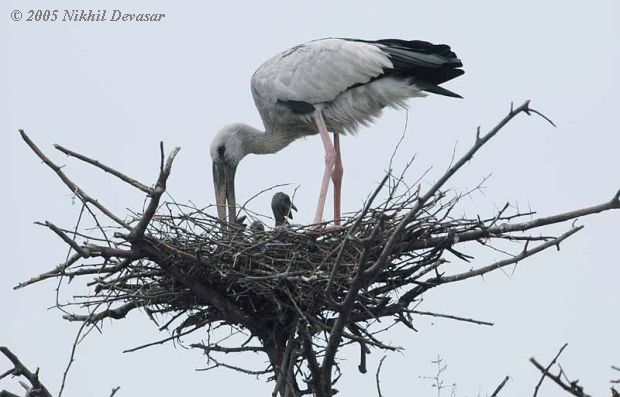
Asian Openbill (Anastomus oscitans) on nest by Nikhil Devasar

Asian Openbill (Anastomus oscitans) on nest by Nikhil Devasar

*

Wordless Birds

*

Bible Birds – Ravens I

Australian Raven (Corvus coronoides) by Ian

Australian Raven (Corvus coronoides) by Ian

And it came to pass at the end of forty days, that Noah opened the window of the ark which he had made: And he sent forth a raven, which went forth to and fro, until the waters were dried up from off the earth.
(Genesis 8:6-7 KJV)

Did you know that is the first bird in the Bible that we are told its name. In Genesis 1 and 2 we are told that the LORD created the birds or fowls, but we don’t know what their names were. Adam gave them names in Genesis 1, but their names are not mentioned.

Ravens are in 11 verses in the Bible (KJV). We will be telling you about them.

The Raven is the largest bird in the Passerine order (Perching and songbirds), able to grow up to 27.1 inches (69 cm) in length. Males are not much different from the females, though the female might be a bit smaller. Both genders are known for their iridescent (shiny)  black feathers covering their bodies, with a bluish hint in the light. Ravens are distinguished from other birds in the Corvus Genus (such as the crows) by their wedge-like tail, large beak, hackles (shaggy neck feathers), and their tendency to soar in flight.

Northern Raven (Corvus corax) ©CreationWikiC

Northern Raven (Corvus corax) ©CreationWikiC

Did you know that the Ravens fed a prophet? God told them to feed him and they obeyed. I Kings 17 tells us about it. We tell you about it in another article.

How about Ravens not building barns? Luke 12:24

The Lord used the Ravens to do errands for Him. Do you do the errands your parents ask you to do?

Children, obey your parents in all things, for this is well pleasing to the Lord. (Colossians 3:20 NKJV)

See:

Bible Birds – Raven

Bible Birds

Ravens – CreationWiki

*

Birds of the Bible – Water-hen or Water hen

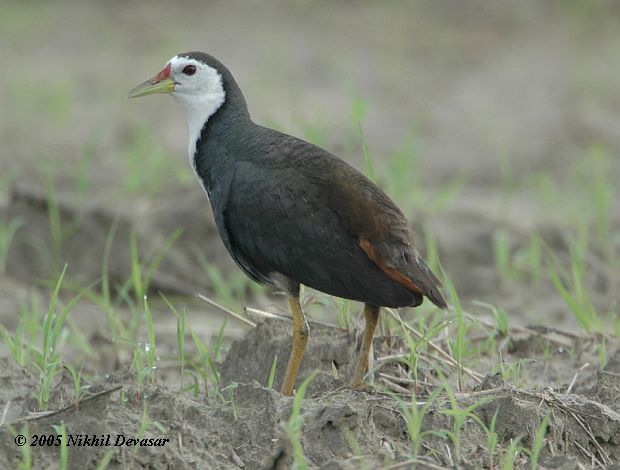
White-breasted Waterhen (Amaurornis phoenicurus) by Nikhil Devasar

White-breasted Waterhen (Amaurornis phoenicurus) by Nikhil Devasar

Leviticus 11:18
(BBE) And the water-hen and the pelican and the vulture;
(ERV) water hens, pelicans, carrion vultures,
(ISV) water-hen, pelican, carrion,
(MSG)  water hen, pelican, Egyptian vulture,
(NRSV) the water hen, the desert owl, the carrion vulture,

(ABP+) and the purple-legged stork, and pelican, and swan
CAB(i) 18 and the red-bill, and the pelican, and swan,
(Brenton) and the red-bill, and the pelican, and swan,
(Bishops) The Backe, the Pellicane, the Pye,

(Geneva) Also the redshanke and the pelicane, and the swanne:
(Vulgate) si ambulans per viam in arbore vel in terra nidum avis inveneris et matrem pullis vel ovis desuper incubantem non tenebis eam cum filiis
(KJV) And the swan, and the pelican, and the gier eagle,
Deuteronomy 14:16
(BBE) The little owl and the great owl and the water-hen;

(Bishops) The litle Owle, the great Owle, nor the Redshanke.
(Geneva) Neither the litle owle, nor the great owle, nor the redshanke,
(KJV)  The little owl, and the great owl,  and the swan,
(Vulgate) herodium et cycnum et ibin

Adam Clarke’s Commentary: “The swan – תנשמת tinshemeth. The Septuagint translate the word by πορφυριωνα, the porphyrion, purple or scarlet bird. Could we depend on this translation, we might suppose the flamingo or some such bird to be intended. Some suppose the goose to be meant, but this is by no means likely, as it cannot be classed either among ravenous or unclean fowls. Bochart thinks the owl is meant.”

Companion Bible Notes: “swan, not our swan: it is variously rendered “ibis”, “heron”, and “pelican”.

Gill: “Leviticus 11:18
And the swan,…. This is a bird well known to us, but it is a question whether it is intended by the word here used; for though it is so rendered in the Vulgate Latin, it is differently rendered by many others: the Targums of Jonathan and Jerusalem call it “otia”, which seems to be the same with the “otus” of Aristotle (n), who says it is like an owl, having a tuft of feathers about its ears (from whence it has its name); and some call it “nycticorax”, or the owl; and here, by Bochart (o), and others, the owl called “noctua” is thought to be meant; and with which agrees the account some Jewish writers give of it, as Aben Ezra and Baal Hatturim, who say it is a bird, which every one that sees is astonished at it, as other birds are at the owl, are frightened at the sight of it, and stupefied. But as the same word is used Lev_11:30 among the creeping things, for a mole, what Jarchi observes is worthy of consideration, that this is “calve (chauve) souris” (the French word for a bat), and is like unto a mouse, and flies in the night; and that which is spoken of among the creeping things is like unto it, which hath no eyes, and they call it “talpa”, a mole. The Septuagint version renders it by “porphyrion”, the redshank; and so Ainsworth; and is thought to be called by the Hebrew name in the text, from the blowing of its breath in drinking; for it drinks biting, as Aristotle says (p):”

Jamieson Fausset Brown: the swan — found in great numbers in all the countries of the Levant. It frequents marshy places – the vicinity of rivers and lakes. It was held sacred by the Egyptians, and kept tame within the precincts of heathen temples. It was probably on this account chiefly that its use as food was prohibited. Michaelis considers it the goose.
McGee:
Leviticus 11:13-19

CLEAN AND UNCLEAN FLYING CREATURES (IN THE AIR)
On the birds there are no visible markers like there are on the fish and the animals. But they seem to have in common that they are all unclean feeders. For the most part, they feed on dead carcasses of animals, fish, and other fowl.

A list of unclean birds of Palestine is given. This is another point that reveals that the Mosaic system was intended for the nation Israel and also for the particular land of Palestine. Some of these birds sound strange to us. They fall into the family of the eagles and the hawks, the vultures and the ravens, the owls and cormorants, and the swans and pelicans. They don’t even sound appetizing. They are the “dirty birdies” because of their feeding habits. Now remember, some people eat some of these birds today. I can’t say I would like any of them, but whether we eat them or don’t eat them makes no difference—meat will not commend us to God. The point is that it was teaching Israel to make a distinction. They had to make a decision about what was clean and unclean.

The lesson for us today is that we must make decisions about our conduct and our profession. We have to make the decision about whether to accept Christ or not, whether to study the Word of God or not, whether to walk in a way pleasing to God or not. That is the application for us today.

This section throws some light on the experience of Elijah. He was fed by the ravens—dirty birds. Elijah did not eat the ravens, but they fed him. This was a humbling experience for this man of God who obeyed God in every detail.

MHCC:
Leviticus 11:1-47

These laws seem to have been intended, 1. As a test of the people’s obedience, as Adam was forbidden to eat of the tree of knowledge; and to teach them self-denial, and the government of their appetites. 2. To keep the Israelites distinct from other nations. Many also of these forbidden animals were objects of superstition and idolatry to the heathen. 3. The people were taught to make distinctions between the holy and unholy in their companions and intimate connexions. 4. The law forbad, not only the eating of the unclean beasts, but the touching of them. Those who would be kept from any sin, must be careful to avoid all temptations to it, or coming near it. The exceptions are very minute, and all were designed to call forth constant care and exactness in their obedience; and to teach us to obey. Whilst we enjoy our Christian liberty, and are free from such burdensome observances, we must be careful not to abuse our liberty. For the Lord hath redeemed and called his people, that they may be holy, even as he is holy. We must come out, and be separate from the world; we must leave the company of the ungodly, and all needless connexions with those who are dead in sin; we must be zealous of good works devoted followers of God, and companions of his people.

***

Well, those are some of the remarks by the different commentaries. It seems there is no real set answer as to whether the Waterhen or Water-hen was the intended bird. The list of Unclean and Clean birds was for the Israelites and not us today. It is not even for them today. Why write about them, because it is interesting. To me, it comes down to a decision on their part and ours today whether we want to obey the Word of God.

….for the LORD your God is testing you to know whether you love the LORD your God with all your heart and with all your soul. You shall walk after the LORD your God and fear Him, and keep His commandments and obey His voice; you shall serve Him and hold fast to Him. (Deuteronomy 13:3-4 NKJV)

Most of the birds seem to have a diet that would cause eating that bird to make people sick or to die. Not all of them are in that category. It could be that they were not to eat a specific bird because they were few in number at that time and it could have caused them to go extinct. (That happens today.) It comes to obedience. That said, let’s see what a Water Hen really is.

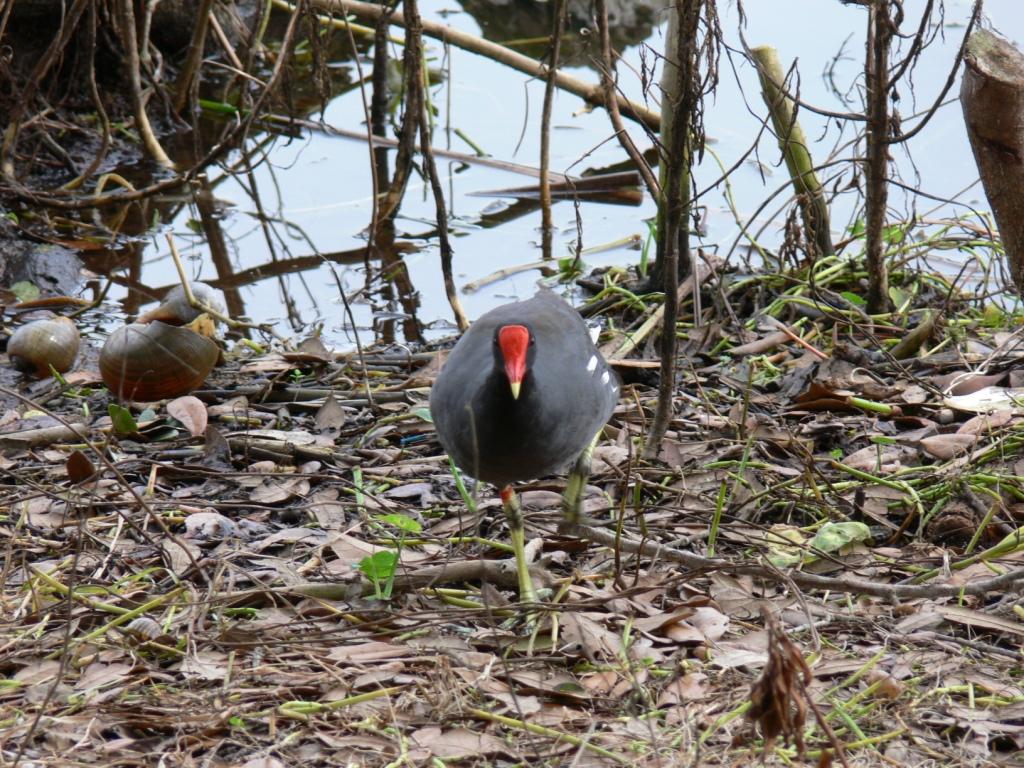
Common Moorhen (Gallinula chloropus) by Lee

Common Moorhen (Gallinula chloropus) by Lee

Water-hen or Waterhens are in the Rallidae – Rails, Crakes & Coots Family. According to Wikipedia’s article on the Waterhen:

Waterhen may refer to any of the following:

Black Crake (Amaurornis flavirostra) ©WikiC

Black Crake (Amaurornis flavirostra) ©WikiC

The adult Black Crake is 19–23 cm long with a short tail and long toes. As its name implies, the adult has mainly black plumage, with a brown olive tone on the wings and upperparts which is rarely detectable in the field. The eye is red, the bill is yellow, and the legs and feet are red, duller when not breeding.

The sexes are similar, but the male is slightly larger. Most males, but only 10% of females, have a hooked upper mandible. The immature bird has brown upperparts and a dark grey head and underparts. Its bill is greenish yellow, and its feet and legs are dull red. The downy chicks are black, as with all rails.

The Black Crake is extremely aggressive when breeding and will attack birds of many species, but especially other rails. It will attack and kill rails of species as large as itself.

The nest is a deep neat bowl made from wetland plants and built by both sexes in marsh vegetation or on the ground in a dry location. The nest is also sometimes constructed up to 3 m high in a bush.

If it was a Redshank(e), then we have a completely different bird in a different family, the Scolopacidae – Sandpipers, Snipes. If so, that would mean I would have to make yet another “Bird of the Bible” category. Humm!

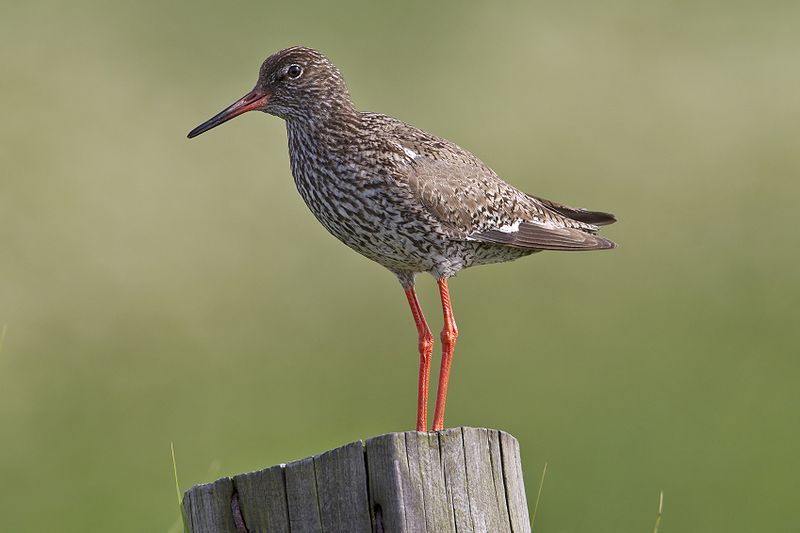
Common Redshank (Tringa totanus) ©WikiC

Common Redshank (Tringa totanus) ©WikiC

Of the three last bird pictures here, they do all have something red. The Moorhen has a red beak and the other two have red legs. You realize that these names are today’s name. They do change over the years. What ever bird this verse applies to, it has been enjoyable for me to investigate it. It has caused me to be in God’s Word, search the Commentaries, and check out the many birds the Lord created. And I trust you have benefited from it also and you might even dig around and find more about these verses.

And I get to add another Bird of the Bible page.

Birds of the Bible – Waterhen

All Birds of the Bible articles.

*

Bible Birds – Swan I

Bible Birds – Swan I

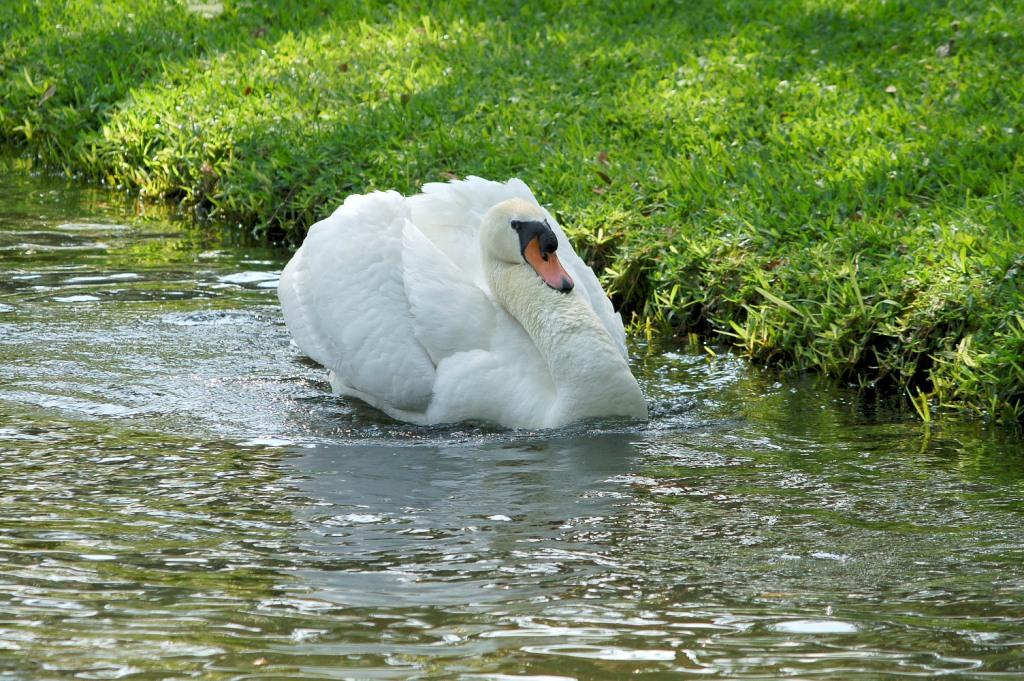
Mute Swan (Cygnus olor)II at Bok Tower By Dan'sPix

Mute Swan (Cygnus olor)II at Bok Tower By Dan’sPix

Swans are birds of the family Anatidae, which also includes geese and ducks. Swans usually mate for life. The number of eggs in each clutch ranges from three to eight.In North America we have at least four swans: Mute (60”), Trumpeter (60”), Tundra (52”), and Whooper (60”). There is also a Black Swan of Australia and a Black-necked Swan in South America. Swans are large, long-necked waterbirds that have a short duck-like bill and short legs. Many are seen on ponds, lakes, reservoirs and coastal bays. The Mute Swans are semi-domesticated. The Tundra Swan is sometime split into two species, Bewick’s and Whistling Swans.

Mute Swan (Cygnus olor) at Bok Sanctuary By Dan’sPix

The Swan is listed in Leviticus and Deuteronomy in the list of “unclean” birds.

And the swan, and the pelican, and the gier-eagle, (Leviticus 11:18 KJV)
The little owl, and the great owl, and the swan, (Deuteronomy 14:16 KJV)

Swans at BokTower

Swans at Bok Tower by Dan

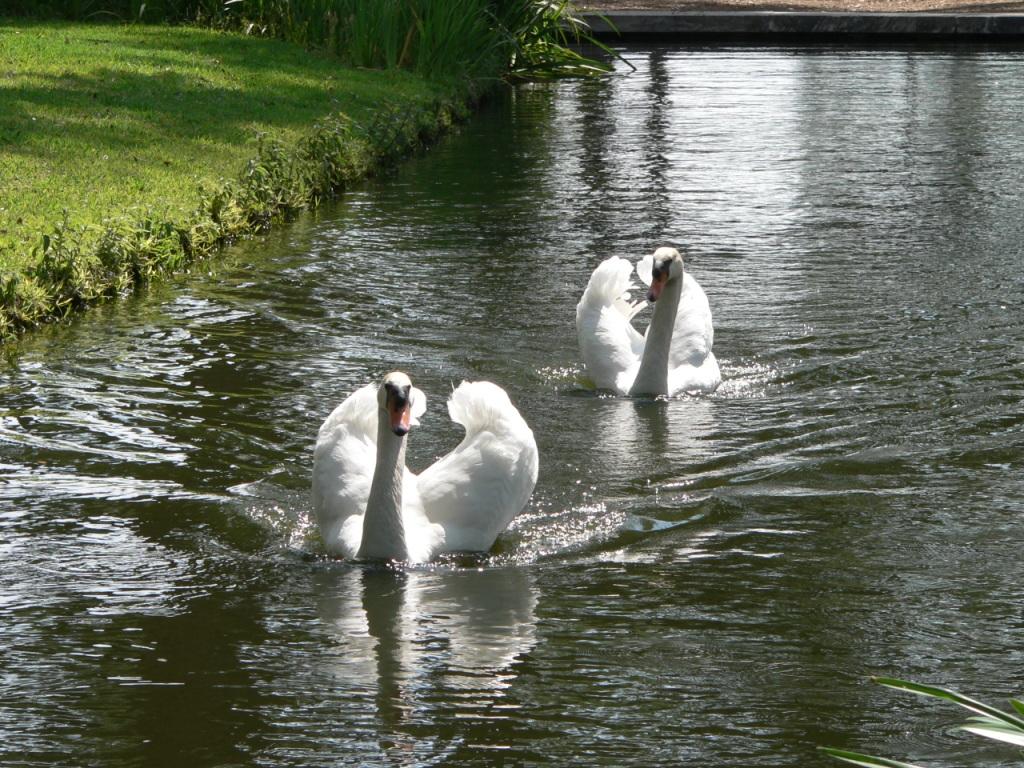
Mute Swan pictures (click on for larger view) taken at Bok Sanctuary in Lake Wales. They were irritated because the worker was mowing the grass beside the water and they kept following him back and forth. They had their wings arched back in frustration, but we thought they were beautiful like what I think “angel’s wings” might look like.

*

More about the Swans:

Bible Birds – Swans

Birds of the Bible – Swans

*