Birds in Christmas Hymns – Mini Series – Re-post

(This is the series posted last year and will be re-posting them again this year along with regular articles.)

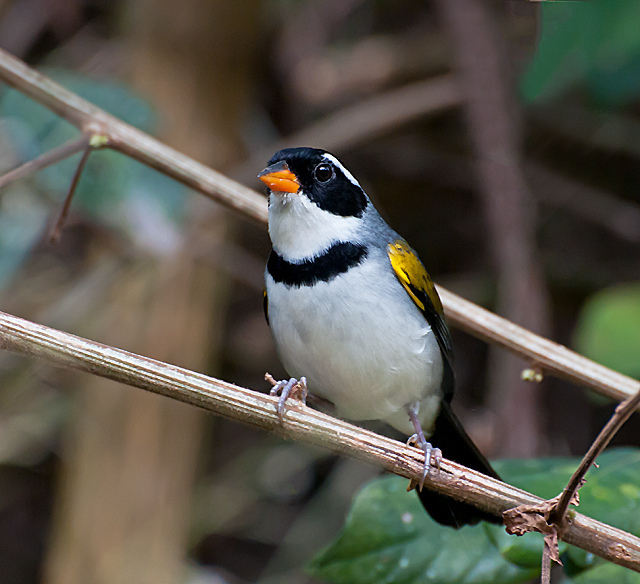
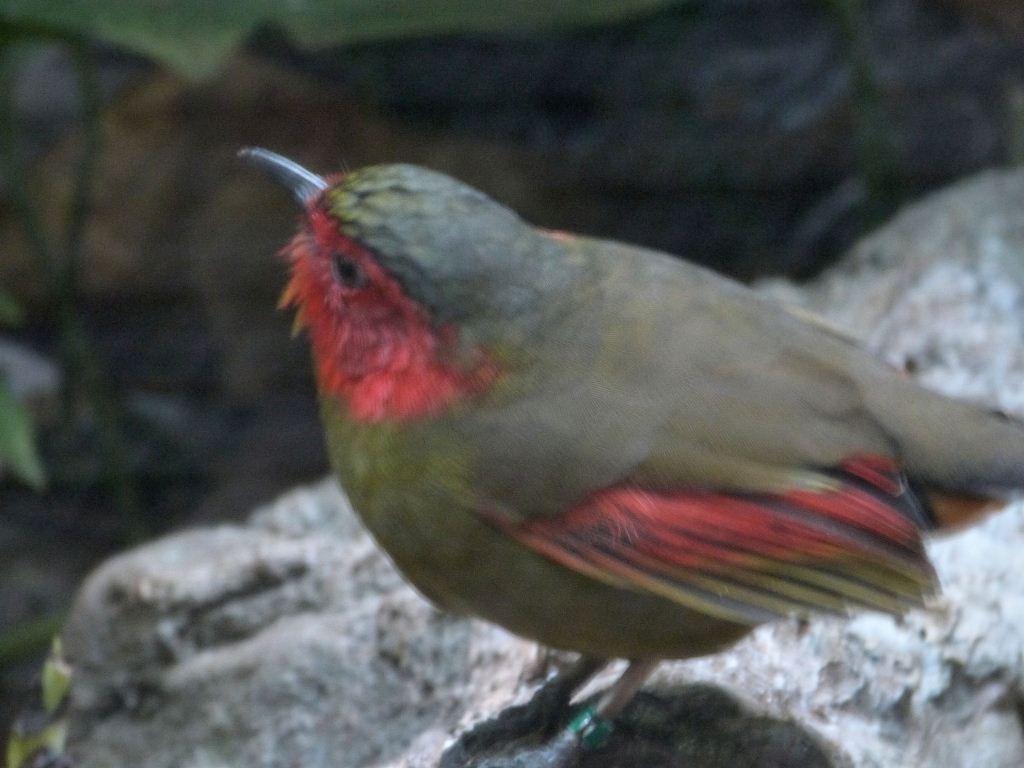
Blue-naped Chlorophonia (Chlorophonia cyanea) by Dario Sanches

Blue-naped Chlorophonia (Chlorophonia cyanea) by Dario Sanches

And she brought forth her firstborn son, and wrapped him in swaddling clothes, and laid him in a manger; because there was no room for them in the inn. And there were in the same country shepherds abiding in the field, keeping watch over their flock by night. And, lo, the angel of the Lord came upon them, and the glory of the Lord shone round about them: and they were sore afraid. And the angel said unto them, Fear not: for, behold, I bring you good tidings of great joy, which shall be to all people. For unto you is born this day in the city of David a Saviour, which is Christ the Lord. (Luke 2:7-11 KJV)

Tomorrow, December 15th, a new mini series will begin. From the 15th until Christmas Day, a different Birds in Christmas Hymns will be posted daily. All of these are in the public domain, so they will be some of the older hymns. (There will be other articles added also.)

It is amazing how many times when you are singing that “birds” appear in songs and hymns. These all relate to the birth of Jesus and the nativity. As Christians, this is one of our greatest holidays, with only Easter and the resurrection of our Savior as the Greatest. Without the virgin born birth of the Lord Jesus as the Christ Child, we wouldn’t have a sinless Savior to die and shed His blood for our salvation at Calvary.

May you enjoy this upcoming season and this little mini series. Below is the video of our pastor telling about the birds at Christmas time. This was from our Christmas Cantata a few years ago.

See:

Sharing the Gospel

Wordless Birds

Birds in Hymns

Merry Christmas 2009

*

Update on Version 3.2 and Eye

Image

Sumatran Laughingthrush by Lee at Zoo Miami

“Look at the birds of the air, that they do not sow, nor reap nor gather into barns, and yet your heavenly Father feeds them. Are you not worth much more than they? (Matthew 6:26 NASB)

I am still working a little behind the scenes on the IOC Version 3.2 update. My eye surgery has slowed me down somewhat. With the new families that were added (see Updating to IOC Version 3.2 Underway ) I am making quite a few changes. Because of those families, I am working backwards to make room for the new pages.

Also, my eye surgery went well for a week, then when I got up from a nap last Thursday, my vision was blurred. After two visits to the Doctor, they say all is well, that something floated across inside. So far it is still there a week later. Right now, my vision is less than before the surgery. So, I have not been writing as many articles as normal. Continue to keep my in your prayers. They have definitely been felt.

Red-tailed Laughingthrush (Trochalopteron milnei) and Black-throated in forefront by Lee

Red-tailed Laughingthrush (Trochalopteron milnei) and Black-throated in forefront by Lee

While working on the Leiothrichidae – Laughingthrushes Family, I was enjoying remembering our visit to Zoo Miami this year. Those Laughingthrushes are sort of fun to watch. They hop around instead of walking. We were able to see the Sumatran (Black and White), Black-throated and the Red-tailed Laughingthrushes. I call the Sumatran “Joe Cool.”  We have also seen the Red-faced Liocichla at the Riverbanks Zoo SC and the Red-billed Leiothrix (Leiothrix lutea) by Dan at National Aviary PA

Here are the Families Updated to IOC 3.2 Version from Laughingthrush to Grosbeaks, Saltators & Allies:

  • Out of date – removed

See all the Birds of the World

*

Ian’s Bird of the Week – Powerful Owl

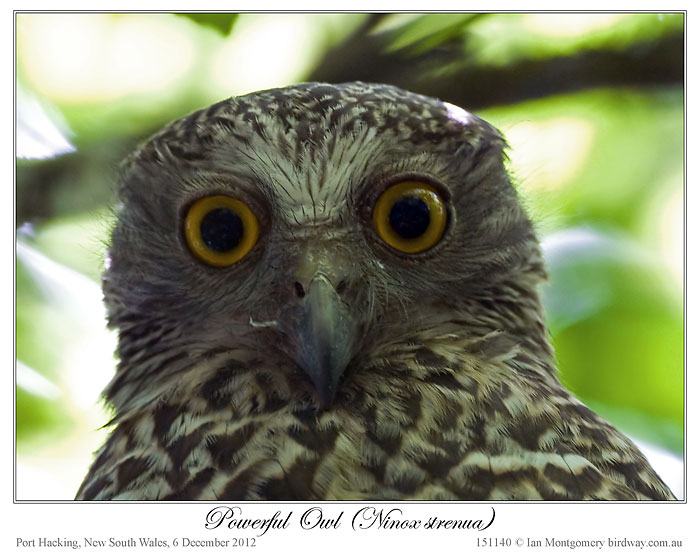
Powerful Owl (Ninox strenua) by Ian 1

Powerful Owl (Ninox strenua) by Ian 1

Ian’s Bird of the Week – Powerful Owl  ~ by Ian Montgomery

Newsletter – 12/9/2012

My apologies again for a tardy bird of the week, so here is something special. Well, special for me, anyway, as it has been a serious bogey bird for me. All addicted birders and bird photographers have their bogeys, in the sense of ‘an evil or mischievous spirit, a cause of annoyance or harassment’ usually a species that is invisible to the victim or hides whenever the victim is around.

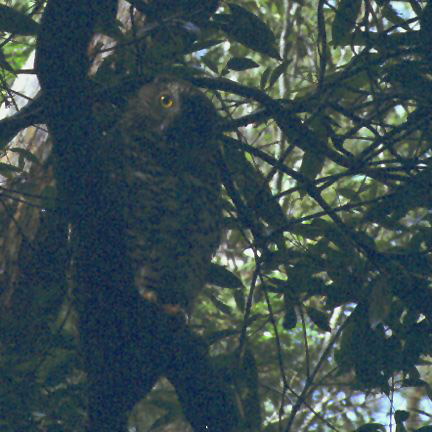
Powerful Owls first cast an evil spell on me on 11 February 1999 when one in Pennant Hills Park made my film camera malfunction so that the entire film was hopelessly underexposed – you can see the wicked gleam in its eye below. As soon as I picked up the film from the chemist the following day, I went back to Pennant Hills Park but the owl was no longer there or no longer visible.

Powerful Owl (Ninox strenua) by Ian 2

Powerful Owl (Ninox strenua) by Ian 2

Shortly after that I moved from Sydney and switched to digital photography (nowadays we take instant photographic feedback for granted). Since then, whenever I’ve visited Sydney I’ve looked for Powerful Owls in all their usual haunts – Pennant Hills Park, Mitchell Park, Beecroft, Warriewood, Royal Botanic Gardens, Royal National Park, etc. – without success.

Powerful Owl (Ninox strenua) by Ian 3

Powerful Owl (Ninox strenua) by Ian 3

Last Tuesday I gave a talk on parrots to Birding NSW in Sydney and inquired about POs. Yes, one had been seen in its favourite tree, the White Fig, near the entrance to Government House the previous Saturday. I went there on Wednesday and searched the tree for at least 20 minutes but the owl remained invisible until I decided to leave. Delighted with its success, it let its guard down, the spell weakened and I got the briefest visual sensation, like a shimmering mirage, of a barred tail. Powerful Owls are big 60-65cm/24-26in in length, it was then quite visible from the ground and not very high up, so a spell is the only explanation.

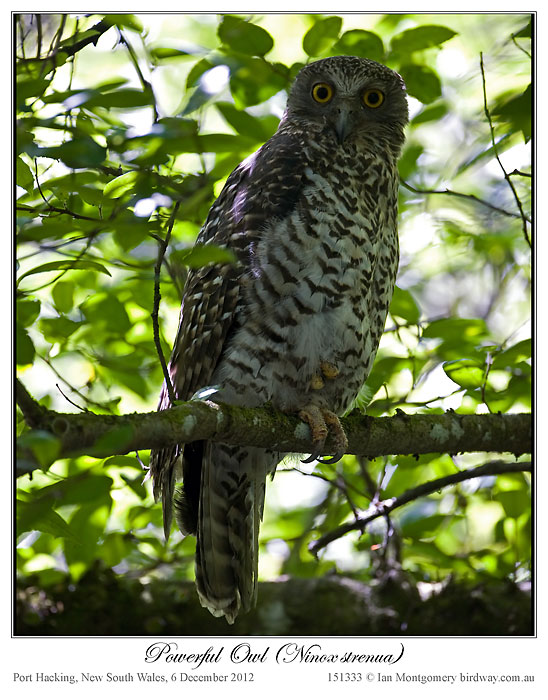
Powerful Owl (Ninox strenua) by Ian 4

Powerful Owl (Ninox strenua) by Ian 4

The next day, I went birding with Madeleine Murray and we abandoned plans to look for the owl (they’re quite visible to her) and went instead to Port Hacking, south of Sydney, where, lo and behold, we found another one, or to be more accurate Mad found it after I’d walked straight past it as the spell hadn’t entirely dissipated – it normally does so quite quickly after it has been broken once.

Powerful Owl (Ninox strenua) by Ian 5

Powerful Owl (Ninox strenua) by Ian 5

The Powerful Owl is the largest of the Hawk Owls (genus Ninox) and exceeded in size only by the world’s largest owls such as the Grey Grey and the larger Eagle Owls. It is found in eastern and southeastern Australia usually within 200km of the coast from central Queensland to eastern South Australia. It has large territories ranging in size from 3-15 square kilometres so it is nowhere common and is listed as Vulnerable. However, it seems to be quite tolerant of selective logging and can survive in patchy forests. It feeds mainly on arboreal mammals such as possums, but will also take flying foxes (fruit bats) and roosting birds.

Best wishes
Ian

**************************************************
Ian Montgomery, Birdway Pty Ltd,
454 Forestry Road, Bluewater, Qld 4818
Tel 0411 602 737 ian@birdway.com.au
Check the latest website updates:
http://www.birdway.com.au/#updates
**************************************************
Lee’s Addition:

Glad you sent us a Bird of the Week, Ian. I was starting to worry about you, that maybe you were sick or something. The wait was worth it because this is a beautiful Owl. I am glad you are no longer under this bird’s “evil spell on” you.

The Powerful Owl is part of the Strigidae – Owl Family. To see more photos of them, check out Ian’s photos and our Family page here:

Typical or Hawk Owls – Ian’s Birdway

Strigidae – Owl Family

*

Bible Birds – Eyes and Birds

Birds on Shore of Tampa Bay

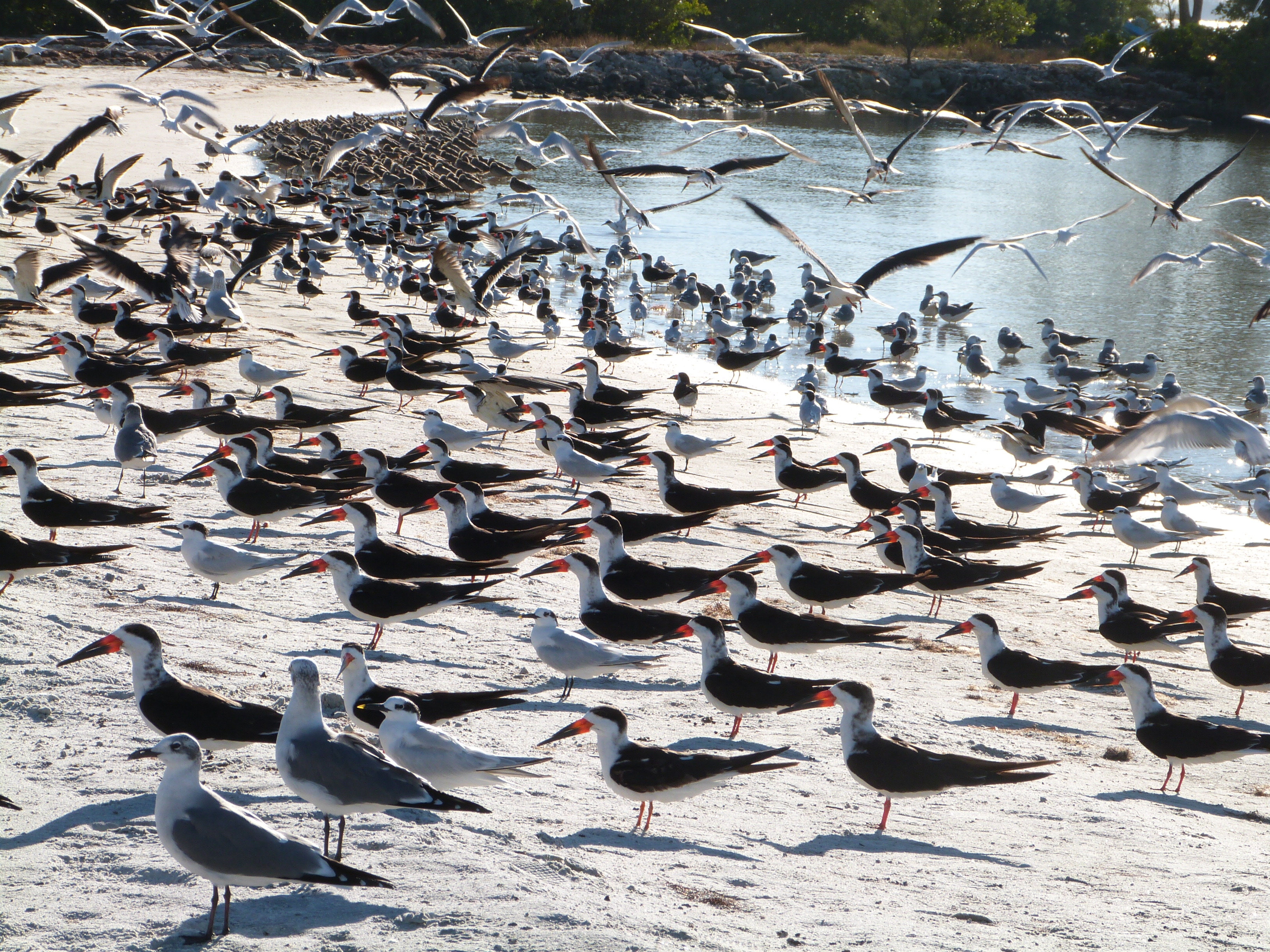
Birds on Shore of Tampa Bay – 11/23/12 by Lee

As many of you know I have just gone through eye surgery this last Thursday. (Prayer for Eye Surgery) Today, Monday, I am getting clearer vision daily, but my activities are still limited. I was able to attend church last evening and even went out afterwards with our friends. The Doctor said it was “his easiest surgery of the day and every thing went just like it should.” (I was his last patient) also told me I was his “best patient of the day.” When he walk out I told the nurses that were with me that he probably tell all his patients that. They told me that they had never heard him say that to anyone.

I told you all of that to thank you for your prayers for my Doctor and for my nervousness. Both were answered mightily. The Lord helped direct his hand and since I had to be awake, helped me stay still. They can’t put you out because you must have your eyes open. My eye was numbed, but I saw part of what was going on.

Well, guess where my mind went yesterday? I started wondering how many times “eye” and some “bird” showed up in the same verse. With enlarged type, my search found around 20 verses. Some of my upcoming Bible Bird blogs will investigate these verses. Have you ever searched your Bible to find out about a certain word or words? There are over 600 verses which have “Eye” in it. I enjoy using my “e-Sword” search and compare modes. Makes for some interesting topics to study from God’s Word.

In fact, some articles that have already been written on the main blog. (These are just a few of them)

Birds of the Bible – Vulture Eyesight – Job 28:7

When I Consider! – Turkey Vulture – Job 28:7

Birds of the Bible – Hawks – Job 28:7 and 39:26-30

Birds of the Bible – God’s Providence To His Creatures

The eyes of all wait upon thee; and thou givest them their meat in due season. (Psalms 145:15 KJV)

Birds of the Bible – Eagles and Riches 

Wilt thou set thine eyes upon that which is not? for riches certainly make themselves wings; they fly away as an eagle toward heaven. (Proverbs 23:5 KJV)

There are more and will be covered later.

Keep me as the apple of the eye, hide me under the shadow of thy wings, (Psalms 17:8 KJV)

Interesting verses, but not directly related to birds:

He that planted the ear, shall he not hear? he that formed the eye, shall he not see? (Psalms 94:9 KJV) (Our Creator)

The hearing ear, and the seeing eye, the LORD hath made even both of them. (Proverbs 20:12 KJV)

Open thou mine eyes, that I may behold wondrous things out of thy law. (Psalms 119:18 KJV)

I will instruct thee and teach thee in the way which thou shalt go: I will guide thee with mine eye. (Psalms 32:8 KJV) (How?)

Again, thank you for your prayers. I still have several weeks of recovery ahead of me, so please remember me in your prayers as you think about it. Prayer is felt when it is being answered.

*

Birds of the Bible – Eyes and Birds

Birds on Shore of Tampa Bay

Birds on Shore of Tampa Bay – 11/23/12 by Lee

As many of you know I have just gone through eye surgery this last Thursday. (Prayer for Eye Surgery) Today, Monday, I am getting clearer vision daily, but my activities are still limited. I was able to attend church last evening and even went out afterwards with our friends. The Doctor said it was “his easiest surgery of the day and every thing went just like it should.” (I was his last patient) also told me I was his “best patient of the day.” When he walk out I told the nurses that were with me that he probably tell all his patients that. They told me that they had never heard him say that to anyone.

I told you all of that to thank you for your prayers for my Doctor and for my nervousness. Both were answered mightily. The Lord helped direct his hand and since I had to be awake, helped me stay still. They can’t put you out because you must have your eyes open. My eye was numbed, but I saw part of what was going on.

Well, guess where my mind went yesterday? I started wondering how many times “eye” and some “bird” showed up in the same verse. With enlarged type, my search found around 20 verses. Some of my upcoming Birds of the Bible blogs will investigate these verses. In fact, some have already been written. (These are just a few of them)

Birds of the Bible – Vulture Eyesight – Job 28:7

When I Consider! – Turkey Vulture – Job 28:7

Birds of the Bible – Hawks – Job 28:7 and 39:26-30

Birds of the Bible – God’s Providence To His Creatures

The eyes of all wait upon thee; and thou givest them their meat in due season. (Psalms 145:15 KJV)

Birds of the Bible – Eagles and Riches 

Wilt thou set thine eyes upon that which is not? for riches certainly make themselves wings; they fly away as an eagle toward heaven. (Proverbs 23:5 KJV)

There are more and will be covered later.

Keep me as the apple of the eye, hide me under the shadow of thy wings, (Psalms 17:8 KJV)

Interesting verses, but not directly related to birds:

He that planted the ear, shall he not hear? he that formed the eye, shall he not see? (Psalms 94:9 KJV) (Our Creator)

The hearing ear, and the seeing eye, the LORD hath made even both of them. (Proverbs 20:12 KJV)

Open thou mine eyes, that I may behold wondrous things out of thy law. (Psalms 119:18 KJV)

I will instruct thee and teach thee in the way which thou shalt go: I will guide thee with mine eye. (Psalms 32:8 KJV) (How?)

This is just a sampling. There are over 600 verses which have “Eye” in it. I enjoy using my “e-Sword” search and compare modes. Makes for some interesting topics to study from God’s Word.

Again, thank you for your prayers. I still have several weeks of recovery ahead of me, so please remember me in your prayers as you think about it. Prayer is felt when it is being answered.

*

Prayer for Eye Surgery

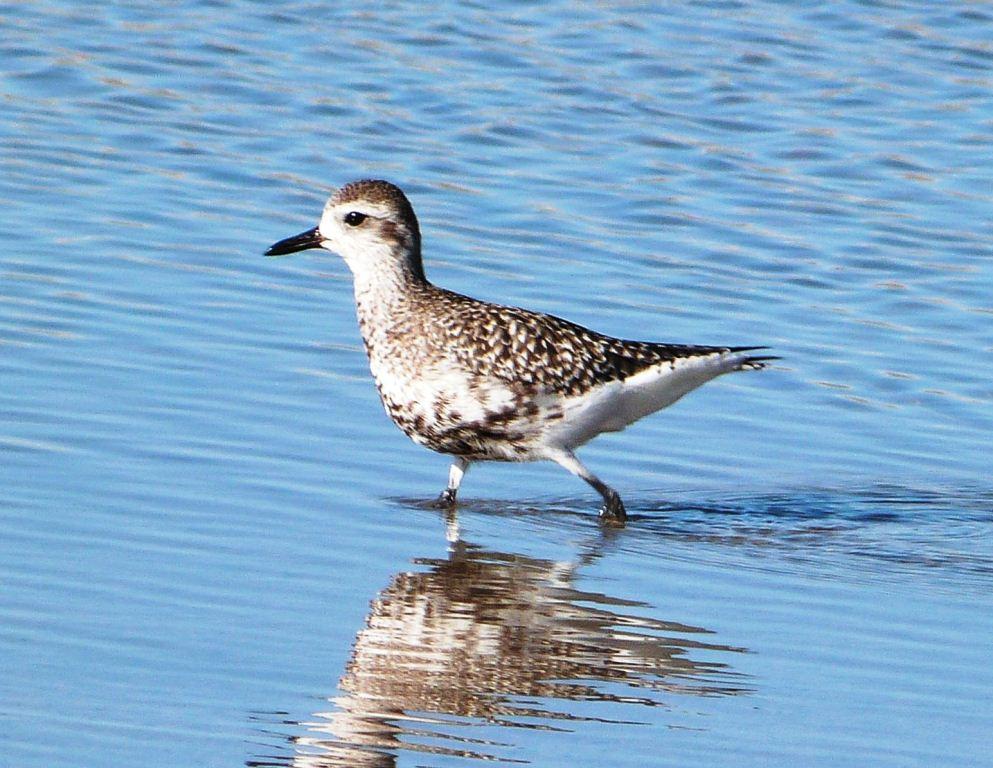
Black-bellied Plover - Ft DeSoto 11-22-12 Thanksgiving

Black-bellied Plover – Ft DeSoto 11-22-12 Thanksgiving – A new Life Bird for me

Oh, taste and see that the LORD is good; Blessed is the man who trusts in Him! (Psalms 34:8 NKJV)

Today I am scheduled to have eye surgery at noon. I have a pucker on my macular (retina) and they are going to remove it. It is on my left eye, which is my camera eye and one of the two I use for my binoculars. This blog is being written and scheduled ahead of time as will the next few days articles. I have been working ahead so that while I am recovering that you won’t be too bored with no articles. :)

Please pray for Dr. Misch as he operates on my eye. It is amazing what they will be doing and it is amazing because of how the Lord created our eyes. It may be a week to 10 days before my vision clears up.

I am trusting the Lord that all will go well and I know He is the Great Physician. He already knows the outcome and will provide whatever is needed. Am I nervous, yes, but I am also human. :)  Pray for me that I stay calm during this procedure.

The birds are waiting for me to recover so I can get back to birdwatching and taking their photos. What amazing things the Lord has created for us to discover.

*

Birds of the Bible – Loading the Ark

Snowy Egret - Wind Blown at Ft DeSoto 11-22-12 Thanksgiving

Snowy Egret – Wind Blown at Ft DeSoto 11-22-12 Thanksgiving

Dan and I just got back from a trip to Tampa for just 2 nights for the Thanksgiving holiday. My brother had a knee replacement on Wednesday (he’s doing fine), so we tied visiting him and doing some birdwatching in that area. Do you know how much we carried with us for just three days? Of course we carried our binoculars, cameras, tripod, laptop, plus clothes. Plus…

I also am starting my reading cycle through the Bible again and just read about Noah and the Ark. Because the earth had become so corrupt and violent, God said He was going to  destroy man, beast, creeping things and birds.

So the LORD said, “I will destroy man whom I have created from the face of the earth, both man and beast, creeping thing and birds of the air, for I am sorry that I have made them.” But Noah found grace in the eyes of the LORD. This is the genealogy of Noah. Noah was a just man, perfect in his generations. Noah walked with God. (Genesis 6:7-9 NKJV)

And God said to Noah, “The end of all flesh has come before Me, for the earth is filled with violence through them; and behold, I will destroy them with the earth. (Genesis 6:13 NKJV)

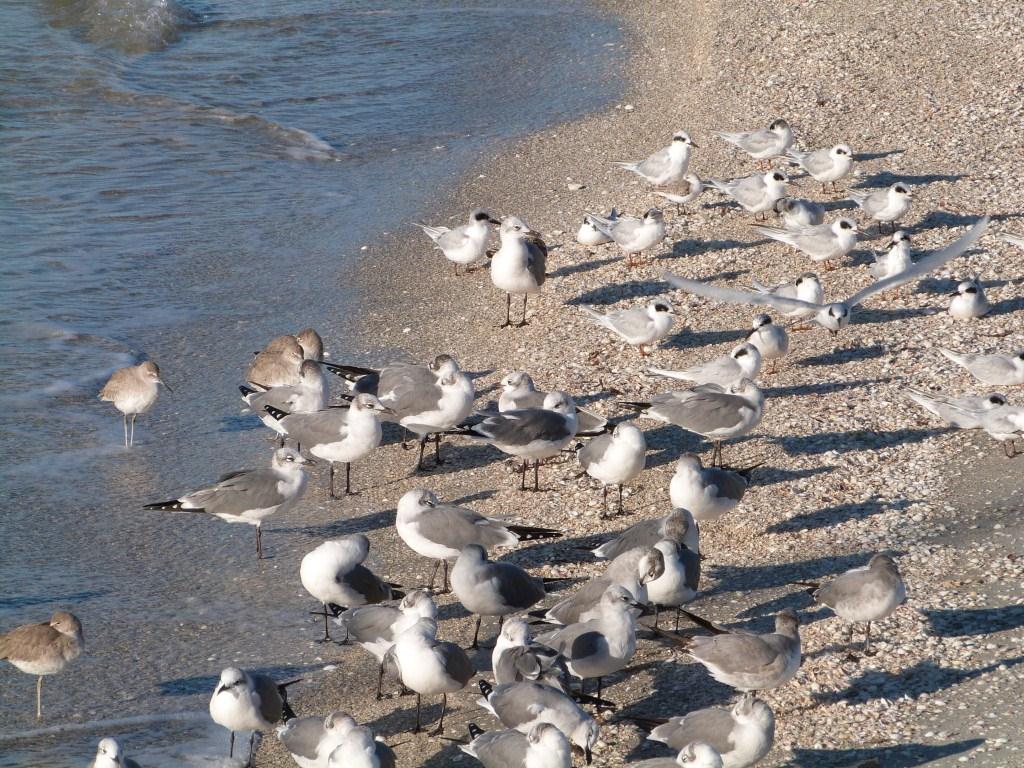
Willit - Laughing Gull - Forster's Tern at Ft DeSoto 11-22-12 Thanksgiving

Willit – Laughing Gull – Forster’s Tern at Ft DeSoto 11-22-12 Thanksgiving

Most of us know this history in the Word. Through Genesis 6, the Ark is built and Noah keeps trying to tell others to repent, but eventually the time comes and it is time to “Load the Ark.”

And of every living thing of all flesh you shall bring two of every sort into the ark, to keep them alive with you; they shall be male and female. Of the birds after their kind, of animals after their kind, and of every creeping thing of the earth after its kind, two of every kind will come to you to keep them alive. And you shall take for yourself of all food that is eaten, and you shall gather it to yourself; and it shall be food for you and for them.” Thus Noah did; according to all that God commanded him, so he did. (Genesis 6:19-22 NKJV)

Noah didn’t need to worry about taking cameras and laptops, but they had a whole lot more to get loaded on the Ark. We have all taken trips and know how long it takes to get everything in the car or van. Can you imagine when the LORD finally said that it was time to “start loading.” Noah and his family had been preparing and gathering the food, water, and supplies. If I read the first few verses of Genesis 7 correctly, they had a week (seven days) to put that in and the animals and birds. Those came to Noah, but they still had to arrange them into the different places on board the Ark. Whew! Some of us have enough trouble just loading the trunk.

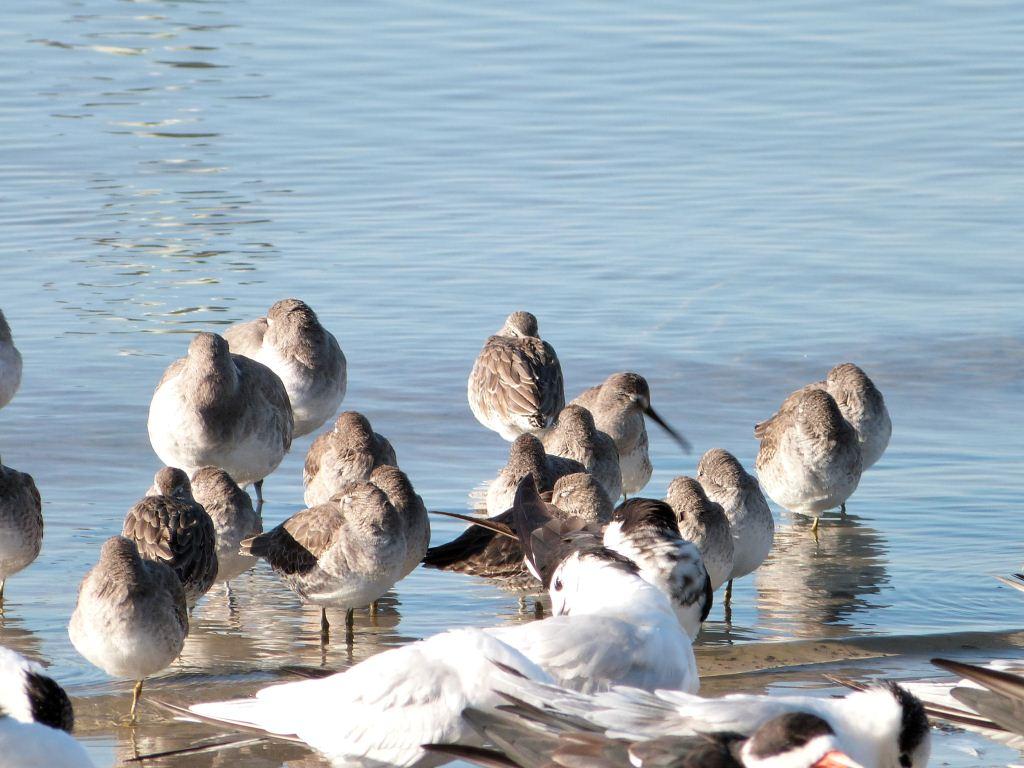
Shorebirds at MacDill AFB shore 11-23-12

Many believe the Critters rested most of the time while on board.

I am thankful that Noah and his family lived righteously and that they found grace. If not, I wouldn’t be writing this blog, nor would I be enjoying all the things the Lord created, especially the birds I love to write about.

Praise the Lord!

*

Other Birds of the Bible articles about this:

The Lord Provides For Them

Seven By Seven

God’s Commands and Promises To Them – Part I

Leaving the Ark

*

Birds of the Bible – Birds and Names?

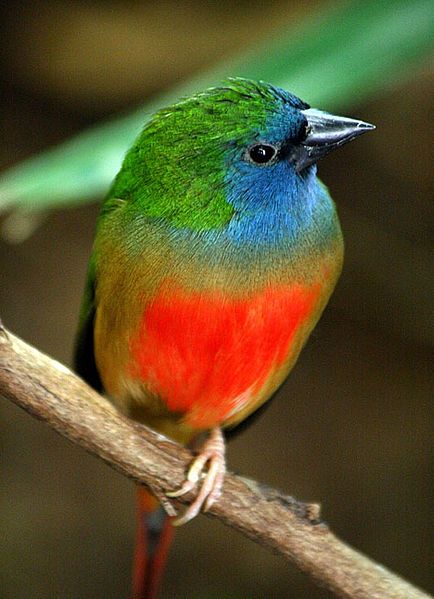
Pin-tailed Parrotfinch (Erythrura prasina) ©WikiC

Pin-tailed Parrotfinch (Erythrura prasina) ©WikiC

The devotional a few days ago from Days of Praise had one called The Names of Men. They were referring to the many list of names of people in the Bible and how many of them are unknowns. Why are they listed? The article gives a good answer to that, but here is the main point of it:

And these are the names of the men that shall stand with you: of the tribe of Reuben; Elizur the son of Shedeur. (Numbers 1:5 KJV)

“He wants to assure us that He is interested not only in the Abrahams, Daniels, Pauls, and other great men in His kingdom, but also in the Elizurs and Shedeurs and Bills and Kates in His spiritual family.

There are many millions of names “written in the Lamb’s book of life” and the heavenly Lamb–the Lord Jesus Christ–is also the Good Shepherd that “calleth his own sheep by name” The names in His book here on earth are an assurance that He knows and calls us by each of our names in His book in heaven. ”

Saffron-billed Sparrow (Arremon flavirostris) by Dario Sanches

Saffron-billed Sparrow (Arremon flavirostris) by Dario Sanches

How does this tie in with birds? We know that the Lord knows the birds because the Word tells us that not a one falls without His knowledge.

I know all the birds of the mountains, And the wild beasts of the field are Mine. (Psalms 50:11 NKJV)

Consider the ravens, for they neither sow nor reap, which have neither storehouse nor barn; and God feeds them. Of how much more value are you than the birds? (Luke 12:24 NKJV)

Who teaches us more than the beasts of the earth, And makes us wiser than the birds of heaven?’ (Job 35:11 NKJV)

Are not two little sparrows sold for a penny? And yet not one of them will fall to the ground without your Father’s leave (consent) and notice. (Matthew 10:29 AMP)

If the Lord knows every birds need, cares about them and knows when they fall, do you not think we are noticed? He knows all of our names and if you know Him as your personal Saviour, your name has been written in the Book of Life.

Gospel Message

More Birds of the Bible

*

Updating to IOC Version 3.2 Underway

Orange-billed Sparrow (Arremon aurantiirostris) by Michael Woodruff

Orange-billed Sparrow (Arremon aurantiirostris) by Michael Woodruff – Emberizidae Family

I deleted this info because it was out of date and causing 404 errors. See

Birds of the World Families

for most up to date links.

Dapple-throat (Arcanator orostruthus) ©WikiC

Dapple-throat (Arcanator orostruthus) ©WikiC

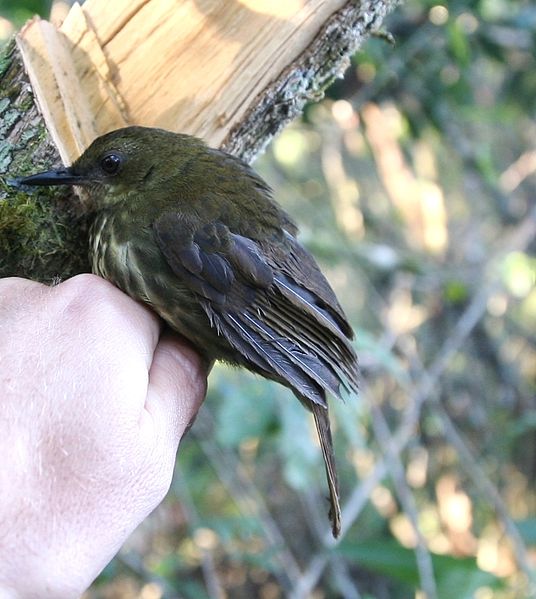
I was adding new photos to it and here is a neat one I came across. Isn’t he cool? Looks like he has glasses on.

He does great things past finding out, Yes, wonders without number. (Job 9:10 NKJV)

“Can you search out the deep things of God? Can you find out the limits of the Almighty? (Job 11:7 NKJV)

He has made everything beautiful in its time. Also He has put eternity in their hearts, except that no one can find out the work that God does from beginning to end. (Ecclesiastes 3:11 NKJV)

Oh, the depth of the riches both of the wisdom and knowledge of God! How unsearchable are His judgments and His ways past finding out! (Romans 11:33 NKJV)

White-rimmed Brush-finch ©Dusan M Brinkhuizen

White-rimmed Brush-finch ©Dusan M Brinkhuizen


Wordless Birds

*

Ian’s Bird of the Week – (Southern Cassowary) and Solar Eclipse

Southern Cassowary and Solar Eclipse by Ian 1

Southern Cassowary and Solar Eclipse by Ian 1

Ian’s Bird of the Week – (Southern Cassowary) and Solar Eclipse

by Ian Montgomery

Newsletter 11-14-12

It’s unusual for my primary photographic goal on a trip to be other than a bird, but birds this week in northern Queensland have been overshadowed – pun intended – by yesterday’s solar eclipse. Residents of the Townsville district had to face the difficult decision on whether to remain here where the probability of clear skies was great but be satisfied with a 96% eclipse or travel to Cairns where the weather forecast was cloudy but the eclipse was total.

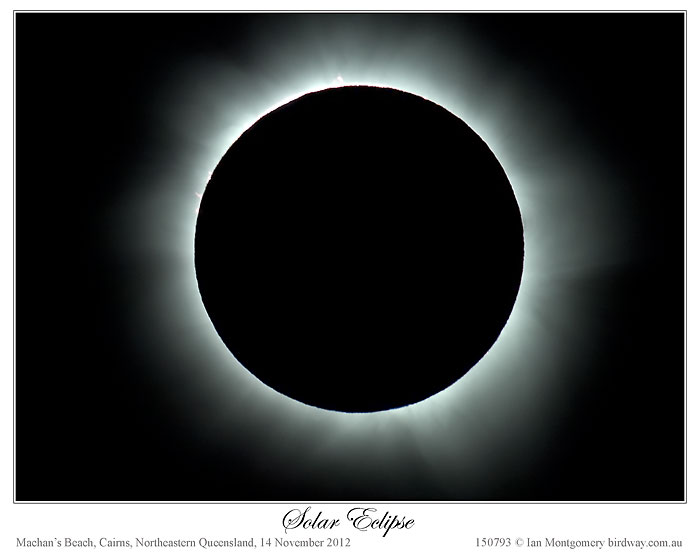
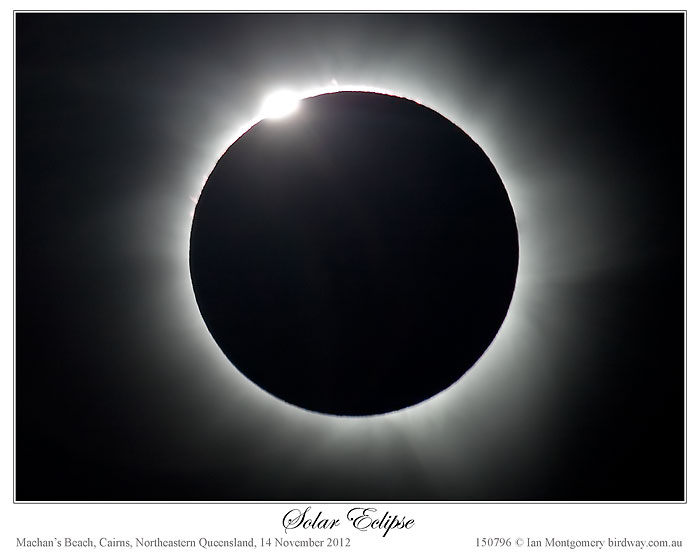
Despite misgivings about the weather, we went to Cairns and in the end it was a close call. We awoke at 5:30am – totality was due at 6:38 – to an unpromising looking sunrise followed by a shower of rain and then headed off to the beach, equipped with solar spectacles and umbrellas. Just before totality, a cloud obscured the sun and the first photo was taken seconds before it was due, at 6:37’37”, according to my iPhone. The suspense was riveting until the cloud moved aside like a slow theatre curtain to reveal a total eclipse in all its glory and all the onlookers cheered. The second photo was taken, not with the iPhone, exactly 40 seconds later.

Southern Cassowary and Solar Eclipse by Ian 2

Southern Cassowary and Solar Eclipse by Ian 2

As well as the corona surrounding the sun, only ever visible from earth during total eclipse, you can see several solar flares between 9 and 10 o’clock and near 12 o’clock. The third photo was taken another 7 seconds later, at 8:38’24”, and the sun is already reappearing producing the ‘diamond ring’ effect. This happens when a relatively tiny portion of the sun – a Baily’s bead – is visible through an irregularity on the surface of the moon – a mountain valley or a crater.

Southern Cassowary and Solar Eclipse by Ian 3

Southern Cassowary and Solar Eclipse by Ian 3

For the photographically-minded, I was unsure what exposure to use and whether automatic exposure would be correct, so I used ‘bracketing’, taking 3 photos with exposures ranging from 1 stop below to 1 above the set exposure and adjusting the set exposure based on the results of the first photos. I got the best results at -2.7 stops, f5.6 at 1/100 and 1/125sec at ISO 100. I used a tripod.

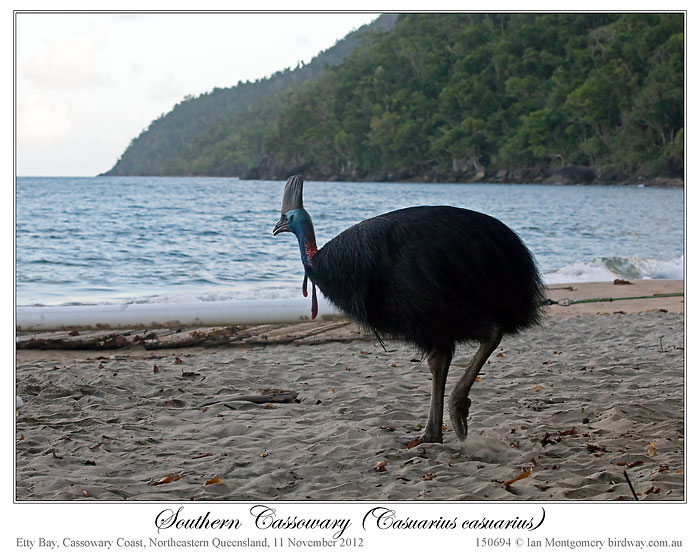
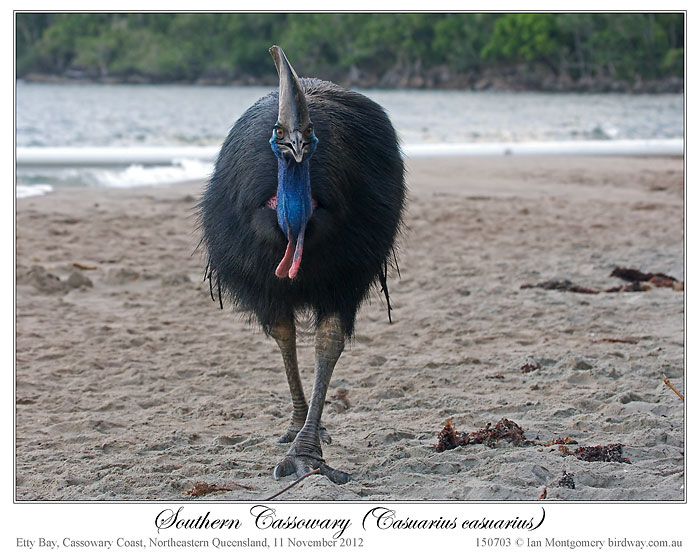
On the way to Cairns we spent a night at Etty Bay on the ‘Cassowary Coast’, the name of the local government region that covers Mission Beach and Innisfail. Etty Bay is, I think, the best place to see Cassowaries, as at least one regular patrols the camping and picnic area looking for scraps of food. The Cassowary Coast has the following logo, and I wanted to take a photo of a Cassowary that emulated the sign (which emulates a Cassowary).

Southern Cassowary and Solar Eclipse by Ian 4

Southern Cassowary and Solar Eclipse by Ian 4

Cassowaries don’t normally frequent beaches, but this one has clearly found that it’s worth checking for scraps.

Southern Cassowary and Solar Eclipse by Ian 5

Southern Cassowary and Solar Eclipse by Ian 5

The one in the second photo might make a good poster for a qualified welcome to the Cassowary Coast!

Southern Cassowary and Solar Eclipse by Ian 6

Southern Cassowary and Solar Eclipse by Ian 6

The Southern Cassowary featured as bird of the week in 2006. Here is one of the photos that I used then, also taken at Etty Bay, for those of you who have joined the list since then.

Southern Cassowary and Solar Eclipse by Ian 7

Southern Cassowary and Solar Eclipse by Ian 7

Best wishes
Ian

**************************************************
Ian Montgomery, Birdway Pty Ltd,
454 Forestry Road, Bluewater, Qld 4818
Tel 0411 602 737 ian@birdway.com.au
Check the latest website updates:
http://www.birdway.com.au/#updates


Lee’s Addition:

What great photos of the eclipse and the Cassowary to add to the delight. Thanks, Ian.

That second photo is a perfect catch of the Solar Eclipse. Wow!

He appointed the moon for seasons; The sun knows its going down. (Psalms 104:19 NKJV)

See:

Ian’s Southern Cassowary page for more of his great photos.

Casuariidae – Cassowaries Family

Cassowary – Wikipedia

*

Birds of the Bible – God Blessed Them

Osprey Family by Phillip Simmons

And God blessed them, saying, “Be fruitful and multiply, and fill the waters in the seas, and let birds multiply on the earth.”
(Genesis 1:22 NKJV)

And God H430 blessed H1288 them, saying, H559 Be fruitful, H6509 and multiply, H7235 and fill H4390 (H853) the waters H4325 in the seas, H3220 and let fowl H5775 multiply H7235 in the earth. H776 (Genesis 1:22 KJV+)

I have written before on this verse, but really never looked into this aspect of it. I knew He had told them to multiply and be fruitful, but I missed the “blessing” part. The Lord didn’t just create the birds and then leave them on their own. He cared about them and “blessed” them. Below is the definition of Strong’s Hebrew word and then Thayer’s Greek word for Blessing or Blessed.

Strong – H1288

בּרך
bârak
baw-rak’
A primitive root; to kneel; by implication to bless God (as an act of adoration), and (vice-versa) man (as a benefit); also (by euphemism) to curse (God or the king, as treason): – X abundantly, X altogether, X at all, blaspheme, bless, congratulate, curse, X greatly, X indeed, kneel (down), praise, salute, X still, thank.

Thayer – G2127

εὐλογέω
eulogeō
Thayer Definition:
1) to praise, celebrate with praises
2) to invoke blessings
3) to consecrate a thing with solemn prayers
3a) to ask God’s blessing on a thing
3b) pray God to bless it to one’s use
3c) pronounce a consecratory blessing on
4) of God
4a) to cause to prosper, to make happy, to bestow blessings on
4b) favoured of God, blessed
Part of Speech: verb

Let’s see what some of the commentaries have to say about the birds being blessed by God:

(Chuck Smith) – “But we get the more complex life forms that sort of are a little independent. They’re not rooted, they’re not grounded, they are mobile, and the various cycles that God has created, the whole process is just so marvelous indeed. The water, teeming with life, and then the air, and the many, many kinds of birds and the variety of birds that God has created. And those instinctive abilities in the birds!
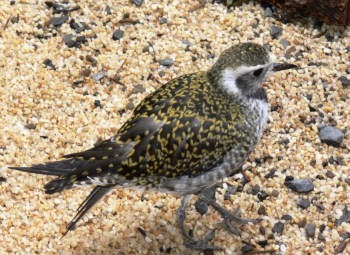
American Golden Plover (Pluvialis dominica) at National Aviary by Lee

American Golden Plover (Pluvialis dominica) at National Aviary by Lee

I’m always fascinated by that little bird in Hawaii that goes up into the Aleutian chain in order to mate. During the summer, they take off from Hawaii and they fly all the way up into Alaska where they mate. They build their nests, they lay the eggs, they hatch their young. And then with the coming of winter, they don’t want to spend winter in Alaska — and who can blame them. And you have to almost envy them, spending their winters in Hawaii. They take off over the thousands of miles without suitcases, without spare gas tanks, without compasses or navigational equipment. And they come and fly right into Hawaii, sometimes they get into severe storms, one-hundred, two-hundred mile an hour winds that blow them off course, but somehow they find their way right in. You say, “oh, they remember the way they flew out.”

How do they reckon? Some think they have some kind of device that tunes on the magnetic field of the earth. I don’t know. But, really, they’re not following the same path, so that argument’s sort of shot down, because, really, the parents decide to leave for Hawaii before the kids are able to fly that far. So, the parents fly off to Hawaii, leaving their kids in Alaska! But, it doesn’t seem to matter, cause a couple of weeks later, their kids take off and they fly right to Hawaii. Never been there before, yet somehow, God has built into this little bird that kind of instinct; and that’s a bird brain. And it’s not a very big kind of a computer. Talk about microsystems!

Oh, the wisdom of God, the wisdom of God. How thrilling to be able to see the design in nature, all testifying of the wisdom of the God that I serve. I’m so glad that I serve Him. I’m so glad that I know Him. Such a glorious God, so wise; all of these created life forms. Now, He created also the mammals, the great whales. He created the animals, the domesticated-type animals, all after their own kind.

And the evening and the morning were the fifth day.”
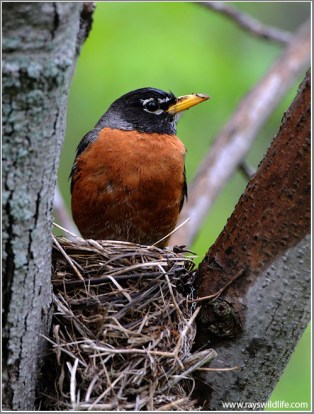
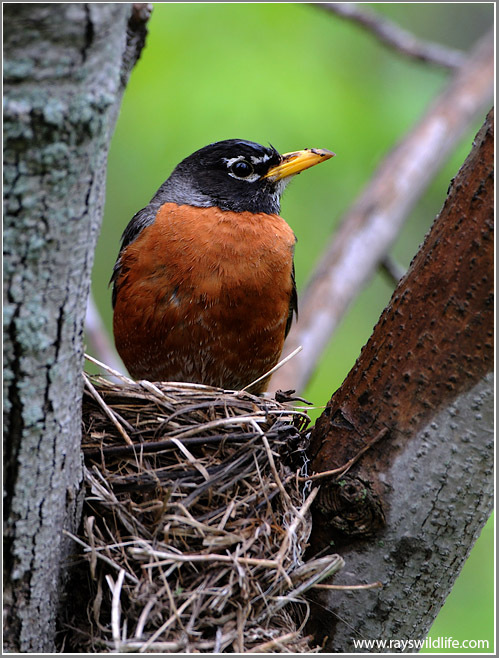
American Robin (Turdus migratorius) in nest by Ray

American Robin (Turdus migratorius) in nest by Ray

(John Gill) – “Genesis 1:22

And God blessed them,…. With a power to procreate their kind, and continue their species, as it is interpreted in the next clause, saying, be fruitful, and multiply, and fill the waters in the seas: and these creatures do multiply exceedingly, and vast quantities there are of them in the mighty waters, though the consumption of some sorts of them is very great. Our English word “fish” is derived from the Hebrew word פוש, “fush”, which signifies to multiply and increase:

and let fowl multiply in the earth; as they did, and continue to do to this day.”

(Matthew Henry) – “2. The blessing of them, in order to their continuance. Life is a wasting thing. Its strength is not the strength of stones. It is a candle that will burn out, if it be not first blown out; and therefore the wise Creator not only made the individuals, but provided for the propagation of the several kinds; God blessed them, saying, Be fruitful and multiply, Gen_1:22. God will bless his own works, and not forsake them; and what he does shall be for a perpetuity, Ecc_3:14. The power of God’s providence preserves all things, as at first his creating power produced them. Fruitfulness is the effect of God’s blessing and must be ascribed to it; the multiplying of the fish and fowl, from year to year, is still the fruit of this blessing. Well, let us give to God the glory of the continuance of these creatures to this day for the benefit of man. See Job_12:7, Job_12:9. It is a pity that fishing and fowling, recreations innocent in themselves, should ever be abused to divert any from God and their duty, while they are capable of being improved to lead us to the contemplation of the wisdom, power, and goodness, of him that made all these things, and to engage us to stand in awe of him, as the fish and fowl do of us.”

(Haydock Commentary) – “Genesis 1:22

Blessed them, or enabled them to produce others. — Multiply: the immense numbers and variety of fishes and fowls is truly astonishing.”

(K & D) – “As animated beings, the water animals and fowls are endowed, through the divine blessing, with the power to be fruitful and multiply. The word of blessing was the actual communication of the capacity to propagate and increase in numbers.”

(John Wesley) – “Observe, 2, The blessing of them in order to their continuance. Life is a wasting thing, its strength is not the strength of stones; therefore the wise Creator not only made the individuals, but provided for the propagating of the several species, Gen_1:22. God blessed them, saying, Be fruitful, and multiply – Fruitfullness is the effect of God’s blessing, and must be ascribed to it; the multiplying of the fish and fowl from year to year, is still the fruit of this blessing here.”
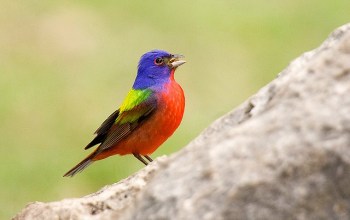
Painted Bunting (Passerina ciris) ©©Flickr

Painted Bunting (Passerina ciris) ©©Flickr

Oh that men would praise the LORD for his goodness, and for his wonderful works to the children of men! (Psalms 107:31 KJV)

The Lord not only blessed the birds, but provided them with the instinct and DNA to be able to reproduce and adapt to the changing conditions. Those that have not been able or suffered disasters be they natural or man-made have become extinct. The “kinds” have produced great varieties (over 10,400 species) that we enjoy as we study and view the different families. While He blessed the birds, in turn, we are blessed because we are able to enjoy the vast variety of these avian creations. Praise the Lord!

Birds of the Bible

Birds of the World

Bird of the Week

*

Ian’s Bird of the Week – Common Redshank

Common Redshank (Tringa totanus) by Ian 1

Common Redshank (Tringa totanus) by Ian 1

Ian’s Bird of the Week – Common Redshank ~ by Ian Montgomery

Newsletter – 11-1-12

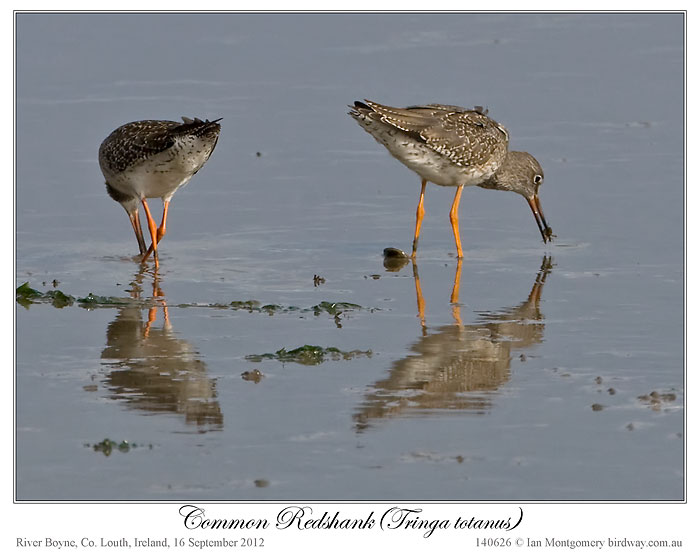
Here’s one for the wader enthusiasts: the Common Redshank, well ‘common’ in Eurasia and rather rare in Australia. It occurred to me when I was photographing these birds in Ireland in September, that, for birders, the appeal of a particular species is very dependent on location. Common Redshanks are noteworthy in Australia (I remember looking quite hard before finding one in Broome) but perhaps a nuisance in Ireland because they’re ubiquitous, nervous and noisy and often put more unusual waders to flight when you least want them to.

The one in the first photo is foraging at low tide in the harbour at Carlingford Lough, an attractive bay between the Republic and Northern Ireland on the east coast and overlooked on the northern side by the Mourne Mountains. The two in the second photo are feeding in the mudflats in the estuary of the River Boyne some distance downstream from where the famous Battle of the Boyne took place in 1690. The bird on the right has just taken a tiny crab.

Common Redshank (Tringa totanus) by Ian 2

Common Redshank (Tringa totanus) by Ian 2

The birds in the first two photos are in non-breeding plumage. Some wader species undergo spectacular colour changes when breeding, but in the Common Redshank the markings just become more pronounced, as in the third photo, taken in Portugal in the month of June some years ago.

Common Redshank (Tringa totanus) by Ian 3

Common Redshank (Tringa totanus) by Ian 3

The bright red legs, or shanks, make this a relatively easy wader to identify. It’s ringing call is also distinctive and it shows a characteristic wing pattern in flight with white panels on the rear edge of the wing, as in the fourth photo, quite different from the wing bar or plain wing of most waders.

Common Redshank (Tringa totanus) by Ian 4

Common Redshank (Tringa totanus) by Ian 4

The generic name Tringa is from the ancient Greek trungas ‘a thrush-sized bird mentioned by Aristotle, not further identified, but taken by later authors to be a sandpiper, a wagtail or a dipper‘. That’s equivalent to saying that this fruit is either an orange, a pineapple or a banana. And totanus comes from the Italian name totano for a Redshank. Sometimes the derivation of scientific names is informative, sometimes less so.

Best wishes
Ian

**************************************************
Ian Montgomery, Birdway Pty Ltd,
454 Forestry Road, Bluewater, Qld 4818
Tel 0411 602 737 ian@birdway.com.au
Check the latest website updates:
http://www.birdway.com.au/#updates


Lee’s Addition:

The birds of the air, And the fish of the sea That pass through the paths of the seas. (Psalms 8:8 NKJV)

What a neat little bird. I especially like the 3rd photo showing the red, hence, Redshank. Thanks again, Ian.

Redshanks do belong to the Scolopacidae – Sandpipers, Snipes Family. See his Scolopacidae family photos also.

Common Redshanks in breeding plumage are a marbled brown color, slightly lighter below. In winter plumage they become somewhat lighter-toned and less patterned, being rather plain greyish-brown above and whitish below. They have red legs and a black-tipped red bill, and show white up the back and on the wings in flight.

(Sound from xeno-canto.org)

See Also:

Ian’s Bird of the Week Newsletters

Common RedshankTringa – ARKive

Common Redshank – Naturia

Common Redshank (Tringa totanus) – Ocean Wanderers Guide

Scolopacidae – Sandpipers, Snipes Family

Scolopacidae – Birdway (Ian’s)