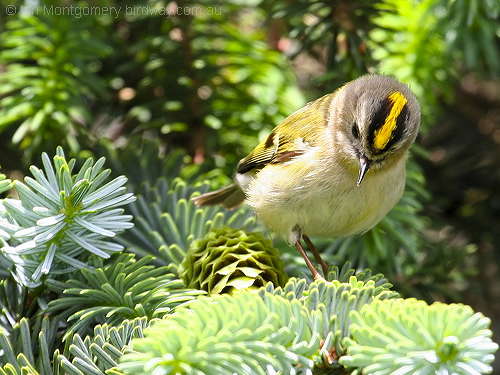
Goldcrest – The Royal Crown

Goldcrest (Regulus regulus) by Ian

Goldcrest (Regulus regulus) by Ian

Goldcrest – The Royal Crown ~ by a j mithra

The Goldcrest, Regulus regulus, is a very small passerine bird in the kinglet family. Its colourful golden crest feathers gives rise to its English and scientific names, and possibly to it being called the “king of the birds” in European folklore. It has a plain face contrasting black irises and a bright head crest, orange and yellow in the male and yellow in the female, which is displayed during breeding.

  • God has created us in His own image and that is why He loves to call us as the Royal Priest..
  • The yellow crest is displayed during breeding season..
  • But, God calls us as His crown and we shall be a crown to our Jesus, our bridegroom, face to face…

“Thou shalt also be a crown of glory in the hand of the LORD, and a royal diadem in the hand of thy God.” Isaiah 62:3

The typical contact call of the Goldcrest is a thin, high-pitched zee given at intervals of 1–4 seconds, with all the notes at the same pitch. It sometimes has a more clipped ending, or is delivered more rapidly. The call is higher and less rough than that of the Firecrest. The song of the male Goldcrest is a very high, thin double note cedar, repeated 5–7 times and ending in a flourish, cedar­cedar-cedar-cedar-cedar-stichi-see-pee. The entire song lasts 3–4 seconds and is repeated 5–7 times a minute. This song, often uttered while the male is foraging, can be heard in most months of the year. The song is a repetition of high thin notes, slightly higher-pitched than those of its relative. The songs of mainland Goldcrests vary only slightly across their range and consist of a single song type, but much more divergence has occurred the isolated Macaronesian populations.

Not only are there variations between islands and within an island, but individual males on the Azores can have up to three song types. The dialects on the Azores fall into two main groups, neither of which elicited a response from male European Goldcrests in playback experiments. There are also two main dialect groups on the Canary islands, a widespread group similar to the European version, and another which is restricted to the mountains of Tenerife. The song variations have been used to investigate the colonisation pattern of the Macaronesian islands by Goldcrests, and identified a previously unknown subspecies.

  • Though these birds have a thin high two note song, they still have different song dialects for different places and can be heard most of the year..
  • We may be from different places but still we have one song which we all are singing and would be singing over and over again..

That songs is , “ALLELUIA”

1) And after these things I heard a great voice of much people in heaven, saying, Alleluia; Salvation, and glory, and honour, and power, unto the Lord our God:
2) For true and righteous are his judgments: for he hath judged the great whore, which did corrupt the earth with her fornication, and hath avenged the blood of his servants at her hand.
3)And again they said, Alleluia. And her smoke rose up for ever and ever.
4) And the four and twenty elders and the four beasts fell down and worshipped God that sat on the throne, saying, Amen; Alleluia.
5) And a voice came out of the throne, saying, Praise our God, all ye his servants, and ye that fear him, both small and great.
6) And I heard as it were the voice of a great multitude, and as the voice of many waters, and as the voice of mighty thunderings, saying, Alleluia: for the Lord God omnipotent reigneth.” Revelations 19:1 – 6

Goldcrest (Regulus regulus) Male displaying ©WikiC

Goldcrest (Regulus regulus) Male displaying ©WikiC

The Goldcrest breeds in mature lowland and mountain coniferous woodlands, mainly up to 3,000 m (9,800 ft), and occasionally to 4,800 m (15,800 ft). It uses spruce, Larch, Scots Pine, Silver Fir and Mountain Pine. Though this bird is just about 4.5 to 7.0 grams in weight, it breeds so high…

  • If these small 8.5 to 9.5 cm long birds can fly that high, how far should we be able to fly?
  • We all want to fly like an Eagle, but are we willing to pay the price of waiting upon the Lord?

But they that wait upon the LORD shall renew their strength; they shall mount up with wings as eagles; they shall run, and not be weary; and they shall walk, and not faint. (Isaiah 40:31)

A study in the Baltic region showed that northern Goldcrests were more likely to migrate, and increased their body mass beforehand; non-migratory
southern birds did not increase their fat reserves. The travel speed of migrating Goldcrests increased for those leaving later in the autumn, and was greater for the northernmost populations. Migration was faster on routes that crossed the Baltic Sea than on coastal routes, the birds with the largest fat reserves travelled at the highest speeds. The ability to lay down fat is adversely affected in this tiny bird by poor health Goldcrests can fly 250–800 km (150–500 mi) in one day, although they keep at a lower level in heavy headwinds.

  • These birds seem to know how to tackle the heavy wind, by flying at a lower level..
  • Here is a secret these birds seem to teach us..
  • They seem to tell us that we need to fly at a lower level, to fly long and fast…
  • Believers find it so difficult to fly low, everyone wants to be seen high..

But, God’s expects us to be different…

And whosoever shall exalt himself shall be abased; and he that shall humble himself shall be exalted. (Mathew 23:12)

The Goldcrest is monogamous. The male sings during the breeding season, usually while foraging rather than from a perch. It has a display which involves bowing its head towards another bird and raising the coloured crest. A male Goldcrest will defend his territory against either species, sometimes including some Firecrest phrases in his song.

  • Goldcrest’s songs, helps in defending its territory from other species…
  • Our songs too has the power to defend us from all evil..
  • It is in our praises that our Lord loves to dwell…
  • Remember, our God is in spirit, so, where there is spirit there is liberty and our praise has the power to bring THE SPIRIT in our midst to liberate us..

So let’s sing and not let GOD dwell in heaven but amongst our praises..

But thou art holy, O thou that inhabitest the praises of Israel. (Psalm 22:3)

The Goldcrest’s nest is a well-insulated cup-shaped structure built in three layers. The nest’s outer layer is made from moss, small twigs, cobwebs and lichen, the cobwebs also being used to attach the nest to the thin branches that support it. The middle layer is moss, which is lined by an inner layer of feathers and hair. The nest is larger, shallower and less compact than that of the Firecrest, with an internal diameter of about 9.0 cm (3.5 in), and is constructed by both sexes, although the female does most of the work. Laying starts at the end of April into early May. The eggs are whitish with very indistinct buff, grey or brown markings at the broad end. The eggs are 14 × 10 mm (0.55 × 0.34 in) and weigh 0.8 g (0.028 oz), of which 5% is shell.

The clutch size in Europe is typically 9–11 eggs, but ranges from 6–13. The eggs are piled up in the nest and the female keeps the eggs warm with her brood patch and also by putting her warm legs into the middle of the pile between the eggs. Within a clutch the size of eggs increases gradually and the last laid egg may be 20% larger than the first egg. Second clutches, which are common, are laid usually while the first nest still has young. The male builds the second nest, then feeds the young in the first nest while the female is incubating in the second; when the first brood has fledged, he joins the female in feeding the second brood.
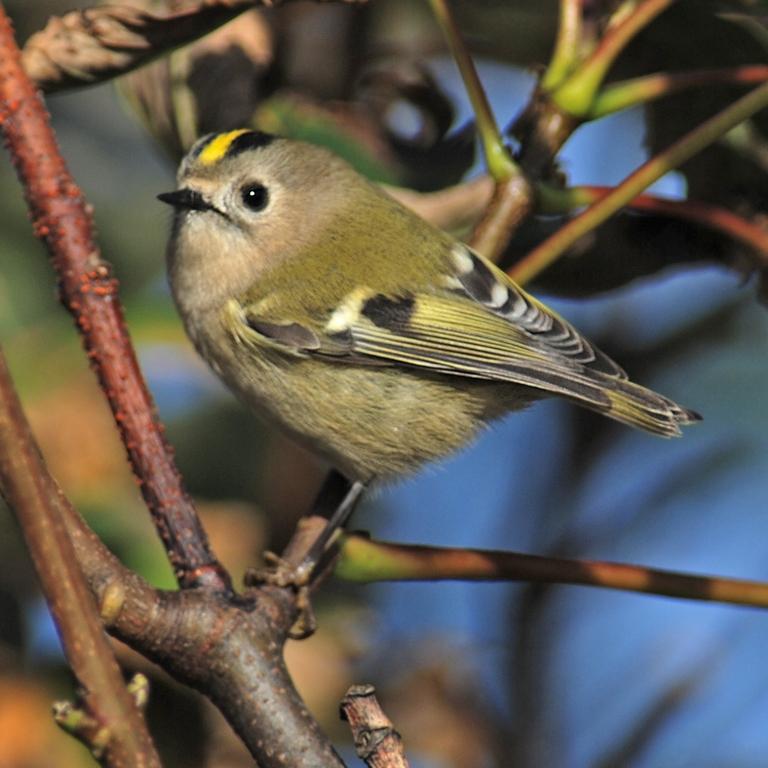
Goldcrest (Regulus regulus) female ©WikiC

Goldcrest (Regulus regulus) female ©WikiC

The female Goldcrest is not normally fed by her mate while incubating. She is a tight sitter, reluctant to leave the nest when disturbed, and has been recorded as continuing to attend the nest when it has been moved, or even when it is being held. The eggs are maintained at 36.5 °C (97.7 °F), the female regulating the temperature of the eggs by varying the time spent sitting. She leaves the nest more with increasing air temperature, and incubates more tightly when the light intensity is lower early and late in the day.

  • The female bird sits tight when the light intensity is lower…
  • When darkness surrounds, we need to be still and wait until THE LIGHT shines on us..
  • It also regulates the temperature of the eggs at 36.5 °C (97.7 °F)…
  • Is the intensity of the spiritual fire in us constant?
  • Or is God upset over us for having left our first love?

Nevertheless I have somewhat against thee, because thou hast left thy first love.: (Revelation 2: 4)

Let us walk as children of light before eternal darkness fall over…

Then spake Jesus again unto them, saying, I am the light of the world: he that followeth me shall not walk in darkness, but shall have the light of life. (John 8:12)

The female incubates the eggs for 16 to 19 days to hatching, and broods the chicks, which fledge in a further 17 to 22 days later. Both parents feed the chicks and fledged young, and in very hot weather, the female has been noted as taking drops of water to her chicks in her bill.

  • To carry water in its tiny bill to its tiny chick is incredible…
  • What a thoughtful mother this bird could be!
  • If this bird could be so incredible, how incredible its creator would be?

These birds carry water only to its chicks but, listen to what our God says…

For I will pour water upon him that is thirsty, and floods upon the dry ground: I will pour my spirit upon thy seed, and my blessing upon thine offspring: (Isaiah 44:3)

He also says,

And it shall come to pass afterward, that I will pour out my spirit upon all flesh; and your sons and your daughters shall prophesy, your old men shall dream dreams, your young men shall see visions. And also upon the servants and upon the handmaids in those days will I pour out my spirit (Joel 2:28)
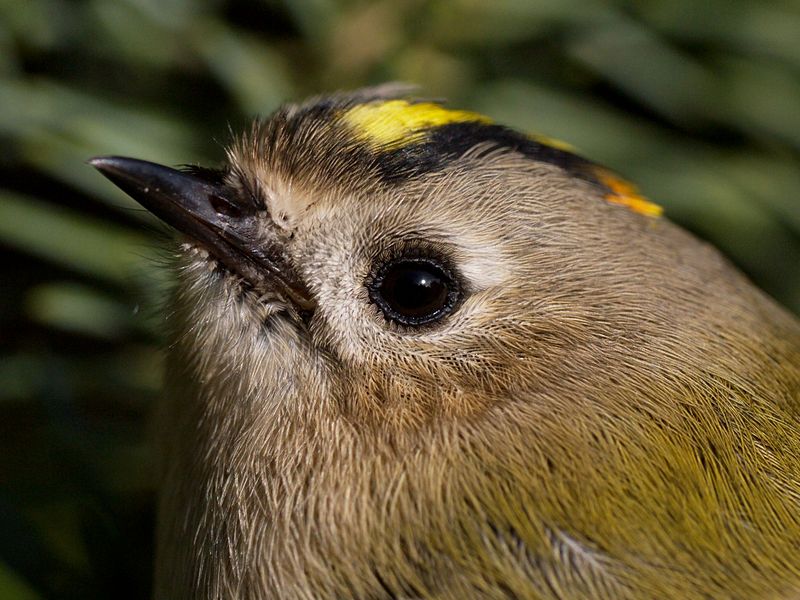
Goldcrest (Regulus regulus regulus) ©WikiC

Goldcrest (Regulus regulus regulus) ©WikiC

The Goldcrest takes a wide variety of prey, especially spiders, caterpillars, bugs, springtails and flies. Larger prey such as oak bush crickets and tortrix moths may sometimes be taken. Goldcrests will occasionally feed on the ground amongst leaf-litter with tits. Non-animal food is rare, although Goldcrests have been seen drinking sap from broken birch twigs together with tits and nuthatches. Flying insects are taken in hovering flight but not nomally pursued; there is a record of a Goldcrest attacking a large dragonfly in flight, only to be dragged along by the insect before releasing it unharmed.

  • The devil may try to drag you, but it can never ever harm you, for you are carved in His palm ..
  • God doesn’t want to go blind for you are the apple of His eye…

No weapon that is formed against thee shall prosper; and every tongue that shall rise against thee in judgment thou shalt condemn. This is the heritage of the servants of the LORD, and their righteousness is of me, saith the LORD. (Isaiah 54:17)

But we need to pay a price to inherit this the promise..

Serve the Lord and He shall save you from every weapon and every tongue..

Several small passerine species survive freezing winter nights by inducing a lower metabolic rate and hypothermia, of a maximum of 10 °C (18 °F) below normal body temperature,in order to reduce energy consumption overnight. However, in freezing conditions, it may be that for very small birds, including the tiny Goldcrest, the energy economies of induced hypothermia may be insufficient to counterbalance the negative effects of hypothermia including the energy required to raise body temperature back to normal at dawn.

Observations of five well-fed birds suggest that they maintain normal body temperatures during cold nights by metabolising fat laid down during the day, and that they actually use behavioural thermoregulation strategies, such as collective roosting in dense foliage or snow holes to survive winter nights. Two birds roosting together reduce their heat loss by a quarter, and three birds by a third. During an 18 hour winter night, with temperatures as low as −25 °C (−13 °F) in the north of its range,

  • Goldcrests huddled together can each burn off fat equivalent to 20% of body weight to keep warm…
  • Did someone preach the word of God or give them a Bible to read?
  • How come they know that they can keep themselves warm by staying together?
  • Who taught them?
  • Does the church stay together to keep themselves on fire?

Again, if two lie together, then they have heat: but how can one be warm alone? And if one prevail against him, two shall withstand him; and a threefold cord is not quickly broken.” Ecclesiastes (4:11-12)

Aristotle (384 BC – 322 BC) and Pliny (23 AD – 79) both wrote about the legend of a contest amongst the birds to see who should be their king, the title to be awardedto the one that could fly highest. Initially, it looked as though the eagle would win easily, but as he began to tire, a small bird which had hidden under the eagle’s tail feathers, emerged to fly even higher and claimed the title.

  • This may sound like a folklore but there is point for us to remember..
  • God carries us like an Eagle in His wings….

Jesus said. “Verily, verily, I say unto you, He that believeth on me, the works that I do shall he do also; and greater works than these shall he do; because I go unto my Father.” (John 14:12)

God has called us to do greater things, come, let us hide under His wings…

Have a blessed day!

Your’s in YESHUA,
a j mithra

Please visit us at:
Crosstree
ajmithra21


Lee’s Addition:

The Goldcrest are in the Regulidae Family of the Passeriformes Order.

See Also:
Goldcrests and Kinglets – Regulidae Family – It has a video of Goldcrest building a nest by Keith Blomerley.
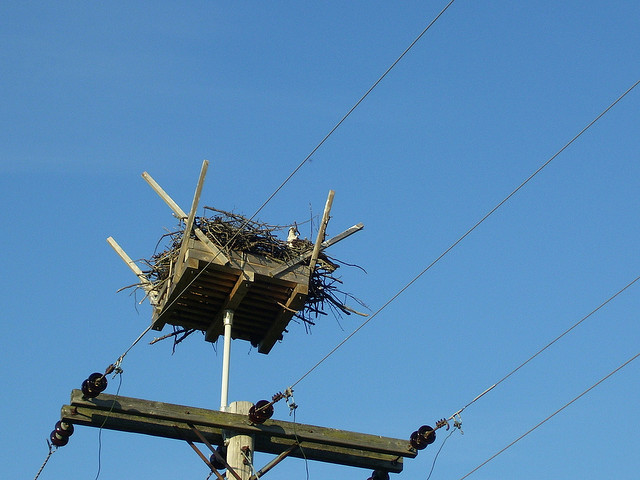
Birds of the Bible – Ospreys in the Storm

Western Osprey (Pandion haliaetus) ©©Mike Bowler

Western Osprey (Pandion haliaetus) ©©Mike Bowler

Yesterday we had very heavy rain and wind. We were under Tornado Warnings most of the day. In the afternoon, it turned very bad as a tornado was being tracked just south of our house. Our flagpole went down as well as the concrete sign at the entrance to our community. There were plenty of trees and branches strewn around and planes tossed around at the Fun n Sun festival in Lakeland, Florida.

We went down to Bartow this afternoon and took the Old Bartow road, that I have renamed, the “Osprey Road.” There are many Osprey nest in the power lines down through there and also the electric companies have placed platforms for the Osprey to raise their babies.

One of the main food source for the Osprey is fish. We have had several very cold snaps these last two winters and many of the fish were killed off. Without a good source of food to raise their young, the numbers of Osprey have decreased in this area.

Osprey Road by Dan - (Old Bartow Road)

Osprey Road by Dan – (Old Bartow Road) 2007

This year we had already seen fewer Osprey’s raising their young. Now many of those nests were destroyed or left bedraggled by the storm yesterday. What a shame. Then again, had there been lots of active nest, there would have been more killed or injured birds.

We are reminded through Scripture that:

Are not two sparrows sold for a farthing? and one of them shall not fall on the ground without your Father. (Matthew 10:29 KJV)

They were not Sparrows, but I know that promise applied to them also. God, the Father, knows all about what happened to them. He is not so busy that He doesn’t take notice of such things. That is why that passage is so special, because, it goes on to say:

Fear ye not therefore, ye are of more value than many sparrows. Whosoever therefore shall confess me before men, him will I confess also before my Father which is in heaven. (Matthew 10:31-32 KJV)

Osprey with Fish by Jim Fenton

Osprey with Fish by Jim Fenton

Another thing about Ospreys as well as the other birds is that they were commanded to “multiply and fill the earth.” What I haven’t mentioned is that on the way down and back we saw four different sets of birds mating. I imagine that they lost their young and are busy planning the next clutch of birds to raise. Birds have emotions, and I am sure they feel the loss, but they have picked themselves back up and have begun repairing nests and starting new families.

May we be reminded that the Lord knows all about the things that happen to us. Sometimes the events aren’t so much “fun.” How do we handle situations when this happens. Do we keep our eyes on the Lord and trust Him to see us through it, or do we blame Him and become angry and miserable?
___
Ospreys are in the Pandionidae Family of the Accipitriformes Order. There is an Eastern Osprey (Pandion cristatus) and a Western Osprey (Pandion haliaetus).

See also:

Birds of the Bible – Osprey
Birds of the Bible – Osprey II
Birds of the Bible – Osprey III

*

I.O.C. Version 2.8 World Bird List Released Today

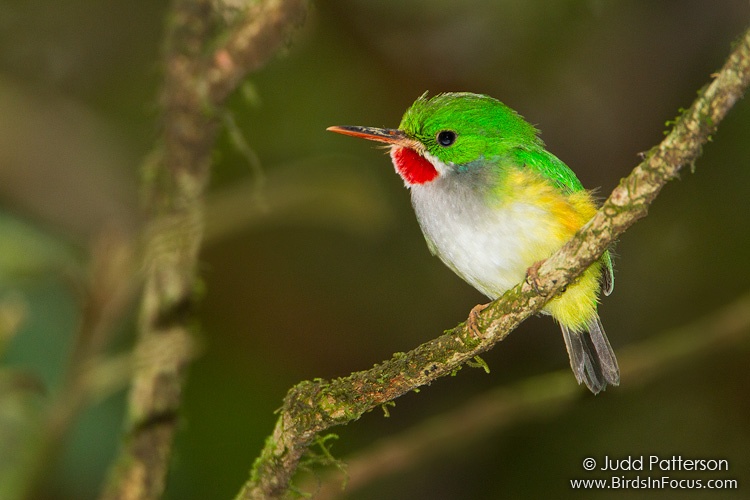
Puerto Rican Tody (Todus mexicanus) by Judd Patterson

Puerto Rican Tody (Todus mexicanus) by Judd Patterson

The I.O.C. Version 2.8 World Bird List was released today and this time I am going to get with it immediately. In fact, I knew it was going to be available on March 31st, so I halted the 2.7 work and began the 2.8 Version two days ago. It’s back to the changes on the 233 Families, but this time it will be easier. (I hope!)

And further, by these, my son, be admonished: of making many books there is no end; and much study is a weariness of the flesh. (Ecclesiastes 12:12 KJV)

This Version of the International Ornithological Congress (IOC), now the International Ornithologists’ Union, has added 15 Species, deleted 3, changed the names of 9 and the ranges of 27 birds. They made changes to the Taxonomy “32 of which 29 are changes of Genera, especially resurrection of Antrostomus for 11 species of New World Caprimulgus and revisions of Aimophila sparrows to follow AOU.” All of this amounts to: “The IOC World Bird List 2.8 contains 10,438 species classified in 40 Orders, 233 Families (including 5 Incertae Sedis) and 2232 Genera.” (from the IOC World Bird List site) The 233 Families is why there are 233 pages to maintain every time a new update comes out.

Blue-winged Teal by Dan at Circle B

Blue-winged Teal by Dan at Circle B

Some changes were made to the new pages completed. There are links at the bottom of the page to the websites of the photographers who have given their permission to use their fantastic photos used on that page. They are already listed in the sidebar, but this might encourage you to also visit their sites. We are thankful for each one who has given permission. If you are a bird photographer and would be willing to let your photos be used, please send an e-mail to:  Lee@leesbird.com. It is a desire to have a photo of each bird species of the world on this site.

The list of species is quite long now, because of the listing of the subspecies. You might find it useful to go to the Find feature of your browser to help locate the bird you are searching for. Here is how to do so:

Use the Ctrl+F keyboard shortcut.
This works on Firefox (shows up at bottom of page), Internet Explorer and Chrome (shows up at top of page).

As previously stated, Adam had it a whole lot easier naming the birds.

Out of the ground the LORD God formed every beast of the field and every bird of the air, and brought them to Adam to see what he would call them. And whatever Adam called each living creature, that was its name. So Adam gave names to all cattle, to the birds of the air, and to every beast of the field. (Genesis 2:19-20a NKJV)

Southern Cassowary (Casuarius casuarius)y by Ian Montgomery

Southern Cassowary (Casuarius casuarius)y by Ian Montgomery

Here are links to the Version 2.8 lists that are completed:

More Birds of the World
*

Birds in Hymns – When Spring Unlocks The Flowers

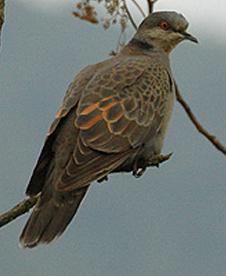
Dusky Turtle Dove (Streptopelia lugens) ©WikiC

Dusky Turtle Dove (Streptopelia lugens) ©WikiC

Based On:

The flowers appear on the earth, the time of singing has come, and the voice of the turtledove is heard in our land. (Song of Solomon 2:12 ESV)

Words by Re­gi­nald He­ber (1783-1826).
Music – Gos­ter­wood, Eng­lish mel­o­dy, ar­ranged by Ralph Vaugh­an Will­iams
In The Eng­lish Hymn­al (Lon­don: Ox­ford Un­i­ver­si­ty Press, 1906), num­ber 299

When Spring Unlocks The Flowers

When spring unlocks the flowers to paint the laughing soil;
When summer’s balmy showers refresh the mower’s toil;
When winter binds in frosty chains the fallow and the flood;
In God the earth rejoiceth still and owns his maker good.

The birds that wake the morning and those that love the shade;
The winds that sweep the mountain or lull the drowsy glade;
The sun that from his amber bower rejoiceth on his way,
The moon and stars their master’s name in silent pomp display.

Shall man, the lord of nature, expectant of the sky,
Shall man alone, unthankful, his little praise deny?
No; let the year forsake his course, the seasons cease to be,
Thee, Master, must we always love, and Savior, honor Thee.

The flowers of spring may wither, the hope of summer fade,
The autumn droop in winter, the birds forsake the shade;
The winds be lulled, the sun and moon forget their old decree;
But we, in nature’s latest hour, O Lord, will cling to Thee!

________

See More Birds In Hymns

*

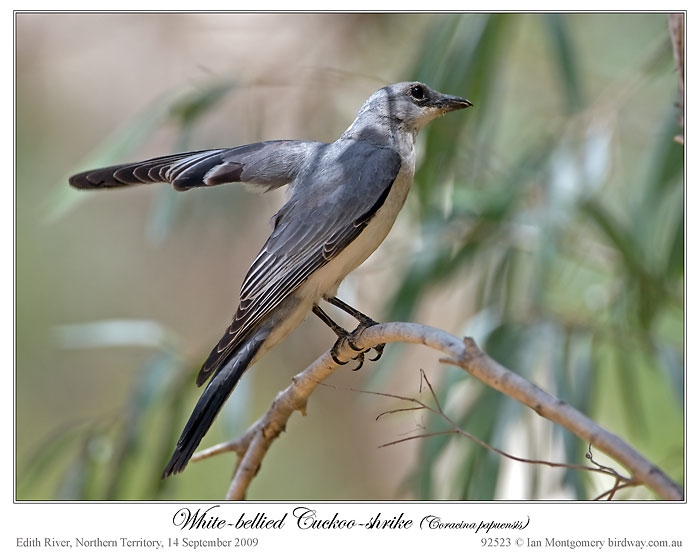
Ian’s Bird Of The Week – White-bellied Cuckooshrike

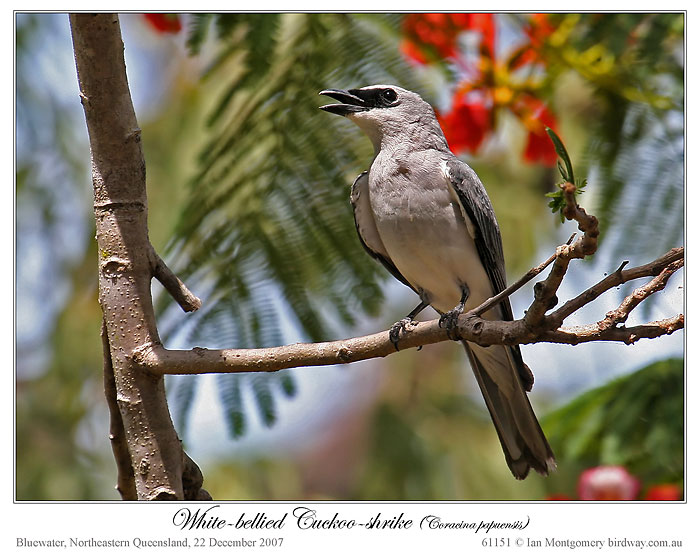
White-bellied Cuckooshrike (Coracina papuensis robusta) by Ian

White-bellied Cuckooshrike (Coracina papuensis robusta) by Ian

Ian’s Bird Of The Week – White-bellied Cuckooshrike ~ by Ian Montgomery

Newsletter – 3/27/11

Not only colourful birds are beautiful. Take, for example, the monochrome Cuckooshrikes, such as the White-bellied. ‘Dapper’ comes to mind, though my dictionary defines it as meaning ‘up-to-date in dress and manners, and there is something timeless about the beauty of birds. I find the soft greys of Cuckooshrikes quite lovely and the contrasting white and black touches make them completely ready for the most formal occasion.

White-bellied Cuckooshrike (Coracina papuensis robusta) by Ian

White-bellied Cuckooshrike (Coracina papuensis robusta) by Ian

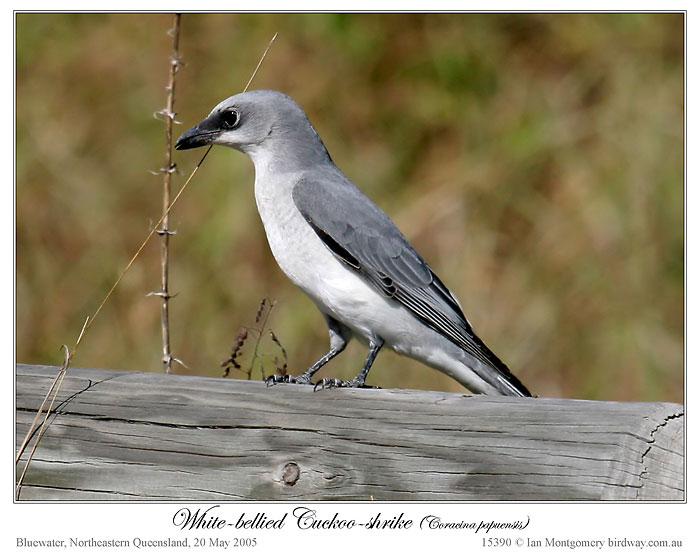
The best known Cuckooshrike in Australia is the very widespread Black-faced, but in North Queensland the smaller White-bellied is usually much commoner, though the migrant Black-faced can be numerous in the (winter) dry season. The first photo shows an adult of the eastern Australian race robusta perched in a red-flowering Poinsiana near my house. The second photo is of a juvenile bird, also in my garden, with the characteristic faintly barred breast and dark smudge behind the eye.

White-bellied Cuckooshrike (Coracina papuensis hypoleuca) by Ian

White-bellied Cuckooshrike (Coracina papuensis hypoleuca) by Ian

The third photo shows the paler, white-breasted, northern race hypoleuca, found in the Northern Territory and northern Western Australia. It merely looks like it’s got a broken wing: it’s actually in the middle of the wing shuffle performed both by this species and the Black-faced after landing and, apparently, during display. The shuffle is done very deliberately and the birds look as if they are having trouble folding their wings comfortably. The Black-faced is sometimes called the ‘Shufflewing’, arguably a much better name than ‘cuckooshrike’ as they are not related to either cuckoos or shrikes and shrikes are meaninglessly unknown in Australia, except as rare vagrants.

White-bellied Cuckooshrike (Coracina papuensis robusta) by Ian

White-bellied Cuckooshrike (Coracina papuensis robusta)dark morph by Ian

Interestingly, the White-bellied seems to have some black-faced genes lurking in its genome, as there is an uncommon dark morph of the race robusta, fourth photo, which could easily be confused with the larger Black-faced Cuckooshrike, though the dark morph of the White-bellied has black scallops between the breast and the belly. The species are distinguishable by call. Both are quite vocal, with the Black-faced having a musical ‘chereer’ while the White-bellied is a peevish ‘kissik’: if it sounds as if it’s complaining, it’s a White-bellied.

Links:
White-bellied Cuckooshrike
Black-faced Cuckooshrike
True Shrikes

Best wishes,
Ian

—
Ian Montgomery, Birdway Pty Ltd,
454 Forestry Road, Bluewater, Qld 4818
Phone: 0411 602 737 +61-411 602 737
Preferred Email: ian@birdway.com.au
Website: http://birdway.com.au


Lee’s Addition:

Thanks, Ian, for introducing us to another interesting bird. The Cuckoo is a Bird of the Bible, but I am not sure if the Cuckooshrike comes under that “kind” or not. The KJV spells it, “cuckow” and the MKJV “cuckoo.”

and the owl, and the night hawk, and the cuckoo, and the hawk after its kind, (Deuteronomy 14:15 MKJV)

The Cuckooshrikes are in the Campephagidae – Cuckooshrikes Family of the Passeriformes Order, whereas the Cuckoo is in the Cuculidae – Cuckoos Family of the Cuculiformes Order. So, I suspect that since they are two different Orders that they are totally different “kinds.”

Cuckoo is used with several other bird families:

Cuckoo-Hawks – Accipitridae Family
Cuckoo-Doves – Columbidae Family
Cuckoo Roller – Leptosomidae Family
Cuckoo Weaver – Viduidae Family

And some of you only thought the Cuckoo lived in a clock!

*

Bible Conference and Birds in South Carolina

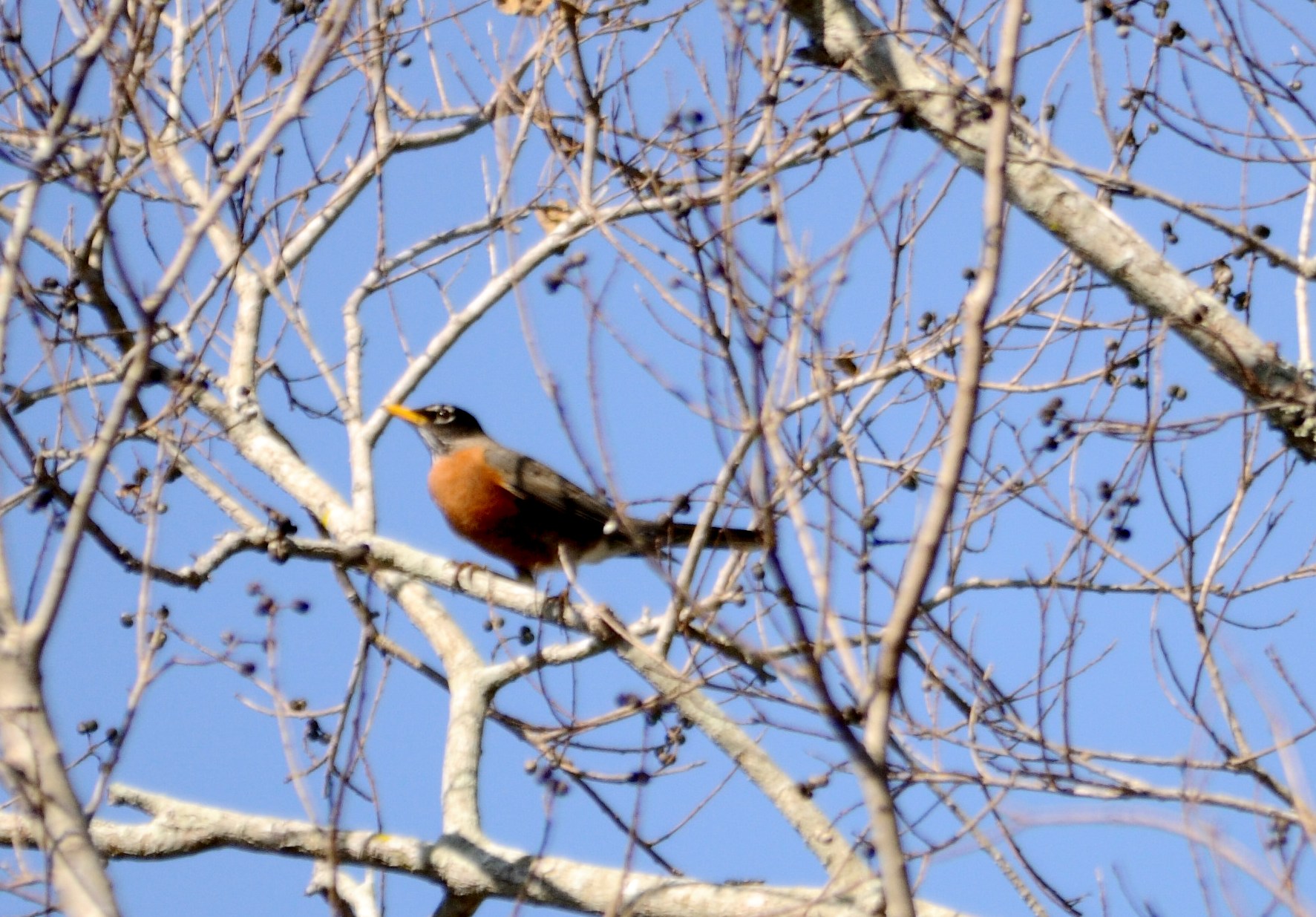
American Robin by Dan

American Robin by Dan

All scripture is given by inspiration of God, and is profitable for doctrine, for reproof, for correction, for instruction in righteousness: (2Ti 3:16)

An American Robin, two Cardinals and a Mockingbird greeted us here in South Carolina. We also saw a Red-tailed Hawk circling over the campus of Bob Jones University (our Alma mater) and a Red-shouldered Hawk sitting in a tree. Spring is blooming out all around.

We came up here for the Bible Conference and have thoroughly enjoyed and received blessings from all five messages we were able to attend. We are now headed home and will arrive back in Florida soon.

Dr. Sam Horn, from Wisconsin, challenged us to “cast all our cares on the Lord” and to remember that, “we have a Father that knows our need.” His other message was to challenge us to “right living” through the “Divine enablement from God.”

Dr. David Innes, from California, taught on the “Greatness of God.” Two quotes I liked were; “All genuine ministry of life is the overflow of our walk with Christ.” and “God is uniquely Uncreated, Infinite, Triune, and Holy.” His second message was about the “Greatness of God’s Word.”

Dr. Bruce Compton, from Michigan, spoke on the “Relationship between a living faith and God’s Word.

It is good to sit under the ministry of Godly men who teach the Word of God in a concentrated time period, like a Bible Conference. Sometimes it is hard to get away to one, but it is worth the effort. Your soul will be refreshed and challenged.

It was also good to travel to a different state to try to get a glimpse of the birds that they have there. Didn’t see too many, but it was a very profitable trip. The Lord is always gracious.

This trip is why there has not been many articles from me lately. I will soon be back at the keyboard after I get the binoculars out to spot some more birds to write about.

*

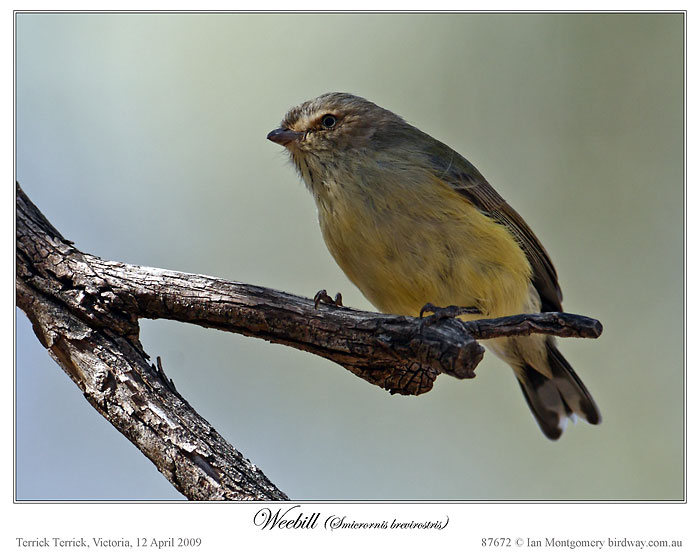
Ian’s Bird of the Week – Weebill

Weebill (Smicrornis brevirostris) by Ian Montgomery

Weebill (Smicrornis brevirostris) by Ian Montgomery

Ian’s Bird of the Week – Weebill ~ by Ian Montgomery

I’ve recently been reformatting the photo galleries of the Thornbills and Allies (Acanthizidae) on the website. This is a family of small, mostly insectivorous birds and here, with a length of 8-9cm/3.2-3.5in, is the diminutive Weebill. It is widespread in drier woodlands, including Mallee, across mainland Australia, but absent from Tasmania and is not found in wetter forests. It has a characteristic stubby horn-coloured bill, pale eyebrow and pale iris, as in the first photo, which distinguishes it from the rather similar Yellow Thornbill. This photo, taken in Victoria, shows the browner nominate race found Victoria, New South Wales, southern Queensland and eastern South Australia.

Weebill (Smicrornis brevirostris) by Ian Montgomery

Weebill (Smicrornis brevirostris) by Ian Montgomery

The northern race (flavescens), second photo, taken on Southern Cape York Peninsula, ranges across the most of the rest of northern and central Australia is much yellower in colour and slightly smaller, making it the smallest bird in Australia. They are often to be found in very harsh, dry habitats and I am frequently impressed that such small birds are so tough and such great survivors.

Weebill (Smicrornis brevirostris) by Ian Montgomery

Weebill (Smicrornis brevirostris) by Ian Montgomery

The third photo, taken in Northwestern Queensland, is also of this race but is, I think, an immature bird, less brightly coloured and a greyish rather than white iris. In southwestern Western Australia, the northern race grades into another race (occidentalis) with a greyish face with a rufous tinge, but I haven’t photographed it.

Weebills are lively, vocal little birds with a remarkably strong voice so you often hear them before you spot them busily feeding in the foliage of trees. The call is rendered something like ‘wee-willey-weet weet’ but I was told to remember ‘I’m a little Weebill’ and that works for me.
Links:
Best wishes
Ian
P. S. There was an error in last week’s Yellow-spotted Honeyeater. I said that the Yellow-spotted and the Graceful where North Queensland endemics when I should have said that in Australia, they occur only in North Queensland. They also occur in New Guinea. 

—
Ian Montgomery, Birdway Pty Ltd,
454 Forestry Road, Bluewater, Qld 4818
Phone: 0411 602 737 +61-411 602 737
Preferred Email: ian@birdway.com.au
Website: http://birdway.com.au

Lee’s Addition:
What a cute little bird. After you check out Ian’s links to the Acanthizidae he has photographed, see the Acanthizidae Family of the Passeriformes Order in our Birds of the World section.

And to every beast of the earth and to every bird of the heavens and to everything that creeps on the earth, everything that has the breath of life, I have given every green plant for food.” And it was so. (Genesis 1:30 ESV)

*

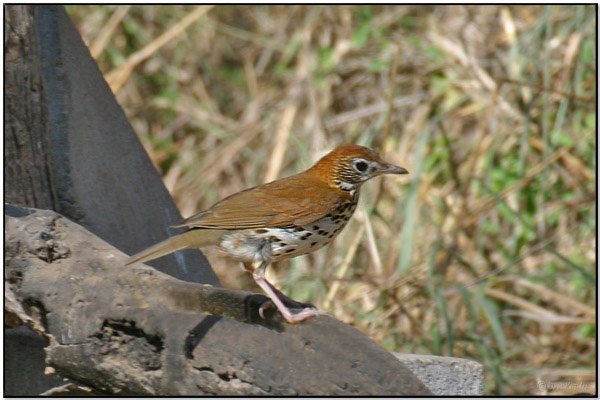
Birds of the Bible – Thrushes II

Wood Thrush (Hylocichla mustelina) by Daves BirdingPix

Wood Thrush (Hylocichla mustelina) by Daves BirdingPix

Storks, doves, swallows, and thrushes all know when it’s time to fly away for the winter and when to come back. But you, my people, don’t know what I demand. (Jeremiah 8:7 CEV)

I recently added the Birds of the Bible – Thrushes page. It now appears in the Sidebar and in the Birds of the Bible List. While comparing the Scripture on Jeremiah 8:7, I decided that the Thrushes deserved to be a Bird of the Bible on this blog. As you know, all birds are “Birds of the Bible,” because the Lord created them all. Mainly the ones named in particular have been given their own page. Since Jeremiah 8:7 is translated “thrush” in six Bible versions, it now has its own page.

So God created great sea creatures and every living thing that moves, with which the waters abounded, according to their kind, and every winged bird according to its kind. And God saw that it was good. (Genesis 1:21 NKJV)

Here is part of the new Birds of the Bible – Thrushes page:


CLASS – AVES, Order – PASSERIFORMES, Family:

Turdidae – Thrushes

Muscicapidae – has Palm & Rock Thrushes

Other Families with Thrushes:

Formicariidae – Antthrushes – Antthrushes

Pachycephalidae – Whistlers and Allies – Shrikethrushes

Psophodidae – Whipbirds, Jewel-babblers, quail-thrushes – Quail-thrushes


Not all versions of the Bible list the Thrush in this verse, but because so many versions do, the Thrush is being added to the Birds of the Bible. The following versions and the verse are listed below:

(CEV) Storks, doves, swallows, and thrushes all know when it’s time to fly away for the winter and when to come back. But you, my people, don’t know what I demand.
(ERV) Even the birds in the sky know the right time to do things. The storks, doves, swifts, and thrushes know when it is time to fly to a new home. But my people don’t know what the LORD wants them to do.
(GNB) Even storks know when it is time to return; doves, swallows, and thrushes know when it is time to migrate. But, my people, you do not know the laws by which I rule you.
(LITV) Also the stork in the heavens knows her seasons, and the turtledove and the swallow and the thrush observe the time of their coming. But My people do not know the judgment of Jehovah.
(NAS77) “Even the stork in the sky Knows her seasons; And the turtledove and the swift and the thrush Observe the time of their migration; But My people do not know The ordinance of the LORD.
(NASB) “Even the stork in the sky Knows her seasons; And the turtledove and the swift and the thrush Observe the time of their migration; But My people do not know The ordinance of the LORD.

See also the following articles:

Birds of the Bible – The Thrush

Birds of the Bible – Thrushes II (this article)

Birds in Hymns – How Great Thou Art

Birds in Hymns – The Bird With The Broken Wing

When The Robins Came by Dorothy Belle Malcolm

Return of the Robins by Dorothy Belle Malcolm

Ian’s Bird of the Week – Bassian Thrush

The Mountain Bluebird – The Zealous Bridegroom.. by a j mithra


A video by Nick Talbot of a Song Thrush singing.

*

Birdwatching and Still Kicking Up Dust

Chipping Sparrow (Spizella passerina) shot thru window with screen by Lee

Chipping Sparrow (Spizella passerina) shot thru window with screen by Lee

You will show me the path of life; In Your presence is fullness of joy; At Your right hand are pleasures forevermore. (Psalms 16:11 NKJV)

Some birdwatching has been going on around the yard and neighborhood. Every once in a while, I do get away from the computer and look around, though only nearby. Yet, I have been seeing some interesting birds, especially some I have never seen in the yard. I was watering a new tree when I heard a sound I didn’t recognize at first. After searching and praying that it would come into view, I spotted a Pileated Woodpecker on a power pole. Been here 5 years and it is the first one spotted from the yard. Then I spotted 2 Chipping Sparrows yesterday and 3 today. (also a yard first) Today an American Goldfinch showed up on my feeder. All 3 of those species were new to the yard. They were kept company by 2 Cardinals, Boat-tailed Grackles, Brown-headed Cowbirds, Eurasian Collarded Doves, Mourning Doves and Red-winged Blackbirds.

Blue-winged Teal by Dan at Circle B

Blue-winged Teal by Dan at Circle B

Dan took some photos today out at Circle B Bar Reserve while I was busy. He said there was lots of activity and many photographers taking advantage of that activity. One photo in particular caught my interest and I have included it. He also had some neat photos of an immature Black-crowned Night-Heron, but they aren’t available yet.

I am still working on updating the Birds of the World section to the IOC World Bird List, ver. 2.7. I have over 91 Families updated and started working on the Index also. The Species List of the First Name of the Birds and Genus is updated “A” through” Z”. So at least you can find the birds.

American Goldfinch (Carduelis tristis) by Lee thru window

American Goldfinch (Carduelis tristis) by Lee thru window

As I have been updating, I have been adding photos to some of the families. Some of the Families that we have written about lately have also been updated even though they are beyond the 91 completed.

Thrush – Turdidae was updated when Return Of The Robins was written.

Meliphagidae Family mentioned in Ian’s Bird Of The Week – Yellow-spotted Honeyeater

Strigopidae Family mentioned in Formed By Him – Kakapo

Since the last update, Birdwatching and Still Updating, I have now completed these bird species:

Kingfishers are next on the agenda.

*

New Finch Species Shows Conservation

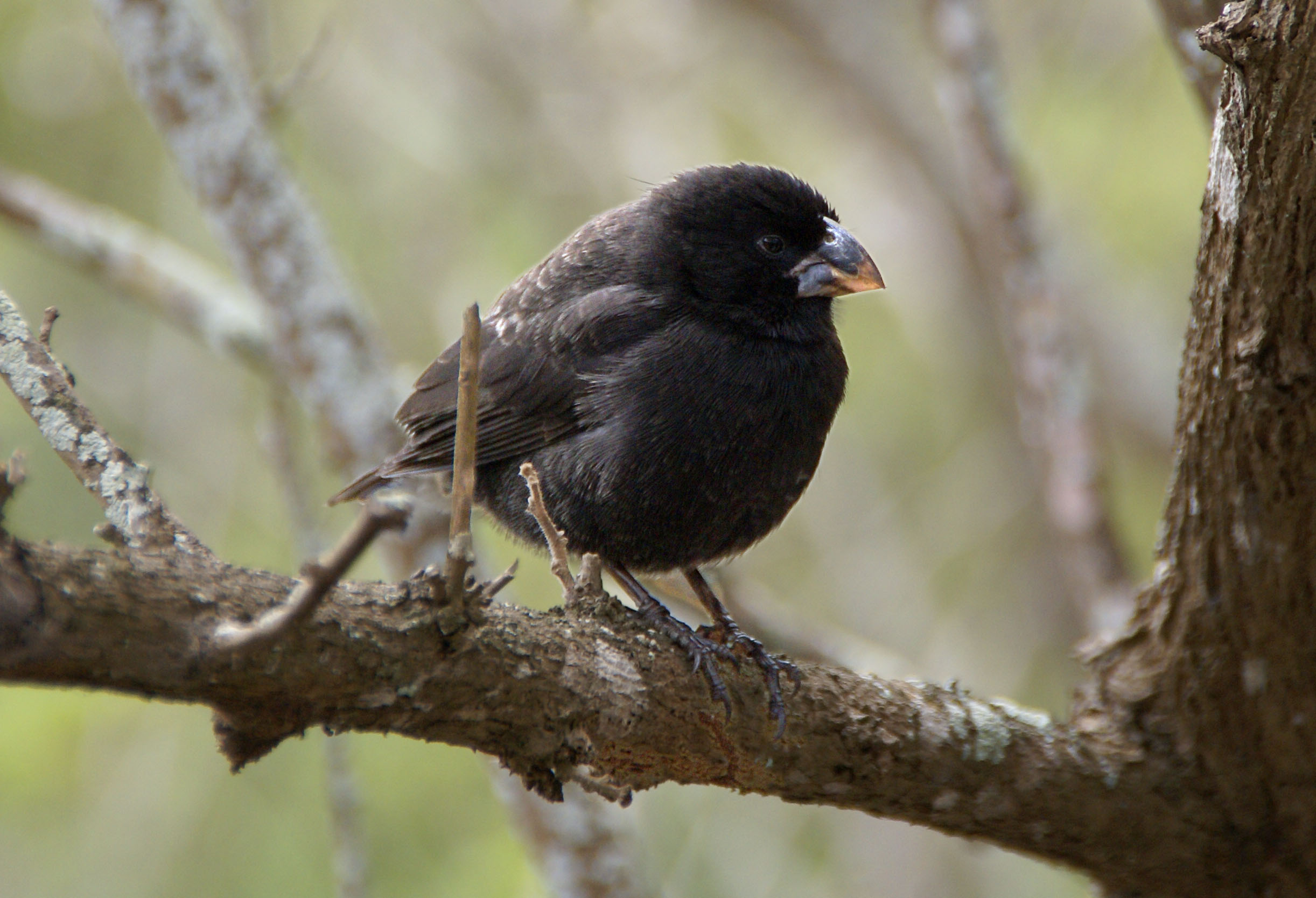
Medium Ground Finch (Geospiza fortis) ©Wiki

Medium Ground Finch (Geospiza fortis) ©Wiki

New Finch Species Shows Conservation, Not Macroevolution
by Brian Thomas, M.S. *

“Darwin’s finches” are a variety of small black birds that were observed and collected by British naturalist Charles Darwin during his famous voyage on the H.M.S. Beagle in the early 1800s. Years later, Darwin argued that subtle variations in their beak sizes supported his concept that all organisms share a common ancestor (a theory known as macroevolution). The finches, whose technical name is Geospiza, have since become classic evolutionary icons.
…..
In the fourth generation, “after a severe drought, the lineage was reduced to a single brother and sister, who bred with each other.”1 Their descendants have carried on the family traits. The Grants reported in a study on the birds published in Proceedings of the National Academy of Sciences that “our observations provide new insight into speciation and hence, into the origin of a new species.”2 But the details show that this new “species” is just a variation within the finch kind, and is therefore irrelevant to big-picture evolution.


Large Cactus Finch (Geospiza conirostris) ©WikiC

Large Cactus Finch (Geospiza conirostris) ©WikiC

Genus Geospiza contains six species, and these are usually distinguished by the songs that the males sing primarily to attract breeding partners. However, if a father bird dies while his chicks are young, and all they hear is the neighboring song of a different species, for example, young birds can learn the wrong songs. When these mature, they sing the song of, and breed with, the foster father’s species. Other scenarios result in crossbreeding between Geospiza species. ……”

To read the whole the article – CLICK HERE

From Institute for Creation Research

Do Migratory Birds Practice Preventative Medicine?


Cedar Waxwing (Bombycilla cedrorum) by Daves BirdingPix

Cedar Waxwing (Bombycilla cedrorum) by Daves BirdingPix

Do Migratory Birds Practice Preventative Medicine?
by Brian Thomas, M.S. *

“Before a long migration, certain birds shift from an insect diet to eating fruits such as berries. Researchers once thought that this added carbohydrate reserves as fuel for the journey. But a new study out of the University of Rhode Island suggests that the birds are interested in the fruits’ antioxidants, not their sugars.

Antioxidants are chemicals that are packed within richly colored fruit skins and are known to stabilize cellular processes. Based on research presented at the March 24th American Chemical Society meeting in San Francisco, it appears that the birds fill up on berry antioxidants for the medicinal benefits they provide to tissues that will undergo stress during the upcoming flight.

But this implies that birds use preventative medicine by instinct,….”
To read the rest of the article – CLICK HERE

Thought this was quite interesting and that you might enjoy reading the article from Institute for Creation Research.

*

Return Of The Robins – by Dorothy (Dot) Belle Malcolm

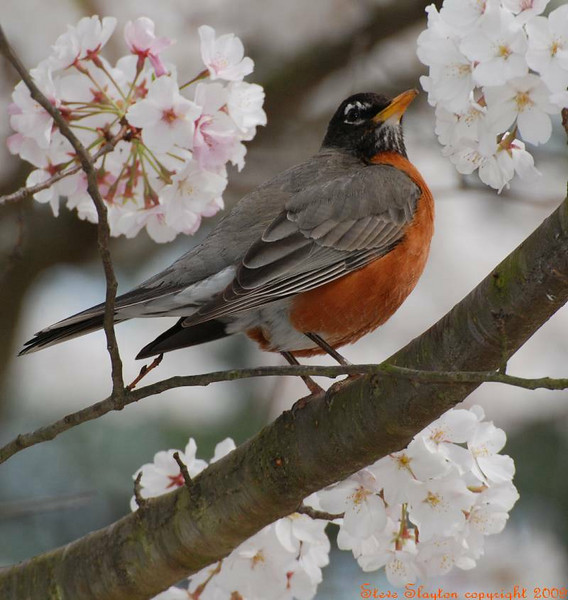
American Robin (Turdus migratorius) by S Slayton

American Robin (Turdus migratorius) by S Slayton

Return Of The Robins by Dorothy (Dot) Belle Malcolm – on February 27, 2011

On the way to church I thought I saw them; however, they flew so fast back and forth I wasn’t sure. The next day I was sure! The Robins had returned. Only a few were in my trees. At first I was disappointed, but at least I could hear lots of them in my neighborhood. I sent them many invitations in my thoughts as I worked in the yard, but they did not come.

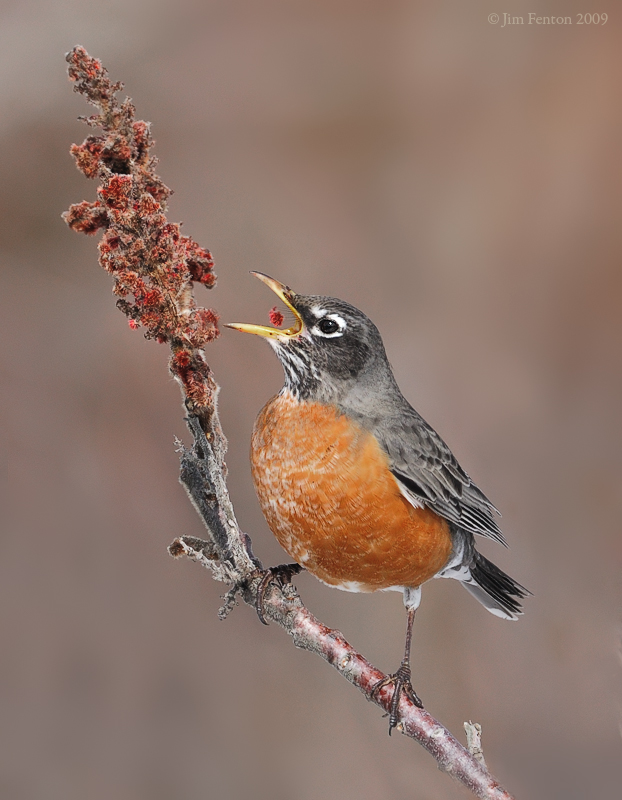
Robin Eating by Jim Fenton

Robin Eating by Jim Fenton

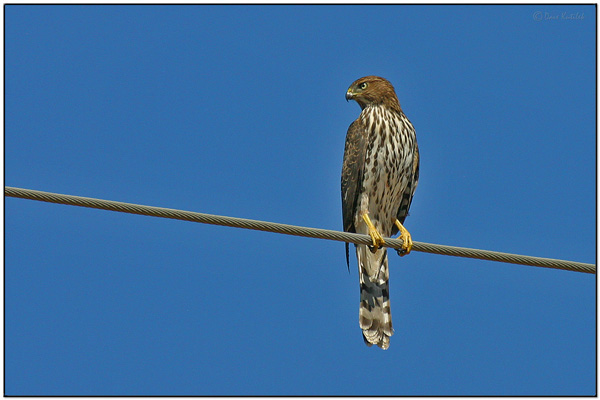
As I worked, I began to hear very high sweet sounds coming from some medium sized black birds. How thankful I was for their “music.” Then it ceased and I realized why when I saw the shadow of the Cooper’s Hawk come across the yard. He frequents our area almost daily, and I now realize why I have fewer birds come to my feeders. He is a beautiful specimen but my heart does not welcome him.

 Cooper's Hawk (Accipiter cooperii) by Daves BirdingPix

Cooper’s Hawk (Accipiter cooperii) by Daves BirdingPix

Well I promised last year I would not speak again of the Robin’s bad manners, so this year I shall not fault them for a lack of a good showing. They had a very good reason. I shall remain satisfied they were around and be thankful for that.

By Dorothy Belle Malcolm

See her article from last year – When The Robins Came


Lee’s Addition:

Even the stork in the sky Knows her seasons; And the turtledove and the swift and the thrush Observe the time of their migration; But My people do not know The ordinance of the LORD. (Jeremiah 8:7 NASB)

Listen to the – American Robin’s song -from xeno-canto.com

The American Robin (Turdus migratorius) is a member of the Thrush – Turdidae Family. As Dorothy (“Dottie” to me) knows, they only pass through on their migration journey. This time of the year, they are on their way north.

“The American Robin is widely distributed throughout North America, wintering south of Canada from Florida to central Mexico and along the Pacific Coast. The American Robin is active mostly during the day, and on its winter grounds it assembles in large flocks at night to roost in trees in secluded swamps or dense vegetation. The flocks break up during the day when the birds feed on fruits and berries in smaller groups. During the summer, the American Robin defends a breeding territory and is less social. It is the state bird of Connecticut, Michigan, and Wisconsin.” (Wikipedia)
*